RSS Feeds
Actor Tim Curry has died
Another season, another failure - where did it all go wrong for Celtic?
Dolly Parton worked ‘until the day she died,’ manager says
Judge lifts major obstacle for Trump mail voting order as states file new challenge ahead of midterms
Trump officials threaten Kennedy Center demolition if court blocks renovations
Libyan who was cleared after Lockerbie bombing trial dies aged 70
В Украине убит гражданин Великобритании, воевавший за Россию
Шведские военные хотят принудительно выкупить у российского бизнесмена участок возле базы флота
Meta согласилась выплатить $18 млрд по иску о защите детей от соцсетей и ввести ограничения для несовершеннолетних
Did the Zodiac Kill the Black Dahlia? This Crime Writer Thinks So.
Tim Curry, Star of ‘Rocky Horror Picture Show,’ Dies at 80
Meta agrees to sweeping changes to restrict kids’ access to its apps as part of settlement with states
Rocky Horror star Tim Curry dies at 80
Rokid Glasses RV101: зачем программисту очки, в которые можно залезть с кодом

Ещё недавно разговор об очках дополненной реальности почти неизбежно заканчивался демонстрацией огромного шлема, роликом с выставки и фразой «через пять лет это будет у всех». Пять лет проходили, шлемы становились лучше, но надевать их по дороге в магазин никто не спешил.
Сейчас ситуация стала интереснее. Устройства наконец начали расходиться по разным веткам. Для игр и тренажёров остались большие VR-шлемы. Для виртуальных рабочих столов появились лёгкие очки-дисплеи. А рядом вырос новый класс - внешне почти обычные очки с камерой, микрофонами, динамиками, ИИ и небольшим экраном перед глазами.
Rokid Glasses RV101 относятся как раз к последнему классу. Мне они интересны не столько как готовый гаджет с переводчиком, телесуфлёром и камерой, сколько как маленький носимый компьютер, на котором разрешают запускать свой код.
Читать далееThreatbit Simple Scanner v1.3: Что нового и почему

Антивирус почистил ваш компьютер, но присутствуют ограничения?
Тогда вам стоит попробовать Threatbit Simple Scanner. Вышло обновление v1.3! Узнайте про свежие функции данной программы. Данная утилита имеет карантин, улучшенный планировщик задач, и многое другое. Узнайте здесь!
Читать далееWhat’s driving Sweden’s startup boom, from Lovable to Legora
The best indoor gardening kits for growing fresh produce at home
SVG: почему иконка получает не тот размер

После экспорта из Figma иконка 24×24 может оказаться в браузере крошечной, огромной или размытой. Обычно файл при этом исправен — просто разные части цепочки смотрят на разные параметры. Разбираем систему координат, viewBox, контракты и ловушки в React.
Читать далее'The record will fall' - Werro takes aim at 43-year-old 800m mark
Liverpool turn attention to Sarr after Brighton reject Minteh bids
Boy, 15, arrested over stabbing at Brent Council HQ
Trump officials threaten Kennedy Center demolition if court blocks renovations
Two women accuse former Fat White Family member Saul Adamczewski of physical and emotional abuse
Insecure Men singer has now been dropped by his record label and had tour dates cancelled after two women shared allegations about his behaviour
Saul Adamczewski of Insecure Men and formerly of Fat White Family has been dropped by his record label and had tour dates cancelled after two women shared allegations of physical and emotional abuse against the musician.
One woman said that the pair had a short relationship that resulted in a pregnancy, after which, she alleged, Adamczewski “made it his duty to make me suffer. He has been violent, pushed me, thrown glass bottles at me, showered me with beer […] insulted me, taken my passport from me, stolen my money and more, all while I had our baby.”
Continue reading...My mum has died – and there is one kind of response I can’t stand | Polly Hudson
The platitudes, euphemisms and cliches are excruciating. But the people who say nothing at all are the worst
Luckily, I already knew having a comic thought at a tragic moment is a natural stress response, or I might have worried. My mum has died, making me an orphan – and what first popped into my head was how annoyed Larry David would be.
In Curb Your Enthusiasm, when Marty Funkhouser’s mother’s wheelchair was run over by a car, he proclaimed himself an orphan. David informed him he was too old to be an orphan. Funkhouser insisted that if your parents are dead, you’re an orphan.
Continue reading...Tim Curry, star of The Rocky Horror Picture Show and Stephen King’s It, dies aged 80
A prolific performer across stage, screen and TV, the actor starred in Legend, Clue and It, but will always be associated with the flamboyantly camp rock’n’roll musical in which he made his breakthrough
Tim Curry on sexuality, surviving a stroke – and 50 years of stardom
Farewell, Dr Frank N Furter: why Tim Curry’s Rocky Horror Show will go on
Tim Curry, the versatile performer of screen and stage, who made his name as the flamboyant Dr Frank-N-Furter in The Rocky Horror Show, has died aged 80. Reports say Curry died at his home in Los Angeles.
The actor’s manager confirmed to Variety that he died peacefully. No cause of death is known as yet.
Continue reading...14 newborns killed in fire at Pakistan hospital, doctor says
Tim Curry, star of "The Rocky Horror Picture Show," dies at 80
Radar makes podcasts searchable — and usable by AI agents
Two women accuse former Fat White Family member Saul Adamczewski of physical and emotional abuse
Insecure Men singer has now been dropped by his record label and had tour dates cancelled after two women shared allegations about his behaviour
Saul Adamczewski of Insecure Men and formerly of Fat White Family has been dropped by his record label and had tour dates cancelled after two women shared allegations of physical and emotional abuse against the musician.
One woman said that the pair had a short relationship that resulted in a pregnancy, after which, she alleged, Adamczewski “made it his duty to make me suffer. He has been violent, pushed me, thrown glass bottles at me, showered me with beer […] insulted me, taken my passport from me, stolen my money and more, all while I had our baby.”
Continue reading...Американские СМИ сообщили о необъявленном визите главы ЦРУ в Москву. Что известно
Два сотрудника аэропорта Франкфурта умерли от малярии. Их заразили комары из самолета, прилетевшего в Германию
Rupert Grint to return to Harry Potter in Broadway play
Cosmic radiation link in flight attendant's breast cancer, French court finds
Maura Higgins to fill Cilla Black's shoes as host of Blind Date reboot
Darline Graham wins South Carolina GOP nomination to replace her late brother in U.S. Senate
Как дизайнеру понять, что его вайб‑код не мусор: веб‑версия моей настолки с середины пути

Два месяца назад мы взялись перенести в веб мою настольную игру. «Release любой ценой» — карточная игра про хаос IT‑разработки: собираешь релиз из Backend, Frontend и Database, соперники его валят, ты отбиваешься. Про саму настолку я здесь уже писал.
Нас в проекте трое: разработчик (ditayler), я (dimbo‑design, дизайнер) и Claude Code, через которого работаем оба. Ему досталась реализация логики игры и фундамент: монорепо, сеть, движок. Мне видимая часть: интерфейс, анимации, поведение карт, UX. Прочитать код я, в общем‑то, могу, а вот понять нет: моё ревью проходит на экране, как дизайн‑ревью.
Из этой конфигурации торчит неудобный вопрос. С моей стороны в проект постоянно едет код. Как убедиться, что туда не едет мусор, если прочитать его я не в состоянии? Ответ, на котором стоит проект: нестыковки должны всплывать сами — между договорённостью и кодом, между докой и реальностью. И сразу честно, чтобы не выглядело героическим строительством по ходу: большую часть этого фундамента разработчик задал ещё на старте, и именно фундамент работает. Что‑то доросло позже в моей зоне, за что‑то пришлось повоевать. Дальше эта система по частям, в порядке появления в проекте.
Читать далееGit was built for humans — agents need an upgrade
The industry is now racing to rebuild source code management for agents. We showed our answer at GitLab Transcend, but let’s reiterate why rebuilding the Git backend is only half the problem.
Three things break when agents become the primary users of a Git server. Every developer running hundreds of agents hits the same wall, regardless of tools:
- The clone tax. An agent clones an entire repository to read a single file, then does it again for the next agent, and the next retry, transferring far more data than the task requires and burning context on a local grep or blame it shouldn't have needed to run. One agent invocation today can mean 5GB to 10GB transferred and 30+ seconds of setup, just to answer a single question.
- Concurrency collapse. Thousands of sessions hit a backend that was originally designed for human scale, producing bottlenecks and unpredictable availability.
- No isolation. Agents share accounts and one branch space, so they overwhelm the repository, leave no clean way to discard abandoned work, and keep no record of which agent did what.
Our platform data shows how fast the pressure is building. Over the past year, our customers created 40% more CI/CD pipelines, and code pushes to GitLab.com were up 50%. While the secure repositories grew by 60%, codebase sizes have also grown by up to 500%.
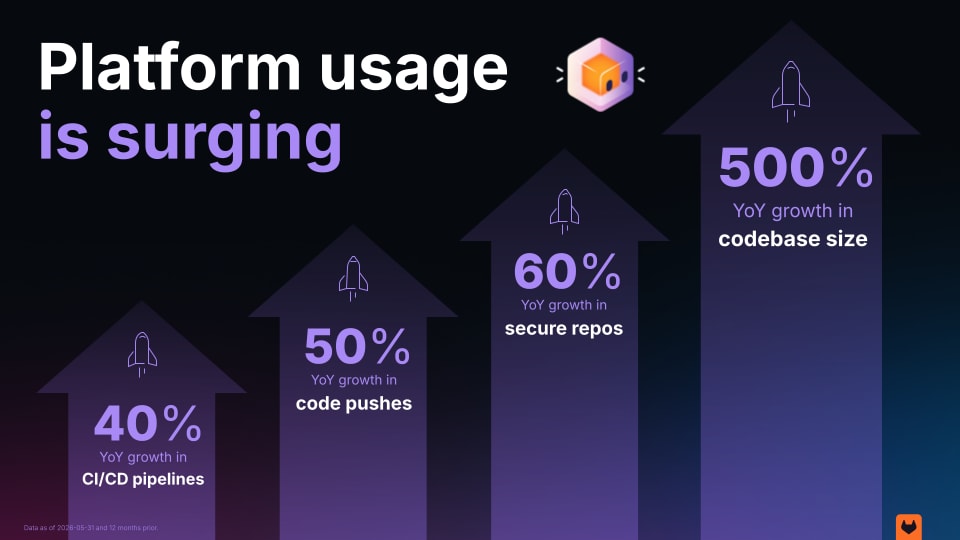
When we announced next-generation source code management (next-gen SCM) at GitLab Transcend in June, we walked through how Git, as an operational model, was not designed for the load agents placed on it. A few weeks later, new entrants, including Git hosts built specifically for agent-scale concurrency, are validating that claim independently. That convergence sharpens why rebuilding the Git backend is necessary, but on its own, it’s still not enough.
What we’re building for agent scale
Next-gen SCM runs on the Git protocol for backward compatibility, with a redesigned backend and interfaces built for agents. Instead of cloning a full working tree, agents query the repository server-side for exactly what a task requires, with each agent limited to the minimum visibility its task needs. It’s the same Git compatibility and auditability with a different motor underneath.
The architecture separates an intelligence layer (routing, caching, background work) from elastic compute that scales on demand and elastic object storage. Purpose-built read and write APIs let agents retrieve file, blame, and history data and commit changes without pulling the whole repository. Developers can run agents on any repo, fan them out by the thousands, and let them experiment safely. In practice, that means an agent gets a single batch-read instead of a full clone, a diff-stat request instead of clone-then-diff, and a last-commit-for-path lookup instead of clone-then-blame.
This isn't designed for cloud-only. The compute and storage tiers talk to each other over the standard S3 API, so the same architecture that runs on GitLab.com runs on a customer's own infrastructure, whether that's a major cloud provider's object storage or a self-hosted, S3-compatible system running in a customer's own data center. For air-gapped, regulated, and sovereignty-constrained environments, that means the same horizontal scaling and consistency guarantees, without repository data ever leaving infrastructure the customer controls.
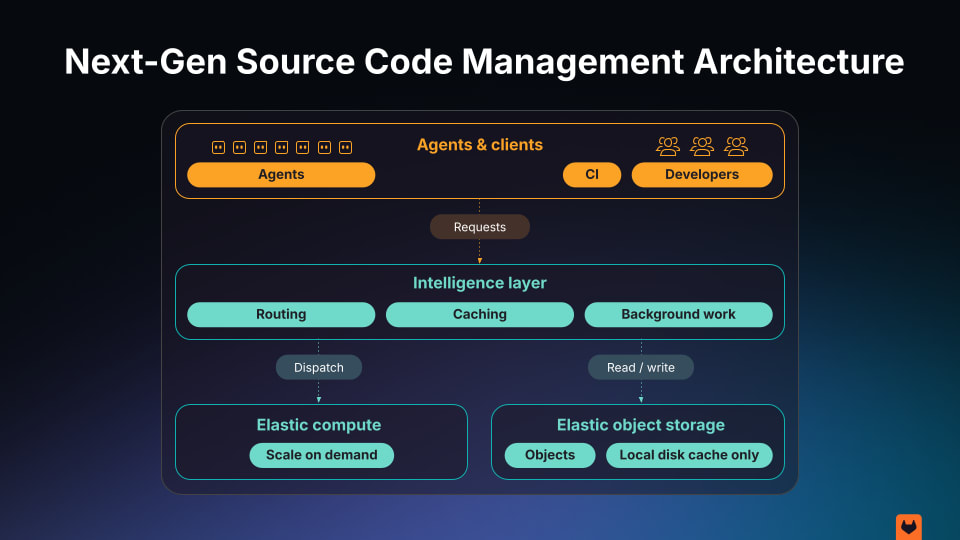
In early internal testing, agents running against next-gen SCM showed:
- Up to 50x faster wall-clock time
- Up to 2x fewer tokens
- Up to 1,000x less network traffic
These are ceilings, not guarantees, measured under our own testing conditions. The workload that actually stresses a Git backend at agent scale is concurrent reads and writes from many independent agents against the same repositories, sustained under load — so a number only means something if the test runs close to that target, the load generator isn't the bottleneck, and the full latency distribution is reported rather than a single best case.
We hold our own results to that bar, and we'd encourage anyone evaluating this category to ask the same three questions of every number they're shown, including ours. That bar is built into the architecture itself, not only our test conditions. Storage maintenance compacts small artifacts into larger, frozen ones on a geometric schedule, which puts a hard ceiling on how much data any node has to fetch to catch up to the latest snapshot. With a 1GB freeze threshold and a 2x compaction ratio, that ceiling is 2GB, regardless of how large the repository has grown.
Next-generation source code management is now in private beta, and here it is in action:
Rebuilding the backend is half the problem
The new entrants are building Git hosts: standalone destinations, or fast mirrors that sit in front of an existing host to absorb read traffic. That solves concurrency, and concurrency is a real problem. But it leaves two questions unanswered, and both are central to how we think about GitLab’s agentic infrastructure.
The first is provenance. When agents push code, touch dependencies, and trigger deployments by the hundreds, the operative question stops being “did we scan?” and becomes “which agent did what, under which policy, and can we prove it?” Our agent APIs attribute every agent action to a specific workflow, model, and token. Every agent operation is routed through the same project authorization and role-scoped human-in-the-loop controls that already govern human contributors. Attribution and policy are platform properties, not repository features, so a standalone Git host isn't built to answer this natively.
The second is what happens to the work after it succeeds. A successful agent experiment lives on a standalone host. On GitLab, next-gen SCM is a Git backend inside a platform that already runs CI, policy management, governance controls, and audit of the resulting code. When an agent's ephemeral experiment works, it graduates directly into a governed, observable production pipeline, without requiring a separate platform or destination.
Next-gen SCM handles execution at agent scale. GitLab Orbit gives every agent and human context on the full software lifecycle as a knowledge graph, and GitLab Duo Agent Platform orchestrates governance and security around every agent action — so agents plan and carry out work across the full lifecycle, not just the Git operations. A faster Git backend hosts the code agents generate. Paired with GitLab's governance, lifecycle context, and orchestration, that code ships through the same CI, policy, and audit path as everything else in the platform.
Every enterprise will hit this wall
Every customer will use agents for coding, and every customer running them at scale will run into the same limits described above, regardless of which models or tools they standardize on. That's what makes this an evolution within the infrastructure layer. The teams that move fastest in the agentic era will be the ones who can host, govern, and absorb agent output back into a lifecycle that was already built to ship trusted software.
Get started
Next-generation source code management is in private beta. Request early access today!
‘Monster isn’t enough’: Family mourns 8 killed, including 4 kids, in Montana shooting
‘It destroyed me’ – your top true-crime TV shows of all time
From influencers gone (really, really) bad and the outrageous Joe Exotic to the greatest reveal in television history – here are Guardian readers’ favourite real-life documentaries and whodunnits
I watched the BBC’s Unsolved: The Boy Who Disappeared when it came out and Damien Nettles, its subject, still pops up in my mind sometimes. It’s a comprehensive, empathetic and gripping investigation into a case I had never heard of. The Serial/Making a Murderer-style approach of showing the investigation, rather than just presenting information, gives the series a much more human angle. I thought it might turn up new evidence; that level of faith in the work being shown is a testament to how thorough it was. AJ, Devon, UK
Continue reading...Dolly Parton’s Death Prompts Rare Bipartisan Outpouring From U.S. Political Leaders

The death of country music legend, actor, and philanthropist Dolly Parton has prompted a rare moment of bipartisanship, with tributes pouring in from both sides of the political aisle.
Parton, who died at the age of 80 on Tuesday, was widely loved and celebrated around the world and leaves behind a life that touched the lives of millions of Americans.
“Dolly Parton’s legacy is one of love, compassion, and resilience. With a seven-decade career, she inspired multiple generations of artists and fans with her music and an unwavering commitment to making the world a better place,” read a statement shared on Parton’s social media page.
Read More: Dolly Parton Dies at 80
President Donald Trump ordered U.S. flags at the White House and other federal facilities to be flown at half-staff through Sept. 1.
Trump called Parton an "amazing" person who and "to lose her is like to lose her a member of the family."
"She wasn't a very political person," Trump said during a live radio interview Wednesday morning with conservative host Glenn Beck.
Despite her grand public presence and persona, Parton often chose to stay out of political discourse.
“Everybody knows I don't do politics because my mother was a Democrat, my daddy was a Republican, so I'm a hypocrat,” she joked in 2017 when asked on Fox & Friends why she had not joined Jane Fonda and Lily Tomlin’s anti-Trump remarks at the Emmys.
“I've got as many Republican fans as Democrats, and I don't want to make any of them mad at me, so I don't play politics. Plus, I'm an entertainer, I don’t usually voice my opinion in a situation like that,” Parton added.
Parton reiterated her apolitical stance during an interview with ABC's David Wright in 2018, where she again repeated, “I'm not being political.”
“I don't do politics. I'm not getting into any of that because I have a lot of fans out there, and I don't want to offend anybody,” she said.
When pressed to answer questions about Trump, who at the time was just over a year into his first term as President, Parton said: “I have my opinion about everybody and everything, but I learned a long time ago: Keep your damn mouth shut if you want to stay in show business.”
“I'm not in politics. I'm an entertainer,” she said.
That broad appeal was reflected in tributes from across the political spectrum.
How Democrats are remembering Parton’s advocacy
Major Democratic figures have cast Parton as a progressive figure who advocated for minority rights through her music, philanthropy, and public comments.
Sen. Bernie Sanders of Vermont, an independent who caucuses with Democrats and is a leading voice of the progressive movement, said Parton “was one of the great entertainers of our era” whose “music and humanity touched millions.”
“She was not only a talented musician & songwriter, but a lifelong philanthropist and advocate for literacy, education, LGBTQ+ rights, healthcare and disaster relief,” he said.
Despite Parton’s desire to remain politically neutral, her reputation as an advocate for LGBTQ+ rights stems from both her public comments and her work.
When asked in an interview aired in 2009 with Joy Behar whether she supported gay marriage, Parton said: “I always say, sure, why can't they get married? They should suffer like the rest of us do.”
At the time, the statement was politically significant, with same-sex marriage not becoming legal nationwide in the U.S. until 2015 and the issue still a source of intense political division.
Again in 2016, Parton underscored her support for the community, saying: “I do not believe that we should criticize and judge other people.”
“I think we should be accepting and loving. We are all God's children. We are who we are, and we should be allowed to be who we are,” she told Larry King during an interview.
Similarly, Tennessee Democratic gubernatorial nominee Jerri Green said Parton was one of "Tennessee's finest," noting that Parton "always used her platform to lift others up."
"She was also an unapologetic advocate for the most marginalized, including our LGBTQ+ neighbors. The world is brighter and better simply because she existed,” she added.
Asked in 2023 about Tennessee’s anti-trans legislation, Parton said she wanted “everybody to be treated good,” described the queer and transgender people in her life, and said their identities were as intrinsic to them as hers was to her.
“That’s who they are. They cannot help that any more than I can help being Dolly Parton, you know, the way people know me. If there’s something to be judged, that is God’s business. But we are all God’s children and how we are is who we are,” she told The Hollywood Reporter.
Former President Joe Biden also reflected on Parton’s legacy, describing her as “an American original” who “was an inspiration to millions” and “a relentless advocate for women and for equality.”
Rep. Ro Khanna of California said Parton “chose to continue her life pursuing the arts, and pushing boundaries to advocate for inclusion, women’s rights, children’s literacy, and more.”
The Country Music Hall of Fame credits Parton and her female contemporaries with revolutionizing country music through their “strong feminine stances.”
In 1995, Parton began her Imagination Library project, which sent an age-appropriate book to children in the U.S. every month until they turned 5. The program has since expanded to multiple countries around the world and delivered more than 300 million books to over 3 million children from all backgrounds.
New York City Mayor Zohran Mamdani called Parton “an extraordinary person and an irreplaceable champion of the working class.”
How Republicans are honoring Parton as an American icon
On the other side of the political aisle, Republicans have sought to highlight Parton as a symbol of American and Appalachian identity.
“Today our nation lost an American icon. Dolly Parton stood on the global stage for many decades and helped define the cultural image of our nation,” said Secretary of State Marco Rubio. “Dolly was an Ambassador for American music and entertainment. She will be missed, but her legacy will continue.”
House Republicans, in a statement, described Parton as an “unmistakable voice” and “joyful presence” whose “deep love of country made her a national treasure.”
Parton was one of 12 children and was raised in poverty in rural Tennessee amid church music and a strong extended-family tradition. Rather than leaving the region behind, she invested heavily in East Tennessee with the opening of the Dollywood amusement park, which became a major tourism and employment engine, while the separate Dollywood Foundation funded scholarship opportunities.
Sen. Marsha Blackburn of Tennessee said that all Tennesseans feel “the loss of Dolly Parton.”
“Dolly’s life and career are forever woven into Tennessee’s music, culture, and history. Her extraordinary talent, generosity, and love for the Volunteer State (the nickname for Tennessee) touched hearts around the world and will continue to inspire generations to come. Tennessee will forever be grateful for Dolly,” she added.
Rep. Diana Harshbarger, who represents East Tennessee's 1st Congressional District, where Parton was born and raised, said the singer “never forgot where she came from” and praised her ability to appeal to people across the political aisle.
“She was so apolitical. She did not want to be on one side or the other, and that made people love her,” she said. “She remained true to who she was, she was a genuine person. She was authentic as all get out, and nothing could sway her.”
В США в возрасте 80 лет скончалась легендарная кантри-певица Долли Партон
Профессиональное заболевание? Французский суд установил связь между радиацией и раком груди у стюардессы
F.D.A. Approves the Drug Daraxonrasib That’s Poised to Transform Pancreatic Cancer
With Nige still sulking, Honest Bob was left to unveil Reform’s latest ‘policies’ | John Crace
The sense of futility hanging over the room was almost overwhelming as Robert Jenrick took the stage
It’s turning out to be one of the longer sulks in Nigel Farage’s already sulk-filled career. Few politicians are better at having a strop and holding a grudge than Nige. At least on this side of the Atlantic. Donald Trump could give Farage a run for his money, but skin doesn’t come much thinner than Nige’s. He’s the soul of the Reform party as long as he’s the centre of attention and the yes-men and women – that’s everyone – around him are saying yes. But the moment reality challenges his narcissism, the mirror cracks.
There was a time when you couldn’t keep Nige away from a TV camera or a gathering of reporters. It’s what he lived for. But ever since the Guardian revealed his £5m gift from the crypto billionaire Christopher Harborne, Farage has gone all shy. Unable to bear the humiliation of being seen for the man he really is. The posh. The entitled. The venal. The grifter. Everything he has spent the last 25 years trying to persuade people he isn’t.
Continue reading...Nearly 1,000 are missing in Nepal and Tibet after floods caused by a glacial collapse

China's Xinhua News Agency said Thursday that mudslides in Tibet caused by a glacial collapse have left three people dead and 558 missing, while police in Nepal reported at least 162 were killed.
(Image credit: Niranjan Shrestha)

Oil prices dip, as optimism over Iran trumps new fears of Russian escalation in Ukraine
Геометрическая калибровка лидара MID360 и камеры глубины intel D455

Ручная калибровка лидара Livox и RGB-D камеры RealSense через визуальное совмещение облаков точек. Альтернатива PnP, ICP и GICP — когда автоматика не справляется, помогают глаза и ползунки.
Читать далееКак настроить nftables на удалённом сервере без риска потерять SSH‑доступ

Одна команда с policy drop может оставить администратора без доступа к серверу — особенно когда исправлять ошибку уже некому. Разберём рабочий сценарий безопасной настройки nftables: подготовку правил, атомарную загрузку конфигурации и автоматический откат изменений при потере соединения.
В результате получится понятная схема, которую можно применять при настройке firewall на удалённых Linux‑серверах.
Читать гайд«У меня ничего не грузится». Как я пришёл к приложению для диагностики сети

Эта история началась не с конкретного приложения, а с задачи, которая меня давно мучает: можно ли сделать простую диагностику для ситуации «у меня не работает интернет» — такую, чтобы человек запустил её самостоятельно и сразу проверил десяток сайтов и заодно состояние сети. Полностью заменить человека такой тест, конечно, не сможет. Но заметно сузить круг возможных причин — вполне.
Читать далее