RSS Feeds
U.S. ambassador clarifies comments on Golan Heights that contradicted Trump's position
Dale Dickey Is Way Past Crying in Barney Suits
How Farmers Are Staying Afloat as Crop Prices Plunge
Trump Lays It on the Line for Darline Graham Ahead of South Carolina Runoff
Trial lawyer on how Lindsay Clancy jury may weigh expert testimony
Kornacki Cam: Watch Steve analyze results from South Carolina's GOP Senate runoff
How the new U.S. sanctions on Iran could affect China
Trump’s new tariffs on Canada will hit everything from whisky to hockey sticks
U.S.-Canada breakdown shows limits of Trump’s aggressive trade strategy
Pence says U.S.-Canada trade fight adds to affordability concerns for economy
The Guardian view on Britain helping Ukraine: build the weapons independence Kyiv needs | Editorial
Moscow hopes western politics will weaken support for Kyiv. The UK and Europe’s answer should be to make Ukraine increasingly capable of defending itself alone
The events of the past few days on Europe’s borders may mark a turning point in Russia’s war on Ukraine. While the political skies in Kyiv have darkened for Ukraine’s Volodymyr Zelenskyy, the military picture looks brighter. Ukraine can already send swarms of drones against Russian oil facilities, e-commerce warehouses and airfields. Andy Burnham’s arrival in Kyiv marks a step forward. Britain is releasing classified information on its components of Scalp, the French version of the Anglo-French Storm Shadow cruise missile, enabling its assembly in Ukraine. This is more than another weapon for Kyiv. Britain is helping Ukraine become less dependent on the western armoury.
Moscow sabre-rattles, but Britain should hold its nerve. Kyiv has been at the mercy of its allies, waiting to replenish weapons stockpiles and release sophisticated arms. Producing its own hi-tech armoury gives Ukraine greater freedom of action because western governments have let go. Two years ago it was different. Joe Biden waited until November 2024 before letting Ukraine strike deep into Russia with US weapons. Yet thresholds once deemed dangerously escalatory have since been crossed without provoking a Russia-Nato war. Kyiv is now being trusted with something more consequential: a measure of weapons independence.
Do you have an opinion on the issues raised in this article? If you would like to submit a response of up to 300 words by email to be considered for publication in our letters section, please click here.
Continue reading...The Guardian view on the Tiananmen vigil convictions: Hong Kong too has been silenced. Others should speak out | Editorial
Two activists who organised commemorations of the bloody crackdown on China’s 1989 pro-democracy protests now face jail. Remembering is not a crime
For decades, Hong Kong mourned when the mainland could not. Its huge annual Tiananmen vigil kept alive the memory of the 1989 pro-reform protests in Beijing, and of the massacre that suppressed them. Along with Macau, it was the only place in China where the anniversary could be publicly marked and the truth preserved.
But the crackdown on the 2019 uprising in Hong Kong has crushed the freedoms that the region once enjoyed. That year’s vigil was the last. On Friday, two leaders of the Hong Kong Alliance, which organised the commemoration, were convicted of incitement to subversion under the draconian national security law. Lee Cheuk-yan, 69, and Chow Hang-tung, 41, face up to 10 years in jail.
Do you have an opinion on the issues raised in this article? If you would like to submit a response of up to 300 words by email to be considered for publication in our letters section, please click here.
Continue reading...Instinct’s powerful AI assistant is raising privacy and security concerns
Organised crime arrests as police investigate A66 crash that killed two officers
MetaRoCE: A New RDMA Transport Built for AI-Scale Ethernet
- Training and serving frontier AI models depends on fast, reliable networks that move data between GPUs without wasting compute cycles.
- To meet this challenge at scale, Meta designed MetaRoCE – a clean-sheet RDMA transport protocol purpose-built for AI workloads on commodity Ethernet.
- We’re releasing the MetaRoCE specification, a reference software implementation and a compliance test suite through the Open Compute Project (OCP) to enable the broader industry to adopt, implement, and build on it.
At Meta, we’ve been a strong driver behind the industry’s growing consensus that Ethernet should be the fabric of choice for AI infrastructure. We’ve already shown that RoCE can power distributed AI training at scale. Now, we’re building on that work with MetaRoCE, protocol designed from the ground up for Ethernet at million-GPU scale.
We’ve scaled up clusters of hundreds of thousands of GPUs, spread over multiple data centers and regions. Whether these clusters are training the next frontier model or serving inference at global scale, the network is in the critical path.
Collective operations like all-reduce and all-to-all synchronize thousands of accelerators during training, and the slowest transfer sets the pace for the entire job. In inference, low-latency communication between distributed model shards directly impacts response times for hundreds of millions of users. Even small amounts of network friction directly strand significant compute capacity.
Standard RoCE expects the network to deliver every frame in order, leveraging PFC and discouraging the packet spraying that provides performance in multiplane and large scale networks. MetaRoCE is built to provide high throughput, low tail latency, and operational simplicity as the network grows in the number of accelerators and the distances between them.
How MetaRoCE Works
MetaRoCE’s core insight is simple: The fabric sees packets, but the NIC sees intent. Traditional architectures centralize intelligence in the fabric, relying on switches to enforce losslessness and maintain order.
By moving intelligence to the endpoint MetaRoCE decomposes the network into many fine-grained logical paths, each with its own real-time telemetry – per-path RTT, ECN state, and utilization. This visibility unlocks capabilities that are difficult to achieve with traditional RDMA.
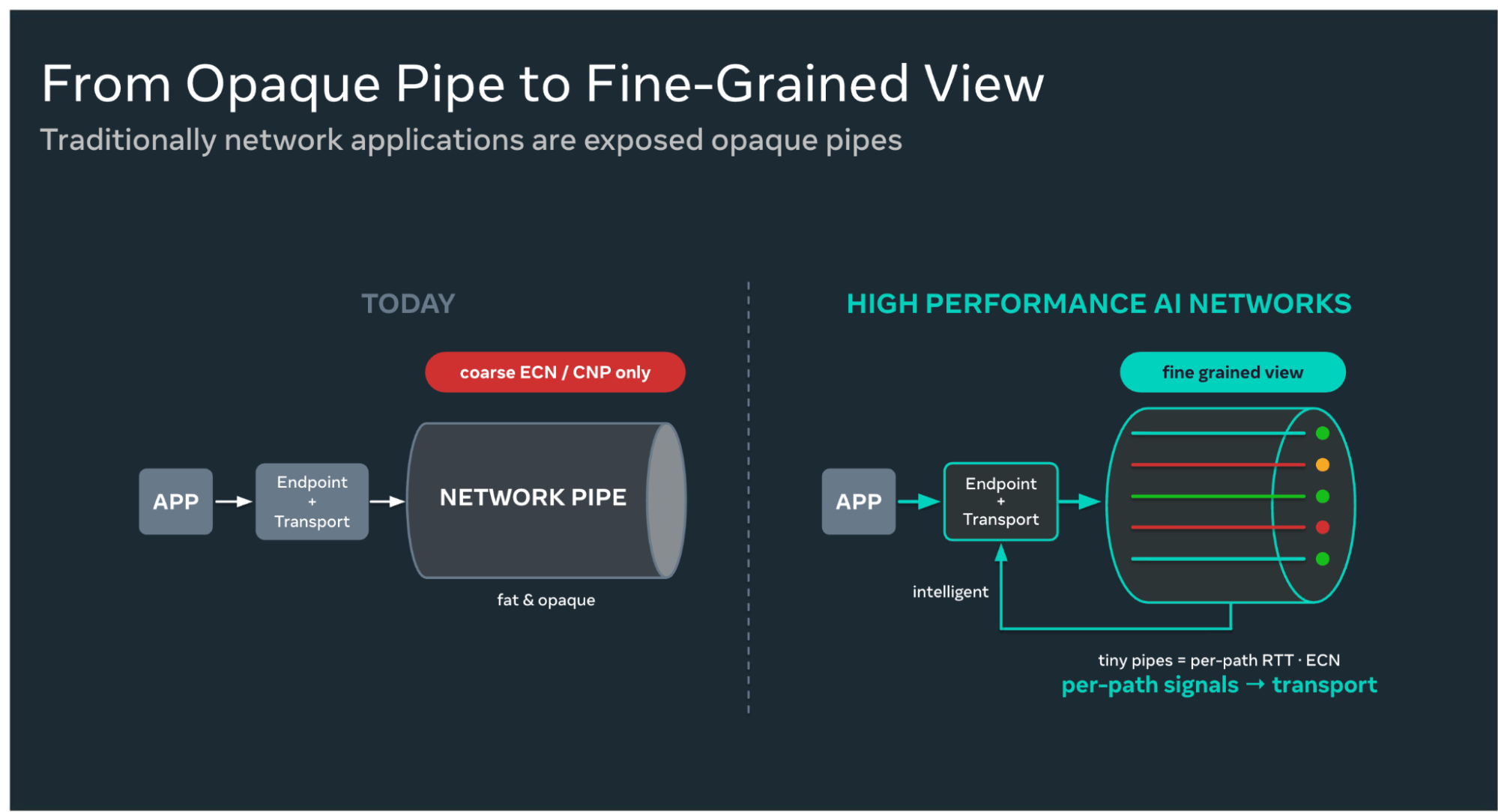
Native Out-of-Order Delivery
MetaRoce sprays packets across many paths, so they arrive out of order by design. The transport treats out-of-order arrival as the normal case. Every packet carries its own destination, so data is written straight to its final memory location as it lands, with no reorder buffer and no head-of-line blocking.
Writes carry their destination in every packet. Sends carry the match to a posted receive buffer, so a Send lands correctly even when the messages ahead of it have not arrived, and without a round trip to learn where the data goes. Collective libraries can use two-sided messaging where it suits them rather than reducing everything to Write.
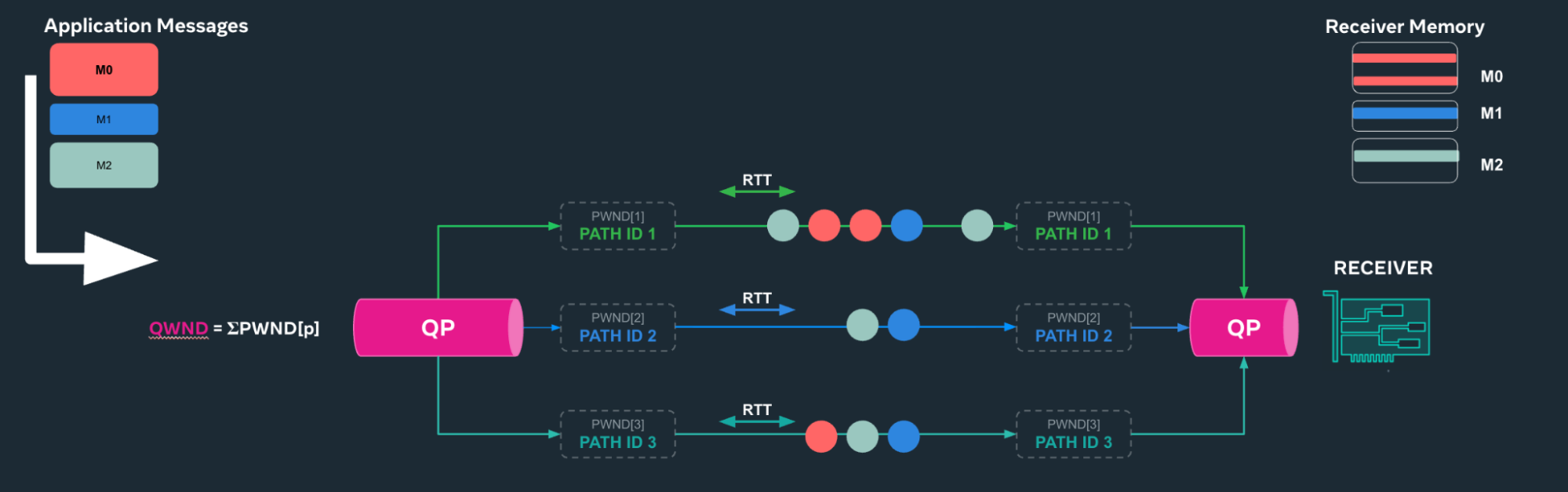
Native Multipathing
MetaRoCE gives each connection first class paths and sprays across them packet by packet. Each path carries a distinct UDP source port as its ECMP entropy, which the NIC can change at any time to move traffic off a bad route. On multiplane fabrics, plane selection falls entirely to the NIC, and the fabric is used only as well as the NIC sprays. Because each path keeps its own window and round trip estimate, the transport can tell congestion from failure and rebalance explicitly, so a hot or broken link slows one path instead of stalling the connection.
Loss Tolerance by Design
MetaRoCE treats the Ethernet fabric as lossy and does not ask it to be otherwise – no PFC, no pause frames. Because each path carries its own ordered sequence, a gap in its 256-bit selective acknowledgment bitvector is evidence of loss rather than of reordering. In other protocols a SACK mostly avoids resending data that already arrived; here it triggers retransmission of exactly the missing packet, on the path that lost it, the moment the gap appears.
Congestion Control From Both Sides
MetaRoCE combines a conventional ECN-based, sender-driven AIMD congestion control with receiver-driven fair-share rate hints. Windows are kept per path as well as per connection, so a congestion mark trims the path that saw it and steers the next packets toward paths that are clear. In every acknowledgment, the receiver returns the share of its inbound bandwidth it has allocated to that sender, so senders approach the right speed directly rather than searching for it. Incast resolves in one or two round trips, with better fairness and lower tail latency.
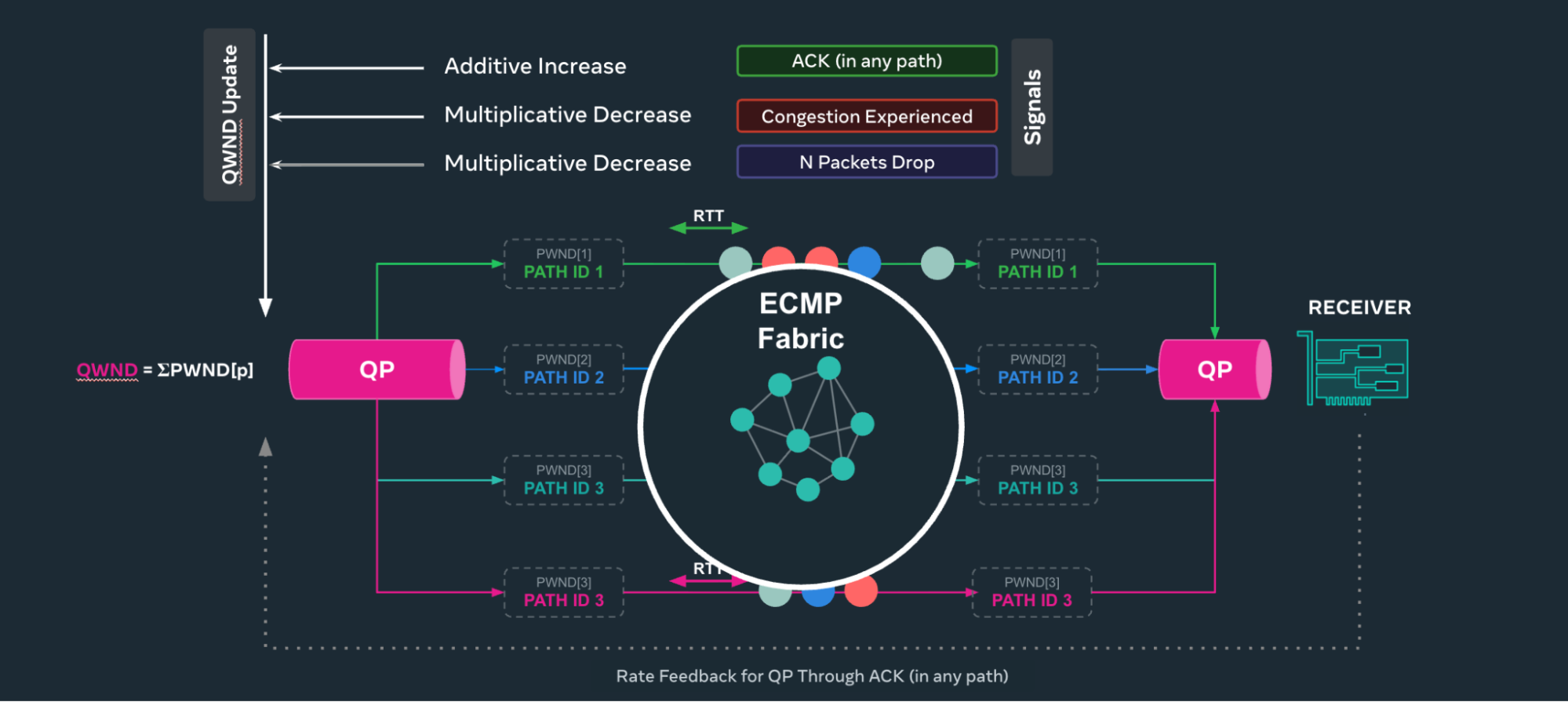
Topology Independence
MetaRoCE asks the fabric for two things every switch already has, ECN marking and ECMP. It does not require packet trimming, in-network telemetry, credit-based flow control, or switch-side spraying, and it does not break when a fabric offers them. The same transport runs over fat-tree, multiplane, deep-buffer, and shallow-buffer fabrics, and over vendor clouds whose configuration you don’t control. Nothing proprietary is involved, so the fabric stays free to optimize for cost and cabling.
Unified Connections at Scale
A queue pair (QP) carries both an ordered stream of messages and bandwidth. Traditional RDMA gets more of either by opening more QPs (dozens per node pair), each with a congestion window blind to the rest and its own state on the NIC.
MetaRoCE separates the two. A single connection carries many independent ordered streams above, one per communicator or collective, and many paths below, under one congestion controller. The connection state stops growing with the parallelism of the workload.
The application layer remains mostly untouched – existing RDMA Verbs APIs and software stacks work without modification. Enhanced features like multiplane support are supported through extension APIs.
Meta-RoCE in Practice
To accelerate hardware validation, we worked with AMD to implement MetaRoCE on their Pensando programmable NICs.
On a 64-node AMD GPU cluster running RCCL collectives, we directly compared MetaRoCE against RoCEv2 across all-reduce and all-to-all operations. The results were consistent with the design goals:
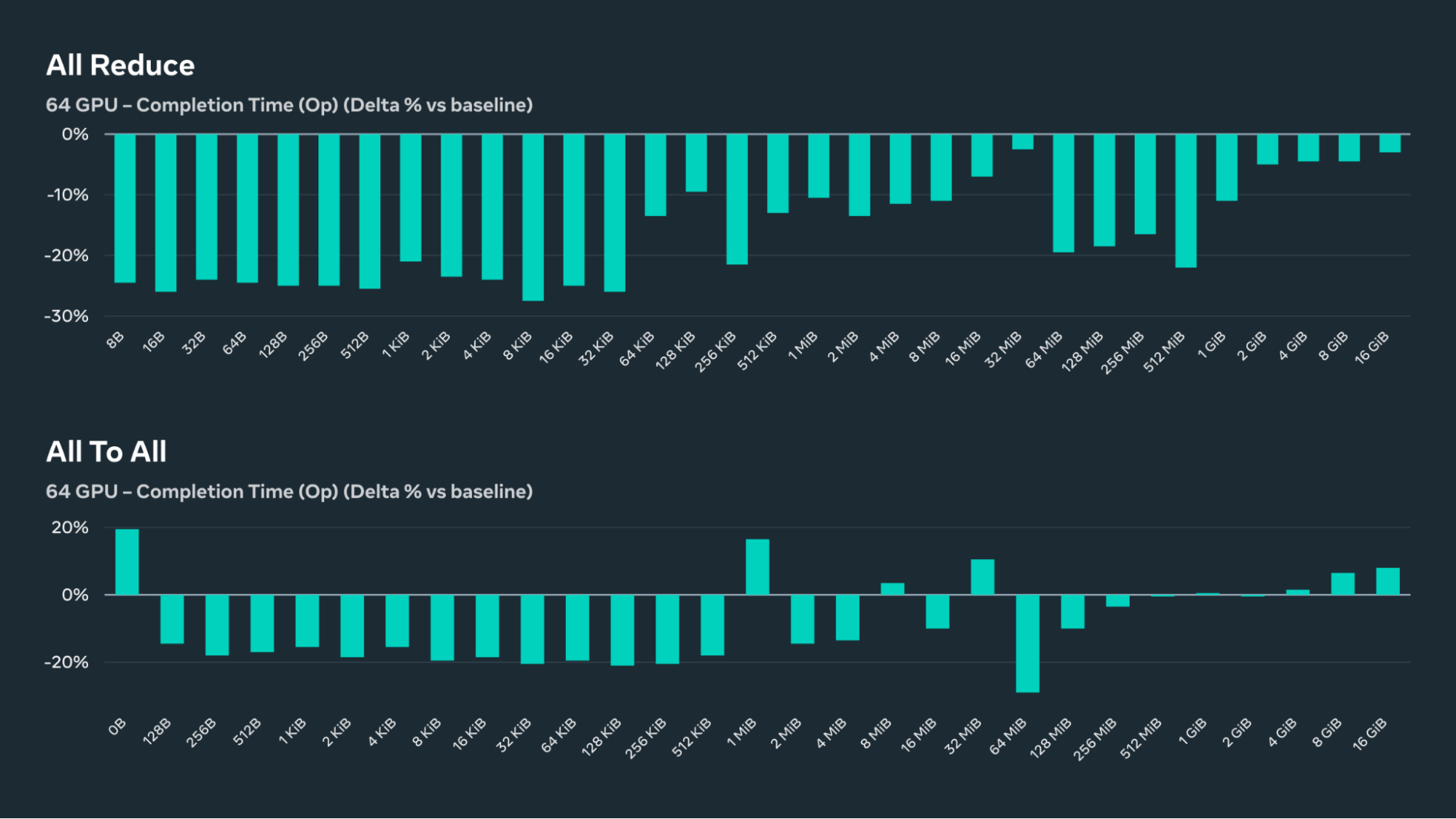
MetaRoCE consistently delivers higher throughput and lower flow completion times than RoCEv2.
Under packet loss conditions that would degrade RoCEv2, MetaRoCE maintains ~86% throughput at 1% packet loss and continues delivering useful bandwidth even at extreme 10% loss rates – converging gracefully rather than collapsing.
Multiplane validation across 4-plane and 8-plane topologies with up to 4,000 concurrent connections confirmed that throughput scales linearly with plane count.
During simulated plane failures, the protocol demonstrates graceful autonomous recovery – traffic redistributes without application involvement or operator intervention.
These results support MetaRoce’s core design choice. By designing for loss from day one and pushing intelligence to the edge, you get a transport that performs better in ideal conditions and degrades gracefully when things go wrong.
Open By Design
AI infrastructure benefits from shared standards that accelerate innovation across the ecosystem. MetaRoCE extends the same open, multi-vendor philosophy that the Open Compute Project (OCP’s) Ethernet Scalable Unified Network (ESUN) initiative established for the fabric into the transport layer.
That’s why we’re opening MetaRoCE:
Open specification via OCP: The full protocol spec is being contributed to OCP, available for any vendor to implement and build interoperable hardware.
Multiple NIC implementations: MetaRoCE is designed to run across diverse NIC architectures – programmable and fixed-function alike. We’ve proven it on AMD Pensando hardware, with additional implementations underway from other vendors.
Production compliance suite: We have developed a compliance suite that gives hardware vendors the tools to prove their implementations match the protocol spec.
Software reference implementation: Our libsoftmetaroce library provides a complete, functional transport stack that runs on commodity Linux over standard UDP sockets without specialized hardware. It serves as the authoritative behavioral model for silicon development and the foundation of our unified compliance framework.
The Road Ahead
With MetaRoCE, we’ve made strong progress on scale-out networking – high-performance, resilient transport within the data center on commodity Ethernet. But AI infrastructure spans multiple distance and latency regimes, and each brings distinct challenges we’re actively working on:
Scale-up: Within a rack, accelerators trade small messages where every nanosecond matters. MetaRoCE removes two main sources of latency, the reorder buffer and PFC. We are now optimizing the fast signaling path for short memory operations issued directly from one processing element to another.
Scale-across: Scale-across enables a single job to span buildings thousands of kilometers apart. Round trips stretch into milliseconds, and small differences between paths add up. Treating paths as first class entities is what lets MetaRoCE adapt, preferring the uncongested ones and seeking fairness at every level. The work ahead is in fairly sharing contended long-haul links.
Storage/Kv-cache use cases: Distributed storage invites incast,where a single read fans out to many servers and they all reply at once. Receiver-driven rate hints let whichever side is receiving(a storage server taking writes or a client taking reads) moderate the inbound rate, whether the request went to ten servers or a thousand. The new dimension is keeping that rate accurate with networks of varying speed and requests of varying size.
Help Us Build the Future of Ethernet for AI Infrastructure
In October, we’ll release the MetaRoCE specification, a DPDK-optimized software reference implementation, and our production compliance framework at the 2026 OCP Global Summit.
We’re building this in the open because the challenges ahead benefit from broad industry collaboration. If you’re building NICs, switches, or AI infrastructure, we invite you to join us.
The post MetaRoCE: A New RDMA Transport Built for AI-Scale Ethernet appeared first on Engineering at Meta.
Breanna Stewart wants WNBA arenas to be safe space as transgender debate sparks rallies at games
Хвост или есть, или его нет. Футболист Эрлинг Холанд постригся почти под ноль
В мировом океане — самая высокая температура в истории наблюдений. И это еще не настало лето в Южном полушарии
Avoid making plantar fasciitis pain worse with these sneakers
U.S. withdraws from military exercises with South Korea set for next month
My Daily Driver Gaming Headset Is Super Cheap Right Now
Canadian politician threatens to cut off electricity to the US - as Trump issues 'fall in line' warning
Prodigal Prince Harry’s Return to U.K. Poses Dilemma for William
Watch: Bessent announces "economic D-Day" sanction plan for Iran, Iranian trade partners
MTIA 300: Meta’s First Training Chip with Built-in NICs and Communication-Offloading Engines
- MTIA 300 is the first of Meta’s family of in-house training and inference accelerators optimized for training ranking and recommendation models.
- We’re sharing how MTIA 300’s built-in NIC chiplets allow it to meet the communication needs associated with training recommendation models with superior performance over general-purpose GPUs.
- By co-designing MTIA’s communication library, HCCL, alongside the chip we’ve taken a fundamentally different approach to chip design and made communication a first-class citizen.
Deep learning models may deliver personalized content—from short videos to friend posts—to people on apps. As these models have grown in complexity, so has the importance of the compute that trains them, and the network that connects those accelerators.
Training recommendation models is a unique infrastructure challenge. Unlike large language models, which need enormous floating-point throughput, recommendation models are bottlenecked by a need for fast and efficient communication between the accelerators that train them. Their embedding tables can contain over 99% of the model’s parameters, requiring hybrid parallelism that generates frequent AllReduce, AllToAll, and AllGather collectives across hundreds of accelerators. On chips like GPUs these communication operations compete with training computation for the same resources, often leaving expensive hardware underutilized.
We’ve addressed this challenge starting on the Meta Training and Inference Accelerator (MTIA), our family of homegrown AI chips, with MTIA 300, the first of the MTIA family optimized for training recommendation and ranking models. By co-designing MTIA 300 with HCCL, a communication library co-designed with the hardware from scratch, we’ve made communication a first-class citizen in the chip’s design, not an afterthought handled by general-purpose compute cores.
Integrating the Network Directly on the Chip
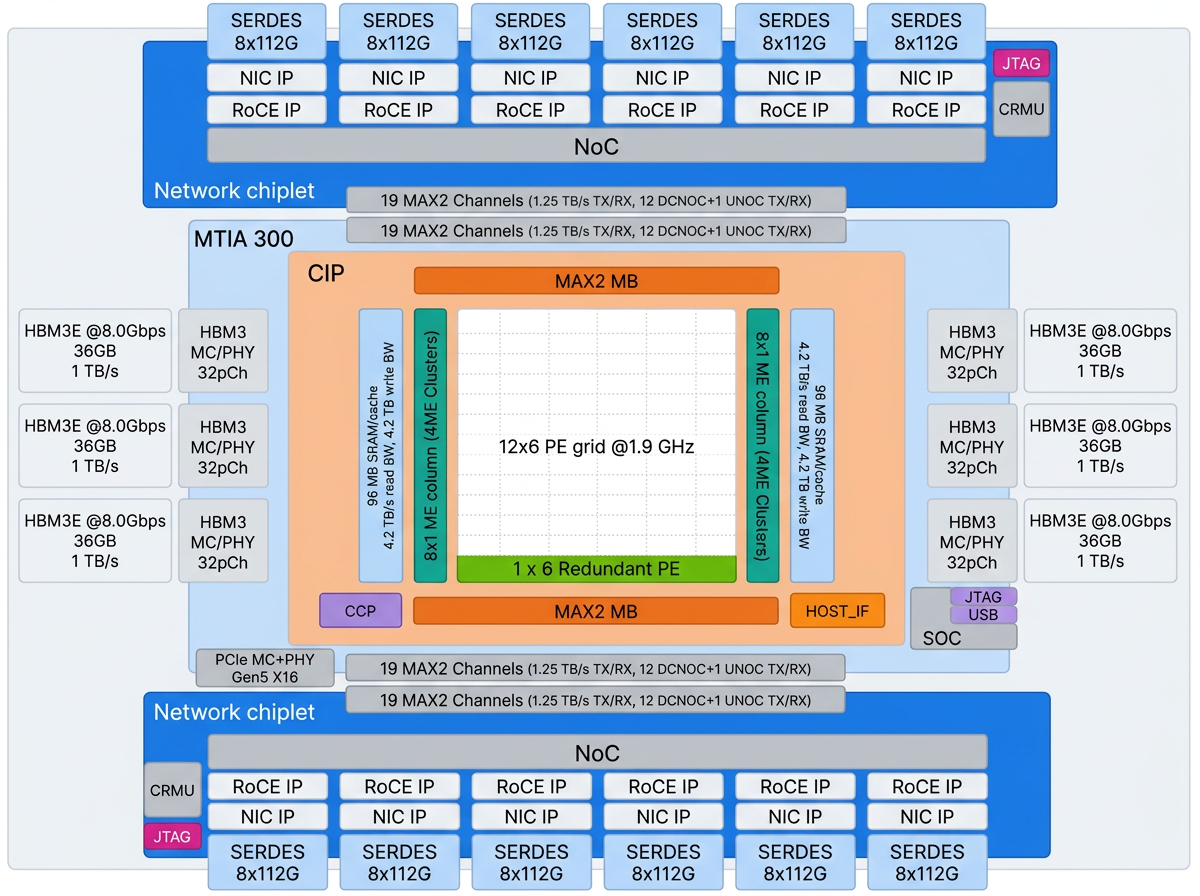
With MTIA 300, the network interface lives inside the chip package itself (see Figure 1). Two network chiplets, each containing six custom 800 Gbps RDMA NICs, provide 1.2 TB/s of total I/O bandwidth without ever crossing a PCIe bus. This eliminates the host-device-NIC bottleneck present in traditional GPU architectures, where the CPU must mediate between the accelerator and the network. (More details about the silicon design are available in our recent paper from the ISCA 26 conference.)
Because we use the same 12 Ethernet-based NICs for scale-up communication (within a rack of 16 nodes, at up to 1 TB/s) and scale-out communication (across racks, at 200 GB/s), we can flexibly partition the NICs to adjust to changing needs.
As model requirements shift, we can reconfigure this split by reconfiguring the network rather than changing the hardware. To minimize per-transaction latency, we introduced express doorbells. The work request write itself serves as the doorbell, eliminating an additional memory read and saving ~800 ns per operation.
Offloading Communication From the Compute Grid
On GPUs, libraries such as NCCL execute collective communication as GPU kernels that consume streaming multiprocessors—the same hardware needed for training computation. When collectives and training kernels run simultaneously, both slow down.
MTIA 300 takes a different approach. Alongside its 12×6 grid of processing elements (PEs) for computation, the chip includes 16 dedicated message engines (MEs) that handle all communication independently.
Each ME contains:
- an RISC-V core for orchestrating w
- an NIC interface that routes requests to the correct NIC
- a near-memory compute (NMC) block that performs reductions at 128 bytes/cycle
Positioned at the chip edges next to HBM and cache, the NMCs collectively deliver more than 2.8 TBs of reduction throughput—more than double the I/O bandwidth—enabling line-rate execution of AllReduce and ReduceScatter collectives without touching the compute grid.
The result is near-perfect isolation. Running large GEMMs concurrently with collective operations introduces less than 0.5% degradation to compute throughput, as opposed to traditional GPUs that can see over 20% degradation because communication is handled by the same GPU resources.
A Compiled-Communication Model
Our communication library, HCCL, was co-designed with MTIA 300. Rather than driving communication from the host during execution, HCCL compiles each collective into a complete set of subgraphs—arrays of work-queue entries with explicit dependencies—dispatched to the MEs for fully autonomous execution. Once work reaches the device, the host is uninvolved. Figure 2 shows how the CPU is no longer involved after copying the instructions into HBM.
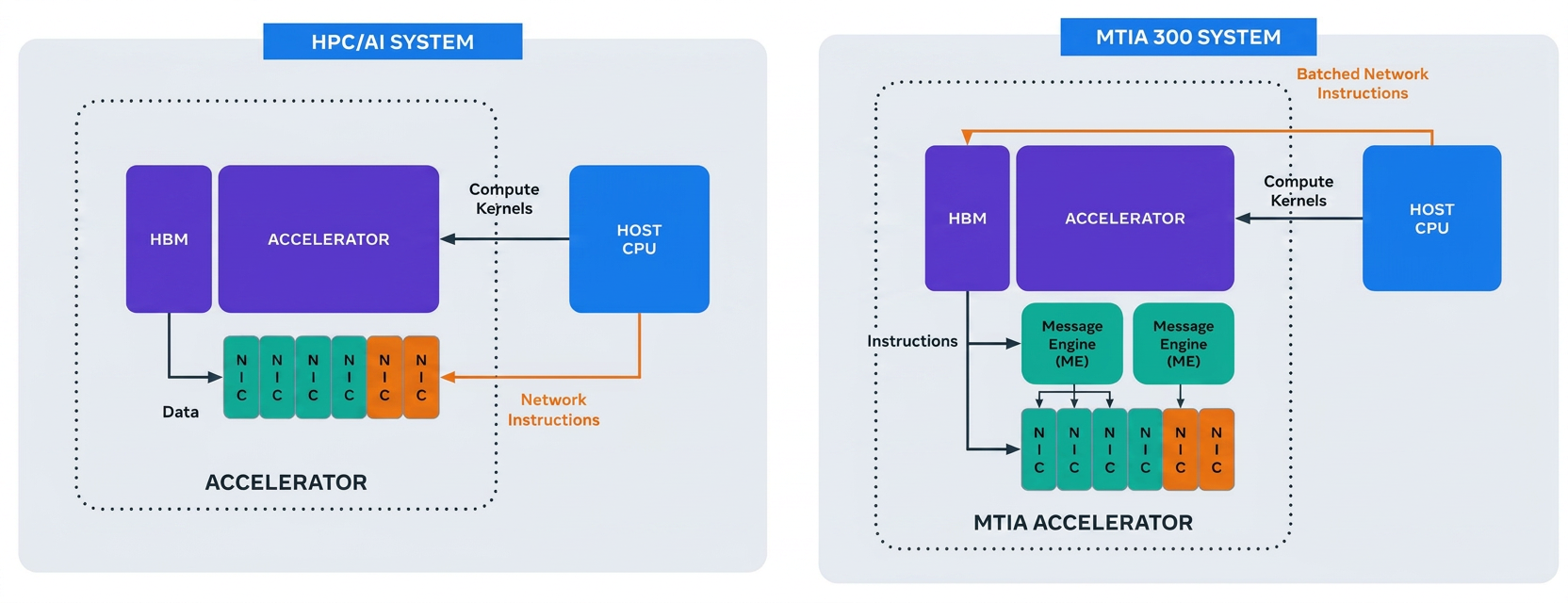
This compiled model integrates naturally with PyTorch’s c10d and torchcomms interfaces. Collectives traced through torch.compile are compiled into a single graph alongside compute operators. HCCL selects topology-aware algorithms that exploit the asymmetric bandwidth between scale-up and scale-out, minimizing cross-rack traffic where bandwidth is constrained. For inference workloads, we developed additional paths: one-sided communication where PEs submit work directly through express doorbells, and device-triggered collectives where compute kernels signal hardware-offloaded communication on a parallel stream without breaking graph execution.
Performance in Production
HCCL achieves up to 940 GB/s of communication bandwidth within a single rack. On a 150-billion-parameter production-recommendation model running across 40 accelerators, MTIA 300’s total communication time is 3.9 times faster than the equivalent GPU cluster.
MTIA 300’s design enables further co-design strategies: Its 216 GB of HBM3E allows larger local batch sizes (reducing trainer count and communication overhead); its 1:1 CPU-to-accelerator ratio enables CPU offloading of numerically intensive optimizer operations; and its high network bandwidth lets us use higher-precision datatypes to maintain precision.
Looking Ahead
While MTIA 300 was designed for training recommendation models, the architectural principles—integrated networking, offloaded collective execution, and system-level co-design of compute and communication—position it for a broader set of workloads. As AI inference evolves toward reasoning, agentic, and long-context use cases, the communication demands a shift: Messages become smaller, more frequent, and latency-sensitive, with tighter per-collective budgets.
An architecture that treats the network as a first-class system constraint, optimizing not just bandwidth but also latency and message rate, is well suited to meet these emerging demands. The patterns established in MTIA 300 and HCCL are the foundation for Meta’s next-generation AI silicon.
Learn More About MTIA 300
To learn more about MTIA 300’s silicon design and the work detailed here, read our papers:
- “MTIA 300: Meta’s First Training Chip Featuring Built-in NICs and Collective Offloading Engines “ (From ISCA ‘26)
- “HCCL: Collective Communication for Meta Training and Inference Accelerators” (to be published at SC26).
The post MTIA 300: Meta’s First Training Chip with Built-in NICs and Communication-Offloading Engines appeared first on Engineering at Meta.
Reform would evict social housing tenants over unkempt gardens
Plan part of a wider policy to remove foreign nationals from social homes and prioritise young British-born couples
Social housing tenants will be evicted if they fail to keep their gardens well maintained under a Reform UK government, the party has announced.
Lee Anderson, the party’s chair, said that if Reform came to power it would insist that those in social rented homes would be required to keep their properties decorated and gardens looked after.
Continue reading...Opinion | A Strong Yemen Can Overcome the Houthi Threat
WATCH: Bessent announces new sanctions to block Iran's revenue streams
Bessent Launches ‘Operation Economic Outcast’ to Isolate and Squeeze Iran
U.S. strikes a vessel in the eastern Pacific, killing 2 people in first attack in months
Bessent threatens new Iran secondary sanctions, says Trump is asking world leaders to sign on
Bessent announces new Iranian sanctions in 'Operation Economic Outcast'
Fulham v Chelsea: Premier League – live
⚽ Premier League updates from the 8pm BST kick-off
⚽ Sign up for the Football Daily email | Follow on TikTok
Joao Pedro, Chelsea’s new No9, has scored after 30 seconds. Cuenca’s driven ball out of defence was headed whence it came by one of the Chelsea centre-backs. Palmer slipped a simple* first-time pass through to Joao Pedro, who dinked the ball decisively over Leno.
* For him.
Continue reading...Burnham accuses Russia of ‘outrageous threats’ against UK as he visits Kyiv
Moscow warns of increased tensions with Britain as PM offers Ukraine declassified details of missile components
Andy Burnham has accused the Kremlin of “outrageous threats” against the UK as Russia warned of an escalation in tensions after the UK’s decision to present Ukraine with newly declassified blueprints to allow Kyiv to improve its production of long-range missiles.
Speaking in Kyiv, Burnham compared Ukraine’s struggle to Britain’s fight against Nazi Germany. “My nation kept the flame of European freedom alive in the 20th century, you hold that flame in the 21st,” Burnham said in a speech in front of St Sophia cathedral to mark the 35th anniversary of Ukraine’s independence.
Continue reading...Iran-linked hackers took U.K. power plant offline for first time, reports say
Trump admin touts efforts to shut down Education Department as school year begins
Пленные солдаты украинского происхождения рассказали Би-би-си, почему воевали на стороне России
Как атаки беспилотников отразятся на Ozon, втором самом крупном маркетплейсе России. Рассылка «Контекст»
Briton fighting for Russia killed in Ukraine
Outrage in Nepal over rape and murder of three-year-old girl
Redfin and Zillow must change agreement that hurts competition, FTC says
The renewed threat to global grain supplies
Chinese women are falling behind in the office
[Перевод] Структуры данных на практике. Глава 19: Управление памятью в прошивках

«Управление сложностью — сама суть программирования компьютеров.» — Брайан Керниган
Стадия финального тестирования
Мы находились на этапе финального тестирования проекта IoT‑датчика — устройства для умного дома с 128 КБ ОЗУ, которое отслеживает температуру, влажность и качество воздуха. Прошивка прошла все функциональные тесты. Юнит‑тесты: зелёные. Интеграционные тесты: зелёные. Энергопотребление: в пределах спецификации.
Последним требованием был тест непрерывной эксплуатации в течение 72 часов. Мы подготовили в лаборатории двенадцать устройств, настроив их на отправку данных датчиков каждую секунду, и оставили их работать.
Спустя три дня я пришёл в лабораторию, ожидая собрать логи тестирования и завершить проект.
Но вместо этого выяснилось, что все двенадцать устройств аварийно выключились.
В консоли последовательного порта на каждом устройстве была одна и та же ошибка:
[72:14:23] malloc failed: out of memory[72:14:23] Fragmentation: 45%[72:14:23] System halted
У меня cкрутило желудок. Проект планировалось выпустить через две недели. Я в точности знал, что произошло, и понимал, что решать проблему будет очень трудоёмко.
Читать далееProblems brewing for the proper pint as Camra membership falls
Cost of living has hit campaign group while multinationals are threatening to squeeze out independent breweries
For centuries, the wooden real ale pump has been the hallmark of a good British boozer. But now problems are brewing for the proper pint, as the Campaign for Real Ale has seen its membership sink to an eight-year low and its accounts show it is firmly in the red, making an £800,000 loss last year.
Real ale is a traditional draught cask beer, a “living” product that is produced and stored in its cask. It differs from a cold, fizzy lager, in which the yeast is killed and carbon dioxide is added. Real ale contains live yeast so it continues fermenting until it is served.
Continue reading...Psychiatrist clashes with Clancy attorney on definition of postpartum psychosis
Treasury Secretary Bessent details economic sanctions against Iran
Семь партий и ни одного независимого кандидата: Казахстан выбирает Курултай
Палестинцы запустили из Газы на израильскую территорию воздушных змеев. Израиль пригрозил жестким ответом
‘Fix that little spot’: Danish PM hits back at unsolicited beauty tip from cosmetic surgeon
Mette Frederiksen, who received message on returning from Ukraine, advises women to embrace self-acceptance
Sick of getting unsolicited beauty tips on social media, the Danish prime minister, Mette Frederiksen, rebuffed a male cosmetic surgeon’s offer to “fix” her and advised women in similar situations to embrace self-acceptance.
Frederiksen, a Social Democrat and Denmark’s second female prime minister, posted on Instagram that she had just returned from a trip to Ukraine, where she was subjected to air raid sirens, when she found a message proposing some help with her appearance.
Continue reading...