RSS Feeds

Announcing rustup 1.29.1
Published: 2026-09-01 00:00:00 | Created: 2026-09-01 11:48:57

The rustup team is happy to announce the release of rustup version 1.29.1.

Rustup is the recommended tool to install Rust, a programming language that empowers everyone to build reliable and efficient software.

What's new in rustup 1.29.1

The headlines of this release are:

  • Concurrency in certain rustup operations has been improved:

    • When running rustup update, rustup will first check for possible updates in parallel. pr#4752
    • When running rustup component add with multiple components, they will be installed concurrently. pr#4790
  • Implicit installation of the active toolchain in rustup-init and rustup invocations has been deprecated where deemed unnecessary and will now produce a warning. pr#4840

    • Please see our blog post for more details regarding this change.
  • rustup doc now supports the --serve flag which allows serving the docs over local HTTP. This should help users with containerized browser and/or rustup setups. pr#4986

  • Installing i686-pc-windows-* host toolchains on 64-bit Windows now requires --force-non-host. pr#4935

  • rustup-init will no longer leave unexpected files on disk after cancelled installations. pr#4996

  • A bug has been fixed which might cause Windows installation to fail when using rustup-init.sh. pr#4756

  • "Target triple" has been renamed to "target tuple" across the project to reflect the new terminology. pr#4743 pr#4827 pr#4834

    • Please note that this is not a breaking change in the CLI since the existing options such as --target are not using this terminology.

In addition, rustup now officially supports aarch64-pc-windows-gnullvm as a host platform. pr#4523

Further details are available in the changelog!

How to update

If you have a previous version of rustup installed, getting the new one is as easy as stopping any programs which may be using rustup (e.g. closing your IDE) and running:

$ rustup self update

Rustup will also automatically update itself at the end of a normal toolchain update:

$ rustup update

If you don't have it already, you can get rustup from the appropriate page on our website.

Rustup's documentation is also available in the rustup book.

Caveats

Rustup releases can come with problems not caused by rustup itself but just due to having a new release.

In particular, anti-malware scanners might block rustup or stop it from creating or copying files, especially when installing rust-docs which contains many small files.

Issues like this should be automatically resolved in a few weeks when the anti-malware scanners are updated to be aware of the new rustup release.

Thanks

Thanks again to all the contributors who made this rustup release possible!

show more
Announcing our first Maintainers in Residence
Published: 2026-08-26 00:00:00 | Created: 2026-08-26 15:00:58

We are very happy to announce the Rust Project's first round of Maintainers in Residence: Gen Li (@rami3l), Chris Denton (@ChrisDenton), Alejandra González (@blyxyas), León Liehr (@fmease), and Maintainer Grant recipients: Jason Newcomb (@Jarcho) and Jonas Böttiger (@joboet). These contributors will be funded for their rust-lang maintenance activities for (at least) the following 12 months!

The funding of the Maintainer in Residence (MiR) and Maintainer Grantee roles is possible thanks to generous donations to the Rust Foundation Maintainers Fund (RFMF) from Google, AWS, OpenAI, the Rust Project Leadership Council and also individual sponsors. We also want to thank the people who advocated for maintainer funding within their companies; Tyler Mandry from Google, Niko Matsakis and Jess Izen from AWS and Predrag Gruevski from OpenAI, and also the whole Rust Leadership Council and our funding advisors. If you would like to help us support even more Rust contributors, consider donating to RFMF.

The Rust Foundation has published a press release and a blog post, where you can learn more about the sponsors and the supported contributors.

Read more below to learn about the MiR program, how we chose the funded contributors, and of course who they are!

Background

The Maintainer in Residence program, established in RFC 3931, is designed to provide stable financial support for Rust contributors, so that they can truly focus on crucial maintenance activities. Currently, there are three categories of support that we offer:

  • Full-time MiR: funded for 5 days/week of Rust Project work
  • Half-time MiR: funded for ~2.5 days/week of Rust Project work
  • Maintainer Grant: funded for ~1 day/week of Rust Project work

Funding for this program comes from the Rust Foundation Maintainers Fund, which was launched recently, and the whole program is managed by the Rust Funding team.

When deciding who to fund, we took a systematic approach. First, we looked at Rust teams to understand their maintenance baseline (the smallest number of maintainers they need to ensure a healthy long-term status of the given project or repository), and how far they currently are from that baseline. From there, we identified and prioritized Rust teams who were both critically underfunded, and have a high impact on the language and its users. These teams (in no particular order) were rustdoc, rustup, cargo, compiler, libs, clippy, rustfmt, rust analyzer and mods.

The next step was pairing these teams with maintainers looking for funding. And it turns out that finding such maintainers for some teams turned out to be much more difficult than we originally assumed! For example, some maintainers are already employed, some do not want to be funded, and while we did our best to promote our funding efforts, not everyone looking for funding actually asked us for it. We also realized that some teams on our list have essentially no active members, which makes it tricky to onboard new contributors, even if they would like to help out.

In the end, we decided to start by supporting six contributors, who will help maintain several critical Rust projects and teams and who could start immediately. However, we are not stopping there. Our funding efforts are ongoing, so stay tuned for more MiR announcements in the near future! If you would like to learn more about our process, check out our recent post.

And now, without further ado, let's meet our newly funded maintainers!

Gen Li (@rami3l)

Gen Li (@rami3l) is a full-time MiR focusing on Rustup.
He has been a Rustup team member since 2023 and its lead since 2025. He deeply cares about the facets of Rust that many might have taken for granted, and embodies all attributes we were looking for in a MiR: he wants to take on complex issues, continue mentoring, and work on important Rustup features, among many other things.

Turning volunteering into an actual job has really been an empowering experience so far! I finally have the bandwidth to take a careful look at my inbox and can actually read each message without the fear of missing crucial details while rushing prompt replies, which has really helped me retain the essential compassion as a maintainer. I also get to interact with regular contributors a lot more often. Finally, I can't wait to see what I can come up with in terms of Project Goals :)

Chris Denton (@ChrisDenton)

Chris Denton (@ChrisDenton) is a half-time MiR focusing on the standard library, compiler, Rustup and anything Windows-related.
For the past five years Chris has been bringing his deep knowledge of Windows to help Rust sustain and improve its great cross-platform support. He will be unblocking other contributors in various Windows use cases, performing refactoring and code reviews and implementing new features across several areas of the Project.

Even though it is still early days, I'm feeling pretty optimistic about the health of the Rust Project going forward, thanks to the recent funding efforts.

Alejandra González (@blyxyas)

Alejandra González (@blyxyas) is a half-time MiR focusing on Clippy.
She is a Clippy team member always keen on improving performance and helping new contributors. She will focus on making Clippy faster and also reviewing its pull requests, to help get the ~300 pull request backlog down. Additionally, she is excited to mentor people from the Rust for Linux project to work on Clippy, and fine tune the open peer review system that Clippy started using earlier this year.

Funding is the system that helps me pour my heart into a project without worrying about making ends meet. Having those needs met is a game-changer and boosts my productivity. One of the areas where I want to focus my efforts is mentoring new contributors. If new people coming is the lifeblood of a project, I want to be the cardiologist!

León Liehr (@fmease)

León Liehr (@fmease) is a half-time MiR focusing on rustdoc and the compiler.
He is a member of the rustdoc and compiler teams, who is usually working on the Rust type system or issues related to parsing. He will continue working on complex features that he started a few years ago, and also focus on general maintenance, code reviews, refactoring and mentoring.

Being funded to work on Rust means I can sustainably focus my time and energy on a project I call a passion of mine.

Jonas Böttiger (@joboet)

Jonas Böttiger (@joboet) is a maintainer grantee focusing on the standard library.
He is a musicology student from Germany. When he is not playing the Cello or reading about Fanny Hensel, he applies his research skills to ensure that programs written in Rust run quickly and soundly on all platforms, no matter how quirky the operating system may be. He loves helping contributors write excellent code that they can be proud of; and considers it to be just as much fun as writing it himself.

Getting funding for my work is a dream come true. It will allow me to continue doing the thing I love instead of worrying about whether I should rather invest all that time in a money-earning job with much less positive impact on the world around me.

Jason Newcomb (@Jarcho)

Jason Newcomb (@Jarcho) is a maintainer grantee focusing on Clippy.
He is primarily working on fixing bugs and making it easier to develop and contribute to Clippy. He is also focusing on making the review process as smooth as possible.

Being funded allows me to work on something I care about and want to work on instead of what will get me paid. I'm looking forward to seeing how this will impact Clippy and the Rust project in general.

Conclusion

The contributors presented above will be funded for the next 12 months, though of course we hope that we will be able to extend their support going further, as this program is designed to be for long-term stable maintenance funding. We are very excited about them; each one of them has been with the Project for years, and we are very glad that we can support their maintenance work! All of them have already signed their contracts, so they are already being funded as we speak.

While there are many other Rust contributors who are doing awesome work, and who would also deserve to get proper funding for it, we think that this is a great start. We hope that the awesome work done by the funded maintainers will allow us to promote this program, so that we can fund even more Rust contributors!

We would like to once again sincerely thank everyone who made this possible, especially our sponsors. If you would like to help us fund more maintainers, consider donating to RFMF. You can also sponsor individual Rust contributors directly.

show more
Enabling the next-generation trait solver on nightly
Published: 2026-08-21 00:00:00 | Created: 2026-08-21 14:58:57

After nearly 4 years of active development, the next-generation trait solver is close to stabilization. We are enabling it by default on nightly to surface any remaining issues and plan to stabilize it in the next months. This is the largest single change to the Rust compiler since its initial release. It completely replaces how we prove where-clauses, normalize associated types, and much more. Please try out the latest nightly and open an issue if you encounter any bugs or regressions.

This is an internal component of the compiler. The main benefits of this rework will come in the future. The removal of the old implementation will unblock features such as Type Alias Impl Trait and Return Type Notation, allow us to add new implicit default trait bounds (e.g., Move and Forget), and enable us to fix the remaining type system unsoundnesses.

Even so, this already fixes a huge number of issues. As an underapproximation, we currently know of more than 200 issues on GitHub fixed by this change. This also has a significant impact on compile times; more on that later. When developing on nightly, you may accidentally rely on behavior only supported by the new trait solver.

This is an incredibly big change which results in a non-trivial amount of breakage. Most of these changes are intended improvements to type inference or the removal of undesirable behavior. We are tracking the known issues and breakage in a pinned GitHub issue.

What can I do?

Please update to the latest nightly version by using rustup update nightly and use it to test your existing projects and libraries.

Please tell us if you encounter any breakage, compile-time performance regression, or bad diagnostics. We have not yet spent too much time on error messages for the next-generation trait solver, so we would also appreciate you using this nightly for development to find poor diagnostics and other bugs in our error handling.

If you encounter any issue, take a quick look at the pinned GitHub issue to see if the affected crate is already listed, and if not, please open a new issue! To disable the next-generation trait solver on nightly, you can pass -Znext-solver=coherence to rustc, use RUSTFLAGS=-Znext-solver=coherence, or change your project's .cargo/config.toml configuration file:

[build]
rustflags = ["-Znext-solver=coherence"]

What exactly does this mean?

We will go into more detail about the next-generation trait solver, how we got here, and what it changes when fully stabilizing it. This is a quick summary of its main impact.

impl Trait handling

The way opaque types — return-position impl Trait (RPIT), but also the unstable Type Alias Impl Trait (TAIT) and Return Type Notation (RTN) — are handled in the type system has nearly completely changed. This fixes a lot of bugs and edge cases with them and should make their behavior a lot more consistent in general. This change is why the next-generation trait solver is necessary to stabilize TAIT and RTN.

The implementation change mostly does not matter for RPIT as we special-cased impl Trait from the method signature when type checking the method body. This means the only way to observe the old behavior is via recursive function calls. The following snippet errors with the existing implementation, but compiles with -Znext-solver enabled: godbolt

fn foo(b: bool) -> impl Sized {
    if b {
        // The old implementation errored here.
        foo(false) + 1
    } else {
        0
    }
}

Associated types in higher-ranked types

The most impactful change is way we handle associated types referencing bound variables, i.e., lifetimes from a for<'a> binder, for example, the type for<'a> fn(<T as Trait>::Assoc<'a>). While most users don't encounter such types directly, there are widely used crates which do. This change impacts existing code by removing incorrect type inference, such as in bevy and minijinja.

It also fixes a bunch of unnecessary errors like in the following example: godbolt

trait OtherTrait {
    type Assoc<'a>;
}
impl OtherTrait for u32 {
    type Assoc<'a> = &'a u32;
}


trait Trait {}
impl<T: OtherTrait> Trait for (T, for<'a> fn(<T as OtherTrait>::Assoc<'a>)) {}


fn impls<T: Trait>() {}

fn main() {
    // The old implementation failed to prove
    // the where-bound of `impls`.
    impls::<(u32, for<'a> fn(&'a u32))>();
}

Compile-time performance

co-authored with jana :3

We've spent a lot of time on the compile-time performance of the next-generation trait solver. There have been many cases where it performed quadratically or even exponentially slower than the old solver.

Especially the last few weeks were mainly spent on improving performance. This work was shared by many people, with major contributions by Nick Nethercote, jana, Rémy Rakic, and mira.

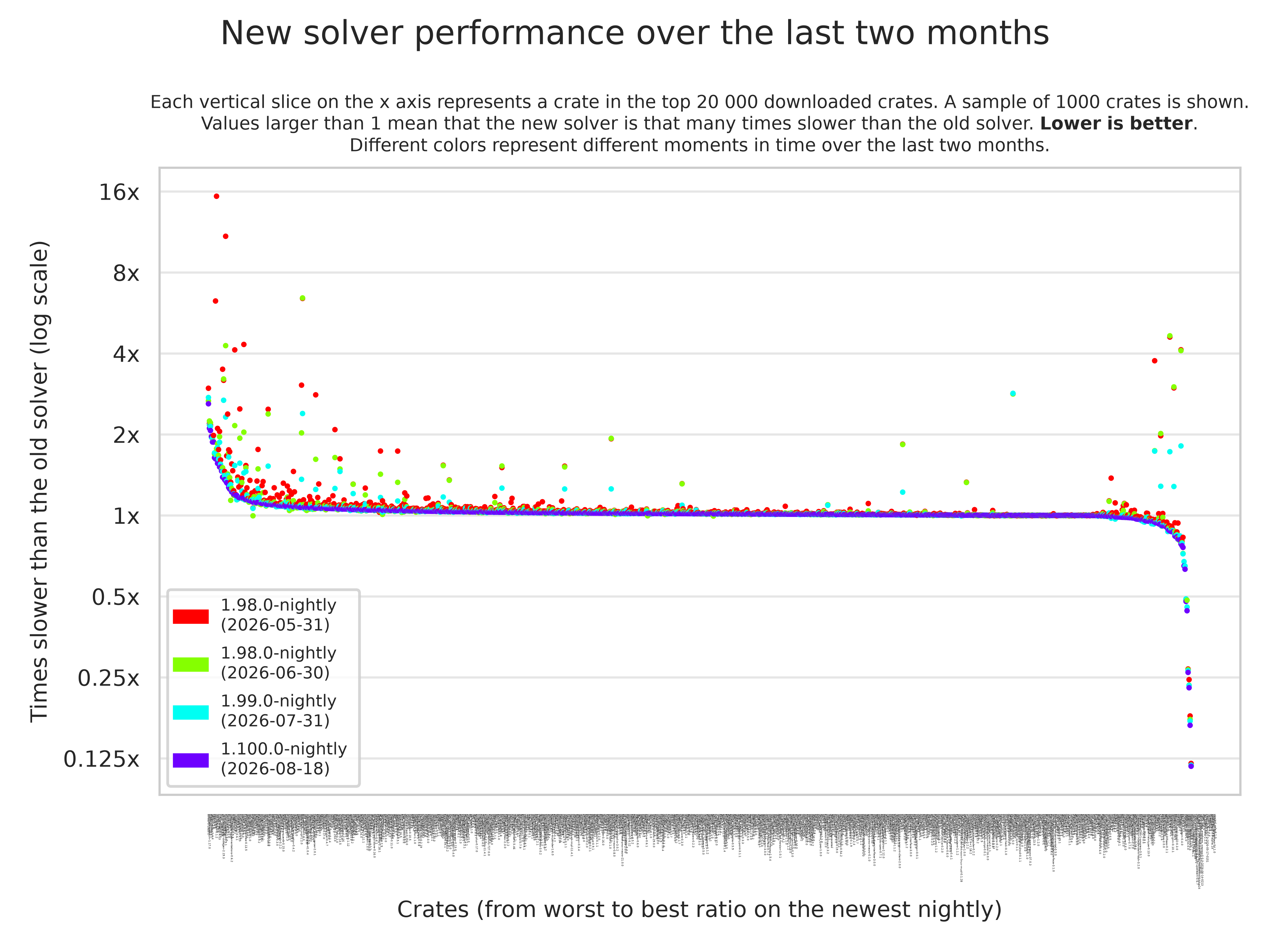
As part of this effort, Rémy Rakic compared the performance of both implementations for the top 20,000 crates on crates.io. Below you is a visualization of the performance changes over the last two months.

The performance of 1000 crates (on the x-axis) plotted against their slowdown factor (logarithmic) on the y-axis. Many crates are around the 1.0 mark (no slowdown), with major outliers at both ends. Colors show progression over time.

On the left and the right, the major outliers can be found. Note that the sample of crates here is biased towards such crates, because those are more interesting to us. Nearly all crates we tested in the top 20k had effectively the same performance with both implementations.

This graph shows that we've mainly focused our efforts on the negative outliers and made significant progress there. While many of the crates that previously took more than twice as long to compile with the new solver are still slightly slower, our work has made a few of them actually compile faster than with the old solver.

We will continue to improve its performance over the coming months, and there are still a lot of optimization opportunities compared to the existing implementation. My expectation is that, in the long term, nearly all crates will benefit from the next-generation trait solver. I am especially excited about the huge performance benefits for some trait-heavy crates.

As an example, a Chess implementation in Rust's type system hangs with the old implementation while taking a minute with the new one. There are also more practical crates with huge performance benefits, e.g., the datafusion crate compiles more than 8x faster now. For more details about the recent performance work, see this blog post by jana.


Again, thank you for testing with the latest nightly and opening a GitHub issue if you encounter any issues! We're excited to fully stabilize the next-generation trait solver soon.

show more
Announcing Rust 1.98.0
Published: 2026-08-20 00:00:00 | Created: 2026-08-20 17:17:57

The Rust team is happy to announce a new version of Rust, 1.98.0. Rust is a programming language empowering everyone to build reliable and efficient software.

If you have a previous version of Rust installed via rustup, you can get 1.98.0 with:

$ rustup update stable

If you don't have it already, you can get rustup from the appropriate page on our website, and check out the detailed release notes for 1.98.0.

If you'd like to help us out by testing future releases, you might consider updating locally to use the beta channel (rustup default beta) or the nightly channel (rustup default nightly). Please report any bugs you might come across!

What's in 1.98.0 stable

Algebraic floating-point methods

The floating-point types f32 and f64 now have "algebraic" methods for addition, subtraction, multiplication, division, and remainder. These allow optimizations on these operations using the algebraic properties of real numbers, even though these properties do not hold with the limitations of floating-point representations. The exact set of optimizations is not specified, but may be similar to the kind of optimization you would see with the -ffast-math option in other languages.

For example, floating-point addition is not associative, so a sum like a + b + c + d must be evaluated in the left-associative order in which it is parsed, like ((a + b) + c) + d. If you write the same sum as a chain of algebraic_add calls, then the compiler is free to reorder it, perhaps like (a + b) + (c + d) to evaluate the partial sums simultaneously. Broader loop-vectorization is often enabled by using these algebraic methods as well.

These methods are non-deterministic, since the compiler is free to choose different optimizations, but they never cause undefined behavior. See the library documentation and the original API change proposal for more details.

Buffered integer formatting

All of the primitive integer types now have a format_into method that takes a &mut NumBuffer<Self> parameter, which is a buffer that is large enough to hold the decimal format of any value of that type. The buffer itself is opaque, but the method returns the formatted &str with a lifetime borrowed from that buffer.

This method also bypasses much of the dynamic dispatch that you would get with buffered write! formatting, which can be a boon to performance. The itoa-benchmark repo now shows that format_into performs similarly to itoa itself, so this could serve as a standard replacement for that dependency and others like it.

Fix interaction between ManuallyDrop and Box

Prior to Rust 1.96.0, there was a bug in the Rust compiler, which made the following code undefined behavior:

let mut x = ManuallyDrop::new(Box::new(1));
unsafe { ManuallyDrop::drop(&mut x) };
let x = x; // UB!

This is because the compiler considers it undefined behavior to move a Box that has been dropped (deallocated), and ManuallyDrop used to propagate that, such that moving ManuallyDrop<Box<_>> where the box has been dropped would also be considered UB.

In Rust 1.96.0 we fixed this, so this code was no longer UB. In this release we have updated the ManuallyDrop documentation, providing a stable guarantee that this code will continue to not be UB in the future. See ManuallyDrop docs and the related RFC 3336 for more information.

Stabilized APIs

Other changes

Check out everything that changed in Rust, Cargo, and Clippy.

Contributors to 1.98.0

Many people came together to create Rust 1.98.0. We couldn't have done it without all of you. Thanks!

show more
Supply chain attack on arrayref
Published: 2026-08-20 00:00:00 | Created: 2026-08-20 10:13:56

What happened

On 2026-08-20 at 7:15 UTC we got a report that the proc-macro1 crate was malicious.

The Rust Security Response Team verified this to be the case: the crate had a build script that was downloading a malicious payload.

This crate proc-macro1 and others like it (proc-macro-en, aovine, arone, aronenao, tinymember) have been deleted.

Furthermore, we discovered that the popular arrayref crate had recently been republished and made to depend on this crate, with the most recent versions yanked. We have removed the malicious version and unyanked the maliciously-yanked versions. Other crates by that author (internment, append-only-vec) were also affected so we have done the same for those, and locked the account as a precaution. We do not believe the author of arrayref to be acting maliciously, but their computer or credentials are likely compromised, and we are attempting to contact them.

What you need to do

We recommend you check your local dependencies to ensure these crates were not pulled in. Here are the malicious versions that we deleted from crates.io:

  • append-only-vec@0.1.9: published at 2026-08-20T07:37:49Z, deleted at 2026-08-20T09:25:24Z. Online for 107 minutes.
  • arrayref@0.3.10: published at 2026-08-20T07:15:00Z, deleted at 2026-08-20T08:41:40Z. Online for 86 minutes.
  • internment@0.8.7: published at 2026-08-20T07:34:07Z, deleted at 2026-08-20T09:04:11Z. Online for 90 minutes.
  • proc-macro1, proc-macro-en, aovine, arone, aronenao, tinymember (any versions).

You can quickly check if these crates have been used locally by going through ~/.cargo/registry/cache with this command:

find ~/.cargo/registry/cache -type f \( \
  -name 'append-only-vec-0.1.9.crate' -o \
  -name 'arrayref-0.3.10.crate' -o \
  -name 'internment-0.8.7.crate' -o \
  -name 'proc-macro1-*.crate' -o \
  -name 'proc-macro-en-*.crate' -o \
  -name 'aovine-*.crate' -o \
  -name 'arone-*.crate' -o \
  -name 'aronenao-*.crate' -o \
  -name 'tinymember-*.crate' \
\) -print

Thanks

We'd like to thank the Research Team at Nextron Systems GmbH for initially discovering this and reporting it to us. We'd also like to thank Emily Albini, Manish Goregaokar, Marco Ieni, Tobias Bieniek, Ubiratan Soares, and Walter Pearce for participating in the response here.

show more
Enabling the next iteration of the borrow checker on nightly
Published: 2026-08-04 00:00:00 | Created: 2026-08-04 19:54:57

TL;DR We are enabling the next iteration of the borrow checker (coined Polonius Alpha) on nightly in preparation for stabilization in the next few months.

Whaaaaaat?

Yes! You heard it right! The next iteration of the Rust borrow checker is coming! Rust's first borrow checker ("AST borrowck") was very limited and was phased out in 2019 in favor of NLL, other than a "migrate mode" that was used to provide nice error messages. That migrate mode was finally removed in 2022.

The Polonius borrow checker spun out of the NLL effort in 2018. The initial formulation passed the NLL test suite and accepted (sound) code that NLL did not. However, performance was a critically-limiting factor; generally borrow check was slower than NLL, but certain programs were considerably slower than NLL to the extent that using that implementation/formulation of Polonius was a non-starter. Attempts were made over the years to implement the Polonius formulation in a performant manner, without much luck in addressing the core issues.

In 2023, a new formulation of a Polonius-style borrow checker was imagined that required minimal rearchitecture of the existing NLL implementation and could be extended to allow more code to compile. We had hoped, to try to stabilize this new formulation in 2024; but, various things popped up that delayed this.

But! We're nearly there now! At this point, there are no known remaining issues with the subset coined Polonius Alpha that we intend to stabilize. And, performance is generally acceptable for stabilization (will discuss that a bit below).

So, we are enabling the Polonius Alpha borrow checker on nightly for testing until we stabilize fully later in the year. We're doing this in order to help find:

  • Any serious performance regressions we're unaware of
  • Unsoundness in the formulation that we haven't thought about
  • Any weird diagnostic issues that we need to improve
    • Note: we have not yet seen any diagnostic changes

You can report any issues on Github or on Zulip.

Okay, what's new?

The key thing that Polonius Alpha enables that NLL does not is flow-sensitive borrow checking of lifetime outlives relationships.

Perhaps the smallest example demonstrating what will pass with Polonius Alpha but not the current NLL is:

fn reborrow(a: &mut u8) -> &mut u8 {
    let b = &mut *a;
    if true { b } else { a }
}

However, the example you will see more often is:

fn get_mut_or_default<'r, K: Hash + Eq + Copy, V: Default>(
    map: &'r mut HashMap<K, V>,
    key: K,
) -> &'r mut V {
    match map.get_mut(&key) {
        Some(value) => value,
        None => {
            map.insert(key, V::default());
            map.get_mut(&key).unwrap()
        }
    }
}

The issue is that the Some(value) => value branch causes the borrow checker to think that the borrow returned by map.get_mut(&key) lives for the entire function (because of the &'r mut V return type), even though that borrow isn't live in the None branch. NLL's analysis is flow-insensitive.

Polonius Alpha passes this because its analysis is flow-sensitive, and it knows that the borrow isn't live in the None branch.

Now, Polonius Alpha is not perfect; some programs that would compile under legacy Polonius (the slow original implementation) don't compile with Polonius Alpha. (This is of course why we call it "Polonius Alpha"). For example:

struct X { next: Option<Box<X>> }

fn conditional() {
    let mut b = Some(Box::new(X { next: None }));
    let mut p = &mut b;
    while let Some(now) = p {
        if true {
            p = &mut now.next;
        }
    }
}

(As a slight note: we have also found programs that compile with Polonius Alpha but not legacy Polonius, so it's not really a full subset.)

So, what about performance?

Polonius Alpha currently does strictly equal or more work compared to NLL, so we have been paying particular attention to potential performance regressions.

From the top ten thousand crates by downloads on crates.io, we have seen relatively few "significant" regressions, and even crates that have a "significant" regression are typically relatively minimal:

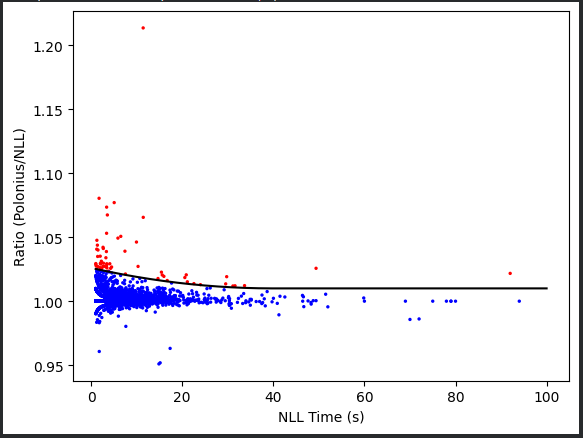
top10k_leaf_graph

Each point represents a crate within the 10,000 most-downloaded crates. The black line is an arbitrary threshold of significance, set to a 1% regression and quadratically scaled below 30 seconds. Red points are crates that pass this arbitrary regression threshold. X-axis is compile time (for the leaf crate only without dependencies) under NLL; Y-axis is the ratio of compile time under Polonius Time compared to NLL.

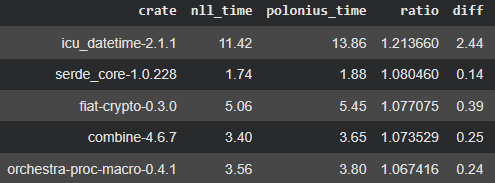
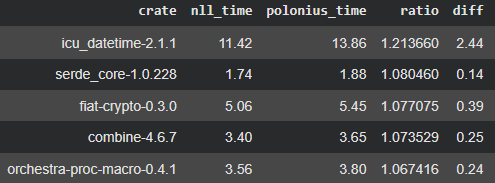
If you look at the top five crates, they are:

top10k_leaf_table

Outside the top ten thousand crates, we have focused mainly on crates with many borrows. The worst case we've seen is a 2-3x regression.

We have done some initial triage of the causes of these regressions and are thinking about the best way to fix them. Though, overall we think these regressions are fairly reasonable even if we can't fix them, given how rare and relatively minimal they are compared to the additional power Polonius Alpha brings over NLL.

I really don't want this. How do I opt-out?

To reiterate: this is only being enabled on nightly. But if you want to disable Polonius Alpha, and only use the stable NLL, you can pass -Zpolonius=off to rustc, use RUSTFLAGS=-Zpolonius=off, or with a project's .cargo/config.toml configuration file:

[target.x86_64-unknown-linux-gnu]
rustflags = ["-Zpolonius=off"]

If you have to do this, for some reason, please do tell us why on Github or on Zulip.

What's next?

Over the next few months, we will be monitoring Github and Zulip for any reported issues about Polonius Alpha. We will also be working to address known performance regressions. Finally, we will be working on internal documentation about the implementation. All prior to stabilization. Then, we are aiming to stabilize prior to the end of the year!

Although some programs that we want to compile don't work with Polonius Alpha (nor NLL today), we don't currently have any concrete plans to continue active feature work on the Polonius implementation after the stabilization of Polonius Alpha. We expect to continue to optimize the implementation and address any performance regressions for a little while. We will likely come back to Polonius feature-work at some point, but given that Polonius Alpha solves the most-encountered borrow-check issues, we are shifting our time to other high-priority work for the near future.

show more
Enabling the next iteration of the borrow checker on nightly
Published: 2026-08-04 00:00:00 | Created: 2026-08-04 14:33:57

TL;DR We are enabling the next iteration of the borrow checker (coined Polonius Alpha) on nightly in preparation for stabilization in the next few months.

Whaaaaaat?

Yes! You heard it right! The next iteration of the Rust borrow checker is coming! Rust's first borrow checker ("AST borrowck") was very limited and was phased out in 2019 in favor of NLL, other than a "migrate mode" that was used to provide nice error messages. That migrate mode was finally removed in 2022.

The Polonius borrow checker spun out of the NLL effort in 2018. The initial formulation passed the NLL test suite and accepted (sound) code that NLL did not. However, performance was a critically-limiting factor; generally borrow check was slower than NLL, but certain programs were considerably slower than NLL to the extent that using that implementation/formulation of Polonius was a non-starter. Attempts were made over the years to implement the Polonius formulation in a performant manner, without much luck in addressing the core issues.

In 2023, a new formulation of a Polonius-style borrow checker was imagined that required minimal rearchitecture of the existing NLL implementation and could be extended to allow more code to compile. We had hoped, to try to stabilize this new formulation in 2024; but, various things popped up that delayed this.

But! We're nearly there now! At this point, there are no known remaining issues with the subset coined Polonius Alpha that we intend to stabilize. And, performance is generally acceptable for stabilization (will discuss that a bit below).

So, we are enabling the Polonius Alpha borrow checker on nightly for testing until we stabilize fully later in the year. We're doing this in order to help find:

  • Any serious performance regressions we're unaware of
  • Unsoundness in the formulation that we haven't thought about
  • Any weird diagnostic issues that we need to improve
    • Note: we have not yet seen any diagnostic changes

You can report any issues on Github or on Zulip.

Okay, what's new?

The key thing that Polonius Alpha enables that NLL does not is flow-sensitive borrow checking of lifetime outlives relationships.

Perhaps the smallest example demonstrating what will pass with Polonius Alpha but not the current NLL is:

fn reborrow(a: &mut u8) -> &mut u8 {
    let b = &mut *a;
    if true { b } else { a }
}

However, the example you will see more often is:

fn get_mut_or_default<'r, K: Hash + Eq + Copy, V: Default>(
    map: &'r mut HashMap<K, V>,
    key: K,
) -> &'r mut V {
    match map.get_mut(&key) {
        Some(value) => value,
        None => {
            map.insert(key, V::default());
            map.get_mut(&key).unwrap()
        }
    }
}

The issue is that the Some(value) => value branch causes the borrow checker to think that the borrow returned by map.get_mut(&key) lives for the entire function (because of the &'r mut V return type), even though that borrow isn't live in the None branch. NLL's analysis is flow-insensitive.

Polonius Alpha passes this because its analysis is flow-sensitive, and it knows that the borrow isn't live in the None branch.

Now, Polonius Alpha is not perfect; some programs that would compile under legacy Polonius (the slow original implementation) don't compile with Polonius Alpha. (This is of course why we call it "Polonius Alpha"). For example:

struct X { next: Option<Box<X>> }

fn conditional() {
    let mut b = Some(Box::new(X { next: None }));
    let mut p = &mut b;
    while let Some(now) = p {
        if true {
            p = &mut now.next;
        }
    }
}

(As a slight note: we have also found programs that compile with Polonius Alpha but not legacy Polonius, so it's not really a full subset.)

So, what about performance?

Polonius Alpha currently does strictly equal or more work compared to NLL, so we have been paying particular attention to potential performance regressions.

From the top ten thousand crates by downloads on crates.io, we have seen relatively few "significant" regressions, and even crates that have a "significant" regression are typically relatively minimal:

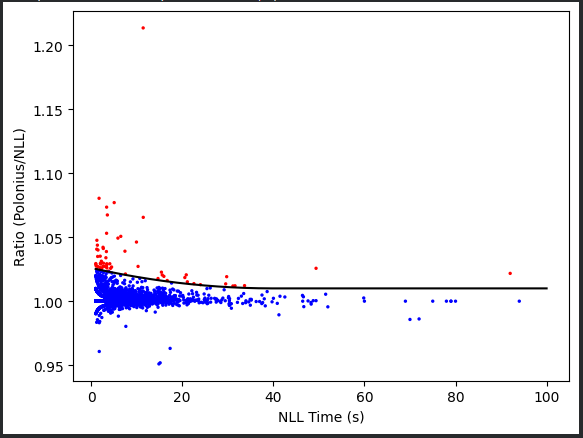
top10k_leaf_graph

Each point represents a crate within the 10,000 most-downloaded crates. The black line is an arbitrary threshold of significance, set to a 1% regression and quadratically scaled below 30 seconds. Red points are crates that pass this arbitrary regression threshold. X-axis is compile time (for the leaf crate only without dependencies) under NLL; Y-axis is the ratio of compile time under Polonius Time compared to NLL.

If you look at the top five crates, they are:

top10k_leaf_table

Outside the top ten thousand crates, we have focused mainly on crates with many borrows. The worst case we've seen is a 2-3x regression.

We have done some initial triage of the causes of these regressions and are thinking about the best way to fix them. Though, overall we think these regressions are fairly reasonable even if we can't fix them, given how rare and relatively minimal they are compared to the additional power Polonius Alpha brings over NLL.

I really don't want this. How do I opt-out?

To reiterate: this is only being enabled on nightly. But if you want to disable Polonius Alpha, and only use the stable NLL, you can pass -Zpolonius=off to rustc, use RUSTFLAGS=-Zpolonius=off, or with a project's .cargo/config.toml configuration file:

[target.x86_64-unknown-linux-gnu]
rustflags = ["-Zpolonius=off"]

If you have to do this, for some reason, please do tell us why on Github or on Zulip.

What's next?

Over the next few months, we will be monitoring Github and Zulip for any reported issues about Polonius Alpha. We will also be working to address known performance regressions. Finally, we will be working on internal documentation about the implementation. All prior to stabilization. Then, we are aiming to stabilize prior to the end of the year!

Although some programs that we want to compile don't work with Polonius Alpha (nor NLL today), we don't currently have any concrete plans to continue active feature work on the Polonius implementation after the stabilization of Polonius Alpha. We expect to continue to optimize the implementation and address any performance regressions for a little while. We will likely come back to Polonius feature-work at some point, but given that Polonius Alpha solves the most-encountered borrow-check issues, we are shifting our time to other high-priority work for the near future.

show more
Project goals update — April 2026 (end of 2025H2)
Published: 2026-05-18 00:00:00 | Created: 2026-07-23 05:23:40

The 2025H2 Project Goal period has now concluded. Over these months, the Rust Project pursued 41 Project Goals, 13 of which were designated as Flagship Goals. This post contains curated updates on our progress since the last post and the final status for each of the goals (many of which continue as part of the 2026 period). Full details for any particular goal are available in its tracking issue.

Thanks to everyone who contributed! <3

Table of contents


Flagship: Beyond the &

Continue Experimentation with Pin Ergonomics

3 detailed updates available.

Design a language feature to solve Field Projections

5 detailed updates available.
  • Benno Lossincomment from 2026-01-01

  • Benno Lossincomment from 2026-01-25

    Earlier this month, Nadrieril Ding Xiang Fei and I held a meeting on autoref and method resolution in a world with field projections. This meeting resulted in a new page for the wiki on autoref.

  • Benno Lossincomment from 2026-02-28

    The first pull request of the lang experiment has just been merged: rust-lang/rust#152730

    This PR enables the use of the field_of! macro to obtain a unique type for each field of a struct, enum variant, tuple, or union. We call these types field representing types (FRTs). When the base type is a struct that is not repr(packed), only contains Sized fields, this type automatically implements the Field trait that exposes some information about the field to the type system. The offset in bytes from the start of the struct, the type of the field and the type of the base type.

    The feature is still incomplete and highly experimental. We also want to tackle the limitations in future PRs. For the moment this is enough to give us the ability to experiment with library versions of field projections and write functions that are generic over the fields of structs. For example one can write code like this:

    #![feature(field_projections)]
    
    use std::field::{Field, field_of};
    use std::ptr;
    
    fn project_ref<'a, T, F: Field<Base = T>>(r: &'a T) -> &'a F::Type {
        // SAFETY: the `Field` trait guarantees that this is sound.
        unsafe { &*ptr::from_ref(r).byte_add(F::OFFSET).cast() }
    }
    
    struct Struct {
        field: i32,
        other: u32,
    }
    
    fn main() {
        let s = Struct { field: 42, other: 24 };
        let r = &s;
        let field = project_ref::<_, field_of!(Struct, field)>(r);
        let other = project_ref::<_, field_of!(Struct, other)>(r);
        println!("field: {field}"); // prints 42
        println!("other: {other}"); // prints 24
    }

    A very important feature of the types returned by field_of! is that you can implement traits for them if you own the base type. This allows anointing fields with information by extending the Field trait. For example, this allows encoding the property of being a structurally pinned field:

    use std::pin::Pin;
    
    unsafe trait PinnableField: Field {
        type StructuralRefMut<'a>
        where
            Self::Type: 'a,
            Self::Base: 'a;
    
        fn project_mut<'a>(base: Pin<&'a mut Self::Base>) -> Self::StructuralRefMut<'a>
        where
            Self::Type: 'a,
            Self::Base: 'a;
    }
    
    fn project_pinned<'a, T, F>(r: Pin<&'a mut T>) -> <F as PinnableField>::StructuralRefMut<'a>
    where
        F: PinnableField<Base = T>,
    {
        F::project_mut(r)
    }

    We can then implement this extra trait for all of the fields of our struct (and automate that with a proc-macro):

    unsafe impl PinnableField for field_of!(Struct, field) {
        type StructuralRefMut<'a> = &'a mut i32;
    
        fn project_mut<'a>(base: Pin<&'a mut Self::Base>) -> Self::StructuralRefMut<'a>
        where
            Self::Type: 'a,
            Self::Base: 'a,
        {
            let base = unsafe { Pin::into_inner_unchecked(base) };
            &mut base.field
        }
    }
    
    unsafe impl PinnableField for field_of!(Struct, other) {
        type StructuralRefMut<'a> = Pin<&'a mut u32>;
        // u32 is `Unpin`, so this isn't doing anything special, but it highlights the pattern.
    
        fn project_mut<'a>(base: Pin<&'a mut Self::Base>) -> Self::StructuralRefMut<'a>
        where
            Self::Type: 'a,
            Self::Base: 'a,
        {
            let base = unsafe { Pin::into_inner_unchecked(base) };
            unsafe { Pin::new_unchecked(&mut base.other) }
        }
    }

    Now you can safely obtain a pinned mutable reference to other and a normal mutable reference to field by calling the project_pinned function and supplying the correct FRT.

    (playground link)

  • Benno Lossincomment from 2026-03-20

    Plan for 2026

    We have an updated plan for this goal in 2026 consisting of three major steps:

    • a-mir-formality,
    • Implementation,
    • Experimentation.

    Some of their subtasks depend on other subtasks for other steps. You can find the details in the updated tracking issue. Here is a short rundown of each:

    a-mir-formality: we want to create a formal model of the borrow checker changes we're proposing to ensure correctness. We also want to create a document explaining our model in a more human-friendly language. To really get started with this, we're blocked on the new expression based syntax in development by Niko.

    Implementation: at the same time, we can start implementing more parts in the compiler. We will continue to improve FRTs, while keeping in mind that we might remove them if they end up being unnecessary. They still pose for a useful feature, but they might be orthogonal to field projections. We plan to make small and incremental changes, starting with library additions. We also want to begin exploring potential desugarings, for which we will add some manual and low level macros. When we have that figured out, we can fast-track syntax changes. When we have a sufficiently mature formal model of the borrow checker integration, we will port it to the compiler. After further evaluation, we can think about removing the incomplete_feature flag.

    Experimentation: after each compiler or standard library change, we look to several projects to stress-test our ideas in real code. I will take care of experimentation in the Linux kernel, while Tyler Mandry will be taking a look at testing field projections with crubit. Josh Triplett also has expressed eagerness of introducing them in the standard library; I will coordinate with him and the rest of t-libs-api to experiment there.

  • Benno Lossincomment from 2026-04-02

    Yesterday, we held a t-lang design meeting on our current approach. Nadrieril and I authored a design document with the feedback of Tyler Mandry, Ding Xiang Fei, Alice Ryhl, and Gary Guo. In this document, we provided the motivation for this feature, what the look and feel of a solution fitting into the existing features of Rust is, and a comprehensive + compact introduction to our current approach based on virtual places.

    The general reception was extremely positive. To give some concrete quotes from the meeting:

    • Josh:

      I adore this! I love how orthogonal it is, and how impactful and universal it is. I anticipate this becoming a beloved, pervasive feature of Rust.

      Places and projection seem important enough to me that they're worth giving one of our precious remaining ASCII sigils to, and @ is nicely evocative of a place (something is at a place). So to the extent the final syntax benefits from a sigil, :+1: for giving this @. (See some feedback below on the details, though.)

    • TC:

      Love it. High concept. As I said in the last meeting:

      I particularly like language features that reduce the need for library surface area, and this is one of those.

      There are, of course, many details to resolve and understand further, e.g., with respect to migration issues, interaction with const, async, and other effect-like things, etc. I'm looking forward to seeing the formalization work.

    • tmandry:

      What I love about this direction is how effectively it builds on what Rust already has. I love to see designs that reinforce our existing concepts while pushing them in directions that make them more expressive.

    • Jack:

      Whoo boy. This is great. There's so much here that I'm not exactly sure where to begin and what to comment on. I think this is the type of thing that we will only really be able to figure out the nitty gritty details and ergonomics only after some amount of experimentation.

    There are a few takeaways from this meeting:

    • Mark raised the concern that t-libs should be more involved in reviewing the experimental traits that we intend to add. Ensuring that we don't accidentally stabilize or expose some behavior, have sufficient documentation on our experimental traits, and that t-libs is in the loop of this feature in general.
      • Mark offered to review PRs and I will be tagging him in those.
    • Jack raised the concern that increasing the cognitive load for the 95% use-case should be avoided. Making the right choice between @ and & might be challenging for users.
      • We discussed this point more in the meeting and concluded with that we need to do some experimentation, possibly utilizing the user research team. We will of course keep this in mind and revisit it later when we have a partially working implementation.
    • TC requested that we publish our fine-grained design axioms, essentially the list of things we go through when considering a modification of our proposal.
      • I will write an update on this issue explaining exactly those.

    Aside from the concerns and directly actionable items, the meeting also covered design questions/comments that we want to take a look at in the coming weeks/months:

    Thanks to everyone who participated in the meeting!

Reborrow traits

1 detailed update available.
  • Aapo Alasuutaricomment from 2026-02-28

    PR open to get the first working version of the Reborrow and CoerceShared traits merged.

    Blockers

    Currently "blocked" on PR review, and of course my (and Ding's) work to fix all review issues.

    The review has brought up an opportunity to replace Rvalue::Ref / ExprKind::Ref with a more generalised variant that could encompass both references and user-defined references. This would be powerful, but it would be a very big and scary change. If this turns out to be a blocking issue for reviewers, then this will block the goal for the foreseeable future as the PR then starts on a massive refactoring.

    Help wanted

    The PR currently does not include derive traits, but we'd really want them. Instead of these:

    impl<'a> Reborrow for CustomMarker<'a> {}
    impl<'a> CoerceShared<CustomMarkerRef<'a>> for CustomMarker<a'> {}
    
    impl<'a, T> Reborrow for CustomMut<'a, T> {}
    impl<'a, T> CoerceShared<CustomRef<'a, T>> for CustomMut<'a, T> {}

    we'd prefer to have something like this:

    #[derive(Reborrow, CoerceShared(CustomMarkerRef))]
    struct CustomMarker<'a> { ... }
    
    #[derive(Reborrow, CoerceShared(CustomRef))]
    struct CustomMut<'a, T> { ... }

    If anyone feels like picking up this thread, that'd be awesome: the derive macros do not need to really perform any validity checking, as the trait itself will do that.

    If the PR merges soon, then public testing and exploration of the traits will be the next big thing. Likely concurrently with that the massive refactoring to generalise Rvalue::Ref / ExprKind::Ref.

Flagship: Flexible, fast(er) compilation

build-std

4 detailed updates available.

Production-ready cranelift backend

Promoting Parallel Front End

Flagship: Higher-level Rust

Ergonomic ref-counting: RFC decision and preview

Stabilize cargo-script

3 detailed updates available.

Flagship: Unblocking dormant traits

Evolving trait hierarchies

In-place initialization

1 detailed update available.

Next-generation trait solver

1 detailed update available.

Stabilizable Polonius support on nightly

2 detailed updates available.
  • Rémy Rakiccomment from 2026-01-30

    This month's update:

    • tiif is making progress on normalizing opaques while computing implied bounds
    • we discussed how to investigate and fix the remaining correctness issues in Tage's work, to be able to evaluate it more accurately: in particular around variance and bidirectional edges, and without the reliance on NLL (having computed region values / errors)
    • we've tried to see if it'd be possible to remove the cfg region elements
    • Amanda is still working on her two papers, one about the current borrow checker and one about the work on Polonius. Her major PR for the restructuring of placeholder handling during region inference is stalled due to a conflict with further trait solver developments and may have to be abandoned. Work with the larger types team is ongoing and smaller patches/refactorings/improvements are being landed in the meantime.
    • #149639 has now landed, and #150551 is still in review
    • I've also fixed more small inefficiencies (computing boring/relevant locals on-demand in diagnostics, removed conversions between locations and points, etc) building on top of the previous PRs (so they need to be reviewed first)
    • I've looked at crates.io again with the alpha, to find functions that are slower than with NLLs. AFAICT the worst case there is 60% for a 5KLOC function with 42K loans, 255K statements, and 125K outlives constraints. I'll see what we can do with this. Small composable functions is still good advice.
    • there seem to be optimization opportunities to 1. limit propagation to the smaller number of blocks that could be affected by bidirectional edges, 2. for unifying invariant lifetimes of live locals that are assigned at most once (à la use-def chains), 3. for invalidations that are just the activation of a reservation
    • we discussed possible plans to gather actual statistics, using the infrastructure that was created for the Metrics project
    • we're also preparing the new project goal for this year, where we'll want to stabilize the alpha 🤞
  • Rémy Rakiccomment from 2026-02-28

    We had a bit less time this month, the update will be shorter, but still meaningful I hope:

    • #150551 has landed, and it feels stabilizable. To me, this part of the goal is achieved.
    • still, "stabilizable" is not stable, and there is more work to do. We plan to stabilize this year, and the project goal proposal for 2026 tracks how.
    • tiif is still deep in #152051, and a-mir-formality work with Niko and I.
    • Amanda has opened a few cleanup PRs (#152438, and #152579), and #151863 has landed already. She also has started looking into Tage's old PR to see if we can fix it, benchmark it more accurately, and see the cool parts there that we could be using.
    • Jack is possibly going to have some time to work with us this year! His help will be very welcome, especially as I will have less time available myself.
    • we'll be tracking the opaque type region liveness soundness issue in #153215, and I've added a couple tests, in case tiif's PR or anything that impacts them lands.
    • some of the tiny cleanups I mentioned last time have also landed in #152587.

Other goal updates

Add a team charter for rustdoc team

Borrow checking in a-mir-formality

C++/Rust Interop Problem Space Mapping

5 detailed updates available.
  • Joel Marceycomment from 2026-01-20

    The Rust Foundation is opening up a short-term, approximately 3-month, contracting role to assist in our Rust/C++ Interop initiative. The primary work and deliverables for the role will be to make substantial progress on the Problem Space Mapping Rust Project Goal by collecting discrete problem statements and offering up recommendations on the work that should follow based upon the problems that you found.

    If you are interested in how programming languages interoperate, are curious in understanding the problems therein, and are have a passion to think about how those problems may be resolved for the betterment of interop, then this work may be for you.

    An ideal candidate will have experience with Rust programming. Having experience in C++ is strongly preferred as well. If you have direct experience with actual engineering that required interoperating between Rust and C++ codebases, that's even better.

    If you are interested, please email me (email address found in my GitHub profile) or contact me directly on Zulip by Tuesday, January 27 and we can take it from there to see if there may be a potential fit for further discussion.

    Thank you.

  • Joel Marceycomment from 2026-01-31

    The effort to fill the contracting role to support this project goal is in the process winding down. The interview and discussion process is nearly complete. We expect to make a final decision for the role in early February.

  • teorcomment from 2026-02-27

    Hi, I'm the new contractor on the interop problem space mapping project goal.

    In the last week and a half, I've:

    Next step is prioritising a few of the use cases, then working on related problem statements in more detail.

    Blockers

    Nothing at the moment, still working through the high level mapping of the problem space.

    Help wanted

    Suggestions for more interop use cases would be very welcome, just open a discussion in t-lang/interop and I'll turn it into a ticket. Or go ahead and open a use case ticket directly.

    I'll post an update here every few weeks, you can follow more detailed weekly updates on Zulip.

  • teorcomment from 2026-03-30

    In the last month, I've:

    • met with the lang team, Crubit team, and cxx author, and Joel and Mara have met with the C++ standards working group
    • expanded some draft high-level problem statement summaries, and added code examples
    • added 6 new interop use cases
    • added more relationships between problems/use cases and existing project goals & unstable compiler features
    • prepared for the Rust All Hands, and started mentoring for Outreachy

    Specifically, the last month we've identified and prioritised two high-priority use cases for more detailed work:

    And I analysed the problems / use cases we've collected so far, with priorities, responsible language, and a split into semantics or tooling changes.

    Next step is continuing to work on overloading and build systems in more detail. If you have specific Rust/C/C++ build system blockers, please open a chat or ticket.

    Blockers

    Nothing at the moment, everyone has been extremely helpful, and I'm getting good feedback on use cases, problems, priorities, and Rust language experiments.

  • teorcomment from 2026-05-01

    In the last month, I've:

    Specifically, the last month we've made detailed progress on two high-priority use cases:

    Next step is continuing to work on the overloading experiment, along with RustWeek/All Hands preparation, and collecting feedback during the conference.

    Blockers

    Nothing at the moment. There is a steady stream of new use cases, problems, code examples and Rust language experiment feedback.

Comprehensive niche checks for Rust

Const Generics

6 detailed updates available.
  • Niko Matsakiscomment from 2026-01-27

    Boxy and I have established a regular time to check-in on formalizing this within a-mir-formality. Today we mostly worked on the "model" of const values, starting with this

    #[term]
    pub enum ConstData {
        // Sort of equivalent to `ValTreeKind::Branch`
        #[cast]
        RigidValue(RigidConstData),
    
        // Sort of equivalent to `ValTreeKind::Leaf`
        #[cast]
        Scalar(ScalarValue),
    
        #[variable(ParameterKind::Const)]
        Variable(Variable),
    }


    #[term]
    pub enum ScalarValue {
        #[grammar(u8($v0))]
        U8(u8),
        #[grammar(u16($v0))]
        U16(u16),
        #[grammar(u32($v0))]
        U32(u32),
        #[grammar(u64($v0))]
        U64(u64),
        #[grammar(i8($v0))]
        I8(i8),
        #[grammar(i16($v0))]
        I16(i16),
        #[grammar(i32($v0))]
        I32(i32),
        #[grammar(i64($v0))]
        I64(i64),
        #[grammar($v0)]
        Bool(bool),
        #[grammar(usize($v0))]
        Usize(usize),
        #[grammar(isize($v0))]
        Isize(isize),
    }
    
    
    #[term($name $<parameters> { $,values })]
    pub struct RigidConstData {
        pub name: RigidName,
        pub parameters: Parameters,
        pub values: Vec<Const>,
    }

    i.e., a const value can be a scalar value (as today) or a struct literal like Foo { ... } (which would also cover tuples and things). We got the various tests passing. Huzzah!

  • Boxycomment from 2026-01-30

    In addition to what niko posted previously there's been a lot of other stuff happening. A lot of people have opened PRs to improve mGCA this month: León Orell Valerian Liehr Noah Lev @enthropy7 Kivooeo mu001999 @Human9000-bit Redddy @Keith-Cancel @AprilNEA

    A rough list of things that have been improved for mGCA:

    • Lots of new expressions now supported by mGCA: const constructors, tuple constructor calls, array expressions, tuple expression, literals
    • associated_const_equality has been merged into min_generic_const_args. the former was effectively dependent on the latter already so this just makes it nicer to use the former :)
    • traits can now be dyn compatible if all associated constants are type consts and are specified in the trait object (e.g. dyn Trait<ASSOC = 10>)
    • type consts are enforced to be non-generic
    • a bunch of ICEs have been fixed
    • camelid has been working on "non-min" version of mGCA which will allow arbitrary expressions to be used in the type system (a blog post with more detail will be published once this actually lands)

    In non-mGCA updates, as niko says, we've been meeting regularly to make progress on modelling const generics in a-mir-formality. I've also been spending time thinking about the interactions between adt_const_params and ADTs with privacy/safety invariants and I think I know how to structure the RFC in this area so can make progress on that again

    There's some more detail about the various bits of work people have done and who did what here: #project-const-generics > perfectly adequately sized wins @ 💬

  • Niko Matsakiscomment from 2026-02-13

    Boxy and I have met (and continue to meet) and work on modeling const generics in a-mir-formality. We're still working on laying the groundwork.

    There is a proposed project goal for next year.

  • Boxycomment from 2026-02-28

    There's been a lot of miscellaneous fixes for mGCA this month. I've also started drafting some blog posts to explain what's going on with mGCA/oGCA as well as soliciting use cases/experience reports for them and adt_const_params. I also talked with some folks at Rust Nation this month about const generics and what features would be useful for them and why.

  • Boxycomment from 2026-04-02

    Late on the update :') niko and i continue to meet to discuss const generics. we've made some progress on figuring out problems around privacy/safety in const generics. we've also been discussing the big picture stuff for const generics and where we're "heading".

  • Boxycomment from 2026-05-01

    started running weekly meetings about const generics to make it easier to keep up to date with all the people who are working on const generics stuff. i think min_adt_const_params is now at the point of what the RFC is going to specify.

    GCA is making good progress thanks to ashley's work. i also met with lcnr where we talked about whether there was some version of mGCA that is stabilizeable in the near future or not (maybe!)

Continue resolving cargo-semver-checks blockers for merging into cargo

1 detailed update available.

Develop the capabilities to keep the FLS up to date

2 detailed updates available.
  • Pete LeVasseurcomment from 2026-03-04

    We have a Project Goal in 2026 that we'll take on: Stabilize FLS Release Cadence. Progress towards 1.93.1 looks good, most issues are closed.

    Help wanted

    We'd love more folks from the safety-critical community to contribute to picking up issues or opening an issue if you notice something is missing.

  • Pete LeVasseurcomment from 2026-04-02

    Trying to prepare FLS releases earlier:

    • since we completed the 1.94.0 release of the FLS a bit early this time, we checked into the stretch part of our goal this year to look at 1.95.0 early
    • we learned a bit more of the release notes process thanks to tips from Eric Huss and TC
    • Tshepang Mbambo and I attended the t-release meeting last week where we chatted about working a little "upstream" with them on generating the release notes a bit earlier
    • tomorrow in our t-fls meeting we'll discuss our interest with engaging over there; at a minimum I'll get engaged with t-release

    Glossary and main-body text harmonization:

    • the first PR landed from Tshepang Mbambo removing IDs from the glossary
    • further steps planned, we have a tracking issue for it

    Developer guide:

    • akin to how the Reference now has a developer's guide now for contributing we'll do the same in the FLS
    • Hristian Kirtchev has been working on this

Emit Retags in Codegen

4 detailed updates available.
  • Ian McCormackcomment from 2026-01-09

    Here's our January status update!

    • Yesterday, we posted an MCP for our retag intrinsics. While that's in progress, we'll start adapting our current prototype to remove our dependence on MIR-level retags. Once that's finished, we'll be ready to submit a PR.
    • We published our first monthly blog post about BorrowSanitizer.
    • Our overall goal for 2026 is to transition from a research prototype to a functional tool. Three key features have yet to be implemented: garbage collection, error reporting, and support for atomic memory accesses. Once these are complete, we'll be able to start testing real-world libraries and auditing our results against Miri.
  • Ian McCormackcomment from 2026-02-24

    We just posted our February status update for BorrowSanitizer. TL;DR:

    • We provide detailed error messages for aliasing violations, which look almost like Miri's do!
    • We have two forms of retag intrinsic: __rust_retag_mem and __rust_retag_reg. We no longer require a compiler plugin to determine the permission associated with a retag, which will make it possible to use BorrowSanitizer by providing a single -Zsanitizer=borrow flag to rustc. You can check out our MCP for more detailed design updates.
    • We are starting to have a better understanding of how BorrowSanitizer performs in practice, but we do not have enough data yet to be certain. From one test case, it seems like we are somewhat faster but still in the same category of performance as Miri when we compare against other sanitizers. Expect more detailed results to come as we scale up our benchmarking pipeline.
    • We have a tentative plan for upstreaming BorrowSanitizer in 2026, starting with its LLVM components. We intend to start the RFC process on the LLVM side this spring, once our API is stable.
  • Ian McCormackcomment from 2026-03-30

    We just posted our March status update for BorrowSanitizer. TL;DR:

    • We added hundreds more relevant tests from Miri's test suite. At the moment, 80% pass.
    • We improved our cargo plugin (cargo-bsan) to better support multilanguage libraries. This will let us start to recreate the bugs from our earlier evaluation.

    Our goal for April is to continue expanding our test suite, finish an initial version of the LLVM components of BorrowSanitizer, and hopefully start the RFC process on the LLVM side.

  • Ian McCormackcomment from 2026-04-29

    We have some exciting news: our talk on BorrowSanitizer was accepted at RustConf this year! We’re grateful for the opportunity and looking forward to sharing our results with the broader community this September.

    We just posted our April status update. It’s a bit of a technical one. Here’s the TL;DR:

    • BorrowSanitizer now uses a shadow stack to track metadata at runtime - this is a significantly different strategy than other LLVM sanitizers, and it will help us support garbage collection.
    • We are now ready to start sending in PRs for our retag intrinsics. It will take a little time to split our changes up into meaningful, reviewable chunks—you can expect to see these throughout the next week.

    The RFC for our LLVM components is taking a little longer than expected, but it was worth taking the extra time to test out compiler changes and make sure that we had the core parts of the instrumentation pass settled. We’ll be drafting the RFC throughout the next few weeks.

Expand the Rust Reference to specify more aspects of the Rust language

1 detailed update available.

Finish the libtest json output experiment

Finish the std::offload module

2 detailed updates available.
  • Manuel Drehwaldcomment from 2026-01-16

    std::autodiff is moving closer to nightly, and std::offload is gaining various performance, feature, and hardware support improvements.

    autodiff

    Jakub Beránek, sgasho, and I continued working on enabling autodiff in nightly. We have a PR up that builds autodiff in CI, and verified that the artifacts can be installed and work on Linux. For apple however, we noticed that any autodiff usage hangs. After some investigation, it turns out that we ended up embedding two LLVM copies, one in rustc, and one in Enzyme. It should be comparably easy to get rid of the second one. Once we verified that this fixes the build, we'll merge the PR to enable autodiff on both targets in nightly.

    offload

    A lot of interesting updates on the performance, feature, and hardware support side.

    1. Marcelo Domínguez, @kevinsala, @jdoerfert, and I started implementing the first benchmarks, since that's generally the best way to find missing features or performance issues. We were positively surprised by how good the out-of-the-box performance was. We will implement a few more benchmarks and post the results once we have verified them. We also implemented multiple PRs which implement bugfixes, cleanups, and needed features like support for scalars. We also started working on LLVM optimizations which make sure that we can achieve even better performance.
    2. I noticed that our offload intrinsic allowed running Rust code on the GPU, but it wasn't of much help when calling gpu vendor libraries like cuBLAS. I implemented a new helper intrinsic which allows calling those functions conveniently, without having to manually move data to or from the device. It will benefit from the same LLVM optimizations as our full offload intrinsic. It also a bit simpler to set up on the compiler and linker side, so it already works with std and mangled kernel names, something that we still have to improve for our main offload intrinsic.
    3. A lot of work happened on the LLVM offload side for SPIRV and Intel GPU support. At the moment, our Rust frontend is tested on NVIDIA and AMD server and consumer GPUs, as well as AMD HPC and Lapotop APUs. Karol Zwolak reached out since he wants to help with with also running Rust on Intel GPUs. Offload relies on LLVM which started gaining Intel support, so hopefully we won't need much work beyond a new intel-gpu target and a new stdarch module. There is also work on a new spirv target for rustc, which we could also support if it goes through LLVM. Due to some open questions around typed pointers it does not seem clear yet whether it will, so we will have to wait.
    4. Nikita started working on updating our submodule to LLVM 22. This hopefully does not only brings some compile and runtime performance improvements, but also greatly simplifies how we can build and use offload. Once it landed I'll refactor our bootstrapping logic, and as part of that start building offload in CI.
  • Manuel Drehwaldcomment from 2026-04-01

    std::autodiff is now partly in CI, and std::offload got tested on a lot more benchmarks.

    autodiff

    Work continued on enabling autodiff in nightly. Since the last update, we have enabled autodiff in some Mingw and Linux runners. Users can now download libEnzyme artifacts, place them locally in the right spot for their toolchain, and then use autodiff on their nightly compiler. Once macOS is added, we will enable a new rustup component that will handle the download for users. Before enabling autodiff on macOS, however, we want to change how we distribute LLVM on this target (from static to dynamic linking). There are a lot of workflows and users of this target, not all of which can be modelled in the Rust CI. Our last two attempts sadly broke such downstream users and local contributors, so both attempts had to be reverted. Since testing here is tricky, progress here might be on the slower side; we will see.

    offload

    Most of the work on the offload side lately has been invisible, since we were working on implementing more benchmarks and LLVM optimizations, as well as missing features, discovered by those benchmarks. We achieved excellent performance on those benchmarks; more details will soon be presented by Marcelo Domínguez at the EuroLLVM conference in two weeks!

    Beyond benchmarks, there was a lot of tinkering on smaller PRs, reviewing, and housekeeping. LLVM-22 landed, so we updated our bootrstrap code to make use of new APIs, and tried to move a few smaller PRs forward, mainly around a better user experience and for making more Rust features available. Since the focus is still on benchmarks, not many of those PRs landed. They are in a mostly ready state, so it's a good time to pick them up if you're considering contributing. Please ping me on Zulip or in any PR with the offload label if you are interested!

Getting Rust for Linux into stable Rust: compiler features

4 detailed updates available.

Getting Rust for Linux into stable Rust: language features

6 detailed updates available.
  • Tomas Sedoviccomment from 2026-01-19

    Update from the 2026-01-14 meeting.

    Deref / Receiver

    Ding's arbitrary_self_types: Split the Autoderef chain rust#146095 is waiting on reviews. It updates the method resolution to essentially: deref_chain(T).flat_map(|U| receiver_chain(U)).

    The perf run was a wash and a carter has completed yesterday. Analysis pending.

    RFC #3851: Supertrait Auto-impl

    Ding has submitted a Rust Project goal for Supertrait Auto Impl.

    Arbitrary Self Types rust#44874

    We've discovered the #[feature(arbitrary_self_types_pointer)] feature gate. As the Lang consensus is to not support the Receiver trait on raw pointer types we're probably going to remove it (but this needs further discussion). This was a remnant from the original proposal, but the Lang has changed direction since.

    derive(CoercePointee) rust#123430

    Ding is working on a fix to prevent accidental specialization of the trait implementation. rust#149968 is adding an interim fix.

    Alice opened a Reference PR for rust#136776. There are questions around the behaviour of the as cast vs. coercions.

    Pass pointers to const in assembly rfc#3848

    Gary opened implementation for the RFC: rust#138618.

    Field Projections goal#390

    Benno updated the Field Representing Types PR to the latest design. This makes the PR much simpler.

    Tyler opened a Beyond References wiki to keep all the proposals, resources in one place.

    In-place initialization goal#395

    Ding is writing a post to describe all the open proposals including Alice's new one that she brouhght up during the LPC 2025. He'll merge it in the Beyond References wiki.

    Macros, attributes, derives, etc.

    Josh brought up his work on adding more capable declarative macros for writing attributes and derives. He's asked the Rust for Linux team for what they need to stop using proc macros.

    Miguel noted they've just added dependency on syn, but they would like to remove it some day if their could.

    Benno provided a few cases of large macros that he thought were unlikely to be replaceable by declarative-style ones. Josh suggested there may be a way and suggested an asynchronous discussion.

  • Tomas Sedoviccomment from 2026-02-16

    Updates from the 2026-01-28 and 2026-02-11 meetings:

    Removing the likely/unlikely hints in favour of cold_path

    The stabilization of core::hint::cold_path lint is imminent and after it, the likely and unlikely hints are likely (pardon the pun) to be removed.

    The team discussed the impact of this. These hints are used in C but not yet in Rust. cold_path would be sufficient, but likely/unlikely would still be more convenient in cases where there isn't an else branch. Tyler Mandry mentioned that these can be implemented in terms of cold_path.

    Niche optimizations

    We discussed the feasibility of embedding data in lower bits of a pointer -- something the kernel is doing in C. This could also enable setting the top bit in the integers (which is otherwise never set) and make it represent an error in that case (and a regular pointer otherwise).

    Ideally, this would be done in safe Rust, as the idea is to improve the safety of the C code in question.

    Extending the niches is something Rust wants to see, but it's waiting on pattern types. There are short/medium-term options by using unsafe and wrapping it in a safe macro, but the long-term hope is to have this supported in the language.

    Vendoring zerocopy

    The project has interest in vendoring zerocopy. We had its maintainers Jack Wrenn and Joshua Liebow-Feeser join us to discuss this and answer our questions. The main question was about whether to vendor at all, how often should we (or will have to) upgrade, and how much of it is expected to end up in the standard library.

    The project follows semver with the extended promise to not break minor versions even before 1.0.0. We could vendor the current 0.8 and we should be upgrade on our own terms (e.g. when we bring in new features) rather than being forced to.

    Right now, the project is able to experiment with various approaches and capabilities. Any stdlib integration a long way away, but there is interest in integrating these to the language and libraries where appropriate.

    New trait solver

    There's been a long-term effort to finish the new trait solver, which will unblock a lot of things. Niko Matsakis asked about things it's blocking for Rust for Linux.

    This is the list: unmovable types, guaranteed destructors, Type Alias Impl Trait (TAIT), Return Type Notation (RTN), const traits, const generics (over integer types), extern type.

    2026 Project goals

    This year brings in the concept of roadmaps. We now have a Rust for Linux and a few more granular Goals. We'll be adding more goals over time, but the one merged cover what we've been focusing on for now.

  • Tomas Sedoviccomment from 2026-03-11

    Update from the 2026-02-25 meeting:

    2026 Project goals

    We spent most of the meeting going over the open Project goals, the Rust for Linux roadmap and other things we'd like to see that aren't the right shape for a goal.

    Miguel Ojeda brought up the upcoming Debian 14 release (coming out probably somewhere around Q2 of 2027) and we went over each item and decided whether it's something we need to make sure is in that release or not.

    Debian stable is an important milestone and the Rust version in it serves as a baseline for Rust for Linux development.

    I'll add all this data into the roadmap.

  • Tomas Sedoviccomment from 2026-03-16

    Update from the 2026-03-11 meeting:

    Field projections

    We now have a macro and machinery that uses the projection mechanism.

    The dma_read! / dma_write! macros switched over to it. This also fixes a soundness issue 1.

    Note: this is done entirely via macros and doesn't use any Field projections language features. The Field projection syntax and traits should make this more ergonomic and integrate the borrow checker so we can accept more code.

    We're planning to have a design meeting with the Lang team in the last week of March.

    rustfmt imports formatting and trailing slashes

    We talked about the rustfmt formatting of the use statements again. While the trailing empty comment // workaround (see this update) is acceptable as a temporary measure, we need to find a long-term solution where you can configure rustfmt to accept this style.

    We don't have a issue for this specific formatting yet, though it was discussed in #3361.

    The next step are to create such an issue. We were hesitant to add burden to a team that's already at limit, but having the issue would let us track it from the Rust for Linux side.

  • Tomas Sedoviccomment from 2026-03-26

    Update from the 2026-03-26 meeting:

    Const generics

    Boxy asked the team for features that are most important under the const generics umbrella. This might help with prioritisation and just understanding of practical uses.

    1. Ability to do arithmetic on const generic types: e.g. the kernel has a type Bounded which has a value and a maximum size (in bits). Both the bit width and value are const values. They want to be able to do arithmetics on these types (starting with bit shifts) that will guarantee the the result will fit within the specified size at compile time.
    2. Argument-position const generics: right now, the const generic types must be specified in the type bound section (within the angle brackets). So for example you have to write: Bounded::<u8, 4>::new::<7>() instead of the more natural Bounded::<u8, 4>::new(7). This gets more complicated when there's const-time calculation happening rather than just a numerical constant -- in which case this also needs to be wrapped in curly brackets: { ... }.
    3. Being generic over types other than numbers: pointers would be useful for asm_const_ptr. String literals too -- even if they're just passed through without being processed / operated on. And if going from a passthrough string makes it possible to pass through any type, that would help the team replace some typestate patterns they're using with an enum.

    statx

    Alice Ryhl proposed being able to create std::fs::Metadata from Linux statx syscall.

    This was discussed in the Libs-API meeting and they had questions about possible evolutions of the statx ABI -- if/how it can grow in the future and how they could handle that if they wanted some of the new data available. So we discussed it in the Rust for Linux meeting.

    In the end, it seems prudent to be reasonably defensive rather than relying on the syscall pre-filling default values.

    Alice Ryhl proposed an opaque statx struct that would give the stdlib a way to decide on the struct's size, pre-filled contents and mask.

    Miguel Ojeda suggested contacting Christian Brauner and Alexander Viro (i.e. the VFS maintainers); Josh Triplett agreed that it would be good if we can get a thread with the right people in linux-fsdevel.

  • Tomas Sedoviccomment from 2026-04-10

    Update from the 2026-04-08 meeting:

    zerocopy features in Rust's std

    zerocopy uses two traits that are both polyfills for unstable traits : KnownLayout (for ptr_metadata) and Immutable (for Freeze). It would help maintenance of zerocopy (which Rust for Linux plans to start using) if these were stabilised.

    ptr_metadata is something the team wants in the kernel independently. It's possibly blocked on (or at least might have interactions with) the Sized Hierarchy work.

    Freeze (now NoCell) has an RFC.

    Deref/Receiver

    Jack Huey started reviewing Ding Xiang Fei's PR to split the autoderef chain and feels it's not ready to go in front of the full Lang team.

    We also discussed the dependence/independence of the Deref and Receiver implementations, in particular whether it ever makes sense to implement Deref but not Receiver. Josh Triplett suggested gathering examples for cases like that (where you can't use the type as a Self type in the function declaration, but allow calling methods on it).

    The current plan for the experiment is to have these traits separate, but have the compiler enforce that if they implement the same type, their targets are identical. This will let us open the door for any future possibilities (a supertrait / subtrait relation, or having diverging targets in the future).

    We want to experiment to see where and how these traits and their possible evolution might be helpful.

    null-ptr-deref

    The team would like to have a (an optional) compiler guarantee, that the compiler never removes null checks on raw pointers. What can currently happen in C is that if you deref a null pointer, the compiler can do optimisations including removing any subsequent checks whether that pointer is null, because dereferencing a null pointer is undefined behaviour.

    But the null check can still help prevent further bugs and in C, the kernel now disables the optimisation that would remove it.

    Miguel Ojeda is going to open an MCP for this.

    In-Place Initialization

    Benno Lossin opened a proposal for an in-person room at the 2026 All Hands for In-place initialization.

    Here's a meta issue tracking all the proposals and discussions about the feature.

    The design space is complex and the team hopes that discussing it in person will help move it forward.

Implement Open API Namespace Support

MIR move elimination

1 detailed update available.
  • Amanieu d'Antrascomment from 2026-04-03

    The RFC has just been published. It has been significantly reworked since the last draft.

    Notable changes:

    • Removed the concept of activation/de-activation. Now the semantics don't need to deal with partially allocated locals. This is less powerful optimization-wise but should still cover most cases.
    • Added byref/byval to call arguments to clarify how they are passed.
    • Added a separate section for the surface language changes to separate it from the MIR changes.
    • Added more details on the MIR optimization which eliminates moves.
    • Changed the MIR operand evaluation order to be left-to-right, except for destination places which are always evaluated last.
    • Added StorageLive back: we need it to mark the location where llvm.lifetime.start should be inserted, which is not the same as the location where a local is initialized. In the opsem, StorageLive doesn't actually allocate the local, that's still done when it is initialized by a write.

Prototype a new set of Cargo "plumbing" commands

Prototype Cargo build analysis

1 detailed update available.
  • Weihang Locomment from 2026-01-08

    The prototype of this project goal is basically complete.

    Current state

    This project goal introduces build analysis support in Cargo, with the aim of making build behavior understandable across multiple invocations, not just a single run.

    At a high level, the prototype:

    • Records build metadata over time, including:
      • rebuild reasons
      • timing information
      • relevant invocation context
    • Stores this data locally in a structured log format suitable for later analysis
    • Exposes the data via unstable cargo report subcommands, such as:
      • cargo report sessions - list session IDs
      • cargo report timings - HTML timing report
      • cargo report rebuilds - Why things rebuilt

    See the Reference for a more thorough usage documentation


    Path towards stabilization

    Before this feature can be stabilized, the following unresolved questions must be answered. They might not block stabilization, but need to be evaluated if it is fine to leave for future.

    cargo report commands

    This is a stabilization blocker.

    • Currently all three report commands (sessions, rebuilds, timings) implicitly inspect global log files when if not in a workspace.
      • Should this be explicit with a flag?
      • Should this be an error if not in a workspace?
    • Bikeshed on command names
      • Currently we have all nouns
        • For sessions
          • runs simple but ambiguous
          • Just log like git log
          • history user-friendly (docker history, shell history, though not alike)
        • For timings:
          • Not controversial, as we have --timings flag already
        • For rebuilds:
          • rebuild-reasons more explicit
      • Or move to action-oriented verbs:
      • cargo report list-sessions
      • cargo report analyze-timings (bazel analyze-profile)
      • cargo report explain-rebuilds
      • Or question-oriented verbs:
      • cargo report what-ran more general (buck2 log what-ran)
      • cargo report why-rebuilt/why-reran
    cargo report sessions
    • Currently it prints a human-readable output without a format for programmable use cases.
      • Should we provide a programmable output (for example behind --message-format=json)?
    cargo report rebuilds

    Log message schema

    This is a stabilization blocker.

    Log infrastructure

    These are mostly future possibilities, not a stabilization blocker, as it is highly possible to do incremental improvements.

    See also https://github.com/rust-lang/cargo/issues/16471#issuecomment-3724915770

    Nested Cargo calls

    See https://github.com/rust-lang/cargo/issues/16477.

    Basically, we need to have a way to associate log files of nested Cargo calls. That helps other tools as well as cargo fix itself.

    This is a stabilization blocker.

    How contributors can help

    Future contributors can help by:

    A series of follow-up tasks has been cut to track remaining work:

    • https://github.com/rust-lang/cargo/issues/16470
    • https://github.com/rust-lang/cargo/issues/16471
    • https://github.com/rust-lang/cargo/issues/16472
    • https://github.com/rust-lang/cargo/issues/16473
    • https://github.com/rust-lang/cargo/issues/16474
    • https://github.com/rust-lang/cargo/issues/16475
    • https://github.com/rust-lang/cargo/issues/16477
    • https://github.com/rust-lang/cargo/issues/16488

reflection and comptime

5 detailed updates available.

Rework Cargo Build Dir Layout

2 detailed updates available.
  • Ross Sullivancomment from 2026-01-15

    Fine grain locking for build-dir was merged and now available on nightly via -Zfine-grain-locking unstable flag. 🎉

    There are some known issues we'd like to address before doing a formal call for testing. Notably, improving blocking messages, fixing potential thread starvation in Cargo's job queue when locks block, and investigate increasing rlimits to reduce risk of hitting max file descriptors for large projects.

    I am hopeful that these issues will be resolved over the coming month and we can do a call for testing to start gathering feedback from the community on whether the new locking strategy improves workflows.

  • Ross Sullivancomment from 2026-03-09

    After the initial PR from the last update was merged, we shifted our focus to resolving some of the known issues. Notably, locking blocks the Cargo job queue slowly causing thread starvation if many build units are held by another Cargo instance.

    We investigated adding the ability for Cargo to "suspend" a job internally while waiting for a lock, but we felt this change was a bit invasive and did not fit well with how the job queue was designed. Instead we plan to change our design to acquire all build unit locks prior to running the job queue (see #16657).

    At the same time, we have continued to refine the new build-dir to prepare it for a call for testing and eventual stabilization. (#16542, #16502, #16515, #16514)

    Finally we decided to split .cargo-lock into 2 locks to allow cargo check and cargo build to run in parallel when artifact-dir == build-dir (and -Zfine-grain-locking is enabled)

    I suspect this may be the last update on this goal, as the 2026 slate of goals is coming up. While I did not renew this goal for 2026, I do plan to continue work on this and eventually stabilize this within this year.

Run more tests for GCC backend in the Rust's CI

Rust Stabilization of MemorySanitizer and ThreadSanitizer Support

3 detailed updates available.

Rust Vision Document

  • People involved: Niko Matsakis, vision team
  • Status: Partially completed; work continues outside of Project Goals

rustc-perf improvements

Stabilize public/private dependencies

Stabilize rustdoc doc_cfg feature

SVE and SME on AArch64

5 detailed updates available.
  • David Woodcomment from 2026-01-15

    rust-lang/rust#143924 has been merged, enabling scalable vector types to be defined on nightly, and I'm working on a patch to introduce unstable intrinsics/scalable vector types to std::arch

  • David Woodcomment from 2026-02-17

    Progress has been slow since the last update because I've been busy, but I've been working on a rebase of rust-lang/stdarch#1509, which has bitrot quite a bit. Rémy Rakic is joining me to work on the Sized Hierarchy parts of the goal.

  • David Woodcomment from 2026-03-17

    On the scalable vector half of the goal, I've got a branch with rust-lang/stdarch#1509 rebased, though without the intrinsic-test tool having been updated - that ended up being tricky and we've agreed to do it as a follow-up. We've opened rust-lang/rust#153286 with the compiler fixes that the stdarch patch requires, which should land soon (rust-lang/rust#153653 was opened and landed in the interim).

    On the sized hierarchy half of the goal, Rémy Rakic has been updating our RFC such that we can discuss it in design meetings with the language team on the 18th and 25th - we'll update rust-lang/rfcs#3729 later today. We've split out the const Sized parts as a future possibility (though one we are committed to pursuing) as that has more open design questions, and we've discussed the proposed syntax and approach to migration - which are what we intend to focus on in the design meetings. He's also been working out how we can start implementing our migration strategy and help resolve blockers in other areas.

  • David Woodcomment from 2026-03-17

    Per last comment, rust-lang/rfcs#3729 has been updated

  • David Woodcomment from 2026-04-14

    For the scalable vector half of the goal, we've landed a bunch of compiler fixes - rust-lang/rust#153286, rust-lang/rust#153608, rust-lang/rust#154850, rust-lang/rust#154950, rust-lang/rust#155106 and rust-lang/rust#155243 - and opened our stdarch patch with intrinsics - rust-lang/stdarch#2071. That patch should be passing CI tomorrow once nightly updates to fix an unrelated spurious CI failure. We've got a handful of follow-ups to do afterwards, listed on rust-lang/rust#145052.

    For the sized hierarchy half of the goal, Rémy Rakic and I had two design meetings with the language team (2026/03/18 and 2026/03/25) discussing the syntax/naming and migration strategy respectively.

    On syntax, the language team preferred introducing an "only bounds" syntax to control opting-out of default bounds and opting-in to alternative bounds in a family of traits (described in an alternative in the RFC), but there was an open question of whether that syntax should apply to an individual bound or all of the bounds - Niko Matsakis is investigating that.

    On naming, the language team also preferred the name SizeOfVal over MetaSized, and didn't like Pointee but had no better alternatives. Rémy Rakic prepared rust-lang/rust#154374 to do that renaming and started a discussion with the library team to confirm they were happy with the name, because changing it involves an amount of churn. The library team wanted to know what other traits in the hierarchy might later be introduced, as that would help inform the naming of the currently proposed traits, so Rémy Rakic wrote up a document with that information. We're holding off on doing any name changes until we find some consensus between libs and lang - who is responsible for these traits' names is a bit unclear.

    On migration, the language team were largely happy with our proposed approach, and we realised that the approach proposed by lcnr for associated types might also work for our other migrations. Rémy Rakic has had meetings with lcnr to better understand that approach and to work out the next steps for implementing it.

Type System Documentation

Unsafe Fields

2 detailed updates available.
show more
Security Advisory for Cargo (CVE-2026-5222)
Published: 2026-05-25 00:00:00 | Created: 2026-07-23 05:23:40

The Rust Security Response Team was notified that Cargo incorrectly normalized the URLs of third-party registries using the sparse index protocol. If a hosting provider allowed multiple registries to be hosted with arbitrary names within the same domain, an attacker able to publish crates in a registry could obtain the credentials of others users of the same registry.

This vulnerability is tracked as CVE-2026-5222. The severity of the vulnerability is low, due to the extremely niche requirements needed to achieve the attack.

Overview

Originally Cargo only supported storing a registry's index within git repositories. Most git hosting solutions allow accessing a git repository with or without the .git suffix, so Cargo mirrored this behavior when normalizing registry URLs. This allowed credentials for https://example.com/index to be used for https://example.com/index.git.

This normalization was unintentionally applied to the new sparse indexes too. Sparse indexes can be hosted on any HTTPS server, which treat URLs ending with .git as different URLs than those without the suffix.

If the following conditions apply:

  • https://example.com/index is a sparse index.
  • https://example.com/index allows crates to depend on crates from any other registry.
  • The attacker is able to publish crates on https://example.com/index.
  • The attacker is able to upload arbitrary files to https://example.com/index.git.

...the attacker could configure https://example.com/index.git to be a Cargo sparse registry requiring authentication for downloads, and with a download URL pointing to a server recording any credentials set to it.

When the attacker then publishes a crate foo to https://example.com/index depending on a crate bar from https://example.com/index.git, and tricks the victim into downloading foo, Cargo will think the two registries share the same credential and send the victim's Cargo token to the malicious registry.

Mitigations

Rust 1.96, to be released on May 28th, 2026, will update Cargo to only strip the .git suffix from registry URLs using the git protocol. No mitigations are available for users of older versions of Cargo.

Affected versions

All versions of Cargo shipped between Rust 1.68 (the stabilization of sparse registries) and 1.96 are affected.

Acknowledgements

We'd like to thank Christos Papakonstantinou for reporting this to us according to the Rust security policy.

We also want to thank the members of the Rust project who helped us address the vulnerability: Arlo Siemens for developing the fix; Weihang Lo, Eric Huss and Emily Albini for reviewing the fix; Emily Albini for writing this advisory; Emily Albini, Josh Stone and Manish Goregaokar for coordinating the disclosure.

show more
Security Advisory for Cargo (CVE-2026-5223)
Published: 2026-05-25 00:00:00 | Created: 2026-07-23 05:23:40

The Rust Security Response Team was notified that Cargo incorrectly handled symlinks inside of crate tarballs downloaded from third-party registries, allowing a malicious crate to override the source code of another crate from the same registry.

This vulnerability is tracked as CVE-2026-5223. The severity of the vulnerability is medium for users of third-party registries. Users of crates.io are not affected, as crates.io forbids uploading crates containing any symlink.

Overview

When building a crate, Cargo extracts its source code in a local cache (stored within ~/.cargo), reusing it for any future build. Cargo includes protections to prevent any file from being extracted outside of the crate's own cache directory.

It was discovered that it's possible to craft a malicious tarball able to extract files one level below the crate's own cache directory. With the way the cache is structured, that allowed the malicious crate to override the cache of other crates belonging to the same registry.

Mitigations

Rust 1.96.0, to be released on May 28th, 2026, will update Cargo to reject extracting any symlink within crate tarballs, regardless of whether they come from crates.io (which already forbids them) or third-party registries. Note that Cargo never added symlinks when running cargo package or cargo publish, so the impact of this should be minimal.

Users who are not able to upgrade to the most recent Rust version are recommended to audit the contents of their registry for the presence of any symlink, and to configure their registry to reject symlink (if such option is available).

Affected versions

All versions of Cargo shipped before Rust 1.96.0 are affected.

Acknowledgements

We'd like to thank Christos Papakonstantinou for reporting this to us according to the Rust security policy.

We also want to thank the members of the Rust project who helped us address the vulnerability: Josh Triplett for developing the fix; Arlo Siemsen for reviewing the fix; Emily Albini for writing this advisory; Emily Albini, Josh Stone and Manish Goregaokar for coordinating the disclosure; Ed Page and Eric Huss for advising during the disclosure.

show more
Announcing Rust 1.96.0
Published: 2026-05-28 00:00:00 | Created: 2026-07-23 05:23:40

The Rust team is happy to announce a new version of Rust, 1.96.0. Rust is a programming language empowering everyone to build reliable and efficient software.

If you have a previous version of Rust installed via rustup, you can get 1.96.0 with:

$ rustup update stable

If you don't have it already, you can get rustup from the appropriate page on our website, and check out the detailed release notes for 1.96.0.

If you'd like to help us out by testing future releases, you might consider updating locally to use the beta channel (rustup default beta) or the nightly channel (rustup default nightly). Please report any bugs you might come across!

What's in 1.96.0 stable

New Range* types

Many users expect Range and related core::ops types to be Copy, but this is not the case: they implement Iterator directly, and it is a footgun to implement both Iterator and Copy on the same type so this has been avoided. RFC3550 proposed a set of replacement range types that implement IntoIterator rather than Iterator, meaning they can also be Copy. The standard library portion of that RFC is now stable, introducing:

  • core::range::Range
  • core::range::RangeFrom
  • core::range::RangeInclusive
  • Associated iterators

A Rust version in the near future will also add core::range::RangeFull and core::range::RangeTo as re-exports from core::ops (these do not implement Iterator and already implement Copy), and core::range::legacy::* as the new home for the current ranges. Range syntax like 0..1 still produces the legacy types for now, but will be updated to core::range types in a future edition.

With these stabilizations, it is now possible to store slice accessors in Copy types without splitting start and end:

use core::range::Range;

#[derive(Clone, Copy)]
pub struct Span(Range<usize>);

impl Span {
    pub fn of(self, s: &str) -> &str {
        &s[self.0]
    }
}

The new RangeInclusive also makes its fields public, unlike the legacy version which avoided exposing the exhausted iterator state. This isn't a concern with the new type since it must be converted to begin iteration.

Library authors should consider making use of impl RangeBounds in public API, which accepts both legacy and new range types. If a concrete type is needed, prefer using new ranges as this will eventually become the default.

Assert matching patterns

The new macros assert_matches! and debug_assert_matches! check that a value matches a given pattern, panicking with a Debug representation of the value otherwise. These are essentially the same as assert!(matches!(..)) and debug_assert!(matches!(..)), but the printed value improves the possibility of diagnosing the failure.

These new macros have not been added to the standard prelude, because they would collide with popular third-party crates that provide macros with the same name. Instead, they should be manually imported from core or std before use.

use core::assert_matches;

/// [Random Number](https://xkcd.com/221/)
fn get_random_number() -> u32 {
    // chosen by a fair dice roll.
    // guaranteed to be random.
    4
}

fn main() {
    assert_matches!(get_random_number(), 1..=6);
}

Changes to WebAssembly targets

WebAssembly targets no longer pass --allow-undefined to the linker which means that undefined symbols when linking are now a linker error instead of being converted to WebAssembly imports from the "env" module. This change prevents modules from linking unless all linking-related symbols are defined to catch bugs earlier and prevent accidental issues with symbol naming or similar.

Undefined linking-related symbols are often indicative of build-time related bugs or misconfiguration. If, however, the old behavior is intended then it can be re-enabled with RUSTFLAGS=-Clink-arg=--allow-undefined or by editing the source code and using #[link(wasm_import_module = "env")] on the block defining the symbol.

This change was previously announced on this blog, and now takes effect in Rust 1.96.

Stabilized APIs

Two Cargo advisories

Rust 1.96 contains fixes for two vulnerabilities for users of third-party registries.

  • CVE-2026-5223 is a medium severity vulnerability regarding extraction of crate tarballs with symlinks.

  • CVE-2026-5222 is a low severity vulnerability regarding authentication with normalized URLs.

Users of crates.io are not affected by either vulnerability.

Other changes

Check out everything that changed in Rust, Cargo, and Clippy.

Contributors to 1.96.0

Many people came together to create Rust 1.96.0. We couldn't have done it without all of you. Thanks!

show more
Launching the Rust Foundation Maintainers Fund
Published: 2026-06-02 00:00:00 | Created: 2026-07-23 05:23:40

If you want to financially support the development of Rust, please consider donating to the Rust Foundation Maintainers Fund.

A few months ago, the Rust Foundation announced the Rust Foundation Maintainers Fund (RFMF). Since then, the Rust Project has been closely cooperating with the Rust Foundation to determine how exactly this fund will be used to support Rust maintainers. This resulted in the acceptance of RFC #3931, which established the Funding team and the Maintainer in Residence program.

The primary goal of the Funding team is to ensure that maintainers who work on Rust and its toolchain will be properly supported. We will talk to Rust Project members to figure out their funding situation, meet Rust team leads to learn about their maintenance needs, approach companies to find opportunities for them to invest into Rust by supporting Rust maintainers, coordinate various funding efforts and ensure that the beneficial effects of funded maintenance are visibly promoted, with the help of the Content team.

Maintainer in Residence is a new program dedicated to financially supporting existing Rust Project maintainers1. Each Maintainer in Residence will be funded to maintain one or more critical parts of Rust, such as the compiler, the standard library, Cargo, Clippy or one of many other projects that the Rust Project develops and maintains. The funded work will include activities such as performing large-scale refactorings, code reviews, unblocking new features, issue triaging, mentoring other contributors and more, and will be split between priorities guided by the teams they are supporting and priorities of their own choosing within the Project. Where applicable, Maintainers in Residence are also encouraged to propose, champion, and drive forward Rust Project Goals.

The goal of this program is to provide stable and long-term funding so that maintainers can focus on important work that ensures the long-term health of Rust. The funding team will select Maintainers in Residence based on funding availability and maintenance needs within the Rust Project, and help ensure that they are successful. We expect that this will usually be a (near) full-time position, but that will depend on the nature of the work and the area of maintenance.

This program extends our existing support for Rust maintainers, such as the program management program and the compiler-ops program. An important development is that we now have a centralized mechanism for gathering donations from both individuals and companies, and a dedicated team that will help direct those funds to specific maintainers. You can find more details about the funding team and the Maintainer in Residence program in the RFC.

We expect to hire the first Maintainer in Residence in the upcoming months and announce it on this blog, so stay tuned!

How to contribute funds

If you are an individual who wants to help Rust succeed and thrive, you can donate to the RFMF through GitHub Sponsors2. Companies who would like to invest in better maintenance of Rust can also donate through GitHub Sponsors or they can contact the Rust Foundation directly.

The important thing is that all proceeds from this fund will be directly used to support Rust Project maintainers. We currently expect that to happen primarily through the Maintainer in Residence program, but it can also be done in the form of smaller-scale grants or other mechanisms, as determined by the Funding team. We will figure this out on the go, as this is also quite new for us.

We really appreciate each donation, however small, because with more money we can hire more maintainers to ensure that we can continue to develop Rust and that important improvements are not blocked on maintenance tasks. This is especially important at this time, where Rust is starting to get used more and more in the industry in various application areas, which increases the need for sustained maintenance. The importance of multiple funding sources is underscored by an unfortunate trend we currently observe, where key Rust maintainers are losing their funding for Rust work due to budget shifts. The Rust Foundation Maintainers Fund is designed to provide stable funding for Rust maintainers that is less dependent on sudden shifts in the job market and the IT industry.

As with most things, there is no one-size-fits-all solution, so there are multiple ways to support Rust financially. The RustNL Maintainers Team recently hired several Rust Project maintainers. Previously, we wrote about how you can support specific individuals working on Rust. And there are also Rust Project Goals in search of funding. We welcome all efforts that can help support Rust Project maintainers, who often do work that is near invisible and thankless, while at the same time incredibly important and necessary, on a volunteer basis.

Thank you for considering sponsoring the development and maintenance of Rust! You can find more information about funding Rust on our Funding page.

  1. This program was inspired by the Developer in Residence concept used by the Python Software Foundation (PSF), with which we led several helpful discussions. Thank you, PSF!

  2. Note that the fact that GitHub Sponsors is currently enabled on the rustfoundation GitHub organization, and not the rust-lang organization, is an implementation detail that might change in the future. All donations raised on this Sponsors page will be routed to the Rust Foundation Maintainers Fund and will be spent on directly supporting Rust Project maintainers.

show more
The many journeys of learning Rust
Published: 2026-06-25 00:00:00 | Created: 2026-07-23 05:23:40

This is another post in our series covering what we learned through the Vision Doc process. We previously described the overall approach and what we learned about doing user research, we explored what people love about Rust, dug into what it takes to ship safety-crticial Rust, and described some of the major challenges that people face when using Rust.

In this post we walk through what folks have found on their journey to learn the Rust programming language with ups and downs covered.

As a disclaimer, LLMs (Large Language Models) come up in this post because our interviewees brought them up. We're scoping discussion to their use as a learning tool, covering research and example generation, not broader questions about AI (Artificial Intelligence) in software development.

Many paths to needing Rust

The interviews surfaced several different paths into Rust: curiosity, embedded work, job-market pressure, organizational adoption, and reassignment after a team or company chose Rust. That last path matters because many learners are not evaluating Rust from a blank slate; they are trying to become productive after Rust has already arrived in their work.

"Funny enough, I've advocated for more niche languages than Rust in the past. Rust has pretty much stopped being as much of a niche language as it was, but it's not Java." -- Fractional CTO

Rust learning resources

Likely as expected, the folks that we talked to reach for a range of resources to learn Rust. Some reach for official documentation, such as The Rust Programming Language Book and find that sufficient to build on what the compiler was already showing them.

"I started with the official Rust documentation because there are a lot of great examples of how features like the borrow checker work." -- Software engineer at an Automotive supplier

Others needed more passes and more formats, sometimes reaching for resources the community maintains, such as Rustlings, The Little Book of Rust Macros, and Learn Rust With Entirely Too Many Linked Lists.

"The first time I went through the chapter in [The Rust Programming Language] on borrow checking, I was like, what is this? I read it again, then I watched a YouTube video of someone explaining the chapter." -- Rust freelance consultant

"Rust book, Rustlings, Zero to Production in Rust, Jon Gjengset tutorials. A bunch of books. It's not a one-pass reading. Can't say how many times I've gone through it." -- Software engineer working on video streaming and storage

These resources have brought up an entire generation of Rust programmers. But, to some, there is a perception that these resources have trouble keeping pace with the language.

"We'd like to use [The Rust Programming Language/'the book'], but we've found that it's out of date, unfortunately. We've looked at the GitHub repo and found it's got a lot of unresolved issues and unmerged PRs" -- Principal Software Engineering work on Rust adoption in a regulated industry

Whether or not this is factually true, Rust's growth has nonetheless put more scrutiny on these materials. Companies evaluating adoption and engineers getting reassigned to Rust teams are looking at them with fresh eyes and finding the gaps that affect their own evaluation.

Beginner stumblings and unlearning habits

It's pretty typical for Rust to be the 2nd, 3rd or Nth programming language that someone picks up. They'd end up writing their most familiar language in Rust, whether C++ patterns, Java patterns, or whatever they knew, for months or even years. Eventually they got comfortable enough to start writing idiomatic Rust.

"There's a bit of a drop in productivity compared to C if you're already familiar with it just because you're learning new rules, new syntax." -- Principal Firmware Engineer (mobile robotics)

"In the beginning it was more poking around the code and adding and removing some ampersands and asterisks to try to make sense of mut and not mut and whatever." -- Senior engineer with 20 years of Java experience in cloud and IoT

We also spoke with someone who found that not having much of a programming background seemed to benefit people picking up Rust. Not having worn-in grooves from other languages may play a role here, and it's worth investigating further.

"I had someone who had never programmed much before start working on the internals of [our Rust project]. She was just fine with getting into Rust. It's more of the senior people that struggle as they need to unlearn practices which may work in other languages, but it's not the 'Rust' way." -- Researcher, Automotive OEM R&D Lab

Learning to work with the borrow checker

We heard a lot about learning to work with the borrow checker instead of against it. People get there through different paths, but a few patterns came up repeatedly.

The compiler as teacher

Rust's diagnostics did the teaching on their own, especially around lifetimes.

"If you mess up the lifetimes in a piece of code that you've written by hand, I usually find that Rust's diagnostics are very helpful" -- Researcher working on static analysis of Rust programs

"Whatever's missing, the compiler usually fills in: it tells me 'you need to declare the lifetime of this reference', so I know and can figure it out. That all generally works pretty well." -- Senior Software Engineer

Learning by doing

Others felt like they only really internalized the borrow checker after writing a lot of Rust. It took projects, coding challenges, prototyping and so on until at some point it clicked.

"I actually did not understand the borrow checker until I spent a lot of time writing Rust" -- Founder of a startup built on Rust

"Besides the prototyping work, I also did coding-challenge-type stuff to get familiar with Rust for Advent of Code. [..] It eventually clicked to the point where I wasn't fighting with Rust, it was working for me. I had that experience other people describe: when I managed to get my program to fit with Rust, it worked. I didn't spend time debugging." -- Principal Software Engineer, large SaaS provider

Letting go of "clone guilt"

Some learners arrive with the assumption that good Rust means zero clones, zero copies, lifetimes threaded through everything. They set the bar at optimal before they've learned how to write idiomatic Rust, and it makes the borrow checker feel harder than it needs to be at the outset.

"On one of my first projects, I was like, 'I don't ever want to copy or clone anything,' so I carefully wove through all the lifetimes and got myself into a bit of a bind. Then I saw someone else just cloning the struct I was working with, and it was super cheap. Sometimes you can just clone and it's going to be okay." -- Researcher at a university

The experienced Rust developers we spoke with consistently said the same thing: clone freely while you're learning, then optimize when you understand the problem. Rust's reputation for performance and correctness feeds this. Newcomers assume anything less than optimal is wrong before they've written a first working program, and clone guilt is how that shows up.

We think it could be an interesting area of future study to check into the patterns Rust programmers employ at different levels of experience and under which circumstances. One member of the Rust Vision doc team that's very experienced with Rust noted that there's kind of an "expected shape" they understand as passing the compiler. This knowledge influences how they approach writing code which wouldn't take that shape and they naturally find themselves understanding when to use so-called workarounds, such as passing around indices into arrays or Vecs.

Multi-paradigm, but not the OOP some are used to

The Rust programming language is multi-paradigm, and how that lands depends on what you're coming from. We heard some that came from a functional background were delighted with digging into learning how much Rust inherits from that lineage. Some others noted that they and others on their teams struggled to unlearn the object-oriented style they'd come to use heavily in other languages like C++ and Java.

"Developers coming from C++ tend to think object-oriented. I think that's a difference between C++ and Rust." -- Architect at Automotive OEM

"I had exactly that thing, where I would apply all my years of Java and JS thinking, where I could just create some object, not care about it, return it, have it sloshing around between various functions. Found myself reaching for these patterns and then being told 'no, you cannot do that'." -- Principal Engineer at a SaaS company

Developers coming from functional programming had less to unlearn: strong typing, pattern matching, and an expression-oriented style were already familiar.

"My background has been more functional programming, strong typing. That originated for me as a Lisper: once a Lisper, always a Lisper." -- Principal Software Engineer working on Rust tooling for safety-regulated industries

"The languages I primarily used before Rust were things like OCaml. Way back, I came from C and C++, the classic languages, and then I spent quite a long time doing primarily pure functional stuff. These days I've ended up back in what I like to think of as a pragmatic center ground [with Rust]." -- Fractional CTO

Teaching Rust in academia

We spoke with a university professor that's been teaching Rust generally. In the academic environment, they were able to use proxies for some things such as "traits are like interfaces in Java" because the students had already gone through a set of courses in their first and second years that taught them Java. They introduced concepts slowly throughout the course, choosing to deal with some more complex topics like generics later. The outcome generally was that students had no problem picking up Rust in this setting.

"I couldn't see any big difference on the embedded side. We also teach an embedded class, and we did an experiment. Half of the students' feedback was worse on the Rust class, mostly because they needed to build the project themselves. The C students just got one from [an LLM], absolutely no problem." -- University Professor, on teaching Rust

The C cohort leaned on LLMs for the project in ways the Rust cohort couldn't. We don't yet have a clear answer for why.

What did come through clearly was the Rust cohort's experience with the community. Some students needed to figure out which drivers to use for the embedded project and how to use them. Their professor encouraged them to open issues and ask questions directly on GitHub, and the maintainers responded. Students who had never contributed to open source before were getting answers from the people who wrote the code.

Learning using LLMs

Some experienced folks shared that they saw LLMs as a tool that can help someone come up to speed quickly, either as a research tool or for generating example Rust code to understand concepts.

"I'm optimistic that there's a way to work [LLMs] in that will cut down that learning curve. One of the big things these tools bring is reducing the learning curve in general; these are very good tools to help you navigate a space that you don't know yet." -- Maintainer of large open source Rust crate

"I try [LLMs] out once a month, usually for generating an example or something like this. Just like with Stack Overflow: when you read an example, you should read it carefully and try to understand it. Not copy and paste it, but type it in your own words in code and then check it, because that's where the teeny tiny little mistakes are." -- Founder of startup built on Rust

For some learners, an LLM is just another way to find answers, no different than a search engine.

"So for the most part, picking up Rust - how do I learn? I'll [use web search for] things, I'll ask [an LLM], I'll just poke around and read the code." -- Senior Software Engineer working in a regulated space

One founder went further and claimed that LLMs change who can become a Rust developer. One consulting company founder described hiring high school graduates with no systems programming background and training them as Rust developers, with LLMs filling in the learning gaps that would previously have required years of experience.

"At the beginning, I was worried, but now that we have [LLMs] supporting development, the difficulty of the language doesn't matter. I'm seeing a huge opportunity behind strong runtime languages like Rust. [..] In [Developing Country] we hire 20-25 high school graduates, train them to be Rust programmers, then they enhance our workforce worldwide." -- Founder of a consulting company

We heard this from one organization. This is a claim that the combination of Rust's compiler and LLM tooling can dramatically shorten the path from beginner to working developer. Whether it generalizes depends on questions we can't answer from a single interview: how long these developers stay, what kind of code they can maintain independently, and whether this training/learning model works outside this company's particular structure. If it holds up, the pool of people who can become Rust developers is much larger than the usual hiring profile suggests.

Organizational considerations for Rust learners

We spoke with a number of folks on teams that are using Rust in larger organizations. Teams wanted to know that everyone would end up at roughly the same level of competence, which led a good number to invest in training courses to get there. Some leaders found that staff was able to ramp well enough by reading The Rust Programming Language, going through Rustlings, and then picking up lower risk and priority tickets to work on. Having a sense of community was also important within companies; it helps people know they are not alone when they are asked to work on Rust after, say, a reorganization happens.

"[..] the idea with the class as opposed to 'just read the Rust book on your own' was that this gives everyone kind of the same baseline going in." -- Principal Firmware Engineer (mobile robotics)

"So typically we're going to have people work through Rustlings, work through The Rust Programming Language. We have them then start to pick up lower risk tickets to work on." -- Principal Engineer at a large SaaS provider

"We've got an internal Slack channel for Rust learning where people can drop questions and others will come in and answer them. That helps build up understanding and community." -- Software Engineer at a large corporation

Some organizations found that while the person they'd hire would need to learn Rust, it was still preferable to the alternative of hiring someone for a critical piece of software written in another language.

"They needed to grow and maintain this C++ codebase. They had a C++ wizard, and they tried for about two years to find someone with the same level of expertise. They ended up hiring people that didn't know Rust and ramping them up, creating FFI bindings from the C++ side so they could work in Rust. And you can feel it: the borrow checker is teaching these people the right way to handle their systems." -- Principal Engineer at an Automotive OEM

The community and helping each other aspect seems to grow bonds as organizations mature.

"Our team is [all about] mentorship. I've mentored people coming up to speed on Rust, and people help each other hugely." -- Principal Software Engineer at a large SaaS company

Silent attrition

We identified some cases where people have approached Rust and bounced off of it, for one reason or another. In the below case, someone with a background in a language with fewer guardrails found themselves frustrated enough with Rust to walk away.

"All of that means that that embedded ecosystem is very frustrating to somebody who comes from C and is like, why can't I just get a pointer to this peripheral and then write into the registers. What are you doing to me? [..] My friend never got over that. He looked at it and said, I'm not going to deal with this and walked away." -– A second University Professor

There may be language features that for a particular domain are not seen as comfortable or usable yet, such as async Rust usage in a safety domain. We'd like to map which language features feel off-limits in which domains; async in safety-critical work probably isn't the only case.

"We're not fully sure how async [Rust] will work out in the long run in our domain. [..] People don't feel comfortable yet since C++14 doesn't provide such concepts. [..] It's the chicken-and-egg problem again: we probably need to gain some experience to see whether we can actually benefit from these new concepts in the automotive and safety domains." -- Team Lead at Automotive Supplier (ASIL D target)

We heard in at least one case, that while the language was challenging and there was a near bounce, the tooling helped keep them coming back and trying.

"Well, I think my early impressions of Rust - one is I find C++ so intimidating, and I think a big part of why I was able to succeed at [..] learning Rust is the tooling. I mean, all this makes sense [..] but it's like, for me, getting started with Rust, the language was challenging, but the tooling was incredibly easy." -- Founder of another startup built on Rust

While it might be considered more of a community concern, if there are interactions online and in spaces that point to learners having so-called "skill issues" this feeds into the narrative that Rust must be hard to learn. We may be unintentionally turning away Rust Project contributors and maintainers due to the vibes being put out when new learners show up in certain spaces.

"People are very helpful, but generally the attitude is: if your program is very complicated, it's mostly a skill issue. There's not that much empathy when people get stuck learning, and a lot of people are just pushed away by it. There's probably a huge number of people who silently stop wanting to write Rust, because at some point it gets complicated and the feedback they get is 'you just need to be a better programmer, obviously'." -- Software Engineer at a SaaS Provider

Feedback on near-bounces from survey

We found a few interesting perspectives collected in the Rust Vision doc survey which we administered with examples of bouncing and coming back:

"I started before 1.0, got stuck very soon when trying to translate patterns from C++ to Rust (due to borrow checking). I tried again after 1.0 and it stuck. [..]" -- Survey Respondent A

Survey Respondent A went on to share in a more detailed response about a perceived weakness in Rust learning materials related to lifetimes and the borrow checker are explained. There was an observation that it's fairly easy to run into more complex situations with lifetimes and the borrow checker. They felt that the current state of this sort of material and tutorials is fairly superficial and can leave learners stuck when they run into those more complex situations.

One respondent that bounced once and came back shared challenges around usage of async. In concert with Rust's memory-safety and the borrow checker, they found some of the nitty-gritty details of async were difficult to learn. While we're aware of the Rust Project's continuous efforts to improve Rust's async story, this is another data point of a user that faced challenges.

Another survey respondent shared how they had multiple times bounced in trying to learn Rust. They returned after a year or so and found Rustlings to be highly motivating. We note that having multiple pathways for folks to learn Rust opens up more possibilities for those that nearly bounced, just like this person.

Need more focused work on silent attritrion

The thing that stood out most to us was the lack of real, first-hand knowledge of having bounced when learning Rust. While this is an obvious effect of soliciting answers to our survey and opportunities to interview through Rust channels and our networks, this cohort is good future candidate where interviews could start.

Conclusions

Across these conversations, the experience of learning Rust depended heavily on context. Why someone was learning and what support they had mattered as much as the borrow checker. The same kinds of examples kept coming up: a training course that got a team to a shared baseline, a maintainer answering a student's first GitHub issue, and a colleague whose code showed that cloning was okay.

That context is largely something the community has a hand in. With that in mind, here is what we take away from what we heard, and what we still don't know.

What seems worth trying

Learning materials aimed at unlearning. Syntax barely came up when people described their struggles. People struggled with unlearning habits from previous languages, whether OOP structuring from C++ and Java or the instinct to grab a raw pointer to a peripheral. Most of our learning materials teach Rust from first principles, and that works. What we didn't come across is much written for, say, the engineer with ten years of Java who lands on a Rust team after a reorg: material that names the patterns they'll reach for that won't transfer, and shows what to do instead. The professor we spoke with did a version of this in the classroom, leaning on "traits are like interfaces in Java" and saving generics for later in the course, and the students did fine. Something similar could work outside the classroom too.

Put the "clone freely while you're learning" advice somewhere official. Every experienced developer we spoke with gave the same advice, but learners seem to mostly pick it up by accident, like the researcher who happened to see someone else cloning the struct they had been carefully threading lifetimes through. Saying it early in official materials would take some of the steepness out of the curve. The broader version belongs there too: idiomatic Rust doesn't have to mean optimal Rust, especially on a first project.

Diagnostics are already a primary learning resource: several people told us the compiler taught them lifetimes before any documentation did. Diagnostics reach learners right at the moment they're stuck. When writing new ones, it seems worth keeping the confused newcomer in mind alongside the expert, because for a lot of people this is where the learning happens.

Is "the book" actually out of date? Whether or not The Rust Programming Language or other materials are actually behind, a team evaluating Rust looked at its repository, saw unresolved issues and unmerged PRs, and moved on. As more companies evaluate adoption, more people will look at these materials with the same fresh eyes. Visible issue triage and some communication about what's current and what's planned would address the perception, separately from whatever content work may or may not be needed.

How stuck learners get treated is shaping who stays. We heard about students getting answers on GitHub from the maintainers who wrote the code, and we heard about learners being told their struggles were a skill issue. The first group came away with a lasting good impression of Rust. Some of the second group walked away entirely, and because they leave quietly, it's easy to underestimate how many of them there are. The welcoming side of the community came up unprompted as a reason people stayed, so we know it makes a difference when we get this right.

Every organization we spoke with described essentially the same ramp-up for bringing a team to Rust. Teams that brought groups of developers to Rust described roughly the same approach: get everyone to a shared baseline with a training course or with The Rust Programming Language and Rustlings, start people on lower-risk tickets, and give them somewhere internal to ask questions. Several organizations also found that hiring developers without Rust experience and ramping them up worked out better than continuing to search for rare expertise in another language. None of this is complicated, and teams weighing adoption don't need to invent a training program from scratch.

What we still don't know

The biggest gap is the people we didn't reach. Nearly everyone we spoke with stuck with Rust long enough to be reachable through Rust channels, so the stories of bouncing off came to us second-hand: a friend who walked away from embedded Rust, colleagues who quietly stopped after the responses they got. As we wrote in our first post, finding people who decided against Rust takes targeted outreach. If the proposed User Research team comes together, talking with learners who bounced would make a good early project, and learning is probably the area where that research would teach us the most.

We also don't know what to make of LLMs as a learning tool yet. They came up as a search engine, as an example generator, and in one organization's case as something that makes training high school graduates into working Rust developers possible. We saw a classroom where the C cohort leaned on LLMs in ways the Rust cohort couldn't, and we don't have an explanation for it. All of this comes from a handful of conversations, so we treat it as a set of leads to follow up on. Given how quickly the tools are changing, it seems better to study this deliberately than to wait and see what folklore develops.

The folks we spoke with showed that people do get there: with enough passes through the materials and enough code written, it eventually clicks. The opportunities above are mostly about making it work for the people who didn't pick Rust on purpose, and for the ones who would have stuck around if their early experience had gone a little differently.


show more
Announcing Rust 1.96.1
Published: 2026-06-30 00:00:00 | Created: 2026-07-23 05:23:40

The Rust team has published a new point release of Rust, 1.96.1. Rust is a programming language that is empowering everyone to build reliable and efficient software.

If you have a previous version of Rust installed via rustup, getting Rust 1.96.1 is as easy as:

rustup update stable

If you don't have it already, you can get rustup from the appropriate page on our website.

What's in 1.96.1

Rust 1.96.1 fixes:

It also fixes three CVEs affecting libssh2 (which is compiled into Cargo):

Contributors to 1.96.1

Many people came together to create Rust 1.96.1. We couldn't have done it without all of you. Thanks!

show more
Announcing Rust 1.97.0
Published: 2026-07-09 00:00:00 | Created: 2026-07-23 05:23:40

The Rust team is happy to announce a new version of Rust, 1.97.0. Rust is a programming language empowering everyone to build reliable and efficient software.

If you have a previous version of Rust installed via rustup, you can get 1.97.0 with:

$ rustup update stable

If you don't have it already, you can get rustup from the appropriate page on our website, and check out the detailed release notes for 1.97.0.

If you'd like to help us out by testing future releases, you might consider updating locally to use the beta channel (rustup default beta) or the nightly channel (rustup default nightly). Please report any bugs you might come across!

What's in 1.97.0 stable

Symbol mangling v0 enabled by default

When Rust is compiled into object files and binaries, each item (functions, statics, etc) must have a globally unique "symbol" identifying it. To avoid conflicts when linking together different Rust programs, Rust mangles the original name of items to include additional context such as the module path, defining crate, generics, and more. Historically, this mangling was based on the Itanium ABI, also (sometimes) used by C++.

The new mangling scheme resolves a number of drawbacks from the previous one:

  • Generic parameter instantiations preserve their values, rather than being tracked solely behind a hash
  • Inconsistencies: not all parts used the Itanium ABI, meaning that custom demangling was still necessary

Since Rust 1.59, the compiler has supported opting into a Rust-specific mangling scheme via -Csymbol-mangling-version=v0. Since November 2025, this scheme has been enabled by default on nightly, and 1.97 is now enabling it on stable Rust. The legacy mangling scheme can only be enabled on nightly, and the current plan is to fully remove it.

See the previous blog post for more details.

Cargo support for denying warnings

It's common practice to deny warnings in CI. Historically, doing so is typically done through RUSTFLAGS=-Dwarnings. With Rust 1.97, Cargo controls how warnings interact with build success: either silencing them (via allow level), rendering without failing (default, warn), or denying them (via deny).

As a result of Cargo configuration determining the behavior, using this feature doesn't invalidate the underlying build cache, meaning that it's easy to temporarily opt-in. For example, if warnings are adding unwanted noise while working through fixing errors after a refactor, you can run CARGO_BUILD_WARNINGS=allow cargo check, temporarily silencing them.

In CI, jobs can instead set CARGO_BUILD_WARNINGS=deny to deny warnings. This can be combined with --keep-going to collect all errors and warnings rather than stopping on the first failing package.

See the documentation for more details.

Linker output no longer hidden by default

rustc invokes a linker on behalf of users. Historically, rustc has silenced linker output by default if the link completes successfully. This can mask real problems, though, so in Rust 1.97 we are enabling linker messages by default. These are emitted as a warning lint, for example:

warning: linker stderr: ignoring deprecated linker optimization setting '1'
  |
  = note: `#[warn(linker_messages)]` on by default

Common linker messages that have been diagnosed as false positives or intentional behavior are filtered out by rustc. Several defects have already been fixed as a result of no longer hiding this output on nightly.
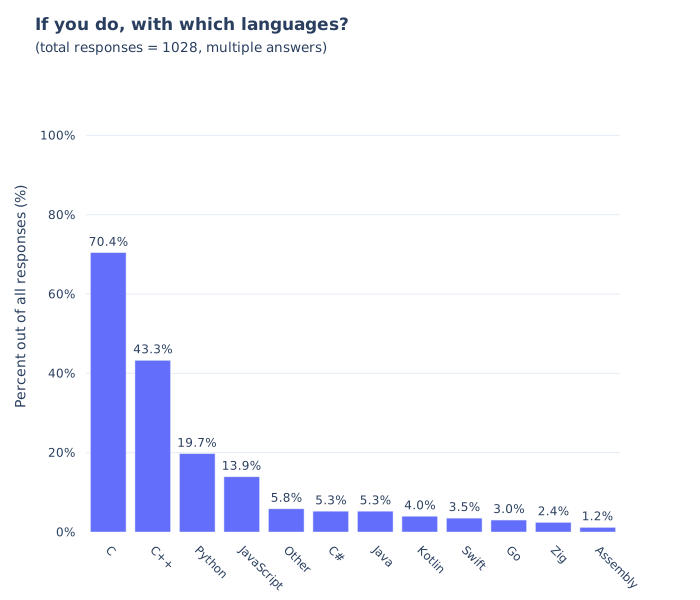
Note that currently, linker_messages is a special lint that is not affected by the warnings lint group. This is intentional as rustc generally doesn't control linker output as precisely, and it's not uncommon for output to only appear on some platforms. If you are seeing what you think is a false positive output from the linker, please file an issue.

To silence the warning in the mean time, you can configure the lint level to allow. This can be done through Cargo.toml by adding a lints section like this:

[lints.rust]
linker_messages = "allow"

Stabilized APIs

These previously stable APIs are now stable in const contexts:

Other changes

Check out everything that changed in Rust, Cargo, and Clippy.

Contributors to 1.97.0

Many people came together to create Rust 1.97.0. We couldn't have done it without all of you. Thanks!

show more
crates.io: development update
Published: 2026-07-13 00:00:00 | Created: 2026-07-23 05:23:40

Another six months have passed since our last development update, and the crates.io team has been busy. Here's a summary of the most notable changes and improvements made to crates.io since then.

Source Code Viewer

Crate pages now have a "Code" tab that lets you browse the contents of published crate versions directly on crates.io. This shows you the exact files that cargo downloads when you add a crate as a dependency, which might differ from the linked repository. This makes it much easier to audit your dependencies, including files that never appear in the repository, like the normalized Cargo.toml files that cargo generates.

The viewer comes with a file tree sidebar with search functionality, syntax highlighting, and GitHub-style line selection, where clicking or dragging line numbers produces shareable #L10-L20 URLs.

Under the hood, the server now builds a zip file for every published version. Since the .crate files that cargo consumes are gzipped tarballs without random access support, a background job re-packs each of them into a seekable zip archive plus a JSON manifest describing the contained files. Both are served from our static CDN. The frontend then fetches only the manifest and loads each file on demand with an HTTP range request. Because of this architecture, browsing crate sources essentially adds no load on the crates.io API servers. Existing crate versions have been backfilled, so this works for old releases too.

The rendering library behind the code viewer is a diff renderer at heart, and that's no accident: a version-to-version diff viewer built on the same infrastructure is currently in the works. This will allow you to review exactly what changed between two published versions, right on crates.io. Stay tuned!

Untangling crates.io Accounts from GitHub

At the end of May, the crates.io team accepted RFC #3946. Crates.io accounts always have been tightly coupled to GitHub: signing in means "Log in with GitHub", and your crates.io identity is your GitHub username. The RFC changes that. It introduces usernames that are native to crates.io and independent of linked GitHub accounts, as a prerequisite for eventually supporting login via other identity providers.

The implementation of crates.io usernames has started, but there is still a lot left to do, most visibly the ability to change your crates.io username. After that is complete, there will be future RFCs and implementation for signing in with identity providers other than GitHub. Since all of this touches authentication and account security, we are deliberately taking it slow and rolling these changes out in small, carefully reviewed steps.

Advisories and Suggestions

In our January update we introduced the "Security" tab, which shows security advisories from the RustSec database. We have since taken this integration one step further: crates that RustSec has flagged as unmaintained now show a warning banner directly on their crate pages, linking to the corresponding advisory for details and possible alternatives. Thanks to Dirkjan Ochtman for implementing this feature!

Unmaintained warning banner on the ansi_term crate page

Related to this, some popular crates have been largely absorbed into the Rust standard library over the years, like lazy_static, which has been superseded by std::sync::LazyLock since Rust 1.80. Crate pages of such crates now show a friendly "You might not need this dependency" banner describing the standard library replacement, and superseded crates in dependency lists get a small light bulb icon with a similar hint.

The dataset behind this feature lives in the new rust-lang/std-replacement-data repository, together with a documented inclusion policy: standard library replacements only, every entry must cite the stable std, core, or alloc API and Rust version, and crate maintainers get a notice-and-comment window before an entry is added. New entries can be proposed upstream and can benefit other tools too.

Ferris

The most delightful change of this cycle: the Ferris on our error pages now follows your mouse cursor with its eyes:

Ferris' eyes following the mouse cursor on the error page

Getting a 404 error on crates.io is now slightly less sad.

Svelte Frontend Migration Completed

In our January update, we announced that we were experimenting with porting the crates.io frontend from Ember.js to Svelte. This experiment has concluded successfully: the new frontend reached feature parity, went through a public testing phase in April, became the default at the beginning of May, and the Ember.js app has been removed from our repository.

We designed this change to be invisible for our users, since the new frontend is a 1:1 port of the previous design and functionality. For the team and our contributors, however, it is a big deal: the frontend is now built on a more modern framework, which should make it easier for new contributors to get started. It also allows us to iterate faster, as the source code viewer above demonstrates.

We want to thank the Ember.js team for a framework that served crates.io well for many years, and the Svelte team for making the transition so enjoyable.

Miscellaneous

These were some of the more visible changes to crates.io over the past six months, but a lot has happened "under the hood" as well:

  • Search performance: Relevance-sorted search queries previously ranked every crate matching the query, which could take 1-2 seconds for short or common search terms. Ranking is now bounded to the 1,000 matching crates with the highest recent download counts.

  • Reverse dependencies performance: The reverse dependencies endpoint no longer recomputes the full dependent set on every request. It is now served from a precomputed table kept in sync by database triggers, turning an expensive join into a bounded index scan and greatly reducing the chance of getting a timeout error.

  • New ARCHITECTURE.md: If you've ever wondered how crates.io actually works, our ARCHITECTURE.md document got a complete rewrite. It is now organized around the high-level systems that make up crates.io and how they fit together, and includes walkthroughs of what happens when you run cargo publish, why a typical crate download never touches our API servers, and how download counts are derived from CDN access logs.

  • Definition lists: READMEs now render Markdown definition lists, a widely used Markdown extension. Our markdown renderer comrak already supported them, the extension just wasn't enabled yet. Thanks to @mistaste for this contribution!

  • CDN cache tags: Files uploaded to our static CDN now carry cache-tag metadata, allowing us to invalidate all cached files of a crate or a specific release in a single operation, instead of issuing one invalidation per file URL.

  • Caching improvements: We removed a global Vary: Cookie response header that was preventing our CDNs from caching public API responses and frontend assets effectively. Per-user responses now use Cache-Control: no-store instead, resulting in better cache hit rates at the CDN edge.
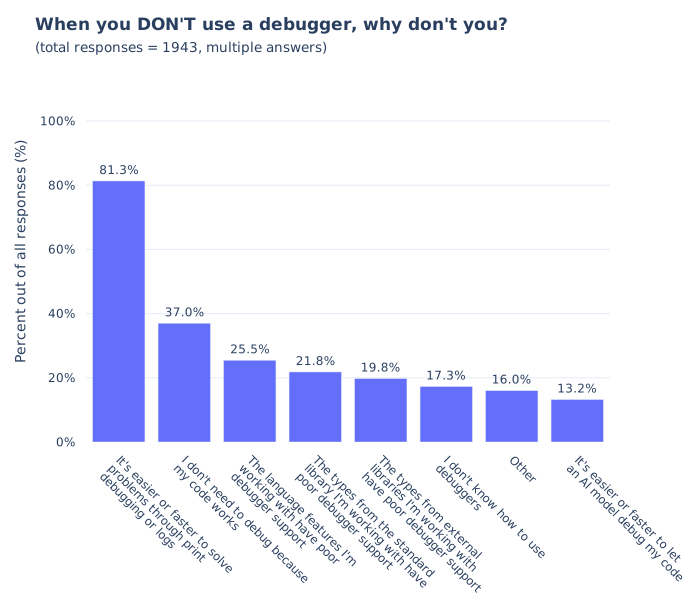
  • Accessibility: We have made crates.io friendlier to screen readers: decorative icons are now hidden from the accessibility tree, heading hierarchies have been fixed, and lists are marked up as proper lists. ARIA snapshot tests now ensure that regressions can't slip in unnoticed. We plan to continue to improve crates.io accessibility over the coming months.

  • Git index performance: The background worker's local clone of the git index is now a bare and shallow repository, eliminating roughly 250,000 checked-out files and the full commit history from its disk, improving its performance as we see increased rates of crate publication. The periodic index squashing now goes through the GitHub API instead of generating large git packs locally, which had previously caused out-of-memory failures on the production worker.

Feedback

We hope you enjoyed this update on the development of crates.io. If you have any feedback or questions, please let us know on Zulip or GitHub. We are always happy to hear from you and are looking forward to your feedback!

show more
Announcing Rust 1.97.1
Published: 2026-07-16 00:00:00 | Created: 2026-07-23 05:23:40

The Rust team has published a new point release of Rust, 1.97.1. Rust is a programming language that is empowering everyone to build reliable and efficient software.

If you have a previous version of Rust installed via rustup, getting Rust 1.97.1 is as easy as:

rustup update stable

If you don't have it already, you can get rustup from the appropriate page on our website.

What's in 1.97.1

Rust 1.97.1 fixes a miscompilation in an LLVM optimization.

We have backported both an LLVM fix and a disable of the underlying change in Rust 1.97.0 of Rust's generated IR that increased the likelihood of this happening. However, note that the underlying miscompilation has been present since at least Rust 1.87.

If you'd like to help us out by testing future releases, you might consider running your code's CI or locally using the beta channel (rustup default beta) or the nightly channel (rustup default nightly). Please report any bugs you might come across!

Contributors to 1.97.1

Many people came together to create Rust 1.97.1. We couldn't have done it without all of you. Thanks!

show more
Page 1 of 1 (17 total items)