RSS Feeds
Google’s first data center satellite is online and writing poetry
Alphabet loses $428B after stock plummets; Binance's colossal $6.3B hack
Republican, Democratic strategists weigh in on midterm expectations
Former non-league football club boss admits offences linked to rape of woman drugged by husband
Leo XIV has become the first pope in history to vote in a U.S. general election
The midterms preview
Is brown rice really healthier than white rice?
Traffic Control Errors Caused Spain’s Deadly Train Crash, Official Says
Disclosure of fired general's polygraph may have violated privacy laws
The Pulse: Time to rethink software security because of AI?
Hi, this is Gergely with a bonus, free issue of the Pragmatic Engineer Newsletter. In every issue, I cover Big Tech and startups through the lens of senior engineers and engineering leaders. Today, we cover one out of four topics from last week’s issue of The Pulse. Full subscribers received the article below eight days ago. If you’ve been forwarded this email, you can subscribe here.
It’s been an absolutely wild few days, with security breaches and major security vulnerabilities being exposed worldwide across tech. Many incidents took place on Tuesday and Wednesday of this week. We’ll start with a brief summary, then look closer at three of them:
- Intermediate CA certificate compromised: eight private 384-bit keys issued by eMudhra – which is an intermediate Certificate Authority (CAs) – leaked, meaning that servers in server-to-server communication can face man-in-the-middle (MITM) attacks. Any internet communication not going through modern browsers (that already patched this) could be risky.
- PHP: Unpatched servers risk remote code execution (RCE) and opening up access for attackers. Around 70% of all websites run on PHP and unpatched systems are at risk. Two critical security patches have been released.
- Railway: customer secrets stored on the service were leaked and some have been decrypted. Secrets exposed can include access to production systems, enabling attackers to potentially access customer systems.
- GitLab: Unpatched GitLab servers are at risk of an attacker gaining full access. A critical security patch for RCE has been released.
- Node.js: Unpatched servers are vulnerable to remote execution attacks. A new release fixes 10 critical vulnerabilities (CVEs), including one that allows for RCE, and another fix revokes the compromised eMudhra intermediate certificate.
- Go: a new release is out, adding a mitigation for the compromised eMudhra intermediate certificate.
- TiDB: attackers gained near-total access to the complete control plane systems of the managed TiDB provider, PingCAP, for a whole month (!!). The attacker released 10TB of customer-sensitive data, including from Booking.com, Airbnb, Pinterest, Databricks, and more such as SQL queries that customers ran, billing, contacts, and source code for PingCAP’s systems The breach lasted from 9 Sept until 7 Oct, but was only disclosed this week. PingCAP claims no customer data stored inside TiDB was accessed, but I find it hard to see how the company will avoid losing security-conscious customers. This incident shows that the absence of adequate access monitoring and alerting can be an open invitation for attacks lasting weeks.
With that, let’s get into the first three incidents in the list.
eMudhra CA compromise
Certificate authorities (CAs) are organizations that vouch for identity on the internet. When a browser, phone, or server pings a site like chase.com or revolut.com, intermediate CAs and digital signatures verify that you really are talking with the bank’s server, and not a fake one set up by an attacker with the purpose of stealing users’ credentials. This is where the HTTPS protocol comes into play, with root CAs, intermediate CAs and the TLS handshake.
The whole system is built on a chain of trust and verification: we trust the root CAs and their certificates, and so we can trust the signatures of the intermediate CAs. The assumption is that both the root CA and intermediate CAs are trustworthy and verifiable.
But eMudhra broke this trust in the most blatant way: its private keys turned out to be single-digit numbers. A private key is a 384-bit key, which means that it would be a number between 0 and 2^384, (a number with 116 digits!)
Except, the key turned out to be the number “4.” Yes, that’s right: the number four. What on earth was eMudhra doing?! It’s as if they chose random numbers between 0 and 384, not 0 and 2^384! It is quite literally comical: in 2007, an XKCD comic described exactly this choice:

And the other keys were also not that much better: 56, 66, 115, 156, 230 and 237! It’s as if eMudhra generated an 8-bit private key, not a 384-bit one.
eMudhra explaining how these keys were generated (emphasis mine):
“We have done some preliminary assessment, there appears to be a flaw in the KGC [Key Generation Ceremony] script that was used on that specific day to create these ECC issuers. As for these ECC keys [elliptic-curve cryptography key pairs], our review of the KGC, assessment of the code and view of HSM [Hardware Security Module] keys so far indicate that a) a set of original ECC keys were created onboard as expected b) an approved deviation to our usual KGC to test a wrap/unwrap was introduced as these keys were meant for export for this instance c) a flaw in the code resulted in the second pair of keys being created onboard which were weaker d) these second pair of weaker keys were used by mistake to create the CSR [Certificate Signing Request] (because the key labels were similar) and signed by our root e) the CSR from these weaker keys were also sent over to Sectigo for cross signing (we verified the files sent over to Sectigo)
The RSA issuers went through a different path as per our assessment of the code and are therefore not impacted.
Some additional context - these issuers were meant for export to our US and European data centers to solve data sovereignty issues for some of our customers (but never ended up operationally in production except for one).
We are still assessing the code to see steps where this process went wrong.”
I have so many questions:
- How does eMudhra test generated keys? There seems to have been no automated testing of the key in place at all, in order to discover that these numbers were not “random” from a flaw in the key generation ceremony
- How did eMudhra not notice this on day one, when the Key Generation Ceremony went wrong? If this was an automated process, the script would’ve changed from one day to the next, which would raise questions. If the process was fully manual, it explains how the mistake would be missed. And if it was manual, then why? Also, where are the detailed audits for such an important process?
- The certificates with the easy-to-guess private keys were generated on 30 April 2025, so why did eMudhra not spot the mistake for 18 months?
Carelessness in the creation of intermediate certificates risks reputational damage to eMudhra’s business as a certificate authority. Google Chrome announced it is evaluating whether to continue with the company:
“Due to the seriousness of this incident, the Chrome Root Program is closely investigating the ongoing inclusion of eMudhra’s remaining CA certificates in the Chrome Root Store and will share further updates in public forums (e.g., the Common CA Database Public list) as our evaluation progresses.”
Given eMudhra’s sole business is in issuing digital certificates, being dropped by Chrome as a CA could be crippling. eMudhra is a publicly traded company on the Indian stock market, and two days before the breach was revealed its market cap was close to $500M. After details of its incompetence in creating certificates emerged, the company lost 40% of its value in two days.
PHP exploit: AI model beats attackers to finding critical vulnerability
The PHP situation is interesting because the “good guys” in this case (the security researchers) found a critical vulnerability in the framework before attackers did. From OpenAI:
“Over the past two months, we led a coalition of maintainers, researchers, and security providers to address critical vulnerabilities in PHP, an open-source programming language used to run websites and web applications. Calif [a respected security team] identified a critical flaw using GPT‑5.6 Sol as part of our Patch the Planet(opens in a new window) initiative, with Wiz [a security company] also independently discovering and reporting both vulnerabilities. PHP’s maintainers led the fixes and release, with our teams and partners like Wiz, Cloudflare, and others contributing research, technical support, and coordination to prepare protections ahead of disclosure.”
On the surface, this is great news! Critical vulnerabilities were found and can now be patched, thereby closing the door before attackers can exploit them. Right..?
The problem of critical vulnerabilities for open source software is that systems which aren’t immediately patched can be exploited. When the PHP team released the fix for these two vulnerabilities, attackers got details about the vulnerabilities: the code itself shows where the attack can be inititiated! In the case of PHP, that means attackers can now easily execute remote code on any PHP server that is as yet unpatched.
Around 70% of all websites run PHP servers, which is a massive attack surface. We can be confident that many sites won’t update their PHP versions for days, weeks, months, or even years.
This particular vulnerability was so severe that before the security patch, the National Security Agency (NSA) in the US issued guidance urging websites to immediately patch upon release, or take applications fully offline until patched.
Exploits began hours before the fix was announced. It was known in advance that a major vulnerability fix was coming for PHP, and somehow, the vulnerability leaked from the group that disclosed and fixed it. Cloudflare was in the group that worked on this problem and created tooling to monitor and block exploit attempts. From Cloudflare CEO Matthew Prince:
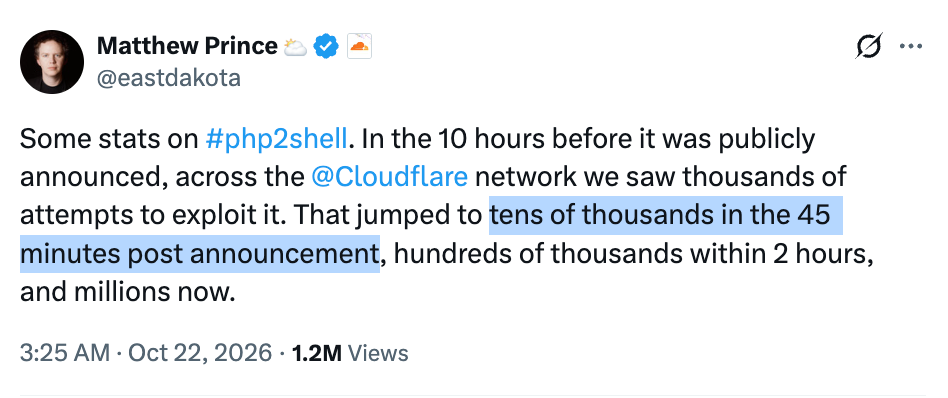
Amazon detected exploit attempts days before the fix. From AWS:
“Amazon Threat Intelligence identified a PHP2Shell exploitation attempt dating to Oct. 17, 2026, in MadPot telemetry, four days before public disclosure of CVE-2026-109618 and CVE-2026-109619. The exploit attempt originated from an IP address associated with a commercial anonymization network. While the vulnerability was under embargo, the targeting of a honeypot from an anonymized IP address suggests the activity was conducted by a threat actor, though it remains unclear how the actor acquired exploit information prior to disclosure.”
Attackers now have AI agents to automate and speed up attacks. Now that the vulnerability is known, attackers can simply spin up agents, instructing them to attempt to exploit servers that have not applied the patch. This probably explains why Cloudflare saw millions of exploit attempts just a few hours after the patch was released.
Railway’s customer secrets leak
Elsewhere on the same day, developer-first cloud provider Railway was hacked and the environment variables (secrets) of its customers were exposed. From the company:
“Our investigation to date indicates that an unauthorized third party may have accessed encrypted environment variables and, for some of them, obtained the decrypted contents. Environment variables may contain secrets such as API keys or database and registry credentials.”
Immediately after detecting the breach, Railway took decisive action by notifying customers and the public, and pausing all deployments.
Pausing deployments created a huge headache for customers, who could not rotate their keys without crashing their systems running on Railway. Also from Railway:
“We strongly recommend that you immediately roll all environment variables, including any API keys, stored in Railway, as well as any private registry credentials, and review logs for those services for unusual activity.
All deployments are paused while we investigate. Until builds are restored, you will not be able to roll out new versions. We apologize for this inconvenience. Follow this incident to be notified when builds resume.”
This is contradictory: rotating environment variables – say, a database access token – means that the application using the old variable stops working until a redeploy. However, Railway has paused deploys! So, customers of Railway had two choices:
- Rotate keys (the responsible step) and deliberately crash their application or take it offline (irresponsible)
- Don’t rotate and hope their key was not leaked – (irresponsible) – and let their application continue to operate (responsible)
Of course, it’s clear why Railway is pausing deployments after the environment variables leaked, and the team must ensure that new variables added by customers do not leak.
In the end, it took Railway close to 20 hours to resolve the problem and allow deployments again. During that time, they unfortunately gave security-conscious customers an impossible choice of bricking their service while rotating keys, or ignoring security best practices to keep services running.
Can we expect future ‘deluges’ of security incidents?
AI labs did warn of a looming “security tsunami” fueled by the technology in May 2026, as per CNBC:
“Dario Amodei warned Tuesday [5 May 2026] that artificial intelligence has created a narrow window for the world’s tech firms, governments and banks to fix tens of thousands of software vulnerabilities found by his company’s latest model.
That AI model, Mythos, was previewed last month along with the disclosure that it had unearthed decades-old vulnerabilities in crucial software.
Since AI models from geopolitical adversary China are “maybe six to 12 months” behind the Anthropic product, there is “roughly that amount of time” to fix these issues, Amodei said.
“The danger is just some enormous increase in the amount of vulnerabilities, in the amount of breaches, in the financial damage that’s done from ransomware on schools, hospitals, not to mention banks,” Amodei said.
Anthropic has limited Mythos to a few partner companies because of concerns about what criminals or adversarial nations could do with it.”
Around that time, I talked with “AI-pilled” devs – some with access to the Mythos model – who told me the same: they expect the security landscape to become very bad in the coming months, with record numbers of systems being breached. One engineer said he’s moving many of his secrets like 2FA backup phrases off cloud storage services and onto paper because he expects cloud storage services to also be breached.
This week, it has seemed like the prediction in May has come to fruition, much of it done with AI’s help. A few days ago, on 17 October, OpenCode was breached and its customer secrets – AI API keys – stolen. Cofounder, Dax Raad, shared that the company has been under constant attack, in his reply to Railway:
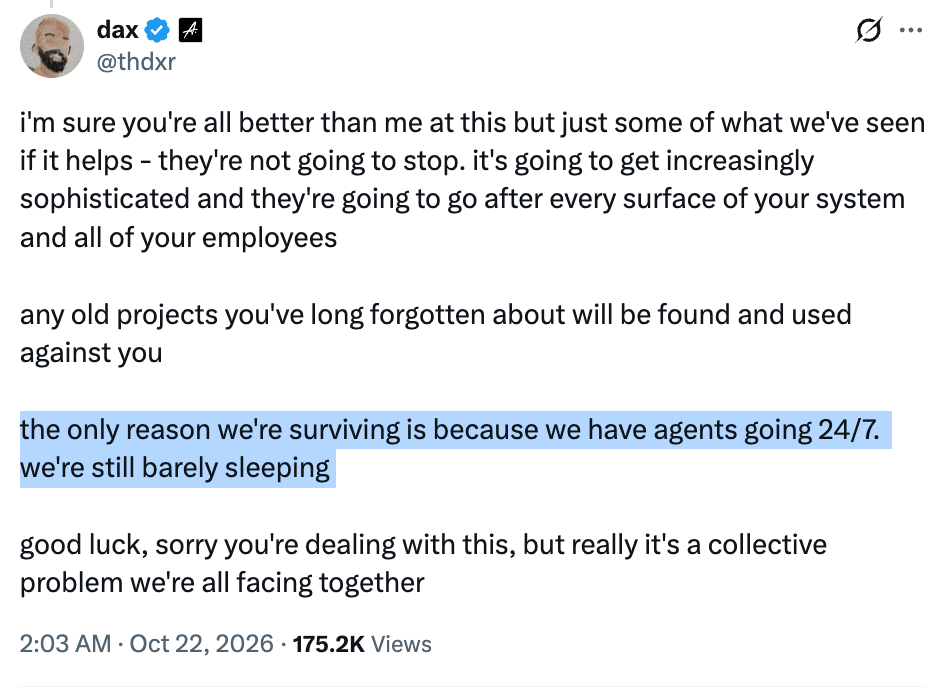
Attacks much easier & defense much harder with AI
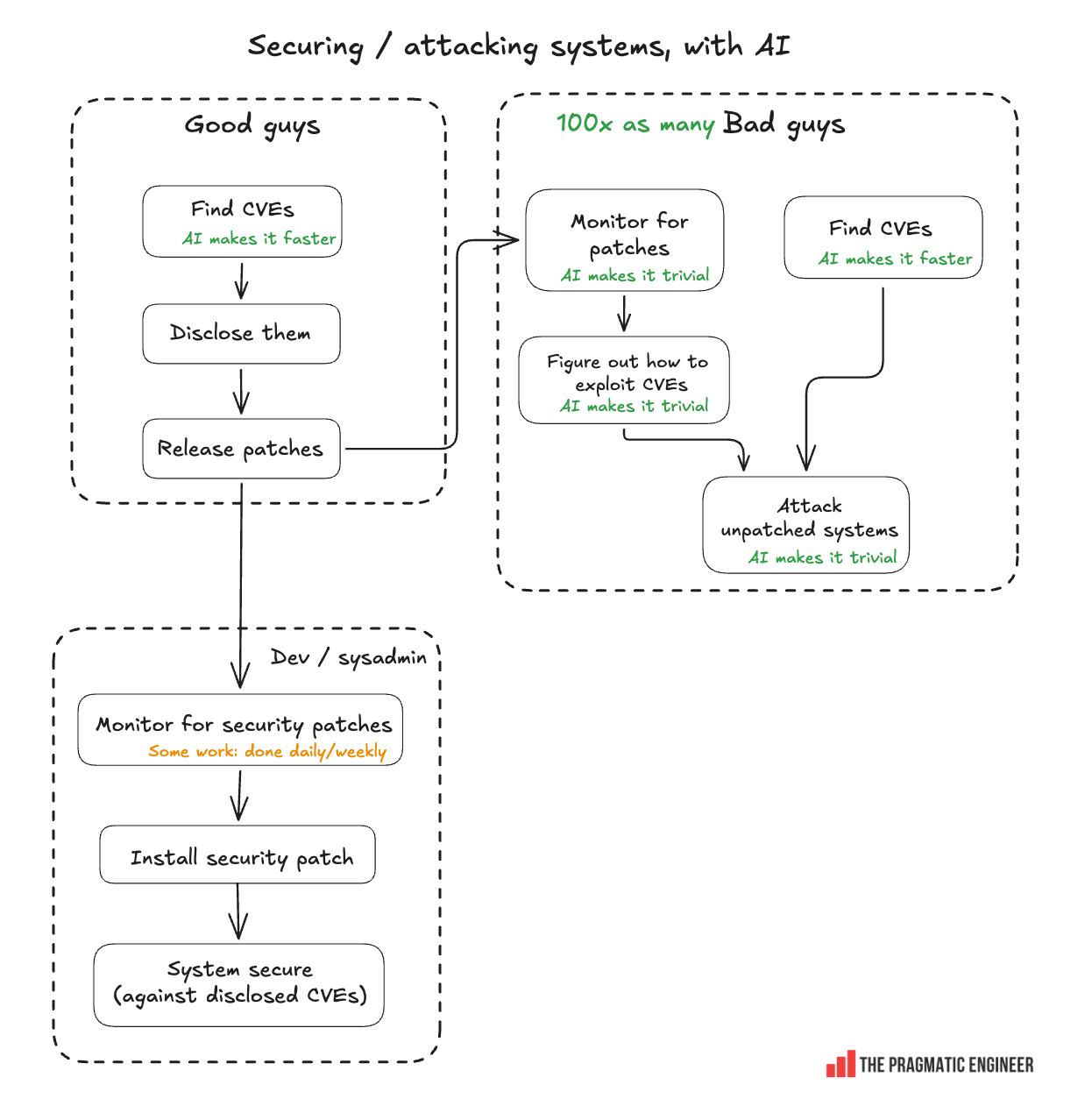
I sense the balance of power between the good and bad actors in this space is shifting because of AI. Let’s see what it took for an attacker to get access to a system before AI existed, via a critical vulnerability exposure (CVE) – disclosed or not:
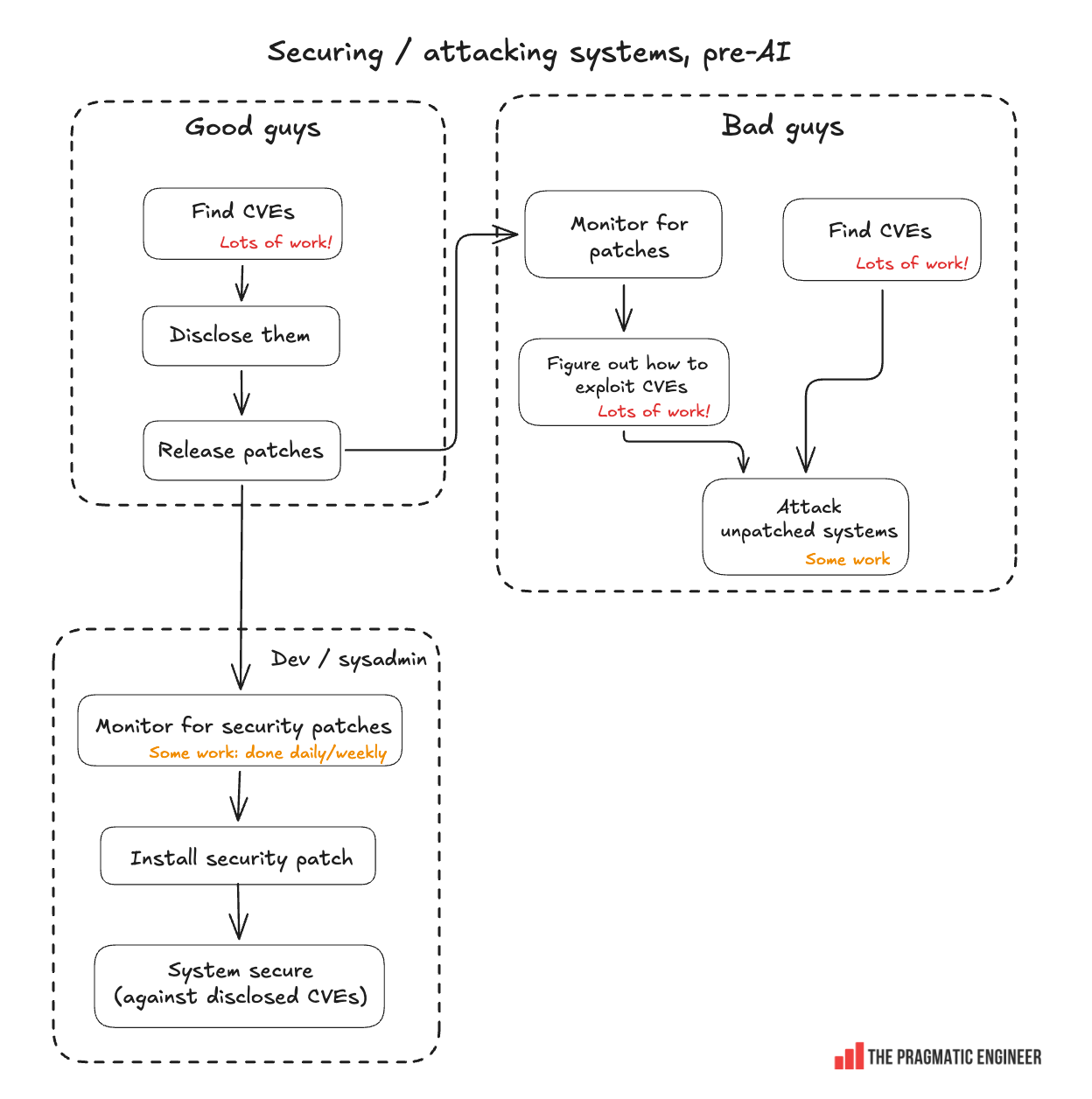
With AI, finding critical vulnerabilities is easier for everybody, including bad actors who can automate attacks as well, and do so easily. The change:
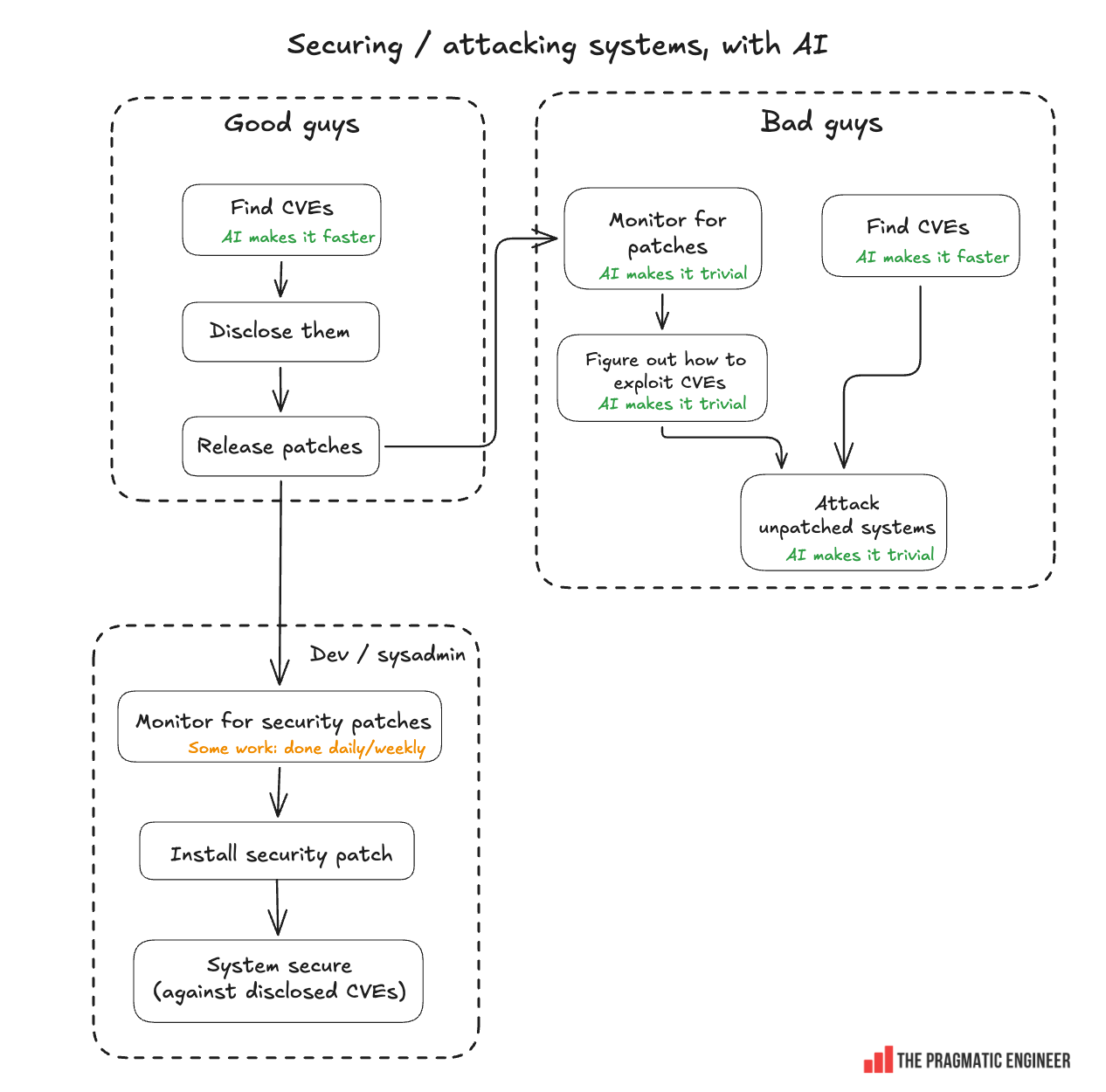
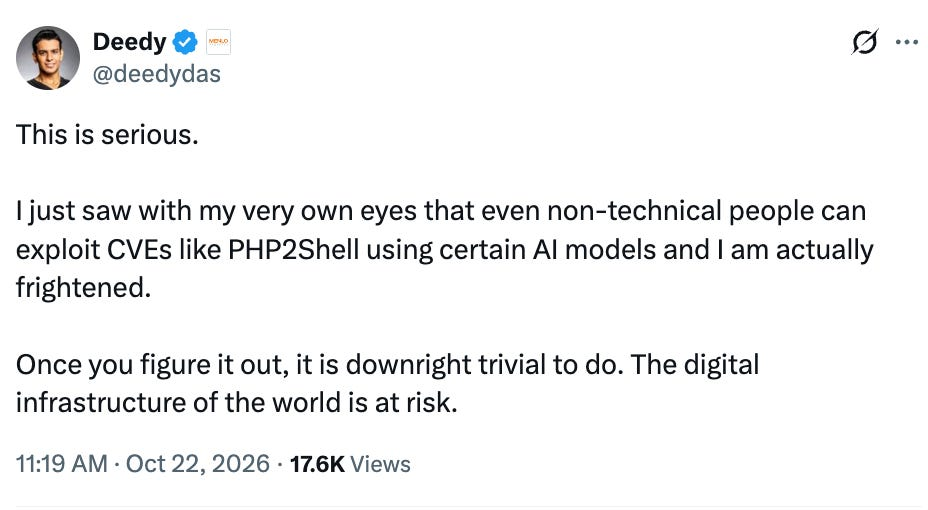
It gets worse: before AI, it took quite some skill to be an effective attacker: you needed to be a good-enough coder, understand concepts like buffer overflows, and also learn techniques for executing remote code execution attacks. With AI, none of that applies. Venture capitalist, Deedy Das, described it as scary that nontechnical people now have the tools to easily exploit known CVEs like the PHP one:
So, let me update the diagram to account for the drastic lowering of the bar to becoming an effective attacker:
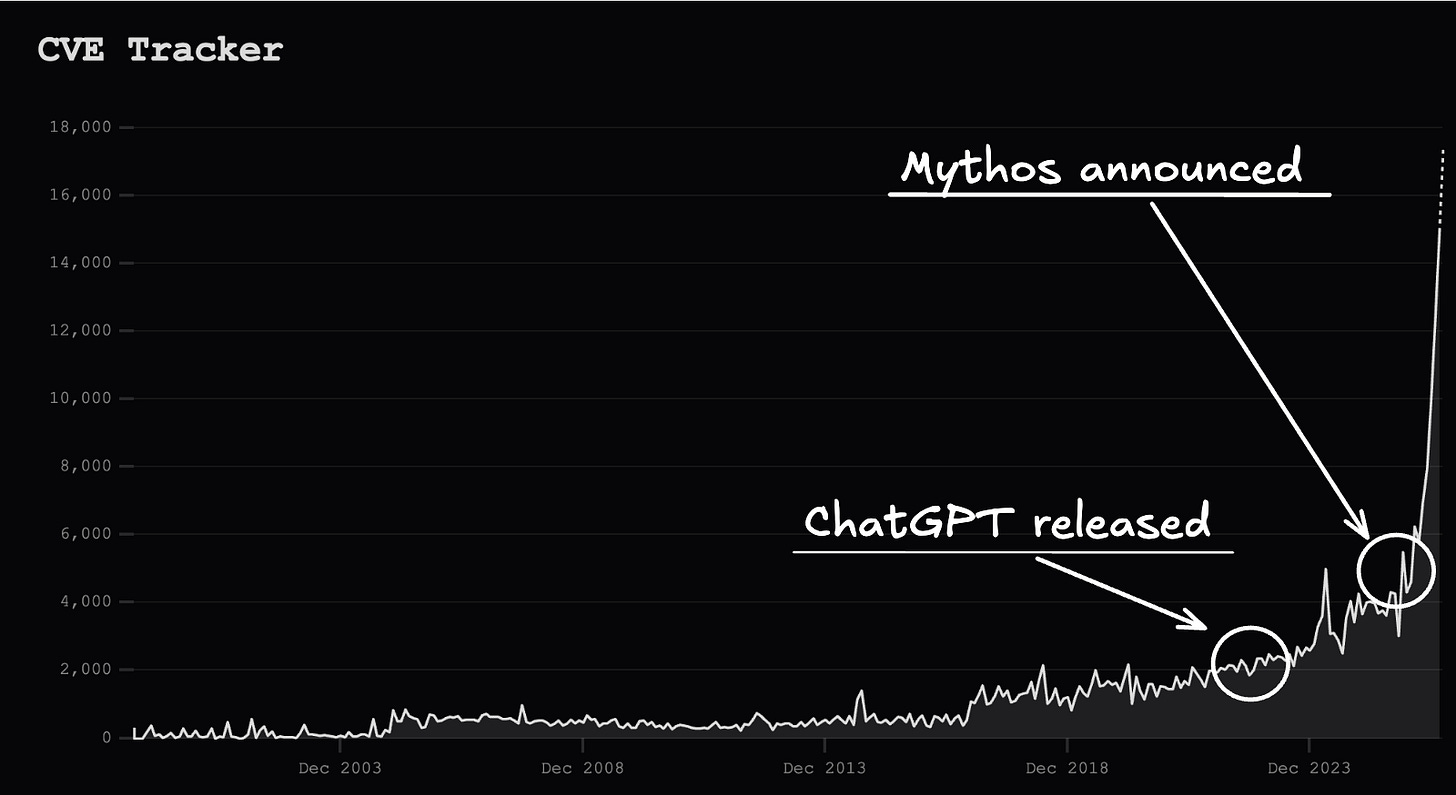
And we see all of this playing out in practice, starting with publicly disclosed CVEs skyrocketing:
We may need to urgently rethink software security for all systems:
- Automated patching: manual monitoring for patches on a daily/weekly basis will become as irresponsible as applying patches months or years after release. Of course, automatic patching has its own risks, such as if a vendor providing a patch is breached, or a patch causes an outage, etc.
- Expect attackers to use day-zero CVEs. Attackers will increasingly have access to undisclosed vulnerabilities and will access systems externally, or even execute code remotely.
- Ongoing automated security monitoring to be non-negotiable. To detect security breaches, you need a decent level of automated logging and monitoring. This needs to be in place sooner rather than later. The TiDB incident this week shows what happens when a company allows an attacker to freely access their system for a month.
- Defenders will have to use more AI. Attackers are gaining advantage by using AI agents, so defenders will have to do the same. There are no best practices in this field, but there are likely to be lessons in how companies like OpenCode, Railway, and PingCAP are responding – if they share their approaches.
- Securing services and software will become more expensive. Continuously running AI agents to monitor for and mitigate breaches costs money, as do security engineers who are “AI-native.” This all increases the cost of security engineering. We previously covered security engineering basics and did a podcast on code security.
... and the security incidents continue
Since publishing the original article on 22 October, there have been more:
- The Brotli remote execution CVE: Brotli is a compression library used at Node.js, Bun, Envoy, and others. The flaw allows an attacker to take over a service. Details
- Another PHP remote code execution CVE. Just two days after the high-impact PHP2Shell patches, PHP warned of another important CVE, for which a fix is coming. PHP versions will need to be updated fast again.
- Linux CVEs posted publicly. Several unpatched Linux kernel vulnerabilities were accidentally posted on the public kernel mailing list. Details.
- Python Pillow CVE: a vulnerability inside the Python Pillow image library lets an attacker issue OS commands. Details
- … and others I’ve doubtless missed.
At this rate, we might start getting “vulnerability fatigue” and become numb to critical security vulnerabilities unless they affect frameworks our applications use. To avoid that, it’ll be necessary for the industry to improve at coming up with and implementing security practices which work in a security environment where AI speeds up the discovery, publication, and exploitation of vulnerabilities.
Read the full issue of The Pulse this is from, or check out this week’s The Pulse. This week’s issue covers:
- Anthropic kills its coding interview. A team at the leading frontier AI company gets zero signal from DSA interviews and so has removed it from the engineering recruitment process. The rest of the company, and other AI-native startups, could follow.
- Details on incident.io’s AI spend and ROI. The resiliency startup has slashed the amount it spends on AI; down from $4,500 per dev, per month, in August, to $1,600 now.
- Amazon formally incorporates AI usage into SDE and SDM expectations. AI has been placed at the heart of software engineering after the company found a correlation between AI usage and productivity. Also, software development engineers (SDEs) and managers (SDMs) must be close to customers.
- Microsoft issues new exit offers to engineers. The tech giant has offered 60,000 employees the opportunity to quit by the end of the year. But the exit package is not particularly tempting, and so the number of people who take it will surely be in the thousands, not tens of thousands.
Football Daily | Newcastle’s Jaissle wants to scream while Grealish leaves Moyes speechless
Sign up now! Sign up now! Sign up now? Sign up now!
While it is customary for fans of top-flight clubs with delusions of grandeur to cope with Fizzy Cup exits by pretending the competition is beneath them, this is no longer an option that is open to supporters of Newcastle United. Winning the trophy sponsored by a low-calorie, fruit-flavoured energy drink brand from Thailand may only rank fifth in the domestic pecking order behind the Premier League, FA Cup and both transfer windows, but nobody will ever forget how much it meant to hundreds of thousands of overjoyed Geordies when their team did exactly that the season before last to end a trophy drought dating back to the Jurassic era. And with a quarter-final trip to the tough-tackling League Two bullyboys of Fleetwood up for grabs during their match against serial trophy-dodgers Everton last night, the travelling Toon Army must have fancied their chances of being in the shake-up again.
I clearly remember the first time I laughed out hard and loud, as a 12-year-old, reading Three Men in a Boat by Jerome K Jerome. Tonight, 50 years later, after a stretch of horrendous bad years and months (and for my mental health, I exclude the struggles of Tottenham), I read the Football Daily column. Its is often quite witty, but this time, reading about some penalty kick gone awry … I know, I have a simplistic sense of humour, but I laughed so hard and cried at the same time, that my family wondered what happened. Thanks for a cathartic experience. Words” – L Json.
As a Spurs supporter who saw my first game at White Hart Lane when I was five years old – almost eight decades ago – I can only express my relief that attention has drifted away from the continual ridicule of my team. The fact that a certain club that should return to south of the Thames managed to lose at Highbury (ironically), that lot from down Kings Road and Manchester United are all hogging the headlines for all the wrong reasons just makes life sweeter. It’s time for my second nap of the day now, so I’ll sign off” – Stewart McGuinness.
This is an extract from our daily football email … Football Daily. To get the full version, just visit this page and follow the instructions.
Continue reading...Judge warns DOJ against 'dawn raid' to arrest James Comey
From her own Barbie doll to bench - how Ellie Kildunne slipped from Red Roses' XV
ICE officer who struck man with vehicle during pursuit indicted: DA
What Howe could bring to Man Utd - and what are the challenges?
U.S. to Send Dozens Back to Afghanistan, Despite Risk of Persecution
Israel's election results are in. Here's what could happen next
John Turturro Will Pick Your Pocket and Steal Your Heart

If it seems like no one else could play the role John Turturro plays in The Only Living Pickpocket in New York, you can imagine the angst writer-director Noah Segan felt when he sent the screenplay to the actor hoping for a “yes.” Turturro brings world-weariness, tenderness, and New York City street smarts to his turn as Harry, a career criminal whose way of life is disappearing in a cashless, electronic, often colder world. The character may steal to put food on his table, but he’s also loyal and honest in his own way, caring for a permanently disabled wife and practically a saint when compared with the tech-enabled, mafia nepo baby (Will Price) he makes the mistake of stealing from, setting off the movie’s drama and putting his life in jeopardy.
Turturro, who has been a ubiquitous presence in film, TV, and theater for decades, truly seems to be everywhere these days—in an acclaimed production heading for Broadway, in Severance, whose fans eagerly await a third season, in the forthcoming climate-change dramedy A Statement from Spotlight director Tom McCarthy, and of course anywhere the Knicks are. With Pickpocket, he could very well land his first Oscar nomination in a career full of performances that have certainly qualified for consideration, from Barton Fink to Quiz Show to more Spike Lee films than any other actor has appeared in.
Ahead of the theatrical release of The Only Living Pickpocket in New York, which hit theaters nationwide on Oct. 30, Turturro spoke to TIME about how his hometown has changed, his love for collaborators old and new, and his nerves heading into this year’s NBA season.
Read more: John Turturro Gives a Career-Best Performance in The Only Living Pickpocket in New York

Noah Segan said that when he came to meet you, “We had some soup and fell in love.” Did you need to be convinced to take the part?
I read so many scripts, and so many of them are derivative. Sometimes they're just violent for violence's sake. Someone's seen you do something, and they say, "Well, he could do this.” I said, "Is this as good as I think it is?” I was struck by the structure of it, because I love Greek plays. I love that Aristotelian 24-hour time frame, when something has tension and propulsive movement, an odyssey to survive in a short time, and then it's juxtaposed with this tenderness and the specificity of language. I met Noah, and I liked him. He's a gentle guy, but he has a backbone. When Noah gave me the script, it's like a gift. You want to reciprocate. You want to surprise that person.
Harry is a criminal, but he operates by a code. He’s true to his word. He’s loyal to his wife. Do you see him as an antihero?
I just try to play a person. I’ve read about a lot of these guys. They were from broken homes, orphanages. They didn’t have a family, so they formed this little family with other people who didn’t want to hurt people. Even though it is a violation, it was nonviolent. It was like a magic trick. They’re taking something. But there’s a lot of people who pick our pockets every day. And they take our world sometimes.
The movie has a real nostalgia for the old New York, a more analog time. Do you share that feeling?
Everything changes. You walk down Bleecker Street, all these theaters, nightclubs are gone. It’s CVS. Ethnic neighborhoods aren’t there anymore. It takes away from the texture of a neighborhood. The thing I miss is things being affordable. When I was young, even if I sat in the back, I could see anyone. Jimi Hendrix at the Electric Circus. Colleen Dewhurst or George C. Scott. I got an education that way, while I was getting a [formal] education, and it opened up my horizons of thinking someday I could make a living doing this.
The city also feels different from decades past because we’re all staring down at our phones instead of looking at each other as we walk down the street.
There's so many people. We're all going somewhere. And there's plenty of people that aren't there. There's a lot of people gone now from all different generations, and you're more and more surrounded by ghosts. In my phone, I don't take people out because maybe I need the number in the afterlife or something. You just understand that there is a clock to our lives, and what you give is also important. It's not just what you take, and I believe in that.
The movie was filmed in every borough, right? It doesn’t feel like a gimmick, but something that could plausibly happen in this character’s life.
The guy is sort of a superhero. He knows the transit lines, the buses, the subways. He doesn't take Ubers. I take subways and I walk everywhere. I love it when I go to an event and everyone's sharing that on the train. It’s kind of about the underbelly, the people keep the city humming. Even though this is not a film about the working class, it is, sort of. The elevator doesn't work. The heat isn't so great. These are real problems, and those people sometimes are not explored as much.
There’s a wonderful scene where Harry dances to the song “Native New Yorker” for his wife Rosie, who is disabled and non-verbal. Was that improvised?
I like to dance. I studied dance. In my household, everybody was dancing, three boys, my mom was a great dancer. I used to go out dancing to that song. When people are incapacitated, you play music, you sing, you dance. It’s a love scene. Movement, especially when it’s not overly choreographed, brings joy. Even in intense stories, people stop to do things. They stop to eat. They stop to have a laugh.
You go way back with two of your co-stars, Giancarlo Esposito, who plays a detective who’s almost like a colleague of Harry’s, and Steve Buscemi, who owns the pawn shop where he brings his stolen wares. How did that come about? Did you suggest them?
Yeah, we talked about it, and I asked Giancarlo to read it. And Steve and I know each other. We've been neighbors. He's a beautiful guy. He's a beautiful actor. We have a history there, so it's not like we have to invent that. So that was helpful in the movie.
You and Tatiana Maslany, who’s also in this film, just finished the play Rhinoceros together. Do you like to get back to the theater every once in a while to sort of sharpen the tools?
That’s where I come from. I love the rehearsal process, if it’s a very open one, which we did in Rhinoceros with [director] Diane Paulus. We explored everything. It’s exhausting, I don’t want to do a run for half a year. But I love doing things that young people can come to and afford. It’s real teamwork, and I think it’s kept me fresh for doing film work. It’s humbling, and it’s nerve-racking, and it’s also exhilarating when you’re able to keep your balance.
There’s so much love for your character Irving on Severance. And fans really obsess over this show with conspiracy theories. Have you been a part of something like that before?
I love Irving too. I have enjoyed working with the entire group, and especially with the apple of my eye, Chris [Walken]. Severance poses questions of work life, personal life. Maybe it resonates in the world. Maybe even more now with all this AI stuff. I think one of the strengths of the show is that it poses these questions and doesn’t answer them. When you answer it, it’s not as satisfying as figuring it out.
As a prominent Knicks fan, how are you feeling about this season?
I feel hopeful. I’m not overconfident. It was beautiful how they all coalesced. I treasure being a fan and a season-ticket holder. I’m still soaking it all in. My favorite thing was coming home on the train, everyone just being in shock. It’s great when people come together.
Correction, Oct. 30
The original version of this story misstated which season of Severance is forthcoming. It will be the third season, not the fourth.
ICE officer charged in Texas after allegedly hitting man with vehicle
Daylight Saving Time for 2026 Ends on Halloween Weekend
FDA again bypasses advisers to remove black-box warnings from menopause treatments
Some experts express concern about ‘lack of transparency’ as agency removes warnings on three estrogen patches
Three more patches for treating menopause will no longer carry black-box warnings about cardiovascular disease, breast cancer and dementia, officials at the US Food and Drug Administration (FDA) said on Friday.
The FDA did not convene an advisory committee and offered few details on the scientific basis for the decision in the press briefing. The news follows the removal of black-box warnings from six menopause treatments in February, as patients across the US struggle with shortages of the patches.
Continue reading...Ex-football chief admits offences linked to woman's drugging and rape by husband
‘We are not in Disneyland’: Arteta warns Dowman of Arsenal’s demands
‘We have made these mistakes … you can get punished’
Dowman lost appeal against red card at Fleetwood
Mikel Arteta has warned Max Dowman that he “is not in Disneyland” and must learn from his red card against Fleetwood after Arsenal’s appeal against his three-match suspension was rejected.
The 16-year-old became the youngest player ever to be sent off in the League Cup on Tuesday as the Premier League champions crashed out to the League Two side Fleetwood. Arteta said he was “very disappointed” that the Football Association rejected the appeal against his red card and felt Dowman was lucky not to suffer a broken foot from “reckless tackles”.
Continue reading...I wrote a book about death. Here’s what people really think about dying
In the eight years since my graphic novel on death published, I’ve learned readers of all ages want to talk about loss and preserve their family’s stories
Becoming an author in my late 50s was unexpected, the result of my daughter Hallie’s own existential anxiety in her early 20s.
Fearing my untimely demise, she begged me to write down advice that would cover all of life’s bases going forward. I agreed, but put the project off for years; it wasn’t until she cornered me with a laptop on vacation that I gave in. She asked countless questions, and I found, to my surprise, that I had plenty to say. Hallie helped shape the manuscript, and then spent a year painting its warmly emotional gouache illustrations.
I lost a parent (or other loved one, including spouse or beloved pet) and your book helped me through.
I gave the book to my kids and wrote my own notes in the margins.
I can’t bear the thought of my mom or dad dying, but they don’t want to talk about it. I’m hoping that sharing the book with them will start some conversations.
Continue reading...История одной IT‑разработки: как мы создали софт по рассылке деловых писем

Всем привет! Я Дмитрий Шихаев, маркетолог для IT-компаний. Сейчас работаю с крупными IT-заказчиками, помогаю выводить технологические продукты на рынок и развиваю направление ABM-маркетинга в России.
Но путь к этому был далеко не сладким. Когда-то мы с товарищем Гошей, у которого за плечами были базовые знания BASIC и опыт работы с конструктором BAS, решили практически без денег и опыта создать собственный софт для массовой отправки качественных персонализированных деловых писем.
Сегодня разработчику стыдно вспоминать эту историю, поэтому его лицо скрыто в контенте, а имя изменено. Он вырос в сильного специалиста и мы работаем вместе до сих пор.
А тогда бюджет у нас был как у студента за неделю до стипендии, техническая команда состояла из двух калек - маркетолога без знаний IT-внутрянки и начинающего автоматизатора, зато амбиции были как у всего состава Кремниевой долины.
Читать далееA historic vote born of fear and frustration for Palestinian citizens of Israel
A working-class Alaskan Native takes on a ‘multimillionaire’ Republican for seat in Congress
Independent candidate Bill Hill is threatening to unseat Trump ally Nick Begich with a message of affordability
As Republicans fight to maintain their narrow majority in Congress, they face a unique challenge in Alaska – not from a Democrat, but from an independent commercial fisher and first-time candidate running to flip the state’s lone House seat.
Bill Hill, who is an Alaska Native and has worked in education and construction, has positioned himself as a working-class candidate who will fight to make life more affordable for people like himself and his family.
Continue reading...Pope Leo votes in US midterms in first known political ballot for any pontiff
US citizen Leo, who has clashed with Donald Trump over several issues, submits his vote by post in Chicago
Pope Leo has voted in the US midterm elections – the first time a sitting pontiff is known to have cast a ballot in any political election at any time in history.
Leo, who has clashed with the US president, Donald Trump, over several issues, submitted his vote by post in Chicago, where he was born, the Vatican said on Friday. Leo became the first American leader of the Catholic church last year after the death of Pope Francis.
Continue reading...Last independent newspaper in Russia forced to shut down
Is AI really reshaping the developer market?
No content available
Theranos whistleblower Tyler Shultz warns that the AI boom is ‘a great opportunity to go deceive people’
Burnham's Number 10 North goes on multi-million pound hiring spree
I Covered the Tiananmen Square Massacre. It Still Weighs on Me.
Два бага, 20 часов откатов: как я чинил гонки в M:N-рантайме Nova

На первый баг ушло десять часов и пять гипотез, ни одна не подтвердилась. На второй — ещё десять часов и семь попыток. А потом каждый закрылся за минуты: в одном случае хватило строчки в дампе состояния, в другом — первого запуска с самодельным обработчиком падений.
Три истории о гонках в M:N-рантайме языка Nova: что сломалось, как я это искал и что в итоге нашло баг. Объясняю простыми словами, знать устройство рантайма не нужно, а в конце — чек-лист для отладки гонок в многопоточном коде.
Читать далееHimalayan Communities Are Relying on Centuries-Old Water Solutions In the Face of Climate Change

The word Laya describes the natural rhythm that has carried the people of the Himalayas through monsoons and drought for centuries. Across the peaks and glaciers, the populated mid-hills and the foothills, communities have harmonized their calendars to the pulsing of water.
Where annual rain falls in just four months, these master engineers funnel rooftop rainwater through handmade bamboo piping into gravel pits to recharge underground wells, maintaining them at the annual festivals. They adapt to the climate by unearthing ancient subterranean medieval stone spout networks for drinking, washing, and bathing.
But there’s another Sanskrit word used in Hindi called Pralaya, passed down through oral tradition like Himalayan myth. It means the melting away of places that no longer exist.
“Recent flooding in Nepal was a pralaya,” says hydrometeorologist and environmental scientist Ngamindra Dahal, chairperson of the Nepal Water Conservation Foundation (NWCF) and executive board member of the South Asian Meteorological Association. “We’ve never witnessed anything like it.”
Himalayans have fallen out of sync with nature at no fault of their own. As earth’s largest swath of ice outside the poles thaws from the unprecedented rapid global warming, high- and mid-mountain villages across eight countries of the Hindu Kush and Himalayan mountain regions have entered a new world of extremes: too little and too much water.
The Himalayas are losing glacier mass 65% faster than a decade ago. The impacts will be felt by 2 billion Asians across 12 major downstream river basins by 2050. And by 2100, it’s projected that 80% of glacier mass will be lost. The reality of dangerous cloudburst floods and water scarcity is, however, already being felt.
On Aug. 26, a 55 million-ton, 93-m.p.h. ice-rock avalanche triggered by a glacier collapse in Nepal near the Tibet border killed more than 1,400 people, with thousands more still missing. Meanwhile, the Nepali government will drain four massive glacial lakes to reduce the danger of yet another catastrophic flood.
The vulnerable, historically low-polluting country has been waiting for a response to its request for compensation from high-emitting nations for the damage created in part by this climate disaster. And on Oct. 22, Nepal became the first country approved for a provisional payout from the U.N.’s Loss and Damage Fund, securing over $21.6 million for recovery from the catastrophic floods. Meanwhile, with deepening uncertainty about the planet’s most basic natural resource, Himalayan people forge on charting their own solutions to save their homes by reviving ancient water systems, building artificial glaciers, and uncovering hidden flood risks.
“The Himalaya is often described as Asia's water tower, but that metaphor is dangerously passive if it makes the mountains sound like a stable reservoir. What the laya-to-pralaya concept clarifies is that the Himalaya is a living, dynamic system—and that climate change is compressing geological time,” says Dahal. “What once happened across generations may now happen within one.”
Reviving Lifelines
For centuries, perennial springs, or mool, have dictated how Himalayan communities live their lives. But that trusted relationship is breaking down. Still, resilient Nepali communities are adapting to the shifting environment of melting snow and ice and unpredictable monsoon rain by reclaiming historic infrastructure.
To combat water shortages often from erratic rainfall shifts disrupted by climate change, they’re reviving an ancient network of underground terracotta canals that channel water to sunken stone spouts, some chiseled as early as the 6th century. Known as hiti or dhara, these water systems connect to ponds that absorb monsoon rain, recharging the groundwater table to keep spouts flowing during dry season. In places like the Kathmandu Valley, local governments are actively restoring and rerouting this massive ancient spring network, originally engineered by the Licchavi and Malla dynasties and now threatened by climate change and rapid urbanization.
Through the NWCF and an intergovernmental organization protecting mountain environments and cultures called the International Center for Integrated Mountain Development, Dahal is replenishing water supplies by taking inventory of more recent drying springs to gauge a new baseline of water availability.
"A community may have adequate water in its landscape but lack the investment to bring it to households,” says Dahal. “Conversely, a community may have taps everywhere but an increasingly unreliable source.”
He’s teaching local communities how to revive and reroute their drying life sources based on changing water movement underground, by tracking seasonal flow rates, water quality, and geographic elevations. Once new water patterns are mapped, Dahal helps communities design localized water-sharing agreements and storage, and adapt household rainwater harvesting systems—in a grass-roots water governance model aligned with the Nepal government adaptation plan. “When a pipe breaks, you repair the pipe; when a tank collapses, you rebuild the tank,” says Dahal. “But when the spring itself stops flowing, repairing the infrastructure solves nothing.”
Hidden Risk
Up in Nepal’s Limi Valley, families are confronting a different kind of uncertainty. Tashi Lhazom recalls being 13, studying at a Kathmandu boarding school, when she received a phone call from her remote high-alpine village. On the other line her mother simply said, “You better study hard because you have nothing to eat here anymore.”
An avalanche had struck her 1,000 year-old ancestral valley—just two years after a massive glacial lake outburst flood (GLOF), a sudden violent release of water from a melting glacial lake—and had taken with hundreds of the yaks that were her nomadic herding family’s generational livelihood. This went against everything Limi Valley indigenous villagers had known about trusting the mountain Gods.
“My people believed the Gods were angry with them for being greedy. That was their cultural rationalization,” explains Lhazom, now 26. When what villagers assumed was another catastrophic GLOF washed away bridges and a hydropower plant in the Limi Valley in May 2025, Lhazom was ready to do something about it.
“I couldn’t let the community blame itself for something it was not responsible when I knew it was those emitting greenhouse gases who were partially to blame,” says Lhazom, one of the first from Limi Valley to earn a college degree and now an activist among a wave of Gen Zs fighting climate destruction in Nepal.
She tracked down climate scientists and politicians, urging them to investigate the cause of the flood, until a field team finally agreed to come. After Lhazom directed them around closed flooded roads to local water sources, they trekked upstream, reaching glacial terrain at 17,000 ft. to learn the truth: It wasn’t a GLOF this time.
Instead, thawing permafrost—the ice that acts as glue to bind mountain rock—was without warning, draining trapped small “thermokarst” lakes, releasing massive volumes of underground water down the slope. As a result of their investigation, that 2025 Limi Valley flood was reclassified as Nepal’s first-ever recorded thermokarst lake flood.
After sharing drone footage, photos, and satellite images with the scientists who proved the flood mechanism, Lhazom became co-author of a September 2025 comment paper in the Communications Earth and Environment Journal alerting the world to this overlooked risk.
It led to an acknowledgement and warning in a July 2026 scientific paper about the increased risk of thermokarst lake floods due to climate change—not just in the Himalayas, but across Peru, China, and other high-alpine mountain environments. And from it, a newly defined dangerous hazard category, called Small Alpine Lake Outbursts (SALOs), emerged.
“Limi is fortunate enough to know they are in danger, but there are hundreds of ‘Limi Valleys’ across the Himalaya. There are still villages whose mountains have not been studied. They don't know if they are living in danger or not,” says Lhazom, whose 2024 film documenting the Limi Valley flooding, No Monastery No Village, was screened at Banff.
But most importantly to Lhazom, she was able to convince her Indigenous people of the Limi Valley that the flooding was not their fault. Since finally putting them on the map, Lhazom has been working to help secure government funds to resettle the remaining families away from danger on nearby ancestral land.
As Nepal’s politicians scramble after this year’s floods to reform the legal framework for disaster relocation, Lhazom is traveling high in the mountains to deliver relief for the victims among 33,000 now in need of permanent resettlement after being banned from rebuilding their homes along the permanently destabilized high-risk mountainside.
“The frozen water banks we know are melting, and that means flooding that can sweep an entire village away within a fraction of a second. Our water sources are getting thinner and fewer and that is a grave concern,” says Lhazom. “But what’s most heartbreaking for these mountain people is knowing they can never go home.”
Generational families have no choice but to accept the erasure of their ancient Indigenous settlements. “The mountain is more than land. It is our identity, our history. The water spirits we worship inspired our folk songs and Indigenous wisdom, and polluting means you are being disrespectful to the water spirits,” says Lhazom. “It’ll be a challenge to convince the people to live in safer places, but I don't want them to be in a place that could kill them.”
Growing Artificial Glaciers
Northwest of Lhazom’s home, in Ladakh, India, where –40°winds whip through a remote desert on an 11,500-ft. shelf in the shadow of the Himalaya’s highest northern peaks, the people rely on a single water source: melting glacial ice, now covered in soot from vehicles carrying adventure tourists acclimating in its capital of Leh.
The region’s unbearably beautiful and dry glacial-dependent settlements could become the next Himalayan ghost villages—joining the 2,000 already abandoned from drying glaciers, water scarcity, drought, and unpredictable monsoons in places like Spiti and the Uttarakhand, India, and the Upper Mustang of Nepal.
But here in the “Third Pole,” climate activist and mechanical engineer Sonam Wangchuk is blending modern technology with his traditional knowledge. In 2015, inspired by stories of his ancestors moving “parent” glaciers into a cave to make “baby” glaciers—based on the early work of “the Iceman of India”—Wangchuk developed the science to revive the ancient cultural practice of grafting glaciers. He grew new ice to reverse water scarcity in Ladakh.
He ran a mile a mile-long pipe from a glacier spring down a steep slope; at the bottom in the shade the water shot straight into the air and, in the dead of winter, froze. Over a month, the ice grew into a multistory conical artificial glacier fountain he called an ice stupa after the sacred Buddhist dome-shaped shrines. Rather than wasting down the mountain, his invention preserves a critical water supply for an extra month through June when farmers need it most for planting.
Word of Wangchuk’s ice storage traveled, and he built ice stupas in numerous Himalayan villages facing water scarcity, even allowing a community from Ladakh’s abandoned village of Kulum to return home.
Beneath this elegant solution lurked a critical flaw. The pipes feeding the stupas were freezing. But working with longtime colleague Surya Balasubramanian, who earned his PhD in Switzerland in ice reservoir behavior, Wangchuk last year brought the ice stupas back to life through automation. By integrating solar-powered, computer-controlled sensor networks and motorized valves, the water flow could be turned off remotely to prevent the pipes from icing, ensuring 80% of the incoming spring water is frozen and stored.
“We innovated a method to either spray water from fountains or drain the pipes using valves controlled by weather and pipeline sensors,” says Balasubramania, who in 2023 independently launched Acres of Ice to scale the ice stupas.
Today, they’ve built or supported 160 ice stupas across Ladakh, Nepal, Mongolia, Kyrgyzstan, Chile, and Pakistan, each standing up to 12 stories and capable of storing 3.2 million gallons.
But the fight may never be over for Wangchuk, who knows the temporary nature of his adaptation strategy won’t outlive the glaciers. He is now testing a new application: sourcing water for his stupa from a dangerous glacial lake to help prevent it from collapsing and sending a massive GLOF wave down the mountain—and using natural refrigeration to refreeze the lakes.
With the growing threat of climate-induced glacier collapse, intensifying monsoons, and prolonged dry spells, the Hindu Kush-Himalaya region is nearing a tipping point. As global temperatures rise, the people who have learned to adapt to harsh conditions for centuries have little control over the destabilization of their ancestral homes. Still, they look to nature for a way forward through simple innovation to make every drop of water count. The question is: Will it be enough?
“There’s very little that can be done at this point to protect against glaciers in vulnerable places in the Himalayas, so these communities suffer and pay the price for what the rest of the world does,” says Wangchuk. “The recent avalanche in Nepal is an alarm bell for the rest of the world to mend our ways on this planet.”
People Are Creating ‘Survival Guides’ to Cope With the ‘AO3 Apocalypse’
Streeting denies 'kicking can down the road' in defence spending row
Russell Brand accusers 'haunted' for years by alleged crimes, court hears
I’m in ‘You Can See Everything.’ Here’s My Side of the Story.
How a passenger's confession helped convict her cousin of murder
Off the Charts newsletter: Seeing red
Off the Charts newsletter: Our favourite books about maps
The Key Climate Issues to Watch In The Midterm Elections

With the midterms approaching, the climate crisis doesn’t seem to be top of mind for most voters. In a recent poll, voters told Gallup that, among 11 issues, the economy, health care, and the war in Iran are the top of their concerns when it comes to this election season.
That doesn’t mean climate isn’t on the ballot. The midterms come as the U.S. has faced a slew of climate rollbacks under the first two years of the Trump Administration, including withdrawing from the Paris Agreement, rolling back the landmark endangerment finding, and leasing public lands for oil and gas drilling. With Democrats being significantly more likely to view climate action as a priority, many in the climate movement are hopeful that if the Democrats take back some leadership in Congress, as it could prove essential in helping to prevent further rollbacks.
“A new government could stop the bleeding,” says Malcolm Araos, assistant professor at the Wagner School of Public Service at New York University, whose work focuses on the politics of climate policy. “A new Congress, or new Senate can't reverse [many of the climate rollbacks], but they could investigate why [they were] repealed, and they could stop things like that from happening in the future.”
All 435 seats in the House of Representatives will be determined on Tuesday, Nov. 3, while 35 Senate seats are up for election. Democrats need a net gain of four seats to take control of the Senate.
Why local elections matter these midterms
With a low likelihood of federal climate policy under Trump, regardless of the outcome of the midterms, state races are where most environmental advocates are looking. That’s because state-level elections still leave open the potential for local climate action—especially if Democrats can manage a “trifecta” and win the governor’s mansion and a majority in both chambers, says Geoffrey Henderson, assistant professor of environmental policy and planning at the University of Michigan. “We've seen in recent history that when we have Democratic trifectas at the state level, that lends itself to an opportunity to pass pretty transformative climate policies,” he says. “It's often underrated how important state level races are, because there are states like Michigan that are not currently Democratic trifectas, but that could shift back in that direction…and that can really unlock major policy change.”
Since President Trump took office, several states, including California, Virginia, and Colorado have pushed forward climate policies despite federal rollbacks.
Climate ballot measures to watch in the midterm elections
A number of climate measures are also on the ballot in several states. In Colorado, Amendment 82 will have voters deciding on the constitutional right to buy and sell natural gas—a measure that critics say, if passed, could challenge climate policies in the state by promoting fossil fuel reliance.
On the other hand, in Michigan, a ballot measure hopes to limit utilities from influencing political campaigns. (Michigan utility companies have previously lobbied against community solar expansion.) Voters in Eugene, Ore., meanwhile, will be asked to decide whether to tax large corporate retailers to fund climate resilience projects. (The measure is modeled after a similar program passed in neighboring Portland in 2018.)
These all serve as bellwether cases, says Henderson. “These ballot measures are in some ways testing theories of how each side is going to approach state level climate policy.”
How could the Iran war and data center concerns in the midterms impact climate policy?
Two issues of concern for voters—the war in Iran and data center construction—could also prove an opportunity for climate-friendly policies like renewable energy investments. “These moments of crisis when energy is really really expensive [can] lead to these switches to renewable energy,” says Araos. As the war laid bare the precarity of fossil fuels, many communities around the world began turning to renewable energy for greater energy security.
Voters in 10 states, including California, Kansas, and Ohio, will decide whether to curb data center development in local communities, a fight that’s been resonating with climate advocates. “Data centers have drawn a grassroots bipartisan opposition, and climate groups are very much aligned with that opposition because data centers are major energy users, and in many cases they're major water users,” says Henderson. “I think it is really a climate issue as well as local land use issue, an issue of costs and water availability, and there's an opportunity here for climate advocates to to be a part of a broader coalition.”
Arteta warns Dowman 'we are not in Disneyland' after red card
BioSilk’s popular Silk Therapy Leave-In Treatment is 72% off today
Son in custody after Oberlin professor dad and stepmother shot dead in Ohio
Daniel Jones held on $3m bail after studio art chair Pipo Nguyen-Duy and Tran Thi Phong found dead at home
Oberlin College was shaken on Friday after an award-winning professor of photography who had worked at the Ohio liberal arts college for nearly 30 years was found shot and killed on Wednesday, officials said.
Pipo Nguyen-Duy, 64, and his wife, Tran Thi Phong, 56, were found shot to death in their home.
Continue reading...Свой «бесплатный» биллинг или коробочное решение — разбираемся, как выбрать оптимальный вариант

Взять готовое или написать свое? Вечный спор в любом бизнесе, который остро встает при выборе буквально чего угодно. И биллинга в частности.
На старте идея написать свою биллинговую систему может показаться невероятно привлекательной. Ведь это просто, быстро и дешевле — у нас и так есть команда разработчиков, зачем платить вендору? К тому же, порой очень хочется получить ту самую гибкость, которой, как кажется, на первый взгляд, нет в коробочных решениях.
Но так ли это на самом деле? В этой статье посмотрим, почему «сделаем сами лучше и быстрее» — не всегда оптимальное решение, когда дело касается биллинга (и дело не только в российском законодательстве) и во что на самом деле обходится поддержка самописной тарификации.
Читать далее‘It really was the idiots in charge’: inside the TV sketch show that launched a generation of stars
It influenced The Simpsons and sparked the careers of Eugene Levy, Catherine O’Hara, John Candy and many others. Now this extraordinary Canadian series is finally getting its due
SCTV – short for Second City Television – is one of most influential comedy shows ever created. In the 1970s and 80s, while North American comedy fans worshipped at the altar of Saturday Night Live, the comedy nerds loved SCTV. The Canadian sketch show was weird. It was dark. It was multilayered and years ahead of its time.
Dave Thomas, head writer and an original cast member, was there from the start. “Conan O’Brien said that he used to watch and he thought, ‘This show is being written specifically for me,’” Thomas tells me. “There were references in it that he was absolutely sure only he got. We wrote at the top of our reference level. And the idea was to see if the audience would meet us there.”
Continue reading...Впихнуть невпихуемое

Прогресс мчится невероятными темпами. Еще в сентябре запуск 125-миллиардной MoE-модели на домашнем ПК казался забавой для владельцев серверных стоек. А уже к концу октября ее спокойно крутят на RTX 5070, при этом 321-миллиардная модель уже работает на одиночной RTX 3090 с 64 ГБ ОЗУ.
Давайте разберемся, за счет чего возможен такой рывок и какую реальную скорость выдает новый подход на практике.
Читать далееВместе мы можем больше: «ЛизаАлерт» на связи или что меняет спутниковый интернет в поисках пропавших людей

#мыпомогаемЛизаАлерт
Вместе мы можем больше: «ЛизаАлерт» на связи или что меняет спутниковый интернет в поисках пропавших людей.
К вечеру становится понятно, что человек действительно пропал...
Читать далее