RSS Feeds
Nick Kyrgios banned from tennis after testing positive for cocaine
Rising inflation underlines scale of Andy Burnham’s cost of living challenge
PM’s plan to shield households from more pressure risks being overwhelmed by wider price rises
July’s increase in inflation, to 2.9%, is likely to be the first of several, underlining the challenge facing Andy Burnham in shielding consumers from a fresh cost of living squeeze this autumn.
Rising energy bills, as an increase in Ofgem’s quarterly price cap came into force, were the main driver of the jump in inflation, from 2.6% in June. That was partly offset by cheaper fuel prices – the knock-on effect of hostilities easing in the Middle East, after Donald Trump hailed his “memorandum of understanding” with Iran in June.
Continue reading...Shares in humanoid robot firm Unitree surge 600% on Chinese stock market debut
Company’s robots have gained global fame via videos of them performing martial arts and as dancers for pop stars
Unitree, the world’s biggest humanoid robot maker, has made a spectacular entry on to China’s stock market, with its shares surging by more than 600%.
The Chinese company’s robots have gained global fame via viral videos of them performing martial arts, running at Olympic speeds and serving as backup dancers for pop stars.
Continue reading...Как удобно и безопасно тестировать платы в лаборатории

Когда инфраструктура готова, возникает следующий вопрос: чем должна быть оснащена лаборатория, чтобы в ней действительно было удобно работать? Рассказываю, без какого оборудования мы уже не представляем повседневную разработку и на чем, по нашему опыту, не стоит экономить.
Читать далееKyrgios suspended after positive cocaine test
Famous cranes at shipyard where Titanic was built set for £3.1m refurbishment
Биться головой об выпирающий узел больно или как избежать шишек с помощью манекена в КОМПАС-3D

В июле вышел КОМПАС-3D v25, а вместе с ним — новое приложение «Эргономика: Манекены». Название «приложение» здесь скорее дань традиции: фактически перед нами специализированная САПР внутри КОМПАС-3D. Разработать ее нам помогли коллеги из компании «Ай-Джи-Эй Системы», за что им большое спасибо.
Но сначала разберемся, зачем вообще инженеру помещать человека внутрь CAD-модели.
Читать далееHarness, Да пребудет с тобой JavaScript

Современные AI-агенты действуют в реальном мире с помощью доступных им инструментов (tools). Ядро вокруг модели (LLM), которое позволяет всему этому работать (harness), серьезно влияет на качество и стоимость конечных ответов. При этом добавление в harness простого JavaScript может существенно прокачать AI-агента и заменить часть долгих и дорогих рассуждений простейшим кодом, который будет лучше, точнее и быстрее.
В этой статье разберу как такие интерпретаторы могут помогать. Начну с примера, который можно повторить у себя в LM Studio, а потом перейду к более общему устройству на LangChain, где простой JS-интерпретатор становится уже не таким простым, а забирает часть логики с LLM и помогает ей фокусироваться на том, что нужно, делегируя детерминированную логику скрипту.
Читать далееWATCH: Chinese robotics company unveils robot that can outrun Usain Bolt: David Muir reports
Government rough sleeping funding may not ‘be enough’ to tackle problem, says Burnham – as it happened
PM pledges to get rough sleepers off streets for Christmas but issues ‘rallying call’ for community and voluntary organisations to help with plan
Andy Burnham has admitted government funding “may not fully be enough” to achieve his aim of offering a place to stay to every rough sleeper by Christmas, as he made a “rallying call” for communities to get behind his plan.
Speaking on a visit to the north-east of England, the prime minister said:
The government money itself may not fully be enough. So I am saying, putting the call out to community and voluntary organisations – we’re at one here in Newcastle today, doing fantastic work.
But we’re saying to the wider community, voluntary, and faith sector: come on, let’s get behind this. Let’s show what Britain can do when we all pull in the same direction.
We did it in the pandemic, we can do it again, and it’s a rallying call, really, that I’m putting out there today with a lot of government money behind it.
We did bring the numbers right down, but because we were the only area providing a high level of support, more people started to travel and it became difficult.
Continue reading...Virgin Australia apologises to disability advocate removed from flight over wheelchair motor
Shane Hryhorec’s viral video showing the interaction with flight staff has already garnered 16m views
Get our breaking news email, free app or daily news podcast
Virgin Australia has apologised to a disability advocate who said he was “humiliated” by his removal from a flight over his wheelchair motor.
The airline called Shane Hryhorec on Wednesday afternoon to offer an apology, two days after the Adelaide-based man published a viral video showing the incident onboard a flight from Sydney.
Continue reading...Как узнать с помощью ИИ где вы сами себе мешаете в работе и бизнесе — Роуэн Чунг, основатель The Rundown AI

Роуэн Чунг создал одну из крупнейших в мире рассылок об искусственном интеллекте. Ее читают более 2 млн человек, включая спецов из Google, Apple, OpenAI и NASA.
Короче, штука прикольная.
Можно поугарать над своими тараканами, которыми кормишь чат-бота годами. Дайте своему ИИ шанс выговориться.
Читать далееMushroom murderer trial undermined by 'catastrophic' hotel mix-up, appeal court told
Mushroom murderer trial undermined by 'catastrophic' hotel mix-up, appeal court told
Первая транзакция в Ethereum из TypeScript: 20 строк кода и три грабли по дороге

В прошлой статье я разбирал блокчейн как append-only базу данных - сплошная теория и одна read-only команда. Долг перед практикой остался, и сегодня я его закрываю: отправим в Ethereum настоящую транзакцию из TypeScript-скрипта.
Сам код - 20 строк и 10 минут. Но по дороге вас ждут три грабли. Я на них наступил сам, когда только заходил в web3, а теперь регулярно наблюдаю, как на те же самые грабли наступают мои менти - с завидным постоянством, в одном и том же порядке. Разберу все три заранее - сэкономлю вам час отладки.
Всё происходит в тестовой сети Sepolia: эфир там бесплатный, ошибки безболезненны, а механика - байт в байт как в мейннете. Тестовый эфир раздают фосеты-«краники», и они имеют привычку умирать - поэтому живые я собираю в шпаргалке в репозитории Копилки: это учебный dApp, который я разрабатываю в открытую по ходу серии «Web3 для JS-разработчиков» в Telegram. Этот туториал - её пятая часть, дальше серия уходит в Solidity.
Читать далееZelenskyy sacks deputy head of his office amid reported corruption investigation – as it happened
Ukrainian anti-corruption agencies said they uncovered group responsible for money laundering $3.35m but did not name individuals involved
The rise in Germany’s borrowing costs to a 15-year high reflects the increased security challenges facing the country following Russia’s invasion of Ukraine and the need to spend much more defence, the Finance Ministry said on Wednesday.
German 10- and 30-year borrowing costs hit a fresh 15-year high in Wednesday’s session. Bond yields of other major Western economies including the US and Japan have also climbed to multi-decade highs this week due to ballooning government debt and geopolitics, increasing borrowing costs for companies and households and complicating policy.
“I am grateful to the MPs for supporting Andrii Sybiha for the position of Minister of Foreign Affairs of Ukraine and Yevhenii Khmara for the position of Minister of Defence of Ukraine.
The tasks for both ministers are absolutely clear: Ukraine needs more strength. And it will have it. Glory to Ukraine!”
Continue reading...How Carrick's Man Utd are shaping up for Premier League season
Знает больше, ездит дальше, получает меньше? Зарплаты в АСУ ТП и IT

Программист АСУ ТП пишет код, работает с ПЛК и SCADA, читает электрические схемы, разбирается в технологическом процессе, ездит на пусконаладку и отвечает за реальное оборудование. Но почему при таком наборе задач он часто получает меньше обычного IT-разработчика?
Четыре года назад на Хабре вышла статья «АСУ ТП — тухлая отрасль, надо идти в IT?». Я решил проверить, что изменилось с тех пор: собрал актуальные вакансии hh.ru, сравнил зарплаты по опыту и условиям работы, изучил требования работодателей и зарубежные исследования.
Читать далееThe Rise and Fall of the Artificial State by Jill Lepore review – an ominous warning of tech takeover
A historian charts the emergence of a democracy-crushing dystopia that is – in some ways – already with us
Pulitzer prize-winning US historian Jill Lepore’s new book addresses the threat posed to liberal democracy by artificial intelligence. According to Lepore, the extraordinary power of private tech companies led by men whose priorities may not align with the wellbeing of the Earth or its inhabitants is set to destroy civilisation as we know it.
Lepore’s concept of the Artificial State is capacious. It includes both a fantasy desired by a select few and a reality that is already with us. The fantasy is of an atomised society in which an elite can transcend biological and planetary restrictions, “abandoning constitutional democracy, the liberal nation-state, and even humanity itself for rule by automation, government by machine, and replacement by artificial intelligence”. The reality is that of public discourse having shifted to privately owned platforms on which monetised attention is valued above all else.
Continue reading...Ukraine war briefing: Would-be parcel bomber convicted in German court
Russian-led plot was exposed when participants sent trial packages carrying GPS trackers through Ukrainian and German post. What we know on day 1,638
Continue reading...David Shrigley London exhibition will find the funny side of old masters
Dulwich Picture Gallery show to feature British artist’s work hung next to paintings by Dutch and Flemish greats
The contemporary UK artist David Shrigley will apply his trademark arch humour and distinctive artistic practice “in dialogue” with old masters of Dutch and Flemish painting in a major new solo exhibition in London.
The celebrated visual artist will explore the 17th-century paintings with his own new works “responding to” and hung alongside original masterpieces by artists including Jan Steen, Adriaen Brouwer, David Teniers the Younger, Adriaen van Ostade, Pieter Brueghel the Younger and Rembrandt van Rijn.
Continue reading...Я DevOps-инженер. Моя работа — чтобы вы обо мне не вспоминали

В начале недели взял задачу, которая выглядела на удивление просто. Сначала я попробовал решить ее одним способом, вторым, пятым, десятым — и очнулся ближе к ночи. Вот тебе и девопс…
Разберемся, чем DevOps-инженер занимается, помимо настройки инфраструктуры, почему его задачи различаются от компании к компании и что стоит выяснить перед откликом на вакансию.
Читать далееGemini API: получаем ключ, разбираемся в моделях и платим из России
Я подключаю API нейросетей почти каждую неделю. Собираю пайплайны для генерации контента, тестирую модели под задачи клиентов, веду сервис, который гоняет запросы через десяток провайдеров. Дольше всего из всех провайдеров я разбирался с Gemini: модели у Google сильные, а вот добраться до них сложнее, чем до любых других.
У OpenAI один кабинет и один ключ. У Google три названия на два реальных способа доступа — Google AI Studio, Gemini Developer API и Vertex AI. На то, чтобы понять, что из этого одно и то же, а что разные вещи, уходит отдельный вечер. Новичок открывает документацию, тыкает не в тот раздел и заводит биллинг в Google Cloud вместо бесплатного ключа в AI Studio. А в России к этому добавляются региональные ограничения.
Дальше я разбираю тот же путь, которым провожу коллег и клиентов, и показываю, на каком шаге официальная инструкция для российского IP перестаёт работать.
Читать далееDavid Shrigley London exhibition will find the funny side of old masters
Dulwich Picture Gallery show to feature British artist’s work hung next to paintings by Dutch and Flemish greats
The contemporary UK artist David Shrigley will apply his trademark arch humour and distinctive artistic practice “in dialogue” with old masters of Dutch and Flemish painting in a major new solo exhibition in London.
The celebrated visual artist will explore the 17th-century paintings with his own new works “responding to” and hung alongside original masterpieces by artists including Jan Steen, Adriaen Brouwer, David Teniers the Younger, Adriaen van Ostade, Pieter Brueghel the Younger and Rembrandt van Rijn.
Continue reading...Как мы сделали бота-консультанта: нейросети и машинное обучение

Одно из важнейших направлений нашего бизнеса – разработка программ для автоматизации бизнес-процессов, управления и учёта предприятий и организаций. А одна из наших главных обязанностей перед пользователями наших продуктов – предоставлять им техподдержку, отвечать на вопросы – как использовать наши продукты для различных бизнес-процессов и в соответствии с текущим законодательством и нормативами. Для этого у нас есть сервис с базой знаний, называется ИТС (информационно-технологическое сопровождение).
На сегодня у нас есть 30+ программных продуктов и документация по ним. А ещё есть постоянно пополняемая база нормативных документов. Идеальная схема процесса:
1. Пользователь задает вопрос в привычной ему форме, например:
- Как в 1С драйв начислить бонусные баллы покупателю
- Налоговая реформа 2025
- Розница 2.3 настроить продажу разливного пива
2. И получает ответ
- При необходимости – пошаговую инструкцию: что и как нужно сделать в программном продукте для работы требуемой функциональности.
- Выдержки из нормативных документов, относящихся к заданному вопросу, со ссылками на исходный текст этих документов.
На заре времен все подобные вопросы решались на уровне телефонной техподдержки с живым экспертом на нашем конце провода. Потом поддержка в основном перешла в онлайн-чат с тем же экспертом у монитора-клавиатуры.
С появлением и взрослением ИИ логичным шагом стал переход с живого эксперта на ИИ-бота.
Как мы его сделали, как обучали, как организовали интеллектуальный поиск по базе документов, почему и как задействовали векторный поиск – под катом.
Читать далее'You Lost Princess Leia, I Lost My Hero.' Joely Fisher Remembers Her Sister Carrie

Joely Fisher has penned an emotional tribute to her half-sister Carrie Fisher in which she describes the late Star Wars actor as “my hero, my mentor, my mirror.”
Writing in the Hollywood Reporter, Joely, an actor and singer, revealed that she had been texting with Carrie the night before she reportedly suffered a heart attack on board a plane from London to Los Angeles late last year. Three days later, Fisher died in intensive care. She was 60.
During their conversation, the half-sisters discussed Joely’s 20-year wedding anniversary, Carrie’s “somewhat less steady love life,” their children and “a dozen other subjects” before promising to spend Christmas together. “It’s a promise we kept, although not in a way either of us had anticipated,” Joely wrote.
https://twitter.com/MsJoelyFisher/status/813888307109056513
In the moving remembrance, Joely wrote that she “adored Mama Debbie” who she described as “such a character,” referring to Carrie’s mother Debbie Reynolds, who passed away at 84 just a day after her daughter’s death.
“Carrie’s mom has once again stolen the show,” Joely Fisher wrote. “We will honor these two magical people who have left the tribe in the way they lived, with grandeur and grace.”
Пожизненный наём в Японии: что это такое и насколько хорошо

Рассказываем про явление пожизненного найма в японских компаниях: откуда появилось, насколько полезно для экономики и людей и как работает сейчас.
Это цикл статей для тех, кто интересуется Японией, её современной жизнью и культурой повседневных деталей. В прошлый раз я писал о том, как искать работу в Японии.
Читать далееКак отдать копию базы 1С подрядчику и не отдать вместе с ней персональные данные

Поговорим про псевдонимизацию?
Есть довольно типичная ситуация в проектах на 1С. На рабочей базе возникает ошибка или нужно доработать нетиповой сценарий. Разработчику желательно получить именно копию базы: на демо-базе ошибка может не воспроизводиться. И тут появляется неприятный вопрос: что еще мы передаем вместе с этой копией?
ФИО сотрудников и клиентов, телефоны, адреса, ИНН, банковские реквизиты, начисления зарплаты, комментарии пользователей — все это легко оказывается на сервере подрядчика или компании-франчайзи. А потом копия может путешествовать между разработчиками, виртуальными машинами и резервными серверами значительно дольше, чем существует сама задача.
Можно удалить чувствительные данные полностью. Но тогда мы получим уже другую базу, на которой часть исходных сценариев проверить невозможно. Мы попробовали другой подход: обратимую псевдонимизацию базы 1С. То есть перед передачей копии заменять реальные персональные данные правдоподобными синтетическими значениями, сохраняя структуру и связи внутри базы, а после работы подрядчика — при необходимости возвращать исходные значения обратно.
Важно сразу уточнить терминологию. Это именно псевдонимизация, а не необратимая анонимизация: соответствие между исходными и подставными значениями существует и хранится отдельно.
Читать далееПлатформа данных на минималках. Часть 2. Практика: разворачиваем и настраиваем каталог метаданных

В первой части мы разобрались с архитектурой Apache Iceberg. Увидели, как иерархия метаданных позволяет находить нужную информацию без полного сканирования хранилища. Также стало понятно, почему Iceberg — это не вычислительный движок и не формат файлов, а табличная спецификация поверх объектного хранилища.
Теперь настало время ответить на практический вопрос: как все эти метаданные связать в единую систему, чтобы несколько движков могли работать с одними и теми же таблицами без хаоса. Помимо теории развернем HMS в Docker, настроим PyIceberg и разберем внутреннюю анатомию файла metadata.json.
Привет! Я Денис, старший бэкенд-разработчик в Selectel. Надеюсь, материал будет полезен инженерам данных и архитекторам. Мы рассмотрим Hive Metastore, AWS Glue, REST Catalog и Nessie и расскажем как выбрать подходящий инструмент под специфику проекта.
Читать далее →Clare Hollingworth, Journalist Who Broke the News of World War II, Dies at 105

Clare Hollingworth, the veteran war correspondent who broke the news that World War II had started, has died in Hong Kong at the age of 105.
Hollingworth was born in rural Leicestershire in central England on Oct. 10, 1911. Although she grew up on a farm in the countryside, her childhood was still overshadowed by World War I, which began in 1914. As Dominique Rowe recently explored in an in-depth TIME.com profile of Hollingworth and her work, Hollingworth decided from a young age that she wanted to be a writer, but first spent time in Poland, arranging the evacuation of more than 3,500 political and Jewish refugees to Britain in the lead-up to World War II.
When she left Poland in 1939, her expertise in that country proved to be essential to what would be the defining moment of her career, as Rowe reported:
Within a month of returning to England, she had secured a job as a war correspondent for the Telegraph, and almost immediately returned back to the Polish-German border in Katowice, where she stayed with a diplomat friend from the Foreign Office.
Knowing that war may be imminent, and bolstered by the presence of a diplomatic flag, she borrowed her host’s car, and “motored off alone into Nazi Germany” to stock up on wine and aspirin. As she drove back along the border, a fabric partition separating the two countries flapped momentarily in the wind, exposing “scores, if not hundreds of tanks” in the valley below. And there was her first big scoop: the outbreak of World War II.
Three days later, at 5 a.m. on Sept. 1, 1939, Hollingworth was awoken by the sound of tanks rolling past her window. She scrambled to call her editor, as well as the British and Polish Foreign Offices, each of whom met her news with disbelief. (At this point Poland thought it was still in negotiations with Germany.)
Hollingworth’s important role in her profession continued long after that groundbreaking scoop. As well as writing five books, Hollingworth covered conflicts in Europe, North Africa and Asia for the Telegraph and the Guardian. (And, when a ban was imposed on British female correspondents on the front lines in Egypt in 1942, she approached the American press instead and became accredited by TIME.)
Read more: The Correspondent Who Scooped the World
Hollingworth married her second husband Geoffrey Hoare, the London Times‘ Middle East correspondent, in 1951. He died about a decade later.
https://twitter.com/CelebrateClare/status/816516834505719808
In 1973, Hollingworth became the first Beijing-based correspondent for the Telegraph, a position she held for three years, and later moved to Hong Kong in the 1980s as the Telegraph’s Southeast Asia correspondent. Until her death, Hollingworth lived in Hong Kong, in an apartment near the Foreign Correspondents’ Club (FCC). Despite the onset of macular degeneration in 1995, Rowe reported, “she never officially retired and ‘Clare’s Table’ at the FCC was reserved for her every single day, in case she turned up for lunch or dinner.”
Tara Joseph, president of the FCC, said in a statement that the organization was “very sad” to hear about Hollingworth’s passing. “She was a tremendous inspiration to us all,” Joseph said.
What the First Days Working at the White House Are Like

When a new president’s staff moves into the White House, there’s a lot to do. Not only do aides need to find their offices, learn where the pens are kept and meet the other members of their team, but they also have to be ready to help govern the most powerful country in the world.
TIME asked staffers from President Barack Obama’s administration to recall their introduction to the White House, and to give advice to Team Trump. From learning the phone system to meeting the longtime White House staff, here are some of Team Obama’s best nuggets from the early days of his presidency:
Dan Pfeiffer, former Senior Advisor to the President: Most people don’t understand how the actual handover of power works. We all sit in the freezing cold. We watch the final culmination of years of effort to see our friend and boss become President of the United States. Then for the senior team, you get on a bus and they take you to the White House. They drop you off, and someone shows you your office. You walk in and there’s a computer there with a Post-it note with your password, and you’re in charge of the government. Full stop.
Josh Earnest, Press Secretary: You literally don’t know how anything works. At the night after the second full day, the President and First Lady hosted a staff party for people who had worked on the transition, the campaign and the Inaugural Committee. I missed almost the entire party because I was still in the lower press office figuring out how the next day we were going to send a video link to the weekly address.
Yohannes Abraham, Deputy Assistant to the President for the Office of Public Engagement and Intergovernmental Affairs: You’re literally frantically looking at the guy next to you, like “Hey Gary, how the heck does the printer work? Does anyone have any idea how to order food? Does anyone have any idea?”
Jason Furman, Chairman of the Council of Economic Advisers: In terms of figuring out who would be in what office, we had looked at the floor plan, and we had a plan to put both of National Economic Council director Larry Summers’ domestic deputies in the West Wing. Then we actually got to the West Wing, looked around and discovered that one of the two rooms we had thought was an office was actually a foyer to the women’s bathroom. That particular seating arrangement ended up not surviving.
Brian Deese, Senior Adviser to the President: For the first couple of days, I was literally squatting in a hallway in the second floor of the West Wing.
Furman: We also saw people’s names were taped to the doors. There was a brief moment when the offices right across the hall from ours looked a lot better than ours, and we thought maybe we would just move the taped names and see if we could get away with it. We decided that probably wouldn’t be the best way to ingratiate ourselves with our new colleagues.
Jen Psaki, Communications Director: None of us knew where the bathroom was. I still didn’t know there was one on the first floor until probably the second year I was here. It may have been the first day, when the President came out of the Oval and walked over into the upper press area to see Robert Gibbs in the press secretary’s office, and a number of reporters were streaming out. He said, “Oh wait, they can come over here?” He wasn’t aware of how everything was set up.
Lisa Brown, former Staff Secretary: I remember the President, by accident, walking into my office on Day Two, because he didn’t even know his way around yet.
Abraham: The Lilly Ledbetter Fair Pay Act passed. It was going to be the first bill that the President signed, and my boss at the time told us at our staff meeting that we were going to do a signing ceremony. Everyone was excited. After a couple seconds, my buddy and I looked at each other and our expressions slowly changed from excitement to the realization that no one yet knew how to do the little stuff. How do you clear guests into the building? How do you reserve the right room? Where do you get the pens? Who stands where?
Katie McCormick Lelyveld, former Press Secretary for First Lady Michelle Obama: We got to White House, and the First Lady called us all into the East Room. There in a big circle was the resident staff, ushers, chefs and pastry chefs, and many other team members. She said, “This is the team I came in with,” referring to us. “This is the team that’s in place here, and they’re in charge now. They know the ins and outs. They know the history. It’s our responsibility to defer to them and ask them questions and follow their leadership.”
To read more advice from Obama’s White House team to Donald Trump’s incoming advisers, see the full story here, or pick up a copy of the latest issue of TIME magazine.
5 Dreamy Gadgets That Will Help You Sleep Better

These Are the Happiest and Healthiest Cities in America

Where Americans Exercise the Most

Sen. Lindsey Graham: It Was Russia, 'Not Some 400-Pound Guy' That Hacked the 2016 Election

South Carolina Sen. Lindsey Graham countered President Donald Trump’s previous comments about who was responsible for the hacks that influenced the 2016 presidential election during his opening remarks at a Senate Judiciary subcommittee hearing Monday,saying there was “no doubt in his mind” Russians were involved,
Graham cited intelligence findings that Russian operatives tried to interfere in the election by hacking into the Democratic National Committee computer network as well as the emails of Hillary Clinton campaign chairman John Podesta.
“I think every American should be concerned about what the Russians did. From my point of view, there’s no doubt in my mind it was the Russians involved in all the things I just described — not some 400-pound guy sitting on a bed, or any other country,” Graham said. “Russia is up to no good when it comes to democracies all over the world.”
Graham’s comments appeared to reference statements made by Trump during a presidential debate in September.
“I mean, it could be Russia, but it could also be China. It could also be lots of other people. It also could be somebody sitting on their bed that weighs 400 pounds,” Trump said at the time. “You don’t know who broke into DNC.”
Trump again raised the possibility that China orchestrated the DNC hack in an interview last month, though he offered no evidence to back the allegation.
Princess Leia's Daughter Almost Played This Major Star Wars Role

Carrie Fisher’s daughter, Billie Lourd, did make an appearance in Star Wars: The Force Awakens, but apparently not in the role she was initially gunning for.
During a Monday appearance on The Ellen DeGeneres Show, Lourd revealed that she met with director J. J. Abrams to discuss following in her mother’s Princess Leia footsteps by playing the lead in Episode VII of the galaxy far, far away saga.
“J.J. Abrams called me to come in for Star Wars because he couldn’t find someone for the lead,” she explained, referring to the role of Rey. “He ended up finding Daisy Ridley, who’s an incredible actress — so talented! But I went in and he ended up giving me this tiny role with a couple lines. I was super excited.”
Lourd also spoke about how much it meant to her to act alongside Fisher — who passed away in December at the age of 60 after suffering a heart attack — as a Resistance fighter in the film. “It was incredible,” she said. “I’m a big believer in things happening for a reason and I think I ended up in that movie for a reason. It was really incredible for us to have that experience together.”
Watch the full clip below.
Shares in humanoid robot firm Unitree surge 600% on Chinese stock market debut
Company’s robots have gained global fame via videos of them performing martial arts and as dancers for pop stars
Unitree, the world’s biggest humanoid robot maker, has made a spectacular entry on to China’s stock market, with its shares surging by more than 600%.
The Chinese company’s robots have gained global fame via viral videos of them performing martial arts, running at Olympic speeds and serving as backup dancers for pop stars.
Continue reading...‘This isn’t normal in football’: Xisco, Malaysia and the new Invincibles
Royal family-backed Johor Darul Ta’zim are on the verge of a world-record 109 league games unbeaten and their former Watford manager is aiming higher
Many Watford fans felt Xisco Muñoz was dismissed too soon after leading them into the Premier League as Championship runners-up in 2021, only to be ousted less than two months into the new season. He is remembered fondly at Vicarage Road, an emblem of the churn-and-burn of the Gino Pozzo era.
But unless you continued to follow the Spaniard’s career closely, you would struggle to guess where he manages now. The life of a football manager is varied and unpredictable, but how has the former Watford head coach ended up in charge of a club 6,500 miles away and on the verge of an extraordinary world record?
Continue reading...Majority of Women Say Their Interest in Politics Has Increased Since Election

More women than men say that their interest in politics has increased since President Trump’s election, according to a new poll.
A Pew Research Center poll released Thursday found that 58 percent of women say they are more interested in politics since November, compared to 46 percent of men. Overall, 52 percent of Americans say their interest in politics has spiked since the election.
Trump won the election by strong support from male voters, winning men by 12 points. According to exit polls, the 2016 election was decided by the largest gender gap in recorded history.
Interest has spiked the most among Democratic women–63 percent of Democratic women say they are more attentive to politics, compared to 54 percent of Republican women. Democratic women are also most likely to say that they have gone to a political event since the election. The Women’s March–which happened the day after Trump’s inauguration in protest of the president–was likely the largest political rally in U.S. history.
Overall, Democrats are about three times as likely as Republicans to say they have been to a political gathering–22 percent compared to 7 percent.
For the majority of the country, the election of Trump is still stressful to talk about. The poll found that 59 percent of the country feels it’s “stressful and frustrating” to talk about politics with people who don’t share their opinion of Trump. More women (64 percent) than men (54 percent) feel this way.
Kaiser Permanente CEO: Health Care Must Mean More Than Coverage

These Are the Favorites to Win the Nobel Peace Prize 2017

Pope Francis, German Chancellor Angela Merkel, the Syrian White Helmets and the architects of the Iran nuclear deal are among the oddsmakers’ favorites to win this year’s Nobel Peace Prize, which is due to be announced on Friday.
The award is given annually to a person or people who “shall have done the most or the best work for fraternity between nations, the abolition or reduction of standing armies and for the holding and promotion of peace congresses”.
The official list of nominations remains a secret, however the committee has said that there are 318 nominees.
Here are the top candidates, based on betting odds from William Hill and Ladbrokes.
1. Pope Francis
Pope Francis has been tipped to win the award each year since he became Pope in 2013. This year he has continued to be vocal in calls for compassion towards refugees and migrants, and is a progressive voice in the Catholic Church, a historically conservative organisation. He was TIME’s Person of the Year in 2013. British betting company William Hill told TIME that Francis had received more bets than any other candidate.
2. Angela Merkel
In the years since German Chancellor announced that she would allow one million refugees into Germany during the height of Europe’s refugee crisis in 2015, she has been high on the list of Nobel favorites. This year she said she had no regrets about the policy despite the political cost, which was made manifest in last month’s German elections where she came out with a reduced majority. In 2015, TIME named her Person of the Year.
3. White Helmets
Widely predicted to win the prize last year, only to be pipped by Colombian President Juan Manuel Santos, the White Helmets or the Syria Civil Defense are a volunteer organisation that came to prominence pulling civilians from bombed-out buildings in Syria. Named after the iconic white helmets that are often their only protection, the group claims to have saved 99,000 lives since the Syrian civil war began in 2011.
4. Federica Mogherini & Mohammad Javad
The EU’s foreign policy chief Federica Mogherini and her Iranian counterpart Mohammad Javad are the architects of the Iran nuclear agreement, a deal reached in 2015 that de-escalated tensions between the U.S. and Iran over the latter’s nuclear program. Under the agreement, Iran agreed to eliminate its stockpile of potentially weaponizable uranium, and allow international observers to oversee the country’s nuclear program, in exchange for the lifting of nuclear-related sanctions.
5. ECOWAS
An outsider choice with 5/1 odds from Ladbrokes is the Economic Community of West African States (ECOWAS), the regional union who this January intervened in Gambia to ensure a peaceful transition of power after the incumbent president of 22 years, Yahyah Jammeh, refused to relinquish power to democratically elected Adama Barrow. The military intervention forced Jammeh to step down and go into exile, with a number of troops remaining to assist Barrow with his consolidation of power and establishing Gambia’s new democratically elected government. The intervention was bloodless, although a number of people fled the political instability in the Gambia during the crisis. The last troops are expected to leave the Gambia this year.
The Nobel Peace Prize is announced at 6am E.T. on Friday.
Here's What We Learned From the Ads Bought by Russian Trolls in 2016

House Democrats released over 3,500 ads from Instagram and Facebook Thursday that were purchased by Russian operatives in an effort to disrupt the 2016 presidential election.
The Democrats’ decision to release the advertisements comes nearly two weeks after their Republican counterparts on the committee released their final report stating there was no collusion between Donald Trump’s presidential campaign and Russia to sway the election, and that Russians had no intent to elect Trump and undermine Clinton.
Less than three months ago, Special Counsel Robert Mueller indicted 13 Russian nationals and three Russian companies for spearheading a campaign to divert support away from Hillary Clinton and towards Trump in the 2016 election. House Democrats argue that these ads only bolster that case.
“There’s no question that Russia sought to weaponize social media platforms to drive a wedge between Americans, and in an attempt to sway the 2016 election,” Rep. Adam Schiff, the ranking Member of the House Permanent Select Committee on Intelligence committee said in a statement announcing the release of the ads. “Russia sought to divide us by our race, by our country of origin, by our religion, and by our political party.”
The ads, which were posted on Facebook between 2015 and 2017 and were originally provided by Facebook to members of Congress, were created by the Internet research agency, an organization linked to the Kremlin. They show an operation designed to build on existing domestic tensions, including issues like immigration, anti-Muslim sentiment, and clashes between African-Americans and law enforcement. (Facebook acknowledged in a statement Thursday that they were “too slow” to spot the operation and have subsequently adjusted accordingly).
While only a small portion of the advertisements appeared to directly mention Clinton or Trump, there were indisputably ads, both explicit and more subtly, designed to undermine Clinton’s candidacy.
Here’s what we learned about the operation, based on TIME’s review of the ads.
Some ads targeted black voters in cities suffering from racial tensions
Some ads don’t look like attempts to directly influence the election, but rather intensify longstanding divisions within the country.
Beginning in 2015, some advertisements were specifically targeting people who had shown interest in the Black Lives Matter movement. But often, they were targeted specifically to people who lived in three cities that were filled with the the most heightened racial tensions between law enforcement and black residents.
The ads were frequently targeted toward Facebook users living in Ferguson, Missouri, which had erupted in violent protests in 2014 after an African-American, Michael Brown was fatally shot by a white police officer; Baltimore, which became a site of protests after an African-American, Freddie Gray sustained a spinal chord injury in police custody and ultimately died; and Cleveland, where 12-year-old Tamir Rice was shot by police in 2014.

In the immediate aftermath of the shooting in Charleston, South Carolina, where nine African-Americans were murdered in their church, an ad ran – again targeted to those three cities – questioning the inevitability of racist problems in the United States.
“Unfortunately, American tolerance is not what we think it is,” the ad reads. “What if America is still a deeply racist country? What if the church is not a safe place anymore?”
Advertisements geared towards supporters of Black Lives Matter persisted throughout the election cycle.
Some ads sought to undermine Hillary Clinton among black voters
A relatively small portion of the ads that were released Thursday explicitly related to the 2016 election. But some that were released showed attempts to undermine Clinton’s support among black voters.
On April 6, 2016, after Hillary Clinton had swept the southern primaries, largely by racking up votes from the African-American voters, an ad ran on Instagram – linked to the page Black Matter U.S. – requested social media users to take photographs with the hashtags #HillaryClintonForPrison2016 and #nohillary2016 as part of an organized “flash mob” against the candidate.

“A great number of black people support us saying that #HillaryClintonlsNotMyPresident!” the ad states. “So this time we would like to make a #flashmob against #HillaryClinton because she is the real enemy of black community and our followers prove it showing their disgrace to her personality and policy.” Another ad that ran on June 16 claimed “Hillary Clinton does not deserve Black voters.”
Other advertisements related to Clinton had nothing to do with race, but capitalized things like her family’s foundation, which one ad described as “organized crime at its finest.” Another ad said that she could not be entrusted with oversight of the Veterans Affairs department.
Ads attacked Clinton more forcefully after the ‘Access Hollywood’ tape
The ads explicitly denouncing Hillary Clinton – and by default, implicitly supporting Trump – appeared more frequent as the election heated up. On October 26, a Facebook page called Heart of Texas created an event designed to express support for secession if Clinton won the presidency. Trump is barely mentioned in the advertisement, but is implicitly lauded as the better alternative because of the way it slams Clinton.
The ad was created a little over two weeks after the Access Hollywood tape was published, in which Trump was recorded discussing how he gropes women, and derides the media for what it deemed its favorable coverage toward Clinton.
“The corrupt media does not talk about the crimes committed by Killary Rotten Clinton, neither does it mention the leaked emails but it would rather keep on kicking around some outdated tapes featuring Trump,” the ad reads. “Even Republicans are now offering her a victory by renouncing their nominee.”
The ad goes on to state that if Clinton won the election, there would be “higher taxes to feed undocumented aliens. More refugees, mosques, and terrorist attacks. Banned guns. Continuing economic depression.”
After Trump was elected, however, another advertisement was published, this time for an event to showcase support for the President-elect after his victory.

Christine and the Queens Is Boldly Reimagining Pop

Jared Kushner: Mueller Investigation 'More Harmful' Than Russia

Hillary Clinton: Anyone Else Would Have Been Indicted After Mueller Report

Hong Kong Suspends Controversial China Extradition Bill After Massive Protests

Hong Kong’s leader Carrie Lam announced Saturday her government will suspend a controversial bill allowing criminal suspects to be extradited to China, after massive street protests that gripped the city this week descended into violence.
Lam has faced unprecedented pressure to scrap the legislation, which its critics say could become a backdoor for China to round up political and commercial adversaries. An estimated one million people joined what is believed to have been the city’s largest ever protest on June 9, and a second round of demonstrations ended violently on Wednesday.
“After repeated internal deliberations over the last two days I now announce that the government has decided to suspend the legislative amendment exercise,” Lam said at a press conference, adding that the central government in Beijing supported the decision to take more time for discussion.
Read more: Hong Kong Is on the Frontlines of a Global Battle For Freedom
Reiterating her position that the legislation is necessary to prevent Hong Kong from becoming a “haven” for criminals, Lam told reporters the government had not provided adequate explanation to the public. The bill, she maintained, was designed to bring justice in the case of a Hong Kong man accused of murdering his pregnant girlfriend in Taiwan in February 2018.
“The original urgency to pass the bill this legislative year is perhaps no longer there,” Lam said, a reference to statements from Taiwanese officials that it would not seek the suspect’s return under the proposed legislation. She added that a majority of lawmakers support the bill and it would not be completely withdrawn, as the protesters demand.
“As there are still loopholes in our [extradition] mechanism we are not in a position to retract this bill,” Lam said, as that would suggest that the legislation was not justified. Suspending the bill came as an abrupt about-face after Lam’s attempt to fast-track the legislation earlier this week. She said there is no timeframe for reopening debate on the matter.
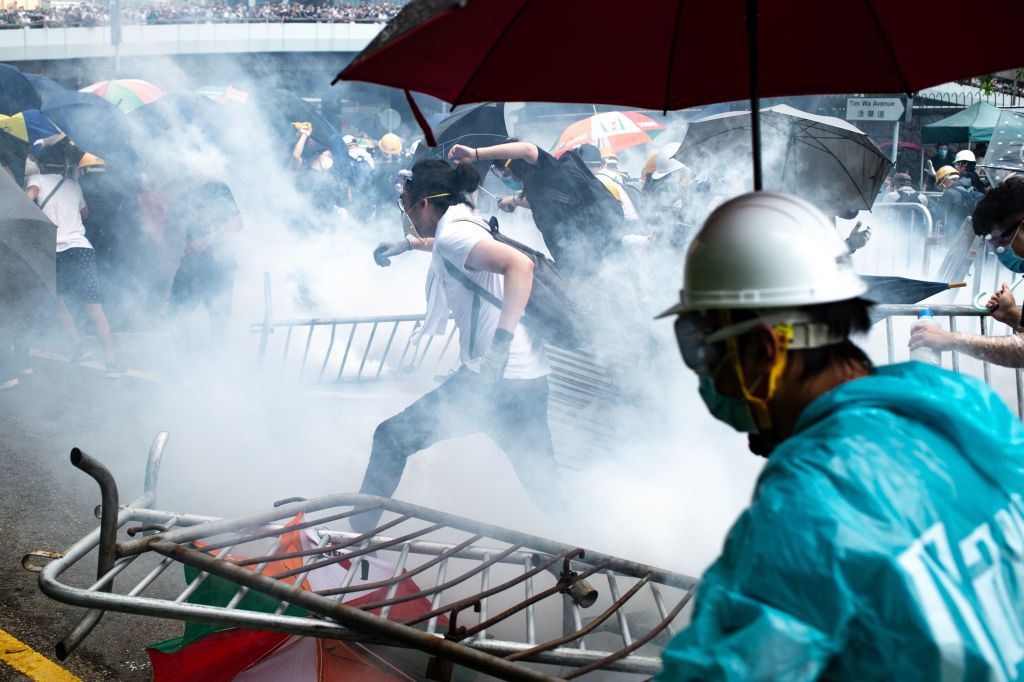
Lam said she “felt heartbroken” by the violence, adding that “this is a time for a responsible government… to restore as quickly as possible the calmness of society.”
Authorities said 81 people were injured, 22 of them law enforcement officials, in the worst unrest the city has seen in decades. Police labeled the protest a “riot,” and said they fired 150 canisters of tear gas, “several rounds” of rubber bullets, and about 20 beanbag shots.
Amnesty International accused the police of using “excessive force” against largely peaceful protesters. A demonstration mostly of concerned mothers rallied in the city center on Friday, some holding signs reading, “don’t shoot our kids.”
The Civil Human Rights Front (CHRF), the pro-democracy coalition that organized the protests, said another march scheduled for Sunday will proceed as planned. The group said in a statement that the purpose of the demonstration is to condemn the use of force by police brandishing “lethal weapons.”
The group is also demanding that police withdraw their characterization of the protest as a riot, and release participants who were arrested, without charge. Demonstrators have further called for Lam to both fully retract the bill and step down as the city’s Chief Executive.
“Tomorrow’s protest sends a very important message: It tells Carrie Lam that we do not accept her response today,” Jimmy Sham, the convenor of CHRF, told reporters after the government’s press conference. “We tell the 1.03 million who took to the streets on Sunday, we hope you all take another step, and encourage another person to come down too.”
A hospital employee in his early 30s, who identified himself only as N., said suspending the bill was “better than nothing,” but was not a sufficient response. “I’m still planning to come out tomorrow because Carrie Lam hasn’t withdrawn the bill,” he said. “It’s just been put on pause, and that’s not good enough.”
Read more: Hong Kong Was My Refuge, Now Its Freedom Is at Stake
Lam’s reversal follows intense pressure across broad sectors of society, as well as the international community, over concerns that the city’s democratic freedoms are eroding as an increasingly assertive Beijing seeks to exert greater influence. The former British colony was returned to China in 1997 under an agreement called “one country, two systems” that guaranteed its autonomy for 50 years, but many say Beijing is steadily chipping away at its freedoms.
The controversy over the extradition proposal has become the latest point of tension between the U.S. and Beijing. On Thursday, members of Congress reintroduced legislation supporting democracy and human rights in Hong Kong. The bill would require an annual assessment of the territory’s political autonomy to determine whether it still qualifies for special trade status with the U.S.
Beijing has rebuffed the U.S., saying it would not accept what it has labeled as foreign interference in Hong Kong’s affairs, and the Chinese government has summoned a U.S. envoy in Beijing over the matter.
Enraged Protesters Storm the Legislature on the Anniversary of Hong Kong's Return to Chinese Sovereignty
The 22nd anniversary of Hong Kong’s retrocession to China degenerated into anarchy Monday, after protesters smashed their way into the legislature and ransacked the offices. The brief occupation culminated in clashes around midnight as riot police dispersed the holdout protesters with volleys of tear gas.
Street clashes bookended the anniversary, starting in the early morning. Protesters occupied Harcourt Road and Lung Wo Road—major thoroughfares in the political heart of the city—and armed themselves with bricks and metal poles taken from a nearby construction site. Police responded with pepper spray and batons.
Demonstrators began besieging the legislature by midday. In the late afternoon, some used metal poles as battering rams and broke through the glass doors at the building’s entrance. Others tore down part of the building’s fence and dismantled a gate.
At around 9:00 p.m., the heavy police presence cleared out and protesters shattered both of the legislature’s public entrances. As they surged inside, they destroyed surveillance cameras and sprayed the facility with graffiti. “H.K. Gov f–king disgrace” was painted in large black letters overlooking the foyer. Another prominent message read, “Hong Kong Is Not China.”
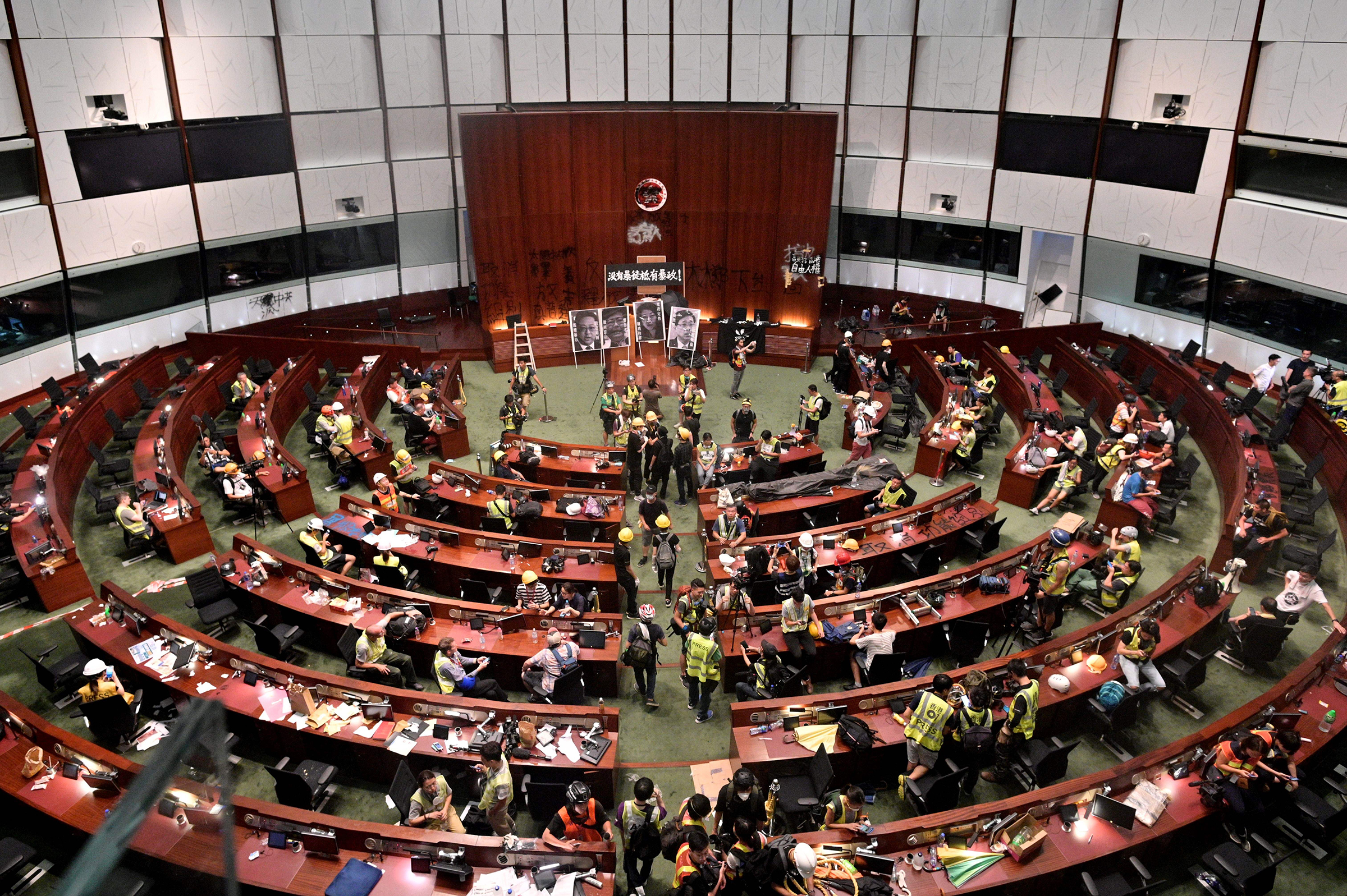
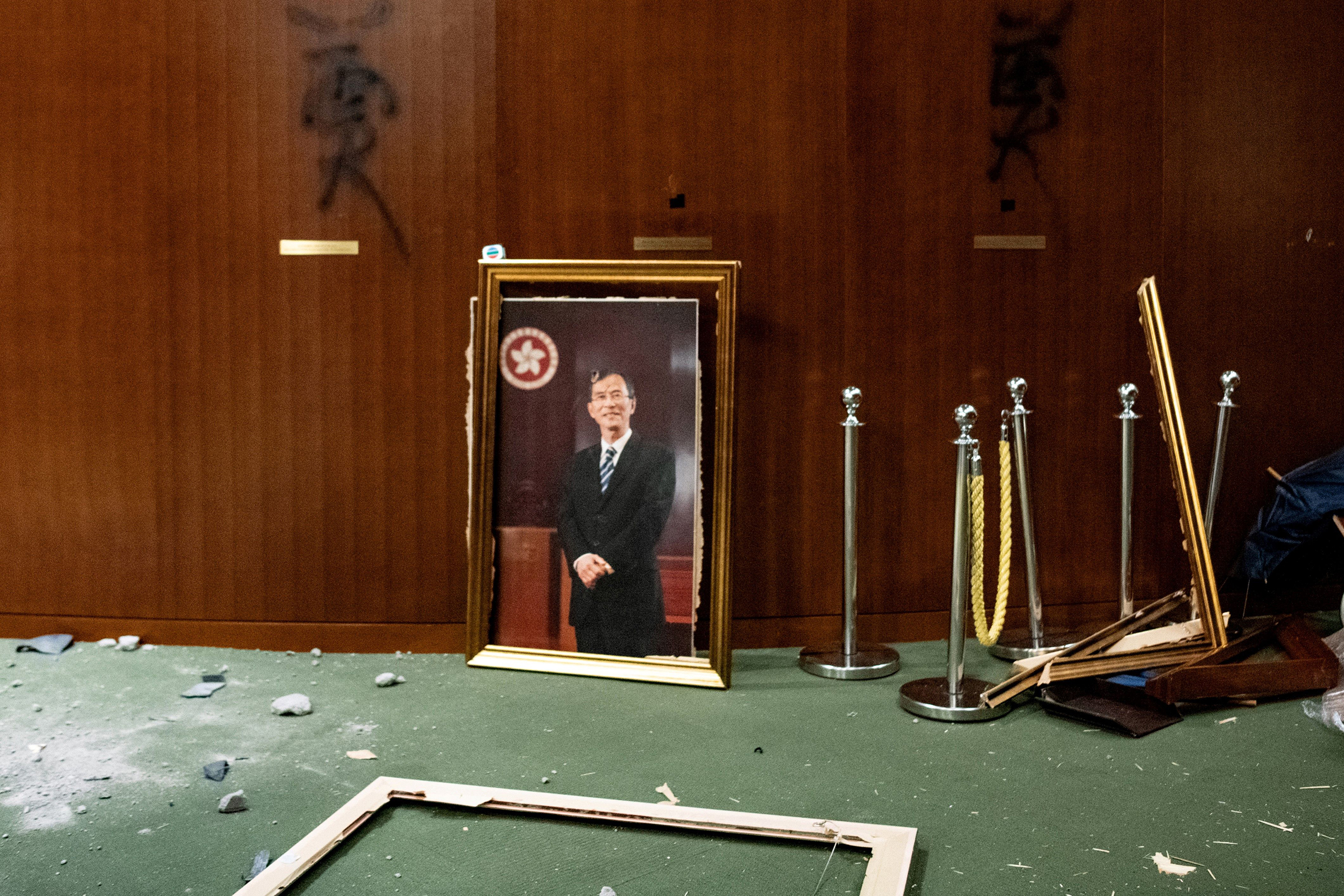
Large oil portraits of Hong Kong’s deeply unpopular leaders were defaced and destroyed by the enraged mob, which freely rampaged through the corridors.
Shortly before 9:30 p.m., protesters breached the debating chamber and set about vandalizing the seat of Hong Kong’s unrepresentative government. They unfurled the colonial Hong Kong flag over the president’s desk and defaced the emblem of the Special Administrative Region, as China refers to the enclave.
In a highly symbolic act, a protester tore up a copy of Hong Kong’s post-colonial constitution and scattered the pages over the chair. A banner reading “There are no rioters, only a tyrannical government” was placed behind it.
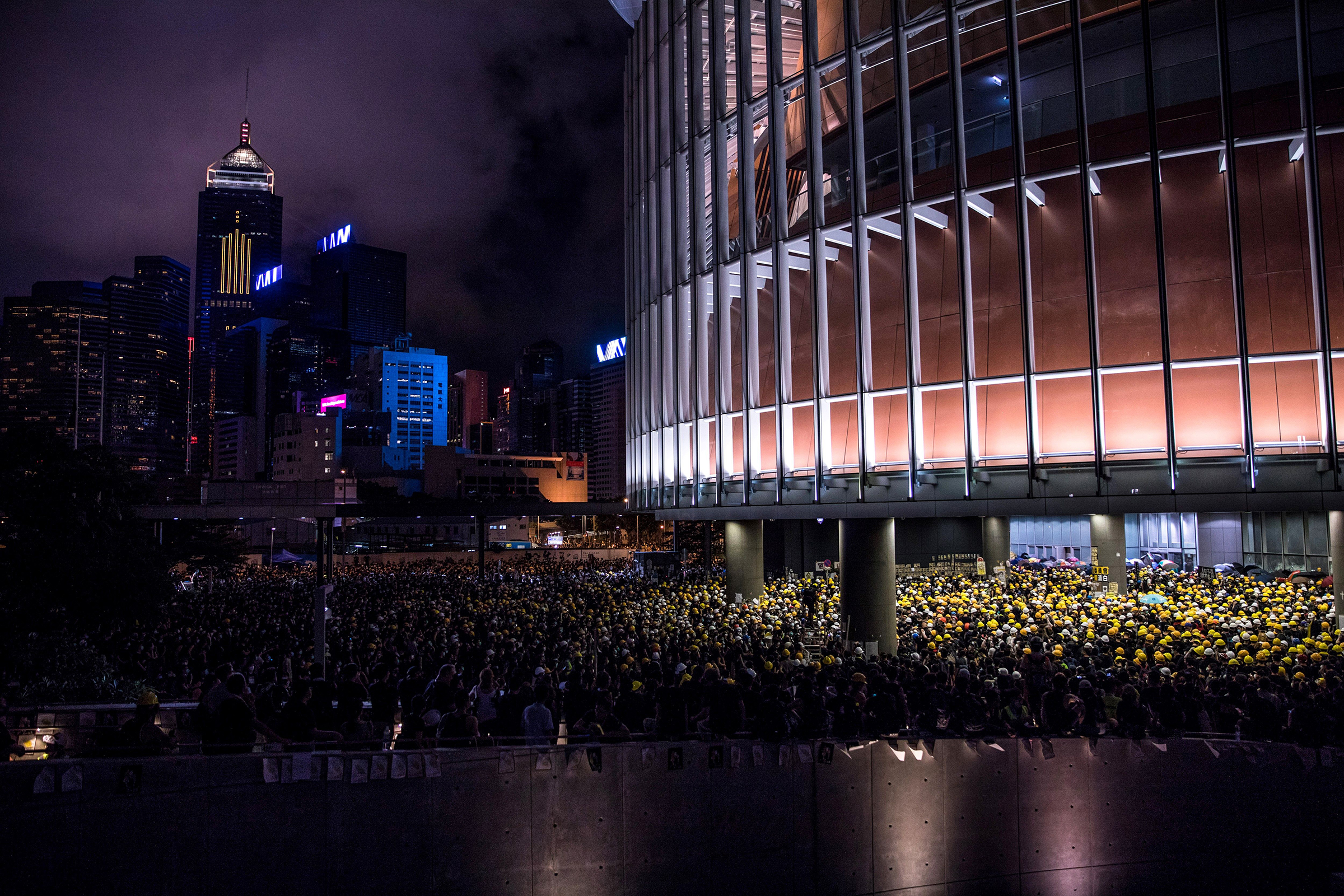
Shortly after the building was stormed, protesters could be seen hauling in supplies and reinforcing barriers, as though preparing for a prolonged occupation. But three hours later, columns of police began to move toward the premises. The Hong Kong Police Force said the building had been “violently attacked” and “illegally” entered.
With police outside preparing to sweep the legislature, protesters occupying the chamber held a deliberation over whether or not to stay. One protester removed his face mask and stood up on the chamber desks, shouting, “We really cannot afford to lose anymore.”
Hong Kong’s embattled top official, Chief Executive Carrie, called a 4 a.m. press conference to rebuke the protesters involved in vandalizing the Legislative Council.
“This is something that we should seriously condemn, because nothing is more important than the rule of law in Hong Kong,” she said. “So I hope the community at large will agree with us that with these violent acts that we have seen, it is right for us to condemn it and hope society will return to normal as soon as possible.”
Read more: It Is Time for Democracy in Hong Kong
At her pre-dawn press conference Tuesday, the Beijing-backed leader also insisted her government has responded to protester’s complaints over a now-suspended bill that would allow extradition to mainland China. The proposal, she said, will die at the end of the legislative session in July 2020.
The government initially said the law was necessary to prevent Hong Kong from becoming a haven for criminals; detractors say Beijing will use it to order the arrest of dissidents and critics. In any case, the protesters’ original demand—that the extradition bill be withdrawn—has been eclipsed by a broad push for greater democracy and a repudiation of Chinese sovereignty itself.
Asked what message he had for the Chinese government on the anniversary of Hong Kong’s reunification with China, protester Don Lee, 26, said: “I’d tell them that we want universal suffrage.”
Earlier in the day, hundreds of thousands of peaceful protesters, including families and young kids, took part in a march from Victoria Park calling on Lam to step down.
After the morning’s disturbances, police attempted to persuade organizers to call off the procession, but they refused. Police sealed off part of the park, the march’s starting point, and, citing a “serious safety threat,” refused to give permission for marchers to proceed through the Admiralty district, where Hong Kong’s legislature and government offices are located.



“China needs to respect our rights as Hongkongers,” said Juliana, a 34-year old advertising worker, defying police to march with others. She added: “The situation is very tense because our government is not acting in the best interest of Hong Kong.”
As marchers began to arrive in Admiralty in the late afternoon, they reinforced those who had set up barricades across Harcourt Road, swelling the crowd considerably. Protesters passed out face masks and carted trolleys filled with bricks.
A protester in her mid-20s, who would only give her name as Mary H. and stated that she was a civil engineer, said “Today is the flag raising ceremony. We wanted to be here early to show our opposition to that. Everything the Chinese government is doing is suppressing our freedoms.”
The deteriorating security situation also forced a humiliating scaling down of a morning flag raising ceremony meant to be a focus of national pride.
Some 5,000 police, including armed marine police, had been deployed to put the area around the Hong Kong Convention and Exhibition Centre on lockdown. A small, carefully vetted audience gathered there in the morning to watch, on closed-circuit television, the flag raising taking place outside.
The government said the indoor location was to spare guests from having to stand in the light drizzle, but there could only have been relief that dignitaries were shielded from the violent unrest breaking out nearby. At a flagpole less than a kilometer away, a Chinese flag was taken down by protesters overnight and the Black Bauhinia, the emblem of the Hong Kong rebellion, was run up in its place. Black-clad protesters attempted to march on the Convention Centre as the ceremony was taking place but were repelled by police.
“I know that the Government has a lot to improve,” Lam said in her address to the official gathering. “We will continue to listen to the community’s views and make continuous improvement to our work.”
Democratic legislator Helena Wong heckled Lam’s speech—an unheard of disruption at what is normally a tightly choreographed event—and was evicted from the hall.
The furore over the bill has laid bare political and social faultlines in the former British colony. Monday’s clashes come in the wake of an unruly rally Sunday that saw pro-government mobs abuse and assault journalists and foreigners. Scuffles and tense standoffs between pro- and anti-government groups also took place in the area around the legislature and central government offices.
Local media meanwhile reported late Sunday that a 29-year-old woman had fallen to her death from the retail podium of the International Finance Centre, after leaving a Facebook post saying that she would not be attending anti-government protests planned for today and encouraging Hongkongers to ga yau. Literally meaning “add oil,” in the sense of injecting fuel into a tank, the Cantonese phrase is a common exhortation among protesters.
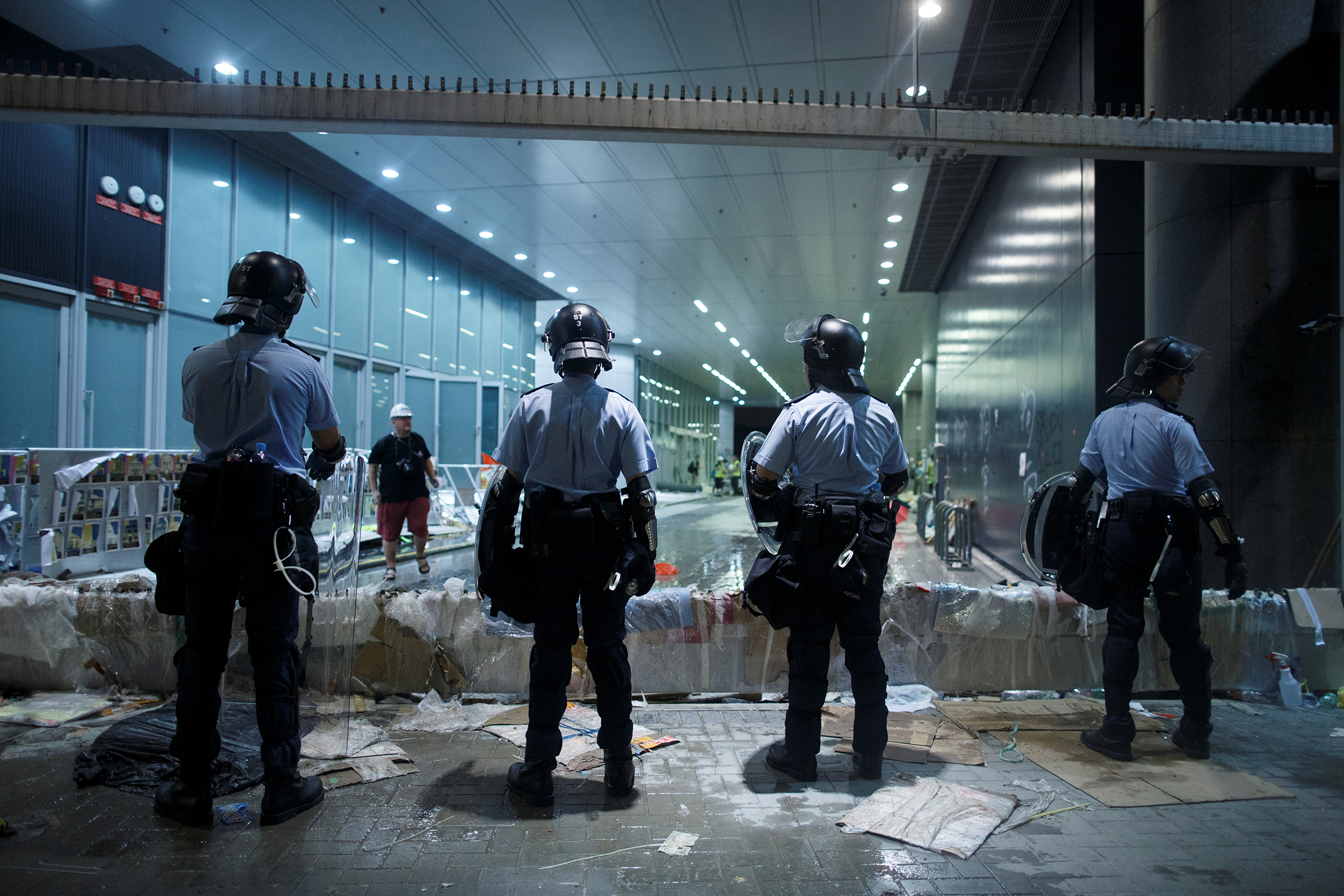

Her death follows that of a 35-year-old man who died on June 15 after unfurling a protest banner on the side of a shopping mall, and a 21-year-old student, who fell from a building yesterday after leaving a note calling for Lam’s resignation. Memorials for all three are planned today.
University student Nicole Cheung, 19, said the deaths “make us heartbroken. I respect them but I don’t want anyone to do the same. We want everyone fighting to see the future.”
Kandice, an 18-year-old protester, who had written the deceased student’s last words on her back, added: “The whole government system is the problem. This is not democracy.”
—With reporting by Kamakshi Ayyar, Laignee Barron, Aria Hangyu Chen, Abhishyant Kidangoor and Hillary Leung / Hong Kong
'You've Caused Hurt and Disappointment.' Hongkongers Lash Out at Embattled Leader During Town Hall Meeting

Hong Kong’s embattled leader faced a barrage of criticism Thursday night as she held a town hall-style meeting in her first overture to the public since pro-democracy protests erupted in the Chinese-ruled city nearly four months ago.
The over two hour-long dialogue, which at times descended into emotional tirades and salvos directed at the Beijing-backed leader, comes as Asia’s financial center is gripped by its greatest political crisis in decades. Businesses, especially tourism dependent sectors, have begun to complain of an economic sting as the protracted, sometimes violent upheaval scares off visitors.
As she met face-to-face with her critics, Hong Kong’s Chief Executive Carrie Lam pledged this was no “PR stunt.” Everyone in the course of these past few months has felt worried and anxious, she said, adding that the responsibility for resolving the unrest lies with her government.
Via lottery, 150 members of the public were invited to come and express their concerns. Speaker after speaker blasted Lam’s handling of the situation, questioned why the police were not being held accountable for perceived abuses against protesters and criticized the electoral system.
“We are really rather desperate,” one woman said, after insisting telling Lam, “You’ve caused hurt and disappointment.”
“Good leaders,” she added, do not “cause society to tear apart.”
“Even [Chinese President] Xi Jinping is ashamed of you,” another speaker said, according to local media.
Many of the three dozen or so attendees who were called on to speak urged Lam to step down. Others expressed uncertainty about how they could be expected to continue living with weekly pitched battles.
“I don’t know how to give this Hong Kong to the next generation,” one man said. “I’m very scared every weekend.”
Read more: Hong Kong’s Summer of Unrest Has Been Drawing Inspiration From Ukraine’s Winter on Fire
Millions of Hongkongers have joined the marches, rallies and demonstrations that have been roiling the semiautonomous enclave since June, though the movement has come a long way from the peaceful demonstrators that snaked through the skyscraper-laden streets with chants of, “Carrie Lam, talk to the Hong Kong people.”
The contentious extradition bill that initially catalyzed the dissent was withdrawn earlier this month. But the movement has since evolved into a push for outright democracy, or even independence, posing a direct challenge to the city’s political masters in Beijing.
The former British colony was retroceded to Chinese rule in 1997 under a handover agreement that pledged respect the city’s autonomy, independent legal system and freedom of expression. Protesters accuse the Communist Party of reneging on the deal and encroaching on the city. They have refused to call off the unrest until their additional demands are met, including fully democratic elections and an independent investigation into the police response.
At the public dialogue, several speakers reiterated this stance, citing the protesters’ slogan, “Five demands, not one less,” to rapturous applause.
Before Lam’s entourage arrived at the Wan Chai district stadium on Thursday, hundreds of demonstrators began amassing outside the venue. Secondary-school students formed human chains along the nearby shopping district and chanted, “Freedom for Hong Kong.”
Concerned about the possibility of disruptions, officials enforced tight security at the stadium, calling on participants to arrive and register two hours in advance and pass bags through scanners. Attendees were barred from bringing umbrellas, helmets or gas masks—all standard issue equipment at protests.
Earlier in the day, dozens of riot police were seen carrying shields, batons and what appeared to be tear gas cases into the venue. Local media reported that the police kept a “maximum reserve” of 3,000 officers nearby in case of clashes.
Weekends in Hong Kong, normally one of the world’s safest cities, now regularly feature street brawls between pro-democracy protesters and police. In response to an increasingly hardline knot of protesters hurling petrol bomb and setting fires in the streets, police have fired volley after volley of tear gas, bean bag rounds and rubber bullets. Last week, Amnesty International accused the force of being “reckless” and torturing people in custody, and called for independent inquiry.
“I don’t want to come out [and protest],” one of the dialogue attendees said in an emotional address at the end of the evening. “I want to have an enjoyable summer. But…I know I am the future generation…That’s why we stand out bravely.”
Thursday night’s dialogue comes three weeks after Lam agreed to formally scrap the bill which sparked the unrest. The contentious legislation would have allowed extraditions to mainland China for the first time. In an opinion column published in the New York Times Wednesday, Lam said her belated concession was necessary “to help create the atmosphere” for the community dialogues.
But the withdrawal did little to pacify simmering public anger. Critics called the move too little, too late.
Lam and Beijing have refused any further allowances, leaving it unclear how the stalemate will break.
The city is heading into its 17th consecutive weekend of protests with a packed agenda. On Saturday, demonstrators will mark five years since the pro-democracy Umbrella Movement seized the enclave. Then on Oct. 1, counter-rallies are planned to coincide with the Communist Party’s 70th anniversary of the founding of the People’s Republic of China, timing that could result in an embarrassment for Beijing if its celebrations are upstaged.
— Reporting by Hillary Leung, Hong Kong
New Speakers Announced for the First-Ever TIME 100 Health Summit on October 17 in New York, NY

Hong Kong's Police Watchdog Is Unable to Do Its Job, Experts Say

Hong Kong’s police watchdog lacks the power to conduct an investigation into the police force’s handling of months of protests in the city, a panel of experts appointed by the enclave’s government said in a report issued Friday.
The report’s findings are a major blow to Hong Kong’s embattled leader, Chief Executive Carrie Lam, who has insisted that the Independent Police Complaints Council (IPCC) is capable of conducting an independent investigation.
The findings will also strengthen the hand of protesters, who for months have been calling for an independent probe into the police.
Hong Kong’s IPCC has a shortfall in “powers, capacity, and independent investigative capability necessary to match the scale of events and the standards required of an international police watchdog operating in a society that values freedoms and rights,” according to a statement posted on Twitter by panel member Clifford Stott.
“Structural limitations in the scope and powers of the IPCC inquiry remain, inhibiting its ability to establish a coherent and representative body of evidence,” the statement read.
It went on to add that the IPCC may only be able to provide an “interim report, with limited but sufficient facts to allow preliminary conclusions to be drawn on some of the divers of the protest, the handling of key events, and the evolution of the disturbances.”
An independent inquiry into the police force is one of Hong Kong protesters’ five key demands. Only one demand — the total withdrawal of a controversial extradition bill which would have allowed China to put criminal suspects on trial in the mainland legal system — has been met.
Experts say that the report’s findings may force the government to take further action.
“This will put additional pressure on the Hong Kong as well as the central government to agree upon setting up a true independent commission of inquiry,” Jean-Pierre Cabestan, a professor in political science at Hong Kong Baptist University, tells TIME.
“It has demonstrated that the IPCC is ill-equipped to conduct an independent investigation of police brutality — a lack of capacity [that] many in the Hong Kong community have suspected from day one.”
However, at a press conference Monday evening, Hong Kong’s leader Carrie Lam dismissed the findings.
“These views are for the council of the IPCC to consider and it is not for me to comment in individual advice tended by overseas experts,” she told reporters. “What the IPCC is undertaking is a very difficult and complex exercise and I have confidence that the IPCC will spare no efforts.”
The panel — comprised of five experts on police tactics from the U.K., Australia, New Zealand and Canada — was appointed by the IPCC in early September to help provide advice on its practices and procedures.
Hong Kong’s police force has faced public backlash for its handling of the protests. Rights group Amnesty International has criticized the force’s “reckless and indiscriminate tactics” and the United Nations High Commissioner for Human Rights said that the extent of violence during the months of unrest warrants an independent and impartial investigation.
The panel’s statement was issued as Hong Kong was gripped by its 23rd straight weekend of anti-government protests. Tensions have escalated after a 22-year-old university student died on Friday, several days after sustaining injuries during a fall from the third story to the second story of a car park, near the scene of a street battle between protesters and police.
On Monday morning, a protester was reportedly in critical condition after police fired live bullets as protesters caused major disruptions to transport networks.
“After what happened the past weekend and this morning the commission is more necessary than ever as a first step to find a solution to the current crisis,” Cabestan says.