RSS Feeds
What two under-the-radar DNC moves say about the party’s direction: From the Politics Desk
Three dead after family get into difficulty in water off Shoreham-by-Sea
A man, woman and teenage girl have died, while a younger girl is in a critical condition, say Sussex police
A couple and their teenage daughter have died after getting into difficulty in the sea off the West Sussex coast, police said on Tuesday.
A man, a woman and a teenage girl died after the incident in Shoreham-by-Sea, the chief superintendent of Sussex police, James Collis, said.
Continue reading...Iran’s Attacks on Ships in Hormuz Mount, Testing U.S. Military Restraint
Yes, Woke 1.0 Was Crazy. Now Where’s the Accountability?
Tracking USS Lincoln's eight-month mission as concerns about conditions grow
OpenAI announces slowing pace of development after hack by rogue agent
Amid race with Anthropic, firm plans to overhaul research and training and require more safety parameters after hack
OpenAI on Tuesday said it had slowed down the pace of its AI development while it overhauled its research and training systems.
The company’s researchers were caught unaware last month when an AI agent under testing hacked another AI firm, Hugging Face.
Continue reading...'Brazen act of self-dealing': Democrats seek to block a Trump-linked crypto bank
The Office of the Comptroller of the Currency granted conditional approval for the Trump family's World Liberty Trust Co. to become a bank handling cryptocurrency and digital assets.
‘Dune: Part Three’ sets off early ticket frenzy as fans crash sales sites
Tupac Shakur autopsy photos shown at murder trial after some family members leave
Polling Firm Released Fake Data in Hong and Bass Races as a ‘Social Experiment’
«Разбомбим к чертовой матери». Трамп пригрозил нанести удар по Оману, если он «будет мешать» переговорам с Ираном
«Демократия не может быть заложницей России». Экс-министр обороны Украины Федоров призвал к выборам и раскритиковал власть
ZZ Top is "Goin' 50"
U.S. quietly deporting Mexican migrants to Guatemala and Honduras
ZZ Top Drummer Frank Beard Dies at 77
Trump cast a mail ballot in Florida's primary despite spreading falsehoods about mail voting fraud
Analysing Africa newsletter: Zambia’s strange election
Defence joins search for missing bushwalker – as it happened
This blog is now closed
Follow our breaking news email, free app or daily news podcast
‘Collapsing confidence’ in housing market, Wilson says
Tim Wilson has jumped on that reporting around rent increases and says there has been a collapse in confidence since the budget which is hurting renters.
We’ve had, since the budget, collapsing confidence, a lack of will to invest in housing that is going to be available for rentals.
We’re seeing a complete disaster in the housing market, and we know that’s only going to do one thing while the government continues to overshoot its migration target, and that is an increase in rents on Australians struggling to save a first home deposit.
There is an awful lot that goes into determining rents in Australia, and the thing that Treasury modelled in the context of the budget, what is the isolated effect of what the government actually changed about the housing market. And if I just step back for a second, we’ve got a broken housing system in our country, and it’s the renters of Australia who are bearing the brunt of really 40 years of government’s not doing enough about this problem.
I think that Clare sadly needs to start taking a bit of responsibility for her housing policy. But also, Clare, stop gaslighting Australians, stop gaslighting the mum and dads who are currently watching this show and feeling the impact of your toxic housing taxes … She can sit on your show and defend her policies, but the evidence on the ground, the evidence from the experts, is that Labor’s toxic housing taxes are smashing the market.
Continue reading...DOJ’s probe into Andreessen Horowitz over board seats baffles VCs
ZZ Top drummer Frank Beard dies aged 77
Tributes paid to ‘great friend and collaborator’ who played with band for 56 years and died in hospice care in Texas
The ZZ Top drummer Frank Beard has died at the age of 77.
A spokesperson for the band confirmed that Beard died on 17 August in hospice care at his ranch in Richmond, Texas. His family were by his side.
Continue reading...ZZ Top drummer Frank Beard dies aged 77
Tributes paid to ‘great friend and collaborator’ who played with band for 56 years and died in hospice care in Texas
The ZZ Top drummer Frank Beard has died at the age of 77.
A spokesperson for the band confirmed that Beard died on 17 August in hospice care at his ranch in Richmond, Texas. His family were by his side.
Continue reading...Barcelona steal Rodri away from Real Madrid and plan to make him new Busquets
Spain’s World Cup-winning captain has completed his move to Camp Nou where he is a natural successor to club legend
By the time Flight PTN27B started its descent into El Prat a bit before 8pm on Monday evening, a small crowd had gathered by the terminal doors, waiting for it to land. A few people stood and watched the sky, cameras out to capture its arrival. A lot more watched on their phones. In the two hours it had taken to get there from Manchester, taking off at 5.11pm, 101 minutes behind schedule, the Pilatus PC-24 had become the most tracked plane on the planet. Everyone knew that Rodrigo Hernández was on board. Unless, of course, he had been sneaked away in a catering cart.
Five days earlier, Rodri had been seen, and recorded, at Barajas airport waiting to get on a flight back to Manchester from Madrid. He wheeled a small RFEF (Spanish football federation) case with his name on, stood alone in the queue, the World Cup-winning captain just a bloke in shorts and T-shirt, and his stay in the UK was supposed to be brief, just long enough to say goodbye. The plane he was boarding was a Ryanair one: that was the detail everyone homed in on, something extraordinary in the ordinariness. This time, though, he came on a private jet, one way. His family travelled with him. He came to sign for FC Barcelona.
Continue reading...Syria Takes Major Step to Come Clean on Past Nuclear Program
Meta is on trial – again. Here's what to know about the case brought by dozens of states
Meta is on trial – again. Here's what to know about the case brought by dozens of states
Temporary Protected Status revoked for more than 1 million people from 13 countries
Squeeze More Juice Out of Your Dead Batteries—Using Physics
Pentagon threatens to cut federal funding to 30 universities over foreign academic partnerships
Harvard, Yale, Stanford and others face directive to review and cut alliances Pentagon deems national security risk
Thirty US universities could lose federal funding unless they review and cut foreign academic partnerships the Pentagon considers a national security risk within the next two weeks, under a Pentagon directive aimed largely at ties to Chinese institutions.
Harvard, the Massachusetts Institute of Technology, Johns Hopkins, Georgetown and Cornell are among the institutions ordered to conduct and report the reviews – and end partnerships deemed problematic – by 31 August, according to a US official who provided the full list to the Guardian.
Continue reading...Embattled Florida Republican Rep. Cory Mills loses his fight to keep his House seat

Mills is the latest lawmaker in a recent string of congressional members facing scandals and allegations of domestic abuse while trying to run for elected office.
(Image credit: Kevin Dietsch)

Pentagon threatens to cut federal funding to 30 universities over foreign academic partnerships
Harvard, Yale, Stanford and others face directive to review and cut alliances Pentagon deems national security risk
Thirty US universities could lose federal funding unless they review and cut foreign academic partnerships the Pentagon considers a national security risk within the next two weeks, under a Pentagon directive aimed largely at ties to Chinese institutions.
Harvard, the Massachusetts Institute of Technology, Johns Hopkins, Georgetown and Cornell are among the institutions ordered to conduct and report the reviews – and end partnerships deemed problematic – by 31 August, according to a US official who provided the full list to the Guardian.
Continue reading...Why is Trump threatening to bomb Oman?
Former NIAID adviser pleads guilty in COVID-19 records scheme
Man in Chucky-style mask terrorises Philadelphia residents
Hayden Panettiere's mother shares first public comments since star's death
TikTok explores peer-to-peer payments via DMs, report says
Avoid the massive end-to-end tax of default full history clones
It's easy to think of git clone as a client-side operation, but the settings of this operation impact the server side and all networks in between. When you run a default full history clone, the server has to walk the entire history, build a pack file for it (that's what "counting objects" is actually doing), and ship it over the wire. The client then unpacks all of it and checks out a full working tree. Every layer, client CPU, network, the Git server's pack-building compute, and disk, pays for the size of that request. Make the request smaller and the whole stack gets cheaper at once, not just your laptop.
Agentic AI turns up the pressure on this in a way normal developer workflows don't. An agent doing repository work can clone far more often, and far less predictably, than a human ever would. If the default is a full history clone, you're now paying that tax at agent scale.
GitLab is working hard on the backend to serve large repositories faster. But you can also change what you ask for. Options like shallow clones (--depth=1), single-branch clones, and partial clones (--filter=blob:none) let you fetch only what a job actually needs. A more precise request immediately reduces peak load, unreliability, wait time, and cost. And every future backend improvement compounds on top of these leaner requests.
In Supercharge your Git workflows, I walked through how Git Much Faster benchmarks the settings that cut clone times by up to 93% and disk usage by up to 98%: disabling compression, widening the HTTP buffer, shallow and partial clones, and sparse checkout that skips binaries. Great numbers. There's just one catch: Every place that clones the repo has to be meticulously updated with many lines of optimizing code. A developer's laptop, a CI job, an agent spinning up a sandbox: Each one is a separate opportunity to forget.
That's not automation. That's hoping.
In this article, you will learn how to implement the Git Clone Override Policy to automatically enforce repository cloning optimizations and minimize costs.
Where the clone tax hits hardest
Agentic AI is the newest and fastest growing pressure, but it's not the only place a default full history clone is costing the software industry dearly:
- Monorepos: Consolidating many projects into one repository means every clone pulls far more than any single team actually needs.
- Complex, long-running Git history: Years of commits compound total repository size even when the current tree is modest.
- Media, binaries, and embedded projects: Firmware images, vendor SDKs, and design assets stored directly in version control balloon a repository the way source code alone never would.
- CI/CD pipelines: A fresh clone on every job, run thousands of times a day, turns a small per-clone inefficiency into a large recurring one.
- Data science and machine learning data sets: Large data files tracked in git carry the same size tax as any other oversized blob.
- Remote developer environments: Cloud-hosted or ephemeral development environments want fast, lightweight startup, but still default to a full repository replication.
- Agentic AI: Many more clone requests, but far less predictable than any human-driven workflow.
Making the optimization impossible to skip
The fix isn't a better README telling people which flags to set. It's moving the decision out of individual hands entirely: Commit the policy to the repository itself, as code, and let a small program enforce it.
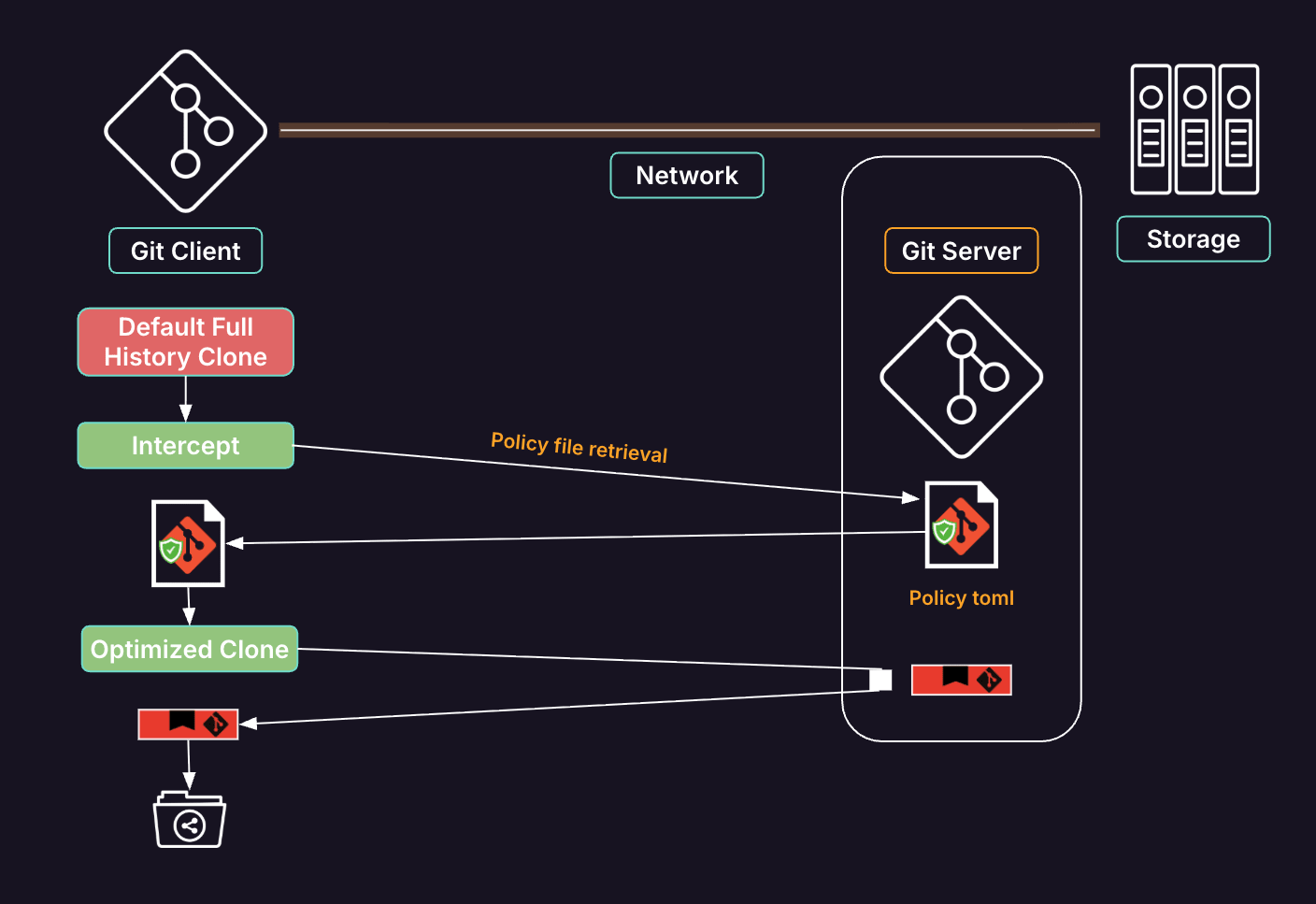
That's what Git Clone Override Policy does. Drop a .afullhistorycloneoverridepolicy.toml file in a repo, and a lightweight Go binary intercepts only a bare git clone URL, the plain, default, full-history request. The moment you add any option yourself (--depth 1, --filter, anything), the binary assumes you're already optimizing and passes your command straight through untouched. No policy file in the repo at all? Same thing: clean pass-through to a normal clone. The only case it ever touches is the one everyone agrees is a mistake: the unqualified default.
When it does intercept, here's the sequence: Fetch the policy file, then run a fixed 13-step process that shallow-and-partial-clones the repo, set up sparse checkout to skip binary files (images, archives, media, fonts, and more), and apply the same tuned git config from Git Much Faster, all before a single line of source shows up on disk.
What maximum optimization looks like
Let’s take a look at the commands required to do a maximum optimization of a Git Clone.
1. Build the repo shell yourself, instead of git clone.
This allows us to set a broad variety of git configuration settings that set the file scope of the first clone request.
mkdir my-repo && cd my-repo
git init
git remote add origin https://example.com/group/my-repo.git
2. Tune git config for large-transfer performance, scoped to just this repo.
git config --local core.compression 0
git config --local http.postBuffer 1024M
git config --local http.lowSpeedLimit 1000
git config --local http.lowSpeedTime 300
git config --local pack.windowMemory 256m
git config --local pack.packSizeLimit 256m
git config --local pack.threads 4
3. Turn on partial clone, since you're about to fetch with --filter.
git config --local extensions.partialClone origin
git config --local remote.origin.promisor true
git config --local remote.origin.partialclonefilter blob:none
4. Narrow the fetch refspec to the one ref you actually want, instead of every branch on the remote.
git config --local remote.origin.fetch "+refs/heads/main:refs/remotes/origin/main"
Without this update, remote.origin.fetch is automatically set to +refs/heads/*:refs/remotes/origin/*, meaning every fetch (and the initial clone) pulls down the ref pointers for all branches on origin. Updating this setting allows us to restrict fetch operations to just the main branch so that Git will no longer track or update refs for any other remote branch.
There are fewer refs to negotiate and update which means less overhead per fetch, especially on repos with hundreds of branches.
5. Fetch shallow, with blob content deferred.
git fetch --depth=1 --filter=blob:none origin main
This depth and filter combination gets you the smallest possible initial transfer: one commit's worth of tree structure, no blob data at all until you check out files. This benefit comes specifically when you’re working on repositories with large files or a lot of history.
6. Turn on sparse checkout and exclude every binary file type you don't need for source work.
git sparse-checkout init --cone
cat >> .git/info/sparse-checkout <<'EOF'
/*
!*.png
!*.PNG
!*.jpg
!*.JPG
!*.pdf
!*.PDF
!*.zip
!*.ZIP
!*.mp4
!*.MP4
!*.exe
!*.EXE
EOF
The real policy excludes over 30 extensions across images, documents, archives, media, compiled binaries, and design files, in both cases. That's just a representative slice.
7. Check out the ref.
git checkout main
Do all seven stages, in that exact order, against www.gitlab.com, and you land at the same 110 MB instead of 9.5 GB. Get the order wrong (fetch before narrowing the refspec, sparse-checkout after checkout instead of before) and at best you've wasted the optimization, at worst you've fetched the thing you were trying to avoid fetching. That precision, repeated correctly on every clone, by every person and every pipeline, is exactly the discipline problem from the top of this post. Git Clone Override Policy doesn't invent a new technique here. It just guarantees these seven stages run, in order, every time, without anyone needing to remember them.
Automation to the rescue
Git client usage is both highly scaled and distributed, so propagating a precise, purpose-specific set of clone optimization commands to be run by humans or custom coded into every CI job and agent sandbox requires automation to be truly reliable.
What if we could enforce that workflow with automatic policies, instead of betting on everyone remembering all seven stages? It turns out there's already a working MVC of exactly that: a TOML policy file that lives in the repository alongside the code, plus a client capable of intercepting every git clone call before it ever reaches the network. Store the policy once, and every clone (human, CI job, or agent) gets the optimized sequence automatically instead of by request. Using a policy settings file also allows for the tuning that will be necessary for various purposes. The default above is for counting lines of code, so we just need a reliable copy of all existing text files. Building the same software might require more files because it compiles some graphics into the UI in the application or some builds may require more of the Git history information in order to locate commit messages for release notes.
A small, portable Go binary and a repo stored policy configuration file
The interceptor itself is a single self-contained Go binary, not a shell script held together with sed and hope. That choice buys a few things worth calling out.
It runs on Linux, macOS, and Windows, for both amd64 and arm64: one codebase instead of a bash version and a separate PowerShell version drifting out of sync. It's been tested across every shell you're likely to hit, from CMD and PowerShell to Git Bash and WSL. The only runtime dependency is a real git binary already on PATH.
Internally it's organized into six small, independently testable pieces (policy parsing, the fixed-sequence interpreter, git command execution, logging, cross-platform detection, and the entry point handling all four invocation modes) rather than one large function doing all of it at once.
This example configuration file gives a feel for the things that can currently be tweaked.
schema_version = 2

[policyinfo]
description = "The most optimal latest-code-only clone for AI agents (that do not need git history) or counting lines of code."
OptimalForAIAgents = true

[git_config]
"core.compression"   = 0
"http.postBuffer"    = "1024M"
"http.lowSpeedLimit" = 1000
"http.lowSpeedTime"  = 300
"pack.windowMemory"  = "256m"
"pack.packSizeLimit" = "256m"
"pack.threads"       = 4

[fetch]
flags = ["--depth=1", "--filter=blob:none"]

[sparse_checkout]
enabled  = true
# conemode 'auto' is processed by the solution code to be either 'cone' or 'no-cone' when passed to git
conemode = "auto"
includes = ["/*"]
excludes = []
exclude_extensions = [
  "png", "jpg", "jpeg", "gif", "svg", "ico", "webp",
  "pdf", "doc", "docx", "xls", "xlsx", "ppt", "pptx",
  "zip", "tar", "gz", "jar",
  "mp4", "mp3", "mov",
  "exe", "dll", "so", "woff", "woff2",
  "ttf", "otf", "psd", "sketch", "fig", "dmg", "eps",
]
case_variants = "both"
Declarative configuration over code
Infrastructure as code successfully reduces complexity and increases standardization and security by boiling down what is usually a sprawl of highly variable team code into a declarative configuration file and an engine that processes it. This very effective pattern is repeated here for all of its benefits including:
- standardization of unfamiliar processes (exceptionally detailed git commands)
- complexity avoidance
- easy adoptability by existing specialized clone code (e.g. vs code “clones” that don’t use the git binary)
- reduced bugs and edge cases (compared to everyone devising their own)
- consistency of implementation across contexts (e.g. CI clones, developer IDEs, AI sandboxes)
- improved auditability
- configuration file generation and manipulation by other automation
- improved security (avoiding many code injection vectors)
The interpreter can only act on configuration: git config key/value pairs, fetch and checkout flags, sparse-checkout include/exclude lists, and a small set of post-clone hooks gated by simple predicates. Any arbitrary additions to the configuration are unknown to the engine and ignored. You can audit exactly what a policy will do just by reading it.
Three ways to leverage Git Clone Override Policy, least invasive to most
| Mode | Command | Needs admin | Best for |
|---|---|---|---|
| Zero-footprint CLI | ./git-clone-override-policy clone URL | No | CI jobs, agents, one-off machines |
| Git alias | git cloneusingpolicy URL | No | Developers opting in individually |
| OS alias | git clone URL (intercepts git binary calls) | Yes | Fleet-wide enforcement without developer awareness |
The zero-footprint mode is just the compiled binary: Download it, run it, done. No install, no PATH changes, nothing to clean up, which is exactly what you want when the whole machine is disposable. The git alias mode installs a git cloneusingpolicy command for a single user, no admin rights required. The OS alias mode goes furthest: It installs itself ahead of the real git on the system PATH, so every git clone on that machine is policy-aware whether the person running it knows this exists or not.
Three example results of Git Clone Override Policy optimization
The results are the same ones from Git Much Faster, now landing automatically instead of by request:
| Repository | Full history clone | Policy-optimized clone |
|---|---|---|
| www.gitlab.com | 9.5 GB | 110 MB |
| Linux kernel | 7.5 GB | 2 GB |
| Chromium | 60 GB | 5 GB |
And the safety behavior holds up under a live demo: Install the OS alias, run a plain git clone against a policy-bearing repo, and you get the 110 MB version. Add --depth 1 to that same command and it's ignored by the interceptor entirely: pass-through, full stop. Uninstall, and git clone goes right back to a standard clone, no residue.
Compounding Git LFS benefits
Git LFS and this policy solve different halves of the same problem: LFS changes how binaries are stored, keeping their history off the packfile, while the clone policy changes what each clone asks for. Because they operate on different layers, they stack rather than compete — on an LFS repo, the policy's shallow depth, single-branch refspec, and transfer tuning still trim everything LFS leaves untouched. And since sparse-checkout excludes those file types by name, it also skips the smudge download of the current binaries, giving you the on-demand behavior of the standard git configuration variable GIT_LFS_SKIP_SMUDGE without any client configuration. The result is compounded: LFS shrinks the history, the policy shrinks the request, and a clone that was already lean under LFS gets leaner still.
Where this goes next
This tutorial closes the loop on where we started: The problem isn't unique to agents, but agents are the use case that makes "just tell people the right settings" fall apart fastest. Policy as code doesn't need anyone, human or agent, to know it's there.
To go deeper, watch the Git Clone Override Policy Solution Architecture Overview for the problem-solution fit and design, and the Git Clone Override Policy Demo to see the three runtime modes in action.
Try the Git Clone Override Policy against your own large repository. And, if you want the benchmarking behind the defaults, Git Much Faster is where those numbers came from.
DOJ asks appeals court to reinstate human smuggling case against Kilmar Abrego Garcia
Hayden Panettiere's ex-boyfriend was present at scene when she died: Police
Trump says no talks are underway with Iran
Judge swapped in Trump's defamation case against BBC
Шоу должно продолжаться. Сценарный пульт для одного шоу

Лет 10 назад, когда я работал в банке в Сибири, был у нас отдел - малая автоматизация. Делали ПО для местных. Потом отдел расформировали и перешли на централизованное ПО.
Сейчас каждый может стать таким небольшим отделом малой автоматизации. Для себя, для личных нужд или для своих.
ИИ помогает делать проекты, которые раньше ты бы никогда не сделал. Или дорого по времени, или по ресурсам. А сейчас.... Давно уже не испытывал такой личной упоротости в маленькие проекты. Про один я уже писал, теперь расскажу про другой.
Итак, добро пожаловать на шоу!
Читать далееСпросил у девяти нейросетей, где лечить зубы в Москве: 4941 ответ и очень странная механика

Ассистент на вопрос «где в Москве вылечить зуб» отвечает не ссылкой на поиск, а готовым списком клиник с адресами и ценами. Я прогнал 549 бытовых запросов через девять моделей, получил 4941 ответ и разметил в них 94 клиники. Конкретная клиника названа в 91,7% ответов. Имя бренда даёт лишь 8,7% упоминаний, всё остальное приносят страницы: одна клиника попала в ответы 1694 раза и ни разу не была названа по имени. Половина моделей в интернет вообще не заглядывает. Внутри разбор механики, таблицы по моделям и источникам и глава про то, где мой метод врёт.
Читать далееUS woman sentenced to six years in prison over plot to kill treasury secretary
Riley English said she was in the grips of a mental health crisis and abusing drugs, and that she planned to kill Scott Bessent
A Massachusetts woman who told police that she brought homemade firebombs to the US Capitol to kill Scott Bessent, the US treasury secretary, was sentenced on Tuesday to just over six years in prison.
Riley English, a 26-year-old transgender woman, said she was in the grips of a mental health crisis and abusing drugs when she drove to Washington in January 2025 and told Capitol police that she was there to kill Bessent on the day of his Senate confirmation.
Continue reading...ABC and Disney sue FCC, alleging First Amendment violations

The ABC network has sued the Federal Communications Commission, alleging that the Trump administration is violating its First Amendment rights by challenging ABC broadcast licenses and investigating the network's talk show The View.
(Image credit: Aurore Marechal)

Minnesota sues Texas to force extradition of ICE agent accused of lying about shooting
Minnesota attorney general sues Texas governor in case of ICE agent charged with wounding a man in Minneapolis
Minnesota’s attorney general has sued the governor of Texas to force him to extradite an Immigration and Customs Enforcement (ICE) agent charged with wounding a man and then lying to justify the shooting during the US agency’s controversial crackdown in Minneapolis.
Keith Ellison, Minnesota’s attorney general, is asking a federal judge to bar the sheriff in Cameron county, Texas, from releasing ICE agent Christian Castro, and to order Greg Abbott, Texas’s governor, to sign his extradition warrant so that Minnesota officers can take custody.
Continue reading...Man accused of attacking duo at New York City synagogue charged with federal hate crimes
Larry Montes, already facing state charges, allegedly attacked 63-year-old woman and security guard on Friday
The man accused of attacking a woman and security guard at a New York City synagogue during Shabbat services Friday has been charged with hate crimes in Manhattan federal court, prosecutors said.
Larry Montes, who is already facing state-level hate crime charges, allegedly struck a 63-year-old woman as security was trying to boot him from Central synagogue. He allegedly spat at, and head-butted, a security team member and damaged synagogue property, authorities said.
Continue reading...Forensic pathologist details Tupac Shakur's fatal wounds in Duane 'Keffe D' Davis trial
Tick prevention for dogs: Vets explain how to beat the blood-suckers
The best styling products to keep flyaway hairs at bay
Teenager dies after falling in abandoned high-rise tower in New Orleans
Jacque St Ann, 17, and his friends broke into Plaza Tower and he fell as they were descending an interior staircase
A high school student recently fell to his death after entering an abandoned high-rise tower in downtown New Orleans with his friends – in an apparent case of urban exploration highlighting the dangers of unaddressed city blight.
New Orleans police said Jacque St Ann, 17, and his friends, of the nearby community of Belle Chasse, Louisiana, traveled into the city and broke into the fenced-off, 45-story Plaza Tower in the central business district, which has stood derelict for years.
Continue reading...