RSS Feeds
Retail tycoon Ashley puts finishing touches to Harvey Nichols rescue deal
‘The Worst I’ve Ever Seen’: Cargo Thefts Have Turned Violent in Pursuit of AI Hardware
Big Tech Wants to Harvest Your Thoughts
FEMA's ‘Shadow Administrator’ Was Paid by a DOGE Member's Startup for Months
What to Know About Mamdani’s Second-Home Tax That Trump Says ‘Must Be Stopped’

Zohran Mamdani’s cornerstone tax on New York City’s high-value second homes is facing backlash—including from President Donald Trump, who wants to thwart what he deems the mayor’s “dangerous political ‘experiment.’”
“The NYC Pied-a-Terre Tax is costing New York City and State a fortune in that the money, eventually to be gotten, is very little compared to to [sic] the TAXES PAID by the tens of thousands of people who are fleeing the City, never to return,” Trump posted on Truth Social on Tuesday morning.
Trump argued that the tax, which took effect last month, could encourage wealthy property owners and taxpayers to leave for places like Florida where taxes are lower. The tax may affect him too: Trump is a born-and-raised New Yorker whose legal primary residence is in Mar-a-Lago, Fla., but he also owns a second home in Trump Tower in Manhattan, which city authorities have assigned a market value of about $6 million (though it could sell for tens of millions more based on valuation estimates).
“This dangerous political ‘experiment’ in New York will destroy what was once a great City and State,” Trump said, adding: “This doesn’t work in America, and must be stopped, NOW!” The President said he was looking to see if the federal government has “any legal right to avert this disaster.”
It’s unclear what legal means Trump could use to dislodge the tax, which New York Gov. Kathy Hochul announced in April to support Mayor Mamdani amid a city budget squeeze. In response to Trump’s criticisms, Hochul, also a Democrat, defended the tax as about “paying your fair share.”
“I believe that in the state of New York, if you have a $5 million second home, then you should be able to afford to pay for police and fire and trash removal and snow removal in the wintertime,” Hochul told local media Tuesday. “Donald Trump ought to focus on all the pain he’s causing New Yorkers and knock it off and don’t worry about us.”
What is New York’s pied-à-terre tax?
In line with Mamdani’s promise to “tax the rich,” New York City implemented a pied-à-terre tax, a yearly levy on high-value residential properties that are not one’s primary residence. Hochul signed the legislation containing it on May 28, and it became effective beginning July 1.
New York authorities say the tax is expected to generate at least $500 million a year in revenue, which would help close the city’s $12 billion budget gap over fiscal years 2026 and 2027.
For two fiscal years starting in July 2026, the levy may apply to one-, two-, and three-family homes valued by the city’s finance department at $5 million or greater, as well as condominium and cooperative units valued at $1 million or more. For covered family homes, the levy rate starts at 0.8% of the market value and goes up to 1.3% for properties exceeding $25 million. As for covered condos and co-ops, the surcharge starts at 4% and reaches up to 6.5% for properties valued at $5 million or more.
As part of the rollout, New York City’s finance department sent letters to about 17,000 addresses that “may be subject to the charge” and shared a data set of about 900,000 properties on its website. A listed property may be exempt from the tax if it is the primary residence of a tenant or subtenant, or an immediate family member of the owner or a majority stakeholder, among others. If a property owner received a letter, they can file for exemption if they are eligible.
What’s the backlash about?
Critics have pushed back against Mamdani’s Administration’s apparent attempt to single out the rich. In April, Mamdani posted a video on social media outside a building where hedge fund billionaire Kenneth Griffin purchased a penthouse for $238 million in 2019. Griffin, a Miami resident, suggested the video put him in harm’s way.
Last week, a group of homeowners sued the city administration over its rollout of the tax. The lawsuit particularly challenged the release of the data set and the sending of the letters, and argued that the city “has arbitrarily and capriciously foisted onto New York City residents the burden of proving they are not subject to the Surcharge.”
The suit said that some residents who are actual primary residents at the addresses still received letters, and criticized how those seeking an exemption only had until Aug. 21 to submit their applications. (That deadline has since been extended to Sept. 18.)
Randy Mastro, the former first deputy mayor under Mamdani’s predecessor Eric Adams and a vocal critic of the incumbent mayor, represented the plaintiffs. Speaking to Spectrum News NY1, Mastro said he also received one of the letters erroneously, and described the tax program as “a botched rollout that didn't involve any of the work the Mamdani Administration should've done before sending out any of those letters.”
On Monday, Staten Island judge Wayne M. Ozzi issued a temporary restraining order on the rollout. “Sending out notices to 17,000 homeowners who might be subject to a surcharge doesn’t satisfy the intent of the legislation,” Ozzi said in the Monday hearing, as reported by the New York Times.
But the city appealed the judge’s order, triggering an automatic stay pending appeal. A hearing before Ozzi is scheduled for Aug. 31.
On Monday, Mamdani continued defending the tax and said his administration was “confident” in it, as it would give the city more funding for its schools and streets. As for the rollout, the mayor said: “We always know that with any new tax, there are more questions than there are answers.”
David Crowley’s Wisconsin Victory Beats Back a Progressive Groundswell
When do A-level results come out and what time does Ucas update?
Wisconsin result dents winning streak for Democratic Party's left wing
Eli Lilly takes aim at illicit market for its experimental weight-loss drug
Wisconsin result dents winning streak for Democratic Party's left wing
Reservoir raises $8M to make water heaters that people — and the grid — will actually want
Тебя съедят первым: неформальные правила, которые помогают тимлиду защитить команду

Когда я говорю руководителям слово «политика», многие отвечают: «Я в эти игры не играю». Я прекрасно их понимаю. Хочется заниматься продуктом, архитектурой, людьми и сроками. Хочется верить, что решения принимаются на основании фактов, а ресурсы получают объективно важные задачи.
Желание понятное, но есть один нюанс. Компания живет по формальным и неформальным правилам независимо от того, замечаем мы их или нет. Если руководитель не понимает, в какой игре оказалась его команда, последствия все равно наступят: у него заберут людей, ему дадут задачи без реального заказчика, команду не позовут на важные встречи. Результат работы, скорее всего, присвоит тот, кто первым о нем расскажет.
Меня зовут Татьяна Костенкова. Я предприниматель, ментор руководителей и ex-CEO IT- и маркетинговой компании. Эта статья о том, как видеть политические процессы в компании и уменьшать ущерб для себя и команды. Я не предлагаю превращать офис в «Карточный домик». Моя цель проще и практичнее: дать тимлиду понимание и приемы, которые помогут не быть съеденным первым.
Читать далееWhat to Know About the E.U.’s New Biometric Entry System That’s Caused Chaos at Airports

The European Union’s new mandatory digital entry system could complicate your “Euro Summer” plans.
Twenty-nine European countries, including France, Spain, and Greece, have implemented the entry-exit system (EES) that replaces manual passport stamping with biometric checks. The system was intended to speed up immigration processes for non-E.U. travelers entering the Schengen Area for short stays.
But the system, which began a phased rollout in October before taking full effect on April 10, has led to long queues and delays, especially in high-tourist destinations. Some border authorities have even opted to turn off the system entirely and return to manual passport checks during peak processing times.
The E.U. said such growing pains are expected in the beginning, but promised that over time, the system should reduce wait times and allow for more accurate tracking of traveler data. The EES was first adopted in 2017, but was repeatedly delayed because of the COVID-19 pandemic and technical challenges in implementing a central E.U. database with national border systems.
Here’s what to know about the system.
What is the new system?
Manual passport stamps are no longer necessary as part of the EES. Instead, biometric data and passport details will be collected at border crossings.
Upon their first visit into the Schengen Area since the EES rollout, non-E.U. short-stay travelers will typically have to undergo a fingerprint scan, facial image capture, and the collection of passport data.
For returning travelers, border guards can verify their stored biometrics, which would theoretically allow for faster processing.
Some airports may also have automated kiosks and mobile apps allowing travelers to pre-register their details. Travelers with biometric passports may also be able to use self-service systems for verification.
Traveler data will typically be stored for three years after their last entry or exit. The EES automatically calculates a traveler’s stay duration. Non E.U. travelers, including those from visa-exempt countries like the U.S. and those on short-stay visas, are allowed to visit Schengen Area countries for a maximum of 90 days per 180-day period. The system keeps track of whether travelers exceed that limit.
Travelers who exceed their authorized stay will automatically be flagged to immigration authorities. Overstayers could face penalties under national law, including warnings, fines, detention, and future entry restrictions. Traveler data will be stored for five years for those who overstay.
Travelers that refuse to provide biometric data will be denied entry, according to the E.U.
The EES is meant to work in conjunction with ETIAS, a pre-authorization system that has yet to be rolled out. ETIAS works similarly to the U.S. ESTA program. People from visa-free countries intending to travel to the Schengen Area would need to submit information including passport details and travel plans online before entering. ETIAS was meant to go into effect in 2024 but has been delayed. No launch date has been announced.
Why has it been changed?
The E.U. introduced the EES to “modernize” the management of its borders and keep a more accurate record of travel by non-E.U. visitors, the bloc said. The electronic record system is meant to help border authorities identify people who overstay.
The system is also meant to enhance security. The E.U. said it has made it easier to detect identity fraud by checking travelers’ fingerprints and facial images against stored biometrics. As of mid-April, more than 32,000 people were refused entry through the system and nearly 800 people were identified as posing a security risk, the bloc said.
The E.U. has also touted the system as improving efficiency and reducing border wait times by reducing the need for manual passport stamping, although its introduction has created initial delays. More than 160 million border crossings have been registered using the system so far, the Financial Times reported.
How does this compare with other entry systems?
Many countries around the world have transitioned to similar electronic entry systems. The U.S. electronically records foreign visitors’ arrivals and departures through its I-94 system. It also uses facial recognition technology at many border crossings.
Several countries in Asia also have robust biometric checks at their borders. Singapore enrolls first-time visitors’ facial, iris, and fingerprint biometrics. On subsequent entries and departures, visitors can use automated biometric clearance. The country also maintains electronic immigration records and has eliminated passport stamps.
Australia, New Zealand, Japan, South Korea, and the U.K. also use both electronic travel records and biometric checks at passport control.
But the EES is unusual in its scale. The system shares its records across 29 European countries. A traveler who enters through France and leaves through Italy, for example, has both movements recorded in one system.
What’s with the hold up?
Despite its goal of making border control more efficient, the initial rollout of the new system has led to delays at a number of European airports.
Days after the full implementation of the EES in April, airport lobby ACI Europe told Politico that queues at airports in 15 countries averaged two to three hours or longer during peak periods. As travel to Europe has increased over the summer months, travelers have seen persistent and at times worsened delays in many of the most heavily touristed countries. In an open letter published July 1, ACI Europe and two other associations said waiting times reached five hours during peak periods. Some airlines and passengers have even reported missed flights as a result of EES delays.
Critics have argued that many airports were not sufficiently prepared for the switch in systems. The E.U. previously said registration in the system should take 70 seconds. But reports suggest initial enrollment takes longer, and has been slowed down by malfunctioning equipment, technical bugs, insufficient personnel, and inconsistent implementation across crossings.
Several airports including in Paris and Amsterdam have temporarily switched off biometric collection and resorted to manual processing as a result of queues. The European Commission allowed border authorities at congested crossings to temporarily suspend otherwise mandatory biometric collection until Sept. 6. Nine European countries—Belgium, France, Germany, Greece, Italy, Malta, the Netherlands, Portugal, and Switzerland—have called for the waiver to continue beyond then. Airports and airlines have also called for more flexibility to suspend checks, as well as for staffing and technology issues to be addressed.
Some airport executives have called for the system to be redesigned, arguing that a border system that must be suspended during peak periods is not operationally ready.
The E.U. has rejected calls to suspend the system entirely, arguing that it could create incomplete entry and exit records. The Commission said it is working with national authorities to address technical problems and provide more border personnel where needed.
In Bali, a Quest to Restore the Sacred Glow of Fireflies
Telescope Spots Two Black Holes on the Cusp of Merging
Blood Tests to Predict Alzheimer’s Are Causing Confusion and Distress
Trump Administration Bars Medicaid Funding of Transition Treatment for Transgender Youth
Trump Tariffs Force Some Canadian Companies to Move South of the Border
Why Is Europe the Fastest-Warming Continent
Heat Kills Hundreds of Workers Each Year. A Postal Carrier Was One.
Musical Manuscripts Are Intimate and Transporting. See Why.
How a Reporter Interviewed Deportees Sent to a Prison in Africa by the Trump Administration
He Was Deported to Eswatini in Southern Africa. He May Never Go Free.
Trump’s press secretary Karoline Leavitt leaving role, president says – as it happened
This live blog is now closed.
Core inflation, which measures price changes without volatile goods like food and gas, rose by 0.2% in July, after not really changing in June compared to the month prior.
While the latest data shows there has been a 2.9% drop in gas prices from June to July, there has been a 25% hike compared to this time last year.
Continue reading...Iran war and high living costs fuelling last-minute holiday bookings, Tui says
Middle East conflict has cost Europe’s largest travel firm €60m so far, and timing of decisions over trips has shifted
Holidaymakers are waiting until the last minute to book their trips because of the continuing uncertainty caused by the war in Iran and the cost of living crisis, according to Tui, Europe’s largest travel company, which said the war had cost it €60m (£51m) so far.
In the weeks after the outbreak of the war at the end of February, Tui recorded a temporary drop-off in customers wanting to travel to Cyprus or Turkey, in what the company called a “volatile market”.
Continue reading...Сирийский суд заочно приговорил Башара Асада к смертной казни за преступления против человечности
Европа отвыкла было от российского газа, но зима снова грозит ЕС энергетическим кризисом
Trump’s press secretary Karoline Leavitt leaving role, president says – US politics live
Donald Trump says Leavitt is leaving to spend more time with her family and would become one of his ‘top outside advisors’
Core inflation, which measures price changes without volatile goods like food and gas, rose by 0.2% in July, after not really changing in June compared to the month prior.
While the latest data shows there has been a 2.9% drop in gas prices from June to July, there has been a 25% hike compared to this time last year.
Continue reading...These seaside apartments were a ghost city - then police say scammers moved in
[Перевод] GitOps для 15 000+ кластеров: что показало крупномасштабное тестирование с vCluster

Мы научили ИИ решать реальные бизнес-задачи клиентов через MCP-сервер Сбера: пример Ouroboros

Всем привет! Меня зовут Оля, я руководитель направления в канале Sber API. Сейчас расскажу, как мы сделали инновационный для российского рынка MCP, и как это решение может упростить вам работу.
ИИ быстро развивается и получает новые функции. Есть LLM-решения для генерирования текста и изображений, для автоматизации персональных задач, для нефинансового сектора и заказа еды, и многие другие. Однако их всё ещё тяжело применять в реальных бизнес-задачах.
Я расскажу, как мы с командой попробовали внедрить в ИИ функцию работы с финансовыми сервисами банка для корпоративных клиентов.
Читать далееAgent Skills in IntelliJ IDEA
Agent Skills have become a key building block of the Agent Harness for AI-driven agentic development. They give AI agents additional capabilities and knowledge, enabling them to complete tasks in a way that aligns with your preferences.
If you are new to Agent Skills, I recommend reading AI-Assisted Java Application Development with Agent Skills first.
IntelliJ IDEA and other JetBrains IDEs include AI Assistant, which helps developers with AI agentic development. AI Assistant provides an elegant and secure way to use and manage Agent Skills.
If you missed the announcement, see Introducing the Skill Manager and Skill Repository.
In this article, we will explore:
- How to install Agent Skills via the Skills Manager.
- Managing skills with the Skill Repository.
- Installing skills globally, per project, or per agent.
- Adding your own Skill Repository.
Skills Manager
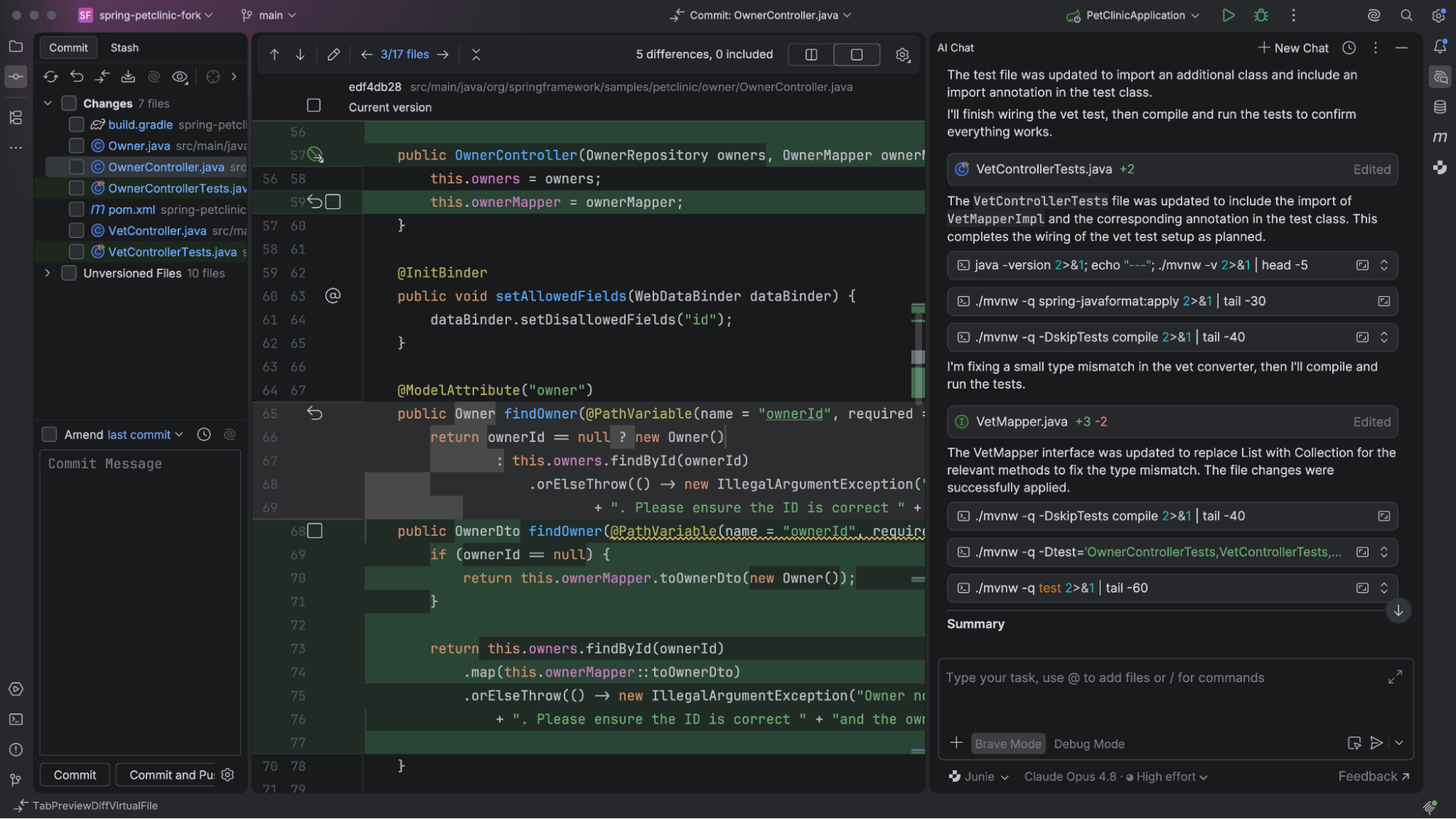
AI Assistant supports a wide range of AI agents through ACP (Agent Client Protocol).
The Skills Manager in AI Assistant lets you view the list of available skills and install them.
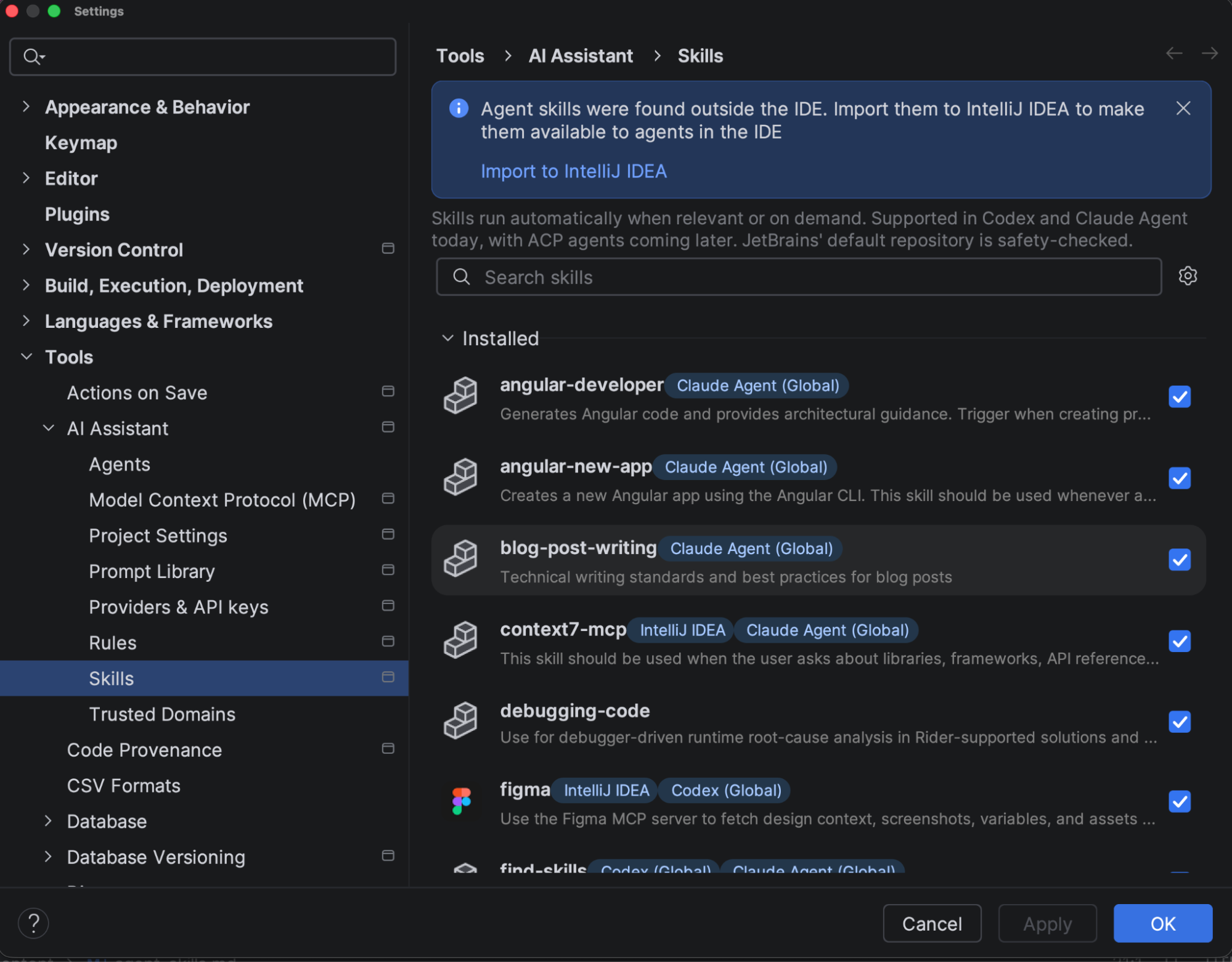
If you have already installed Agent Skills globally, the Skills Manager detects them and helps you install them as IntelliJ IDEA agent skills.
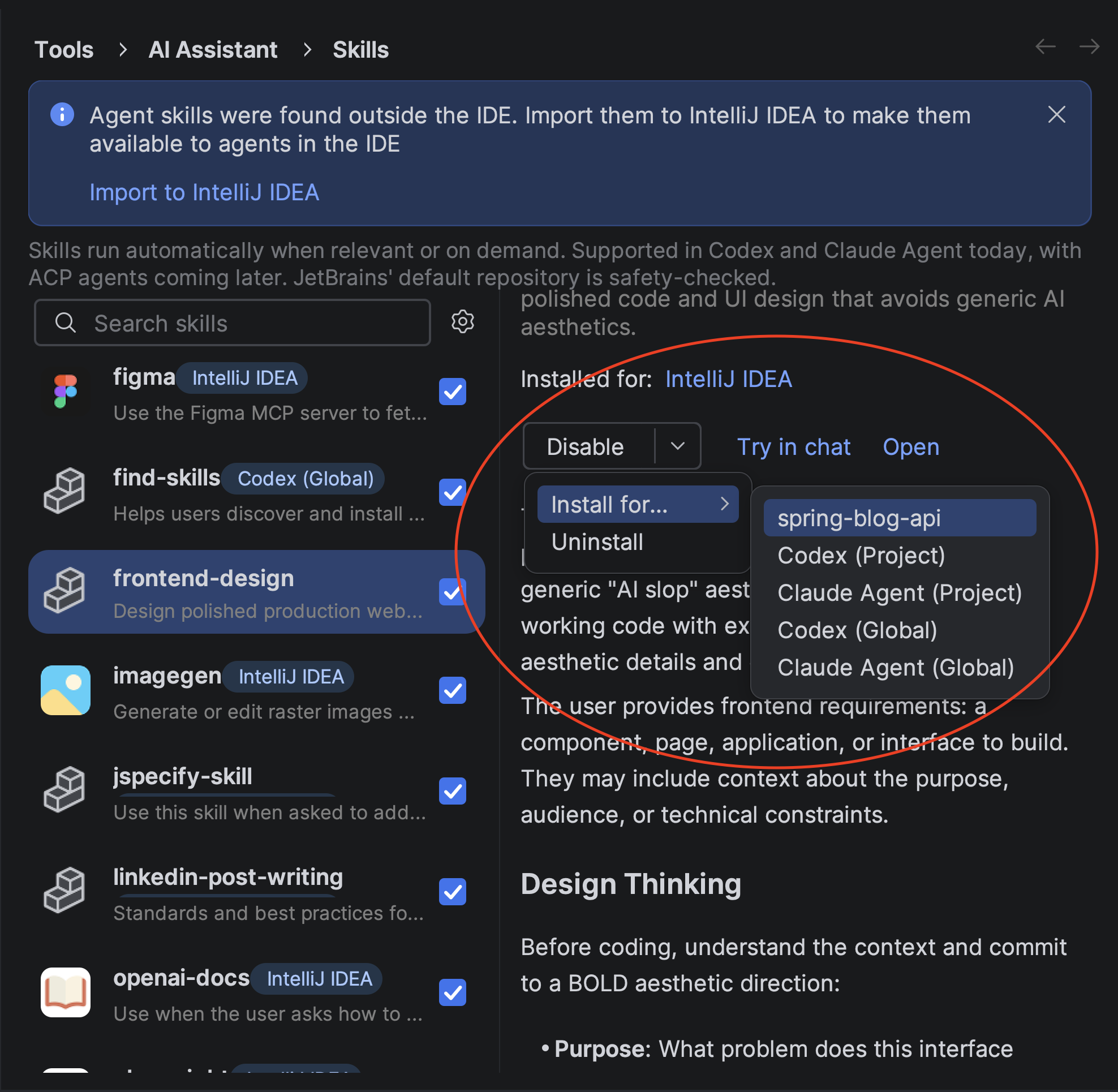
You can install a skill globally, at the project level, or per agent.
Skill Repositories
The Skill Repository lets you manage a list of locations where your verified skills are stored.
By default, JetBrains provides a Skill Repository hosted at https://github.com/JetBrains/skills.
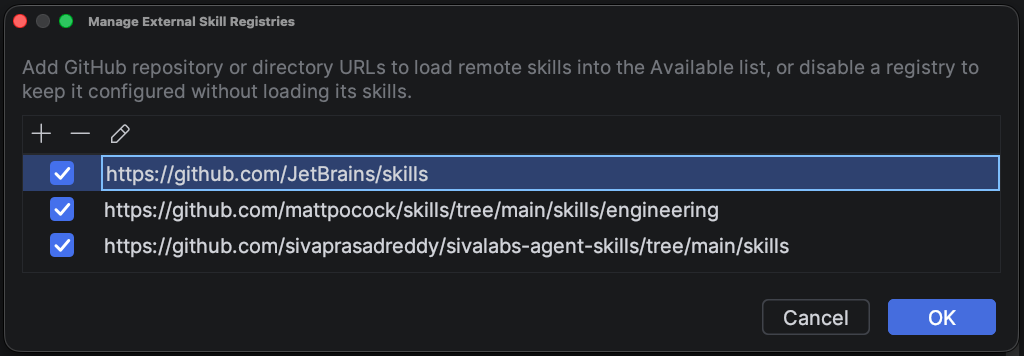
These skills are verified by JetBrains for security vulnerabilities.
It is essential to check for security issues before using agent skills downloaded from the internet. A better approach is to maintain an organization-wide Skill Repository, verified by your team, and add it to the Skill Repository list.
Agent Skills in action
Based on the prompt description, the AI agent automatically detects and uses relevant agent skills.
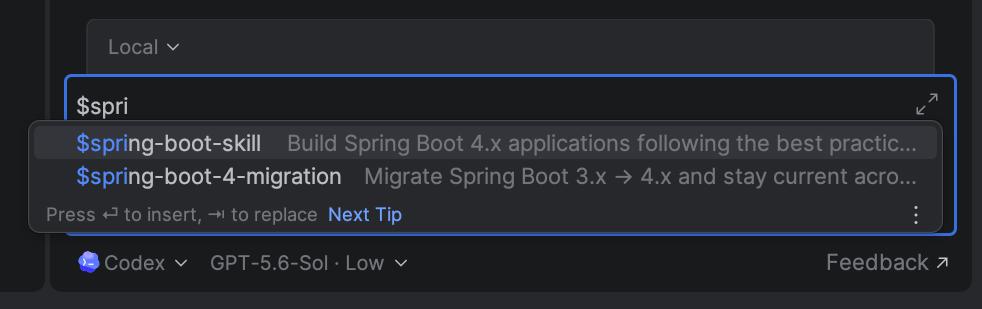
For example, I installed spring-boot-skill, and when I asked the AI agent to write tests for Spring Boot REST API endpoints, it used the spring-boot-skill.
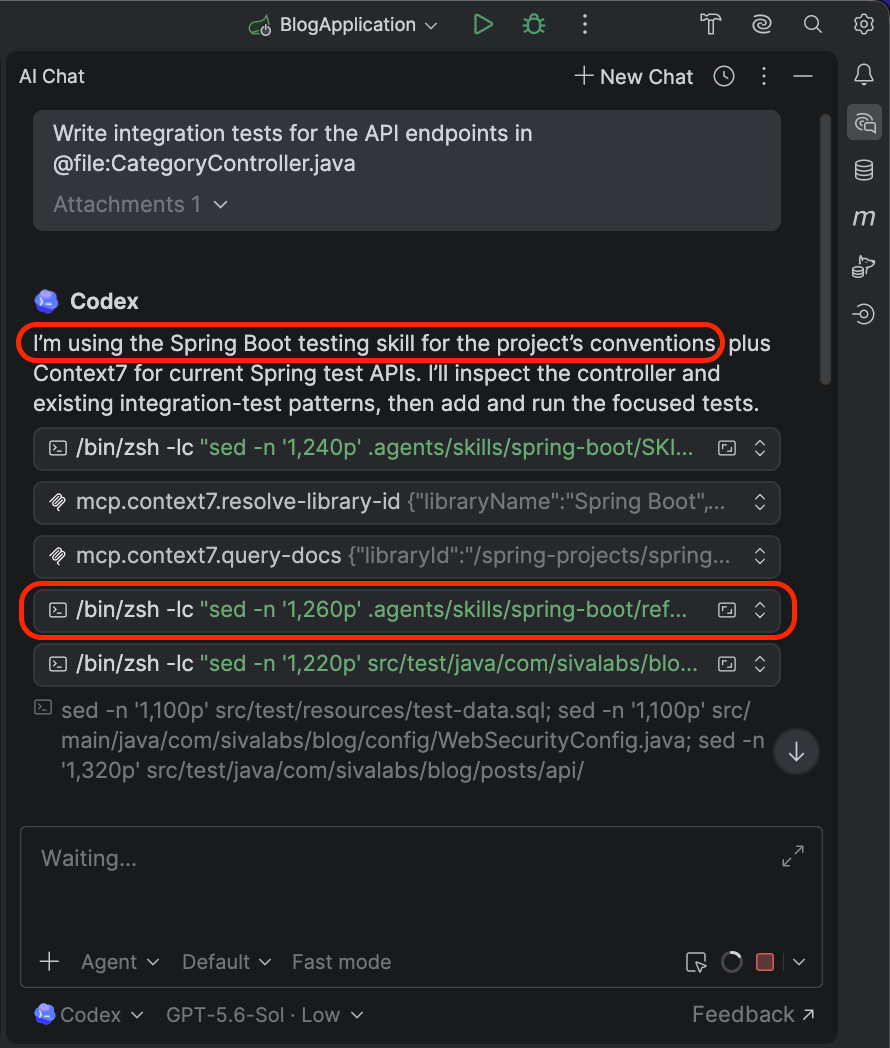
You can also explicitly invoke an agent skill using $skill-name [prompt] with Codex or `/skill-name [prompt]` with Claude.
Summary
AI Assistant’s Skills Manager makes agent skills part of your regular IDE workflow. You can discover, install, and manage skills without leaving IntelliJ IDEA, then make them available globally, for a specific project, or only to a particular AI agent. The AI agent can automatically select a relevant skill from your prompt, while explicit invocation gives you control when you need it.
Just as importantly, the Skill Repository provides access to skills verified by JetBrains for security vulnerabilities. Teams can also add their own repositories containing internally reviewed skills. This makes it easier to benefit from reusable agent capabilities while maintaining control over which skills developers use in their projects.
Why science still needs animal testing
Top 5 AI Features in IntelliJ IDEA
When developers hear “AI in the IDE”, the first thing that often comes to mind is a chat window. IntelliJ IDEA includes an AI chat, but JetBrains AI features also appear in many other parts of the development workflow.
Some of those features are easy to miss because they are built into existing IDE actions: editing code, generating code in place, explaining selected code, working with stack traces, writing commit messages, and choosing which model or agent should handle a task. This overview focuses on five AI features in IntelliJ IDEA that are worth knowing about, with a few additional capabilities explained at the end. The list starts with one that can help before you even open the chat.
1. AI completion
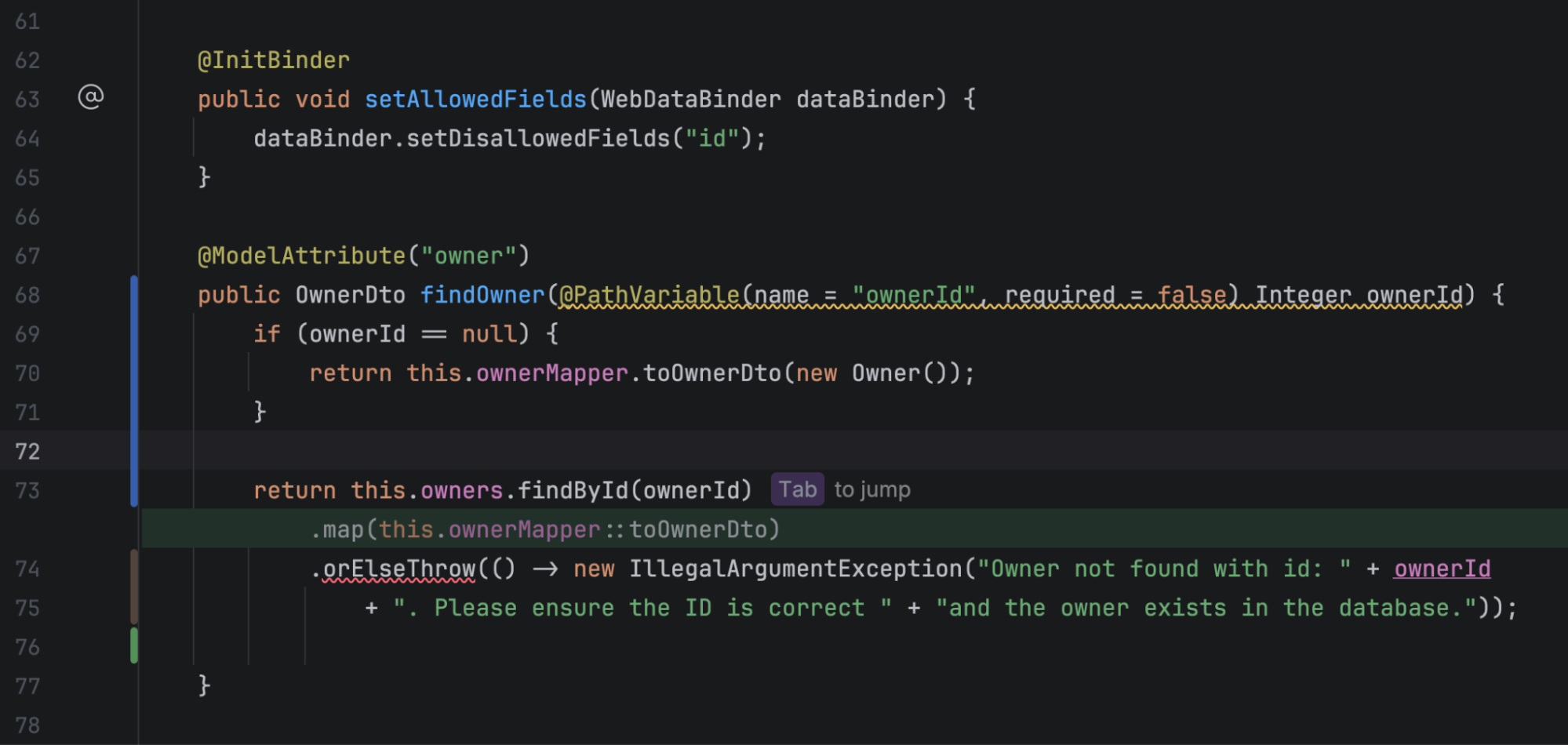
You change a line, and the IDE points out the next line that needs to be changed to match. Rename a field, and it walks you to the other places that reference it, one keystroke at a time. Press Tab to jump to the spot, and Tab again to accept the edit. Ordinary completion guesses what should follow directly under your cursor. This type looks a step ahead, at the edit you haven’t made yet.
It runs on JetBrains’ own models, tuned for coding, and it stays out of your way. Fix the spacing after one comma in a parameter list, and it will offer to fix every other comma in the file. On a larger scale, this is also where full-method generation is handled – the editor has enough local shape to fill in a method body without turning the task into a chat session.
The feature is easiest to understand in small edits. Change one line, and IntelliJ IDEA suggests the next related change in the file.
2. In-editor code generation
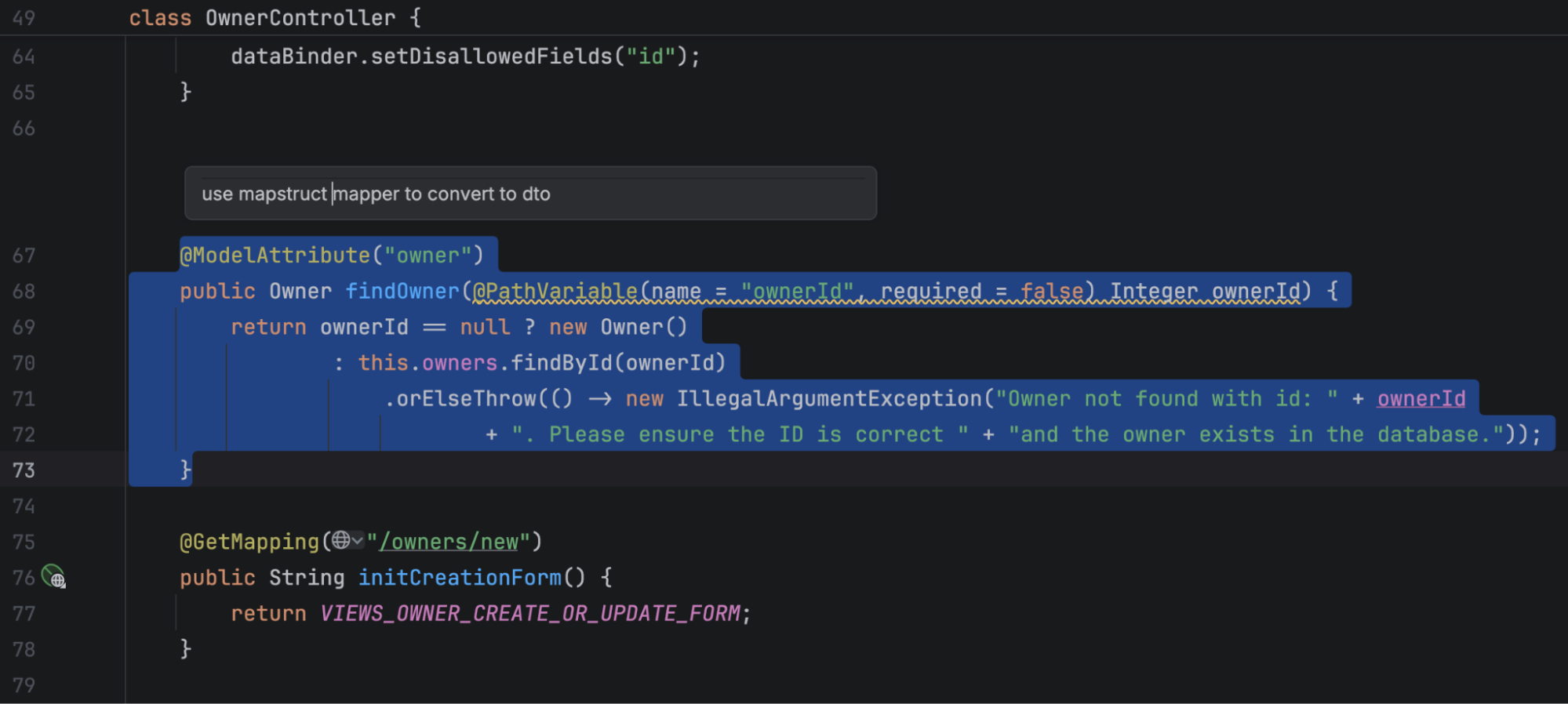
Press Ctrl+\ anywhere in a file, type what you want in plain words, like “turn this loop into a stream” or “give me a builder for this class”, and the code appears right there at the cursor. The code lands in place, and you never have to switch to a chat to copy an answer back out of a conversation.
For a small, well-scoped change, the convenience is that the prompt starts where the edit happens. You type the instruction in the editor, review the generated code in place, and keep moving.
The generated code appears as an in-editor diff, so you can accept it, reject it, or refine the prompt. If the first version misses a constraint, add more context, ,like “Keep the method name” or “use Optional instead of null”. IntelliJ IDEA regenerates the code with the extra information and shows the new diff in the same place.
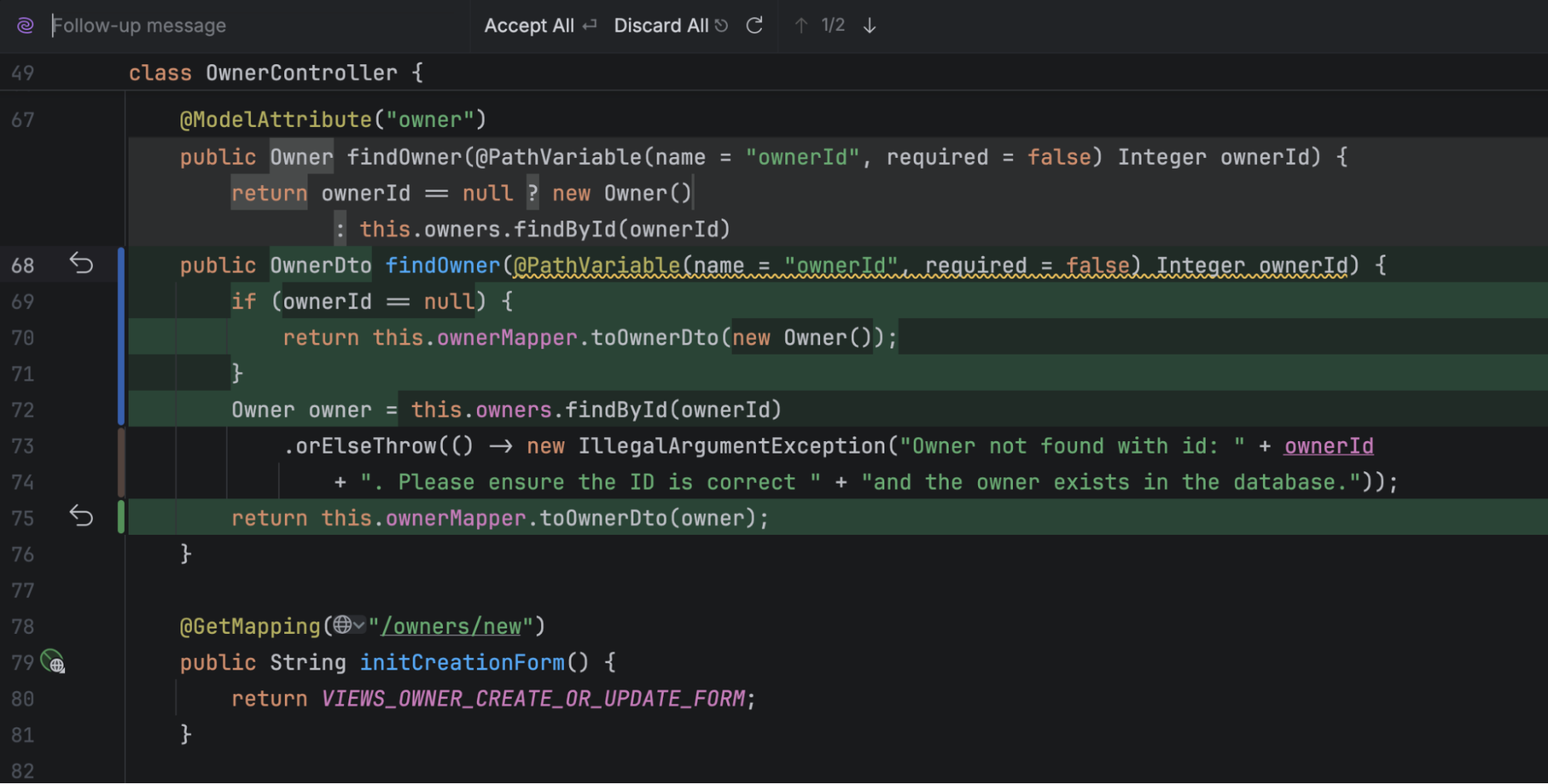
It is the hidden gem in the list – a general-purpose prompt you can invoke at the cursor for small, arbitrary edits, without opening the AI chat or copying code back into the file.
3. AI Actions
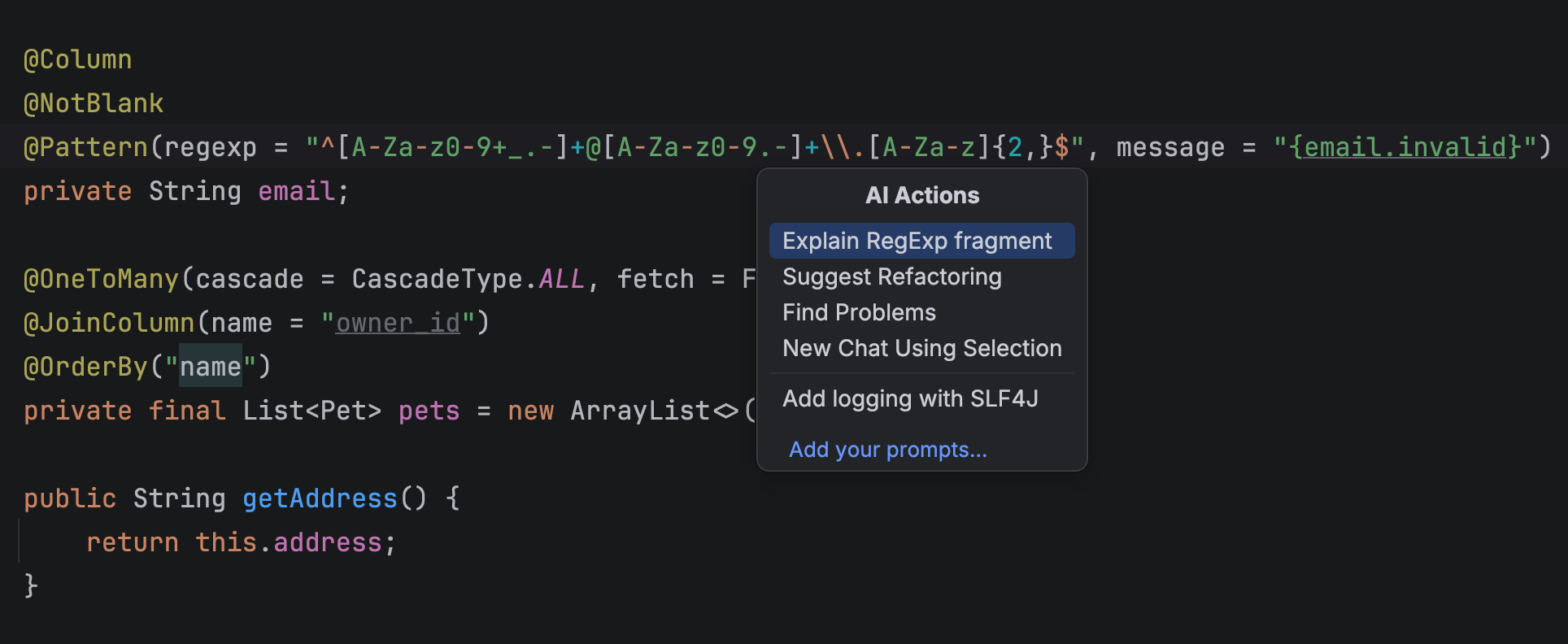
AI Actions is the menu for people who never want to have a conversation with our model. Select a piece of code, press Alt+Enter, and choose from a variety of useful actions – no chat required.
Explain Code takes a regex you didn’t write, a SQL query someone left you, or a cron expression, and tells you in plain English what it does. Generate Unit Tests opens the tests in a diff, so you can argue with them before they land in your project. Generate Documentation writes the doc comment for a public method. These actions keep you in the file. Point at your chosen code, pick an action, and get an actionable response immediately.
4. Bring your own agent
At some point, the task stops being a single editor action. It needs file changes, tests, and a diff you can review. Through the Agent Client Protocol (ACP), you connect an external coding agent and drive it from the same place where you already inspect files, diffs, tests, and problems. Think of ACP as the LSP for agents: one protocol, so the IDE doesn’t need a custom integration for every new agent that appears next month. JetBrains’ own agent, Junie, shows up in the same registry as the third-party agents and receives no special treatment.
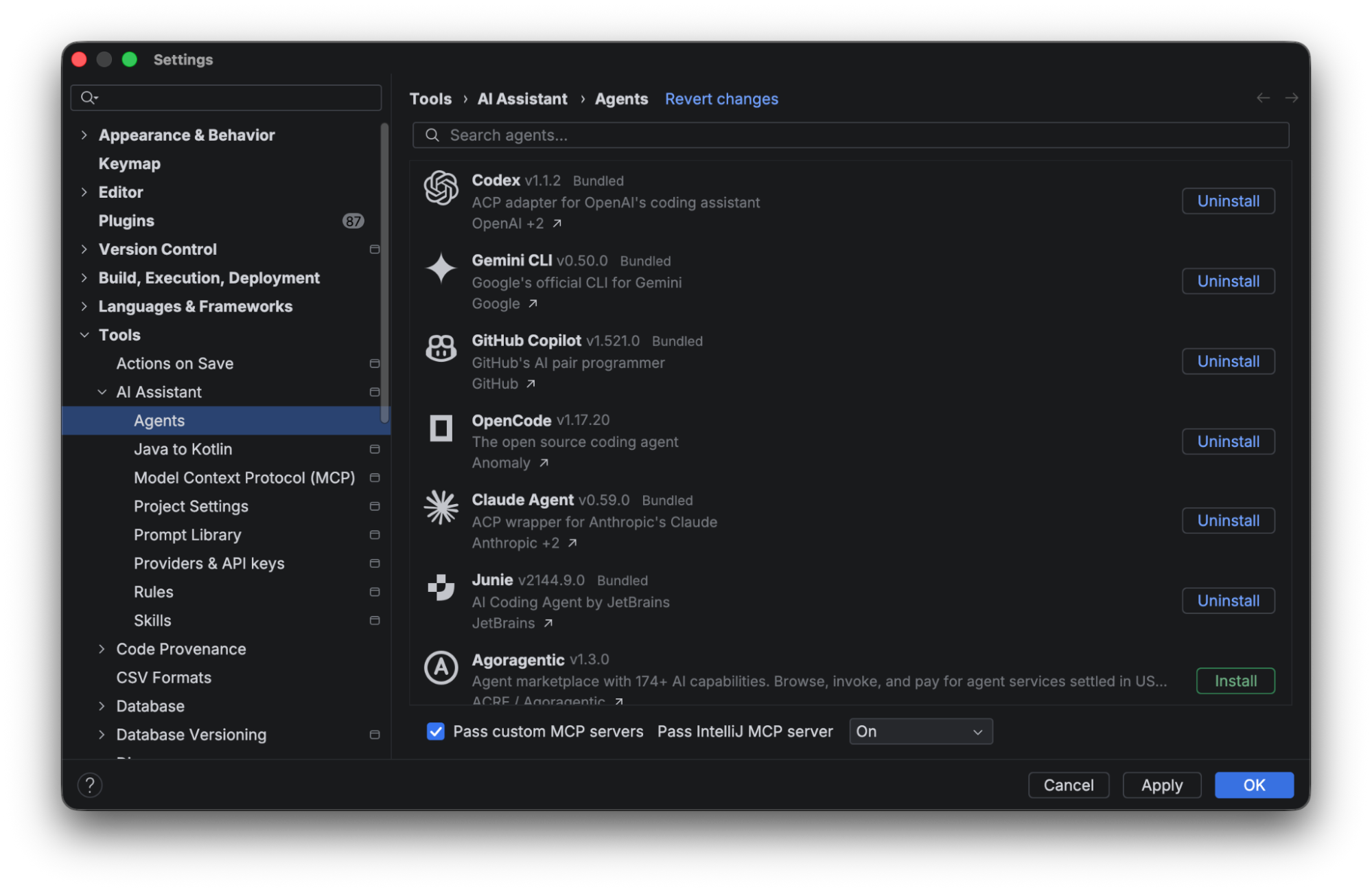
You ask the agent to change one endpoint. It proposes the steps, edits the service and the test, runs the test command, and leaves you with a diff you can open from the chat before accepting anything. That is the IDE part of the story. The agent can act, but the review still happens where you already review code.
Skills sit next to that. A skill is a reusable capability you set up once: triaging a CI failure, working through PR comments, converting Java to Kotlin, or nudging an agent away from the usual Spring Data JPA pagination mistake. You add skills from the + menu in the chat, and supported agents can use them without you having to retype the same long set of instructions every time.

That is where the IDE demonstrates its worth. The agent can make a series of edits, but you can inspect each one as it appears – open the affected files, check test outputs, and review diffs before accepting anything. The chat, code, and review stay in the same window, making it easier to stay in control while the agent handles the mechanical work.
5. Bring Your Own Key
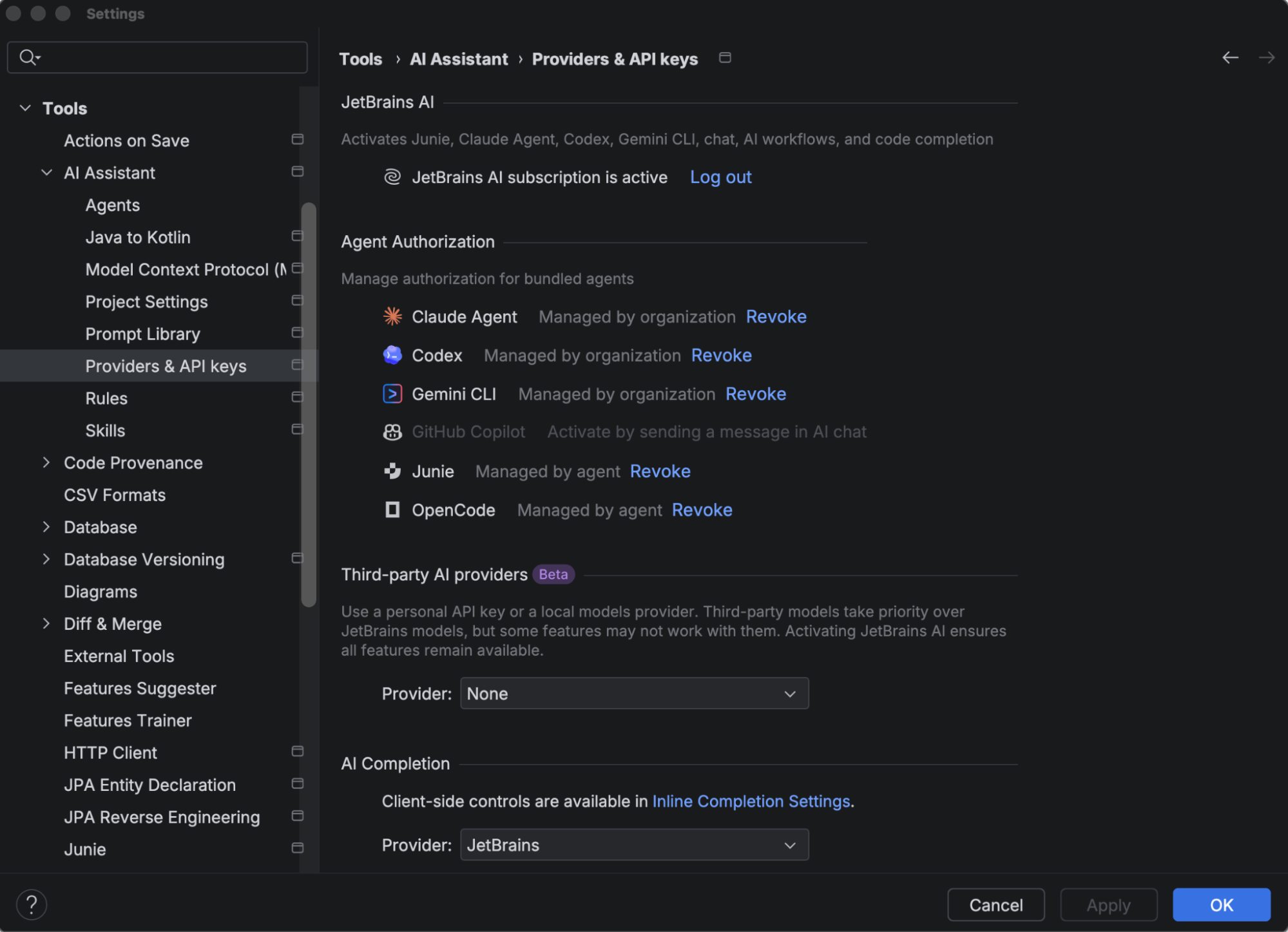
Once agents are in the IDE, the next decision is more straightforward – which provider your organization allows the IDE to call. Bring Your Own Key (BYOK) enables you to add the API key or endpoint for any provider your team already uses.
A configured key can sit behind the AI chat and selected IDE features, such as commit message generation, depending on what features the provider and model support. For some teams, the ability to use a provider that has already passed internal review matters more than support for the one at the top of the current model leaderboard.
You can configure your keys in Settings | Tools | AI Assistant | Providers & API keys. Choose a provider under Third-party AI providers, enter the key or endpoint, and test the connection. Once it is connected, the provider’s models will appear in the AI chat’s model selector.
Beyond the top five
Aside from the top five headline features, a couple of smaller capabilities are still worth knowing about because they appear where the IDE already has context.
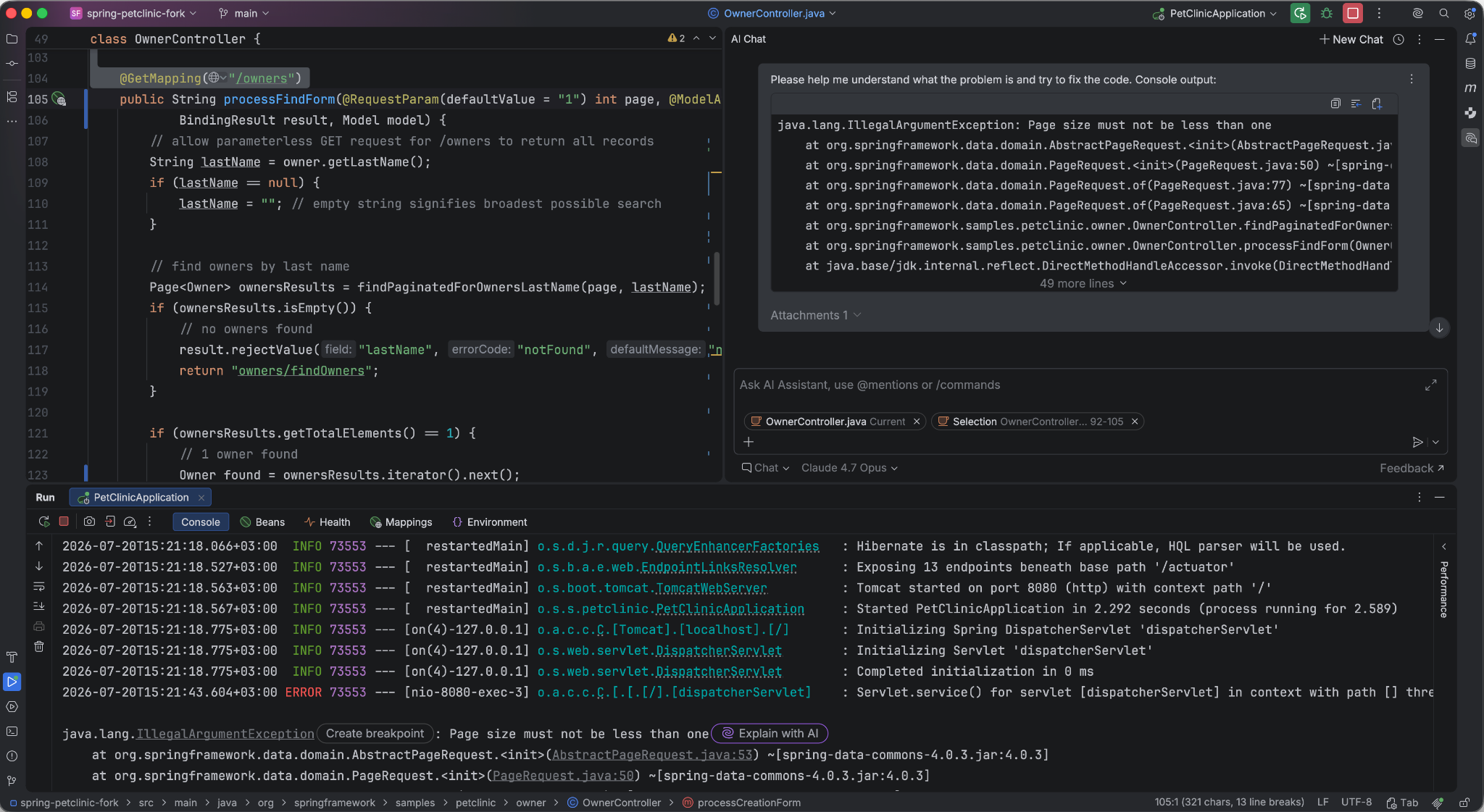
When the stack trace is already in the console
The run console is where optimism goes for a reality check. When your app throws an error and the stack trace lands there, the Explain with AI action is on hand. The IDE reads the trace and then gives you a likely cause and a suggested fix. That is a better use of thirty seconds than pasting the top line into a search engine and opening three tabs from 2017.
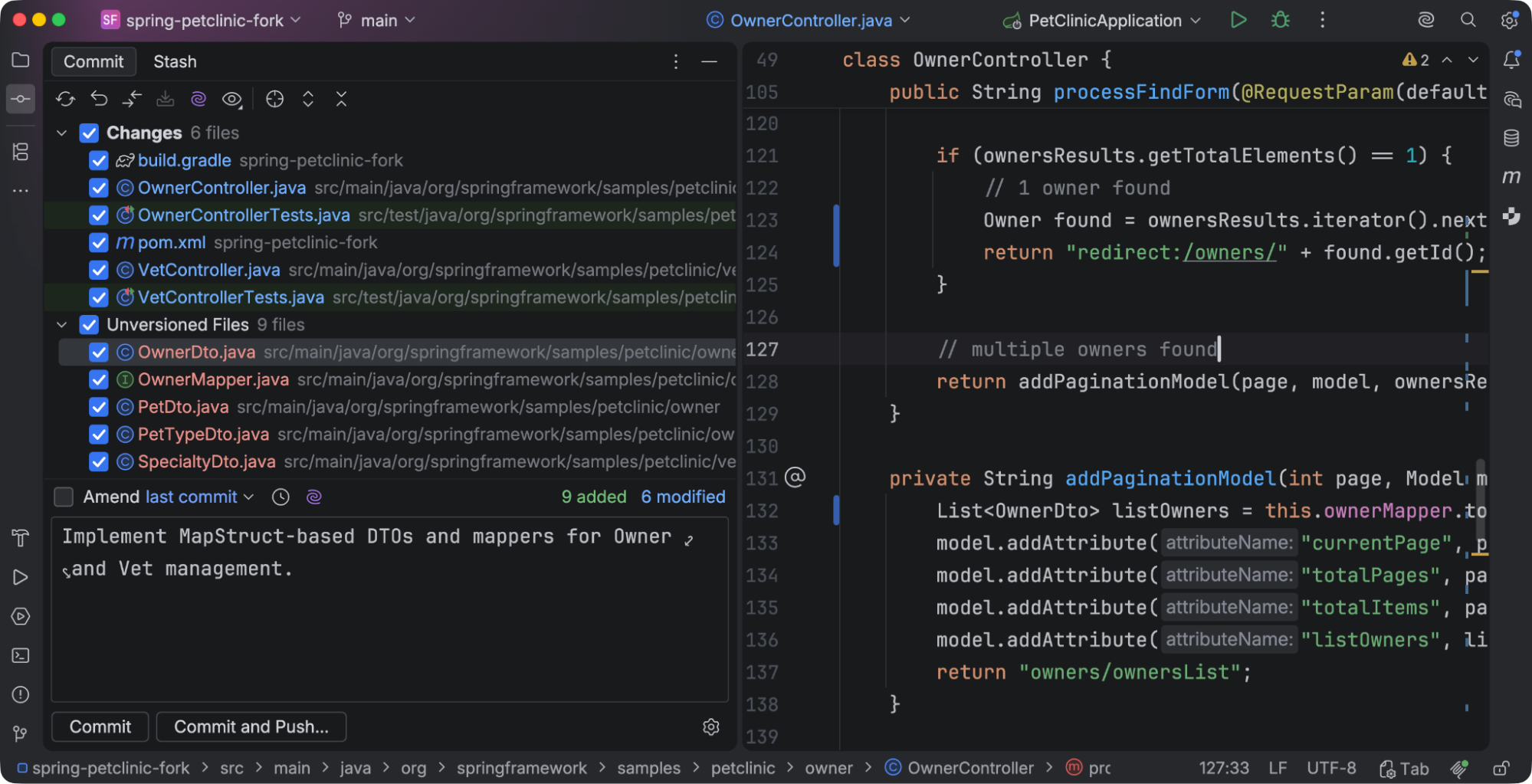
When the staged diff needs a sentence
Generate Commit Message reads your staged diff and writes the message for you. Edit it, commit, and move on. It is a small feature, but it is exactly the kind you keep using once you know it exists.
The part you may have missed
The AI Chat window is still here, and has gotten more interesting with agents and skills. The easy-to-miss part is the layer of AI-powered productivity features around it: edits suggested as you type, code generated at the cursor, explanations for selected code and stack traces, and commit messages written from the staged diff.
The final effect is boring in the best way: IntelliJ IDEA, doing a little more than it used to, without making a ceremony out of it.
If you tried AI Assistant a year ago and mostly remember the chat, this is the part you may have missed.
Pump and circumstance: is China the new OPEC?
Just 20 of 6,600 Defra staff working on climate adaptation amid drought and wildfires
Exclusive: England ‘desperately unprepared’ for effects of crisis including water shortages and heatwaves
Just 20 staff are working on climate adaptation within a key government department tasked with protecting the environment and maintaining food security, a freedom of information request has revealed.
The officials make up 0.3% of staff within the Department for Environment, Food and Rural Affairs.
Continue reading...Устанавливаем Digital Q.DataBase 18.2 на РЕД ОС 8: PostgreSQL, MS SQL и Oracle в одной СУБД

Привет, Хабр!
Меня зовут Жуйков Андрей, занимаюсь развитием и продвижением СУБД Digital Q.DataBase.
Сегодня для многих организаций импортозамещения СУБД - уже практическая задача, которую необходимо решать без остановки бизнес-процессов и без многомесячной переработки прикладных систем. Одним из ключевых требований при выборе новой платформы становится возможность сохранить существующую прикладную логику и минимизировать объем изменений в коде приложений.
В этой статье я покажу, как установить Digital Q.DataBase 18.2 на РЕД ОС 8.0.3, познакомлю с новой архитектурой СУБД и продемонстрирую подключение к каждому из поддерживаемых диалектов.
Читать далееChum review – daft shark attack movie with wedding guests running gamut of toothy undersea beast
Producer-star Alice Eve seems to be laughing along with the audience in this deeply silly high-concept thriller
To be as clear as the crystalline waters in which the characters here frolic before their blood turns the ocean the colour of sangria: this is grade A tosh. It’s a deeply stupid high-concept feature wherein a bunch of bourgie wedding guests run afoul of an errant great white shark. The twist is (and it’s really not much of a surprise) that the true enemy is not really the shark, which is only following its sharky instincts. No, the bad guy is a bereaved weirdo called Roy (Jim Klock), who wants revenge on the shark for eating his wife in the opening pre-credits sequence.
Alice Eve, who is also one of the film’s producers, at least seems to be having a bit of a giggle playing Tina, the most resourceful of Roy’s victims. Tina is a lawyer who should be enjoying the first days of her marriage to Tom (Eric Michael Cole) after their lavish destination wedding – except it looks like they are heading for a swift annulment, because ecowarrior Tom is disgusted with Tina for considering taking on an oil company as a client. They can’t make peace on the topic, and in the middle of an endless bicker they are press-ganged into what is supposed to be a relaxing three-hour cruise with a bunch of disposable secondary characters.
Continue reading...Takeaways From the Wisconsin, Minnesota and South Carolina Primaries
You’re Thinking About Online Trends All Wrong
Harrods Fights With Al Fayed Estate Over Hundreds of Sex Abuse Claims
Barnaby Joyce claims One Nation ‘one of the gayest parties in Australia’ as former candidate’s comments surface
One Nation MP says failed WA candidate’s comments describing same-sex attraction as a mental illness are ‘highly offensive’
Get our breaking news email, free app or daily news podcast
Barnaby Joyce has defended One Nation as “one of the gayest parties in Australia” after comments surfaced from one of its failed candidates describing same-sex attraction as a mental illness.
The former National turned One Nation MP was asked to respond to a series of homophobic comments made by a former Western Australian legislative council candidate for One Nation in a video last month, as first reported by ABC on Wednesday afternoon.
Continue reading...183 модуля, 2 разработчика и никакой подписки: как 15 лет живет система учета для бизнеса

15 лет назад небольшая команда начала делать собственную систему учета для бизнеса — без подписки, венчурных инвестиций и большой команды разработки. Сегодня в СКИФ 183 модуля и интеграции, а ядро компании по-прежнему состоит всего из двух человек.
Поговорили с создателем системы о том, зачем понадобился еще один учетный продукт, почему Freemium оказался ошибкой, как они пришли к модели платных доработок и зачем небольшой команде сегодня ИИ.
Читать далееМасштабирование без потерь: база знаний, чтобы запустить филиалы банка за 2 недели

Первый день работы нового филиала банка: кажется, что может пойти не так? Сотрудники держатся уверенно, но в глазах заметно напряжение. Один ищет скрипт в планшете, другой вспоминает, какой шаблон использовать для заявления, третий отвлекает старшего менеджера банальным вопросом. А клиент ждет: для него это не «технические трудности», а плохой сервис.
Читать далееGreat Britain braced to pay millions for backup electricity during solar eclipse
Event expected to curtail solar power just as summer’s fifth heatwave increases use of air conditioning and fans
Great Britain is braced to pay millions for backup electricity supplies to prevent a shortfall on Wednesday evening as the near-total solar eclipse is expected to wipe out solar power generation.
The government’s electricity grid operator is expected to make multimillion-pound payments to secure electricity at short notice before the moon blocks up to 95% of the sun over parts of the country, the most dramatic solar eclipse visible in Great Britain since 1999.
Continue reading...Мысленный эксперимент, который показывает, что ни одна теория не может адекватно формализовать самоощущение машин

Печатая эти строки, я вижу мир вокруг, слышу его звуки, чувствую, как течет время. Ветер колышет верхушки елей, птица выводит трель, пахнет ивовой корой, горное солнце печет мою кожу. Я ощущаю себя, и это ощущение само по себе кажется мне чудом. Как оно рождается? Как множество разрозненных и неразумных клеток, потоков жидкостей и электрических импульсов внутри моего тела объединяются в единое целое и становятся тем, что мы называем собственным "Я"?
Можем ли мы математически описать природу самоощущения, можем ли мы построить машины, которые обладали бы им наподобие нас?
Sali Hughes on beauty: a shortcut to glass skin? Try these one-step moisturisers
Three new products – and one old favourite – achieve a glazed sheen in one easy application
As you will no doubt have noticed, “glass” skin – that is, a complexion with a smooth, glazed sort of sheen – has been fashionable for ages. Until now, however, it has only come as the result of a meticulous, umpteen-step Korean skincare routine. But the new glass skin moisturisers attempt to mimic the look in one simple application.
Erborian’s Glow Moisturiser (from £9, all skin types) is a Goldilocks’s porridge sort of face cream. Not too heavy, not too light, just dewy enough without looking oily, and with lasting hydration that never becomes wet. I must advise the glimmer-avoidant that it does have a smidge of pearlescence, but I find that flattering.
Continue reading...Carcass Clad: stifling tank combat promises tension, terror and surprising laughs
After the success of space horror Mouthwashing, Swedish developer Wrong Organ has created a Battlefield-inspired co-op with a supernatural twist
‘Claustrophobic”, “oppressive”, “pretty depressing” – these are the words Jeffrey Tomec and Dave van Egdom volunteer when I ask them to reflect on their work as part of Swedish indie developer Wrong Organ. I’d add “nightmare-inducing”, too. Their last game, Mouthwashing, was an acclaimed work of horror storytelling set on a scuttled space freighter, in which players uncover the horrible things its desperate crew have done to each other.
When you’re planning a follow-up to something so pitilessly nasty, how do you raise the stakes? Well, you could set the entire game in the stifling crew compartment of a heavily armoured tank, a coffin-like interior you share with two other players as you co-operatively attempt to pilot your beleaguered war machine to safety through the crumbling remains of a city in enemy territory.
Continue reading...Marvel Tōkon: Fighting Souls review – an anime-style rumble that’s rooting for you
PlayStation 5, PC; Arc System Works/Sony Interactive Entertainment
With tremendous visuals and accessible controls, this superhero-themed fighter has the chops to inspire a new generation of champs
Arriving at the turn of the millennium and the twilight of the video arcade, Marvel vs Capcom 2: New Age of Heroes has long been a high-water mark for fighting games, with no heir apparent; its massive, colourful roster and frenetic, spectacular combos have lured newcomers and elite competitors alike. Developer Arc System Works, a fan-favourite studio famous for its hyper-fluid and extremely technical anime-style fighting games, has been on a long journey to usurp Capcom’s throne. With Marvel Tōkon: Fighting Souls, it may have finally achieved this difficult task.
Marvel Tōkon is less an attempt to recreate a Marvel vs Capcom-esque phenomenon out of whole cloth, and more a thoughtful evolution of the developer’s previous riffs on the formula such as 2018’s BlazBlue: Cross Tag Battle and Dragon Ball FighterZ, building on its low-floor, high-ceiling approach. Simplified inputs allow players to execute combos and finishers with a single button, which gives novices the confidence to keep playing and inspires them to study and improve – because when anyone can pull off a flashy ultimate skill or EX attack, strategy and mastery take on a premium. And Marvel Tōkon has great depths to plumb.
Continue reading...David Crowley wins Democratic primary for Wisconsin’s governor in upset over progressive Francesca Hong
Crowley pulls off last-minute victory in tight race after polls had shown Hong as the clear Democratic frontrunner
David Crowley, the Milwaukee county executive, won the Democratic primary for Wisconsin governor after beating the democratic socialist Francesca Hong in a tight contest.
Crowley pulled off a last-minute victory in the critical swing state after re-entering the campaign and snagging an endorsement from Tony Evers, the outgoing governor.
Continue reading...