RSS Feeds
What's at stake as voters cast ballots in six primaries, including South Carolina and Wisconsin
Thunderstorms cause major travel delays, ground stops
Pentagon report reveals steep civilian toll of Trump’s Yemen campaign
Trump took secret flight from Turkey NATO summit last month due to Iranian missile threat
A Timeline of the Fight Over the Elizabeth Street Garden in Manhattan
What to know as your driver's license gets a digital upgrade
New forecast shifts GOP Rep. Max Miller's reelection race to "toss-up"
Buzzer-beaters and besties: the rivalries and friendships that make the WNBA
From Comets-Liberty and Lynx-Sparks to Wilson-Gray and the StudBudz, the feuds and friendships that have shaped 30 years of the WNBA
It’s Rivals Week in the W, and it’s already given us so many spicy viral moments. But when I look at the matchups that headline the schedule, it made me think of all the different rivalries that have come and gone throughout the league’s 30 years – some rooted in half-court buzzer-beaters, others in baseline jumper buzzer-beaters. Moral of the story: if there’s a buzzer-beater involved, it’ll likely turn into a team rivalry.
And while there are tense rivalries, there are also fierce friendships in this league. The ones that make you giggle to yourself when they wind up guarding each other during a game, or they show off a special celebration as teammates. Today, I want to highlight both – because both are what makes the W worth watching.
Continue reading...Male redback spiders invite cannibalism through a ‘self-sacrificial somersault’ during sex – but why?
New research sheds light on the genetic basis of the venomous arachnid’s ‘weird mating behaviour’
Get our breaking news email, free app or daily news podcast
If you think you’ve had a bad one-night stand, spare a thought for the male redback spider, whose sole reproductive partner eats him after sex.
Male redbacks appear to invite this cannibalism through a “self-sacrificial somersault”, with new research shedding light on the genetic basis of the behaviour.
Continue reading...What inspired the outfits in "The Handmaid's Tale"
Veteran faces childhood trauma on psychedelic journey
The anatomy of a big chief showdown
FDA last inspected Mexican farm linked to cyclospora outbreak in 2019, records show
Credit card debt surges in U.S. as high interest rates make it harder to pay off
The effectiveness and cost of the National Guard deployment in D.C.
Why Trump’s Secret Flight Was Extraordinary by Presidential Standards
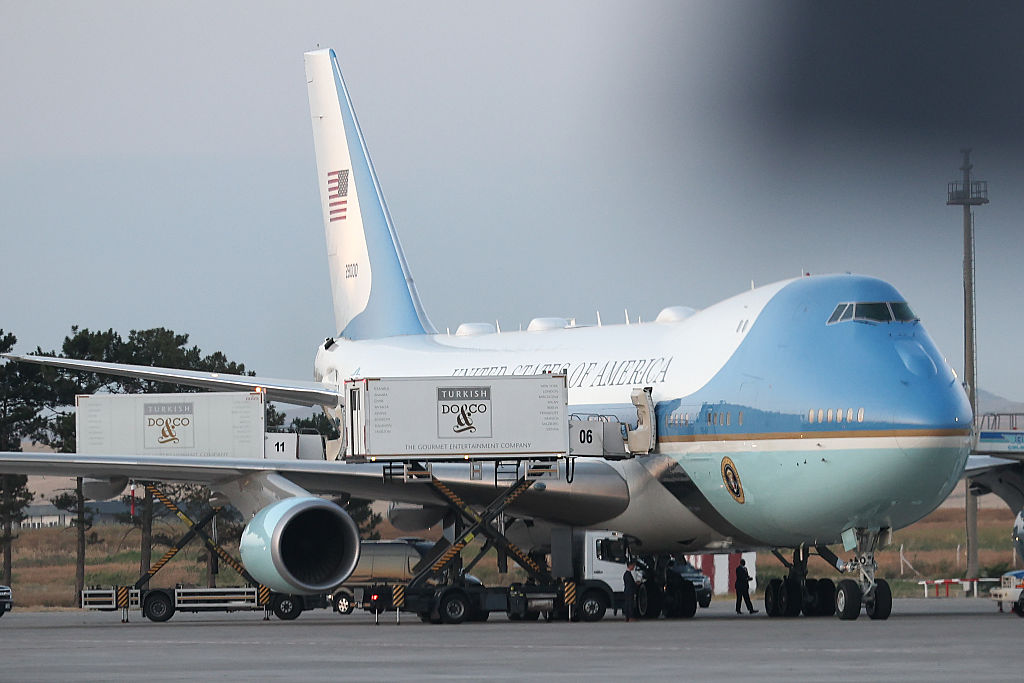
The “secret flight” that President Donald Trump took out of Turkey last month following an Iranian assassination threat, newly revealed by the Washington Post this week, marked a rare occasion for a commander-in-chief: traveling without the White House press pool.
Multiple outlets have reported, citing unnamed sources, that when Trump left Turkey after the NATO Summit last month, he secretly departed the country on an alternate plane because of an assassination threat made against him from Iran.
Publicly, the Administration said that Trump would fly out of Turkey on July 8 on an older Air Force One aircraft, and the President did board that plane in the sight of cameras and reporters on that day. But the Post reported that Trump then got into a catering truck, which transported him to another plane—all unbeknownst to the journalists who were on the former Air Force One and were under the impression that they were on the same aircraft as the President.
The clandestine operation meant that, for several hours, the President’s real whereabouts were unknown to—and concealed from—both the White House press pool and the American public.
Read More: Former Secret Service Agents: Trump’s Secret Plane Swap Unusual, Not Unprecedented
In response to the Post’s questions about the operation, White House communications director Steven Cheung shared a statement defending the plane Trump traveled on to get to Turkey, a Qatar-gifted aircraft that drew controversy.
“The new Air Force One is a state-of-the-art aircraft that has been fitted with high-level security protocols that ensure the safety of the President and his staff,” Cheung said in the statement. “As the President has said recently, there are many enemies of America who have their sights on him, and we use every tool at our disposal to address those threats.”
Historically, the journalists who make up the White House press pool travel with—or alongside—the sitting President nearly everywhere he goes. Here’s what to know about the pool, and previous instances when a commander-in-chief has made the extraordinary move of traveling without those journalists.
What is the White House press pool?
The White House press pool is a small group of journalists from various news outlets who follow the President around to various events, such as bill signings and trips. Because there is limited space to attend these events or travel with the President, the system allows news outlets to “pool” their resources; the print reporter on “pool duty” each day shares “pool reports,” which contain notes and quotes they took down as they followed the President, with the entire White House press corps. The specific journalists who are part of the press pool rotate.
“For nearly a century, the story of the American presidency has been written through the eyes of the ‘press pool,’ the small team of writers, photographers and technicians assigned each day to cover the commander-in-chief on behalf of the broader corps of correspondents,” the White House Correspondents’ Association (WHCA), which works to coordinate and ensure access for journalists covering the White House, said on its website. The WHCA went on to say that the accounts documented by the pool “provide a daily record of the presidency that forever lives in the archives of news organizations.”
“Pool duty is an essential element of the work of White House correspondents because one never knows when the world will need good information about precisely where the president of the United States is and what he is doing at any moment,” the association continued.
Members of the White House press pool have been with Presidents during a slew of historic and high-stakes moments. They were, for instance, in the motorcade when former President John F. Kennedy was assassinated in Dallas in 1963. The press pool was also present when an assassination attempt was made on former President Ronald Reagan’s life in Washington, D.C. in 1981. On Sept. 11, 2001, amid the chaos and fear that followed the 9/11 terrorist attacks on the World Trade Center and the Pentagon, Bush traveled with a smaller press pool to a military facility and then back to the nation’s capital. Journalists have also followed Presidents—including Trump—into dangerous war zones.
When Presidents have traveled without the press pool in the past
While it is rare for the sitting President to travel without the press pool, it has happened on occasion in the past.
In 2010, former President Barack Obama left the White House without the press pool and went to one of his daughter’s soccer games, a decision that generated controversy. The Associated Press wrote at the time that Obama had “quietly breached years of protocol” by doing so.
Soon after Trump first won the presidency in 2016, but before he was sworn into the White House, he went out to dinner without notifying the reporters who were covering him. The move prompted press organizations to release an open letter to Trump, in which they emphasized the importance of the press pool.
“As the new leader of the free world, we expect that you will preserve longstanding traditions that ensure coverage of the Trump presidency,” the organizations said in their 2016 letter. “The idea of a press pool that covers all of the president’s movements is one that dates back to the Franklin Delano Roosevelt administration. Every president of both parties has treated this important tradition with respect. The role of the press pool is critically important to our country, whose citizens depend on and deserve to know what the president is doing.”
Neither of those instances were a result of threats made against Obama or Trump. The operation last month, in contrast, stemmed from a threat against the President’s life that Administration officials deemed credible enough to warrant the secrecy, the Post reported.
Air Force One has been used as a “decoy” for a President’s protection in the past: former President Bill Clinton, for instance, traveled to Pakistan in a white aircraft that followed Air Force One in 2000. But he got off the unmarked plane in Islamabad in view of cameras and journalists, revealing the covert operation. And, before takeoff, Clinton Administration officials told at least one member of the White House pool about the operation.
When Trump boarded the alternate plane in secret last month, the poolers who were assigned to travel with him were not informed that he had switched to a different aircraft—nor were they notified about the adjudged credibility of the threat on the one they were on, an official told the Post.
CNN anchor Jake Tapper emphasized on Tuesday the extraordinary circumstances of the clandestine operation in Turkey.
“Obviously the life of the president is paramount, and previous White Houses have used deception to protect the president’s life,” he said in a post on X. “But no officials I’ve spoken to have ever before heard of using an [Air Force One] full of [White House] staff and journalists as a decoy during an imminent threat.”
Ronald L. Rowe Jr., a former acting director of the Secret Service, told the Post that, if the President’s location is kept secret, it is for a reason.
“We need to keep the ‘secret’ in Secret Service,” Rowe told the news outlet. “The public should know what the president is doing on a daily basis, but when it comes to the methods by which the Secret Service keeps the president safe, that should remain out of public view.”
Robert McDonald, who worked with the Secret Service for more than two decades, told TIME that the operation in Turkey appears to be a result of real-time improvisation by the President’s security team. He also cast doubt on the idea that the journalists who were on the former Air Force One were left at risk.
“I would find it incredibly hard to believe that those two planes weren’t escorted or with other assets from allies or the U.S. Air Force in the area,” he said.
McDonald went on to say that restricting the number of people who are informed of such an operation is standard practice, and stressed that the outcome of the mission was that everyone arrived home safe.
“Everybody that I’m aware of got home from that trip to Turkey,” he said. “The bottom line is everybody got home safe. That’s the main function of the Secret Service.”
Transportation Secretary Duffy discusses new technology aimed at making air travel safer
The Papers: 'Andy U-turns on early release' and 'Hunt on for eclipse glasses'
U.S. military operations killed 153 civilians last year, Pentagon says
Male redback spiders invite cannibalism through a ‘self-sacrificial somersault’ during sex – but why?
New research sheds light on the genetic basis of the venomous arachnid’s ‘weird mating behaviour’
Get our breaking news email, free app or daily news podcast
If you think you’ve had a bad one-night stand, spare a thought for the male redback spider, whose sole reproductive partner eats him after sex.
Male redbacks appear to invite this cannibalism through a “self-sacrificial somersault”, with new research shedding light on the genetic basis of the behaviour.
Continue reading...Deadly storms, tornadoes slam Midwest, causing widespread power outages
Hundreds of children hurt in 'serious' e-scooter accidents
Putin sends Trump a gift - and will hope for something in return
Emery positive about Aston Villa’s outlook despite summer exits as PSG await
Ebullient manager takes his side to Salzburg to cross swords with the European champions in the Super Cup
One thing was almost instantly detectable as Unai Emery walked into a stuffy room inside the Red Bull Arena on the eve of Wednesday’s Super Cup against Paris Saint-Germain. After a summer of change, Aston Villa’s manager appeared uber-relaxed, confident his team will absorb a series of headline departures. He cracked a joke about his English improving and poked fun at John McGinn, impersonating his captain while next to him on the auditorium’s top table.
Emery was in a jovial mood, then. But he was also switched on, alert to the frequency, the tone of the wave of questions at the beginning of his fourth full season in the job. “You ask about the changes of coaches and players, but McGinn is intelligent and his answer was fantastic,” Emery said with a smile. “When he arrived here [in 2018] they were in the Championship and every year since there have been changes and still the club has moved forward.
Continue reading...Premier League 2026-27 preview No 5: Brighton
Fabian Hürzeler has lost key players including Welbeck and Van Hecke with Brighton needing squad depth to cope with the demands of European football
Guardian writers’ predicted position: 9th (NB: this is not necessarily John Brewin’s prediction but the average of our writers’ tips)
Last season’s position: 8th
Continue reading...Top adviser to Iran's Revolutionary Guard leader sits down for rare interview
<a href='https://news.sky.com/story/politics-latest-andy-burnham-labour-kemi-badenoch-tories-nigel-farage-reform-12593360?postid=12212103#liveblog-body'>More than a dozen asylum hotels closed and returned to public use</a>
No content available
Frenzy for Solar Eclipse Glasses Takes Over London
How a catering truck helped Trump secretly switch planes amid threat from Iran
Search for earthquake survivors in Colombia enters critical phase
PBS Chief Paula Kerger on the Aftermath of Federal Funding Cuts—and What People Get Wrong About Public Media
.jpg?branch=production)
Paula Kerger is navigating arguably the most challenging period of her 20-year tenure at the helm of the Public Broadcasting Service (PBS), which has more than 330 member stations. Last spring, President Donald Trump signed an executive order calling for all federal funding to PBS and NPR to be blocked, accusing the organizations of bias. Soon after, the Department of Education notified the Corporation for Public Broadcasting (CPB) that it was terminating the 2020-2025 Ready To Learn grant for educational content, affecting PBS as well as dozens of public television and radio stations. PBS and NPR sued, and in March this year a federal judge ruled that the executive order barring the federal funding violated the First Amendment.
But the organization must still grapple with a funding shortfall created by a Congressional vote to rescind around $1.1 billion in advance appropriated federal funding for PBS and NPR, and an entirely new landscape for public media. The CPB, which was created in 1967 as a nonpartisan nonprofit to direct federal appropriations to public television and radio stations, announced in January that it would officially dissolve. PBS has since reduced its budget by 21% and cut 15% of positions, or around 100 jobs.
It’s not the first time PBS has faced such a threat, Kerger says, pointing to Newt Gingrich's “Contract with America” platform in 1994. But his idea was a “three-year glide path to zero,” she says. By contrast, the latest move gave stations just three months to find alternative funding, since they were already expecting the appropriated funds for 2026 and 2027, she says.
Since the rescission, Kerger has been touring the U.S. and speaking with affected communities. “The light bulb went off,” she says of the public’s reaction. “It's like, ‘Oh, Viewers Like You. That means us.’” Since the July 2025 rescission, PBS has seen more than a million new memberships. Philanthropy and commercial partnerships are helping. And Kerger hopes to get “some level of government funding back,” particularly to support rural communities and infrastructure, she says.
Kerger says she is most concerned about the future of content for children. “The kids' media landscape right now is really scary. A lot of kids are on YouTube, and there is some good stuff on YouTube, but kids get caught in the algorithm and they end up in places they shouldn't. Not all of it is by educators—our stuff all is, and it's rigorously tested,” she says. PBS is also working on games and content for “the significant number of kids that are not in formal pre-K, and whose family may not have access to as much technology or broadband.”
TIME spoke with Kerger on July 15 about the aftermath of the funding pullback, what people get wrong about PBS, and what gives her hope about the future for the organization.
This conversation has been condensed and edited for clarity.
You've talked before about how some people don't understand what PBS is. What do people get wrong about PBS?
Media in most countries started out as government-based, and then commercial media came second, and we were the other way around here. So commercial media was actually a growing industry, and it was the first woman FCC commissioner—a woman by the name of Frieda Hennock—who was looking at what she was anticipating as something that was going to have an enormous impact on society, but that was all rooted in commercialism in the marketplace. She worried there would be limitations, that there would be things that would be in the public interest that [the] commercial marketplace wasn't going to take up, and so she lobbied to have spectrum put aside for both TV and radio, and that's how we began.
Flash forward to Lyndon Johnson. He was particularly taken with what the BBC was able to do in terms of bringing great culture and history to the public, and he thought that our country should have that. He recognized that this loose confederation of individual stations that were mostly doing local or educational stuff wasn't exactly it, and that with some support you could create something that was more akin to the BBC, and that's when he signed the Public Broadcasting Act. Part of that was to create a network [that] could pull all these individual stations together. The second part of it was to ensure that there was federal funding available for communities that would perhaps be challenged to have their own stations. And so our funding always looked like that up until we lost the money last year. The largest percentage of most of the money went to stations, not to PBS and NPR. I think that was a confusion with some members of Congress. I'm not sure they knew exactly what they were voting on.
Those that were in smaller communities would get a larger proportion of their budget from the federal government. In Alaska, there actually is no other media except public radio and public television stations. Almost half of their budget comes from the federal government. So, it sort of played out exactly as LBJ anticipated. Our stations are all locally owned, locally operated, locally governed. I don't tell anyone what to do, but everyone pays dues to PBS. We take that money, we raise some other money, leverage some additional money. We work with producers. We pull together a full schedule that we distribute. The whole broadcast infrastructure is all managed by PBS. The digital infrastructure that was built— apps, PBS.org that a lot of stations plug into—all built by PBS. Stations’ positions on cable and on places like YouTube TV, negotiated by PBS. The work that we do in schools, which is all distributed via broadband—free, all done by PBS. Stations then contribute their content, so that it is still very much bottom up, but the glue that pulls it all together is PBS.
Can you talk me through where things stand today with the funding pullback?
So last year was quite a year, and we're still navigating through quite a few things. It started out with the FCC saying, "We think you're running commercials.” We actually are not. What we are running is sponsorship credits. We actually had worked with the FCC to define what is appropriate for public media, and we've worked closely with every Administration. Then we had the executive order that was going to make it illegal for any federal money to come to PBS and NPR. We won that suit. And the government [missed] the deadline to appeal, so it stands.
And then, of course there was the rescission. The executive order took out a program that we have managed for 30 years, which has funded our kids' content: Ready To Learn. For many years, the Department of Education would fund programming out of PBS that was all built around what the Education Department's priorities were, whether that's literacy or math skills or executive function or, in the last round—which had been re-upped under the first Trump Administration—workforce preparedness. Now, you can decide what that means for preschool, but we interpreted it as giving kids a really good start on the basics, before they entered school, as a way of just helping to make sure that we were jump-starting them in their school career that would lead to a professional career. After the executive order, that money was gone.
Then in June we lost the House vote, and this money had been advance appropriated for 2026 and 2027…I worked with the Public Media Company and within a very short period of time, we were able to raise bridge funds. That helped stabilize smaller stations that I think, some of them, would have gone dark very quickly.
PBS have been working pretty deliberately to make sure that the public is aware that the funding is gone. In the time since the rescission, we’ve picked up more than a million new members, and most of those are people that didn't just write a check, but they agreed to give every month, so they've really signed up to be part of this. It has not solved all of our problems, but we're in at least a stable position right now.
What I've been really focused on is our business model moving forward. Obviously, I would really love to get some level of government funding back, and I would argue [that’s] infrastructure money. If we could get that back, that would make an enormous difference. In addition to being a broadcaster, we're also the backup system for the emergency alert for this country because we operate broadcast, so we can reach everywhere. It's not just the messages to the public, but it's also using our spectrum to get information to first responders. It's a stable platform. Data and so forth can be pushed out via broadcast very effectively and very efficiently.
The philanthropy is going to continue to be significant. We continue to look for production partners. We are streaming content on Amazon. So, some business revenue, some philanthropic investment, and the hope of trying to get at least some [funding] from the government. I think if we can get all those pieces aligned, we'll be in really strong shape.
Can you give an indication of the proportions of those different funding streams?
So historically, half of our money came from our stations, and a lot of that was contributed money. So I would say probably moving forward, I would assume that half of our money would continue to be contributed money, if we can manage this properly. Of the government money, it was 15% in aggregate. Whether some piece of that would come back, I can't even begin to quantify what that would mean. The rest of it would be some combination of increased foundation grants, as well as the contributed money. So a quarter of earned revenue, a quarter of high net worth and then foundation grants and individual giving. Individual giving is what's kept us anchored in communities. It's also what makes this so powerful, because everyone feels that they own it.
On the philanthropy side of things, how are you thinking about who you want to take funding from? You've said before that you don't really want billionaires.
There were a lot of people that said, “Don't you have a billionaire that could solve your problems?” If people want to make more generous contributions, that’s great. We have some big needs. I just think that this idea that someone is going to sail in and save you is not good, and it's particularly not good for media. Even if someone has the very best of intentions, there's always going to be that doubt of, is someone really directing, or does someone have a thumb on the scale, or so forth.
There are some people that really did step up this last year. I'm out talking to a lot of them, particularly around specific genres, and particularly around kids, right now. Kids have been impacted on so many different levels in the last couple of years, whether it's access to health care, there's so many children that have food insecurity now, and daycare circumstance—particularly high quality pre-K—has deteriorated, not improved. You just see that kids have borne the brunt of so much. We've got the history going all the way back to Fred Rogers and Sesame Street—we reach all those children. Our stations live in communities across the country. There are a lot of philanthropists that are looking at this, and these are areas that they care deeply about. So I'm hoping to continue to make that good case.
The current administration has turned its attention to some foundations as well. Is that a consideration when you're thinking about which foundations you will accept funding from?
I'll tell you what I pay attention to. One is, obviously, we have a firewall between our editorial and the contributed money, and that's really important. What I do pay attention to is not whether I'll take money from this foundation or that foundation for political reasons. What I do pay attention to is that we have a mix of donors that represent a range of interests, perspectives, geography, and so forth. I think there was a fallacy in the arguments around us and our funding that somehow we were left-leaning, or that we were funded by left-leaning organizations. Look at Ken Burns' recent series on the American Revolution. If you look at those funders, particularly the larger ones, you see people across the political spectrum. That's how it should be. We want all people engaged and involved. We're a public media service for the country, and we need to reflect the country in that way.
I think the combination of doing that with the larger contributions, as well as lots and lots of small contributions, that's really always been the bedrock of public broadcasting. Every year, I think 23 years in a row, we have fielded a study that ranks us most trusted of public institutions. YouGov has been doing a similar survey in the last years. Same thing. I think we're number two after the Weather Channel. I think part of it is that if you anchor your support in a lot of grassroots philanthropy, people have to trust you, and so we take all of this really super seriously.
And I would say that in the funding discussions in the last year, and actually on an ongoing basis, occasionally someone says—and believe me, I get these calls—”What, are you just catering to the Administration?” or “You're too hard on the Administration.” A lot of times I'll get those calls around the same broadcast, which is a little weird. People say, “Well I think you're biased” and it's like, OK, we do take this really seriously, can you give me an example? And oftentimes they can't.
Are these the sorts of conversations that you're having with members of Congress? What is it that they are expressing they're most concerned about?
Some, I think, were surprised when we were defunded that it actually affected their local station. Ironically, a lot of the legislators spend time at the stations. That's where a lot of them end up doing town halls and debates, and they come in for various community events. I went and visited a couple of the senators that had voted against us and some of them said, well it was really the advance appropriation we were trying to get rid of and we'll look at the regular appropriations process, and it's still a dance. There was a little movement this year in looking at the infrastructure money that I'm talking about, at least reopening the program that existed where that funding had flowed before. That's a really important first step. Government funds infrastructure—it makes sense to me.
What would it take to get that through?
Getting enough people to vote from both sides of the aisle. I don't know [that], out of this budget process, we’ll be successful, but we're going to just keep plugging away at it because I think as people are setting priorities, the important thing is to get on that list. One of the things, both helpful and not, is in this last year, for the most part, people haven't seen enormous change. Unless we get some help, I think it'll become apparent in this next year we’ll likely lose a few stations, and I think that will also get people's attention, particularly if it happens to be in your legislative district.
This isn’t the first time that PBS has faced these sorts of challenges, but to your mind, why do you think PBS has become a target in this moment?
Well, I think media in general has been a target. I frankly think that's part of why so many people have also stepped up. I think a lot of people are very concerned about the impact of what they're seeing and how it's affecting different media organizations. It's a challenging time for media anyway because of the changes in how people are consuming content, and so we have been very much involved over a number of years, in really looking at how do we meet people where they are. YouTube has been a great partner of ours, and they helped us get all of our stations on YouTube TV, and that's opened up other possibilities on other platforms. So it's been a complicated time to navigate through. People's patterns have shifted a lot.
Who are your audiences, in terms of demographics?
Depends on what you're watching. We have a very big audience under 5. We have a very large audience across demographics on digital. For example, the Frontline broadcast audience is well over 60. The YouTube audience is under 35 [and] is also global.
I'd say the one commonality for a PBS viewer is that [it’s] people that are curious about the world, just want to learn more. I've been talking a lot over this last year as we've rolled into the 250th [anniversary of the U.S.]. I've always been struck by what I view as our key values of our country. The pursuit of happiness. What does that mean? I think what it means is lifelong learning. It's this idea that anyone would have the opportunity to achieve their potential, and that's who we are, and so I think that for our viewers, that very much captures who watches.
Where would you like to see PBS over the next 10 or 15 years?
I feel like we have had a role in the life of people and families and communities across this country, and I am deeply committed to making sure that we continue to meet the needs of people that clearly will evolve over the next 10, 15 years. I think how we connect to people will continue to change. I think the power of a story well told is extraordinary, and so, however that story [is told], I want to make sure that we're there to do that. I think our place in local communities is pretty profound.
But I think for us to thrive, we also have to make sure that we're continuing to bring in new voices and new perspectives. Our focus is around making sure that we're educating and engaging and inspiring. I really hope that as we look forward over the next 10 to 15 years, that it will continue to also be a through line. We want to embrace that whole idea of pursuit of happiness and really ensure that people see possibility. And if we do that and we do it well, then I'll be really proud of what we've accomplished at PBS.
Australia’s prime minister refuses to apologise to Japanese counterpart over melon gaffe
Anthony Albanese faces criticism after appearing to joke on a podcast about a gift of melons from Sanae Takaichi
The Australian prime minister, Anthony Albanese, has rejected calls to apologise to Japan’s prime minister over a joke he made about melons on a satirical podcast, amid a media frenzy and accusations of sexual innuendo.
Government MPs have defended the prime minister as criticism mounted over last month’s remarks, branded by the Coalition opposition as “grubby”. The assistant minister Pat Gorman told media: “I don’t know why we’re still talking about this.”
Continue reading...News Wrap: Syria sentences Bashar al-Assad to death in absentia
Blackstone, La Caisse to Buy 25% of Air Canada’s Aeroplan Loyalty Program
Tuesday primaries: Crowley projected to defeat Hong in Wisconsin
Rep. Meng slams DOJ memo extending executive privilege to outside advisers
Trump administration bars use of Medicaid funds for some youth transgender care
In South Carolina, Sen. Darline Graham advances to a GOP special primary runoff for U.S. Senate

Sen. Darline Graham, who is serving out the remainder of her brother's term, and Rep. Ralph Norman advance to the special primary runoff later this month.
(Image credit: Sean Rayford/Getty Images)
