RSS Feeds
Rocky Flintoff hits first professional century for Lancs
Unhappy PSG given extra Super Cup dressing room
Palace co-owner spoke to McNeil's partner before move
Hodgkinson and gold medal rivals progress at Europeans
The map showing world's division over Infantino
Uncovering sexual misconduct claims against the Oscar-winning actor
How a murder case fuelled a culture war
Subscriptions, ‘Intergalactic Affairs’ and Alleged Cartel Boss Daniel Kinahan
Thailand suspends new gun permits after mass shooting
Antisemitism towards Jewish children 'shocking', government expert tells BBC
Seaside visitors going home earlier, Skegness traders say
Lebanon parliament votes to abolish death penalty
Charlotte Church's forest school set up without permission on pig farm faces closure
AI agent hacks gym to get its user a spot in pilates class
BBC Weather's monthly outlook
How to get a good night's sleep during hot weather
The lonely Chinese men being conned by fake brides
Luigi Mangione appears in court as questions remain in case ahead of murder trial
Gap between children's swimming skills revealed - search for your school
Amanda Knox comedy show 'sincere' but 'just not very funny'
The map showing world's division over Infantino
How the weather will affect your viewing
Trump took a secret flight out of Turkey in an elaborate plot to hide his location amid Iran war
Drone captures devastating aftermath of Spokane wildfires
Watch: Family escapes home during Colombia earthquake
Four Killed in Houthi Strike on Red Sea Ship, Yemeni Government Says
Luigi Mangione murder trial to have anonymous jury
Russia releases former US Marine reported in poor health
US state department has canceled more than 175,000 visas since Trump’s return to office
Revocations targeted foreign nationals who allegedly broke terms of their visas, government says
The US Department of State has canceled more than 175,000 visas since Donald Trump returned to office, quadrupling the pace of revocations under Joe Biden’s final year in the White House, according to a new tally released by the department this week.
The announcement said the revocations targeted foreign nationals who allegedly broke the terms of their visas, committed crimes, called for violence against Americans, defrauded US citizens, abused the immigration system or endangered national security. Many followed run-ins with law enforcement, the department said, with assault, drunk driving, theft and drug offenses the leading causes, alongside reckless driving, sexual assault, child abuse and fraud.
Continue reading...The “LSP Moment” for AI Agents: WebStorm ACP
WebStorm has always been at the forefront of technological advancements and developer experience enhancements. And with the arrival of the ACP, WebStorm becomes even more customizable, as developers can collaborate with their preferred agent to create software using their preferred technology.
For instance, if your team already has a subscription with Anthropic, OpenAI, or Google, you can now use it directly in WebStorm – with no additional JetBrains AI subscription required. JetBrains AI is still there as a convenient way to manage multiple models in one place, but it’s no longer your only option.
This is made possible by the Agent Client Protocol (ACP), an open standard that decouples the IDE from the AI agent – the same idea as the LSP, but for AI. Just as LSP meant you didn’t have to switch editors to get better tooling for a new language, ACP means you don’t have to leave WebStorm to use a specific agent that excels at, say, React refactoring or architectural planning.
In practice, this means you can orchestrate a fleet of specialized agents, switching between them as easily as you switch tabs, while keeping WebStorm’s deep local indexing.
This flexibility matters. Independent benchmarking of Figma-to-code tasks found that no single agent is the leader in every area: agents that scored well on component architecture (3.3–3.6 out of 5) dropped sharply on design token extraction (1.7–2.9). Every agent has different strengths. ACP lets you use them where they can deliver the most value.
And the landscape keeps shifting, so the agent that leads today may not be the one that leads next month. ACP means you don’t have to commit to a single provider to stay current; you can switch agents, not IDEs.
Interoperability via ACP
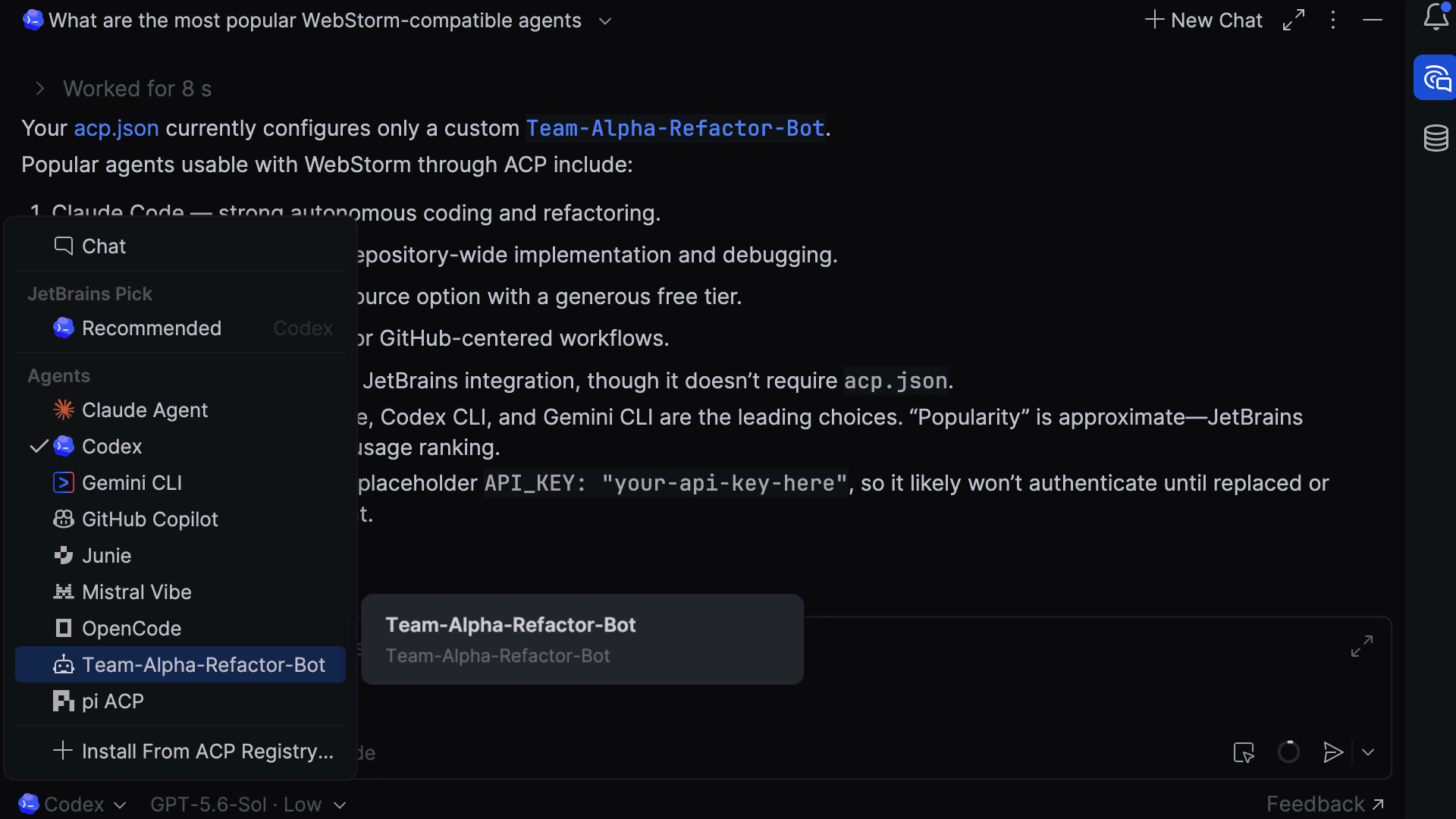
Instead of WebStorm building a custom integration for every new agent on the market, any agent that implements ACP becomes a first-class citizen in your editor. GitHub Copilot already ships an ACP server, Claude Code has an official ACP adapter, and more major agents are following suit.
- Agent Client Protocol (ACP): Standardizes how the IDE sends context (files, diffs, and terminal output) to an agent and how the agent sends back actions (file edits, tool calls, and shell commands).
- Registry and custom agents: Use curated agents from the JetBrains registry (like Junie) or connect your own private, ACP-compliant agent via a simple acp.json configuration.
- BYOK and infrastructure control: Because ACP is provider-agnostic, teams can point their agents to any backend – Azure, AWS, Anthropic, or local LLMs – maintaining full governance over their data.
Specialization isn’t a bug
In addition to industry volatility, with new agents being released and the leading agents changing every month, agents are also trained on different data and built for different tasks. One might be great at turning a Figma spec into a component. Another could be better at reasoning through a messy refactor. A third might handle debugging well because it’s good at reading stack traces alongside source code.
None of these things are flaws – just specialization.
The catch is that using this knowledge means constantly switching tools, and each tool starts fresh, with no idea what you’re working on. So most developers don’t switch. They use one agent and live with results that are “good enough” but not great.
With ACP, switching agents is cheap. Your files, your project, and your current diff stay where they are. Only the agent changes.
Deep dive: The design → code → browser pipeline
Here’s what a multi-agent workflow looks like for building a complex React dashboard.
Scaffolding with the UI specialist
When converting a high-fidelity design to code, you need an agent tuned for your component library and styling system.
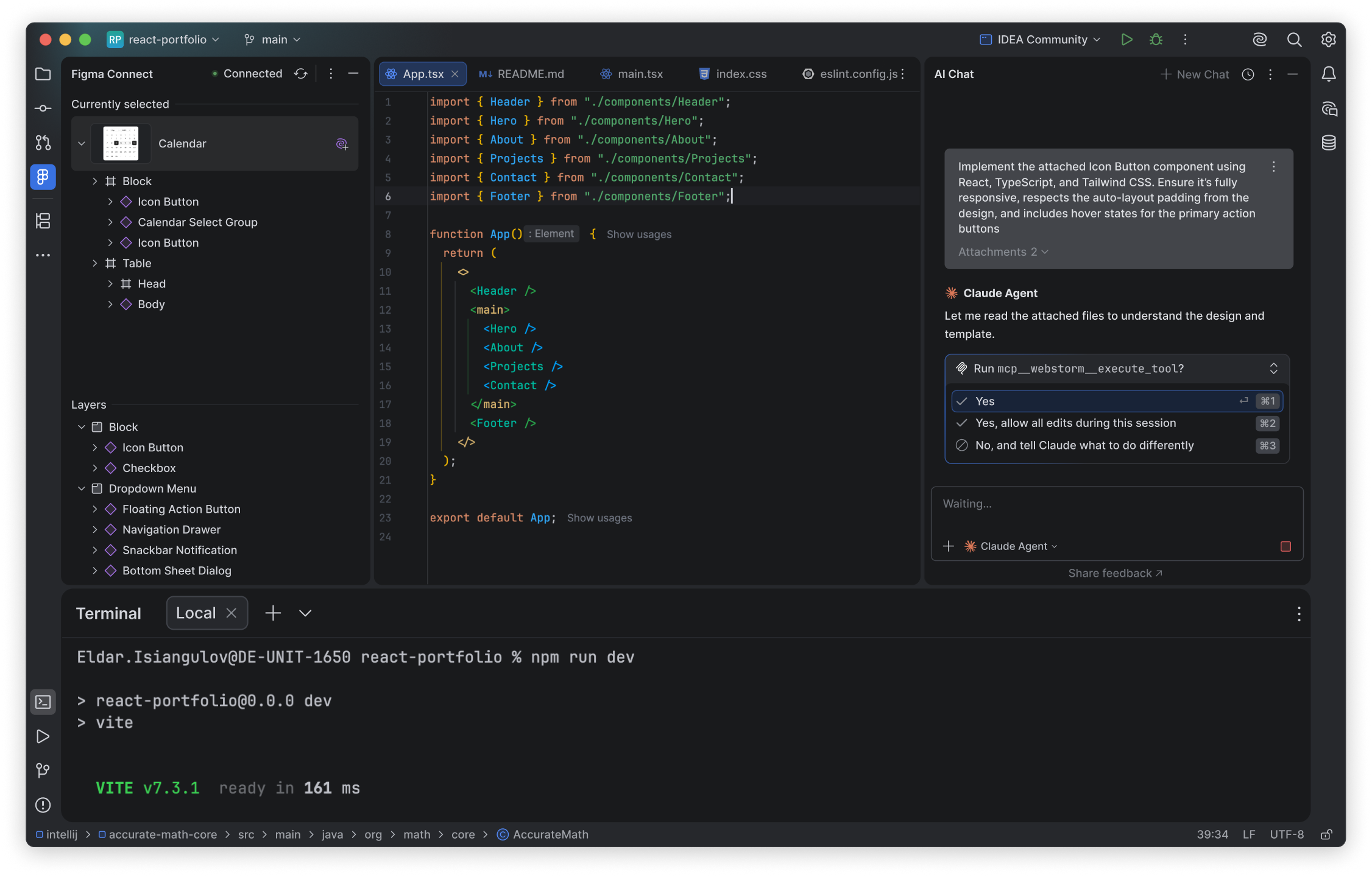
- The action: Select a “Frontend Specialist” agent from your ACP list. Figma Connect for WebStorm will then pull design context directly into WebStorm.
- The protocol: WebStorm sends the agent the relevant theme files and component specs.
- The result: The agent returns a set of file edits that the ACP server applies directly to your project.
Closing the loop with Chrome DevTools
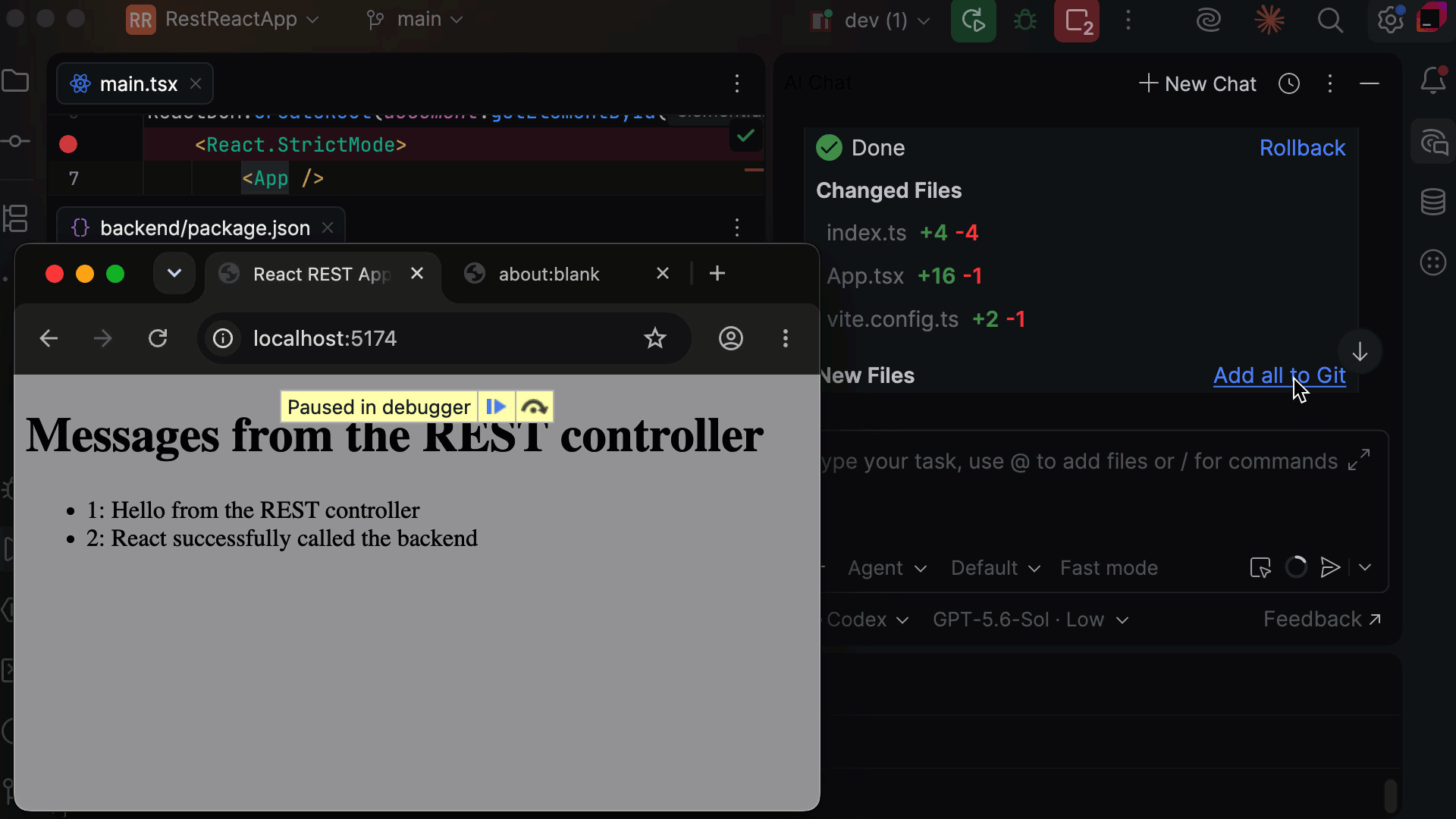
The agent doesn’t just write code – it can verify that the code runs correctly in the browser, too.
- The action: Tell the agent to fix a console error and verify the fix in the browser.
- The result: Chrome Connect, which is a bundled Chrome DevTools CLI skill in WebStorm, gives the agent direct access to Chrome. It reads console logs and network requests, traces the error to its source, applies the fix, and confirms it’s resolved. No switching environments. Only a one-time setup is required.
Built in partnership with Google’s Chrome DevTools team.
The rest of the stack
The Figma-to-browser workflow is a clear example, but the same logic applies to various other tasks that show up frequently in your day-to-day workflow:
- Commit messages: An agent tuned for conventional commits gives you cleaner, more consistent history than asking a generalist as an afterthought.
- Code review prep: Some agents are genuinely better at reading diffs and spotting patterns.
- Refactoring: Multi-file changes work better with agents that stay coherent when handling a large number of files.
- Documentation: Generated docs that people actually read tend to come from agents that write like humans, not spec sheets.
For teams
If you’re a tech lead, ACP fits into your AI governance structure. Approved providers, compliance requirements, and long-term contracts. ACP fits into that structure. Once a provider is approved, ACP provides an IDE integration that is clean, direct, and auditable, so there’s no need for middleware, a third-party relay, or extra subscriptions on top of what you already have.
Standardized tooling. Define which agents are available for your team, curate them for your stack, and deploy them without individual setup. Every developer gets the same well-matched options without having to configure anything themselves.
Data compliance. ACP communicates directly between the IDE and the agent. If your legal team has approved only one provider, ACP keeps the data flow within those established boundaries.
Custom agent deployment. Build your own ACP-compliant agents pre-loaded with internal project knowledge, coding standards, and private API documentation. Every developer gets that context without manual configuration.
No mandatory subscription lock-in. ACP lets your team connect agents directly (including ones you already pay for) without an additional JetBrains AI subscription. JetBrains AI remains the most convenient option, but it’s no longer the only one.
And because everything stays in WebStorm, you keep the code intelligence that browser-based tools don’t offer: proper indexing, accurate navigation, and real refactoring.
Choice without compromise
ACP ensures that you’re always using the best agent for the task at hand. By bringing ACP to WebStorm, we’re giving development teams the freedom to innovate with AI without losing the world-class refactoring and navigation they expect from a JetBrains IDE.
ACP is available in WebStorm now. Open the Agents menu in JetBrains AI to find it. You’ll see third-party agents there alongside Junie and Quick Edit as they become available through the JetBrains AI platform.
To connect your own agent or set up BYOK, the WebStorm documentation on ACP walks you through the steps.
WebStorm is the best place for humans – in collaboration with their favorite agents – to create software using the tools and stack of their choice. ACP makes this easier.
Tried ACP with a specific agent for a specific task? Share what you found in the comments.
Delta investigating after someone set up fake Wi-Fi network mid-flight
Russia releases former US Marine reported in poor health
Lebanon parliament votes to abolish death penalty
Цифры не сходятся: алгоритм действий, который поможет находить расхождения в отчетах

Сообщение в личку в 18:40: «Слушай, а почему у тебя в выгрузке 11 903 заказа, а на дашборде 12 480? Завтра в 11 показываем отчет».
Дальше начинается то, что я про себя называю паникой первого года и человек открывает свой запрос и перечитывает его сверху вниз, надеясь, что ошибка как-нибудь сама подсветится. Не подсвечивается. Тогда он переписывает запрос немного иначе, получает третье число, и к полуночи у него уже три версии правды и ноль понимания.
За годы работы я разбирала такие расхождения десятки раз, собрала алгоритм, по которому причина находится примерно за час: таблица симптомов, семь шагов и список типовых причин, от границ периода до кэша дашборда.
Читать далееBlock Blast! goes ad-free on Apple Arcade
37+ best college-exclusive deals, sales and memberships from stores you actually want to shop
Что такое ARP‑Spoofing и как от него защититься

«ARP‑Spoofing», или же «Отравление ARP‑кеша» — это тип кибератаки уровня L2, чья работоспособность до сих пор держится лишь на огромной дыре в безопасности Address Resolution Protocol. Основная суть данной атаки — испортить ARP‑кеш устройства путём рассылки пакетов с поддельными данными в своей подсети. В этой статье я по шагам покажу весь процесс этой атаки на своих домашних устройствах типа MITM (Man In The Middle), а также расскажу как от неё защититься.
Читать далееMore details emerge on Trump's secret plane switch
When did Americans start doubting public health experts?
Australia PM under fire for remarks on Japanese counterpart's melon gifts
Lebanon parliament votes to abolish death penalty
Rivian CEO RJ Scaringe is betting on EVs, robots, and autonomy all at once — he’ll explain why at Disrupt 2026
Key primaries underway in 6 states while South Carolina holds special vote to replace Lindsey Graham
Are humanoid robots ready to scrub your kitchen? Not quite.
U.S. Marine veteran freed from Russian prison after nearly 4 years
What should you never say when negotiating debt forgiveness with a creditor?
University of Cambridge whistleblower who reported alleged bullying wins employment tribunal
Prof Wyn Evans, who raised concerns over treatment of female staff at Institute of Astronomy, was subject to ‘baseless’ investigation, judge rules
A University of Cambridge whistleblower who alleged bullying of female staff inside the university’s Institute of Astronomy has won a tribunal against his employer.
Prof Wyn Evans told a tribunal hearing in June that the institute suffered from “a bad history of misogyny”. He claimed that one woman in the department had been “hounded out of a job”, another was “left a frightened woman”, and a third had faced “aggressive professors” at the institute.
Continue reading...FlightAware sues Kalshi over flight cancellation prediction markets
U.S. small business optimism, and uncertainty, ramped up in July, key report shows
I thought having a second baby would be easier – but, from food to teeth to poos, I’ve forgotten so much | Bim Adewunmi
My mum has been a huge help with the practical stuff. She’s also stirred up memories of my own blissfully bored childhood
I gave birth to a second child a few months ago. I don’t think I will ever get over the fact that this is the way people come into the world. It’s a ridiculous endeavour, from start to finish.
My first pregnancy was almost comically miserable for the first 20 weeks, then glorious for 10 weeks, then scary and stressful for the remainder. And this time? More intense in every way, but with added toddler. Which is to say: no breaks, suck it up, keep on moving.
Continue reading...