Токен доступа живёт ограниченное время. Сколько именно — решают трое: пользователь хочет подольше, безопасность покороче, серверы — подешевле. Когда коллеги объясняли, какие бывают ситуации с токенами, в моей голове развернулся перевод с айтишного на театральный.
The CEO of Etchea Energy described being inundated with calls after inadvertently planning an underground cable beneath a memorial to the fictional "Harry Potter" character.
Days of heavy monsoon rain has caused rivers, including the Brahmaputra, to overflow, inundating communities, disrupting livelihoods and damaging infrastructure.
Разворачивать бэкенды для личного использования с помощью systemd удобно, но stdout плохо интегрируется с journald, а устанавливать софт только для просмотра логов не хочется. В статье - простой пример, как можно писать логи из Java-приложения в journald так, чтобы их потом удобно просматривать
A Brazilian’s goal celebration went badly wrong when he jumped over advertising boards after scoring, only to fall down a hole in the ground. Jacy Maranhão, a defender for Coritiba, escaped without serious injury, though his spectacular moment proved in vain.
A video assistant referee’s decision ruled out his goal in a Brazilian Série A encounter with Chapecoense that Coritiba thought was their second goal. They did win the game 2-1.
The crew of a yacht owned by Mark Zuckerberg did not hear a radio call for a maritime assist from a small skiff that ran out of fuel off the coast of Alaska, and by the time it did, another nearby ship had already rendered assistance, a spokesperson for the Meta CEO said.
The Alaska Beacon news outlet reported that the skiff had issued a call for assistance through the US Coast Guard last week and a nearby small cruise ship, the Wilderness Legacy, towed it into nearby Farragut Bay in south-east Alaska and refueled it.
Российская армия начала активно использовать самолеты дальнего радиолокационного обнаружения А-50У для защиты своего воздушного пространства. Каковы первые результаты применения А-50 против украинских крылатых ракет? Достаточно ли у России таких самолетов-радаров, чтобы отражать воздушные угрозы в условиях быстрого роста ракетного производства в Украине?
Россия активизирует свои усилия, пытаясь перекрыть торговые связи Украины с внешним миром и нанося удары по всему черноморскому побережью страны. В одесском порту, где побывал корреспондент Би-би-си Пол Адамс, свидетельства этого повсюду — от поврежденной портовой инфраструктуры до кренящихся судов с почерневшими мостиками и все еще тлеющими контейнерами.
17 лет с покупки первого айфона я складывал музыку в одну медиатеку. Она начиналась с mp3-шек на жёстком диске, пережила переезд в стриминг (через iTunes Match) и росла до марта 2026-го. Плейлисты «Deepden», “Kizaru”, “повтор” — собранные под себя, годами.
Потом сверху решили, что оплачивать Apple Music в России никак нельзя. Я закинул 2000 ₽ на счёт Apple, чтобы не умерла синхронизация с iCloud, остальные подписки отменил — с мыслью, что за год решения, как обойти ограничения, найдутся. Так и жил без подписки: медиатека на месте, слушать нельзя. В августе 2026-го понадобился особенный трек, которого не было в Я.Музыке (худший сервис — и, к сожалению, ровно потому, что соблюдает законы РФ). Завёл американский аккаунт — тем более после покупки MacBook Air в американском сторе подарили три месяца халявы. Регистрируюсь, соглашаюсь на триал, открываю «Музыку».
Пусто.
10 532 трека — как оказалось позже — канули в лету. Переживал я даже не из‑за конкретных треков, а из‑за плейлистов: там собирались подборки под каждое настроение. Собирать их заново — ни в Я.Музыке, ни где‑то ещё — у меня не было ни желания, ни времени.
6 453 трека и все плейлисты вернулись на место. Ниже — как именно.
В результате атаки украинских дронов на город Нижнекамск в Татарстане погибли 13 человек, в том числе один ребенок и девять граждан Узбекистана. По данным властей, еще более 70 человек пострадали. Генштаб ВСУ заявил об ударе по нефтеперерабатывающему заводу в Нижнекамске. Сообщения о жертвах Украина не комментирует. По числу погибших в России в результате одной атаки это один из самых смертоносных ударов с начала войны.
В любой системе, где есть остаток, счётчик или итог, рано или поздно встаёт один и тот же выбор. Либо считать величину заново при каждом обращении к ней, либо хранить готовой и подправлять при каждом изменении исходных данных. Первое медленно и всегда верно, второе быстро и верно ровно до первой пропущенной правки. Выбор этот делают все: складские остатки, счётчики просмотров, баланс лицевого счёта, любые предрассчитанные итоги.
Я сделал его в 2002 году, выбрал хранить, и получил вместе со скоростью проблему на двадцать лет вперёд.
Проблема выглядела так. Хранимые остатки по счетам время от времени переставали сходиться с операциями, которые их формируют. Иногда на копейки, иногда на миллионы. Я написал утилиту, которая находила такие счета и правила цифры. Потом встроил её в запуск приложения. Потом добавил кнопку в интерфейс, потому что остатки успевали скривиться и среди дня. Костыль на костыле, зато быстро. Причину я нашёл только сейчас, когда сел писать систему заново: в новой архитектуре каждый случай приходится описывать явно и покрывать тестом, и на этом всё и вскрылось.
Причина оказалась не в триггерах и не в производительности. Она в том, что одно бизнес‑правило было записано в коде шесть раз в разных местах, а в седьмом его забыли написать.
Всего за несколько лет технологии ИИ заслужили популярность среди компаний – согласно отчёту McKinsey в 2025 году 88% компаний заявляли об использовании ИИ хотя бы в одной бизнес-функции.
Наряду с этим для злоумышленников ИИ становится и целью, и инструментом атаки. Такой факт подтверждается майским отчетом Google AI Threat Tracker – его обзор опубликован в моём канале.
В итоге компании внедрили технологии ИИ и начали задумываться о безопасности. А ведь многие процессы обеспечения информационной безопасности основываются на моделировании угроз. Откуда же можно узнать о возможных угрозах информационной безопасности, связанных с использованием ИИ?
Эта статья поможет ответить на этот вопрос – в ней представлен обзор основных источников для сбора информации такого рода, а в выводах определены лучшие.
В проекте периодически перезапускались PM2-воркеры. Сами рестарты сначала и были проблемой: процесс завершался, PM2 запускал новый, какое-то время всё работало нормально, затем ситуация повторялась.
По логам было понятно, что воркеры перезапускаются после достижения установленного лимита памяти. Увеличили лимит, воркеры стали жить дольше, но перезапуски никуда не делись: процесс просто позже доходил до нового значения.
A quick, takeaway-style chicken dish full of spice and flavour, with a homemade plum sauce, to serve with pancakes or rice
I have a real aversion to the term “fakeaway”. I don’t know why. But as much as I resist the terminology, I guess it’s exactly what this dish is – it’s 100% based on and inspired by a Chinese takeaway classic: crispy duck pancakes. A real people pleaser, and something my girls adore. Making this with pan-fried chicken takes next to no time and is the perfect after-school/work quick dinner. And for a different ending, I sometimes serve the chicken and plum sauce over jasmine rice instead. With the same accompaniments, of course.
Now, wildlife authorities are attempting to bring some cohesion to tackling the diverse slate of issues by borrowing from a playbook that has already proved successful on land.
Political leaders have kicked the can of public protection tariff reform down the road for years – causing hopeless inmates to take their own lives
In January 2015, Tommy Nicol told his family that he was suffering “psychological torture of a person who is doing 99 years”. Nicol had been given an imprisonment for public protection (IPP) sentence six years earlier for stealing a car from a garage and injuring the owner. He was already two years beyond his four-year tariff – the minimum time you can serve in prison before being considered for release. Nicol was given another two-year knock-back from the Parole Board and was in despair. If and when he got released, he would be on a lifelong licence. Eight months later, aged 37, Nicol hanged himself at The Mount prison in Hertfordshire, England.
By the time he took his own life, the inhumane IPP sentence had already been abolished for three years. The problem is, it didn’t apply retroactively. Those already serving IPP sentences stayed on them. This, despite David Blunkett, who devised and introduced them as home secretary in 2005, calling it “the biggest regret” of his political career. And this despite UN special rapporteur on torture Alice Edwards agreeing with Tommy Nicol that the sentence was “psychological torture”. Astonishingly, more than 2,000 people are still serving IPP sentences in England and Wales.
AI’s danger isn’t just in experts losing the ability to reason. It’s that trainees may never learn how to do so in the first place
In healthcare, there’s growing concern over doctors becoming less clinically adept as they increasingly rely on AI tools. But what about the trainees – medical students, residents and fellows – who are using these tools before they’ve built their own clinical judgment? The idea of deskilling implies that someone possessed an ability and then lost it. Here, the danger is not just deskilling but never-skilling. Although a doctor who has forgotten how to reason is recoverable, one who never learned how may not be.
OpenEvidence, essentially an AI chatbot for clinicians, has given this concern its most concrete form. About two-thirds of US doctors actively use OpenEvidence, asking about puzzling symptoms, drug interactions, and clinical guidelines, getting responses within seconds, anchored in the latest research. Trainees, unsurprisingly, have also begun to use this AI tool in many of the same ways – but at a far more formative stage.
The New Orleans native is a three-time Grammy winner at the top of his game – and is now using his instinctive style to celebrate the resilience and clarity of Katrina survivors
‘Black music is forward and upward in movement, you know? Never forward or upward,” pianist Sullivan Fortner declares. “It’s a tornado that’s always getting bigger and moving faster,” he adds, whizzing his fingers around with delight.
On a video call between sets at Rotterdam’s North Sea jazz festival, the 39-year-old speaks like he plays, with quirkiness, subtlety and mischief. A three-time Grammy winner – including for 2025’s Southern Nights – Fortner also recently received the Larry J Bell award, a prize of $300,000 (£225,000) given every four years to a standout jazz pianist, which gave him the confidence to present an all-encompassing version of himself on Leave That in There, his sixth album. “I’ve tried the self-editing way,” he says of previous albums involving multiple takes and endless post-production tinkering. “For this record, I took an edible and I just said, screw it.”
Меня зовут Алексей Тиньков, я занимаюсь тестированием производительности уже 8 лет. В первой статье цикла хочу поделиться своим опытом организации процесса нагрузочного тестирования (НТ), рассказать о том, как правильно думать о тестировании производительности и чем оно принципиально отличается от привычного функционального тестирования.
Great Britain’s biggest household energy supplier is calling on its customers to use less electricity this week during the deepest solar eclipse in almost 30 years.
Octopus Energy has urged customers to avoid running washing machines and dishwashers between 6pm and 8pm this Wednesday as the moon is expected to block up to 95% of the sun over parts of Britain.
Однажды в проде контейнеры одного из сервисов начали падать по OutOfMemory. Контейнерам было выделено по 4 ГБ оперативной памяти, нагрузка была вполне обычной: десятки страниц в секунду.
Расследование показало, что проблема была в JSON-конфиге.
Схема была стандартная. В базе данных хранился JSON. При запросе приложение доставало его из базы, выполняло дополнительную обработку — заполнение вычисляемых полей, обогащение справочниками — и сохраняло результат в Redis. Подавляющее большинство пользователей запрашивало один и тот же JSON и ходило за ним в Redis.
Из-за ошибки в обработке закэшированный JSON распухал до десятков мегабайт. В кэш писались не только нужные поля, но и вложенные коллекции, история изменений, сериализованные справочники.
Казалось бы, если мы запрашиваем один и тот же JSON, размер не должен так критично влиять.
Hannah Einbinder as Kris in Teenage Sex and Death at Camp Miasma —Courtesy of Mubi
Warning: This post contains spoilers for Teenage Sex and Death at Camp Miasma. The last thing Kris Williams (Hannah Einbinder) does before she dies is watch herself do it. She lies on a twin bed in Camp Tivoli’s Bunk 5, candles burning around her, rose petals scattered across the sheets, while Billy Presley (Gillian Anderson) stretches out on top of her and coaches her toward the end. “You’re almost there now,” she says. “You’re almost dead.” Billy tells Kris to watch herself through the killer’s eyes, and the film obliges: The camera slips out of the cabin and into Little Death’s helmet as he climbs the steps, breath ragged, spear in hand.
What follows is impalement and orgasm in the same instant—one spear through both women, blood passing from Billy’s mouth onto Kris’s upturned face—and when their breathing stops, the hole at the bottom of the lake pushes out a fresh videotape.
That tape, and the women’s smiles in the film’s final moments, hold the keys to Jane Schoenbrun’s latest featureTeenage Sex and Death at Camp Miasma: a horror comedy, a love story, and the most sexually direct film of their career. It follows Kris, a young queer director hired to reboot the moldering Camp Miasmaslasher franchise, as she tracks down its original final girl, Billy, who now resides at the abandoned camp where the movies were shot. Kris’ trip turns into a courtship, and the courtship into something the film doesn’t quite spell out, though Schoenbrun will name what it’s chasing. “It’s a movie about getting out of your head and getting into your body,” they tell TIME.
Schoenbrun realized they were trans while writing the 2021 release We’re All Going to the World’s Fair, and began physically transitioning after finishing it. Where that film and its 2024 follow-up, I Saw the TV Glow, grew out of the frightening early days of coming out and transitioning, this one, Schoenbrun says, “came from the fun parts” of their transition—a period when, “for the first time, I think, since childhood, it felt like the world around me was real.”
Kris begins the film investigating desire the only way she knows how: academically, through film theory, a method that has not met with much success thus far in her personal life. “By the end of the movie, the only way she’s able to actually do that is with her whole body, by embracing the flesh and fluids of it all,” Schoenbrun says. The surest way to understand the film’s transcendent final moments is to approach it the way Kris does: from the beginning.
Who gets to watch whom
Kris taking in a Miasma movie —Courtesy of Mubi
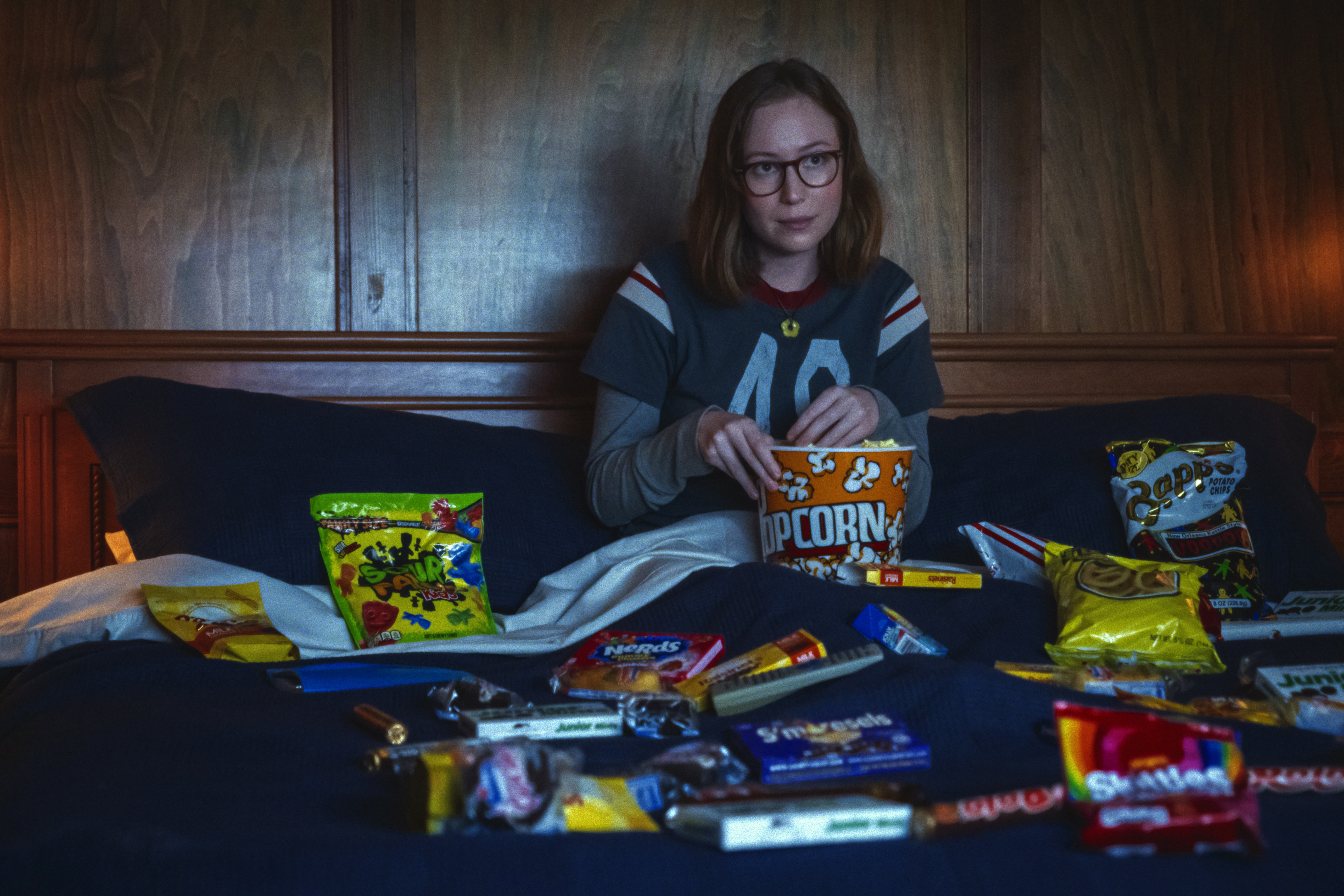
The film settles in early on with Kris alone in a hotel bed, a bucket of popcorn and Raisinets in hand, watching Camp Miasma Part VI: A New Beginning and writing the word “Desire” in her notebook, underlined twice. “People giggle at it,” Schoenbrun says. “What a pretentious, film-school-y thing to do.” The character, they add, is “a bit of a funhouse mirror” of them. The sequel Kris falls asleep to ends with a bloodied final girl refusing a cop’s reassurance that the killer is gone. It’s never over, she says, warning that “he’s still down there at the bottom of the lake” and “still hungry.”
Kris continues driving to Camp Tivoli to court Billy for an appearance in her film. Billy, for her part, vanished from acting directly following the first Miasma movie and now lives on the property: crafting, sketching, and painting. Their first encounter sets the terms for everything to follow. In the camp’s Cinema building, an old projector flickers to life on the scene where young Billy (Amanda Fix) loses her virginity, and the real Billy materializes behind Kris, hoping for a jump. “It’s only fair, right?” she says. “You’ve already seen me.” Kris has spent a lifetime studying this woman’s most exposed moment on a screen; Billy answers by watching her back.
That exchange starts an open question of power between the two, and their sensual fried-chicken dinner is the first round of the negotiation. Kris arrives with what Schoenbrun calls her “whole spiel down pat.” Billy “sees right through it” and needles her “in a way that gives her power in that dynamic.” “Well, you remade Psycho from the perspective of the shower curtain,” she says of Kris’s feature debut film. Eventually, Billy correctsKris’s theories with just three words: The original Camp Miasma was never about monstrosity or gender trouble so much as simply “flesh and fluids.”
On the cabin wall behind them hangs a vintage poster bearing the franchise’s old tagline: “If it gets too real, you can always turn it off.” A leftover Billy says she’s kept from the home-video campaign. From there, Schoenbrun says, the two spend the movie “yes, and-ing” each other—the comedy improvisation principle of accepting a partner’s offer in a scene and building on it—a courtship built on daring one another to admit what they want.
The tagline on the poster
A young Billy (left), played by Amanda Fix —Courtesy of Mubi
That night, with the fire burning and the snacks close by, the film’s tagline gets put to the test. Smoking a joint in front of the mirror, Kris glimpses the young boy Little Death used to be, the bullied camper who, by franchise lore, was drowned in the lake. She emerges blissfully stoned, flirts with Billy, then confesses an intimate truth she has never told anyone: She can only approach pleasure by leaving herself, imagining her way into an old slasher film, becoming either the bookworm in Camp Miasma: Part II, or the girl in the outhouse in Camp Miasma: Part IV, or even young Billy in bed with that look in her eye.
She calls it dissociation, stupid and misogynistic. It’s all just play, Billy assures her, and if it gets too real, you can always turn it off. Then she urges Kris’s gaze up at the Little Death mannequin looming over the room and tells her to look into his eyes and make them her own. “Let’s make a movie,” Billy says.
For Schoenbrun, the meaning of this line is simple. “It’s about consent,” they say. One way to think about the film is that it is “structured like queer sex”: the long hangout, the shared joint, the rises and rests, the breaks for junk food. Good sex, in their view, involves “stopping and laughing for a while in the middle.”
What the tagline promises is the shared understanding that all of this is performance and play, and that play only works when you are fully inside it and free to step out of it at any moment. The promise, in Schoenbrun’s terms, extends even to “places that feel taboo or embarrassing or traumatic,” the ones people who have experienced sexual trauma often have to revisit to come out the other side: “You can go to those places, and then we’ll eat some candy and have some aftercare.”
The tale of Little Death
Kris and Billy watch the original film together —Courtesy of Mubi
The next day, the courtship escalates: Billy screens her personal print of the original Camp Miasma for Kris. The film-within-the-film’s campfire story invents Little Death as a gender-confused child, mocked by campers, drowned in the lake, their death covered up. The killer that legend produced wears a camper’s uniform sheathed in plastic, a drowned thing the lake never quite gave back. “This part’s transphobic,” Kris announces, ever the annotator. Billy tells her to shut up.
As the film approaches young Billy’s sex scene, the older Billy’s pencil digs harder into her sketchbook until the tip snaps, and she murmurs a single word at the screen—“Rise”—and the movie-within-the-movie erupts.
Until this moment, the old film was styled as a half-remembered ’80s slasher, a collage of borrowed images. Then, in one roving, unbroken take set to the Counting Crows’ “A Long December,” the camera becomes Little Death, surfacing from the lake and cutting down counselor after counselor, the fuzzy, faded look of an old print giving way to a sleek, furious sequence that moves like a dance. Here, the movie hands the massacre to the monster the franchise built out of transphobic panic, and lets him move like a star. Schoenbrun grew up on that era’s horror villains imagined as men in dresses and gender-confused boys, from Sleepaway Camp to The Silence of the Lambs, and the sequence plays like those villains taking the wheel.
The power cuts out just as young Billy starts to climax. Walking through the snow afterward, Kris finally drops the pitch for good. That look in Billy’s eye, she admits, she doesn’t want to just watch it anymore; she wants to experience it. “Will you show me how?” Kris asks.
The hole where the movies come from
Billy delivers a monologue that holds the key to the film —Courtesy of Mubi
Kris will have to wait another night for Billy’s answer. First, Kris torches her career. On a video call from her parked car, she delivers her reworked pitch to the studio: There is a hole at the bottom of Lake Miasma where the movies come from, and it predates the first film, predates even the murders that inspired it. When a sympathetic executive, Tracy (Jess McLeod), offers Kris a way out of her heady vision for the film—it’s a meta take, like Wes Craven’s New Nightmare—Kris refuses it flatly. The hole is realer than this call, she insists. If anything, the call is the movie. “You all are characters in a movie,” she tells them.
As she speaks, the film cuts to the chamber beneath the lake: pink, pulsing walls lined with shelves of VHS tapes, and Little Death at the center, unmasked and unclothed. He doesn’t need the helmet down there. “We’re his little playthings,” Kris says, unraveling and arriving at once. “We are a movie for him to edit, and he has final cut.” Has Kris lost her mind? “Kris is right,” Schoenbrun says. “Kris is a character in my movie.” So, they add, is Tracy. What plays on the call as a breakdown is, in Schoenbrun’s telling, closer to an anarchic clarity: Kris has seen through the fourth wall of her own life and begun to play with it, and what looks like madness from the outside feels, from the inside, like creative freedom.
Underneath the bit is the film’s densest idea, the one the tape will make literal. “You think that you created these movies, but really these movies created you,” Schoenbrun says. Little Death, they explain, is the “eternal embodiment of desire, or of the orgasm.” It’s right there in the name, which in French is “la petite mort,” the old euphemism for climax. And he is forever restless for the next picture: “All right, now time for another one. Let’s pop another VHS in the slot.” We flatter ourselves, they say, that we steer the deep drives humming under everything we make. The thing under the water “is creating what we create, through us, as a vessel.” Translated out of theory: We don’t tell stories about desire so much as desire tells stories through us. That evening, back at camp beside a fire, Billy answers Kris’ question with the monologue that is the film’s spine. Filming the original’s sex scene at 24 and playing a character aged 17, she went somewhere far away in her head to survive a joyless first time with a creep on a grimy mattress—and something answered. “I caught a signal,” she says. Suddenly she was watching herself from across the room, creeping closer: the watcher and the one being watched at once. She was the killer, leering and breathing hard, and she was the girl on the bed with that look in her eye. “And then I came,” Billy recalls.
It was her first orgasm, she tells Kris, and still the biggest of her life. Note the mechanism the film keeps returning to: the signal could only reach her once she had stepped out of herself. The question she has spent decades circling—why did he make it feel like that, “so good, so close to magic”—is the question the ending exists to answer. Kris, listening, murmurs the joke that is no longer a joke: “Psycho, perspective of the shower curtain.”
Everyone Kris knows must die
Little Death rises from the lake —Courtesy of Mubi
Then the lake opens. A vortex churns the surface, and a wave of light rolls across the snow, turning winter to summer, the “Welcome to Camp Tivoli” sign into “Welcome to Camp Miasma.” The women haven't slipped into a fantasy so much as crossed into the world of the original films—the summer camp slasher Kris grew up watching—and they direct it together as it happens. If the swerve feels characteristic, it is: Like Schoenbrun’s two previous films, We’re All Going to the World’s Fair and I Saw the TV Glow, this one turns on someone crossing into a fiction—this time, the Camp Miasma slasher franchise itself. From here until morning, the movie plays it absolutely straight: Whatever this realm is, it is real enough to kill in.
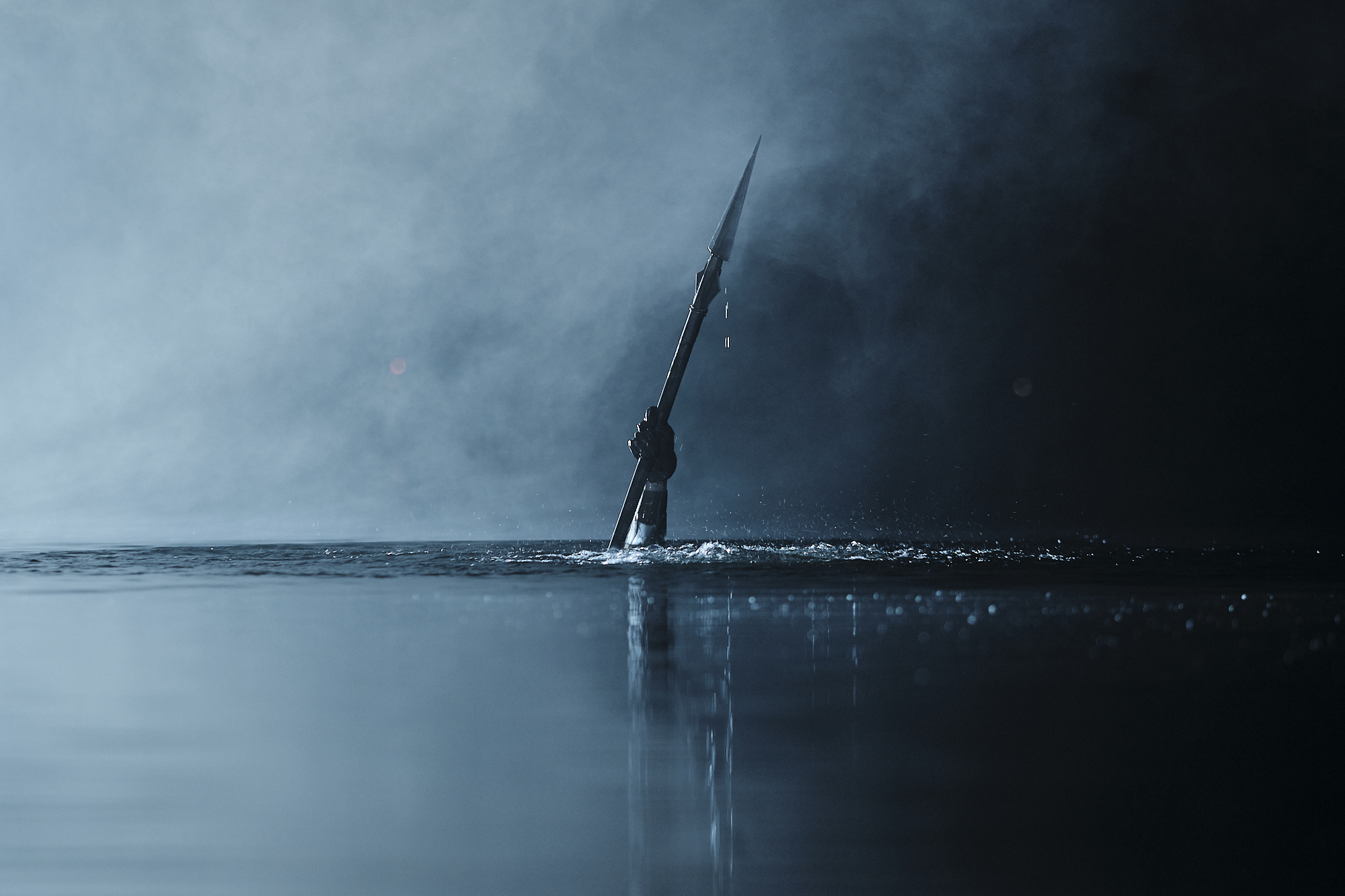
When Little Death’s spear breaks the water, Kris, a director suddenly inside the picture, asks what should happen next. Billy comes up with the next move: Kris could fall down the hill, so she really has to run from him. Then Billy pushes her. Kris tumbles, scrambles up, and, in the movie’s best throwaway, apologizes to the advancing killer. “Sorry, I’m like, I’m a fan, obviously,” she says. Then she strips to her T-shirt and underwear and runs through the woods in slow motion, an ’80s synth line pulsing under her breath, a scholar of the final girl actually becoming one.
What she runs into are people she knows. Her partner Mari (Jasmin Savoy Brown) arrives in a truck and is decapitated moments into the reunion by Little Death; Mari’s boyfriend Thor barely gets through a friendly hello before his blood sprays the headlights. Kris’s agent (Sarah Sherman) turns up hoping to workshop the failed pitch and takes four arrows. The studio executives appear in the trees with notes—they get the allegory of her film pitch, they’d just like it a “little bit more commercial”—before being speared mid-sentence.
The kills are gushing and rhythmic. “You tee up these things early in the movie, and then you get to surprise people once they’ve forgotten about it,” Schoenbrun says. By this point, they argue, the audience has traveled too far past these briefly spun characters to grieve them. “We’re not like, no, Mari, you had such a rich inner world,” they joke. “We want to watch a bunch of people get killed at that point in the movie. That’s the joy of the slasher film.” While Kris runs, Billy is occupied in Bunk 5, laying rose petals on a twin bed and lighting candles to Sade’s “No Ordinary Love,” setting the stage for the film’s transcendent climax.
What actually happens in Bunk 5
Billy sets the stage for the climax —Courtesy of Mubi
Kris bursts into Bunk 5 gasping. You made it, Billy soothes, adding that it’s just play. “It doesn’t feel like play, Billy,” Kris says. “I know,” Billy answers. “But it is.” Everything the film taught them converges on the bed. Billy lies over her, tells her she’s almost there, almost dead, and asks her to do what Billy did on that mattress decades ago: watch herself through his eyes. Kris does. Billy once left her body to survive a scene; Kris leaves hers to arrive in one. We enter Little Death’s perspective, taking in the blue door, the candles on the railing, the slow approach down the hallway, while Kris narrates her own stalking in a mounting gasp: He’s walking inside, he’s coming closer, she can see herself now. Terror is no longer distinguishable from arousal. “Billy, I don’t want to die,” she pleads, and then, in the same breath, “Billy, please don’t leave me.” Billy stays. The spear comes down through them both, and Einbinder plays the instant of it with astonishing precision: Kris’s face moving from something like surprise into unmistakable release, her eyes fluttering as the blood arrives.
For a long moment they lie still. Little Death jostles the spear, satisfied, and carves a fifteenth notch into the wall. Below the lake, the pink wall dilates and delivers its newest production, cased and labeled, Kris and Billy’s faces already printed on the sleeve. The mythology closes its circuit, and the signal finally has a name: It is desire’s own broadcast, transmitting from the hole beneath the lake through anyone open enough to receive it. Billy caught it on a film set four decades ago; Kris tuned into it as a child in front of a television; and the desire that made them both has cut its picture together.
Little Death had final cut, and this was it. For anyone who left the theater asking who made the movie, that is the answer: he did.
A little death, not a big death
The morning after —Courtesy of Mubi
Morning comes. Birds chitter. Andy Shauf’s “Satan” drifts over sunlit woods as the camera calmly inventories the bodies, Mari and Thor and the agent and the executives, and Little Death wades back into the lake, going home. The film spends one brief flashback on an 8-year-old Kris on the floor of a dark room, transfixed by young Billy’s scene in Camp Miasma, while Shauf sings about the worst parts of a person being what make them strong. In Bunk 5, Billy lifts her head, exhales, and looks down at the woman underneath her. “Good morning, sleepy head,” she murmurs.
Were Billy and Kris ever really dead? “They die, but it’s not a permanent death. It’s fictional in some way. It’s in the land of metaphor, poetry,” Schoenbrun says. “It’s a little death. It’s not the same thing as a big death, and it allows them a shedding of something, probably shame. That’s quite healthy.” By the killer’s own name, it could never have been otherwise.
The two women rise and walk hand in hand through woods that no longer pretend to be real: mountains and orange sky now plainly a painted backdrop, the film’s handmade make-believe carried out of the night and into daylight. Painted skies like these have hung over the fantasy throughout the film; letting one stand in ordinary morning light is the movie’s way of saying the enchanted state was never a place the women visited, but a way of seeing they get to keep. The walk ends where Kris’s story began, at the gas station.
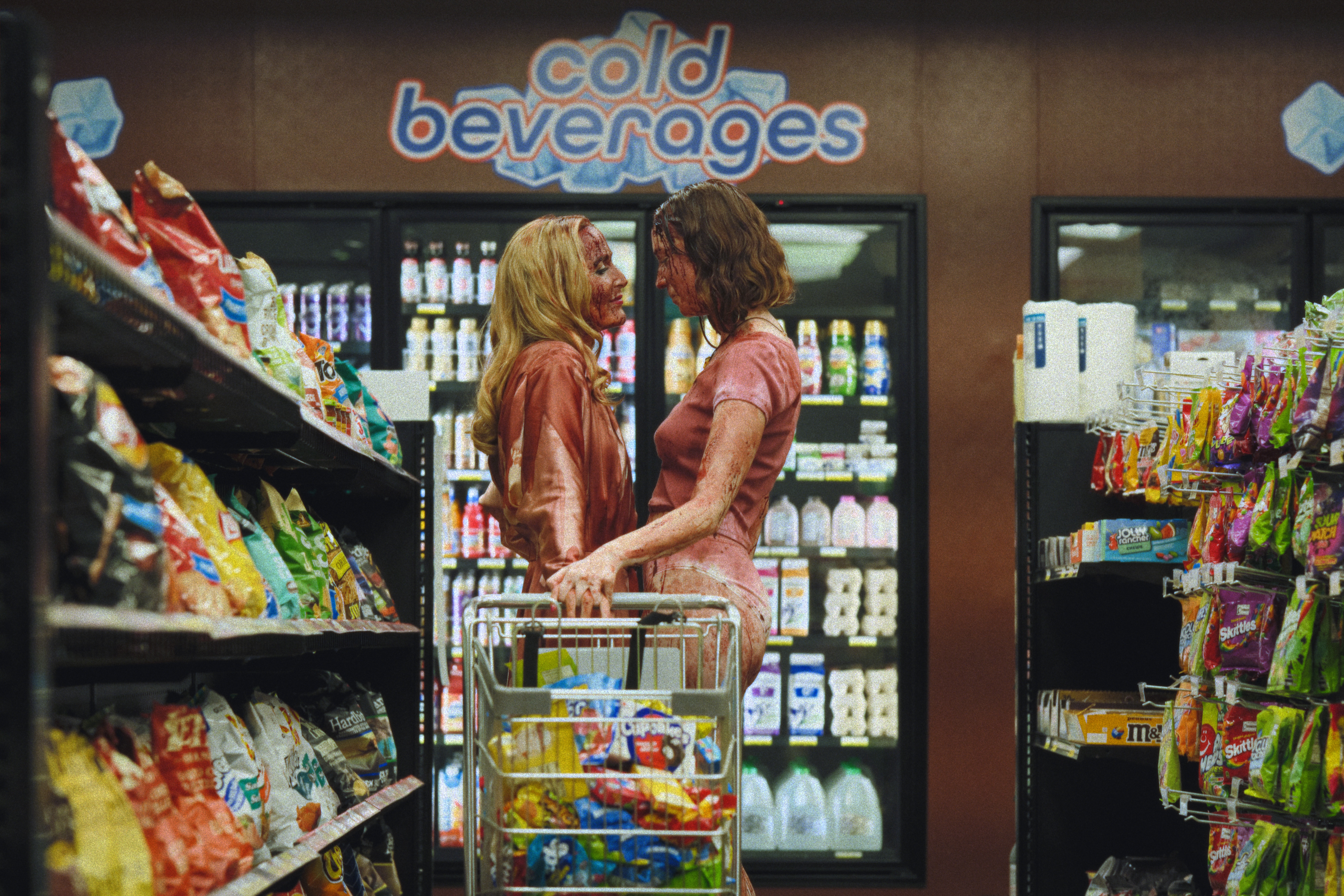
What happens there seems minor but for Schoenbrun, close to the bone. Still bloody in last night’s clothing, the two fill a cart with candy and bicker contentedly about the state of the candy industry—arguably also a wink at the state of film. “We’re living in the golden age of gummy candy,” Kris says. A man at the coffee stand stares and shakes his head—a nod to Schoenbrun’s own experience. “The way that dude by the coffee stand is looking at these two women in their underwear covered in blood is kind of how I always feel at a roadside gas station as a trans person,” Schoenbrun says.
The cashier, Flo, offers the counterweight: “I like your guys’ outfits.” She greets them, in Schoenbrun’s words, as if “this is a crazy thing to see, but a normal thing to see.” That’s the morning’s tender verdict on both women. “They’ve gotten a little less self-conscious about their freakiness,” the director says, and the two can stand out now without it costing them anything, shame loosening its hold at last, which for Schoenbrun is the heart of the film’s whole journey, and especially Kris’s.
Then Kris drifts outside, her face clouding, followed by Billy. “He’s still down there, you know, at the bottom of the lake,” she says. “He’s still hungry.” It is, nearly word for word, the warning the final girl gave at the end of Camp Miasma: Part VI, the one Kris heard half-asleep in a hotel bed four days and a lifetime ago—except the warning now belongs to Kris, and it is about to stop being a warning at all. “Can you feel it? He’ll be back soon to feed again,” Kris says. Her expression tips from worry into wonder, and the wonder becomes a smile, and the smile widens. Billy, watching her, smiles too.
Desire isn’t defeated at the end of this horror movie; it triumphs. It’s permanent, hungry, waiting under the water—and that is the good news where Schoenbrun is concerned. A Betty Who cover of “I Love You Always Forever” swells, Kris takes Billy’s hand, kids with water guns tear past the pumps, and the camera lifts over the gas station into a clear sky before the title card lands like a punchline: this, all of it, was Teenage Sex and Death at Camp Miasma.
The person in the movie
Seen whole, the ending is a transfer of ownership. Kris appeared toward the start of the film alone in a bed, annotating desire from a safe distance; she closes it inside the frame she used to study, holding the hand of the woman whose look she spent a lifetime decoding, speaking what may be the franchise’s scariest line with a grin. The line completes its long rotation, too. What began as a reassurance—none of this can touch you—was never quite true. The movies touched Kris as a child, before she could spell out their titles. What Billy made of the words instead was a promise between two people at play: go as far as you need to, because you can always stop. Here, by the final shot, nobody wants to stop.
Schoenbrun saved one more detail for the ending, and it doubles as a request. The second-to-last shot uses a “split diopter,” an old lens trick that holds two faces in sharp focus at once, one near, one far: Kris in the foreground telling us he’s still hungry, Billy behind her. It’s the same shot Kris called out at the screen earlier in the film, saying “split diopter” to the movie-within-the-movie like the true fan she is.
“Now she’s entered the movie,” Schoenbrun says. “She’s no longer the person in the audience calling out ‘split diopter.’ She’s the person in the movie who people are going ‘split diopter’ to.” That choice, as they see it, is a “beautiful” one and very much in the larger “language” of their film. Schoenbrun has started saying this—“split diopter!”—at screenings, and they’re serious about it. If the film is playing somewhere in 10 years, they hope audiences will treat Teenage Sex and Death at Camp Miasma the way longtime fans treat The Rocky Horror Picture Show, hurling the line back at the screen with glee, a ritual they’d like to “lightly encourage” starting now.
It’s the rare ending that comes with instructions for loving it, and they suit the film. Somewhere down the line, in a theater at midnight, a crowd may see Kris’s blood-streaked face fill the frame once again, calling out to her the way Kris once called to the film-within-a-film—and the signal, still hungry, will have found its next set of eyes.
The dreaded sled pull, one of the eight exercise stages in a Hyrox race. | Amaury Paul/AFP via Getty Images
Exercise can be a humbling experience.
A simple push-up can debase the most dignified humans, transforming them into helpless little halibuts, unable to unmoor their bellies from the floor. Squats and lunges can leave their victims crouching like tiny goblins or trembling against gravity’s will. Have you ever willingly watched yourself run at full speed? Only if you have self-esteem of steel.
But for certain people, the most physically demanding experience of their lives is not something they want to avoid, but an alluring temptation: a challenge too impossible to ignore, an irresistible dare that must be completed day after day. And they quench this desire — as well as the thirst for friendship and community; some vanity muscles; and mini vacations to the likes of Oslo, Brisbane, and Bangkok — in the sweaty, grunty, made-for-TikTok $200 million world known as Hyrox.
What is Hyrox and why is everyone doing it without me?
HYROX is stylized in all caps. Capitalization makes it seem as if it’s a word that only exists to be yelled, an apt choice for an experience that seems to take inspiration from military training and/or the PE class you hated growing up.
How Hyrox became such a cultural phenomenon
When it comes to Hyrox and its $270 million projected revenue, we can pinpoint to a few reasons how and why this fitness race has become such a cultural moment:
People want to be athletes. Hyrox allows people who work out (which is a lot of people) to put all of their training toward a bigger goal — basically giving them the experience of being an athlete.
It’s a lifestyle that you buy into. Prepping for a Hyrox race typically means taking classes at a Hyrox-affiliated gym and traveling to an attractive destination.
It’s (relatively) easy. Despite how punishing it looks at first glance, trainers insist that Hyrox is less difficult than other intense workouts.
Since launching in Germany in 2017, Hyrox has become a worldwide phenomenon. As CNBC reported in June, it initially started with just 650 people and now is projected to capture roughly 1.5 million participants across 121 events in 34 countries around the world. Revenue, which comes from a combination of contest entry fees, sponsorships, merch, licensing for Hyrox-affiliated gyms, and other avenues, is expected to reach $270 million in 2026. This year, 42,000 tickets were sold to the New York City race in the event’s first 24 hours. In 2025, there were roughly 12,700 athletes registered for the event.
Technically speaking, Hyrox is a timed competition that spans eight rounds; the person or team — athletes can compete as individuals, as doubles with a partner, or as part of a relay — with the fastest overall time wins.
Each round consists of a 1-kilometer run followed by a more “functional” strength-based move, often done using a machine. These exercises include: 1,000 meters on a SkiErg; a weighted 50-meter sled push; a weighted 50-meter sled pull; 80-meter burpee broad jumps; a 1,000-meter row; a 200-meter Farmers Carry (lugging around two heavy weights at your side while walking); 100 meters of lunges with a sandbag on your back; and 100 wall balls (squat thrusts that involve launching a medicine ball into the air as you stand). It’s run-exercise-run-exercise-run-exercise until all eight kilometers and all eight movements are completed.
But Hyrox is also, Hyroxers say, a lifestyle. Because the best way to succeed at Hyrox — and for many participants, winning or at least finishing with a decent time is the goal — is to train for it. That likely means going to Hyrox-affiliated gyms that prepare you for the different exercises, and training alongside other people who also plan to run the race. And that’s where it can get all-consuming.
Abby Roskind, a 35-year-old project manager living in Washington, DC, who has finished two races, told me that Hyrox sort of subsumes your entire existence. Training for Hyrox, she said, involved 5:30 am workouts, an excruciating amount of time learning how to properly broad jump, daily soreness, and lots of complaining.
“Because you are always with other people doing these things, it becomes a little bit of a hostile takeover of your life where you meet up with your ‘fitness’ friends, and then they become your actual friends, and all you end up doing when you’re not training for Hyrox is talking about Hyrox,” she said.
Roskind and other Hyroxers told me that people who are very serious about wanting to do well in competition may go on a diet, cut alcohol before the race, or squeeze in extra workouts, which naturally leads to less dinners out, less meeting up for drinks, and, ultimately, less socializing. It makes sense that people going through this experience will want to talk about Hyrox since so much of their life centers on it, and that the best audience for a discussion on Hyrox strategy would be other people doing Hyrox.
“It definitely didn’t come across as culty where it’s like, ‘Oh, welcome to my Scientology of Exercise and you’re going to do this,’” said LJ, a 34-year-old with one Hyrox under his belt. (LJ told me he was afraid of being “canceled” by fellow Hyroxers and maybe his friends for talking to Vox, so we agreed to let him use his first initials to maintain some anonymity.) LJ said that one of his friends had run races in Europe and talked him and a small group of others in their circle into competing this past year. They generally approach it as a fun, casual thing to do together.
“But then when I got to the actual venue day of the race, I felt like Hillary Clinton walking through that apartment like, What the hell is going on here?” he said. “Because there are a lot of people where this is a big chunk of their life. I saw people walking around — I guess they [Hyrox] give out badges — showing all the badges that they had from all the different cities that they competed in.”
The idea of someone, ostensibly with a day job, going from city to city to compete in Hyrox and then showing off commemorative brooches is what signaled to LJ that the workout he enjoyed could be experienced in a different, more serious way. In that moment, LJ saw Hyrox the way outsiders might. Still, for him, the positives of Hyrox — being in better shape; experiencing runner’s highs, friendships, and the rush of competition — outweighed the possible cult-by-association.
A lot of people want to feel like an elite athlete, and now we can pay for the experience
If you make a Hyroxer feel comfortable enough, you will find that they all love to talk about the parts of the race they hate the most. It’s the feeling of thick death rushing through their lungs as they stare down the number of meters left in the burpee broad jump section. It’s the judges who are there to make sure participants are getting low enough during the wall balls. It’s seemingly everything about the race.
There’s a bottomless chasm between how much people love Hyrox and how much they love to talk about how much it actually sucks to do. The bridge that connects the two is getting to feel like an elite athlete.
“Once you become an adult, how many times are you going to get a sticker?” James McMillian, a trainer and the president at Tone House, a strength and conditioning facility in New York City, asked me. “How many times are you going to get a reward? How many times are you going to get a medal? People just want to be part of something. They want to feel close to greatness.”
McMillian, who has completed six Hyrox races, said that the vast majority of us will never ever know what it’s like to be a GOAT like A’ja Wilson or Lionel Messi, but Hyrox lets racers microdose it: the discipline sticking to a training schedule (as opposed to just working out day after day), the adrenaline of competing on game day, and the high of thousands of people cheering for you.
“They turned working out into an athletic sport,” McMillian said. “Making everyday people feel like an athlete and giving them that opportunity to compete like one — that’s a smart business.”
Because it turns out that people are more than willing to pay for that athlete feeling.
While participants aren’t required to work out at Hyrox-affiliated gyms to run the race, Hyrox-specific classes can cost more than regular group fitness packages. One Hyroxer told me that their 10-class package was around $600. There’s also a microindustry developing around getting better times. You might, for example, purchase Hyrox-branded fitness trackers and training apps, Hyrox shoes, and Hyrox equipment for your home gym (like a Hyrox Official Competition Power Rope, $275; Official Competition Sandbag, $87; or HYROX Perform Turf, starting at $1,799).
The actual competition varies in price depending on the race and location, but can cost upward of $200. Racers can also opt in for a $35 photo package, which means a professional will take shots of themselves looking muscular and sweaty during the race.
You don’t have to beat anyone else better or qualify to compete in Hyrox — you just have to buy a ticket in.
Then there’s Hyrox’s travel aspect. Hyrox is a benchmark and a goal, and race day is the culmination of all the training and sacrifice. It’s also where you get an official time. More competitive racers are training not just for their home city’s Hyrox, but to go to other races on the Hyrox calendar.
The races are often in desirable destinations like Rome, Berlin, and Miami Beach, which can make Hyrox seem like vacation or, I guess, make a vacation seem more like Hyrox.If you’re traveling for Hyrox, that may mean paying for a plane or train ticket, or gasoline, and lodging. One Hyroxer I spoke to said that he spent roughly $1,500 on airfare and a hotel in addition to the official entry fees and photo options. Another said they spent roughly $500 in travel, saving money by splitting a hotel with a fellow racer.
“Look, it’s the fitness space’s Eras Tour,” Bobby McMullen, a trainer and founder of the fitness app Adonis, told me. McMullen has completed four Hyrox races. “If you don’t get to do as well as you think, you’re like, ‘I’ve always wanted to go to Vegas, I’ll go to Vegas,’” McMullen said. “Or if maybe you do really well and you’re like, ‘Oh, I want to go do that again.’”
“If you travel for Hyrox, just like if you travel for Taylor or if you travel for Disney, that’s fine,” McMullen added. “But the thing I learned about Disney adults is they’re rich. It’s so expensive. Same with Hyrox.”
Hyrox is easy, sort of
Here is a secret to the success of Hyrox that you may not believe: Despite its HARDCORE exterior and all of its supposed brutality, Hyrox is fairly accessible for a certain type of person, particularly millennials who have made fitness a part of their life for a couple of decades now, and who’ve dabbled in intense workout trends that included Tae Bo, CrossFit, Orange Theory, and Peloton. Think about it: Hyrox couldn’t do $270 million in business if it was too difficult for people with injuries, or if participants couldn’t finish, let alone do it over and over again.
Adherents claim there’s less injury risk compared to CrossFit because Hyrox exercises are relatively lower impact and don’t involve lifting heavy weights in complicated ways. Hyrox requires less training than preparing for something like a marathon, coaches and trainers told me. Unlike a triathlon, you don’t need to find access to water or risk drowning. The same cannot be said of an IRONMAN (another race, stylized in capitalizations that just feel very aggressive).
“For the New York marathon, I would have to start training right now,” McMillian, the coach and president at Tone House said. “I could start training a month and a half before and be able to finish.”
To be clear, McMillian makes his living being fit. Though we did not put this to the test, I’m pretty sure he could squat two of me. McMillian competes in the pro division, the competition’s advanced tier. His definition of what’s physically doable is relative because McMillian looks like he could physically do anything.
Still, he assured me that Hyrox’s barrier to entry is lower than it might seem. While prospective Hyrox racers also have the option of taking uniquely tailored classes at Hyrox-affiliated gyms (over 15,000 across the world) and group fitness studios, McMillian said you can do most of the race’s strength-based exercises or variations of them on your own, at any basic modern gym, making it somewhat more accessible.
“What we noticed with our clients was that these are movements they’re already doing,” McMillian said. “All we have to do is make you better at those movements and teach you how to breathe during the movements, teach you the actual metrics on the rowers to be more efficient, teach you how to be a better runner instead of teaching you a whole new style of training. We’re already teaching you what you know how to do.”
Essentially, people already working out — and there are plenty of them — are well equipped to try Hyrox. Part of Hyrox’s appeal is that it’s a bigger, bolder version of the popular, grueling luxury fitness classes that already exist, or a more competitive version of what everyone’s already doing at Equinox. “It’s a little like, how good can you gym?” says Roskind, the DC-based project manager who’s competed in two Hyrox races.
She wryly pointed out that being good at Hyrox is a little different than winning a tournament in a skill-based sport (e.g., tennis, soccer, basketball) or getting a qualifying time into a speed-based race like swimming or running. You don’t have to beat anyone else better or qualify to compete — you just have to buy a ticket in.
Being so good at the gym and spending money to compete against other people who are good at the gym is perhaps why some racers I spoke to seemed to temper their love of Hyrox with a scrim of self-deprecation. It’s as if they’re slightly embarrassed that this race may be a millennial-targeted fake Olympics, and it’s scored a direct hit with them. In mixed company, they might not want to say why they’re really going to Athens, Mexico City, or Dublin.
This may be the most relatable thing about Hyrox and the people who love it: Even when you’re really good at exercise, it can still find a way to be, at least, a little humbling.
Третья, заключительная статья об исследовании MiroFish, открытого стека мультиагентной симуляции общества. В первой части изложены методология и Silent Failure; во второй слепота отчёта, управляемая графом. В этой части: как одна фраза запроса превращается в конфигурацию запуска, что систему ограничивает на длинной дистанции, и общая карта находок серии.
More severe storms are on the move with reported tornados touching down across Illinois. Extreme heat is sweltering nationwide as wildfires continue to rage across the West. NBC’s Shaquille Brewster reports and TODAY’s Angie Lassman tracks the latest forecast.