Elementor позволяет собрать страницу буквально за несколько часов. Поставить контейнер, добавить заголовок, картинку, кнопку — и визуально всё работает.
Проблемы обычно начинаются позже.
Нужно поменять основной цвет сайта — оказывается, он вручную прописан в десятках виджетов.
Нужно увеличить отступы — на одной странице стоят padding, на другой margin, а на третьей вообще добавлен пустой контейнер.
Клиент поменял номер телефона — приходится искать его в шапке, подвале, странице контактов и нескольких всплывающих окнах.
Поэтому для себя я использую определённые правила верстки на Elementor PRO. Они не являются официальным стандартом Elementor и не претендуют на единственно правильный способ разработки.
Это скорее мой рабочий стандарт, который позволяет делать сайты аккуратнее, быстрее вносить изменения и не превращать WordPress в конструктор из сотен случайных настроек.
There was good, bad and plenty of ugly but the Les Kiss era is off to a winning start. Despite searing heat and a brave home side, the Wallabies shrugged off an early red card and a litany of reckless errors to welcome their new coach to international rugby with a brave and dramatic victory over Japan in Osaka.
Against an unpredictable Brave Blossoms side coached by the former Wallabies mentor Eddie Jones, the former rugby league player, who is coaching Australia’s union side despite never having played the game, escaped the ambush Jones laid for him and comes home with a heartening triumph.
В этой обзорной статье-конспекте мы будем работать с чистым модулем socket — без готовых библиотек вроде Microdot, urequests или MicroWebSrv2.
Почему мы отказываемся от готовых решений?
Понимание «под капотом». Когда вы знаете, как работает socket, любая сетевая библиотека становится прозрачной. Вы перестаёте быть заложником чужого кода и начинаете понимать, что на самом деле происходит в программе.
Экономия памяти. Для ESP8266 (особенно для модулей ESP-01S с 1 МБ Flash) каждый килобайт на счету. Готовая библиотека может весить 10–20 КБ, а чистый socket решает те же задачи с минимальными затратами.
Гибкость и независимость. Вы не привязаны к сторонним решениям и можете адаптировать код под любую, даже самую нестандартную задачу. Библиотека есть не всегда, а socket — есть всегда.
Этот материал — не просто статья, а личный конспект-справочник, к которому можно возвращаться в своих проектах. Мы пройдём путь от подключения к Wi-Fi до полноценного веб-сервера, работающего в неблокирующем режиме.
Сокет — это программный интерфейс для обмена данными между устройствами по сети. Если проводить аналогию, то серверный сокет — это дверь, в которую стучатся клиенты. Клиентский сокет — это человек, который стучится в дверь и ждёт ответа.
Сокет работает на уровне транспортного протокола — TCP или UDP. Он умеет:
- Устанавливать соединение (connect() для клиента, accept() для сервера).
- Отправлять и получать данные (send() и recv()).
- Работать в блокирующем или неблокирующем режиме.
Я давно интересуюсь звуком, писал обзоры по железу, писал про Dolby Atmos. Меня не оставлял в покое формат Auro 3D, который нам обещает многоканальный звук, а чтобы послушать и услышать, нужно покупать дорогой AVR, который из 5.1\7.1 мог извлечь верха.
Brazilian excels at winning free-kicks and conjuring results from them, hence why the champions were willing to spend £75m
Bruno Guimarães has broken a very niche record. His £75m move to Arsenal is the most expensive transfer for a midfielder aged at least 28. This should not be taken too seriously given the previous record holder, Zinedine Zidane, moved 25 years ago from Juventus to Real Madrid, and would have cost far more in 2026 money. But it shows how highly the Gunners rate the Brazilian to have spent so much on a player who will be in his 30s before the end of next year. It is a transfer for today, not tomorrow.
The question is why. One reason is that Guimarães rarely misses matches. Another is that he can play anywhere across midfield in the 4-3-3 formation Mikel Arteta often deploys. These attributes could be priceless with Declan Rice managing long-term nerve pain in his hamstring and Martin Ødegaard playing 40% of possible Premier League minutes last season.
Shop back-to-school shoe deals up to 55% off top brands like Nike, New Balance, and Crocs. Find popular styles for kids and adults before prices go up.
Iran said on Saturday that a deal with Oman on control of the Strait of Hormuz was close but would not be enough to free up the waterway, and the United Arab Emirates said Iran had hit another ship there.
A top Iranian official laid out a series of tough demands for opening the Strait of Hormuz, and the United Arab Emirates said Iran launched a missile attack on one of its ships.
Four-year-old Taras, who now resides at a Minnesota sanctuary, was diagnosed with an often fatal infection
A lion that escaped the war in Ukraine after being found as a four-month-old cub inside a duffel bag at Odesa railway station is facing an even greater battle for survival in his new home in Minnesota from a rare and often fatal fungal disease.
Taras, his two sisters Lesya and Stefania, and an unrelated, slightly older cub from Kyiv named Prada, were brought to the US in November 2022 by the Wildcat Sanctuary, a secluded private reserve near Sandstone, Minnesota, that arranged their rescue with the International Fund for Animal Welfare (IFAW).
Four-year-old Taras, who now resides at a Minnesota sanctuary, was diagnosed with an often fatal infection
A lion that escaped the war in Ukraine after being found as a four-month-old cub inside a duffel bag at Odesa railway station is facing an even greater battle for survival in his new home in Minnesota from a rare and often fatal fungal disease.
Taras; his two sisters, Lesya and Stefania; and an unrelated, slightly older cub from Kyiv named Prada were brought to the US in November 2022 by the Wildcat Sanctuary, a secluded private reserve near Sandstone, Minnesota, that arranged their rescue with the International Fund for Animal Welfare (IFAW).
The photograph, taken in visible light, made it possible to observe for the first time the tiny plasma vortices that had been predicted for more than a century.
Привет, Хабр! Местный музыкант неожиданно столкнулся со звоном шестой струны на одном из ладов этого роскошного инструмента и обратился ко мне за помощью в решении создавшейся проблемы.
Причина оказалась весьма простой и легко устранимой, зато у нас с вами появилась возможность всесторонне рассмотреть и послушать эту прекрасную электрогитару.
Four-time Olympic champion Michael Johnson speaks publicly for the first time since Grand Slam Track went bankrupt, and clarifies details of payments to himself and athletes.
Nat Sciver-Brunt makes a stylish unbeaten 67 as Trent Rockets book their spot in the knockout stage of The Hundred with an emphatic nine-wicket win over MI London.
When the mysterious death of a 23-year-old mother in New Mexico goes unsolved, her family searches for answers. Keith Morrison reports, Friday, August 7 at 10/9c on NBC.
⚽ West Ham come from behind to see off Pompey ⚽ Kyle Walker seals shootout win for Burnley ⚽ Millwall keeper Lukas Jensen saves all four QPR spot-kicks
QPR 0-0 Millwall. There’s not a lot going on at Loftus Road in today’s only 2pm kick-off. Rangers have had most of the ball, Millwall have just had their first (off-target) shot at goal, and that’s it.
Pre-main-flurry-of-matches postbag. “How is there football already?” splutters Kári Tulinius. “Doesn’t it ever stop? Someone should campaign to stop football.” An admirable idea, though if we’re heading down that road, wouldn’t there first need to be a campaign to re-start the Fiver? And nobody’s going to agitate for that, are they.
New York mayor’s policy set to generate revenue and address housing crisis despite outcry in some quarters
New York City’s introduction of a pied-à-terre tax has provided fodder for Zohran Mamdani’s critics, who accuse the democratic socialist mayor of attacking the rich – even as others welcome it as a much-needed effort to tax the wealthy in a city known for its yawning inequality and cost-of-living crisis.
The tax, aimed at closing the city’s budget gap, covers people who own but do not live full-time in a house worth more than $5m or a condominium or cooperative unit worth at least $1m.
Представим что у вас есть свой сайт запущенный на VPS на голом HTTP, также вы уже купили домен и связали его со своим IP-адресом.
Но спустя время вы решили, что не хотите, чтоб весь трафик между клиентами и сервером был виден любому желающему.
Вспомнили, что есть протокол HTTPS, который по сути обычный HTTP, но на 5 и 6 уровне работает протокол SSL/TLS, который занимается шифрованием и аутентификацией.
Дело осталось за малым, перевести сайт с HTTP на HTTPS.
Bill must still be approved by House but would keep government running at current funding levels
The US Senate on Friday passed a government funding bill that will prevent a shutdown through the midterm elections, though it still must be approved by the House of Representatives.
The continuing resolution (CR) passed by a 90-6 vote will keep the government running at its current funding levels until 11 December, more than a month past the midterms in which Democrats are hoping to regain control of Congress and block Donald Trump’s legislative agenda for the final two years of his presidency.
При обучении графных нейросетей и гигантских эмбеддингов на миллионы узлов стандартный torch.optim.SparseAdam в PyTorch моментально забивает RAM и VRAM, вызывая ошибку CUDA out of memory (OOM). В этой статье разбираем, как устроена легковесная Open Source библиотека Disk Sparse Adam (DSA), которая выносит состояния моментов на диск через memory mapping (mmap) и позволяет обучать огромные спарс-модели на обычной домашней видеокарте.
New York mayor’s policy set to generate revenue and address housing crisis despite outcry in some quarters
New York City’s introduction of a pied-à-terre tax has provided fodder for Zohran Mamdani’s critics, who accuse the democratic socialist mayor of attacking the rich – even as others welcome it as a much-needed effort to tax the wealthy in a city known for its yawning inequality and cost-of-living crisis.
The tax, aimed at closing the city’s budget gap, covers people who own but do not live full-time in a house worth more than $5m or a condominium or cooperative unit worth at least $1m.
Water bombers, the air cavalry of wildfire fighting, buzz the treetops like air show stunt pilots as they save the day with surgical drops of water or orange retardant.
But what happens when those drops have no effect? When, as a pilot working the massive Gironde Fire just west of Bordeaux, France, described it, “The environment above the fire is so hot that my payload of 10,000 liters of water evaporates in the air.”? Mathieu Jomain, a commander and 26-year veteran in Gironde’s fire service, compared the fire’s intensity to “a meteorological nuclear bomb.”
This is the new reality of wildfires in the 21st Century: they hit different. And, too often now, the water doesn’t hit at all.
From America to Algeria, dangerous blazes are occurring around the world, giving us a glimpse into an age ablaze. We should all be asking the question: What will this age entail?
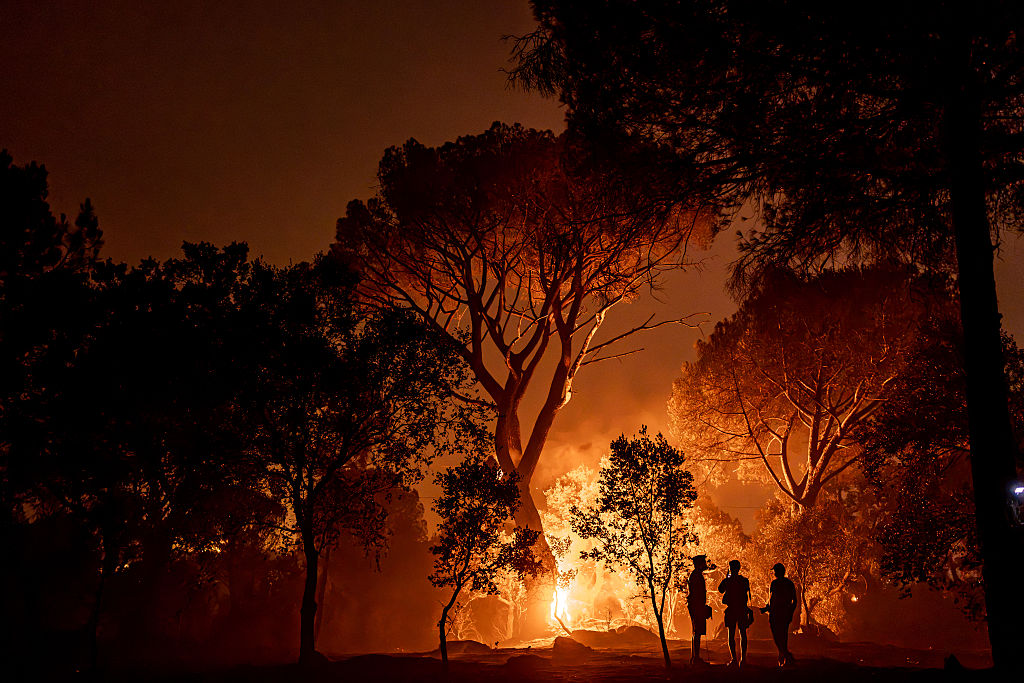
Flames engulf trees as a wildfire burns during overnight in La Adrada, Spain on July 26, 2026. —Diego Radames—Anadolu/Getty Images
A world on fire
In Spain, where several massive fires recently began burning with comparable ferocity, Interior Minister Fernando Grande-Marlaska declared, “We are facing the most significant and aggressive fire in Spain’s history.” Spain is more than 500 years old.
Across France and Spain alone, approximately a third of a million people have been displaced, the largest evacuations since World War II, but that is just the one among many examples. This summer, evacuations are ongoing across Europe, from Portugal to Turkey. Earlier this summer in Germany, evacuations were ordered in record-breaking heat after a wildfire triggered explosions in a nature reserve strewn with leftover ordnance from World War II.
Between drought, heat, and wildfire, much of the world is summering in record-breaking territory. The U.K., its iconic green landscape now parched to desert brown, is suffering one of its worst droughts since record-keeping began. Eight time zones away, Spokane, Washington, endures similarly outlandish temperatures as it continues to battle the most destructive wildfire the city and state has ever seen. With no relief in sight, there is, according to the city’s mayor, Lisa Brown, a years-long recovery already baked in. British Columbia, which has suffered several of the worst fire seasons in its history over the past decade, is bracing itself for the worst one yet. In Utah, fire officials are saying the same thing. In Russia this month, temperatures broke 90°F. at two different weather stations at the Arctic Circle, nearly 3,000 miles north of Miami, where such temperatures are the norm for this time of year.
Fire phnonemon
We are witnessing, live and in person, a terrible convergence of prolonged drought and record-breaking temperatures across the Northern Hemisphere. It is a convergence expressed most emphatically by unfightable fires racing across tinder-dry landscapes, fanned by high winds that are, increasingly, generated by the fires themselves. Just as warm waters fuel hurricanes, hot landscapes alive with roaring fire energize a wildfire’s chimney-like central column by burning all available fuel—grassland, forests, and neighborhoods alike—with explosive speed, and irrepressible ferocity that can produce flames higher than a thirty-story building and radiant heat approaching 1,000°F.
The ultimate expression of such a fire (so far) is the pyrocumulonimbus fire cloud or pyroCb, a colossal fireborne weather system that rotates like a hurricane, can shroud a major city in choking smoke, and puncture the stratosphere, allowing its mushroom cloud to achieve altitudes normally reserved for intercontinental jets. In order to oxygenate themselves, these massive systems inhale huge volumes of fresh air from the surrounding area, much as a hurricane does, and with similar effects on windspeed.
These massive fire weather systems, once an anomaly only seen over volcanoes, did not enter the vocabulary of fire scientists until the late 1990s, when atmospheric CO2 reached 370 parts per million (ppm)—about 30% higher than pre-industrial levels. It was only in the 2000s that wildfires, formerly seasonal events for which there was a well-rehearsed response, became able to generate these self-perpetuating and uncontainable firestorm clouds on a regular basis. Since 2016, they have become a feature of major fires across the North American West, but until the past year or two, they were virtually unknown in Europe. Matchstick-dry pine plantations in Gironde, France generated what is believed to be that country’s first-ever pyroCb just last week. Today, atmospheric CO2 is pushing 430 ppm, more than 50% higher than pre-industrial levels.
This matters to all of us because once a fire generates a pyrocumulonumbus cloud, it can perpetuate itself almost indefinitely by creating its own fiery weather, including ember blizzards and lightning strikes able to ignite fuels well beyond the current perimeter of the fire. Nothing and no one can stop a pyroCb save for a regional change in the weather, or an ocean-sized body of water.
With infernos burning so hot that water evaporates before even reaching the flames, firefighting operations are devolving, increasingly, into lifesaving operations. Whether you’re in the suburbs of Athens, Bordeaux, or Spokane, evacuation is often the only viable option. Over the past decade, millions of unsuspecting people have found themselves in the path of these hyper-scaling flames and, from Valparaiso, Chile to Fort McMurray, Alberta, victims are astonished by the speeds at which these fires move—speeds which photos and even video clips can fail to adequately convey.
How our climate changed the world
This is climate breakdown, and its expressions are manifold. We can now expect everything from yellow and orange air and failed crops to buckling railways and the forced shutdowns of nuclear plants due to low water. When temperatures exceed 110°F, passenger planes must consider lightening their loads. At 120 degrees (an increasingly common summer temperature across the Middle East and the American Southwest), flights are often canceled altogether. Such temperatures also ground firefighting aircraft, leaving cities, towns and forests even more vulnerable to a wildfire’s whims.
Bearing the brunt of our new climate reality, of course, is the simmering countryside, desert dry and ready to ignite from the first mechanical spark, hot muffler, or flying ember. In many parts of the world—such as southern Europe, North Africa, and the Middle East—many charred and desiccated landscapes are no longer able to support the agriculture they have nurtured for thousands of years. As a result, for instance, wine production is decreasing globally, not just because of changing tastes but because heat, drought, and increasingly unstable weather are disrupting this ancient crop and craft.
However, there is another, slower and more insidious evacuation taking place, and that is the steady migration from rural areas all around the world to burgeoning cities, which now host more than half the world’s population. Left behind, landscapes previously managed by seasonal harvesting, pruning, burning, and grazing have gone feral: overtaken by scrub brush and weeds, they are terrifically flammable under current, much hotter weather conditions. Exacerbating this situation in regions like southern Europe and California is what’s being called “weather whiplash.” That is, heavy winter rains and snowfalls that encourage abundant spring growth, only to be dried to tinder by the now-successive heatwaves baking southern Europe and the American Southwest.
With this brutal heat comes another 21st-century chimera: the “flash drought,” a combination of searing, triple-digit temperatures and high wind that can turn a green field brown in the space of a workday.
A destabilized climate poses an existential threat to human civilization, pushing agrarian populations off their traditional lands into contact—and, often, conflict—with their neighbors. Take the recent war in Syria. The conflict had deep political roots, but it was exacerbated by internal migrations driven by failed harvests and drought.
Both Europe and North America are now beginning to see similar situations without—as yet—the armed conflict. In addition to already stressful and divisive cross-border migration, we are experiencing a second wave of internal migration in the form of mass evacuations due to fire. More than 800 homes have been destroyed and more than 60,000 people displaced thus far by the fires in and around Spokane, Washington. In Utah, thousands more evacuations have been ordered as that state faces record-breaking heat, high winds, and the worst fire season in its history. North of the border, in British Columbia, hundreds more homes were lost this week, and 15,000 people are currently under evacuation, with extreme fire weather conditions predicted to worsen in the coming days.
Fire prone regions such as these are already seeing an exodus of so-called “climate refugees.” As fires grow more frequent and destructive, we are going to see more people leave—driven out, because they can’t rebuild, or opting out because the price and risk of staying feels too high.
The role humans play
I wish I could say this summer was an anomaly or an outlier, but it clearly isn’t, and there’s more on the way. Our world is changing rapidly, and we are torn between adaptation, and clinging to the status quo.
In fairness, it’s hard to know where to look, and what we should be reacting to. Often ignored in discussions about drought, fire, and climate change in general, are the world’s oceans, which are warming just as the air is. Significant marine heatwaves have been recorded this year in the North Pacific and Atlantic oceans, and in the Mediterranean. It is ocean temperatures in the Pacific that generate the El Niño effect, and the next one, due this fall, is expected to break all previous records. Consider this summer a preview. But how did we get here?
Fossil fuels enabled modern civilization and got us where we are today. Had we never moved beyond wood-fueled steam power, there might scarcely be a tree left standing. Had we relied solely on coal, the air in our cities and towns would likely be as toxic as Pittsburgh’s in the 1940’s. Oil and gas has enriched and expanded our lives in such profound and far-reaching ways that renowned energy historian Daniel Yergin coined a new name for our species: Hydrocarbon man. From road paving to running shoes, lingerie to jet fuel, petroleum products are integral to our society—ubiquitous, affordable, and very well represented in Washington.
But the immeasurable gains fossil fuels have given us over the past century are now being taken away in real time, hundreds of houses, thousands of evacuations, and billions of dollars at a time, leaving behind mass trauma, ravaged landscapes, impoverished communities, and a tattered social fabric. Senator Sheldon Whitehouse (D-RI) summed up this dilemma more succinctly than anyone: “It’s not complicated,” he said at a Senate Budget Committee hearing in 2024. “Climate risk makes things un-insurable. No insurance makes things un-mortgageable. No mortgages crashes the property markets. Crashed property markets trash the economy.”
When will the oil and gas industry’s eye-watering profits be outweighed by all the losses their emissions incur?
Cumulatively, they already have. Spain’s prime minister, Pedro Sanchez, who speaks with hard-won authority on this matter, put a finer point on it: “Climate change kills: it kills people, as we’ve seen; it kills our ecosystem, our biodiversity, and it destroys the things we as a society hold dear—our houses, our businesses, our livestock.”
If there is a glimmer of hope in the smoke, it can be found in the relatively low mortality rates for these recent urban fires, and their largely successful evacuations, which demonstrate real social cohesion and admirable courage and civic spirit.
On the energy front, there is real and tangible good news, but neither the White House nor the CEOs of oil majors and their army of lobbyists are keen to share it: the energy transition to reliable, affordable renewable energy is underway and irreversible. Deploying renewables paired with intelligent energy conservation and grid management, individuals, businesses, municipalities, and entire countries are earnestly curbing their CO2 emissions. Arguably, the biggest hurdle will be curbing the appetites of the wealthiest 10%, not just at the extremes—vanity rockets, super yachts, and spurious wars—but two-day shipping, budget jet travel, F-150s, and the most casual wish granted with the click of a button.
As long as we burn fossil fuels without limits, wildfires will do the same in our forests, cities, and towns. But we are not passive bystanders, and these genuine “trials by fire” are Nature’s stern invitation to mature as a society, to confront with intelligence and courage the daunting energies we’ve unleashed with our own.
Fire is, at its core, an ambitious, energy-burning appetite. But so are we. Our future depends on whether this ambition is used to reinforce a now-maladaptive status quo, or to evolve, adapt, and conserve as so many among us are already doing.
113km to go Coston is about one minute ahead of the peloton but sitll more than three minutes behind the lead pair, who will reach the summit Col des Robines shortly.
123km to go Morgane Coston (Ma Petite Enterprise) has gone off after the breakaway pair, she has 2mins 35secs to make up. The peloton is more than three minutes behind the leaders.
An exchange between Dr Erica Schwartz and Senator Josh Hawley during her confirmation hearing is alarming
Robert F Kennedy Jr’s new cooking show isn’t the only big news out of the public health world this week. On Wednesday, Dr Erica Schwartz was confirmed by the US Senate as director of the Centers for Disease Control and Prevention (CDC), making her the first Black woman to hold the position. This is the first time in almost a year that the agency has had a permanent leader; the previous director, Susan Monarez, only lasted 29 days before she was ousted for butting heads with RFK about US vaccine policies. Translation: she was a little too keen on following accepted science for the Trump administration.
So is Schwartz an RFK-approved vaccine skeptic who thinks you can cure cancer by praying to trees? Surprisingly: no. Schwartz, who served as deputy surgeon general during Trump’s first term, actually has government experience and a public health background. During her confirmation hearing in July, she walked a careful tightrope when asked about her stance towards vaccines. Schwartz said she “will never betray the science” but also dodged questions about how she would handle pressure from Kennedy.
Сразу дисклеймер: эта статья не реклама магазина, не туториал «парсинг за 5 минут», и я не программист. Я переводчик и штангист-любитель, а код, который будет представлен ниже, писал вместе с нейросетью. Это история о том, как одна рекомендация из книги перевернула мои представления о спортивном питании, а лень и любопытство привели к написанию скрипта, который за пару минут сделал работу, на которую у меня раньше уходило несколько часов.
Привет, Хабр. Статья является напоминанием как уязвимы ваши личные данные при несоблюдении базовых правил цифровой гигиены. Материал создан исключительно в учебных целях, для специалистов по информационной безопасности и для пользователей, которые хотят более углубленно понимать, как защитить свои данные от утечек. Использование данных методов против других лиц без согласия — уголовно наказуемо (ст. 272 УК РФ).
Речь пойдет о том, что происходит, когда вы переходите по ссылке, минуя предупреждения браузера о "Небезопасном соединения", или устанавливаете в систему корневые сертификаты, полученные из сомнительных источников.
Europe is in another brutal heat wave. The summer's earlier record-breaking weather already damaged crops, sparked wildfires and led to increased deaths.
(Image credit: Pablo Blazquez Dominguez/Getty Images)
On August 5, 2025, the US Department of Health and Human Services canceled 22 mRNA vaccine projects worth roughly $500 million and told the country it would stop investing in the technology that had brought us life-saving Covid vaccines. Health Secretary Robert F. Kennedy Jr., a longtime vaccine skeptic, claimed that the data showed these vaccines fail to protect against upper respiratory infections like Covid and flu. That his claims weren’t true — Moderna had already published Phase 3 trial results showing the opposite — didn’t seem to matter.
On August 5, 2026 — one year to the day later — the Food and Drug Administration (FDA) approved mFLUSIVA, the first mRNA influenza vaccine ever licensed in the United States.
That symmetry, while highly useful to writers like myself who are always looking to identify the rhymes of history, wasn’t planned. The approval landed on the one-year anniversary simply because of the deadline the agency had set for itself in February of this year, after it refused to review Moderna’s application and then, 15 days later, reversed itself.
The decision didn’t earn a huge amount of press, in part because seasonal flu is a disease Americans have rarely taken seriously — fewer than 50 percent of US adults got their flu shot this past fall and winter. But flu is no joke: The 2024–’25 season produced 51 million illnesses, 710,000 hospitalizations, and 45,000 deaths. That’s more than the number of Americans who died in car crashes last year. And the damage from a flu virus doesn’t stop when the fever does. In the week after a confirmed infection, the risk of a heart attack runs roughly six times higher than normal.
So a better flu vaccine matters. But the more interesting thing is what the approval says about the year that produced it. The nine experts who voted unanimously that this vaccine’s benefits outweigh its risks were appointed under the very same secretary who was against mRNA technology. Asked to look at the evidence, those experts couldn’t produce a single vote against it.
That’s not quite a change of heart, but at a dark time for public health, it’s something to hang our hopes on — because flu could just be the start for this technology.
The egg came first
If you’ve ever taken a flu shot, thank a chicken.
Every flu vaccine Americans have received since the 1940s has been grown inside fertilized chicken eggs. It’s a laborious process, closer to agriculture than it is high technology. Each batch incubates for nine to 12 days; the World Health Organization then spends months making the reagents manufacturers need to calibrate doses. The whole sequence runs about six months.
That means that the flu strains in your vaccine in November were selected back in February. Which is a problem, because flu viruses don’t like to stand still. Between February and November, the virus drifts, and the current dominant H3N2 flu drifts especially fast.
The eggs are a problem, too. Growing flu virus in a chicken egg forces it to adapt to egg cells, and those adaptations alter the very surface protein the vaccine is meant to teach your immune system to recognize. Between the 2011 and 2020 flu seasons, egg-adaptive mutations caused more mismatches than the virus’s own drift did. And more mismatches mean a less effective vaccine — while the flu shot prevented an estimated 12,000 deaths in the 2024–’25 flu season, it is the weakest vaccine in routine American use, landing anywhere between 20 and 60 percent effective depending on how well February’s guess matched November’s virus.
mRNA skips the egg. The shot carries instructions, a strip of genetic code that tells your own cells to build the flu’s surface protein, which your immune system then learns to attack. And swapping in a new strain means retyping that code, not growing a new virus.
As a result, Moderna told the FDA’s advisory panel it can go from strain selection to finished vaccine in two to three months instead of six. That means strain picks could move later, closer to the season they cover, and a novel flu virus surfacing in September could still be blocked by a reformulated vaccine in the same season. Eggs are great, but they can’t do that.
Building off the platform
Back in January I wrote here about the universal flu vaccine — one shot covering every strain for years. It’s a public health dream. mFLUSIVA isn’t that, but some of the best hopes for a universal flu vaccine run through the mRNA platform, and platforms only improve when somebody uses them.
That word — platform — is where last August’s decision went wrong. Kennedy made a claim about one application, mRNA respiratory vaccines, and cut funding for the technology underneath all of them. But over the 12 months that followed, the science on mRNA kept flowing.
In June, five-year melanoma results showed an individualized mRNA therapy given after surgery alongside pembrolizumab cut the risk of recurrence or death by 49 percent. In April, a Memorial Sloan Kettering team reported that among pancreatic cancer patients whose immune systems responded to a personalized mRNA vaccine, nearly 90 percent were alive six years later; the five-year survival rate in that disease sits near 13 percent. And KJ Muldoon, the first person treated with a gene-editing therapy built for his mutation alone, is walking and talking, though half the infants born with his disorder never see a first birthday. The editor that rewrote his DNA was delivered to his liver as messenger RNA — mRNA as the delivery truck rather than the vaccine.
None of those is a flu shot. All of them are the same chemistry — a strip of genetic code wrapped in a lipid nanoparticle — and none of them were what Kennedy was talking about when he defunded it.
Partially as a result, Americans are falling behind. Moderna’s combined Covid-and-flu shot is already licensed in Europe while patients here wait for a resubmission. The Phase 3 trial of its H5 bird flu vaccine — the one meant to be ready if bird flu ever learns to spread between people — runs on money from the Coalition for Epidemic Preparedness Innovations, and the British government, after the administration killed a $760 million BARDA contract. “The United States invented this platform,” Johns Hopkins RNA biologist Jeff Coller wrote on Thursday, “and is the only country walking away from it.”
Of course, you need to actually get the vaccine
mFLUSIVA beat a standard-dose flu shot by 26.6 percent in a 40,700-person trial. (Against flu bad enough to send someone to a doctor, the figure was 33.7 percent — an exploratory finding the trial wasn’t built to prove, but that points in the same direction.) This is a better flu shot, but it hasn’t solved flu.
There are issues with side effects: Two-thirds of recipients reported injection-site pain, against 30 percent for the comparison. Most cleared in a day or two, but in a country where a quarter of the people who skip the flu shot cite side effects, that’s not a minor problem.
And approval, unfortunately, isn’t access. The CDC’s vaccine advisory committee has been frozen by a federal court since March, so there is no clinical recommendation, which means insurers aren’t required to cover mFLUSIVA at no cost. The $500 million in canceled contracts hasn’t been restored. As Michael Osterholm, who runs the University of Minnesota’s infectious disease center, put it after the government reversed its mRNA decision in February: “We don’t have any idea why they reversed course. That’s part of the problem.”
The most optimistic reading is that nine independent experts appointed by this government looked at the evidence on mRNA and could not produce a single vote against it. The more pessimistic one is that it took a refusal-to-file letter, a public outcry and two senior departures to get there.
But here’s what we do know: Some morning this fall a 58-year-old will roll up a sleeve at a CVS for a vaccine designed off a sequence rather than grown in an egg, and will think about none of this. That’s more progress than I would have expected a year ago.
A version of this story originally appeared in the Good News newsletter. Sign up here!
Watchdog examines handling of an incident last year that was treated as an attempted burglary
Counter-terrorism police investigating the death of Ann Widdecombe have reopened an inquiry into an incident last year, in which Nigel Farage’s home was allegedly firebombed.
During the incident in April 2025, a lit incendiary device was pushed through the Reform UK leader’s letterbox, according to reports.
Britain’s spooks take quiet satisfaction from survey ranking Secret Intelligence Service Europe’s top espionage agency
MI6 has the swagger of James Bond; its French equivalent, DGSE, the complexities of the television drama Le Bureau. The film and TV shows may be fictional, but a survey run by a French magazine that placed the British spy agency above the French as No 1 across all of Europe this week is not.
L’Express, a news weekly, conducted a Eurovision-style poll of 60 current and former spies from across the continent, plus the CIA and Israel’s Mossad. Each was asked to rank their top five foreign intelligence agencies, in secret, naturally enough. MI6 was first with 251 points ahead of DGSE on 169, with other agencies trailing behind.