Когда я прочёл о том, что Андрей Карпати больше не пишет код руками, а перешёл на агентное программирование, я, честно говоря призадумался. Скажи об этом кто-то другой, пропустил бы мимо ушей, но именно его слова стали сигналом - в своей работе, и в группе разработчиков придётся что-то менять. Как известно, личный пример - лучший способ убедить коллектив и повести за собой, поэтому пришлось пробовать.
Первой же пробой пера стал вовсе не Todo-app, а самый что ни на есть хардкорный энтерпрайз. Задача - создать полноценный аналог интеграционной шины CellWorks MBX. Это ключевой элемент автоматизации завода по производству полупроводников: она связывает в единое целое MES-систему и сотню единиц технологического оборудования. Мы как раз начинали перенос легаси-стека с PA-RISC-серверов на x64, и вопрос портирования старого транспорта стоял остро.
Вторым проектом стала имитационная модель этого производства. Нет-нет, это не аналог factorio, в ней ни намёка на 3D или игровые механики. Это симулятор реального цеха: с моделями оборудования, технологическими маршрутами, реальным незавершённым производством, производственным планом на годы вперёд (при желании). Эта модель отвечает на вопрос: какую продукцию и в какой срок я потенциально смогу выпустить, если запущу в работу вот столько-то сырья, и оборудование не встанет надолго из-за поломки или отсутствия материалов. Результат превзошёл ожидания. Софт, который раньше создавался большими коллективами, благодаря ИИ и open-source, теперь можно создавать практически в одиночку, и активно внедрять в реальное производство!
Federal authorities are investigating billions in related-party loans made by two insurers owned by Mark Walter reportedly to entities associated with him or his holding company.
<a href='https://news.sky.com/story/jewish-couple-attacked-by-teens-who-tried-to-take-clothing-as-appalling-rise-in-antisemitic-incidents-revealed-13569658'>Jewish couple 'attacked by teens who tried to take clothing'</a>
Progressives notched major wins in Michigan, while voters in Missouri and Washington rejected insurgent Democrats. Meanwhile, Trump continued to flex his influence over the Republican Party.
Диэдральная группа — это математическое обозначение всех поворотов и отражений правильного многоугольника. Для n‑стороннего многоугольника всегда существует n возможных поворотов и n отражений, что даёт нам 2n возможных симметрий.
Сочетание любых двух симметрий даёт нам элемент из той же группы, и это превращает её в группу в математическом смысле.
Теория групп полезна при разработке игр. Я вспомнил об этом, прочитав девлог Factorio, в котором разработчик рассказал о проблемах, возникших из‑за того, что изначально он забыл учесть все случаи.
Candy-coloured recreations of one woman’s pregnancy unravel as dark truths are revealed in Maite Alberdi’s intimate docudrama
This cheekily inquisitive docudrama by Chilean director Maite Alberdi features a unique variation on the long con, and one with a precise duration: nine months. After suffering three miscarriages and under pressure from her husband and in-laws to give them a child, Eleonor Alejandra Marín Mendoza (aka Ale, and played by Ana Celeste in re-enactments) decides to fake her next pregnancy. She is determined to have something to show at the end of it: after meeting single mother Mayra, who wants to abort her second pregnancy, at the hospital where she works, Ale agrees to take her baby once it is born.
The details are hardly believable: eating copiously to gain weight, Ale manages to convince husband Arturo (Armando Espitia) and his family that this pregnancy is on track for her entire term. She reflexively tenses her muscles while he strokes her baby bump and smiles through a swirl of conflicting thoughts at her baby shower. While most con artists must dupe themselves on some level, it is true down to a physiological level in Ale’s case: a judge later testifies that her desperation to bear children may have resulted in a pseudo-pregnancy. How else to explain that the doctor signing off her maternity leave appears to hear the baby’s heartbeat?
The Hostel and Thanksgiving director takes a massive stumble with a rushed retro horror made on the cheap
A few years ago, Eli Roth realized his long-held ambition to make a movie out of Thanksgiving, the horror-movie trailer he made as a gag for the Quentin Tarantino/Robert Rodriguez anthology feature Grindhouse, back in 2007. Though he didn’t actually go so far as to make the scratched-up decades-ago slasher shown in the original trailer, Thanksgiving was still Roth’s most satisfying movie in ages, replete with ridiculous gore and a side of satirical commentary – a 2020s movie fit for an old video store’s VHS horror section despite its contemporary setting.
Now Roth has founded a horror-focused company actually called the Horror Section, aimed at releasing movies, shows and “experiences” that appeal to the modern equivalent of those VHS-shelf gorehounds. After “presenting” a few other movies, Roth’s first direct contribution to the company is Ice Cream Man, exactly the kind of knowingly disreputable button-pusher befitting the company’s retro-sticker logo. (Indeed, Roth’s movie shares its title with a 1995 direct-to-video curiosity starring Clint Howard, though this one is unrelated.) Unfortunately, rather than a companion piece to the blackly funny murder-mystery of Thanksgiving, which riffed on Scream as much as 80s slashers, Roth’s latest feels like a demo reel for someone vastly less talented.
Toast the cat escaped his namesake fate when blaze ripped through building and displaced more than 40 families
A pet cat quite fittingly named Toast survived a devastating fire that recently gutted an apartment complex in Utah by hiding in a closet – and then safely endured a days-long wait before being rescued, according to officials.
Beside prompting comments across the news and social media landscapes about cats having nine lives, Toast’s death-defying story provided a slight measure of glad tidings surrounding a blaze that ultimately displaced hundreds of residents.
Amid stop-and-start threats and with a divided staff, it’s clear Trump has no idea how to end a war that shouldn’t have begun
On Thursday, 23 July, after weeks of escalating attacks between the US and Iran, Donald Trump told a reporter that Iran hadn’t received “enough pain yet”, and he leveled a threat. “I am considering a massive attack. Bigger than ever before,” he warned. “I am close to making a decision.” Then, on Monday 27 July, he called it off.
A few days later, on Friday 31 July, Trump said: “We’ll be hitting them very hard. At some point, they’re going to say: ‘We just can’t take it any more.’” This time, it took him just one day to back down.
Shouldn’t the health secretary have his hands full with the cyclosporiasis outbreak, measles or rabbit fever? Not when there are crispy salmon cakes to prepare …
The US health secretary Robert F Kennedy Jr has got his work cut out for him. A cyclosporiasis outbreak linked to iceberg lettuce has the entire country playing salad roulette: one bad leaf and you could become very unwell. The condition isn’t normally deadly, but, on Monday, officials in Michigan confirmed the first two fatalities. Meanwhile, it’s the worst year for measles in the US since 1991. A disease that was once eliminated now looks as though it’s back with a vengeance – thanks in part, according to experts, to anti-vaxxers such as Kennedy himself. And this week New York officials are warning about a rare tick-borne illness called rabbit fever (tularemia).
Still, despite having rather a lot on his plate, Kennedy has found the time to front a new cooking show, hosted on YouTube. It’s called The Real Food Show and it’s supposed to help Americans prepare healthy, affordable meals at home. The first episode features the chef and TV personality Andrew Gruel (perfect name) teaching the US to prepare crispy salmon cakes with … salad. Which is certainly a bold way to kick things off.
Set on an idyllic Canadian island, this coming-of-age series is juicy stuff. It swaps the darkness of recent YA TV for warmth, humour and a surprisingly compelling mystery
I’ll be honest: I was prepared to grit my teeth through Sterling Point, Prime Video’s newest coming-of-age offering, which I dismissed as another by-the-numbers high-school drama. The show follows a type-A teen on a journey of sun-dappled self-discovery, escaping her native New York for an idyllic getaway on a picturesque Canadian island. It’s an unassuming, summer camp-style narrative, but in the style of last year’s seasonal phenomenon that was series three of The Summer I Turned Pretty, it manages to transcend the limits of its YA niche, revealing itself to be quite juicy.
Protagonist Annie (Ella Rubin) is a highly strung 17-year-old, still reeling from a rejection from a summer business school programme when she receives the news that her estranged maternal grandfather has left her some mysterious assets. Annie, whose mother had died years ago, and her twin Connor (Keen Ruffalo), are prompted to start digging through family secrets, much to the distress of their dad (Jay Duplass of Transparent and Industry). The two learn that they’ve inherited a house in Canada – prompting Annie to take off on a secret trip in search of answers about her late mother’s life.
Uncertainty around the investigation into the death of the 18-year-old, whose body was found after a 4 July boat trip with friends, has led some to question whether justice will be meted out equally
Almost a month after his body was found, mystery still shrouds what happened to Nolan Xavier Wells, an 18-year-old college student from Ocean Springs, Mississippi.
There are the facts: Wells was alive on the morning of 4 July when he and a group of friends took a boat out to Horn Island, a barrier island off the coast of Mississippi. Hundreds of people were on the island, enjoying a last hurrah before returning to work or school after the holiday weekend. Wells was due to report to Southwest Mississippi Community College the following Monday for football camp, but he never returned home with his friends that day. The last known photos of him were taken around 4pm that afternoon.
The White House has declassified information claiming the FBI probed whether President Trump acted as a Russian asset when he fired James Comey, a theory an administration official said wasn't backed up by evidence.
AI is disrupting the world of work. But can it disrupt gender inequality at home?
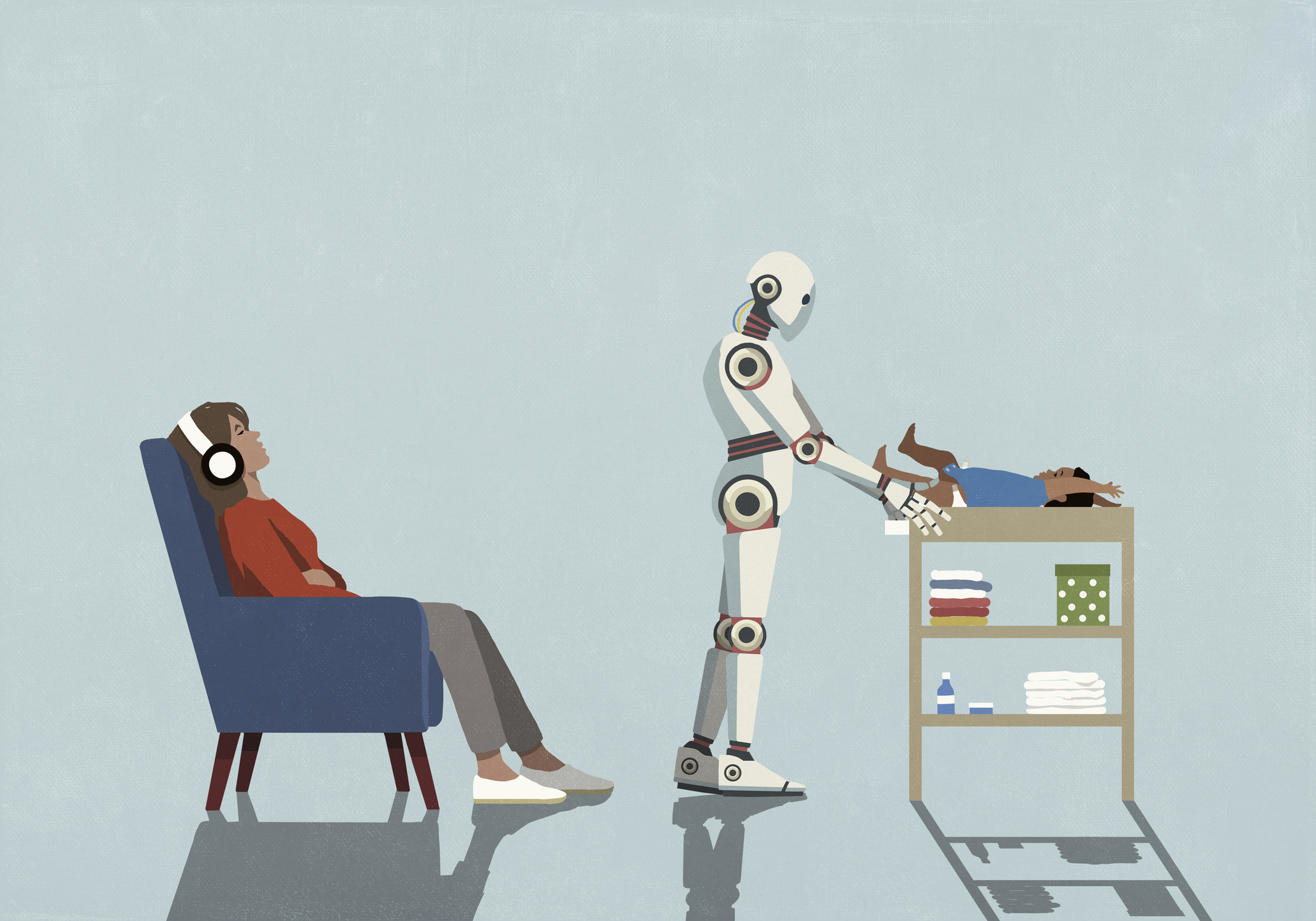
The rise of “Care AI” offers up a tantalizing vision, one in which the never-ending work of managing family life—the anticipating, planning, caretaking, troubleshooting, worrying, and remembering—is outsourced to and supported by AI.
Can’t keep up with emails and updates from your child’s school? An AI personal assistant can summarize communications, prioritize action items, and send reminders about back-to-school night. Worried something is off with your elderly father? An AI agent can track his medications, monitor for warning signs, and draft emails to his doctors.
Techno-optimism hails AI’s transformative potential to solve major social problems and address unmet needs. These arguments highlight how Care AI can augment our social capacity to care, alleviating the care crisis, while reducing the caregiving burden on women.
On the face of it, such technological developments are welcome news. Despite recent upticks in the amount of time men spend on unpaid household work, women still do significantly more. And that’s especially true when it comes to the mental load. In most households, it is women’s enduring vigilance, problem-solving work, and emotional management that keep the wheels from falling off.
Studies show that the gendered division of cognitive labor is even more unequal than housework or childcare. And women pay an enormous price for holding everything together. Mothers who do a disproportionate share of the mental load have higher rates of depression, stress, and burnout. They are also more likely to report lower quality romantic relationships and to arrive at work already exhausted. An AARP survey found that four in 10 caregivers of adults say they rarely or never feel relaxed.
This unpaid labor women do may leave them depleted, but its economic value has long gone unrecognized. Tasks like cooking or coordinating family logistics are typically excluded from measures of GDP.
A new analysis turns this thinking on its head. A new report by consulting firm PwC provides an estimate of the socioeconomic value unlocked by AI assistive supports for unpaid household work. From AI-enabled wearable monitors that alert caregivers to problems to AI assistants that research options, streamline family routines, and prevent missteps, the value of technologies that bring efficiencies to “care and life management” and that “reduce friction in everyday life” is $330 billion, and that’s just assuming a 40% adoption rate. These gains are generated not only from time savings but from the decreased stress and higher well-being that results from AI reducing the cognitive load caregivers carry.
Are techno-optimists right? Can Care AI offer women a better organized, fairer, and more carefree existence? History suggests otherwise.
Technofeminism has long criticized the idea that technology is the solution to the problem that has no name. In her influential 1985 book, More Work for Mother, historian Ruth Schwartz Cowan documented how the rise of “labor saving” domestic technologies like washing machines and vacuums actually increased women’s load by raising cleanliness standards and expanding housewives' responsibilities. Because technology is laid over existing cultural beliefs and social relations, it rarely fixes social problems.
Innovation has not brought about women’s liberation. In fact, it’s added to women’s plates. Research has found that the uneven gendered division of labor extends to the digital realm, where women often take the lead on their family's online communications and oversee and negotiate their children’s media use. Moreover, technologies that keep us continually connected have given rise to a relentless and transcendent type of caretaking. Far from feeling like they have less to do, women now feel like they are never off the clock.
Indeed, Care AI arrives on the scene as parenting standards have become supercharged. The cultural ascendance of intensive mothering, in which mothers are deemed entirely responsible for their children’s well-being and success, has upped the ante. Mothers feel this pressure to be the perfect parent acutely. Compared to fathers, mothers tend to hold higher standards for “good parenting,” but nonetheless judge themselves more negatively and worry more about falling short. The all-consuming and unforgiving nature of motherhood today results in a sad irony. Women often do more than their own mothers, but feel like they are not measuring up.
To be sure, there are enormous upsides to Care AI. These technologies will enable more convenience, improved coordination, enhanced monitoring, and in many cases better care. Women stand to benefit from these developments.
An analysis of Japan and the U.K. estimated that automation could reduce time spent on unpaid work by 50 to 60%, decreasing women’s domestic workload by about three hours per day, and enabling 9.3% of working-age women in Japan and 5.8% of women in the U.K. to take up a job. Against the backdrop of a care crisis and high burnout, Care AI provides a lifeline that families desperately need.
And there’s high demand. A new survey from LogicMark, a provider of personal safety and connected care technology, found that almost eight in 10 caregivers would embrace or try AI that predicts health issues before an emergency happens.
But for these gains to materialize, we must guard against Care AI creating even more intensive care standards. If “frictionless” family life becomes the norm, whatever downtime or peace of mind AI might give women will instead be consumed by datafication, mommymaxxing, and an endless quest for optimization.
In the end, what is most likely to ignite the gender revolution at home are not large language models but a cultural reckoning over why we continue to expect women to do it all and hold them to such impossible standards.
What’s really needed is for men to do more at home and for women to be given the green light to do less. In her recent book, anthropologist Carrie M. Lane shows how professional organizers do this kind of “feminist work.” Not only do organizers give their mostly women clients the permission to part with belongings, but also the permission to let go of exacting societal expectations like having a perfectly organized and spotless house. As one organizer explained, “Moms who are doing so much and have all this stuff and think they’re supposed to be able to handle everything… ‘You cannot do it all. You can’t. So, it’s okay.’”
Until we upend these stubborn cultural beliefs, and until we have functional care systems, we’ll just have to watch as the tech bros get rich by monetizing ever more innovative ways for women to continue doing the mental load for free.
A health worker prepares a dose of the measles vaccine at a health center in Lubbock, Texas, on Feb. 27, 2025. —Ronaldo Schemidt—AFP/Getty Images
Periods of disruption have often forced societies to rethink old assumptions, create new institutions, and find novel ways to solve problems. I have been thinking about that idea over the past year after seeing a record number of measles cases in the U.S.; disease outbreaks not seen in our country in decades, such as New World screwworm returning to our states; dismantling of federal health agency programs such as smoking cessation and global health; the chipping away at the childhood vaccine schedule and declining vaccination rates for children; and all of this coupled with less trust in federal agencies and political leaders.
I spent a decade at the U.S. Centers for Disease Control and Prevention (CDC) and believe deeply that our country needs strong, independent federal health institutions. States cannot replace national disease surveillance, reference laboratories, research, or the ability to coordinate a response across 50 states.
But since leaving government almost a year ago, I have had a different vantage point. I have worked with state health leaders, universities, entrepreneurs, philanthropists, and organizations across the country. And amid the significant disruption, I see something else happening. Like a phoenix rising from the ashes, new ways of working in public health are emerging.
States are finding new ways to work together. The West Coast Health Alliance and the Northeast Public Health Collaborative have aligned states in their regions on evidence-based vaccine recommendations after Health and Human Services Secretary Robert F. Kennedy Jr. fired members of the Advisory Committee on Immunization Practices. And this isn’t simply a red-state or blue-state phenomenon. When Texas needed greater capacity for measles testing, its public health laboratory developed a high-throughput approach that other states could validate and use for measles outbreaks. Further, states are collaborating and sharing information with one another through national organizations in the face of multistate threats such as Cyclospora. Recently, California launched its PHNIX initiative to connect public health with technology to develop scalable solutions in the state that improve health, lower costs, and strengthen emergency response. Rather than simply rebuilding what existed before, PHNIX asks what should be built next.
Medicine is responding, too. The American Academy of Pediatrics has continued issuing evidence-based vaccine recommendations and has challenged federal actions that threaten the integrity of the vaccine advisory process, resulting in courts temporarily pausing these federal policies that might limit access to childhood vaccines. The Vaccine Integrity Project, working with the American Medical Association and other organizations, has created an independent, science-driven process to review evidence on influenza, COVID, and RSV vaccines to counter the political interference impacting CDC’s recent vaccine guidance.
Universities are also rethinking what public health can be. Yale’s new Future of Health Innovation Hub fosters a different model where public health ideas engage commercial partners and move from research into products and solutions. Yale’s PopHIVE combines traditional government data sources with information from electronic health records and other sources to provide a timely picture of population health that is less impacted by government shutdowns or political priorities. With concerns about gaps in federal infectious disease monitoring during the World Cup, Georgetown University created a Health Security Operations Center that brought together universities, health systems, public health, and technology partners to use real-time data to help identify emerging threats.
And innovators are applying technology to problems that public health and health care have struggled to solve at scale. While it is too early to call them success stories, they are steps in the right direction. This month, the Coalition for Health AI launched PULSE, bringing public health agencies at state, tribal, local, and territorial levels together with technology companies to test responsible use cases of generative AI ranging from biosurveillance to multilingual communication. OpenAI and Anthropic are providing access to their technology, and lessons from participating health departments will be shared so others can build on what works. Akido is using AI to help street medicine teams care for hard-to-reach populations, using technology to increase the number of patients each clinician can see while maintaining strong retention in care and addressing public health concerns such as substance use. Jimini Health is using technology-enabled AI models made for mental health to extend care between visits, engaging patients between sessions while giving clinicians visibility into progress and allowing clinicians to prioritize what the models work on with patients.
None of this means the challenges facing public health can be solved or even patched up without federal leadership. The U.S. still needs a CDC capable of detecting threats, coordinating across states, conducting rigorous science, and providing trusted guidance. But resilience comes from having multiple sources of strength. Maybe that is a better ambition for American public health now: not simply to restore what has been lost, but to try to rebuild what worked, learn from what didn’t, and establish something stronger in its place.
After a year with plenty of reasons for concern, I find myself increasingly focused on what is being created. For centuries, the phoenix has symbolized renewal and the idea that something new can emerge from destruction. We should not have to lose important institutions and capabilities to spur innovation. But when disruption comes, we can choose what we build from it. Across American public health, I see people making that choice now. And that is what gives me hope.
President Trump announced a proposal aimed at achieving the disarmament of Hamas and an Israeli withdrawal. Israel ramped up attacks on the Palestinian enclave.
The state’s conservative Legislature had put the measure on the ballot that would have enacted citizen initiatives only if they won majorities in each of Missouri’s eight U.S. House districts.
Привет! Это команда Яндекс Практикума. 17 июня у нас прошёл открытый вебинар «Как попасть на стажировку в Яндекс» — рекрутер Young&&Yandex Дарья Чикалова рассказала, где искать программы стажировок, как они устроены и как на них подаваться. Пересказываем самое интересное.
As homeownership slips further out of reach in America, more people are spending more of their lives as renters. Millennials and Gen Zs are less likely to own homes than older generations did at the same age, and the median age of a first-time homebuyer recently reached an all-time high of 40, up from 28 in 1991.
That need not be a bad thing. Renting offers many benefits — flexibility, far lower upfront costs, never having to figure out what a “sacrificial anode rod” is — and homeownership is overrated as a savings vehicle.
But being a renter in America (as roughly one in three people here are) can also be a very undignified experience. In most states, your landlord can kick you out when your lease ends for no reason at all, even if you haven’t done anything wrong. Many tenants live in fear of receiving their next lease renewal, not knowing if they’ll be displaced by the next rent hike.
Some progressive policymakers, buoyed by the growing influence of democratic socialism and a resurgent tenant movement, are reviving an old, highly controversial answer to renters’ lack of security: simply ban steep rent increases through rent control.
In June, New York City, under Mayor Zohran Mamdani, froze rents on rent-stabilized apartments, which make up about 40 percent of the city’s rental housing stock. Rent control laws have been passed or tightened in recent years in places from Washington state to Los Angeles to Montgomery County, Maryland, and tenant advocates this year have pushed similar measures in Massachusetts, Washington, DC, Providence, Rhode Island, and Redwood City, California.
Decoding rent control jargon
• Rent control: The broad umbrella term for laws limiting how much landlords can charge or raise rents on covered homes. It can refer to anything from a total freeze to a relatively loose cap on the size of annual increases.
• Rent stabilization: A form of rent control that permits rents to rise but limits the size of annual increases, often according to inflation or a percentage set by a government board. It usually implies a less rigid system than a permanent price freeze.
• Rent freeze: A temporary prohibition on rent increases for apartments covered by rent control, like the policy adopted in NYC this summer.
• Vacancy decontrol: A rule allowing landlords to increase an apartment’s rent to its market rate after a tenant moves out. Limits on annual increases then resume once a new tenant moves in.
Rent control’s advocates argue that the policy not only moderates prices, but also offers tenants stability and a firmer claim to their homes. It helps put “the landlord-tenant dynamic on different and more equal footing,” as Siraj Sindhu, executive director of Reclaim Rhode Island, which backed a Providence rent-stabilization ordinance that passed the city council before being vetoed by the mayor, told me.
Those are really important goals. I’m a lifelong renter, having literally never lived in an owner-occupied home, and I hate that I can’t predict what my housing costs will be less than a year from now. But is rent control the best way to achieve stability?
Housing economists have long hated rent control; the Swedish economist Assar Lindbeck famously called it “the most efficient technique presently known to destroy a city — except for bombing.” Decades of research have found that it can have many unintended negative consequences, including depressing housing construction by making it financially impractical to build new rentals. And as we know from today’s crippling housing shortage, nothing is worse for long-term affordability than a scarcity of homes. More recent research, however, suggests that better-designed rent control laws can protect some tenants without having catastrophic consequences for housing supply.
That rent control keeps coming back as a centerpiece of our housing politics reflects just how impoverished our policy ideas are for providing renters what they lack most: predictable costs and secure tenure. The US has an elaborate policy infrastructure to privilege and subsidize homeownership, while treating renting as an afterthought, like a condition of poverty or at best a waystation on the path to buying a house. That makes ever less sense in a country where millions of people will rent for life, whether by choice or necessity.
The truth about rent control is somewhere between both extremes. It can, in some cases, certainly be worthwhile. But it remains a highly limited tool, and others can furnish some of the same benefits without fueling the very affordability crisis that they’re meant to address.
Why economists (mostly) oppose rent control
Rent control polls favorably, and it’s not hard to imagine why — voters despise high prices. Capping rents might intuitively seem fair and costless: The tenant is protected from ridiculously high prices, the landlord profits a bit less, and society as a whole is no worse off. Who could object to that?
In fact, though, many economists vehemently oppose rent control precisely because it isn’t cost-free — it merely moves costs onto others and makes them less visible.
In uber-expensive cities like New York and Boston, rents are so high because demand to live there far outstrips the supply of homes. In a healthy housing market, high prices signal to developers to build more homes, which then brings prices down and, just as importantly, grows the city’s population and economy by providing homes to people who want to move there. We’ve recently seen this happen in Austin, Texas: The city experienced a rapid run-up in rents during Covid, and builders responded (after the city eased some of its building restrictions) with a flood of new apartments. Rents have since fallen well below pre-Covid levels in real dollars. By contrast, policies that cap rents would diminish the incentive to build rental homes at a time when the US needs many more of them.
Meanwhile, if rent caps fail to keep pace with landlords’ rising costs, owners may neglect maintenance or even pull apartments from the rental market if they no longer pencil out. One widely cited economics paper documented this dynamic in San Francisco, where the majority of rental housing is rent-controlled and annual rent increases are capped well below inflation. The city’s 1994 expansion of its rent control law, the researchers found, shrank the supply of rental housing among newly covered properties by 15 percent, largely because landlords converted rentals into owner-occupied units. The expansion made tenants 10 to 20 percent more likely to remain in their homes, but at the cost of making San Francisco’s rental housing scarcer and raising the rents of non-rent-controlled apartments.
Rent control programs are generally not means-tested, meaning that tenants in eligible apartments receive it regardless of their incomes. So a higher-income tenant who happened to secure a regulated apartment can remain indefinitely at a steep discount, while a lower-income newcomer is left to compete for market-rate units, which are exorbitantly priced in part because of rent control.
As a result, rent control laws bear part of the blame for why San Francisco and New York City are so unaffordable, Arpit Gupta, a housing economist at New York University, told me. Trying to suppress rents in cities like these is like trying to hold the lid down on a boiling pot — the pressure inevitably spills over somewhere else. Gupta, who sits on the New York City Rent Guidelines Board, which sets maximum increases for the city’s rent-stabilized apartments, cast the lone “no” vote on the rent-freeze measure this summer.
The freeze creates “a severe risk of financial distress” for many buildings, he told me. It could prompt landlords to leave apartments vacant after a tenant moves out if the cost to rehabilitate it cannot be recouped through the legally permitted rent. The number of vacant rent-stabilized apartments in the city has already been rising, and Gupta has argued that New York state’s 2019 overhaul of its rent-regulation laws, which further constrained landlords’ revenues, may be partly to blame.
Many leftists don’t like arguments like these because they’re uncomfortable with the idea that housing must be kept financially worthwhile for private owners. I sympathize with that instinct — housing is a human need, and it feels wrong for its availability to depend on profitability. But it doesn’t do us much good to ignore the structure of the economy we actually live in, where housing is overwhelmingly provided by the private market.
Housing markets can be very good at providing for people’s needs, if we allow them to workbetter by legalizing more housing construction and pair it with targeted rental subsidies to people with low incomes.
How rent control got smarter
One of the clearest ways to understand rent control comes from Shane Phillips, a housing researcher at UCLA. It should be viewed not as a long-term affordability strategy, he has argued, but as a targeted stability tactic. For affordability, there’s no substitute for building enough homes. But in already broken, unaffordable markets, like many of America’s superstar cities, rent control can be a stopgap that lets some residents remain in their homes. It’s reasonable to expect that people’s homes shouldn’t be treated as crude commodities that they can be priced out of at any moment. The question is how to balance security for existing residents against the structural harms rent control can cause to the overall market.
Not all rent control policies are created equal. Old forms of it appeared in places from ancient Rome to imperial China to the Jewish ghettoes of Early Modern Europe. When describing modern rent control, however, researchers distinguish among a few different types. “First-generation” rent controls arose largely as emergency measures across Europe during World War I, becoming very widespread in the US during World War II. These typically froze each unit’s rent at a fixed dollar amount, with few avenues for adjustment as costs rose; over time, they tended to push homes out of the rental market and discourage maintenance, reducing both the quantity and quality of rental housing.
By the 1970s-80s, a “second generation” of rent control laws, often called “rent stabilization,” was adopted in New York, Boston, Washington, DC, municipalities across New Jersey, and numerous California cities. These introduced some important innovations: They allow modest annual rent increases, set by a formula or regulatory board and often pegged to the rate of inflation. They exempt new-construction buildings from price controls, which reduces the disincentive for developers to build new apartments.
They also often include “vacancy decontrol,” which allows landlords to reset an apartment’s rent to its current market rate after a tenant moves out (after that, the unit remains subject to the annual rent increase caps). Vacancy decontrol is especially important for preserving rental housing supply, experts told me. But it also creates an incentive for owners to try to push tenants out so they can raise the rent. To combat this, most rent-control programs include “just-cause” eviction protections, meaning that landlords cannot arbitrarily evict tenants or refuse to renew their leases; they must cite a serious lease violation (or another legally recognized reason, such as removing the unit from the rental market).
Second-generation systems remain in place in major US cities, including New York, San Francisco, and Los Angeles. They tend not to distort housing markets as severely as first-generation laws, but they can still, as seen in the evidence from San Francisco, meaningfully damage housing supply. And Gupta has warned that New York City’s system has been regressing back toward first-generation rent control, with the recent rent freeze and the removal of vacancy decontrol under New York state’s 2019 Housing Stability and Tenant Protection Act.
Meanwhile, the recent revival of interest in rent control has produced some laws whose design may magnify the policy’s worst impacts. Montgomery County, Maryland, which includes some of Washington, DC’s most expensive suburbs, implemented a rent-control law in 2024 that lacks vacancy decontrol, while St. Paul, Minnesota, voters approved a 2021 ballot measure that initially lacked both vacancy decontrol and an exemption for new construction. Both places subsequently saw sharp declines in apartment construction, though the timing alone does not prove rent control was the sole cause. (St. Paul has since added partial vacancy decontrol and a permanent new-construction exemption.)
In a recent working paper, a pair of UCLA economists identified a “third generation” of rent control that is less restrictive than second-generation laws. California passed a statewide rent stabilization law in 2019, for example, that set a high ceiling on allowable annual rent increases: 5 percent plus inflation, or 10 percent, whichever is lower. It exempts new buildings for their first 15 years, and includes vacancy decontrol and just-cause eviction. Oregon passed a similar law the same year, as did Washington state in 2025. Using data from San Diego, the new paper found no discernible loss in housing supply there under California’s law. The implication is pretty intuitive: “The laxer the policy, the fewer the negative consequences,” as Phillips put it.
The flipside, of course, is that the least restrictive laws also do the least to protect tenants — a 10 percent cap mostly just amounts to an anti-gouging measure, and landlords rarely raise rents by that much anyway. Still, double-digit rent increases do happen. And even a loose cap can offer renters peace of mind and insurance against a life-upending rent hike.
We need a broader renter stability agenda
Some current proposals may soon play out the tradeoffs of rent control. This November, residents of Redwood City, located between San Francisco and San Jose, will vote on a ballot measure that would cap rent increases at 60 percent of inflation, with a maximum increase of 5 percent.
Clara Jaeckel, a renter in the city and an organizer with the campaign, told me that the proposed law would allow landlords to petition for higher increases if it’s necessary to cover operating costs. It’s “designed to strike a fair balance between letting landlords have a fair return on their investment and keeping things affordable for renters,” she said. Under California law, the city would still be required to include vacancy decontrol and exempt housing built after 1995. “We believe building new housing goes hand-in-hand with rent control — so we want both of those things,” Jaeckel said.
Limiting rent increases so far below inflation, which is similar to San Francisco’s rent cap, has the potential to meaningfully reduce the quantity and quality of rental housing. But it’s also possible that its negative impacts remain muted. Gupta and Phillips both told me that vacancy decontrol substantially limits the harms of rent control, regardless of the exact percentage rent increase permitted, and the proposed Redwood City rent cap would apply to a smaller share of its rental housing than San Francisco’s law does.
Voters and policymakers might decide that this tradeoff with housing supply is worth it if it can allow longtime residents to stay in their homes. The Bay Area has become so unaffordable that such laws right now represent one of the few ways that communities in the region can maintain some measure of class diversity.
But it’s worth considering how to deliver the same stability and affordability without rent control, which for too long has been the fallback that expensive cities and towns reach for after allowing their housing markets to become dysfunctional. It can ultimately only offer tenants a cramped kind of security, trapping them in homes that may no longer suit their needs because leaving would mean surrendering their only affordable option.
A better stability agenda for renters would give them genuine choices in where to live, and how long to stay. In places with broken housing markets, that means, first and most importantly, repealing exclusionary zoning laws and other barriers to building enough homes. That’s the foundation of affordability for everyone, but especially for renters, whose housing costs rise unpredictably with the market rather than remaining relatively fixed by a long-term mortgage. Renters with low incomes, meanwhile, need help affording housing even in a balanced market, and that ought to be provided far more consistently (Section 8 vouchers and other federal rental-assistance programs currently only reach a fraction of people who qualify).
Other policies can offer the long-term stability that rent control provides, too. “The ultimate issue that a lot of [rent control] interventions are trying to target is the challenge of being a renter and being faced with these cost shocks year after year,” Gupta said. Most American residential leases are one year long, but policy could encourage longer terms, which are common in some peer countries like Germany and Japan, and, Gupta noted, widespread in US commercial leases.
Another step is to give tenants a presumptive right to remain in their homes — in the vast majority of states, landlords can refuse to renew a lease without any cause because the law simply defers to their private property rights. That is a bigger deal than it might sound like: If you’re a renter in one of the 40-odd states that don’t have a right to renewal, and you have, say, loud young children who irritate one of your neighbors, you can be forced out when your lease ends without any recourse. I’ve seen this happen firsthand as a renter in Wisconsin, and it’s one of many ways that cities can be hostile to families. Protection from arbitrary eviction would benefit renters regardless of whether their units are rent-controlled.
These sorts of policies also need to be balanced with reliable processes for removing tenants who seriously damage property, endanger their neighbors, or repeatedly violate their leases. “Sometimes landlords are taken advantage of. Sometimes they are lied to,” Phillips said. It’s rare to find a jurisdiction in the US that’s both “very concerned about tenants and very concerned about landlords,” he said. Instead, US housing policy tends to oscillate between either extreme, but protecting the rights and interests of both need not be mutually exclusive.
America will remain stuck with a housing shortage for the foreseeable future, which not only makes housing unaffordable in our highest-demand cities and suburbs, but also gives landlords a structural advantage over renters because they’re shielded from competition. Until that changes, a limited form of rent control can redistribute some of that power back to renters. That may be a bargain worth making, but, Phillips said, cities should make it knowingly: with a clear idea of which renters they intend to protect, and who will bear the cost.
At first, it seems innocuous. You’re burned out at work, and an influencer video promising the five steps to find the career you’ve always wanted catches your eye on Instagram. Perhaps you’re also anxious about a big birthday approaching, so while commuting home, you listen to a podcast host explain the seven essential habits you should start today to extend your lifespan by 20 years. Later on, you ask AI assistant ChatGPT to help resolve a debate with your partner.
In all of these moments, you are temporarily relieving your stress and anxiety. You might even be getting some answers. But with each path you go down, you’re also losing something important: the opportunity to sit with, and tolerate, uncertainty.
Being able to keep it together when an outcome is unknown is critical to enjoying your life. It’s what helps us manage friction in relationships, allows us to make considered decisions as opposed to acting on impulse, and empowers us to eventually take big leaps. But we’re collectively losing our ability to bear uncertainty.
The proliferation of the internet and smartphones kicked off the trend of reduced exposure, which a 2019 study suggested was linked to an overall decline in our ability to tolerate uncertainty. Now there’s emerging evidence from multiplestudies suggesting that AI systems could be weakening our uncertainty muscles further. AI systems not only supply instant answers, but remove the need for us to make meaning of ambiguous experiences. They convert interpretation from something actively done to something that is outsourced, then passively consumed.
When we strengthen our uncertainty tolerance, what we’re really learning is a new definition of what it means to feel safe and secure.
One study comparing the responses of mental health professionals and chatbots found that the bots were more likely to provide advice than their human counterparts. Perhaps this is because they are designed to give us what we want, rather than what we need: Other research has found that people are more satisfied when their AI therapist provides advice instead of encouraging reflection, and are more likely to continue using it when it’s solution-oriented.
“It’s a skill to manage ambiguity and uncertainty, and if you’re not exposed to it, if you don’t know how to deal with it, you never learn that capacity,” Llewellyn van Zyl, a Netherlands-based wellbeing researcher and AI systems designer, told me. As LLMs supply immediate and sycophantic companionship, validation, and answers, they slowly replace the need to, for instance, practice ambiguity tolerance in the messy context of a human relationship, or to muddle through your own interpretation of an experience. “Friction, effort and struggle are not barriers to wellbeing but are the main ingredients needed for development to take place,” Van Zyl wrote in a paper.
Indeed, tolerating uncertainty often feels like a struggle, and for some people manifests as consistent anxiety or depression over being unable to control or predict the future. It is a state characterized by fear-based decision-making, where the ultimate achievement is avoiding discomfort and surprise at all costs.
But this way of living has an unexpected cost. If you’re especially anxious about a question or decision, that could indicate that you’re wedded to a single idea of what your future could look like, which could mean you close yourself off to other meaningful opportunities.
If you’ve increasingly found yourself looking for certainty and definitive answers, here’s how to get more comfortable sitting with unknowns.
How to strengthen your uncertainty muscles day-to-day
If you’re lifting weights for the first time, you wouldn’t go in and try to deadlift 200 pounds; you’d work your way up to it. Similarly, building uncertainty tolerance starts by integrating small, safe, and low-stakes moments of practice — think of these ideas as your 5-pound dumbbells.
Identify the small opportunities.
First, look for ways in your daily life to live with short bursts of uncertainty and break out of your routine: For instance, try going to a restaurant without looking at the menu if you typically scour it first. Attend an exercise class with a new instructor if you never stray from your favorite, or grab a coffee with that new potential friend you’ve been meaning to hang out with.
Choosing uncertainty might lead to discomfort: The cafe could serve food you don’t like, the yoga teacher might be too intense, the new pal could turn out to be dull.
But as in weight lifting, comfort isn’t the point. It’s about enduring discomfort and getting stronger.
Find a simple phrase to bring you back to the present.
If you are feeling anxious as you attempt to practice this, you can try a couple of strategies from psychiatrist Judson Brewer’s book Unwinding Anxiety. He recommends learning to weave curiosity into our most stressful moments, asking questions like, “How is this feeling serving me right now?” Even a simple, “Hmmm…” when you feel anxiety can bring you into the present moment, and create the space for curiosity.
In her new book, Prophecy, Oxford philosopher Carissa Véliz also identifies curiosity as a salve for our obsession with answers. “If anxiety about the future is the main driver behind our craving for prediction, curiosity is one of its most powerful antidotes,” she writes. “… the more curiosity you can manage to conjure about the present, the less apprehension you’ll feel about the future, because your attention will be in the here and now.”
Learn to ask the right questions
Curiosity is fueled by questions. But not all questions are created equal.
A good question, the Zen Buddhist teacher Joan Sutherland told me for my recent book, “will always make the room bigger, or open a door in the room to let something else in, or blow down the walls of the room entirely.” Obsessing over finding fast, easy answers to your biggest life questions can give you tunnel vision, eliminating possible futures by keeping fear and anxiety at the wheel.
From the stories and research I explored in my book, I’ve learned that great questions — the best curiosity fuel — have a few key attributes:
Avoid yes or no questions in favor of something more expansive.
First, as Sutherland explained, the best questions grow your set of possible solutions and futures. Sometimes, a binary question — e.g., Am I in the right relationship? — can make you feel stuck because it’s artificially limiting the options. A better question opens up possibilities, so instead you might instead ask yourself, “How would my partner and I both need to change in order for us to stay together?
Make sure your question is your own.
A great question serves as an internal GPS leading you back to your own needs and values, not what someone else might want or expect of you.
Take, for instance, a question like, Am I ever going to get married or Should I have a second kid? Not only are these binary questions, but they also could be questions that a family member is pressuring you to answer.
The best questions are the ones you create. They are rooted in self-compassion, allowing you to build yourself up rather than tear yourself down. Try to ask yourself questions that take the pressure off, that give you space to breathe.
Find a question that propels you forward.
Ah, regret. It plays an important role in our lives, but should be used sparingly, if at all, as question fuel. Think about questions like, What if I had just done it differently? or Why did we break up? If great questions open up a window or a door, these kinds of queries board them up. They keep you stuck in a stale, ruminative loop, rehashing the past rather than moving on and considering possible futures. If what you’re seeking is clarity or answers, these kinds of questions won’t provide them.
Take the pressure off
The last way to get comfortable with uncertainty is more subtle. It’s a mindset shift rooted in a 120-year-old piece of advice that the Austrian poet Rainer Maria Rilke offered to an aspiring poet, Franz Kappus.
Kappus had written to Rilke asking him all kinds of questions about how to live his life. Rilke responded:
I want to ask you, dear sir, as best I can, to have patience about everything that is still unresolved in your heart; try to love the questions themselves, like locked rooms, like books written in a truly foreign language. Don’t look for the answers now: they cannot be given to you yet because you cannot yet live them, and what matters is to live everything. For now, live the questions. If you do, then maybe, gradually, without your realizing it, some far-off day you will live your way into the answer.
Part of what can make uncertainty so uncomfortable is the sense of urgency it creates in us. We treat questions like problems that need immediate solutions. Rilke offers a powerful reframe: Questions are not tormentors, but teachers. And finding answers, especially to our most challenging questions, is not something that can happen instantly. Questions must be lived.
This advice is an invitation to pause and take a breath. You do not need to have all of the answers today, tomorrow, or next week. In fact, when it comes to the big questions of our life, it’s better if you don’t seek the answers immediately.
It is also a reminder to go out and live your life. It’s easy to let anxiety about uncertainty stop us from pursuing new experiences — even seemingly small steps into the unknown can feel very scary. When we strengthen our uncertainty tolerance, what we’re really learning is a new definition of what it means to feel safe and secure. Instead of defining security as being protected from challenge, we can define it as being ready to face whatever the future holds.
Привет, Хабр! Меня зовут Динар, я один из разработчиков службы каталогов «Эллес» в ГК «Иннотех». Кратко о продукте «Эллес», откуда он взялся и что из себя представляет, писал мой коллега. Подробное описание и документацию можете найти на официальном сайте. Но если коротко, то «Эллес» — это служба каталогов (в основе которой лежит глубоко модернизированный код проекта Samba), функционально аналогичная Microsoft Active Directory, с возможностью работы в гетерогенной среде с бесшовной интеграцией и миграцией клиентов.
[object Object] выглядит почти бесплатной абстракцией. Создал объект, напихал полей в любом порядке, удалил ненужное, передал дальше и забыл. Но, внезапно, одинаковые для тебя объекты могут оказаться разными для V8, порядок присваиваний влияет на машинный код, а “безобидный” delete оставляет после себя совсем не пустое место.
Для 99% систем это не имеет значения. А вот если у тебя hot path, через который проходят десятки тысяч объектов в секунду, или ты пишешь библиотечный код, стоит знать, что V8 на самом деле делает с твоими объектами.
The Trump administration has refunded about $100bn from the tariffs it collected before the US supreme court ruled them illegal, according to reports.
The $100bn (£74bn) figure, which represents 60% of the total $165bn collected from Donald Trump’s “liberation day” tariffs, was reported by customs officials to the US court of international trade (CIT) on Tuesday, according to the Financial Times.
Во время обучения чему-либо часто сталкиваешься с тем, что забываешь, что вообще изучал, особенно детали. Мне 18, я решил 822 задачи на LeetCode со стриком 430+ дней. Количество решённого само по себе ничего не гарантирует, если через пару недель не можешь вспомнить логику без подсказки. Поэтому я решил создать этот проект, но это относится не только к литкоду, но и ко всему остальному.
Начнем с простого. Писать заметки — это вполне рабочий вариант, но здесь есть важный момент: заметки работают эффективно только тогда, когда они заставляют мозг перерабатывать информацию («эффект генерации»), а не просто копировать её.
А теперь подробнее. Начнём с важного заявления психологов Родигера и Карпике, авторов классического эксперимента по retrieval practice: студенты предсказывали, что многократное перечитывание материала даст лучшее долгосрочное запоминание, а активное вспоминание — худшее, хотя на практике всё оказалось ровно наоборот.
Возможно, для многих это очевидно, да? Да, но суть глубже.
Когда человек перечитывает текст несколько раз, при повторном чтении слова "узнаются" легче и быстрее — возникает субъективное чувство беглости (лёгкости обработки). Мозг путает эту лёгкость восприятия с реальным пониманием и прочностью запоминания. То есть "мне легко это читать" ошибочно интерпретируется как "я это знаю". На это важно обратить внимание.
Это работа Роберта Бьорка — он же автор концепции desirable difficulties ("желательных трудностей"): вещи, которые кажутся трудными и медленными в моменте (типа вспоминания без подсказок), реально дают куда более прочное обучение, чем лёгкие и приятные способы (перечитывание).
Лет 8 назад пришла идея создать игру, где игрок сможет программировать космические аппараты, управлять его системами, управлять полётом и так далее. Концептуально игра должна была быть похожей на Kerbal Space Program, но вместо конструирования космических аппаратов игрок должен их программировать. Также KSP мне не нравился тем, что игрок по сути управляет космическим аппаратом вручную, вручную совмещает точки, стыкует космические аппараты «на глаз». Хотелось больше автоматизации (космическая станция должна расти). И в этот момент у меня зародилось приблизительное и далёкое видение моей игры.
На тот момент я интересовался программированием, но моих знаний не хватало для того, чтобы создать самому игру такой сложности. Однако примерно 3 года назад, уже имея профессиональный опыт в программировании, я решил, что пора, поэтому приступил к написанию. Конечно, как оно всегда бывает, финальный вариант далеко отличается от того, каким он задумывался, многие фичи сложно реализовать, некоторые выглядели в воображении лучше, чем оказалось на практике, однако основную идею, на мой взгляд, мне удалось воплотить, и я могу сказать, что вполне доволен результатом.
17-летняя девушка зарабатывает 10+ тыс долларов в неделю на создании сайтов с помощью ИИ. Она просто находит на картах компании с устаревшими сайтами и предлагает им свои услуги. Затем за 20-30 минут вайбкодит новый сайт в Claude или Lovable и продает готовый результат клиенту. Гениально.
U.S.-made systems are Kyiv’s only means to shoot down ballistic missiles, and Ukraine says it has run out of interceptors. Seventeen Ukrainians died overnight.
The Trump administration has refunded about $100bn from the tariffs it collected before the US supreme court ruled them illegal, according to reports.
The $100bn (£74bn) figure, which represents 60% of the total $165bn collected from Donald Trump’s “liberation day” tariffs, was reported by customs officials to the US court of international trade (CIT) on Tuesday, according to the Financial Times.
Как выбрать аналитическую СУБД, если одна быстрее, другая проще в эксплуатации, а третья лучше поддерживает нужный SQL? Рассказываю о нашем исследовании: TPC-DS и SSB, экспертные критерии и метод комплексной оценки с расчётом, который можно повторить на своих данных.
Привет. Это снова Саша Басун. Я работаю в «Петрович-Тех» инженером направления пользовательских ИТ-сервисов. Моя предыдущая статья про FortiClient VPN нашла отклик, потому я решил рассказать о самых распространённых ошибках при установке или запуске FortiClient VPN.
Итак, обычный будний день. Админу приходит заявка от пользователя, который жалуется, что FortiClient не подключается к серверу. При этом шквала подобных заявок не наблюдается, из-за чего админ делает вывод, что проблема у пользователя локальная.
Он подключается на удалённый компьютер, чтобы провести диагностику. Открыв логи программы, админ понимает, что помимо бутылки тут может потребоваться ещё и тонометр. Всплывающие окна с предупреждениями выглядят хотя бы немного понятнее. О них я вам и расскажу.
Drew Penrod is an experienced fullstack engineer at a company that makes phones designed for kids using Samsung Galaxy hardware running custom software. He and his team develop and maintain an Android-based platform that gives parents control over apps, contacts, screen time, messaging, and browsing through a web-based interface.
As the company and its engineering organization have grown, maintaining consistent code quality, security visibility, and policy enforcement – across multiple repositories and language ecosystems – has become increasingly important.
In this interview, we spoke with Drew about introducing Qodana into the team’s workflow, the challenges they were trying to solve, and what they’ve learned during rollout.
Can you tell us about your role and your team?
I’m a career full-stack software engineer, currently working as a DevSecOps engineer. My day-to-day sits between the engineering teams and the systems they ship through: CI/CD, pipelines, developer tooling, and the security and quality controls that run alongside them.
Alongside that, I’ve built several internal services that support our DevOps work, done a lot of PR and code review, mentored other engineers, and dug into time and space complexity and other performance issues across the codebase. I drove the Qodana adoption directly, from evaluation through to rollout.
What were your biggest challenges around code quality before Qodana?
We already had written standards for code style, pull request reviews, and QA. Style guides existed for TypeScript, Kotlin, and React. Every PR required two reviewers. What was missing was consistent enforcement of any of it.
ESLint ran in some places, sometimes locally, sometimes during a build, but it was not a formal CI step. Prettier and tests were reliable; but static analysis was not. Across several language ecosystems and a growing repo count, that meant standards were applied unevenly, depending on which repo a developer was working in and who reviewed their PR. There was no single place to see whether quality was getting better or worse over time.
How did you manage code reviews and quality checks previously?
Reviews were manual, with two reviewers per PR, against the written style guides. Automated checks in the pipeline were limited to formatting and tests. Linters ran inconsistently across repos, and there was no shared static analysis layer enforcing the same rules everywhere. Anything that needed deeper inspection (security issues, license problems, dependency risks) was caught case by case, rather than as a pipeline step.
Were there any specific compliance or security requirements you needed to meet?
Yes. The product we sell goes on kids’ devices, so security and dependency posture matter to us. We’re working toward alignment with CIS Controls v8 and the NIST Cybersecurity Framework (CSF) 2.0. Those frameworks shape how we think about the development pipeline.
Several of the controls land directly on the kind of work Qodana supports. CIS v8 Control 7 covers continuous vulnerability management, and Control 16 covers application software security, which calls out static analysis and secure coding practices specifically.
CSF 2.0’s Protect and Identify functions cover similar ground: knowing what’s in your software, knowing where the risk is, and keeping controls between vulnerable code and production. For us, these frameworks lead to the same practical requirement: automated checks that run on every change, with results we can audit later.
Drew’s take on Qodana
What made you start looking for a solution like Qodana?
A few things lined up at once. The pipeline itself was being modernized, and we wanted to fold static analysis, SCA, and license checks into it. Our Dependency Update Policy needed enforcement tooling, and the inconsistency across repositories was getting harder to ignore as the codebase grew. We needed a single tool that could provide coverage across our languages and run in both CI and the IDE.
What other tools did you consider?
We looked at SonarQube, ESLint-only setups, and standalone software composition analysis tools. Each covered part of the problem. None covered the full surface area without significant operational overhead or a patchwork of tools to integrate.
What stood out about Qodana?
Qodana fit the requirements better than the alternatives. It covers static analysis, dependency scanning, style, coverage, and license auditing in one platform, across the languages we use.
It runs the same inspections in JetBrains IDEs that the pipeline runs in CI, so developers see findings before they push rather than after a pipeline fails. It integrates with our existing CI platform and supports global configuration so rules stay consistent as repos are onboarded.
Getting set up
How did you introduce Qodana into your workflow?
Adoption has been incremental. Qodana was wired into pull request and main-branch pipelines through a shared pipeline mechanism, so individual repos can be onboarded without each team rebuilding CI from scratch. Each onboarded repo gets a baseline so existing findings are scoped separately from new ones.
Right now we are moving toward soft gates. A few repositories are running pilots of both soft and hard gates, but soft gates have not yet been rolled out to all repos.
How long did it take to see value?
We started getting value as soon as findings showed up in PRs and in the IDE, well before any gates were turned on. Visibility into dependency vulnerabilities and license issues was the first noticeable win, because those previously surfaced inconsistently across repos. Putting all that information in one place changed how we triage updates.
Were there any challenges during adoption?
Some of the pacing has been shaped by limitations of our underlying CI platform, which has affected how quickly we can promote soft gates to hard ones across the organization. Onboarding a polyglot codebase also takes time per ecosystem, since each one needs its own configuration and baseline. None of this has been blocking, but it is the reason we are still rolling out rather than fully enforced.
What impact has Qodana had on your code quality?
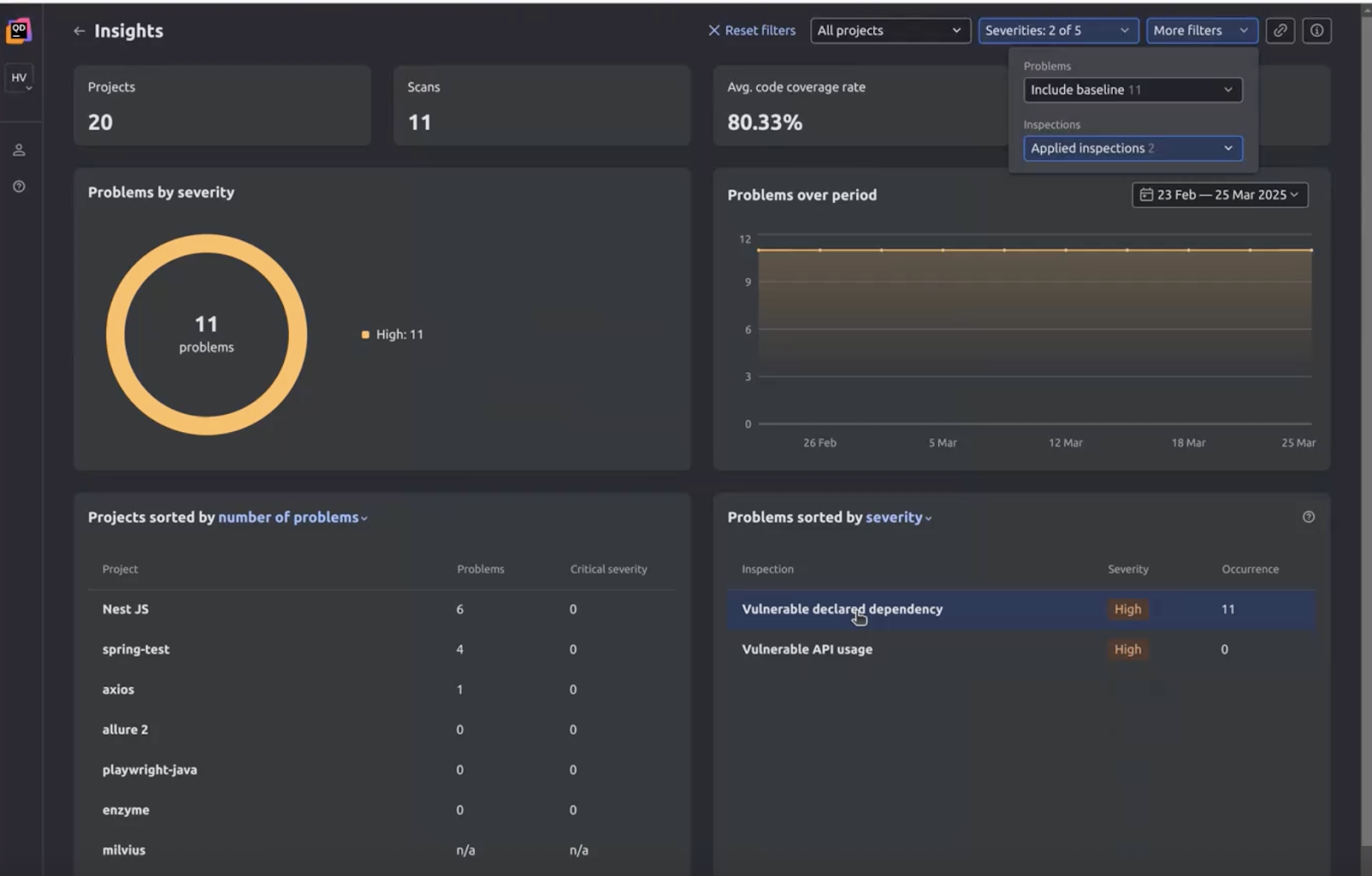
Rollout is still in progress, so most of the impact so far has been in visibility rather than in pipeline enforcement. Qodana has surfaced about 99,000 issues across the codebase.
That number is a starting baseline, not a count of issues fixed, and it covers code quality, style, and security findings together. Having those numbers in one place is itself useful: before Qodana, there was no consistent way to compare quality across repos or languages.
Have you seen changes in the complexity and functionality of your codebase?
Performance and complexity work is something I spend real time on, and Qodana has been useful as another lens on it.
The inspections surface things like inefficient loops, redundant work, and patterns that hint at deeper time or space complexity issues, which gives me a head start when I’m reviewing PRs or going back to look at hotspots in older code. It is not a replacement for understanding an algorithm, but it does flag enough that we end up having those conversations earlier than we would have otherwise.
It’s still too early to claim broad measurable changes in complexity across the whole codebase, since rollout is ongoing. The pilot repos are where the cleanest signal will eventually show up.
Has it helped with compliance or security processes?
Yes. Dependency vulnerabilities and license issues are now visible in PRs and inside the IDE, where they previously surfaced inconsistently.
That is also what gives our Dependency Update Policy something to attach to, since CVSS thresholds, license rules, and audit checks can run in the same pipeline developers already use. Once we finish the soft-gate rollout and begin promoting hard gates, those policy rules become enforceable rather than aspirational.
Ready to improve code quality across your repositories?
Qodana helps development teams bring static analysis, dependency scanning, license auditing, and quality enforcement into a single workflow, directly in the IDE and in CI/CD pipelines.
Try Qodana and see how your team can improve consistency, visibility, and code quality across every repository.