
RSS Feeds
5 Ideas to Build a Better Future
Feed:
TIME
(https://time.com/feed/)
Published: 2025-01-16 12:05:28
|
Created: 2026-08-04 08:56:55
Архитектура под замену: чему нас научил переход с OIDC на Kerberos
Feed:
Все публикации подряд на Хабре
(https://habr.com/ru/rss/articles/)
Published: 2026-08-04 08:54:49
|
Created: 2026-08-04 08:55:58

Нужно было заменить OIDC на Kerberos при внедрении платформы в облако заказчика. Простая замена не сработала: пользовательский контекст и межсервисные вызовы оказались плотно завязаны на OIDC.
В статье рассказываю, как мы искали компромиссное решение, пересматривали границы между бизнес-логикой и инфраструктурой и довели проект до приемки без полной переработки платформы.
Что пошло не такCharity cyclist Bob Montgomery, 82, dies one day after 5,200km ride across Australia
Feed:
The Guardian
(https://www.theguardian.com/international/rss)
Published: 2026-08-04 05:32:58
|
Created: 2026-08-04 08:50:56
His family said it was Montgomery’s sixth interstate fundraising ride in support of Motor Neurone Disease NSW
Get our breaking news email, free app or daily news podcast
Bob Montgomery, a charity cyclist who has just finished a 5,200km bike ride from Broome to Bowral, died on Monday at the age of 82.
His family confirmed his death on social media, saying he had died unexpectedly just a day after completing the cycling feat alongside his grandson, Tom, as a fundraiser for motor neurone disease.
Continue reading...Oil profits boom on ‘war bonus’ as Trump blasts energy giants for ‘making too much money’ - business live
Feed:
The Guardian
(https://www.theguardian.com/international/rss)
Published: 2026-08-04 08:46:32
|
Created: 2026-08-04 08:50:56
Rolling coverage of the latest economic and financial news
While oil company profits soar, farmers across Europe are warning of a slump in food production and rising prices as crops suffer as a result of extreme heat, drought and wildfires.
Olive groves have also been hit as the climate crisis drives temperatures across the continent to fresh record highs, meaning the cost of olive oil – already at elevated levels – is expected to start rising again.
[BP] prioritises paying shareholders over looking after workers and ordinary people whilst reaping a ‘war bonus’ because of the Iran conflict.
The war isn’t only a humanitarian disaster but an economic one for ordinary people, who have ended up paying the price of a ‘Trump Tax’ as the cost of energy rises.
Continue reading...Фасетный поиск с активными фильтрами
Feed:
Все публикации подряд на Хабре
(https://habr.com/ru/rss/articles/)
Link:
https://habr.com/ru/articles/1066312/?utm_source=habrahabr&utm_medium=rss&utm_campaign=1066312
Published: 2026-08-04 08:49:48
|
Created: 2026-08-04 08:49:57

Фасеты в интернет-магазине кажутся простыми до первого выбранного фильтра.
В каталоге это часть навигации. Выбранный цвет не должен исчезать из списка. Соседние цвета лучше оставить доступными: пользователь может переключиться на них или расширить выбор. А варианты без товаров полезнее сразу показать как недоступные. Внутри одного фасета обычно работает OR: красный или синий. Между разными фасетами - AND: бренд, цвет и размер одновременно.
Неприятная часть начинается после первого выбора. Представьте каталог товаров: пользователь выбрал бренд, цвет и размер. Основная выдача должна остаться узкой и показать только товары, которые подходят под все три условия. Но панель фильтров живёт по другим правилам. В ней нужно сохранить выбранный цвет и одновременно показать цвета, на которые можно переключиться при том же бренде и размере.
Если каждый фасет наследует все фильтры из основного запроса, он быстро схлопывается до уже выбранных значений. Если для каждого фасета фильтры приходится пересобирать вручную, появляются отдельные ветки запросов для цвета, размера, бренда, наличия, продавца и остальных атрибутов.
В Manticore Search 25.12.0 появился facet_filter_mode, который переносит это поведение в API фасетов. Теперь в запросе можно описать, как ведёт себя панель фильтров магазина, а приложению не нужно вручную собирать почти одинаковые запросы для каждого фасета.
В фокусе RVD: дайджест трендовых уязвимостей июля
Feed:
Все публикации подряд на Хабре
(https://habr.com/ru/rss/articles/)
Published: 2026-08-04 08:43:04
|
Created: 2026-08-04 08:44:58

Хабр, привет!
На связи команда инженеров-аналитиков R-Vision. В июле мы выявили 13 трендовых уязвимостей, а по итогам месяца подготовили дайджест, в который включили шесть наиболее интересных среди них.
В новом выпуске разберём уязвимости в Linux KVM, Adobe ColdFusion и Microsoft SharePoint Server. Некоторые из них уже используются в реальных атаках, для других опубликованы демонстрационные эксплойты, а последствия эксплуатации варьируются от аварийной остановки физического сервера до удалённого выполнения кода, кражи криптографических ключей и закрепления во внутренней инфраструктуре.
Также расскажем, при каких условиях возможна эксплуатация каждой уязвимости, какие системы находятся под угрозой и какие меры необходимо принять для снижения рисков.
Читать далееПочему нельзя измерять разработчика строками кода — и что мы делаем вместо этого
Feed:
Все публикации подряд на Хабре
(https://habr.com/ru/rss/articles/)
Link:
https://habr.com/ru/articles/1066370/?utm_source=habrahabr&utm_medium=rss&utm_campaign=1066370
Published: 2026-08-04 08:41:20
|
Created: 2026-08-04 08:42:57

Строки кода, число коммитов и закрытые задачи легко превращаются в ложные KPI. Рассказываем, как связать данные репозиториев, задач, ревью и трудозатрат, чтобы раньше видеть риски проектов, оценивать эффект AI-инструментов и принимать управленческие решения без цифрового микроменеджмента.
Читать далееDetectives hunting man over Primrose Hill stabbing murder offer £20k reward
Feed:
The Latest News from the UK and Around the World | Sky News
(https://feeds.skynews.com/feeds/rss/home.xml)
Published: 2026-08-04 07:55:00
|
Created: 2026-08-04 08:39:56
Detectives have offered a £20,000 reward for information leading them to a man they want to arrest over the murder of Finbar Sullivan.
show more
Women under 50 at risk of breast cancer are not being referred - study
Feed:
The Latest News from the UK and Around the World | Sky News
(https://feeds.skynews.com/feeds/rss/home.xml)
Published: 2026-08-04 06:52:00
|
Created: 2026-08-04 08:39:56
The criteria given to GPs to refer women at risk of breast cancer for further action miss nearly all under-50s who go on to develop the disease within a decade, analysis suggests.
show more
Две дыры в приёме платежей, которые ИИ-ассистент оставляет по умолчанию
Feed:
Все публикации подряд на Хабре
(https://habr.com/ru/rss/articles/)
Link:
https://habr.com/ru/articles/1066376/?utm_source=habrahabr&utm_medium=rss&utm_campaign=1066376
Published: 2026-08-04 08:34:29
|
Created: 2026-08-04 08:35:58
Просишь ассистента «сделай приём платежей» — и получаешь код, который работает. Нажал кнопку, оплатил, получил доступ. Тесты проходят, демо клиенту показывается.
Дальше кто-то открывает devtools и платит доллар вместо ста.
Разбираю две ошибки, которые модель воспроизводит почти всегда — цену, приходящую с клиента, и подтверждение оплаты страницей «Спасибо». С кодом обеих в правильном виде: проверка подписи вебхука, идемпотентность, сверка суммы со своим заказом.
Читать далееAbout 1,000 fewer prisoners to get early release as Burnham tightens rules
Feed:
The Guardian
(https://www.theguardian.com/international/rss)
Link:
https://www.theguardian.com/society/2026/aug/04/fewer-prisoners-early-release-burnham-tightens-rules
Published: 2026-08-04 08:16:11
|
Created: 2026-08-04 08:35:55
Justice secretary says blocking more would have caused prison system to ‘break’ but admits impact on grieving relatives such as those of PC Andrew Harper
About 1,000 fewer prisoners will be released early after Andy Burnham’s intervention to exclude those convicted of rape, serious child sexual offences and grooming from the scheme.
The justice secretary, Alex Norris, said 5,000 prisoners would be released over 10 months from October in England and Wales, down from the government’s original plan for 6,000 from September.
Continue reading...Charity cyclist, 82, dies a day after 3,300 mile ride across Australia
Feed:
BBC News
(http://feeds.bbci.co.uk/news/rss.xml)
Published: 2026-08-04 07:13:40
|
Created: 2026-08-04 08:34:56
Bob Montgomery died unexpectedly just a day after finishing what he had called 'One Last Ride'.
show more
2021 TIME100 NEXT Leaders: Sanna Marin, Jon Ossoff, Maria Raga, & More | TIME100 Talks
Feed:
TIME
(https://time.com/feed/)
Published: 2021-02-19 23:17:39
|
Created: 2026-08-04 08:34:56

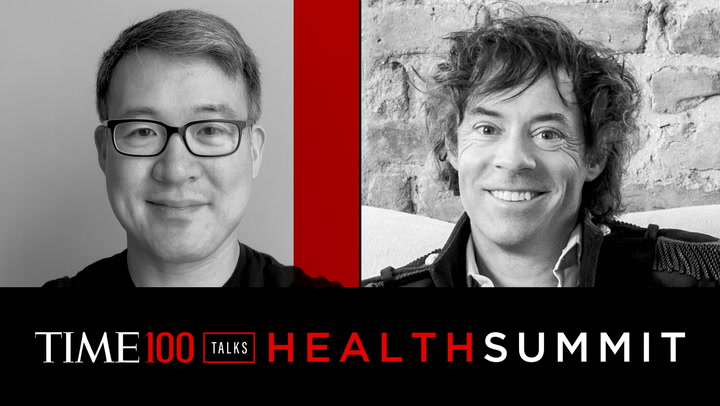
James Park and Michael Acton Smith | Health Summit
Feed:
TIME
(https://time.com/feed/)
Link:
https://time.com/collections/time100-talks/7372175/james-park-and-michael-acton-smith-health-summit/
Published: 2022-07-15 17:17:29
|
Created: 2026-08-04 08:34:55
Weather Forecasters Are Now Connecting Hot Days to Climate Change
Feed:
TIME
(https://time.com/feed/)
Published: 2022-07-20 15:22:59
|
Created: 2026-08-04 08:34:55

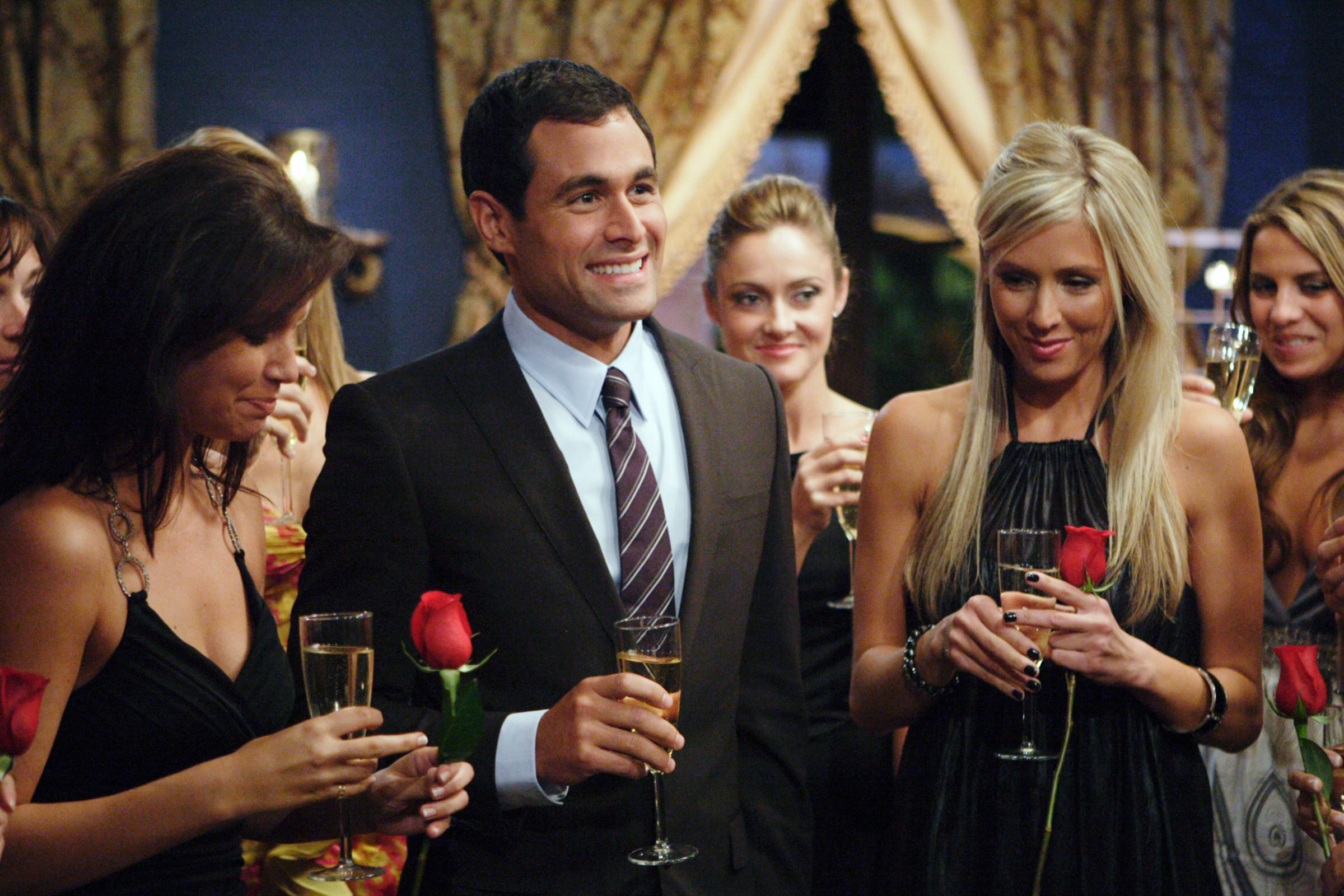
The Bachelor
Feed:
TIME
(https://time.com/feed/)
Published: 2022-08-04 12:30:19
|
Created: 2026-08-04 08:34:55
Selling Sunset
Feed:
TIME
(https://time.com/feed/)
Published: 2022-08-04 12:30:45
|
Created: 2026-08-04 08:34:55

90 Day Fiancé
Feed:
TIME
(https://time.com/feed/)
Published: 2022-08-04 12:32:34
|
Created: 2026-08-04 08:34:55

Huw Edwards criticised for entering festival poetry competition
Feed:
BBC News
(http://feeds.bbci.co.uk/news/rss.xml)
Published: 2026-08-04 05:14:42
|
Created: 2026-08-04 08:34:55
A sex abuse survivor says the ex-BBC newsreader winning would've been "catastrophic" and wants the rules changed.
show more
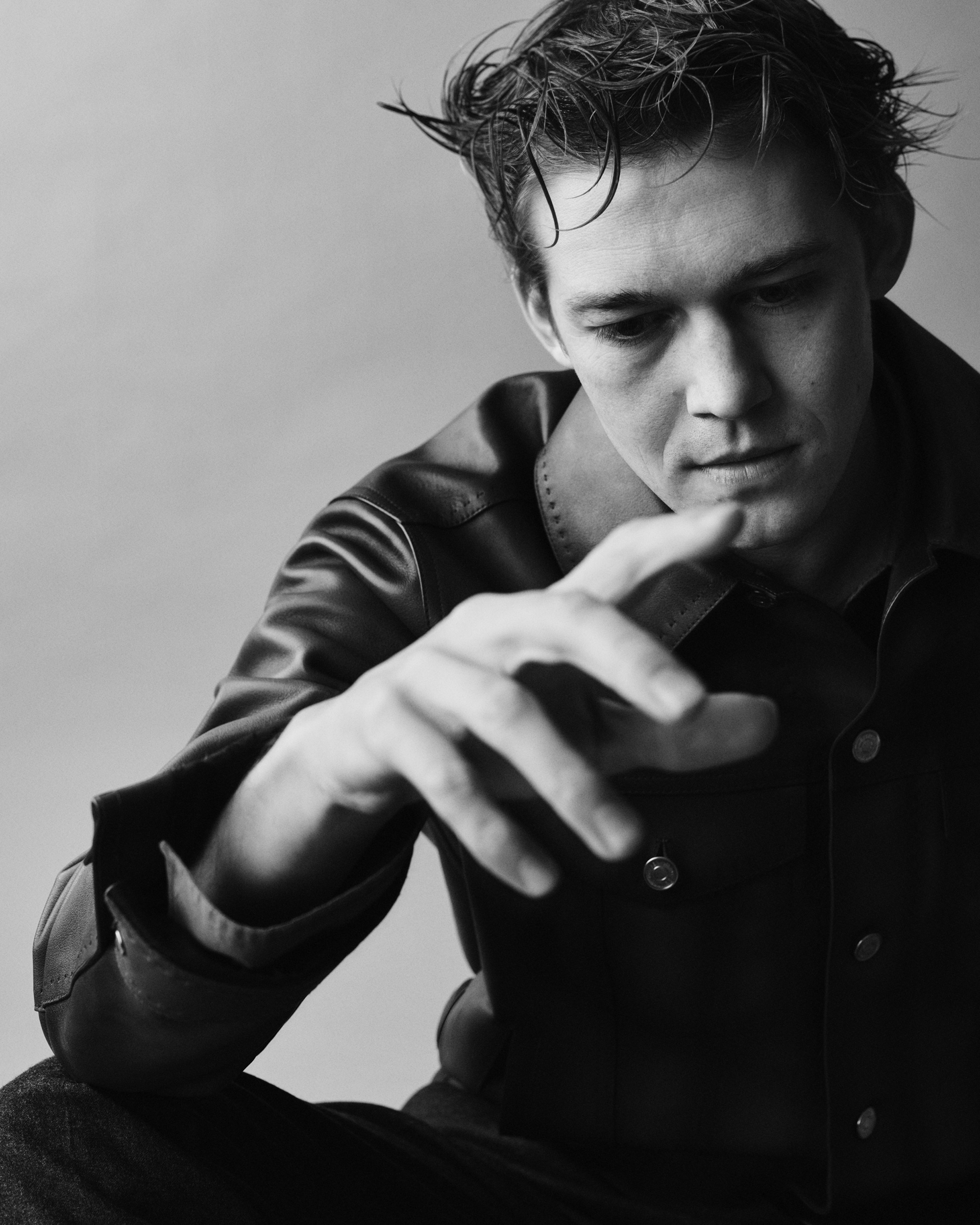
Joe Alwyn
Feed:
TIME
(https://time.com/feed/)
Published: 2022-09-28 09:54:55
|
Created: 2026-08-04 08:34:55
About 1,000 fewer prisoners to get early release as Burnham tightens rules
Feed:
World news | The Guardian
(https://www.theguardian.com/world/rss)
Link:
https://www.theguardian.com/society/2026/aug/04/fewer-prisoners-early-release-burnham-tightens-rules
Published: 2026-08-04 12:18:17
|
Created: 2026-08-04 08:29:57
Justice secretary says he could not have gone further without causing system to ‘break’ but acknowledges impact on grieving relatives such as those of PC Andrew Harper
About 1,000 fewer prisoners will be released early after Andy Burnham’s intervention to exclude those convicted of rape, serious child sexual offences and grooming from the scheme.
The justice secretary, Alex Norris, said 5,000 prisoners would be released over 10 months from October in England and Wales, down from the government’s original plan for 6,000 from September.
Continue reading...Gaza tech workers give glimpse of possible future
Feed:
BBC News
(http://feeds.bbci.co.uk/news/rss.xml)
Published: 2026-08-03 23:13:03
|
Created: 2026-08-04 08:29:55
Thousands of young people in Gaza are pursuing roles in the digital economy as the territory's wider recovery stalls.
show more
Florida Bills Would Ban Teachers From Calling Students Pronouns That Differ From Their Biological Sex
Feed:
TIME
(https://time.com/feed/)
Published: 2023-03-14 18:41:35
|
Created: 2026-08-04 08:28:55
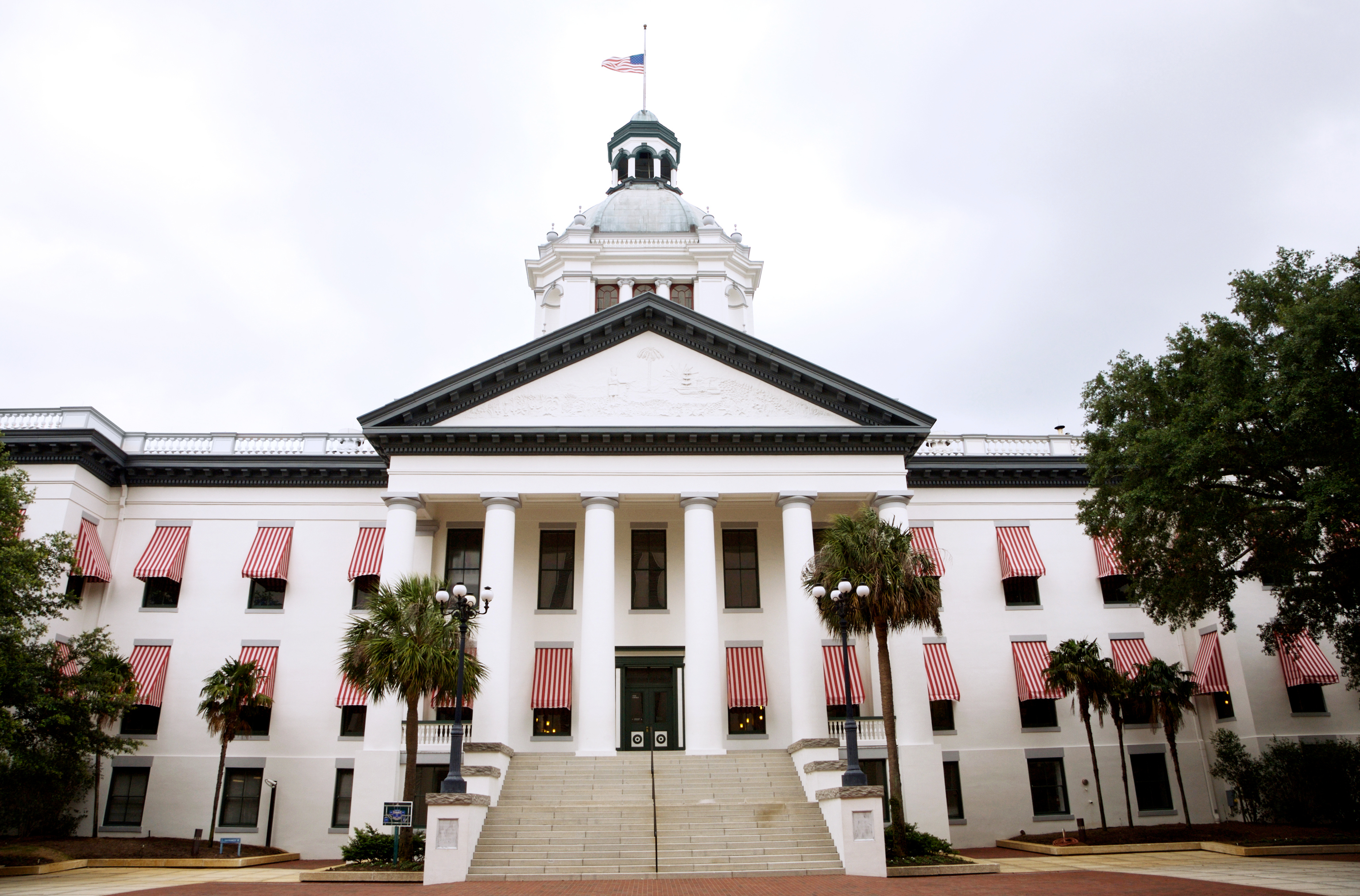
Republican lawmakers in Florida are proposing bills that will prevent staff from addressing students with pronouns other than the ones they were assigned at birth. The bills would also make it the policy of state schools that sex is “an immutable biological trait.”
Legislators introduced six bills that seek to alter the type of education students receive before the start of the Sunshine State’s legislative session in early March. The bills would affect the more than 16,000 minors in Florida who identify as transgender, and thousands of nonbinary people who may use different pronouns, but might not identify as trans.
Two of the bills would build on the existing Parental Rights in Education, or “Don’t Say Gay” law, passed in 2021, which prohibits class discussions about sexual orientation or gender identity from kindergarten through 3rd grade. Older children may only receive education about these topics that is “age appropriate,” though the exact guidelines on what type of education that would entail are unclear.
Advocates say that the proposed legislation will only harm students. “It really is further and further isolating LGBTQ students,” Sarah Warbelow, legal director for LGBTQ advocacy group Human Rights Campaign, told the Washington Post. “It’s making it hard for them to receive the full support that schools should be giving every child.”
Senate Bill 1320 would expand the ban on discussions about gender and sexuality until ninth grade (when most students are 14 or 15) instead of grade three (when students are 8 or 9). It would also amend the definition of the term sex to a “person’s sex chromosomes, naturally occurring sex hormones, and internal and external genitalia present at birth.” Per the legislation, sex is defined as “immutable” and “biological.”
Teachers and staff would also be prohibited from using student’s preferred pronouns if they differ from those assigned at birth. And employees would also be banned from sharing their preferred pronouns with a student if they do not “correspond to his or her sex.”
Lawmakers are also considering similar legislation in House Bill 1223, which would impose similar restrictions on teaching about sex, gender, and sexuality. At a subcommittee meeting on Tuesday for the bill, legislators voted in favor of adding an amendment that said this new definition of sex would not apply to intersex people.
Another amendment, proposed by Rep. Rita Harris, a Democrat, would allow school staff to refer to a child by their preferred pronouns if their parent sends in a note in writing.
Parents of transgender children voiced their support for the amendment. “These laws invade our privacy as [my son] would be forced to start the fifth grade as a gender that no one knows him as,” said one mother, Shannen Callahan, during the bill’s House Choice and Innovation Subcommittee hearing on Tuesday. “How do you foresee that first day of school and those conversations with the teachers as the children ask ‘Why is he coming back as a girl?’ This amendment would protect my freedom and my parental right to protect my child’s privacy.”
The amendment failed along party lines.
The state House bill also seeks to expand the Parental Rights in Education law to apply to charter schools, which receive state money but were previously exempt from this rule.
Another bill, House Bill 1069, would require schools to teach students from grade 6 through 12 that “biological males impregnate biological females by fertilizing the female egg with male sperm; that the female then gestates the offspring; and that these reproductive roles are binary, stable, and unchangeable.”
Sex ed teachers would only be able to teach about reproductive health using materials approved by the Department of Education, instead of the district school board.
The legislation would also require every district school board to create an objection form that would allow any resident of the county to complain about any instructional material used in class, if it “depicts or describes any sexual conduct.”
If passed, the bill would go into effect on July 1.
Who is Tim Mayopoulos, the New CEO of Silicon Valley Bank?
Feed:
TIME
(https://time.com/feed/)
Published: 2023-03-14 20:22:11
|
Created: 2026-08-04 08:28:55
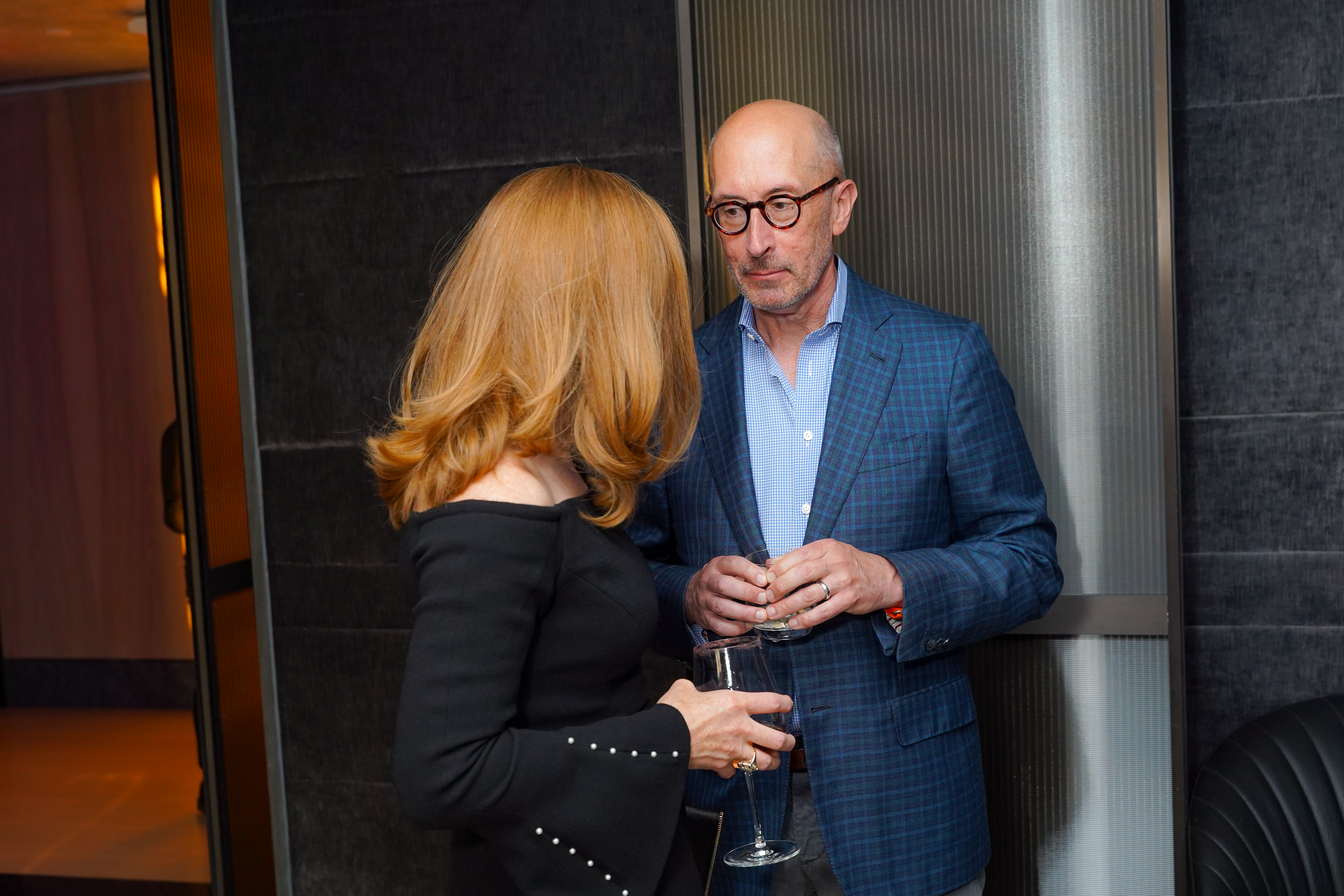
Silicon Valley Bank—which is under federal government control after becoming the second-largest bank failure in U.S. history last week—has a new CEO, Tim Mayopoulos.
Mayopoulos, who has other crisis experience, says that business will carry on as usual while he works to unwind the bank’s assets.
The Federal Deposit Insurance Corporation (FDIC) was quick to intervene on Friday after Silicon Valley Bank faced a bank run in the face of mounting concerns over its cash flow and assets that had declined in value.
On Monday, Mayopoulos–
The businessman brings decades of legal and financial leadership experience, notably his time as president and CEO of Fannie Mae, a government-sponsored company that buys and guarantees home loans. He led Fannie Mae at a time when it was still recovering from the 2008 financial crisis.
Mayopoulos has acted fast to tackle the challenge at Silicon Valley Bank, reaching out to the bank’s clients with a letter of reassurance on his first day.
“I look forward to getting to know the clients of Silicon Valley Bank,” he wrote Monday. “I come to this role with humility. I also come to this role with experience in these kinds of situations.”
Here’s what to know.
More from TIME
Who is Tim Mayopoulos?
Mayopoulos attended Cornell University in his undergraduate years where he studied English until 1980, before he graduated from New York University School of Law in 1984. Mayopoulos has said that he comes from a humble background and that he attended Cornell with a generous financial aid package, which opened new opportunities for him.
He began his career after law school by clerking for a U.S. district court judge. Mayopoulos then worked at a law firm, and from 1994 to 1996 he served on the federal Whitewater investigation into Bill and Hillary Clinton’s real estate dealings. In the 2000s, Mayopoulos held senior roles at Deutsche Bank and Credit Suisses before serving as Bank of America’s general counsel for five years. He was dismissed from the position after the economic recession in 2009 after Bank of America acquired Merril Lynch.
Mayopoulous joined Fannie Mae months later as general counsel, vice president and corporate secretary. In 2012, he took over as the company’s President and CEO, positions he kept for the next six years.
Under his tenure, Fannie Mae recovered from the recession and implemented new technology to bring more safety and transparency to mortgage lending. He moved on in 2019 to serve as president at Blend, a cloud-based software company that processes mortgages and consumer banking.
After the FDIC took control of Silicon Valley Bank last week, the agency tapped Mayopoulos to be the company’s new CEO. Right as he took up the role, Mayopoulos assured clients that the lender would continue “conducting business as usual.”
“We are here to serve you,” he wrote in a letter to clients. “I recognize the past few days have been an extremely challenging time for our clients and our employees, and we are grateful for the support of the amazing community we serve.”
In the letter, Mayopoulos explained that the FDIC transferred all assets held by Silicon Valley Bank to an FDIC-operated “bridge bank” called, “Silicon Valley Bank, N.A.,” where depositors have full access to their money and both existing and new deposits are protected.
The Federal Reserve and government announced on Sunday that even customers with deposits over the $250,000 FDIC insurance limit would have full access to their funds.
The former CEO
Before Mayopoulos stepped in, Silicon Valley Bank had been led by Becker since 2011. The FDIC announced that Becker had been ousted from the role on Friday.
The trouble really kicked off on March 8 when the bank made a surprise announcement that it was attempting to raise cash through a sale of stock, and that it had sold $21 billion in assets at a $1.8 billion loss in an attempt to keep up with withdrawals in deposits.
In a letter to clients March 8, Becker urged them not to pull funds out of the bank, saying that Silicon Valley Bank could weather the pressure. But, he admitted that customer deposits had come in lower than forecast last month. On March 9, amid immense panic, customers had attempted to pull $42 billion out of Silicon Valley Bank, and its parent company—SVB Financial—saw a 60% drop in stock price. By the end of the day, Silicon Valley Bank had a negative cash balance around $958 million.
On March 10, the FDIC closed the bank and took it over.
Becker has been heavily criticized for selling $3.6 million in Silicon Valley Bank stock less than two weeks before the collapse. The sale was part of a stock sale plan that was filed in January.
Silicon Valley Bank clients and employees have since blamed Becker in large part for spreading panic that led to the bank’s collapse. Becker has reportedly apologized to employees.
“It’s with an incredibly heavy heart that I’m here to deliver this message,” Becker said in a video to staff on Friday, according to Reuters. “I can’t imagine what was going through your head and wondering, you know, about your job, your future.”
The Physical Toll Systemic Injustice Takes On the Body
Feed:
TIME
(https://time.com/feed/)
Published: 2023-03-28 11:00:52
|
Created: 2026-08-04 08:28:55
The pathologists who performed Dr. Martin Luther King Jr.’s autopsy noted he had the heart of a 60 year old, although he was 39 when he died. His damaged heart was duly noted in the official record as a curiosity, but there was no question as to the cause of death: homicide; indeed, assassination. A racist hate crime.
But if we were to try to understand the poor condition of his heart, we might be flummoxed. Our general repertoire for understanding the early onset of heart disease points us to demographic and behavioral risk factors like poverty, low education, family breakdown, unhealthy diet, and little exercise. King certainly looked physically fit, capable of leading miles-long civil rights marches. He was well-educated, not impoverished. He grew up in an “intact” household and had a strong father figure. His faith was unswerving, as was his sense of purpose. He had a loving wife and family.
We might ask, did he partake of a particularly unhealthy diet? Did he have a genetic predisposition, a family history of heart disease? We can neither rule out nor rule in such possibilities for King. Yet, the more likely explanation, according to data on the prevailing causes of heart conditions, is that chronic stress or exhaustion took a toll on his heart. But what does that really mean? Would his heart have been healthy if he had managed his stress with meditation? (We don’t know that he didn’t.) Or if he reduced his travel and public engagements to get more rest? Perhaps marginally. But those strategies alone would not have addressed the source of his most severe and chronic stressors—the fact that he lived continuously on alert to threats, maintaining his composure, nonetheless, and in survival mode. This chronic vigilance and adaptation takes a huge health toll on the human biological canvas—a condition known as “weathering.”
More from TIME
After almost 40 years of research in public health and a lifetime of wrestling with questions of racial and class injustice, I have concluded that a process I call “weathering” is critical to understanding why someone like King, whom we’d consider young and healthy by all conventional measures, would have the damaged heart of someone in late middle age. Weathering afflicts human bodies—all the way down to the cellular level—as they grow, develop, and age in a systemically and historically racist, classist, stigmatizing, or xenophobic society. Weathering damages the cardiovascular, neuroendocrine, immune, and metabolic body systems in ways that leave people vulnerable to dying far too young, whether from infectious diseases like COVID-19, or the early onset and pernicious progression of chronic diseases like hypertension. Because of the physiological impacts of unrelenting exposure to stressors in one’s physical and social environment, as well as the high physiological effort that coping with chronic stressors entails, weathering means that relatively young people in oppressed groups can be biologically old.
Take Erica Garner. She became a tireless advocate for racial justice after her father, Eric Garner, was murdered by a New York City in 2014 police officer who placed him in an illegal chokehold for the crime of selling untaxed cigarettes. Her father’s dying words, “I can’t breathe,” became a rallying cry for the Black Lives Matter movement. Afterward, though she was initially apprehensive, Garner became a major force in the movement for police accountability. She died at age 27 in 2017, only three and a half years after the death of her father, and four months after the birth of her second child. Her own difficulty breathing, due to asthma, precipitated a major heart attack that killed her. According to her doctors, the pregnancy had stressed Garner’s already enlarged heart, so her death was classified as a maternal death. But why did she have an enlarged heart at her young age?
In the weeks before her death, Garner described the stress, exhaustion, and frustration she suffered as a spokeswoman for the Black Lives Matter movement. “I’m struggling right now with the stress and everything,” she said. “This thing, it beats you down. The system beats you down to where you can’t win.” Or as her sister, Emerald Snipes Garner, described it a week after Garner’s death, “It was like a Jenga”; they were “taking out pieces, taking out pieces, ripping her apart.”
Read more: Toxic Stress Load Is the Biggest Barrier to Living Longer. Here’s How to Reduce It
Weathering is a life-or-death game of Jenga. The Jenga tower appears strong and upright as the first pieces are removed, one by one. To all appearances, it continues to stand strong as pieces keep being taken away until the removal of one last fateful block exposes the many weaknesses of its interior, and the tower collapses. In spring 2020, COVID-19 turned out to be that last fateful block for tens of thousands of people of color. Every day, towers collapsed, as they continue to do, before our eyes.
“The only thing I can say is that she was a warrior,” Garner’s mother, Esaw Snipes, said after she died. “She fought the good fight. This is just the first fight in 27 years she lost.” After she had spent 27 years of battling headwinds, fighting the same system that had killed her father for selling a few cigarettes, those headwinds took their toll and killed her too. She was weathered to death.
I think the same could be said of Fannie Lou Hamer, the 1960s voting rights activist who famously observed at age 46 that she was “sick and tired of being sick and tired.” She died 13 years later at age 59, of breast cancer and complications of hypertension. I think she intuitively understood the price she paid for her years of activism. After failing the literacy test in her first attempt to register to vote, she told the registrar of voters, “You’ll see me every 30 days till I pass.” In later years, as she reflected on her persistence, her words suggest she knew she was being weathered: “I guess if I’d had any sense, I’d have been a little scared—but what was the point of being scared? The only thing they could do was kill me, and it kind of seemed like they’d been trying to do that a little bit at a time since I could remember.”
“A little bit at a time,” piece by Jenga piece, the assaults on the body continue to accumulate as weathering. You don’t have to be a high profile political activist to experience weathering. Any marginalized person who persists daily to survive or overcome and to see to their family’s and community’s needs in the face of long odds and systemic barriers will weather, to greater or lesser extent. Through my decades of research, I have seen how cultural oppression and economic exploitation move from society to cells in the bodies of people of color, working-class people, political refugees, the deplored or stigmatized, and the impoverished who sustain ferocious hope as they work hard and play by the rules.
However, as the Reverend William Barber, co-chair of the Poor People’s Campaign, asserted in June 2020, “Accepting death is not an option anymore.” He emphasized that the imperative extends far beyond the issue of police brutality. Echoing Fannie Lou Hamer, he said, “In everything racism and classism touch, they cause a form of death.”
Barber’s words read as metaphor, but they are the literal truth. The country is waking up to what Black Americans have known for centuries and what public health statistics have shown us for decades: systemic injustice—not just in the form of racist cops, but in the form of everyday life—takes a physical, too often deadly toll on Black, brown, and working-class or impoverished communities. Contrary to popular opinion and accepted wisdom, healthy aging is a measure not of how well we take care of ourselves—but rather of how well society treats and takes care of us. When society treats our community badly, it doesn’t just “cause a form of death,” it causes damage that can literally age and kill us.
Adapted excerpt from the book WEATHERING by Arline Geronimus. Copyright © 2023. Available from Little, Brown Spark, an imprint of Hachette Book Group, Inc. All rights reserved.
The DeSantis Project
Feed:
TIME
(https://time.com/feed/)
Published: 2023-05-18 11:00:00
|
Created: 2026-08-04 08:28:55
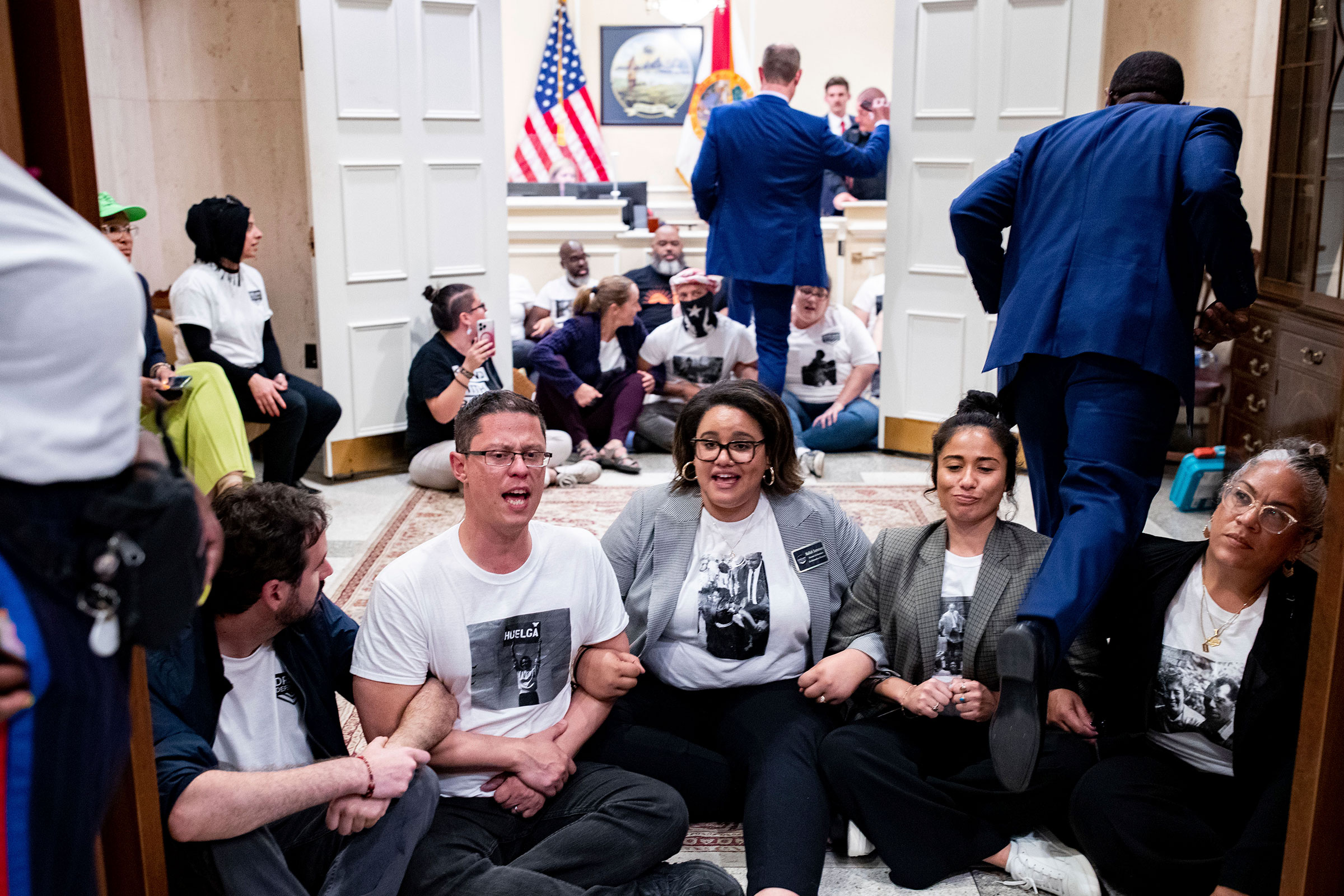
It’s a Tuesday morning in Tallahassee, and a wood-paneled hearing room at the Florida legislature is packed. The state senate’s fiscal-policy committee is considering a bill to prohibit most abortions after six weeks of pregnancy, and dozens of citizens have lined up to testify: anguished young students in colorful hair and “abortion is health care” T-shirts; little old ladies wearing cardigans and crosses. For hours they speak in emotional terms as the senators listen.
Yet an air of inevitability hangs over the proceedings. Governor Ron DeSantis supports this bill, and therefore it is destined to pass. In Tallahassee these days, what the governor wants, the governor gets. It is DeSantis who welcomed this fight, DeSantis who calls the shots, and DeSantis who will reap the credit—or blame—for his latest move in a frenzy of right-wing policymaking.
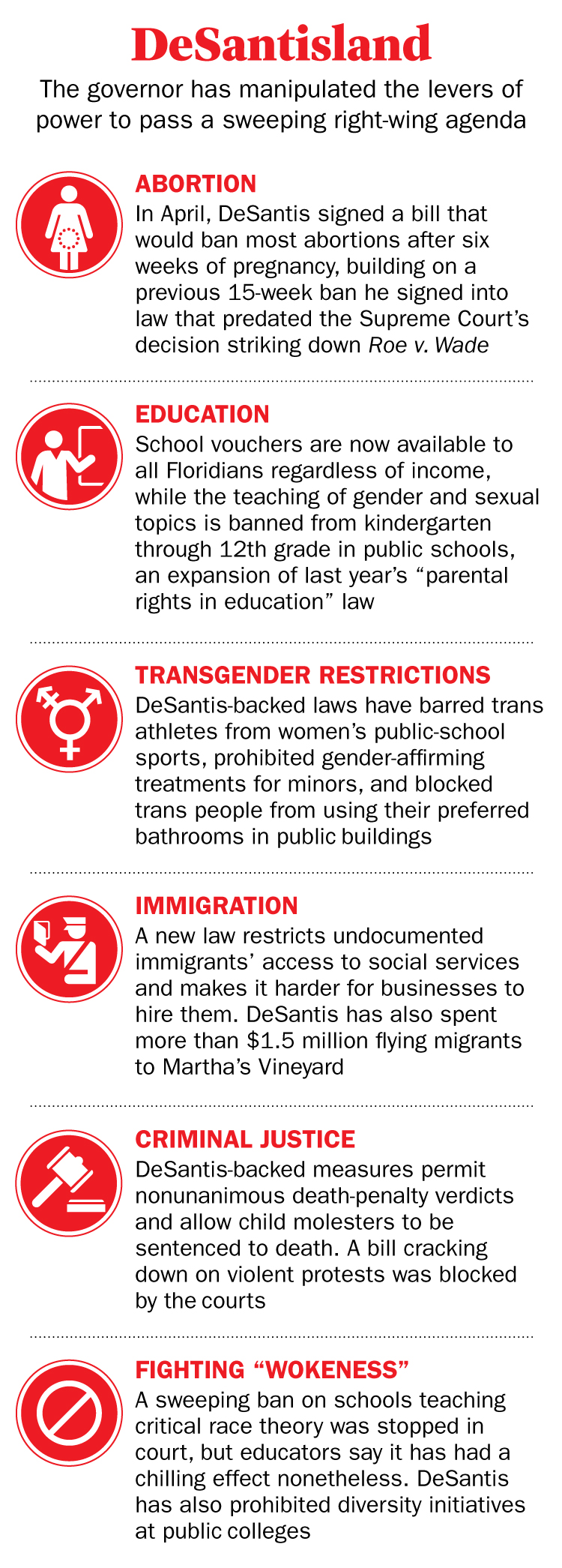
His dominance is hard to overstate. From school-board meetings to the Walt Disney Corp., the shelves of elementary-school libraries to local mask ordinances, everything bears his stamp. Having shepherded his state through the COVID-19 pandemic, bucking the political and medical establishments to follow his own read of the data, DeSantis has manipulated levers of power to enact a sweeping agenda. The week I landed in Tallahassee, he signed an expansive school-voucher law and a measure investing more than $700 million in affordable housing. The legislature was hearing his proposed ban on gender-affirming health care for minors, a bill to expand gun rights that would allow concealed carrying of firearms without a permit, another that would dramatically curtail union rights, and a bid to prohibit socially conscious investing. All would eventually pass. At DeSantis’ behest, legislators this year also eliminated diversity programs at public universities, made it easier to sentence criminals to death, and barred schools from using trans students’ preferred pronouns.
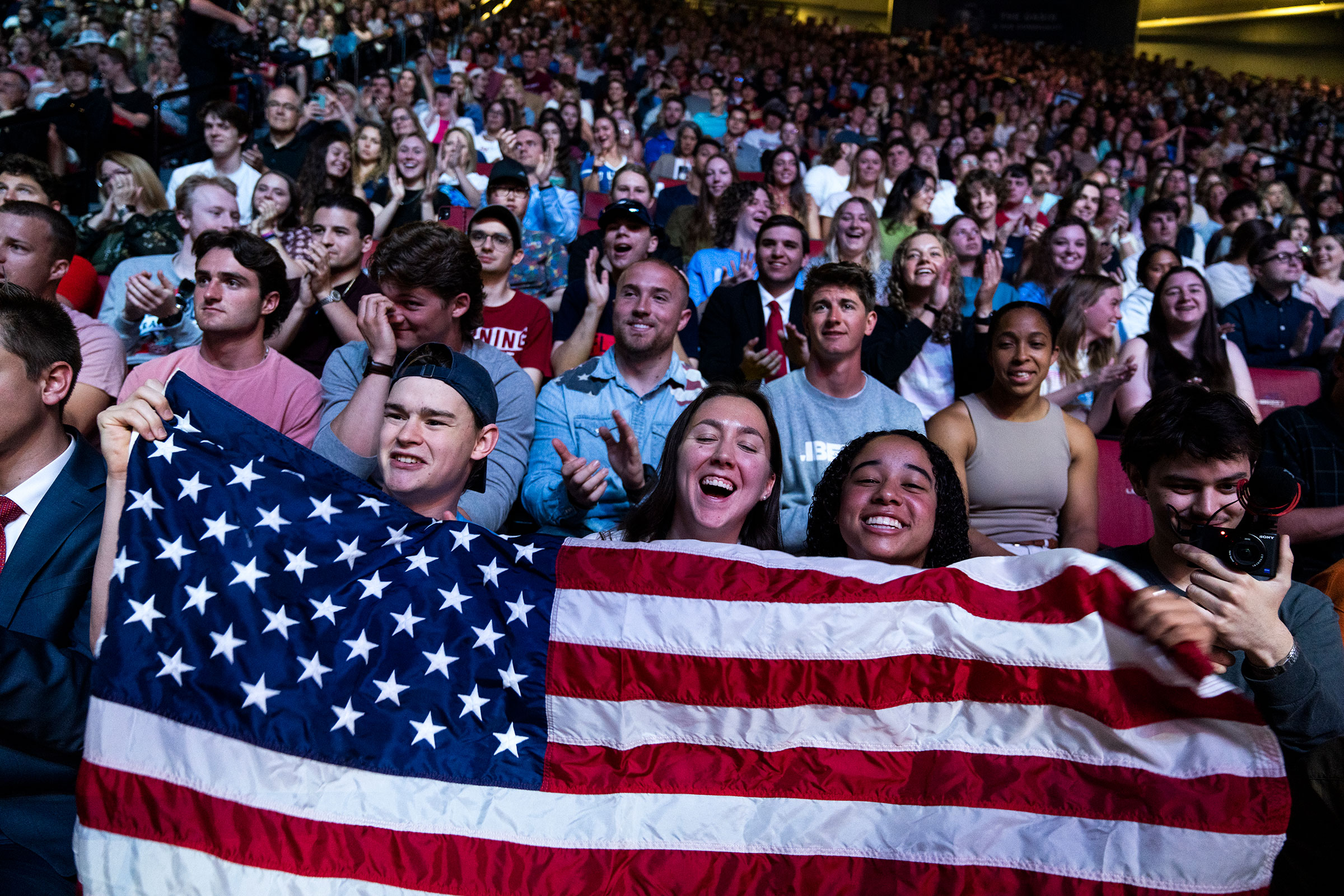
For a typical Republican governor, any of these policies might represent a signature achievement. For DeSantis, they’re the latest line items in an agenda he calls the Florida Blueprint. “We’ve had conservative leadership in Florida for the past 23 years, but we’ve passed more conservative bills in the past two years than the previous 20, and more this year than the past 22,” says GOP state senator Joe Gruters. “It’s a rocket ship, a steam engine.”
More from TIME
Out of a combination of fear and mutual interest, legislators have put aside their own pet projects to do DeSantis’ bidding, passing bills to shield his travel records from the public and allow him to run for President without resigning the governorship. They’ve also been enlisted to clean up his messes, retroactively legalizing his migrant flights to Martha’s Vineyard last year and attempting to restore state control of the special tax district around Disney World amid the company’s feud with DeSantis over LGBT rights. “This governor has used all of his powers to make sure everyone around him is in lockstep,” says Jeff Brandes, a libertarian-leaning former GOP state senator who lost a seat on a prized committee after clashing with DeSantis over fiscal issues.
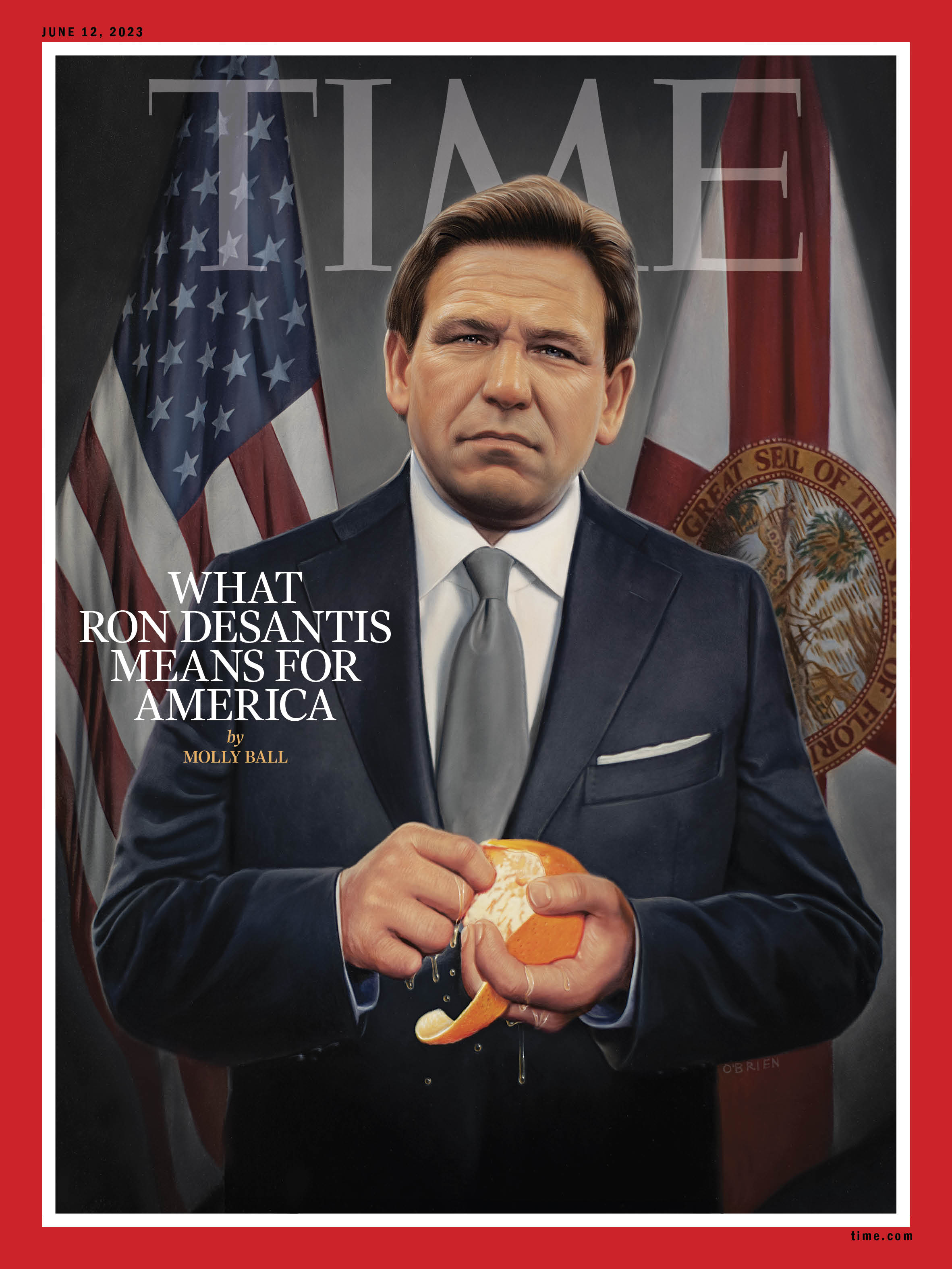
By operationalizing the culture war into a set of concrete policies, DeSantis has transformed the nation’s third most populous state. What was once the butt of jokes about gators and retirees is now the swaggering, Southern-tinged Free State of Florida—where men are men, woke is broke, and business is booming; 1,200 net new residents arrive every day. “It’s in the air, it’s everywhere, it’s amazing,” says former GOP Representative David Jolly, no fan of the vibe shift. “It’s between neighbors, it’s when you go to restaurants, when you go to schools. You’re on one side or the other, and people know it.” A Florida native, Jolly is considering moving his family out of the state.
If critics see DeSantis as a would-be authoritarian, allies see a conservative who gets things done. Many predicted that his hard-charging first term in office would provoke a backlash. Instead the opposite occurred. While Republicans across the country struggled last November, DeSantis romped to a 19-point re-election victory, the biggest win for a Florida governor in decades. What was once America’s paradigmatic swing state now pulsates bright red. For the first time in modern history, registered Republicans outnumber Democrats. The people of Florida seem to like the steady hand—even if it’s an iron fist.
To fans, DeSantis’ success proves that a pugilistic, big-government conservatism that promises ruthless competence instead of Trumpian chaos can win broad support, including a growing share of working-class and minority voters. “We’ve shown that you don’t have to do it the liberal way, and we’re the envy of the nation when you look at our results,” says state representative Randy Fine, a Republican who has sponsored some of DeSantis’ most controversial legislation and may soon be rewarded with an appointment as a university president despite no background in academia. “DeSantis says what he’s going to do and he does it. People like that, even if they don’t agree with him.”
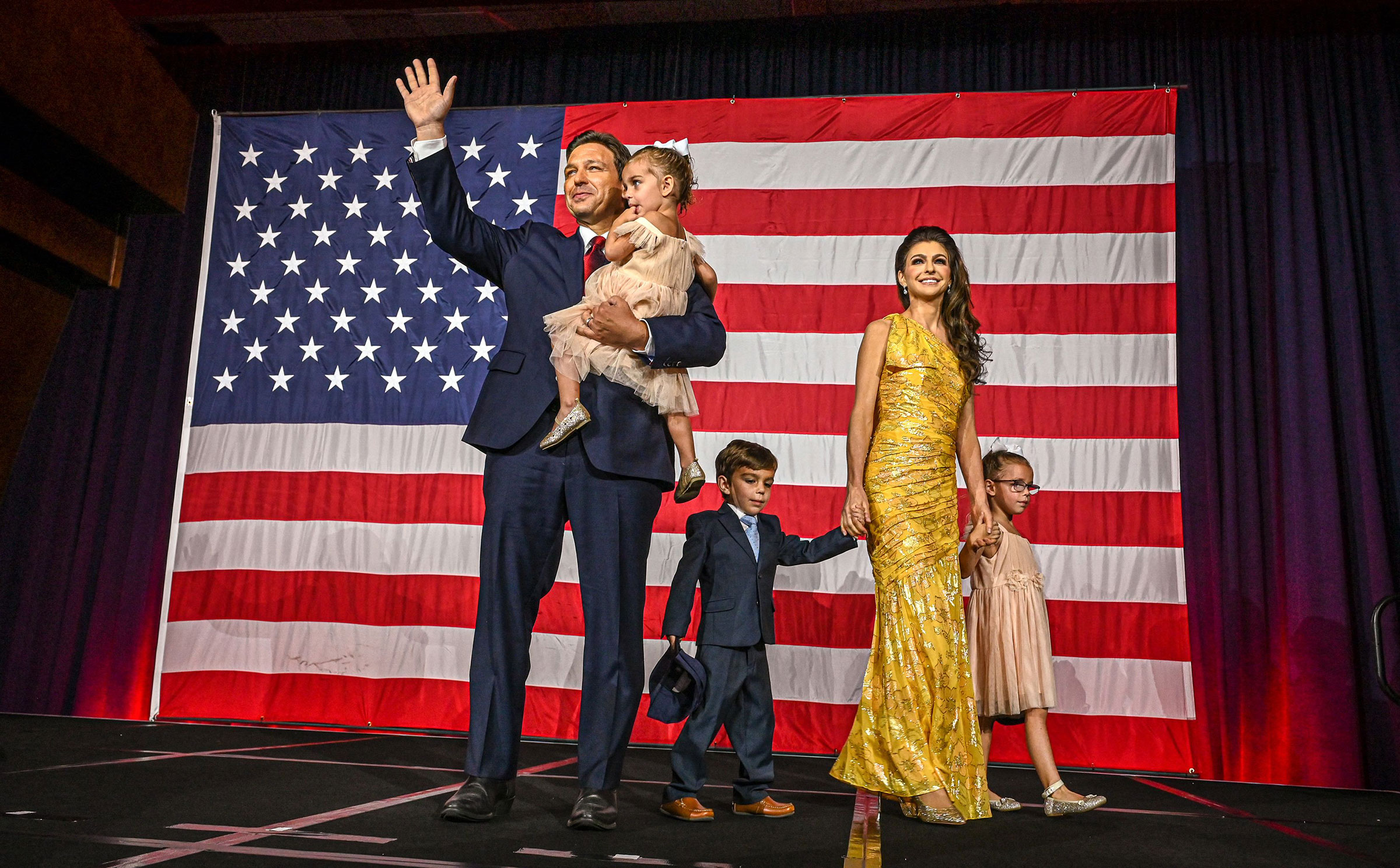
The Blueprint has already done more than just make DeSantis the darling of right-wing media and donors. It has changed the face of American politics. His gerrymandering of the state’s political map added enough red seats to secure the U.S. House of Representatives for the GOP last November. Fellow governors, invited by DeSantis to policy summits where they study his approach, have enacted laws modeled on his policies, affecting millions of lives beyond Florida. And his agenda has set the stakes for the 2024 presidential primary. Donald Trump’s campaign has been notably more focused on transgender issues, education, and “wokeness” than on the tax cuts and vaccine development that might be considered his main presidential accomplishments.
Soon DeSantis is expected to announce his presidential run and become Trump’s chief rival for the Republican nomination. Trump has attacked him relentlessly, denting DeSantis’ standing with GOP voters and sowing doubts about his national viability. But those who have witnessed DeSantis operate say it would be foolish to count him out. “He’s not charming,” says GOP state representative Fiona McFarland. “But he’s a terminator.”
DeSantis’ methods of keeping the legislature in line are not subtle. At one point, a Republican lawmaker was planning to oppose a DeSantis-backed bill until he got a phone call from the governor, who had helped the lawmaker get elected. Without preliminaries, DeSantis barked into the phone, “Do you know why you’re here?”
“Yes,” the startled lawmaker answered. Without saying another word, the governor hung up, two people familiar with the incident told me. Message delivered.
Unlike his predecessors, DeSantis does not roam the halls of the Florida statehouse and spends little time in his office in the legislative building. The office, situated on the ground level, has become code for DeSantis, Politico recently reported. “That’s Plaza’s bill,” lawmakers will say.
DeSantis, 44, was born in Jacksonville and raised in the Gulf Coast city of Dunedin, where his mother was a nurse and his father installed Nielsen TV-rating boxes. A book-smart introvert and talented baseball player, he graduated with honors from Yale University (where I knew him slightly) and Harvard Law School before joining the Navy. As a member of the Judge Advocate General (JAG) Corps, he was stationed at Guantánamo Bay and then deployed to Iraq, where he served as a legal adviser to the SEALs during the 2007 troop surge.
In 2010, DeSantis left active duty and settled near Jacksonville, where he worked as a lawyer and married a local TV anchor, Casey Black, whom he met at a driving range. As the Tea Party fervor crested, he self-published a book of conservative ideas, Dreams From Our Founding Fathers, and traveled to local activist meetings to give talks and sell it. DeSantis was looking for a way into elected office but unsure where to start until he met two Florida consultants, Tim Baker and Brian Hughes, who had made a specialty of electing conservative insurgent veterans. DeSantis thought he might run for state legislature or some other low-level office. The consultants persuaded him he had a shot at a Jacksonville-area congressional district that had just been redrawn to favor the GOP.
The 2012 primary was crowded, and DeSantis had little money or name recognition. The consultants devised a guerrilla strategy designed to tap into the new conservative zeitgeist. Casey, a local celebrity, began using her married name on television. The couple went door to door, using his advisers’ data to target households with the strongest record of voting in Republican primaries. Meanwhile, his consultants, who had agreed to backload their fees, gambled by spending nearly all of the campaign’s meager budget on an ad on Fox News.
DeSantis began to close the gap on his more experienced rivals. He impressed national right-wing groups and won the endorsement of the influential Club for Growth, which brought a flood of cash from donors. He won the seven-way GOP primary by a wide margin, drawing nearly 40% of the vote.
Buoyed by this success, the consultants drew up a plan to raise DeSantis’ profile as he headed to Washington. But the candidate dismissed them: he didn’t want to spend more money with his election to Congress all but assured. It was only when Baker and Hughes expressed concern that the dispute might become public that DeSantis relented, according to two people familiar with the episode. Their role in his early career is not mentioned in DeSantis’ new memoir, The Courage to Be Free, which describes the door-knocking strategy as if it were DeSantis’ own idea. “He has a habit of rewriting history,” one of the people familiar with the episode told me. “There’s Richard Petty, there’s Tom Petty, and then there’s Ron DeSantis petty.”
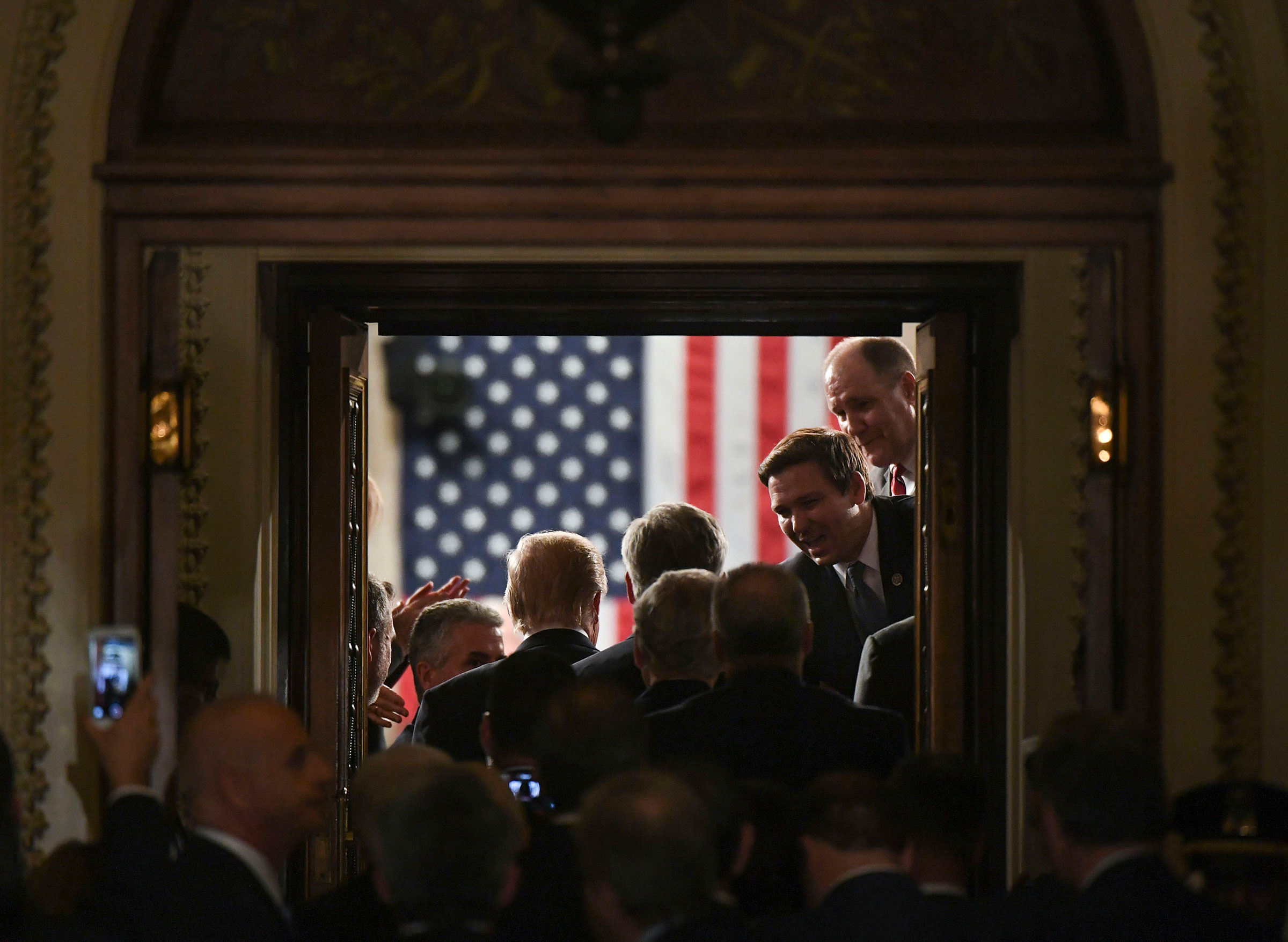
Over three terms in the House, DeSantis was a reliable conservative not known for his people skills. Congressional colleagues describe him as strikingly aloof, rebuffing or ignoring friendly overtures and wearing earbuds to avoid conversation. A co-founder of the right-wing Freedom Caucus, DeSantis in his memoir describes his years in Congress as mostly frustrating. GOP leaders exercised top-down power, he argues, but weren’t willing to fully use their leverage to achieve conservative goals. He does, however, tout his work on the Puppies Assisting Wounded Servicemembers (PAWS) Act, which funded a program providing service dogs to veterans with PTSD.
In 2016, DeSantis briefly ran for the U.S. Senate seat that Marco Rubio had vacated to run for President, but dropped out when Rubio decided to return to the Senate. Instead, DeSantis announced a run for governor in 2018. It was another insurgent campaign: the Florida GOP establishment already had its handpicked candidate, Adam Putnam, the state agriculture commissioner. But DeSantis again read the changing currents of the GOP. He appeared relentlessly on Fox, emerging as a reliable defender of Trump, particularly on the Russia scandal that enveloped the first years of the President’s term.
On Dec. 8, 2017, DeSantis and a fellow right-wing Florida Congressman, Matt Gaetz, hitched a ride on Air Force One to a Trump rally in Pensacola. Along the way, Gaetz urged the President to endorse DeSantis for governor. He described Putnam as a Never Trumper and read aloud a list of negative things Putnam had said about the President. A couple of weeks later, after catching another DeSantis appearance on Fox, Trump endorsed him on Twitter. DeSantis made the most of it, mentioning Trump 21 times in his first debate with Putnam and running an ad that jokingly showed him reading The Art of the Deal to his young children and “building the wall” with toy blocks.
In the general election, DeSantis faced Andrew Gillum, the progressive Black mayor of Tallahassee. In an early post-primary appearance, DeSantis said, “The last thing we need to do is to monkey this up by trying to embrace a socialist agenda.” Democrats decried his verbiage as a racist dog whistle. DeSantis refused to back down or apologize. But while many national observers remember that controversy, in Florida the campaign mostly focused on state issues. “What Ron said to me in 2018 when we were laying out the strategy was, ‘We’re going to nationalize the primary and localize the general,’” Gaetz tells me. “The plan was to run against Putnam on national issues and then paint Gillum as in the pocket of Big Sugar.” In a good year for Democrats, DeSantis defeated Gillum by less than half a percentage point.
Trump has claimed credit for DeSantis’ rise, but one former DeSantis adviser says the governor sees his success as foreordained. “He has a providential belief that he will talk sincerely about. He believes he is exactly where God planned him to be at all times,” the adviser says. “I’m sure he believes, ‘It was nice of Trump to help me kick the sh-t out of Adam Putnam. But it would have happened anyway.’”
The Florida governorship has not always been a powerful position. Until 1968, the governor could serve only one term, and until the 1990s he (Florida has only had male governors) shared decisionmaking powers with six other statewide elected officials. Reforms that took effect during Jeb Bush’s tenure in the early 2000s shrank the elected cabinet to just three members while also giving the executive more say in judicial nominations. At the same time, term limits approved by voters in a 1992 ballot initiative took hold, turning the legislature into a revolving door where lawmakers could no longer amass power over decades. As DeSantis entered office in 2019, the power of Florida’s executive was already at a historic high.
He was determined to use every bit of it. “One of my first orders of business after getting elected was to have my transition team amass an exhaustive list of all the constitutional, statutory, and customary powers of the governor,” he writes in The Courage to Be Free. “I wanted to be sure that I was using every lever available to advance our priorities.” Aides from the time have corroborated this account, describing a thick binder of information that DeSantis proceeded to devour.
Conscious of his narrow victory, DeSantis initially sought to broaden his appeal. “We got elected by the hair of our chinny-chin-chin, so the goal of the transition was to grow the universe of DeSantis supporters in the state of Florida and do better with nonwhite voters, independents, suburban women, and young people,” says Gaetz, who chaired the transition to the governorship. (Once an ally of both men, Gaetz has grown distant with DeSantis since endorsing Trump’s 2024 campaign.) DeSantis approved the sale of smokable medical marijuana, appointed Democrats to prominent posts in the administration, raised teacher pay, and proposed record levels of environmental funding for the Everglades. He posthumously exonerated the Groveland Four, Black men wrongly accused of raping a white woman in 1949. When his proclamation honoring the third anniversary of the massacre at the Pulse nightclub in Orlando was criticized for failing to mention the affected groups, DeSantis’ office reissued it with a new sentence decrying “hatred towards the LGBTQ and Hispanic communities.”
Even early on, though, there were hints of a more assertive approach. DeSantis short-circuited the usual process for state supreme court nominations, allowing him to cement a conservative majority that would be unlikely to overturn his policies, as previous courts had done to his predecessors. He used a new, aggressive interpretation of his powers under state law to remove local elected officials, including Scott Israel, the Broward County sheriff whose response to the Parkland school shooting drew criticism. Previous governors had reserved that right for officials who broke the law, and a state senate special master recommended that Israel be reinstated, but DeSantis pushed through the removal. DeSantis’ support for Everglades funding may have been less about the environment than getting back at the powerful sugar industry, whose generous subsidies he had opposed since his days in Congress and which had spent more than $10 million backing Putnam in the primary. “Sugar is more powerful than Disney here, by far, and he took them on unapologetically,” says Nick Iarossi, a Tallahassee lobbyist and DeSantis ally.
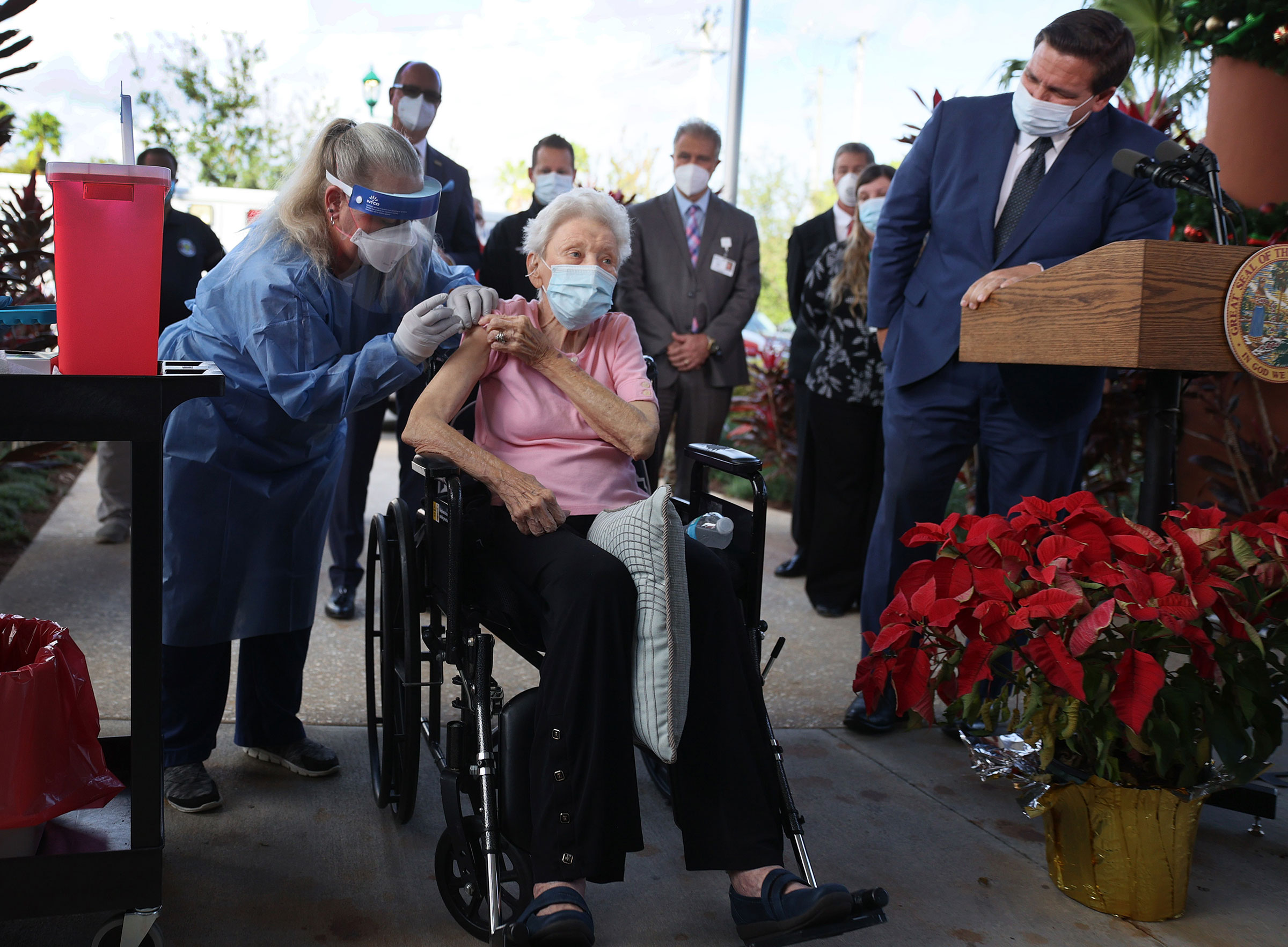
But it was the pandemic, critics and supporters agree, that changed DeSantis. After initially shuttering schools and restaurants, DeSantis grew frustrated by the lack of clear guidance from Washington and the medical establishment. He began doing his own research and soon concluded that much of the early conventional wisdom about COVID-19 was wrong. The spread of the virus could be mitigated but not contained, he believed. Democratic Governor Andrew Cuomo of New York was being hailed by the media for his strong leadership even as he sent infected elderly people back to nursing homes, an act of tragic malfeasance intended to prevent a hospital-bed shortage that never materialized. Studying the emerging medical data, DeSantis concluded such fears were based on faulty models, and he almost certainly saved lives by isolating elderly patients. He soon reopened Florida’s beaches, schools, and businesses while prioritizing protections, vaccines, and treatments for the most vulnerable citizens.
Gaetz, who talked to DeSantis daily during this period, says the governor often brought up the 1918 Spanish flu pandemic, in which people were wheeled onto beaches for sunlight and ventilation. He fretted about the long-term mental-health effects of shutting people indoors and became emotional describing nursing-home residents dying in isolation, prohibited from seeing their loved ones. DeSantis had surveyed the landscape, watched a stampede of governors go one way, and determined he would do the opposite. “It was very binary,” Gaetz recalls. “One group was going to be toast. The other was going to be vindicated.”
The crisis hit right after the 2020 legislative session had concluded. Rather than call back the frightened lawmakers to address it, DeSantis seized new powers for himself. Declaring a state of emergency, he claimed unfettered authority to allocate pandemic funds from the federal government. He overrode local governments and school boards that tried to impose closures or mask mandates, and threatened to remove or withhold pay from local officials who sought further restrictions.
Once receptive to input from outside his orbit, he became convinced of his own rightness. “COVID was definitely the switch that flipped, when he started to become a bully,” says Nikki Fried, who served at the time as agriculture commissioner, the only Democrat elected statewide alongside DeSantis. Having initially welcomed her outreach, she says, during COVID-19 he stopped returning her calls. Fried, who now chairs the state Democratic Party, began calling DeSantis a “dictator.”
At a dinner in Austin in January 2021, Iarossi introduced DeSantis to Elon Musk. The two men proceeded to discuss disease vectors and biotherapies in obsessive detail. DeSantis “was getting the sh-t kicked out of him on CNN,” Iarossi recalls. “And he said to me, ‘Nick, I don’t care what they say about me now. I care what they say six months from now. I’ve done the research, and I think I’m right.’” At the time, loosening restrictions seemed like a risk, but DeSantis’ confidence was unshakable. “Everyone’s in hysteria thinking the world is going to end, all his advisers are telling him not to. But business thrived, the economy thrived, people moved here. It took a year, not six months. But he was right.”
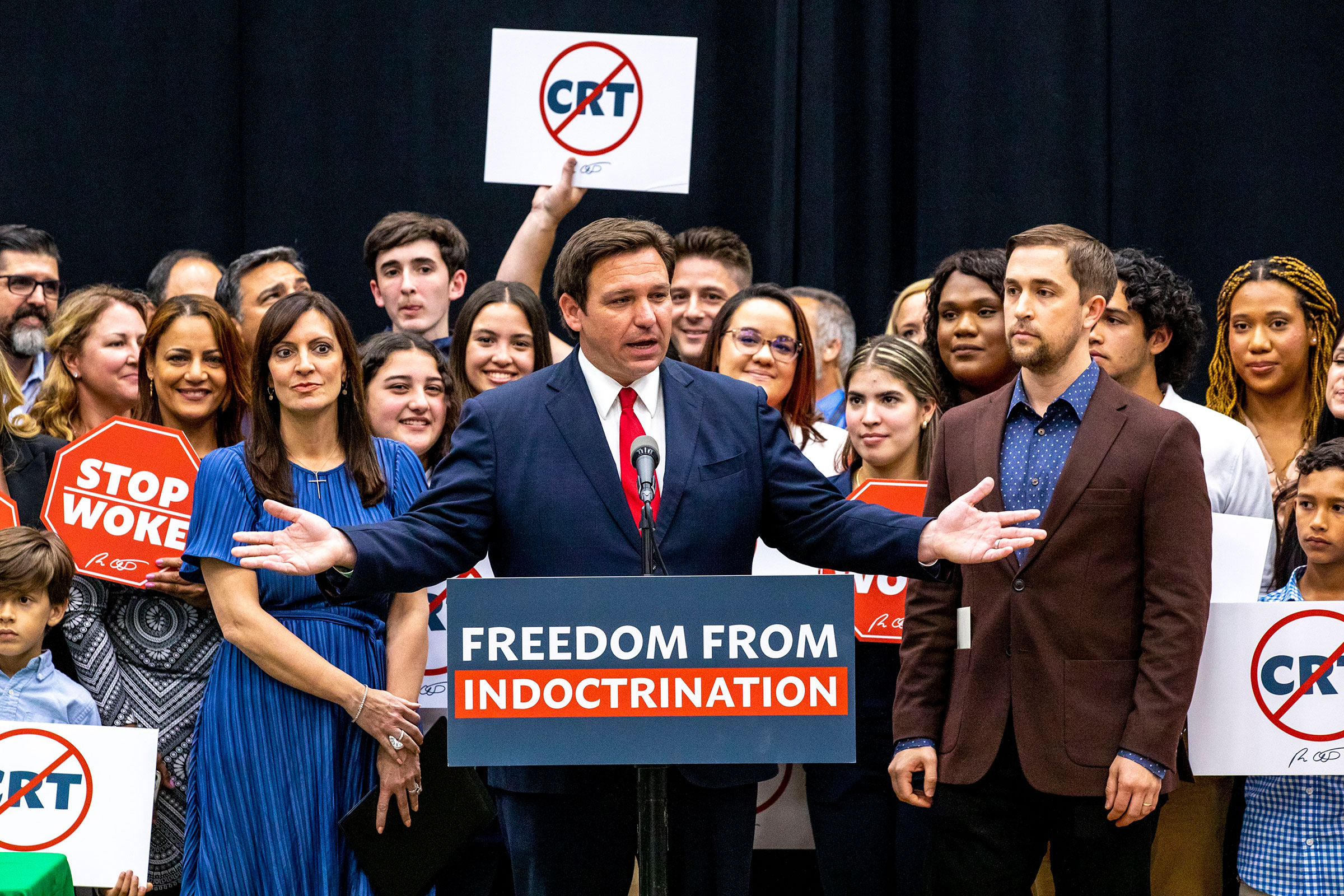
As Trump left office and the pandemic waned, the governor grew more emboldened. In 2021 and 2022, the legislature pushed through DeSantis-backed bills to make it harder to vote, ban vaccine passports, and crack down on “rioting” at protests. The “parental rights in education” bill, better known as “Don’t Say Gay,” prohibited the teaching of sex and gender in early elementary grades, while the Stop WOKE act banned the teaching of critical race theory (CRT) at schools and businesses. DeSantis signed a 15-week abortion ban, contingent on the yet-to-come reversal of Roe v. Wade, and began to express skepticism about the COVID-19 vaccines, appointing a new state surgeon general, Joseph Ladapo, who opposed vaccine and mask mandates while promoting unproven treatments.
Favor-trading was not DeSantis’ style; loyalty was not necessarily returned. At the end of one legislative session, he proceeded to theatrically veto budget priorities of the legislative leaders standing alongside him on the stage.
When it came time to redraw the state’s congressional districts in 2022, legislators proposed a new map that largely preserved the delegation’s balance. A voter-approved constitutional amendment prohibited partisan gerrymandering and sought to protect minority districts, and lawmakers were wary of being slapped down by the courts if they went too far. But DeSantis had read the relevant laws and precedents, and in January 2022 he proposed his own map, which eliminated a majority-Black district in north Florida and gave the GOP a shot at up to four additional seats in Congress.
None too keen on this attempt to usurp their traditional responsibility, legislators ignored DeSantis and passed their own map instead. DeSantis vetoed it. At the same time, he let it be known that Senate president Wilton Simpson, who was running for agriculture commissioner, might not get his endorsement if he didn’t go along. Finally, the legislature relented and passed DeSantis’ map. A few days later, DeSantis endorsed Simpson, and another Republican candidate who had been running for the post dropped out. (The map, which governed the 2022 elections, still faces court challenges.)
The redistricting fight was pure DeSantis. “He did that single-handedly—nobody pushed him—and he was relentless,” one current GOP lawmaker told me. Brian Ballard, a powerhouse lobbyist in Tallahassee and D.C. and an ally of both Trump and DeSantis, says the gambit cemented his dominance. “The [state] senate didn’t lay down for him at first. But he showed he was able to use his political popularity in a way that previous governors had not, and it’s brought him incredible power.”
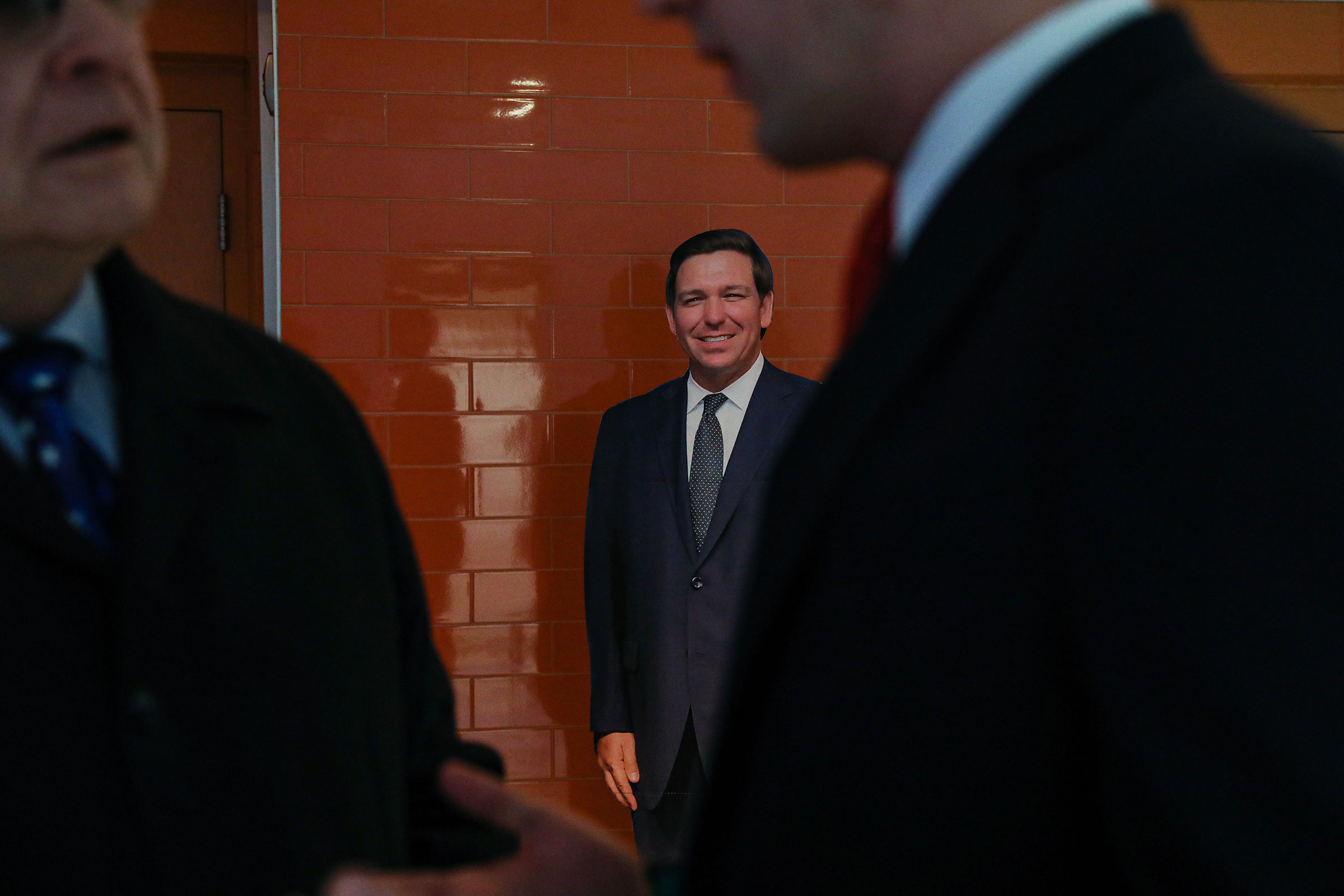
DeSantis’ chief of staff, James Uthmeier, says he has never seen a policymaker so hands-on. “He sits and talks through the nitty-gritty of policy and the budget,” says Uthmeier, who previously served as a senior official in Trump’s Commerce Department. “He’s ingrained in the process in a way I haven’t seen working in the Trump Administration or with other public officials.”
With polls showing DeSantis’ approval ratings among Florida Republicans in the 90s, he moved to spend his skyrocketing political capital. Traditionally, the state senate caucus had recruited candidates for office and funded their campaigns, but DeSantis had other ideas. In statehouse races in the Tampa and Jacksonville areas, he announced his own handpicked candidates, prompting those backed by the senate to drop out. Republicans who went against him drew complaints from their constituents. In the 2022 election cycle, several Florida political consultants told me, their research found DeSantis’ endorsement to be the single most important attribute for GOP primary voters. “In 2020, every member in a strong Republican seat campaigned with a picture of Donald Trump,” says GOP state representative McFarland. “In 2022, they campaigned with a picture of Ron DeSantis.”
His political aims didn’t stop at the statehouse. In another unprecedented move, he issued a raft of down-ticket endorsements as well. Working with the conservative parents’-rights group Moms for Liberty, he backed slates of school-board challengers in districts across the state, targeting boards that had tried to impose school closures and mask mandates during the pandemic. He moved to fill the state bureaucracy with the like-minded, stacking traditionally nonpartisan university and hospital boards with right-wing warriors like the anti-critical-race-theory activist Christopher Rufo. When a locally elected Democratic prosecutor announced he would not enforce DeSantis’ abortion and transgender policies, DeSantis removed him based on his own reading of the relevant statutes. (A court ruled that the rights of the prosecutor had been violated, but that his dismissal could stand.)
DeSantis and his aides went to war with the press, ignoring media requests or publicizing inquiries they considered off-base on Twitter, urging fans to swarm and harass reporters. At press conferences, he delights in berating members of the “corporate media,” often challenging the premise of their questions and accusing them of bias. He scrupulously avoids the mainstream media, once theatrically turning down an invitation to appear on The View. This year, DeSantis’ proposal to make it easier to sue media outlets for libel was one of a handful of initiatives the legislature balked at. (DeSantis’ staff did not respond to multiple requests to interview him for this article.) At the same time, DeSantis carefully tends his image in conservative media. He appears frequently on Fox News, once granting the channel exclusive rights to cover a bill signing, and doles out interviews and exclusives to right-wing influencers and publications. A pair of local digital outlets, Florida’s Voice and the Florida Standard, popped up shortly after DeSantis was elected, helmed by writers with backgrounds in conservative activism. Their funding sources are unknown, but with DeSantis’ help, they frequently break news about the governor, forcing the rest of the press corps to follow their lead. The strategy has made him a household name to the national GOP base, and he attracts large crowds at appearances across the country.
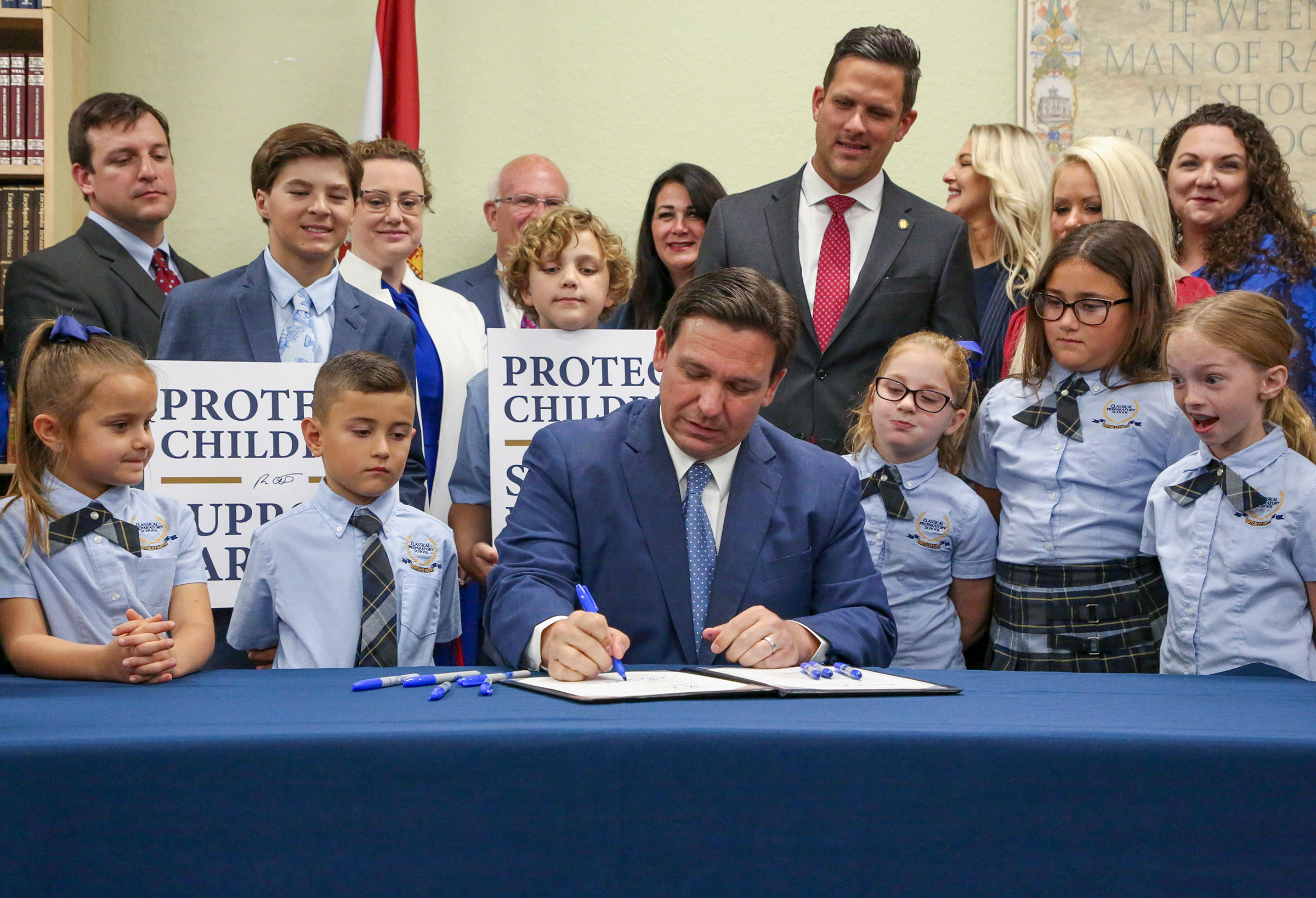
DeSantis’ policies drew the notice of other red-state governors across the country, who began to see Florida as a laboratory for conservative policy. A raft of states have introduced legislation mirroring “Don’t Say Gay,” and many have followed his lead with bans on transgender athletes and CRT. His battle with Disney has galvanized a national GOP war on “woke” business practices like environmental, social, and governance (ESG) investing. DeSantis donor retreats in Fort Lauderdale last July and Palm Beach in February were styled as policy conferences, with attendees including GOP governors. He was not the first Republican governor to transport border-crossing migrants to liberal cities—a gambit the Trump Administration had considered but rejected as too extreme—but by flying them to tony Martha’s Vineyard, he managed to up the ante.
“What DeSantis has done which his predecessors did not do is exploit all of the power inherent in the office of the governor,” says Mac Stipanovich, a longtime GOP lobbyist and operative in Tallahassee who left the party after Trump’s election. “Just because you have the right to do something doesn’t make it right, and his predecessors were conscious of that. There were guardrails. But if he has the right he doesn’t hesitate—and the voters like a strongman.”
As a popular governor with a weak Democratic opponent, DeSantis was virtually guaranteed to win re-election in 2022. But he craved something bigger. With a war chest of more than $100 million, he instructed his campaign that he wanted to run on his record. Admakers were told to focus on his policies—even the ones that didn’t poll well in isolation. The campaign ultimately produced some 70 different commercials, each looking backward at the accomplishments of DeSantis’ first term. Not a single ad focused on his promises for the future.
DeSantis took the resulting landslide as vindication. If past editions of the legislature tended to do DeSantis’ bidding, this year’s session—with a GOP supermajority in both the state house and senate stacked with newcomers he handpicked—was engineered to work his will. DeSantis passed down a list of more than 40 legislative priorities and pushed the lawmakers to get started early. Twice before the official March kickoff, he called special sessions to knock out priorities that could have waited, like insurance reform.
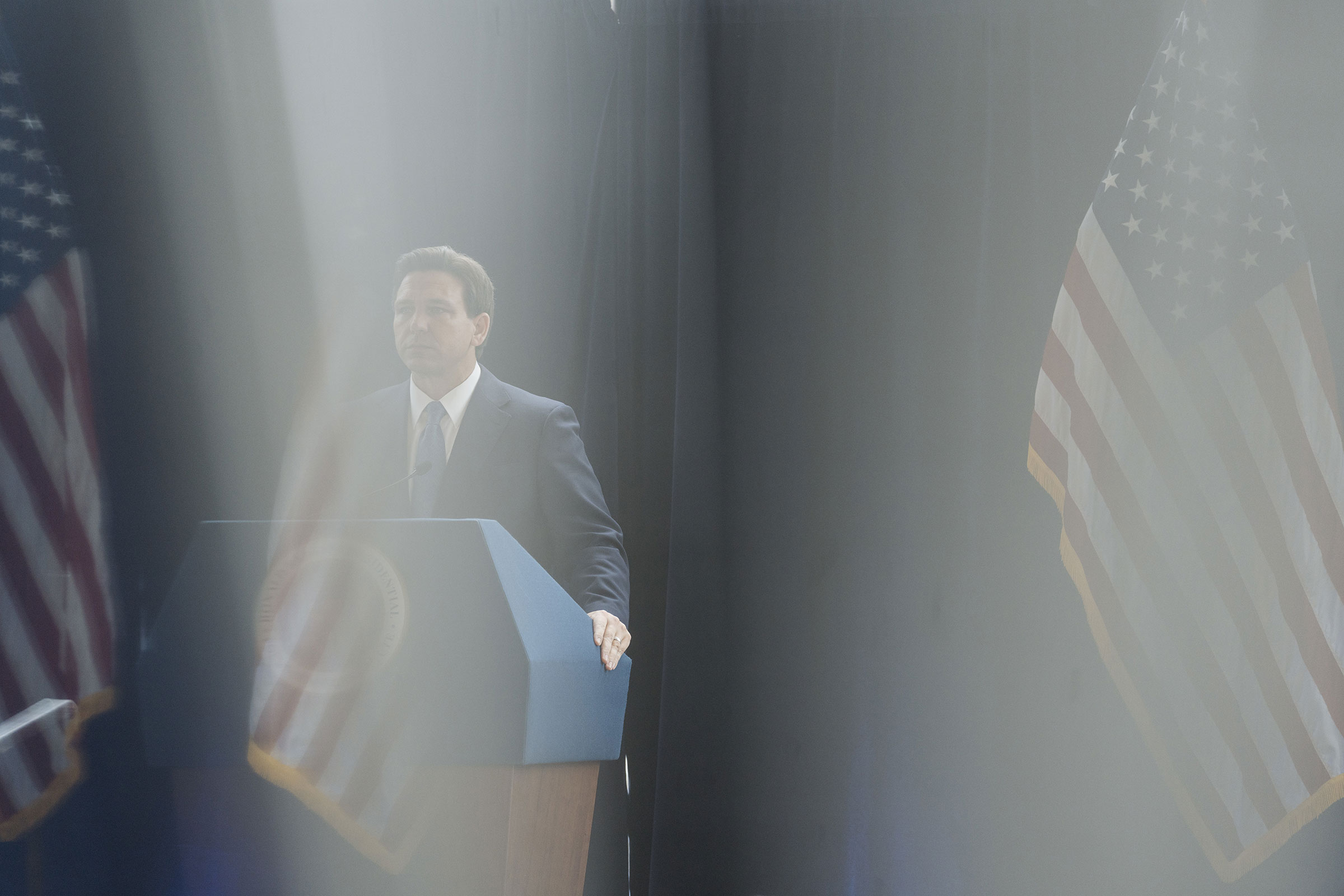
Tallahassee observers believe the flurry was choreographed to tee up the launch of a presidential bid that will place his policy record at its center. But unlike the legislative session, the pre-campaign has not gone according to plan. DeSantis stumbled on foreign affairs out of the gate, drawing harsh criticism for a statement that described Russia’s invasion of Ukraine as a “territorial dispute.” Trump has savaged him in personal terms. Some Republicans worry that DeSantis’ rush to the right on issues like abortion may come back to bite him.
Even allies wonder if DeSantis is cut out for the intense human interaction required in a national campaign. An April trip to D.C. to meet with his former colleagues in Congress ended disastrously, producing a flood of anecdotes about his antisocial ways on Capitol Hill and a slew of new congressional endorsements for Trump. The same bunker mentality that has made DeSantis more feared than loved, enabling him to shut out distractions and dismiss the naysayers, has created an insular operation struggling to do the outreach a presidential campaign requires. His stiff-arming of mainstream media has made it difficult to regain control of the narrative. And Trump’s political rise would seem to show that policy, substance, and governing experience may not count for much in today’s GOP.
But those who have had a front-row seat to DeSantis’ transformation of his state know better than to underestimate him. In his presidential run, allies say, will draw on his Florida record to argue he is both more effective and more electable than Trump. To GOP partisans hungry for confrontation but weary of losing, he offers Trumpian aggressiveness without all the baggage. “What got him here isn’t personality, it isn’t gladhanding,” says Iarossi. “It’s the relentless pursuit of conservative policies that have made Floridians’ lives better and led to a majority of registered Republicans. It’s the result of policies and governing.” —With reporting by Leslie Dickstein and Julia Zorthian
Why Everyone Is Having Bad Sex (Especially Young People)
Feed:
TIME
(https://time.com/feed/)
Published: 2023-05-31 11:00:04
|
Created: 2026-08-04 08:28:55
Despite all the social developments that have made sex easier (the sexual revolution, dating apps, yassified contraceptives), we still haven’t moved the dial on better. Bad sex has endured. And when I say “bad sex,” I am referring to sex that is quite simply unpleasurable, unsatisfying, or even demoralizing. While older generations are up against many of the same barriers to sexual wellbeing (like purity culture and the enduring impact of inadequate sex education), young people have been uniquely inundated with toxic messaging surrounding sex that has actually disrupted our abilities to feel pleasure. Resource-sharing on platforms like TikTok and Instagram may have positioned young people to better parse their sexualities, but not necessarily closer to building affirming and pleasurable sex lives.
As a professional sex writer whose latest research is on maximizing pleasure, communicating with partners, and exploring sexual autonomy, I, too, grapple with the disconnect between the sex I know I could have and the sex I actually have. I now know I am not alone in enduring medium, bad, to very bad sex again and again, even though I know better; even though I own good vibrators; even though my therapist is this close to leaving the field because I “don’t want to be helped.” No amount of sexual know-how or progressive personal feminism could salvage the majority of my sexual encounters.
Over the course of hundreds of interviews with sexually active millennials and Gen Z-ers, I’ve found that sexual dissatisfaction is nondiscriminating, though the “badness” of bad sex varies wildly. In fact, Laurie Mintz, a professor of human sexuality at the University of Florida and author of Becoming Cliterate, suspects millennials and Gen Z-ers are the most sexually misinformed generations of all time, due to the unprecedented accessibility of misinformation.
More from TIME
For many young people in relationships, bad sex often looks like middling intimacy upkeep. A 28-year-old cis woman who identifies as “hetero-ish” said sometimes sex with her partner is just “maintenance.”
“It’s the days where maybe neither my boyfriend nor I feel super excited about having sex, but it’s sort of an acknowledgement of maintaining intimacy,” she said.
A 31-year-old cis gay man told me something similar. “I can tell the times we get short with each other are usually because we haven’t been intimate in a while, and when we do I definitely notice a positive difference in mood.”
Then there is bad sex among single people, wherein lack of comfort and familiarity is one of the biggest issues.
“I’d say most of the casual, consensual sex I’ve had was in the meh-to-bad range,” a 28-year-old cis straight woman told me, citing “jabby fingering, lackluster oral, and flipping me over every two seconds because they watch a lot of mainstream porn.”
Studies suggest young people are experiencing growing rates of anhedonia, or the reduced motivation and capacity to feel pleasure. The COVID-19 pandemic made things considerably worse across all populations. Some researchers cite this anhedonic wave as one of the core phenomena fueling the sex recession, as it becomes harder to justify the work of coordinating sex when the experience doesn’t even feel pleasurable. In fact, neuroscientist Dr. Nan Wise posits in her book Why Good Sex Matters that the ever-increasing external stimuli in our environments are not conducive to feeling more of anything, let alone satisfaction.
Read More: Why Are We All Having So Little Sex?
Research has shown that, in many ways, we’re not just going backwards from the sexual revolution of the 1960s; rather, we’re still enduring the backlash to it. Historian Dagmar Herzog, in her ever-relevant 2008 book Sex in Crisis, explores this very problem by tracing America’s sex anxiety to the legislative victories of conservative evangelicals.
“Our national conversation about sex now suffers a tremendous impoverishment,” Herzog writes. “It is simple to find near-frenzied talk about adolescents’ exposure to sexual imagery on the Internet. It is far tougher to find frank and open dialogue about our hopes and fears for our children’s—and our own—sexual health and happiness. There is much titillating talk about sex in America, yet there is very little talk about sex that is morally engaged and affirmative.”
Over 15 years later, Herzog’s analysis rings truer every day, with a dizzying uptick in legislative efforts to police adolescent sexuality and gender identity, particularly in American schools, which continue to deprive young people of inclusive, medically accurate sex education. (Republican lawmakers are ramping up efforts to restrict comprehensive sex ed. According to a 2022 study by the Guttmacher Institute, adolescents were less likely to have received sex education on key topics like contraceptive methods in 2015-2019 than in 1995.) The lack of pleasure-forward public discourse on sexual wellness is dark, to put it mildly—where are we to learn about and explore and delight in our own pleasure, if it’s becoming increasingly criminalized?
When it comes to sexual happiness, young people are still left to fill in the blanks, seeking out our own information from mass content like porn and bad Google results that so often lead us astray in the absence of widespread media literacy. What’s more, other institutions that teach us about sex—like family, church, and school—are largely reinforcing cis-heteronormative, puritanical values that marginalize our most vulnerable youth and interfere with their sexual well-being. Too often these institutions stigmatize sexual pleasure, perpetuating messages like: sex is scary; genitals are gross; sex is for men’s pleasure; sex is straight; sex is just for making babies; sex is for certain types of bodies.
A growing body of research shows that sex education is more effective at promoting health when it’s pleasure-inclusive. When mortified parents or health teachers teach us about sex, they usually fail to point out that sex is supposed to feel good. At school, talking points stick to the risks of sexual activity, like STIs and unwanted pregnancy. If you’re lucky, and find yourself in a classroom that acknowledges birth control, you’re given the opportunity to roll a condom atop a banana. But even in more progressive classrooms, pleasure rarely comes up, leaving us entirely on our own to figure out pleasurable, affirming sex in a culture stacked to deprive us of it.
When are we supposed to learn about intimate communication, which most sex therapists agree is the key to pleasurable sex? Certainly not in high school, or from Gossip Girl, or in the moment, when you are laser-focused on concealing the body part you hate most, or mustering every scrap of concentration to pull off dirty talk.
“There’s a huge lack of modeling around intimate communication,” Carole Cain, a sex therapist and educator, told me. “The Hollywood model is two people meet each other, they throw off their clothes, they jump on each other. They go home happy; nobody says a word.”
In fact, one 31-year-old cis-het man put it to me like this: “Once sex is engaged, my ability to communicate through verbal means goes away almost immediately. I have no ability to say things without feeling stupid. Given that communication is so central to having good sexual experiences, that’s a huge handicap.”
This feeling is common. If the awkwardness doesn’t get you, the lethargy will. Communicating feels like work. “I wish more guys were better at sex so that I wouldn’t have to do so much work to find satisfying sex partners,” another 31-old cis-het woman lamented to me. “But I also do nothing in the way of instructing men on how to be better at sex, so I’m not really doing much to combat this issue.”
We must respect the calculations we all make surrounding sex—even bad sex. For years, I figured that as long as I used protection and avoided friends’ exes, bad consensual sex was a net wash—a silly, aerobic way to pass the time that didn’t positively or negatively affect my life. But bad sex is not a wash; bad sex matters because good sex matters. Our pleasure matters. Our time matters.
From Laid and Confused by Maria Yagoda. Copyright © 2023 by the author and reprinted by permission of St. Martin’s Publishing Group.
Как я собрал навигацию в Obsidian без единого плагина
Feed:
Все публикации подряд на Хабре
(https://habr.com/ru/rss/articles/)
Link:
https://habr.com/ru/articles/1066266/?utm_source=habrahabr&utm_medium=rss&utm_campaign=1066266
Published: 2026-08-04 08:22:47
|
Created: 2026-08-04 08:23:57

В моём хранилище 801 заметка. Когда я открывал Obsidian, меня встречала пустая вкладка - не главная страница, не список последнего, просто пустота, из которой надо было куда-то попасть.
Поиск помогал ровно в одном случае: когда я помнил, что искать. Граф связей выглядел внушительно и не отвечал ни на один вопрос. Папки требовали от каждой заметки выбрать себе одно место, хотя заметка про базы данных одновременно относится к литературе, к клиентскому проекту и к статье, которую я про это писал.
Ниже - что я с этим сделал: какой чужой метод взял за основу, что в нём пришлось переписать под себя и какие два правила оказались важнее самого метода.
Про системы в Obsidian я регулярно пишу в своём телеграм-канале - там короткие разборы и то, что не дотягивает до полноценной статьи.
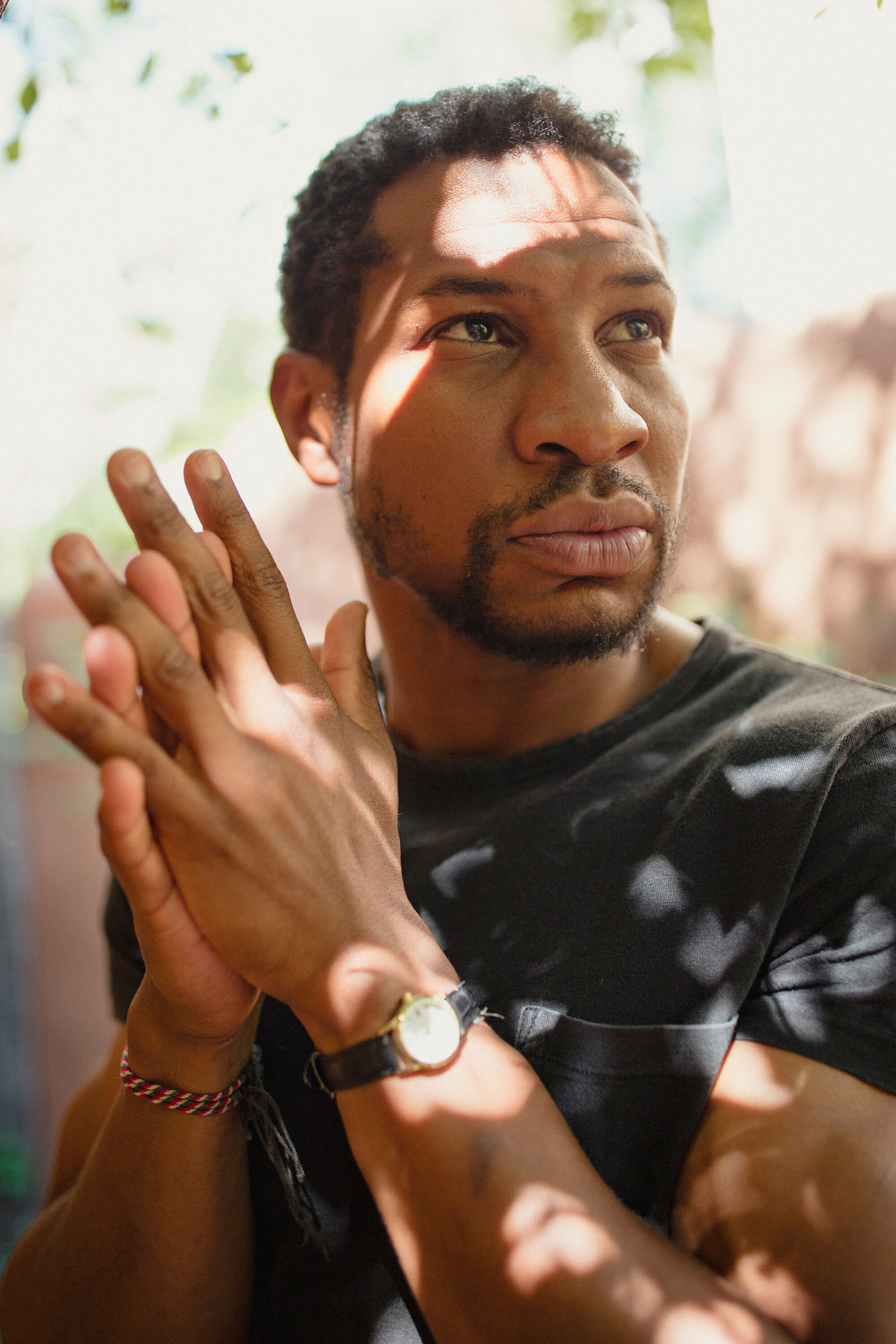
Читать далееJonathan Majors
Feed:
TIME
(https://time.com/feed/)
Published: 2022-09-28 09:54:56
|
Created: 2026-08-04 08:23:55
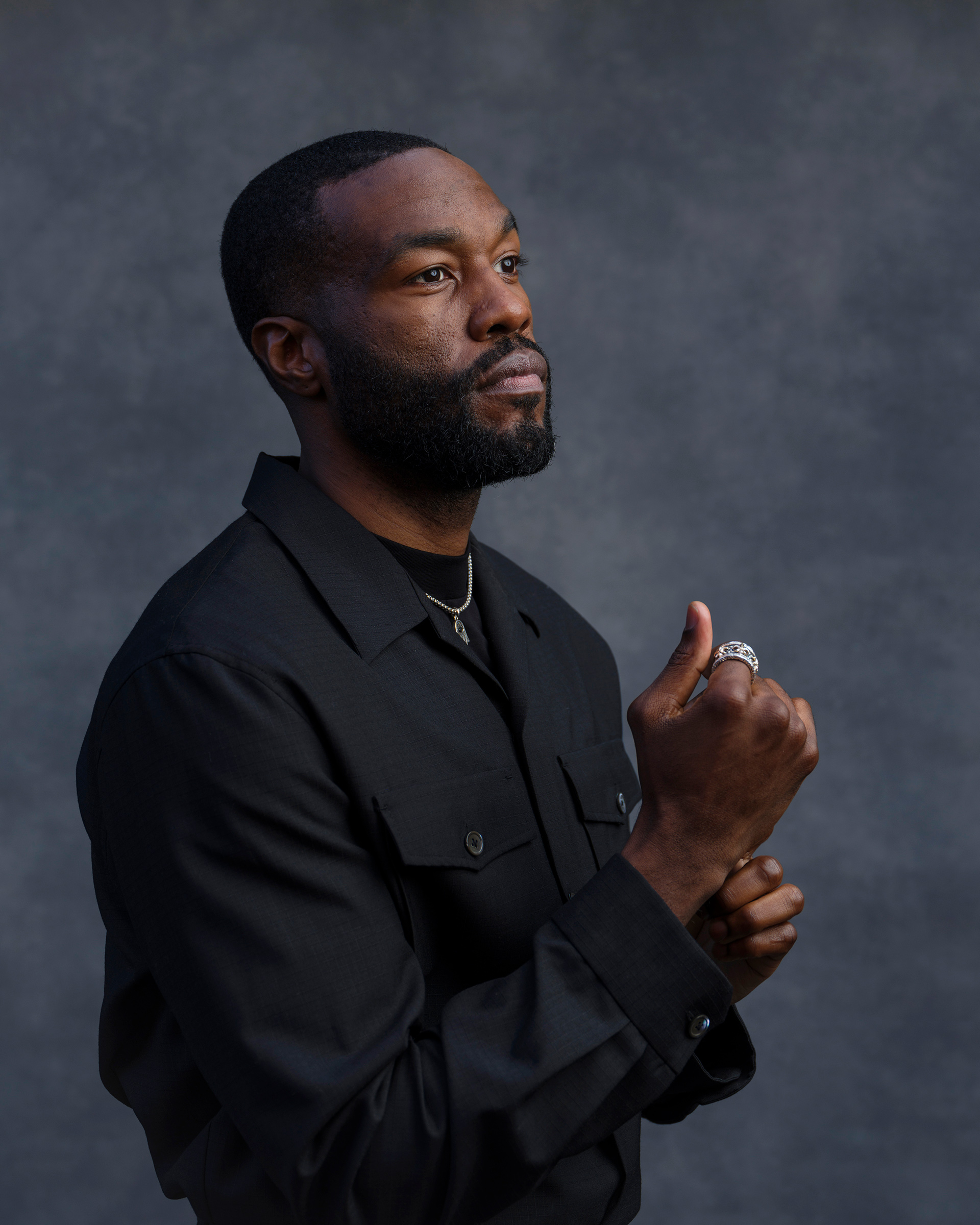
Yahya Abdul-Mateen II
Feed:
TIME
(https://time.com/feed/)
Published: 2022-09-28 09:54:58
|
Created: 2026-08-04 08:23:55
'There's Something Causing It.' Trump Draws False Link Between Vaccines and Autism in TIME Interview
Feed:
TIME
(https://time.com/feed/)
Published: 2024-12-12 12:51:00
|
Created: 2026-08-04 08:23:55
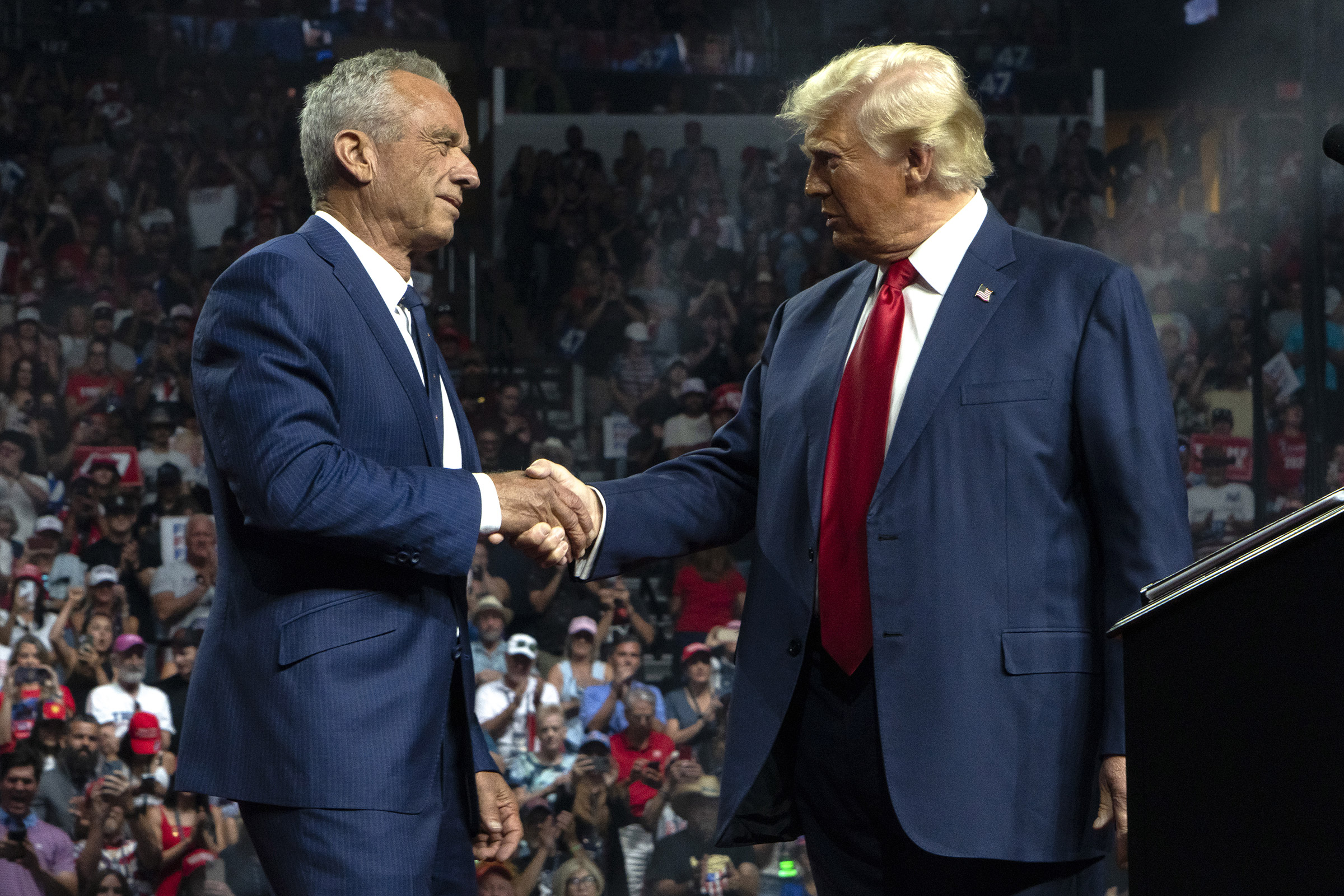
President-elect Donald Trump said in a new interview that he would consider altering childhood vaccination programs in the United States and questioned whether vaccines cause autism—a widely disproven claim.
When asked in an interview for TIME’s 2024 Person of the Year whether he would approve of an end to childhood vaccination programs, Trump said he would have a “big discussion” with Robert F. Kennedy Jr., the vaccine skeptic he has tapped to run the U.S. Department of Health and Human Services (HHS). “The autism rate is at a level that nobody ever believed possible,” Trump continued. “If you look at things that are happening, there's something causing it.”
Trump did not explicitly say in the interview that vaccines cause autism, a false claim that traces back to a retracted study from the 1990s. When pressed on the issue, Trump said his administration will complete “very serious testing,” after which “we will know for sure what's good and what's not good.”
But merely by suggesting that there may be a connection between vaccines and autism, Trump has reaffirmed his alignment with the misinformation that has for years fueled anti-vaccine movements.
The origins of a debunked claim
It’s true that autism is diagnosed much more frequently now than in the past—but not because vaccines are causing the condition. Researchers have explored possible reasons for the uptick, including rising parental ages and environmental triggers. But much of the increase, research suggests, stems from changes to diagnostic criteria, widespread awareness of the condition, and improvements in screening. Detection jumps have been particularly steep among children of color, girls, and young adults, all of whom have historically been diagnosed less frequently.
Why do vaccines get dragged into the discussion? In 1998, British gastroenterologist Andrew Wakefield published a study in The Lancet, reporting an apparent association between the measles, mumps, and rubella (MMR) vaccine and an increased risk of autism. The research sparked widespread concern about the safety of childhood vaccination.
In the years following, however, multiple other studies refuted that claim, finding no evidence of a connection between MMR vaccination and autism. And in 2004, 10 of Wakefield’s original co-authors published a statement saying their data were “insufficient” to prove that the MMR vaccine causes autism. It also came to light that Wakefield had not properly disclosed a conflict of interest: he was a paid adviser in lawsuits brought by families allegeding vaccines had harmed their children.
In 2010, more than a decade after it was originally published, The Lancet officially retracted the paper. At the time, the journal’s editor told The Guardian that the study’s conclusions were “utterly false.” The same year, Wakefield lost his U.K. medical license, with regulators saying he had acted “dishonestly and irresponsibly” in his research.
Even though Wakefield’s study has been widely debunked and refuted, and modern studies consistently show that shots are safe, the idea that vaccines are linked to autism persists, without evidence, among some vaccine skeptics—including Kennedy who, if confirmed, will run the federal health agencies responsible for vaccine approvals and recommendations.
Trump’s previous anti-vaccine stance
Trump has questioned the safety of childhood vaccines and mused about a possible link to autism for more than a decade. “When I was growing up, autism wasn’t really a factor,” Trump said in a 2007 interview with the South Florida Sun Sentinel. “And now all of a sudden, it’s an epidemic. Everybody has their theory. My theory, and I study it because I have young children, my theory is the shots. We’ve giving these massive injections at one time, and I really think it does something to the children.”
He has repeated similar claims on social media and in other interviews. In 2015, Trump boasted that he had never gotten a flu shot. “I don’t like the idea of injecting bad stuff into [my] body, which is basically what they do,” he said on a radio show.
During his first term as president, however, Trump oversaw Operation Warp Speed, a historic effort to create a vaccine in response to the COVID-19 pandemic. In 2021, Trump called the rollout of COVID-19 vaccines “one of the greatest miracles of the ages”—one from which he has since distanced himself.
A vaccine-skeptic in the administration
Judging by his recent comments—and his selection of Kennedy to run HHS—Trump seems to be reverting to his older, more negative views on immunization.
Kennedy has said in post-election interviews that he does not plan to take vaccines off the market. “I’m not going to take away anybody’s vaccines. I’ve never been anti-vaccine. If vaccines are working for somebody, I’m not going to take them away,” he told NBC in November.
In his Person of the Year interview with TIME, Trump allowed for the possibility that the future of some approved vaccines might be in doubt. “He does not disagree with vaccinations, all vaccinations,” Trump said of Kennedy. “He disagrees probably with some.”
Trump added that he “could” move to get rid of some vaccines “if I think they are not beneficial”—then added that his policies are unlikely to be “very controversial in the end.”
Pulling already-approved vaccines off the market without a clear safety imperative would likely lead to legal challenges. “If the FDA were to have a record of approving a vaccine for many decades and then all of a sudden withdrew that approval, the courts would demand scientific justification for it,” Lawrence Gostin, director of Georgetown University’s O’Neill Institute for National and Global Health Law, told TIME in November.
Both Kennedy and Trump have said that the incoming administration intends to conduct more research on vaccine safety, despite the fact that vaccines are already widely studied and safety and efficacy data is publicly available. “We're going to be able to do very serious testing,” Trump said in the interview with TIME. It’s unclear exactly what sort of studies he and Kennedy would like to oversee. Trump told TIME he wants “to see the numbers,” without specifying which numbers.
Experts have raised concerns that calls for more data and other vaccine-skeptical policies and rhetoric from the incoming administration could have a chilling effect on immunization efforts. Health agencies under the Trump Administration could use federal funding to pay for vaccine-skeptical research, spread misinformation, require new warning labels on shots, change recommendations about routine vaccinations for children, and more, as Arizona State University Professor James Hodge recently laid out for KFF Health News.
Such actions could endanger an achievement that the U.S. Centers for Disease Control and Prevention has called one of the most impactful of the early 21st century: reducing cases of and deaths from vaccine-preventable illnesses. Diseases that are currently rare—such as polio, measles, and whooping cough—could make deadly returns if vaccination rates plunge under a skeptical administration.
Trump has not even taken office yet for his second term, but many public-health experts are already deeply concerned. In November, after news broke that Trump would pick Kennedy to run HHS, Gostin told TIME that he “can’t think of a darker day for public health and science itself.”
“The minimum qualification for being the head of the Department of Health and Human Services is fidelity to science and scientific evidence,” Gostin said, “and he spent his entire career fomenting distrust in public health and undermining science at every step of the way.”
What Cuts to FEMA, Climate Agencies Mean During a Government Shutdown
Feed:
TIME
(https://time.com/feed/)
Published: 2025-09-30 16:27:18
|
Created: 2026-08-04 08:23:55
As a government shutdown looms, two storms are brewing in the Atlantic. For many, it raises the question of what might happen if communities are impacted by extreme weather while the federal government halts all non-essential work.
The deadline to avert a shutdown is tonight at midnight. A number of federal agencies focused on climate and science stand to be left in the lurch—but after already operating in limited capacity after cuts earlier this year, it might not be much of a change. The limited staff, funding, and data heading into a shutdown, however, could leave the federal government even more unequipped to prepare for and respond to climate risks.
Neither hurricane Humberto nor tropical storm Imelda is expected to make landfall in the continental United States, but both are forecasted to generate some coastal flooding, high surf, and life-threatening rip currents along parts of the East Coast this week. The good news is that FEMA’s emergency response functions would continue to operate during a government shutdown. The agency receives funding through the Disaster Relief Fund (DRF), which is allocated at the beginning of the financial year and available until it’s spent, so it theoretically would not rely on the federal government to continue operating in the event of an emergency. Much of the agency’s staff is considered essential, and would be available during an emergency.
Read more: The True Cost of Trump’s Cuts to NOAA and NASA
But given the mandatory early retirements, furloughs, and reductions in force that much of the government saw earlier this year, FEMA, along with other agencies, are already operating at an extremely limited capacity.
“All of those fears we have about what's going to happen to FEMA during a shutdown, essentially, that's the world we're living in at the moment,” said Manann Donoghoe, fellow at the Brookings Institution’s Center for Community Uplift. “FEMA already is operating in that ‘immediate-needs' funding status as it would be under a government shutdown.”
Along with staff, FEMA’s funding has been dwindling. A June 3 report projected that the agency’s DRF would run out of money by the end of August. This could have implications in a worst case scenario during a shutdown.
“You're looking at a situation where you would want to go to Congress and get additional appropriations if there happens to be a major event, which the costs for which exceed that which is already in the Disaster Relief Fund,” says Donoghoe.
If the agency required additional funds to respond to serious damage caused by a natural disaster during the shutdown, they would be unable to appeal to Congress.
A shutdown would impact other agencies as well. In 2019, when a government shutdown furloughed a number of federal workers for 35 days, scientists warned that the loss would have major impacts on scientific research—and put at risk data sets that help federal, state, and local governments prepare for natural disasters and inform policymakers about climate risks.
Read more: How a Government Shutdown Could Affect Your Life
“Basic cuts in data collection means that everything from private companies and corporations through state and local governments can't plan,” says Carlos Martín, vice president for research and policy engagement at the nonprofit research institution Resources for the Future. “You need data about your demographics, greenhouse gas emissions to basically compete on a global level, to sell products internationally, and to prepare for your workforce and long term viability of communities.”
Even before the threat of a shutdown, lags in data collection have left the country unprepared for a major disaster. “It's long-term planning that makes [the difference between] these shocks being stronger and more impactful, or more muted and mitigated,” says Martín. “So it's important to realize that we are setting ourselves up for some serious problems.”
The Tragedy of Eric Adams
Feed:
TIME
(https://time.com/feed/)
Published: 2025-10-29 11:00:00
|
Created: 2026-08-04 08:23:55
Before Eric Adams can start explaining the conspiracy that took him down, the soon-to-be-former mayor of New York City must make his morning smoothie. On a chilly recent Friday, he is standing in the stainless-steel kitchen of Gracie Mansion, the stately official residence on the Upper East Side, layering blueberries and ginger and flaxseed and greens into a Nutribullet blender.
“People think that our stomachs are like a washing machine—that when you eat, everything mixes up together—and it is not,” he says, whirring the mixture into a greenish-brown sludge. “Our stomachs are like a sink, where what you put in it first goes down the drain first.” He pours me a sample. It tastes like ginger-flavored grass.
We are speaking a week and change since Adams bowed to the inevitable and dropped his bid for re-election. There is a lot he wants to get off his chest. When he was elected four years ago, Adams seemed poised to be a transformational figure. Amid rising crime and racial tensions, the former police captain promised there need be no compromise between safety and justice. Like Joe Biden’s election a year earlier, his win was a triumph of the Democratic Party’s moderate Black base over the radical-chic faculty liberals and their alienating ideas. “I’m the Biden of Brooklyn,” Adams boasted. “Look at me and you’re seeing the future of the Democratic Party.” Aides whispered that he could run for President.
Four years later, the Democrats’ future looks murkier than ever, and Adams’ lofty ambitions lie in ruins. His approval rating sank as low as 20% in the wake of his federal indictment on bribery and corruption charges and its subsequent dismissal by President Trump’s Justice Department. In the mayoral race between Zohran Mamdani and Andrew Cuomo, Adams was relegated to an afterthought, an object of ridicule and scorn. The cloud of scandal has obscured the message he wants to leave on his way out.
“I could have made better choices,” he says, reflecting on all the appointees who broke the rules and betrayed him. “But I had a city to run. And when you look at it, even with the crew that I assembled, there was not one year that we were not moving the city forward.” He’s been punished, as he sees it, for telling unpopular truths, harassed by an unfair justice system, hammered by a biased press, his achievements diminished by a system he threatened.
It’s hard not to think about what might have been. “It strikes me as Shakespearean in its tragic outcome, because there was so much there to admire,” says Juan Williams, the Fox News analyst who has known Adams since the 1990s, when Playboy assigned him to write a profile of the young lieutenant who’d risked his career to testify about racism in the NYPD. “There was so much energy and determination,” Williams recalls, ”a sense that this guy was going somewhere and he was going to take other people with him, especially Black people. But I don’t think there’s any question it’s his fault. He was selfish, and it clouded his thinking—his sense of right and wrong.”
Adams proceeds to a peach-colored parlor, the smoothie in one hand and a container of carrot slices in the other. All he is asking, he says, is for people to look at his record. To put the good alongside the bad and see how it all adds up. The crime and homelessness he reduced, the jobs numbers and test scores he improved, the nightlife he brought back from its COVID-era slumber.
Settling onto an orange couch, a carrot stick in each hand, he turns the conversation to his late mother, whom he says left school after third grade, worked three jobs, and raised six kids on her own. A black-and-white photograph of her adorns the cufflinks he’s wearing. “There was one point during this whole thing that it took everything to get out of bed,” Adams says. “And it was only thinking about Mommy—how she always got up, no matter what she had to go through—that I said, listen, Eric, you just can’t surrender.”
He came so far, only to end up isolated and diminished. “They didn’t think I could do it,” he says. “You’re a darn former cop, how are you going to run a city this complex? And there was a body of people that was not even willing to give me a chance.”
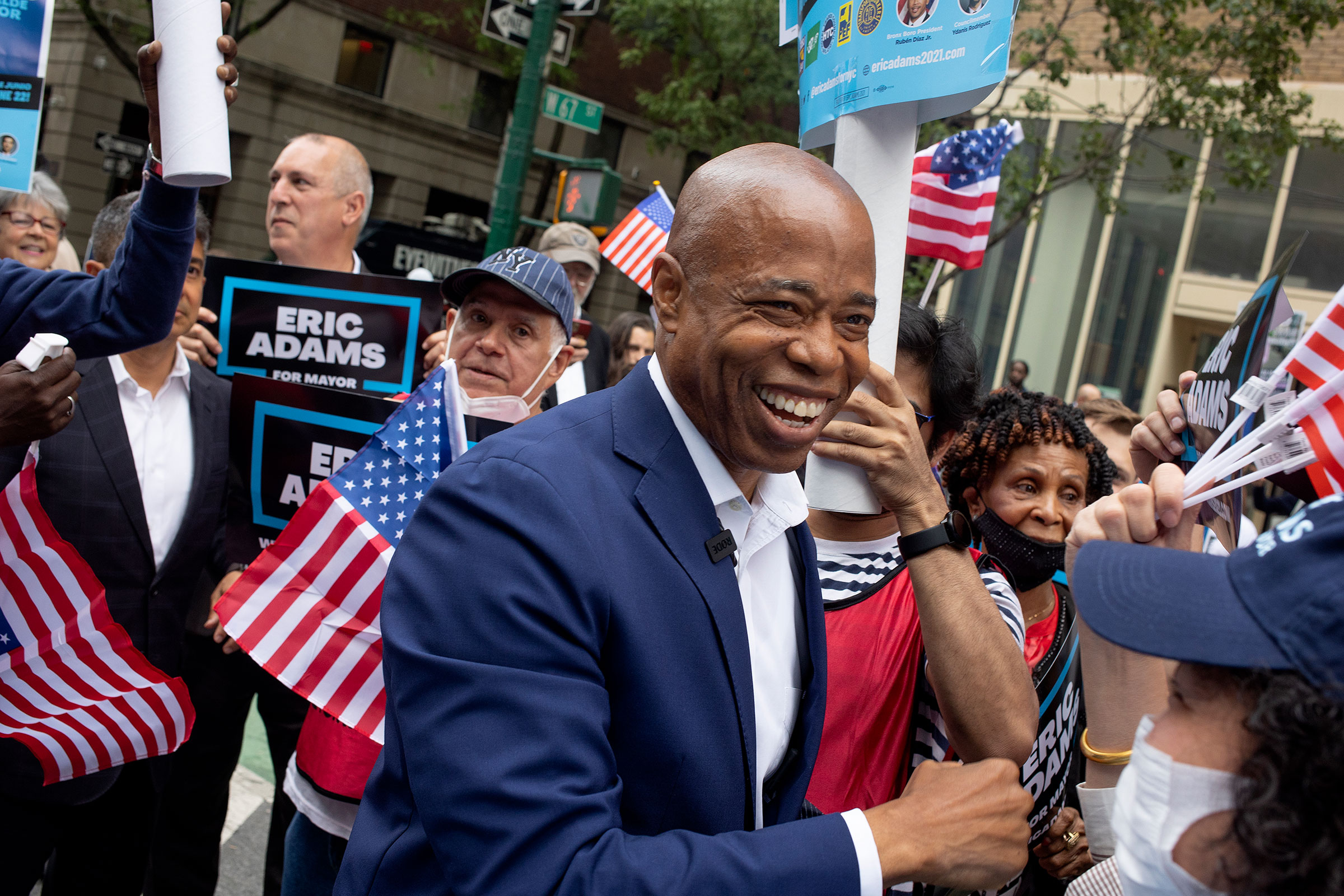
Adams grabs the smoothie and his suit jacket and climbs into the back of the black Suburban that is his de facto office. There is a packed day ahead. The next 12 hours will take us to 10 stops across three of the city’s five boroughs, from a rundown police precinct to a glitzy nightclub, from a subway platform to a taxi-drivers’ gala.
The indictment is on Adams’ mind as we make our way to City Hall. “No gold bars, no bags of cash, nothing—the case was about upgrades,” he says of the bribery charges. “Over years of investigating me, they could never find anything. So they had to concoct this.”
Adams was born in Brooklyn and moved to Queens in elementary school. By his teens he was a street hustler affiliated with a local crew. At 15, he was arrested with his brother after being caught stealing. In police custody, officers repeatedly kicked the brothers in the groin, according to Adams, leaving him urinating blood. The encounter left Adams’ brother with a hatred of cops—but it motivated Eric to become one. In 22 years on the force, he became known as an outspoken internal critic.
Adams left the NYPD and ran for state Senate in 2006, where one of his first causes was pay raises for lawmakers. (“Show me the money!” he said in a floor speech.) He served four terms before being elected the first Black Brooklyn borough president in 2013. In 2020, he joined a crowded Democratic mayoral primary that included tech executive Andrew Yang and several liberal technocrats. Adams’ focus on public safety stood out. His upset victory, powered by outer-borough Black voters, signaled that the party’s working-class silent majority wanted more and better policing, not the “defund the police” of the fashionable activist slogan.
Under Adams, the city has seen a decline in both violent and property crimes. This year, shootings are down 54% and murders are down 36% compared to the same period four years ago, according to the NYPD. Subway crime in the third quarter of 2025 was the lowest in recorded history excluding the pandemic. And crime isn’t the only area where Adams’ accomplishments have been “substantial,” says Kathryn Wylde, president of the powerful Partnership for New York City, who has worked with mayors since the 1970s. The city’s economy has grown at a faster pace than the rest of the country, hitting records for gross output and jobs last year. Adams’ zoning reform, the biggest in decades, is projected to spur the construction of 80,000 new homes over 15 years, and his “Trash Revolution” has begun to move the city’s notorious garbage piles off the sidewalk and mitigate the rat problem. As one X user argued: “Eric Adams is legitimately insane and literally committed treason in exchange for airline miles. He’s also the only NYC mayor in ~50 years to make progress on two of the biggest issues the city has: trash & housing.”
Adams cut billions from the budget and took on entrenched urban nonprofits, weathering criticism from homelessness advocates when he ramped up the city’s use of involuntary commitment for those with severe mental illness—a policy Mamdani has vowed to roll back. His chief of staff, Camille Joseph Varlack, tells me Adams has a skepticism of government grounded in his upbringing. “He feels the city failed his family, and that drives him in a way I don’t know if he even understands,” she says. “I tell him, ‘I always think of you as Batman, and not just because you like to go out at night.’”
New Yorkers are not convinced. In a recent CBS News poll, 61% of respondents said that things in the city are “going badly.” Just 22% said crime had decreased over the last four years, while 46% said it had increased. Ana María Archila, co-director of the left-wing Working Families Party, says Adams doesn’t deserve credit for declines in crime when rates have been falling nationally. Adams, she says, has been too willing to see police as the answer, and has governed the city for the benefit of his wealthy patrons rather than his working-class constituents. “He spent so much time fear-mongering about crime,” she says, “and at the same time he put police officers on the front lines of the approach to mental health and homelessness in ways people perceived as highly ineffective and not very humane.”
But political leaders are often defined not by the plans they make but by the crises forced upon them. For Adams, it was the migrant surge. When he came into office, the Biden Administration was insisting there was no crisis at the border. Texas Gov. Greg Abbott then began sending buses of asylum seekers to Washington in protest. In July 2022, Adams called Abbott’s action “heartless” and vowed that New York City would welcome migrants and provide them with shelter and services. Abbott was happy to oblige, and in August he announced he had sent buses to Manhattan. (Adams contended that Texas was busing migrants to New York prior to the announcement.)
A year later, Adams’ tone changed. New York was spending billions housing the migrants, whose numbers had reached six figures, in shelters, encampments, leased hotels and a cruise terminal. Adams began criticizing the Administration, saying Biden had “failed New York City.” In private meetings, Adams says, he urged Biden and his team to secure the border. He says Administration officials urged him to be quiet and compared the crisis to gallstones—it would be painful, but it would pass, and the best thing to do was tough it out.
For Adams, who was cutting back library hours to pay for the shelters and taking political heat for giving handouts to migrants, that was not a satisfying answer. Adams wondered who was really in charge at the White House: in his later meetings with Biden, he says he noticed a marked decline, and suspected the president wasn’t well-served by his staff. He found himself frozen out by the White House, dropped from the advisory council of Biden’s reelection campaign. (A Biden spokesperson did not return a request for comment.)
On Nov. 2, 2023, Adams was headed to Washington to confront federal officials about the migrant crisis when the FBI raided the home of his chief campaign fundraiser. The mayor turned his car around on the way to LaGuardia and canceled the trip. Four days later, the feds stopped Adams on the street and seized his phones and iPad. To Adams, the connection seems obvious: He called out Biden, and then Biden’s Department of Justice went after him.
A few months later, Trump went on trial in Manhattan, and Adams began to sympathize with the former president’s claims of political targeting. Adams read the book Government Gangsters, by Kash Patel, the erstwhile MAGA influencer who is now Trump’s FBI director, which painted a sinister picture of the “deep state” that would stop at nothing to destroy Biden’s enemies. He watched Biden decry Trump’s subversions of justice and then pardon his son on his way out of office. “Take Trump’s name off it,” Adams says. “They basically had a hit list.”
Back in the car after taping a TV interview about subway surfing, the mayor takes a sip of his smoothie, which has been sitting untouched for hours. “My spinach,” he says, “like Popeye.”
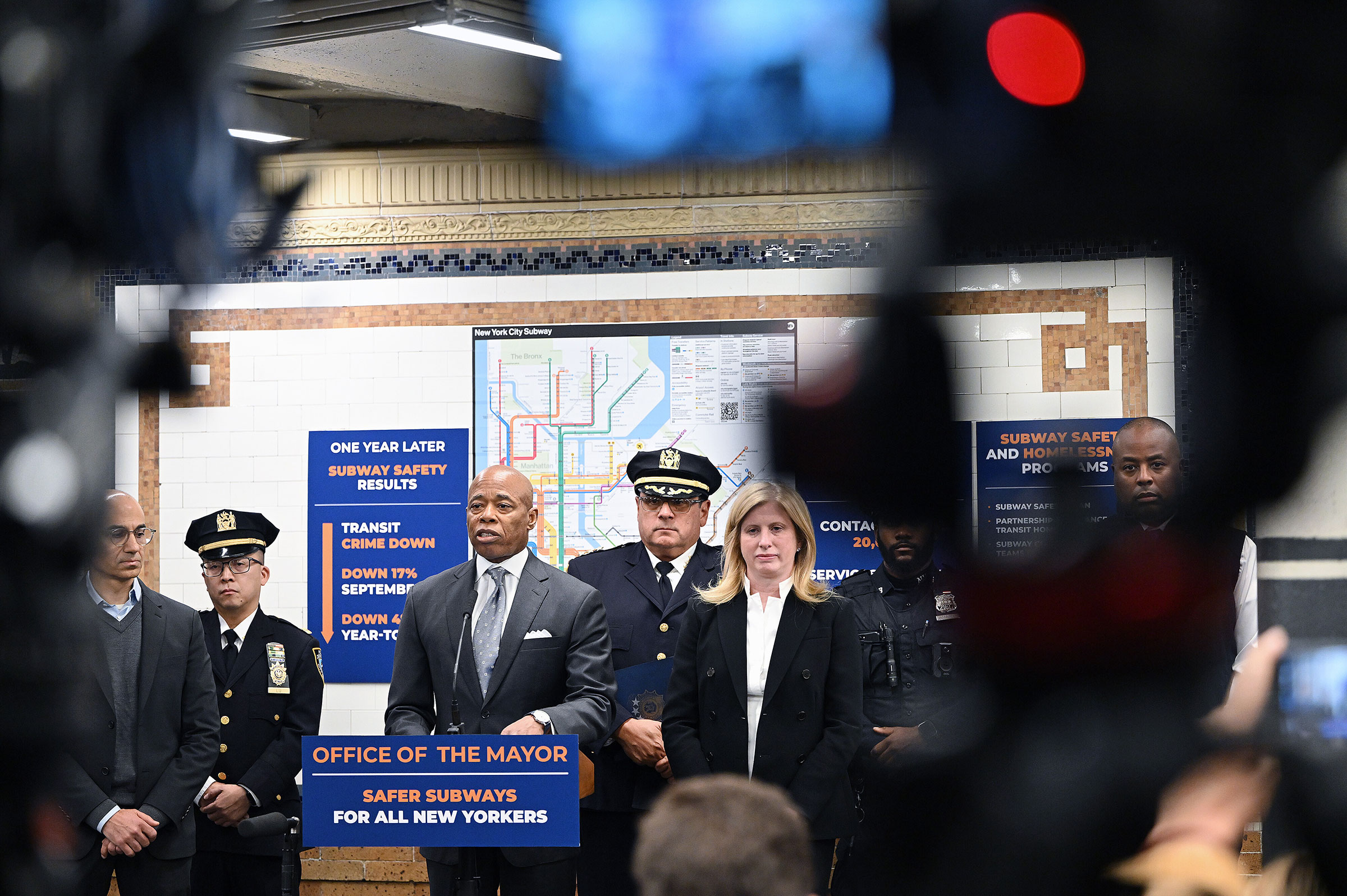
We pass the flashing screens of Times Square and descend the steps to its subway station, where a dozen reporters and a row of television cameras await. Adams, as is his custom for even the most banal announcement, enters to the strains of Jay-Z’s “Empire State of Mind.”
The press conference begins normally enough. Adams and his well-respected police commissioner, Jessica Tisch, tout the program they’ve instituted to reduce crime and homelessness on the subway, which they say has removed 2,100 people for quality-of-life violations and connected thousands with shelter beds and permanent housing. It’s when the reporters start asking questions that things start to go off the rails.
One asks about the latest gruesome subway crime, a 64-year-old man beaten to death at a Brooklyn station. Another asks if Adams’ campaign failed because his claims of progress weren’t convincing. Adams blames the media. “My campaign didn’t struggle because we failed,” he says. “My campaign struggled because the story has not been told by the same people that are not telling the story right now.”
Perhaps, another reporter suggests, there are shootings not being recorded in official statistics. Tisch takes this one. “If the suggestion is that we are in some way hiding people with bullet holes in them, I think that’s absurd,” she says.
Adams seizes the lectern. “Let’s be honest,” he says. “You didn’t think I could turn this city around. Many of you thought, He’s just a cop. What does he know about running a city this complicated?You don’t want to deal with the fact of more housing than ever in the history of the city, lowest crime in the history of the city, more jobs—we broke the record 11 times. Outpacing the state in reading and math. We have dropped unemployment all across the city, but particularly in the Black and brown community. All of these indicators. You didn’t think I could do it in four years.” The same statistics the press uses to judge other mayors demonstrate his success, Adams argues, yet “you’re still talking about how we’re fudging numbers.”
He’s getting heated now, lapsing into the third person: “Eric has turned around the economy. Broadway had the best 12 months in recorded history. Crime is at record levels. Just report the facts. Stop coming up with all of these creative ways of saying Eric failed. Eric didn’t fail. Eric did the job of a working-class mayor."
Now Adams points a finger at his least favorite reporter, Chris Sommerfeldt of the Daily News, whom he banned from City Hall press conferences earlier this year. In today’s paper, Sommerfeldt has a story about Political Humanity, a new memoir self-published by Adams’ former girlfriend Jasmine Ray, who later worked in his administration. Their relationship first turned romantic, according to the book, in a 2014 encounter at Brooklyn Borough Hall. Adams takes issue with Sommerfeldt’s description of this as “the first time she slept with Adams.” (The book strongly implies it, but Ray tells me they merely kissed.)
“You’re a dark, sick person, man,” Adams says, glaring at Sommerfeldt. Tisch and some of the other officials are starting to look uncomfortable. He dismisses them: “Y’all can depart. Let me do this.” A prolonged diatribe at Sommerfeldt ensues.
New York Attorney General Letitia James has just been indicted by Trump’s Justice Department, but her indictment, Adams notes, is being widely portrayed as politically motivated payback, unlike his own. “People attacked me. They called me names. They destroyed an impeccable record in the city,” he rants. “Folks, I’ve been doing this for 40 years. I have 40 years of delivering for the people of the City of New York. And within months, because of a lawfare, you all of a sudden turned me into a criminal.”
Adams goes on in this vein for some time. “So don’t start asking me about what’s going on now,” he finally concludes. “I want to know what did y’all think about when my life was destroyed in this city. And I wish I had a mic so I can drop it right now.”
He turns on his heel, exuding the calm of a man whose anger has escaped his body. The small crowd that has gathered on the other side of the turnstiles breaks into a mix of heckling and applause. As Adams strides back up the subway steps to his waiting car, a voice calls out behind him: “Would you take the upgrades again, Mr. Mayor?”
Adams settles into the back seat, turns to me, and grins. “For the next three months,” he says, “I’m going to have so much fun.”
The federal indictment of Eric Adams, unsealed in September 2024, alleges that before he became mayor, Adams accepted valuable gifts from the Turkish government in exchange for official favors, and that his mayoral campaign accepted illegal donations by laundering them through straw donors. Among the alleged gifts in question were airline upgrades on Turkish Air between the years of 2016 and 2021; the official favor is that he called the FDNY in 2021 to see what was holding up the inspection of the new Turkish consulate building.
As we make our way through traffic to a police precinct in the Bronx, Adams lays out his defense. “When you get an upgrade, if you’re in your official capacity, there’s no problem—you’re allowed to do it,” he says, with the confidence of a man who has carefully scrutinized what the ethics laws permit. As for calling the fire department, he says, he was just trying to make sure the city’s bureaucracy was working to meet the needs of an important resident. “I was indicted for calling the fire department and saying to them, ‘Hey, the president of Turkey is coming in and they have a new building. Can you go do a building inspection?’ I didn’t say pass them. I said, if you can’t do it, let me know and I’ll manage their expectations.” (In fact, the indictment describes a lengthy back and forth between Adams, the fire commissioner, and a Turkish representative as he sought to facilitate the building’s opening without an inspection. In the course of urging the commissioner to get it done “today if possible,” Adams says that if it can’t be done, he will “manage their expectation.”)
Adams is not the only one to find both the quid and the quo alleged in the case underwhelming. The CNN legal analyst Elie Honig, a former federal prosecutor, opined that it was “not a slam dunk.” Former Mayor Bill de Blasio, whose campaign was also investigated for alleged campaign finance violations, says there ought to have been a higher bar to bring the first-ever indictment of a sitting mayor. “I did not see how on earth he would ever be convicted on those charges,” de Blasio tells me. “Something involving airline upgrades? An allegation of foreign money, but nothing linking him to it directly? It seemed very thin.” Adams’ staff refers to it as “an indictment over legroom.”
More vexing to many New Yorkers than whatever he did or didn’t take from the Turks were Adams’ dealings with Trump in the aftermath. The two men met for the first time, according to Adams, in October 2024, three weeks after Adams was indicted and three weeks before the presidential election, when they both appeared at the Al Smith Dinner, an annual white-tie charity roast. At the time, top Democratic politicians had disowned Adams, and Gov. Kathy Hochul was considering using an obscure state law to force him from office.
Trump saw a fellow victim. “I’ve never met a person who’s a vegan who liked Turkey so much,” Trump razzed, before adding: “I was persecuted, and so are you.” He continued to champion Adams’ case on the campaign trail. In January, as Trump prepared to move back into the White House, Adams traveled to Florida to meet with him. He skipped Martin Luther King Jr. Day celebrations in New York to attend Trump’s inauguration; I found him in the Capitol before the program began, sitting with his eyes closed. After I interrupted Adams’ meditation to ask if he was angling for a pardon, he insisted he only wanted to talk to Trump about their shared policy priorities.
Trump’s Justice Department filed to dismiss Adams’ case in February. At least 10 prosecutors resigned in protest. In her resignation letter, then acting U.S. Attorney Danielle Sassoon wrote that the case was being dismissed in exchange for Adams’ cooperation with the Administration’s deportation efforts. “I cannot agree to seek a dismissal driven by improper considerations,” she wrote. Two days later, Adams went on Fox and Friends alongside Tom Homan, Trump’s immigration czar. “If he doesn’t come through, I’ll be back in New York City,” Homan grinned, “up his butt, saying, ‘Where the hell is that agreement we came to?’”
A judge, while observing that “everything here smacks of a bargain,” dismissed Adams’ case in April, saying he could not force the Justice Department to prosecute. The next day, Adams dropped out of the Democratic primary, staying in the race as an independent candidate. His re-election bid was hobbled by the city’s Campaign Finance Board, which denied him more than $4 million in matching funds, citing the corruption charges. Cuomo, the former governor who’d once vowed not to run if Adams was in the race, had already reversed himself and entered the field.
Rumors swirled that Trump’s allies were working to lure Adams out of the race. He was offered the ambassadorship to Saudi Arabia, or a position at the Department of Housing and Urban Development, per various reports. Adams says none of it was ever true: “There was never a deal with Trump.” The proof, he says, is that he was consistent when it came to the migrant crisis. “I said pre-election that if you break the law you need to get the hell out of this country,” he says. “I said that after the election.” He has urged Trump not to send the National Guard to New York City—successfully, thus far—and criticized the Administration for a recent ICE raid.
“The visceral hate for Donald Trump, and the feeling that he did something for me—the city turned on me,” Adams says. “It was like I became the symbol of their hate.” New Yorkers were convinced Adams couldn’t be trusted, and he, in turn, was radicalized—disillusioned about the justice system, the law-and-order apparatus he’d held dear.
To hear Adams’ critics tell it, the mayor was not a victim but a serial offender, a machine pol on the make who was never really vetted before he won the keys to the city in a stroke of lucky timing. Adams was repeatedly investigated for alleged ethical lapses prior to his mayoral election. Once in office, he surrounded himself with cronies, many of whom were quickly enmeshed in scandal.
“In 2021, I warned people that he would be corrupt and there would be chaos, and unfortunately I was right,” says Curtis Sliwa, the Republican who ran against Adams four years ago and is once again the GOP nominee. “He is the most corrupt mayor in the history of New York City, and that’s saying a lot. He created his own destruction, but like every politician, he can never acknowledge it, can never apologize. It’s always a conspiracy.”
By the time Adams was indicted, dozens of city officials had resigned or been fired, and many had themselves been indicted for allegedly selling contracts and trading favors. An October 2024 New York magazine cover blared, “Last one out of City Hall, turn out the lights.” It is a testament to either Adams’ governance or to New York’s vast and competent bureaucracy that the city continued to function smoothly as members of the mayor’s cabinet fell like dominoes.
Adams’ car pulls up to the NYPD Academy in Flushing, Queens, where this year’s class of more than 1,000 cadets has assembled in a massive auditorium. He stands at the front beside a pair of flags, a tiny figure against a big gray wall. “It takes a special person to complete their career and not be bitter, because you’re going to watch the worst things that man can do to man,” he says, speaking with feeling and without notes. “And you can either leave your career being engulfed by the pain and devastation of that, or you can embrace it.”
He urges the young officers to take care of their families and relationships, and to learn from one another about their diverse communities. “Wearing that shield and that gun and that vest is a commitment. It’s a dedication. And you cannot do anything to tarnish that.”
Adams is vague about what he’s going to do next. Back at Gracie, as he microwaves a vegan dinner for one—a lentil-based pasta and medley of vegetables smothered with nutritional yeast—he tells me he’d like to travel the world and work in the private sector. In recent days he has regaled the city press corps with talk of a book, a documentary, a Ph.D. he wants to pursue.
Our conversation turns to the election. Adams considers Mamdani’s promises unrealistic; he predicts buyer’s remorse when the frontrunner’s supporters realize he can’t actually freeze most people’s rent, make buses free, or bring down the cost of living. Adams is also concerned about the threat of Islamic extremism, with which he thinks Mamdani is too comfortable, and perplexed by polls that show Mamdani getting a large proportion of the Jewish vote. (In public comments, Mamdani has cast such criticism as Islamophobic.)
In 2023, Adams hosted Mamdani and his father, a scholar of post-colonialism at Columbia University, for dinner. “The frightening thing is, he really believes this stuff!” Adams tells me as he mixes the veggies. “Globalize the intifada, there’s nothing wrong with that! He believes, you know, I don’t have anything against Jews, I just don’t like Israel. Well, who’s in Israel, bro?” At the dinner’s end, Adams says he told the Mamdanis, “Listen, I just don’t believe what you do.” (Mamdani has decried antisemitism and recently, after a prolonged controversy, said he will discourage use of the loaded intifada phrase.)
On Oct. 23, Adams endorsed Cuomo, calling him the better candidate to keep the city safe. Mamdani’s candidacy, Adams tells me, is “the number one threat to our city, and to be honest with you, I think the entire country, because you’re going to watch cities fall like dominoes if his philosophy takes root in New York City.” But he is still no fan of Cuomo, whom he sees as too inclined to capitulate to the left. "Andrew sabotaged this race,” Adams tells me. “He’s better than Zohran, yes, but that’s not a hard choice, because to me everybody’s better than Zohran.”
Later in the evening, Adams will take me to a taxi-drivers’ gala in Queens, where numerous young Black and brown men tell me they think he got a raw deal. Then it’s on to a club opening in downtown Manhattan, where he’ll pose with a pair of puffy-vested DJs at an outdoor roller rink while a deafening beat thumps, and crypto billionaire Brock Pierce will urge him to reenter the race. He’ll swap his suit coat for a maroon dinner jacket and head back uptown, where a celebrity chef, an ambassador, and a selection of imported wines await in a private room.
But for now, as he eats his plant-based meal standing up in his taxpayer-funded kitchen, he seems like a man who is very much alone. “There won’t be anybody like him again,” the veteran New York Democratic consultant Hank Sheinkopf tells me. The city’s demographics are changing, becoming more Chinese and Muslim, less Black and Jewish and white-ethnic, and its politics have been taken over by an educated, professionalized cohort. “The political-industrial complex is now in control, and they don’t need the Eric Adamses of the world. He wasn’t from Harvard, wasn’t from Yale; he was from the streets. He was held to a different standard in many ways. He never had a shot.”
The Democratic strategists who have chewed over their party’s unpopularity in memo after memo since last November pine for an authentic tribune of the working class. A candidate who plays to the middle. Someone who can sound tough on crime and immigration without being a malicious racist. Someone who understands the aspirations of regular people. Who can embody masculinity without disrespecting women or gay people, who can speak to the men—particularly young men of color—leaving the party in droves. Someone who can work the system and deliver for the people.
“You had a mayor that was probably one of the finest mayors for working-class people, and the city turned against him,” Adams says. “But no one said it’s supposed to be fair.”—With reporting by Leslie Dickstein
Correction appended, Oct. 30: The original version of this story misstated Adams' comments about the migrant busing controversy. Gov. Abbott announced that he would begin busing migrants to New York City in August 2022 in response to Adams' criticism, but Adams had accused him of sending the buses prior to that announcement.
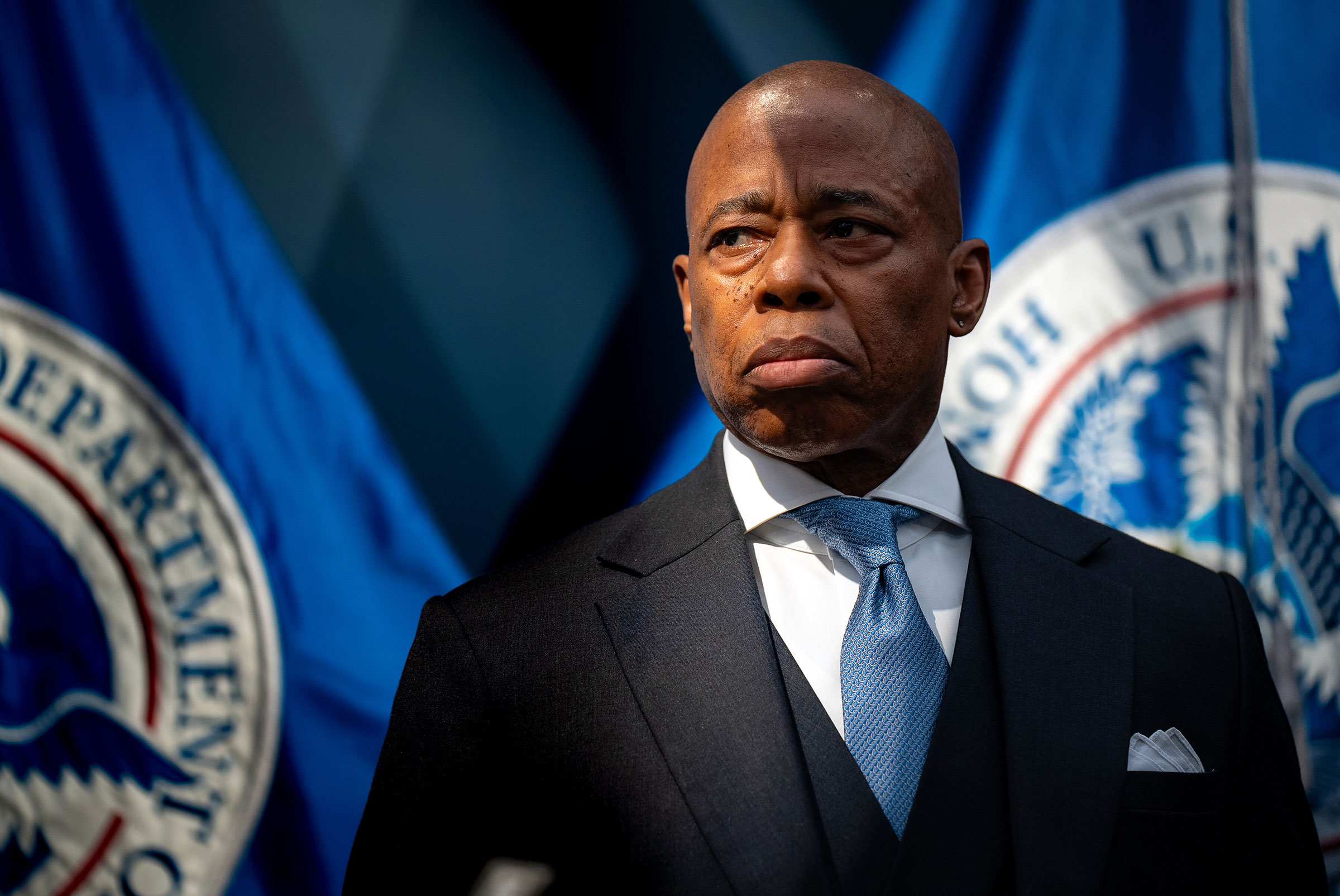
What to Know About Prince Andrew’s Epstein Fallout
Feed:
TIME
(https://time.com/feed/)
Published: 2025-10-31 09:00:00
|
Created: 2026-08-04 08:23:55
Prince Andrew, the British royal with ties to Jeffrey Epstein, has been stripped of his remaining titles and evicted from his royal residence, as Buckingham Palace faces mounting pressure to address his associations with the late sex offender.
In a statement Thursday, Buckingham Palace said that King Charles “has today initiated a formal process to remove the style, titles and honours” of his younger brother, who should now be referred to as Andrew Mountbatten Windsor. The palace said the former prince will also have to move out of the Royal Lodge mansion near Windsor Castle.
The removal of Andrew’s Prince title, which he has held since birth as the son of the late Queen Elizabeth II, comes after he had already given up his Duke of York title and his other honors earlier this month. But his association with Epstein attracted renewed attention after the recent publication of a posthumous memoir by one of Epstein’s victims, Virginia Giuffre, who alleged forced sexual encounters with Andrew when she was a teen, which the British royal has repeatedly denied.
Buckingham Palace said, “these censures are deemed necessary, notwithstanding the fact that he continues to deny the allegations against him.” It added: “Their Majesties wish to make clear that their thoughts and utmost sympathies have been, and will remain with, the victims and survivors of any and all forms of abuse.”
Royal historian Kate Williams described King Charles’ action against Andrew as a “huge moment in royal history.” The last time a prince or a princess was stripped of their royal title was in 1919.
Here’s what to know.
How did Prince Andrew get here?
Several outlets cite palace sources saying that Andrew’s “serious lapses of judgement” have been a source of anxiety for a Buckingham Palace rocked by scandals in recent years.
Andrew has faced intense scrutiny over his relationship with Epstein. In a disastrous 2019 interview with the BBC, he asserted that he stopped all contact with the disgraced financier in December 2010. Days later, Andrew announced that he would step back from royal duties in what some assumed to be damage control.
In January 2025, however, Bloomberg News obtained a legal filing showing that Epstein had been in contact with Andrew at least through email until February 2011. The filing reportedly showed emails where the two discussed press reports, and Andrew wrote they should “keep in close touch and we’ll play some more soon!!!!”
Earlier this month, British media further reported on that exchange, which came after a 2001 photo of him and a young Giuffre at the London townhouse of Epstein’s then-girlfriend Ghislaine Maxwell was first published. “I’m just as concerned for you! Don't worry about me! It would seem we are in this together and will have to rise above it,” the Feb. 28 email reportedly said, which was signed off with “A, HRH The Duke of York, KG.” The email reportedly came from Andrew’s official email address.
The scandal escalated after excerpts of the memoir by Giuffre, who died by suicide earlier this year, alleged that she had sex with Andrew three times, with the third time in an “orgy” on an island Epstein owned in the U.S. Virgin Islands. Andrew had claimed he did not even remember meeting Giuffre in the 2019 BBC interview, and his lawyers have tried to get a civil suit she filed in 2021 dismissed. (In early 2022, an out-of-court million-dollar settlement had been reached between Andrew’s and Giuffre’s camps, without Andrew admitting liability.)
“‘I was around 18,’ I said in a sworn declaration in 2015,” Giuffre wrote in Nobody’s Girl: A Memoir of Surviving Abuse and Fighting for Justice, which was published Oct. 21. “‘Epstein, Andy, and approximately eight other young girls and I had sex together. The other girls all appeared to be under the age of 18 and didn’t really speak English. Epstein laughed about how they couldn’t really communicate, saying they are the easiest girls to get along with.’”
She also reflected on how Andrew allegedly behaved during their sexual encounters. “In the years since, I’ve thought a lot about how he behaved. He was friendly enough, but still entitled–as if he believed having sex with me was his birthright,” Giuffre wrote.
With Andrew’s Epstein-related controversies proving an unwelcome distraction from the British royal family’s work, he gave up his Duke of York title and other honors on Oct. 17, a decision he reportedly made with consultation from King Charles.
But another issue quickly followed, this time, centered on his living arrangements. The Times of London published a report on Oct. 21 that found Andrew’s lease agreement on the Royal Lodge, a 30-room property that his family moved into in 2004 and was set to live in until 2078, only required him to pay an annual rent of “one peppercorn (if demanded)” after he had paid at least £8.5 million (more than $11 million) upfront, prompting rare questioning from the British parliament. Fanning the flame was an Oct. 27 BBC report that revealed Andrew hosted Epstein, Maxwell, and disgraced film producer Harvey Weinstein at the Royal Lodge during his daughter’s 18th birthday celebration in 2006.
Earlier this week, while King Charles was visiting Lichfield Cathedral, a heckler screamed, “How long have you known about Andrew and Epstein?” and “Have you asked the police to cover up for Andrew?”
An unnamed royal source told the Telegraph that King Charles “acted swiftly” after revelations of Andrew’s ties to Epstein, but he recognized that there was a need to have a longer-term solution. The broadsheet reported that the decision to strip him of his title followed almost two weeks of negotiations before Andrew agreed to it on Thursday. The paper also reported that William, Prince of Wales, who is next in the line of succession, was “fully supportive” of how his father handled the issue over his uncle, citing an unnamed Kensington Palace source.
Impact on the royal family
Andrew henceforth no longer has the Prince title, and the order also applies to his other titles of Duke of York, Earl of Inverness, Baron Killyleagh, and the style “His Royal Highness.” The honors affected are his Order of the Garter and Knight Grand Cross of the Victorian Order.
It is very rare for princes and princesses to lose their titles. King Henry VIII removed the princess titles of his daughters—later Queens Mary I and Elizabeth I—after he annulled his marriages with their mothers. And, in 1919, under the Titles Deprivation Act of 1917, Prince Ernest Augustus, Duke of Cumberland and Teviotdale, a Prince of Hanover and of the U.K., had his British title removed after having sided with the Germans during World War I.
In 1936, just months after ascending to the throne, King Edward VIII abdicated to marry divorced American socialite Wallis Simpson. He kept the title Duke of Windsor but lived in exile outside Britain.
Williams, the historian, told Sky News that Andrew’s situation was unique given how “he’s lost his title as a consequence of … ‘errors of judgement.’”
Princesses Beatrice and Eugenie, Andrew’s daughters, will retain their titles under King George V’s Letters Patent of 1917, as children of the sons of a sovereign.
Andrew remains eighth in the line of succession to the throne, though he may be removed by an Act of Parliament and the consent of the 14 other countries that are part of the realm of the U.K. monarchy.
As for his lodging, Andrew is set to relocate to a property on the Sandringham estate in Norfolk, according to the Telegraph, while his ex-wife, Sarah Ferguson, who continued to live at Royal Lodge with Andrew even after their 1996 divorce, will need to sort out her own living arrangements. Until this month, Ferguson had used the title Duchess of York, but said she will revert to using her name after Andrew was stripped of his Duke of York title.
Giuffre’s family’s reaction
The strongest response came from Giuffre’s family. “He’s just Andrew, he’s no longer a Prince, and she is celebrating from the heavens right now,” Sky Roberts, Giuffre’s brother, tearily told the BBC in an interview. “This normal girl from a normal family has taken down a prince. We are so proud of her.”
At the same time, Roberts said Andrew ought to face more consequences. “He needs to be behind bars—period,” Roberts said.
Roberts’ wife Amanda added that this was “truly a moment for [Giuffre] and all survivors,” but she also suggested that the U.S. government should do more. Congressional Democrats released partial records of Epstein-related files in September, which showed the late sex offender had ties with prominent figures globally, including Prince Andrew.
The Trump Administration, however, has stalled any further development on the Epstein case, as President Donald Trump’s ties to him have prompted calls for transparency from both his opponents and some allies.
"The U.S. government hold the key to the larger scope of the Jeffrey Epstein case,” Amanda said. “Prince Andrew may be just one of those people that are implicated. And I do believe if he’s willing to come forward now and cooperate, it will lead to the larger scope of what really gone on here because there’s so many people that need to be held accountable. And again, the U.K. is setting an example for what the U.S. should be doing right now.”
Trump Pushes to Scrap the Filibuster to End the Shutdown. Here’s What Republicans Have Said About It
Feed:
TIME
(https://time.com/feed/)
Published: 2025-10-31 17:51:39
|
Created: 2026-08-04 08:23:55
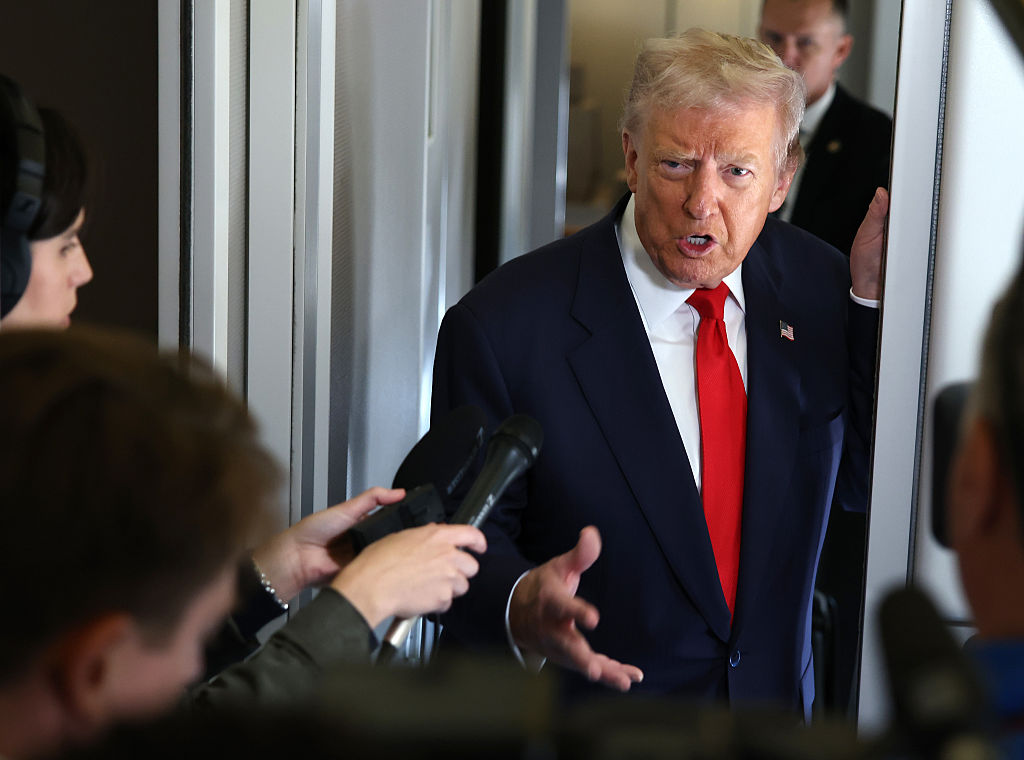
President Donald Trump is calling on Republicans to get rid of the Senate filibuster to end the government shutdown—but many in his party are pushing back.
“It is now time for the Republicans to play their ‘TRUMP CARD,’ and go for what is called the Nuclear Option—Get rid of the Filibuster, and get rid of it, NOW!” Trump posted on Truth Social on Thursday night. “If we did what we should be doing, it would IMMEDIATELY end this ridiculous, Country destroying ‘SHUT DOWN.’”
The shutdown, which started on Oct. 1, is already the second longest in U.S. history and still has no clear endpoint in sight. If the shutdown continues into next week, it will become the longest one in history, breaking the previous record of 34 days set during Trump’s first term.
Some GOP leaders have previously suggested ending the filibuster, which allows the minority to block legislation by drawing out debate, effectively creating a 60-vote threshold for passing most bills. Sen. Bernie Moreno, an Ohio Republican, said in an interview on Fox News earlier this month, “Maybe it’s time to think about the filibuster,” saying that eliminating it would “open the government” again.
But many lawmakers within the President’s party have dismissed the idea of eliminating the filibuster, emphasizing its importance.
Senate Majority Leader John Thune has previously said it would be a “bad idea” to get rid of it.
“The 60-vote threshold has protected this country,” he said earlier this month. A spokesperson for Thune told POLITICO on Friday that Thune’s stance on the issue has not changed.
Sen. John Curtis, a Utah Republican, said on X on Friday, “The filibuster forces us to find common ground in the Senate. Power changes hands, but principles shouldn’t. I’m a firm no on eliminating it.”
House Speaker Mike Johnson, who is not directly involved in Senate business, warned against ending the filibuster in a press conference on Friday, though he added that his opinion on the issue “is not relevant.”
“The filibuster has traditionally been viewed as a very important safeguard,” Johnson said. “If the shoe was on the other foot, I don’t think our team would like it.”
Johnson didn’t openly criticize the President on the issue, but suggested that Trump’s remarks come amid frustration over how long the shutdown has lasted.
“What you’re seeing is an expression of the President’s anger at the situation,” Johnson said. “He is as angry as I am and the American people are about this madness, and he just desperately wants the government to be reopened.”
Доверие корневому сертификату с ограниченным списком хостов в Chrome
Feed:
Все публикации подряд на Хабре
(https://habr.com/ru/rss/articles/)
Link:
https://habr.com/ru/articles/1066372/?utm_source=habrahabr&utm_medium=rss&utm_campaign=1066372
Published: 2026-08-04 08:21:40
|
Created: 2026-08-04 08:22:58
В Сhrome (и практически всех chrome-подобных браузерах) достаточно давно есть политика CACertificatesWithConstraints, которая, в том числе, позволяет доверять конкретному корневому сертификату только для фиксированного списка доменов. Сам сертификат при этом не требуется размещать в системном корневом хранилище. Это актуально для текущих проблем с отзывами сертификатов и переходом банков на корневой Минцифры https://habr.com/en/news/1066284/
Читать далееA Positive HIV Test Shattered His Dreams of Serving in the U.S. Army. Now He's Suing
Feed:
TIME
(https://time.com/feed/)
Published: 2022-12-01 17:06:10
|
Created: 2026-08-04 08:17:56
One cold winter morning in 2008, 8-year-old Isaiah Wilkins decided to try on his mother’s National Guard uniform, something he always wanted to do. She was away at training in Texas, but she kept an extra uniform at home in Temple, Georgia.
Young Isaiah climbed up to the attic of his parents’ single-story house and spotted the blue 30-gallon bin where his mother stored her military clothes. He unclicked the clips on the sides, lifted the lid, and rummaged through the neatly organized items. After carefully shuffling through a few patches and her combat boots, he spotted her uniform.
He unfolded the garment and draped it against his own body to see if it fit. He turned it around and moved his fingers across the digital camouflage pattern, feeling the stitched texture of the American flag on the right sleeve. The boy was captivated. He quickly slipped it on. He was already almost as tall as his mom, 4’11”, so it fit perfectly.
Isaiah ran to the bedroom where his stepfather, Daren, was sleeping. He woke him up. He didn’t just want to show him the uniform, he wanted Daren to drive him to the nearby Waffle House, 10 minutes down the road. It was where all the local veterans gathered for coffee and breakfast in the early morning.
They sat down at the restaurant chain and Isaiah ordered two classic waffles with butter and maple syrup. While he waited for his breakfast, Isaiah walked from table to table, chatting with veterans. Most had fought in the Vietnam War. They smiled and chuckled at the uniformed 8-year-old. The fact that someone so young was taking an interest in them was both amusing and flattering. The child was spellbound by their stories of how they risked their lives for the freedom of Americans. He wanted to be just like them one day, telling his own stories about how he was a hero, fighting for his country.
More from TIME
The military was also in his blood. On his mother’s side, he had ancestors who fought in every American military campaign dating back to the Civil War. His mother, Stephanie Womacks, was in the Georgia National Guard. Before that, she was a communications specialist in the Army, and had been deployed to Saudi Arabia during the First Gulf War in 1991.
By the time he was a teenager, Isaiah knew he wanted to become a Blackhawk helicopter pilot in the Army. He dreamed of flying the aircraft that would land on a battlefield and help save another soldier’s life.
He also knew that he was gay and that Temple was no place for a gay man. He wanted more for himself. The military, he thought, would be his way out.
By age 17, Wilkins dropped out of high school, earned his GED, and enlisted in the Georgia Army National Guard. He enrolled in Georgia Military College (GMC) and took out a loan contingent upon him completing eight years of military service.
After two years, he performed so well at GMC that West Point took notice. The famed military academy accepted him into its prep school, a one-year program to sharpen his academics, before matriculating into the four-year academy as a freshman. As part of the agreement, he signed an additional one-year contract with the Army as a new enlistment. He was overjoyed. He had made it out of his small, rural Georgia town and was going to attend West Point and serve his country.
But his dreams were soon shattered. Shortly after he entered West Point Prep, he tested positive for HIV, was discharged, and was banned from re-enlisting. His paperwork reflected that he simply finished his one year contract with West Point, not that he was discharged for HIV.
Living with HIV automatically disqualifies a person from joining the armed forces. That means there’s no record of the number of people who have intent to enlist but don’t even try because they know there’s no point, due to Department of Defense (DOD) policies.
And those policies cost more to those rejected than a professional opportunity. At his exit screening from the Army, Wilkins was diagnosed with a combination of anxiety and depression, which he attributes to his discharge. Additionally, he is expected to pay back $16,427.42 to the government, because he only completed three of his eight years of his service commitment before being discharged.
Despite the ban, Wilkins has not given up on his dream. On Nov. 10, 2022, Lambda Legal, a legal organization focused on LGBTQ+ civil rights, filed a class-action lawsuit against DOD over its policy banning civilians living with HIV from joining the military. Wilkins is the named plaintiff.
This isn’t Lambda Legal’s first fight against the military’s HIV policy. In April, it won a class-action lawsuit against DOD forcing it to change part of its HIV policy. Previously, the roughly 2,000 service members living with HIV (SMLWH) were banned from deploying or commissioning as officers, effectively stunting their military careers. A federal judge found that this part of the policy was in violation of the Equal Protection Clause of the U.S. Constitution, forcing DOD to update its policy in June 2022. Current military personnel with an undetectable viral load can no longer be denied the opportunity to deploy or to commission based on HIV status.
However, civilians with an undetectable viral load are still not allowed to enlist. Lambda and Wilkins are now suing to repeal this last piece.
In the meanwhile, the DOD’s rollout of its policy change has not been smooth. Sergeant Nick Harrison, the plaintiff in that landmark victory served in the military for 22 years, including two combat tours of duty: one in Afghanistan in 2006 and another in Kuwait in 2011. In 2013, he was offered his dream job in the National Guard: the JAG position (a military lawyer). But, in order to take it, he needed to be commissioned as an officer—a commission he was denied because of his HIV status.
After his court victory, the military was mandated to re-evaluate Harrison’s original application from 2013. But his National Guard recruiter informed him that he would need to reapply with a new application. Harrison didn’t know why, and DOD has not facilitated a set of formal next steps. “No one has shown up to help me. There is no process for how this should be resolved,” Harrison says. Indeed, a spokesperson for DOD, Charlie Dietz, says, “The DOD is not providing guidance to the services on this at this time.”
The policy that impeded the careers of men like Harrison and Wilkins has also caused the military to lose talented personnel. According to a 2015 study by the Armed Forces Medical Surveillance Monthly Report, the military’s own peer-reviewed journal, at least 25% of SMLWH leave the service within the first 16 months of diagnosis.
Read more: For HIV/AIDS Survivors, COVID-19 Reawakened Old Trauma—And Renewed Calls for Change
Wilkins can’t forget the day he received his HIV diagnosis. He was one month into his time at West Point Prep standing in front of an obstacle course on a rainy August day. It was part of a grueling physical fitness test he had to complete with his team of other plebes: jumping hurdles and crawling through mud; pushing a Humvee up a hill; and then running a mile—all in the rain.
He was mentally preparing, breathing in the smell of wet grass, when he got a tap on his shoulder. “Come with me, cadet. You have a doctor’s appointment,” the sergeant said. Wilkins was reluctant to leave his team and go to the clinic. They were relying on him. He asked the sergeant if it was urgent. “Now,” the sergeant replied. Wilkins was confused. What could this doctor’s appointment be about and why was it so time-sensitive? He had just taken his entrance physical exam, and he felt strong and healthy.
He followed the sergeant for a few minutes before he realized that they were not going to the clinic. They passed the break room just outside of the commandant’s office. It was usually buzzing with chatter, but it was uncomfortably silent now. Four officers stood inside watching him in silence.
Inside the office, the commanding officer of the school hospital and a public nurse were waiting for him. There was an exact model of the helicopter he dreamed of flying, a UH60 Black Hawk, on the desk. The office also had a big window overlooking the track that was part of the obstacle course. He yearned to be with his teammates. The officer introduced herself. “On the first day you were here, you had some blood drawn,” she began. “We test for a variety of things.” She was trying her best to make him comfortable, but he was feeling knots in his stomach. “We got the results of your blood test back. You tested positive for HIV,” she said.
“Can I have a moment?” Wilkins asked. It wasn’t so much a question. He stood up and stepped out of the office and into the hallway. He lifted up his hands to cup his face and began sobbing. He didn’t know much about HIV. All he knew was that it was the one thing as a gay man he never wanted. His only understanding of it was that people with HIV die painfully and alone. He composed himself and returned to the office. “Will I be kicked out for this?” he asked. “We will address everything one thing at a time,” said the nurse.
The nurse told him that people living with HIV, who are treated, live long and healthy lives—and then made him list every sexual partner he ever had, providing names and phone numbers. He felt humiliated. The nurse then instructed him not to tell anyone on campus about the meeting or about his HIV status so as to avoid inciting fear within the unit. As he listed the names of his former sexual partners, he stared at the Black Hawk model on the commandant’s desk.
Later that day, Wilkins met with the battalion tactical officer at the prep-school. “Well son, unfortunately you won’t be able to stay here,” he recalls the officer saying. “You’ll be discharged. We want to get you home to get the medical help you need.”
Home was the last place Wilkins wanted to be. Temple, Ga. was the kind of place where gay men grew up to marry women and have children. It was also a place where gossip spread quickly.
So Wilkins vowed to stay and fight back. He knew that in some cases, the military granted waivers, and thought he might be a strong candidate for one. He learned that while on treatment, his HIV would not progress and wouldn’t be transmittable to anyone else either. He had also proudly served his country for two years already in the National Guard, and was on track to attend West Point. Surely, the chain of command would see the value in letting him stay. He spent the rest of that academic year living at West Point but separated from the other students, and trying to win a waiver to return to class.
He tried his best to get in touch with an army lawyer to help him understand his next steps, but she didn’t respond to his emails. Major Jeremiah Ellis, deputy commandant of West Point Prep, became Wilkins’ strongest advocate. Ellis had survived a combat injury to his spine in 2009 when a rocket exploded behind his seat in Afghanistan; he joined West Point Prep in June 2018, and was passionate about training the next generation of soldiers. He met Wilkins because, as part of his job, he was assigned to oversee the plebe’s administrative discharge. But as he began getting to know Wilkins and his story, he was inspired by him and saw great potential. Ellis began pushing for Wilkins to receive a waiver but ran into resistance from his colleagues.
“My fear was that it was discrimination,” says Ellis. “I’m not sure he would have been treated the same way if it was cancer. People’s perception of him was that, because he was gay, HIV was a product of his choices.”
But Ellis only had so much power and ultimately, Wilkins was discharged. “To lose him as a future leader for the Army was a shame,” says Ellis. “He was absolutely the kid that I could see leading our soldiers one day.” Heartbroken, Wilkins tried to move on. He transferred to Wesleyan University in Connecticut the next year with a full tuition scholarship from the Posse Foundation, a nonprofit that looks for leaders from diverse backgrounds and communities. But the costs of housing and books were still too high for him. He was forced to drop out after just one semester.
To avoid going home, he moved in with a close friend, Dominique Schwartz, who lived two hours east of Temple. Wilkins desperately needed a job to pay his portion of the rent, so he became a correctional facilities officer in Milledgeville, Georgia. The $13 an hour he earned was not enough to cover his expenses so to make ends meet, Wilkins started delivering food for Uber Eats when he wasn’t working at the county jail.
Depression crept in. “There were days where it was so difficult to get out of bed, to even open up the curtains,” he says.
Schwartz noticed, too. She knew Wilkins as vibrant and charismatic. Before leaving for West Point, they would spend all their weekends together. “We’d be at the pool all day, laughing and eating pizza,” says Schwartz. She also admired his caring nature. “He was the first person I told when I was pregnant. We processed it together.” She was worried about how much the discharge had derailed his life. “It ruined everything. It took away his financial security, his purpose, and his self-worth. He had always wanted this,” says Schwartz.

Depression is not uncommon. A 2012 study published by the Armed Forces Medical Surveillance Monthly Report found that almost 57% of SMLWH received a diagnosis of a mental health disorder six months after their HIV diagnosis.
Licensed clinical psychologist Tiffany Lange, who worked at the U.S. Department of Veterans Affairs for seven years as a psychologist, specializing in LGBTQ+ veterans, has seen similar responses in many of her patients. “Coming into contact with a loss of career as a result of discrimination can certainly lead to a diagnosable disorder like depression, anxiety, or PTSD, and in some cases, suicide,” she says.
Lange is encouraged by the change in policy allowing current HIV+ personnel to deploy and commission, but says education will be critical to a successful rollout. “If service members don’t understand that U=U, there will still be fear that active duty SMLWH are a danger on and off the battlefield,” she says. U=U stands for undetectable=untransmittable, and is a term used by the National Institute of Allergy and Disease Control to indicate that a person with an undetectable viral load of HIV cannot transmit HIV.
Read more: HIV Used to Be a Death Sentence. Here’s What’s Changed in 35 Years
Undetectability is achieved and maintained by taking a daily pill of HIV antiretroviral therapy. This means that when a service member is diagnosed and treated, there is effectively no risk of transmitting HIV to anyone else; it was the basis of Lambda Legal’s successful argument in Harrison’s case. In Wilkins’ case, they argue that a civilian with an undetectable viral load would similarly pose no threat of transmitting HIV to others, were they admitted into the armed services.
DOD’s lack of central direction on HIV policy has resulted in a disjointed approach to U=U education across the branches. Some, like the Army’s Medical Department (MEDCOM) have articles on U=U, whereas others, like the Navy Marine Corps Public Health Center website and the Air Force Medical Service website have no mention of it at all. DOD’s own Defense Health Agency website has no mention of U=U as of publication either.
When asked why SMLWH could serve without restrictions but civilians couldn’t enlist, Dietz, the DOD spokesperson, said that there is a working group “looking into this and may release updated guidance upon conclusion of their investigation.” DOD has not disclosed who is in the working group, and what their medical and military credentials are.
Ray Mabus, Secretary of the Navy from 2009-2017, wrote a 2019 op-ed for the Washington Post advocating for SMLWH to serve without restrictions. Mabus was pleased with DOD’s policy update but feels differently about enlistment, citing cost. “Once you sign up, the military is saying they will take care of your medical bills for the rest of your life,” says Mabus.
Scott Schoettes, one of the attorneys on Wilkins’ case who helped win Harrison’s case earlier this year, says that’s a weak argument. “Cost is a drop in the bucket for them. And the federal government already pays for a lot of HIV-related care for people who are not serving in the military.” Indeed, according to the Department of Health and Human Services, the federal government provides free HIV care and treatment to approximately 50% of all people diagnosed with the condition in the U.S.
Other advocates argue that the military’s resistance is connected to a history of unfairness against LGBTQ+ people. “Much of the resistance is because of the stigma and shame of being LGBTQ+,” says Jennifer Dane, executive director of Modern Military Association of America, the country’s largest LGBTQ+ military advocacy organization. The White House estimates there have been over 100,000 U.S. military discharges because of sexual orientation or gender identity.
But many LGBTQ+ service members are proud of the progress the military has made. Jaime Elizabeth Hash, a trans woman and a technical sergeant in the Air Force, was recently appointed to the Air Force’s working group that analyzes barriers faced by LGBTQ+ service members. “The military has always been at the forefront of social change,” Hash says. “I am proud to be part of an organization that values everyone’s service and dedication, but we still have work to do with supporting those living with HIV.”
Schoettes believes that if they win the case, it will have major effects on the country. “If the military is welcoming to people living with HIV, workplaces everywhere will see people living with HIV as less of a danger,” he says. “For many Americans, this will reduce the shame of disclosing their status and even getting tested all together.”
As for Wilkins, his HIV is undetectable, and he has largely overcome his depression and anxiety after several years in therapy, since his discharge. He’s also enrolled in a two-year program to train as a commercial pilot. But he still wants to live his dream. He hopes that the military will change its policy.
“I don’t want to give up until I’ve tried everything I can possibly try, ” Wilkins says. “It’s still my dream to serve my country.“
Iran's Water Crisis Will Make It Harder for the Regime to Regain Control
Feed:
TIME
(https://time.com/feed/)
Published: 2022-12-08 16:23:20
|
Created: 2026-08-04 08:17:56

Iran’s government has spent this week trying to quell the protests that have rocked the country for the last three months. Officials put out several statements about unconfirmed plans to “review” the country’s hijab requirement for women and “disband” the morality police—two key factors in the Sept. 16 death of 22-year-old Mahsa Amini, which initially sparked the unrest.
So far, it hasn’t worked. On Monday, protesters launched a three-day general strike, designed to show that their uprising was never only about the restrictions placed on women. Iranians are also angry about poverty, economic dysfunction, corruption, a lack of freedom—a litany of government failings that mean many of the young people leading the rallies say they have “no future” as long as the Islamic regime remains in power.
Those failings also include the environment. The regime has disastrously mismanaged Iran’s water resources in the decades since the 1979 revolution. In a push for food self-sufficiency to shield the country from Western sanctions, authorities have championed a shift to unsustainable agricultural practices: they oversaw an expansion of water-intensive crops like sugar beet and a frenzy of poorly planned dam-building, and later well-digging, to collect water for irrigation. They also diverted rivers to provide water for heavy industries like steel manufacturing. These measures have overwhelmed the natural water cycle, drying up aquifers, rivers, and wetlands. The mismanagement, combined with climate change, caused the worst drought in half a century in 2021.
Read More: The Women of Iran are TIME’s 2022 Heroes of the Year
The water crisis is not the focus of the current demonstrations, which have mostly been led by city dwellers whose livelihoods are unlikely to be directly affected. But it is part of the accumulated anger now being unleashed. On the streets and on social media, protesters have referenced the dried up Urmia salt lake and Zayandeh Rud river, which have emerged as symbols of the regime’s incompetence. Other environmental problems, like air pollution, are cited as motivations for rebellion in viral protest anthem Baraye (“Because of”).
More from TIME
Environmental challenges can be a “uniting” factor for Iranians, says Kaveh Madani, a scientist who served as deputy head of the Iranian government’s environment department under former President Hassan Rouhani, before fleeing to the U.S. in 2018 amid a crackdown on environmentalists. “Everyone is unhappy when a big wetland dries up. It brings everyone together,” Madani says. “This is why the environmental activists have been targeted by Iran’s security agencies so much.”
A version of this story first appeared in the Climate is Everything newsletter. To sign up, click here.
Water’s growing threat to Iran’s regime
Even if the regime manages to stymie the current urban-led unrest, it won’t be long before the next June-August dry season carries the risk of new water shortages in rural areas, which for the last two years have triggered protests among farmers—potentially mobilizing a demographic that has not been as drawn to the women’s rights cause. In late November, hacking group Black Reward published what they claim is a leaked document from a news agency linked to Iran’s Islamic Revolutionary Guard Corps, in which officials express concern that water shortages could spark demonstrations in several provinces.

Discontent over water is only likely to grow. Climate change is making Iran hotter and drier, exacerbating the human-made problems. A 2019 study on Iran’s climate outlook for 2025-2049, published in Nature, found “a grim picture” of increasingly severe droughts and floods, with the driest regions potentially becoming uninhabitable.
Climate campaigners say the government’s efforts to avert that situation, including a restoration program for Urmia, have largely relied on unsustainable solutions like diverting water from under-used basins. Truly ensuring water security for Iran would require radical reforms to diversify the economy from agriculture and other water-intensive industries—something today’s political system makes all but impossible, according to Madani. “No president within the current structure can address the environmental problems.”
All of that will make it harder and harder for the government to prevent unrest from boiling over in Iran in the future, Madani adds. “Water is affecting the resilience of the system. They’re close to their tipping point.”
The War in Ukraine Is Emboldening Germany’s Far Right
Feed:
TIME
(https://time.com/feed/)
Published: 2022-12-09 15:08:10
|
Created: 2026-08-04 08:17:56
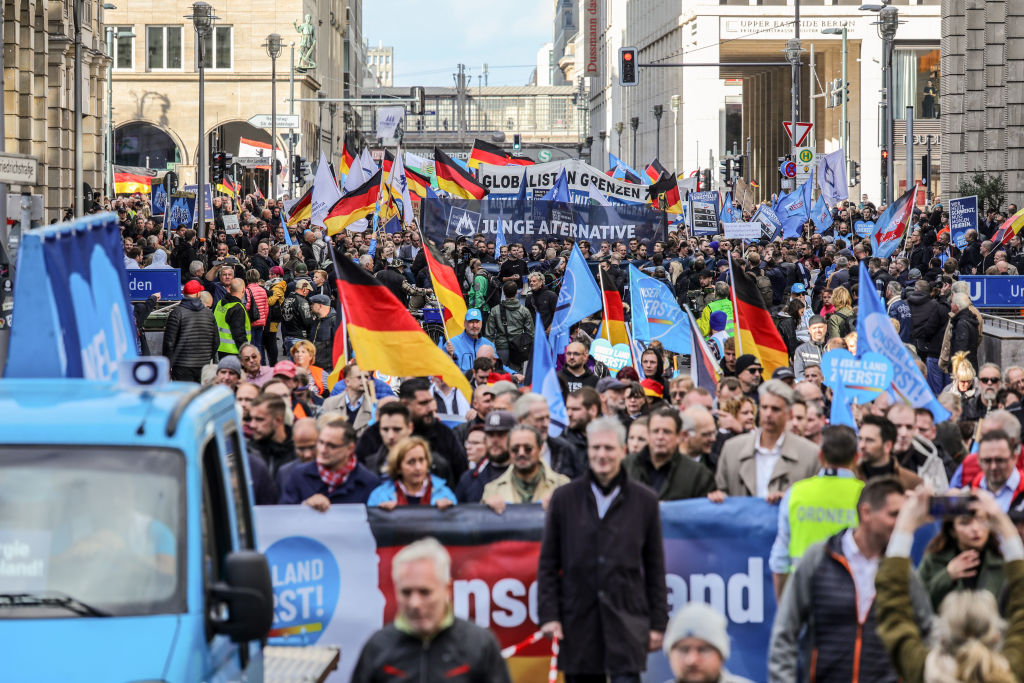
“We are the people! We are the people!”
Replete with boos, cheers, a brass band, and even a puppet show, this weekly gathering in the small eastern German city of Zittau could be easily mistaken for a pantomime performance. But the messages and ideas spread at the cobbled square in front of city hall are deadly serious: flags of far-right groups dot the scene as speakers rile up a crowd of 600.
“How did an ideology-driven elite manage to completely destroy the livelihoods of such a well-educated people as the Germans?” shouts Karin Viehweg, a far-right activist in her late 50s, over the loudspeaker in late November, nodding to the cost-of-living crisis and Germany’s left-leaning government led by Chancellor Olaf Scholz. “The citizens of the GDR didn’t go into the streets in 1989 to land in a new Red-Green socialism, did they?” she adds, referring to the Communist and Soviet-backed German Democratic Republic that ruled East Germany from 1949 to 1990. As Viehweg speaks, the crowd holds up posters demanding an end to arming Ukraine and restarting gas imports from Russia, calling sanctions “economic suicide.”
These demonstrations, held every Monday, have popped up all over eastern Germany—styled after weekly protests in the 1980s against the GDR. While the protests began in 2020 over COVID-19 lockdowns, they have swelled in recent months as anger mounts in Germany amid the economic fallout from Russia’s invasion of Ukraine. The Alternative for Germany, a far-right party, is a regular fixture at these demonstrations. The party has opposed arming Ukraine or sanctioning Russia—a position that is resonating with some voters as the AfD polls at near-record levels nationally and looks poised to come first in some state elections in 2024.
More from TIME
Read More: Volodymyr Zelensky Is TIME’s 2022 Person of the Year
Concerns over the far-right’s rise only grew larger this week, after 25 people were arrested Wednesday, including a former AfD MP, over plans to storm parliament. German officials said they expect more arrests to follow. That the coup planners had reportedly wanted to try to negotiate with Russia as soon as they took power has placed a larger spotlight on how the far-right in Germany—if not much of Europe—is being emboldened by the war in Ukraine.
“Cloud cuckoo land”
Overlooking the marketplace where protesters have gathered, in the towering yellow Zittau city hall that dates back to the mid-19th century, is mayor Thomas Zenker’s office. The 47-year-old has had a busy day trying to prepare the town in case energy shortages result in blackouts—a growing fear since Russia drastically reduced supplies to Europe. Unlike the protesters outside, Zenker does not blame Ukrainians or NATO, but rather the political establishment that made Germany so dependent on Russian gas. “We were living in Cloud Cuckoo Land,” he says. The mayor expresses irritation by a statement from Minister President of Saxony Michael Kretschmer that eastern Germans, or “Ossis,” think differently about Russia. “I remember how hated the Russians were in the GDR. They were the occupiers,” he says.
Zenker, who sports long, pointed sideburns and jet-black hair, could pass as a rock musician. But the Zittau native founded the independent voters’ coalition “Zittau can more!” in 2013 and ran for mayor after returning home to Saxony from stints abroad and in Berlin. Initially, his goals were to invest in education, promote international cooperation with neighboring Czechia and Poland, and entice people back to Zittau (the city’s population has halved since German reunification in 1990). But Zenker found himself locked in a struggle with the AfD and other fringe groups when the COVID-19 pandemic began; a struggle that has continued with Russia’s invasion of Ukraine. “There are people on the stage who you hear—and you ask if they live in the same world as us. ‘Great Replacement’ is normal by now. The reptilians are practically the only thing that haven’t come up yet,” he says, referring to two conspiracy theories espoused on the far-right.
Zenker blames much of the dissatisfaction driving the protests on unrealistic expectations set under East German socialism, which he says provided excellent public services but was financially unsustainable.
Robert Grünbaum, deputy director of the Federal Foundation for the Study of the Communist Dictatorship in Eastern Germany, agrees. “But at the same time, eastern Germans do not want to have anything to do with the state, and really distrust ‘those up there’,” he says. “The GDR saw itself as an anti-fascist state, so therefore, the Communist leadership didn’t see a need for dealing with the [Nazi] past… while keeping silent about right-wing extremism and racism.”
Today, eastern Germans are more likely to be critical of the West’s foreign policy. A recent poll shows that almost 60% agreed or partially agreed that the “Russian invasion of Ukraine is justified by NATO provocation.” Only half as many western Germans said the same.
Read More: Exclusive: Chancellor Olaf Scholz on a New Era for Germany
Indeed, many who gather outside Zenker’s office after marching the old boundaries of Zittau’s city wall see the mayor, and even Germany’s entire political system, as the enemy. One young man with a shaved head and face tattoos waves a placard urging to “overthrow tyrants” like Zenker and Scholz. Hermann Büll, a demonstrator in his 70s, describes the political situation today in Germany as “totally unequivocally scheisse. I’m a pensioner and in the east pensions are lower. After reunification, many lost their jobs, and the prices of everything are going up.”
The number of attendees has surged since the war in Ukraine began, according to Heiko Eksner, a tall, bearded man in his early 40s. Eksner was one of the first of just eight people to take part in the march in Zittau over two years ago; he has attended almost 200 by now. Eksner says “many here vote AfD” but that this is “an independent citizen’s initiative.” Freie Sachsen, a far-right group who support Saxon independence (“Säxit”), are also waving flags.

Town councilor Elke Koppatsch hangs at the edge of the demonstration. A member of the Left Party, Koppatsch says that many here are simply angry because the war is hurting pocketbooks. She says she met with a couple of demonstrators recently to hear their concerns, and helped them get sick pay they had been denied. “It’s hard work though,” Koppatsch admits. The Left Party, which like the AfD is more popular in eastern Germany, is divided on the war in Ukraine and contains a vocal pro-Russia faction centered around populist Sahra Wagenknecht, who has called sanctions “an unprecedented economic war against our biggest energy supplier.”
One voter who represents this crossover between far-left and far-right is Christel, who TIME speaks to a week later in Magdeburg, the capital of the neighboring state of Saxony-Anhalt. A 70-year-old former cultural attache for the GDR in Muammar Gaddafi’s Libya, she says “the West started this war” and that, “if I hear the word ‘Ukraine’ one more time, I will puke.” Christel insists that she doesn’t like the AfD’s nationalism but agrees with their opposition to arming Ukraine. “You don’t create peace with weapons!” she says, quoting a slogan common in the German peace movement. (The GDR defined itself as a “peace state” built from the rubble of World War II.)
The far-right anger at Ukrainians
Although things are calm in Zittau in late November, Saxony is a hotbed of violent extremism. Shelters for Ukrainian refugees have been firebombed, and while the anti-fascist Antifa frequently clash with the far-right in Leipzig and Dresden, they have demonstrated against energy price rises on the same day.
Ukrainians have grappled with the hold of these far-right groups. Mariana Yaremchyshyna, 23, tells TIME that a small group of friends held two counter-protests at an AfD demonstration in September in Lubmin, in the eastern German state of Mecklenberg Western Pomerania, where the Nordstream 2 pipeline was due to bring gas from Russia. (German officials froze the project in February; mysterious explosions struck the Nord Stream pipelines in September but investigators have been tight-lipped over naming a suspect.) The AfD has made major inroads in the state, polling seven percentage points higher than in the last state election in 2019, just behind the ruling Social Democratic Party.
Read More: Inside the Historic Mission to Provide Ukraine Aid and Arms
The protesters covered their mouths with black tape and held up posters describing the suffering brought on by the war in Ukraine. Yaremchyshyna says people screamed at them and said they were “paid crisis actors.” One drunk older man came and ripped a poster from one of them. When the police searched him, she says, it turned out he was carrying a knife.
“It was very traumatic for us,” Yaremchyshyna recalls. “I couldn’t get out of bed the whole next day. It’s just unbelievably cynical and of course it’s very painful to hear this victim blaming. I lost my friend [in the war] but you know they won’t believe you, they will always find a reason to justify Russia and Russians.”
Yaremchyshyna is hardly alone in her experiences.
While protesting in Leipzig in October against Russia’s war in Ukraine, Anastasia, 21, was confronted by AfD counter-protesters screaming “Nazis out” at her and fellow Ukrainians. Later, a friend with Ukrainian car license plates received a note on the dashboard that read, “Asylum tourists please stay home!” Anastasia says the note came just weeks after Friedrich Merz, the leader of the center-right Christian Democrats, accused Ukrainian refugees of “social tourism.” She says she no longer feels safe wearing Ukrainian symbols on the street. “The colder it gets, the worse it gets,” she sighs.
How India’s Record-Breaking Population Will Shape the World
Feed:
TIME
(https://time.com/feed/)
Published: 2023-01-20 17:25:17
|
Created: 2026-08-04 08:17:56

On New Year’s Day in 2021, nearly 60,000 babies were born across India—the highest number of births given anywhere in the world that day, according to UNICEF. The record-breaking number also contributed to India being on track to become the world’s most populous country later this year.
On Wednesday, a newly-released U.N. report projected that India’s population of 1.428 billion will surpass China’s 1.425 billion in 2023. While the UN did not specify a specific date for the demographic crossover, a U.N. spokesperson told TIME that its Department for Economic and Social Affairs estimates this crossover will occur by July 2023.
Experts had already raised this possibility back in January based on estimates from the World Population Review, after China’s National Bureau of Statistics announced that the country’s total population declined by 850,000 between the end of 2021 and the end of 2022.
“There is no ideal population number for India, China, or any other country in the world. Far more interesting is how India and China can best unlock opportunities for their societies and economies, regardless of their size,” the U.N. spokesperson added.
The development marks a new phase in India’s growth on the global stage, riddled with the challenges of managing a rising population, but also an opportunity to “reimagine strategies and build on our successes to provide a healthy and happy life for its people,” Poonam Muttreja, the executive director of the Population Foundation of India (PFI), told TIME.
Read More: How a Historic March Could Revive India’s Opposition Movement
What’s behind India’s growing population?
The biggest factor behind India’s massive population is its young people: 650 million Indians—nearly half the country’s population—are below the age of 25. And experts estimate that India won’t hit its population peak until 2065, which means that even if the younger demographic produces only one or two children per couple, the population size will continue to increase over time before it stabilizes, driving what PFI calls the “population momentum.”
India’s historic lack of family-planning services also means that many Indian women aren’t able to have smaller families. Although India was the first country to adopt family planning as an official policy in 1952, a period of economic and social stagnation led former Prime Minister Indira Gandhi to suspend all civil liberties during The Emergency in 1975. A mass drive to sterilize men compulsorily was also launched, which became so unpopular as a population control method that for the next two decades, subsequent governments didn’t broach the topic of family planning at all. Instead, population control methods have focused on women: between 2013 and 2014, India carried out the majority of nearly 4 million sterilizations on women, according to government statistics. Until 2017, India’s public healthcare system also didn’t offer many contraceptive choices to men or women, something which Muttreja believes needs to change.
“We must empower our women to be able to decide if, when, and how many children to have,” she said.
Contrary to popular perception, however, India’s population growth rate has actually slowed down in the last few decades—from a 24.7% growth between 1971 and 1981 to a 17.7% growth between 2001 and 2011—due to the rising levels of education and healthcare, as well as the alleviation of poverty.
PFI adds that India can learn from China’s shrinking population by achieving low fertility rates without imposing further population control methods. “India must put an end to the noise around the possible introduction of a two-child norm,” said Muttreja, adding that a few Southern Indian states like Kerala, Tamil Nadu, and Andhra Pradesh have already achieved this by providing better access to education and development opportunities.

What impact will India’s population have on the country—and the rest of the world?
Becoming the world’s most populous country can signal a “paradigm shift” for India’s development, Muttreja said. That’s because the country’s younger population also comes with a huge potential to boost the economy—what economists usually call the “demographic dividend.” In 2021, the working-age population of India stood at a whopping 900 million, according to OECD data.
Almost 40 years ago, India’s population boom was described in menacing terms like “population explosion” and the “brain drain”, a reference to India’s young, skilled labor force that migrates to the West in search of better rewards for their potential. But SY Quraishi, who authored the book, “The Population Myth: Islam, Family Planning and Politics in India,” said that both these concepts have changed over time. Today, this same labor force has instead become what he calls “human resources,” or a boom to the Indian economy: “They are the CEOs of the world, and the source of an economic revolution that gives back 90 billion dollars in remittances from abroad,” Quraishi said.
More from TIME
This group isn’t just young, it’s also dynamic: it grew up in a market economy with access to the Internet and a hunger to compete on the global stage. Two-thirds of the Indian population has access to smartphones, thanks to cheap data plans in the last decade. “This generation of young Indians will be the largest consumer and labor source in the knowledge and network goods economy,” writes the U.S.-based Indian economist Shruti Rajagopalan.
And with rising tensions between China and the West, India has become an important player on the world stage. It will lead the charge on the G-20 this year, and as a founding member of the U.N., experts suggest it may even eye a permanent seat on the U.N. Security Council, of which China, but not India, is a permanent member. The country is also boosting production capacity by attracting international conglomerates like Apple, and turning smaller cities like Pune and Chennai into hubs of manufacturing, innovation, and technology.
Read More: China’s Aging Population Is a Major Threat to Its Future
What’s more, a decreasing skilled population across Europe and America has resulted in a shortage of manpower, making India’s population an asset that’s “politically important and indispensable,” Quraishi said. “Other countries may be hating India, but they love our market.”
But India has its challenges, too
Despite the obvious advantages of having a populous country, Quraishi added that the Indian government has failed to prioritize the upskilling of its young people, given that India’s labor force participation rate, which accounts for how much of the country’s working-age population works or wants to work, is it a mere 40%.
Millions of young Indians feel discouraged by their job prospects and actively decide to opt out of working, choosing instead to continue studying, stay home or rely on their family members for financial support. India’s high unemployment rate has hovered around 7 to 8% in the last year (rising from 5 to 6% in 2021), according to the Centre for Monitoring Indian Economy (CMIE), which has led to a shrinking workforce.
To absorb the young working population, India will need to create at least 90 million new non-farming jobs by 2030, a 2020 report by McKinsey Global Institute states. Muttreja and the PFI agree, noting that the government also needs to invest in a “time-bound manner” so that young people are productive and can contribute to the national economy.
“In order to leverage the demographic dividend, the country will have to place the youth at the center of its policies,” she said.
She added that India needs to include those who have traditionally been excluded from its development agenda in order to harness the full potential of its young people—notably, women who continue to have more children than they wish to have and, more broadly, the vast majority of women—by removing barriers to women’s agency and reproductive autonomy.
“India can do better by investing in women’s equity and economic development,” she said.
The Artist Behind the New MLK Jr. Sculpture Has a Message for Its Critics
Feed:
TIME
(https://time.com/feed/)
Published: 2023-01-21 15:42:08
|
Created: 2026-08-04 08:17:55
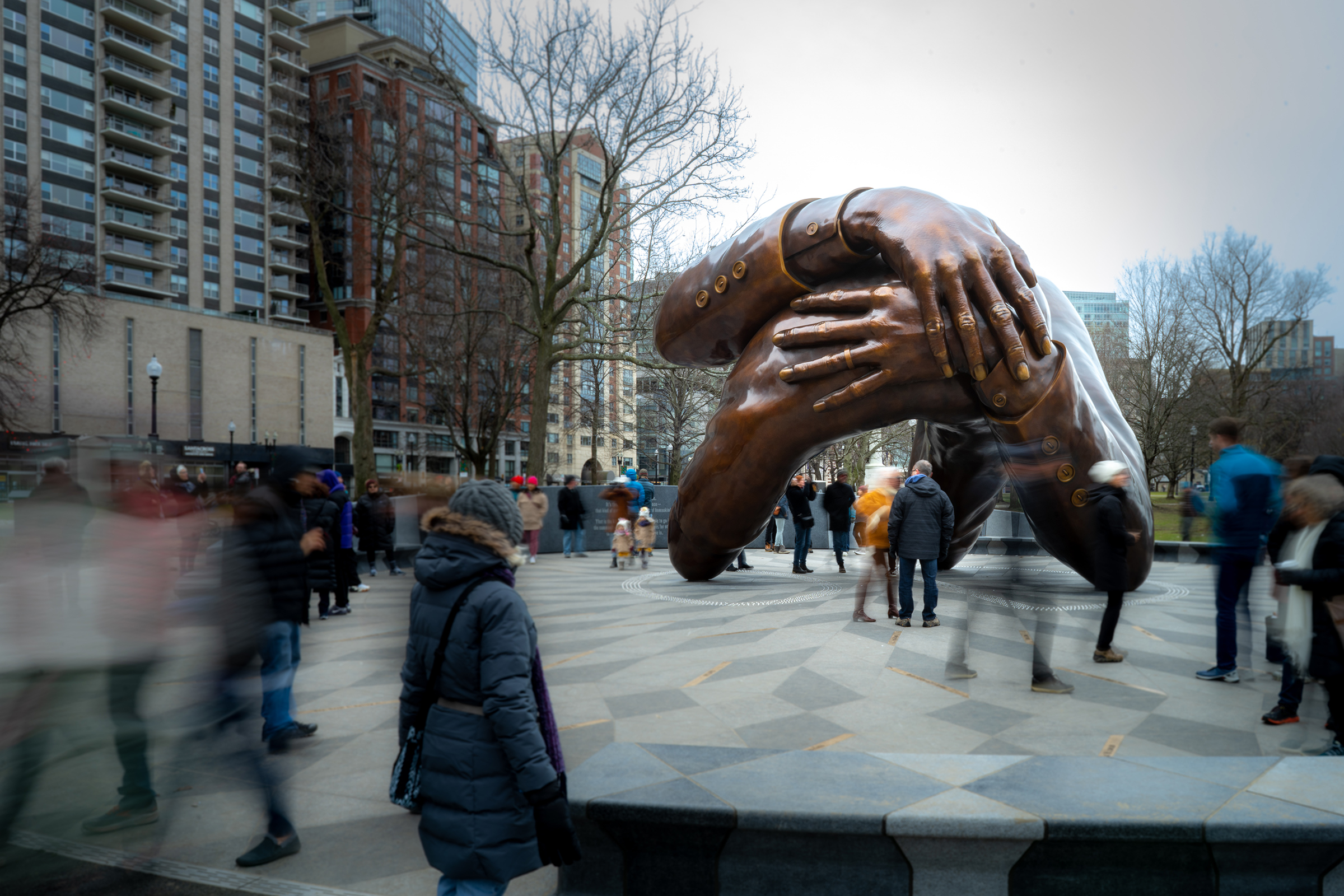
By the time The Embrace, a bronze sculpture by the artist Hank Willis Thomas, was unveiled on the Boston Common on Jan. 13, it had been years, or by some measures, more than seven decades in the making.
In 1952, a pair of students met for a blind date in Boston. Coretta Scott was studying singing at the New England Conservatory of Music. The Rev. Martin Luther King Jr. was working on a PhD in systematic theology at Boston University. It reportedly took the soprano some time to fall for the minister, but the two quickly discovered that they shared a driving belief that their brand of Christianity demanded personal action and sacrifice to create a beloved community, a world in which almost no form of human suffering, violence, inequality, or injustice is tolerated. And while it was King who was assassinated at 39 on a Memphis balcony, King whose name would become synonymous with the philosophy of nonviolent resistance and arguably the most effective, long-odds social justice movement the United States has ever seen, it is possible that none of that would have happened had King’s request that a friend set him up with a nice Southern girl led to someone else.
It was Coretta Scott King who is said to have brought King into an activist circle in Boston and it was between the two of them that they crafted parts of an American philosophy of nonviolent resistance, enriched by B. R. Ambedkar’s work on the immorality of caste and immutable group oppression, and marinated on ideas, strategies, and actions that would ultimately change the country. It was between the two of them and later with people such as A. Philip Randolph, Ralph Abernathy, the Rev. Fred Shuttlesworth, and Bayard Rustin –whom Coretta Scott King met long before she met her husband–that the commitment to demand justice, the tactics to make the seemingly impossible real, flourished. It was for those ideas and the actions that followed that Martin Luther King Jr. would be awarded the Nobel Peace Prize in 1964. Although King is said to have asked or even demanded that his wife maintain some distance from the movement and occupy a more traditional wife and mother role as time passed, what they crafted and committed to in those early years built a legacy that Boston officials, activists, and philanthropists worked for years to recognize with a sculpture on the Boston Common, the nation’s oldest public park.
More from TIME
Read More: The New Ways Teachers Are Talking About Martin Luther King Jr.
But in the week since The Embrace was unveiled, all of that has been almost entirely overshadowed. As pictures of the sculpture began to circulate, so too did descriptions, online and on cable TV, devoid of most context. Instead, reactions were heavy on sarcasm, cynicism, and one of the Internet’s favorite flavors: outrage. Tweets and posts proliferated describing the sculpture in terms so bawdy that they are more often conveyed by strings of emoji. In an essay published the day after the unveiling, in the online magazine Compact, Seneca Scott, an activist and cousin of Coretta Scott King, depicted The Embrace as an insult to Black people everywhere. He did so in language he later told The Guardian, reflected his state of frustration and grief which he knew would gain traction online: “a masturbatory metal homage to my legendary family members,” a “debacle” born of “the insidiousness of astroturfed woke movements that have come to dominate black America.” Since then, news outlets worldwide have covered the monument with a focus not on the rich history it evokes but on the controversy surrounding it, many with references to human genitalia.
So, when I called Thomas on Friday to discuss the most 2023 trajectory of public commentary about The Embrace, and his original intent, I’d expected a mournful or at least mildly angry conversation about the general public’s limited knowledge of history, a missed opportunity to expand knowledge of the central role Coretta Scott King played in the making of the mind and legacy of Martin Luther King Jr., or the power of a meeting of equal minds. Instead, what followed was an interesting discussion about public critique, about grace and learning, and about what today drives public debate. This interview has been edited for clarity and length.
There’s a lot that’s happened over the last seven days. So let’s go back to the beginning. Can you tell our readers a bit about the genesis of The Embrace, your sculpture unveiled on the Boston Common last Friday?
I believe it began with conversations between [the businessman and philanthropist] Paul English and [the] Rev. [Liz] Walker, after Paul learned that Dr. King and Mrs. King not only were educated in Boston, but also met and fell in love in Boston. And knowing about the historic march in 1965. [In April 1965, King led his first civil rights march outside of the South, to the public space known as Boston Common]. And so along with [others] they began a commission to [develop] a monument to the Kings, Dr. King actually, put up somewhere in Boston. As they raised money, in connection with the Boston Foundation, they got over 126 formal proposals.
Read More: How We Can Make Martin Luther King Jr.’s Dream of Ending Poverty a Reality
Eventually, I got a call from Michael Murphy of Mass Design Group asking me if I wanted to submit a proposal with him, because we just recently had done a proposal for an MLK Library in Cleveland, as well as worked on [a piece for] the Equal Justice Initiative. And we’re in the process of [others]. So I had done a lot of research on the Kings. I started to just look through archival images that I’ve encountered because in my own studio practice, I make a lot of sculptures that are about gestures, inspired by photographs. So I ultimately landed with a few different ideas, but the most compelling was what became The Embrace.
It was because it was not just about Martin Luther King, which the original commission was about. It was about his partnership with his wife, that picture where you could see the weight of his body was on her shoulders. I thought that was a powerful metaphor for his legacy. And the way in which she, after he was assassinated, literally carried it on her shoulders. But also, the way him winning the Nobel Prize was really them winning the Nobel Prize, right? Because it wasn’t ever just about him. It was about him and his family, but also about the community he was uplifted by. We wanted to make a monument that really highlighted this powerful moment between him and his wife, but also was a call to action, that reminder that we all have the potential to embrace another that could have a transformative, productive impact for society.
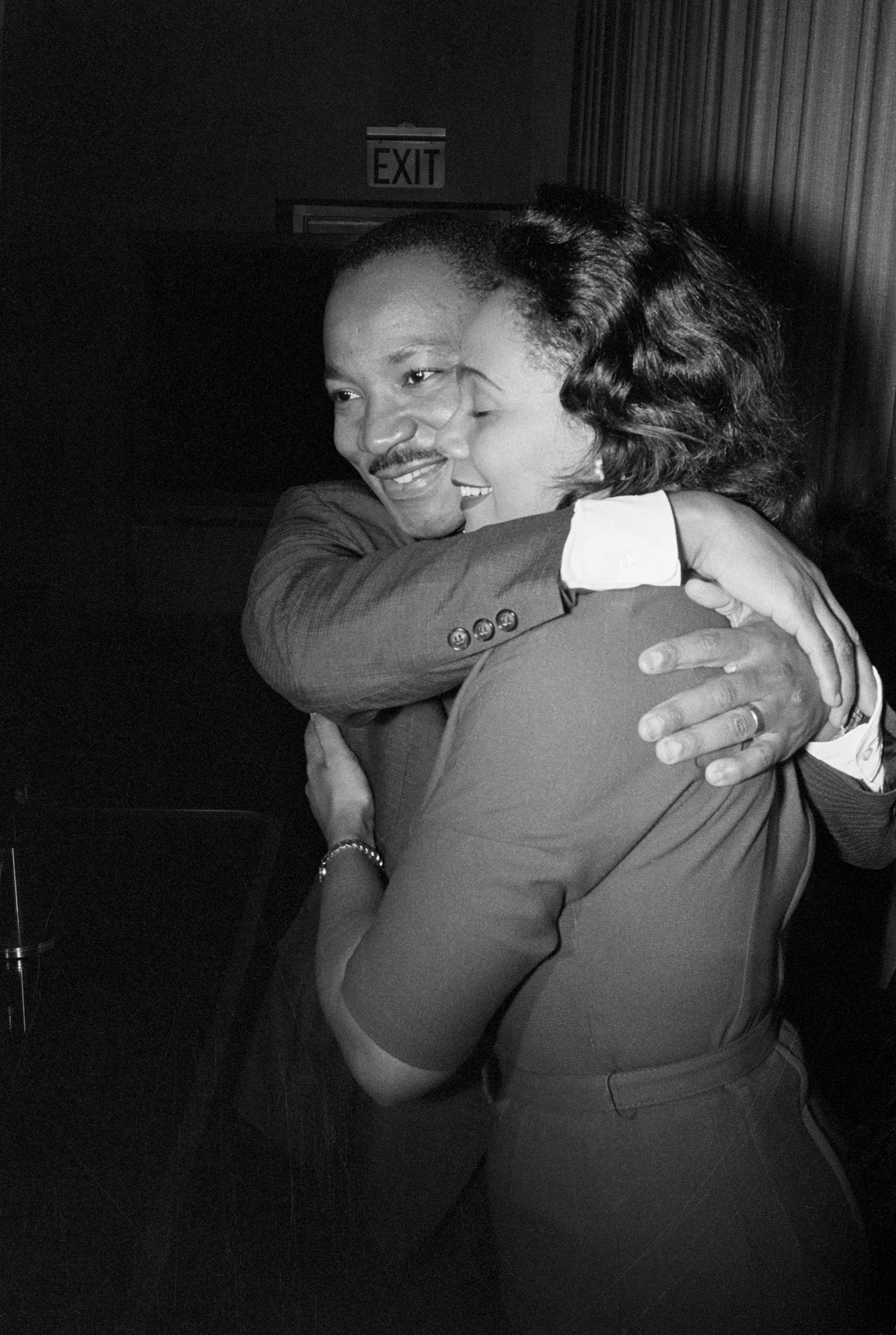
You mentioned that you have looked at a lot of images of King. What made that one the right inspiration for Boston public art?
Well, I think most of us are not familiar with how intimacy played a role in social justice and civil rights. And this was more of a tender intimate moment. When I started to read certain quotes by Mrs. King, learn about how often she talked about embracing, I thought that was a really poetic thing. And I felt like it was essential for my proposal, that both of them were represented, and also that there was a representation of them that encourages others to see themselves rather than to see them [the Kings] on pedestals. Which has been done a lot, but to really start to create a space to invoke and embody and celebrate him, this notion of the beloved community. So this is, to some degree, an artist’s portrait of that and the embodiment of their love.
The image includes the Kings’ entire upper bodies. Why did you elect to focus your sculpture on the Kings’ arms and the limited space between them?
In part, it was to see how much she was holding him up. But also, I was really excited. When you’re inside The Embrace [those who visit the statue can also walk beneath it into the space between the Kings’ arms], you’re in the heart of their love. We come together with another person, we embrace our hearts. Meet. And so in this case, basically the viewer becomes the heart. The heartbeat. I’m not sure if you’re familiar with the notion of Celtic love knots, but I wanted to create something where the arms almost formed this infinite loop. To me, it’s powerful.
It’s interesting that you use the word powerful. I would like to think of myself as reasonably well read. But I have to confess I knew almost nothing about how central Coretta Scott King was to helping Martin Luther King embrace a commitment to the philosophy of nonviolent resistance as a vehicle for radical social change, the moral obligation to soldier for equity and justice, until I was a working adult. I sort of stumbled upon it in the late 2000s while working on a news obituary about a North Carolina educator, a woman who had been a bridesmaid at the Kings’ wedding. She’d told her children some very personal things about the kind of life her friend had been expected to lead before deciding to marry Martin Luther King, the way the Kings felt about one another, the way they’d explored and developed ideas together that had also inspired this woman’s own lifetime of work. She’d told them it was powerful to witness. That sent me on a reading spree about the Kings’ Boston years. But, even with that arc of my own, I have been shocked by some of the commentary about the sculpture this week. Not all of it, but certainly some of it, I think Grandmother would say, is “as deep as a puddle.”
Well, you never know what to expect. Right? I mean, when you put this in context, it’s fair to say that over a billion people have seen this work – mostly by internet.
I can say that the experience I had with people in person was probably the most powerful for me, because the most common response I experienced was crying. It was almost a holy experience. And it’s hard to erase that, with what people are commenting online, based off of some pictures.
Read More: What It Was Like to Watch Martin Luther King Jr. Give the ‘I Have a Dream’ Speech
I can’t really I can’t blame anybody on the internet for seeing what you see when you have only seen something from one angle. It’s sculpture that people are invited to go inside. So, honestly, the fact that there are no pictures of [that] online, on the inside, says how much more to the work there is. So I’m very excited that there’s elements of this work that can’t be captured [in images online].
That’s what I’ve always dealt with in photography. I come from a photographic background. It’s only one perspective of a split second of time. And what I’ve always been interested in, is there are things that are in the image and there are things that are cropped out of every photograph. But this is a chance to go and ponder a portion of a photograph in four-dimensional space.
When you walk underneath the statue into the space between, what does one see? What have the people looking at pictures on the internet missed?
I really tend not to talk about what I see because I like to keep my ears open. Like I’ve said on NPR, I look up and it sounds corny, but I see the heavens. But what I was really amazed by, being inside the sculpture with Martin Luther King III; his wife, Arndrea [Waters King]; and their daughter, Yolanda King, you know, Yolanda looked up and said, “Wow, it’s like a portal.” She’s 14. Fourteen years old. That’s why I like to listen. If I was in there talking, I might not have heard that.
There’s so little of what people understand about the sculpture that can be represented online. I would encourage others to reserve judgment until they experience it just as I must reserve judgment on their responses.
It seems incredibly generous of you to reserve judgment on some of the ribald commentary and critiques. This is perhaps the most basic question in the world, but why? Why are you willing to do that?
Well, there’s a guy named Martin Luther King who in [one of] his 1957 sermon[s] said love your enemies. He says that we must, I think, be integrated in ourselves to meet every moment with an unbounding love. So I have been invited to answer the call.
Of course, anyone who does public work, particularly creative work, understands that there will be commentary. Some people absorb and are devastated by or defensive about every single thing said. Some studiously try to determine then absorb what’s valid. Some avoid any and all commentary to maintain their mental equilibrium and ability to produce. And I suppose some people are somewhere in between. Over the course of your career, what has your approach been?
Well, I’ve never experienced anything quite like this. I guess my general point, my belief, is artists learn through critique. Artwork becomes multidimensional through critique, and people’s perspectives of art changes over time. There’s things that we love that over time we get tired of, and there’s things that we’re not quite sure about at the beginning, but over time, we love. And the fact that the sculpture of mine is being discussed alongside the Eiffel Tower, the Vietnam War Memorial, and Statue of Liberty and Washington Monument – those things are timeless works of art. So I pray that this work will be around in 40 years, so that I will finally be able to have a fully resolved perspective of it.
Read More: The MLK Speech We Need Today Is Not the One We Remember Most
Listening, over time [is why] I feel like there’s also a lot of confidence, about the potency, the power of the work, because there has been so much discussion about it. And we’ve heard it.
[This is the] oldest continuously used public space in the country. Stuff doesn’t just sprout up there. A lot of people had to approve this, not only through the public process that they did with the voting, but literally like lawyers and officials and blah, blah, blah, blah, blah. They are a part of the work. They literally had to embrace the work. So I feel like all of those people who – you know, the paper pushers, the politicians, the advocates, nonprofit workers, they put their spirit in the work but also the masons and welders and the casters and engineers to the construction workers – a lot of people took action to make this possible. So I see the embrace as also a metaphor for the process of making it.
You talked about your desire to listen rather than deflect or redirect the critics. How much of the context of the Nobel picture, the King relationship, are you able to resist explaining?
It’s a collaboration with Embrace Boston, which is a nonprofit organization that is responsible for commissioning the piece and stewarding not only the piece, but also the work that continues for social justice in Boston, so we’ve been telling the stories all along.
I’ve been more fascinated by how what appears to be a very limited and, some might say, childish perspective of a work can somehow get as much credence and more attention than years of more elevated and more thoughtful and more earnest and sincere discourse.
We’re talking about the Kings, who, if anybody, should be taken seriously.
King was awarded the Nobel Peace Prize in part for his work and those ideas which he and Coretta Scott King germinated between them – ideas that connected a broader philosophy of love and the obligation to the unrelenting pursuit of equity and justice in all things. I just have to ask if it pains you for something so profound to be overtaken by this torrent of juvenile commentary?
I just look at Bernice King, I look at Martin Luther King III and Dexter King, and the burden of responsibility and the burden of carrying on a legacy that they have done throughout their entire lives. And I don’t even get to think about myself. I’m in awe of it. Think about the daughters of Malcolm X and Betty Shabazz, who have this huge responsibility to carry on a legacy and tell a story. I’m honored to even be invited into the conversation.
What does that say to you? What does the wild ride the sculpture has taken on the Internet this week mean?
What it says to me is that I need to be more mindful of what I click on. We know our clicks are things that give our algorithms information on what is important to us. And so like I’m sitting here curious about what I click on myself. Not just related to The Embrace, but like literally everything. You know the headlines that we all are used to. Most headlines do not honor the text.
I am sadly deeply aware that we are reaching the point that you can create something that took eight years of research and work. You can expose massive injustice. And if it gets five clicks online, that story effectively does not matter nearly as much as a story about hand gestures some celebrity made on a red carpet because that’s going to prompt a lot of clicks. But where does public conversation, contemplation, and the spread of information by popular referendum, or clicks, really leave us?
I’m no holier than thou. I’ve read those articles too, about the hand gestures on red carpets. So, it’s, for me, a really powerful mirror for myself and how I operate as a citizen online.
We’ve gotten to see, as a result of Freedom Summer 2020, that the movement is still alive. I also am clear that movement was only possible because we were no longer distracted by the Internet. We were tired of looking at the internet every day. So we actually were probably the closest we have been for some time to the people in the [mid–20th century] civil rights era. We both had the information in front of us, but also had an urgency and a desire to be out amongst others and understood that it required risk. But now that we’re back and football is happening again and basketball is happening again and the award shows are happening, we have been lulled back into a form of sleep or inaction because we’re not dealing with the serious stuff anymore. We’re just dealing with the silly stuff.
But, hey, you know, pick your medicine.
Well, I feel like I have probably asked my major questions, but I wonder if there’s anything that we’ve not talked about that you really think would be critical for people to know, to understand, to contemplate?
Yeah, well, I think it’s important, definitely, to highlight, to acknowledge, that this piece is a call to action, or call to love. It’s important to highlight that the overwhelming majority of monuments not only in the park, but also in the world are monuments to violence, or memorials for victims of violence. And something as radical as a monument to love in a society that celebrates hate is going to and must necessarily challenge the status quo. And therefore, it should be scrutinized and critiqued. But as long as we’re using our heads, we’re not going to be very much in touch with the heart.
And I felt like that ultimately this work – really all artwork, but especially this work – has become somewhat of a Rorschach test. You know, where’s your head? And where’s your heart? What do you see? What does that say about the society? And what does it say about the way you see the world and yourself?
Correction, January 22
The original version of this story misstated where Martin Luther King Jr. was studying for his PhD. It was Boston University, not Boston College.
What to Know About Tyre Nichols' Life as Police Release Videos of His Death
Feed:
TIME
(https://time.com/feed/)
Published: 2023-01-25 11:35:14
|
Created: 2026-08-04 08:17:55
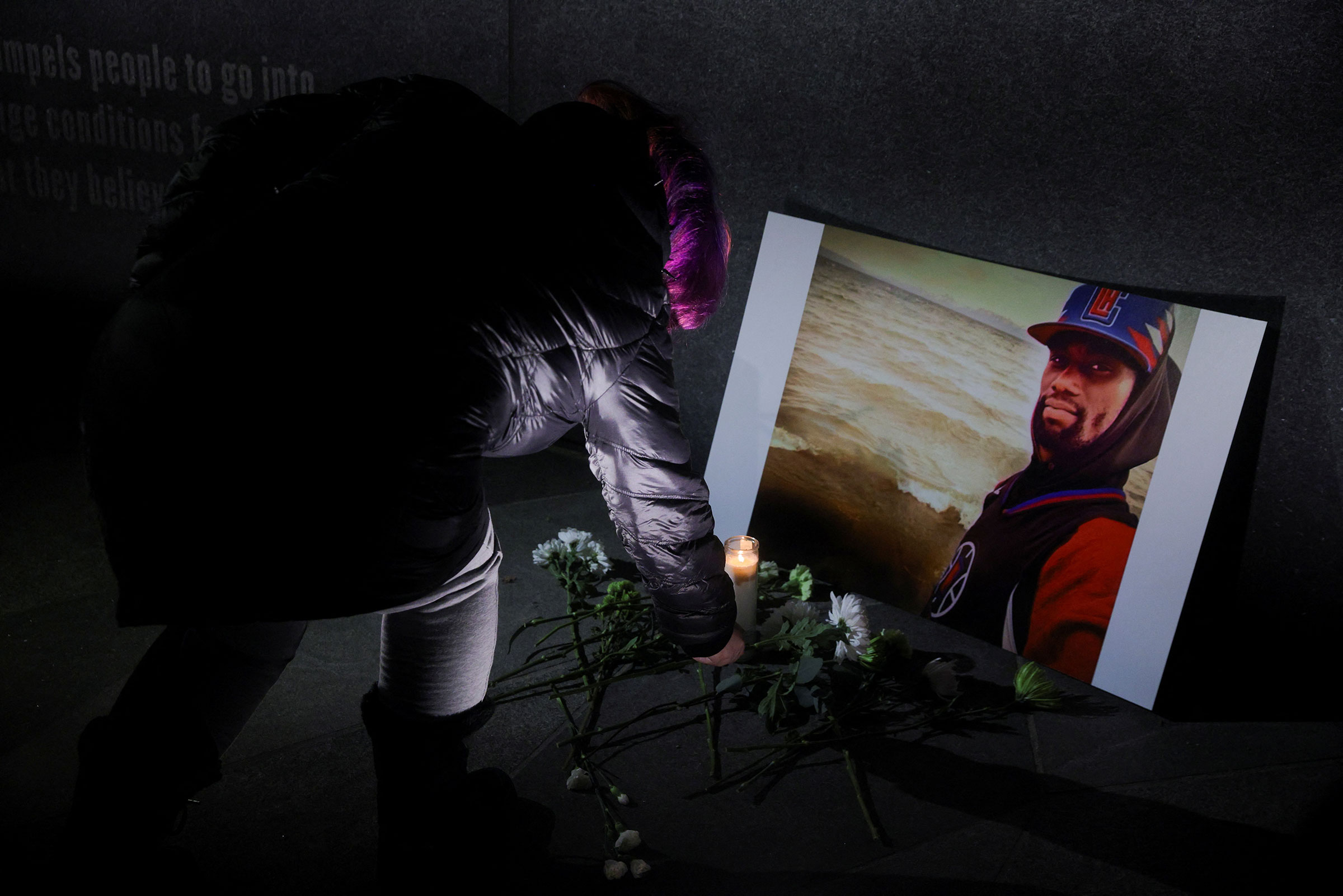
Tyre Nichols likely took in one last sunset at his beloved Shelby Farms Park before Memphis police killed him, his mother says. He loved looking at and taking photographs of sunsets, RowVaughn Wells said at a press conference on Friday—hours before officials released video documenting his fatal Jan. 7 beating by five police officers, who have since been arrested and charged with murder. “My son was a beautiful soul. He was a good boy. No one’s perfect but he was damn near,” she said.
Wells, who said she had not yet processed her grief, noted Friday that she had not watched the entire video but knew the details.
As the family’s attorney Ben Crump pointed out at Friday’s press conference that the video would show Nichols calling for his mother in his last words, her eyes shifted down to the ground. As she took the mic shortly afterwards, Wells spoke through tears about her pain as a mother.
“For a mother to know their child was calling them in need and I wasn’t there for him; do you know how I feel right now because I wasn’t there for my son?” Wells said. “You know it’s funny he always said he was going to be famous one day. I didn’t know this is what he meant but we want justice for my son.”
Video shows violent, repeated beating
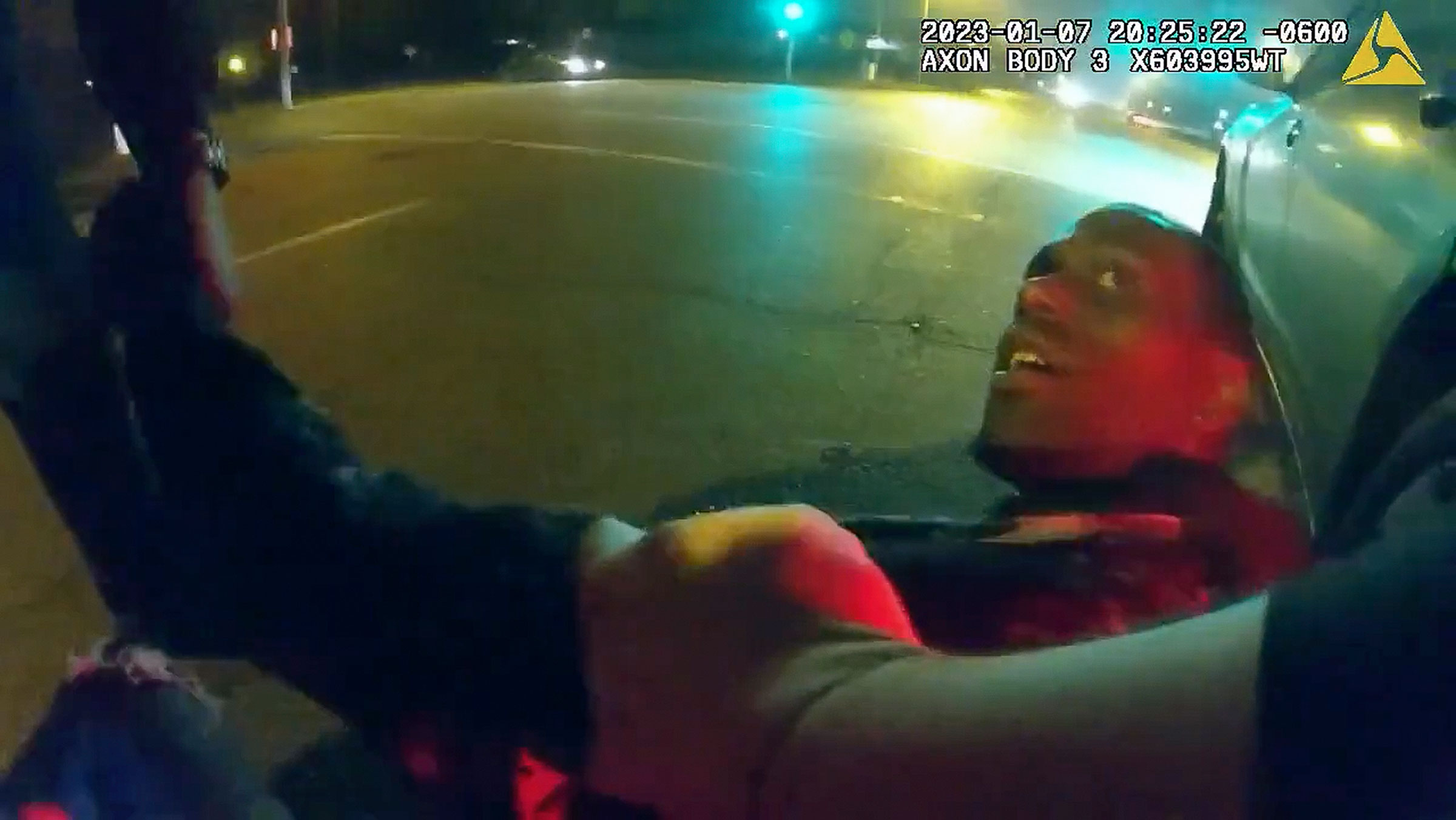
Bodycam and surveillance camera video released Friday evening showed Nichols yelling out repeatedly for his mother and trying to catch his breath. “I didn’t do anything,” he had said as officers first pulled him out of the car. After officers tased Nichols, he got up to run.
The video documents a brutal beating during which two officers hold Nichols down and another kicks him, possibly in the head. One officer can be heard saying “I’m gonna baton the f— out of you” before hitting Nichols repeatedly with a baton. Two officers hold him upright while a third repeatedly hits him in his face and his body.
Later on an officer tells him, “you can’t go nowhere man” and “you about to get sprayed again.” Nichols is later seen slumped against a car, barely moving.
The injuries he faced were so severe that he died three days later. His family’s attorney said Nichols dealt with “extensive bleeding.”
The videos were posted to a public Memphis City Vimeo account. They contain graphic and disturbing scenes.
Ahead of the video’s release, Police Chief Cerelyn “CJ” Davis described on CNN just how “alarming” the video footage was and that it showed “acts that defy humanity.”
“I was outraged. It was incomprehensible to me. It was unconscionable. And I felt that I needed to do something and do something quickly,” Davis said. “I don’t think I’ve witnessed anything of that nature in my entire career. It was that bad.”
U.S. prepares for protests
In anticipation of a visceral community response, President Joe Biden urged Americans to keep their protests peaceful and avoid violence. “I join Tyre’s family in calling for peaceful protest. Outrage is understandable, but violence is never acceptable,” Biden said in a statement on Thursday.
Nichols’ mother has also requested people to protest peacefully. “I want each and every one of you to protest in peace. I don’t want us burning up our cities, tearing up the streets because that’s not what my son stood for,” she said on Thursday. “And if you guys are here for me and Tyre, you will protest peacefully.”
Memphis police are increasing their presence throughout the city; so is local law enforcement in Washington, D.C.
5 officers charged with murder
Prosecutors said Thursday all five officers are to blame for Nichols’s death. “While each of five individuals played a different role in the incident in question, the actions of all of them resulted in the death of Tyre Nichols and they are all responsible,” said Shelby County District Attorney Steve Mulroy at a press conference.
Nichols’ family’s lawyers said Nichols was killed following what was supposed to be a routine traffic stop that turned into a brutal beating reminiscent of the 1991 assault on Rodney King in 1991.
“The news today from Memphis officials that these five officers are being held criminally accountable for their deadly and brutal actions gives us hope as we continue to push for justice for Tyre,” the attorneys and family said in a statement following the arrests.
Nichols, who is Black, died three days after the traffic stop.
“It was so violently intentional. There really was no purpose or basis to be that violent or brutal against a defenseless human being. I mean, this is a citizen. These Memphis police officers are charged with protecting their citizens and instead they literally unabashedly beat him for over three minutes,” attorney Antonio Romanucci told TIME on Tuesday.
The five officers involved—Tadarrius Bean, Demetrius Haley, Emmitt Martin III, Desmond Mills, Jr., and Justin Smith—were fired on Jan. 20 after an investigation found they “violated multiple department policies, including excessive use of force, duty to intervene, and duty to render aid.” All of the officers are Black.
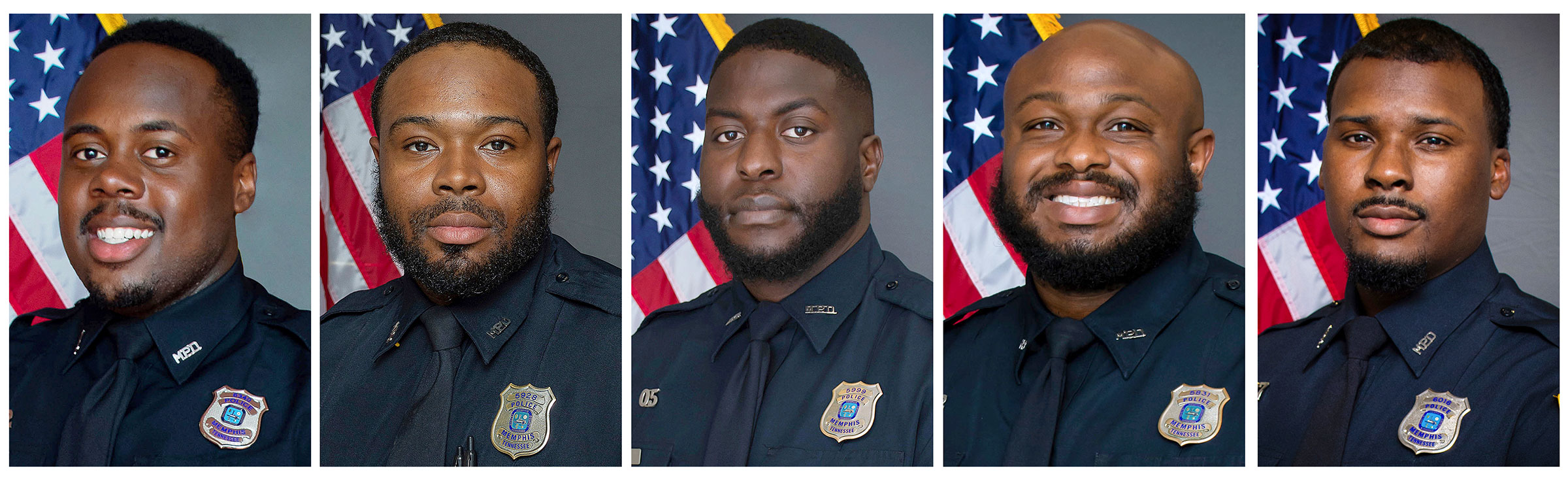
In addition to second-degree murder, the officers faced charges of official misconduct, aggravated assault, aggravated kidnapping, and official oppression.
Two firefighters involved in the traffic stop have been put on leave and two Shelby County Sheriff’s deputies have also been “relieved of duty.” The deputies responded to the scene that night, but it’s unclear what role they played in the assault on Nichols.
“Having watched the videotape for the first time tonight, I have concerns about two deputies who appeared on the scene following the physical confrontation between police and Tyre Nichols,” Shelby County Sheriff Flyof Bonner said in a statement Friday.
In 2016, Haley, a then-corrections officer, was accused of participating in a prison assault that left one inmate unconscious, according to a complaint filed to the U.S. District Court in Tennessee, NBC reported Wednesday.
Romanucci and fellow attorney for the family Ben Crump said that the video showed that Nichols was pepper sprayed, restrained, and shocked with a stun gun.
Romanucci said that Nichols was a “human pinata for those police officers,” the Associated Press reported.
Nichols worked at a FedEx facility, had a 4-year-old son, and had his mother’s name tattooed on his arm, according to the New York Times. He also had Crohn’s disease and suffered from severe weight loss, ABC News reported. Officials said his family described him as a “cheerful” individual who loves skateboarding and enjoying sunsets over Shelby Farms Park on the city’s east side.
Here’s what to know about the Nichols’ lethal encounter with Memphis police, what investigations are underway, and the official video of the incident.
What happened at the traffic stop?
In an initial description of the incident, police wrote in a Jan. 8 statement that as officers attempted to make a traffic stop for reckless driving, a “confrontation occurred, and the suspect fled the scene on foot.” The statement added that officers pursued Nichols and in attempting to do so “another confrontation occurred” and that he was later apprehended. The statement noted that Nichols “complained of having a shortness of breath” and he was transported to hospital in critical condition.
Officials have said that Nichols had a medical emergency. But Nichols’ family accuse police of causing him to have a heart attack.
Crump also pushed back on an initial statement from the police that a “confrontation occurred” in an interview with TIME on Tuesday. “It’s hard to see Tyre doing anything that resembles a confrontation… but everybody can judge for themselves how unnecessary this was.”
The Nichols family hired a forensic pathologist to review the case and his family’s lawyers say that Nichols’s injuries are consistent with what is shown on the video, following a preliminary independent autopsy. “There were large amounts of blood found in the deep tissues of his body,” Romanucci says.
“When people see this video it’s going to remind them of Rodney King; tragically, the only difference in many regards is that Tyre didn’t survive,” Crump says.
What is the reaction to the video?
On Thursday, Memphis police chief Cerelyn Davis called for calm ahead of the release of what she called the “heinous, reckless, and inhumane” death of Tyre Nichols.
A source told CNN that authorities expect to release the footage on Friday. Law enforcement across the U.S. are bracing for demonstrations and unrest following the video’s release, multiple sources told CNN.
“What is so alarming about the video is the escalation from the moment they encountered Tyre—and that escalation only increases,” Crump says. “The first words that you hear Tyre utter is, ‘what did I do?’ And there’s never an answer for that.”
Memphis police announced Monday that they met with Nichols’ family to view the video recordings and that they would comply with investigations. “Transparency remains a priority in this incident, and a premature release could adversely impact the criminal investigation and the judicial process. We are working with the District Attorney’s Office to determine the appropriate time to release video records publicly,” Chief Cerelyn Davis said in the statement.
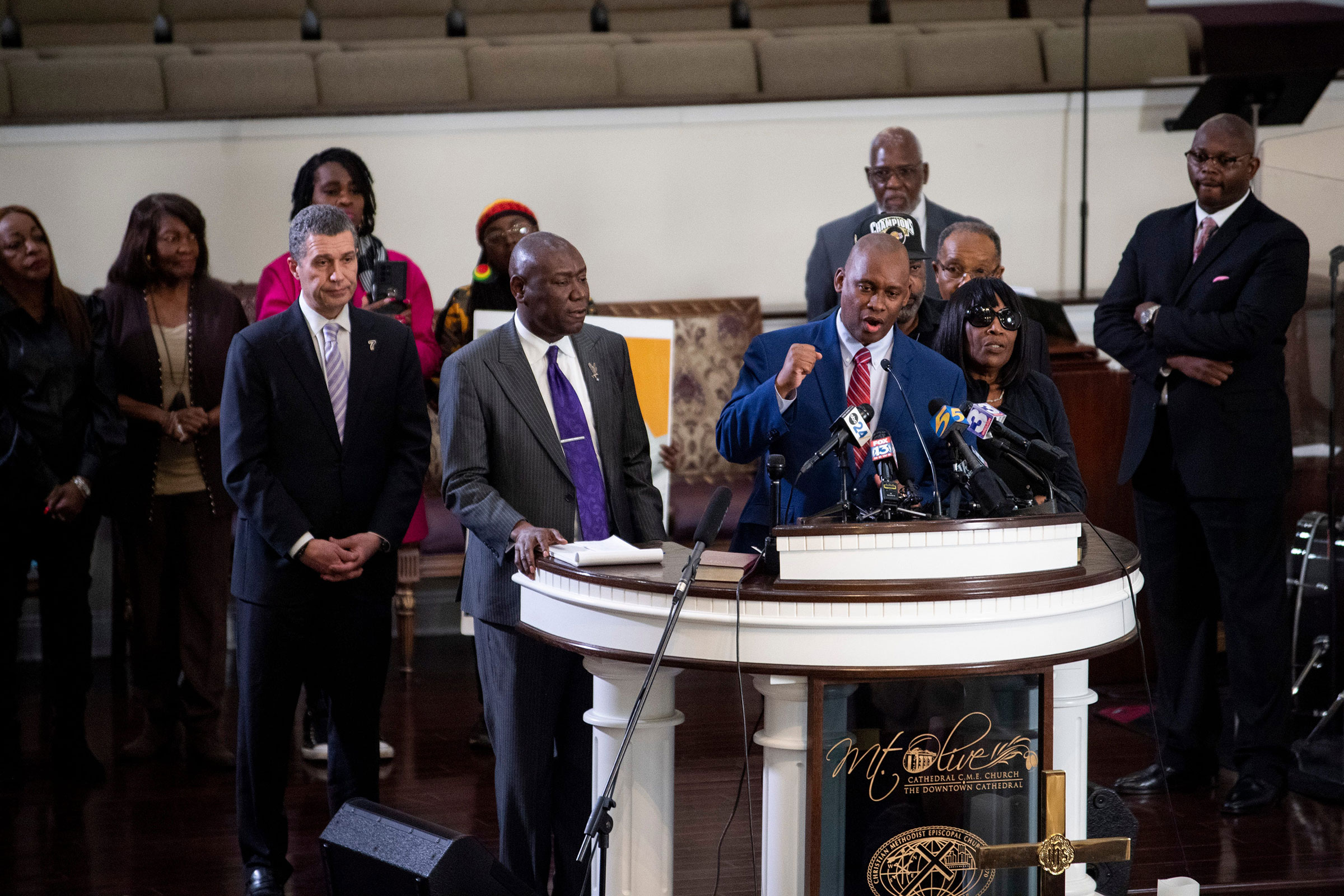
How is Tyre’s family reacting to the charges?
For the family, justice entails “criminal culpability and civil accountability,” Crump says. It means charging the officers with first-degree murder. “Anything short of that we will not accept,” Rodney Wells, Nichols’ stepfather, said at a news conference on Monday after viewing the footage.
Tyre’s family and lawyers issued a statement Thursday, saying that they felt hope following the arrests of five police officers.
“This young man lost his life in a particularly disgusting manner that points to the desperate need for change and reform to ensure this violence stops occurring during low-threat procedures, like in this case, a traffic stop,” the statement said. “This tragedy meets the absolute definition of a needless and unnecessary death. Tyre’s loved ones’ lives were forever changed when he was beaten to death, and we will keep saying his name until justice is served.”
At a vigil on Thursday night, Nichols’s mother RowVaughn Wells warned of the “horrific” nature of the video but implored supporters to demonstrate nonviolently when it is released to the public. “I don’t want us burning up our city, tearing up the streets, because that’s not what my son stood for,” she said, according to the Associated Press. “If you guys are here for me and Tyre, then you will protest peacefully. You can get your point across but we don’t need to tear up our cities, people, because we do have to live in them.”
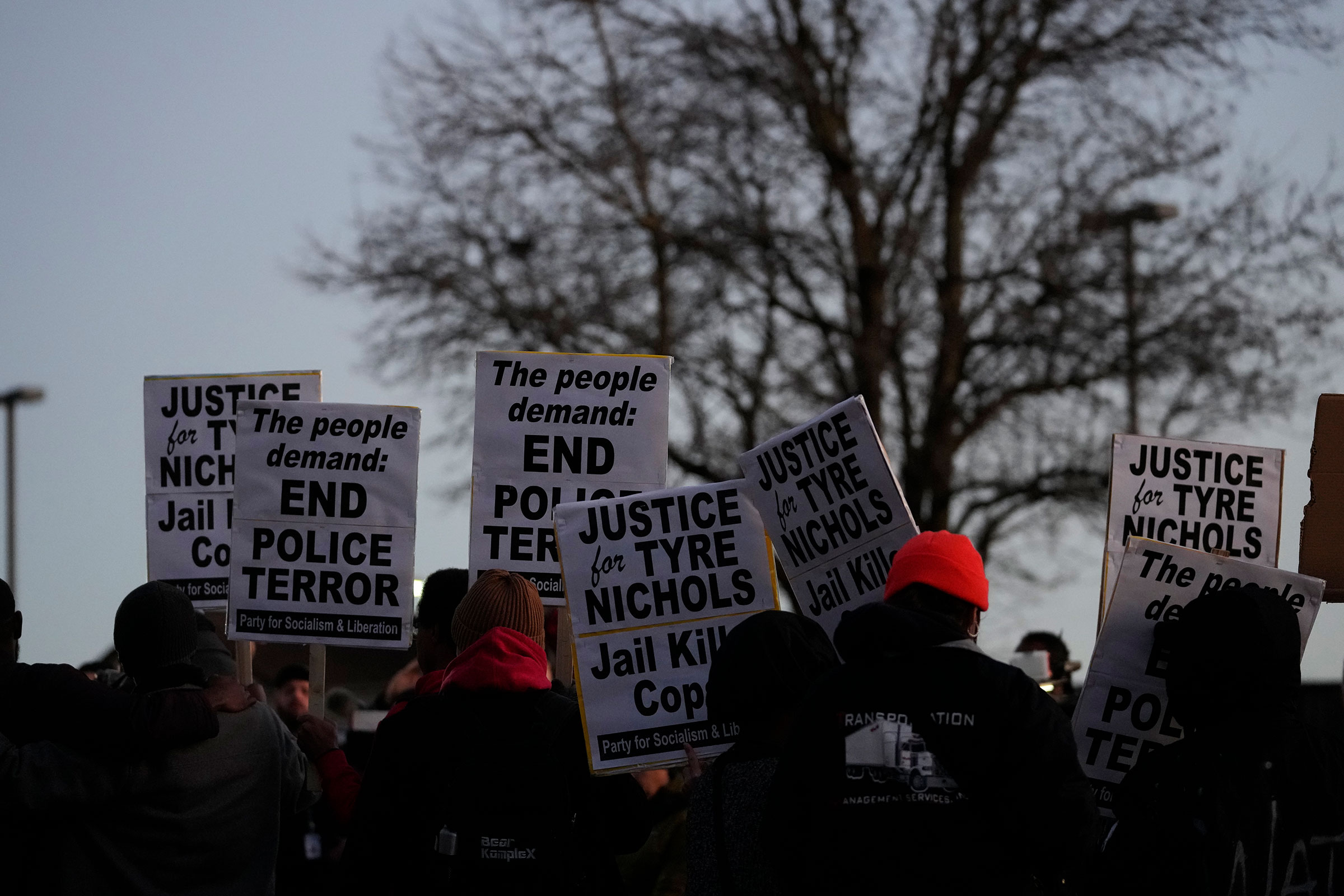
What is the Scorpion police unit?
Prosecutors confirmed Thursday that at least some of the five officers involved in Nichols’s death are part of the Scorpion Unit—a special law enforcement division focused on “violent crime reduction.”
The SCORPION unit, which stands for Street Crimes Operation to Restore Peace In Our Neighborhoods, was created in November 2021 amid soaring violent crime in the city.
This week, Shelby County District Attorney Steve Mulroy announced a review of all specialized police units, including Scorpion.
Romanucci, the attorney for the family, asked in a CBS interview: “They were in unmarked cars, why are they conducting traffic stops?”
What investigations are ongoing?
Nichols’s fatal encounter with Memphis police has sparked state, federal, and local probes. The FBI, U.S. Attorney’s Office, and Department of Justice have opened a civil rights investigation. The Tennessee Bureau of Investigation is also looking into whether police officers broke any laws.
The Memphis Police Association, the city agency’s union, declined to comment on the firing of the five officers. “The citizens of Memphis, and, more importantly, the family of Mr. Nichols deserve to know the complete account of the events leading up to his death” and what may have contributed to it, Lt. Essica Cage-Rosario, the union’s president, said in a statement.
This is not the first time Memphis police have come under fire for excessive force; in 2018, local law enforcement repeatedly shot Martavious Banks after an attempted traffic stop. Footage of the arrest was publicly released in 2020. Banks later settled a lawsuit against the city in 2021 after an investigation highlighted that police had their body cameras turned off—violating department policy.
Toxic Stress Load Is the Biggest Barrier to Living Longer. Here's How to Reduce It
Feed:
TIME
(https://time.com/feed/)
Published: 2023-02-16 12:00:39
|
Created: 2026-08-04 08:17:55

Each person has a powerful combination of characteristics that influence their chances of living a long life. A 2019 study by the City Health Dashboard analyzed the data from the 500 largest cities in the U.S. provides a case in point: a baby born in the Streeterville community of Chicago, in 2015, could live to be 90 years old, while the life expectancy of another baby born just eight miles away, in the Englewood neighborhood, was 60 years. In the Englewood neighborhood, where the life expectancy was 30 years less, 97% of the population is Black and 47% live below the poverty line. Meanwhile in Streeterville, where the residents were living longer, 78% of the residents are white or Asian, with a high income. The same study showed that in 55 other cities—including New York, San Francisco, and Washington D.C.—some people could also expect to live up to 30 years less than their neighbors. At the time, this difference was the same as for people living in Monaco and the Central African Republic, the countries with the longest and shortest life expectancy in the world.
What was behind these stark differences? One larger factor is something we like to call the Toxic Stress Load (TSL). And it’s been hiding in plain sight for decades.
The TSL is the term that describes the build up of negative physical and psychological changes that result from your ongoing need to respond to challenges. It is the baggage, the scars, and the tensions collected through life. When your TSL becomes overwhelming, it triggers changes in your body that are so profound that they are equivalent to accelerated aging.
More from TIME
Read More: 6 Expert-Backed Ways To Manage Your Stress
The TSL results from our study of the scientific evidence behind two well-researched and validated components. One is “toxic stress,” namely the physical and psychological response to long-term threatening situations or events, especially those that start in early childhood. The other is known as “allostatic load,” which represents the physical price paid by being exposed to prolonged toxic stress. The term “toxic stress load” makes explicit that these two components come together, are generated by coinciding challenges, and compound each other. The TSL is what can, ultimately, kill you prematurely.
Nobody can escape the TSL. What is different, however, across people and communities, is the intensity, speed, duration, and frequency with which it accumulates—the specific sources and the way in which it influences a person’s overall longevity and health. Its effects begin before someone is born, inside the mother’s womb, and end at the time of their death.
Each of us has multiple identities and labels, as well as changing life circumstances that interact constantly and simultaneously, which contribute to our TSL. This “simultaneity” of identities and labels is captured in the term “intersectionality,” which often focuses on the combined effects of gender, race, class, ethnicity, sexuality, age, ability, religion, nationality, and social status. Many of the factors that influence the intensity, frequency, duration, and manageability of the TSL are already in place even before a person is aware of their own existence. In sum, how you are labeled in terms of race, ethnicity, or immigration status has a significant impact on your life expectancy, with consistent disparities among different racial groups, both domestically and internationally, as was seen with the case with cities in the U.S., and between countries such as Monaco and the Central African Republic.
The TSL touches people of every socioeconomic status, anywhere in the world. Business executives, for instance, tend to have a high social status, an advanced education, a comfortable financial situation, admirable resilience, and abundant resources at their disposal to protect their physical fitness, which would all normally set them up for a long and healthy life. This makes the results of a 90-year-long study from Harvard University surprising, as it found that senior managers and executives experience a mortality penalty of around three to five years compared to employees lower in the organizational hierarchy.
Many sources of TSL, however, vary through life, and can be changed. Those that tend to fluctuate and most affect your TSL are poor sleep, worries related to money, work, and family, and loneliness. Analysis of data from more than 3.4 million people found that loneliness is associated with a 26% increase in the risk of premature death, equivalent to the effect of smoking 15 cigarettes a day. These changeable sources are what usually increases the risks of building a dangerous TSL for individuals of any social status. Death by suicide among physicians is one disturbing example. In the U.S. alone, it is estimated that one physician dies of suicide every day. Male physicians are 40% more likely to die by suicide, while female physicians have double the risk of ending their own lives than their non-physician female counterparts in the general population. Although there is a dearth of data around physician suicide, there is suspicion that it emerges from intersecting risk factors such as high levels of psychological distress and burnout, sleep deprivation, and depression—compounded in many cases by racism and discrimination.
Just as it is possible to learn about the risks from those who have the highest TSLs, it is also possible to gain insights from those who manage to live a long life. Research on these longest-lived humans, namely centenarians (those who live past 100 years of age) and “supercentenarians” (those who live beyond 110 years) provide valuable clues on how to keep the TSL at bay. Although they appear to have protective genetic, immunological, and hormonal factors special to them—or to have lived so long because of luck—research on centenarians and supercentenarians has also identified several non-biological characteristics that could improve a person’s chances of getting to an advanced age. Some of these characteristics include a tendency to react with low anxiety to stressful conditions, eat in small amounts that trigger caloric restriction, maintain an ideal weight, exercise regularly, avoid smoking and excessive drinking. Most importantly, they are also actively engaged in community activities, and have close friends and strong social support systems. Rather than being found in isolated small towns of special mountainous regions or valleys, the longest-lived people tend to live in cities with at least 4 million inhabitants in warm and sunny climates, where the life expectancy at birth was already in the mid-70s or higher.
Today, these characteristics might feel like a tall order to apply to your own life. Fortunately, there are some more practical, tangible ways to lessen your TSL. It’s important to focus on on identifying the biggest contributors in your daily life. To do this, it’s worth reflecting on the following questions: What do you feel is the biggest contributor to your TSL? What do you think you need to improve your TSL? What kind of support do you need from others to reduce it? This, then, makes your efforts to manage it more feasible. Even if your levels are low, any reduction in your TSL can be protective.
At any rate, regardless of your labels and identities, which might confer disadvantages or privileges, every day, you will encounter many mental, physical, and social challenges that you will have to overcome in order to thrive. Some you can immediately recognize and tackle. But it’s how you deal with them that makes the difference between a long and healthy life, and one that is cut short.
To Understand What Could Happen on Election Day, Understand the Suburbs
Feed:
TIME
(https://time.com/feed/)
Published: 2024-08-15 13:00:00
|
Created: 2026-08-04 08:17:55

The second night of the Republican National Convention had the theme of “Making America Safe Again.” As Texas Senator Ted Cruz proclaimed, “your family is less safe, your children are less safe, the country is less safe” — all because of Joe Biden’s presidency. While crime was the central focus of the night’s speeches, immigration loomed large in the messaging as well.
The GOP platform not only adopted Donald Trump’s hardline stance on the topic, it spelled out purported links between immigration and crime, terrorism, and the opioid crisis. Trump hammered home these ties during his acceptance speech.
Republicans claim that the way to fix all of these problems is the largest mass deportation program in American history, requiring localities to cooperate with federal immigration enforcement, and securing the southern border. While the Democrats have shied away from these extreme positions, they too have latched onto immigration to appeal to voters concerned about border security, crime, and safety.
This messaging is finding particular resonance in America’s suburbs. While the suburbs haven’t been as much of a focus in the media as in past campaigns, they matter more than ever. As of 2020, 54% of Americans lived in suburban areas. They may well hold the balance of power in November, not just in the presidential race, but especially in determining control of the House of Representatives.
The suburbs have their own political culture, one that’s often protectionist on local matters — built around the desire to safeguard and defend homes and neighborhoods — but can lean more liberal on national and state matters. What many political analysts miss is that even as the suburbs have diversified, many new residents of color have adopted politics driven by the same protectionist mindset long embraced by suburban whites.
The suburbs have long and deep histories of racial exclusion, creating the lily-white neighborhoods that benefited generations of white families. After cresting in the 1950s and 1960s, however, suburban segregation receded in many regions. Beginning in the 1970s, more and more people of color settled in the suburbs in the wake of fair housing laws and court decisions, increased immigration from Asia and Latin America, and the expansion of the Black, Latino, and Asian middle class. Nationally, nonwhites made up just under 10% of suburbanites in 1970, and by 2020 they were 45%. In Los Angeles, at the cutting edge of these changes, the jump was more striking — nonwhites rose from 9% of the suburban population in 1950 to 70% in 2010.
But rather than dramatically shifting the politics of the suburbs, often these diverse suburbanites shared goals with their white neighbors — a desire for decent schools and municipal services, safety, protection of property values, and the freedom to choose where to live without discrimination. For non-white suburbanites, their arrival in suburbia was the culmination of years of civil rights struggle and a racial achievement not to be taken lightly. The right to hold property signified full inclusion.
Read More: In a Toss-up House Race, the Fight for Asian American Voters Gets Messy
Thanks to a confluence of forces, the 1980s put these suburban values and politics to the test. Nowhere was this clearer than in Los Angeles.
Even as suburban diversity accelerated, industrial plants were closing and government cut services as a result of Proposition 13, which limited property taxes. At the same time, the suburbs began taking a more active role in immigrant oversight. Although authority over immigration technically resided with the federal government, during the Reagan years, federal retrenchment began shifting enforcement authority to suburbs and other localities. Suburban communities, in turn, began developing their own toolkits for controlling immigrants, drawing upon their local powers to control land use and behaviors in public spaces.
In this altered climate, an anti-immigrant backlash erupted in the suburbs. Town after town launched actions against immigrants, particularly the undocumented. Some suburban city councils used local police powers to aid in INS/ICE crackdowns on undocumented immigrants at factories, bus stops, and apartment buildings. Many suburbs passed ordinances outlawing day laborers, pushcart vending, spontaneous games of soccer in parks, and foreign-language signage on businesses. One campaign in a Latino suburb tried to outlaw the bright paint colors on homes and businesses that some Latinos had tended to favor. These crackdowns came in wealthy suburbs and working class ones, both of which contained increasingly diverse residents.
In the suburbs of southeast Los Angeles, which had flipped from majority white to majority Latino, local officials adopted policies that especially targeted undocumented immigrants. They launched an aggressive crackdown on informal housing (like converted garages) in suburban backyards. What had once been an acceptable practice for white residents, now became essentially criminalized as such dwellings became increasingly associated with the undocumented. Suburban leaders also tended to hinder immigrant entrepreneurs, targeting them for regulatory violations instead of promoting their businesses.
Yet, racism wasn’t necessarily driving the anti-immigrant policies. The leaders behind them included both old guard whites and newly elected Latino city council members, representing the interests of middle-class homeowners. They expressed concerns about protecting property values, beautifying their suburbs, and scrambling to fill the economic void left by local plant closures. As South Gate Mayor Henry Gonzalez, who backed the paint color campaign, observed in 1998, “As people climb the ladder of success, they start thinking about property values.” Gonzalez acknowledged that some had charged “that if I were white I’d be a bigot.” But all of the complaints to him about the paint colors had been from “second- and third-generation Hispanics,” not white residents.
Local leaders worried too about the strain that dwellers of garage housing were putting on local resources, from the schools to water supplies and sewer systems. While informal housing actually met local needs for affordable housing and kept the homelessness rate low in these suburbs, at the time many residents — Latino and white alike — perceived it as a blight on the community and the crackdowns continued.
These actions brought into focus an emerging suburban politics in Los Angeles’s diversifying suburbs. Protect your property and neighborhood from encroachments that might threaten security, dampen property values, and strain local services already stretched thin. Suburbanites of all races chose to scapegoat immigrants for the struggle of local services to keep up with growth, when in truth corporate disinvestment and government cutbacks were the bigger culprits.
In the years since, this anti-immigrant backlash spurred tremendous activism among Latinos, and helped usher in California’s blue wave, which gathered momentum by 2000 thanks in part to grassroots campaigns that linked community organizing with voter mobilization. Many California suburbanites proved to be pro-immigrant — as long as they felt that immigration was not hurting their communities. And more and more of these suburbanites were immigrants themselves. In Los Angeles, 57% of immigrants lived in suburbs by 2010 (nationwide, that number was 50%).
Read More: America Needs a New Approach on Affordable Housing. History Offers a Guide
Yet, today we’re seeing something of a resurgence of the suburban debates about immigration in the 1980s, spurred by common concerns about rising crime and economic pressures on families. That’s important because these suburbs in places like Encinitas in northern San Diego, Los Angeles and Orange County, and beyond, may determine which party controls the House of Representatives. Some of them are in critical swing districts. As in the 1980s, suburbanites have linked immigration to concerns that hit close to home about public safety and strains on municipal budgets posed by recent arrivals.

But this shouldn’t be surprising. It’s simply a continuation of the politics that have shaped the suburbs for more than four decades. Even as they diversified, the priorities for homeowners of all races were protection of homes, safe communities, strong schools with adequate resources, and protection of civil rights. These politics defied neat categorization as liberal or conservative. Instead, they were protectionist, and have remained so.
For all candidates who need to run up big margins in the suburbs, understanding this complex political culture is a must. Scapegoating immigrants will only get a candidate so far, since immigrants are also suburban voters. Yet, candidates must also recognize that diverse suburbanites seek policies to shore up their communities — to promote safe, healthy neighborhoods, protect and promote homeownership, help maintain a decent standard of living, and ensure civil rights. Democratic candidates who assume liberal suburbanites are likewise liberal on immigration must understand this is not always the case when they perceive immigration as a threat to these goals.
The suburban dream remains as strong as ever — even as the dreamers have changed. The protection of that dream may well hold the key to November’s election.
Becky Nicolaides is a research affiliate at the Huntington-USC Institute on California and the West. She is the author of The New Suburbia: How Diversity Remade Suburban Life in Los Angeles After 1945 (Oxford, 2024).
Made by History takes readers beyond the headlines with articles written and edited by professional historians. Learn more about Made by History at TIME here. Opinions expressed do not necessarily reflect the views of TIME editors.
A Complete Guide to Taylor Swift's Most Important Collaborators Over the Years
Feed:
TIME
(https://time.com/feed/)
Published: 2025-10-02 11:00:00
|
Created: 2026-08-04 08:17:55
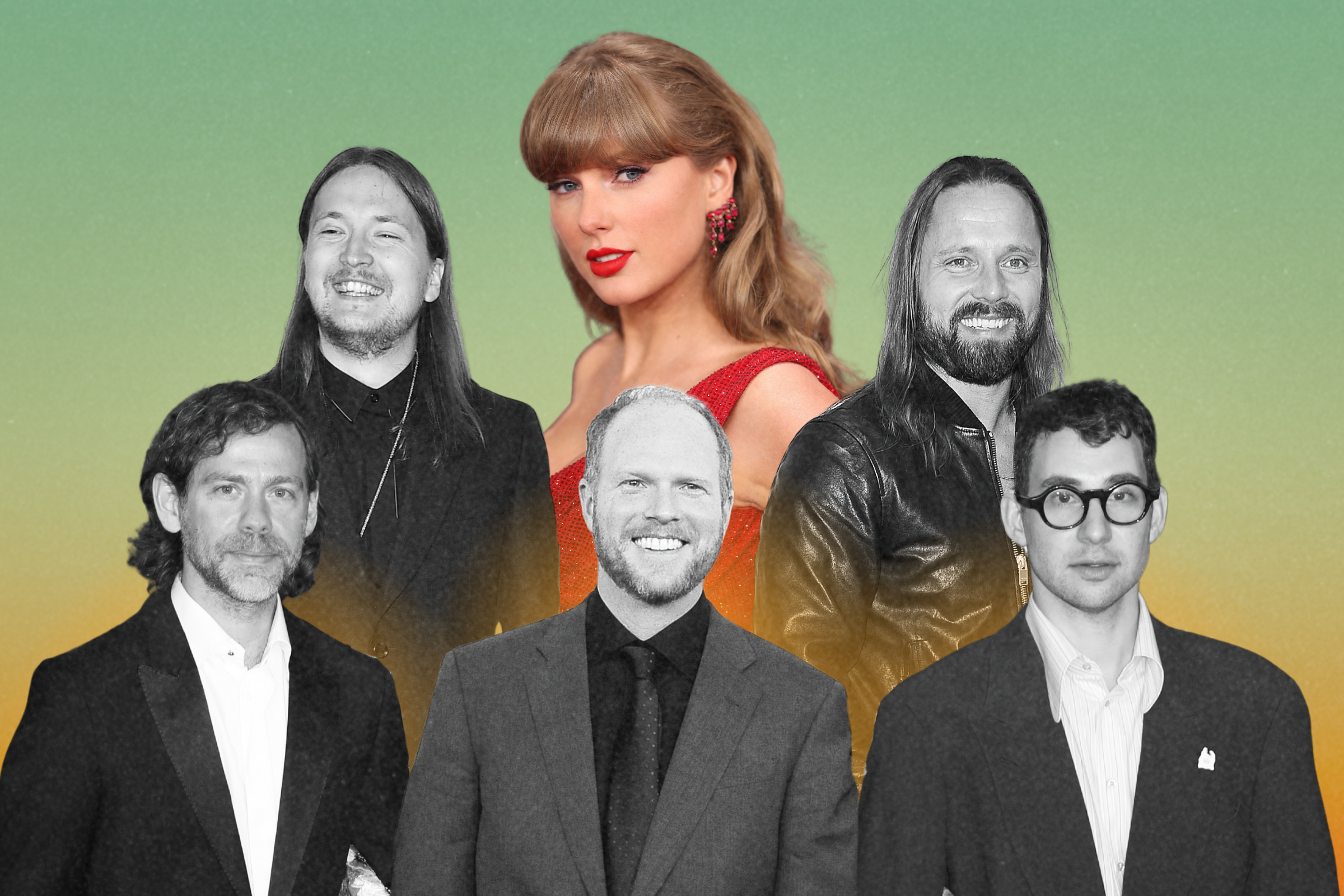
It's a big week for Swiftie nation. After a year-and-a-half hiatus—the longest gap between Taylor Swift albums since the nearly two-year jump between 2017's reputation and 2019's Lover—her latest release, The Life of a Showgirl, is set to drop on Friday, Oct. 3.
Swift has long been a genre-hopping force in the music industry, moving from country to pop to folk and points in-between in the two decades since her career began. Now, her 12-track 12th studio album promises to be a pop extravaganza that mirrors the emotions she was experiencing during the nearly two-year run of her record-shattering Eras Tour.
"This album is about what was going on behind the scenes in my inner life during this tour, which was so exuberant and electric and vibrant," Swift said during an appearance on the Aug. 13 episode of New Heights, a podcast hosted by her fiancé, Kansas City Chiefs tight end Travis Kelce, and his brother, retired NFL great Jason Kelce. "It just comes from, like, the most infectiously joyful, wild, dramatic place I was in in my life."
Swift collaborated on The Life of a Showgirl with legendary Swedish production duo Max Martin and Shellback, a move that suggests the album will mark a return to the contagious melodies and upbeat styling of the pair's previous pop hits from Red, 1989, and reputation. "We’ve never actually made an album before where it’s just the three of us. There’s no other collaborators. It’s just the three of us making a focused album," Swift said of Martin and Shellback on New Heights. "When I was on tour in Stockholm, I had Max Martin come out to the show, and I was talking to him, and I was like, 'I just feel like we could knock it out of the park if we went back in.' I essentially said to him, 'I want to be as proud of it as an album as I am of the Eras Tour, and for the same reasons. And he was like, 'Do you understand what kind of pressure that is?'"
Let's take a look back at how Swift's most important collaborators have influenced her sound over the years.
Read more: What Taylor Swift’s Relationship With Max Martin Means for The Life of a Showgirl
Nathan Chapman

Key quote: "All of the iconic artists in Nashville tell the best stories. Willie Nelson, Reba McIntire, Dolly Parton—so many others I could name—they all have that in common. That's one of the reasons why Taylor has done so well and why she calls Nashville home: She's a great storyteller." - Chapman, 2013, in an interview with MusicRadar
Role: Producer
Albums worked on: Taylor Swift, Fearless, Speak Now, Red, 1989
Biggest singles: "Teardrops on My Guitar," "Our Song," "Love Story," "You Belong With Me," "Mean," "Back to December"
Genre: Country-pop
What to know: After producing 14-year-old Swift's first demos, Chapman was a producer on Swift's first five albums and helped craft the signature early sound that launched her meteoric rise to stardom. Beginning with her 2006 self-titled debut and continuing through Fearless and Speak Now, Chapman blended traditional country instrumentals like fiddle and acoustic guitar with catchy pop melodies and hooks to propel Swift to significant commercial and critical success, including a Grammy for Album of the Year for Fearless. His role was scaled back as Swift started to make the transition to full-on pop and brought in new producers on Red, culminating in a final credit for "This Love" on 1989.
Max Martin and Shellback
Key quote: "Max and I had a conversation nine months later at the [2016] Grammys, when we had literally just won [Album of the Year] for 1989. He kind of laughed, he pointed to all the other producers on the album, and he's like, 'If she had, like, three more hours in the day, she would just figure out what we do and she would do it. And she wouldn't need any of us.'" - 1989 producer Ryan Tedder on Max Martin's praise for Swift, 2024, in an interview with Grammys.com
Role: Producers/Songwriters
Albums worked on:
Martin: Red, 1989, reputation, The Life of a Showgirl
Shellback: Red, 1989, reputation, Red (Taylor's Version), 1989 (Taylor's Version), The Life of a Showgirl
Biggest singles: "We Are Never Ever Getting Back Together," "I Knew You Were Trouble," "Shake It Off," "Blank Space," "Bad Blood (feat. Kendrick Lamar)," "...Ready For It?"
Genre: Pop
What to know: Martin and Shellback first joined forces with Swift on Red, fueling her pivot from country music chart-topper to pop superstar. The pair's influence generally seems to result in a style of hit that Swift has referred to as a glitter gel pen song, one of three metaphorical groupings of music that make up her discography. According to Swift, she writes with a figurative glitter gel pen in hand when the track is "frivolous, carefree, bouncy, syncopated perfectly to the beat."
"Glitter gel pen lyrics don’t care if you don’t take them seriously because they don’t take themselves seriously," she said while accepting the Songwriter-Artist of the Decade honor at the 2022 Nashville Songwriter Awards. "Glitter gel pen lyrics are the drunk girl at the party who tells you that you look like an angel in the bathroom. It’s what we need every once in a while in these fraught times in which we live."
Jack Antonoff

Key quote: "She’s the first person who recognized me as a producer. A lot of people are afraid to sign off on something that isn’t done by a proven person. I had written lots of songs and produced them, but they would always sort of go somewhere else. So the label or whoever could say, oh, we had this person produce it. And, you know, I put my heart and soul into that song and she said, 'I love it.'" - Antonoff on how Swift helped launch his producing career with 1989's “Out of the Woods," 2023, in conversation on TIME's Person of the Week podcast
Role: Producer/Songwriter
Albums worked on: 1989, reputation, Lover, folklore, evermore, Fearless (Taylor's Version), Red (Taylor's Version), Midnights, Speak Now (Taylor's Version), 1989 (Taylor's Version), THE TORTURED POETS DEPARTMENT
Biggest singles: "Out of the Woods," "Look What You Made Me Do," "Cruel Summer," "Anti-Hero," "Is It Over Now? (Taylor's Version) (From the Vault)," "Fortnight (feat. Post Malone)"
Genre: Pop
What to know: A partnership that began with cowriting and coproducing the song "Sweeter Than Fiction" for the 2013 film One Chance has blossomed into one of the most important creative relationships in both artists' lives. Since working with Swift on the Golden Globes-nominated soundtrack single, Antonoff has been a producer on every Swift album from 1989 on, notably instilling a distinctly '80s-inspired sound in many of her iconic pop hits. When Antonoff is involved, expect heavy synths, rock-influenced rhythms, experimental vocals, and intimate lyrics with high-energy choruses.
Aaron Dessner
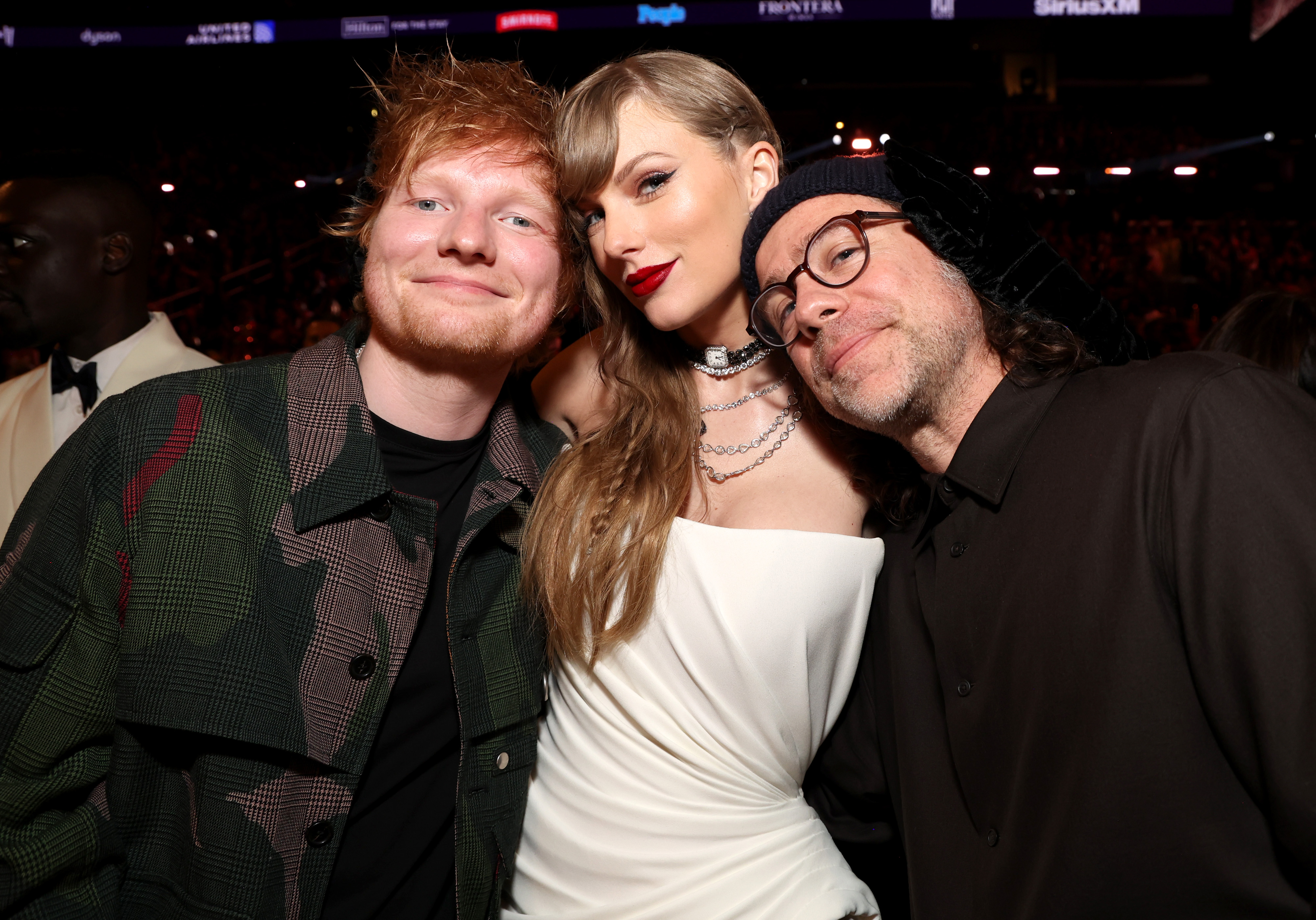
Key quote: "Taylor is one of the greatest songwriters of all time. The poetic and literary bent of her lyricism, where songs often have elaborately woven narratives and hidden meanings that connect to her earlier or future work, what her fans call 'easter eggs,' helps to create an entire artistic world that we all get to inhabit and obsess over as her fans." - Dessner, 2023, in an interview with People
Role: Producer/Songwriter
Albums worked on: folklore, evermore, Fearless (Taylor's Version), Red (Taylor's Version), Speak Now (Taylor's Version), Midnights, THE TORTURED POETS DEPARTMENT
Biggest singles: "cardigan," "willow"
Genre: Indie-folk
What to know: When folklore debuted in July 2020, it ushered in yet another new musical era for Swift—one that was characterized by a stripped-down, indie-folk sound and represented a marked departure from her previous country and pop efforts. It also heralded the arrival of producer Aaron Dessner, a founding member of indie rock band The National, on the Swift scene. Dessner's collaborations with Swift have been praised for their minimalist instrumentation, introspective storytelling, and atmospheric tone.
Christopher Rowe
Role: Producer
Albums worked on: Fearless (Taylor's Version), Red (Taylor's Version), Speak Now (Taylor's Version), 1989 (Taylor's Version)
Genre: Country, pop
What to know: Having previously worked as an engineer and sound mixer on Swift's concert films, Rowe was brought on as a producer for her "Taylor's Version" rerecording project with the apparent goal of replicating the sound of Swift's masters as faithfully as possible while adding her updated vocals and some new instrumental elements. He was heavily involved with all four of Swift's rerecorded albums, recreating songs from Fearless, Red, Speak Now, and 1989 that were originally developed by Chapman, Martin, and other producers.
Vince Gilligan Is Breaking Good
Feed:
TIME
(https://time.com/feed/)
Published: 2025-10-27 14:57:16
|
Created: 2026-08-04 08:17:55
Vince Gilligan knows better than to try to explain where his stories come from. Like the extraterrestrial transmission that kicks off his new Apple TV series, Pluribus, their origin is a mystery. But the writer, producer, and director best known for creating the era-defining crime drama Breaking Bad can approximate where and when he started mulling the idea for the sci-fi epic that would become his first major project since leaving the Walter White universe.
It was probably 2016, in Burbank, where Gilligan had convened the writers’ room for Season 3 of Better Call Saul, the Breaking Bad spinoff he created with Peter Gould. “We would take lunch breaks that seemed to stretch longer and longer,” he recalls. “I'd walk around the neighborhood, and my mind would wander.” Eventually, his thoughts coalesced around the concept of wish fulfillment. “I thought: What if everyone in the world got along? And, specifically, what if everyone in the world was suddenly really, really nice to me personally?” When he took himself out of the scenario, the question became: “Why would one guy be that interesting to people?”
The answer forms the wild premise of Pluribus, whose particulars are being kept under wraps until Apple unveils its first two episodes on Nov. 7. But as for that irresistibly interesting guy, well, he turned out not to be a guy at all. Gilligan recruited Rhea Seehorn, who earned two Emmy nominations for playing the beloved Saul character Kim Wexler, to anchor the show as his first female protagonist, Carol Sturka. Despite press materials that introduce Carol as “the most miserable person on Earth,” she is also his first bona fide hero.
For a creator synonymous with the rise of antihero television, who made his name telling what he famously called “a story about a man who transforms himself from Mr. Chips into Scarface,” this is a seismic shift. Yet it’s also a reflection of the keen moral sensibility that has always permeated Gilligan’s work, as well as the kindness for which he has long been known throughout his industry. Though he remains proud of Breaking Bad and Better Call Saul, both of which aired on AMC, the once avowedly apolitical storyteller has become convinced that pop culture’s recent supersaturation with antiheroes has been unhealthy for society. His most ambitious series to date, Pluribus can be seen as a corrective of sorts—a grand, artful, mind-bendingly philosophical, darkly funny, sometimes heartbreaking, but consistently humane vindication of our fractious species.

When Gilligan reflects on his trajectory, from a kid making Super 8 movies in the Richmond, Va., area to, at 58, one of the small screen’s most acclaimed creators, the word that comes up most is luck. “I really feel like I'm the Kramer of the TV-writing world,” he says when we meet in October at a boutique hotel in New York City. “I fell ass-backward into good luck time and time again.” This self-assessment egregiously undersells the talent of a man who has made two of the medium’s greatest dramas. But rather than false modesty, it comes across as the genuine humility of a guy who, throughout our conversation, reflexively credits his collaborators.
It’s about a month before Pluribus is slated to debut, and Gilligan, who lives in New Mexico—his new show, like the Breaking Bad universe, is set in Albuquerque—is in town for a round of press and a preview screening during New York Comic Con. Dressed in a bright blue T-shirt that happens to match the hotel room’s azure-and-white decor, in an accidental echo of the meticulous production design for which his series are known, he speaks largely in anecdotes, with a soft Southern twang. As if to mark a new phase of his career, he has shaved the goatee that was his signature throughout the AMC years.
He’s been through several eras already. Gilligan was studying film at NYU when, in 1989, he won the Virginia Governor's Screenwriting Award for the screenplay that would become the movie Home Fries. He spent the next few years writing feature scripts. But by 1994 screenwriting work was drying up; he was broke and had lost his Writers Guild insurance. When his agent got him a meeting with The X-Files creator Chris Carter, Gilligan only intended to compliment him. But Carter asked for ideas, Gilligan pitched an episode about a character whose shadow came to life, and the man who’d soon become his boss hired him on the spot to write it.
Gilligan’s three-decade tenure in television has paralleled the rapid evolution of the medium. In the mid-’90s, broadcast networks dominated prime time with megahits like Seinfeld, ER, and The X-Files, whose viewership on Fox peaked at a now-inconceivable 20 million. Breaking Bad and Better Call Saul emerged into what has been called the Third Golden Age of Television, a renaissance in audacious, cinematic cable programming for adult audiences, spurred by the success of The Sopranos and sustained by Netflix’s need to build a streaming library. Now he’s making Pluribus for Apple, one of the few companies still reliably funding expensive streaming series—especially science-fiction titles like Foundation and Severance—at a time of consolidation and austerity in Hollywood.
And yet Gilligan initially doubted he could make it as a TV writer. “The thing I was most trepidatious about is, I am so lazy,” he says. Surely, he figured, a guy whose process involved frequent video-game breaks wouldn’t last past his 13-week X-Files probation. “I thought, I don't really need to clean out my fridge in Virginia. The ketchup will keep 13 weeks.” But to his surprise, he took to the hard work. “The two things about TV that are so great,” he discovered, are that “your writing actually gets produced”—unlike film scripts, which can take years to reach the screen, if they do at all—and “working with smart, talented people you can stand to be in a room with for 12 hours a day, five or six days a week.”
Another aimless period followed The X-Files’ 2002 finale. But Gilligan counts himself, yes, lucky to have been pitching Breaking Bad amid a boom in cable networks making bespoke scripted series, an escape hatch from broadcast’s grueling 22-plus-episode seasons. The 2008 premiere of the show, which follows a terminally ill teacher (Bryan Cranston) who cooks meth to stockpile money for his family, failed to generate the same buzz as AMC’s flagship original, Mad Men. A 2011 New York Times Magazine profile ventured, in an observation that has aged awkwardly, that Gilligan might be “TV’s first true red-state auteur.” Just when it looked as if that crowd might not be enough to sustain it, Netflix licensed the show during its fourth season, driving millions of new viewers to AMC for new episodes.
Breaking Bad not only ended its five-season run with a record-breaking 10.3 million viewers tuning in for Walter White’s Shakespearean sendoff, but also yielded a more ruminative companion show in Saul, about Walt’s crooked lawyer (Bob Odenkirk), and a feature-length Netflix sequel, El Camino, that followed Walt’s puppyish partner in crime, Jesse Pinkman (Aaron Paul). Gilligan isn’t wrong that he benefited from serendipitous timing. Yet it’s equally true that none of Breaking Bad’s rivals maintained both the huge audiences (Mad Men never averaged more than 2.6 million) and the consistent quality (see: Game of Thrones) of what became basic cable's crown jewel of the 2010s.
Pluribus, which arrives three years after the final episode of Saul, opens by having a bit of fun with the clichés of prestige apocalypse dramas, from The Walking Dead to The Last of Us to 3 Body Problem. The premiere hints at many types of extinction events before pivoting to a cataclysm so surprising, it’s useless to guess. All you really need to know is that, within the first half-hour, the world we know is transformed beyond recognition. I wouldn’t want to reveal more even if I hadn’t been asked not to, because the show works best when you’re just as clueless as poor Carol.
What is clear from the outset is Pluribus’ global scale, which required a much larger canvas than Gilligan had ever been given. Portions of the nine-episode season were shot in the Canary Islands and northern Spain. There are scenes set at a Norwegian ice hotel and in the hills of Tangier, Morocco. The production built Carol’s entire neighborhood in the desert outside Albuquerque: “We picked a spot with this beautiful view of the Sandia Mountains," Gilligan says. "And we said, ‘OK, in however many months we're gonna have a whole cul-de-sac here.’” It wasn’t just a flex. “We knew we couldn't shoot in a real neighborhood,” he explains, “because the neighbors would kick us out after the second episode.” Suffice to say, a lot of weird stuff happens at Carol’s house.
This cul-de-sac at the end of civilization feels like a physical manifestation of the loneliness Carol radiates even before the cataclysmic incident. A best-selling romantasy author with a perma-grimace, she dismisses her own books as “mindless crap” and hates her fans in what Gilligan says is a projection of self-loathing. Her manager and romantic partner, Helen (Miriam Shor), serves as a buffer between Carol and everyone else. When your hero has so many flaws that they initially obscure positive traits like independence and grit, it doesn’t hurt to cast an actor your loyal audience already adores. For Gilligan, who wrote the character specifically for Seehorn, the reunion also meant getting to spend more time with a performer who was “as sweet and kind and pleasant to be around as anyone I've ever worked with.”

He didn’t take the challenge of crafting his first female protagonist lightly. (While Kim, a chronically underestimated lawyer torn between law and morality, was so popular that viewers lived in fear she’d be killed off, Walt’s long-suffering wife, Skyler, played by Anna Gunn, was widely despised for her perceived shrillness.) “I always worry about writing female characters,” he says. “A lesbian character as well, because that's not my experience.” But women are well represented among the series’ writers and directors. Besides, what makes Carol, like Kim, a great character is that she isn’t defined by gender or sexuality; she’s a person first. “It doesn't feel like [Gilligan] had an agenda of, ‘I'm going to write a female-empowerment story,’” Seehorn says. “He wrote a fascinating, complex, incredibly reluctant hero with a lot of flaws but a lot of strengths, some of which she didn't know she had.” “I wasn't thinking in terms of masculine versus feminine,” Gilligan confirms. “I was just writing this character who’s got a lot of issues and is struggling to find happiness” but somehow feels even worse once society reorients itself around her whims. Only in hindsight did he realize that her anxious, misanthropic tendencies—“standard writer problems”—mirrored his own.
Still, for all that Pluribus constitutes a departure from male-antihero crime capers, it’s also unmistakably a Vince Gilligan creation: mournful undertones cut by dark humor; visual grandeur and distinctive characters. Gilligan’s trademark cold opens, which can transport us halfway around the world or introduce new characters, remain a masterly way of calibrating suspense. Exiting the New York screening, I heard one giddy attendee regale her companion with a list of Breaking Bad Easter eggs I hadn’t even noticed. In many ways, returning to speculative storytelling has felt like a homecoming to Gilligan, even as swerving away from crime presents a chance to expand his legacy. “I'm lucky as hell to be known for Breaking Bad. That'll be the first thing on my tombstone,” he reflects. “But I don't want to be a one-trick pony. If I have any life left in me, I want to do a few other things before I'm done.”
Between the second and third seasons of Better Call Saul, in 2016, the news broke that Gilligan was developing a drama about the Jonestown massacre. But the project never got off the ground, in what he looks back on as “a real failure on my part.” Gilligan found himself paralyzed by the task of doing justice to the victims and their families without elevating the perspective of their “scumbag” leader. “So I realized I better stay in my lane,” he says. “I'm better at making up stories. Then I don't have to feel responsible” for dramatizing real people's pain.
As adaptations and franchises crowd out the original storytelling of a bygone Golden Age, Gilligan is notable for what he doesn’t do as well as what he does. You’re not likely to find him helming the next Andor or The Penguin or any other prestige-branded series based on monolithic IP. “We've got modern mythologies now, with Star Wars and Star Trek and Marvel and DC—and all that stuff's great,” he says. “But that stuff was created for people who are now in their 60s and 70s. In terms of DC Comics, it was created for people who are now long deceased. It's good that they continue. It shows that they have a fundamental worth in terms of myth.” He just thinks it’s vital for pop culture to keep producing stories organic to the times we’re living in: “Every generation deserves its own mythology.”

Another lucrative option that would surely be open to Gilligan is the megaproducer route, in which a big-name creator like Ryan Murphy or Shonda Rhimes develops a stable of series, each with their valuable imprimatur but its own showrunner. “I probably should figure out how to do that, because there's a lot more money,” he muses. But the idea of parachuting into a writers’ room, dispensing high-level feedback, then moving on to the next? “That sounds like hell on Earth,” he says.
Though often described as an auteur—a term he has rejected—Gilligan continues to thrive on the collaborative spirit of the writers’ room as well as the production process. “There are writers who write every episode of a TV show, and my hat is off to them,” he says. (Think Mike White’s The White Lotus.) Not only does he appreciate camaraderie; he also believes that, were he to script every episode solo, he’d have “a poorer show creatively.” Seehorn describes him as “the composer in the middle of the orchestra,” working to realize “this beautiful story in his mind” but also leaving room for each musician to contribute. Perhaps unsurprisingly, Gilligan alums were represented in almost every department of the Pluribus crew.
In his 2013 book Difficult Men, which profiled the mostly prickly personalities behind contemporaries like The Sopranos and Mad Men, Brett Martin observed that Gilligan “was known as a good man to work for—someone who managed to balance the vision and microscopic control of the most autocratic showrunner with the open and supportive spirit of the most relaxed.” This reputation has persisted; as Shor noted at the preview screening, he’s been called the nicest guy in Hollywood. (Even the mildest criticisms are difficult, though not impossible, to find.) This fosters creativity. When Seehorn joined Saul, she found herself surrounded by “people that are all working at the very top of their game.” What was even more remarkable, she says, is that it was “all in service to the story, not ego. And you come on and they cannot wait for your contribution.”
Standing before a crowd of peers in February to accept a lifetime achievement award from the Writers Guild, Gilligan argued that pop culture needed to move on from bad guys like Walter White. “We are living in an era where bad guys, the real-life kind, are running amok,” he said. “Bad guys who make their own rules, bad guys who, no matter what they tell you, are only out for themselves. Who am I talking about? Well, this is Hollywood, so guess.” It was time, he believed, for heroes to make a comeback.
Gilligan has been expressing similar sentiments since at least 2018. What changed to make a creator who spent the better part of the Obama years cultivating his own Scarface nostalgic for Mr. Chips? Gilligan doesn’t mention names. But Donald Trump took office in 2017, so guess. “I've been studiously apolitical my whole career,” he says, because he found that polemic “instantly turned off half the potential audience.” Breaking Bad and Saul were concerned with larger moral truths: “At their heart, both say: actions have consequences.” Simple though it is, Gilligan points out that this message eluded TV for years, as characters in the episodic fare that predominated before DVR and streaming enabled serialized storytelling could commit murder in one episode and never speak of it again.
Now, Gilligan feels compelled to reexamine the kinds of characters he’s creating because “what's going on does not seem like it's about left or right anymore. It feels like it's about maintaining a democracy, maintaining a civil republic and the rule of law and the right to free speech versus giving it all away.” Though it seems, to him, like the U.S. is “right on the edge of civil war,” he’s convinced that no one actually desires that outcome.
“We’ve got to find a way to talk to each other,” he says. Gilligan wants to see people from across the partisan spectrum interact face to face, instead of taunting each other online. He’s as stumped as anyone about how to make that happen. But he does hope Pluribus, a show too removed from our reality to explicitly address current political debates that is nonetheless “about people struggling to do the right thing,” can play a small part in facilitating those conversations.
Despite its speculative premise, the series captures the loneliness that has pervaded society since the COVID pandemic and the dread of a future in which artificial intelligence might render human interaction obsolete. (Gilligan didn’t have LLMs in mind when he conceived Pluribus but says he’s “happy if this show, in any way, shape, or form, could turn people off to AI.”) And in the imperfect hero who is Carol Sturka, viewers get a role model who doesn’t let her own anger or grief stop her from trying to save the world.
Gilligan is probably incapable of saccharine. Pluribus is as dry, ironic, brutal, and alert to the horrors festering in no small number of human souls as anything he’s made. Yet, as the season goes on, Carol’s quest becomes kind of inspiring. This reflects not just Seehorn's charm and Gilligan’s frustrations with antiheroes, but also his anxiety about the prevalence of postapocalyptic sci-fi stories. “It started to worry me that we were writing so many of them,” he says. “It was like it was priming people for the apocalypse, instead of priming them to avoid the apocalypse at all cost.” Distilled to its essence, the message of Pluribus might be: Humanity is worth fighting for.
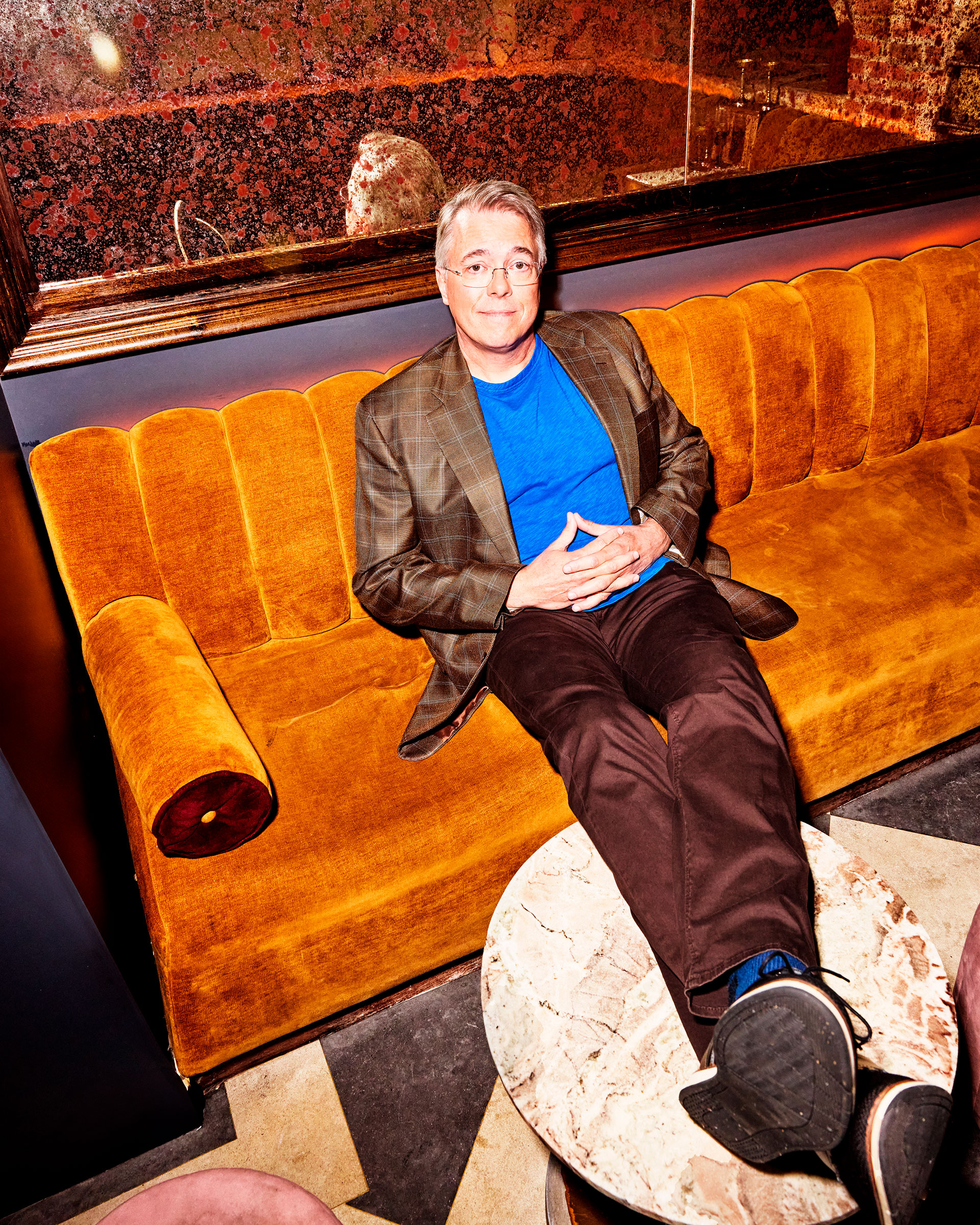
By the time Pluribus premieres, Gilligan will be back in the writers’ room, at work on a second season that was greenlighted along with the first. He’s relieved to have gone into the project knowing he’d have time to tell his story, as viewers who get invested in its expansive world-building surely will be, too. Does it bother him that he won’t get to hear audience feedback first? No, he says, because “I don't think that's the job.” Ever since The X-Files became one of the first shows to engage the online commentariat, he’s avoided fan chatter. “Fellow writers would say: ‘You need to check out this chat room. They're talking about your episode,’” he recalls. “I instinctively knew to never do that.” Now he jokes to friends that they should euthanize him if he ever makes a social media account.
Not that he’s closed off to all input. “He never, ever shuts me down,” Seehorn says. And as meticulous as he is in constructing his richly detailed stories, Gilligan also values dynamism and spontaneity. As a showrunner, “you have to be ready to jettison ideas at the drop of a hat,” he says. Breaking Bad lore is littered with major plot changes made on the fly, alternate endings tossed around the writers’ room, characters as major as Jesse that Gilligan kept around much longer than he’d intended because he liked the actors’ performances so much. He has a clearer sense of how he wants to wrap up Pluribus than he did for previous shows at this point in their runs but makes no guarantees that he’ll stick to it.
“I want to stay open to the possibilities of going a different way,” Gilligan explains. “It's like if you get in your car and you say, ‘I'm in Virginia, I want to head out to California. So I know, basically, the direction I need to head.’ But there's all these little side trips and backroads you can take along the way—and that makes the trip more exciting.” Luck is part of that ride. You may get a flat tire, or you may run into a long-lost friend at a rest stop. But if the destination is appealing and the driver adept, the journey is bound to be worth taking.
А что по скорости печати?
Feed:
Все публикации подряд на Хабре
(https://habr.com/ru/rss/articles/)
Link:
https://habr.com/ru/articles/1066262/?utm_source=habrahabr&utm_medium=rss&utm_campaign=1066262
Published: 2026-08-04 08:14:51
|
Created: 2026-08-04 08:15:57
Клавиатуре около 150 лет. Это один из самых старых интерфейсов, которым люди пользуются каждый день. При этом большинство людей не задумываются о том, насколько хорошо владеют этим интерфейсом. Все обсуждают новые IDE, фреймворки, AI-инструменты — но базовый навык взаимодействия с компьютером остаётся на уровне «как-то печатаю и ладно».
Читать далееJack Harlow
Feed:
TIME
(https://time.com/feed/)
Published: 2022-09-28 09:56:09
|
Created: 2026-08-04 08:11:56
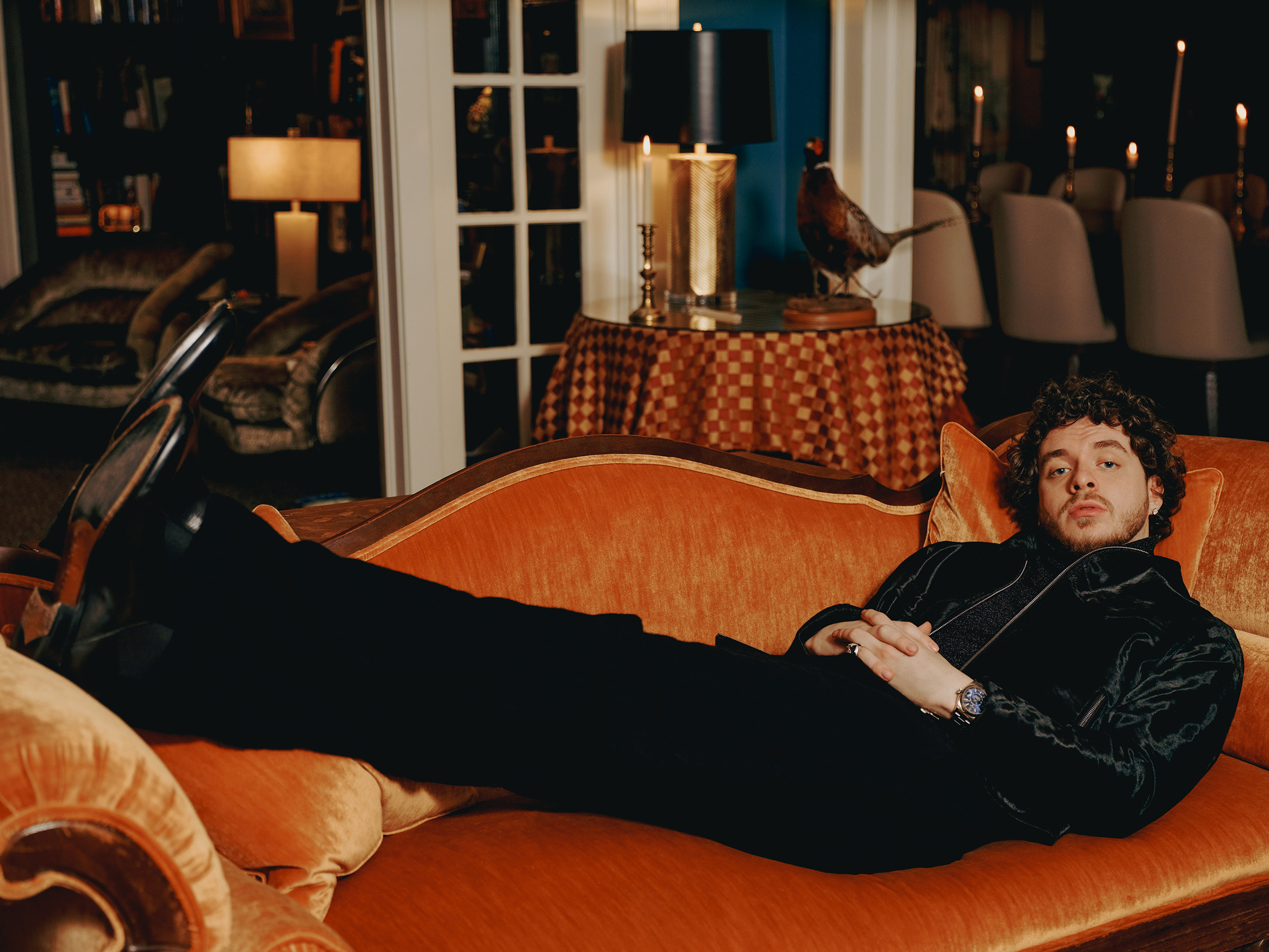
Machine Gun Kelly
Feed:
TIME
(https://time.com/feed/)
Published: 2022-09-28 09:56:10
|
Created: 2026-08-04 08:11:56
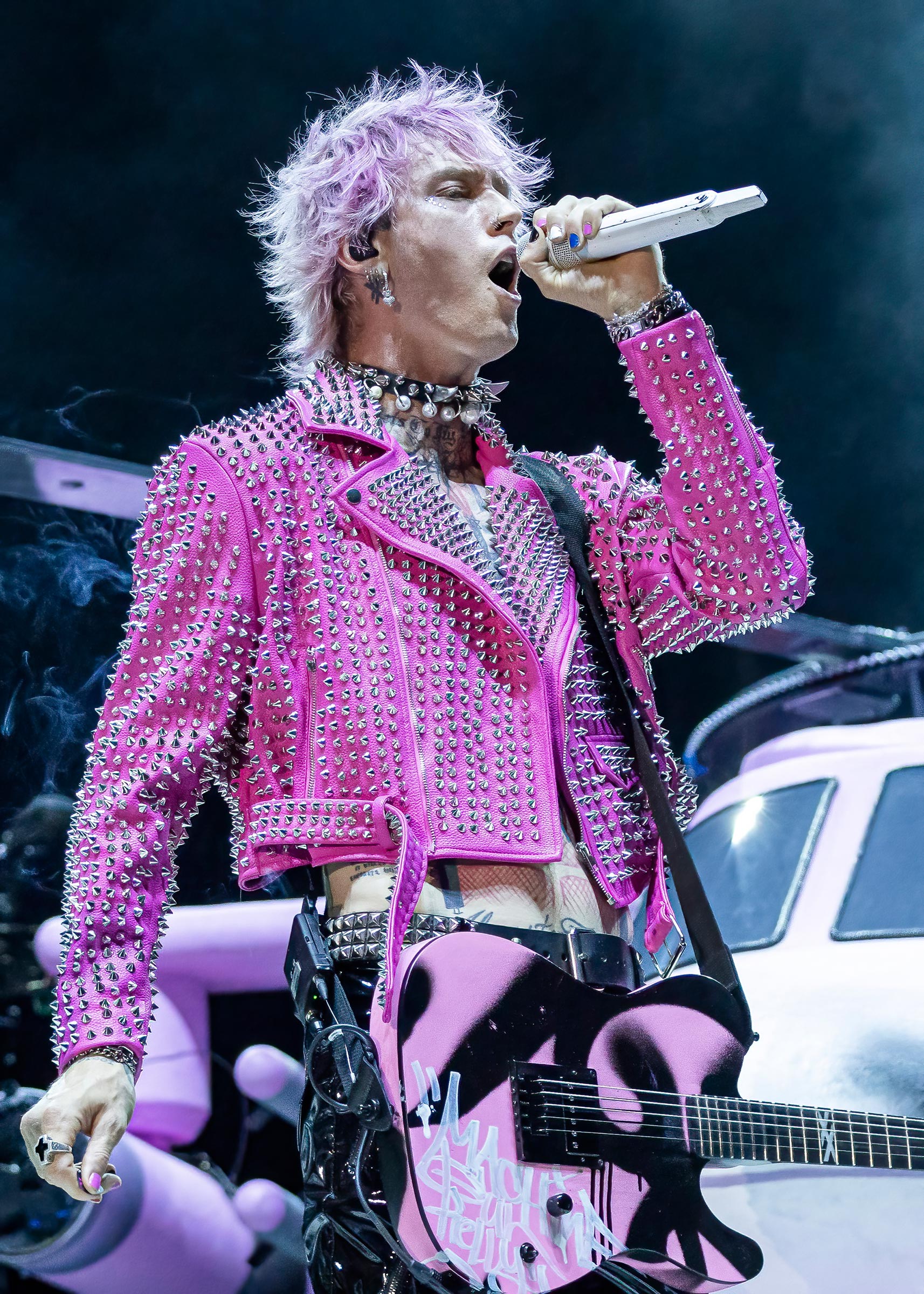
A Bank of America Glitch Sent Customers Into a Panic Over Missing Funds
Feed:
TIME
(https://time.com/feed/)
Published: 2023-01-18 22:05:28
|
Created: 2026-08-04 08:11:55
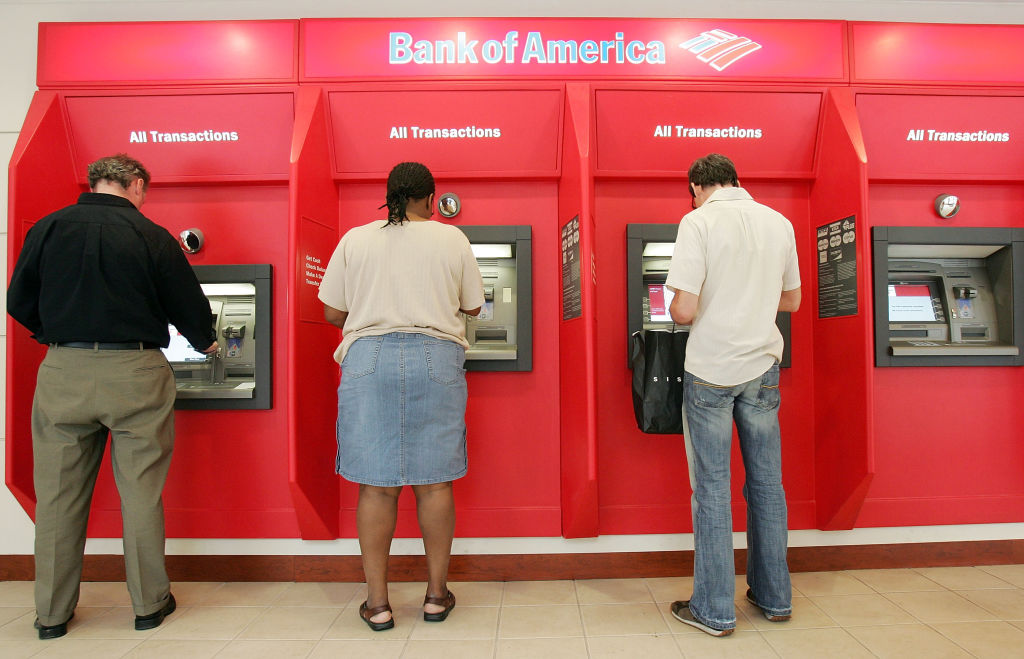
On Wednesday morning, Bank of America customers began reporting issues with payments processed through the money transfer service Zelle, which led to money disappearing from their accounts.
Many customers took to Twitter to express their outrage as they began to notice the missing funds.
One user tweeted, “I almost lost my mind when I saw $2,000 was missing from my account.”
Another said, “So cool how @BankofAmerica magically disappeared a large Zelle transaction that HAD ALREADY POSTED and I had used to pay bills. Now I’m extremely in debt in my checking and I can’t get ahold of them. Unbelievable.”
Zelle is a money transfer service that works with U.S. banks to move funds directly from one bank account to another. Zelle transfers are quick and free––making the service a popular alternative to credit card transactions that can take a few days to hit users’ accounts and often require fees and bank transfers. However, the service has been under fire by government officials for being an easy facilitator for fraud and theft. Zelle does not offer any protection for payments made through their services—which means that there’s no safeguard for customers if a transaction goes wrong.
The website downdetector.com reported over 1,000 outage reports for Bank of America by 10:30 a.m. EST Wednesday, coupled with a similar spike in Zelle outage reports.
https://twitter.com/YepItsZak/status/1615716481765113856
Over a customer support social media account, Zelle redirected users to Bank of America, saying, “The Zelle App & Network are up & running. We are aware of an issue that is impacting Bank Of America customers when sending & receiving payments. We recommend contacting Bank of America’s customer support team for additional updates.”
Bank of America told TIME that, as of 3:00 p.m. EST Wednesday, the issue was resolved and customers were receiving their funds back.
The Charlotte Observer reported that customers received a notice when they logged into their online bank accounts on Wednesday, saying that transactions were not missing, but delayed.
More from TIME
“Zelle transactions made between January 14th and January 17th may be delayed in occurring and posting to accounts as requested,” the notice said. “Transfers will be completed and will appear in your account activity and balances as soon as possible.”
Zelle provided a statement to TIME on Thursday reading: “We understand that a Zelle Network® financial institution may have experienced issues processing some of their customers’ Zelle® transactions, which has now been resolved. This issue was not the result of any issues with the Zelle Network®.”
https://twitter.com/GNCordova/status/1615744829857861632
In 2020, Bank of America customers reported another major glitch, with accounts showing inaccurate balances of as little as $0. The company acknowledged the issue, saying at the time that any inaccuracies did not impact their actual funds. “Some clients may currently see an inaccurate account balance in online or mobile banking. There is no impact to their accounts and their information remains secure,” Bank of America said.
Global payment service ACI Worldwide reported last year that fraud loss in the United States from Authorized Push Payments—scams that trick victims into willingly making large bank transfers to fraudsters—is expected to rise to $3 billion in 2026.
https://twitter.com/JaimeSeija/status/1615707602968784898
In a report issued last fall, U.S. Senator Elizabeth Warren said four banks provided data reporting over 190,000 cases of fraudulent transactions on Zelle involving over $213 million of payments in 2021 and the first half of 2022. In the majority of the cases, the report noted, individuals were not repaid the amount they were defrauded.
Warren called out both services on Twitter Wednesday afternoon, writing “@BankofAmerica and @Zelle are apparently failing customers again, with money somehow disappearing from accounts. This should be fixed immediately and customers should be compensated. I’ve called out serious fraud issues on Zelle and this is their latest failure.”
Page 537 of 1026 (51253 total items)
Recent Feeds
NYT > Top Stories
World news | The Guardian
NBC News Top Stories
Home - CBSNews.com
Все публикации подряд на Хабре
The Latest News from the UK and Around the World | Sky News
The Guardian
BBC News
WIRED
ABC News: Top Stories
PBS News Hour - The Latest
BBC Russian
Latest Updates
TechCrunch
TIME
BBC News
World
NPR Topics: News
WSJ.com: World News
Stack Overflow Blog