RSS Feeds
For Trump, the Year Is Always 2020
Russia says seven killed and 40 injured by Ukrainian drone hitting busy beach
Why the 2027 Met Gala is already causing controversy
Russia blasts Zaporizhzhia with glide bombs while Ukrainian drones kill 9
Russia says seven killed and 40 injured by Ukrainian drone hitting busy beach
Judge orders return of alleged victim of trafficking sent to France under ‘one in one out’ scheme
Ruling quashes Home Office policy to refuse asylum seekers’ right to have trafficking claims reconsidered after initial rejection
A high court judge has ordered the Home Office to bring an alleged victim of trafficking forcibly removed to France under the “one in one out” scheme back to the UK.
It is the first ruling of its kind and could lead to more people affected by the “one in one out” policy being brought back to the UK.
Continue reading...15 Things Mosquito Experts Never Do in the Summer
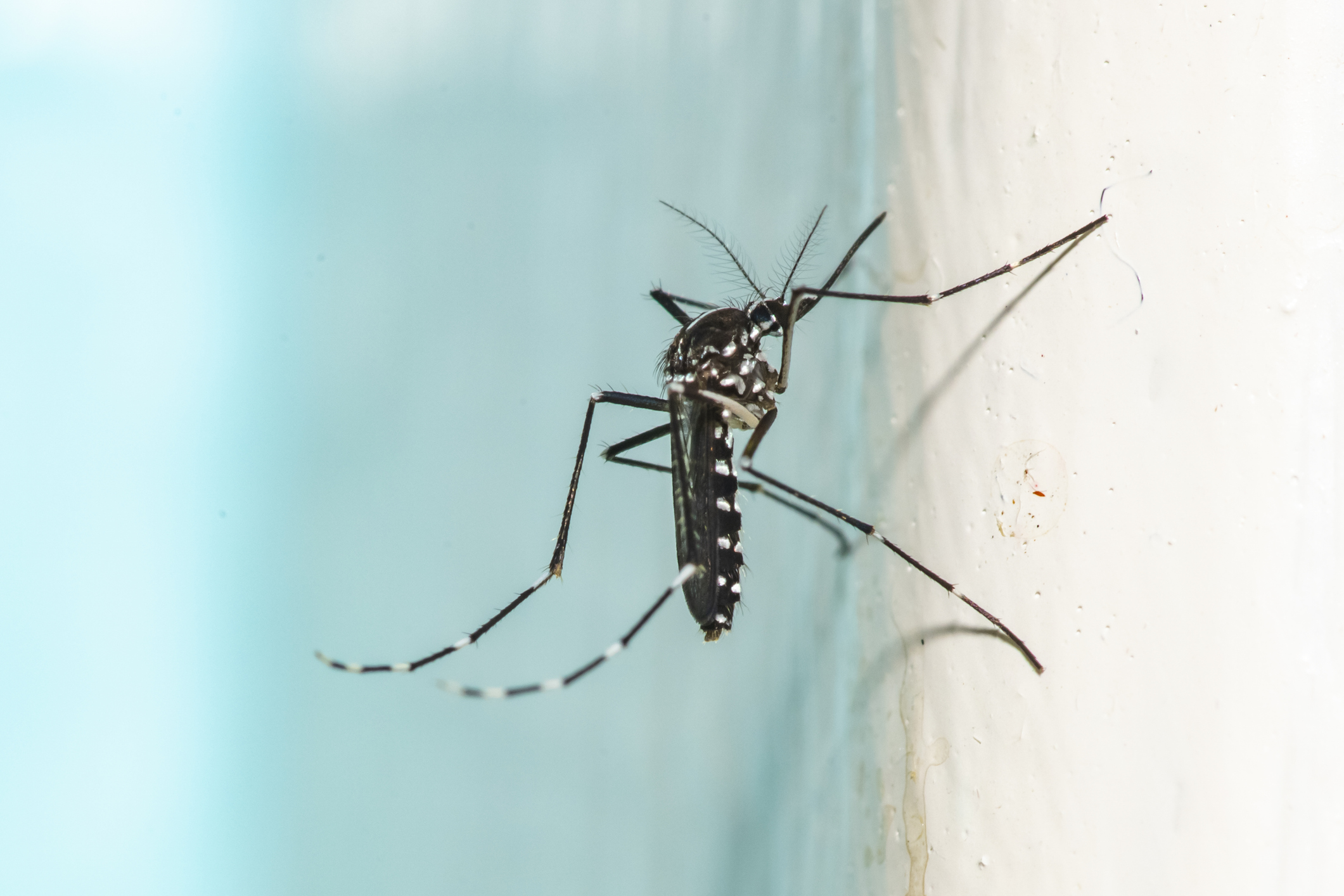
If you think mosquitoes suck, science is on your side. They don't actually bite, explains Lyric Bartholomay, a medical entomologist at the University of Wisconsin–Madison School of Veterinary Medicine: They have sucking mouthparts, not biting ones. "So they literally suck," she says, "and they figuratively suck, too."
Their resume only gets worse from there. The mosquito is the deadliest animal on the planet, killing more people than any other creature by spreading malaria, dengue, West Nile virus, Zika, chikungunya, and other diseases. In the contiguous U.S., West Nile is the leading mosquito-borne disease, sickening about 2,000 people and killing more than 130 every year.
There isn’t one mosquito-borne-disease hot spot in the U.S. West Nile virus has been reported across the contiguous U.S., and where cases surge can change from year to year. Most locally acquired dengue transmission happens in Puerto Rico and other U.S. territories, though limited local transmission has also occurred in Florida, Texas, Arizona, California, and Hawaii.
Fortunately, protecting yourself doesn’t require surrendering your backyard—or spending the summer sealed indoors. It does require avoiding some surprisingly common mistakes. We asked mosquito experts what they never do during the summer, from overlooking tiny pools of standing water to relying on products that don’t actually work.
They don’t ignore standing water
Bird baths, koi ponds, and fountains are the easy stuff—the water you can see from the kitchen window. The real trouble is the more hidden water.
Louisa Messenger, a vector-borne disease researcher at the University of Nevada, Las Vegas, points to a bottle cap that has rolled underneath a shrub and catches a little spray whenever the sprinklers run. It holds less than a milliliter of water, but that’s enough for certain daytime-biting mosquitoes to lay their eggs. “You would never find that, never in 1,000 years,” she says. “But your mosquitoes will find that.”
Other easily missed breeding spots include a tiny pocket of water beneath the soil in a potted plant, a discarded tire, or a planter saucer. Maintained, chlorinated pools and fountains with moving water generally aren’t the problem. Mosquitoes want still water—and the smaller the pool, the easier it is to miss.
They never walk past a container without glancing inside
Once mosquito experts learn what a breeding spot looks like, they see them everywhere.
In her own yard, a tarp left crumpled over some lumber became a collection of tiny pools after it rained. Buckets and cups forgotten after parties are equally inviting. Then there’s her neighbor’s wheelbarrow, which is full of weeds and refills whenever it rains. “I keep sneaking over there and emptying it out,” Bartholomay says. “The mosquitoes just love it.”
Where you live determines where else you need to look. In parts of Florida, some plants, like ornamental bromeliads, collect water in the cups of their leaves, allowing mosquitoes to breed several feet above the ground. Daniel Markowski, technical advisor with the American Mosquito Control Association, flags children’s toys—dump trucks, sand pails, plastic cups—and buried downspouts that aren’t draining properly. Mosquitoes can breed in the trapped water underground, then fly in and out through the top.
Once you find standing water, dump it. Scrub the sides of containers you’re keeping to dislodge any eggs, then turn them upside down so they can’t refill. Bromeliads should be flushed with a strong stream from a hose, while blocked downspouts need to be cleared or repaired so they drain completely.
The habit follows Markowski everywhere. “Walking my dog down the street, I see something and think, ‘Oh, yeah, they need to empty that bird bath,’” he says. “You just can’t help but make a mental note of everywhere you see standing water.”
They never let a bird bath sit untouched
A bird bath can become a mosquito nursery in about a week. Markowski recommends dumping and refilling it at least that often. The U.S. Centers for Disease Control and Prevention advises scrubbing it too, which helps dislodge eggs stuck to the sides. Stick with plain water: Bleach and other harsh chemicals can leave residue that harms birds.
Do the same weekly sweep for flowerpot saucers, buckets, toys, tarps, and anything else that has collected water. Bartholomay’s rule is simple: “Just take away their habitat.”
Gutters don’t necessarily need weekly attention, but they do need to stay clear. Markowski cleans his every spring, before mosquito season gets underway; Bartholomay uses gutter guards to keep water from pooling in the first place.
They wouldn’t dare underestimate the power of a fan
One of Bartholomay’s favorite mosquito-fighting tools is low-tech: a fan. Mosquitoes are weak flyers, so even a modest breeze makes it harder for them to land. “You can make your own breeze with a fan,” she says.
When her family plans to eat outside, she points a fan toward the table and switches on a spatial repellent—a small device that heats and releases repellent into the surrounding air—about 10 minutes before they sit down. Together, they make the patio much less hospitable to pests before dinner even arrives.
They never assume daylight means they’re safe
The dawn-and-dusk rule most people think applies to mosquitoes isn’t comprehensive. The pests are also active midday.
Culex mosquitoes that spread West Nile virus tend to feed around dawn and dusk. But invasive Aedes mosquitoes, including Asian tiger mosquitoes, are “really vicious daytime biters,” Bartholomay says.
Aedes mosquitoes can transmit dengue, Zika, yellow fever, and chikungunya. These viruses aren’t endemic in the continental U.S., but travelers can bring them home after getting infected elsewhere. If a local Aedes mosquito bites an infected traveler while the virus is circulating in their blood, the mosquito can pick it up. After the virus multiplies inside the mosquito, it can spread dengue by biting someone else—starting a local chain of transmission.
Daylight, in other words, offers no protection. “You’re out in their environment in the daytime, and so it’s up to you to protect yourself,” Messenger says. “They will come and find you.”
They never assume a drought—or a desert—means no mosquitoes
Drought may knock back some mosquitoes, but it doesn’t get rid of all of them.
“I wouldn’t assume that when it’s really hot and dry, there’s no mosquito risk,” Bartholomay says. Species that flourish after heavy rain may dwindle, but some of the mosquitoes that transmit West Nile virus continue doing just fine.
Moving to the desert doesn't guarantee an escape, either. Messenger lives in Las Vegas, where she hears from people who expected the heat and aridity to leave them mosquito-free. Instead, Southern Nevada has a significant mosquito problem, as do parts of Arizona and Utah.
“Mosquitoes are super adaptable,” Messenger says. Some of her friends and colleagues are being “absolutely shredded”—bitten so badly they can’t enjoy their yards.
They won’t grab a repellent without checking the label
When it comes to bug spray, mosquito experts worry less about the branding than the active ingredient and concentration.
Markowski favors products with 20% DEET. “It’s the gold standard,” he says. “It’s been around for 50-plus years for good reason.” Picaridin is another well-supported option. Bartholomay uses the U.S. Environmental Protection Agency’s searchable repellent list to compare ingredients and protection times rather than guessing in the store aisle. Products with a lower concentration, for example, typically need to be reapplied sooner.
They don’t rely on repellent alone
When mosquitoes are especially intense, the experts add a physical barrier. Markowski wears long pants and sleeves—even when it’s 95°F outside. “I know no one’s going to do it,” he says. “But I’m not getting bit.” Lightweight, loose-fitting fabrics make the strategy more realistic in summer.
Pay particular attention to your feet and ankles, which Wolff says mosquitoes find especially attractive. In higher-risk areas, she trades sandals for socks and closed shoes.
Bartholomay goes further during fieldwork, wearing permethrin-treated clothing and, when mosquitoes are truly out of control, a net over her head—so she doesn’t end up “sucking mosquitoes into [her] nose holes.” Permethrin should be applied only to clothing and gear, never directly to skin, and always according to the label.
They never rely exclusively on an untested natural remedy
Natural doesn’t necessarily mean useless, but it does mean less certain.
Citronella, lemongrass, cinnamon, and other botanical extracts may repel mosquitoes to some degree. But if the finished product isn’t EPA-registered, you might not know how well it works—or how long the protection lasts. “There’s nothing wrong with people using that,” Messenger says. “But I wouldn’t rely on it exclusively.”
Gabriella Wolff, an assistant professor of biology at Case Western Reserve University in Ohio, draws the line based on risk. Around her Cleveland neighborhood, she sometimes mixes cinnamon oil into lotion. In a place where mosquito-borne disease is a bigger concern, she reaches for DEET or picaridin.
They never count on a citronella candle
Asked what he would tell someone relying on citronella candles alone, Markowski doesn’t hesitate: “I’d say good luck.”
Citronella does have mild repellent properties—but the problem is delivery. If the breeze carries the plume downwind while you’re sitting upwind, the mosquitoes might enjoy a citronella-free meal of you.
They stay away from ultrasonic gadgets
Wolff studies how mosquitoes hear, making her a good person to ask about ultrasonic repellents—small electronic devices, often sold as plug-ins or portable units, that claim to drive mosquitoes away by emitting high-frequency sounds humans can’t hear. Her verdict is straightforward: “So far, we haven’t found any evidence that mosquitoes respond to ultrasonic frequencies.”
Researchers are exploring whether certain lower-frequency sounds—including noises made by mosquito predators—can disrupt their behavior. For now, though, that’s an experiment in a lab, not a reason to buy a gadget online.
Ultrasonic devices aren’t the only products that make mosquito experts skeptical. Markowski is similarly unimpressed by repellent bracelets, stickers, and passive patches, which release repellent from one small spot. At best, a bracelet protects the small area around your wrist. Your neck, legs, and ankles remain available—and mosquitoes are particularly drawn to feet and ankles, Wolff notes. When they’re out in force, socks and closed shoes offer considerably more coverage.
They never prop the back door open
During the hottest part of the day, mosquitoes often rest in cool, shaded eaves—sometimes directly above your door. Prop it open, and they have an easy route inside. “We’ve all seen the flies fly in,” Markowski says. “Well, mosquitoes are flying in with them.”
He insists on intact, tight-fitting screens on windows, doors, and patio sliders. Otherwise, mosquitoes can get inside and feed on you while you sleep.
Bartholomay hates feeling sealed indoors, so she relies on screens and applies the national-park rule to mosquitoes: Don’t feed the wildlife. “Don’t feed them,” she says. “Don’t give them your blood.”
They try not to scratch with abandon
Everyone knows this rule, and almost nobody obeys it. Messenger included: “You’re not supposed to scratch them, but obviously I do.”
Scratching can break the skin, which raises the risk of infection and scarring. Instead, try a cold compress or an over-the-counter anti-itch or antihistamine cream. Wolff also likes targeted heat. Small handheld gadgets that you press directly against the bite use a ceramic tip to warm the skin for a few seconds; research suggests this controlled heat can reduce itching and pain. Follow the device instructions; don’t substitute scalding tap water, which can burn the skin.
They never forget that pets are on the menu
Your pets have blood too, and mosquitoes know it.
Mosquitoes transmit heartworm disease, a connection Markowski says surprises many dog owners. Heartworm can damage the heart, lungs, and blood vessels, and advanced cases are harder and riskier to treat. Ask your veterinarian about year-round prevention; don’t wait until mosquitoes become noticeable.
The stakes are high for horses, too. West Nile virus kills an estimated 22% to 44% of horses diagnosed with it, while eastern equine encephalitis can kill more than 90% of horses without prior immunity. Vaccines for both are considered core vaccinations for horses.
Don’t improvise by spraying an animal with your own repellent. Some human formulations can make pets sick, so stick with veterinarian-recommended preventives and vaccines—and work on keeping mosquitoes out of their environment.
They never surrender the summer to mosquitoes
Mosquito experts don’t spend the summer hiding indoors. Messenger considers it the best time of year. Markowski says he would never give up the outdoor activities he enjoys.
Messenger doesn’t rule out having your yard professionally treated if mosquitoes are making it impossible to enjoy. But the relief may be temporary: A private pest-control treatment “will probably be effective for a few weeks,” she says. “If you’re not treating everybody’s house, you’re just going to be doing that all summer.” Before hiring a company, she suggests contacting your local or state health department and asking whether your community has a mosquito-control program. Not every community does, and services vary. Some programs investigate complaints by setting small surveillance traps—often baited with light, carbon dioxide, water, or another attractant—to collect mosquitoes, identify the species, and gauge where activity is concentrated.
Experts also know that an immaculate yard can only get you so far. If a daytime-biting female mosquito can find water, sugar, a mate, and blood within about 100 meters, she has little reason to leave. The mosquito on your ankle is probably “homegrown,” as Messenger puts it—yours or your neighbor’s. Control what you can, then protect yourself from the rest.
Bartholomay wants that knowledge to feel empowering, not frightening. “Get outside, enjoy,” she says, “and don’t get bitten.”
4th case of 'rabbit fever' reported in New York. Here's what to know
Vampire fan given hospital order after putting animal body parts in churches
Michigan health officials report 2 deaths among cyclosporiasis cases
U.S. companies work to cut reliance on China for critical minerals used in weapons
GEM Training: How Meta Doubled the Efficiency of Its LLM-Scale Ads Foundation Model
- Meta’s Generative Ads Recommendation Model (GEM), the foundation model behind ads recommendations across Instagram and Facebook, now trains at LLM scale on several thousand of the latest-generation GPUs. This post goes into the details on how we achieved: doubling end-to-end (E2E) training efficiency to 20–25% Model FLOPs Utilization (MFU) while scaling training FLOPs 4x in 12 months, by co-designing kernels, precision, parallelism, networking, and memory together.
- Training GEM presents unique engineering challenges at the intersection of recommendation systems and LLMs as the model combines a hybrid architecture plus recommendations-domain data properties that are unlike typical LLM workloads.
- AI infrastructure optimized for LLM training (kernels, parallelism, low precision recipes etc.) does not directly transfer, requiring significant innovation and hardware/software co-design to reach LLM-scale training for recommendation models efficiently.
- We tackled these challenges through complementary compute efficiency and scaling efficiency innovations:
- Compute efficiency: Achieved through a customized recommendation kernel library — Jagged Flash Attention (JFA), Generalized Dot-Product Attention (GDPA), BlockAttention, etc. — and mixed ultra-low precision training (including MXFP8 attention and MLP) optimized for recommendation workloads, purpose-built to exploit latest generation GPU’s architecture.
- Scaling efficiency: Topology-aware 5D parallelism with Streaming Multiprocessor (SM)-free collectives — 2D FSDP + Expert Parallelism for dense parameters, combined with Fully Sharded 2D Model Parallelism for sparse parameters — co-designed with Meta’s multi-tiered network hierarchy to reduce communication overhead.
- The results: we doubled GEM’s E2E training efficiency to 20-25% MFU while scaling total training FLOPs 4x over the past 12 months.
GEM’s Architecture And Its Unique Training Challenges
GEM is the central recommendations foundation model behind Meta’s ads system. It has a hybrid architecture with trillions of sparse embedding parameters and billions of dense parameters. GEM is trained on ad content and user engagement data with two categories of features: sequence features (e.g., user activity history) and non-sequence features (e.g., user location, ad creative representation). Customized attention mechanisms are applied to each group independently, while also enabling cross-feature learning.
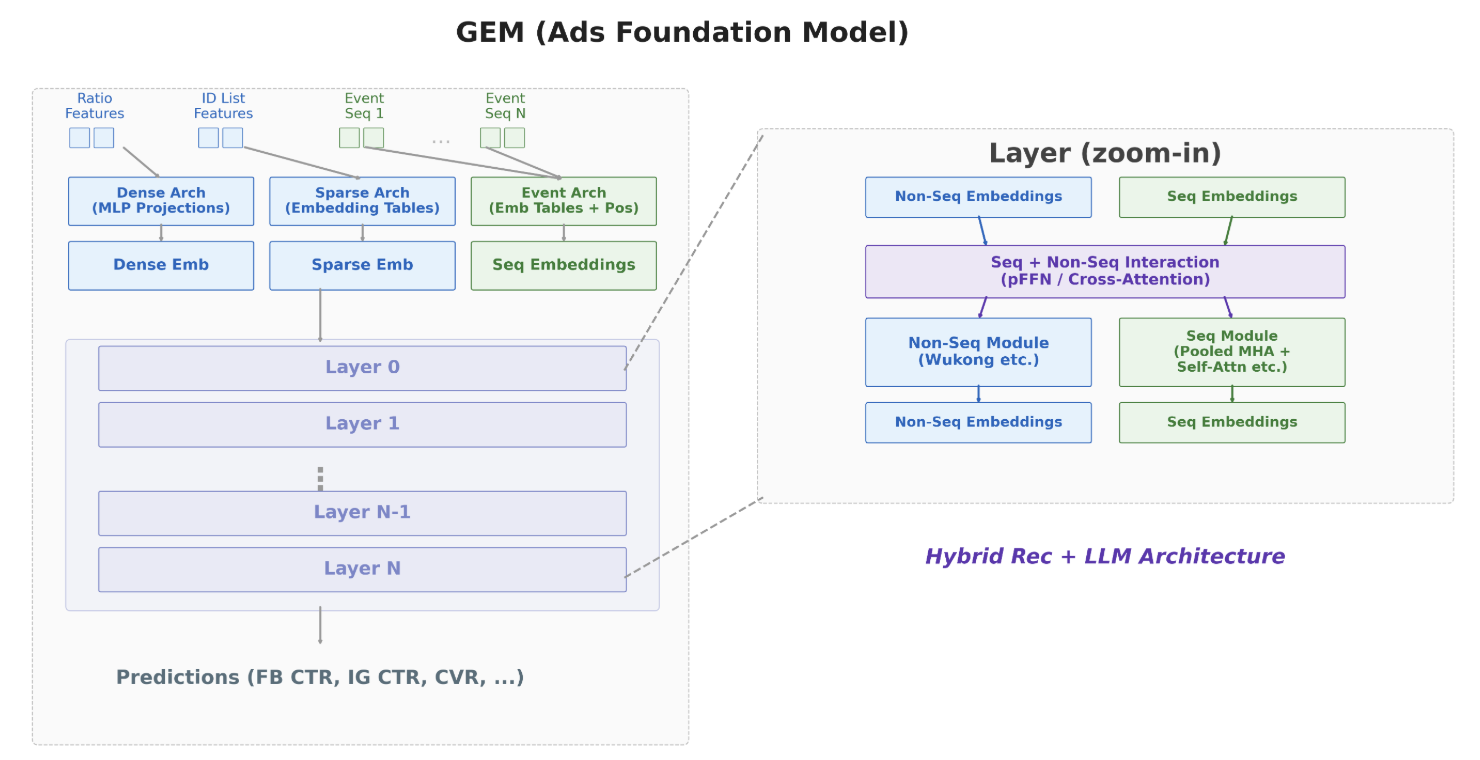
The interplay between this hybrid architecture and rec-domain data properties is what makes GEM’s training uniquely challenging.
Challenge 1: Achieving High Per-GPU Utilization
Today’s data center GPUs and their software stacks are mostly optimized for LLM workloads, whereas recommendation workloads have a fundamentally different profile due to unique data characteristics and rich user & ads signal interaction patterns that make it extremely difficult to achieve high GPU compute utilization for training a foundational recommendation model of GEM’s size.
- Jagged Inputs: Training samples have highly variable sequence length as user activity history can vary wildly. Padding to max length would waste up to 50% compute.
- Diverse interaction patterns and asymmetric sequences: Self-attention operates on extremely long sequences (activity history) but short attention window; cross-attention learns user x ads interaction with long queries but short key/value; pooled multi-head attention (PMA) compress user activity history, resulting in short queries but long key/value. These asymmetric shapes make intra kernel pipelining less effective to saturate compute units.
- Memory-bound operations: e.g., small embedding dimension for MLP and various normalizations for model quality and training stability leave compute units underutilized.
- Numerical sensitivity: Ads optimization tasks (CTR/CVR prediction) are highly sensitive to numerical change (e.g., precision), making naïve low-precision training prone to quality regression.
Challenge 2: Scaling Efficiently Across Thousands of GPUs
Training GEM across thousands of GPUs with trillions of sparse embedding parameters and billions of dense parameters requires scaling efficiently, not just scaling up. Simply adding more GPUs does not translate to proportional speedup. In distributed training, E2E latency per training step is determined by:
E2E Latency = Max across GPU Rank (Max(Local Compute Time, Communication Time))
Near-linear scaling requires four conditions:
- Total compute time >> total communication time.
- Communication hidden behind compute without contention.
- Minimal recomputation from memory pressure.
- Good load balancing across ranks.
GEM’s workload threatens every one of these:
- O(Trillion) sparse parameters and O(Billion) dense parameters drive heavy communication with mixed compute patterns.
- Architecture diversity across layers makes overlap windows uneven; resource contention between communication and computation makes hiding communication non-trivial.
- Long sequences with large activations push memory usage toward its limit, forcing activation recomputation that erodes efficiency.
- Jagged sequences across samples create data-driven load skew that varies across ranks.
Our Approach and Efficiency Framework
Given the challenges outlined above, we needed a framework that turned a sprawling co-design effort into a small number of technical levers. We measure training efficiency through E2E MFU, which decomposes into two factors:
E2E MFU = Local MFU (compute efficiency) × Scaling Ratio (scaling efficiency)
These factors describe two related but distinct optimization problems.
Local MFU (compute efficiency) measures how well a single GPU’s compute units are utilized — how close the workload runs to the hardware roofline. It is determined by kernel design, numerical precision, and how well the workload’s compute patterns (data dimensions, sequence lengths) map onto GPU architecture (Tensor cores, memory hierarchy, streaming multiprocessor scheduling).
Scaling Ratio (scaling efficiency) measures how much single-GPU performance is retained when distributing across thousands of GPUs. A scaling ratio of 1.0 means perfect linear scaling; in practice, communication overhead, load imbalance, straggler effects, and activation recomputation from memory pressure all erode it.
To isolate local MFU, we run model layers individually on a single GPU and compute a weighted average MFU without activation recomputation or communication exposure. The scaling ratio is derived as the ratio between local and E2E MFU.
This decomposition matters because it lets us treat compute efficiency and scaling efficiency as related but distinct optimization problems, each with its own dedicated set of techniques:
- Compute efficiency is a kernel-level and numerical-precision problem. The levers are kernel design and ultra-low-precision training — both targeting the per-GPU roofline.
- Scaling efficiency is a distributed-systems problem. The levers are parallelism strategy, network topology mapping, networking efficiency, memory management, and load balancing — all targeting the gap between single-GPU and multi-GPU throughput.
Both must be addressed to maximize end-to-end MFU.
Optimizing Compute Efficiency With Recommendation Kernels and Ultra-Low-Precision Training
To address the recommendations-system-specific challenges mentioned above and push up GPU FLOPS utilization, we built a custom kernel library and an ultra-low-precision training recipe custom-built and optimized for recommendation workloads on the latest GPU hardware.
- JFA — eliminates the up-to-50% compute waste from padding jagged inputs.
- BlockAttention — reduces long user-history self-attention cost from O(L²) to O(L) while preserving model quality and efficiency
- GDPA — unifies and accelerates GEM’s diverse, asymmetric attention modules where FlashAttention’s dense long-sequence assumptions break down
- MXFP8 attention + MLP — turns lower-precision Tensor Core throughput into real end-to-end speedups without regressing precision-sensitive CTR/CVR objectives
Inside the Customized Kernel Library for Recommendation
Jagged Sequence Flash Attention
FlashAttention is designed for dense, fixed-length sequences common in LLMs. In recommendation models, user sequences are inherently jagged — varying from hundreds to tens of thousands of tokens per sample — and padding to max length could waste up to 50% of compute.
Standard FlashAttention implementations assume uniform sequence lengths for efficient tiling and parallelization; with jagged inputs, naive approaches either pad (wasting compute) or leave SMs idle when short sequences finish early. We developed JFA, a custom FlashAttention implementation that operates directly on variable-length jagged tensors, eliminating padding overhead while supporting rec-specific features such as custom attention biases, asymmetric query/key-value lengths, and efficient backward passes.
We evolved JFA through four generations, progressively closing the gap from being slower than padded SDPA (scaled dot-product attention) to matching SOTA CUDA/Cutlass performance on latest-generation GPUs:
- Jagged masking via subtraction scheme: Traditional 2D masking for jagged boundaries (marking invalid positions with -inf) consumes significant non-tensor-core instructions (~28% of executed instructions). We replaced this with a novel subtraction scheme — masking Query/Key with zeros (which the Tensor Memory Accelerator (TMA) does for free) and subtracting the extra exponents — producing numerically equivalent results without the masking overhead.
- Backward parallelization: FlashAttention’s backward pass requires accumulating dQ across sequence tiles, typically via costly atomic adds. We explored multiple schemes (seq-parallel with atomics, no seq-parallel, seq-parallel with recompute, split dQ/dKdV) and found that for rec workloads with high batch x heads, a non-seq-parallel scheme with split dQ computation delivers 21-40% backward speedup by eliminating both atomic writes and redundant recomputation.
- Warp specialization and persistent kernels: Upgrading to Triton Low-Level Extensions (TLX) enabled explicit warp specialization, along with use of TMA, and persistent kernel scheduling — unlocking 30-100% TFLOPS improvement by leveraging the latest hardware feature.
JFA v4 (TLX) achieves 40-140% TFLOPS improvement over JFA v2, which delivers consistent gains under production jagged distributions (sparsity 0.5), contributing to 18.5% relative local MFU gain and 12% QPS gain.
Generalized Dot-Product Attention (GDPA)
GEM uses diverse attention-like interaction patterns — self-attention, PMA, and cross-attention — that share a common structure: two matrix multiplications with an element-wise activation in between, but replace softmax with activations like GELU or SiLU. We unify these modules under a single GDPA kernel optimized for production RecSys training workloads on latest generation GPUs.
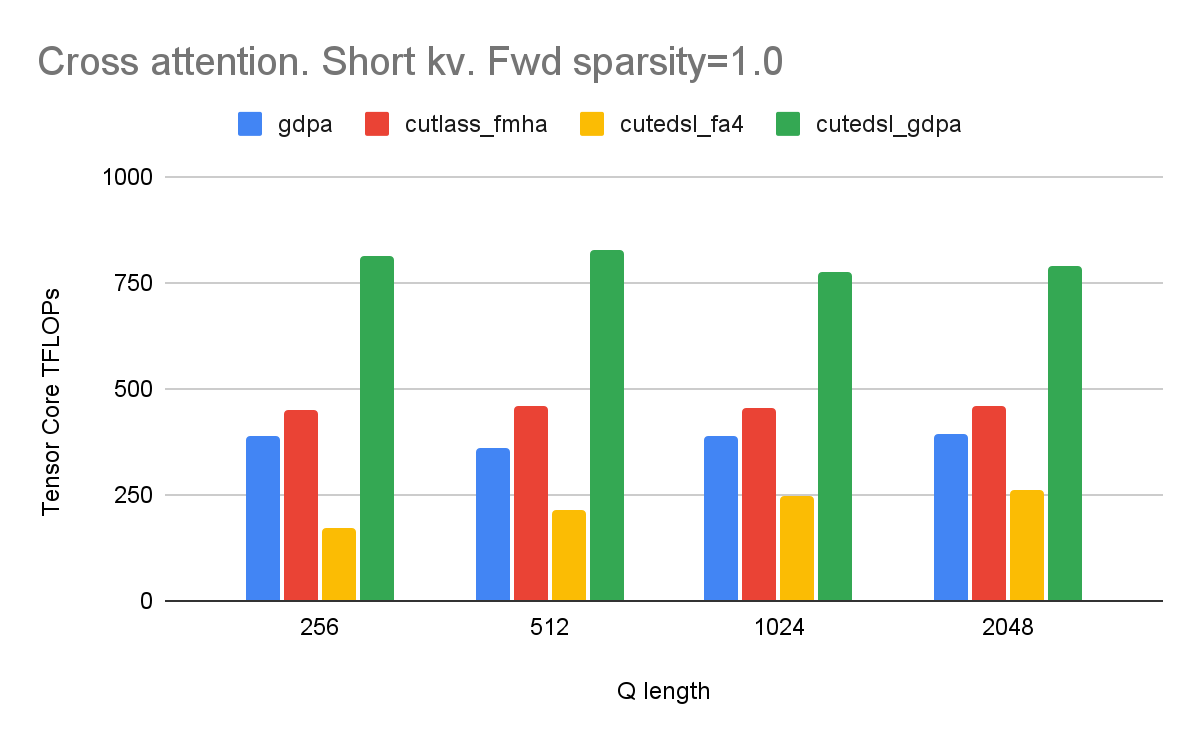
Existing FlashAttention kernels are designed for LLM-style dense, long-sequence inputs and perform poorly under real production traffic. We observed a 2.6x forward performance gap and up to 4x worst-case gap between real-world workloads and synthetic benchmarks driven by short/asymmetric K/V sequences, jagged inputs, and large batch sizes that break pipeline occupancy assumptions.
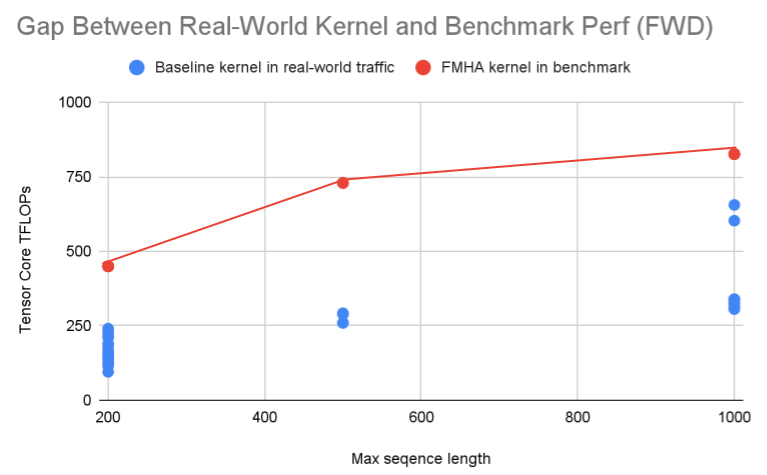
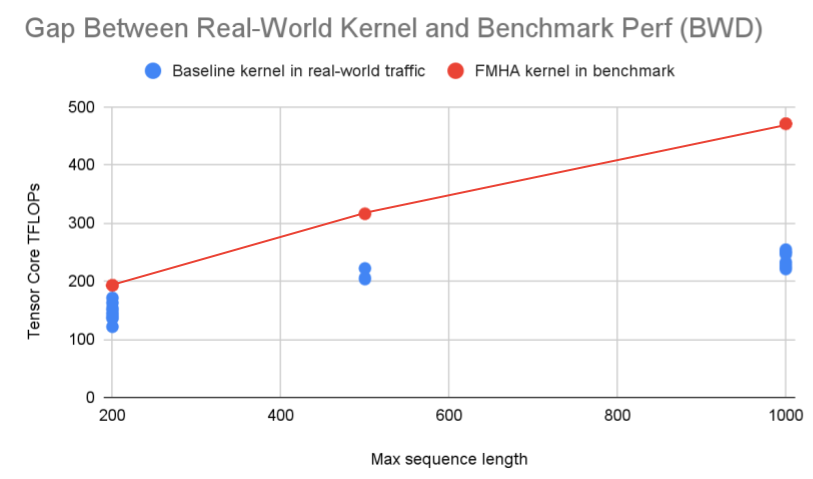
We redesigned the kernel pipeline, scheduling, and math to close the performance gap between real-world traffic and hardware roofline.
- Pipeline redesign for non-softmax activations: Eliminating the softmax correction stage frees four warps and their registers. For short K/V sequences, outer-loop software pipelining recovers ~10% performance lost by inner-loop pipelining when the inner loop runs only 1–2 iterations.
- Software-level tile scheduling for jagged tensors: precompute valid tiles on CPU, skip empty tiles entirely, and apply zigzag assignment across SMs — reducing workload skew from 6x to near-balanced.
- ALU-only activation approximation: Replace GELU’s SFU-bound tanh with a 6th-order Taylor expansion (ALU-only), accurate within the bounded input range enforced by QK-norm (query/key normalization). Eliminates SFU contention in both forward and backward passes.
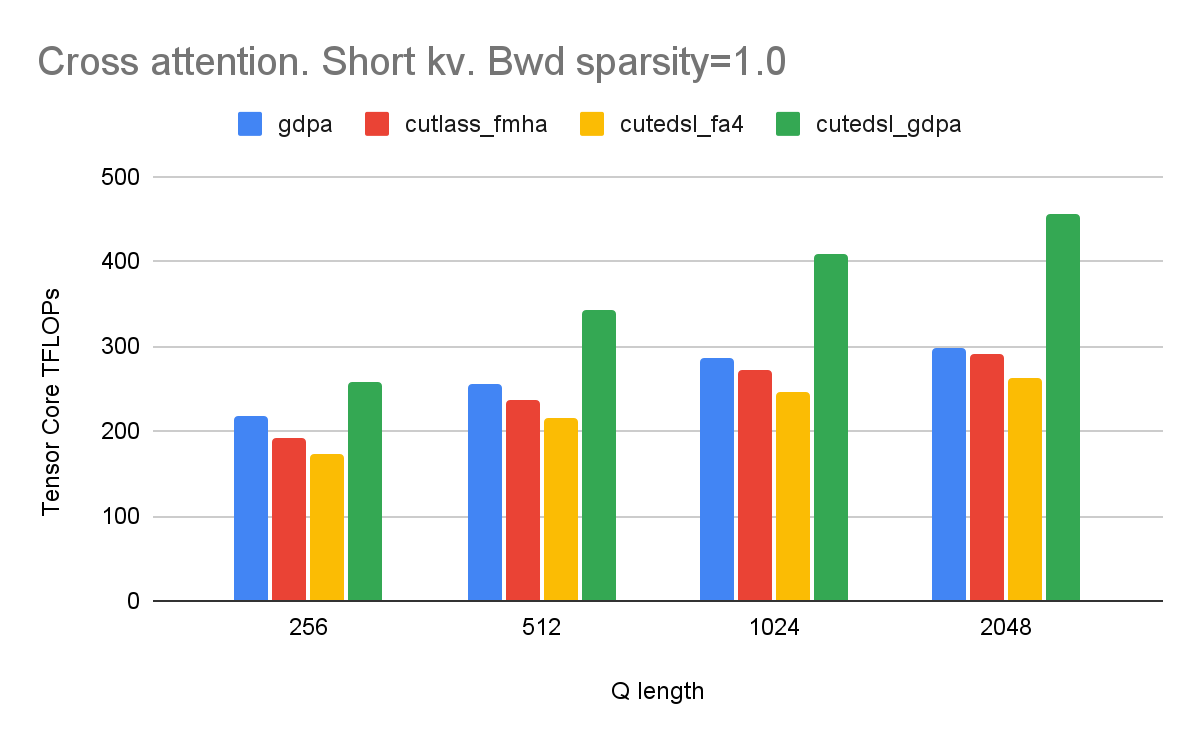
With these optimizations, the optimized GDPA kernel achieves 2x forward speedup (1,145 BF16 TFLOPs, ~97% Tensor Core utilization) and 1.6x backward speedup over baseline. Under short K/V production settings, it achieves up to 3.5x forward speedup over Flash Attention 4 (FA4). Applied across the full model, these kernels deliver over 30% end-to-end training throughput improvement.
BlockAttention
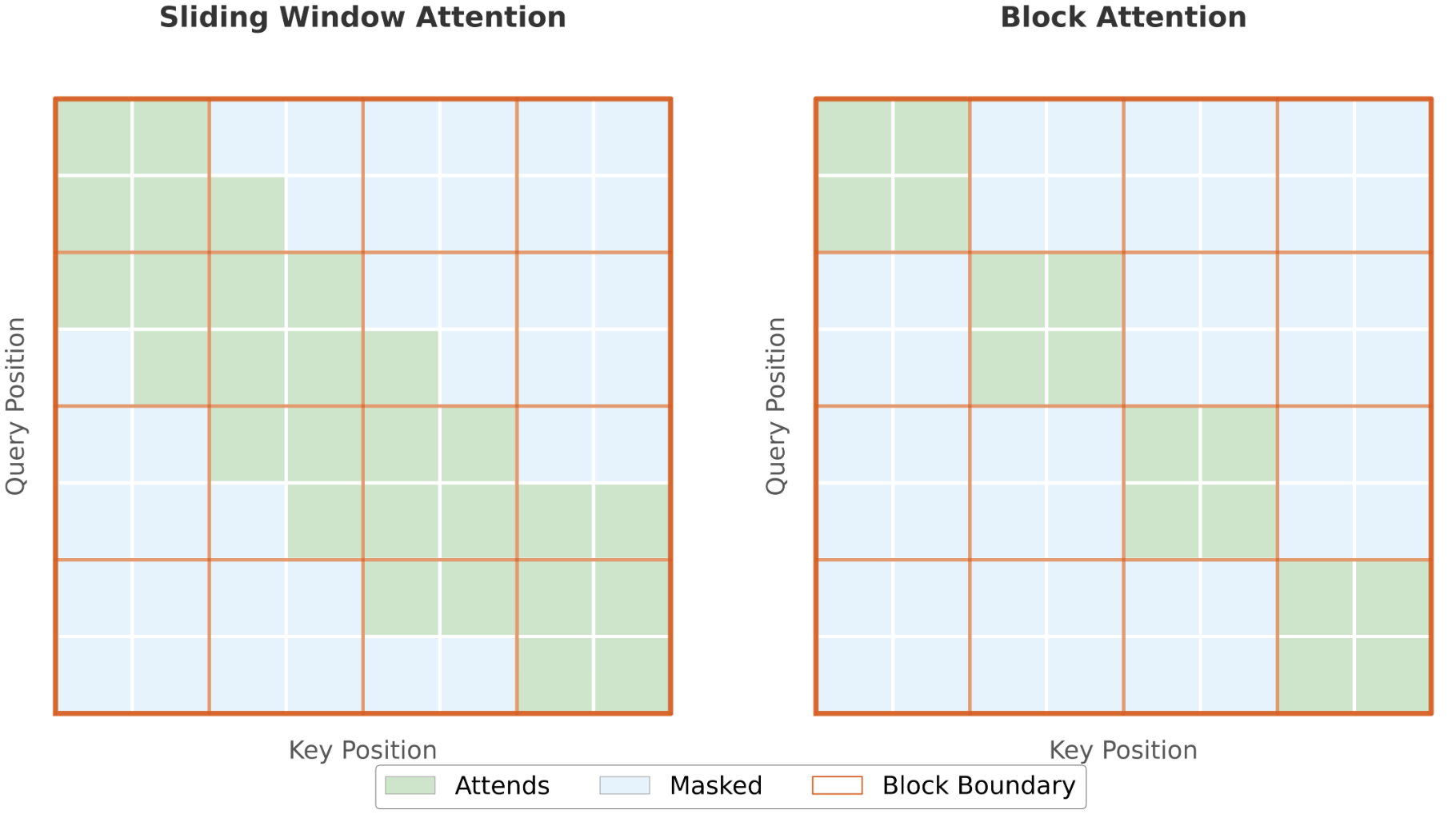
For GEM self-attention, the core efficiency challenge was scaling long user sequences without paying the quadratic cost of full attention. We first moved the layer from full self-attention to sliding-window attention, limiting each token to nearby events and reducing complexity from O(L2) to O(L * window). This made longer sequences practical. The Sliding Window Attention (SWA) kernel skipped off-window tiles in JFA and reduced long-sequence self-attention latency by up to 68% with neutral NE (normalized entropy, a model-quality metric).
We then pushed the structure further with block-aligned attention. Since GEM could safely use fixed 64-token blocks, each Q block only attends to its corresponding K/V block, turning attention into independent 64×64 problems. This removes the partial-window masking and multi-tile iteration still present in SWA, and lets a dedicated TLX kernel eliminate FlashAttention overheads such as online softmax correction, logsumexp HBM traffic, and separate Di preprocessing.
Fusing RoPE backward into the attention epilogue removes another memory-bound kernel and keeps gradients in FP32 registers. Together, TLX block attention + fused rotary improves self-attention layer MFU by +30.6% over Triton block attention, or roughly +44% over the SWA baseline.
Mixed Ultra-Low-Precision Training
On a GPU, lower precision directly translates to higher Tensor core throughput. For the latest generation GPU, FP8 delivers 2x peak FLOPS over FP16, and FP4 delivers 4x. We expect the peak FLOPS of low precision to increase faster in next-generation GPUs. This makes low-precision training increasingly attractive as hardware vendors scale low-precision FLOPS faster than FP16.
However, making low-precision training work without quality regression — addressing both numerical stability and quantization overhead — remains an industry-wide challenge. We developed MXFP8 Attention and MLP with numerical stability enhancement, which addressed both training stability and quantization overhead.
Low Precision Flash Attention
We extended the FA4 kernel with end-to-end MXFP8 blockscaled MMA for both forward and backward passes leveraging latest generation GPUs’ native support for low precision. The main challenge is that low precision attention is not just a datatype swap. Scale factors must be generated along each GEMM’s (General Matrix Multiplications) K dimension, staged through shared memory (SMEM) / tensor memory (TMEM) despite FA4’s already full TMEM footprint, and computed online for intermediates such as softmax P and backward dS.
To make the Tensor core speedup survive at module level, quantization was fused into upstream normalization and projection kernels, emitting FP8 activations and tensor-core-friendly scale layouts directly while avoiding extra BF16 global-memory traffic. For GEM’s jagged recommendation workloads, FP8 data stays at unpadded positions and only compact scale factors are scattered/padded for TMA. This turns MXFP8 block-scaled MMA support into practical E2E attention speedups without introducing model quality regressions.
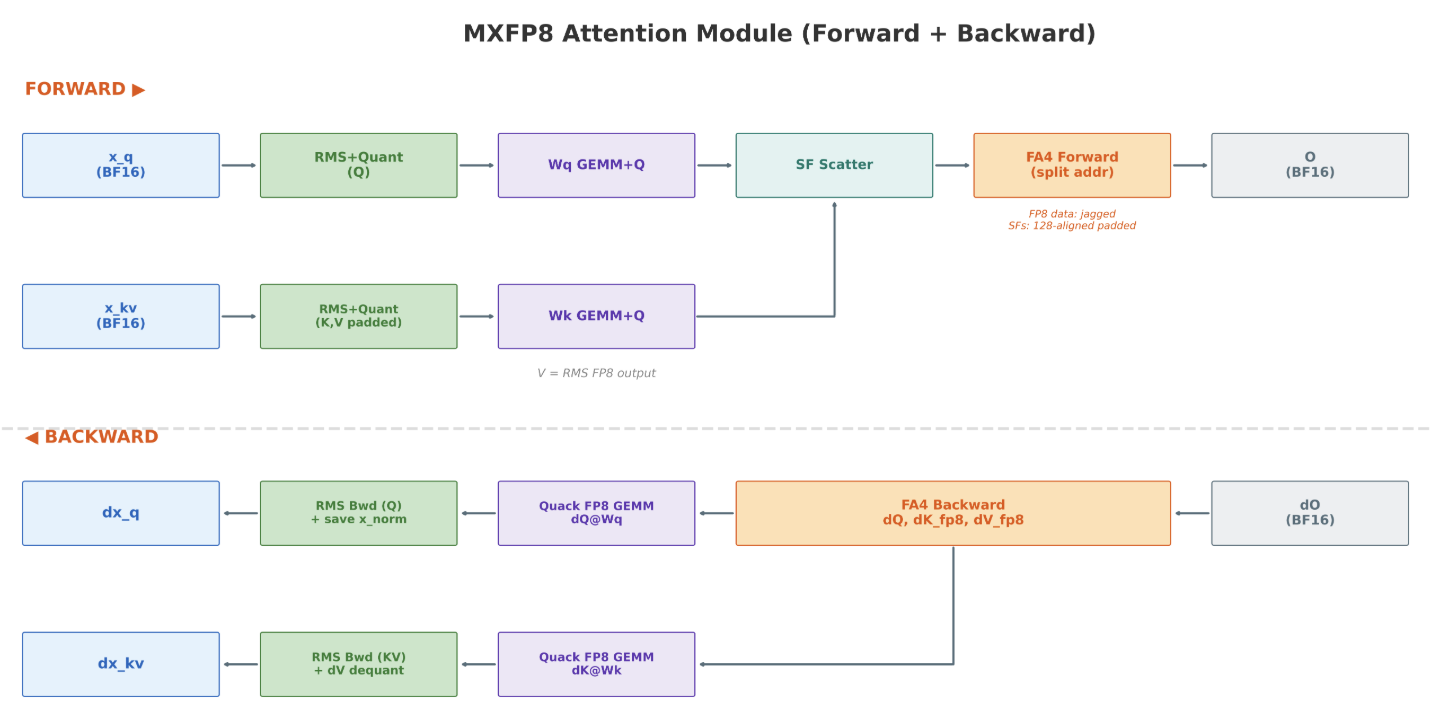
To meet our unique requirements we had to develop three new innovations at the kernel level:
- TMEM scale factor placement: The original FA4 fully utilized 512-column TMEM for accumulators, leaving no room for block-scale factors. We solve this by overlapping scale factors with temporarily-unused TMEM regions (e.g., placing S(i) scale factors in the S(1-i) accumulator region), requiring only one additional lightweight barrier that is hidden behind existing GEMM latency.
- Online P-to-MXFP8 conversion: Softmax output (P) is quantized to MXFP8 in-place within the softmax warp, reusing the row-max already computed for softmax normalization to avoid redundant reductions. Scale factors are derived via optimized PTX bit-manipulation sequences instead of expensive log2/round/clamp operations.
- Block-wise Quantization: We use [32, 32] square quantization computing one scale factor per 32×32 block via redux.sync.max.abs.f32 warp-wide reduction — making quantization transpose-invariant so each tensor is quantized only once. This is useful for the backward pass, where transposed Q,K values are needed.
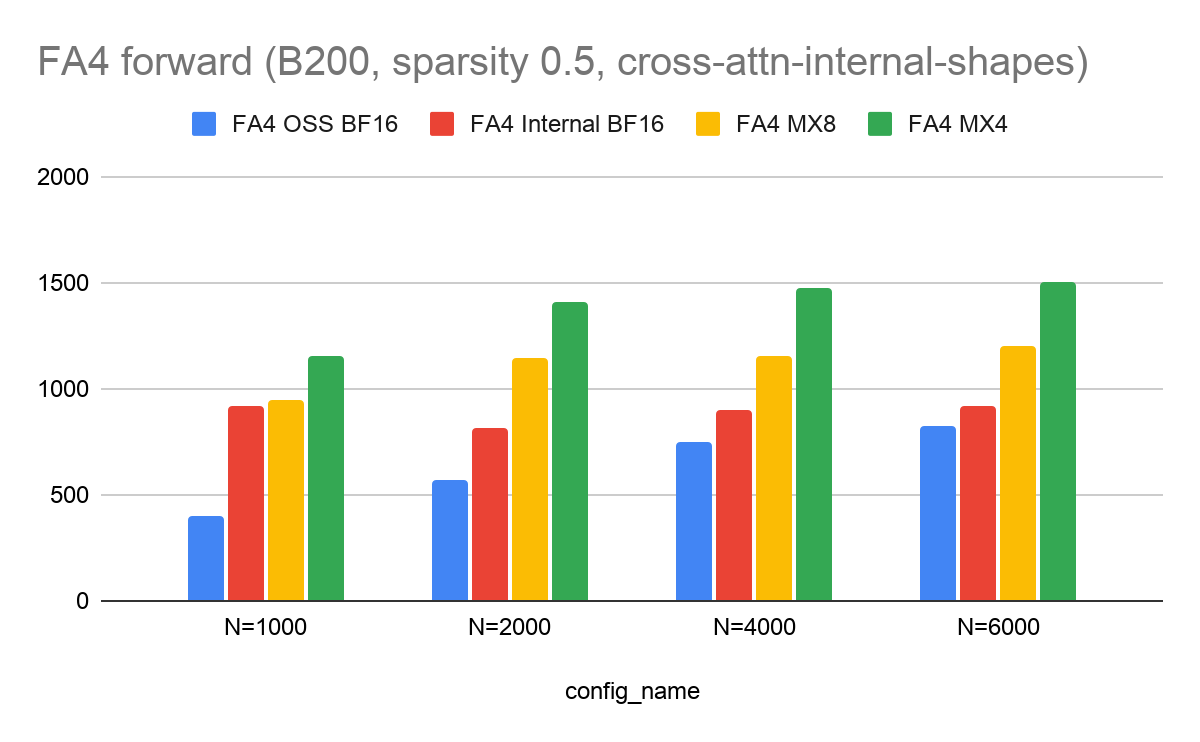
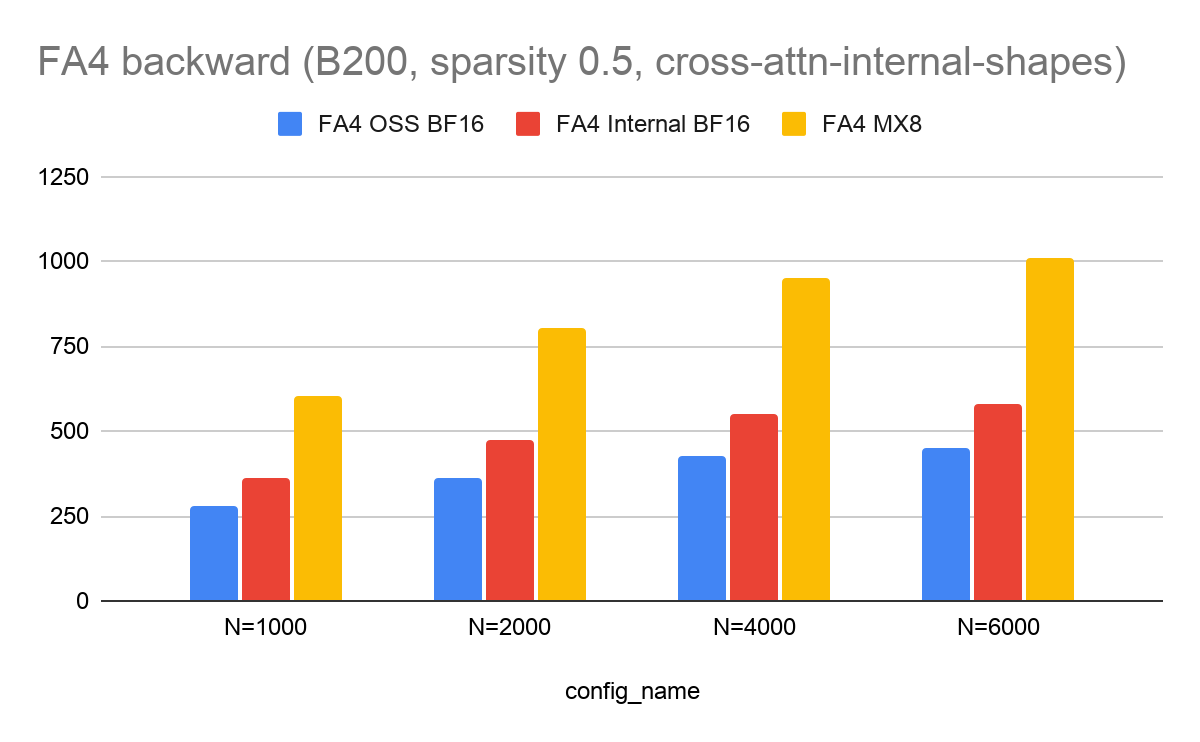
On GEM representative shapes, measured on Meta internal power capped latest generation GPU, we achieved >1.3x speedup for the forward kernel with MXFP8. For the backward kernel, we achieved >1.5x speedup with MXFP8.
Handling Quantization Overhead
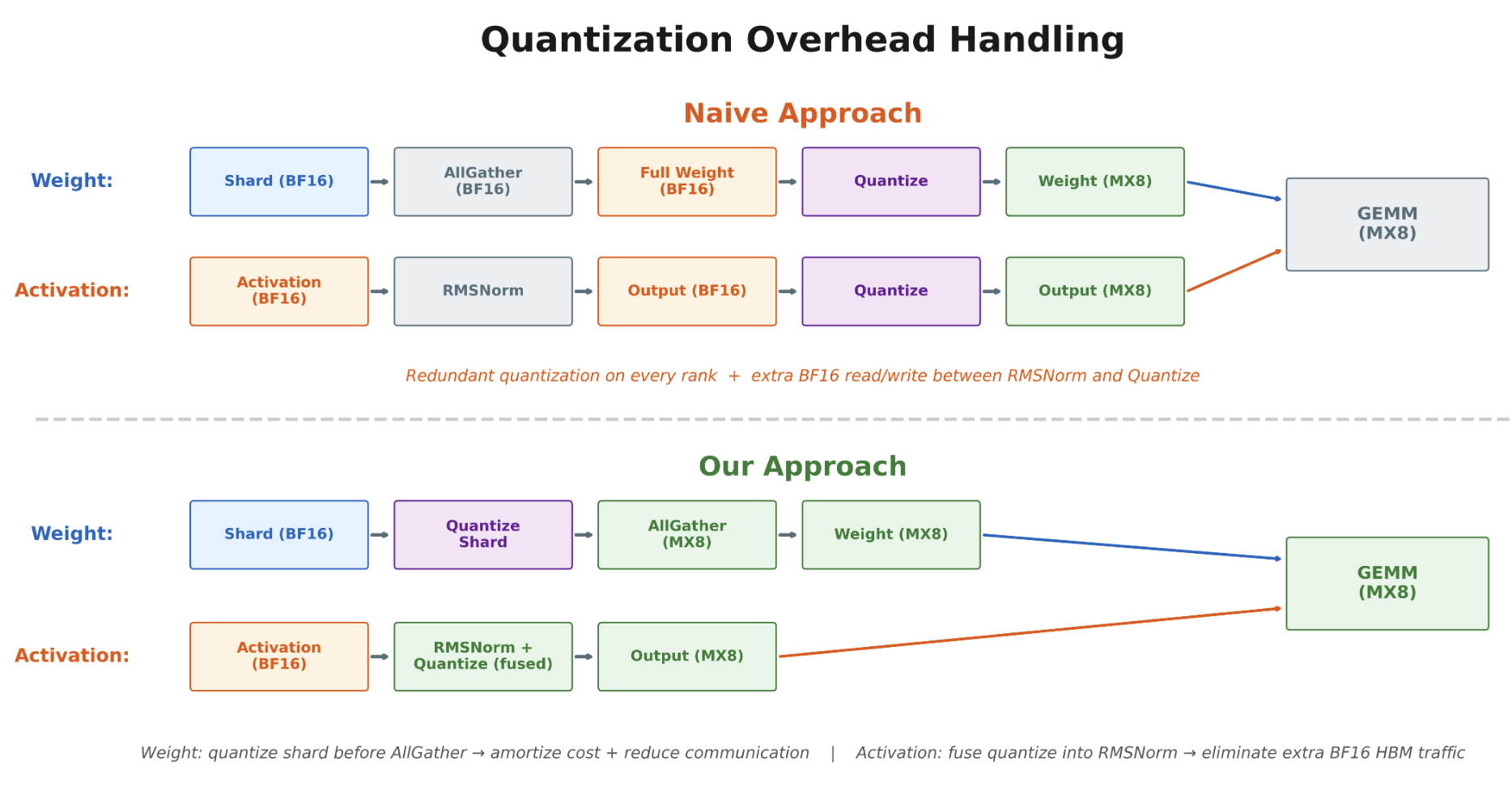
Quantization overhead mainly comes from two sources, model parameters (weights) and intermediate tensors (activations). If handled naively, the extra casting, scaling, and data movement can offset the compute speedup from low-precision Tensor cores.
- Weight – quantization on Fully Sharded Data Parallel (FSDP) shard
-
- Pre-all-gather shard quantization: quantize each rank’s local shard before FSDP all-gather to amortize the quantization cost across ranks, this avoids re-quantizing the fully gathered weight on every rank.
- Quantized FSDP communication: communicate low-precision payloads (vs. BF16) to reduce all-gather volume and cut all-gather latency which further neutralizes the quantization overhead.
- Activation – kernel fusion
-
- Linear modules: Instead of doing a separate quantization step with extra kernel launch + HBM traffic, we fused activation quantization into the preceding normalization (PreNorm fusion) to avoid the overhead.
- Attention modules: In addition to PreNorm fusion, we also fused quantization into the preceding projection so the attention kernel consumes low-precision activations directly with no extra quantization step.
Addressing Numerical Stability
Quantization errors, outliers, and rounding bias can make low-precision training numerically fragile, especially for gradient computation. We addressed these challenges with:
- Outlier mitigation:
- We applied Random Hadamard Transforms spread outliers and smooth distributions prior to low precision quantization.
- Recipe tuning (fine-grained controls):
- We used stochastic rounding to eliminate deterministic rounding bias.
- Skipping / higher-precision weight-gradient (WGrad): We observed activations and gradients can exhibit more severe outlier behavior; selectively skipping WGrad or using higher precision can materially improve model quality.
- Mixed precision:
- We use ultra low precision where it will have the most benefit (e.g., large GEMMs) and fall back to BF16 (e.g., later layers in the model are more sensitive to quantization errors) where ultra low precision is insufficient to meet model quality targets.
Scaling Efficiency: 5D Parallelism, Networking, Memory, And Load Balancing
As mentioned above, for large scale distributed training:
E2E Latency = Max across GPU Rank (Max(Local Compute Time, Communication Time))
Near-linear scaling requires four conditions: total compute time > communication time, compute / communication overlapping without contention, minimal recomputation, and good load balancing. Our optimizations address each condition to push up GEM’s scaling efficiency.
| Condition | GEM’s Challenges | Optimizations |
|---|---|---|
| Total compute time > total communication time | O(Trillion) sparse parameters and O(Billion) dense parameters drive heavy communication with mixed compute patterns. | Topology-aware 5D Parallelism |
| Communication hidden behind compute without contention | Resource contention between communication and computation | SM Free Communication |
| Minimal recomputation from memory pressure | Long sequences with large activations push memory usage toward its limit, forcing activation recomputation | Automatic Activation Checkpointing with Quantization |
| Good load balancing across ranks | Jagged sequences across samples create data-driven load skew that varies across ranks | Sequence length aware load balancing |
5D Parallelism, Optimized with Meta’s Network Topology
GEM’s hybrid architecture requires distinct parallelism strategies for each component as dense and sparse parameters have different compute and communication patterns. We use 5D parallelism to scale GEM’s training efficiently across thousands of GPUs: 2D FSDP with Expert Parallelism (EP) for dense parameters, and Fully Sharded 2D Model Parallelism for sparse parameters.
The design principle is to match communication volume to available bandwidth across the topology hierarchy. When a collective becomes a bottleneck on a given tier, we introduce a new parallelism dimension that reduces message volume or group size on that tier.
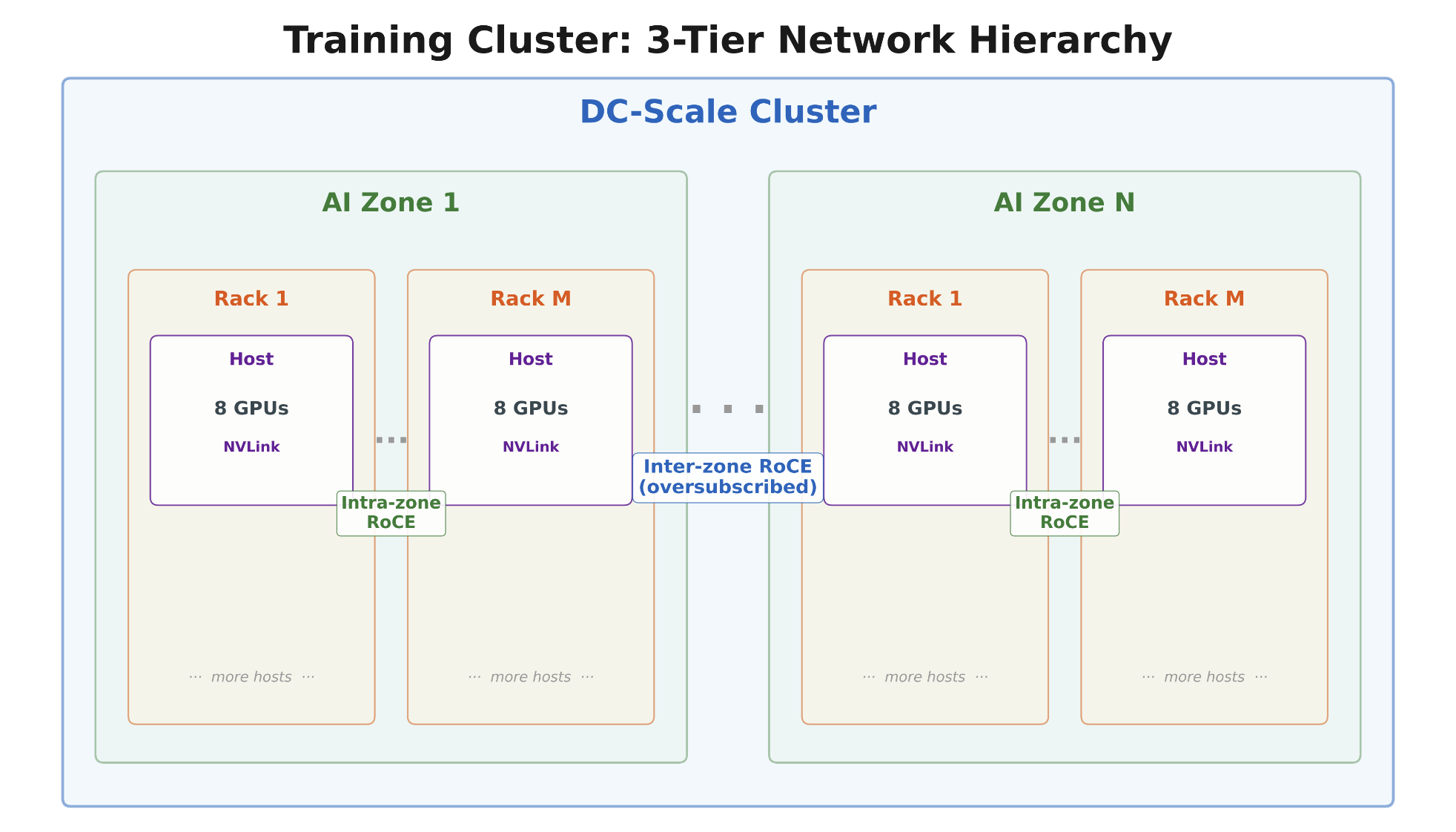
Meta’s training cluster used by GEM has a three-tier network hierarchy: Eight GPUs per host connected via NVLink , hosts within an AI zone connected via RoCE, and AI zones connected via oversubscribed RoCE with bandwidth reduction.
Dense Parallelism Evolution: From 1D to 3D Parallelism
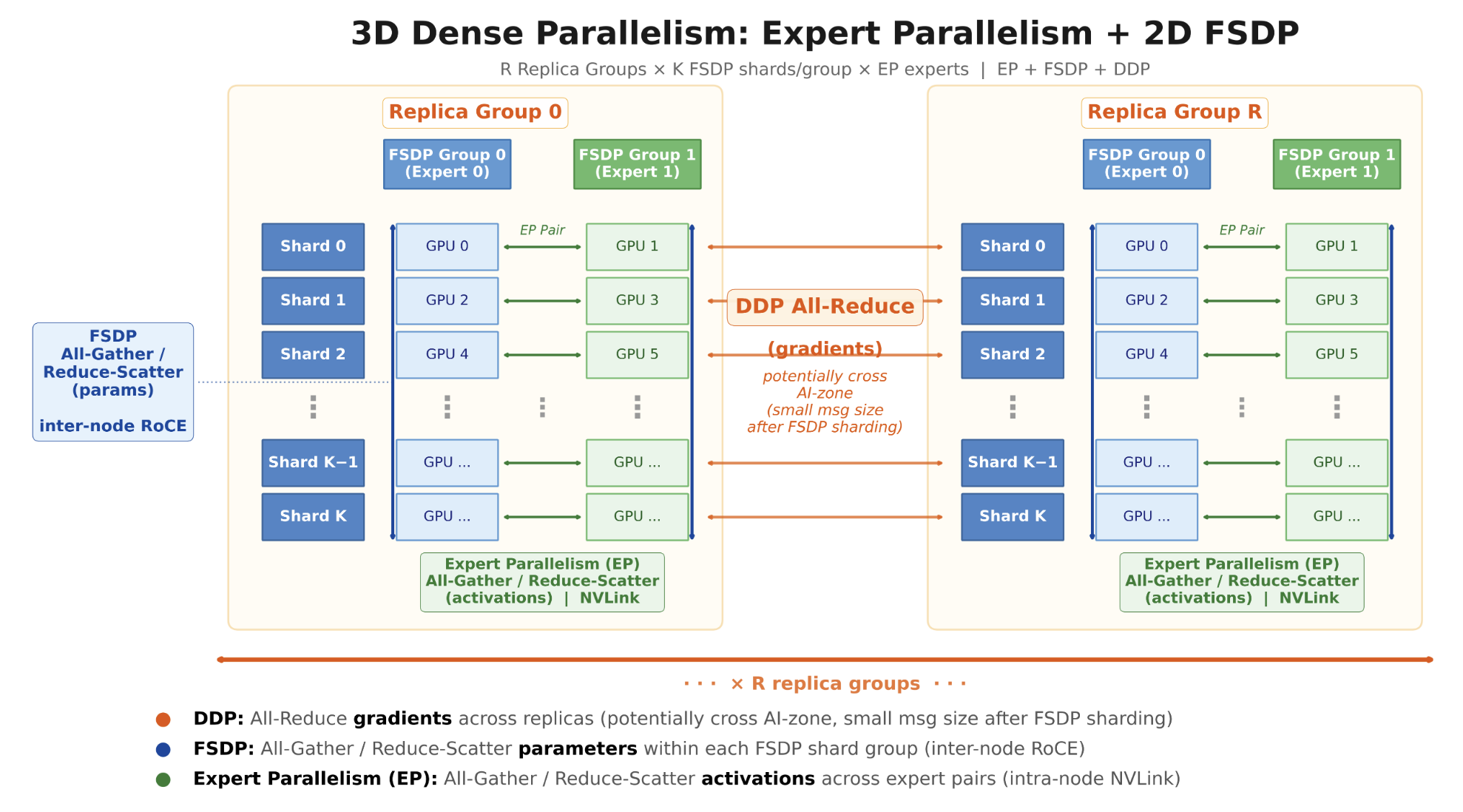
GEM’s O(Billion) dense parameters are sharded using FSDP. Parameters are distributed across GPUs and reconstructed via all-gather before computation, with gradients synchronized via reduce-scatter. We add two dimensions on top of FSDP — a replica (DDP) dimension (making it 2D FSDP) and EP — for a total of three dense parallelism dimensions (3D dense parallelism).
| Parallelism Dimension | Collectives | Topology Tier | Bandwidth |
|---|---|---|---|
| EP (Expert Parallelism) | All-gather / reduce-scatter | Intra-node NVLink | High |
| FSDP (within group) | All-gather / reduce-scatter | Inter-node (within AI zone) | Medium |
| DDP (across groups) | All-reduce | Inter-node (potentially cross zone) | Low(Oversubscribed) |
This topology-aware distributed training is what makes 3D dense parallelism efficient — each dimension’s communication cost is matched to the bandwidth available at its topology level.
Why 2D FSDP: Reducing Group Size for Better Bandwidth
At several thousands GPU scale, standard FSDP requires collectives across the full rank count, where effective bandwidth degrades with group size — particularly when spanning multiple AI zones. 2D FSDP solves this by splitting the communication into two topology-aware tiers:
- FSDP shard group : Parameters are sharded and reconstructed via all-gather / reduce-scatter across a much smaller group (e.g., 128-256 GPUs). The reduced group size achieves higher effective bandwidth.
- DDP replica group : Gradients are synchronized via all-reduce across replica groups. Because parameters are already sharded by FSDP, each rank sends only a fraction — the message size is small enough to even tolerate the lower cross-zone bandwidth.
We aggressively pre-fetch parameter all-gathers, pipelining each module’s communication with the previous module’s compute to maximize overlap. This works well for most modules — however, large modules like DHEN (Deep Hierarchical Ensemble Network) experts have parameter sizes where communication time still outweighs neighboring compute time, becoming exposed and slowing down E2E efficiency.
Adding Expert Parallelism: Pushing Heavy Communication to the Fastest Links
To address communication exposure from large dense expert modules, we layer EP on top of 2D FSDP. With EP, each rank holds only one expert, shrinking the FSDP all-gather to a single expert’s parameters — reducing both group size and message size.
The extra EP communication is placed on intra-node NVLink with high bandwidth making it easily hidden. The forward and backward passes coordinate FSDP and EP collectives:
- Forward: FSDP all-gather expert params (16-way, inter-node) → EP all-gather activations (2-way, intra-node NVLink) → compute local experts on full batch → EP reduce-scatter outputs (2-way, intra-node NVLink).
- Backward: FSDP all-gather expert params (16-way, inter-node) → EP all-gather output gradients (2-way, intra-node NVLink) → compute expert gradients → EP reduce-scatter input gradients (2-way, intra-node NVLink) → FSDP reduce-scatter param gradients (16-way, inter-node).
Sparse Parallelism Evolution: From 1D to 2D memory overhead free parallelism
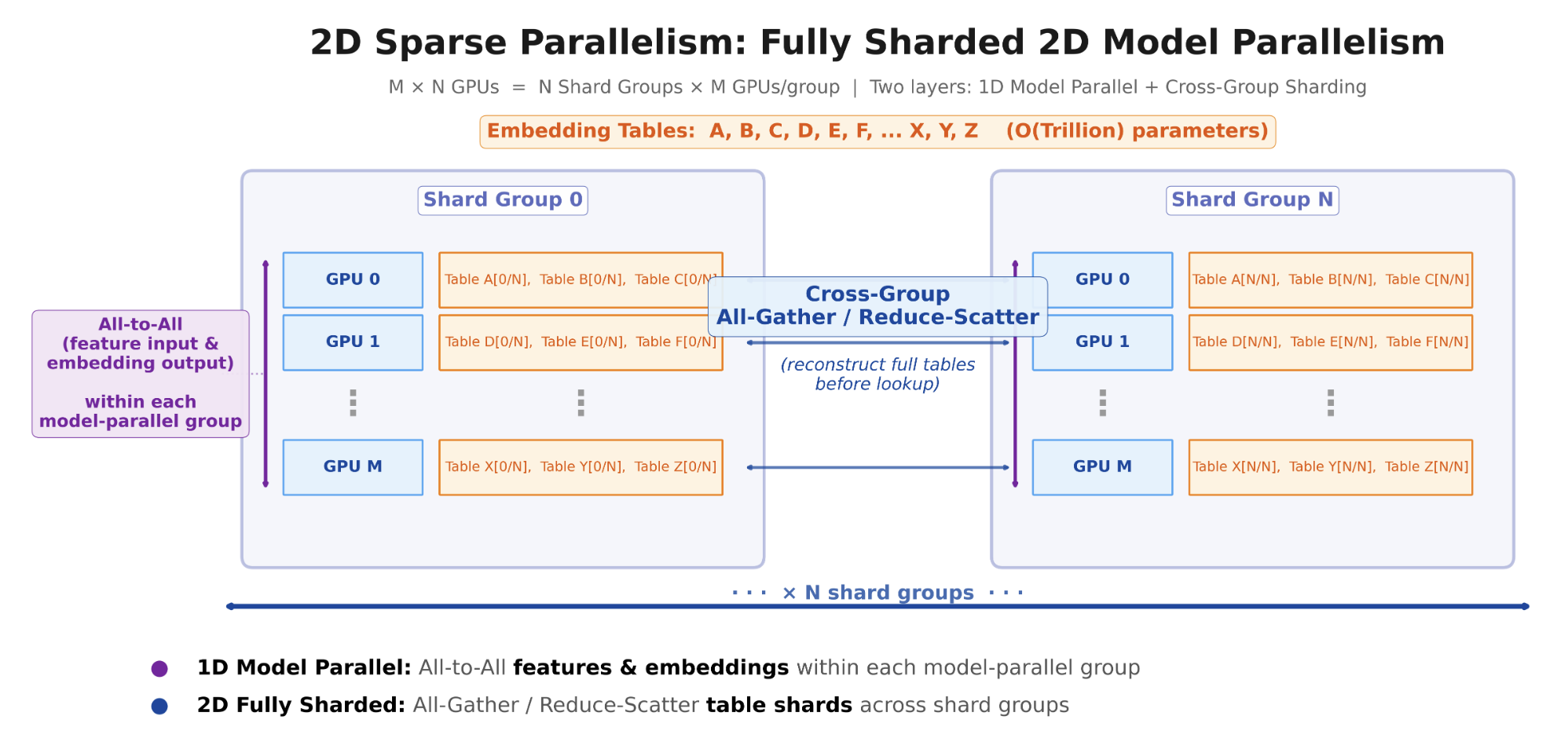
GEM’s sparse parameters (O(Trillion) embedding tables) present unique scaling challenges distinct from dense parameters. Embedding tables require model-parallel sharding with all-to-all communication for feature distribution, and their sheer size makes memory overhead a primary constraint. We evolved through three generations of sparse parallelism to address these challenges.
| Load imbalance | Memory overhead | Communication cost | |
|---|---|---|---|
| V1: 1D Model Parallelism | Poor | None | Very high – full rank |
| V2: 2D Model Parallelism | Good | High — each replica group maintains a full copy of sparse parameters O(Trillion) | Moderate — reduced group size |
| V3: Fully Sharded 2D Model Parallelism | Good | Near zero | Moderate — extra comm through fast NVLink |
V1 → V2: Solving Imbalance and Communication Bottlenecks
At several thousands GPU scale, 1D model parallelism hits two fundamental bottlenecks for good efficiency:
- Load imbalance: Distributing embedding table shards across thousands of ranks results in severe workload skew — each rank holds too few shards for balanced partitioning.
- Communication latency: All-to-all collective group size scales with total rank count. Cross-node bandwidth degrades rapidly with group size, particularly when jobs span multiple AI zones where bandwidth is oversubscribed
2D model parallelism addresses both by partitioning ranks into smaller model-parallel groups (e.g., 256 GPUs), with multiple replica groups performing data parallelism. Each replica group independently shards and communicates within a much smaller scope, reducing all-to-all latency and improving load balance — delivering significant QPS gains over 1D at large scale.
V2 → V3: Eliminating Memory Overhead
The tradeoff of V2 is memory: each replica group must hold a full copy of its assigned shard’s parameters. For GEM’s trillion-parameter sparse tables, this O(T) overhead can consume significant HBM — blocking further model scaling.
Fully Sharded 2D removes this overhead by further sharding each replica’s parameter copy across its groups. Each rank stores only a fraction of the shard, and parameters are reconstructed on-demand:
- Forward: All-gather table shards → all-to-all feature distribution → embedding lookup → all-to-all embedding return
- Backward: All-gather table shards → all-to-all gradient exchange → local update → reduce-scatter parameters
The extra all-gather and reduce-scatter from V3 are mapped to intra-node NVLink. We overlap these collectives with concurrent dense compute through pipelining, and schedule the all-gather to release reconstructed copies before peak memory usage.
With these optimizations, we’re able to make sparse scaling nearly overhead-free at GEM’s training scale with very minimal communication exposure.
Networking Efficiency : Getting Communication Off the SMs
With 5D parallelism, GEM hides most communication behind compute kernels through pipelining. However, communication collectives could also occupy SMs, which creates SM contention. Communication kernels occupy SMs (e.g. ~24 SMs for all-gather, reduce-scatter) that would otherwise be utilized by compute kernels running in parallel, costing up to 15% efficiency. What makes it worse is that compute kernel performance could drop more than SM occupancy loss, since wave scheduling could end up with more waste.
Hence, our primary networking efficiency push is SM-free communication — offloading data movement from SMs to dedicated hardware engines.

For pure data-movement collectives (e.g., all-gather), we use NCCLX — Meta’s extension to the NCCL library — for copy-free, SM-free communication. NCCLX leverages hardware features to move data without SM involvement: the Copy Engine (CE) handles intra-node NVLink transfers and RDMA handles inter-node transfers, reducing SM usage from 24 to 1 for all-gather. This reclaims ~23 SMs for compute, yielding ~5% E2E QPS gain at full training scale.
For collectives that require reduction (e.g., All-Reduce), we found NVLink SHARP with in-network reduction a viable option to reduce SM usage by offloading the reduction computation from SMs to the network switch hardware.
Memory Efficiency: Large Local Batches Without Paying the Full Memory Bill
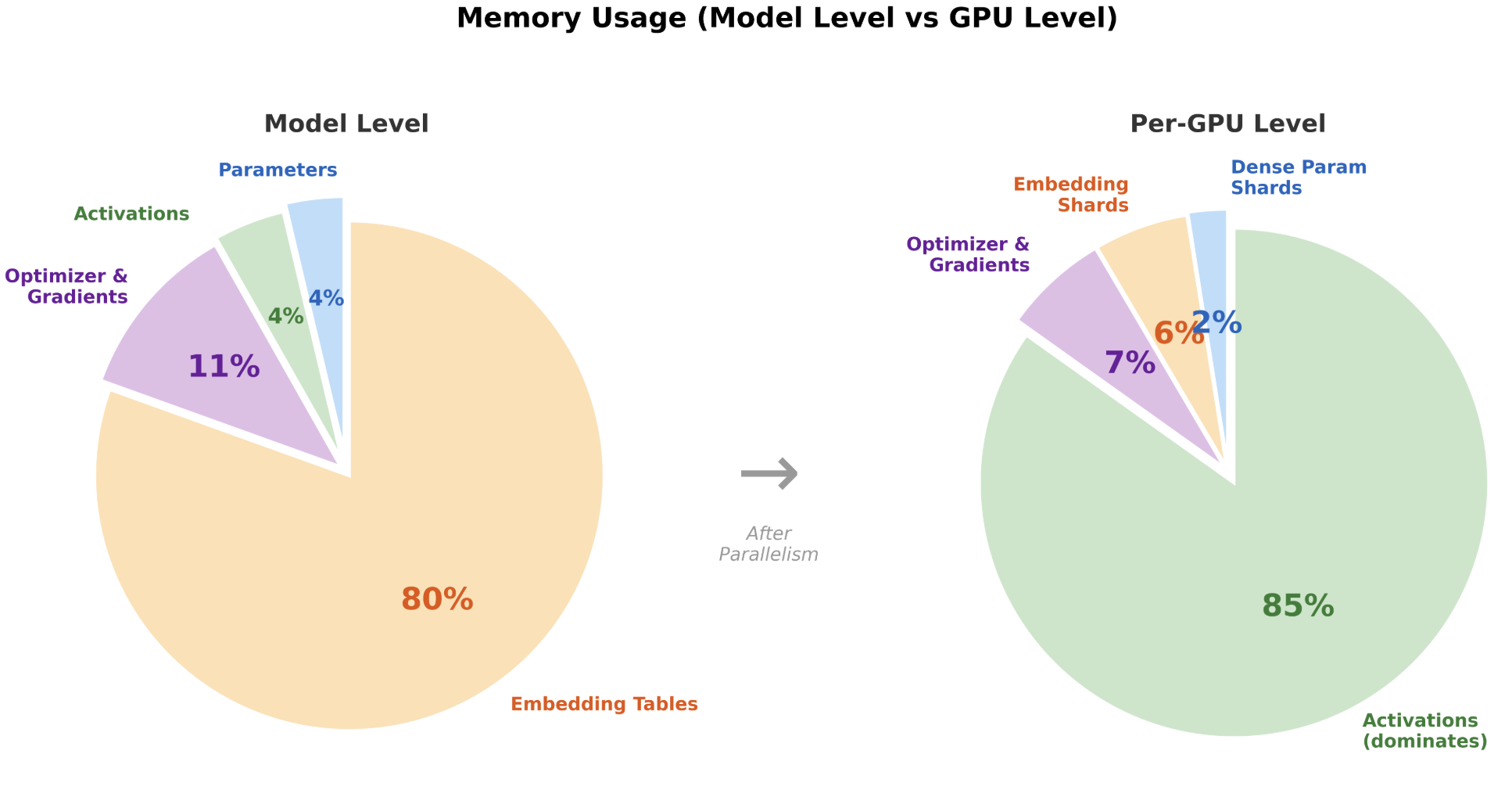
Per-GPU memory breaks down into three categories: activations, embedding tables, and dense parameters (including optimizer states). After parallelism shards embedding tables and dense parameters across GPUs, activations dominate per-GPU memory and scale with model and batch size.
We used two techniques to address this:
Compiler-based Automatic Activation Checkpointing (AutoAC)
PyTorch’s compiler-based activation checkpointing already beats traditional all-or-nothing recompute by reasoning over individual nodes in the joint forward–backward graph — saving expensive ops, recomputing cheap pointwise ops. But it still applies a single memory budget across the whole model, which leaves performance on the table when regions (compiled subgraphs between graph breaks) differ in recompute ROI (latency saved per GB of activation). We replaced the global budget with a customized per-region budget schedule, so memory flows to the regions with the highest payoff. This pushes the memory–latency tradeoff past what any uniform budget can achieve.
Activation Quantization
On top of AutoAC, we further squeeze the memory usage via activation quantization. It operates on the checkpointed tensors — the set of intermediate activation tensors that AutoAC has already determined need to be stowed for the backward pass. When enabled, it quantizes these saved activation nodes (e.g., from BF16 to FP8/MX4) at the boundary between the forward and backward graphs.
With these optimizations, we’re able to use large local batch sizes (up to 1K+ samples) with modest activation recompute cost to train the GEM model efficiently. This is important for scaling since small batch size and heavy activation recompute both hurt MFU.
Load Balancing: A Recommendation-Specific Straggler Problem
LLM training could avoid load balancing by padding all sequences to fixed length. For GEM, user sequences are inherently jagged, and padding wastes 50%+ of compute. Jagged kernels avoid per-rank waste but create a new problem – data-driven compute skew that varies every iteration.
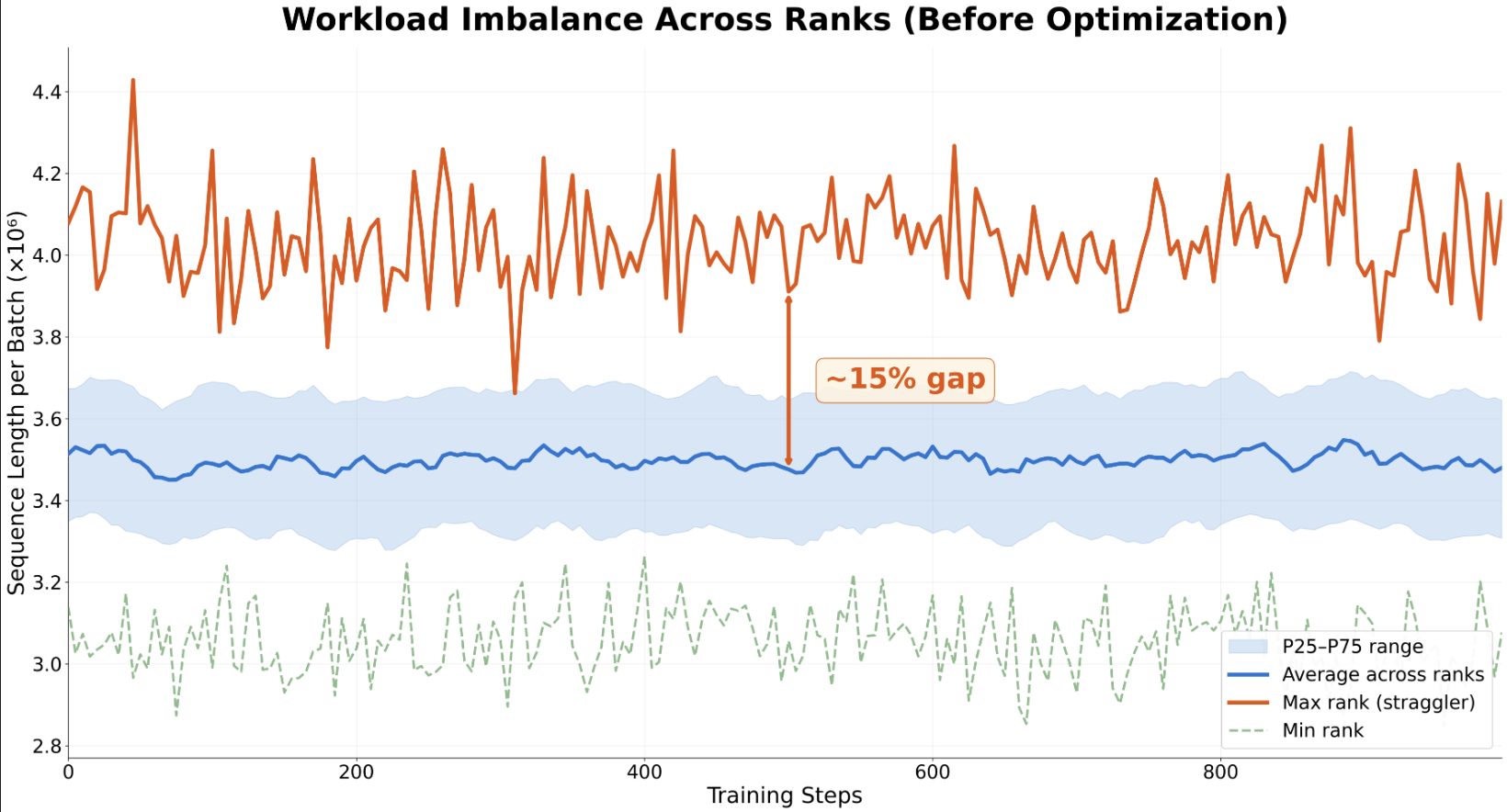
The heaviest rank consistently exceeds the average by ~15% each iteration.
Choosing the Right Rebalancing Strategy
We considered local and global rebalancing strategies to address workload imbalance:
| Approach | Mechanism | Balancing Quality | Overhead |
|---|---|---|---|
| Local (Intra-Rank) | Each rank independently rebalances its own batches. | High: 90% of optimal | None (zero cross-rank communication). |
| Global (Cross-Rank) | Ranks exchange samples via all-to-all. | Near-perfect | Introduces new all-to-all collective per training step. |
The overhead associated with the global approach — a collective on every training step — negates the very efficiency gains it aims to deliver. We developed a new technique that we call Base Batch Shuffling (BBS), where distributed readers generate small sub-batches (128 samples), which are sorted by total sequence length and interleaved (heaviest paired with lightest) when merged into full training batches (1k+ samples per rank) — capturing most of the theoretical optimal balance with zero cross-rank communication.
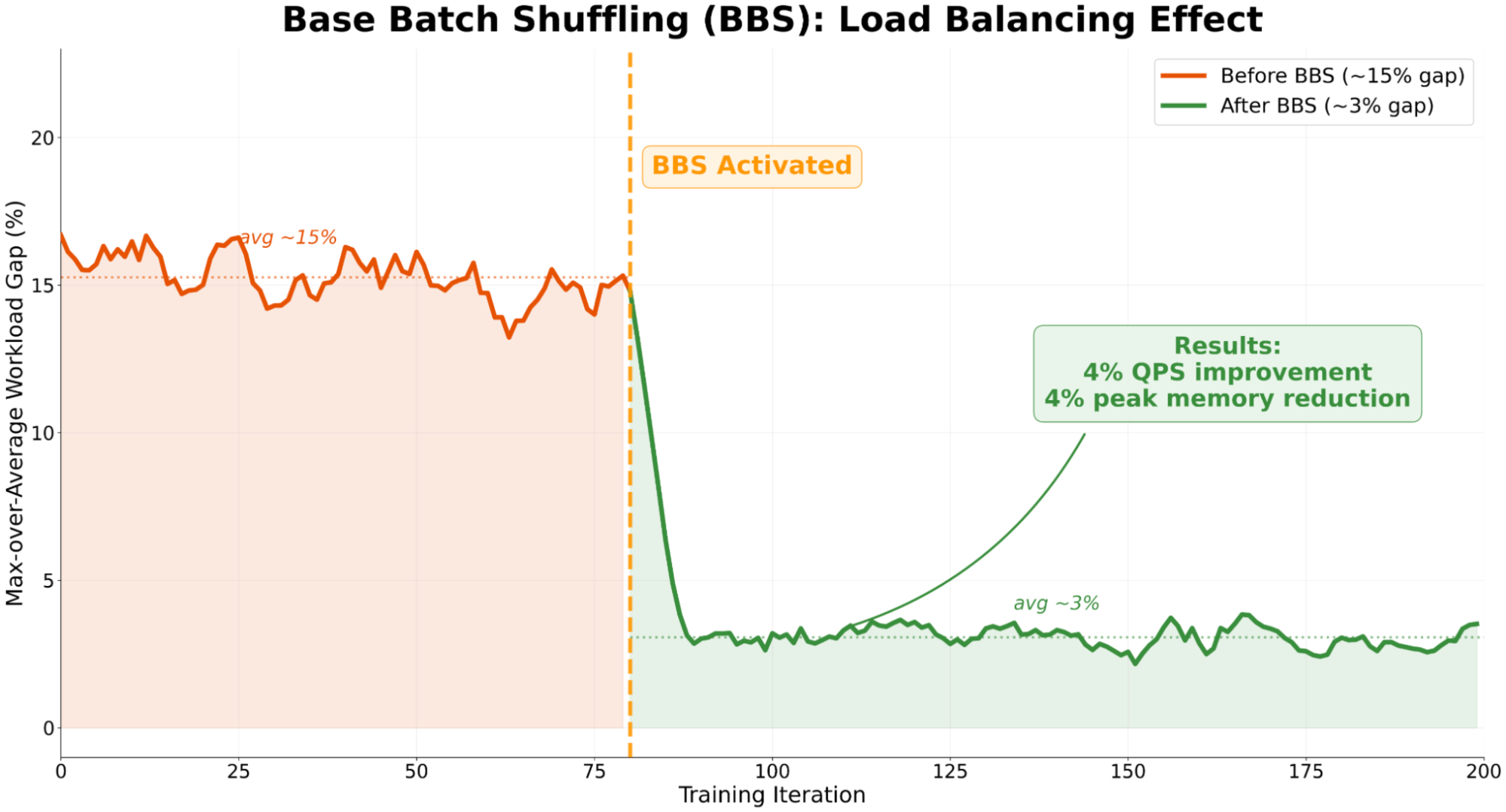
BBS delivered 4% efficiency gain on GEM training, comprising 4% QPS improvement and 4% peak memory reduction. Upon activation, the maximum-over-average workload gap immediately dropped.
On to the Next Level of Scale and Efficiency
Training a foundation model at the intersection of LLMs and recommendation systems is a co-design problem, not a software problem or a hardware problem alone. The 2x efficiency gain we describe here came from carefully considering every layer of the stack for optimization— kernels, precision, parallelism, networking, and memory all had to move together. We expect the next 2x to come in a similar way and with even faster iteration speed as we embrace agents to automate some of the optimization cycles. As we continue to scale the GEM model, we expect to keep pushing system boundaries and extreme co-design across different layers of the AI infra stack to further advance compute and scaling efficiency. We’re sharing this work in the hope that the broader community sees similar opportunities in the workloads they run.
Acknowledgements
We would like to thank Tianshu Peng, Jiasheng Zhang, Angel Yang, Rikin Shah, Ke Sang, Kevin Tang, Pawel Kadluczka, Jacky Zhou, Han Xu, Enes Palaz, Hao Yan, Jake Siso, Rupert Wu, Liangbei Xu, Yusuo Hu, Serena Liu, Hongtao Yu, Bor-Yiing Su, Santosh Mohan, Min Si, Shali Jiang, Laming Chen, Boyang Liu, Qinghai Zhou, Xiaozhen Xia, Jason Rudy, Jiayi Xu, Dan Chanpuriya, Justin Yang, Mandeep Chadha, Carmen Au, Hairong Kuang, Subodh Iyengar, Balaji Balasubramanian, Anamaya Sullerey, Viral Vimawala, Saket Gur, May Wang, Vibha Sinha, Rustam Hashimov, Ernest Wang, Max Leung, Shuo Chang, Musharaf Sultan, Oana Platon, Jade Nie, Eric Falconer, Ping Chen, Damian Reeves, Xian Chen, Ellie Wen, Chonglin Sun, GP Musumeci, Reva Srinivasan, Brian Hansen, Vivienne Sung, Patrick Phelps, Paolo Massimi, Jie Zheng, Anuj Madan, Nikhil Garg, Xiaorui Gan, John Bocharov, Ritwik Tewari, Wenlin Chen, Rocky Liu, Tak Yan, Santanu Kolay, Sandeep Pandey, Matt Steiner, and the entire v-team behind training Meta’s largest ads recommendation workloads at scale and efficiently.
The post GEM Training: How Meta Doubled the Efficiency of Its LLM-Scale Ads Foundation Model appeared first on Engineering at Meta.
Outernet turns your saved posts into real-world adventures
Pochettino stays as US coach, agrees to contract extension through 2030 World Cup
Apple launches legal challenge against UK government demand to access data
The Home Office has made a fresh request for ‘back door’ access to encrypted iCloud data belonging to British users
Apple has launched a new legal challenge against a UK government demand to access its customers’ highly encrypted data, a year after the Home Office agreed to abandon its previous request.
The US tech company launched the legal complaint last month at the Investigatory Powers Tribunal (IPT), an independent court that has the power to investigate claims that the UK intelligence services have acted unlawfully.
Continue reading...Raducanu to miss US Open to continue recovery
Author La Plante banned from driving for six months
Trump holds executive order signing at the White House
Inside the Sentencing of the Gilgo Beach Serial Killer | Case by Case
Apple launches legal challenge against UK government demand to access data
The Home Office has made a fresh request for ‘back door’ access to encrypted iCloud data belonging to British users
Apple has launched a new legal challenge against a UK government demand to access its customers’ highly encrypted data, a year after the Home Office agreed to abandon its previous request.
The US tech company launched the legal complaint last month at the Investigatory Powers Tribunal (IPT), an independent court that has the power to investigate claims that the UK intelligence services have acted unlawfully.
Continue reading...Transfer roundup: Chelsea sell Trevoh Chalobah and sign Jordan Henderson
Chalobah to join Cesc Fàbregas at Como for £27.5m
Fulham sign Real Madrid’s Gonzalo García for £34m
Trevoh Chalobah’s long association with Chelsea is to end after Como agreed a deal worth an initial £25.7m. The England defender’s departure was agreed on the same day the club completed the signing of Jordan Henderson.
Chalobah made 105 Premier League appearances for Chelsea and established himself as a first-team option during a number of turbulent periods for the club. The move will be seen as a coup for Como’s head coach, Cesc Fàbregas, with the former Chelsea midfielder pushing to bring the centre-back to Italy.
Continue reading...WhatsApp says it is fixing an issue that disabled several accounts
Total solar eclipse will sweep over Spain, Iceland and Greenland in August
Body found in search for 19-year-old kayaker
Farage says he discussed return to politics months before general election
Michigan reports two deaths linked to cyclosporiasis outbreak
Brown’s President Will Resign after a Tenure that Included Trump Deal
Funeral held for family "wiped off the map" in Russian strike
Author of Democrats’ 2024 election autopsy report says chapter was left out
Paul Rivera says missing section included questions on Biden’s decision to run for re-election, the Times reports
The author of an infamous internal Democrat party report on the 2024 presidential election loss has claimed that an entire section that included a discussion of generational wealth established by high-ranking elected officials was cut from the draft version leaked and later released earlier this summer.
Paul Rivera, the author of the autopsy, told the New York Times that a section titled “What Happened in 2024” was missing from the published version but had been included in the version he personally handed to embattled party chairman, Ken Martin, in January.
Continue reading...Serena and Venus Williams set to play doubles in Cincinnati as US Open nears
Pair last played doubles at the 2022 US Open
Serena returned to action at Wimbledon before injury
US Open begins 31 August in New York
Serena Williams and Venus Williams are set to make their Cincinnati Open doubles debut this month after being awarded a wild card on Monday, marking their return to doubles action for the first time since 2022.
The Williams sisters have won 14 major doubles titles, including six at Wimbledon, plus three Olympic gold medals.
Continue reading...The Guardian view on events in Ceuta: chaos and tragedy are weaponised by the far right | Editorial
Instead of finger-pointing at Spain, mainstream EU leaders should be showing solidarity with its prime minister, Pedro Sánchez
At least 72 people are believed to have died late last week, most of them drowned or crushed as they joined tens of thousands of others in attempting to swim from Moroccan waters to the Spanish exclave of Ceuta. Yet the scale of that human tragedy has barely registered, as Donald Trump has decried an “invasion” while European politicians exploit the crisis to serve their own agendas. If further evidence were needed of the way that the radical right increasingly distorts the terms of the migration debate in the EU, the last few days have furnished it.
More needs to be understood about the drivers behind a shocking episode. Misinformation on social media – orchestrated or otherwise – appears to have played a big part, following a Spanish supreme court ruling that migrants arriving by sea could not be summarily turned back. Moroccan authorities seemingly did little to prevent the chaotic exodus, which echoed previous smaller incidents and focused international attention on a territory whose sovereignty Rabat contests. If there were online indications that such an incursion was a possibility, no alarm was sounded.
Do you have an opinion on the issues raised in this article? If you would like to submit a response of up to 300 words by email to be considered for publication in our letters section, please click here.
Continue reading...The body snatchers: how a young Nigerian man was lured to London in an organ-trafficking plot
Daniel was working at a market in Lagos when he was given the chance to start anew in the UK. He had no idea what was expected of him in return
• The summer issue of the Long Read magazine is out now. Click here to order
Daniel arrived in Lagos for the first time in 2016. He had come from a village in Ebonyi, a state in south-eastern Nigeria. He was 15 years old, the eldest of nine siblings, and his parents were farmers. When he was a boy, his father became sick and Daniel started working to assist his family, helping to cut trees and clear land. A few years later, he decided to seek his fortune in Lagos.
In Nigeria’s commercial capital, Daniel spent his days in the open-air Ikotun Market, where thousands of people shop every day for everything from tomatoes and fabric to suitcases and electronics. He sold cellphone accessories out of a wheelbarrow under a wide umbrella, making less than £10 a day. After living with a relative, he moved into a room with friends, including a young man named Chukwudi, who also worked in the market. Daniel had grown up in the same village as Chukwudi. A photo from their early childhood shows the boys together, Daniel in a red sportswear shirt.
Continue reading...Maryland Democrats considering partisan redistricting for 2028 election
Documents Undercut Trump’s Claims About Bears Ears National Monument
Checks and Balance newsletter: Democrats are in a state of convulsion
Mexico’s president stops turning the other cheek
How China gets better bang for its buck than America in AI
China won’t apologise for overcapacity
What to watch for in SpaceX's first public earnings report today
Почему отправленная MDM-команда ещё не означает выполненную

MDM-команда проходит через очередь, инфраструктуру Apple или Google и агент на устройстве. Поэтому ответ API ещё ничего не говорит о фактическом применении политики. Разбираю модель доставки, которую мы используем в Айтера MDM: desired, delivery и observed state, Outbox, ретраи, идемпотентность и разные транспортные контуры Android Enterprise и Apple MDM.
Читать далееDesigner John Galliano to get unvarnished Met retrospective in May
Decision to stage solo exhibition comes 15 years after conviction over racist and antisemitic remarks
The controversial designer John Galliano is to get an unvarnished retrospective at the Metropolitan Museum of Art’s Costume Institute in New York next May.
Galliano, who is widely considered to be one of the most influential designers of the past four decades, was exiled from the industry in 2011 after he was filmed making a series of racist and antisemitic comments. He was fired from his position as creative director of Dior, a post he had held for 15 years, condemned by the media and later convicted and fined by a French court.
Continue reading...US cyclosporiasis outbreak kills two people in Michigan, officials say
US sees first fatalities due to intestinal illness, though both had significant underlying health conditions
Two people have died from cyclosporiasis in Michigan, the state’s health department said on Monday, marking the first fatalities in the largest US outbreak of the intestinal illness.
“According to medical records, both individuals had significant underlying health conditions that may have been impacted by cyclosporiasis and dehydration,” a spokesperson for the Michigan health and human service department told the Guardian in a statement.
Continue reading...Sequoia’s Shaun Maguire leads $1B round for nuclear startup Valar Atomics
Could Eating Less Protein Help You Age Better and Live Longer?

Protein is having a moment. Supermarket shelves are chock-full of protein-packed cookies and cereal, popcorn and Pop Tarts, and even coffee, soda, and water. Social-media influencers—and people at the highest levels of the U.S. government—are advocating for Americans to eat more of the nutrient. The Trump Administration issued new U.S. dietary guidelines in January 2026 that urge people to prioritize “protein at every meal.”
But more protein might not always be the healthier choice, a new scientific review suggests. Instead, restricting protein could be better in some cases for health and longevity.
The review, published July 31 in the journal Cell Press Blue, analyzed 350 studies of protein-restricted diets in animals and people. It found that mice, rats, flies, and fish that ate less protein consistently lived longer and healthier. In some small human studies, people who ate a protein-restricted diet for several weeks lost weight and fat mass, and saw improvements in their fasting blood sugar—even though people on these diets tended to eat more calories.
While animals in these experiments were sometimes placed on diets that were very low in protein, the lower protein diet in the human studies usually was within the range of the official RDA, or recommended dietary allowance, of the nutrient. (The new U.S. dietary guidelines recommend people consume 1.2 to 1.6 grams of protein per kilogram of body weight daily, which is up to twice the minimum RDA.)
Still, eating the RDA of protein and not more appeared to be sufficient to improve health outcomes in people, the review shows. “Accumulating evidence challenges the idea that higher protein intake is beneficial,” it says.
These findings appear to contradict other research that suggests higher protein diets are more beneficial for health. Some studies have shown that eating more protein promotes weight loss, lowers the risk of sarcopenia—age-related muscle loss—in older people, and extends health span, or the period of life spent in good health.
This apparent paradox is part of what drew Dudley Lamming, co-author of the new review and a researcher of aging, to study protein in the diet and its effects on health.
“We think of protein as beneficial because it promotes satiety and it’s good for muscles, but at the same time, a series of epidemiological studies have shown that people eating higher protein diets tend to have higher rates of cancer, diabetes, cardiovascular disease, and even, in some studies, mortality,” says Lamming, a professor of medicine at the University of Wisconsin-Madison.
Some studies have also suggested that more protein doesn’t necessarily equal more muscle. A 2023 study of about 1,500 pairs of British twins found that the sibling who ate more protein had a higher risk of developing sarcopenia compared to their protein-restricted twin—“exactly the opposite” of what one might expect, Lamming says.
How protein restriction may slow aging
Scientists have known for decades that protein restriction can slow aging in animals, but interest in the subject—particularly how it could benefit people—has snowballed in recent years as longevity research has intensified and people want to eat more protein.
Lamming says scientists don’t know for sure why protein restriction appears to lengthen life and improve health, but one theory is that limiting protein consumption might prompt the body’s cells to shift from a “growth and proliferation” state—in which new cells and new components of cells are made—to one focused on the “recycling and repair” of existing cells.
Cell division, Lamming explains, can accelerate aging and disease. “One of the easiest ways to think about this is that every time you replicate a cell, you need to copy its DNA, and that process isn't perfect. There are always errors introduced,” he says. “Every time a cell divides, it increases the chance of that cell getting cancer.”
But when protein consumption is limited, the thinking is that the body prioritizes repairing and recycling cells instead of making new ones—processes that some scientists think could help delay aging. The same theory has been used to explain why calorie restriction improves health and extends lifespan in animals and people. But protein restriction and calorie restriction aren’t the same thing, Lamming says, and appear to trigger distinct biological responses.
“In some of these [protein restriction] studies, people actually ate more calories,” he says, including in his own research. Studies in mice suggest a potential mechanism: protein restriction appears to increase thermogenic fat—a special type of body fat that burns energy to produce heat instead of storing extra calories. “They're eating more calories, but they're also increasing their energy expenditure,” Lamming says.
Calorie restriction is widely acknowledged by scientists as the “gold standard” experimental intervention for delaying aging in lab animals, Lamming says. “But anyone who has tried to go on a diet knows that calorie restriction is very difficult,” he says, which is why researchers are exploring lower-protein diets as an alternative anti-aging intervention and also searching for drugs that could mimic the health benefits of calorie and protein restriction.
People likely have different protein needs
Despite some promising research on protein restriction, people shouldn’t start eating diets that are very low in protein, Lamming and other scientists of aging say.
“While we know that protein restriction extends lifespan in yeast, fruit flies, mice, and rats, that doesn’t necessarily mean it will do so in humans,” says Christopher D. Morrison, a professor at Louisiana State University’s Pennington Biomedical Research Center whose lab pioneered the discovery of a life-extending hormone known as FGF21 that is required by mice to respond to protein restriction. The hormone also increases in people eating a protein-limited diet.
Protein restriction studies in people have also been small in scale and short-term, Lamming says. He adds that more research is needed into how protein restriction might impact exercise and people of different ages and needs.
Matt Kaeberlein, a molecular biologist and longevity scientist, says there could also be some negative consequences of a diet that is very low in protein, such as poor immune function and lower bone density. He also points out that while the diets of lab animals in protein restriction studies can be extreme, the studies in people have involved more moderate diets. “We're not talking about extreme protein restriction down into malnutrition territory,” he says.
There also remains plenty of evidence that a protein-rich diet can be good for health. A 2024 study, for instance, found that people who ate more protein than the RDA were associated with healthier aging, including better physical health and cognitive function.
Lamming says he suspects that some people may benefit more from higher-protein diets than others, including those who do resistance training and pregnant women.
“Protein is now infused in water and spread on potato chips, and maybe that’s neutral to beneficial for people who are doing some exercise. But maybe for sedentary people, that could be detrimental,” he says.
The type of protein likely also matters, says Andres V. Ardisson Korat, a Tufts University researcher who led the 2024 study linking more protein intake with healthier aging. In that study, Korat says people who ate more plant-based protein were significantly less likely to suffer from chronic diseases and had better physical and cognitive health compared to people who ate less plant-based protein. On the other hand, people who consumed more animal-based protein were at higher risk of chronic diseases than people who ate less animal-based protein, though they had better physical function than people who ate less protein overall.
The new review points out that even individual amino acids—the building blocks of protein—could be more beneficial to health than others. Of the nine essential amino acids that people and many mammals need to survive, studies suggest that restricting some of them could extend lifespan, the review says. This research is too preliminary, however, to warrant people supplementing or restricting specific amino acids, says Kaeberlein, the longevity scientist.
Eventually, he says, we might have enough scientific data to personalize how much and what kinds of protein someone should ideally consume. But for now, “our understanding of how to optimize protein levels for the population or even for an individual is still really early,” Kaeberlein says. “For the average person, you're better off not getting lost in all the weeds, because we don't really have concrete answers.”
Instead, Kaeberlein recommends that people focus on the quality of their diet, eating mostly “whole foods and lots of vegetables.”
“Think about the quality of your diet before you worry about how much protein you're eating. And then I think it really depends on your goals, where you are in your life course, and what's going to be sustainable for you,” he says. “I know people want a number, like how many grams of protein should I eat per pound of body weight. But we don't have the long-term data to be able to say with confidence that we know what's optimal.”
Sheriff in Nancy Guthrie case contradicted himself on ransom note
Shop Owala’s Back-to-School sale: Save 20% on FreeSips, SmoothSips and more deals
Greece Battles Raging Wildfires After Collision Between Firefighting Helicopters Kills Two
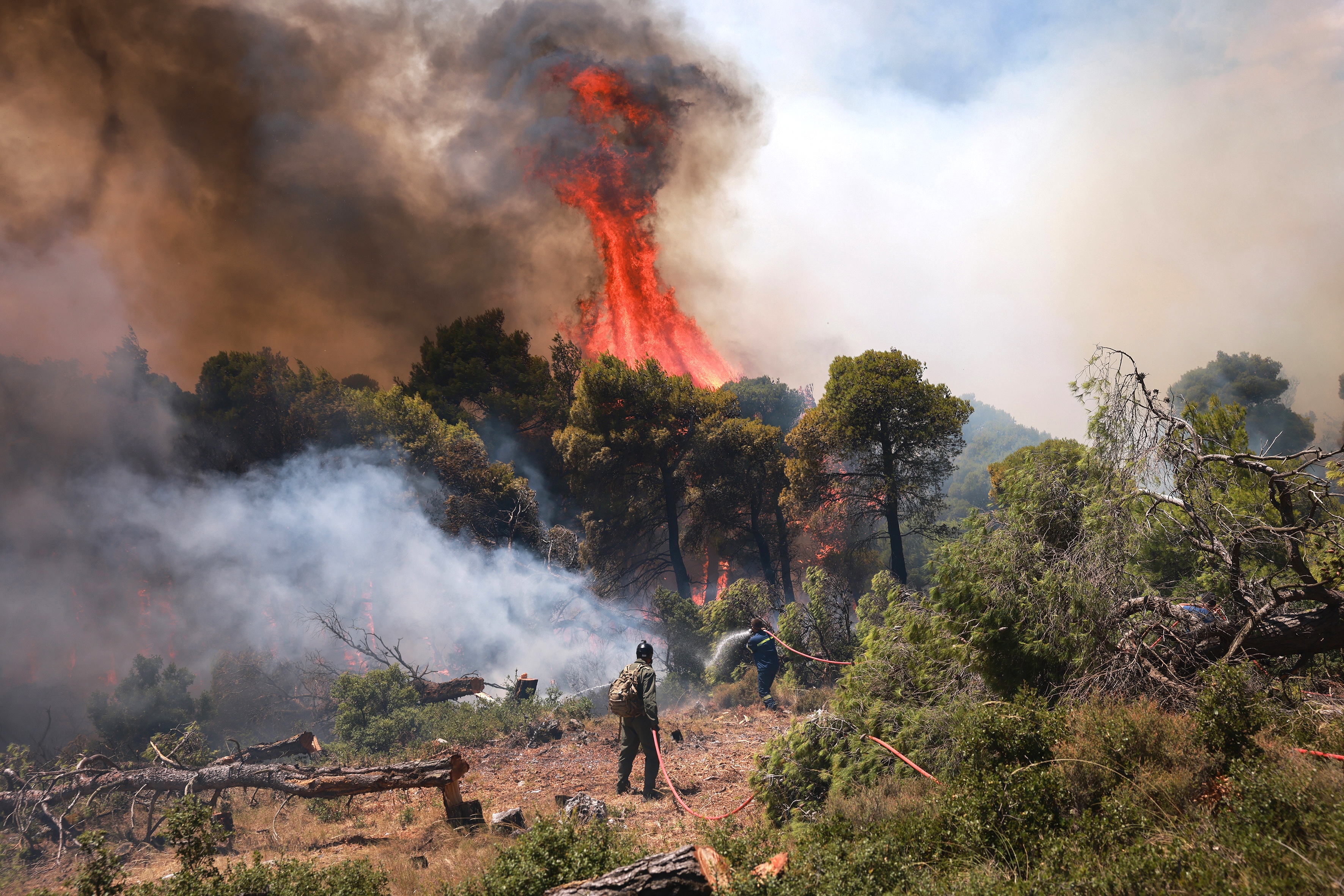
Emergency services in Greece are rigorously battling wildfires across the country, a day after two firefighting helicopters collided in midair, killing two crew members.
Almost 500 firefighters have been deployed to stop advancing wildfires west of Athens, with water-dropping planes utilized early Monday morning in an effort to stem the blazes.
A high risk warning is in place until at least Tuesday for areas surrounding Athens, with hundreds of people already evacuated from the nearby regions.
The Greek seaside resort of Porto Germeno has also issued further evacuation notices as emergency services continue to tackle major blazes.
According to the national fire and rescue service of Greece, around 220 agro-forest fires have broken out across the country since July 27.
Chief fire officer Vasilios Vathrakoyannis referred to the uphill battle as “perhaps the most difficult days of the summer,” noting that the strong winds have “created extremely difficult conditions.”
Greek Prime Minister Kyriakos Mitsotakis also highlighted the plight of the emergency services, explaining how “the burden of the battle” has fallen almost exclusively on “frontline” responders due to unforgiving weather conditions.
“When the winds blow with such force, even the dozens of aerial resources at our disposal cannot operate safely,” he said. “In several cases over the last few days, it was not possible to carry out either water intakes or water drops, as the extreme turbulence made flights prohibitive.”
Greek authorities have also been issuing fines and carrying out arrests on suspicion of arson-related crimes, according to local officials. Around 22 administrative fines have already been issued, totalling €70,100 euros ($80,666), Vathrakoyannis said.
Firefighting helicopters collide midair, killing two crew members
A midair collision between two firefighting helicopters occurred Sunday during operations to combat a blaze around 65 km (42 miles) west of Athens.
Two crew members, a Greek and a Danish national, onboard one of the helicopters were killed in the crash in the Psatha area of the Attica region. A Briton and another Greek national were pulled from their helicopter alive.
An investigation is underway to determine the cause of the crash.
Mitsotakis paid tribute to the fallen frontline fighters, expressing his “deepest sorrow” over the incident. “The loss of the Greek coordinator and the Danish pilot while they were operating in the major fire at Porto Germeno fills us all with grief,” he said. “Sincere condolences to their families.”
Ursula von der Leyen, president of the European Commission, also remembered the contributions of the fallen.
“It takes a special courage to fly towards the flames so that others can be safe. As we continue to battle these fires side by side, Europe grieves with Greece and Denmark,” she said.
Widespread wildfires devastate Europe
Blazes across Greece come as significant fires have also gripped other European countries in recent weeks.
Wildfires have swept across regions in France, with President Emmanuel Macron describing the situation as “the toughest since the Second World War.”
In Spain, officials fighting the blazes near Madrid last week said they were the worst the region had ever experienced.
Elsewhere in western Europe, an emergency incident was declared in Suffolk, England, last week as firefighters tackled a blaze the size of at least 210 soccer pitches.
Much of Europe is in the midst of yet another heat wave, further compounding the issue and raising concerns that even contained fires may gather pace once more.
A drought has been declared in seven areas of England after record low rainfall and exceptionally high temperatures.
Additionally, the U.K.’s national weather and climate service said England and Wales have provisionally recorded their driest July on record.
Reflecting on the devastation sweeping Europe, Spanish Prime Minister Pedro Sánchez referred to the wildfires as "the most painful expression" of the climate emergency.
Republican holdouts say they will back Todd Blanche for attorney general
Move comes after Blanche gives senators written assurance he will drop Trump’s $1.8bn anti-weaponization fund
Two Republican senators who threatened to block Todd Blanche’s bid to permanently become US attorney general announced they will advance his nomination after he said in writing that a planned $1.8bn slush fund for Donald Trump’s allies was dead.
The US Senate judiciary committee is due to vote on Tuesday on whether to approve the nomination of Blanche, who is already acting attorney general, and send it to the wider Senate for a vote.
Continue reading...US cyclosporiasis outbreak kills two people in Michigan, officials say
US sees first fatalities due to intestinal illness, though both had significant underlying health conditions
Two people have died from cyclosporiasis in Michigan, the state’s health department said on Monday, marking the first fatalities in the largest US outbreak of the intestinal illness.
“According to medical records, both individuals had significant underlying health conditions that may have been impacted by cyclosporiasis and dehydration,” a spokesperson for the Michigan health and human service department told the Guardian in a statement.
Continue reading...Scottish seabird hunt cancelled for first time in 400 years
NatureScot refuses licence for hunt on Hebridean island of Sula Sgeir in which up to 2,000 gannet chicks are killed
A controversial Scottish seabird hunt will not go ahead for the first time in 400 years, in what campaigners have called a “victory for common sense”.
In the annual guga hunt, up to 2,000 gannet chicks are killed over a 10-day period on the uninhabited Hebridean island of Sula Sgeir, 40 miles north of Lewis and Harris.
Continue reading...