RSS Feeds
The best ways to avoid (and treat) heat rash and sun poisoning, according to derms
Details from Nolan Wells' independent autopsy
Latest on U.S.-Saudi nuclear deal, Trump threats against Iranian infrastructure
Liverpool issue bans as £1.2m seized from ticket touts
How much interest will a $40,000 1-year CD account earn if opened now?
Dozens of beluga whales transferred to U.S. after Canadian theme park closure
US trade chief defends tariffs as Democrats say Trump ‘in denial’ over price hikes
Jamieson Greer denies tariffs have pushed up prices during grilling from lawmakers over cost-of-living concerns
Donald Trump’s chief trade official denied the president’s sweeping tariffs have increased prices for US families, as lawmakers challenged him over cost-of-living concerns across much of the country.
US inflation surged to a three-year high earlier this year. During a heated exchange before US senators on Wednesday, however, US trade representative Jamieson Greer appeared to claim Trump’s controversial economic agenda had not driven prices higher.
Continue reading...The tariffs that just won’t die
What Trump's generic drug tariffs could mean, according to experts
Trump says U.S. will destroy a bridge or power plant for each Iranian attack in the Strait of Hormuz
SoundCloud acquires decentralized music platform Nina Protocol months after its shutdown
'No role' for White House in extradition to UK of Tate brothers, says top US diplomat
Trump speaks at Atlanta area high school
Dubai Firm Cuts Deal for New Port to Bypass Strait of Hormuz
Astronomers Discover the First Known Moon Outside our Solar System—and What a Moon it Is
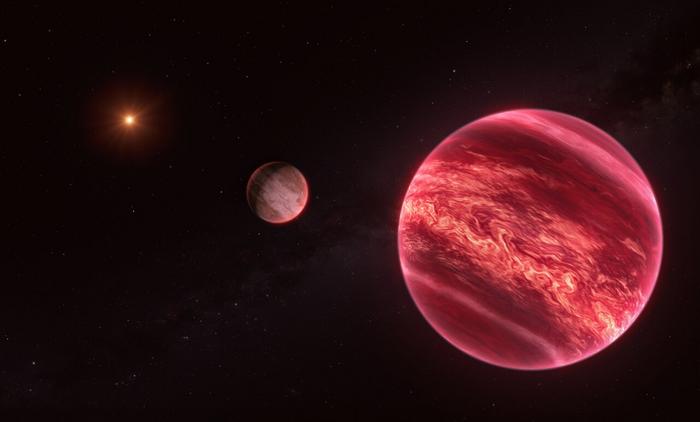
Humans have been observing distant stars since antiquity. Distant planets, however, have been a different matter. It was not until 1992 that the first exoplanet—or a planet orbiting a star other than our sun—was detected. Since then there has been a storm of such observations, with space-based and Earth-based telescopes spotting more than 6,000 exoplanets all over the skies. Astronomers now believe that there is at least one planet circling virtually every existing star.
What has eluded detection so far have been exosatellites: moons orbiting those remote planets. Our solar system is home to a whopping 891 moons, but the rest of the known cosmos? Nothing. Until now.
What is an exomoon?
As a new paper in Nature reports, a team of scientists using the European Southern Observatory’s Very Large Telescope (ESO’s VLT) in Chile have discovered astronomy’s first known exosatellite, or exomoon, orbiting an unusual body in the solar system known as CD-35 2772, just 71 light years away—next door by astronomical standards. That, by itself, makes cosmic news, but the nature of that planet and that moon make the story even stranger.
The moon is huge—at least as massive as Jupiter, which is itself the largest planet in our solar system with a diameter 11 times that of Earth. And the planet that exosatellite orbits isn’t a planet at all. Rather it’s a brown dwarf, a gassy object far too big to be a conventional planet—in this case 33 times the mass of Jupiter—but too small to ignite its nuclear furnace and become a star.
“The host [brown dwarf], span[s] the mass regime between more normal planets and the smallest stars,” says Kevin Hoy, lead author of the study, who is an ESO student in Chile and an investigator at Chile’s Universidad Diego Portales, in an email to TIME. “You'll actually find some brown dwarfs in both stellar and exoplanetary catalogs.”
Exoplanets typically aren’t spotted visually, since the pinpoint light of the distant world is swamped by the glare of the nearby star—a little like a moth fluttering invisibly next to a street light. Rather they are discovered in one of two indirect ways. The first is known as the transit method. When an orbiting planet passes in front of its parent star, it blocks a bit of the star’s light. The dimming is exceedingly tiny—the equivalent of removing one light bulb from a board containing 10,000 of them—but it’s enough for a sensitive telescope to detect. The greater the dimming the greater the diameter of the planet. The second means of detecting an exoplanet is known as the radial velocity method: looking for the tiny wobble the moving planet’s gravity causes in the star. The greater the wobble, the greater the planet’s mass.
The brown dwarf “planet”—which orbits the star in the CD-35 2772 solar system—was discovered in 2011 using neither of these methods. Its huge, almost star-like bulk was great enough that astronomers could detect it with an ordinary optical telescope. The exosatellite, however, was a different matter. Even with its Jupiter-like mass it was too small to be seen from 71 light years away. Instead Hoy and his colleagues used the radial velocity method to look for wobbles in the brown dwarf. They spotted them and used the degree of the wobble to calculate the size of the world.
What does the discovery of an exomoon teach us about the universe?
“Being the third wheel in this system makes us want to call it a moon,” said Hoy in a statement that accompanied the release of the study, “even if it is nothing like the small, rocky moons we have in our system.”
That fact raises the larger question in this discovery, which is essentially one of nomenclature. When is an almost-star actually a planet, and when is a Jupiter-like planet actually a moon? Astronomy typically has neater labels than that, but the CD-35 2772 solar system defies such tidiness.
“It's hard to say what we will learn from this one particular system,” says Hoy, “because we don't know if it's common for high-mass systems to look like this, or if it's a weird case among more comparable systems.”
Whatever the answer is, Hoy plans to keep looking. He and his colleagues are already on the trail of another, as yet undisclosed, exosatellite candidate. Their work will be aided by the planned European Southern Observatory’s Extremely Large Telescope (ESO’s ELT) which is expected to go into service in early 2029, providing 20 times more light-collecting power than the existing ESO’s VLT.
“That will be an enormous boon to the search for exomoons,” says Hoy, “as we'll have much better access to known exoplanet systems and be able to discover new ones [by] applying the same method we used here.”
The deeper astronomers look into the universe the more curious it becomes. Solar system CD-35 2772, with its mammoth exosatellite is not the first example of that—and it surely won’t be the last.
House passes temporary government funding bill months early
Paramount’s £80bn takeover of Warner Brothers a step closer after EU approval
European Commission says Paramount Skydance’s decision to end Universal venture addresses merger concerns
Paramount Skydance’s £80bn takeover of Warner Brothers took a step closer to being realised after it won conditional approval from the European Union.
The European Commission said Paramount’s offer to end a film distribution joint venture with Universal Pictures addressed its concerns over the potential merger. As part of its commitments in the EU, Paramount has 13 months from the date of closing the deal to pull out from the venture.
Continue reading...‘The Odyssey’ Is Inspiring Unprecedented Levels of Cope
Zelenskyy under growing pressure to reinstate sacked defence minister
Campaigners in Ukraine pledge to continue nationwide protests until Mykhailo Fedorov gets his job back
Volodymyr Zelenskyy was under growing pressure to reinstate his sacked defence minister on Wednesday, after campaigners said they would continue indefinite nationwide protests until Mykhailo Fedorov got his job back.
On Tuesday, Zelenskyy bowed to public demands by firing Ukraine’s commander-in-chief Oleksandr Syrskyi. He appointed Mykhailo Drapatyi as the new head of the country’s armed forces, as part of a radical reshuffle of the top military command.
Continue reading...The Odyssey film fans inspired to go back to the source
House and Senate take different paths to avoid shutdown before midterms
What Is the Youth-Led ‘Cockroach Movement’ Staging Mass Protests in India?
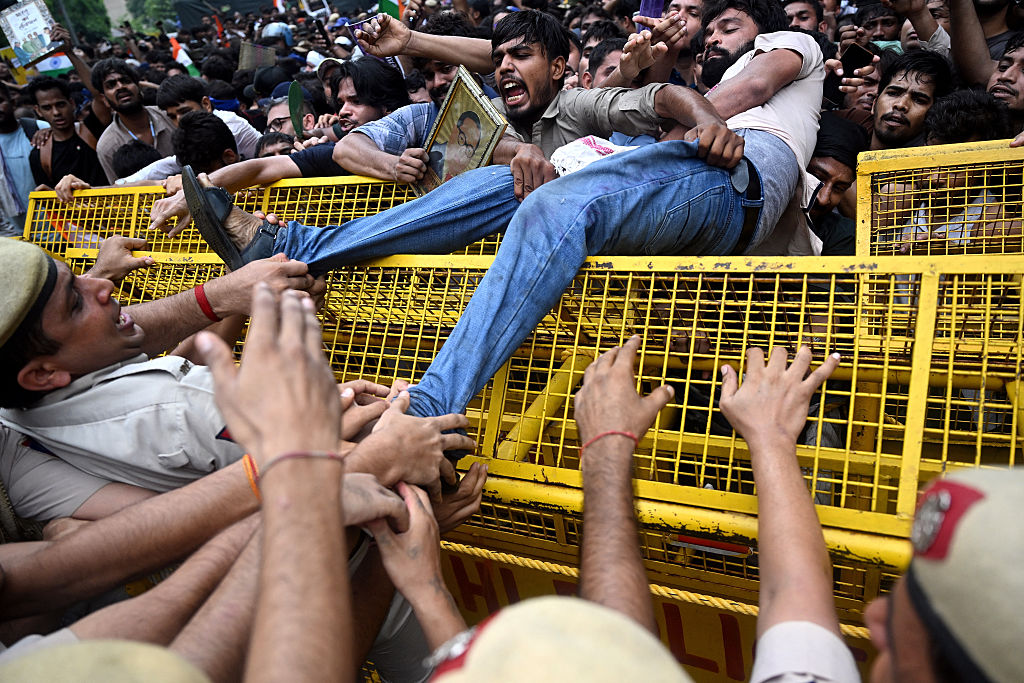
India’s youth-led “cockroach movement” was born just over two months ago as a satirical online campaign. But it has quickly swelled into a formidable real-world political force, bringing tens of thousands of protesters into the streets in the country’s capital in recent days to call for the resignation of Education Minister Dharmendra Pradhan and reforms to India’s troubled education system.
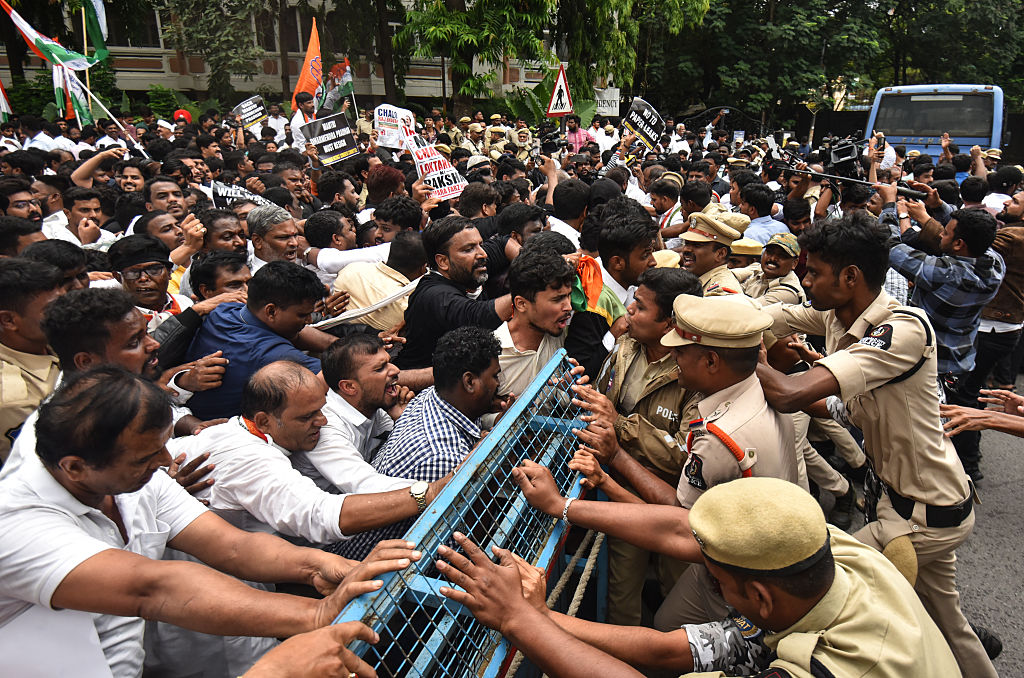
Thousands of supporters of the Cockroach Janta Party (CJP) continued to protest in the capital of New Delhi on Wednesday even after demonstrations earlier in the week erupted into violent clashes with the police that left dozens of people injured.
The movement’s Monday protests in New Delhi marked one of the country’s largest anti-government gatherings in years, with an estimated 20,000 people, made up mostly of students and young people, taking to the city’s streets. Amid the massive protests, a senior government minister reportedly met with CJP representatives to hear their demands, in what was seemingly the government’s first move to hold talks with members of the movement.
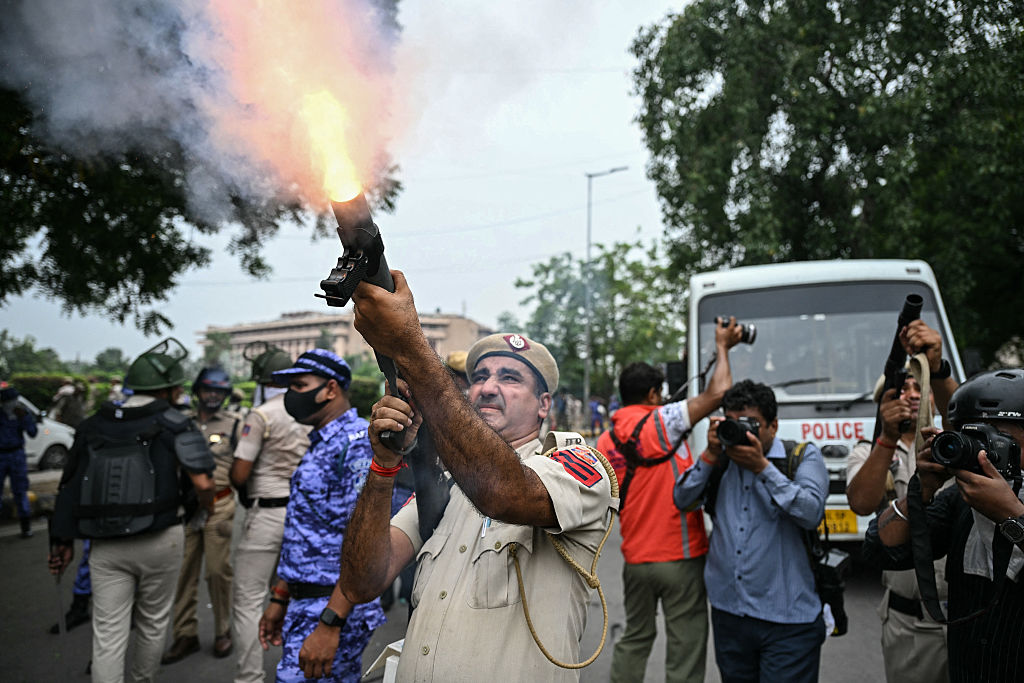
But in central Delhi, the protests confronted an aggressive law enforcement response. Police set up barricades and used batons and tear gas to disperse thousands marching on Parliament. Video from The Associated Press showed protesters gathering together to push over the tall yellow barricades and sometimes climbing atop them as droves of Delhi Police stood guard in riot gear.
Delhi Police said that around 180 people were injured amid the Monday clashes, including 118 security personnel and 60 protesters. Meanwhile Abhijeet Dipke, the founder of the cockroach movement, said 150 protesters were receiving treatment in hospitals.
The movement called off another march on Parliament that had been planned for Tuesday over safety concerns.
"We will not march again because the police will hurt the youth again," Dipke said at a press conference on Tuesday.
But a sit-in continued into Tuesday and Wednesday in Jantar Mantar, close to the Parliament building. A separate sit-in was also held at the residence of the country’s right-wing prime minister, Narendra Modi, where the leader of the country’s opposition party was detained on Tuesday. The following day, members of the opposition party held a protest in Parliament in support of the cockroach movement protesters.
After weeks of silence in the face of the movement’s growing momentum, Modi on Tuesday made his first comments since May about a widespread leak that led to the cancellation of national medical entrance exams this spring, an issue that has been one of the driving forces behind the protests. The Prime Minister defended the government’s response and vowed to strictly punish those involved, according to a cabinet minister.
Pradhan, meanwhile, condemned the protest at Modi’s residence in a post on X and stated that the government “remains 100% committed” to discussing the exam leak and “addressing every genuine concern of our youth on the floor of the House.”
“We owe our students more than outrage. We owe them answers, reforms and accountability,” he wrote. “That is exactly what our government remains committed to delivering.”
Still, the CJP demonstrations have shown no signs of abating.
Here’s what to know about the growing movement, and the ongoing protests it’s leading in India.
How did the cockroach movement start?
In the spring, Indian authorities voided the results of the May 3 NEET exam, the country’s highly competitive entrance exam for admission to undergraduate medical programs, after an investigation found that questions had been leaked.
The incident marked just the latest in a series of leaks and other irregularities that have impacted the exam in recent years. As a result of the May test being voided, more than two million students have been forced to re-take the stressful and costly exams, prompting outrage and demands for systemic reform.
That situation has served as the most immediate spark for the exploding momentum of the cockroach movement and a core focus of its ongoing protests, which have also tapped into young people’s broader anger over extremely high unemployment rates and economic pressures.
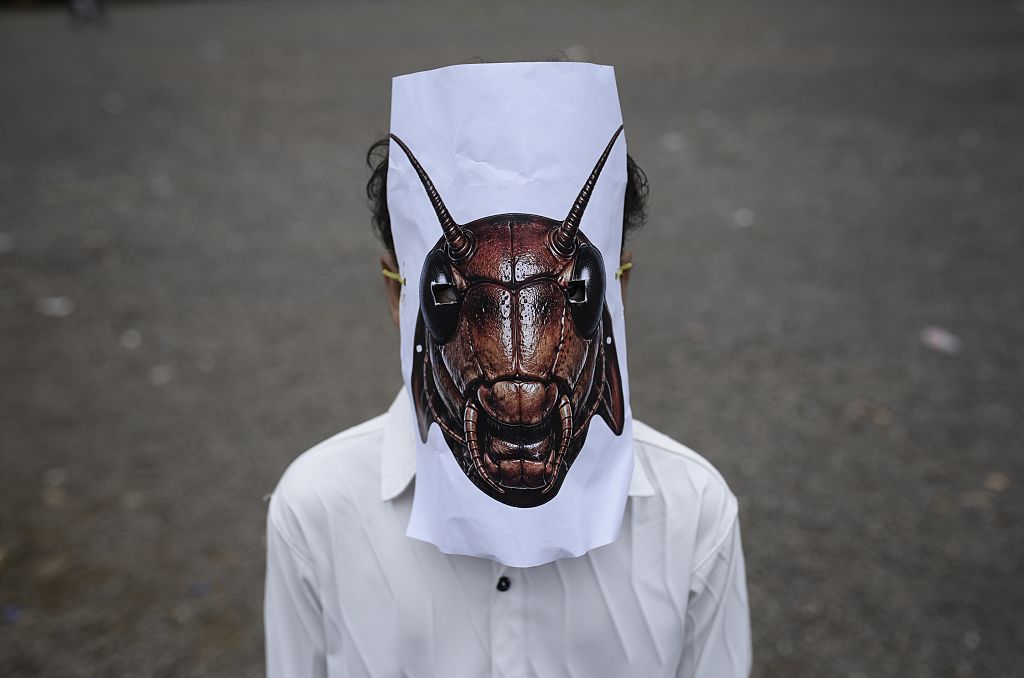
The CJP itself was born in response to a comment the Chief Justice of India’s Supreme Court made during an unrelated hearing the same month of the testing scandal, in which she compared young unemployed people to "cockroaches” and “parasites.”
“What if all cockroaches came together?” Dipke, who was then living in the U.S. after graduating from Boston University, wrote on his social media in response.
That initial post drew a huge reaction amid the backlash to the justice’s remark. And Dipke proceeded to build out the movement from there. He created social media accounts and a website for the CJP—whose name references both the justice’s remark and the country’s ruling Bharatiya Janata Party—and garnered a fast-growing following as he did so. Within mere weeks, over 20 million people had followed Dipke’s accounts, and the Modi government temporarily blocked the X account for the CJP in the country.
As the movement gained momentum, Dipke decided to return to India to lead it in Delhi, and at events across the country.
“Build a party for the young people who keep getting called lazy, chronically online, and — most recently — cockroaches,” the CJP articulates its “vision” on its website. “That's it. That's the mission. The rest is satire.”
What is the movement demanding?
The movement’s website features a manifesto detailing five demands.
They include restricting chief justices from being appointed to Parliament following their retirement; arresting the Chief Election Commissioner if any citizens’ votes are erased; reserving 50% of cabinet positions for women while increasing reservation—the quota to increase female representation across the government—from 33% to 50%; creating a more independent media; and barring any lawmaker who switches political parties from holding a government position for 20 years.
The CJP also posted a separate “charter” on the website last week titled “5 Demands to End India's Exam Crisis.” Those demands include creating a new Public Examinations Act to increase transparency and accountability; establishing new and reforming current examination bodies; developing a “students’ rights charter”; forming a welfare fund for students and their families; and establishing consistent parliamentary oversight of examination authorities, “not only when there’s a scandal.”
Weeks of protest culminate in mass demonstrations—and violent clashes
Protestors have camped at Jantar Mantar, the epicenter of the protests, for the past month.
In June, CJP members began staging a sit-in at the site, refusing to move until Pradhan resigned. Along with students, professionals and families with young children have joined the demonstrations there.
Later in the month, Sonam Wangchuk, an education activist who has been detained by Modi’s government for past demonstrations, began a hunger strike on June 28 to show his support for the CJP, which caused more people to surge to the site in support.
Wangchuk proceeded not to eat for 20 days—a period that ended only after Delhi police hospitalized him against his will, sparking national outcry. After being forcibly removed from his hunger strike, Wangchuk called on CJP members to march on Parliament.
They did so on Monday. Protesters took to the streets in Delhi that day holding signs that read “Stop normalizing paper leaks!” and “Save education, save the future,” along with countless others calling for Pradhan’s resignation. The day’s protest, which marked the culmination of weeks of building momentum, then escalated in clashes with authorities.
Dipke, the founder of the cockroach movement, called the police response to the protests on Monday “really cruel and evil” while speaking to reporters in the streets on Tuesday. He accused male police officers of tearing clothes off of girls and beating them “black and blue.”
After witnessing the aggressive response, Dipke said, “I don’t believe that Narendra Modi deserves to be called as the Prime Minister. He’s a dictator.”
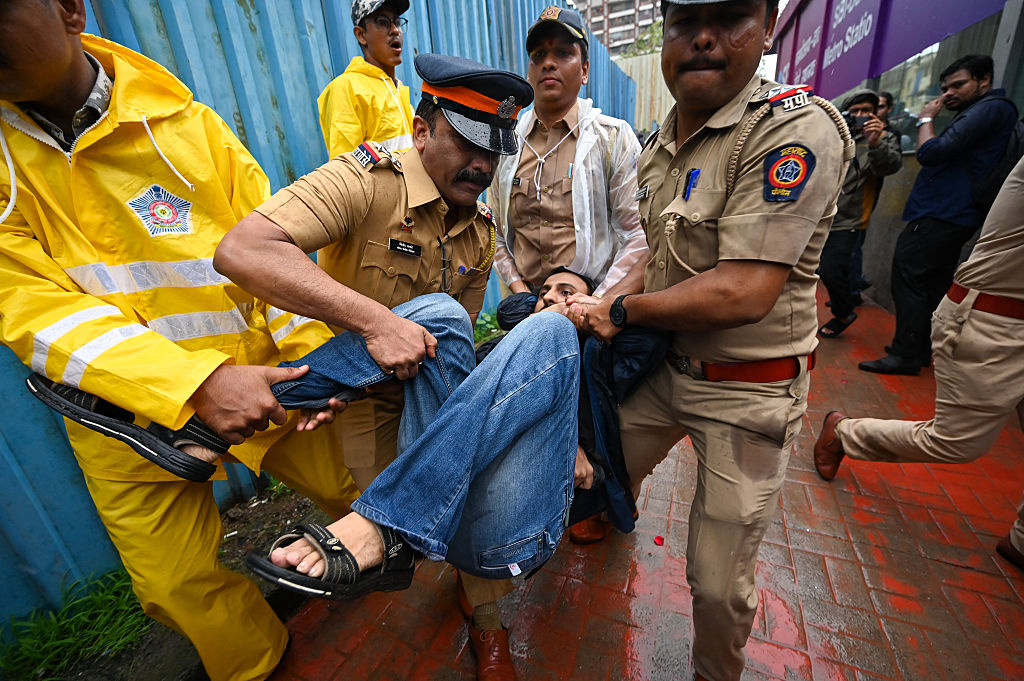
In addition to the ongoing sit-in in Jantar Mantar, which has now lasted over four weeks, a protest against Monday’s police response was held outside Modi’s residence on Tuesday.
“We have marched to PM Modi’s house to demand answers from him for the brutalities against young students yesterday,” Rahul Gandhi—the leader of India’s opposition party, the Indian National Congress (INC), which has also rallied behind the cockroach movement—posted on Tuesday.
“The Government doesn’t want to take any accountability or does it want to have a debate on it in Parliament,” he continued, calling for Modi and Indian Home Minister Amit Shah, who oversees the police, to resign “for destroying the future of India’s youth.”
Gandhi was detained along with other opposition leaders during the sit-in outside of the prime minister’s residence.
On Wednesday, protests continued in the capital, with lawmakers in the opposition party gathering to demonstrate both in- and outside Parliament. Gandhi, released following his detention, led other opposition lawmakers in protest outside of the Parliament building as many waved signs calling for Pradhan’s resignation. More opposition leaders inside of the building called for the government to address the violent police clashes on Monday, causing proceedings to be suspended.
Meanwhile, at Jantar Mantar, food deliveries sent in by supporters sustained protestors as they continued to demand that Pradhan step down.
Latest on confirmation processes for Clayton, Blanche
Paramount’s £80bn takeover of Warner Brothers a step closer after EU approval
European Commission says Paramount Skydance’s decision to end Universal venture addresses merger concerns
Paramount Skydance’s £80bn takeover of Warner Brothers took a step closer to being realised after it won conditional approval from the European Union.
The European Commission said Paramount’s offer to end a film distribution joint venture with Universal Pictures addressed its concerns over the potential merger. As part of its commitments in the EU, Paramount has 13 months from the date of closing the deal to pull out from the venture.
Continue reading...Сколько на самом деле берут за оплату ChatGPT из России: посчитал до рубля у восьми посредников
Оплатить зарубежную подписку из России сейчас можно десятком способов, и почти все они непрозрачные. Пишешь боту «сколько будет ChatGPT Plus за 20 долларов» — получаешь цену в рублях, но не понимаешь, откуда она взялась. У одного сервиса выходит 1900 рублей, у другого за то же самое 2700. Официальный курс доллара в тот день — 78,4 рубля, то есть честная цена подписки 1568 рублей. Куда девается остальное и почему у всех по-разному?
Я потратил пару недель на то, чтобы это выяснить: писал ботам и менеджерам, просил посчитать одни и те же подписки, записывал итог в рублях и сравнивал с курсом ЦБ на день замера. Оказалось, что за пёстрыми ценниками прячется одна и та же формула, и, поняв её, переплату можно предсказывать заранее.
Читать далееHow OpenAI’s human mistake led to the AI-powered hack on Hugging Face
How often should you wash and change out your sheets? Experts explain
Teenager drops social media addiction lawsuit against Meta
China’s Open AI Models Are Challenging Silicon Valley’s Playbook
What to know about the Nolan Wells independent autopsy results
Model scout investigated for Epstein trafficking ties found dead
Минфин США пригрозил санкциями за китайский ИИ. Через несколько часов глава Nvidia встал на защиту моделей

Во вторник министр финансов США Скотт Бессент заявил в эфире Fox Business, что администрация изучает китайские ИИ-модели на предмет украденной интеллектуальной собственности и рассматривает санкции: по его словам, внутри китайских моделей находят "водяные знаки" американских. А через несколько часов глава Nvidia Дженсен Хуанг в интервью Axios заявил, что Америке нечего бояться китайского ИИ — бояться стоит кампании по его запрету.
Читать далееКогда TIME_WAIT становится врагом

Ошибка Cannot assign requested address, внезапные обрывы соединений и растущее число сокетов в TIME_WAIT часто выглядят как странности Linux, пока сервис не начинает терять доступность под нагрузкой.
В статье разберём, почему заканчиваются локальные порты, какие параметры ядра действительно влияют на ситуацию и где проблема решается настройкой, а где — только изменением архитектуры соединений.
Читать далееWarnock calls on Democrats to investigate those who redrew maps
Should you lock a mortgage rate before the July Fed meeting? Pros and cons to consider now
What to Know About Lindsey Graham’s Funeral Services

Funeral services for the late Sen. Lindsey Graham will take place on July 28 and 29 in both the nation’s capital and the Republican’s home state of South Carolina.
The details of the services were announced by Graham’s sister, Darline Graham Nordone, who was sworn in last week to temporarily take over her brother’s seat in the Senate. Nordone announced earlier this week that she plans to run for a full term.
“I am grateful to all those who have come together to help honor and remember Lindsey,” Nordone said in a statement. She went on to thank several people and groups—including President Donald Trump, who encouraged her to run for a full term—”for going above and beyond to ensure these will be honorable tributes to Lindsey.”
Here’s what to know about the planned services for the late Senator.
What will happen on the first day of the funeral?
On July 28, an arrival ceremony will take place at the Capitol building in Washington, D.C., according to the details shared by Nordone. In honor of Graham’s service in the U.S. Air Force, his remains will be brought into the building by an Armed Forces Body Bearer Team, who will later be relieved of their duties by a U.S. Capitol Police memorial guard to signify his time in the upper chamber.
A “short program” intended to honor Graham’s congressional service will take place in the Capitol Rotunda, though the details of this ceremony are unclear. While the ceremony will not be open to the public, there will be a livestream of it.
After that, Graham’s remains will be taken to Washington National Cathedral for a funeral service, which will begin at 2 p.m. The service will only be open to those who received invitations, which “will be sent out in the near future.” But, as with the Rotunda ceremony, the public will be able to watch the funeral service, this time on either the Washington National Cathedral’s website or its YouTube channel.
Once the funeral service ends, Graham’s remains will be taken to his home state of South Carolina, where additional services will be held the following day.
What will happen on the second day of the funeral?
The second day of Graham’s funeral services will take place in South Carolina.
The day will start at about 10:45 a.m., with Graham’s “final visit” to the South Carolina State House. Members of the public are invited to pay their respects to the late Senator along the funeral procession’s route to the State House.
The South Carolina State Guard caisson detachment will carry Graham’s remains. Upon arrival at the State House, there will be a “presentation of law enforcement from agencies across South Carolina” on the steps of the building. After a “brief pause,” a F-16 flyover via the 169th Fighter Wing from McEntire Joint National Guard Base will take place at about 11 a.m.
Once the flyover ends, the caisson will carry Graham’s remains to First Baptist Church of Columbia, where the funeral will be held. This funeral service will be open to the public, and seating will be on a first-come, first-serve basis.
After the service, Graham’s remains will be taken to a private family burial in Pickens County, South Carolina.
Are the services open to the public?
Parts of the services will be open to the public, while others will be private or by invitation only. For instance, the late Senator’s family has invited the public to pay their respects during the procession leading Graham’s remains to the South Carolina State House, as well as to attend the funeral service at First Baptist Church of Columbia. But Graham’s burial is a private family affair, and the services planned in the nation’s capital are closed to the public.
Will Trump attend the funeral services?
The President is expected to attend the service at Washington National Cathedral on July 28, during which he is scheduled to give a tribute to the late Senator. It is unclear at this time if Trump will attend the services in South Carolina as well.
Israeli Banks Threaten to Cut Off Palestinian Economy
Travis Kalanick’s robotics company raises $1.7B, led by a16z
Trump attends dignified transfer of 4 service members killed in Iran attacks
Zelenskyy under growing pressure to reinstate sacked defence minister
Campaigners in Ukraine pledge to continue nationwide protests until Mykhailo Fedorov gets his job back
Volodymyr Zelenskyy was under growing pressure to reinstate his sacked defence minister on Wednesday, after campaigners said they would continue indefinite nationwide protests until Mykhailo Fedorov got his job back.
On Tuesday, Zelenskyy bowed to public demands by firing Ukraine’s commander-in-chief Oleksandr Syrskyi. He appointed Mykhailo Drapatyi as the new head of the country’s armed forces, as part of a radical reshuffle of the top military command.
Continue reading...Tories ask HMRC to investigate whether Nigel Farage owes tax on £5m gift
Party chair queries status of funds Reform leader received from crypto billionaire Christopher Harborne
The Conservatives have asked HMRC to investigate whether Nigel Farage should have paid tax on the £5m gift he received from the crypto billionaire Christopher Harborne.
The party chair, Kevin Hollinrake, wrote to the tax authorities questioning whether it was a payment to compensate him for running to be an MP.
Continue reading...