After the team’s third-placed finish, we rate the 24 squad members who made an appearance at the tournament
Jordan Pickford Could he have done better with Enzo Fernández’s equaliser for Argentina? Jude Bellingham certainly thought so. But the man who has made more World Cup finals appearances than any other Englishman made some crucial saves, including a brilliant stop from Nicolas González in the semi-final. 7
Great brought an ideology to Barcelona that Guardiola and Emery refined, defining the playing style of the national team
Two countries are generating powerful, cross-border momentum in football. Spain represent the leading footballing culture, radiating their influence across the globe. Argentina possess a distinct identity that shapes the South American continent. Consequently, the World Cup is witnessing the perfect final.
The architect of Spain’s vision is Johan Cruyff. He brought the 4-3-3 formation and a specific ideology to Barcelona. A cadre of tactical purists, such as Pep Guardiola and Unai Emery, refined his approach into a philosophy that has defined the playing style of the entire league, all youth squads and the national team for nearly two decades. Its principles include ball-oriented defending, clearly defined positions and roles, a high level of organisation, and technical, combination-based football. Eleven players operate as a unit, moving like a swarm.
Death salons are spaces that allow free-flowing conversations about mortality and are becoming more popular around the country
In a small cream-colored room at a cemetery in Philadelphia, Pennsylvania, Nefertiti Moor sat at the head of a semicircle. Dressed in black with her long hair in locs, she delivered instructions for the evening discussion. “It’s not death counseling or a debate,” said Moor. She invited the two women in attendance to talk freely about their cultural associations with dying and grief. Tasha Johnson, who worked in behavioral health, said that she felt desensitized after the recent deaths of several people she knew. She was grappling with “the reality that it can be anyone at any point”.
The free-flowing conversation about mortality, otherwise known as a death salon or death cafe, was unique in that it was designed for people of color. Death salons for marginalized communities are becoming more common around the country, with practitioners addressing the unique end-of-life concerns of queer, trans, or Black and brown people. Acting on a lifelong interest in how communities process grief, Moor became a death doula, a non-medical professional who provides emotional and practical support to people who are dying and to their loved ones.
From manufactured election insecurity to an outbreak of ‘explosive’ diarrhea, Americans are bearing the brunt of harmful policies
Between widespread cuts to vital government agencies, various disease and illness outbreaks, and new environmental disaster vulnerabilities, the United States is facing a convergence of crises with widespread repercussions.
Yet the Trump administration has hamstrung the federal government from addressing these crises – and in some cases is actively fanning them. Over the past year, the administration has moved to shrink the federal workforce, roll back environmental protections and policies intended to fight the climate crisis, reduced funding for scientific research and is seeking to advance legislation that would impose new voting restrictions.
Top Democrat says findings show public ‘way ahead of the politicians’ as Trump dismisses global heating as ‘hoax’
Amid a summer of dangerous heat, drought and floods, a majority of Americans are connecting increasingly severe weather to the climate crisis, new polling shows, despite efforts by Donald Trump to dismiss global heating as a “con job” and a “hoax”.
It’s a sign that attempts to suppress polarize climate concerns may not be seeing full success, said Grace Adcox, senior climate strategist at Data for Progress.
From Nevada to Manchester, developers are trialling innovative solutions to clean energy’s biggest challenge
In the deserts of the United Arab Emirates a sprawling clean energy project, stretching across an area roughly the size of 12,600 football fields, will play host to a breakthrough allowing solar energy to power the equivalent of half a million homes through the night.
The Gulf state has been steadily combining 5.2GW of solar power capacity with 19GWh of battery storage to create the largest battery scheme in the world.
The president no longer treats the people who defeated him as voters. He treats them as suspects
There is a version of this country in which Donald Trump tells Americans the truth he has been handed: that their elections are secure. Once, he apparently wanted to.
The Atlantic reported after Thursday night’s address that a February 2020 election-security briefing pleased Trump so much he wanted to announce the news himself. The press conference never happened. The election did, and Trump lost it.
Experts believe it’s at least possible. We urgently need a plan to navigate the ethical implications
In January, the AI company Anthropic published a new constitution for Claude, its most advanced large language model (LLM), which contained the comment: “We are caught in a difficult position where we neither want to overstate the likelihood of Claude’s moral patienthood nor dismiss it out of hand.” A month later, Anthropic’s CEO Dario Amodei went on a podcast and said his company couldn’t rule out the possibility that Claude was conscious. Philosopher David Chalmers, who coined the phrase “the hard problem of consciousness”, has said there is a significant chance of conscious LLMs within a decade. And what about Claude itself? When asked during testing to estimate the probability that it is a moral patient, meaning that its wellbeing matters in its own right, it gave numbers ranging from 5% to 40% and stressed how uncertain it was.
Modern AI systems are extraordinarily complex, and they are advancing fast. In terms of structural complexity and computational scale, by some measures a few are already in the range of a mouse brain, and at recent growth rates, they could reach the range of a human brain within five to 10 years.
Almost all of the sandy stretches on the country’s 8,000km of coastline are run for profit. Now ‘free beach’ campaigners are fighting back against the mafia, the military and those profiteering from sun loungers and cocktails
Walking along Italian beaches is like strolling through a rainbow. The sand will be subdivided into colours: for 50 metres or so the perfectly spaced parasols and deck chairs will be all red, then they become orange, then yellow, green and so on.
These are the country’s famous bagni (lidos), formally known as concessioni balneari (bathing concessions). They’re simple but stylish. The sand is raked at dawn. The bar plays ambient music and serves negronis or fried squid. There will probably be a table-tennis table, or a beach volleyball area. Some have swimming pools.
A recent update made video playback the default for songs and podcasts with a visual component. If you just want to listen to music—and save your data and battery—follow these tips.
The Trump administration faces a daunting cleanup after earthquakes flattened the country’s infrastructure while oil and mineral reserves beckon to U.S. investors.
The name “Tristan” grew in popularity after Brad Pitt played a character with that name in the 1994 movie Legends of the Fall. | Katelyn Mulcahy/FIFA via Getty Images
Have you noticed there are a lot of professional basketball players named Jalen? Well, it’s not just the NBA: There are a plethora of Jalens in the NFL, and even the NHL has one. How did this name get so popular? Did all their parents watch basketball in the 1990s and fall for Jalen Rose?
There are many ways names come about, and according to Cleveland Kent Evans, there is something unique about naming traditions in the United States. Evans is the former president of the American Names American Name Society, and he writes a column for the Omaha World Herald nabout what names are popular, and why.
“In American culture, individualism is so strong. What I hear most often from parents is we want to find a name which is different, but not too different,” he told Explain It to Me, Vox’s weekly call-in podcast. “A lot of people are picking names which are unusual to them because they don’t know anybody their own age or their parents’ age with the name.”
So what makes some names go mainstream, and what outside factors play a role in what parents choose? We discuss that and more on the latest episode of Explain It to Me.
Below is an excerpt of my conversation with Evans, edited for length and clarity. You can listen to the full episode, on Apple Podcasts, Spotify, or wherever you get your podcasts. If you’d like to submit a question, send an email to askvox@vox.com or call 1-800-618-8545.
So we have this very American individualized outlook when it comes to names. I would love to get into how other social factors shape how we name people. How does race shape our names?
The African American community has had a very different experience with naming since the 1960s. If you go back before the 1960s, unfortunately prejudiced racist people, one of the things they used to see about Black people was that they have funny names.
Statistically, before 1960, that wasn’t really true. It was like Black people had names that were like 1 or 2 percent more unusual than white people. It was very small. What happened in the ’60s as part of [the] Black Power [Movement], they turned what had been a negative into a positive. Many Black people said, “We are the people who give our children unique names to show how much we love them, to show how valued they are.” And that’s when you got the tradition of creating new names. Instead of the individual names necessarily being what went through fashions, it was the syllables they were made out of. In the ’60s and ’70s for girls, the most common prefix was law. And so you had Lakeisha, Latasha, Latoya. Then in the ’90s, the most popular prefix was Sha. And so you had Shanisha, Shaquita.
“Just like there is no such thing as the perfect parent or the perfect child, there’s no such thing as the perfect name.”
How does class show up in the way we pick names?
People who are highly educated want new names for their kids, but for them, they have to find something that has a history in the culture. They’re the ones that go back and revive the old names, while blue-collar people are more interested in stuff which is new — things which are newly invented or things which have not been girls or children’s names until recently.
How do names become popular?
Things do not go from zero to top 10 overnight. But what happens is you often have what I call the Hollywood feedback loop. Screenwriters in Hollywood tend to be college educated. They often are going to give their characters names which are too young for them because they name their characters like they would name a kid. The screenwriters name characters and that presents the name to the whole population. Then all of a sudden it shoots up. An example of something changing social class that way was Tristan. Tristan sort of first came up among more educated people. There was a character in the original All Creatures Great and Small. Then you have the movie Legends of the Fall, which comes out with Brad Pitt playing the character Tristan. All of a sudden the name shoots up. It was not just the educated people who were naming their son Tristan anymore very suddenly at that point.
Are there any other examples?
One of the hugest increases just because of television was a few years ago. About 2008 there was a program on one of the cable TV networks called 16 and Pregnant. One of the first babies born on that show was a boy named Bentley. The name Bentley for baby boys was one of the fastest growing boys’ names ever. It went from almost nothing to within about three years being the 75th most common name for boys in the US.
Do people ever see naming their children as a way to break from their past or from their culture?
If you look at the immigrant groups that came from Europe in the 19th and the early 20th century, it was very common for the immigrants to want to give their kids quote “American” names. They would tend to pick things which they heard in the neighborhood. Then as the ethnic groups become assimilated, one of the ironies of that is that the grandchildren or great grandchildren of the immigrants go back and they say, “Well we want to revive our ethnic names.”
The first group that did that was the Irish. A lot of Irish people came over and they quit naming their kids things like Bridget. Then a lot of them wanted to bring back Irish names like Kevin. And then because they were doing it, those names started spreading to the whole whole country. So today Kevin is not an especially Irish American name. There are many, many Americans who have no Irish ancestry who are named Kevin.
What advice do you have for people out there who are like, “Oh my gosh, I’ve got to name this kid. What am I going to do?” How should people be approaching it? How should they be thinking about it?
Well, I think first of all, they shouldn’t worry about it too much. I got a communication from a woman who had an uncle who she really loved and really admired, whose name was Floyd. She said, “Can I really name my son Floyd? Won’t he be teased too much?” I told her, “Look, you really love this uncle. What you do is you name your son Floyd, but then from the very beginning, you tell him why you named him that and why his great Uncle Floyd was a marvelous person and why you loved him so much and make him proud of it to protect him from the teasing.”
Just like there is no such thing as the perfect parent or the perfect child, there’s no such thing as the perfect name. There are lots of different names that would work equally well for your child and you shouldn’t think that you have ruined their life by giving them the wrong name.
Lionel Scaloni says he has a squad full of fighters – wild and unruly – but on the pitch they play with a freedom reminiscent of eight- or nine-year olds
After scoring the goal that secured Argentina’s place in the World Cup final, Lautaro Martínez burst into convulsive sobs during the touchline interview. He spoke of the first pair of trainers his father bought him and of how his mother kept making his bed when he moved to a club pension house in another city as a teenager. Every single day. Martínez said that mattered to him more than any goal, any cup.
Argentina’s head coach, Lionel Scaloni, said he was a bit worried after England’s goal but never stopped believing in his players. “They grew up in environments where they were afraid of nothing, in which they’ve always been the best at what they do,” he said. “As small children they competed and everyone expected so much of them; responsibility doesn’t weigh them down.”
Fans evacuated from sold-out open-air show as organisers promise full refunds
An open-air show by the Puerto Rican music star Bad Bunny was abandoned in Italy on Saturday night because of a violent hailstorm, but the organiser said ticketholders would be reimbursed.
Videos posted on social media showed large hailstones hitting people at the sold-out show, along with strong winds and driving rain, after the star began his set at Milan’s Snai La Maura Hippodrome.
Fans evacuated from sold-out open-air show as organisers promise full refunds
An open-air show by the Puerto Rican music star Bad Bunny was abandoned in Italy on Saturday night because of a violent hailstorm, but the organiser said ticketholders would be reimbursed.
Videos posted on social media showed large hailstones hitting people at the sold-out show, along with strong winds and driving rain, after the star began his set at Milan’s Snai La Maura Hippodrome.
Victor Marx barely won, but his victory delivers a strong statement about the nature of today's politics. It shows what happens when a party stops seriously competing and instead indulges its fever dreams.
California has been the target of more civil rights actions than any other state. The civil rights division is led by California-native Harmeet Dhillon.
Expectations that prioritize privileged identities keep women and people of color from even running for office
Since Kamala Harris’s defeat to Donald Trump in 2024, Democrats have chased candidates who exude an ever-elusive “authenticity”. For many on the left, the answer was Graham Platner, a military veteran turned oyster farmer with a gravelly voice and deep hostility toward the political establishment.
Even as controversy after controversy emerged – racist, sexist, homophobic online posts; a tattoo widely recognized as a Nazi symbol, which he later covered up; sexually explicit messages sent to other women while he was married; and allegations from former partners of toxic and threatening behavior, which he denied – Platner’s momentum didn’t slow. It was only after a woman accused Platner of rape – which he denies – that his political support collapsed.
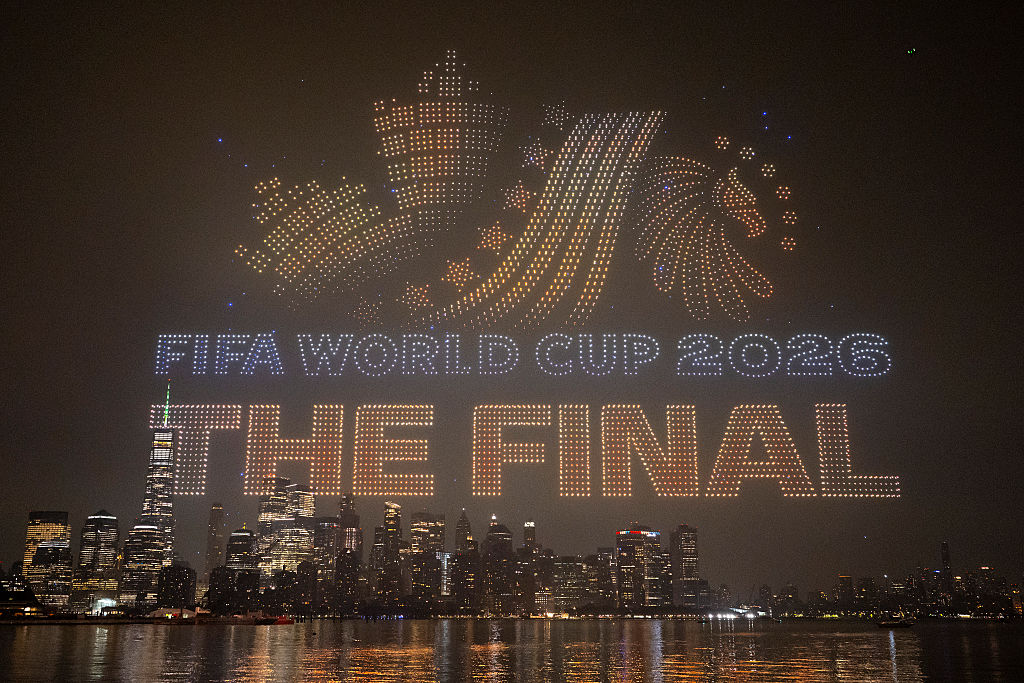
A drone show celebrating the 2026 World Cup Final against the Manhattan skyline on July 15, 2026 in Jersey City, New Jersey. —David Ramos—Getty Images
Americans are far from optimistic about our future. According to a recent Pew Research poll, 69% of us are dissatisfied with the way things are going, and 59% believe the United States’ best days are behind it. When asked to predict what America will be like 25 years from now, a majority said it will be more dangerous, more divided, worse off economically, and less influential in world affairs.
In other words, the World Cup could not have come at a more crucial time.
One sporting event will not reverse a years-long trend toward pessimism, or make the very real challenges facing our country disappear. But this Cup has nevertheless served as a reminder that America can still deliver on the same revolutionary promise that was made 250 years ago.
While the tournament was not without its fair share of controversy, everyday Americans showed the world that we can still achieve great things on our own terms.
This year’s World Cup wasn’t just a soccer tournament. It was among the biggest global events in human history. Millions of in-person attendees traveled to stadiums across North America to cheer on 1,248 players from 48 countries. More than 100 broadcasters reached a combined viewership of well over 2 billion on television and billions more on social media. More than 400 government agencies were involved in security alone.
The 2026 Cup was not an exclusively American undertaking. There were three host nations, and five of the 16 host cities were located in either Canada or Mexico. Even so, it was clear from the beginning that the tournament's success depended on the United States. Seventy-five percent of the matches, including the final at MetLife Stadium in New Jersey, were played on American soil. Because of the new expanded format, which increased the total number of teams from 32 to 48, America hosted more individual games than any host nation in World Cup history.
Given the deep divisions in our country, the dysfunction that too often characterizes our politics, and the many genuinely serious challenges we face, it would have been easy to assume that America would not be up to this unprecedented task. The red-card controversy that colored the USMNT’s final game provided America’s skeptics with plenty of additional fodder. But in the end, while no nation or sporting event is perfect, those who doubted the U.S. could organize a historic World Cup learned the same lesson those who underestimate America have learned repeatedly over the past 250 years.
We weren’t just able to pull off a massive national enterprise. We did it in a way that reflects our unique national structure and character.
That begins with our federalist system. Every host nation must coordinate a variety of matches, transportation plans, and events. But few host nations have the kind of decentralized structure created by America’s Founders: a combination of sovereign states and a strong federal government, plus overlapping federal, state, local, and jurisdictions. At times, this system can make meeting major logistical challenges more difficult. It takes more effort, more compromise, and more involvement from civic institutions and the business community.
But the past five and a half weeks demonstrated that our different levels of government are, even now, capable of joining together to get things done. In New York and New Jersey, where I served as chair of the host committee, we worked across state and city lines to lodge players and teams, get spectators to games, coordinate fan festivals, and more. No less importantly, despite political differences, we were able to count on partners throughout the Federal Government, who supported states and cities with funding, coordination, and infrastructure development.
This didn’t just happen in New York and New Jersey. It happened across the country, in a way that reflected America’s place as one of the world’s largest and most populous democracies. The World Cup was a major national event—yet it was also made up of dozens of individual events that took place from coast to coast, each in a community with its own budget, laws, priorities, and culture.
It’s safe to say that when our Founders drafted the Declaration of Independence and Constitution, they were thinking about issues more significant than soccer. Even so, the Cup was an example of the kind of country they imagined: a sprawling nation that allows for, and even embraces, regional differences.
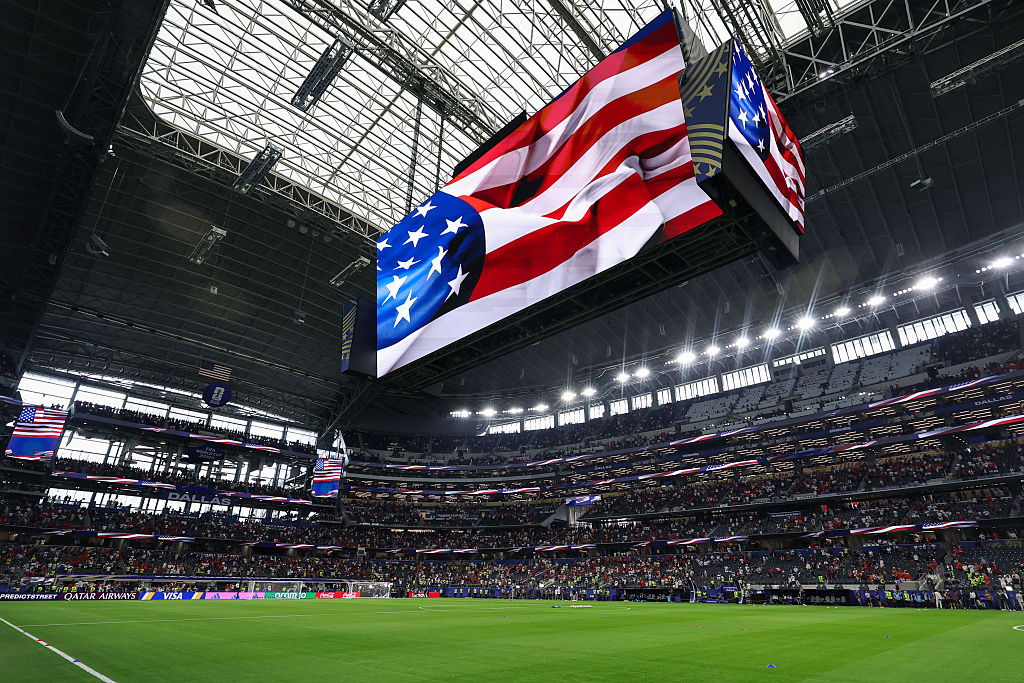
The FIFA World Cup 2026 Semi-Final match between France and Spain on July 14, 2026, in Arlington, Texas. —David Buono—Icon Sportswire/Getty Images
Today, some argue these differences have grown so great that we can no longer remain a single nation. But the World Cup helped prove those doubters wrong. It demonstrated that out of our separate and distinct state and regional identities, a single national identity can emerge. The World Cup in Miami was different from the World Cup in Boston, or Kansas City, or Atlanta, or Seattle. Yet combined, this Cup showcased something particularly American.
Which brings us to the final way in which this year’s World Cup set itself apart: the character of the American people. The United States’ international reputation is in severe decline. It is likely an understatement to say that the impression people around the world have formed in recent years is less than positive. Yet the America that millions of foreign fans saw with their own eyes was a far more nuanced place—and a far better one—than the one they see on their local news. Social media was full of visitors stunned by things we take for granted: the scale of our cities, the architecture and history of our buildings, the variety on our store shelves, and yes, our ranch dressing.
Most of all, foreign fans discovered that Americans are kind, generous, gregarious, and welcoming. Whether it’s Norwegians rowing in Times Square, the Tartan Army drinking Boston dry, or Lawrence, Kansas becoming the unofficial home away from home for fans of the Algerian national team, people around the world fell in love with America. And America returned the favor.
Perhaps, if we’re lucky, this will be the most lasting legacy of the 2026 World Cup. If millions of people from around the globe could imagine America at its best, then so can we. That doesn’t mean the challenges we face aren’t real or daunting. But maybe, as we enter our 250th year, we can see our country the way so many fans returning home now see us: as a fundamentally good place, full of fundamentally good people, still capable of doing extraordinary things.
We were all so happy when the World Cup was fun. And now… | Paige Vickers/Vox; Getty Images
Just a few weeks ago, Americans were able to eat salad without the fear of liquid feces and breathe in air that didn’t taste like campfire ash.
And — we were just really excited to watch some soccer.
One major concern at the outset was whether America’s foreign and strict immigration policies would impact the levity of the games, and, at worst, deny entry to people, and perhaps even athletes and officials, from countries at odds with the current administration (it did).
But in the early days of the World Cup, Americans and fans across the globe were surprised by how much of the world embraced coming here — and vice versa. Visiting international fans shared their astonishment at the sublime oddities this massive country has to offer, posting about: ranch dressing (in bowls if you ask nicely), unlimited refills in towering glasses, dairy products, air conditioning, Tex-Mex, ammunition displays, chicken tenders, cowboy hats, and, among other things, the Cheesecake Factory. Oh, how we all rejoiced in seeing the rest of the world experience the Byzantine beauty of our chain restaurants for the first time, and how craggy we enjoy our fried chicken strips!
Adding to the cultural exchange on the sidelines, fans were also pleasantly surprised by how well the United States — historically a country that’s been bad at soccer — showed up.
We were high off the US team’s 2-0 win over Bosnia-Herzegovina. We looked like a team with guts! Malik Tillman scored a goal down a man after star striker Folarin Balogun was sent off with a (questionable — experts said) red card. Many players on the US team have immigrant parents, are army brats, or are American by birthright citizenship (a constitutional privilege that the Trump administration has sought to dissolve). Though Belgium, in the next round, was going to be a difficult matchup, you couldn’t count out toughness.
Even though many Americans root for the underdog, and many see themselves as underdogs, it’s rare that America is ever actually the underdog.
But in the context of the World Cup, one of the rare things that American men will never win because soccer is one of those rare sports that no American man has ever been the best at, the stars aligned for Americans to have the scrappy longshot team of our dreams.
But it didn’t take long for the illusion to shatter.
As the Fourth of July weekend finished, FIFA announced that it had reversed Balogun’s red card and that he would, in an exception to the rules, be allowed to play against the Belgians. The move was unprecedented and fishy.
That red-card reversal also ripped open a portal into a nightmare realm.
Acting like a person who can’t keep a surprise party a surprise, President Donald Trump began insinuating that he might have had something to do with the decision. Then, on the morning of the match against Belgium, Trump said that he had placed a call to FIFA president Gianni Infantino about the red card and implicitly took credit for its reversal. Infantino not only confirmed the call but said that he takes calls from important and rich people all the time — a cartoonishly suspicious response from an organization that’s historically famous for corruption.
Trump on Balogun: "I saw the play, and I'm a person that loves sports … that wasn't a foul. That wasn't even an infraction … this referee, who is a little bit suspect if you check his past. He made a call that nobody could believe … he's our best player, or one of our best… pic.twitter.com/YfIqb1JA4u
Some fans, upon learning that the laws had been bent for the host country, reacted with astonishment, if not fury. Ethically, FIFA’s bar is on the floor, and this blatant move to help the United States somehow seemed to confirm onlookers’ worst fears.
In that moment, it was clear the US was no longer an underdog. Underdogs aren’t supposed to be able to put their thumb on the scale. They surely aren’t supposed to have their papa call favors. Perhaps all that talk of guts and toughness and how the team was a band of overlooked outsiders was just a mirage — and all that ranch dressing merely a charm offensive.
Whether you’re a soccer fan or someone who is ambivalent about soccer but loved the vibes, the shift was palpable. We’re all experiencing a collective whiplash and perhaps a sports-affected melancholy.
And now that the Cup is ending, Americans are now living in a country where vegetables, famously healthy, and good for you, carry the risk of “explosive” diarrhea. Diarrhea itself is something many would not consider a calm experience, so the idea that this is not just diarrhea but somehow a special, even worse diarrhea, one akin to detonation, feels especially terrifying.
This week also saw swaths of the US living under a plume of wildfire smoke — the dirtiest air in the world. Breathing outside is, according to scientists, the equivalent of smoking 10 cigarettes. Breathing in smoke-laced air and worrying about the looming spectre of diarrhea with every meal puts the shared cultural joy we had in perspective. But even without these extreme plagues, it’s worth mourning how fleeting those moments can be.
Amid anxiety over how the United States would welcome the world, cities like Lawrence, Kan., and Boston threw open their doors. The bonds forged are still visible on the streets.
Longtime leaders and advocates in minority districts fear that victories by the Democratic Socialists of America in gentrifying neighborhoods could mean political erasure.
Political campaigns have something new to worry about these days: unflattering or incomplete information produced by A.I. programs when voters ask questions about candidates.