RSS Feeds
Два сотрудника аэропорта Франкфурта умерли от малярии. Их заразили комары из самолета, прилетевшего в Германию
«Будет еще круче!» Благотворительный фонд рекламирует «Единую Россию» — хотя закон запрещает ему агитировать
WATCH: Kinley Rasmus ends record-setting run at the Little League World Series
WATCH: Yayoi Kusama, 'Friends' reunion, Busy Phillips: Here's what's trending
WATCH: Author discusses how to escape living paycheck-to-paycheck
WATCH: Inside the largest private collection of Dolly Parton memorabilia
Fans Push to Rename Nashville Airport for Dolly Parton
In ‘9 to 5,’ Dolly Parton Put a Friendly Face on Feminism
UK salmonella cases nearing 500 as egg investigations continue
Clean-up of illegal waste supersite costs taxpayers £6m
Fired Stars and Stripes journalists sue Hegseth and Pentagon spokesperson
LaGuardia air traffic controllers left work early before deadly collision, source says
Rockstar Games pulls back the curtain on ‘Grand Theft Auto VI’ after leak
Danny Welbeck leads Chelsea past Luton but Enzo Fernández misses Carabao Cup tie
Emiliano Martínez is on his way but another high-profile Argentinian is likely to be wearing a different shade of blue soon. Chelsea have dealt with their biggest weakness, satisfying Xabi Alonso’s wish for a new goalkeeper by agreeing a £7.5m deal to sign Martínez from Aston Villa, and it will surely not be long before they have put an end to the Enzo Fernández saga.
Fernández was the most notable absentee as Chelsea eased into the third round of the Carabao Cup with a 2-0 win over Luton. There is a desire to move on from the circus. Manchester City are poised to bid for Fernández and, with the noise around the midfielder becoming a distraction, Alonso and the club decided to leave out Chelsea’s supposed vice-captain.
Continue reading...Drone video shows aftermath of deadly floods in Nepal
Hanson tells star One Nation candidate to stop speaking Japanese – as it happened
This blog is now closed
Get our breaking news email, free app or daily news podcast
Greens say Australia needs to ‘step up and really commit’ to aiding rebuilding in Nepal
David Shoebridge, the Greens’ spokesperson on foreign affairs, told RN Breakfast earlier the Australian commitment of $5m for affected communities in Nepal “won’t come close to touching the sides” of the calamity.
I think Australia needs to step up and really commit to helping rebuild. This is a country with minimal spare resources. Life is tough in Nepal at most times, but I don’t think $5 million comes close to meeting the scale. …
We also have an obligation to do what we can to meet our targets for carbon and to keep coal and gas in the ground. These things are connected, as much as we don’t want them to be. These things are connected, and unless we address that, these kinds of disasters will continue to happen at a more rapid scale.
Continue reading...Opinion | The Path to Zero: The Tragic Withdrawal From Afghanistan
Trump signs order to rename Lake Ontario as Lake America
Робот написал одному человеку пять раз. Виноват оказался знак доллара
Робот отвечал одному человеку пять раз подряд, потому что дедупликация писала в базу запрос, который никогда не выполнялся.
Читать далееPeter Cullen, known for voicing Optimus Prime, dies at 85
'Mortified' McInnes takes responsibility for Rangers' European exit
Optimus Prime voice actor dies
Families say social media put their kids in danger | 60 Minutes Archive
Кривенко сидел за столом, но я всё равно не понимал, кто здесь главный. Клиентократия, пациентократия и Фабрика Смыслов
Как работа в «Клинике Фомина» и знакомство с командой «ВкусВилла» подтолкнули меня к маркетингу причин, политтехнологиям и, в конце концов, к «Фабрике смыслов»
В 2018 году я работал менеджером отдела маркетинга «Клиники Фомина». Это был момент появления первой клиники в Москве, время для меня было довольно нервное, быстрое и совершенно не приспособленное для того, чтобы сидеть в углу с блокнотом и записывать наблюдения для будущей книги. Мы много работали, решали задачи развития и роста, постоянно что-то перестраивали, запускали, проверяли и снова перестраивали. Я был частью команды и занимался своей работой, а не ходил по компании с видом будущего автора методологии, который уже всё понял и теперь ждёт, когда остальные подтянутся.
Наоборот, большую часть происходившего я тогда ещё не умел нормально объяснить. Я видел вокруг очень сильных, заряженных идеями людей, которые строили не просто ещё одну частную клинику с хорошим ремонтом, вежливыми администраторами и рекламой про заботу. Таких клиник можно открыть сколько угодно: заказать фирменный стиль, поставить кофемашину, научить администратора говорить «будьте здоровы» после того, как пациент чихнул в телефонную трубку, и торжественно объявить, что теперь у вас медицина будущего. В «Клинике Фомина» всё было устроено сложнее. Доказательная медицина воспринималась не как удачное позиционирование, а как основание для решений: кого брать в команду, как обучать врачей, что считать качеством, как проверять назначения и каким образом переносить этот стандарт в новые города.
Читать далееTate brothers appear in court, asking to be released from jail during extradition fight
Expert shares 3 morning habits to keep your gut microbiome happy
Jury deliberating in trial of Lindsay Clancy, US woman accused of killing her children
Sports Direct founder Mike Ashley attacks Burnham's 'populist' High Street plans
Rivian’s CFO is leaving the company
2 dead in Pennsylvania as measles cases rise in the U.S.
Jury deliberating in trial of Lindsay Clancy, US woman accused of killing her children
Bluesky adds an ‘algorithmic opt-out’ feature for those who don’t want to go viral
Callaway cuts ties with Good Good Golf over ad depicting violence against woman
Golf giant ends partnership with YouTube group
Retailers have pulled Good Good products from shelves
Garrett Clark says controversial skit was in ‘poor taste’
Callaway has ended its relationship with Good Good Golf amid mounting fallout from an advert that many believe made light of violence against women.
The golf equipment manufacturer announced the decision on Thursday, cutting ties with one of the world’s most popular YouTube sports channels effective immediately. Callaway also said it would donate $1m to organizations working to prevent violence against women and support survivors of domestic violence.
Continue reading...We surveyed 6,000 Americans. Here is the winning message for Democrats | Dustin Guastella
It’s about ‘kitchen-table populism’: focusing on Americans’ day-to-day economic struggles
This year’s Democratic primaries look and sound a lot more populist than usual. Brian Poindexter, a union iron worker running on a “workers first” message, won a House primary outside Cleveland. Sherrod Brown is mounting a Senate comeback in Ohio on the same “rigged system” message that has allowed him to outshine other Democrats in Ohio. Troy Jackson, a fifth-generation logger who built his career fighting corporate landowners, is the Democratic Senate nominee in Maine. And Josh Turek, a self-described “prairie populist”, is on the Senate ballot in Iowa.
In fact, according to research we’ve conducted through the Center for Working-Class Politics (CWCP), more than 70% of 2026 Democratic candidates now rely on populist rhetoric in their campaigns, laying the blame for our broken system on rich elites of one kind or another.
Continue reading...How to recognize your team with GitLab Achievements
Every team runs on people who go above and beyond. The engineer who fixes the flaky test nobody else will touch. The reviewer who turns your merge request around in an hour. The teammate who finishes their certification. Or the community member who shows up release after release. Whether your team is a company, an open source project, or a community, GitLab had no built-in way to say "we see you." GitLab Achievements changes that.
What are GitLab Achievements?
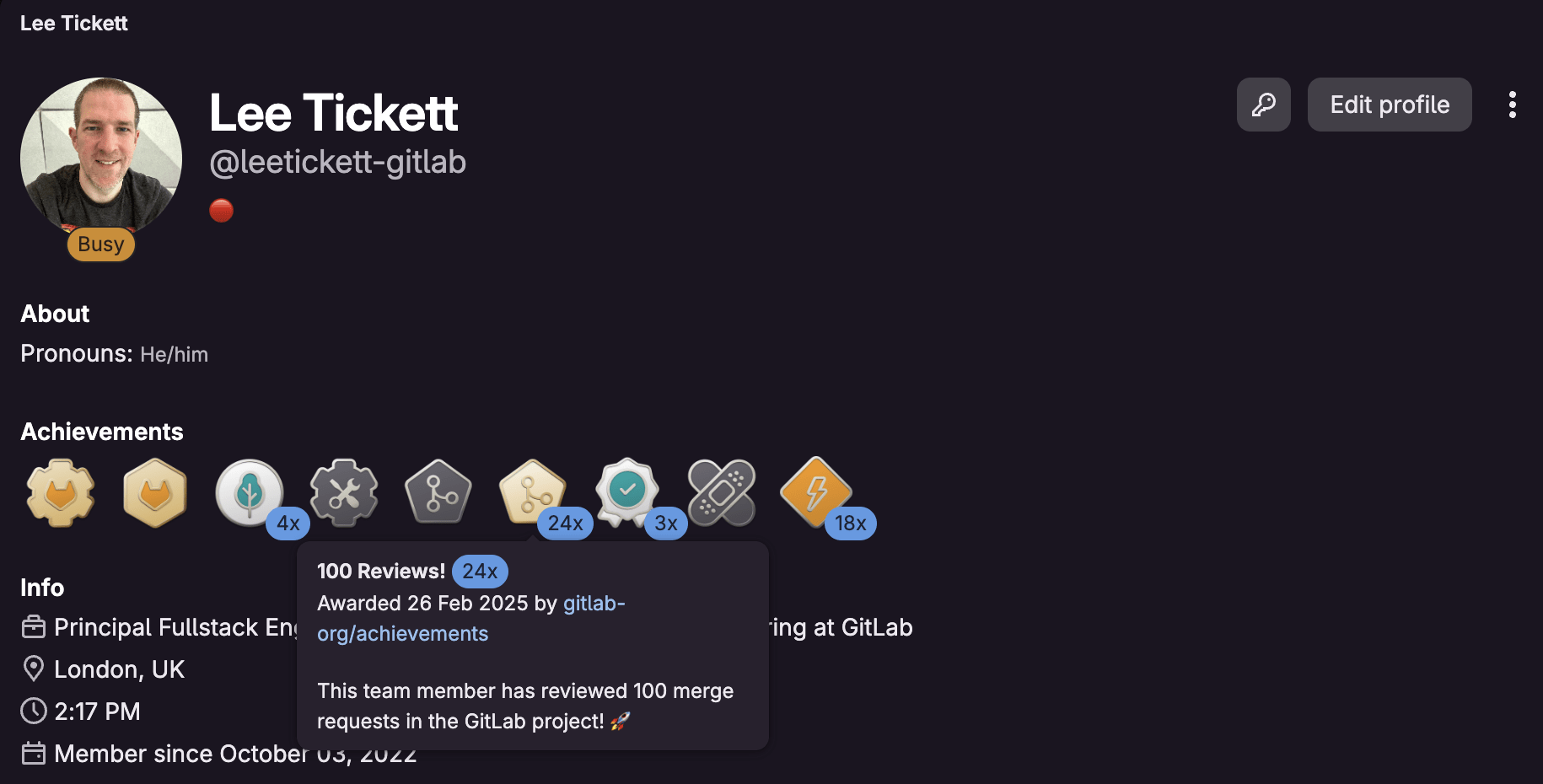
An achievement is a custom badge you create once and award to people for their behavior. That might be a contribution, a milestone, or simply getting the most out of GitLab. Each one has a name, a description, and an avatar. Think "First merged MR", "Certified", or "Contributor of the month". Awarded achievements appear on the recipient's profile, alongside their contribution history.
There are two halves to the achievement. The achievement itself is a reusable template you define at the group level. Awarding that achievement to someone is a separate action, and it can carry an optional personal message. That message supports GitLab Flavored Markdown, so you can link straight to the merge request, issue, or event that earned it. The same "Contributor of the month" badge can then tell a different story every time you award it.
Recipients stay in control. An award doesn't appear on anyone's profile until they accept it using a link from an email notification. Recognition is offered, never forced onto someone's profile.
Achievements are generally available as of GitLab 19.2, across Free, Premium, and Ultimate, on GitLab.com, GitLab Self-Managed, and GitLab Dedicated.
Why recognition matters
Recognition is one of the least expensive, most effective tools you have for retention, motivation, and belonging. A visible badge on a profile costs you a minute to award and gives the recipient something lasting. And "team" is broad: It might be your company, your open source project, or your wider community. The value depends entirely on who you are and what you're trying to reinforce.
Internal engineering and platform teams
This is where most teams will start. Reward the people who keep the wheels turning: your fastest reviewers, engineers who complete onboarding or earn a certification, members of a guild or chapter, or the ones who show up during an incident. A badge makes the effort that usually goes unnoticed visible to the whole organization.
Open source maintainers and community programs
This is our own story, and the reason we built the feature. Open source contributors are rarely paid so recognition is often the only reward on offer. It needs to be genuine and visible. Achievements give you a way to celebrate external contributors at scale: Award a "First contribution" badge automatically, or a "Notable contributor" badge each release. Contributors get something concrete to point to, and you get a consistent way to celebrate people behind it.
Ways to use achievements
Here are five ways to use GitLab Achievements.
Identify your team and core contributors
The use case that started it all: Badge your team and core contributors so your community knows who's who. When someone new lands in your project, a glance at profiles tells them who maintains it, who reviews it, and who will field questions. Add a "Hackathon winner" badge and you've turned a one-off event into lasting recognition. Recognition becomes something people can see, not something buried in a changelog.
Reward great reviews and fast turnarounds
We've since expanded our own use internally to recognise great reviews and fast turnarounds. This is the quiet lesson of achievements: You reinforce the behavior you reward. Badge thoughtful reviews, quick responses, or mentoring, and you signal to the whole team what good looks like. It costs nothing and it compounds.
Reward adoption and learning
Recognition isn't only for the people who build GitLab, it works just as well for the people getting the most out of it. Award a badge when someone earns a certification, finishes an enablement path, or adopts a capability your team has been trying to roll out. For customer success and platform teams, this turns dry adoption metrics into something people are proud of. Learning to use a tool well is a contribution, too.
Celebrate milestones and first contributions
Achievements come in three flavors:
- Awarded once and kept forever ("First merged MR")
- Awarded once but revocable ("Core team member")
- Awarded repeatedly ("Contributor of the month")
Use them to mark the moments that matter, a first contribution, a 100th contribution, a hard problem finally solved.
This is where the personal message earns its keep. For a recurring award, attach a message linking to the exact merge request or issue that earned it, with a line on why. The badge stops being a generic sticker and becomes a record of a specific achievement.
Run programs, hackathons, and campaigns
Because achievements can be awarded multiple times and revoked, they suit time-boxed events. Run a hackathon and award a badge to every participant. Run a quarterly contribution drive and award a limited-edition achievement that only that cohort will ever hold. It's a lightweight way to give a campaign a lasting footprint.
How to create and award an achievement
The Achievements documentation covers creating, awarding, accepting, and revoking in full.
Everything is scriptable through the GraphQL API, so you can award in bulk or wire achievements into your own automation. Awarding a "First contribution" badge the moment someone's first merge request merges, for example.
Built by the community, for the community
Achievements didn't come from the core product team. The feature started as a gap that our team, Co-create and Community Engineering, and the wider community set out to fill, captured in Epic #9429. It's the "everyone can contribute" value in action: a feature that lets you recognize contributors was itself co-created by contributors.
Community contributor and Core Team member Niklas van Schrick was key to making it happen. There's a neat symmetry to that. A feature for recognizing contributors, delivered by a contributor, and now we get to recognize him for it. If you've ever wanted to shape GitLab itself, this is proof that you can! Start contributing here.
How AI helped us ship it
Getting Achievements to general availability fell to Mattias Michaux, who had just joined the company, and our team. The feature was part-built and had sat idle for a while, so his first job wasn't writing code, it was working out where the previous effort had got to, what was left to do, and how this corner of an enormous, unfamiliar codebase actually fitted together.
That's usually the slowest part of picking up someone else's half-finished work. This is where GitLab Duo and Orbit came in. Mapping the existing code, understanding what remained, and getting productive quickly. Doing all of that in the time we had simply wouldn't have been feasible without them.
The takeaway isn't about us. It's that these tools collapse the ramp-up cost of a large, unfamiliar codebase whether you're a new hire on your first week or a first-time contributor sending your first merge request. The barrier to contributing has never been lower.
Get started
Recognition works best when it's a habit, not an afterthought. So create your first achievement and award it to someone this week: a reviewer, a mentor, a first-time contributor.
Want to help build the next feature like this one? Start contributing to GitLab. And if you have a use case we haven't thought of, let us know in the Achievements epic.
What is the treatment for postpartum psychosis, the condition central to the Lindsay Clancy trial?
Clancy’s defense team argues she killed her three children under the condition, and should not be convicted of murder
Postpartum psychosis, a rare and severe mental illness, is central to the trial of Lindsay Clancy, who has pleaded not guilty to three counts of first-degree murder. Her defense team argues that she killed her three children while experiencing the condition, which can cause hallucinations, delusions and rapid mood changes.
While the outcome of the trial may hinge on a determination of Clancy’s mental state, women who have experienced postpartum psychosis say the attention surrounding the case could help raise awareness about the need for better support, including more research and improved medical training.
Continue reading...ICE agent charged with Minnesota shooting released from jail in Texas
Judge rules Christian Castro, accused of shooting man and lying about it, cannot be held pending extradition request
An Immigration and Customs Enforcement (ICE) officer charged with shooting a man and lying about it during the immigration crackdown in Minneapolis was released from a Texas jail on Thursday, after a judge refused to order his return to Minnesota.
Christian Castro was released at the break of dawn from a detention center in Brownsville. He motioned his hand toward a few camera operators and a reporter crowding around him and quickly got into an SUV that drove off.
Continue reading...Jury deliberations begin in Lindsay Clancy murder trial after her attorney blames medical system
The state concludes: ‘This wasn’t a woman suffering from a lack of care’ or ‘a lack of resources’
The jury in the Lindsay Clancy murder trial has moved into deliberations as jurors decide whether the 36-year-old former labor and delivery nurse is criminally responsible for fatally strangling her three children in January 2023.
Over the past five weeks, the trial, which has been called “America’s saddest murder trial” , has renewed nationwide attention on postpartum mental healthcare. Clancy’s defense maintains that she was suffering from postpartum psychosis – a condition estimated to affect around two women per 1,000 births – and therefore should not be held criminally responsible for her actions.
Continue reading...Buried in Meta’s $18B settlement is a legal pass on kids’ data
Devastating before-and-after satellite photos show Nepal flood destruction
Satellite images provide new insight into the catastrophic flooding that took place in Nepal. The images show several locations before and after the flood.
OpenAI, Anthropic warn AI cyberattacks could surge in coming months
Florida grand jury finds DeSantis administration ‘misappropriated’ funds from Medicaid settlement
Grand jury declined to indict anyone but said there was a ‘sophisticated scheme’ to use funds for political activity
A Florida grand jury has found that the administration of the governor, Ron DeSantis, “misappropriated” $10m in taxpayer money from a Medicaid settlement into the Hope Florida Foundation, a charity with ties to DeSantis’s wife, before the money was reportedly “funneled” into “two political action committees”.
In the grand jury report, which remains sealed but was obtained and published by CBS News Miami on Wednesday, the grand jurors wrote that “we conclude that these funds were misappropriated as part of a sophisticated scheme to fund political activities” but said that they found “insufficient evidence to charge anyone criminally”.
Continue reading...The surprising reason food recalls are getting worse

Summer is supposed to be the best time for fresh produce. Corn on the cob at the cookout. Berries plucked right from the vine. Salads on the cafe patio while you take an extra long lunch break because the weather and the food is that good.
But this year, summer’s harvest brought something much different than the flavorful dishes we’ve come to expect. Since May, the United States has seen more than 17,000 lab-confirmed cyclosporiasis cases. Before this summer’s massive outbreak, the country had never recorded more than a few hundred infections in a single year from this parasite, which can cause watery and at times explosive diarrhea.
And that isn’t the only bug invading Americans’ digestive tracts.
One person died from a listeria infection traced to ricotta cheese. Close to 100 people came down with salmonella from recalled eggs, while more than 400 people have gotten sick in a separate salmonella outbreak involving jalapeños. Last week, the Food and Drug Administration issued its highest urgency warning for frozen blueberries believed to be contaminated with E coli.
And now several dozen people across 15 states have become ill after eating alfalfa sprouts in a new outbreak that involves salmonella and E coli. Four of them have been hospitalized.
It’s gotten so bad that one Washington Post columnist argued we should stop eating lettuce altogether. Experts have told me they were worried people might actually completely stop consuming vegetables — vital to any healthy diet — for fear of contracting cyclosporiasis and enduring a month of watery diarrhea. I personally avoided the bagged salad kits that provided me with many easy lunches on a workday.
While this spate of foodborne illness is especially bad, the worst may be yet to come.
It’s only natural to look for somebody to blame. Culpability has understandably fallen on the Trump administration and Robert F. Kennedy Jr., who helms the US Department of Health and Human Services — especially after his deep staffing cuts at the FDA and the Centers for Disease Control and Prevention, the two federal agencies most responsible for investigating and responding to disease outbreaks. Those cuts have slowed the response, and officials have struggled to communicate with the public clearly in a fast-moving crisis.
While our government officials are partly to blame, the problem is bigger than Trump and Kennedy, or even this one summer. While seasonal changes will always play a role — the warmer months, when people eat more fresh produce and consume more food that’s been sitting out at unsafe temperatures, typically have more foodborne illnesses — the underlying factors contributing to these outbreaks are becoming more potent. The food supply is more and more globalized. And the planet continues to warm, allowing these pathogens to spread to more and more farms all over the world, including in the US.
As the weather finally begins to cool down, I’ve been asking myself an uncomfortable question: What if diarrhea summer never really ends?
Climate change is spreading dangerous germs
Our globalized food supply chain has a lot to do with our food safety — and that isn’t going to change any time soon. Americans expect access to any produce they want year-round, even produce that isn’t in-season locally, or that may not grow anywhere in the US at all. We source food from all over the world: Most cyclospora outbreaks originated with foods grown in other countries. This year’s crisis was eventually linked to iceberg lettuce from Mexico.
And as the New York Times recently documented, the sometimes international trip from the farm to the store for a bagged salad kit offers multiple moments for potential contamination, including tainted irrigation water, local wildlife excrement, and poor storage practices, making it possible for dangerous pathogens to take hold before a person even buys their groceries.
Sign up for the Good Medicine newsletter
Our political wellness landscape has shifted: new leaders, shady science, contradictory advice, broken trust, and overwhelming systems. How is anyone supposed to make sense of it all? Vox’s senior correspondent Dylan Scott has been on the health beat for a long time, and every week, he’ll wade into sticky debates, answer fair questions, and contextualize what’s happening in American healthcare policy. Sign up here.
Warming temperatures around the world are also helping those bugs spread. Humidity is essential for salmonella and warmer summers will mean more humid-favorable conditions for the bacteria to grow. E coli likewise will thrive as temperatures rise. Cyclospora has historically been found in subtropical climates, so for a long time, infections from food grown inside the United States were unheard of. Not anymore.
“Climate change has allowed pathogens like cyclospora…to expand from the tropic, subtropic lines into areas more north and south of that tropic line,” said Joseph Eisenberg, a professor of epidemiology and global public health at the University of Michigan School of Public Health.
“With respect to the US, we’re starting to see new infectious diseases in southern Louisiana, Texas; that also increases the presence of cyclospora in food systems in other countries,” he said. “It suggests that, through climate change, we might potentially start seeing it be endemic in the United States at some point.”
And indeed, cyclospora was found in farms in Florida in 2020. This is a problem that is going to become worse, not better, given the expected trends in global warming in the decades to come.
“It wasn’t until about within the last 10 years we started to see cases from domestic origin,” Francisco Diez-Gonzalez, director of the Center for Food Safety at the University of Georgia, told me. “Before, there were predominantly cases due to international travel or importation of products because it used to be endemic in some tropical or warmer climates.”
“It’s clear that now,” he said, “it’s become established in the domestic environment.”
The US is less prepared than ever to stop food contamination
To make matters worse, at the same time conditions for foodborne illness are ripening, the US government has been sharply cutting its ability to monitor for and respond to these outbreaks.
At the beginning of the second Trump administration, as part of the widespread government staffing cuts, the FDA laid off 3,500 workers. Between the FDA and the US Department of Agriculture, which also oversees food safety, and several related agencies, more than 11,000 workers have been lost, a 22 percent cut, according to the Partnership for Public Service. And the CDC, which helps respond to outbreaks once they start, has lost about a quarter of its workforce from January 2025 to October 2025, according to Reuters; by this summer, CBS reported, the number of scientists tracking food parasites at the agency dropped from 11 to three. Meanwhile, the administration has been rushing to hire 2,200 people in the middle of the crisis.
“There have been a lot of federal cuts. There have been cuts around CDC surveillance, around state and local public health. You’ve lost people,” Dr. Anurag Malani, vice chief of staff at Trinity Health’s Ann Arbor, Michigan, campus, told me. “The ability to do what you need to do to keep citizens safe and to keep the public safe, we don’t have as many people doing that as we used to.
The federal government also shut down several national monitoring programs for foodborne illness in 2025 — including for the cyclospora parasite specifically. The state and local agencies that surveil for and respond to food outbreaks have also faced staff cuts because they depend on the federal government for their funding.
“It’s hard when there is one larger entity kind of controlling all of that,” Dr. Kathleen Linder, the hospital epidemiologist at the Veterans Affairs hospital in Ann Arbor, told me in July. “Local health departments are having to do more on their own than they would have had to do in the past just because of decentralization at that level. It has been very hard to get updated information. The information has been lagging a little bit behind.”
Food safety is hard enough to tackle on its own. Part of the reason we experience regular outbreaks of cyclospora is that it can successfully infect people even when only very little of it is present, and because we can’t grow it in a lab to study it.
But the US has made things harder by cutting these important programs. Rebuilding the staff and capacity to do this work is not likely to happen under the Trump administration, and former FDA officials have described a “brain drain” for the food safety programs that won’t be easy to reverse in the next administration.
But something will have to be done if we’re ever to escape the food recall cycle. Despite the name, food has historically been neglected by the “Food and Drug” Administration, and better food safety could require serious restructuring and investment in these capabilities. And foodborne illnesses aren’t the only kind of infection that climate change will make more likely: The United States is also seeing the spread of mosquito-borne diseases like dengue. Responding to those new threats is going to require a rebuilt and potentially reimagined federal public health apparatus.
If there is any good news in the short term, it’s that there are a lot of great recipes for grilling your vegetables to eliminate any pathogens hiding in our side dishes at next summer’s cookouts. It sure seems like we’re going to need them.
Data center controversies have transformed midterms. Here's where different groups stand
WATCH: More than 80 people charged in federal takedown of Puerto Rico gang
Here's how much interest a $100,000 9-month CD can earn savers who open an account now.
Trafficked on the last US slave ship, Cudjo Lewis never returned home to Benin. But his descendant has
Cassandra Lewis’s Benin citizenship reflects a broader push by African countries to reconnect with diaspora descendants
Cudjo Lewis, originally named Oluale Kossola, never forgot home – and he ensured that his descendants would remember a place that they might never see with their own eyes. Captured from the Bantè region of Benin, west Africa, Lewis was trafficked across the Atlantic Ocean and enslaved in rural Alabama in 1860, just one year before the onset of the US civil war and 52 years after the transatlantic slave trade was outlawed.
He was one of the last survivors of the Middle Passage when he died on 17 July 1935, and one of the 110 survivors of the Clotilda, considered to be the last slave ship to illegally traffic Africans to the United States. Conspirators burned and sunk the Clotilda – a hull from the ship was not recovered until 2019 – and refused to facilitate the survivors’ return to Africa, even after the civil war.
Continue reading...Trump signs executive order to rename Lake Ontario as Lake America
Mark Carney rejects attempt to rename lake as did several US governors, with Tony Evers mocking the move
Donald Trump signed an executive order on Thursday directing the federal government to rename Lake Ontario, making it Lake America, amid his escalating trade war with Canada.
The order directs federal agencies to adopt the name-change on US maps, documents and databases. But Trump has no authority to rename Canada’s portion of the lake, nor to compel Canada, international legal bodies, international mapmakers, or the rest of the world to adopt a new name.
Continue reading...