RSS Feeds
U.S. launches strikes on Iranian targets in Strait of Hormuz, officials say
1 dead, 2 injured in helicopter crash near Mount Everest base camp
Announcing rustup 1.29.3
The rustup team has published a new point release of rustup, 1.29.3.
Rustup is the recommended tool to install Rust, a programming language that empowers everyone to build reliable and efficient software.
What's new in rustup 1.29.3
This new patch release has fixed some minor regressions over the previous one:
-
Fixed "Illegal instruction" error on certain x86_64 CPUs without SSE4.1. pr#5162
-
Fixed "
lock()not supported" error on Solaris. pr#5167
Further details are available in the changelog!
How to update
If you have a previous version of rustup installed, getting the new one is as easy as stopping any programs which may be using rustup (e.g. closing your IDE) and running:
$ rustup self updateRustup will also automatically update itself at the end of a normal toolchain update:
$ rustup updateFor this particular release, if you have encountered any issues during self-update, you may try to update rustup manually by following the steps below:
- Download the corresponding
rustup-initbinary for your platform. - Make double sure that no other
rustupprocesses are running. - Replace your existing
rustupbinary with the downloadedrustup-initrenamed torustup.- As a reminder, this binary is often located at
$HOME/.cargo/bin/rustup, or$CARGO_HOME/bin/rustupif you have overridden the$CARGO_HOMEenvironment variable.
- As a reminder, this binary is often located at
If you don't have it already, you can get rustup from the appropriate page on our website.
Rustup's documentation is also available in the rustup book.
Caveats
Rustup releases can come with problems not caused by rustup itself but just due to having a new release.
In particular, anti-malware scanners might block rustup or stop it from creating or copying
files, especially when installing rust-docs which contains many small files.
Issues like this should be automatically resolved in a few weeks when the anti-malware scanners are updated to be aware of the new rustup release.
Thanks
Thanks again to all the contributors who made this rustup release possible!
Вы зря боитесь что вас заменит ИИ. И вот почему

Недавно я провёл почти четырнадцать часов за разработкой программы, которая должна экономить людям время. При этом у меня ещё книга, исследования, другие проекты и необходимость зарабатывать деньги.
ИИ действительно позволил мне делать то, о чём раньше я мог только мечтать. Но вместо свободного времени я получил проблему, к которой совершенно не был готов.
Кажется, технический прогресс немного вышел из-под контроля.
Питер Брейгель Старший. «Алхимик», около 1558 года. До появления ChatGPT оставалось примерно 464 года.
Читать далееSnowy Hydro 2.0 executives awarded bonuses totalling $751,925 despite cost blowout
Annual reports show NSW renewable company’s CEO opted out of cash bonus, while CSIRO’s chief received an extra $200,000
Get our breaking news email, free app or daily news podcast
Executives at the troubled Snowy Hydro company collectively banked bonuses worth a combined $751,925 in the last financial year, despite its renewable energy project blowing out to 12 times its original cost.
But Guardian Australia can reveal chief executive, Dennis Barnes, who has a base salary of $1,845,126, opted not to accept the extra cash.
Continue reading...Public service union refuses to back Labor at Victorian election, condemning job cuts and $1.2bn consultant spend
Exclusive: Community and Public Sector Union denounces ‘privatisation by stealth’, joining growing number of unions turning on Carroll government
Get our breaking news email, free app or daily news podcast
Victoria’s public servants union says it will not support Labor at this month’s state election, condemning the government for cutting public service jobs while spending $1.2bn on consultants.
The Community and Public Sector Union (CPSU) will announce the decision on Wednesday, joining several other unions that have refused to back Labor or are actively campaigning against the government ahead of the 28 November poll.
Continue reading...Indian navy rescues 20 crew from Iranian fishing boat hijacked off Somalia

he operation involved a warship, a maritime surveillance aircraft and marine commandos. The hijacking followed a resurgence of Somali piracy across the Gulf of Aden and western Indian Ocean.
(Image credit: Ben Curtis)

Rebecca Gayheart Opens Up About Eric Dane’s Life and Legacy
Spanish police investigating after soccer player dies following on-field collision
U.S. carries out strikes on Iran’s Qeshm Island
UK and EU agree draft deal to scrap Brexit red tape over food exports
Celebrity loses injunction bid but will stay anonymous pending appeal
India’s strongman faces stern challenges
Google Will Turn Off Search for Schools That Reject A.I.
Watch: Why is 'mogging' the word of the year?
1С через OData: от первого запроса до корпоративной интеграции – гайд для архитекторов и разработчиков
В крупной компании учетная система обменивается данными с CRM-, ERP-, ECM- и BPM-системами, интернет-магазином, мобильными приложениями, BI и внешними сервисами. Быстро связать ее с этим ландшафтом без доработки конфигурации можно через OData.
В этой статье разберем подключение 1С через OData: публикацию, первые обращения, параметры выборки, запись, нагрузку, синхронизацию, ошибки и защиту. Текст пригодится архитекторам, аналитикам и разработчикам интеграций.
Отдельно покажем, когда прямых вызовов уже не хватает. В этот момент появляется корпоративная интеграционная платформа: она принимает протокол как один из каналов и централизованно управляет маршрутизацией, преобразованием сообщений, мониторингом и контролем обмена.
Читать далееGirl who rescued injured boy from bonfire acted 'on instinct'
Scientists detect signals from the zeptoverse - the smallest scale of nature ever explored
Third teen arrested after Halloween party stabbings
Third teen arrested after Halloween party stabbings
Trump's unusual last-minute message to voters before the midterms
The Joy of Six: Glenn Maxwell’s greatest innings for Australia
From the miracle of Mumbai, gamechanging centuries and a rare Test ton, here are half a dozen of the Big Show’s most destructive knocks
Glenn Maxwell has bowed out from international cricket, leaving behind a trail of destruction razed by his most blistering innings and unconventional shots. Yet for all the outrageous highlights and gamechanging knocks, the 38-year-old’s legacy is tainted by an unshakeable feeling that he remained an unfulfilled talent.
The Big Show was denied a farewell appearance for Australia when overlooked for their T20 squad to face England this month before bringing the curtain down on his international career. But the three-time World Cup winner already has a long list of show-stopping performances to point to including arguably the greatest ODI knock of all time.
Continue reading...Falling revenues, bigger losses, higher wages: Prem Rugby clubs’ debt climbs to £366m
Six clubs found to be balance-sheet insolvent
Spending restraint urged despite investment
Prem Rugby clubs’ collective losses and debt levels are continuing to increase despite growing interest from global companies and financiers shown by the recent investment of Red Bull, Sir James Dyson, and the Black Knight group which owns AFC Bournemouth.
The third edition of the Leonard Curtis Rugby Finance Report published on Tuesday shows that the financial losses of the 10 Prem clubs rose from £34m to £36.5m over the 2024-25 season and combined debt levels increased from £342.5m to £366.1m, while the top flight’s total wage bills grew from £125.9m to £129.8m, 80% of revenues.
Continue reading...‘The output of a lunatic asylum’: what the Bloomsbury group can tell us about mental health
From Virginia Woolf’s horrifying views on eugenics to James Strachey’s seminal translations of Freud, the Bloomsbury set didn’t only experience mental illness, they shaped how society thinks about it
‘As an experience,” Virginia Woolf wrote in 1930, “madness is terrific and not to be sniffed at … In its lava, I still find most of the things I write about.”
Woolf’s 1941 suicide by drowning in the River Ouse, her pockets weighted with stones, is usually framed as evidence of her tortured genius. But a new exhibition at Charleston in Lewes radically excavates this narrative while challenging ideas about mental illness.
Continue reading...I spent 11 years without my childhood friend. Finding our way back together was staggeringly simple
I thought about her a lot after our friendship imploded. When our birthdays rolled around, I wondered what we’d be doing if we were still in touch
I was 26 when I lost my childhood friend. By that point, I’d known her for almost two-thirds of my life.
Our first conversation was at an ice-skating party when we were nine years old. I’d been nervous in the weeks leading up to the party because I couldn’t ice-skate. Every time the Spice Girls’ 2 Become 1 music video came on, the sight of Victoria Beckham singing on an ice rink filled me with impending doom. I was sure I would disgrace myself at the party.
Continue reading...Lupin is back! Omar Sy is ridiculously watchable and effortlessly charming as a blindingly brilliant thief
The thrilling and twisty Netflix show is in its fourth season. If you’re not caught up with this French caper you’re missing out
If you’re not watching Lupin, you’re missing out on one of the most charming, thrilling and twisty capers of all time. Netflix’s adaptation of the popular French drama first hit our screens back in 2021 and it is the most wildly ambitious – and successful – to date. The brilliant writing, terrific ensemble cast and the effortless charm and panache of its lead actor, Omar Sy, make it ridiculously watchable.
The series is based on the adventures of Arsène Lupin, conceived by the French author Maurice LeBlanc. In France, Lupin is an almost totemic cultural figure. LeBlanc penned 24 books about the definitive gentleman thief in his lifetime, the first being 1907’s Arsène Lupin, Gentleman Cambrioleur. And the 119-year-old character is everything readers crave: suave, mysterious and cunning, with an unerring ability to run circles around law enforcement.
Continue reading...Apple iPad Mini (2026) Review: A Dream Device, but Who Is It For?
Roli Has Fallen Apart—and Left Customers Holding the Bag
8 Senate Races the Forecasters Can’t Agree On
Amid projections of a Democratic blue wave, as voters head to the polls, several pivotal races are too close for all the experts to comfortably predict.
A TIME analysis of race ratings by 10 reputable election forecasters found that of the 35 U.S. Senate seats up for election on Nov. 3, eight are not rated unanimously in favor of one party. Those eight races are in Alaska, Iowa, Kansas, Maine, Michigan, Ohio, South Carolina, and Texas. And Democrats would have to win at least four of them, assuming other results go as expected, to take control of the upper chamber of Congress.
The analysis examined ratings from Cook Political Report (CPR), Decision Desk HQ (DDHQ), FiftyPlusOne (FPO), Fox News Power Rankings (FNPR), Inside Elections (IE), Race to the WH (RWH), Sabato’s Crystal Ball (SCB), Silver Bulletin’s FLIPR Deluxe model (SB), Split Ticket (ST), and The Economist (TE).
Read More: 12 House Races That Forecasters See Going Different Ways
In Alaska, four forecasters—DDHQ, FPO, SCB, and ST—rate the race between Democratic former Rep. Mary Peltola and Republican incumbent Sen. Dan Sullivan as leaning Democratic, while the remaining six call it a toss-up. (TE uses the term “uncertain,” which this analysis treats as the equivalent of a toss-up rating.)
In Iowa, different forecasters can see the race between Republican Rep. Ashley Hinson and Democrat Josh Turek going different directions. RWH rates it as Tilt Democratic, while SCB says it leans Republican, and TE rates it Likely Republican. The other seven forecasters call the race a toss-up.
In Kansas, where Democrat Adam Hamilton is challenging Republican incumbent Sen. Roger Marshall, four forecasters—FPO, SCB, SB, and ST, say the race leans Democratic. The other six forecasters call it a toss-up.
In Maine, seven forecasters favor Democrat Troy Jackson over Republican incumbent Sen. Susan Collins, rating the race either Lean or Likely Democratic. CPR, IE, and FNPR call it a toss-up.
Read More: 10 Candidates Who Could Make History in the Midterms
In Michigan, only FNPR rates the race between Democrat Abdul El-Sayed and Republican Mike Rogers as a toss-up. IE says it tilts Democratic; CPR and SCB say it leans Democratic; and the rest all rate it Likely Democratic.
In Ohio, where Democratic former Sen. Sherrod Brown is challenging Republican incumbent Sen. Jon Husted, seven forecasters favor Brown—rating the race either Tilt or Lean Democratic— while CPR, DDHQ, and TE call it a toss-up.
In South Carolina, FNPR and RWH say the race between Republican Sen. Darline Graham and Democrat Annie Andrews is a toss-up, while eight forecasters favor Graham keeping the seat she filled after her brother’s passing. IE says it tilts Republican, TE rates the race Likely Republican, and the other six all say it leans Republican.
In Texas, seven forecasters favor Democrat James Talarico over Republican Ken Paxton. IE rates the race as Tilt Democratic; DDHQ, FPO, RWH, and SCB say it leans Democratic; and SB and ST rate the race Likely Democratic. CPR, FNPR, and TE call it a toss-up.
Read More: The 7 Key Governor Races to Watch in the Midterm Elections
Of the remaining 27 Senate races, 13 are unanimously rated in favor of Democrats. Nine of those are rated safely or solidly Democratic by all 10 forecasters: John Hickenlooper in Colorado, Chris Coons in Delaware, Juliana Stratton in Illinois, Ed Markey in Massachusetts, Cory Booker in New Jersey, Ben Ray Luján in New Mexico, Jeff Merkley in Oregon, Jack Reed in Rhode Island, and Mark Warner in Virginia. Another four Democrats—Jon Ossoff in Georgia, Peggy Flanagan in Minnesota, Chris Pappas in New Hampshire, and Roy Cooper in North Carolina—are unanimously favored, although not every forecaster rates their races as safe or solid.
The other 14 races are unanimously rated in favor of Republicans. Seven are rated safely or solidly Republican by all 10 forecasters: Barry Moore in Alabama, Tom Cotton in Arkansas, Jim Risch in Idaho, Kevin Hern in Oklahoma, Bill Hagerty in Tennessee, Shelley Moore Capito in West Virginia, and Harriet Hageman in Wyoming. In seven more, all 10 forecasters favor the Republican candidate—Ashley Moody in Florida, Andy Barr in Kentucky, Julia Letlow in Louisiana, Cindy Hyde-Smith in Mississippi, Kurt Alme in Montana, Pete Ricketts in Nebraska, and Mike Rounds in South Dakota—though not all rate the contests as safe or solid.
TIME’s analysis reflects the forecasters’ ratings as of 7 a.m. ET, Nov. 3. Ratings describe the forecasters’ assessments of each race based on polling and fundamental assumptions, but they are not guaranteed outcomes.
12 House Races That Forecasters See Going Different Ways

Most election forecasters broadly agree on the direction of this year’s 435 U.S. House elections. But a TIME analysis of race ratings from 10 reputable forecasters found 12 contests where some favor the Democratic candidate while others favor the Republican.
Those 12 conflicting forecasts are in the races for Alabama’s 2nd congressional district, Colorado’s 5th, Kentucky’s 6th, Michigan’s 10th, New York’s 17th, Ohio’s 7th, Pennsylvania’s 1st, Texas’ 15th and 35th, Virginia’s 1st and 5th, and Wisconsin’s 1st.
The analysis examined ratings from Cook Political Report (CPR), Decision Desk HQ (DDHQ), FiftyPlusOne (FPO), Fox News Power Rankings (FNPR), Inside Elections (IE), Race to the WH (RWH), Sabato’s Crystal Ball (SCB), Silver Bulletin’s FLIPR Deluxe model (SB), Split Ticket (ST), and The Economist (TE).
Read More: 8 Senate Races the Forecasters Can’t Agree On
In Alabama’s 2nd congressional district, SCB says the race leans toward Democratic incumbent Rep. Shomari Figures, ST calls it a toss-up, and all eight other forecasters favor Republican Rhett Marques.
In Colorado’s 5th district, SCB also says the race leans toward the Democratic candidate, Jessica Killin, while FNPR and ST say it leans toward Republican incumbent Rep. Jeff Crank, and DDHQ and TE rate the race as Likely Republican. The remaining five forecasters call the race a toss-up.
In Kentucky’s 6th district, FPO and SCB say the race leans toward Republican Ralph Alvarado, while ST says it leans toward Democrat Zach Dembo. The other seven forecasters call it a toss-up. (TE uses the term “uncertain,” which this analysis treats as the equivalent of a toss-up rating.)
In Michigan’s 10th district, IE says the race tilts toward Republican Michael Bouchard, whereas DDHQ, FPO, SCB, SB, and ST all say it leans toward Democrat Christina Hines. The remaining four forecasters call it a toss-up.
In New York’s 17th district, CPR and IE rate the race between Republican incumbent Rep. Mike Lawler and Democrat Cait Conley as a toss-up. SCB says the race leans toward Lawler, while the other seven forecasters all favor Conley.
In Ohio’s 7th district, RWH rates the contest between Republican incumbent Rep. Max Miller and Democrat Brian Poindexter as Tilt Republican. IE rates it as Tilt Democratic, SCB and ST as Lean Democratic, and SB as Likely Democratic. The other five forecasters call it a toss-up.
Read More: Ohio’s Data-Center Revolt Is Upending the Midterms
In Pennsylvania’s 1st district, TE rates the race between Republican incumbent Rep. Brian Fitzpatrick and Democrat Bob Harvie as Likely Republican, while SCB and SB say it leans Democratic, and FPO rates it Likely Democratic. The other six forecasters call the race a toss-up.
In Texas’ 15th district, FPO says the race leans toward Republican incumbent Rep. Monica De La Cruz. IE says the race tilts toward Democrat Bobby Pulido, while SCB, SB, and ST say it leans Democratic. The remaining five forecasters call it a toss-up.
In Texas’ 35th district, SCB and ST say the race leans toward Democrat Johnny Garcia over Republican Carlos De La Cruz. TE rates the race as Likely Republican. All seven other forecasters call it a toss-up.
In Virginia’s 1st district, three forecasters—FPO, SCB, and SB—say the race leans toward Democrat Shannon Taylor over Republican incumbent Rep. Rob Wittman. IE, DDHQ, and TE rate the race as Tilt, Lean, and Likely Republican, respectively. And the other four forecasters call it a toss-up.
In Virginia’s 5th district, SCB says the race leans toward Democrat Tom Perriello. All nine other forecasters favor Republican incumbent Rep. John McGuire III—including SB and TE, which rate the race as Likely and Very Likely Republican, respectively, while the others say it leans Republican.
In Wisconsin’s 1st district, FPO says the race leans toward Democrat Mitchell Berman, while CPR, DDHQ, IE, RWH, and SCB say it leans toward Republican incumbent Rep. Bryan Steil, and TE rates it Likely Republican. The remaining three forecasters call it a toss-up.
Read More: Polls Point to a Blue Wave. Here’s Why Republicans Say They’re Wrong
Of the remaining 423 House races, 182 are unanimously rated Safe or Solid Democratic, and another 31 are unanimously rated in favor of Democrats, though not all as Safe or Solid. On the Republican side, 108 are unanimously rated Safe or Solid Republican, and another 72 are unanimously rated in favor of Republicans, though not all as Safe or Solid. Thirty races have at least one toss-up rating but no disagreement among forecasters who favor a party: 17 for Democrats and 13 for Republicans.
TIME’s analysis reflects the forecasters’ ratings as of 7 a.m. ET, Nov. 3. Ratings describe the forecasters’ assessments of each race based on polling and fundamental assumptions, but they are not guaranteed outcomes.
Soccer player dies following on-field collision in Spain
Тимлиды, мы в настоящем аду

Неспокойный во всех отношениях 2026 год. Мы, как самые большие молодцы, стараемся вывезти на себе всё возрастающую сложность перемен. Как лидеры наших команд, мы должны показывать пример, воодушевлять других, и конечно, быть в основных трендах профессии.
Все пишут, как ИИ поменял жизнь разработчика. Наш коллега IC стал эффективнее, он стал быстрее доносить пользу до продакшена, он настраивает себе все эти скиллы и MCP. В тысячах статей и сотне тысяч комментариев под ними программисты ведут бесконечный холивар: надо использовать ИИ всегда или только по особому случаю, тупеет ли человек от частого употребления ИИ или нет, больше стало багов или меньше.
Но что с управлением процессом производства ИТ-содержащего продукта на уровне команд? Понимаем ли мы реально, на каком вулкане сидим?
Я долгое время кодил, а теперь управляю командами в ИТ уже 5-й год. Мне, как и многим другим, сначала казалось, что процесс перехода на AI-driven development будет медленный, и мы всем сообществом что-нибудь придумаем. Но сейчас, в конце 2026, я стою и смотрю на эту картину, как тот зевака на балконе бейрутского отеля, который уже увидел взрыв в порту, но ещё не ощутил приход воздушной волны.
Давайте поговорим об этом?
Читать далееTomorrow: TechCrunch Founder Summit takes over Boston and when pass rates increase
U.S. strikes Iran's Qeshm Island ahead of Election Day
WATCH: On the ground in Maine on Election Day
British people don’t need to apologise for slavery – but the government does | Olivette Otele
Andy Burnham’s intervention is important. Because when it comes to Britain’s role in the transatlantic trade, the collective amnesia is stunning
Departing from his predecessors’ stances, the UK prime minister, Andy Burnham, surprised us all when he stated he was open to listening to calls for an apology for the UK’s role in centuries of transatlantic enslavement. King Charles is expected to speak with “unflinching honesty” and “sincere sorrow” about the UK’s role in the transatlantic slave trade at the Commonwealth heads of government meeting in Antigua and Barbuda today. Burnham was quick to add that financial reparations were off the table. But he was in favour of discussions about debt restructuring – one of the key concerns of the Caribbean community (Caricom) and the African Union. The opposition, led by Kemi Badenoch, argued that apologies were a distraction.
Beyond political bickering and point-scoring lies a deeper question. Why does Britain struggle to fully understand its colonial past and to grapple with the negative impact of its legacies? One the one hand, the country celebrates its historical conquests as far back as the Battle of Hastings and applauds the wealth that derived from the products of colonisation, such as cotton. On the other, it refuses to accept that harm was caused to populations whose lands it forcefully occupied – and that the trafficking of African captives has changed how we think and what we assume about different racial groups to this day.
Olivette Otele is a historian and distinguished research professor of the legacies and memory of slavery at Soas University of London
Do you have an opinion on the issues raised in this article? If you would like to submit a response of up to 300 words by email to be considered for publication in our letters section, please click here.
Continue reading...Live Results: Wisconsin governor midterm election
Live Results: Georgia Senate midterm election
Live Results: Minnesota Senate midterm election
Live Results: North Carolina Senate midterm election
Supreme Court rejects Trump administration's last-ditch effort on California ballots
Top races to watch on Election Day
Как и зачем дизайнеры развивают библиотеку ИИ‑компонентов от макета до кода

Раньше предложения изменений для основной дизайн-системы могли месяцами оставаться в ветках Figma — иногда вплоть до года. В макетах эти изменения уже были, но до кода и публикации в Storybook так и не доходили..
Когда нам понадобились общие компоненты для ИИ-интерфейсов, мы решили организовать для них свой процесс и сами отвечать за результат: от исследования и проектирования до реализации, проверки и исправлений. Рутинную работу делегируем агентам, а фронтендерам передаем на ревью уже подготовленные изменения в коде.
Расскажу, как мы устроили свою библиотеку ИИ-компонентов и что пришлось освоить по пути. Этот опыт может пригодиться дизайнерам и командам, которые хотят участвовать в полном цикле создания общих компонентов и готовы взять на себя их проверку и дальнейшее развитие.
Читать далееAustralia's social media ban challenged by Reddit and rights group in court
Federal judge dismisses Trump lawsuit seeking Harvard admissions data
Demand for individual applicant records as part of purported civil rights review fails on procedural grounds
A federal district court judge dismissed a lawsuit on Monday filed by the Trump administration seeking individual applicant records from Harvard, finding the government failed to meet procedural requirements before filing the lawsuit against the university.
Judge Myoung J Joun did not rule on the merits of the case, rather he granted a request from Harvard to dismiss the case on procedural grounds, finding that the justice department failed to demonstrate it took necessary steps to seek voluntary compliance before moving for judicial enforcement.
Continue reading...Car finance: Barclays becomes first big lender to offer payouts for mis-selling of loans
Bank to make ‘early settlement’ offers before outcome of legal battle, with those who accept likely to get money before Christmas
Barclays will this month start offering compensation to tens of thousands of people who claim they were mis-sold car loans, with some of those who accept likely to see the money land in their account before Christmas.
Amid an ongoing legal battle over an industry-wide compensation scheme for victims of the UK’s car finance scandal, Barclays has become the first big UK lender to break cover and begin offering payouts to some customers who have complained.
Continue reading...Миллионы строк или миллионы параметров: как мы искали баланс для kazRush — открытой модели перевода «русский—казахский»

В задаче обучения модели машинного перевода есть приятный момент: вы находите несколько миллионов пар предложений и на секунду чувствуете, что самая трудная часть уже позади. Потом открываете случайную строку. Слева — предложение, справа — фрагмент таблицы. У следующей пары совпадает тема, но не смысл. Ещё чуть дальше кто-то заботливо положил в текст остатки HTML. Датасет приехал с мебелью предыдущих жильцов.
Для малоресурсных языков к этому добавляется ограниченность параллельных данных. Поэтому здесь особенно полезно понимать, что именно модель получает на вход и какую архитектуру мы пытаемся на этом обучить.
На связи Аня Лебедева, разработчик в отделе экспериментальных технологий AI VK, и сегодня я расскажу про kazRush — систему перевода с русского на казахский и обратно. Мы собрали и очистили корпус из открытых источников, обучили модели с нуля и подобрали конфигурацию модели примерно на 197 миллионов параметров. По дороге выяснилось, что более строгая очистка иногда ухудшает результат, бо́льший словарь не обязательно полезнее, а увеличение модели до 738 миллионов параметров само по себе не решает задачу. В общем, несколько вполне разумных идей пришлось проводить обратно до двери, но итоговый результат оправдал усилия. Русско-казахская модель заняла первое место в своём треке на LoResMT 2026 — воркшопе при конференции EACL.
Читать далееWhere Did the Saved Bytes Go? Compact Object Headers in IntelliJ IDEA
AI agents may make code faster to produce, but they don’t make it cheaper to run. In applications managing millions of objects, memory allocation and garbage collection still matter. The JVM has been addressing these costs on several fronts: ZGC targets garbage collection pauses, Project Leyden tackles startup and warmup, and Project Lilliput reduces the space occupied by every single object header. In Java 27, HotSpot enables compact object headers (Project Lilliput, JEP 534) by default.
Synthetic benchmarks frequently demonstrate smaller object footprints, but what does this change actually deliver for a massive, real-world JVM application? We evaluated the impact directly inside IntelliJ IDEA.
What are compact headers?
Every Java object carries a header. It identifies the object’s class and holds or encodes state used for locking, identity hashing, and garbage collection. Because every instance incurs this tax, shrinking the header represents an attractive target for memory optimization.
In the 64-bit HotSpot configuration we tested, a conventional instance header takes 12 bytes: an 8-byte mark word and a 4-byte class pointer. The compact layout compresses both into a single 8-byte word.
Does that translate to an immediate 10%–20% reduction in total application memory? Not necessarily. Below, we trace the impact of compact headers from raw object layouts and heap dumps through to resident process memory and interactive IDE workloads, highlighting where the savings materialize and where they vanish.
How we tested compact headers in IntelliJ IDEA
We measured three configurations with escalating resource demands:
- No project (only the Welcome screen open).
- Small project: Spring Petclinic, with about 3,370 Java/Kotlin lines of code.
- Large project: IntelliJ IDEA monorepo, with about 26.5 million lines of code.
The codebase sizes differ by nearly four orders of magnitude, providing substantially different indexing profiles and memory footprints. For both project configurations, we ran an automated script that repeatedly opened Java source files, inserted and removed comments, resolved code references, saved changes, and closed the editor.
We used IntelliJ IDEA 2026.2.3 running on JBR 25.0.4 (the Java runtime used by JetBrains IDEs), explicitly switching compact headers on and off. Within each on/off comparison, the build, project snapshot, workload, and -Xmx values stayed the same. We ran multiple runs per configuration on an otherwise idle host, alternating the on/off execution order to minimize cache-warming and ordering bias.
Resident set size (RSS)
Let’s start with the primary metric users tend to notice when a process looks large: its RSS (resident set size).
RSS counts the physical RAM pages mapped to a process. This includes private memory pages and shared memory pages, such as dynamic libraries. Because shared pages count toward every process mapping them, RSS does not represent the amount of RAM exclusively held by the IDE.
We sampled the main IDE process using the ps command. The table below lists the mean of three per-run phase medians in MiB, with the lowest and highest run medians given in brackets.
| Condition | Headers off, MiB | Headers on, MiB | Delta |
| Welcome screen (-Xmx2048m) | 1,226.9 [1,213.6–1,247.8] | 1,266.4 [1,238.8–1,294.1] | +39.5 MiB (+3.22%) |
| Petclinic active (-Xmx2048m) | 3,576.4 [3,442.8–3,647.1] | 3,531.7 [3,436.3–3,625.3] | −44.7 MiB (−1.25%) |
| Monorepo active (-Xmx4096m) | 7,352.6 [7,351.3–7,353.4] | 7,376.9 [7,339.8–7,426.1] | +24.3 MiB (+0.33%) |
Verdict: At identical -Xmx limits, compact headers produced no statistically significant or consistent reduction in overall RSS.
Does this imply that compact headers yielded no practical benefit? To answer that, we need to look inside the heap and find out how compact headers actually work, rather than assuming an across-the-board drop in process memory.
Measuring object footprints
Process RSS encompasses much more than live Java heap objects. Resident pages can include unallocated headroom inside the committed heap, class metadata, JIT-compiled code, thread stacks, native buffers and JVM data structures, shared libraries, and other memory-mapped files. Reducing object headers alone, therefore, might not necessarily lower the process’s RSS by a matching number of bytes (if it makes a visible change at all).
To isolate the structural savings, we compared the object footprint – how many bytes the same set of captured objects would occupy under each header layout model.
For your projects, you can explore this directly in IntelliJ IDEA. Its memory dump shows instance counts, shallow sizes, and retained sizes by class, so you can see what occupies the heap. As of the 2026.3 EAP, it also offers compact-header-aware estimates using JOL’s layout models.
The table below contrasts the modeled footprints for identical captured heaps.
| Captured population | Instances | Conventional model | Compact model | Memory saved |
| Welcome screen | 2,587,924 | 141.533 MiB | 132.619 MiB | 8.914 MiB (6.3%) |
| Petclinic, headers off | 9,335,990 | 472.304 MiB | 442.633 MiB | 29.671 MiB (6.3%) |
| Petclinic, headers on | 9,314,900 | 470.790 MiB | 441.179 MiB | 29.610 MiB (6.3%) |
| Monorepo, headers off | 19,102,676 | 924.818 MiB | 848.823 MiB | 75.995 MiB (8.2%) |
| Monorepo, headers on | 19,980,536 | 953.401 MiB | 873.060 MiB | 80.341 MiB (8.4%) |
Here, the savings are visible: The fixed-population model reduces the Welcome and Petclinic objects by about 6.3%, and the monorepo objects by 8.2%–8.4%. While system-level RSS obscured the effect, the memory savings within the heap are real.
Why the win is not fixed
Why doesn’t removing 4 bytes from the header translate to a uniform 4-byte saving for every single object? Because two heaps of the same size can contain very different objects, and the header is only one of the variables at play.
An instance also stores primitive fields and references. An array stores its length and element data. Their number, type, and reference width all affect an object’s overall size. In our comparison, field types and reference width stay the same, but changing the header can move field offsets and alter padding. Here’s how that works:
HotSpot rounds each object’s shallow size up to a multiple of eight bytes by default. That can absorb the four-byte header reduction: An object with one int stays 16 bytes in either layout (12 + 4 bytes, or 8 + 4 bytes plus 4 bytes of padding). An empty Object, by contrast, shrinks from 16 to 8 bytes; one with two int fields shrinks from 24 to 16 bytes, as illustrated in the image below:

There can also be padding inside an object. Fields have their own alignment requirements; they do not all start on eight-byte boundaries. In the HotSpot layout modeled here, ordinary field offsets follow their storage width: one byte for byte/boolean, two for short/char, four for int/float and compressed references, and eight for long/double. That is separate from rounding the whole object to an eight-byte size, and it is not a Java-language guarantee.
Let’s look at Long.value. After a 12-byte header, its eight-byte field starts at offset 16, leaving a four-byte gap. After an eight-byte header, it can start at offset 8. The whole object shrinks from 24 to 16 bytes. HotSpot can pack or reorder fields, so the exact offsets still depend on the class and the JVM’s layout rules.
Arrays show the same pattern: byte[0] stays 16 bytes, while byte[1] shrinks from 24 to 16 bytes. When a heap contains millions of different shapes, its total saving depends on that mix, not just the object count.
We checked these examples against actual shallow sizes with Instrumentation.getObjectSize on the same JBR, with compact headers explicitly off and on. A shallow size counts the object’s header, fields, and padding, but not any objects reached through its references. We also verified compressed references and alignment. Here is what JBR 25.0.4 reported:
| Shape | Headers off | Headers on | Saved |
| Empty Object | 16 B | 8 B | 8 B |
| One int field | 16 B | 16 B | 0 B |
| Two int fields | 24 B | 16 B | 8 B |
| Integer | 16 B | 16 B | 0 B |
| Long | 24 B | 16 B | 8 B |
| Node shape: int + three references | 32 B | 24 B | 8 B |
| byte[0] | 16 B | 16 B | 0 B |
| byte[1] | 24 B | 16 B | 8 B |
| byte[4] | 24 B | 16 B | 8 B |
| byte[8] | 24 B | 24 B | 0 B |
| int[4] | 32 B | 32 B | 0 B |
| Object[1000] | 4,016 B | 4,016 B | 0 B |
The takeaway from the table is simple: A smaller header does not make every object smaller. Total heap reduction depends entirely on an application’s object population profile.
Practical wins: Allocation, GC, and throughput
Even if the process’s RSS does not decline at a fixed -Xmx, does reduced object size benefit the runtime elsewhere? We looked for four effects:
- Does the same workflow allocate fewer total megabytes?
- Does the garbage collector run less often or consume fewer cycles?
- Do scripted IDE operations become faster as the result of the changes above or effects like better CPU cache locality?
- Can the application execute reliably under a smaller -Xmx?
For the first three questions, we compared headers off and on at the same -Xmx: 2,048 MiB for Petclinic and 4,096 MiB for the monorepo.
Did JVM allocate fewer bytes?
For each project, our benchmark script repeated the same sequence of operations: opening a Java file, inserting and removing a comment, resolving references, saving, and closing the editor. That includes concurrent background and probe work, so it is not an allocation summary for the edits in isolation.
If you want to analyze allocation hotspots in your own code, IntelliJ IDEA’s Memory Allocations profiler tracks call paths and timelines. Like IntelliJ IDEA’s heap dump tool, it natively models compact object headers, so you can expect true numbers for your application, regardless of your target JVM version.
| Project | Scripted operations | Headers off, MiB | Headers on, MiB | Total reduction |
| Petclinic | 75 | 671.2 [655.4–683.1] | 612.3 [605.4–621.0] | −58.9 MiB (−8.8%) |
| Monorepo | 384 | 5,241.6 [5,118.0–5,341.3] | 4,558.2 [4,486.8–4,598.7] | −683.4 MiB (−13.0%) |
Under identical workloads, compact headers eliminated 8.8% to 13.0% of total allocated volume.
Did the garbage collector have less to do?
Lower allocation volume could mean less work for the garbage collector. We compared the JVM’s GC counts and elapsed collection time during project opening/indexing, followed by GC pause times during scripted operations.
| Project and phase | Metric | Headers off | Headers on | Delta |
| Petclinic, opening/indexing | GC events | 90.7 [82–98] | 82.3 [63–95] | −8.4 events (−9.3%) |
| Petclinic, opening/indexing | GC elapsed, ms | 758.3 [733–788] | 698.0 [595–783] | −60.3 ms (−8.0%) |
| Petclinic, opening/indexing | Recorded GC CPU, s | 5.9 [5.6–6.1] | 5.3 [4.8–5.9] | −0.6 s (−10.2%) |
| Petclinic, scripted operations | GC elapsed, ms | 24.3 [10–50] | 13.0 [0–25] | −11.3 ms (−46.5%) |
| Monorepo, opening/indexing | GC events | 560.0 [546–574] | 530.7 [527–534] | 29.3 events (−5.2%) |
| Monorepo, opening/indexing | GC elapsed, ms | 11,322 [10,944–11,823] | 11,001 [10,965–11,061] | 321 ms (−2.8%) |
| Monorepo, opening/indexing | Recorded GC CPU, s | 88.9 [86.5–92.0] | 85.7 [85.3–85.9] | −3.2 s (−3.6%) |
| Monorepo, scripted operations | GC elapsed, ms | 92.0 [77–107] | 72.0 [36–106] | −20.0 ms (−21.7%) |
During monorepo opening/indexing, every compact-header run recorded fewer GC events than the conventional-header runs. Mean GC elapsed time and recorded GC CPU were lower in these comparisons, too.
Did IDE work speed up?
This is ultimately the question developers care about most. For the same operations, we compared their total time, their 95th-percentile operation latency, and process-wide CPU utilization.
| Project | Metric | Headers off | Headers on | Delta |
| Petclinic | Cumulative operation time, s | 3.682 [3.632–3.710] | 3.568 [3.423–3.775] | −0.114 s (−3.1%) |
| Petclinic | Per-operation p95, ms | 60.63 [59.51–61.72] | 59.11 [52.81–63.48] | −1.52 ms (−2.5%) |
| Petclinic | Total process CPU, s | 12.92 [12.66–13.18] | 12.90 [12.62–13.09] | −0.02 s (−0.2%) |
| Monorepo | Cumulative operation time, s | 16.768 [16.220–17.246] | 16.751 [15.565–17.422] | −0.017 s (−0.1%) |
| Monorepo | Per-operation p95, ms | 69.06 [68.56–69.44] | 67.46 [64.48–69.53] | −1.60 ms (−2.3%) |
| Monorepo | Total process CPU, s | 52.73 [51.95–53.24] | 51.55 [49.58–52.84] | −1.18 s (−2.2%) |
The performance numbers trend slightly positive, suggesting a modest speedup.
How low can -Xmx go?
If compact headers pack more instances into the same heap volume, how far can we drop -Xmx before workloads fail?
We stepped -Xmx downward until the indexing and editor scenarios could not completely reliably. A pass meant that the short scenario finished, even if it became slow.
The table below shows the lowest tested settings that completed every repeat for each project and header layout.
| Project | Headers | Effective -Xmx, MiB | Active RSS, MiB | Opening/indexing, s | Opening/indexing GC, s | Fixed-work time, s |
| Petclinic | Compact | 376 | 2,528.2 [2,465.4–2,558.2] | 67.0 [60.0–71.0] | 29.6 [22.9–32.6] | 4.74 [4.42–5.09] |
| Petclinic | Conventional | 400 | 2,529.3 [2,508.9–2,580.7] | 69.5 [64.0–70.0] | 31.9 [25.6–33.3] | 5.18 [4.75–6.76] |
| Monorepo | Compact | 1568 | 4,718.8 [4,658.6–4,837.0] | 344.0 [344.0–348.0] | 36.5 [36.4–39.6] | 17.8 [17.8–17.8] |
| Monorepo | Conventional | 1888 | 5,063.1 [4,804.2–5,097.9] | 341.0 [338.0–344.0] | 27.9 [27.8–33.5] | 16.3 [16.2–17.4] |
Note: These represent the boundary thresholds where test workloads consistently completed – not suggested production configurations.
For Petclinic, compact headers allowed us to lower the minimum viable heap from 400 MiB to 376 MiB (a 6% reduction). For the monorepo, the minimum ceiling dropped from 1,888 MiB down to 1,568 MiB – a 320 MiB (17%) saving.
Conclusion
Upgrades that make existing applications more efficient without requiring a single line of application code are rare. Compact object headers achieve this by reducing a memory tax paid by millions of objects. Alongside improvements to startup and garbage collection, they are part of Java’s broader work on runtime efficiency – strengthening the JVM at a time when we’re generating more code than ever.
When you adopt compact headers in your own applications, the actual benefit will depend on your mix of objects and their alignment. Many objects will take up less space, which often translates into lower allocation churn, reduced GC pressure, and a smaller viable heap ceiling. However, it does not guarantee an immediate, matching drop in process RSS or faster execution across the board. Measure those metrics separately, and don’t lower your -Xmx just because headers are supposed to be smaller.
You may already be using the feature in IntelliJ IDEA. The IntelliJ Platform change arrived in 2026.2, and Java 27 enables company headers by default. That removes any manual configuration as soon as you migrate to the new Java version – which is well worth doing, given how much runtime work has landed recently.
What would you like us to explore next? Are you interested in more articles on Java performance, newer Java features, or both? Let us know in the comments!
600 перерисовок в минуту ради одной цифры: аудит Vue-фронта с vue-why-render
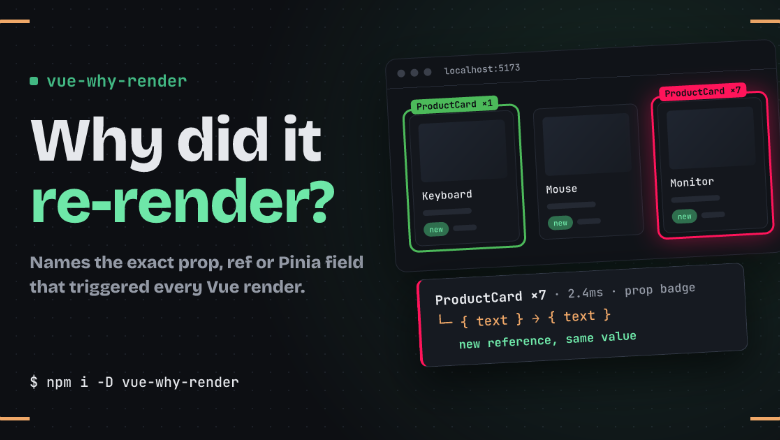
Прогнали фронт киберспортивной платформы на Nuxt через vue-why-render. Пять правок по несколько строк убрали до 98% лишних перерисовок: таймер, который перерисовывал карточку 600 раз в минуту, реф в слоте, будивший не тот компонент, и тест, который проходил, ничего не проверяя.
Читать далее