RSS Feeds
Patrick Stewart, ‘Star Trek’ Captain and Professor X on ‘X-Men,’ Dies at 86
'One of the greats' - Star Trek and X-Men star Sir Patrick Stewart dies
AI deepfakes pose risks to consumers and voters, experts warn
Nothing Headphones Sale: Stylish and Up to 41% Off
Flávio Bolsonaro calls himself 'leader of Brazil' after election loss
JD Vance letter may offer last chance to avert fresh conflict between US and Iran
US vice-president writes to top Iranian security official in sign Washington has not abandoned diplomacy
Hopes of averting a major new conflagration between Iran and the US soon after Tuesday’s midterm elections could rest on Iran’s response to a personal letter from the US vice-president, JD Vance, offering to restart diplomacy.
The letter, written after predominantly Qatari mediation, was sent to the secretary of Iran’s supreme national security council, Mohsen Rezaei on Sunday. It requires Tehran to agree to make commitments on its nuclear programme at the start of a process that would lead to the opening of the strait of Hormuz within seven days in return for US sanctions relief.
Continue reading...MI5 false evidence in neo-Nazi spy case a serious failing, says intelligence watchdog
Grealish dropped by Everton after 'breach of club discipline'
Paris suburb shooting suspect targeted people of Muslim or African appearance, prosecutor says
DOJ vets say politically charged moves close to election violate norms
JD Vance letter may offer last chance to avert fresh conflict between US and Iran
US vice-president writes to top Iranian security official in sign Washington has not abandoned diplomacy
Hopes of averting a major new conflagration between Iran and the US soon after Tuesday’s midterm elections could rest on Iran’s response to a personal letter from the US vice-president, JD Vance, offering to restart diplomacy.
The letter, written after predominantly Qatari mediation, was sent to the secretary of Iran’s supreme national security council, Mohsen Rezaei on Sunday. It requires Tehran to agree to make commitments on its nuclear programme at the start of a process that would lead to the opening of the strait of Hormuz within seven days in return for US sanctions relief.
Continue reading...Judge blocks Trump administration's Medicaid rule forcing sick recipients to prove frailty
Justice Department announces Trump plans for golf course are in the works
Grealish dropped over 'breach of club discipline' - what now?
How Trump's immigration crackdown sparked a backlash that could undermine Republicans' campaigns
Lib Dems and Reform UK in war of words over alleged shove
The reports of Stack Overflow's death are greatly exaggerated
Why Miami Is a Destination for Latin America’s Political Exiles
Where was my invite to the — wait, what? Airbnb had a gala?
Выборы в Израиле: подсчитаны более 89% голосов, перспективы коалиции неясны. Что дальше?
На Аляске среди кандидатов в сенаторы два Дэна Салливана. Губернатор велел проверить, причастны ли к этому демократы
Offshore workers turn to weight-loss jabs to meet helicopter weight rules
Seven oil tankers carrying 288,000 tonnes of Russian diesel sail towards US
Tankers, tracked by Greenpeace, are first phase of Trump-Putin deal – but there is uncertainty over whether they will unload
Seven oil tankers carrying an estimated 288,000 tonnes of Russian diesel are now sailing towards the US, though it is uncertain if the vessels will be able to unload amid a political row about the legality of the shipments.
The transport, tracked by the pressure group Greenpeace, is the first phase of a contentious supply deal negotiated between presidents Donald Trump and Vladimir Putin earlier this month, reversing years of sanctions on Russia oil.
Continue reading...Polymarket briefly halts trading after third-party compromise and reports of stolen user funds
Meta quietly launches an AI fashion app called Style Sketch
Top Military Admiral Briefs Trump on Iran Options
Dream serve up lunchtime rout of Valkyries to force historic WNBA finals Game 7
Dream win 80-69 to level best-of-seven series at 3-3
First Game 7 in WNBA history set for Saturday night
The Atlanta Dream had no intention of letting a matinee become their curtain call.
Facing elimination at a lunchtime tipoff, the Dream overwhelmed the Golden State Valkyries 80-69 on Thursday afternoon to force a decisive seventh game in the WNBA finals, rediscovering their offensive touch just as their title hopes were threatening to slip away.
Continue reading...Manchester City 1-1 Paris Saint-Germain: Women’s Champions League – live reaction
⚽ Women’s Champions League updates; kick-off 8pm GMT
⚽ Live scores | Read Moving the Goalposts | Mail Sarah
4 min: City have the first real chance as they try and find Shaw in the box but Karchaoui marshals the threat well. The hosts come again with Fujino finding the Jamaica international but she can’t connect with the cross.
2 min: Can you believe this is the first time these two clubs have met? That fun fact blew my mind a bit. Both teams starting slowly, trying to figure the other out.
Continue reading...Seven oil tankers carrying 288,000 tonnes of Russian diesel sail towards US
Tankers, tracked by Greenpeace, are first phase of Trump-Putin deal – but there is uncertainty over whether they will unload
Seven oil tankers carrying an estimated 288,000 tonnes of Russian diesel are now sailing towards the US, though it is uncertain if the vessels will be able to unload amid a political row about the legality of the shipments.
The transport, tracked by the pressure group Greenpeace, is the first phase of a contentious supply deal negotiated between presidents Donald Trump and Vladimir Putin earlier this month, reversing years of sanctions on Russia oil.
Continue reading...A peek inside the 2026 L’Oréal-UNESCO For Women in Science celebration

On October 22, Vox co-hosted a screening event honoring the 2026 L’Oréal-UNESCO For Women in Science grant awardees.
The program awards five women scientists postdoctoral grants to advance their research. This year’s recipients work in fields including immunology, planetary science, and ecology. Learn more about the 2026 recipients here.

The evening was emceed by aerospace engineer Aisha Bowe and featured a cocktail reception, a panel discussion and a screening of five documentary profiles produced by Vox Creative. The full profiles can be viewed here.
Applications for the 2027 L’Oréal-UNESCO For Women in Science US program are now open.
Все русскоязычные стримы в Postgres раз в 10 минут: 2 млн строк вместо 30 млн и баг, в котором я три недели винил VK
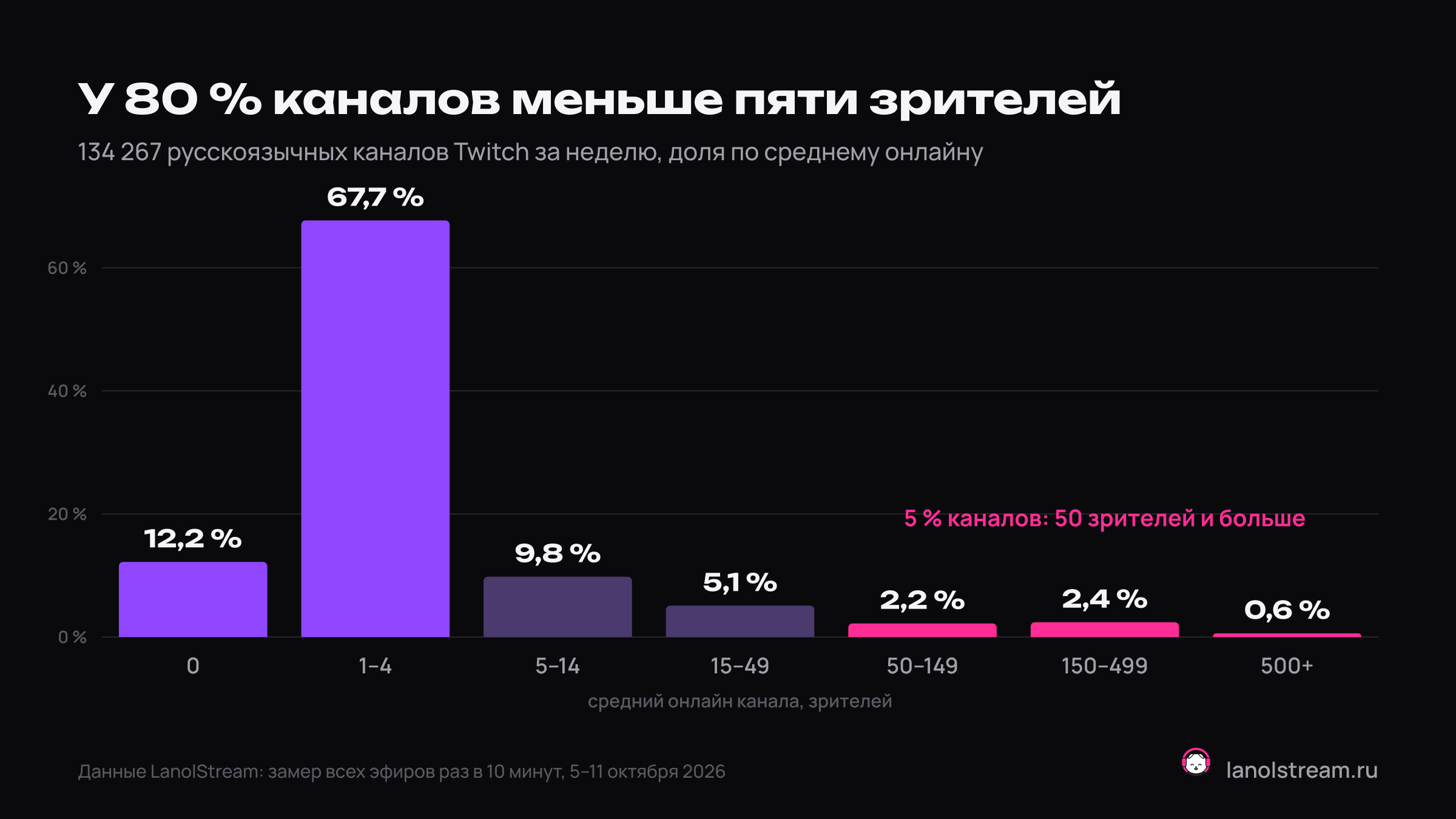
Каждые 10 минут в русскоязычном эфире Twitch и VK Видео Live в среднем 7 200 каналов. Писать их как есть - больше миллиона строк в сутки. Я храню агрегаты, и за четыре недели вышло 2 млн строк. Расскажу, как это устроено и где я три недели искал проблему не там.
Я Максим, разработчик, вечерами пишу LanolStream - инструменты для стримеров, которые мы делаем вместе со стримершей lanolkid. Стримеры часто спрашивают «во сколько лучше стримить» и «много ли у меня зрителей для моей игры». Чтобы отвечать цифрами, а не ощущениями, нужен весь рынок, а не только наши каналы.
Читать далееUefa close to selecting candidate to run against Infantino in Fifa election
Challenger’s identity could be approved by next week
Arsène Wenger not thought to have entered reckoning
Uefa and its allies are close to identifying a candidate to run against Gianni Infantino in the Fifa election and could select the challenger as early as next week.
The clock is ticking on efforts to oppose Infantino in March, with candidates required to confirm they are standing by 18 November, but there is growing confidence those attempts are nearing a successful resolution. Discussions with potential nominees have gained momentum despite recent setbacks that included a U-turn by the Asian Football Confederation president, Sheikh Salman bin Ibrahim al-Khalifa, who surprisingly endorsed Infantino’s push for a fourth term.
Continue reading...Running in the dark? This reflective running gear will help you stay safe
MI5 false evidence in neo-Nazi spy case a serious failing, says intelligence watchdog
U.S. Expels Cuban Diplomat After Fiery Showdown at United Nations
Taxing Wealth Makes Sense, But It Won’t Fix Our Economy

In June, Elon Musk became the world's first trillionaire when SpaceX began trading on the Nasdaq. Now, the U.S. midterms are here, and wealth taxation is on the ballot.
Californians are set to vote on Proposition 40, which would take 5% of fortunes above $1 billion, once, and send nine-tenths of the revenue to fund California’s Medicaid program. A swarm of Silicon Valley billionaires, including Google co-founder Sergey Brin, has spent more than $333 million campaigning against the potential tax, warning it will backfire and push the wealthy to flee the sunshine state.
Such reactions are not new. Even the income tax once looked like an assault on property. The Supreme Court struck one down as unconstitutional in 1895, and it took the 16th Amendment in 1913 to make it ordinary. Taxes on great fortunes may travel the same road and become unremarkable within a decade. Plus, research indicates that the wealthiest households often pay lower effective tax rates than the people who work for them.
I support Proposition 40. But it is not sufficient in addressing the underlying economic issues at hand.
A wealth tax like Proposition 40 tries to recover a share of value long after that value has been created, compounded, and defended. By then, the money has lawyers. Which is why the origins of this extreme wealth matter, now that the prospect of redistribution has so agitated the people holding it.
To understand how these systems work, think of the iPhone. As I argued in my book The Entrepreneurial State, the iPhone's foundational technologies came from public research: the internet, GPS, the touchscreen, and the voice recognition behind Siri. Speech understanding research at Carnegie Mellon, MIT, and Stanford Research Institute was funded by the Defense Advanced Research Projects Agency (DARPA) in the 1970s. Researchers then spent two more decades on language and learning systems no company would finance, because the payoff lay thirty years out.
Or think of Google. The search algorithm that made Brin's fortune grew out of a National Science Foundation project at Stanford.
And then there’s SpaceX, whose listing made Musk a trillionaire, took $396 million from NASA to develop the Falcon 9 and the Dragon capsule, then $1.6 billion to fly cargo to the space station and $2.6 billion to fly astronauts. The world’s richest man was also the biggest political donor this election cycle, spending $366 million supporting Republican causes.
Other people see them as tech bros. I see them as a brologarchy. They surfed off publicly financed research to earn enormous rents, and continue to profit off of them through what I call “algorithmic rents”: returns from owning the platforms, data, and models the rest of us must pass through, and manipulating what our “attention” sees.
None of this takes anything away from the entrepreneurs. Turning a research program into a reusable rocket is hard. The public carried the risk in the years when these technologies had no market and no buyer. The state carries the blame: for not setting out, in the contracts, the terms of that initial investment and a fair share of the rewards for the risk the public took.
The Department of Energy made the asymmetry explicit in 2009, issuing two near-identical loan guarantees to two of Musk’s companies: $465 million to Tesla and $500 million to Solyndra. Solyndra, a now-bankrupt solar panel manufacturer, collapsed two years later, and the taxpayer absorbed the loss and the political damage. Tesla, by contrast, succeeded. Under its loan agreement, the government held warrants it could exercise only if Tesla failed to repay on schedule; Tesla repaid nine years early and the warrants lapsed. The public took the downside on one deal and wrote itself out of the upside on the other.
Economists call this socializing risk and privatizing reward. It describes a contract drafted without the confidence to ask for anything.
NASA once had that confidence. In the early 1960s, it moved Apollo contracts from cost-plus-fixed-fee to incentive contracts tying a contractor's fee to cost, schedule, and performance, setting terms rather than writing blank checks. More recently, the CHIPS and Science Act attached conditions to $52.7 billion of semiconductor funding, covering where plants get built and what jobs they create.
I believe those conditions did not go far enough. Wage standards covered laborers and mechanics rather than every worker, and affected communities got no formal seat in the decisions. But the principle is American, recent, and bipartisan. Public money can come with terms.
This is called “pre-distribution,” shaping how value is created and shared at the outset, rather than waiting for the tax code to repair the damage, and it is a crucial principle for making capitalism work for us all.
But establishing this kind of capitalism requires that we commit to another principle: access for all and reward sharing. If the public carries the risk, it should hold a claim on the reward. In practice, that means equity stakes in companies built on public loans, royalties on patents from publicly funded research, and a public fund that recycles the returns into the next round of risk. The United States has started to embrace this philosophy in its semiconductor infrastructure funding. It could do the same for our public investments in artificial intelligence, and those contracts are still being written.
These principles address our broader capitalist system and create a different framing from universal basic income, which many tech billionaires are quite fond of. A basic income leaves the origins of their fortunes untouched, treats wealth as given, and asks only for a transfer, which is why it can be endorsed without conceding anything. A citizens' dividend changes the logic, because it pays out on the grounds that the public helped create the value in the first place. That is a debt owed directly, not only through the tax code. And we know it is possible. Alaska has paid its residents a dividend from oil revenue since 1982.
None of this is an argument for voting against Proposition 40. California's billionaires should pay, and the state's health system needs the money. But a one-time levy collected decades after the fact is a costly way to claim a return that could have been written into the contract at the start. Redistribution settles old accounts. Pre-distribution can redesign an economy from the outset for more inclusive, sustainable growth.
It matters that we act now. The next fortune is being built right now, on public research, with public money; we should make sure it serves the common good.
An economy is not weather, a natural phenomenon that cannot be designed differently or more fairly. It is a set of contracts, and we are the ones who write them. We can write them for an economy designed with people and for them, one that shares the knowledge and the rewards along the way. The common good economy provides the principles through which to achieve this.
Логическое обоснование невозможности согласования сверхинтеллекта (AGI)

Проблема согласования (alignment problem) — обеспечение соответствия целей искусственного интеллекта человеческим ценностям — обычно рассматривается как инженерная задача: «как построить систему, которая не будет нарушать наши цели». В данной работе обосновывается более сильное утверждение: для систем, превосходящих человека в когнитивных способностях, согласование логически невозможно в том смысле, что не существует механизма, созданного человеком, который гарантирует согласование. Любое ограничение является отсрочкой, а не решением.
Читать далееCuauhtémoc Cárdenas, Leftist Leader Who Paved Mexico’s Path to Democracy, Dies at 92
A Defense Contractor Gave Their Personal AI Agent Access to a Secure Pentagon System
Prosecutors ask judge to reject Lindsay Clancy defense’s motion to dismiss charges
Taryn Simon Fills Guggenheim With Evidence in ‘Father Country I Do Love You’
Scottish football could pave way for 3pm TV blackout to end
DOJ issues subpoenas in Alaska Senate race as governor launches separate investigation
Почему pandas и ClickHouse считают разные перцентили на одних данных и как добиться совпадения

Один и тот же набор из десяти заказов, а p90 получается от 3900 до 12 500 рублей. В ноутбуке аналитика одна цифра, на дашборде другая, и даже повторный запуск запроса иногда меняет результат. Причина может скрываться в самой функции расчёта перцентиля — разберёмся, как разные инструменты выбирают значения и какой метод использовать, чтобы метрики можно было сравнивать.
Разобраться в перцентиляхВыгрузка данных в Google‑таблицу из 1С в 2026 году

Понадобилось выгружать данные в Google-таблицу.
Мне пришлось долго прорываться через дебри нюансов Google-авторизации и доступов, часто с помощью ИИ. Но все же в итоге удалось победить эту заградительную конструкцию. Делюсь с Вами, как организовать доступ к Google-таблицам в 2026 году.
Читать далееEverton 3-1 Newcastle: Carabao Cup fourth round – live
⚽ Everton dispatch the 2025 winners without too much fuss
⚽ Grealish misses last-16 tie over ‘breach of discipline’
2 min: Dewsbury-Hall shoots. Deflected. Nothing comes of the corner. Everton are playing in blue, Newcastle a pinky purple.
The match begins. Sky’s red-button treatment of this game, squirrelled away deep in its planner, is little short of a disgrace.
Continue reading...How Hochul Became a Surprise Champion of the Subway
Hong Kong’s leader apologises for residential fire that killed 168 people
Blaze was world’s deadliest residential fire since 1980, but some survivors and bereaved families say justice has yet to be served
Hong Kong’s leader has apologised for government shortcomings that contributed to a fire that killed 168 people in the city last year, a rare sign of public contrition that nevertheless failed to impress some victims’ families.
The chief executive, John Lee, and seven other officials bowed in apology at the release of a report that pointed to “decades of failure” by government bodies.
Continue reading...