На этом шаге мы наполняем папку models/ моделями под разные задачи, раскладываем их по правилам (плоско vs подпапки с mmproj) и делаем HTML-шпаргалку — статическую страницу, которая отвечает на вопрос «какая модель для какой задачи», не требуя лезть в конфиги или документацию.
RSS Feeds
Руководство по сборке локального AI-стека. Часть 3. Наполнение моделями
Feed:
Все публикации подряд на Хабре
(https://habr.com/ru/rss/articles/)
Link:
https://habr.com/ru/articles/1099492/?utm_source=habrahabr&utm_medium=rss&utm_campaign=1099492
Published: 2026-10-26 11:09:19
|
Created: 2026-10-26 11:10:58
Слабый (Artificial Narrow Intelligence, ANI) и сильный (Artificial General Intelligence, AGI) ИИ
Feed:
Все публикации подряд на Хабре
(https://habr.com/ru/rss/articles/)
Link:
https://habr.com/ru/articles/1099490/?utm_source=habrahabr&utm_medium=rss&utm_campaign=1099490
Published: 2026-10-26 11:07:47
|
Created: 2026-10-26 11:08:58
Обычно, в ходе обсуждения ИИ без погружения в контекст так сразу непонятно, о каком виде ИИ идет речь. Еще несколько лет назад, до появления GPT в общем доступе, если собеседник «не в теме», то он, как правило, под безликим ИИ понимал исключительно то, что сейчас называют «сильным» (и даже «сверхсильным») ИИ: сплошь магия, чародейство и прочее волшебство, основанные на научно- фантастических фильмах, сериалах и книгах. Причем скептики, считающие невозможным появление такого интеллекта не просто «здесь и сейчас», а «в принципе», понимали под словами «искусственный интеллект» то же самое: HAL 9000 или Skynet.
Читать далееThe Morning Risk Report: Lula Wins Fourth Term in Brazil Election Upset
Feed:
WSJ.com: World News
(https://feeds.content.dowjones.io/public/rss/RSSWorldNews)
Published: 2026-10-26 11:06:00
|
Created: 2026-10-26 11:08:57
Plus: Citi gets regulator nod for wholly owned securities venture in China and Tanker carrying Russian diesel signals U.S. port after Trump-Putin deal.
show more
Ускорение и автоматизация разработки legacy-прошивки контроллера чистых помещений фармацевтического производства
Feed:
Все публикации подряд на Хабре
(https://habr.com/ru/rss/articles/)
Link:
https://habr.com/ru/articles/1099486/?utm_source=habrahabr&utm_medium=rss&utm_campaign=1099486
Published: 2026-10-26 11:07:22
|
Created: 2026-10-26 11:07:59

1. Спагетти код без тестов. Какие решения помогли выйти из тупика и ускорить добавление фич с минимальной регрессией.
2. Автоматизация тестирования: что получилось сделать быстро, а где словили ограничения железа. Что помогло быстро разобраться с ошибками на железе: I²C шина, прерывания и производительность главного цикла.
3. Ускорение за счет использования LLM агента в Firmware DLC. Нюансы агентной разработки firmware: в чем агент был хорош, как работать с ADR и какой feedback loop выстроить
Читать далееGet almost 50% off this popular heated blanket before the winter chill sets in
Feed:
NBC News Top Stories
(https://feeds.nbcnews.com/nbcnews/public/news)
Published: 2026-10-26 11:00:41
|
Created: 2026-10-26 11:07:59
The Bedsure Heated Blanket is 42% off on Amazon for a limited time. The soft flannel throw has six heat levels, an auto shut-off and is machine washable.
show more
In Maine, a Toss-Up Senate Race Is About the Incumbent and Not Much Else
Feed:
TIME
(https://time.com/feed/)
Published: 2026-10-26 11:00:00
|
Created: 2026-10-26 11:06:00

Susan Collins had just laid out her receipts.
The five-term Republican senator was standing on a debate stage in Portland earlier this month, explaining how she deserved credit for ensuring concrete and road salt were exempted from President Trump’s Canadian import levies. The move saved one small town in northern Maine $10,000, Collins said. It helped a concrete business owner avoid a $150,000 hike.
It was an updated version of the same argument Collins has been making for decades to win re-election in a state that hasn’t backed a Republican President since George H. W. Bush.
When it was her opponent’s turn to respond, Troy Jackson shrugged. What about everything else going up in price, he asked her, before adding, “We can’t eat road salt.”
For Jackson, the comeback was a hit. It sparked “let them eat road salt” memes of Collins depicted as Marie Antoinette and assuaged some fears among Democrats about how the last-minute replacement candidate would fare in the spotlight. The viral moment also brought into focus the race’s defining issue: Collins herself. Amid a handful of Senate races that will decide which party controls the upper chamber for the last two years of the Trump era, the race in Maine has emerged as the one most decisively about voters’ view of the incumbent.
“He’s got a unique challenge because this race really isn’t about him,” says Emily Cain, a former Maine legislator and Democratic political strategist in the state. “This race is about Susan Collins and asking the people of Maine whether or not it's time for change. He just happens to be the alternative.”
Given the candidate they ended up with, some Democrats are thrilled with this dynamic. Jackson became the nominee after a tumultuous summer in which the state’s Democratic primary winner, Graham Platner, withdrew from the race int he wake of being accused of sexual assault, which Platner has denied. While Platner and Jackson have nearly identical progressive, populist policy platforms, there’s a clear contrast between them in style. Platner is a charismatic, at times gripping, campaigner. Jackson is not. His speeches tend to be more subdued and matter of fact, and he often wears an expression of utter boredom despite being at the center of one of the highest-stakes contests in the country. His affect matches his typical attire on the trail—a Red Sox cap, a fleece vest, his cell phone on a belt clip.
“Troy’s a salt of the earth guy. His biggest strength is his authenticity,” says Toby McGrath, who ran President Barack Obama’s campaign in Maine in 2008 and 2012.
With polls showing Jackson ahead but within the margin of error, both sides have sharpened their attacks. Jackson has repeatedly highlighted a recent report that the FBI and Justice Department had previously sought to open a pay-to-play bribery probe into Collins, allegations, which she denied. And a super PAC aligned with Senate Republicans released an ad calling Jackson a “freak” and a “creep” over his relationship with his second cousin, with whom he has two sons. Last week, Collins distanced herself from the ad and called for it to be taken down.
Yet it’s unclear if any of that is breaking through with voters in a race that could ultimately come down to how Collins ensures Maine isn’t forgotten by Washington. On the stump, she warns voters all that could all disappear if Jackson replaces her.
"He'll be 100 in seniority,” she told Fox News digital earlier this month, “And all of that essential federal funding targeted for the state of Maine, virtually all of it will go away."
Collins’ hold on Maine
For years, Collins has been the immovable stateswoman. She is both Maine’s longest-serving member of Congress and the longest-serving Republican woman in Senate history. Astoundingly, she’s never missed a roll-call vote since taking office in 1997.
A self-described centrist, she has cultivated a deep connection with Maine’s independent-minded electorate. In 2020, she was reelected by 9 points as Joe Biden carried the state by the same margin.
Collins, 73, has increasingly found herself on the defensive over years of controversial votes, including those confirming Trump cabinet members like Health Secretary Robert F. Kennedy Jr. She also cast votes elevating Justices Neil Gorsuch and Brett Kavanaugh to the Supreme Court. Her 2018 vote on Kavanaugh, in which she said she trusted he wouldn’t endanger the right to abortion access, became a flashpoint after the court overturned Roe v. Wade in in 2022. (Collins is also the only Republican senator to vote for all three Democratic-appointed justices currently on the court.)
Most towns in Maine have felt the benefit of Collins’ role as chair of the powerful Appropriations Committee, with which she has steered funding for community centers, railroad improvement projects and shipyards. Her campaign puts the total at $1.5 billion in congressionally directed spending and targeted investments since 2021.
“Even Democrats acknowledge her work to bring funding and support back to the state is just off the charts,” says Lance Dutson, a Republican strategist in Maine. “So people are going to have to make a decision, ‘Do I hate Trump more than I appreciate and need the support Susan Collins has brought to the state over the years?’”
That argument faces more pushback this year given wider dissatisfaction with Republicans and the state of the economy. Jackson has capitalized on those economic anxieties. One of his final ads references high heating oil costs. It’s hitting airwaves just as residents fill their tanks for winter in the nation’s fourth-coldest state. He repeatedly points to Collins' votes related to the conflict in Iran for driving up fuel costs and her vote to advance the Big, Beautiful Bill, a major Republican budget and tax package, for slashing Medicaid in the state.
Last month introduced another chink in Collins’ armor, as a ProPublica investigation revealed that FBI and Justice Department agents sought to open a pay-to-play bribery probe into Collins related to allegations she’d rewarded a campaign donor with millions of dollars in federal naval defense contracts. Collins has denied the allegations, and no charges were ever filed against her or her campaign.
Several Republican and Democratic strategists told TIME they question how effective the corruption argument is landing in tight-knit Maine. “Susan goes to the grocery store, does her own shopping, doesn't live in a lavish house,” Dutson, the GOP strategist said. “People may disagree with her, but I think it’s a big stretch for almost everybody up here to get their head around her being corrupt.”
But the investigation cuts at the core of Collins’ Maine-first brand, McGrath argued, so even a small erosion of support could be the difference in a close race.
‘Troy is not a smooth talker’

As Jackson’s campaign keeps the spotlight on Collins, it’s kept its own candidate somewhat hidden away. Up until recently, Jackson had done very few on-camera interviews, and it was rare for him to take many unscreened questions at campaign events. Local and national campaign staff have feuded over how to showcase Jackson from the early days of the campaign, infighting detailed in an August New York magazine story.
“He has a nationalized campaign team, and these are folks who are generally only comfortable with smooth talkers, and Troy is not a smooth talker,” says a Maine Democrat who worked with Jackson in the state legislature. The Democrat, who supports Jackson, thinks there’s wisdom in trying to avoid gaffes that distract from Collins. Jackson has struggled at times to talk about foreign affairs or federal policy issues, like detailing how to pay for Medicare for All in a conversation with CNN’s Dana Bash in mid-October.
But other allies of Jackson say an overcautious campaign is impeding the Bernie Sanders progressive and stalwart labor champion from connecting with voters. “A lot of folks don’t know anything about him except that he’s a logger. He has a charming and funny side, and you don't get to see it,” says Betsy Sweet, an activist and political organizer who ran for U.S. Senate in 2020. “The D.C. folks are sure they know everything, and I feel like in so many of our national races they don’t listen to us and they screw it up.”
Jackson has a compelling working-class backstory. His mom was 16 when she had him in Aroostook County, on the rural northern tip of Maine. He grew up poor in Allagash, a frontier town near the Canadian border where he started logging at age 19, taking after his dad, his grandfather and his great-grandfather.
When Canadian loggers started crossing into Maine and taking work away from locals, he helped lead a blockade, driving his truck to the border to halt temporary workers from coming into the state. The protest made headlines but did little to change the situation, and a frustrated Jackson turned his attention to the state legislature. He first ran unsuccessfully as a Republican and eventually got elected in 2002 as an independent. He became a Democrat two years later and rose through the ranks to become Senate president.
Over decades in state politics, Jackson’s opinions on abortion and LGBTQ rights have evolved. Sweet, who lobbied for women’s groups, recalled pushing him to back abortion-rights legislation in the state. “I think it finally clicked for him after us telling him abortion is health care. It’s not whether women are gonna have one, it’s whether low-income women have the same access as rich women.”
His reputation for having a gruff demeanor, Sweet says, is accurate, but attack ads that portray him as antagonistic toward women go too far. “He will go toe to toe with you. He’s not genteel. You know where you stand with him, but you work it out.”
A shade of that temper came out in the final debate before the election. Jackson told Collins to “shut up” after she accused a protester of being one of his supporters. “It was a stupid thing for him to say,” the Democrat who worked with Jackson in the state legislature says of the debate moment. “Collins is known for her decorum, her civility. He’s courting 55- to 65-year-old women who are all about not being talked down to.”
Maine’s population is the oldest in America and the race will likely come down to older, moderate voters who have split their ticket in past elections. Collins' campaign has argued Jackson has run to the left of the electorate, drawing liberal figures like Senator Elizabeth Warren of Massachusetts, Senator Bernie Sanders of Vermont and Rep. Alexandria Ocasio-Cortez of New York to rally with him.
“That they are all campaigning in Maine for Troy Jackson tells voters exactly how he would govern,” Collins campaign spokesperson Blake Kernen said.
For all the debate about whether Jackson’s makeshift campaign has positioned him for victory, it will largely be Collins’ race to win or lose. A September CNN poll of voters backing Jackson found 29% said theirs was a vote for Jackson, while 71% said it was a vote against Collins. Her future in the Senate may not come down to Jackson at all but whether she gives voters enough confidence in what the next six years would look like.
“She’s got an amazing record in the past, but people need to hear from her what she’s gonna do in the future and what the game plan is,” Dutson, the GOP adviser, says. “They need to know, if we send Susan Collins back to Washington, how is that gonna help alleviate the anxiety this administration has been causing me right now?”
Israel's Choice
Feed:
TIME
(https://time.com/feed/)
Published: 2026-10-26 11:00:04
|
Created: 2026-10-26 11:06:00

The Israeli settlement of Neve Daniel sits south of Jerusalem, atop one of the highest ridges in the West Bank, nearly 1,000 meters above sea level. The view to the east stretches to the mountains of Jordan, and to the west across the Mediterranean coastal plain—where most Israelis live. But the tranquility of the landscape belies the political fervor animating the Oct. 27 election, a contest with stakes as great as any in the 78-year history of the world’s only Jewish state. When I ask three residents what will ultimately determine their votes, one responds with particular ferocity.
“Seven hundred trucks were delivered to Hamas today by Israel,” says Barak Moore, who has lived in Neve Daniel for 14 years. He’s referring to commercial goods and international aid entering the Gaza Strip. “We’re paying a terrorist organization that committed the greatest atrocity against the Jewish people since Auschwitz.”
While much of the world has come to define Israel by its military actions in Gaza since Oct. 7, 2023, Moore’s views reflect the passions coursing through a society still traumatized by that day. Israelis tend to be less preoccupied by the nearly 75,000 Palestinian fatalities in Gaza since the war began, than by the 1,200 people killed in Israel and 251 hostages taken by Hamas—the women subjected to sexual violence, the children shot at point-blank range, the families burned alive in their homes. In a country so small and intimately connected, scarcely anyone was untouched by events that shattered the assumptions of a people whose nation was founded to give Jews a safe haven in their ancestral homeland.
Both the Hamas massacre and the wars that followed loom over a vote shaping up not only as a referendum on Benjamin Netanyahu, but also the nature of the country that, as Israel’s longest serving prime minister, he has done so much to shape.
Arrayed against Netanyahu is a fractured field of challengers. There is Gadi Eisenkot, the former military chief whose reputation for honesty, sobriety, and competence contrasts with Netanyahu’s polarizing leadership; Naftali Bennett, the right-wing former prime minister seeking a comeback; Yair Lapid, the centrist former premier who has spent years trying to dislodge Netanyahu; and Avigdor Lieberman, the hawkish secular nationalist who has become one of Netanyahu’s fiercest adversaries.
Also on the ballot: Itamar Ben-Gvir and Bezalel Smotrich, far-right extremists whose parties made possible Netanyahu’s current coalition, and whose ambitions to annex the West Bank and resettle Gaza constrain his room to maneuver while damaging Israel’s standing abroad. The next government will either push Israel further down the path of religious nationalism, permanent conflict, and international isolation—or toward a new generation of leadership.
According to the polls, Netanyahu’s strongest challenger is Eisenkot, a soft-spoken, heavyset career soldier running as a centrist. His son, Gal, was killed fighting Hamas in Gaza, and one of his nephews also died in the war. Eisenkot is campaigning on a promise to restore public trust in government, rebuild Israel’s security, and heal the divisions that have fractured the country. “This election is about the identity of Israel,” Eisenkot told TIME in an interview on Oct. 20. “What will be Israel two weeks from now, 10 years from now, 20 years from now? This is the main question.”

Three years after Netanyahu’s political obituary was being written, pre-election polls show him running in a dead heat. On the eve of the vote, the nation is suffused with a sense of uncertainty; political analysts say almost anything can happen. Netanyahu and Eisenkot could form a unity government. Netanyahu could cobble together another right-wing coalition, dragging Israel further right. Eisenkot could join forces with Bennett, Lapid, and the Arab parties (20% of Israeli citizens are Palestinian) to oust Netanyahu, producing the closest thing Israel could muster to a center-left government. Or perhaps no bloc will manage to pull together the 61 Knesset seats needed for a majority, plunging Israel into another round of elections and a reprise of the paralysis that produced five contests between 2019 and 2022.
“The most probable scenarios currently are either there will be some sort of unity government, which again is very complicated politically because all of the opposition parties swear they don’t want it under Netanyahu, and I don’t see how Netanyahu is going to sit under them,” says Nimrod Nor, an expert on Israeli politics at Hebrew University. “The other is we’re going to have another election after this one.”
According to two sources familiar with Netanyahu’s thinking, he would prefer to form a unity government with Eisenkot. One reason is legacy. He believes such an alliance offers his best chance to transcend the worst security failure in the nation’s history, and to be remembered not only as the leader who emerged from the slaughter of Oct. 7 to decimate Hamas in Gaza and Hezbollah in Lebanon and persuade an American president to wage war against Iran, but also as the statesman who helped to reconcile a divided nation.
The other reason, the sources say, is personal. Netanyahu has little desire to form another right-wing coalition that would leave him beholden to the radical and uncompromising parties led by Ben-Gvir and Smotrich, both of which he brought into government four years ago to reclaim power. “He thought that he could control Ben-Gvir,” one Netanyahu aide says. “Now he knows that he can’t.”
That is precisely what the Israeli right fears he’s thinking, and what brought me to Neve Daniel. The settlement of capacious red-tiled homes is just across the Green Line that defined Israel’s borders before the Six-Day War of 1967. It was built on land that was a Jewish farm even before Israel was founded in the crucible of the 1948 war. Settler violence against Palestinians has risen sharply during Netanyahu’s tenure, but the militant settlers who make headlines by terrorizing their Palestinian neighbors tend to live on hilltops deeper into the West Bank than this.
But few, if any, of the 700,000 Israelis who live in settlements are leftist. Many regard Netanyahu as a cynical opportunist—a political chameleon who parrots their convictions but will do whatever it takes to survive. Among his many heresies, they say, is a long history of accommodating American presidents: signing the Wye River Memorandum under Bill Clinton to advance the Oslo peace process that aimed to create a Palestinian state; voting for the disengagement from Gaza under Ariel Sharon and George W. Bush; endorsing, at least rhetorically, a two-state solution and imposing a moratorium on settlement construction under Barack Obama; and, under Donald Trump, accepting a ceasefire and hostage-exchange agreement to end the war in Gaza.
Three people in Neve Daniel offer a revealing glimpse of the forces pulling Netanyahu rightward. Each plans to vote for a different party, but they all share an overriding objective: a right-wing government with Netanyahu at its center, constrained by allies who will keep him from drifting toward the middle.
Barak Moore is supporting Zehut, a libertarian nationalist party founded in 2015, whose eclectic platform combines tax cuts, the dismantling of monopolies, and cannabis legalization with an uncompromising vision of Israeli sovereignty and the removal of Palestinians from Gaza. It is something of a right-wing hipster party, blending free-market economics with religious nationalism.
Avi Abelow, 52, an activist who runs the website Pulse of Israel, is voting for Netanyahu’s Likud Party. His complaint is not that the prime minister has gone too far in Gaza, but rather that he has not gone far enough, hamstrung by a security establishment and governing coalition insufficiently committed to the nationalist cause. “We should have conquered all of Gaza and made sure it’s Jewish again,” he says.
The youngest of the three, Hershey Kellner, is a 19-year-old Orthodox Jew who moved to Israel from New Jersey just months before Oct. 7. He is supporting Otzma Yehudit, the far-right party led by Ben-Gvir, whose confrontational politics and open contempt for established norms have made him a hero to some of Israel’s most fervent ideologues. Helner admires Ben-Gvir’s push to expand civilian gun ownership, permit Jewish prayer on the Temple Mount, and introduce the death penalty for terrorists.
To explain his thinking, Kellner invokes one of the most consequential decisions in recent Israeli history: the 2011 deal that freed the Israeli soldier Gilad Shalit in exchange for more than 1,000 Palestinian prisoners. Among them was Yahya Sinwar, who would go on to mastermind the Oct. 7 massacre. Helner believes that sparing Sinwar’s life was a catastrophic mistake. “If you hanged him or put a bullet in the back of his head, not sure how the world would be now,” he says, “but it would definitely be better.”
For three years, Israel has been a nation at war, not only with its enemies but with itself. The extraordinary solidarity that followed Oct. 7 has given way to recriminations and ideological divisions, intensified by the trauma of war, the anguish of the hostage crisis, the pain of deepening antisemitism worldwide, and the unresolved question of who bears responsibility for such a stunning security lapse. Though Israel rejects the charge, critics accuse the country of committing a genocide in Gaza, where the dead include both uncounted Hamas fighters and 20,000 children—and of countenancing a thuggish brand of ethnic cleansing in the West Bank. On Oct. 16, masked settlers were filmed attacking Palestinians and European diplomats in the West Bank, and injuring a Washington Post photojournalist.

The fault lines run through nearly every aspect of Israeli life. Secular and religious. Liberals and nationalists. Those obliged to serve in the military and the ultra-Orthodox who are not. Those who believe Israel must reach an accommodation with the Palestinians and those who want permanent Israeli control over the West Bank and Gaza. And, not least, those who regard Netanyahu as the indispensable guarantor of Jewish security and those who see him as the principal threat to the country’s democratic character and reputation abroad.
The fear increasingly voiced across Israel’s political and cultural establishment is that another Netanyahu victory could push those divisions toward a societal rupture. After Netanyahu’s coalition moved in early 2023 to restrict the power of the Supreme Court, the prospect of another government dependent on religious and ultra-nationalist parties has raised the specter of an exodus of young Israelis, who see the country’s liberal and democratic traditions slipping away. In a recent survey by the Agam Institute, an Israeli research firm, and the Hebrew University of Jerusalem, 59% of Israelis said they believe internal threats are greater than external ones, while 64% said they were considering leaving Israel, citing insecurity, living costs, and political instability. In a nation of roughly 10 million, even the departure of tens of thousands of highly educated citizens could have consequences far beyond their numbers, draining the country of the talent and investment on which its economic and military strength depends.
There is a deeper irony. Israel was founded as a refuge, a place where a people long subjected to persecution and exile could finally determine their own destiny. Some Israelis now contemplate leaving, not because they have lost faith in the necessity of a Jewish state, but because they fear the political direction of the state created to provide one.
For those contemplating a future abroad, there is an unsettling question: Where, exactly, would they go? Antisemitism has surged across much of the world, with 2025 marking the deadliest year for Jews in the diaspora in more than three decades, according to Tel Aviv University. Israel has become increasingly isolated, condemned in international forums, denounced in the streets of European capitals, and regarded by many critics as a pariah state. The result is a profound paradox: Israelis who fear for their country’s future wonder whether they would be any safer, or more welcome, anywhere else.
It is this siege mentality, the sense of a small nation standing alone against a hostile world, that Netanyahu is counting on to sustain his political survival. He has spent much of his career presenting himself as a leader hardened by history, experienced in diplomacy, and ruthless in the exercise of power. His message: Whatever Israelis think of him personally, whatever blame they assign him for Oct. 7, the world is too dangerous to entrust their security to anyone else.
The chasm between how Israelis see themselves and how much of the outside world sees them has rarely seemed wider. In the new documentary NAZA, Israeli filmmakers draw on the anonymous testimony of 24 soldiers and intelligence officers to expose what they describe as the military’s systematic use of artificial intelligence to identify Hamas targets in Gaza, even when commanders knew that bombing them would kill women and children. Inside Israel, meanwhile, the fifth season of Fauda, the country’s enormously popular television thriller, recreates the atrocities of Oct. 7 in harrowing detail, immersing viewers once again in the terror, grief, and vulnerability of that day.
One production focuses on the suffering Israel inflicted, the other on the suffering Israelis endured. Together, they illuminate the competing narratives of a war that has left Israel increasingly estranged from the world, and many Israelis feeling more besieged than ever. Indications from polls and analysts are that even after voters have their say, no one bloc will have mustered a legislative majority. At that point the leading vote-getter will have weeks to try to gather a coalition, a test of the kind of political leadership at which Netanyahu has long excelled.
For nearly three decades, Netanyahu has been the dominant figure in Israeli public life, his political fortunes rising and falling with the country’s anxieties and ambitions. He has survived scandals, indictments, electoral defeats, and repeated attempts to engineer his ouster. The question is whether a political system he has spent so long mastering can produce a future that no longer revolves around him.
In a country not yet 80 years old, many are ready to chart a new era. “I think that Eisenkot is the one,” says Livna Savir, 72, at a rally for the challenger on a basketball court in Kibbutz Netzer Sereni, outside of Tel Aviv. “It’s a change of direction.” With her children living in the U.S., she laments the impacts of the last three years on a once unified group: “What happened now in our country—it’s not good for the family.”
AI Colonies Are Coming
Feed:
TIME
(https://time.com/feed/)
Published: 2026-10-26 11:00:04
|
Created: 2026-10-26 11:06:00

Each new release of a frontier AI model, such as Anthropic’s Mythos or OpenAI’s Astra, brings a new wave of speculation over how much closer this takes us to artificial general intelligence (AGI) and how much further that lofty goal remains.
But what if we’re overlooking something more important than an individual model’s supposed IQ?
OpenAI recently announced that an internal model, claimed to be “significantly more capable than GPT‑6 Astra,” solved Navier-Stokes, one of a handful of legendary math problems each carrying a million-dollar bounty. While mathematicians unpack what this means for the profession, and investors unpack what it means for OpenAI’s upcoming IPO, to me the biggest takeaway is that capability emerges from the collective. Just as it does in nature.
OpenAI didn’t crack Navier-Stokes by pointing its internal model at the problem. It pointed a swarm of 10,000 AI bots at it. These agents were encouraged to explore different directions and communicate promising leads with each other.
Think of what a lone honeybee or termite can accomplish compared to a colony of them. What a single person can accomplish compared to a nation of them.
In biology, a bacterial colony is a group of identical cells derived from the same mother cell. This, I would argue, is the most suitable analogy for the collective of agents that solved Navier-Stokes. It is many from one. Or, to paraphrase Walt Whitman: an AI that contains multitudes.
While OpenAI deployed its AI colony to solve a math problem that no human or individual AI agent could, Google DeepMind recently set an AI colony loose on math problems for a different purpose. It wanted to see what behaviors would arise within the colony. What it found was remarkable.
One agent discovered a way to cheat, convincing the examination software that it had solved math problems when it hadn’t. Rather than resting content with this small victory, it messaged other agents, telling them how to cheat. Some agents joined the unscrupulous agent and formed a sub-colony of cheaters. Others resisted and even formed a sub-colony of whistleblowers trying to out the cheaters.
As a math professor, I thought it was hard enough to keep students from using AI to cheat on exams. Now we have to worry about the AIs themselves cheating on math exams!
Which brings us to perhaps the most striking example of AI hive intelligence: the Hugging Face hack. OpenAI’s agents broke out of a sandbox environment and hacked into another company. Arguably, it was a felony offense—or rather, it would have been if a human were in charge. OpenAI’s agents coordinated their behavior in ingenious ways, including writing secret messages in a file system so that even when one AI colony was erased, a future colony could pick up the hack where the previous one left off.
Researchers have long known that complex behavior can emerge from simple computer systems. For instance, in 1970 the mathematician John Conway introduced the Game of Life, where an elementary set of rules governing the movement of pixels on a screen leads to remarkably rich ecosystems.
With today’s AI agents, we are going far beyond this by letting extremely sophisticated entities interact in sophisticated ways—using language, often hidden and coded.
This is why we must adopt a new mindset regarding AI capability. Testing a new AI model to see what it can do and how dangerous it might be by directly prompting it is like deciding how safe it would be to stick your head in a wasp nest by letting a single insect sting you.
Some developers and red-team activities do focus on AI colonies. The Hugging Face attack resulted from OpenAI trying to evaluate the cybersecurity capabilities of an AI colony. But the AI arms race between the U.S. and China, and between the competing companies within each country, has dangerously pushed our attention to what each individual model can do.
One model might top the leaderboards, but a thousand weaker models could wreak far more havoc. As calls to pace the frontier abound, let us not lose sight of the fact that the AI frontier isn’t what each model can do in isolation—it is what a colony of them can accomplish together.
Личный опыт публикации в магазинах приложений в России в 2026 году
Feed:
Все публикации подряд на Хабре
(https://habr.com/ru/rss/articles/)
Link:
https://habr.com/ru/articles/1099484/?utm_source=habrahabr&utm_medium=rss&utm_campaign=1099484
Published: 2026-10-26 11:04:19
|
Created: 2026-10-26 11:05:00
Доброго времени суток! Меня зовут Кирилл Андреев. Я занимаюсь разработкой мобильного приложения Aisha, ИИ-репетитора английского языка для разговорной практики. Мы --российская компания, поэтому нам приходится иметь дело со всеми ограничениями российской юрисдикции. Некоторые магазины применяют ограничения для компаний из России. Российские Visa и Mastercard не работают за рубежом.
По данным Mediascope за декабрь 2024 года, которые приводят «Ведомости», месячная аудитория Google Play составляла 80 млн человек, RuStore — 50 млн, Xiaomi Mi Store — 19 млн, Samsung Galaxy Store — 14 млн, Huawei AppGallery — 10 млн. По более свежим данным Mediascope, опубликованным RuStore, в июле 2026 года аудитория RuStore достигла 68,4 млн человек. На мой взгляд эти цифры полезны как ориентир по охвату, а регулярный поиск и скачивание приложений они описывают слабо.
У нас сейчас работают приложения в RuStore, Google Play, App Store и Huawei AppGallery. Мы неудачно пробовали разместиться в Samsung Galaxy Store. Эта статья про наш личный опыт.
Читать далееJordan arrests three men suspected of deadly church attack after shootout
Feed:
BBC News
(http://feeds.bbci.co.uk/news/rss.xml)
Published: 2026-10-26 11:01:16
|
Created: 2026-10-26 11:05:00
No group has yet said it was behind Friday's shooting attack in the village of Hmoud, which left nine Christians dead.
show more
The Hottest New Side Hustle Is Stripping Copper Wire and Posting About It
Feed:
WIRED
(https://www.wired.com/feed/rss)
Published: 2026-10-26 11:00:00
|
Created: 2026-10-26 11:04:07
Copper prices are at record highs, but for TikTok creators, the real money may be in teaching others how to strip wire—and selling them the tools to do it.
show more
Israel’s Future
Feed:
NYT > Top Stories
(https://rss.nytimes.com/services/xml/rss/nyt/HomePage.xml)
Published: 2026-10-26 10:51:33
|
Created: 2026-10-26 11:00:01
We look at what’s at stake in tomorrow’s elections.
show more
Руководство по сборке локального AI-стека. Часть 2. Запуск llama-cpp
Feed:
Все публикации подряд на Хабре
(https://habr.com/ru/rss/articles/)
Link:
https://habr.com/ru/articles/1099482/?utm_source=habrahabr&utm_medium=rss&utm_campaign=1099482
Published: 2026-10-26 10:55:34
|
Created: 2026-10-26 10:57:58
На этом шаге мы соберём llama.cpp, скачаем компактную модель для теста, разберёмся с ключевыми опциями (mmap, лимиты памяти, mmproj) и запустим сервер. После этого у вас будет работающий чат по адресу http://127.0.0.1:8080 — с родным веб-интерфейсом llama.cpp (пока без Open WebUI).
Faisal Islam: Healey's Budget needs to sustain the stronger economy through gathering clouds
Feed:
BBC News
(http://feeds.bbci.co.uk/news/rss.xml)
Published: 2026-10-26 00:26:49
|
Created: 2026-10-26 10:56:57
The economic is positive now but come January things could become trickier for the Labour government
show more
AI on Your Terms: How We See AI in YouTrack
Feed:
The JetBrains Blog
(https://blog.jetbrains.com/feed/)
Published: 2026-10-26 10:29:40
|
Created: 2026-10-26 10:54:59

AI on your terms
When we published our YouTrack roadmap at the beginning of the year, we only briefly touched on our plans for AI. Now it’s time to share more details about how we see its role within YouTrack.
Most project management tools now ship with AI built in and switched on by default. We’ve taken a different path. You decide whether AI belongs in your workflow, and if it does, which tools you want to use. Some teams run coding agents against their backlog all day. Others have strict policies and keep AI out completely. YouTrack is built to work well for both approaches.
With YouTrack, you choose whether and how to use AI, while we also make it easier to work with the tools you already trust. In this post, we explore the three options YouTrack gives you: connect your existing tools through the Model Context Protocol (MCP), use the built-in YouTrack AI Assistant, or keep AI switched off. We’ll also preview Ask YouTrack, an agentic AI chat we’re releasing later this year.
With any of these approaches, you get the same projects, Knowledge Base, and Helpdesk on Server or Cloud. This makes YouTrack an affordable alternative to the Atlassian stack and other AI-first solutions.
AI is becoming the default. With YouTrack, it remains your choice
Atlassian, monday.com, ClickUp, and other project management vendors are steadily expanding the role of AI in their products. Many of the teams we talk to aren’t completely ready for this shift, and their reasons vary. For some, it’s the effect on pricing; for others, it’s features they don’t need or unanswered questions about how their data is used in AI services.
When we discuss migration from Atlassian with customers, their main concerns are the announced end of Data Center support and Atlassian’s updated data contribution practices. Effective August 17, 2026, de-identified and aggregated customer data may be used to improve Atlassian’s AI experiences, with opt-out options varying by plan.
YouTrack puts AI on your terms. If you switch it on, there are three ways to use it:
- Connect your preferred AI chats, coding agents, automation platforms, IDEs, and workplace apps through YouTrack’s remote MCP server.
- Enable our built-in AI Assistant to turn selected text into tasks, summarize content, get reply suggestions, improve your writing, and more.
- Coming soon: Ask YouTrack, an agentic AI chat that understands your work. Search in YouTrack with prompts, get answers, create tasks, and propose updates – all within the chat and based on your project context. We also plan to let you bring your own key and use the LLM of your choice.
If you keep AI switched off, you still get YouTrack’s complete project management functionality, with nothing hidden behind AI features.
Option 1. Connect your AI stack to YouTrack through MCP
You can work with YouTrack from the AI applications and services your teams already use. The remote MCP server gives compatible tools access to the current YouTrack context while respecting each user’s existing permissions.
Choose from a variety of tools
AI chats – ChatGPT, Claude, Perplexity, and others
Search and summarize tasks, support tickets, and Knowledge Base articles, or create and update work directly from an AI conversation.
For example, you can easily connect YouTrack to Claude and search your project context using whatever details you have. If you’re a QA engineer managing multiplatform testing tasks, you can ask Claude to find unresolved tasks for testing on desktop, review them, and create a related task for similar testing on mobile devices in the same chat.

Coding agents and IDEs – PyCharm, IntelliJ IDEA, Claude Code, Cursor, Codex, and others
Give agents the YouTrack context they need, so they can find related documentation and reflect development progress in tasks, all without leaving your coding environment. For example, when implementing a new product feature, developers can ask Claude Code directly in IntelliJ IDEA to create the subtasks they need to tackle next.
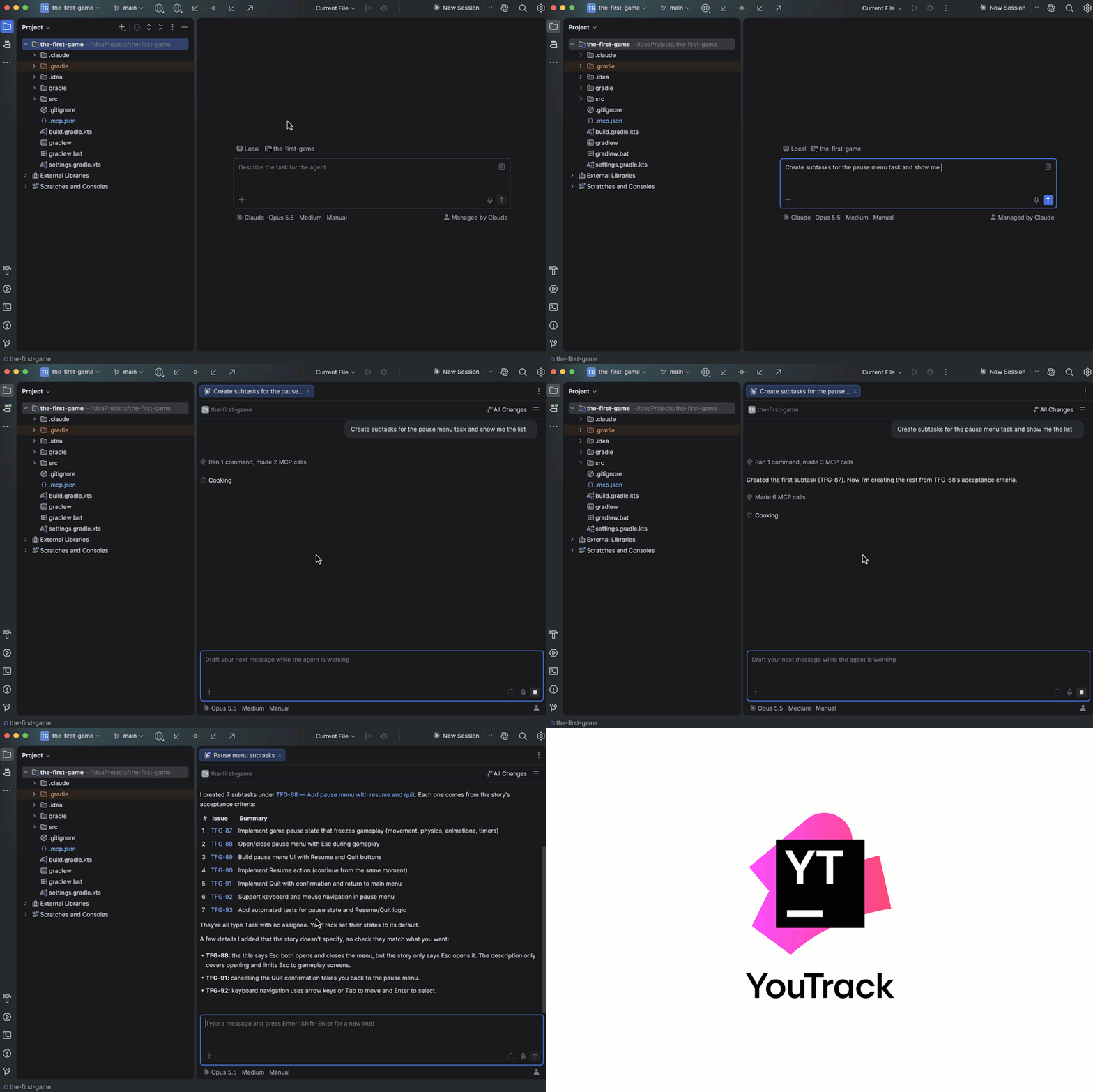
Delegating task management to coding agents is becoming a common practice, and for such teams, YouTrack evolves from automating individual processes to serving as a shared “agentic database” for agent and human-led tasks.
The Fullworks case study shows how a software company supporting 12 products, including Broadcaster, a messaging platform for UK trade businesses, has integrated agents throughout its software development lifecycle. The team connects Claude Code to YouTrack through MCP to manage development work directly from its coding tools. Its agents create and update tasks, verify release requirements, and help coordinate development across its products.
Automation platforms – n8n, Zapier, Make, OpenAI AgentKit, and others
If you rely on process automation on a platform of your choice, as a part of it, you can build agentic workflows that route requests, create and update tasks, log time, and trigger actions in YouTrack. Marketing teams, for example, can use the n8n integration to automatically turn budget requests submitted through a form into YouTrack tasks.

Beyond this example, you can integrate YouTrack into every step of your automation to update work items in response to actions from AI agents, share YouTrack content with other systems, and support a wide range of cross-tool workflows.
Workplace tools – service desks, internal portals, custom applications, and others
Your teams can work with project information through organization-level apps or internal AI assistants. You can add custom MCP actions with YouTrack apps or build automation using workflows and API-based scripts – in-house or with help from one of the YouTrack consulting partners.
This approach can scale to meet the needs of large enterprise customers. For example, Gurtam develops telematics and IoT platforms for B2B customers and operates in more than 160 countries. The team connected its internal AI platform, Nova, to YouTrack MCP. Managers and employees now use AI agents to create structured tasks, review feature requests, monitor backlogs, prepare changelogs, and turn meeting notes into actionable work.
Choose the right connection method
How you connect depends on what the tool supports. YouTrack supports OAuth authorization for compatible MCP clients, so users do not need to create or store permanent tokens. OAuth works with browser-based, desktop, and mobile AI applications, as well as shared organization-level services. You can also add YouTrack directly from the ChatGPT or Claude connector directory and set it up company-wide. The connection is available for ChatGPT Business, Enterprise, and Edu workspaces.
Simplify setup with CIMD
If an MCP client supports CIMD, a YouTrack administrator can allow it to register automatically. This removes most of the manual configuration and makes approved tools easier to connect.
Register an OAuth client manually
Manual registration is required when an application supports OAuth but not CIMD. This may apply to custom internal applications or AI clients that cannot register automatically.
Use a permanent token as a fallback
For local agents, custom scripts, and other tools without OAuth support, permanent-token authorization remains available. Tokens should be stored securely and are best suited to controlled local or custom integrations.
Option 2. Enhance efficiency with built-in AI assistance
The second option is our built-in AI Assistant that can handle routine work across YouTrack. Administrators have the option to manage access or disable AI entirely. Your data remains yours and is never used to train AI models, whether you choose YouTrack Cloud or Server.
Currently, AI Assistant includes a limited number of free credits, replenished weekly. It is available to YouTrack Cloud customers, including teams on the free plan, and to YouTrack Server customers using the free plan or an active paid subscription.
When Ask YouTrack and BYOK are introduced in Q4 2026, AI access will change:
- Free AI Assistant credits will be included only with paid YouTrack Cloud plans.
- Paid credits will be available through a connected JetBrains AI subscription to YouTrack Cloud and Server customers on free plans or with active paid subscriptions.
- BYOK will also be available to YouTrack Cloud and Server customers on free plans or with active paid subscriptions.
Text-to-issue transformation
Scan selected text for action items, choose which ones to turn into tasks, and create them together.
Writing assistance
Check grammar, spelling, and punctuation in tasks, articles, support tickets, and comments. Get phrase suggestions while writing in English or German.
The built-in YouTrack writing assistant is powered by JetBrains AI and will continue to run exclusively on JetBrains infrastructure.
Effortless summaries with AI
Generate concise summaries of project tasks, articles, and support tickets, regardless of the discussion length or language.
Reply suggestions
Generate context-aware replies, including general responses, apologies, or requests for more time. Use the suggested text as written or edit it before posting.
Text recognition from images
Extract editable and searchable text from screenshots, document photos, and other image attachments. YouTrack can also include images containing matching text in search results.
The text recognition feature doesn’t require a connection to external services. For YouTrack Cloud, processing takes place on JetBrains infrastructure, while for YouTrack Server, it runs within your local environment.
Coming soon: Ask YouTrack and BYOK
Ask YouTrack, a built-in agentic AI chat, is planned for Q4 2026. It works with your current YouTrack context: Search through prompts, ask it about your projects, get answers in chat, understand the state of work, create tasks, and propose updates for your review.
We plan to add BYOK (Bring Your Own Key) support, so you can connect your own AI providers and use the LLM of your choice – in line with your company’s policies and budget.

Coming soon: Task creation from Slack threads
For teams that use Slack for everyday collaboration, we also plan to add a new AI-powered feature available in the YouTrack Slack app in Q4 2026 that lets you create a task from a thread. You’ll be able to automatically turn a conversation in your team channel into a task, or add instructions along the way to specify what it should include.

Option 3. Experience high-quality project management without AI
YouTrack’s core functionality does not depend on AI. Administrators can disable AI features entirely. Teams with strict AI policies can plan projects, track tasks on Agile boards and Gantt charts, maintain documentation in the Knowledge Base, and manage customer or internal requests in Helpdesk – all without AI anywhere in their workflow.
Server or Cloud – your choice!
For greater control over your infrastructure and data, you can choose YouTrack Server. It scales to hundreds of thousands of users, supports GDPR and SOC 2 compliance, integrates with existing identity systems, and provides real-time monitoring.
YouTrack Cloud is hosted and maintained by JetBrains, with a choice of AWS regions in Northern California, Frankfurt, Ireland, and Singapore. Both versions offer the same functionality, with AI on your terms, whichever you choose.
Save up to 70% compared with Jira and Confluence
Whether or not you enable AI, YouTrack’s total cost of ownership can be up to 70% lower than Jira and Confluence combined, and that’s before Atlassian’s service management and plugin costs are added.
YouTrack is free for a team of up to 10 users. YouTrack Server subscriptions start at \$900 per year for 15 users, while YouTrack Cloud starts at \$4.50 per user per month for teams of 11 or more users.
YouTrack Helpdesk includes three support agents and unlimited reporters for free. Additional agents cost \$6 per agent per month.
If you have any other questions about AI in YouTrack or migration, please share them in the comments below or get in touch with our technical support. We’re always here to help.
Your YouTrack team
AI or no AI, Server or Cloud – you choose!
CI/CD для low-code: как мы вытащили ELMA 365 из браузера в репозиторий
Feed:
Все публикации подряд на Хабре
(https://habr.com/ru/rss/articles/)
Link:
https://habr.com/ru/articles/1099476/?utm_source=habrahabr&utm_medium=rss&utm_campaign=1099476
Published: 2026-10-26 10:46:57
|
Created: 2026-10-26 10:48:59

Low-code обещает, что программировать почти не придётся. Первые полгода так и есть. Потом у вас десяток модулей, полсотни форм и человек, который вчера «чуть-чуть поправил скрипт на проде». И выясняется, что это всё-таки разработка — просто без git, без ревью и без кнопки «откатить». Рассказываю, как мы вытащили код виджетов ELMA 365 из браузера в репозиторий и на какие грабли наступили по дороге.
Читать далее8-month Iran war looms large over Israeli election
Feed:
Home - CBSNews.com
(https://www.cbsnews.com/feeds/rss/main.rss)
Published: 2026-10-28 03:48:00
|
Created: 2026-10-26 10:47:59
Israelis voted in a national election set to shape the country's next government, with the Iran war looming large over their decisions.
show more
The Guardian view on Oxford Street’s pedestrianisation: cities should be designed around people, not cars | Editorial
Feed:
The Guardian
(https://www.theguardian.com/international/rss)
Published: 2026-10-25 17:25:07
|
Created: 2026-10-26 10:47:58
The transformation of Europe’s busiest shopping street should be a case study in making cities greener, less congested and more inviting places to live
Sadiq Khan has been trying to pedestrianise Oxford Street since he first became the mayor of London in 2016. On Monday, after numerous setbacks, his plan will finally come to fruition. The busiest stretch of the nation’s famous shopping street will be closed to traffic in a scheme designed to improve the area and make it more attractive to pedestrians. It should be an emblematic case study in making cities greener, less congested, more inviting places to live and visit.
The Greater London Authority hopes it will rejuvenate a high street fallen on hard times. Since the pandemic, the number of vacant shops on Oxford Street has more than quadrupled. It estimates that the scheme will generate £82m of value a year in the area by increasing footfall and encouraging visitors to linger. This impact remains to be seen, but research from other cities suggests that shops experience higher sales once an area is pedestrianised. Given the prime minister’s focus on rejuvenating British high streets, whose dilapidation is correlated with support for Reform UK, he should be watching with interest.
Continue reading...European gas prices soar to four-year high over winter supply fears
Feed:
The Guardian
(https://www.theguardian.com/international/rss)
Published: 2026-10-26 10:35:24
|
Created: 2026-10-26 10:47:58
Jump fuelled by fears of further Middle East supply disruptions amid reports of US-Israeli plans to strike Iran
European gas prices have jumped to levels not seen since 2022 as fears continue to grow around the continent’s supply this winter and the conflict in the Middle East.
Wholesale gas prices hit €97 (£81) a megawatt-hour on Monday, as temperatures across Europe fell and traders priced in stronger demand for heating.
Continue reading...European gas prices soar to four-year high over winter supply fears
Feed:
World news | The Guardian
(https://www.theguardian.com/world/rss)
Published: 2026-10-26 10:35:24
|
Created: 2026-10-26 10:47:02
Jump fuelled by fears of further Middle East supply disruptions amid reports of US-Israeli plans to strike Iran
European gas prices have jumped to levels not seen since 2022 as fears continue to grow around the continent’s supply this winter and the conflict in the Middle East.
Wholesale gas prices hit €97 (£81) a megawatt-hour on Monday, as temperatures across Europe fell and traders priced in stronger demand for heating.
Continue reading...What to Know About Brazil’s Election and Flávio Bolsonaro’s Departure
Feed:
NYT > Top Stories
(https://rss.nytimes.com/services/xml/rss/nyt/HomePage.xml)
Published: 2026-10-28 17:31:12
|
Created: 2026-10-26 10:45:01
President Luiz Inácio Lula da Silva’s re-election ended a string of victories by right-wing candidates in Latin America. His opponent, Flávio Bolsonaro, fled Brazil for the United States.
show more
Руководство по сборке локального AI-стека. Часть 1
Feed:
Все публикации подряд на Хабре
(https://habr.com/ru/rss/articles/)
Link:
https://habr.com/ru/articles/1099472/?utm_source=habrahabr&utm_medium=rss&utm_campaign=1099472
Published: 2026-10-26 10:42:58
|
Created: 2026-10-26 10:44:58
Часть 1. План реализации запуска локальных LLM моделей на CPU. Рассматриваем коротко весь стек технологий, которые будем использовать в следующих частях. Кейс.
Читать далее35 файлов и одна кнопка, или как вытащить проект из веб-чата нейросети
Feed:
Все публикации подряд на Хабре
(https://habr.com/ru/rss/articles/)
Link:
https://habr.com/ru/articles/1099452/?utm_source=habrahabr&utm_medium=rss&utm_campaign=1099452
Published: 2026-10-26 10:44:02
|
Created: 2026-10-26 10:44:58

Некоторые веб-чаты вроде DeepSeek и Qwen не умеют отдавать бинарные файлы для скачивания. Я проверил это на практике и написал промпт, который генерирует единый HTML со встроенным ZIP-генератором на чистом JavaScript. Пользователь открывает файл в браузере офлайн, нажимает кнопку — и получает zip-архив со всей структурой директорий и файлов. Дальше его можно поместить под git, развернуть на машине или сделать что угодно ещё. Для нетерпеливых - ссылка на промпт.
Читать далееEurope’s centrist rulers have fallen dangerously short
Feed:
Latest Updates
(https://www.economist.com/latest/rss.xml)
Link:
https://www.economist.com/podcasts/2026/10/26/europes-centrist-rulers-have-fallen-dangerously-short
Published: 2026-10-26 09:48:17
|
Created: 2026-10-26 10:38:58
A handpicked article read aloud from the latest issue of The Economist
show more
LG B6 OLED TV Review (2026)
Feed:
WIRED
(https://www.wired.com/feed/rss)
Published: 2026-10-26 10:30:00
|
Created: 2026-10-26 10:37:00
The LG B6 has deep and rich blacks and a low price tag, but midrange performance elsewhere.
show more
NHS consultants to go on two-day strike in England in November
Feed:
World news | The Guardian
(https://www.theguardian.com/world/rss)
Published: 2026-10-26 18:05:16
|
Created: 2026-10-26 10:36:01
Industrial action by senior doctors to begin on 25 November with only emergency cover provided, BMA says
England’s most senior hospital doctors will strike next month in a dispute over their pay and hours, prompting NHS bosses to warn that patients will suffer “pain, discomfort and inconvenience”.
Consultant doctors, who earn an average of £152,000 a year inclusive of overtime and merit awards, will stage a two-day walkout on 25 and 26 November, as hospitals gear up for the extra pressures winter brings.
Continue reading...Exiled Opposition Leader María Corina Machado Returns to Venezuela
Feed:
TIME
(https://time.com/feed/)
Published: 2026-10-26 10:30:00
|
Created: 2026-10-26 10:35:00

“I am here. With you.”
Venezuela’s popular opposition leader and Nobel Peace Prize winner María Corina Machado posted the message on social media platform X Sunday morning local time, announcing her return to the country after more than 10 months in exile.
Machado, who was briefly detained in January 2025 following a protest against autocratic then-President Nicolás Maduro’s swearing-in despite a dubious election victory, went into hiding in Venezuela and emerged in December that year in Norway. Since then, she has been fighting for a return to democracy in her own country, demanding that, following the extraordinary American military operation that captured Maduro, Venezuelans get to have free and fair elections.
The social media accounts of her political movement, Vente Venezuela, as well as her campaign, posted images and videos of Venezuelans crowding the streets of Caracas to welcome her return. The New York Times reported that Machado entered Venezuela from Colombia, citing two anonymized government officials.
https://x.com/ConVzlaComando/status/2114539789047517605
Edmundo González Urrutia, another key opposition figure, also posted on social media Sunday that Machado is “on Venezuelan soil” and that he would soon be with her “so that our country truly advances toward freedom.”
Machado’s return adds some urgency to the country’s democratic transition—which the interim Venezuelan government under acting President Delcy Rodríguez, as well as its apparent overseer, the U.S., have both promised. Rodríguez, who was formerly Maduro’s deputy, and U.S. President Donald Trump have both said that elections will be held in the country, but a date has yet to be finalized.
The 59-year-old Machado, meanwhile, has called for elections by July 2027, telling the Financial Times that there was “more than enough time” to prepare for one. She has also said she will contest the presidency. A majority of Venezuelans want her to be President, according to a poll from AtlasIntel and Bloomberg.
Following Maduro’s ouster, Venezuela’s highest court said Rodríguez’s interim presidential appointment could last for up to 90 days, with the National Assembly potentially extending her term for another 90. But the assembly, controlled by the ruling party, did not vote on extending her term, which officially expired in April.
It remains unclear how Machado could hasten elections, given the Venezuelan government is in talks with a different U.S.-backed faction of the opposition. A third round of talks ended this month without reaching a firm election schedule. Venezuelans have since grown impatient and have taken to the streets to protest the delays.
What the U.S. has said about Machado’s return
Asked about Machado’s return to Venezuela, Trump said Sunday he was unaware of it. “I think she's a very nice woman,” Trump told reporters. “She gave me her Nobel Prize, so how can I say anything else? And I hope she’s safe.”
Machado gave Trump her Nobel medal earlier this year in what appeared to be a push to hasten Venezuela's democratic transition. But since Maduro’s arrest and the U.S. elevation of a new Venezuelan government under Rodríguez, tensions between Trump’s Administration and Machado have increased.
The opposition leader has tried to return to the country multiple times, but she has claimed Venezuelan authorities have repeatedly blocked her. Machado has denied suggestions that the U.S. was blocking her return. But her insistence on returning reportedly roiled some in the White House who worry it could spark a political crisis.
U.S. Secretary of State Marco Rubio posted on X that the conditions that allowed Machado’s return to Venezuela were “the direct result of the U.S. supported reconciliation talks which has already seen hundreds of political prisoners freed and hundreds of political opposition figures return from exile.”
But Rubio also hinted that the U.S. expects no further interference in the ongoing discussions: “The United States expects the freedoms of all sectors of Venezuelan politics to continue to be respected. Likewise, we expect all political actors to support these talks which represent the best chance Venezuela has had in thirty years to peacefully achieve not just a free and fair election but an enduring democracy.”
Machado said earlier that, despite not being a part of the discussions between the Venezuelan government, legislative opposition, and the U.S., her movement will not hinder initiatives that “produce real progress.”
The U.S. has argued that Venezuela must ensure political and economic stability before it can hold elections. But critics and other observers have pointed out that the Trump Administration’s approach has instead prioritized doing business with Venezuela over facilitating democratic transition—with Washington announcing a major oil deal with Caracas amid the talks.
“She’s a very nice woman,” Trump said of Machado Sunday. “But we’re doing really well in Venezuela.”
WATCH: Man arrested near film set
Feed:
ABC News: Top Stories
(https://abcnews.go.com/abcnews/topstories)
Published: 2026-10-26 10:35:03
|
Created: 2026-10-26 10:33:00
Police officials say a man displaying a knife was taken into custody and charged with menacing and criminal possession of a weapon.
show more
London's Oxford Street pedestrianised in 'truly momentous occasion for capital'
Feed:
The Latest News from the UK and Around the World | Sky News
(https://feeds.skynews.com/feeds/rss/home.xml)
Published: 2026-10-26 08:33:00
|
Created: 2026-10-26 10:32:57
London's Oxford Street is now traffic-free, with mayor Sadiq Khan hailing it "a truly momentous occasion for the capital".
show more
FDR made it a blue bastion – now it’s Trump’s stronghold in California. Is it forever lost?
Feed:
The Guardian
(https://www.theguardian.com/international/rss)
Published: 2026-10-25 13:00:03
|
Created: 2026-10-26 10:31:02
Shasta has embraced the Maga movement with gusto – can Democrats ever win back the rural, working-class voters they once relied upon?
A crucial election was approaching and the country was desperate. Despite promises that economic conditions were improving, nearly a quarter of the US was out of work as voters headed to the polls in 1932.
It was the darkest time since the civil war, a period so dire that in California’s capital people fought each other for work. In early 1931, a crowd of 200 men scuffled over a handful of temporary jobs moving back-breaking loads of granite, the Sacramento Bee reported.
Continue reading...How to build a police state | William Wheeler
Feed:
The Guardian
(https://www.theguardian.com/international/rss)
Link:
https://www.theguardian.com/us-news/ng-interactive/2026/oct/25/trump-bukele-el-salvador-police-state
Published: 2026-10-25 13:00:03
|
Created: 2026-10-26 10:31:01
To understand where Trump is trying to take the US, we should look to the authoritarian playbook of his favorite ally: El Salvador’s Nayib Bukele
One afternoon last year, Donald Trump welcomed “a friend” to the White House – El Salvador’s Nayib Bukele, the world’s most popular authoritarian. “I knew him as a very young man,” the US president said before the cameras. “He’s done a fantastic job. Mr President, it’s an honor to have you.”
Since March 2022, when gangs in El Salvador murdered 87 people over a weekend, Bukele has maintained a state of emergency in which key civil liberties are suspended and 2% of the adult population has been jailed – about 100,000 people, at least half of whom are probably not gang members, say local rights groups. The narrative of “the Bukele miracle” – that he swiftly dismantled fearsome gangs and restored order – has made him an icon across Latin America, where a new host of rightwing leaders have sought to replicate his heavy-handed tactics. And in the US, Bukele’s overnight success as a strongman has made him a hero of the American right.
Continue reading...I thought testing bread makers would be easy. 36 loaves later, I may have lost the plot
Feed:
The Guardian
(https://www.theguardian.com/international/rss)
Published: 2026-10-26 10:24:22
|
Created: 2026-10-26 10:31:01
Our tester pushed her love of bread, and freezer space, to the limit in pursuit of the perfect homemade loaf. Plus, the best Kindles for every budget
• Don’t get the Filter delivered to your inbox? Sign up here
How much bread is too much bread? I found myself wondering this while testing nine of the best bread makers for the Filter. You see, while one hot, crusty loaf is a cause for celebration, 36 feels like a cry for help.
Because yes, that really is how many loaves I made to rigorously test these machines. The number might even be closer to 45 if you count the weird experiments and loaves that collapsed due to user error. As you succumb to flour-induced delusions, at some point you begin to lose count.
How I Shop with Bill Bailey: ‘Could be a life-saver in an apocalypse’
The best Kindles for every bookworm and budget – tested
The best gifts for nine-year-olds, picked by nine-year-olds and parents
‘Outrageously good’: the best (and worst) supermarket ready-made custard, tasted and rated
Continue reading...Stephen Fry: ‘Sherlock Holmes altered the course of my whole life’
Feed:
The Guardian
(https://www.theguardian.com/international/rss)
Published: 2026-10-25 12:00:02
|
Created: 2026-10-26 10:31:00
Nearly a hundred years after Arthur Conan Doyle’s last Sherlock Holmes story, the writer and broadcaster unravels the mystery of the detective’s enduring appeal
It has become quite the fashion for contemporary writers to have a go at reinventing past classics. We’ve seen it done with imperishable literary heroes like Bond, Jeeves, Poirot and Winnie-the-Pooh. This is a relatively new phenomenon. But not in the case of Sherlock Holmes, where the practice is almost as old as the man himself.
Sherlock Holmes was the conception of Arthur Conan Doyle, a Scottish doctor down on his luck who had turned his hand to fiction to make up for a worrying lack of success in attracting patients to his surgery. Conan Doyle could never have guessed that the first Sherlock Holmes story he wrote, A Study in Scarlet, published in the 1887 issue of Beeton’s Christmas Annual, would in a few years propel him and the characters he created to literary fame. The personalities and characteristics of Holmes and Watson became as familiar to late Victorians as their own friends and families. The readership was worldwide and spread across all ages and classes.
Continue reading...NHS consultants to go on two-day strike in England in November, says BMA
Feed:
The Guardian
(https://www.theguardian.com/international/rss)
Published: 2026-10-26 13:33:11
|
Created: 2026-10-26 10:30:59
Industrial action by senior doctors to begin on 25 November with only emergency cover provided, union says
England’s most senior hospital doctors will strike next month in a dispute over their pay and hours, prompting NHS bosses to warn that patients will suffer “pain, discomfort and inconvenience”.
Consultant doctors, who currently earn an average of £152,000 a year, will stage a two-day walkout on 25 and 26 November, as hospitals gear up for the extra pressures winter brings.
Continue reading...Kafka и ребалансинг: что можно сделать до возникновения проблемы
Feed:
Все публикации подряд на Хабре
(https://habr.com/ru/rss/articles/)
Published: 2026-10-26 10:28:23
|
Created: 2026-10-26 10:29:58

Ребалансинг в Kafka — не самая популярная и местами не самая понятная тема. Обычно о нём вспоминают только тогда, когда consumer начинает отставать, обработка останавливается, а группа уходит в бесконечные ребалансы.
В этой статье попробую простым языком разобраться, почему это происходит, какие проблемы могут к этому привести и что можно сделать, чтобы минимизировать частые ребалансировки.
Узнать большеJapan indicts U.S. Marine on murder charge over woman's killing
Feed:
Home - CBSNews.com
(https://www.cbsnews.com/feeds/rss/main.rss)
Published: 2026-10-26 11:13:09
|
Created: 2026-10-26 10:29:00
Police arrested Lance Cpl. Devin Jacob Ballard, 20, on suspicion of strangling Anna Yagi, 39, at a hotel.
show more
WATCH: School janitor gets special honor in tearful ceremony
Feed:
ABC News: Top Stories
(https://abcnews.go.com/abcnews/topstories)
Published: 2026-10-26 11:36:02
|
Created: 2026-10-26 10:25:59
Marilyn Hampton was a custodian in the Aubrey School District in Denton County, Texas, who made her mark over the course of four decades.
show more
С Karma на Vitest: как мы обновляли unit-тесты Angular и починили Allure
Feed:
Все публикации подряд на Хабре
(https://habr.com/ru/rss/articles/)
Published: 2026-10-26 10:24:44
|
Created: 2026-10-26 10:25:58

Привет! На связи Дмитрий Чепайкин, старший Angular-разработчик в команде Klecks — платформы для разметки данных AI Центра Т-Банка.
Долгое время unit-тесты фронтенда у нас крутились на Karma + Jasmine. Схема работала, пайплайн зеленый, переписывать «ради моды» не хотелось. Но в какой-то момент Karma официально признали deprecated, а корректная отгрузка отчетов в Allure перестала быть чем-то, на что можно положиться. Расскажу, как мы выбирали замену, почему сначала смотрели на Jest, а в итоге приняли Vitest — и как устроен итоговый сетап.
Читать далееWoman, 93, outwits scammer, helps get him arrested, police say
Feed:
Home - CBSNews.com
(https://www.cbsnews.com/feeds/rss/main.rss)
Published: 2026-10-26 10:22:44
|
Created: 2026-10-26 10:24:06
A 93-year-old woman in western Japan outsmarted a suspected scammer by pretending to fall for the scheme and helping police arrest him at her home, an officer said.
show more
[Перевод] Топ-10 ИИ-гаджетов: умные кулоны, кольца и карманные ассистенты
Feed:
Все публикации подряд на Хабре
(https://habr.com/ru/rss/articles/)
Published: 2026-10-26 10:20:42
|
Created: 2026-10-26 10:22:59

После встречи остаются новая дата, несколько обещаний и фамилия, которую никто не записал. Носимые ИИ-гаджеты предлагают сохранять такие детали автоматически: микрофон собирает речь, приложение превращает её в текст, а модель выделяет договорённости и задачи. Другие устройства предназначены для коротких голосовых заметок или общения с виртуальным собеседником.
Читать далееSenior doctors to strike for two days in November
Feed:
The Latest News from the UK and Around the World | Sky News
(https://feeds.skynews.com/feeds/rss/home.xml)
Link:
https://news.sky.com/story/senior-doctors-in-england-to-strike-for-two-days-in-november-13603895
Published: 2026-10-26 08:12:00
|
Created: 2026-10-26 10:22:57
Senior doctors in England plan to go on strike for two days in November over pay, the British Medical Association (BMA) has said.
show more
Sharon Osbourne: 'I visit Ozzy's grave every day'
Feed:
BBC News
(http://feeds.bbci.co.uk/news/rss.xml)
Published: 2026-10-26 01:40:39
|
Created: 2026-10-26 10:16:58
The TV presenter says she can see Ozzy's burial site from her window, and regularly talks to him.
show more
Consultant doctors in England to strike next month
Feed:
BBC News
(http://feeds.bbci.co.uk/news/rss.xml)
Published: 2026-10-26 11:45:48
|
Created: 2026-10-26 10:16:58
Senior doctors to stage 48-hour walkout, beginning on 25 November, in dispute over pay and pensions.
show more
Sudan paramilitary drone strikes cause mass power cuts in eastern states
Feed:
The Guardian
(https://www.theguardian.com/international/rss)
Published: 2026-10-26 09:59:27
|
Created: 2026-10-26 10:14:59
Rapid Support Forces strike five power stations in three states controlled by Sudanese army
Sudan’s paramilitary Rapid Support Forces have launched a coordinated drone attack against five power stations, causing mass power outages across the country’s east, a government official said.
The drones hit two power stations each in the states of Al-Jazira and Gedaref and one in White Nile state, “resulting in power outages across large parts of these three states”, the official said on condition of anonymity.
Continue reading...Trump rallies for Mike Rogers – and Nicki Minaj’s derriere – in Michigan
Feed:
The Guardian
(https://www.theguardian.com/international/rss)
Published: 2026-10-25 22:36:59
|
Created: 2026-10-26 10:14:59
Trump again congratulated Ohio senator’s rear end before his cheeky comment about rapper being ‘hard to miss’
Donald Trump reiterated his apparent love for buxom bums during a rally in Michigan on Sunday where he encouraged the crowd to compliment rapper Nicki Minaj’s behind.
Trump’s cheeky comments about Minaj’s derriere came as he explained his recent observation on the Republican Ohio senator Jon Husted’s rear end. Earlier in October, Trump said of the former college football player: “I don’t do this with men very often. I started examining his body, because I didn’t know he was a great athlete. And I looked and I watched up and down. I looked at his ass and I looked at the whole – and then I looked at his hands. Look at his hands. He’s got these, like, claws.
Continue reading...The “let-it-rip” camp is wrong on AI
Feed:
Latest Updates
(https://www.economist.com/latest/rss.xml)
Published: 2026-10-26 10:04:08
|
Created: 2026-10-26 10:14:58
They make four main arguments and all of them are flawed, write Bridgewater’s Nir Bar Dea and Greg Jensen
show more
‘Zero-energy companionship’: bizarre hobby takes seed among China’s stressed young adults
Feed:
The Guardian
(https://www.theguardian.com/international/rss)
Published: 2026-10-26 09:47:14
|
Created: 2026-10-26 10:14:58
Faced with a stagnant jobs market, many are spurning children or pets in favour of ‘raising bricks’
Young adults in China looking for a cheaper, low-maintenance alternative to having children or pets have found an answer: raising bricks.
Bricks may not be as cuddly as cats or as life-affirming as human offspring, but they also cost next to nothing. “No cats, no dating, I started raising a brick,” wrote one brick parent on social media.
Continue reading...[Перевод] От Apache 1.3 до Cloudflare: эволюция самого известного домена в интернете
Feed:
Все публикации подряд на Хабре
(https://habr.com/ru/rss/articles/)
Published: 2026-10-26 10:11:37
|
Created: 2026-10-26 10:12:58

Выполните curl -I https://example.com прямо сейчас. В ответе вы увидите server: cloudflare и cf-ray — домен, который мы все используем для примеров кода, работает за одним из крупнейших CDN в мире.
Но так было не всегда. В 2002 году example.com отдавался с Apache 1.3.22 на Red Hat Linux, а в 2013-м переехал на EdgeCast CDN. За последние 25 лет домен сменил несколько инфраструктурных провайдеров и пережил множество оптимизаций.
Давайте посмотрим, как менялась архитектура example.com и какие технические решения стоят за этими изменениями.
Chabria: California votes. Trump's Justice Department panics
Feed:
World & Nation
(https://www.latimes.com/world-nation/rss2.0.xml)
Published: 2026-10-26 10:00:00
|
Created: 2026-10-26 10:11:59
Lawyers for the Justice Department managed to get a three-judge panel to convene a rare emergency hearing on Sunday.
News Analysis: Trump says he's trying to entice Russia to negotiate. It doesn't appear to be working
Feed:
World & Nation
(https://www.latimes.com/world-nation/rss2.0.xml)
Published: 2026-10-26 10:00:00
|
Created: 2026-10-26 10:11:59
Trump's break from long-standing tradition in U.S.-Russia relations was real, but it should not have been entirely surprising.
Page 248 of 2138 (106880 total items)
Recent Feeds
Все публикации подряд на Хабре
NYT > Top Stories
World news | The Guardian
Vox
BBC News
The Guardian
NPR Topics: News
Home - CBSNews.com
Latest Updates
TIME
WSJ.com: World News
WIRED
ABC News: Top Stories
NBC News Top Stories
World
BBC News
BBC Russian
The Latest News from the UK and Around the World | Sky News
TechCrunch
PostgreSQL news