Есть удивительная вещь. Человек может двадцать лет получать зарплату и каждый месяц тратить почти всё, что заработал. И это почему-то не кажется ему рискованным.
В следующем месяце будет следующая зарплата. Потом ещё одна. А если зарплата станет больше — можно будет больше тратить. Так проходят годы, иногда десятилетия. При этом предложение регулярно откладывать небольшую часть дохода и постепенно превращать её в капитал почему-то воспринимается совсем иначе:
— Что откладывать, если и так мало денег.
— Биржа - это казино, управляемое жуликами!
— Скоро всё изменится, и акции будут стоить ноль!
— Рынок вот-вот рухнет!
Да, рынок упадёт.
Обязательно.
Недвижимость тоже когда-нибудь подешевеет. Золото может годами стоить дешевле, чем хотелось бы его владельцу. Валюта может обесцениться. Банк может обанкротиться, а государство может поднять налоги. И вообще, будущее имеет неприятную привычку не спрашивать нашего мнения.
Именно поэтому я инвестирую. Не потому, что знаю, что будет. А потому, что не знаю.
During the 1990s, a new strata of independent film studios and distributors revitalised the Hollywood movie machine. The likes of Miramax, New Line Cinema and October Films challenged the ageing behemoths of the industry and pushed forward offbeat directors such as Quentin Tarantino, Darren Aronofsky and Jane Campion. The decade is widely considered an artistic high point for western cinema after the bloated mainstream excesses of the 1980s. Could something similar now be happening in games?
Certainly, we have a comparable setup. The big players of the games business are in various states of creative disarray: Electronic Arts (EA) has been bought out by a Saudi-led consortium, which is likely to lead to more cautious, hit-driven decisions; Microsoft bought Activision and Bethesda and then ordered waves of redundancies; Ubisoft has cancelled several titles and is posting big losses. Those companies are also facing rising development costs, so they’re circling the wagons, focusing on legacy brands and freezing recruitment. It’s hard to imagine any left-field works of genius emerging from this imaginative quagmire.
Atlassian recently announced that they are suspending sales for Data Center Products, followed by the end of life for those products in 2029. Additionally, this August, Atlassian began using certain customer data to improve its AI experiences. In light of these changes, switching to an alternative solution has become a priority for many organizations.
Around 70% of the customer projects currently discussed by the YouTrack team and our consulting partners involve migrating to YouTrack. Organizations are looking for a long-term, self-hosted alternative to their current setup, a cost-effective solution to bring projects, a Knowledge Base, and a Helpdesk together, or greater control over how AI fits into their work.
In this guide, we’ll share practical advice for migrating from Jira, Confluence, and Jira Service Management to YouTrack. You’ll also learn from real customer experiences and see how our consulting partners can support your migration with a free demo, proof of concept, and expert guidance.
We’ll walk you through how your Jira, Confluence, and Jira Service Management setup can be imported and migrated to YouTrack. If you’re migrating from another project management system, or even from chats, emails, Excel, or Google Sheets, the same general steps can help you plan the process.
YouTrack lets your team choose between Server and Cloud, depending on how you want to host and manage your data. Regardless of team size, the core functionality is almost identical across both versions.
With YouTrack Server, you host the data on your own server, ensuring a greater degree of control. If you want to know whether this is a good choice for your organization, you can consult the general technical requirements for larger installations, or our Support team will be happy to advise you. With YouTrack Cloud, you select from the available Amazon Web Services (AWS) regions: Northern California, Frankfurt, Ireland, and Singapore.
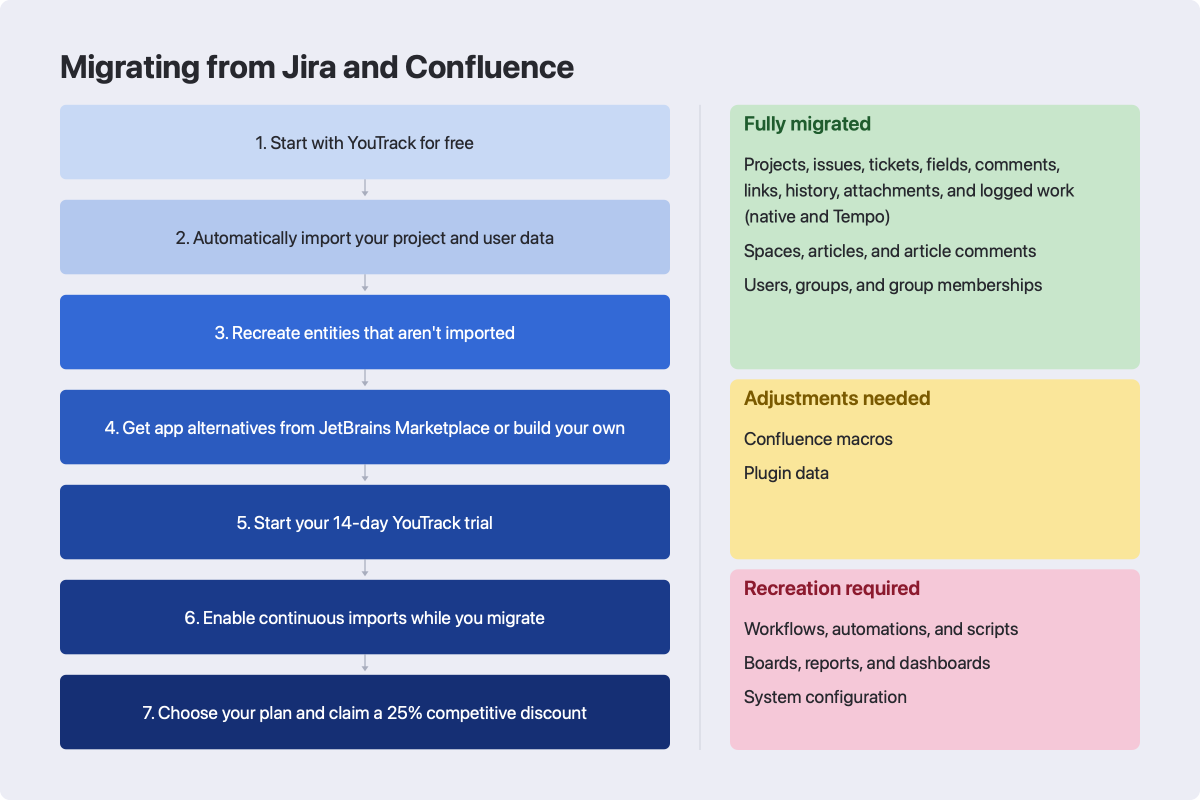
Here’s a brief overview of the steps you should take once you’re ready to start your migration:
Get started with YouTrack for free.
Use the built-in import wizard to automatically migrate your project and user data from Jira, Confluence, Jira Service Management, Asana, ClickUp, monday.com, or other tools.
Recreate entities that aren’t automatically imported, for example, boards, reports, dashboards, or SLA policies for helpdesk projects.
If your team relies on Atlassian Marketplace apps (formerly known as plugins), assess your needs before migrating. Some capabilities may be available in YouTrack out of the box or through similar apps from JetBrains Marketplace. Recreate the rest with custom workflows or apps built either in-house or with a YouTrack consulting partner.
Try YouTrack with an extended team in your company, taking advantage of a 14-day free trial that allows up to 100 users on YouTrack Cloud or 10,000 users on YouTrack Server.
Enable continuous import from Jira, Confluence, and other supported tools, so your team can use them in parallel during the free trial. Previously imported tasks will be automatically updated in YouTrack.
When you’re ready to start using YouTrack with a team of more than 10 members, choose your paid option, and apply for a 25% discount when migrating from Jira Software or another competitive tool.
If you get stuck at any point along the journey, our team and partners will be happy to help.
Check out the detailed migration guide in the YouTrack documentation (Cloud or Server).
Connect with YouTrack certified consulting partners for a free demo or a proof of concept for your migration project.
Estimate your migration steps with a practical migration whitepaper from our trusted partner twenty20.
What it takes to migrate: A step-by-step guide
For many teams considering a switch from the Atlassian stack, one of the key reasons was the announced end of Data Center sales and the end of support on March 28, 2029. After that date, impacted products will become read-only and receive no product updates or security fixes, increasing compliance risks and dependence on legacy systems.
Some teams are also concerned about Atlassian’s growing reliance on AI and its updated data contribution practices, effective August 17, 2026. De-identified and aggregated customer data may now be used to improve Atlassian’s AI experiences, with opt-out options varying by plan. A full opt-out is available only with Enterprise, requiring customers on lower-tier plans to upgrade.
With YouTrack, you choose between Server and Cloud and decide how AI fits into your work. Let’s walk through the migration steps and address the questions our customers often raise along the way.
Step 1. Choose your YouTrack version and start for free
Server or Cloud – YouTrack your way!
Choose between YouTrack Cloud, hosted by us, or YouTrack Server, installed on your own infrastructure. While Atlassian is shifting its customers toward its cloud platform, YouTrack Server remains fully supported. We feel a deep sense of responsibility toward customers who choose YouTrack Server and want to help teams of all sizes – from 10 users to thousands – keep their data and infrastructure under their own control.
If you have never used YouTrack, we recommend starting with YouTrack Cloud to get your instance set up quickly. It only takes about 2 minutes, and your team can migrate to Server with all the data from your Cloud instance at any time. Regardless of the version you choose, the functionality will be identical, so you’ll get a good sense of how YouTrack can be adapted to your needs.
AI or no AI – your choice!
YouTrack does not require your team to adopt AI. Administrators control which AI-powered capabilities are available, while individual users select the assistance they need. Depending on your requirements, you can:
Connect your preferred AI tools, IDEs, agents, and workplace apps through the remote MCP server, allowing them to work with your organization’s project context.
Use free built-in AI Assistance to create tasks, summarize content, and draft replies.
Keep AI turned off and continue using YouTrack without it, in line with your organization’s data-governance policy.
Start for free and scale on the go at a price you’ll love
Both YouTrack Cloud and Server are always free for teams of up to 10 users, so you don’t need to worry about budgeting for your pilot migration project.
When you need to invite an extended team to your pilot project, you can switch to a free YouTrack trial plan. The Cloud trial allows for up to 100 users for 14 days, and with a Server trial, you can have up to 10,000 users for 60 days.
You can switch to a paid subscription from the free plan or a trial at any time, and continue working with all your projects’ data. YouTrack Cloud offers flexible per-user monthly or annual subscriptions, and YouTrack Server uses an annual subscription model with user packs of 15, 25, 50, 100, 250, 500, or more users, including 1 year of upgrades and support. The result of this model is a savings in cost of ownership up to 80% compared to Jira and Confluence.
YouTrack brings projects, Knowledge Base, and Helpdesk together in one solution, so teams can manage work, document knowledge, and handle B2B customer support or internal service desk without switching tools. You no longer have to juggle multiple Atlassian products.
With YouTrack’s import wizard, you can migrate issues, tasks, and tickets from Jira, GitHub, GitLab, Mantis, Redmine, Bugzilla, ClickUp, Asana, monday.com, and Zendesk, as well as migrate tasks and projects from one YouTrack instance to another.
For other systems, you can first export your data to a CSV or XLSX table and then import it via Google Sheets. You can also customize one of the existing scripts or create a new one from scratch to import data to YouTrack from an external source.
A full history of commit messages and pull requests from TeamCity, GitHub, GitLab, Bitbucket Cloud, and other version control systems can also be added to imported YouTrack issues via an integration with your VCS.
YouTrack can be configured to import continuously from Jira, Confluence, GitHub, and other tools. When continuous import is enabled, YouTrack checks the connected Jira or GitHub instance for changes in the imported projects every 10 minutes. Issues that have been added or updated since the previous check are imported and updated in YouTrack.
Import from Jira
YouTrack’s Jira import wizard will get all your teams on board. Users, groups with memberships, and the activity history of all users will be automatically imported to your new YouTrack instance. For example, you would be able to see which user was assigned to a task or who left comments when the team was working on it in Jira.
You also won’t lose progress on your work, as all projects will be imported to YouTrack along with their related tasks. Every imported task would have the same content, including attachments and comments, custom fields, and issue links.
What will be fully migrated?
YouTrack’s import wizard allows you to migrate the following data from Jira into YouTrack:
Projects.
Users and their group memberships.
Issues in the projects, along with their custom fields, comments, attachments, and history data.
Links between issues.
Labels, which become tags in YouTrack.
Logged work time, including work logs from Jira’s native time tracking and supported Tempo work log data.
Import from Confluence
Your Confluence setup can be migrated to YouTrack’s Knowledge Base with the Confluence import wizard. You can transfer users and groups, spaces (projects in YouTrack), pages (articles in YouTrack), page labels (tags in YouTrack), comments, and attachments.
Confluence macros may require extra review after import, especially if your team uses them for dynamic content or custom page structures. You can prepare your content in advance or adjust the import script so that migrated articles better fit YouTrack Knowledge Base’s Markdown.
Jira Service Management import
YouTrack Helpdesk can be an alternative to your Jira Service Management solution. YouTrack’s Jira Service Management import wizard offers a similar experience to the Jira import wizard, allowing you to migrate your tickets. Simply choose the necessary ITSM projects while setting up the import, and they will be migrated to YouTrack as helpdesk projects.
All your existing service projects and related tickets, with their content, history, custom fields, and ticket links, are automatically imported – along with agent, user, and reporter data. Later, you can finalize each helpdesk project setup by reconfiguring non-imported project entities, like channels and SLA policies.
Migrate your projects – one at a time or all at once
When using the import wizards, you can choose the project you want to import first, as well as whether to migrate the data to an existing YouTrack project or create a new one. We recommend beginning with a small import test. Import a pair of projects, one that is relatively basic and another that has more complexity.
When you’ve assessed the results, you can decide on the full scope of your project import. After the initial import, you can use the continuous import to transfer any subsequent changes.
Step 3. Finish setting up YouTrack
Re-create entities that are not migrated automatically
After you’ve finished importing your data to YouTrack, you’ll see that some entities were not migrated with the import wizard. This is why we recommend estimating the scope of your migration before you start, so you can identify what may need to be adjusted or recreated manually in YouTrack.
Boards, reports, and dashboards
Filters, boards, dashboards, roadmaps, and reports are implemented differently in YouTrack and can’t be mapped one-to-one from Jira. You can recreate them manually and adapt them to the way your teams are used to working.
Automation and workflows
Jira automations can be recreated with YouTrack workflows, while Jira workflows can often be rebuilt with state-machine rules that define how tasks move between statuses.
If you use ScriptRunner or another script-based tool to automate complex business processes, you can recreate these automations as YouTrack workflows in JavaScript. For simpler use cases, the YouTrack Workflow Constructor provides a no-code, drag-and-drop interface with predefined conditions and actions.
Go deeper with YouTrack customization
Replace the Jira app ecosystem with YouTrack apps
If your team relies heavily on Atlassian Marketplace apps, formerly known as plugins, JetBrains Marketplace offers a growing selection of alternatives for YouTrack, most of which are available for free.
You can look for a matching YouTrack app on JetBrains Marketplace, build your own, or work with a consulting partner to recreate the functionality your team needs. Our partners specialize in creating high-quality apps for specific customer scenarios, helping ensure that your add-ons can be supported long term.
For teams that want to build apps in-house, YouTrack provides developer tooling for JavaScript and TypeScript that can fit into modern development workflows, including AI-powered ones. Here’s what YouTrack app creators say:
“Building apps for YouTrack requires detailed knowledge of the YouTrack API and architectural planning, plus general technical understanding, but not necessarily deep programming knowledge. As a vibe coder, I managed to do most of this myself with some support from developers, and many tasks can be handled with Cursor, Windsurf, Junie, or other coding agents.”
Julian RadünzTeam Lead, Professional Services, MSP AG
Customize the YouTrack UI with apps
UI customization may also be part of your migration scope. With YouTrack apps, you can add custom widgets to issues, tickets, articles, and dashboards, or create new pages that are accessible from the main menu or project pages. For example, you can build a new page for your company intranet or add custom task buttons to support approval processes.
Set up user notifications
Notifications work differently in YouTrack. If your team currently uses Jira project-level subscription schemes managed by an admin, keep in mind that each YouTrack user manages a personal notification center. Include notification setup in your onboarding so everyone stays informed.
Configure your user authentication methods
The final setup step is to configure how users log in to YouTrack. This is usually a quick task for administrators, as YouTrack can connect to the identity systems your team already uses for Jira, Confluence, or other tools. YouTrack provides native authentication modules for OAuth 2.0, SAML, LDAP, OpenID, and other third-party authentication methods, plus two-factor authentication where needed.
Migration stories from YouTrack customers
Every migration is different, and real customer stories can make the process easier to evaluate. These stories show why teams chose YouTrack and how they approached the process, from a company building marketing automation for major retail brands to a smaller development team of 10.
From Jira and Confluence to the self-hosted YouTrack Server
MSP AG offers integrated marketing software solutions and IT operations for major European retail customers, including REWE and Hagebau. The team used Jira and Confluence for customer projects for 10 years, but they began looking for an alternative after Atlassian discontinued Jira Server. They selected YouTrack for its lower maintenance effort and on-premises deployment option.
They migrated to YouTrack Server in phases over several months using the Jira import wizard, filling any gaps through manual configuration and self-built apps. The team later replaced Confluence with YouTrack Knowledge Base, cleaning up page formats and migrating one space per day over a few months. Today, all departments, including development, project management, and both B2B and B2C support, work in a single YouTrack instance.
From Jira and Freshdesk to YouTrack for development and their helpdesk
Fullworks builds and supports WordPress plugins for events, security, and payments, and recently launched a new SaaS business, Broadcaster. Before YouTrack, the team used Jira for development management and Freshdesk for plugin support. With hundreds of thousands of reporters, including plugin users and premium customers, support requests often turned into development tasks, forcing work to move between separate tools.
YouTrack gave Fullworks one place for issue tracking and external customer support with YouTrack Helpdesk, where they used the free plan for up to 10 users, 3 support agents, and unlimited reporters. The team also connected YouTrack to its AI-powered workflows through the remote MCP server, allowing Claude Code to create, update, and close tasks as part of their software development lifecycle.
Get support for complex migrations from YouTrack consulting partners
For larger organizations, migrating from the Atlassian stack often requires extensive planning. Certified YouTrack consulting partners have hands-on experience helping teams make the transition as smooth as possible.
Our partner network covers different regions and industries, so we can connect you with a partner that fits your location and use case. They can prepare a proof of concept, create custom apps to replace Jira plugins, and help your team avoid common migration pitfalls.
If your team uses Jira or Confluence and is considering a migration in the near future, you may want to start with a practical self-guided assessment. Our consulting partner twenty20 has prepared a whitepaper that covers common questions teams face during the switch to YouTrack. It gives an honest overview of what YouTrack can replace and includes a checklist for planning the necessary migration steps from the beginning.
The whitepaper is available in English and German on the twenty20 website. You can also contact them directly with questions about your migration.
If you have any other questions about migrating to YouTrack, please share them in the comments below or get in touch with our technical support. We’re always here to help!
Пара new в горячем методе может вообще не попасть в кучу — а после безобидного if внезапно вернуть аллокации обратно. Разбираемся, как C2 принимает такие решения, где ломается скалярная замена и как проверить всё это через JMH и диагностические флаги JVM.
Monique Ngock starred as Cameroon triumphed for the first time in a tournament of compelling surprises, even if crowd figures disappointed
Cameroon became only the fourth country to lift the Women’s Africa Cup of Nations (Wafcon) title following Nigeria, Equatorial Guinea and South Africa, and only the third to have both a men’s and women’s continental champion, after a 3-0 win over Malawi in Rabat last weekend. The result was significant for several reasons, not least because it gave the competition a new winner after the former champions Nigeria and South Africa were eliminated in the quarter-finals to mark a changing of the guard in the African women’s game.
It is worth remembering that Cameroon did not directly qualify for this edition of the Wafcon and were only added when the tournament was expanded to 16 teams last November. That gave them the opportunity to compete, but almost no one would have picked them as champions based on reputation and results. Cameroon had not reached a Wafcon final in a decade and had never even scored a goal in the final, but had three before half-time against a Malawi side that seemed destined to complete a fairytale.
The move from an architect of Ukraine’s drone program is a remarkably direct challenge to President Volodymyr Zelensky’s authority and may test Ukrainian unity.
Incumbent Dan S Sullivan, the US senator, advanced in Alaska’s non-partisan primary race for his seat on Tuesday alongside Mary Peltola, a former Democratic congresswoman.
With the top four candidates moving forward from Alaska’s open primaries to the general election, the Associated Press reported that Sullivan and Peltola had qualified for November’s general election.
Rightwing populist’s inconsistent positions on Europe and Russia suggest he is testing how far he can push partners and electorate
One evening nine years ago in the Bulgarian town of Balgari, a Brazilian tourist approached the casually dressed, middle-aged man surrounded by bodyguards, bystanders and photographers. “Why are you important?” she asked. “I’m not so important,” he replied. She repeated the question and he admitted: “I’m the president.”
Now, in 2026, the rightwing populist Rumen Radev is no longer the president, but the prime minister – the more powerful of the two positions – after his Progressive Bulgaria party secured an overwhelming majority in April’s election. While many in Europe breathed a sigh of relief that month at the demise of Viktor Orbán in Hungary, others wondered if Radev would become the EU’s next disruptor-in-chief.
‘Bag of medication’ found where Hayden Panettiere died, police report says Panettiere’s on-again, off-again boyfriend Brian Hickerson and his brother were at the scene when police arrived, according to the report. Her mother also spoke exclusively with NBC News about Hickerson. NBC News’ Steve Patterson reports.
Обычно он просто постепенно перестаёт соответствовать проекту: переименовали команду, перенесли файл, удалили .env.example, сменили package manager — а инструкция осталась прежней.
В итоге новый пользователь копирует команду из README и получает ошибку. Разработчик же часто узнаёт об устаревшей документации только после issue, сообщения коллеги или неудачного деплоя.
Мне стало интересно: можно ли автоматически находить хотя бы часть таких расхождений, не выполняя команды из README и не отправляя исходный код в LLM?
Так появился RealityLint — open‑source CLI, который статически сверяет проверяемые утверждения из README с реальным состоянием репозитория.
Ученики начальной школы могут заучивать таблицу умножения однозначных чисел, но простого запоминания будет недостаточно, когда учитель задаст задачу на умножение трёхзначных чисел. Здесь требуется алгоритм: учеников учат выстраивать числа друг над другом и умножать каждую цифру нижнего числа на каждую цифру верхнего. На протяжении тысячелетий математики считали это самым быстрым способом умножения, пока в 1960 году 23-летний молодой человек не сделал шокирующее открытие, которое привело к загадке, остающейся неразгаданной до сих пор.
Эта загадка имеет решающее значение для всех, кто имеет отношение к цифровому миру, поскольку умножение является основополагающей операцией для компьютеров. Шифрование, робототехника, искусственный интеллект, обработка звука и практически всё остальное, чем мы заставляем заниматься кремниевые чипы, связано с умножением, причём иногда огромных чисел, умножаемых многократно. В таких масштабах даже простая операция становится «узким местом», и любое дополнительное повышение эффективности имеет глобальные экономические последствия.
Чтобы понять суть этого «узкого места», обратите внимание на то, как «школьный» алгоритм справляется с увеличением размера чисел. При умножении двух двузначных чисел выполняется четыре однозначных умножения. Если перейти к паре трёхзначных чисел, то потребуется девять однозначных умножений. Нагрузка растёт пропорционально квадрату количества разрядов (n², где n — количество разрядов в умножаемых числах). При анализе подобного алгоритма компьютерные учёные не измеряют скорость в секундах, поскольку она зависит от аппаратного обеспечения. Вместо этого они подсчитывают количество вычислительных шагов. Они также игнорируют второстепенные детали, такие как время, необходимое для переноса единицы при умножении. Когда числа становятся достаточно большими, эти низкоуровневые операции перестают иметь значение, поскольку их полностью затмевают более ресурсоёмкие операции. Информатики обозначают количество шагов с помощью так называемой нотации «большого O»: например, алгоритм, который учат в начальной школе, требует O(n²) шагов, что читается как «порядка n в квадрате». В общих чертах, если числа в два раза длиннее, для выполнения алгоритма требуется в четыре раза больше вычислительной работы. Если числа в тысячу раз длиннее, требуется в миллион (1 000 в квадрате) раз больше работы.
Right to assisted dying established for patients with conditions assessed as incurable and causing unbearable pain
Legislation granting incurably ill adults the right to assisted dying has been formally adopted in France after the text was approved by the country’s highest constitutional authority and published in the official journal.
The law, known as a law on “end of life” or “aid in dying” rather than “assisted dying” or “euthanasia”, means France joins the small group of countries including the Netherlands, Belgium, Switzerland and Canada to have legalised the practice.
Result tees up marquee race in US midterm elections, which could decide if Republicans or Democrats control Senate
Incumbent Dan S Sullivan, the US senator, advanced in Alaska’s nonpartisan primary race for his seat on Tuesday alongside Mary Peltola, a former Democratic congresswoman.
With the top four candidates moving forward from Alaska’s open primaries to the general election, the Associated Press reported that Sullivan and Peltola, had qualified for the November’s general election.
Имя пакета в реестре часто оказывается первым сигналом того, что компоненту можно доверять. Разработчик видит название вроде google-cloud-storage, opentelemetry-sdk или apache-airflow-providers-slack раньше, чем открывает исходный код, и ожидает, что знакомый префикс указывает на известный проект. В PyPI это ожидание пока ничем не подтверждено: реестр формально не связывает общее начало имени с его владельцем, поэтому любой свободный вариант может зарегистрировать посторонний пользователь.
В конце июня 2026 года в Python‑сообществе приняли PEP 752 (мы писали об этом здесь). Он предлагает закреплять за организацией не отдельные имена, а префикс и все будущие проекты, которые ему соответствуют. Если PyPI реализует этот механизм, то пакет с именем вроде «google‑cloud‑new‑service» сможет опубликовать только та организация, которой принадлежит право на этот префикс или которой разрешили пользоваться этим правом. На первый взгляд, решение очевидное. Однако общий префикс не всегда означает, что все пакеты принадлежат одному издателю. Иногда он обозначает семейство официальных библиотек, а иногда экосистему сторонних дополнений.
Меня зовут Артем Максимов, я отвечаю за аналитику продуктов в CodeScoring. Вместе с дата‑инженером Артемом Ивановым в этой статье мы разбираемся, какую проблему решает PEP 752, где проходит его граница и что нам показывает база данных CodeScoring.
Готовое решение в статье — как реализовать вход в Telegram через РФ сервисы: VK ID, Яндекс ID и MAX.
Мы оставили Telegram как удобную точку входа и канал доставки, а идентификацию вынесли в отдельные ID-сервисы. Идея простая: разделить «кто пользователь» (identity) и «куда ему слать уведомления» (channel identity). Пользователь авторизуется через VK ID, Яндекс ID или MAX, а telegram_id позже привязывается к его аккаунту исключительно для отправки ленты — не для входа.
Меня зовут Василий Миловидов, я системный архитектор в крупной компании. Мы строим обмен между сервисами на событиях: сервис меняет агрегат в PostgreSQL, в той же транзакции кладёт задачу в outbox на River, воркер публикует событие в Kafka с ключом aggregate_id.
Разбирая соседнюю задачу, я обнаружил, что эта схема не даёт гарантии, которую мы в неё заложили. Строгого порядка событий одного агрегата в ней нет, и Kafka тут ни при чём: порядок теряется раньше, на своих же воркерах.
Статья написана для моей команды, чтобы у всех была одна картина проблемы и один язык для её обсуждения. Если она пригодится кому‑то ещё, тем лучше. Отдельно я старался, чтобы текст был понятен человеку, который только начинает работать с распределёнными системами: каждый механизм я объясняю с точки зрения того, что он делает и от чего защищает.
Всё, что касается поведения River, Kafka и PostgreSQL, проверено по документации, ссылки собраны в конце. Там, где утверждение является моим выводом, а не документированным поведением, я это отмечаю отдельно.
Prosecutors in Charlie Kirk's killing pointed to an engraved bullet, arguing that its inscription shows Kirk was targeted for how the defendant perceived his politics.
Привет, Хабр! В целом, про миграцию и импортозамещение высказался уже практически каждый утюг нашей необъятной родины. Почему мы вообще снова хотим подсветить эту тему? Потому что прошло уже достаточно времени, чтобы осознать: миграция — это не просто оперативное решение проблемы, а новый подход к созданию и поддержанию ИТ-инфраструктуры. Мы в компании работаем в такой парадигме довольно давно, начали задолго до 2022 и роста популярности подобных решений, так что успели накопить достаточно опыта.
Статья носит обзщепознавательный характер и будет полезна тем, кому в целом интересны механизмы миграции ИТ-систем — и их ключевые отличия у разных вендоров в разных странах. В следующих статьях цикла мы разберем типы миграции, их алгоритмы и посмотрим на результаты тестирования, чтобы оценить их работу в реальных условиях. А пока…
Right to assisted dying established for patients with conditions assessed as incurable and causing unbearable pain
Legislation granting incurably ill adults the right to assisted dying has been formally adopted in France after the text was approved by the country’s highest constitutional authority and published in the official journal.
The law, known as a law on “end of life” or “aid in dying” rather than “assisted dying” or “euthanasia”, means France joins the small group of countries including the Netherlands, Belgium, Switzerland and Canada to have legalised the practice.
Меня зовут Роман, я работаю продактом в Альфа-Банке. В первые дни работы ко мне перешла команда разработки, которая сформировалась буквально за 2 месяца до меня. Прошлый продакт работал на 3 команды, времени на всех не хватало, поэтому команда встретила меня холодно. Как я это понял? По ретро — несмотря на то, что мы не закрывали планируемые задачи на спринт, у всех «все было хорошо» и «обсуждать нечего», а ребята больше работали как одиночки, чем как команда.
Это было что-то новое для меня, так как на прошлом месте работы команда разработки работала вместе не один год и решала многие проблемы самостоятельно. А для продакта, который взаимодействует с командой разработки кучу своего времени, а также отвечает за сроки релизов, чрезвычайно важно выстроить хорошие отношения и атмосферу доверия внутри команды.
Я начал искать как можно быстрее сплотить команду и в какой-то момент осознал, что могу скучные и вымученные ретро добавить эмоций. И решил попробовать.
President Trump has announced that the U.S. is delaying a 50% tariff on Canadian imports after reaching a deal. And, how progressive Democrats fared in Florida's primary elections yesterday.
Меня зовут ZolAnd, я - независимый инженер-разработчик embedded-систем в основном для дома и сельской усадьбы. В какой-то момент мне захотелось собрать под одной крышей разношёрстный парк ZigBee-устройств от разных производителей, работать с ним локально, без обязательной привязки к облаку, и при этом иметь возможность не только интегрировать чужие устройства, но и проектировать свои. Так появился проект ZBFun. Эта статья — про то, с какими вызовами я столкнулся, какие решения уже существуют и почему они мне не подошли, и про архитектуру, к которой я в итоге пришёл.
С чего всё началось
Задача звучала просто: хочу python-библиотеку для ZigBee на ESP32-C6. Готовой не нашлось — есть отличный esp-zigbee-lib от Espressif на C, но ничего сопоставимого на Python или MicroPython для этой платформы не было. Значит, писать самому. И тут выяснилась вторая, более фундаментальная проблема. Чтобы написать библиотеку, нужно понимать, что такое ZigBee Cluster Library (ZCL) — стандарт, который описывает, из чего вообще состоит ZigBee-устройство: кластеры, атрибуты, команды, типы данных, зависимости между ними. Официальный документ Alliance — 1213 страниц PDF, написанный для инженеров, имплементирующих стек с нуля, без какой-либо машиночитаемой версии. Ни JSON, ни XML — только текст, рассчитанный на то, что человек прочитает и перепечатает нужное руками. Дальше — хуже. Когда я стал сверять этот текст с реальными SDK и реальными устройствами, обнаружились расхождения. Причём не косметические, а такие, из-за которых устройство просто не будет работать правильно.
В прошлой статье я рассказывал о случайно попавшем ко мне образце ChainVeil - вредоносном ПО из источника, который на тот момент не был зафиксирован в публичных исследованиях.
На этот раз первым сигналом стал мой собственный supply chain‑мониторинг. Он сообщил о новом npm‑пакете plugin-react-vite. На первый взгляд это выглядело как очередной тайпсквоттинг - ничего особенно необычного.
Но я решил пойти дальше: сначала проверить метаданные пакета, затем код, затем инфраструктуру, а уже после этого попытаться понять, кто стоит за образцом и связан ли он с чем‑то уже известным.
В результате расследование ушло далеко за пределы одного package.json: от подозрительной зависимости я пришел к второму этапу размером около 30 тысяч строк, а затем - к нескольким месяцам активности, связанным пакетам, нескольким npm‑аккаунтам и уже известному кластеру.
New findings further call into question scientific judgment of current health leaders in the Trump administration
A French researcher whose work was praised by Donald Trump and Dr Mehmet Oz during the Covid-19 pandemic published hundreds of papers with “substantial” ethical and legal concerns, according to a new analysis.
An international team of scientists found concerns in 853 articles published by the Institut Hospitalo-Universitaire Méditerranée Infection, or the IHU, hundreds more than previously flagged by past investigations into work at the large research hospital. Of those, institute founder Didier Raoult was listed as co-author on 758 of them, according to one of the researchers behind the new analysis.
Move could be confirmed along with $100m US Open pot
Slams have been in dispute with players for 18 months
The grand slam tennis tournaments have agreed to establish a formal Player Advisory Council in a move aimed at defusing the row over prize money. The joint venture could be confirmed on Wednesday as part of US Tennis Association’s announcement of this year’s US Open prize money, which is expected to top $100m (£74m) for the first time.
The four slams have been in dispute for almost 18 months, with with leading players, including Jannik Sinner and Aryna Sabalenka, demanding a greater share of tournament revenues as part of a wider overhaul of the sport’s finances and operations that would also lead to the major tournaments making contributions to player welfare and offer meaningful player representation.
Bruno Fernandes and Youri Tielemans will be key to Michael Carrick’s chances of success over a full season and of healing the rift between club and fans
Guardian writers’ predicted position: 5th (NB: this is not necessarily Jamie Jackson’s prediction but the average of our writers’ tips)
Alexandria Ocasio-Cortez’s co-opting of conservative language to discuss a movement against state-sanctioned killings of Black people is damning
August has brought us a referendum on “Woke 1” – a term that reductively brands 2020’s social justice movement – as prominent liberal voices reflect on that time period with disappointing hindsight. During a recent appearance on ABC’s This Week, when asked about 2020-era demands to abolish prisons and police, Alexandria Ocasio-Cortez, the US congresswoman from New York, abandoned her previous support of the “defund the police” movement, and instead joked: “Woke 1 was crazyyyyy.”
Ocasio-Cortez, a democratic socialist, implied that the still-resounding calls for municipalities to reduce police budgets and to divert aid to poor communities were worth advocating for during the 2020 uprising, but are now “crazyyyyy”. In 2020, she noted that “a lot of people cannot fathom what an abolitionist America looks like. Tell them it looks like a suburb. Affluent white communities already live in a world where they choose to fund youth, health, housing more than they fund police.” But she has since backtracked on that idea.
Move by Years, which provides personalised meals in subscription-based service, follows recipe change
A dog food brand has recalled all of its fresh meals after reports that a recipe change may have caused some animals to develop an eye condition that, if left untreated, can lead to sight loss.
The brand Years said owners should stop feeding its fresh meals to their dogs “immediately” and also told them not to feed them to any other animal, or to donate or sell them.
A rise in lawsuits over AI use in employment decisions is raising questions about how companies hire and fire
For the last four years, Erin Kistler has applied for thousands of jobs at companies like Paypal, Microsoft and Netflix, only to find her résumé disappear into a black hole. A product manager with nearly 20 years of experience, Kistler believes she was qualified for every role, yet she never received a single interview.
Now, Kistler is suing Eightfold AI, the Silicon Valley maker of hiring software used by hundreds of companies, including those where she applied, in a class-action lawsuit. The case, filed in January in California court, is one of the first to argue that automated screening functions as an undisclosed consumer report or applicant dossier, ranking job applicants on their likelihood of success without giving them the chance to see or challenge the results, according to Kistler’s legal team.
The shelf life of fresh food delivered to your doorstep varies by as much as three days, depending on the supermarket, new consumer research has found.
Nearly 380 drivers ignored lane closures on smart motorways this year, leaving them paying fines and costs totalling more than £100,000, research found.
Andy Burnham has made unemployment a priority amid skyrocketing youth inactivity and a rapid collapse in entry-level vacancies. Economists warn the issue risks leaving a permanent scar on the economy.
Pyongyang dismissed the move to end Washington-Seoul military exercises six days early, while talking up the relationship between Kim Jong Un and President Trump.
—Photo-Illustration by TIME (Source Image: monkeybusinessimages/Getty Images)
Lizzie Post still remembers the time she walked into a party and an acquaintance greeted her with exciting news: “You had a baby!”
“Nope,” Post said.
“You got engaged!”
Nope again.
“You got married!”
“I’m going to the bar,” Post replied.
Post, co-president of the Emily Post Institute and Emily Post’s great-great-granddaughter, knew the woman meant well. She had apparently heard that something momentous had happened—it hadn’t—and cycled through three incorrect milestones trying to identify it. Fortunately, she eventually stopped guessing: a relief for everyone involved.
Life is full of faux pas, but even when you’re the one making it, you can dig your way out of social quicksand most of the time. Here’s what psychologists and etiquette experts suggest saying, plus when to stop talking.
First, take your foot out of your mouth
Your immediate reaction after saying something you regret might be to turn fire-truck red. Then comes the urge to reach for the very thing that got you into trouble in the first place: more words. People often try to explain, defend, or excuse their misfired remark, says Karina Schumann, a social psychologist and associate professor at the University of Pittsburgh who studies apologies and conflict resolution. The instinct is self-protective: They’re frantically trying to repair their image in the other person’s eyes.
“What actual repair looks like is to shift the attention to the other person,” Schumann says. “Put aside this very strong need that you have to repair your self-image, and instead think: ‘If I were on the receiving end of this, what would I need to hear?’”
Pause, acknowledge the impact of what you said, and take responsibility. She suggests phrasing it like this: “I’m sorry. I shouldn’t have assumed.” Or: “I can see that my joke was insensitive. I apologize.”
Then take a breath. More words will still be available later, should the situation require them.
Match the apology to the offense
A minor blunder and a painful faux pas shouldn’t trigger matching productions of remorse. Forget an acquaintance’s name? A quick “I’m sorry—please remind me” may be enough. Ask when someone is due when she isn’t pregnant, or make a joke that accidentally lands on a painful subject? That calls for a direct acknowledgment of the harm, without trying to laugh it off, and perhaps a longer conversation if the other person wants one.
The person responsible isn’t always the best judge of what it will take to repair the situation. Schumann points to a phenomenon researchers call the “magnitude gap”: People who cause harm tend to view it as less severe and less damaging to the relationship than the people on the receiving end do. The offender may think, I apologized; this should be over. The other person may still be wondering how the offender could fail to understand how much it hurt.
Don’t turn an apology into an autobiography
An apology doesn’t require an origin story, a director’s commentary, or a guided tour of everything happening inside the offender’s head.
“Blame is like a hot potato,” says Jennifer Thomas, a psychologist and co-author ofThe 5 Apology Languages: The Secret to Healthy Relationships. Defensive responses—including “I was only joking,” “I didn’t mean it that way,” and “Why did you take it so personally?”—toss it back to the injured person. They minimize the harm, gloss over the offender’s intentions, or suggest the other person is simply too sensitive.
An explanation can sometimes make what happened easier to understand, Schumann says, but it has to provide context without weakening responsibility. Lead with: “I shouldn’t have done that. There’s no excuse for it.” Then ask whether an explanation would be helpful.
A digital faux pas calls for the same restraint. If you send a text to the wrong person with information you wouldn’t have divulged to them otherwise, Post suggests writing: “I’m so sorry. Clearly that text wasn’t meant for you—and I probably shouldn’t have been sending it anyway.” Then leave it at that.
Resist the apology encore
For a minor, accidental blunder—maybe you stuck your toe in your mouth instead of your whole foot—one sincere apology is generally enough. “The more you apologize, the more it’s about you,” Post says. That means no apology cookies, no anguished message the following morning, and no campaign to extract an official declaration that everything is fine.
Serious harm is different. Schumann cautions against treating every apology as a “one-shot thing,” as though finding the perfect words should settle the matter. The other person may need a longer conversation, an effort to make amends, or simply more time.
“The timing of any forgiveness should stay wholly in the hands of the person who was hurt,” Thomas says. An apology offers them a choice, not a deadline.
What if you don’t realize you made a faux pas until hours or days later? It’s usually better to address it than hope the other person forgot, therapist Elika Dadsetan-Foley says. Try: “I’ve been thinking about what I said yesterday. I realize it may have been insulting, and I’m sorry I didn’t recognize that in the moment.”
The next time you meet, act normal
The next time you run into the neighbor you assumed was sick but who had merely gone makeup-free, or the acquaintance who received a text that was definitely not meant for them, offer a friendly greeting. Avoiding the person can make one uncomfortable exchange feel like a permanent rupture; bringing it up again can give a dying embarrassment fresh oxygen.
Keep the story to yourself, rather than retelling it as evidence of what a hopeless fool you are. “You may think that’s you throwing yourself under the bus, but you’re dragging the other person with you,” Post says. Your self-deprecation may get a laugh, but it also makes the other person’s embarrassment public.
Fortunately, most faux pas don’t require a lifelong of self-flagellation. If you’ve apologized sincerely and the other person seems ready to move on, follow their lead. “We all get stuff wrong from time to time,” Post says. Sometimes recovering gracefully means making amends. Other times, it means saying sorry—and letting everyone get on with the party.
The Chinese national flag is pictured at half mast to mourn the death of China's former premier Zhu Rongji at the Red Building of Peking University, the site of early Chinese Communist Party revolutionary activities, in Beijing on Aug. 18, 2026. —Adek Berry—AFP/Getty Images
The Trump Administration ordered 30 universities to audit their foreign research partnerships or risk losing funding.
The order, issued Monday by the Defense Department, instructs universities to review their ties to 130 foreign institutions, mainly Chinese, that “engage in activities that increase the likelihood of U.S. government-funded research and development efforts being misappropriated.” Schools that fail to terminate any “problematic” partnerships within two weeks may lose their eligibility for future federal research funding.
The order is intended to protect taxpayer-funded research from “unauthorized technology transfer, intellectual property theft and adversarial exploitation,” the Pentagon said in the announcement.
“The Department of War has zero tolerance for academic partnerships that compromise our national security,” Emil Michael, undersecretary of war for research and engineering, said.
The announcement did not identify which schools had received the order or how they were selected, but a U.S. official told the Associated Press on Tuesday that they include Harvard University, the Massachusetts Institute of Technology, and Johns Hopkins University.
The order is the latest effort to clamp down on alleged Chinese influence in the U.S., including in higher education. The Trump Administration and several lawmakers from both parties have argued that China exploits U.S.-funded research to obtain sensitive technology and intellectual property.
U.S. concerns about Chinese intellectual property theft and espionage have grown in recent years. Last year, a federal jury convicted former Corning scientist Ji Wang of stealing files containing trade secrets from a Pentagon-funded project. Prosecutors said he planned to use the technology in a Chinese business backed by government entities. In May, Eileen Wang, the mayor of Arcadia, Calif., resigned after admitting to acting as an unregistered Chinese government agent before taking office.
But some observers have warned that the crackdown unfairly politicizes academic collaboration, stigmatizes Chinese academics, and could weaken American scientific competitiveness.
The Chinese embassy in Washington said in a statement to news outlets that it opposed “the overstretching of the concept of national security and the politicisation or instrumentalisation of normal scientific, educational and academic exchanges.”
“The U.S. side should abandon the Cold War mentality and foster an open, fair and non-discriminatory environment for educational, scientific and people-to-people exchanges between China and the United States,” it added.
Here’s what to know about the raft of policies aimed at curbing institutional ties to China.
Order targets primarily Chinese institutions
The foreign institutions the U.S. seeks to blacklist were identified by the Pentagon last month. Eighty-eight of the 130 institutions are in mainland China, while the remaining institutions are in Russia and Iran. The list has been updated annually since an earlier version was first released in 2023. It was established under Section 1286 of the 2019 National Defense Authorization Act, which was enacted during President Donald Trump’s first term.
While some Chinese universities on the list have more explicit ties to the military, others are prominent civilian institutions with extensive international research partnerships. These include Fudan University and Shanghai Jiao Tong University. The updated list also added a number of other Chinese institutions with varying links to China’s defense and security establishment, including Shandong University, Hangzhou Dianzi University, Shenyang Aerospace University, and the University of International Relations.
People familiar with Chinese academic institutions previously told TIME that Chinese Communist Party structures are embedded throughout the country’s universities, making institutional links to the government common, even though individual students or researchers may not be engaged in political or military work.
The Pentagon also instructed universities to audit collaborations with organizations associated with “rebranded Confucius Institutes.” Confucius Institutes are non-profit language and cultural programs funded by the Chinese government and hosted in universities around the world. Launched in 2004, there were at one time more than 100 Confucius Institutes operating on U.S. college campuses. But most U.S. programs closed after 2019 amid congressional scrutiny and federal funding restrictions. By late 2023, there were fewer than five active Confucius Institutes in the U.S.
Many universities, however, retained partnerships with their former Chinese partner institutions or established successor language and cultural programs under different names. Critics characterized some of these arrangements, particularly those that continued to receive Chinese funding or instructors, as “rebranded Confucius Institutes.” Of 74 former Confucius Institute hosts surveyed by the Government Accountability Office in 2023, 43 said they maintained ties to their former Chinese partner institutions. Nine reported receiving continued funding or other support for programming from those institutions, although eight of the nine said the partnerships predated their Confucius Institutes.
Crackdown on broader Chinese ties
The Trump Administration has pursued a slate of policies that build on Trump’s first-term “China Initiative.” These have included tighter scrutiny of universities’ foreign funding and research partnerships and restrictions on collaborations with blacklisted Chinese institutions. The Trump Administration has also increased vetting of Chinese student visa applicants, threatened visa revocations for some students, and renewed investigations of China-linked researchers.
Since last year, the Pentagon has prohibited funding fundamental research projects conducted in collaboration with a listed foreign institution or its employees. The policy was expanded in March to bar the use of equipment from listed entities in certain Pentagon-funded projects.
Days before the latest announcement, the Republican-led House Select Committee on the Chinese Communist Party and the House Education and Workforce Committee released a report accusing Harvard of failing to adequately screen its relationships with Chinese institutions linked to the People’s Liberation Army and China’s defense industry. The investigation said it identified more than 140 publications co-authored by Harvard-affiliated researchers and scholars at certain Chinese defense-linked civilian universities.
Harvard disputed the report’s “mischaracterizations,” and said it follows federal national security standards.
The changes also come as the U.S. seeks to maintain its lead over China in the global AI race. A 2025 report warned that major AI data centers in the U.S. were vulnerable to Chinese espionage, sabotage, and intellectual property theft.
In July, the Administration recommended redirecting potentially billions of dollars of federal research funding from universities toward individual scientists and AI-focused projects as part of an effort to counter Chinese scientific advances.
Last week, Reuters also reported that the Administration was preparing to tell 35 partner countries that participation in Pax Silica—a U.S.-led initiative to strengthen supply chains for semiconductors, critical minerals, and AI infrastructure—was conditioned on their refusal to join China’s rival AI framework. The reported demand appeared in an internal draft and has not been formally issued.
A Greek gambling tycoon is in talks to buy a large stake in the Championship football club Bristol City, part of an ongoing frenzy of dealmaking involving clubs in the top two tiers of the English game.