RSS Feeds
From playing Serena Williams on screen to following in her footsteps
Georgia police officer put on leave after family’s pet donkey killed during search
Donkey named HeeHaw was shot and killed as authorities reportedly looked on property in search of a missing person
A police officer in the US state of Georgia was placed on leave after a family’s pet baby donkey was shot and killed during an early-morning search on their property.
The animal’s owner, Hannah Israel, said officers were at her pasture without notification or permission at about 12.45am on Sunday, reportedly looking for a missing person when they encountered the small male donkey named HeeHaw.
Continue reading...All the past Met Gala themes over the years
Man poses as NFL player, allegedly steals millions in shocking love scam
Midnight matches and money disputes - why is tennis schedule such a headache?
Свой протокол удаленного доступа: почему Open Source недостаточно и как мы делаем Pulsar

Система удаленного доступа — это клиент, брокер, агенты на серверах. Все это нужно, чтобы десятки тысяч пользователей попали к нужным приложениям на нужных серверах с нужными политиками. Но когда соединение установлено, в дело включается протокол: будет ли картинка рваться при плохой связи, пробросится ли нужное устройство, будет ли соединение зашифровано по ГОСТ без костылей. Год назад мы в Orion soft решили, что работать в рамках чужих архитектурных решений дальше невозможно, и начали писать протокол с нуля.
Меня зовут Александр Донин, я технический менеджер платформы VDI и терминального доступа Termit. В этой статье я расскажу, как устроен наш протокол Pulsar и какие решения мы принимали в процессе его разработки, чтобы было понятно, почему российскому энтерпрайзу недостаточно допиливания Open Source и чем отличается протокол, с самого начала спроектированный под реальные сценарии использования.
Читать далееОбратимый процесс теплообмена между двумя брусками с разными температурами

В термодинамике большую роль играет отличие между обратимыми и необратимыми процессами. Идеальный цикл Карно включает в себя обратимый изотермический процесс превращения теплоты в работу. Его возможность обеспечивается тем, что предполагается бесконечно малая разность температур между источником теплоты и рабочим телом. С другой стороны, теплообмен между двумя телами с разными температурами является необратимым процессом, что подчеркивается во всех учебниках термодинамики. В этом случае переход к медленному процессу при стремлении времени к бесконечности не помогает, процесс остается необратимым. Энтропия системы, состоящей из двух тел с разными температурами, по мере передачи теплоты возрастает.
В. А. Зорич в книге ‘Математические аспекты классической термодинамики‘ предложил задачу, которая показывает, как при сохранении формулировки Клаузиуса 'Теплота не может переходить само собой (без компенсации) от более холодного тела к более тёплому' можно провести обратимый теплообмен между двумя брусками с разными температурами. Никогда не предполагал, что такое возможно. Конечно, предложенный процесс невозможен практически, но предлагаемая концептуальная модель дает новый взгляд на теплообмен.
Читать далееReaders reply: If all car tyres were filled with CO2, would this cut atmospheric carbon significantly?
The long-running series in which readers answer other readers’ questions considers a change that might help the environment
This week’s question: Would equal pay create a better society?
If all the vehicles on the planet had their tyres pumped up with CO2, would this lock up enough carbon to lower the amount in the air significantly? Would there be other issues, such as the carbon cost of trapping it all into the tyres? Chris Coldwell, Lancaster
Send new questions to nq@theguardian.com.
Continue reading...How a South African town cleaned up its polluted river using stones, wood and sand
Scientists say system to treat contaminated wastewater offers a model for ensuring food security in a fast-warming climate
All it took to turn the murky, heavily polluted waters of South Africa’s Stiebeuel River into a resource clean enough for irrigating a community’s vegetable plots was a collection of stones, heat-treated wood and sand.
Without chemicals and using renewable energy, researchers from the University of Cape Town are cleaning 36,000 litres of water, polluted by sewage, chemicals, and traces of drugs and medication, every day to make it usable for growing food in a fast-expanding informal settlement along the course of the river.
Continue reading...Smelling test: children need education in sniffing aromas, scientist says
Exclusive: Dr Will Tullett says better understanding of scents can improve wellbeing and perception of the world
Children need a better education in sniffing aromas, a leading historian of smells has said, noting it may improve their wellbeing and help them understand the world around them.
Dr Will Tullett, of the University of York, said pollution had been found to impair people’s olfactory abilities, while many objects and substances today – from margarines to car interiors and even our own homes – were stripped of their original smells and “reodourised” with synthetic scents.
Continue reading...Iran’s economy in crisis as US launches new sanctions campaign
Trump’s Operation Economic Outcast is expected to push many Iranians into deeper poverty as food inflation soars
For many Iranians, the new US sanctions campaign, called Operation Economic Outcast, seems superfluous given the grim economic situation in their country.
Iranians are facing runaway food inflation, closed petrol stations and a seemingly never-ending depreciation of the nation’s currency caused by a lack of foreign exchange reserves.
Continue reading...Passenger jets pass extremely close to Cape Town rugby stadium in flyover
Trump announces deal to take control of 65 million barrels of Venezuela's oil preserves
Spectator calls low stadium flyover a top life moment: "Amazing"
John Galliano Bows Out of Met Museum Show After Criticism Mounts
Lindsay Clancy trial jury deliberations to enter third day
Smelling test: children need education in sniffing aromas, scientist says
Exclusive: Dr Will Tullett says better understanding of scents can improve wellbeing and perception of the world
Children need a better education in sniffing aromas, a leading historian of smells has said, noting it may improve their wellbeing and help them understand the world around them.
Dr Will Tullett, of the University of York, said pollution had been found to impair people’s olfactory abilities, while many objects and substances today – from margarines to car interiors and even our own homes – were stripped of their original smells and “reodourised” with synthetic scents.
Continue reading...Iran’s economy in crisis as US launches new sanctions campaign
Trump’s Operation Economic Outcast is expected to push many Iranians into deeper poverty as food inflation soars
For many Iranians, the new US sanctions campaign, called Operation Economic Outcast, seems superfluous given the grim economic situation in their country.
Iranians are facing runaway food inflation, closed petrol stations and a seemingly never-ending depreciation of the nation’s currency caused by a lack of foreign exchange reserves.
Continue reading...Barcola joins Liverpool from PSG in £123m move
German Inflation Rises But Few Signs of Energy-Shock Spillover
How to clean your washing machine so it lasts for years, according to cleaning experts
[Перевод] Ваш исполняемый файл — это база данных SQLite

Последние несколько лет я, похоже, одержим двумя темами: а) Nix в качестве инструмента для исследования новаторских идей, требующих возможностей перестройки мира; б) замена ELF на SQLite в качестве формата исполняемых файлов. Возможно, вы заметили, что эти две идеи хорошо сочетаются друг с другом.
Я изучал вторую идею в рамках своей диссертации, однако реакции окружающих оказались довольно разочаровывающими. Радикальные идеи сложно продвигать, ведь приходится бороться с инерцией давно устоявшегося решения.
Одним из результатов этого исследования стал инструмент sqlelf, позволяющий декларативно исследовать файл ELF при помощи SQL. [Я написал статью arXiv:2405.03883, которую мне не удалось опубликовать]. SELECT name FROM elf_symbols вместо возни с readelf и grep. Это оказалось на удивление просто благодаря использованию виртуальных таблиц для ELF, однако мне всё равно было интересно исследовать формат файлов ELF. Но всё же я понимал, что можно сделать нечто гораздо большее.
Меня всё не покидала эта мысль, а в свете прогресса LLM мне показалась привлекательной идея исследовать эту тему глубже. В частности, мне было любопытно, что будет, если мы заменим ELF на SQLite в качестве формата исполняемых файлов?
Не просто «база данных, описывающая исполняемый файл», а реальный файл, с которым можно сделать chmod +x и запустить его.
Lindsay Clancy trial jury facing "incredibly complicated" case, expert says
U.S. strikes Iran for the first time in weeks, Trump threatens Kharg Island
Суд в Финляндии смягчил пожизненный приговор бывшему замкомандира неонацистской штурмовой группы «Русич» Яну Петровскому
«Превентивная мера». Почему Ильхам Алиев ужесточает репрессии
Anthropic sued over alleged theft of ‘tens of thousands’ of songs
AI company faces multibillion dollar lawsuit over misuse of copyrighted songs to train Claude models
All AI wants for Christmas is a vast back catalogue of songs without paying for it, according to a multibillion-dollar lawsuit against the startup behind the Claude chatbot.
Sony Music Publishing and Warner Chappell, music publishers who manage the copyright of songs on behalf of songwriters and composers, are seeking damages for alleged misuse of “tens of thousands” of copyrighted works by Anthropic.
Continue reading...Meeting note-taker Circleback adds a free tier to attract more customers
Неочевидное влияние искусственного интеллекта на интеллект людей
Не раз был свидетелем того, как малый ребёнок 2–3 лет играет в смартфоне, а родитель рядом беззаботно занимается своими делами. Говорить о том, что такой ребёнок с высокой вероятностью будет испытывать проблемы со зрением, обучаемостью, мышлением не буду — это индивидуально. Прямо сейчас наблюдаю проблему, по моему мнению, более глобальную и серьёзную.
Ещё совсем недавно модели искусственного интеллекта с трудом писали складной текст. А совсем недавно выпуск одной из последних версий был отложен из‑за угрозы компьютерной безопасности банков США. Но буквально за несколько месяцев он (ИИ) стал настолько хорош, что людей стали увольнять тысячами: программистов, дизайнеров, секретарей, писателей, переводчиков и многих других. То, что заменяет человека в ряде отраслей занятости. А те, кто остаются или остались, сетуют на то, что работа перестала быть творческой и приносить наслаждение.
Многие выпускники колледжей развитых стран не могут найти работу, потому что искусственный интеллект вполне успешно справляется с работой начинающих специалистов. Единственный совет, который даётся молодым выпускникам, это то, что они должны обладать хорошими навыками работы с искусственным интеллектом.
Какое же при этом влияние оказывает искусственный интеллект на ментальную сферу?
Исследователи из Массачусетского технологического института провели любопытный эксперимент, в котором предложили участникам написать сочинение.
Участников разделили на три группы. Одна использовала искусственный интеллект в качестве помощника, другая использовала поисковую систему, а третья — только свои умственные возможности.
Читать далееМайнинг по‑тихому: 4 млн в год. Как все устроено. Налог на майнинг в России

Реально ли майнить в плюс в России? На чем майнят биткоин в 2026 году?
Белый майнинг — невыгодная схема для наивных или рабочая математика?
Реальный кейс, подробные расчеты.
Читать далееWATCH: Mom tennis players make a splash at 2026 US Open
Vance will address Republican Jewish Coalition amid lingering tension over Israel and antisemitism
Раскол в спектре? Почему не прекращаются споры о том, что считать аутизмом
В Дании обнаружили крупнейший клад эпохи викингов: 700 серебряных предметов весом 18,5 кг
U.S. hits Iran with first strikes in weeks
Can Reform UK recover from its summer horribilis?
Clacton, funding, internal divisions – party prepares for annual conference next week after a season of missteps
Senior Reform UK figures like to boast that the summer time – and parliament’s longest recess – is when the party makes hay.
Supposedly, it is when Nigel Farage and co can muscle in on the news cycle with provocative statements and new policies, painting “establishment” opponents as workshy layabouts.
Continue reading...Nepal on high alert for more flooding as death toll mounts
WATCH: Warnings to Hegseth about war in Iran are 'significant': Analyst
[Перевод] Регрессивные JPEG

Одно из удобных свойств файлов JPEG заключается в том, что в них можно опционально сохранять первыми низкочастотные компоненты. Это означает, что частично скачанное изображение будет отображаться в низком разрешении, а не обрезаться снизу.
Внутри файла это реализуется разбиением сжатых данных на несколько «сканов», перед каждым из которых добавляется заголовок. Вот первый скан изображения:
FF DA - Маркер "начало скана"
00 0C - Поле длины в big endian (12 байт); включает и свою длину
03 - Количество каналов в скане (3)
01 - Глобальный id первого включённого канала
00 - Индекс 1 таблицы Хаффмана (DC: 0, AC: 0)
02 - Глобальный id второго включённого канала
10 - Индекс 2 таблицы Хаффмана (DC: 1, AC: 0)
03 - Глобальный id третьего включённого канала
10 - Индекс 2 таблицы Хаффмана (DC: 0, AC: 0)
00 - Начальный коэффициент DCT (DC)
00 - Конечный коэффициент DCT (тоже DC)
01 - Точность: половинная, предыдущие данные отсутствуют.
f8ad 512d d3f1 cd96 - Зашифрованные кодом Хаффмана коэффициенты DCT
bcb0 58df 53d5 5d97 [...и так далее]
В него включён самый низкочастотный коэффициент (DC-компонент) преобразования Фурье для всех трёх цветовых каналов.
В качестве трёх цветовых каналов вместо привычного RGB используется YCbCr. Яркость (Luminance, Y) отделена, потому что должна иметь высокое качество, а цвета можно передавать кое-как и они всё равно будут выглядеть неплохо.
Читать далееFrom Leaderboards to Model Profiles: A Deep Dive Evaluation of LLMs for Agentic Coding

Felix Plantenberg
Felix Plantenberg is a ML Engineer intern at JetBrains, working on improving Junie evaluation pipelines Beyond that, his work extends to satellite imagery processing, data analytics and process automation. builds and evaluates data-driven software. His background spans computer science, management and machine learning. LinkedIn

Marco Damonte
Marco Damonte is a ML Scientist at Jetbrains. He loves finding answers to difficult questions and mentoring junior scientists. LinkedIn
Beyond the resolve rate
Imagine plugging two LLMs from different frontier labs into the same coding agent and finding that they solve exactly the same number of benchmark tasks. If the evaluation stopped there, you might conclude that the models are interchangeable and simply choose the cheaper one.
This is what also happened on one of our private benchmarks: Claude Opus 4.7 and Gemini 3.5 Flash solved the same number of tasks. But the tie concealed two very different execution profiles. Opus used an average of 184 steps and cost USD 2.79 per run, while Gemini took an average of 271 steps but cost only USD 1.24. The final result was identical, but the way each model reached it was not.
This difference is invisible in the metric most often used to compare coding agents, which is the resolve rate. It measures how many tasks the evaluation tests pass, expressed in percent. While resolve rate answers an important question, namely whether the agent solved the task, it says little about how the solution was reached.
A coding agent such as Junie is more than the LLM behind it. Given an issue and a repository, Junie lets the model inspect files, search for symbols, edit code, run commands, and execute tests. These observable actions form the agent’s trajectory. A trajectory does not reveal the model’s private reasoning, but it does show how the model worked with the repository. We can see whether it localized the problem before editing, repeated the same searches, tested its assumptions, and kept the final patch focused.
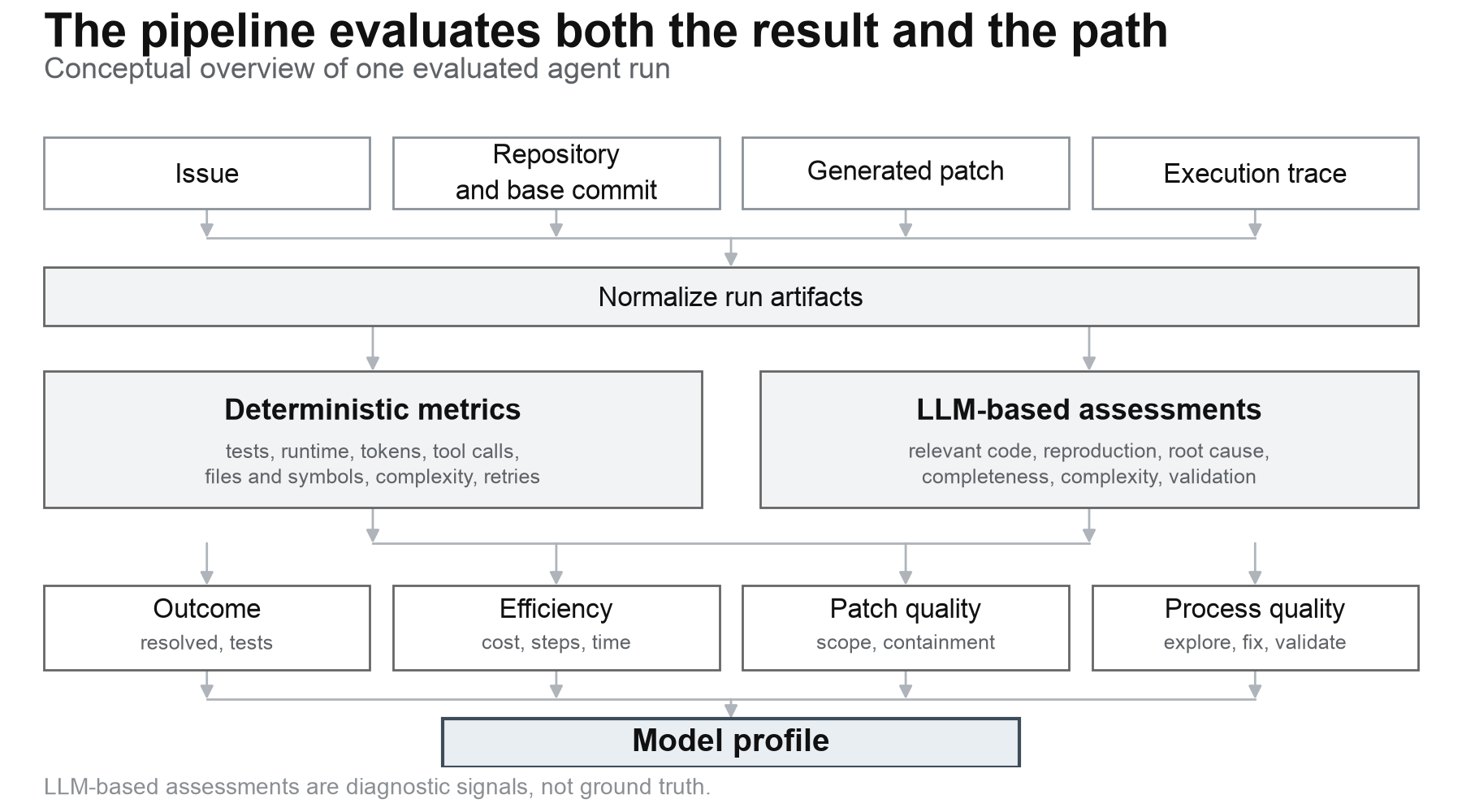
We built an evaluation pipeline that analyzes both the result and the path that produced it. It combines four perspectives: functional outcome, execution efficiency, patch quality, and process quality. Functional correctness remains the starting point, while additional metrics explain what lies behind the final score.
What current evaluations miss
A recent JetBrains Research post describes the benchmark meaning gap, identified in a recent research paper: a benchmark measures performance under a particular setup, but its score is often treated as evidence of a much broader coding ability. Performance gains may not transfer to other tasks, even within the same codebase, and model rankings can change with the task type.
Our work looks at a related gap within individual agent runs. Passing tests does not fully describe the patch quality. Two patches may implement the required behavior while differing greatly in scope, complexity, and fit compared to the existing architecture. For example, one may change a single relevant function. Another may add helpers, state, branches, or unrelated files – and still pass the same tests.
A failed outcome is equally ambiguous. The agent may never find the relevant code, may instead misunderstand the cause, edit the wrong layer, implement only part of the fix, or stop without adequate validation. These failures all require different actions. For example, a repeated search may call for better repository navigation or more focused prompting. Another example is a correct diagnosis of the issue followed by an incomplete patch. This suggests a problem in implementation or task completion.
Cost and latency add another dimension. As mentioned above, two successful runs can differ substantially in tokens, runtime, model calls, and tool use. A long trajectory is not necessarily bad if the task requires broad investigation. The important distinction is whether the extra work contributed to the solution, or it came from repeated and unproductive actions.
For model selection, the more useful questions are which model suits a particular kind of task, where it spends its effort, and how it tends to fail. This can be answered by a fine-grained analysis of both the trajectory and the patch through our pipeline.
Evaluating the outcome and the process
For each benchmark task, the pipeline combines the issue, repository context, generated patch, test result, and execution trace. It then evaluates the run from four perspectives, which ask the following questions:
- Outcome: Did the patch resolve the task, and which tests passed or failed?
- Efficiency: How many tokens, model calls, tool calls, and seconds did the run require, and what did it cost?
- Patch quality: Did the change touch the relevant files and symbols, remain contained, and avoid unnecessary complexity?
- Process quality: How did the agent move through exploration, implementation, and validation? Did it reproduce the problem, repeat work, or stop without testing the final change?
We propose a pipeline that combines deterministic metrics with semantic evaluation. The deterministic layer derives reproducible measurements from logs and repository data. These include test outcomes, runtime, token use, tool calls, modified files and symbols, code complexity changes, repeated file reads, unchanged command retries, and tool failure loops.
Rules alone cannot interpret every action. Opening a file twice may be wasteful, or it may be necessary after a related edit. A large patch may be unfocused, or it may be appropriate for a change that spans several components. For these questions, LLM judges receive structured evidence from the issue, patch, trajectory, and bounded repository context. They assess milestones such as finding the relevant code, reproducing the defect, identifying the root cause, addressing it in the patch, introducing unnecessary complexity, and validating the result. This combination gives us a clearer account of progress. It shows not only whether a run failed, but whether it failed during localization, implementation, or validation. Below figure serves as an illustration of the aforementioned components, inherent in our evaluation pipeline.
What the agent trajectories reveal
We used the pipeline to compare Claude Opus 4.7 and Gemini 3.5 Flash in Junie across four benchmark datasets containing 523 tasks. The results are shown below:
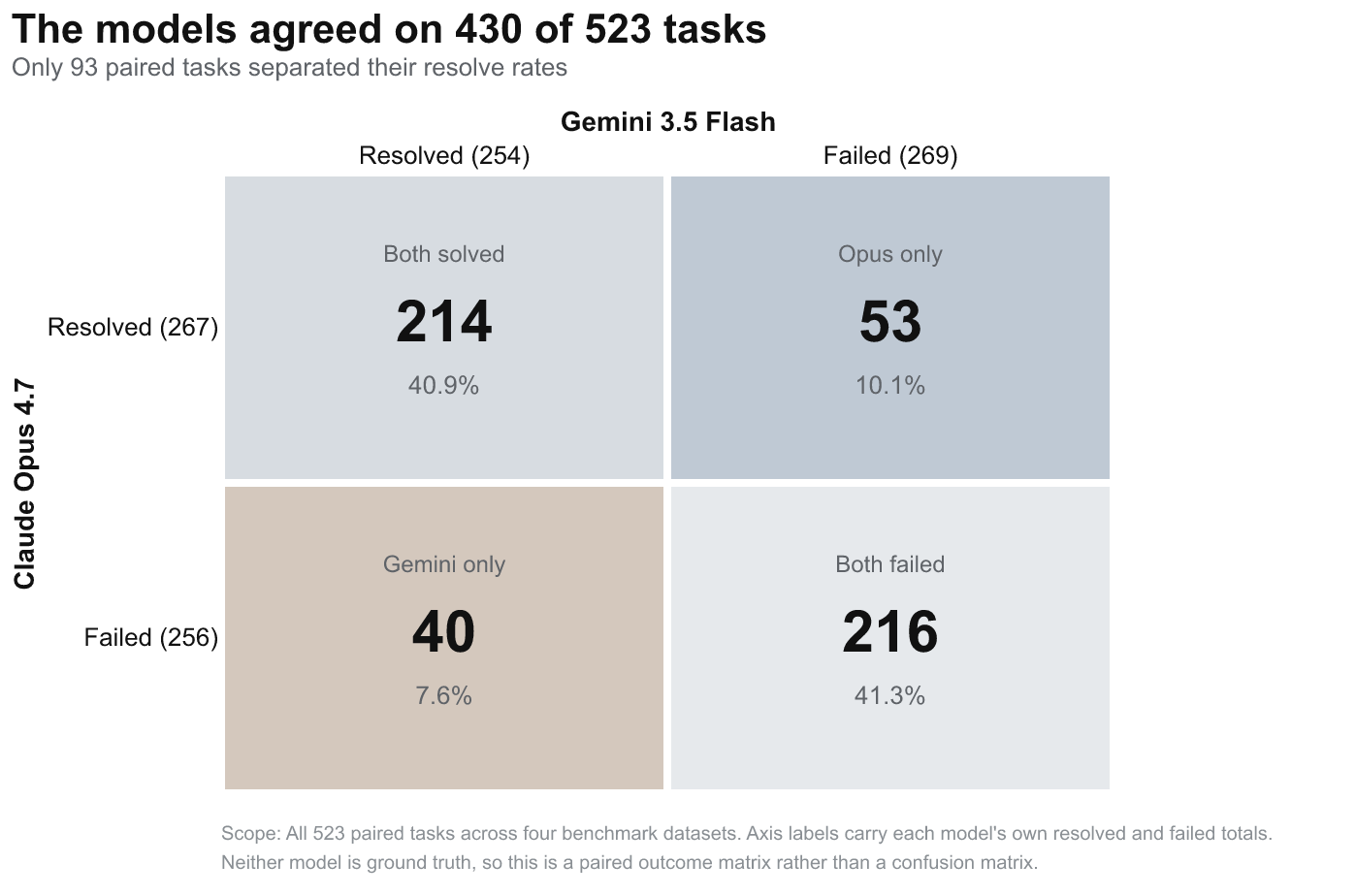
As you can see in the figure above, Claude Opus resolved 267 tasks, or 51.1 percent, while Gemini Flash resolved 254, or 48.6 percent. The models produced the same outcome on 430 tasks: both solved 214 and both failed 216. Only 93 tasks separated them. The overall scores were close, but the trajectories and patches showed different behavioral profiles.
Identical outcomes via divergent trajectories
A same-task comparison makes the different behavioral profiles concrete. One Opus run and one Gemini run both solved the same task. Both first opened a relevant file at step 15, were judged to have identified the root cause, and performed thorough validation. However, they had progressed in varying increments d by that point. Opus used a targeted search within the file and began implementation 13 steps later. Gemini initially inspected the large module more broadly. It ran its first executable check at step 30, but did not make its first production edit until step 88. Opus finished in 53 steps, moving between exploration, implementation, and validation six times; Gemini needed 192 steps and thirty-four such switches. The following figure depicts the different paths.
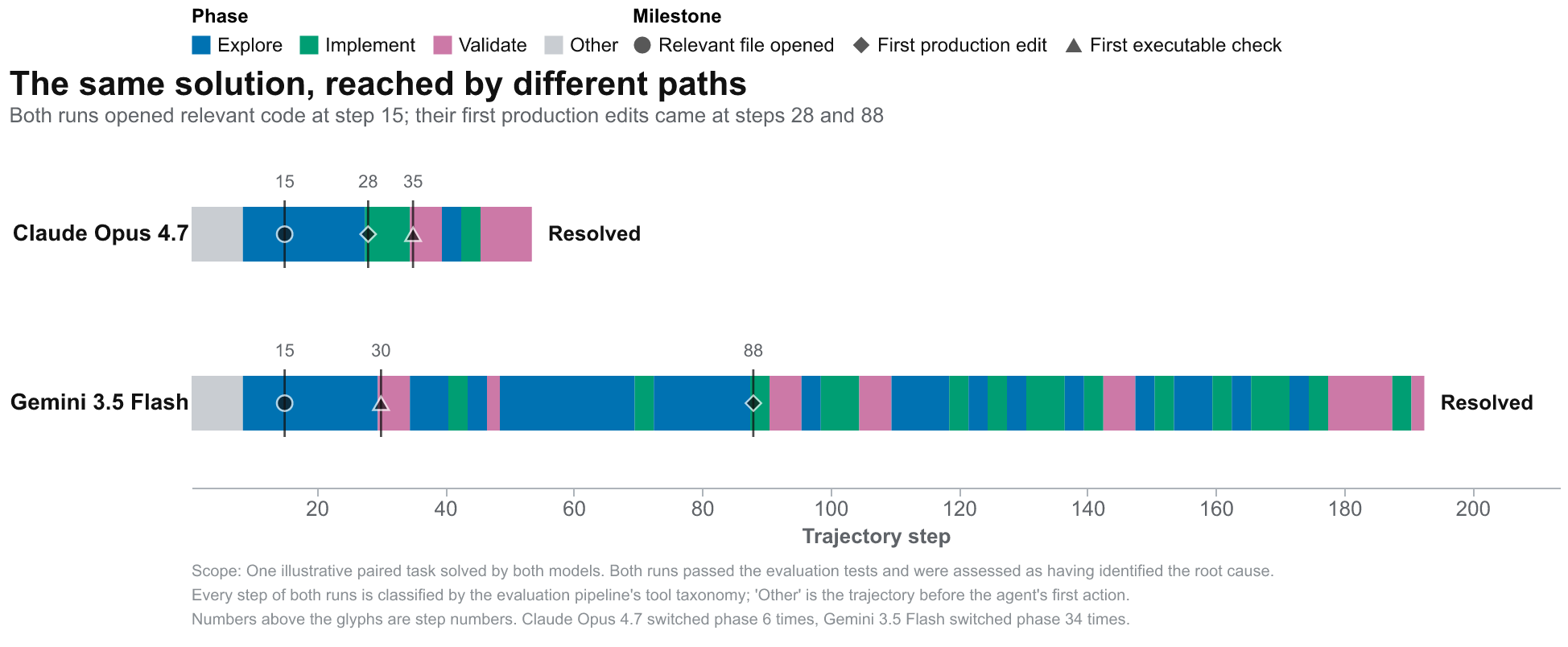
Gemini’s additional investigation was partly useful, but it also widened the scope and led to an unrequested change. Both runs passed the evaluation tests, and both changed the same file and symbols that the reference solution changed. Opus touched nothing else. Gemini’s patch also reached four further files, making edits there. It was assessed as sprawling, with significant redundancy and moderate hallucination.
This single example is illustrative rather than statistical. It shows how the same benchmark success can come from a direct, contained run or a longer path with unnecessary expansion.
Failure can occur at several stages
A successful run usually progresses through four stages: locating the relevant code, identifying the root cause, implementing the complete fix, and validating the result. Resolve rate compresses this entire process into a single binary outcome, whereas trajectory analysis shows where the agent succeeded and where it fell short.
As trajectory analysis separates them, we can better analyze the 216 tasks that both models failed. We can see the results of the analysis in the figure below.
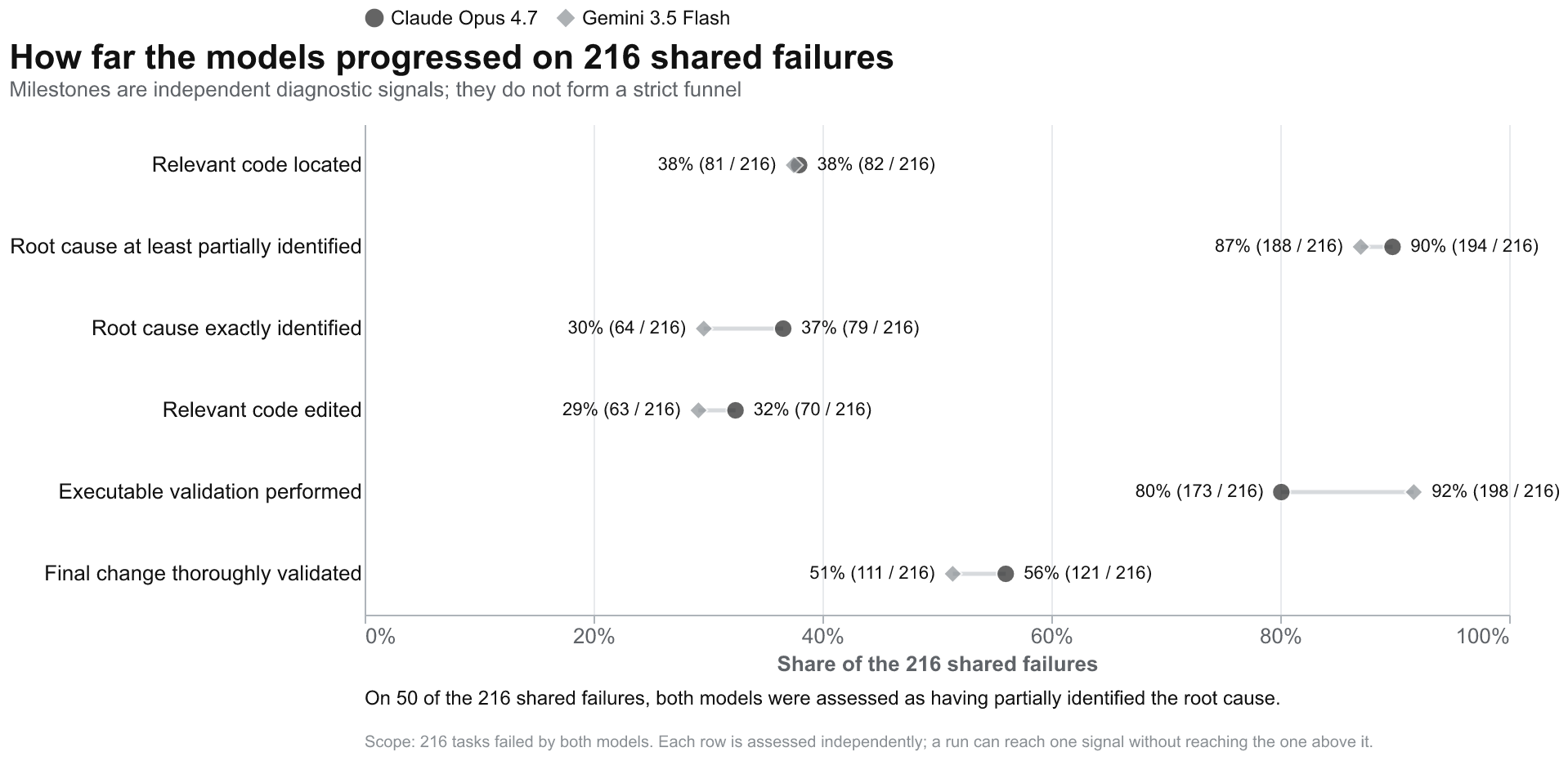
For both models more than 85 percent were assessed as having at least partially identified the root cause. For example, in one task, both agents recognized that text exceeding a token limit caused the error, but truncated the text instead of splitting it into valid chunks. In another, both corrected a faulty download parameter in one code path and missed the same problem in a companion path. A binary failure treats these runs like cases in which the agent never found the relevant component, although they were much closer to a correct solution.
The models were not completely lost. They had reached the relevant mechanism but implemented the fix incompletely, changed the wrong layer, or missed the task’s exact contract.
This is not simply a question of matching the golden patch. The reference solution is useful, but it is not the only possible valid implementation. A candidate may change a different file or architectural layer and still address the same mechanism. Structural comparison therefore needs to be combined with semantic assessments of diagnosis, completeness, and validation.
From leaderboards to model profiles
By using these outcomes it is possible to construct model-specific profiles that give more information about their strengths and weaknesses. In the following we list exemplary ones for Claude Opus 4.7 and Gemini 3.5 Flash.
Claude Opus 4.7: Strong diagnosis, weaker completion
Opus was more likely to identify the underlying cause of ambiguous defects. It often reached the correct mechanism or architectural layer and solved 53 tasks that Gemini missed. These results make Opus a useful starting point when the main challenge is understanding an unfamiliar repository or separating a visible symptom from its source.
The main weakness appeared after localization. Some runs found the right mechanism but stopped with a reproduction test, missed a companion branch or call site, or implemented a plausible custom solution instead of following an existing repository pattern. In 123 runs, Opus performed no executable validation, including 68 runs that still resolved the task. Skipping executable validation means a patch’s correctness is never actually confirmed, so even a resolved task carries undetected risk of regressions or edge-case failures that only running the code would surface.
Overall, Opus’ profile suggests a strong diagnostic model that benefits from an explicit transition to implementation, completion, and testing.
Gemini 3.5 Flash: Stronger validation, weaker grounding, and convergence
Gemini was more likely to run an executable check and use its output to refine the solution. These features were useful when the expected behavior was explicit, the responsible component was reasonably clear, and feedback was readily available.
The main risks we found with Gemini were convergence and repository grounding. Gemini often continued searching after reaching relevant code, repeated equivalent commands, or spent many steps on build infrastructure. It was also more likely to rely on unverified APIs, dependencies, paths, or test fixtures: 195 of its runs, or 37.3 percent, were assessed as containing moderate or severe hallucination, against 130 runs for Opus. Some patches expanded beyond the issue or included unrelated artifacts, and 80 runs, or 15.3 percent, showed significant or severe redundancy, more than twice the Opus rate of 6.5 percent.
Overall, Gemini benefits from precise task contracts, symbol verification, clear stopping rules, and a final review of the diff.
A Wider set of models
We also ran the pipeline over a wider set of models. We evaluated GPT-5.5, Claude Opus 4.7, Gemini 3.5 Flash, and Qwen 3.6 27B FP8 on the same four benchmark datasets, and the table below compares them on the 522 tasks all four of them share. The same four perspectives separate them as well: GPT-5.5 reached the highest resolve rate at 51.5 percent and was the only model that always ran an executable check, Opus led every patch quality metric, and Qwen 3.6 27B FP8 resolved 38.9 percent of the tasks at three percent of GPT-5.5’s cost per run.
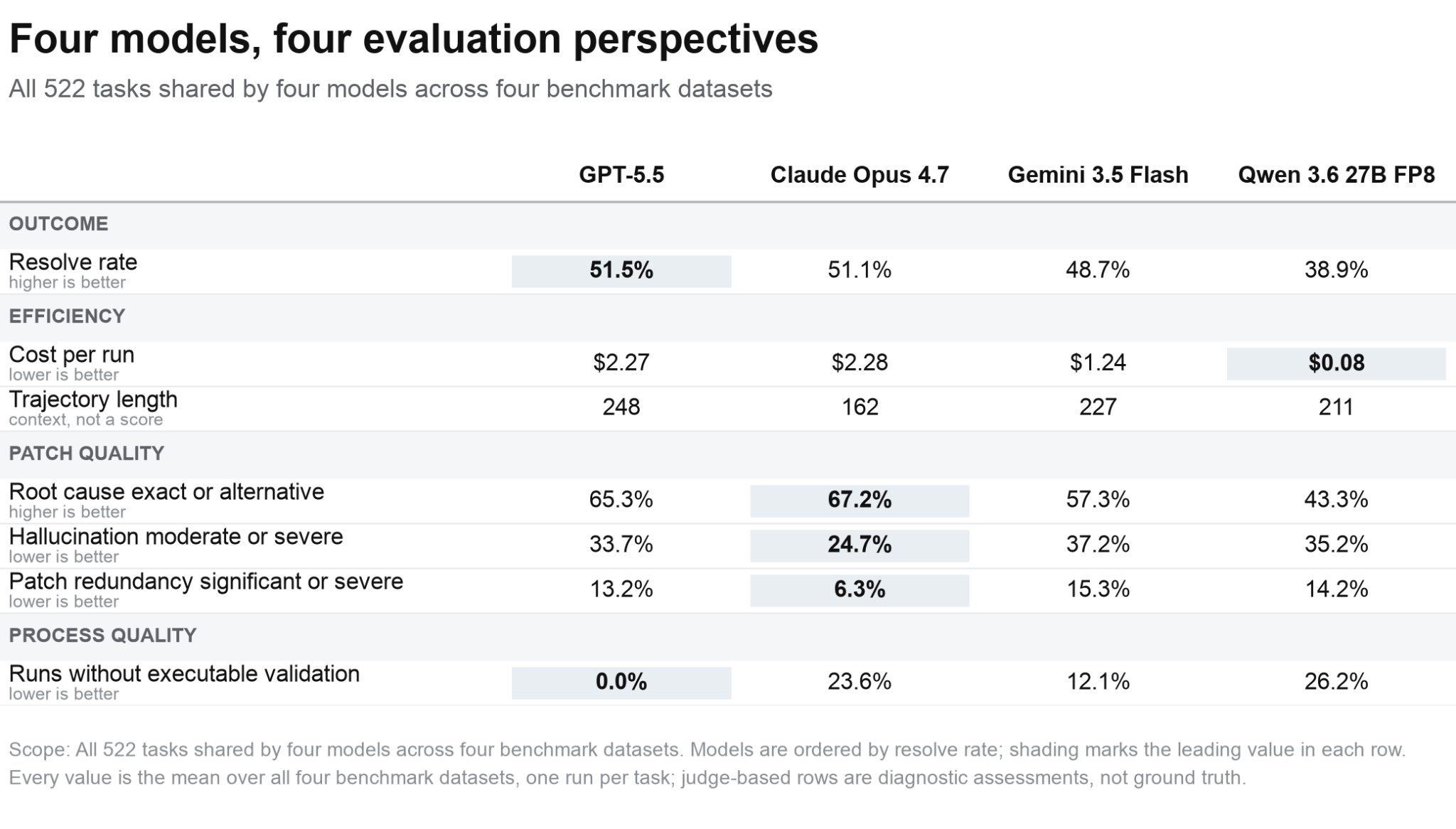
GPT-5.5 and Opus finish four tenths of a point apart on resolve rate and within a cent of each other per run, so a leaderboard would treat them as interchangeable. Their patches are not: Opus was assessed with moderate or severe hallucination in 24.7 percent of its runs against 33.7 percent for GPT-5.5, and with significant or severe patch redundancy in 6.3 percent against 13.2 percent, while producing the shortest trajectories of the four models. What GPT-5.5 offers in return is process discipline, since it never ended a run without an executable check while Opus skipped validation in 23.6 percent of its runs.
Qwen 3.6 27B FP8 is a third kind of trade-off: 12.6 points behind on resolve rate and the weakest of the four at identifying the root cause, but inexpensive enough that a failed run costs little. Which model is preferable therefore depends on whether the expensive part of the work is diagnosis, patch review, or the run itself.
Limitations and conclusions
In this post, we inferred profiles for Claude Opus 4.7 and Gemini 3.5 Flash. These inferences are based on a specific Junie scaffold used in this evaluation, and they should not be used to generally describe the model themselves. Moreover, The LLM judge assessments are diagnostic signals rather than ground truth, and are heavily based on a single golden patch, which in most cases, as typical in the coding domain, is not the only viable solution. The judges may be therefore inclined to score negatively valid solutions if they differ from the reference one.
Resolve rate remains the foundation of coding agent evaluation, but it becomes more useful when paired with evidence about efficiency, patch quality, and process. Our overall goal is not to replace a leaderboard with another aggregate score. We would like to understand what produced each result and use those patterns to improve model selection, prompting, and agent design. From an industry perspective we can better refine agent design, by moving beyond aggregate success rates to fine-grained scores and behavioral profiles. On the other hand, from a user perspective, we can now empower Junie users to choose the right model for the job.
Вставай, Василий: как мы отобрали у пульта право поднимать гуманоида

Может ли робот встать по голосовой команде, если производитель это запретил?
Гуманоид Walker Tienkung поднимается на ноги только с физического пульта: короткое нажатие кнопки будит моторы и проводит самодиагностику, а длинное — ровно секунда удержания — поднимает из нулевой позы в стойку. Мы решили отдать весь этот путь голосу и быстро упёрлись в проблему: наши программные «нажатия» система молча игнорировала, а переход «встать» оказался заблокирован намеренно — команда принималась без ошибки, но робот не реагировал.
Рассказываем, как мы разобрали сигнал пульта до отдельных событий, зачем пришлось дизассемблировать закрытый вендорский бинарник прямо на роботе и что нашли внутри.
Читать далееАнимации в терминале — это сложно (иногда)

Не так давно я на ровном месте занялся написанием библиотеки на Go (spinq) для, казалось бы, тривиальной задачи — спиннера, который гарантированно не будет ломаться при конкурентных записях в stderr и stdout.
Все началось с того, что я писал вообще другой код — консольную утилиту для запуска тестов. И захотел прикрутить туда спиннер. Но не просто спиннер, а такой, что позволил бы использовать оба потока вывода — stderr и stdout, без риска оставить артефакты на экране. Более того, во время анимации мне нужно иметь возможность показывать на экране отчеты по завершившимся тестам, не откладывая это все до конца запуска/остановки спиннера. И так уж почему‑то получилось (спойлер: потому что не слишком просто, иногда совсем невозможно и мало кому нужно), что я не смог найти библиотеку, которая бы мне подошла.
Читать далееWATCH: Curaçao captures Little League World Series title
Stars in their AIs: tech is changing Hollywood
Grand Canyon flood evacuee says he "didn't know what was going to happen"
Can Reform UK recover from its summer horribilis?
Clacton, funding, internal divisions – party prepares for annual conference next week after a season of missteps
Senior Reform UK figures like to boast that the summer time – and parliament’s longest recess – is when the party makes hay.
Supposedly, it is when Nigel Farage and co can muscle in on the news cycle with provocative statements and new policies, painting “establishment” opponents as workshy layabouts.
Continue reading...UK social mobility watchdog could be axed as ministers plan shake-up
Exclusive: Labour MPs believe Gordon Brown-era SMC has become ineffective and its work ‘should be a core function of government’
Ministers are considering a shake-up of the government’s social mobility watchdog that could range from giving it more teeth to abolishing it outright.
The move comes amid concerns that the Social Mobility Commission (SMC) – originally conceived under Gordon Brown’s government in 2010 – has become ineffective.
Continue reading...Юридическому отделу тоже нужен Service Desk. Но никто в этом не признаётся

Для ИТ-департамента управлять заявками в единой системе — привычная история. Service Desk помогает обрабатывать обращения, расставлять приоритеты и соблюдать SLA. Но поток запросов есть не только в ИТ. В юридический отдел также приходят заявки: через почту, мессенджеры, звонки и личные обращения. Но для них чаще всего используют ручную маршрутизацию. Часть задач теряется, дублируется или зависает, а руководителю приходится восстанавливать общую картину вручную.
Читать далее