
The rules have led to changes in course materials, prompted accusations of censorship and fueled pushback from faculty and students, including faculty departures, student protests and a federal lawsuit.
(Image credit: Michelle Waida)

The rules have led to changes in course materials, prompted accusations of censorship and fueled pushback from faculty and students, including faculty departures, student protests and a federal lawsuit.
(Image credit: Michelle Waida)
US set to host Summer and Winter Olympics
USOPC CEO says business model in early stages
The US Olympic and Paralympic Committee (USOPC) is in the advanced stages of setting up an entity to sell a stake in the commercial rights for Team USA in return for capital, according to multiple reports.
Any deal would mark a significant shift for the USOPC, a non-profit organization that, unlike many national Olympic committees, relies heavily on sponsorships, licensing and other commercial revenue streams rather than government funding.
Continue reading...Speaking in Antigua, the king did not give explicit support for reparations but said he wanted to ‘address past wrongs’
King Charles has said that deepening his understanding of the horrors of slavery has made him more determined to address the wrongs of the past, as Caribbean leaders and campaigners intensified demands for an apology and reparations from Britain.
“We cannot change the actions of those who came before us,” Charles told leaders at the opening of the Commonwealth summit in Antigua and Barbuda on Tuesday. “We can, however, learn from the past.
Continue reading...Отправил агенту задачу с телефона, убрал телефон в карман и хочешь узнать, когда он закончит. Обычно для этого берут пуши Google (FCM). У DSH Mobile облачного сервера нет, телефон разговаривает напрямую с компьютером, на котором работает агент. В версиях 0.9.x я переделал уведомления. Постоянного соединения в простое больше нет, а за отправленной задачей телефон следит, даже если Android выгрузил приложение или телефон перезагрузили. Расскажу, как это устроено и какие четыре ошибки нашлись по дороге. Самая заметная съедала 11 секунд на каждом ответе агенту, самая неприятная обрывала загрузку фото на 5 МБ.
Читать далее
Статья будет полезна не только пользователям DeepSeek API. Она пригодится тем, кто покупает на Taobao, Tmall и 1688, и тем, кто собирается в Китай: там через Alipay можно оплатить метро и транспорт, билеты, отели и многое другое. Для вашей конкретной ситуации уточняйте отдельно — нюансы возможны.
Читать далее
Статья является продолжением темы, начатой некоторое время назад в статье, о моделировании в реальном времени решётчатых функций технологических параметров промышленных объектов управления.
В статье кратко рассказано о ядре моделирования, использующего математический аппарат, описанный в указанной статье, и результатах его работы на одноплатном компьютере скромной производительности.
You can use the audio player below to listen to this blog post.
With JetBrains IDEs 2026.3, we’re adding a new way to stay connected to your work: sound cues.
A short sound can tell you if a build has finished successfully or failed, a breakpoint has been hit, or there’s something at the caret that needs your attention. These cues are designed to make everyday development easier to follow, whether you are concentrating on another task, working across several projects, or using a screen reader.
Sound is on by default for screen reader users, and opt-in otherwise. In both cases, the sound cues are configurable – you can choose the cues that help you and leave the rest off.
The new Sound Signals settings let your IDE provide audio feedback for all important events.
For long-running work, you can hear when a build, test, or other task finishes, with different cues for success, warnings, and errors. The IDE also plays a sound when a breakpoint is hit and while a background task is running, so you know where the progress is at without having to repeatedly check a status area.
Sound cues also cover editor line marks. When screen reader support is enabled, the IDE plays distinct cues as the caret reaches a line with:
These editor marks are usually communicated visually. The new cues provide an additional way to notice them while moving through code.
You can also enable sound for individual notification groups. For example, if a particular tool or workflow sends notifications you care about, you can choose to have the IDE play a sound for it.
JetBrains IDEs 2026.3 also ship with Air. Agent work can have the same rhythm as a long build: you set it in motion, then turn to another task or window while it works.
Air has four sound cues: one when the agent completes its work, one when it stops with an error, one when it needs your input, and one for starting and stopping dictation. The sounds for AI operations are distinct enough from general IDE sound cues for you to easily tell them apart.
Air sounds can be configured separately in the dedicated settings section Settings | Tools | Air.
IDE sound cues live on a new settings page built for accessibility. Settings | Appearance & Behavior | Accessibility now brings together Support screen readers, Zoom, contrast scrollbars, colors for red-green vision deficiency, the option to announce notifications with a screen reader, and sound cues, all in one place.
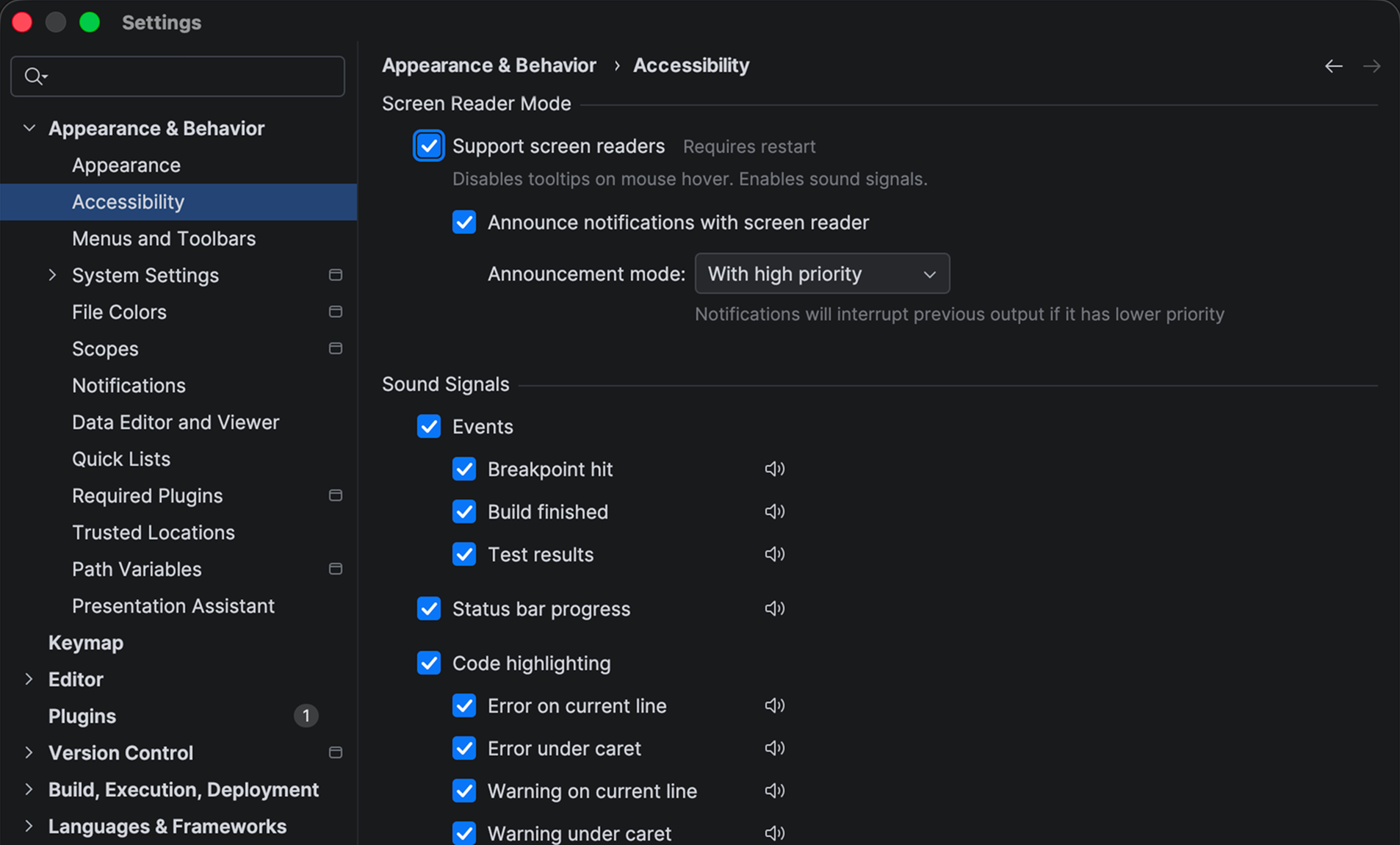
If you use a screen reader, the relevant sound cues are enabled automatically when the Support screen readers option is on. This includes sound cues for IDE events (builds, tests, progress, and breakpoints) and editor line marks.
If you do not use a screen reader, sound cues are off by default. To enable them:
You can preview each sound on the same page before enabling it, and turn off any cue that does not fit your workflow.
For a specific notification, go to Appearance & Behavior | Notifications, select the notification group in the list, and enable the Play sound option.
To learn more about configuring sound cues in your IDE, see this section in our accessibility documentation.
By default, VoiceOver makes other sounds quieter while it speaks. If the IDE sounds are hard to hear, turn off audio ducking in the VoiceOver settings on your Mac.
Development often involves waiting: for a test suite, a build, a background task, a debugger, or an agent to reach the right point. Sound cues let the IDE share that status in a lightweight way, so you can stay focused on the work in front of you.
For visually impaired developers, these sounds also make information available that was previously represented only on screen. Sound cues began with an accessibility request, and they are part of our ongoing work to make JetBrains IDEs more accessible rather than a one-off feature.
If you’d like to stay informed about accessibility improvements, you can subscribe to our accessibility updates here.
Sound cues will be available starting with the 2026.3 release of JetBrains IDEs, but you can already try them out in our Release Candidate builds.
We’re eager to hear from developers who rely on accessibility features, as well as from anyone interested in improving the experience of using them. If you have ideas or feedback about accessibility in JetBrains IDEs, you can reach us directly at accessibility@jetbrains.com. You can also report issues through YouTrack or the support request form.
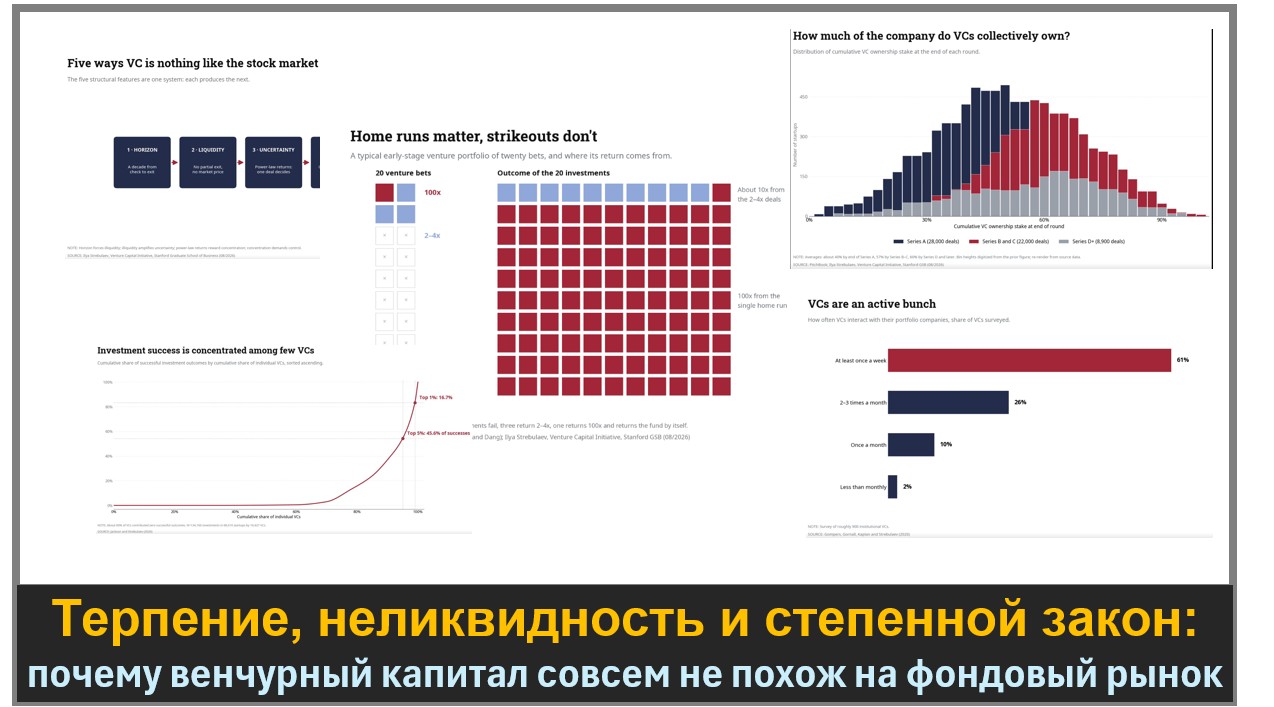
Новое исследование профессора финансов Стэнфордского университета Ильи Стребулаева позволяет узнать пять фундаментальных особенностей, которые отличают инвестиции в стартапы от традиционных классов активов.
Читать далееNations in the group fare worse than others, with funding for nature projects especially hard hit even as climate crisis intensifies global need
The UK government has slashed overseas aid to Commonwealth countries, the Guardian can reveal, in contrast to the warm words for the group from King Charles and the prime minister, Andy Burnham, this week.
Amid sharp cuts in the UK’s aid budget overall, the Commonwealth has fared poorly, an analysis of the most recent and projected aid figures, seen by the Guardian, has shown.
Continue reading...Budget retailer and 12,000 jobs at risk after US owner fails to accept buyout offers
MPs have called on the government to protect Poundland and other high street stores from “predatory capitalism” and asset-stripping.
The fate of the retail chain and its 12,000 staff remains uncertain after it filed a notice of intention to appoint administrators at the high court last Thursday. The US restructuring specialist Gordon Brothers, which controls Poundland, has lined up the advisory company AlixPartners to run the process.
Continue reading...US president makes surprise election day announcement, saying country does not ‘need’ $4bn annual payment
Donald Trump has said that the US will end military aid to Israel at the end of this year in a surprise election day announcement that appeared to be targeted at voters sceptical of US support for Israel and the war in Gaza.
In a phone interview with Fox News as voting began on Tuesday morning, the US president said the US would cut nearly $4bn (£2.96bn) in military aid to Israel because “they don’t need it”.
Continue reading...People everywhere are searching for the reason behind their sudden bursts of anguish or homesickness
Some say it feels like a sudden burst of anguish; others liken it more to homesickness. The sudden onset of a sinking, upsetting feeling due to nipple stimulation is anecdotally known as Sad Nipple Syndrome (SNS), and for Sandra, it can be triggered by something as commonplace as putting on a shirt.
“I was probably a child when I first noticed: ‘Why does touching my nipple make me sad?’” says the 28-year-old. The sensation seemed to happen at random, and without the words to describe it, she kept it a secret. It wasn’t until college that she worked up the courage to Google it. “I realized I wasn’t crazy,” she says.
Continue reading...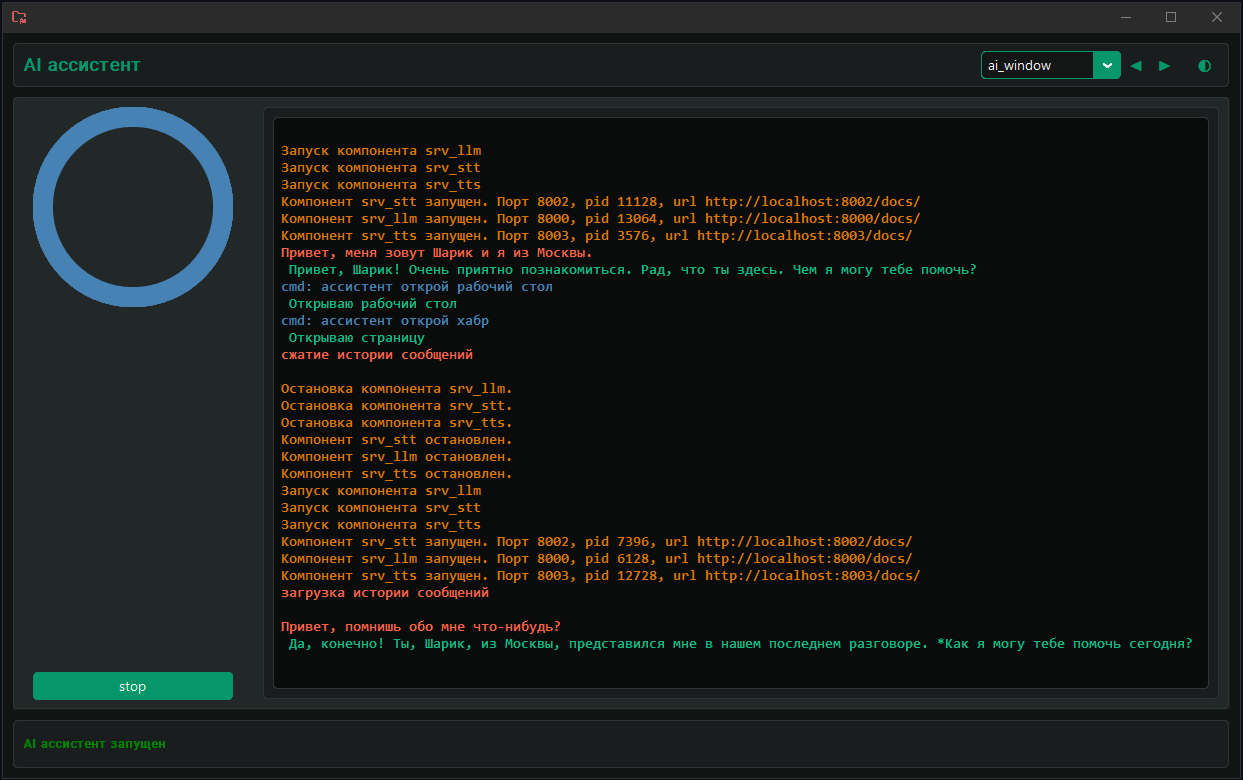
Привет, Хабр!
Пока весь мир заворачивает платные API в красивые обёртки, мне захотелось сделать что-то полностью автономное, конфиденциальное и бесплатное. Результат — App AI Assistant, локальный компаньон, с которым можно поговорить + голосовой ассистент («Джарвис» на минималках), который работает на 100% оффлайн на вашем компьютере.
Проект полностью открытый, исходный код опубликован под лицензией MIT. Мне интересно было не просто «поиграться», а подружить нейросети в реальном времени.
Что умеет ассистент:
Читать далееPerson arrested after fire at police department where officer who shot and killed one-year-old Kohen Wiley had worked
In the early hours of 31 October, a fire broke out at the Senatobia police department in Mississippi, which has been embroiled in controversy recently after one of its officers shot and killed Kohen Wiley, a one-year-old. Though the cause of the fire has not been reported, it is being investigated as arson by agents with the US Bureau of Alcohol, Tobacco, Firearms and Explosives.
In June, then Senatobia police sergeant Hunter Foster shot Kohen as he sat in his mother’s arms in a Walmart parking lot. Foster, who is white, was responding to a report of an alleged shoplifting; Kohen, his mother and the driver of the vehicle, are Black.
Continue reading...AARP reports family caregivers are spending 60% more than they were five years ago. Journalist Paula Span discusses the rising costs of caregiving and senior living, and the options available to us.

The robotaxi company Waymo is expanding its Los Angeles service area into South Bay and adding popular destinations such as Universal Studios.
These resource-guzzling centres drive up utility bills and are hated across the political spectrum. Cue a clunky, but potentially influential, new name for them
Jesus may have turned water into wine, but Donald Trump has done one better: he turned Lake Ontario into Lake America and the Gulf of Mexico into the Gulf of America. And then, for his next trick, he insisted we all stop talking about artificial intelligence (AI) and call it superintelligence (SI) instead.
Those, of course, are only a few of the name changes the president has ushered in. When he’s not golfing or commenting on senators’ buttocks, president Trump loves a rebranding project. Which makes sense: coming up with a new name is far easier than making meaningful improvements to people’s lives.
Continue reading...Production machine learning systems rarely consume raw data directly. Before a model can make a prediction, its feature-serving system may need to read stored signals, filter events to a time window, count or sum values, normalize them, and combine intermediate results.
The simplest design to complete this work treats every feature as an independent function. That is easy to understand, but it becomes wasteful at scale, because features are not computationally independent. A seven-day click count and a seven-day impression count may read the same event source and apply the same time-window filter. A click-through rate feature may then reuse both results. Running each feature separately would repeat that filter, and every other shared step, on every request.
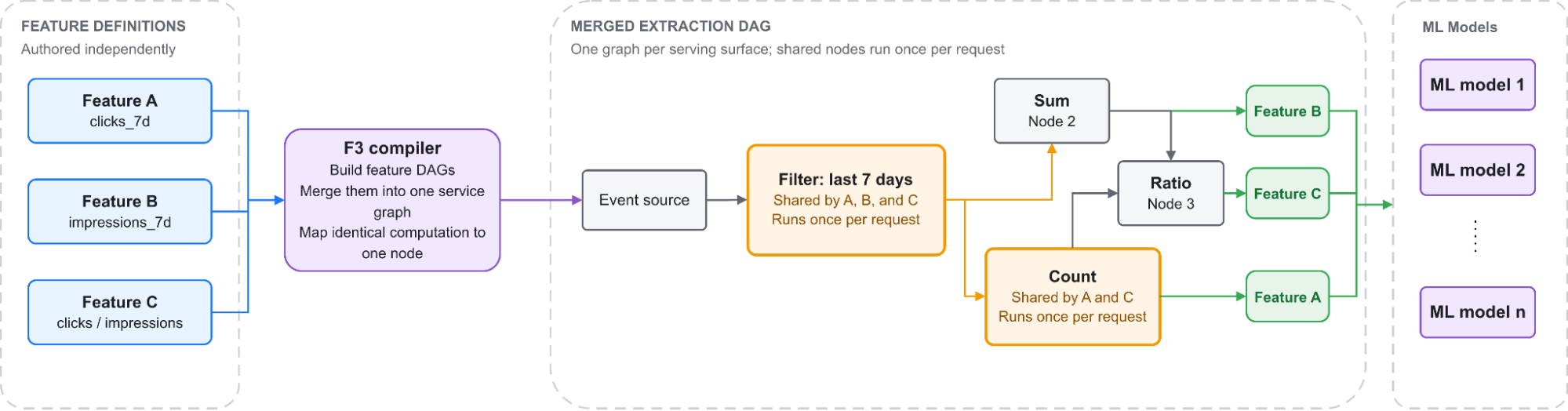
F3 approached this differently, by representing feature extraction as a directed acyclic graph (DAG). Each node performs one unit of work, such as reading an input, applying a filter, or calculating an aggregation. An edge means one computation depends on the result of another. The graph’s outputs are the feature values a model consumes.
Engineers author each feature independently in a high-level language. The F3 compiler turns each definition into a small graph, then merges the graphs for every feature a service uses into one merged graph (Figure 1). Where features share an operation, such as the seven-day filter above, the compiler collapses the duplicates into a single node. That shared work then runs once per request, not once for every feature that needs it. At runtime, feature extraction is a traversal of this merged graph.
F3’s merged graph shared computation efficiently, but it came with a major catch: The graph was also the release, and one malformed definition could hold back every other feature in the merged graph.
Figure 2 illustrates this challenge. It shows seven independently authored features, A through G, where five definitions are valid, but D and G contain unrelated errors. The “Attempt 1” build fails on D, so none of the seven features ships. After D is corrected, the “Attempt 2” build reaches G and fails again. Only after both definitions are fixed in “Attempt 3” does the complete merged graph make it successfully to production.
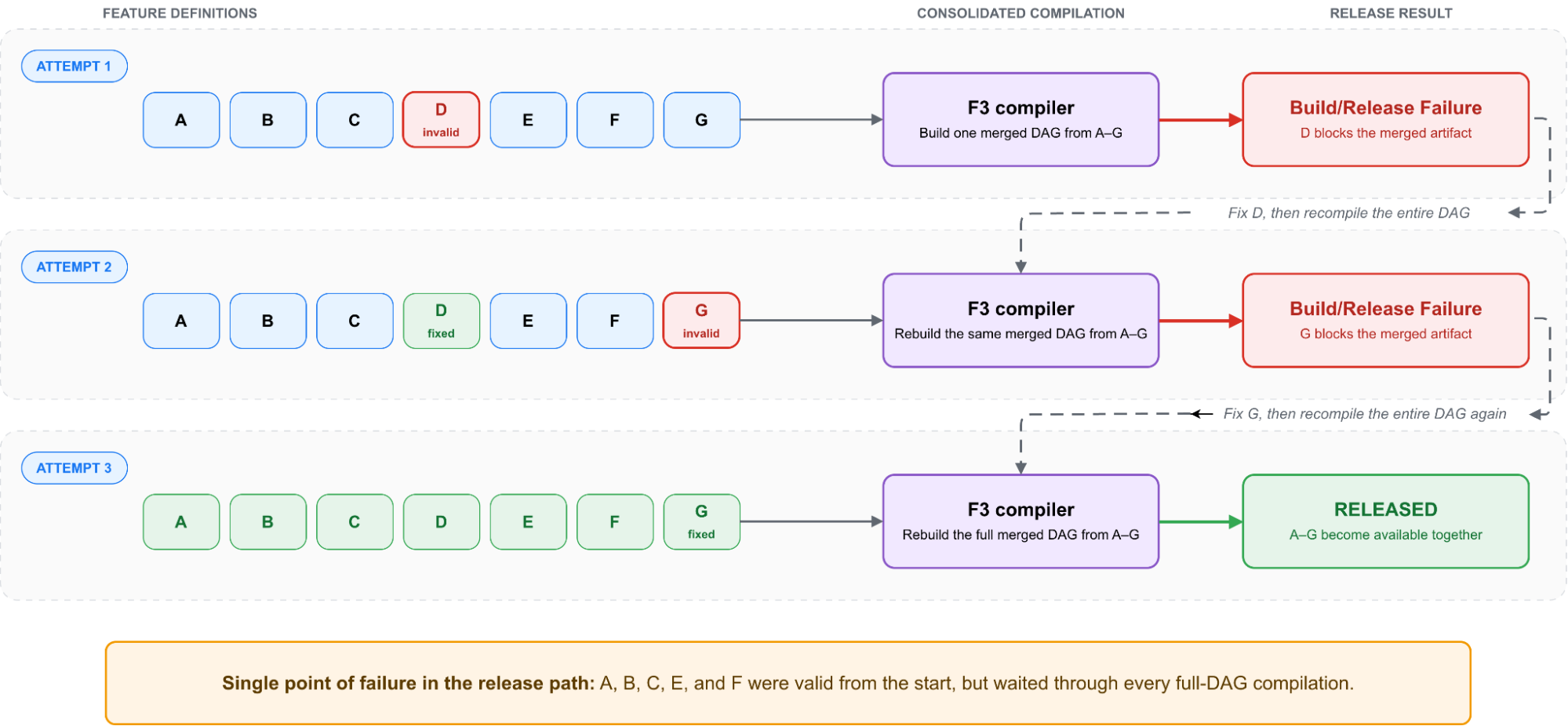
Failures became more frequent as F3 scaled. F3 originally served a few hundred features, and at that size merges succeeded and releases were largely smooth. Today that number is more than 20,000, and different feature types need their own checks depending on how they compute, so new features and modified features are held to different testing bars. A feature that a model already consumes needs model-related tests before it can be released. Those tests are computationally expensive enough that they run only in a later release stage, and, because the merged graph ships as one unit, every other feature in it waits for them too.
After F3 launched, we made several rounds of improvements to the merged graph. Each one brought back release speed for a while, but the gains eroded as more features landed, because all features still shipped together in the merged graph. So F3 Lightning was built to make every feature releasable on its own while preserving F3’s efficiency.
As illustrated in Figure 3, F3 Lightning introduced two changes to help achieve this:
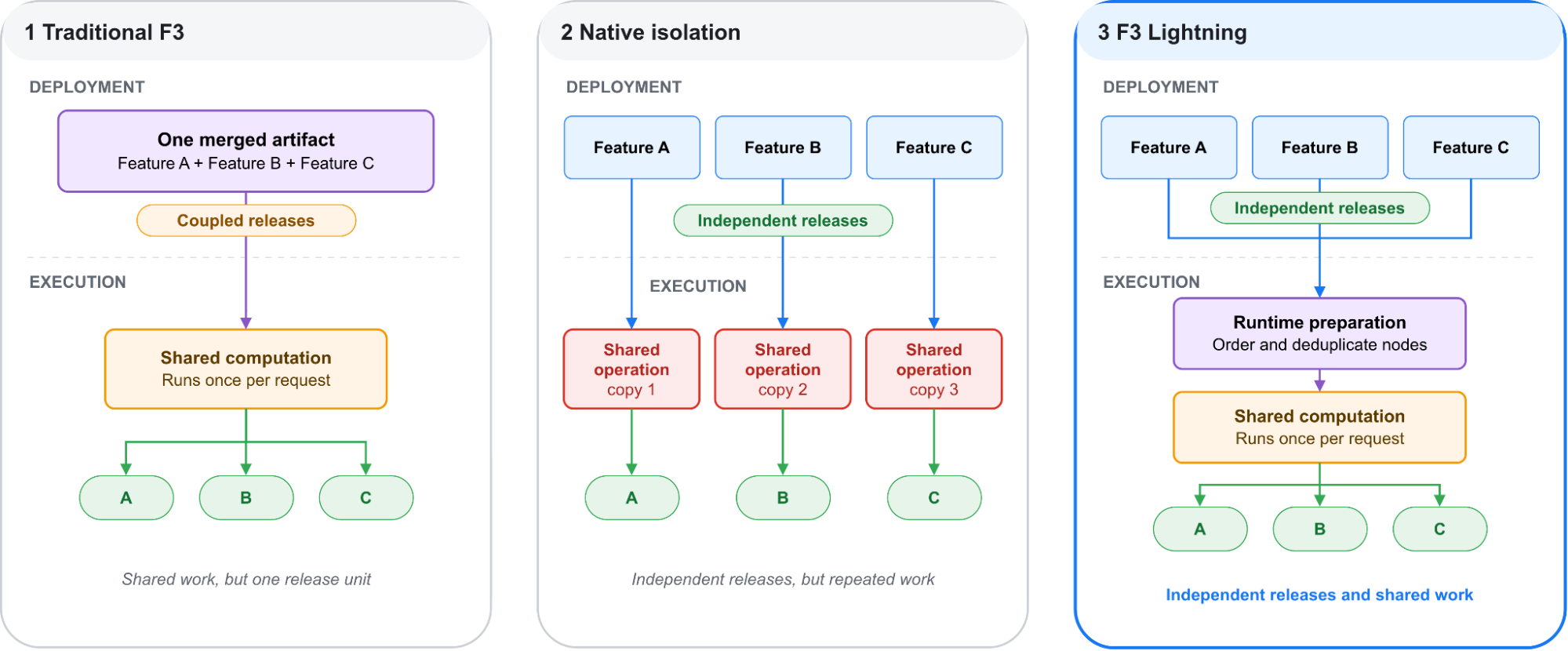
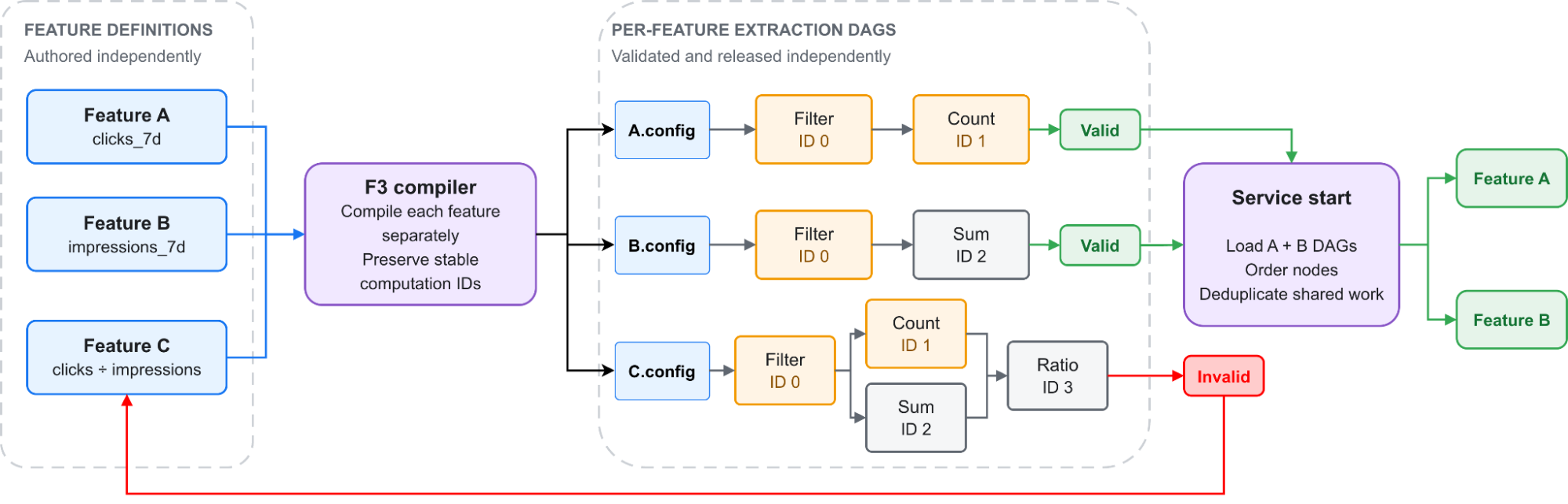
Isolation starts in the compiler, where each feature is compiled on its own into a single configuration. That feature configuration carries everything needed to extract that feature — every node it needs, in order, with nothing borrowed from a neighbor. If feature C has a problem, feature A still ships, because the two configurations have no relationship to each other.
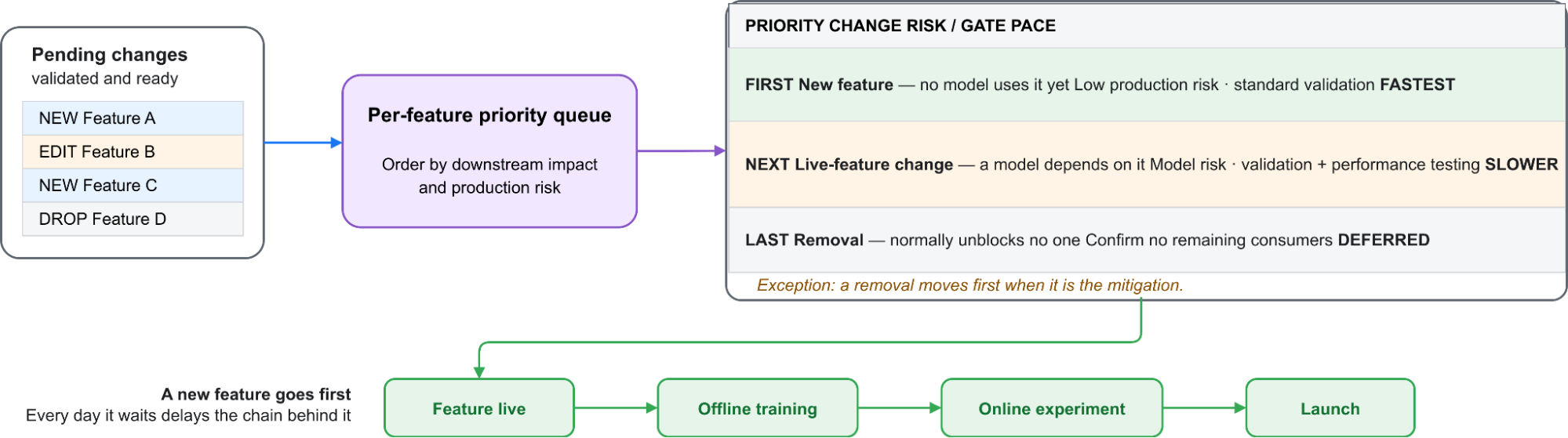
Because features are no longer merged at release time, each one can be selected and released on its own schedule. The release path becomes an ordered queue instead of a batch that ships all at once or not at all. Changes are prioritized by what they unblock. A new feature that no model consumes yet can go out quickly on standard validation, while a change to a feature a live model already reads gets extra testing first.
Our first prototypes separated deployment only. Features shipped independently, but execution was no longer shared, so the prototypes used substantially more CPU than traditional F3. Each independently released configuration arrived at the serving process as its own graph and was executed separately, repeating every read, filter, and aggregation that F3’s merged graph had eliminated.
The fix was to bring shared execution back without bringing the merge back. At startup, F3 Lightning does not rebuild a merged graph. It takes the active feature configurations, consolidates the work they share, and arranges it into a single execution order. Getting back to parity took four steps: a compiler prerequisite followed by three startup optimizations.
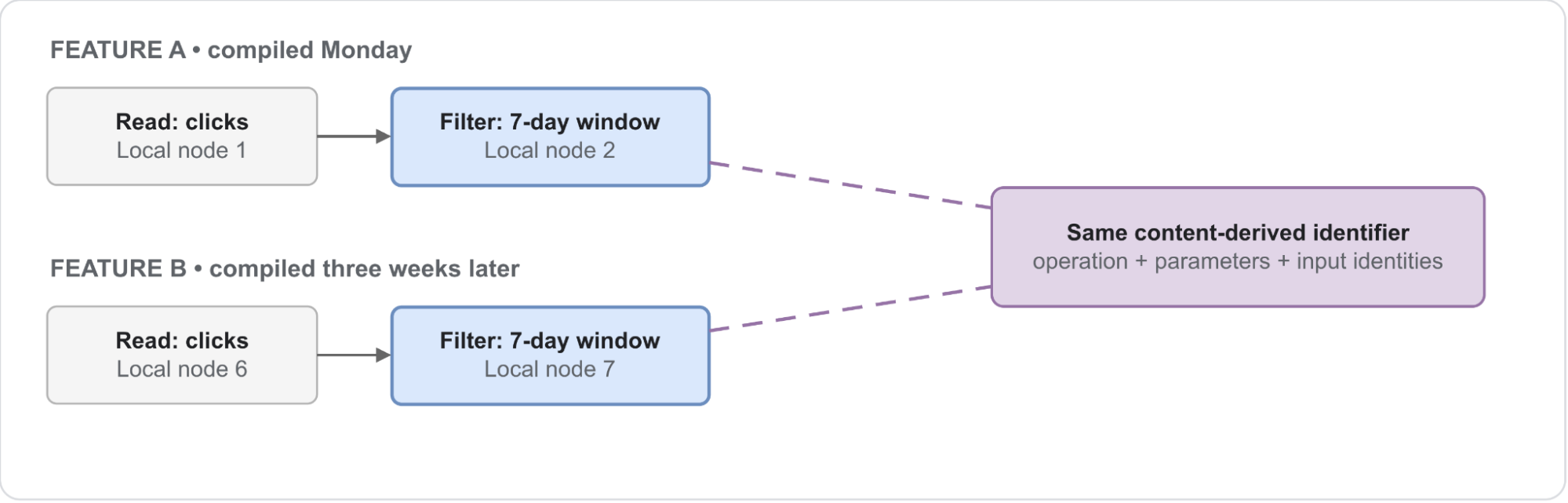
To deduplicate execution, the runtime must recognize when two independently compiled configurations contain the same computation. Node numbers can’t do this, because numbering is local to each feature’s graph. The same seven-day filter might be node 2 in one configuration and node 7 in another, and inserting a single node renumbers everything after it. Traditional F3 never had this problem, because one compiler run saw every feature and could assign identifiers globally.
F3 Lightning instead has the compiler derive each identifier from what the work does, not where it sits: the operation, its parameters, and the identifiers of its inputs (see Figure 6). Because each input’s identifier already reflects everything upstream of it, the identifier captures the whole chain of work that produced the result. Where input order doesn’t affect the result, inputs are put in a standard order. Aggregations also include the properties that define their behavior, such as the time window and grouping keys. As a result, two features that define the same operation over the same inputs receive the same identifier, even if they were compiled and released weeks apart. If a computation’s meaning changes, its identifier changes with it.
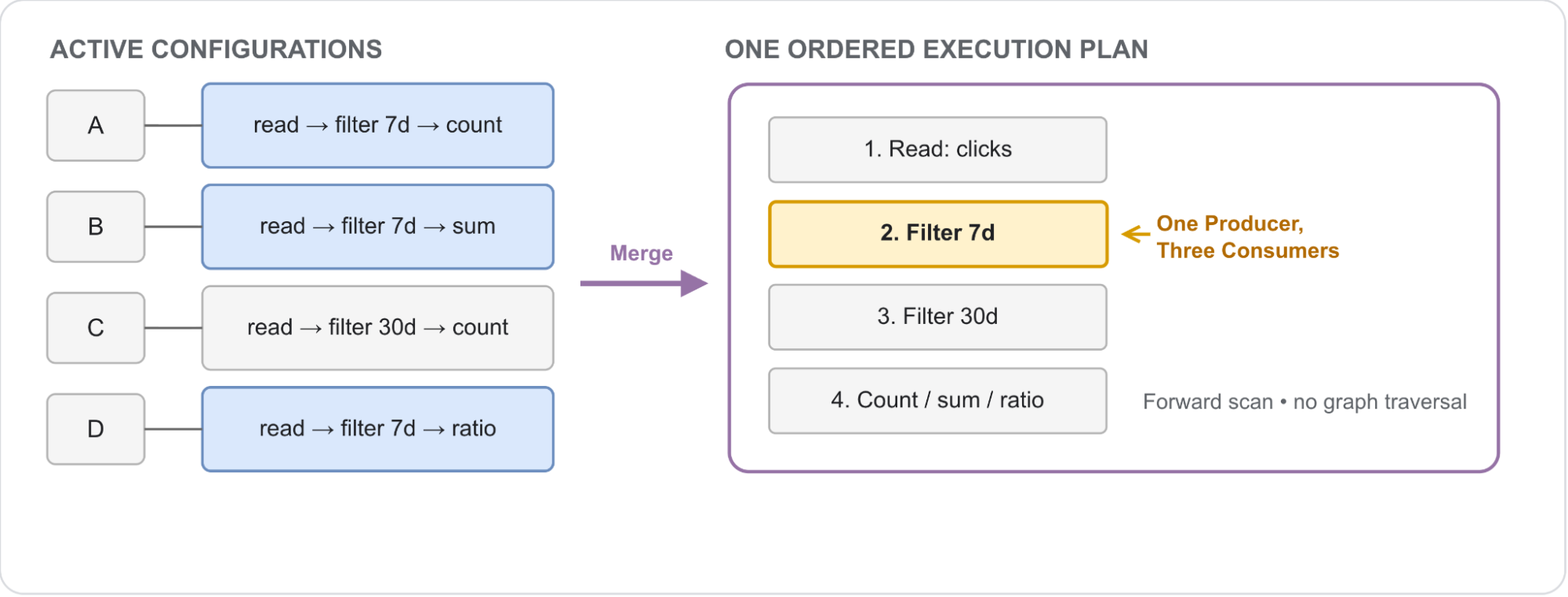
At service startup, F3 Lightning builds a single execution plan across all active features, using a topological sort to place every node after the nodes it depends on. When several features contain a node with the same identifier, the plan keeps one copy and connects every consumer to it, so that computation runs once no matter how many features use it.
Merging guarantees each computation runs once, but the plan is still a graph that the executor walks pointer by pointer on every request. The same startup pass therefore flattens it into an ordered list, so each request runs a single forward pass down the list instead of traversing a graph.
Sharing one plan raises a risk: A single failing computation could affect every feature. To prevent this, if a computation fails or its input is unavailable, F3 Lightning marks everything downstream of it as not ready, and the executor skips that work. A failure affects only the nodes that depend on it, and independent branches keep running.
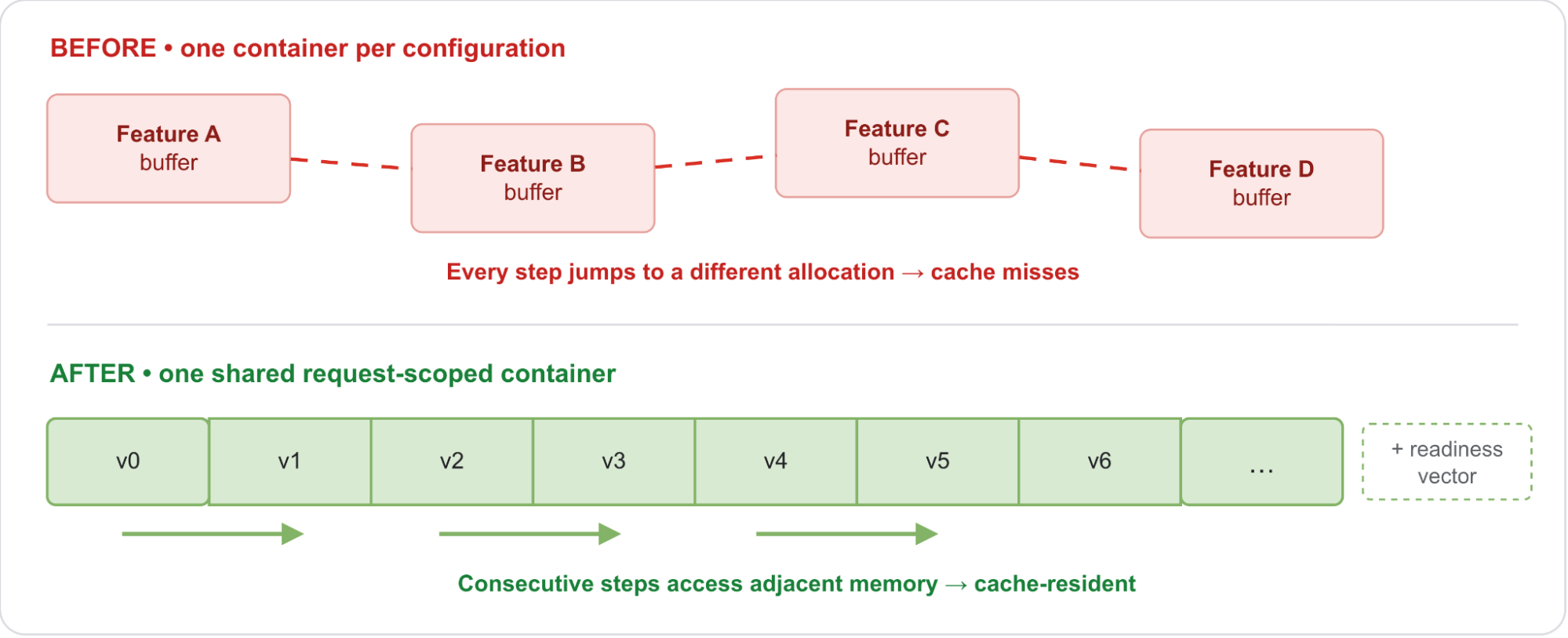
After steps 1 and 2 were complete, no computation ran twice, yet CPU use was still above traditional F3. The remaining compute cost came from memory layout. Each configuration carried its own request-time data container, so intermediate results were scattered across separate memory allocations. Walking the plan in order meant jumping between them, and each jump cost a cache miss.
F3 Lightning replaced those per-feature containers with one buffer per request. At startup, each feature’s references are rebound to slots in that buffer.
Three improvements follow from the single buffer:
Locality: Consecutive plan steps now touch adjacent memory, so the values a step reads are usually already in cache. This restores the sequential access pattern the merged graph always had. It also removes the per-feature allocation on every request.
One readiness vector: A single vector, stored apart from the values, replaces per-feature tracking, so the executor can check whether a value is ready without reading the value itself. The marker has to be separate because an empty list is a valid result, so “empty” can’t also mean “not computed yet.”
No duplicate copies: Most feature values are lists and maps, and consumers no longer get their own copy. The shared slot holds a reference to the producer’s result, so a computation used by 20 features is computed once and stored once. Single values (scalars) are still copied, because copying a small value is cheaper than following a pointer. This is safe because each buffer lasts only for one request, and the execution order guarantees each result outlives its last reader.
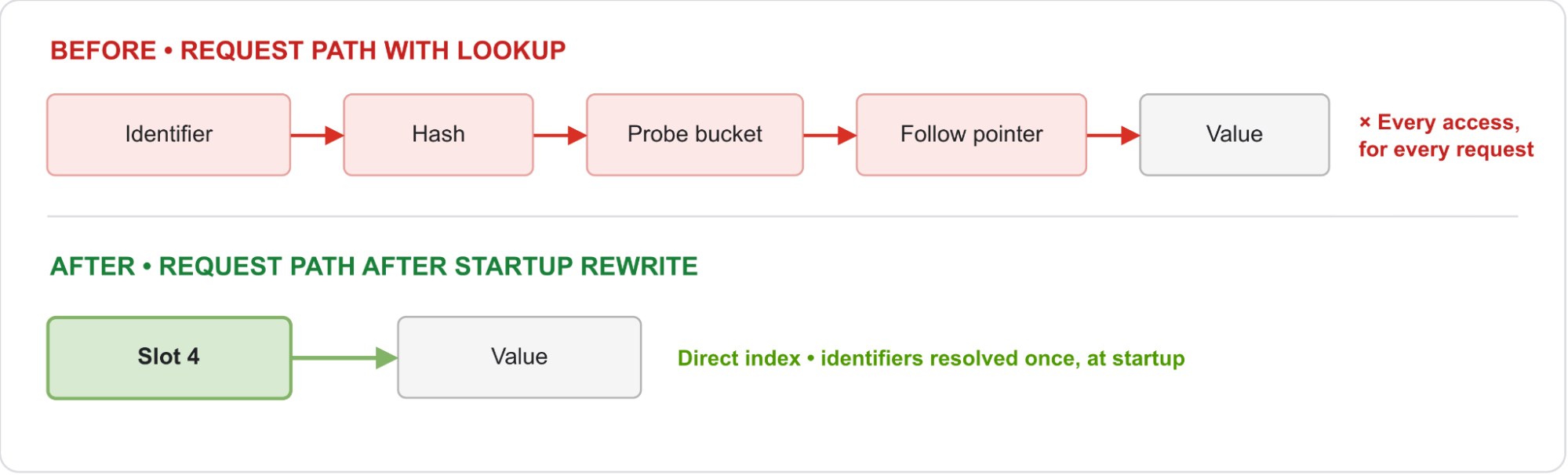
Values now lived together, but finding one was still computationally expensive. Every access had to resolve an identifier, which meant hashing a key, probing buckets, and following a pointer. Lookups weren’t computationally efficient at Meta’s serving volume.
The final fix applied the same principle as steps 2 and 3, doing the work once at startup. F3 Lightning assigns every unique identifier a consecutive integer slot and rewrites every reference in every configuration to point at those slots, so identifiers are used only during initialization. Reading a result becomes a direct array index into the shared buffer, with no hashing and no lookup table on the request path.
With F3 Lightning, comparable extraction features now reach production ~3.6x faster than on traditional F3, with no increase in infrastructure computational cost. That shorter release cycle means models can be improved and retrained more often in the same period. Building F3 Lightning also taught us three lessons:
Deployment and execution should have separate boundaries: If one artifact determines both how components run and when they ship, a failure in any one of them blocks all the others. Splitting the two jobs removed a trade-off between efficiency and release speed.
Work that never changes between requests belongs at startup, not on the request path: Three tasks were identical for every request: spotting shared work, deciding the order to run it in, and finding where each result is stored. F3 Lightning now does them once, when the service starts, so independent releases add no computational cost to individual requests.
Two designs can execute the same operations in the same order and still differ substantially in CPU computational cost: In F3 Lightning, we removed every repeated computation, yet CPU use stayed above traditional F3. Each feature still kept its own copy of the shared results, spread across memory. Consolidating them into one copy per result closed the gap. This is the least obvious result in the project and the one that generalizes furthest. On modern CPUs, where results live and how many copies exist can matter as much as how many computations run.
We would like to thank Sourabh Bansal, Ping Chen, Weitao Chen, Benjamin Dummitt, Junhua Gu, Henry Hu, Jing Huo, Joffrey Liu, Rocky Liu, Weixi Ma, Shuby Mao, Sandeep Pandey, Mihir Rastogi, Tim Sombuntham, Matt Steiner, Vivienne Sung, Ritwik Tewari, Vivek Trehan, Arnaud Venet, Ziheng Wang, Gautam Wilkins, Fan Yang, Qiao Yang, Jie Zheng and the entire team behind the development and productionization of F3, Meta’s Ads ML feature computation and serving platform, and F3 Lightning, the capability built on top of it.
The post F3 Lightning: How Meta Accelerates Ads ML Features to Production at Scale appeared first on Engineering at Meta.
Are you getting your RDA (recommended dose of art)? Along with 10,000 steps and five fruit and veg a day, this small, enjoyable change could make you much healthier – and happier
Name: Art.
Age: Art has been around for thousands of years. The drawings in Blombos Cave in South Africa, for example, are estimated to be about 73,000 years old. But this is less about how old and more about how often, and for how long.
Continue reading...Retailer acquires robot-assisted warehouse and intends to have UK service up and running before end of 2027
Primark is to begin making home deliveries by the end of next year as it aims to win new shoppers after a slide in profits.
George Weston, the boss of the cut-price fashion chain’s owner Associated British Foods (ABF), said it had brought forward the launch of Primark’s home delivery plans by about two years.
Continue reading...Sign up now! Sign up now! Sign up now? Sign up now!
While Football Daily hasn’t actually seen much of West Ham this season, we’ve noted enough of their results to presume they were doing OK in their attempt to bounce back to the Premier League after relegation. Less than a third of the way through the Championship season under Nuno Espírito Santo, they’d already spanked six without reply past both Wrexham and Lincoln, while scoring three or more in wins over Wolves, Derby and Bolton. However, it turns out that of the 13 matches they’ve played in a league that is famously difficult to get out of (unless you were Sheffield Wednesday last season), they have actually lost three times and currently sit in eighth place, a whopping six points off leaders Middlesbrough. Given the context of such an unbridgeable chasm, it is small wonder West Ham fans woke up to news that Nuno had been unceremoniously bounced out of the London Stadium with a P45 in hand.
While my heart aches for Jesús de Miguel, who has died after a collision with the Andorra goalkeeper Jesús Owono, I shudder to think the trauma that shall haunt Owono for the rest of his life. I do hope and pray the wider community understands and extends their support in his recuperation” – Krishna Moorthy.
As an upgrade to Steve Plever’s suggestion of paper thin shirts [Monday’s letters]: how about Velcro shirts? If the bit comes off, it is a shirt pull and the offender has the honour of putting it back in place before being awarded a yellow card” – Mike Harold.
To dive or not to dive seems to be biggest dilemma in the Premier League right now. It’s not. The problem with today’s highly paid professionals is that they simply have no panache at all when they go down. I recall watching Francis Lee pick up the ball on the halfway line at a mud soaked Maine Road in the late 1960s, he put his head down and headed for goal, he was determined, he was single minded. He was 30 yards from goal, he was in full flow. He was tackled from behind and then he really took off, he grew wings, he soared. I swear he landed in the penalty area over 10 yards away. He dragged himself to his feet and without a semblance of a smile smashed the well-deserved penalty, with a very heavy leather ball straight at the centre of the goal at over 70 mph. The goalkeeper, obviously no fool, simply dived out of the way. The press christened him “Lee Won Pen” He was my hero. That man had panache, he had style” – Myles Flynn.
I am interested to read that Aston Villa considered the words of Jamie Carragher “unacceptable insults”. It would obviously help matters if they could publish examples of acceptable insults” – Rupert Jeffery.
This is an extract from our daily football email … Football Daily. To get the full version, just visit this page and follow the instructions.
Continue reading...