6 августа истекает первый lock-up период для акций SpaceX. Сотрудники и другие инсайдеры, которым было запрещено торговать акциями после июньского IPO, смогут продать часть своих бумаг — до 911,5 млн акций, или 20% от заблокированных.
Это важный момент для компании Илона Маска, который может повлиять на динамику бумаг. Триггером для разблокировки стал первый квартальный отчёт SpaceX после IPO, опубликованный на этой неделе.
Истечение lock-up периода происходит на фоне падения акций компании более чем на 13% в среду, 5 августа, после резкого увеличения капитальных затрат. Капзатраты выросли в шесть раз — до $18,4 млрд во втором квартале, причём значительная часть средств была направлена на искусственный интеллект.
За семь недель с момента выхода SpaceX на биржу её акции ненадолго взлетели, а затем упали почти на 50% от максимума, значительно опустившись ниже цены публичного размещения в $135.
Ken Paxton is divorcing. James Talarico is dating a onetime staffer. Both have had their romantic lives scrutinized as part of their high-stakes campaigns.
Российский рынок observability парадоксален. У нас есть сильные продуктовые и внутренние инженерные команды, сложные заказчики, открытые технологии и редкое окно для развития собственного рынка. И одновременно десятки компаний параллельно оплачивают один и тот же фундамент: сбор, хранение, права, аудит, обновления, дедупликацию и корреляцию.
13,84 млрд рублей потерялись. Моя гипотеза: заметную часть этой суммы мы тратим на повторное создание одинаковых платформенных функций. Размер этой части ещё нужно измерить, но он точно существенен. И эта часть вместо мультиплицирования технологического задела в тиражируемых решениях российских вендоров остается технологиями для одного клиента.
The Argentine Football Association announces 15 July as National Football Teams Day to mark Argentina's 2026 World Cup semi-final victory over England.
Пообщавшись с клиентами, которые приходят к нам за услугами, с коллегами, выяснил, что внедрение ИИ в бизнес 2026 году стоит от 50 000 ₽ за простого бота до 1,5 млн ₽ за хорошего ИИ-агента и от 3 млн ₽ за полноценную корпоративную систему на базе ИИ. Удивительные цены для рынка, многие клиенты охают и не понимают откуда такие суммы берутся. Поэтому хочу немного внести ясность. Цену обычно задают четыре фактора:
Michigan Democratic Senate candidate Abdul El-Sayed departs with his wife after a press conference declaring victory in the primary election in Detroit, on August 5, 2026. | Jeff Kowalsky/AFP via Getty Images
The acrimonious Democratic primary contest in Michigan is over: Dr. Abdul El-Sayed will move on to face the Republican former Rep. Mike Rogers this November for a must-win seat in controlling the US Senate.
Al-Sayed’s victory, as the first Muslim major-party Senate nominee, is historic for Muslim Americans. But the race also pitted various constituencies of the Democratic base against each other, and set the Democratic establishment and heavy AIPAC spending against El-Sayed, a progressive political newcomer.
To get a better sense of the significance of this moment, and to get an on-the-ground perspective of the repairing of bonds that Democrats must now do to prepare for the general election, I turned to another trailblazer: Abdullah Hammoud, the mayor of Dearborn, Michigan.
In 2023, Dearborn became the first majority-Arab American city, and a large percentage of its residents are Muslim. Hammoud was the first of both communities to be elected mayor. He has long been on the front lines of how these communities engage with, or feel left out of, the Democratic Party. He was a prominent voice of the Uncommitted movement back in 2024 which urged people to vote “uncommitted” in Democratic primaries in 2024 in protest of President Joe Biden’s handling of the Gaza war. That issue pushed many residents out of the party. Later that year, Dearborn, along with Michigan, shifted right, with Donald Trump winning a plurality of the city’s vote and contributing to former Vice President Kamala Harris’s eventual loss.
Two years later, things are very different, he told me. Our conversation has been edited for length and clarity.
You endorsed and campaigned for Abdul El-Sayed. How are you feeling today, and how is your community feeling?
Many of us are feeling exhausted because we haven’t slept. But what I can tell you, honestly, is that many people are feeling hopeful. In addition to, obviously, the outcome of the elections yesterday up and down the ballot, what was hopeful this morning is just seeing the whole party come together.
So kudos to Congresswoman [Haley] Stevens, to state Sen. Mallory McMorrow, to Curtis Hertel, the chair of the Michigan Democratic Party, for announcing right away that we know what we’re facing down in November, we have a lot more that we agree about than we disagree about; it’s time to come together and continue marching forward and to build this momentum and this movement.
But I think overall, people are just feeling inspired. I’m out and about today, and a lot of people are just approaching, talking about how hopeful they are.
How much of that hopefulness is about the possibility of El-Sayed making history as a Muslim American in the Senate?
Listen, most certainly I’m not going to take away the significance of a potential first. And as a fellow Abdul — I mean, Abdul is just short for all of our full names — it’s beautiful to see a son of Michigan who’s authentically himself, welcomed and uplifted by the people of Michigan. What is more American than that? That you’re willing to support a candidate regardless of the direction in which they pray, because of the direction in which they lead? And that is the American story.
I’m wondering, are you worried at all about the spotlight that this has all brought, or fearful about more ugliness? Already the GOP is trafficking in Islamophobia: Mike Rogers tweeted out that he’s going to save Michigan from El-Sayed, just as when he went after terrorists.
The ugliness and the Islamophobia and the bigotry is not going to be anything new. Keep in mind, what did they do to our first Black president, whose middle name happened to be Hussein? How much Islamophobia was thrown out there at the idea that he may have been Muslim?
And when we’ve had women run for office, whether it was Secretary Clinton or Vice President Harris, you saw the sexism come out. Time and time again, regardless of who you have at bat, this type of hateful rhetoric always seems to emerge. And unfortunately, the algorithms seem to promote it.
That’s honestly what’s most problematic: a lot of the rhetoric you do hear online, it’s fake accounts, it’s bots, and it’s because these social media owners and operators, these conglomerates and these monoliths, are so afraid of the president that they’re unwilling to have a check on hate speech. Rather than focus on the hate, again, people feel hopeful because you have candidates who are authentically themselves, who are not only welcomed and accepted, but uplifted and supported. And it’s because they spoke to a set of values that people of all faiths, of all backgrounds, of all ethnicities, of multi-generational, multi-ethnic coalitions that were constructed, all share. And they’re a set of values that we want to apply globally and they’re not exclusionary.
A lot of money was spent on painting an educated, kind man as misogynistic, who is married to a far smarter physician, who is the father of two young daughters. And I’m a girl dad myself, married to a far smarter physician. But stereotypes, they get acted on for the purposes of immediate political satisfaction…there will be some carryover as a result, with Republicans now utilizing those stereotypes, trying to cast fear because of Abdul’s name, Abdulrahman. They tweeted out his full name. He’s Abdulrahman Mohamed El-Sayed, I’m Abdullah Hussein Hammoud, so unfortunately that will happen. But again, I choose to believe that people are bigger than the naysayers and people are bigger than all the negativity.
Was there anything about El-Sayed’s contest that reminded you of your own run for mayor?
Obviously my race was far smaller. And I’m in the city of Dearborn, where people expect somebody with a name like mine to come to office, although we were the first at the time. I’ll tell you, even then in that race, in a city like Dearborn, there was a lot of rhetoric that said Hammoud could be the mayor for some, but not the mayor for all.
And you hear that underlying nature with the Mike Rogers attack ads, with the Republican Senate campaign coming out and saying, look at his full name.
What is wrong with that full name? It’s a beautifully American name. And so yes, there are similarities in that sense, similarities in other candidates who were the first who rose to power.
What surprised you about this primary?
On the ground, we felt like there was a lot of momentum. And obviously I’m talking about the city of Dearborn, and obviously El-Sayed took nearly 80 percent of the vote here.
I would say that this election was also a stark reminder that people are hungry for a politics that answers to working families, not to corporate PACs and special interests. And the influence of big money has too often drowned out the voices of everyday people. And so, it’s beautiful to see that there’s an opportunity to restore a government that works for those it was meant to serve. And I think that is an underlying story that is foundational to the campaigns we’re seeing not only in Michigan, not only in the US Senate race, but in campaigns all across this country. It’s the mini versus the money, as Abdul would say.
How have things changed since 2024? Trump made major inroads with Muslim and Arab American communities back then — how does it feel now?
What’s changed are candidates who are trying to build authentic connections with people on the ground on a set of values and ideals that we can all corral around, versus in 2024, just being told that, well, the other candidate is worse.
Everybody knows what Abdul’s platform is. And remember, people in Dearborn didn’t vote for Abdul because he’s Muslim. They voted for Abdul because he showed up, he knocked on the doors, he went to places of worship. He canvassed and rallied. He had an agenda that wanted to tackle the main issues that so many working families are facing, economic issues.
And obviously in ’24, slightly different, but I would say that people did not feel heard in 2024. And yes, Trump came to the City of Dearborn. I rejected meeting with Trump. I spoke to the threat that Donald Trump presented, to unravel the very fabric of America, and we see that happening each and every single day. But unfortunately at that time, the [Democratic] party was not willing to move. And I think there were lessons happening in that election, and I think we’re kind of seeing that play out right now.
You were a pretty vocal leader of the Uncommitted movement back then. My colleague Astead Herndon recently made the case that El-Sayed’s campaign has its roots in this movement, and in some way his victory came about because of those 2024 efforts. I’m wondering if you agree, or how you think about that legacy.
For me, getting 100,000 votes for Uncommitted, I don’t categorize it personally as victories. For me, it was, can you demonstrate that children being blown up in their homes or in their schools, or in hospitals being bulldozed, that these are things that universally we as human beings should all be opposed to? And you saw a multi-generational, multi-ethnic, multi-faith coalition be constructed around that.
It wasn’t an Arab, a Muslim issue. And in this election, what I see is that that coalition grew.
We’re still seeing atrocities unfold, but what is beautiful is people are bold enough, daring enough to come forward now and say, “Hey, why send our tax dollars for death and destruction when we need to build and uplift and support working families here?” Blind to who is being killed or murdered. And I think that’s ultimately what we were trying to achieve.
The Uncommitted movement was an anti-war coalition, a pro-justice movement. And I think that’s what you’re seeing manifest in these candidates on the ground. And so I don’t like to consider anything a mere victory. It’s one election. We’re in another election right now. And ultimately victory is when working families feel seen, feel heard, and when policies change to change their lives for the better.
That is victory and that has yet to happen.
You mention this multi-ethnic, multi-faith coalition. I’m wondering if there have been any constructive interfaith conversations you’ve heard, or had, in this primary.
We worked a lot with organizers on the ground when they asked us, how do you mobilize and canvass in cities like Dearborn? And we told them, it’s not the traditional sense where you send out a text message or do phone banking. You got to show up. You got to be seen in community with them.
We believe in authentic relationships. And I think that the same is true about many communities where they don’t want you to show up just during election time. And so I think the coalition-building and the community-building has been happening for quite some time between myself and my residents, obviously.
We educated them; when we did do canvassing, I gave them the tips about the cultural norms, the greetings. Don’t jump right into politics. Ask somebody: What do they care about? Find the issue that matters to them and try to uplift that somehow and speak to that. Show up multiple times. “Oh, I appreciate you passing by a place of worship once.” It’s not enough. You should be there every single week, if you authentically mean and stand by the idea that you want this community to support you. What are you doing today? Today’s the day after the election — are you coming back?
It was a pretty bitter race at times, particularly on the Israel and Palestine question. Lots of attempts were made by Republicans and Democrats to drive a wedge between Muslim and Jewish voters both in Michigan and in other races around the country. What’s it going to take to rebuild trust, to repair relationships?
Prior to the genocide in Gaza, there’s been strong relationships between the Jewish community, the Muslim community and the Arab communities. The City of Dearborn is a city that uplifteditsJewish uncle Bernie Sanders twice in the presidential election. I personally endorsed Andy Levin when he first ran for Congress against Congresswoman Haley Stevens. We’re in contact.
I’ve worked with Jewish Voice for Peace (the pro-Palestinian national Jewish activist organization) for several years now. We just put up the Wall of Tears mural in the City of Dearborn, which highlights the nearly 20,000 children in Gaza that have been killed. They brought the idea forward to work with us.
Sometimes the media likes to speak to a relationship that is fraught with many issues. The reality is we know that antisemitism and Islamophobia and anti-Arab sentiment are one and the same. When you see a rise in one, you see a rise in the other, and we have to counteract all this together. And we have to distinguish between criticism of a government and criticism of a people.
With a new payment system still not in place, advocates for immigrant detainees fear some are going without necessary treatment as medical providers near a year without compensation.
Driven by social media hype and a growing distrust of public health guidance, consumer demand for experimental peptides has exploded over the last decade.
The return of the country’s most incompetent police force fails to bring enough laughs or any real justification for its existence
Super Troopers occupies a sacred corner of the millennial DVD shelf, a goofy rebuttal to the endless procession of just-the-facts-ma’am TV cops that reimagined America’s most mythologized authority figures as incompetent brats.
The original is a testament to Y2K friendship – the college comedy troupe Broken Lizard, after losing out on an MTV show to The State, pooled their money to make a scrappy indie that became a cult classic. It had Brian Cox gleefully playing against his capital-A Actor persona (a novelty for American audiences in 2001) and offering a glimpse of the Logan Roy fury he would later perfect on Succession, only with lines such as “I’ll believe ya when me shit turns purple and smells like rainbow sherbet.” After generating more than $60m in post-release sales on a reported $3m budget, a film franchise was born.
Waititi’s eccentric drama sends the late actor into the New Zealand wilderness with his young charge, angry authorities in hot pursuit
The recent sad loss of Sam Neill is a great opportunity to revisit one of his greatest roles, in this tremendous family film from 2016, a goofy mix of Butch and Sundance and Chaplin’s The Kid. It’s arguably the masterpiece of its writer-director Taika Waititi, who adapted the 1986 bestseller Wild Pork and Watercress by New Zealand author Barry Crump, bringing his distinctive irony, comedy and quirk (Waititi has a droll cameo as a wacky vicar), but wisely lets the story and performances do the real work, so the movie continues to win the hearts of audiences.
Neill plays Hector, a grouchy old buzzard who works on a farm on New Zealand’s North Island just below the vast forested wilderness of the breathtakingly beautiful Te Urewera. The property is owned by his big-hearted wife Bella (Rima Te Wiata) who works as a foster parent, regularly taking in troubled kids, and Hector is under no illusions that she married him in the same charitable spirit. But glum, taciturn Hector is not best pleased when Bella takes in the toughest and most recalcitrant teen the state authorities have ever dealt with. This is Ricky, played by Maori actor Julian Dennison, and Rachel House gives an amusing performance as Paula, the child welfare worker who is on Ricky’s case.
Gavin Cain, Andrew Tuggle and Jackson Castro were at golf team tryouts when they heard screams from nearby lake
A trio of Virginia teenagers recently showed up to golf team tryouts, jumped into a nearby lake to rescue three people – including a preschooler who couldn’t swim – after their kayaks capsized, and then earned spots on the squad, according to officials who are hailing their actions as “heroic”.
In events that authorities say demonstrate the kind of leadership that young people are capable of, Andrew Tuggle, 15, and 17-year-olds Gavin Cain and Jackson Castro showed up to the Culpeper Country Club links on the afternoon of 27 July to compete for places on Eastern View high school’s golf team, the local police department said in a statement.
No, Amazon, I do not want to buy another version of the thing I just bought, or any other random object I don’t recognise or understand
We live, as I’m sure someone’s chief growth officer has recently boasted on an earnings call, in a golden age for data capture. Jeff Bezos knows what I buy, read and watch; Mark Zuckerberg will be aware that I recently sold a car transport box for a medium-sized dog. I’ve been ruthlessly conditioned into clicking Accept All Cookies every time I want to check how much cumin my favourite chilli needs, and I simply accept that my washing machine is probably spying on me.
All of which raises the obvious question: with all of these terabytes of personal information available, why can’t advertisers try to sell me something I might actually like? Every time I swipe open my Kindle, for instance, I dismiss an advert for a bestselling trilogy called something like Ruthless Faerie Werewolves or Evil Mafia Hunk, even though I have never once – in my life – read a book where the main character could be described as a “morally grey shadow daddy”. I stopped watching Stranger Things after one season, and yet Netflix, which should know this better than anyone, has suggested the stage-play version to me so many times that I can recite its ad from memory. Amazon seems to have given up on predicting my needs and advertises the same one-off purchases that I’ve just bought, while Reddit and X want me to buy software products that I genuinely don’t understand.
The images crossing all our screens certainly feel war-like – emergency aircraft and black smoke fill the skies, frantic civilians seeking shelter, historic towns lying in ruins, charred forests and burned-out vehicles, exhausted and sweat-soaked emergency responders.
With less than a third of cycling journeys taken by women, Colombia’s capital, Bogotá, is installing bike lanes, teaching cycling and making sure ‘stereotypes are left behind’
Eliana González has a busy morning ahead of her, dropping off her son at school and picking up groceries. Her trusted vehicle to get around in Bogotá is a colourful cargo bike, adapted to carry her two children and occasionally her dog.
“For me, my cargo bike is a way to carry my children safely and comfortably without polluting the environment,” she says.
Environment Agency assessments find just 14.3% of country’s surface waters in good ecological status
Every single English water body is polluted with toxic chemicals, new government data shows, while just 14.3% of surface waters achieved good ecological status.
Each of the country’s rivers, lakes and estuaries was assessed by the Environment Agency as part of a six-yearly evaluation of England’s water quality. The EA checked for a range of toxic chemicals, from Pfas – or “forever chemicals” – to microplastics. Waters were also checked against a range of standards covering wildlife, water quality and physical habitat.
Letter says lifting of sanctions sent ‘clear message’ settlers can use deadly force in West Bank without consequences
Senior Democrats have accused Donald Trump’s administration of giving a green light to violent Israeli settlers in the occupied West Bank, warning that its policies created “a climate of impunity and unbridled violence” that endangers both Palestinians and US citizens.
In a letter seen by the Guardian, a group of 19 Democratic senators and representatives call for the restoration of sanctions against extremist settlers and demand independent US investigations into the deaths of nine US citizens killed in the West Bank since 2022.
Senior Democrats have accused Donald Trump’s administration of giving a green light to violent Israeli settlers in the occupied West Bank, warning that its policies created “a climate of impunity and unbridled violence” that endangers both Palestinians and US citizens.
In a letter seen by the Guardian, a group of 19 Democratic senators and representatives call for the restoration of sanctions against extremist settlers and demand independent US investigations into the deaths of nine US citizens killed in the West Bank since 2022.
Gavin Cain, Andrew Tuggle and Jackson Castro were at golf team tryouts when they heard screams from nearby lake
A trio of Virginia teenagers recently showed up to golf team tryouts, jumped into a nearby lake to rescue three people – including a preschooler who couldn’t swim – after their kayaks capsized, and then earned spots on the squad, according to officials who are hailing their actions as “heroic”.
In events that authorities say demonstrate the kind of leadership that young people are capable of, Andrew Tuggle, 15, and 17-year-olds Gavin Cain and Jackson Castro showed up to the Culpeper Country Club links on the afternoon of 27 July to compete for places on Eastern View high school’s golf team, the local police department said in a statement.
Environment Agency assessments find just 14.3% of country’s surface waters in good ecological status
Every single English water body is polluted with toxic chemicals, new government data shows, while just 14.3% of surface waters achieved good ecological status.
Each of the country’s rivers, lakes and estuaries was assessed by the Environment Agency as part of a six-yearly evaluation of England’s water quality. The EA checked for a range of toxic chemicals, from Pfas – or “forever chemicals” – to microplastics. Waters were also checked against a range of standards covering wildlife, water quality and physical habitat.
Letter says lifting of sanctions sent ‘clear message’ settlers can use deadly force in West Bank without consequences
Senior Democrats have accused Donald Trump’s administration of giving a green light to violent Israeli settlers in the occupied West Bank, warning that its policies created “a climate of impunity and unbridled violence” that endangers both Palestinians and US citizens.
In a letter seen by the Guardian, a group of 19 Democratic senators and representatives call for the restoration of sanctions against extremist settlers and demand independent US investigations into the deaths of nine US citizens killed in the West Bank since 2022.
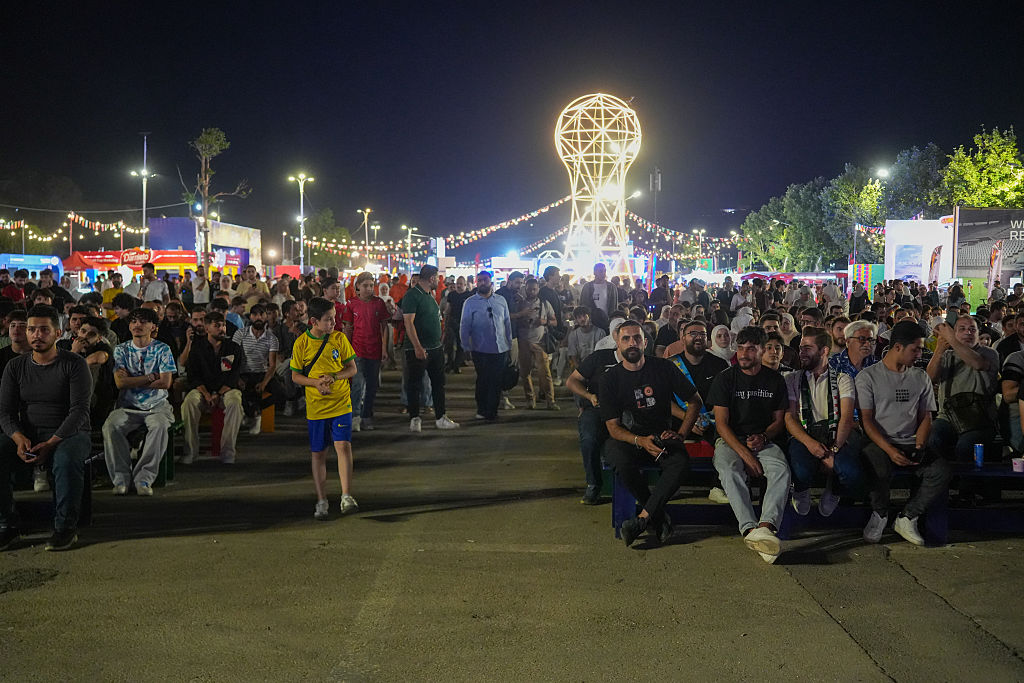
Syrian soccer fans watch World Cup matches on giant screens at the Damascus Fairgrounds in Damascus, Syria, on June 11, 2026. —Rami Alsayed-NurPhoto via Getty Images
I returned to Syria in the summer and found something new: the quiet miracle of ordinary life. On a July afternoon, I stood on the edge of al-Hatab Square in the old city of Aleppo, filming, transfixed. A group of boys was kicking a soccer ball around the square. One kicked it out into the street, out of the frame, where it bounced off a parked car. Another ball appeared immediately from the other side. They shouted, laughed, and kept playing. It was an ordinary scene, but I couldn’t look away.
The historic al-Hatab Square had been repaved a few years ago with broad, white slabs of limestone, ringed by a mix of gutted buildings and jarring white storefronts—the residue of nearly 14 years of war and the Assad regime’s failed attempts at reconstruction. For years, Syria had been defined by images of war: the deep bomb craters, the crumbled neighborhoods, the sprawling refugee camps. al-Hatab Square had been a fault line between regime and rebel territory in Aleppo during the particularly brutal years of 2013 to 2016. Many died crossing between the two sides. The regime’s aerial bombardment and the rebels’ underground explosions caused much of the destruction in the Jdeideh quarter, a UNESCO World Heritage Site that includes the al-Hatab Square.
I had watched the aftermath of bombings many times during the war: the pillars of smoke rising from the rubble, the White Helmets rushing to pull ash-covered bodies from the wreckage, the brokenness that was left behind. Now boys chased soccer balls across the square that was once a battlefield. I thought of a video produced by the advocacy group Syria Campaign in 2014 that imagined this scene in reverse: beginning in the moments after a bomb fell and rewinding until the bomb shot back into the sky with an explosive boom, the camera panning down to children playing soccer in a square. Just like this one.
In those moments in the square, you could squint and believe that fate had spared Syria the war. Yet all around me there were reminders; there was evidence. The yellowed stone planters that once held trees were gone. The old silver and gold shops, their facades blackened by time, were gone. What had once been dense and crowded was now open and disorienting. This was my fourth trip to Aleppo since the Assad regime fell in December 2024. Every visit evoked grief and fury, happiness and gratitude, disbelief and mourning. As time passed, these emotions grew quieter, and something new took their place.
Great expectations in Syria
Across the country, people offered wildly different accounts of how they felt 18 months after liberation. Some declared that nothing has changed. Others insisted, with equal conviction, that everything has. People complained about inflation, the fuel crisis, and the soaring cost of electricity. Some called the revolution a failure; others considered the new transitional government, led by President Ahmad Al-Sharaa, to be faultless. “What has changed?” “Things are worse than ever!” “I thought things would be so much better.” Somewhere between these lines lies the truth. No, things are not worse than ever. It is, mostly, a matter of expectations.
Still, as I witnessed scenes like the one in the square unfold across Syria, I found myself wondering: Can we finally live an ordinary life? Every day, I was struck by normalcy. The narrow streets of old Damascus were filled with crowds of shoppers. Cafes in the city were crowded with Syrians watching World Cup matches through the night.
Little girls roller skated on the grounds of a government sports complex in Damascus, in front of a former security center that once ruled the neighborhood through terror. The head of the complex told me the tracks, gyms, and saunas had once been used by Russian and Iranian soldiers during the war. Now I watched dozens of children running soccer drills on the field and doing knee-up laps in a karate class inside. These programs were offered to the community for free; the sports complex returned back to the people.
One evening at the citadel of Aleppo, more than 1,800 people gathered in the amphitheater for a musical performance. The Gardenia Choir, a Syrian women’s vocal ensemble, sang tunes that every Syrian child of the 1980s would recognize. A traditional singer from Aleppo performed qudud halabiyeh and muwashahat—Andalusian poems that have been sung for centuries. The crowd broke into carefree dance, singing along. Even the security guards joined in. As dusk settled, fireworks burst above us. I flinched, by instinct, then relaxed. For years, pops and booms had meant death from the sky.
I was moved by this lightness of being, by how fully people seemed to embrace joy, enacting it with their whole bodies. These fleeting moments felt like a release of pain and sorrow held too long. Can new memories of music, dance, and fireworks exploding into color over an ancient, battered city undo, or even weaken, the memory of bombs falling?
After all that has happened, it is no small thing to feel true joy in Syria. The normal feels radical. But a sense of normalcy is fragile and unevenly distributed. In Damascus, over the course of a single week in July, two bombings shook the city. The first bomb targeted a cafe outside the courthouse, killing nine people, most of them lawyers. Days later, two explosions injured 18 people near the Ministry of Tourism and the Four Seasons Hotel, where President Emmanuel Macron of France was visiting—the first head of state from the European Union to do so since the regime’s fall, a sign of Syria’s extraordinary reentry to the world. The bombings were a stark reminder of how easily life can still be shattered.
Soon after the bombings, the People’s Assembly, Syria’s new, transitional parliament, convened its first session since the fall of the Assad regime. Many Syrians remain critical of its delayed and flawed formation: one third of the assembly was appointed by the president, the rest chosen through regional electoral colleges led by committees assigned by the president. Yet, this parliament was not like the ones I had watched growing up, more theater than representation. Debate and disagreement with the Assad regime was not only unimaginable, but lethal.
From the first session, the differences of tone and practice were significant. President Ahmed al-Sharaa entered the chamber quietly and addressed the new members of the parliament without the choreographed applause of the past. No clapping after each sentence he spoke. No clapping at all.
For Syrians, this was a notable shift. The Assad regime cultivated idolatry and many had been happy to oblige it. A member of parliament once famously declared that Bashar al-Assad should rule not just Syria, but the entire universe, even as Assad dropped barrel bombs on his own people. The new ways of the parliament carried meaning and signified the beginning of a new era.
What do we talk about in Syria?
What was changing in Syria was not only what people were able to do, but what they were able to say. The shroud of silence and fear that enveloped Syria throughout the Assad decades was gone. Syrians were, finally, speaking freely about those dark decades.
In Hama, a city 130 miles north of Damascus, I visited the atelier of one of the last traditional weavers in the city. We drank coffee as he told stories of February 1982, when Hafez al-Assad put the rebellious city under siege and the regime’s army killed tens of thousands in a single month. Others in the shop shared stories of entire families being killed together in their homes. What felt radical was that we were in Hama, openly speaking about the stories of Hama.
In Aleppo, which is 220 miles northwest of Damascus, a kind man sitting next to me at dinner casually recounted how he and his wife—both were jailed for opposing Assad during the revolution—had survived. Their survival and our ability to speak openly about the brutal past felt miraculous. I teared up listening to them. I couldn’t get over what it meant to hear these stories exactly where they had happened. Just being there, bearing witness together, speaking and listening without fear or filter seemed to loosen some of the pain trapped inside us. In Hama, the wounds are 44 years old; the city was hollowed out, every family touched by loss. In Aleppo, in the suburbs of Damascus, across Syria, people and neighborhoods heaved under the trauma of the last 14 years. Thousands of families are still searching for answers about their loved ones—more than 100,000 of whom had disappeared under Assad’s rule.
Careful, beloved Syria
Syria has some new wounds as well. On the coast and in southern Syria, Alawite and Druze communities mourn the loss of loved ones and homes after deadly clashes between the government and armed militias last year. The return of normalcy for some cannot be an excuse to overlook those for whom the new Syria has brought new suffering. The Alawite and Druze communities are not obstacles to Syria’s hopeful future. Securing their safety and right to justice is a test of whether that hope is real. Normalcy cannot mean that some people dance and others grieve in silence.
The weight of all this loss can feel like too much for our ancient, newborn country to bear, as it tries to shake off the past while building a future on unsteady ground. There are no easy answers on how to move forward after a war that tore a country apart. In Bosnia, people are still identifying and burying their dead 31 years after the Srebrenica massacre. Such rituals strengthen collective memory and help a grieving community process and find some measure of closure. Syria is still at the beginning of this reckoning, and it will take time to build the forms of justice and remembrance that honor all its people.
I can squint my eyes, watch children play, and imagine what could have been. But you can’t go in reverse, rewinding a film scene, no matter how badly you want to. Syria cannot change its past, but it can forge a different future. Syria represents a chance, a possibility despite all the odds and expectations. One day, al-Hatab Square will be old again, and its white stones will weather and match the gray ones beside them. Maybe then our present will finally become history. Maybe then we will no longer be shocked by normal.
For now, people look up in delight rather than terror at a blaze of colors across the sky. Children play soccer in Aleppo on an old battlefield, laying new layers of joyful memories.
ABC News' Danny New explains the annual event where people travel from all over the U.S. to sprint in an inflatable dinosaur costume and try to win a giant trophy.
New Jersey Gov. Mikie Sherrill is taking her first major step onto the national stage, endorsing 13 Democrats — as the moderate signals she may jump into the debate over her party's future.
Пока университеты по всему миру пытаются понять, как жить в эпоху генеративного ИИ, преподаватель истории из Alcorn State University придумал довольно необычный способ проверить, кто действительно писал работу самостоятельно. Эксперимент оказался настолько показательным, что быстро разлетелся по соцсетям и вызвал споры среди преподавателей.
Addiction treatments are safe, effective — and rarely offered to patients. That's because many doctors and nurses still view people with alcohol or drug addiction with suspicion and hostility.
This is neither your father’s, your grandfather’s, nor your great-great-grandfather’s philanthropy. | Olga Aleksandrova for Vox
Well before he became CEO of one of the most valuable startups of all time, Dario Amodei was a 26-year-old PhD student studying biophysics at Princeton, obsessing over how his money would leave its mark on the world.
On what one might assume was likely a fairly modest academic stipend and with no discernible inheritance from his parents, an Italian-American leatherworker and a project manager for libraries, Amodei gave $10,000 in 2009 to a relatively new charity evaluator called GiveWell. Founded by two ex-hedge funders before effective altruism was even a phrase, GiveWell ranked charities primarily by a single dispassionate metric: dollars per lives saved.
Key takeaways
The AI boom is set to create a new slate of Silicon Valley millionaires and billionaires, many of whom say they plan to give all or much of their wealth to charity.
Much of that philanthropy — which one estimate says could exceed $100 billion per year — will go to causes associated with effective altruism, like animal welfare or AI safety.
This influx of wealth may ultimately reshape American philanthropy in its own rigorously optimized image, with broad implications for how we treat animals, fight disease, and adapt to AI itself.
It was the kind of approach that clearly appealed to Amodei — though it may not have gone far enough for him. In 2010, he wrote a guest blog post for GiveWell dissecting the effectiveness of two of the group’s top global health charities: VillageReach and StopTB. Both charities could save a life at roughly comparable costs — around $545 — but while StopTB treated or prevented tuberculosis in adults, VillageReach’s interventions mostly saved babies and children. Most people would probably feel that saving a child trumps saving an adult; indeed, even effective altruists often agree on the grounds that children have more life to live left.
Amodei, though, viewed that as a liability for VillageReach. An adult death, he wrote, is “perhaps 2 or 3 times worse than an infant’s death,” because adults “are capable of deeper and more meaningful experiences.” As uncomfortable as such a calculus may be, he wrote, “on a practical level one is forced to make difficult decisions with limited funds.”
Though he declared StopTB to have “superiority on cost-effectiveness,” Amodei ultimately gave VillageReach higher marks for their tightly controlled “chain of execution” — the full sequence of steps between a dollar of donation and a vaccine reaching a child. That was important enough to Amodei that, despite his initial reservations, he ultimately gave VillageReach his entire $10,000 donation in 2009 — enough to save, he estimated, the lives of 20 babies across rural Africa.
But Amodei hoped the ultimate impact would be even greater. “The money I give out is not just a one-shot intervention,” he concluded, “but also a vote on what I want the philanthropic sector to look like in the future.”
The future, it seems, has arrived. Amodei is now a multibillionaire, his fortune poised to skyrocket further if and when Anthropic goes public, as many expect it to do later this year. He is one of dozens of new billionaires and millions of new millionaires minted virtually overnight by the AI boom.
There have already been plenty of aftershocks to this emerging AI megawealth, like the stratospheric San Francisco housing market, the nerdmaxxing of sex work, and the proliferation of all-you-can-biohack peptide raves.
But the most consequential, and perhaps weirdest, way this burgeoning AI-ristocracy plans to burn through its cash is by giving a huge chunk of it away. Amodei is one of several AI multibillionaires — alongside his co-founders at Anthropic and OpenAI’s Sam Altman — who have pledged to donate most of their wealth in their lifetime. But even their obscene degree of collective wealth — they are worth $111.8 billion as of this writing — is only one slice of an AI bonanza that seems poised to balloon into one of the most consequential waves of American philanthropy of all time, one deeply shaped by the same utilitarian impulse that guided one of young Amodei’s first big donations.
“I am having thousands of conversations with people who are perplexed by their own fortune and determined to give with thoughtfulness and urgency in a way that I haven’t, frankly, experienced before,” said Nick Allardice, CEO of the effective-altruism-aligned anti-poverty group GiveDirectly, whose work is grounded in research on the efficacy of unconditional cash transfers. “It’s just really important that people get started, that they don’t let perfect be the enemy of the good.”
This is neither your father’s, your grandfather’s, nor your great-great-grandfather’s philanthropy. If Gilded Age industrialists like John D. Rockefeller, a devout baptist, gave in service of their religiosity or, as was the case for Andrew Carnegie, their reverence for civic duty, then most of today’s AI barons carry forth their own spiritual tradition, one at the very least informed by the vigorously optimized commandments of the effective altruism movement. They appear far less likely to fund Carnegie-style works like opera houses or libraries than they are to put their faith — and their billions — in what they believe they can measure, calculated on the cost benefit analysis of a life saved or an apocalypse averted.
In some cases, as Amodei did as a grad student, they’ve already begun the process. “These are people who have committed themselves to giving back even before they were very wealthy,” said Sjir Hoeijmakers, CEO of Giving What We Can, an organization that developed a campaign popular with effective altruists to give away at least 10 percent of their yearly income, “people who have been building the habit of giving for a very long time.”
And it is, to be clear, a very particular kind of giving. Amodei was the 43rd person to sign the 10 percent pledge the year after it launched in 2009, and its roster has since swelled to over 11,000 people, including more than a dozen current or former Anthropic employees. Donations made through Giving What We Can’s platform are on track to grow by 40 percent this year, Hoeijmakers told me, and support for animal welfare charities — a cause particularly and unusually popular with effective altruists — has already exceeded its 2025 total.
“We have the resources available to tackle things that we should have tackled a long time ago,” like eradicating malaria or putting an end to factory farming, Hoeijmakers said. “I hope this funding wave, if it comes, will show that we can actually solve global problems at scale if we put our mind to it and our resources.”
Devoutness has long been a virtue in philanthropy, which largely originated in religious tithing, and there are plenty of worse things to have faith in than numbers. Having a communal guiding philosophy will undoubtedly help effective altruism’s newly flush disciples follow through on their promises far more prolifically and consistently than they would without it. And despite its high profile, less than 1 percent of total philanthropy came from effective altruism last year, according to Hoeijmakers. Most rich people prefer to give to the normie causes, like their alma maters, not to the sort of chronically underfunded global problems — like protecting animals or fighting lead poisoning — that effective altruists justifiably care most about.
Now, quite suddenly, there’s about to be much more money to go around for these causes, which as Hoeijmakers hopes, could help finally address some of the enormous, entrenched global problems that more traditional philanthropists have all but ignored.
But such piety also carries its own risks. In a viral Substack post from May, Stripe executive Nan Ransohoff argued — rather dismissively, but not incorrectly — that “traditional philanthropic orgs and people won’t cut it” in this new wave of AI-funded effective philanthropy, that these donors “will have an affinity” for “tech-caliber talent and execution” and will be “by default wary of folks who come from traditional philanthropy.” Ransohoff called instead for Silicon Valley to build its own new ecosystem of funds and “philanthropic startups” to cater to this new wave of wealth, emboldened with the “speed, intensity, and execution of a top technology startup.” Many of those old-school philanthropic people wroteindignantrebuttalstoRansohoff’spiece, arguing against their own obsolescence at a time when a number of the organizations they support are increasingly starved for funding.
Those responses are, in aggregate, also correct, after their fashion. The new AI philanthropists will likely aspire to new models and approaches, as Ransohoff rightly argues. But they reinvent the wheel at our collective peril, not least of all because ignoring past efforts and steamrolling over existing infrastructure might make even the most optimized giving less efficient, and certainly less informed, than it would be otherwise.
“Acknowledge what’s here and what’s working — don’t just ignore it,” said Nicole Taylor, president and CEO of the Silicon Valley Community Foundation. “These folks are transforming our daily lives with their technology, and they have the opportunity to be as transformational with their philanthropy. My fear is that they think that they can do it alone.”
How much money are we actually talking about?
As Ransohoff pointed out in her piece, a lot of money is on the line here — and, along with it, a lot of cautious hope about how it might get spent.
Ransohoff posits that if you add up the promises of Amodei and his fellow co-founders, the worth of the OpenAI Foundation — the nonprofit that owns a big chunk of OpenAI’s profits — and rumored contributions from Anthropic employees, then the AI wealth boom could, in theory, lead to at least $37 billion and as much as $100 billion in total annual giving, a sizable boost to the roughly $617 billion that was given in the US in total last year.
“These folks are transforming our daily lives with their technology, and they have the opportunity to be as transformational with their philanthropy. My fear is that they think that they can do it alone.”
Nicole Taylor, Silicon Valley Community Foundation president and ceo
This projection should be treated with cautious skepticism. For one thing, hundreds of billions in cash are not just sitting around in some Bay Area money vault; much of today’s AI wealth is wrapped up in potentially volatile equity, and many lofty philanthropic pledges ultimately fail to reach their full potential.
“What people say before they become extremely wealthy, and then how they behave after they become extremely wealthy, sometimes diverge,” said David Goldberg, founder and CEO of Founders Pledge, which recruits tech leaders to donate a portion of their future earnings. It doesn’t help either, he said, that some tech luminaries — namely, Elon Musk and Peter Thiel – have come to treat most philanthropy with disdain in recent years, an ethos that has permeated some parts of the sector. Musk, it’s worth noting, actually pledged to give most of his wealth away himself back in 2012, though, like many other ultra-wealthy signatories of the Giving Pledge, he seems quite unlikely to keep that promise.
That’s not to say AI money isn’t already flowing. Coefficient Giving, a grantmaker that evolved out of GiveWell, is poised to steward a large portion of the coming philanthropic bonanza. For most of its history, the group operated essentially as the private grantmaking operation for Facebook co-founder Dustin Moskovitz and his wife Cari Tuna. But it recently made a significant pivot towards operating pooled, multidonor funds for anyone interested in causes like lead exposure, farm animal welfare, or questions of AI safety. Just last month, Coefficient Giving announced it would donate $1 billion to GiveWell alone this year, more than five times the $175 million the group initially pledged seven months ago. They chose to do so explicitly, because Coefficient Giving expects to receive much more funding very soon.
There’s also the OpenAI Foundation, which has already begun pumping $100 million into Alzheimer’s research, and Anthropic, which recently announced a partnership with the Gates Foundation to invest $200 million worth of grants, API credits, and technical support into global health work. And plenty of Silicon Valley elites have begun making promises of their own. Earlier this summer, David Silver pledged to donate 100 percent of his equity proceeds from his UK-based $1.1 billion startup Ineffable Intelligence — the largest commitment in Founders Pledge history — and many signers of the Founders Pledge will see their portfolios skyrocket in response to the coming wave of AI IPOs.
But Goldberg does believe there’s a risk that as people get rich fast, they will donate money “much, much slower” than they intended, simply because they get “too busy, they don’t have the right support, or there’s some form of analysis paralysis.”
All of this is to say that the biggest beneficiaries of the AI boom are not going to function as some sort of charitable monolith. Some, like Musk, probably won’t give much or anything to charity at all. Others may park their money in donor-advised funds — a kind of secretive charitable investment fund — or, eventually, a private foundation, both of which tend to dole out their money gingerly, meaning donors can enjoy the tax benefits of charity many years before they actually opt to help anyone with their money.
Effective altruism is about to have its big break
While its name recognition may be relatively high these days, the effective-giving movement is still on the margins of American philanthropy. But if this new wave is anywhere near as big as everyone says it will be, then that won’t be the case for long.
For the uninitiated, my ex-colleague Dylan Matthews has written plenty on what effective altruism is, but, in sum, it is a movement that believes in goodmaxxing, in the idea of using rigorous research to save the greatest number of lives possible, including future human lives and farm animal lives. Once an EA poster boy, Sam Bankman-Fried sullied the movement in 2022, which may help explain why some prominent adherents — like Amodei and his sister and co-founder Daniela, whose husband Holden Karnofsky co-founded GiveWell — have distanced themselves somewhat from the movement in recent years.
But even when donors shy away from the term, the causes and principles of utilitarian evaluation that have defined effective altruism from its early days still permeate the new moneyed corners of Silicon Valley, particularly among those most poised to give a lot — and to give a lot quickly.
Ask any animal welfare or global health nonprofit — or, better yet, an expert-led pooled fund with a reputation for rigorous charity evaluations — and they will tell you that they are preparing for, and possibly even beginning to see glimmers of, a windfall.
“We are very much anticipating a significant influx of funding,” said Dan Shannon, CEO of the Humane League, which fights to end factory farming. “I am cautiously optimistic that this could be a real sea change for us,” because “even if it’s a fraction of the big numbers being bandied about,” it could do a lot for a movement that operates on less than $300 million per year.
He said he’s been speaking with other leaders about the possibility of creating a pooled fund to absorb more cash, which has become an increasingly popular solution for donors who want the rigor of a 2010 Dario Amodei-style deep dive on a charity’s methodology and effectiveness without having to do the math or thinking themselves.
Much of the new EA wealth will likely go toward efforts to make life on Earth better now or in the near future through donations to causes like medical research, animal advocacy, or anti-poverty interventions. But another, more controversial chunk of it will go toward mitigating existential risks, especially that of Silicon Valley’s own Frankensteinian creation: AI itself.
“If you’re breaking the world and making money by breaking it, should you just not break it? I wrestle with the question myself.”
David Goldberg, Founders Pledge founder and ceo
It’s that last cause that has proven most controversial. If these billionaires are so afraid that AI will break the world, then why, you might ask, would they not just stop building it in the first place? Is there not an inherent contradiction, a conflict of interest perchance, in the sense that those tasked with making sure AI does not, let’s say, build a bioweapon, take your kid’s job, or make everyone dumb, are doing so with money made from the very thing they’re trying to regulate?
In other words, “If you’re breaking the world and making money by breaking it, should you just not break it?” asked Goldberg of Founders Pledge. “I wrestle with the question myself.” In the end, “this is a technology that’s coming, regardless of who’s building it,” he reasoned, and it is better that the presumably good guys — the ones bothering to think about the consequences at all — build it first.
If you broke the world, can you fix it?
Even if the AI bubble pops, and if the much-discussed giving boom ends up smaller than many anticipate, it could still lead to significant changes for some of the world’s most neglected problems. And if it is close to as big as it’s expected to be, then what happens next could be gravitationally transformative, reshaping how the world lives, considers animals, and adapts to its most disruptive technological breakthrough in a century.
“I don’t think most people think about factory farming as something that could actually be eradicated. Full stop,” Shannon said, but “my grandparents lived in a time without factory farming, and I think my grandchildren could live without factory farming,” and “that could ultimately be the legacy of this wave of philanthropy.”
Ending the pervasive use of cages — “probably the cruelest way that animals are treated on industrialized factory farms,” says Shannon — could cost as little as $500 million over 25 years, or less than 1 percent of the $60 billion that Ransohoff estimates Anthropic employees may have sitting in donor-advised funds, thanks to Anthropic’s generous early gift-matching policy, which could quickly turn into real cash once the company goes public.
“There’s so much needless stupid, preventable suffering in the world. We live in this time of so much abundance, so much wealth, so much technological development, and yet, there are so many people who have been left behind.”
Nick Allardice, GiveDirectly CEO
Developing a new vaccine costs an average of $886.8 million, which may sound like a lot, but it is equivalent to less than 6 percent of Amodei’s newfound fortune. It is less than what the OpenAI Foundation has pledged to invest in disease research and other causes next year alone.
Then, there’s, perhaps, the biggest target of all. Ending extreme poverty everywhere would cost just over $300 billion annually, according to one analysis — which is a hefty price tag, but less than one-fifth of what the wealthy spend on luxury goods each year. “There’s so much needless stupid, preventable suffering in the world,” said Allardice of GiveDirectly. “We live in this time of so much abundance, so much wealth, so much technological development, and yet, there are so many people who have been left behind.” If this new wave of giving is wielded well, he said, then “we have the potential to collectively raise the floor of human experience.”
That’s a lot of responsibility to place on the shoulders of a bunch of bustling young tech workers still processing what it means to be quite suddenly, dazzlingly wealthy. It is also a lot of faith to place in an industry that has left more Americans feeling scared than hopeful about what a future flush with AI portends.
If you aim to fix global poverty, but the technology that made you rich also threatens to make everyone else poor, then whose side are you really on? To be clear, many of the AI-ristocracy have fretted, often apocalyptically, over the implications of their creation long before most of us knew we had anything to worry about. But that doesn’t mean they know how to fix this, and, at the very least, they will not do so alone.
The last time the ground shook from such a supermassive earthquake of wealth was arguably during the Gilded Age, when robber barons and industrial tycoons turned American charity — until then, mostly almsgiving and poorhouses — into big business. They seeded enormous philanthropic empires like the Rockefeller Foundation and beloved institutions like Carnegie Hall. But, even as their exorbitant fortunes made life indisputably better — birthing the modern library, the yellow fever vaccine, and many social services — they were often built atop systems of vicious exploitation. When those systems changed, as they did eventually, it did not come from the benevolence of industrial barons, but from sustained public pressure for better labor protections.
Effective giving was born out of the conviction that many of the world’s most important causes go vastly underfunded, which, in turn, demand relentless prioritization of the limited funds that exist. If those causes are no longer underfunded — a plausible scenario if AI wealth continues to grow at the pace many expect it to — then that might change the calculus of how effective altruists decide what’s worth funding. It might even open up some wiggle room for new causes, including somewhat less measurable — but not necessarily less impactful — approaches. “Now we’ll be thinking more about what we can do with a lot of resources; which larger problems can we solve?” said Hoeijmakers. “You’ll put slightly less relatively into evaluating every small dollar on the margin.”
This already seems to be happening, to some extent, at places like Coefficient Giving, which, in recent years, has begun adding new funds for causes like housing policy reform that fall out of effective altruism’s traditional purview. “We don’t want to be only appealing to the subset of people who happen to be interested in effective altruism,” CEO Alexander Berger told my colleague Bryan Walsh last year. “Our aim — and so far we’ve seen some success — is being a resource to people who have never heard of effective altruism or are not interested in it or don’t find it very motivating or welcoming. And I think that’s good.”
The optimal outcome here is not that Silicon Valley wealth edges out everything else, but that the siloes begin to break down altogether and that there is enough money to go around that the sector no longer needs to make overly intellectualized trade-offs, like young Amodei sitting in his dorm room, ascribing a number on the relative worth of a parent versus a child.
“It’s tough to find the right balance between caring and hard-nosed realism,” he wrote at the time, “but it is possible, and it is, as far as I know, the only way to truly change the world.” He’s about to search for that balance on a much bigger scale.
Washington-Rabat ties under scrutiny as questions swirl over what led to deadly influx into tiny Spanish territory
The cosy relationship between Washington and Rabat has long been flaunted by both sides, from Morocco’s announcement this year that it would be the first African state to join Donald Trump’s Board of Peace to the congratulatory message recently sent by Trump to mark King Mohammed VI’s 27 years in power.
The latest example landed this week. As Spain grappled with the aftermath of the sudden influx – and swift return – of more than 70,000 people into Ceuta, Morocco’s monarch confirmed he had named a $1bn highway flanking the disputed territory of Western Sahara after Trump.
Есть кластер задач, который выглядит скучно, но кормит половину мировой экономики. «Сколько будет стоить эта квартира?» «Сколько дней займёт доставка товара получателю?» «Какое количество посетителей будет в магазине в субботу?» «Какой будет расход электричества дата‑центра за неделю?»
Выглядят эти задачи однотипно: на входе набор известных заранее данных, а на выходе одно конкретное число. Статистики и специалисты по машинному обучению называют это регрессией, а для остальных это «прогноз», с которым они работают на ежедневной основе.
Последние полтора десятка лет эти задачи решали инструменты, о которых обычный человек никогда и не слышал. К примеру, XGBoost. Устроены эти инструменты как перечень примерно из двадцати вопросов, на которые необходимо последовательно ответить. «Дорогой ли район?» «Больше трёх комнат?» и так далее. Заданные в определённом порядке, они относительно точно приводят к ответу. Работает быстро, себестоимость копеечная, принцип понятен на всех уровнях руководства.
А потом выяснилась неожиданная вещь. Языковые модели (LLM), которые обычно помогают нам писать письма и придумывать креативы, умеют делать то же самое, а иногда даже точнее.
The government turned to the world to respond to twin quakes. But years of shrinking budgets and political repression weakened its ability to rescue countless people trapped in rubble.
Gun-friendly Wyoming has a “stand your ground” statute that allows people to use force to defend themselves. So why is a trans woman being prosecuted after being shoved to the ground?
These officials oversee or help administer elections in counties across the nation where competitive House and Senate races will determine control of Congress.
Washington-Rabat ties under scrutiny as questions swirl over what led to deadly influx into tiny Spanish territory
The cosy relationship between Washington and Rabat has long been flaunted by both sides, from Morocco’s announcement this year that it would be the first African state to join Donald Trump’s Board of Peace to the congratulatory message recently sent by Trump to mark King Mohammed VI’s 27 years in power.
The latest example landed this week. As Spain grappled with the aftermath of the sudden influx – and swift return – of more than 70,000 people into Ceuta, Morocco’s monarch confirmed he had named a $1bn highway flanking the disputed territory of Western Sahara after Trump.