Singer with one of the first ‘girl groups’, the Chantels, whose 1950s hit Maybe sold more than a million copies
Almost before the five Bronx schoolgirls who called themselves the Chantels had finished their unaccompanied delivery of a song called The Plea in his office on Broadway one day in 1957, the record label owner George Goldner was fishing in his desk for a contract they could take home and show their parents. Within months the group were high in the charts with a ballad called Maybe, featuring the powerful lead voice of the 16-year-old Arlene Smith.
The Chantels set the pattern for the success of such “girl groups”, as they became known, as the Shirelles, the Crystals, the Chiffons, the Ronettes, and many more.
Каждый инженер или системный администратор, работавший в компании с большой историей, знаком с этой болью: инфраструктура масштабируется, сотрудники приходят и уходят, а в службах каталогов постепенно накапливаются тонны legacy-объектов. С одной стороны, всё может работать в штатном режиме, но на деле контроллеры домена начинают с задержкой откликаться на LDAP-запросы, аутентификация периодически дает сбои, а в случае миграции на новое ПО админам приходится долго разбираться с правами доступа.
Проблема раздутых служб каталогов — это прямая угроза производительности, безопасности и отказоустойчивости всей компании. О том, как исправить ситуацию, поговорим в этой статье.
Promoters who worked with Oasis on their huge 2025 reunion tour have secured a licence to host events at Knebworth, the site of the band's most famous gigs.
Российская армия начала активно использовать самолеты дальнего радиолокационного обнаружения А-50У для защиты своего воздушного пространства. Каковы первые результаты применения А-50 против украинских крылатых ракет? Достаточно ли у России таких самолетов-радаров, чтобы отражать воздушные угрозы в условиях быстрого роста ракетного производства в Украине?
Два года назад, 6 августа 2024 года, украинские войска вошли в Курскую область и на восемь месяцев взяли под контроль город Суджу и окрестные села. До сих пор неизвестной остается судьба 330 человек. Би-би-си рассказывает, как родные пытаются найти своих близких — живыми или мертвыми.
У цифрового продукта есть шанс исправить плохой onboarding следующим релизом. У физического продукта, который уже нанесли на стену, такого шанса почти нет.
Магнитная поверхность - хороший пример. На уровне идеи все звучит просто: сделать стену, к которой крепятся магниты. На уровне внедрения появляются основание, слои, финиш, сушка, инструмент и тип магнитов. Если пользователь или подрядчик пропускает один из пунктов, проблема проявляется уже после работы.
Use case: поверхность, где результат зависит от процесса
Магнитная поверхность не равна одной банке материала. Это система.
Есть стена. Ее нужно оценить: ровность, стабильность, старое покрытие, пыль, впитываемость. Есть магнитный слой: краска, грунт или шпаклевка. Есть финиш: интерьерная краска, маркерное или грифельное покрытие. Есть магниты, которыми будут пользоваться каждый день.
С точки зрения продукта это не просто SKU. Это сценарий внедрения, где ошибка пользователя может выглядеть как ошибка материала.
In 2014, Narendra Modi pioneered the use of social media and digital campaigning in India to become prime minister. Known as one of the first global politicians to harness the power of the internet, he has the most social media followers of any world leader currently in office.
Today, over a decade since Modi’s digital-first political campaign, an internet-fueled youth movement called the Cockroach Janta Party (or the Cockroach People’s Party) is using the same social media platforms to organize protests, successfully forcing the resignation of one of Prime Minister Modi’s top advisers. The Indian government has responded with a crackdown, arresting protesters and increasingly censoring X, Meta, and other social meda sites. The legacy of the Cockroach Janta Party will be complex: On one hand, it brought to the forefront important conversations around Gen Z unemployment and meritocracy; on the other, it may have pushed the Indian government to create stricter new censorship laws to silence future dissent.
The internet that helped propel Modi to power is becoming a tool that a new generation uses against him. How much further will Modi’s government go to censor its people and restrict free speech?
Read more about censorship in India and the Cockroach Janta Party:
If you enjoy our reporting and want to hear more from Vox journalists, sign up for our Patreon at patreon.com/vox. Each month, our members get access to exclusive videos, livestreams, and chats with our newsroom.
The launch of these new features reflects Google’s ambitions to transform Google Maps from a navigation tool into an assistant that's capable of helping users complete real-world tasks.
Royal Opera House, London Mixing contemporary, Cuban and classical works, Acosta has charisma to burn and is accompanied by an impressive cohort
It’s a bit of a stretch to call this undoubtedly enjoyable programme Myths and Modern Masters but granted, it sounds better than Miscellany. Carlos Acosta – superstar dancer, now director of Birmingham Royal Ballet and Cuban company Acosta Danza – has picked and mixed dancers from both companies to offer a very eclectic spread of dance, and added himself into the mix.
At 53, Acosta may not have the physical prowess of his youth, but he brings great presence and depth – and some great dancing, too. That serves very well in José Limón’s landmark 1949 work The Moor’s Pavane, a distillation of Shakespeare’s Othello which boils down the story to four characters – Othello (Acosta), Desdemona (Beatrice Parma), Iago (Max Maslen) and Emilia (Miki Mizutani) – and contains their drama of deception, jealousy and revenge within a stately composition of measured steps and stylised gestures, set to courtly music by Purcell.
Dowman is old news by now, so we’re going to look at someone four months older than him. Much like the fish of the same name, Salmon has risen quickly. The defender became the fourth-youngest player to represent Arsenal last season when he came off the bench against Club Brugge in the Champions League in December at the age of just 16 years and 102 days.
National Football Teams Day established for 15 July
Post-match celebrations included Falklands banner
Argentina’s World Cup semi-final win over England last month is being commemorated by the country’s football association, the AFA, which has established 15 July as National Football Teams Day.
“The date was chosen to commemorate Argentina’s historic victory over England in the World Cup semi-final,” an article on the AFA’s official website stated after a meeting of its executive board on Wednesday. “Lionel Scaloni’s team was trailing the English side by a single goal, but with goals from Enzo Fernández and Lautaro Martínez, they turned the game around, sending the entire nation into a frenzy of celebration.
The heat has set a national temperature record in Austria, fueled wildfires in France and disrupted energy and transportation systems across the continent.
From a wild corner of southern France, these crisp, minerally whites and silky red blends are unforgettable wines
We all have our coming-of-age story: a transition to adulthood defined by emotional growth. I’ll let my friends be the judge of whether mine’s happened, but in wine terms, I can pinpoint my coming of age to the day I first tasted a white from Côtes Catalanes IGP. What was this nectar? I’d spent a lifetime chugging things I liked (from Um Bongo to supermarket Macon), but this was not a chugger. The bottle was Domaine Gauby’s Les Calcinaires Blanc 2010, a blend of muscat, chardonnay, macabeu and vermentino from the eastern foothills of the Pyrenees in French Catalonia. I had to take my time over something this good, and that felt very grown up indeed.
The Côtes Catalanes IGP (Indication Géographique Protégée) sits within a nook of Languedoc-Roussillon in the very south of France. As an IGP, it is a less prestigious designation than AOP (Appellation d’Origine Protégée), but one that gives winemakers greater freedom to flex their muscles. Where wines from Côtes de Roussillon AOC have to be particular blends with particular proportions, winemakers in the Côtes Catalanes can produce single-varietal wines with a greater range of grapes; many are organic or biodynamic. They have a renegade spirit I’m sure you can taste in wines that are mineral, full of complex fruit and often have notes of garrigue – Mediterranean scrubby herbs such as thyme and rosemary.
Preceding a long-awaited sequel, Griffin Dunne’s supernatural suburban romance gets a big-screen rerelease. With its romcom quirk, buttery cinematography and stabs of black comedy, it remains a zany gem
With a sequel shortly to make an appearance – Nicole Kidman, Sandra Bullock, Stockard Channing and Dianne Wiest (but not Evan Rachel Wood) all reprising their roles – the original Practical Magic from 1998 is now getting a rerelease. This is Griffin Dunne’s smalltown supernatural goof-fest, adapted from a bestseller by Alice Hoffman; the sequel is based on her own follow-up, The Book of Magic. A zanier adventure in occult romance can hardly be imagined, and the elements of grown up noir violence only make it weirder – it is as if The Witches of Eastwick took on something of Thelma & Louise with a decaffeinated David Lynch. Meanwhile, cinematographer Andrew Dunn bathes the daytime scenes in a golden, buttery light.
In a suburban American anytown, buttoned-up residents and frowning soccer moms are disapprovingly obsessed with the fact that the local Owens family womenfolk are witches. There is an amusing “prelude” scene showing a Salem-style public hanging of one of their ancestors; a stark stab of black comedy. In the present day, the Owens sisters Sally and Gillian, played by Bullock and Kidman, are intensely aware of their magical inheritance, as personified by naughty maiden aunts Frances and Bridget, played by Channing and Wiest.
Danish teenagers will have to make an oral defence of their written essays to combat AI cheating, the government has announced.
Pupils aged 16 to 19 at upper secondary school (known in Denmark as gymnasiet) will also be encouraged to do written assignments at school under controlled conditions, including monitoring of their computer screens, rather than at home.
Projects like London’s Backyard Biennial East are collective endeavours aiming to reach people who feel excluded by art galleries
In 2018, on the outside wall surrounding the entrance of the National Theatre of Bangladesh, I first encountered a work by the artist Reetu Sattar. A group of musicians were perched on construction scaffolding, all dressed in white and playing a single note on the harmonium – an instrument used in Bengali classical music. Together, they produced a low hum that seemed to vibrate through everything around me. The work was called Lost Tune.
I came across the work at a time when I desperately wanted to learn a musical instrument, but music was not allowed in my house. A growing sentiment in many Bangladeshi Muslim households held that music was prohibited in Islam, despite our long histories of musical traditions. It felt as though everything we knew of the past had been locked away inside the Jadu Ghor, the “magic house” (the Bangla words for museum), quietly collecting dust.
The University of Minnesota withdrew an offer for Raz Segal to lead its Center for Holocaust and Genocide Studies after an organized campaign against his hiring
When the University of Minnesota (UMN) extended an offer to historian Raz Segal to lead its Center for Holocaust and Genocide Studies in June 2024, it did so upon the near-unanimous recommendation of a committee of academics after a rigorous search process. The scholars had enthusiastically praised Segal, with one committee member describing a presentation he gave as “breathtaking”.
But five days after making the offer, the university abruptly withdrew it, citing “perspective” it had received from members of the community. The reversal followed backlash over Segal’s criticism of Israel’s actions in Gaza, which he called “a textbook case of genocide” in an October 2023 op-ed published in Jewish Currents. Segal’s critics condemned the piece, published just days after the 7 October attacks in Israel, accusing him of justifying Hamas crimes – an assertion that Segal rejected and the article does not sustain.
Exclusive: Louisiana firm awarded tender to build rudimentary outpost to house Moroccan troops
Donald Trump’s Board of Peace, which was set up in January to oversee the reconstruction of Gaza, has finally issued its first construction contract in the devastated territory: a project to build a rudimentary 150-person military outpost to house Moroccan troops, a source familiar with the matter told the Guardian.
The contract, which has not yet been finalised, was awarded to Arkel International, a Louisiana-based firm that has previously carried out work with the US government in countries such as Iraq.
Cities in Washington and Oregon seeing some of world’s worst air quality indices as smoke from fires cloaks region
Wildfires raging in the US Pacific north-west are blanketing the region with thick smoke, delivering some of the world’s worst air quality even as firefighters made progress against larger blazes in Washington state.
As of Thursday afternoon, Seattle, Washington, and Portland, Oregon, hovered at the top of Swiss company IQAir’s list ranking the most polluted cities globally.
Scheme aiming to stop people turning to terrorism has 39% overall rise in referrals in year to September 2025
A record number of people have been referred to the government’s anti-terror programme in England and Wales, with a 39% rise over the last year, including a 20% rise in referrals for extreme rightwing ideology, according to official data released on Thursday.
A total of 10,293 referrals – up from 7,408 – were made to the Prevent programme in the year to September 2025, which is the highest number since records began 11 years ago.
Exclusive: Louisiana firm awarded tender to build rudimentary outpost to house Moroccan troops
Donald Trump’s Board of Peace, which was set up in January to oversee the reconstruction of Gaza, has finally issued its first construction contract in the devastated territory: a project to build a rudimentary 150-person military outpost to house Moroccan troops, a source familiar with the matter told the Guardian.
The contract, which has not yet been finalised, was awarded to Arkel International, a Louisiana-based firm that has previously carried out work with the US government in countries such as Iraq.
Danish teenagers will have to make an oral defence of their written essays to combat AI cheating, the government has announced.
Pupils aged 16 to 19 at upper secondary school (known in Denmark as gymnasiet) will also be encouraged to do written assignments at school under controlled conditions, including monitoring of their computer screens, rather than at home.
There was nothing much happening in Jerome and Benno Leuer’s yard in Hamel, Minn. on August 11, 1948. It was noontime in the thick of summer and the boys, 10 and 8, were idly playing when, as they later described it, something overhead caught their eyes. They looked up and their jaws dropped.
Roughly 12 ft. up in the air was a dull gray, circular object, about 1 ft. thick and 2 ft. in diameter, slowly descending between them. They stood transfixed as the object settled onto the ground, making a clattering sound like metal hitting metal. The object rested there a moment, and then began emitting a high-pitched whistle that, to the boys, sounded like a teakettle. It spun in place once, then shot 20 ft. into the air, hovered for a moment, and ascended to 30 ft., maneuvering around tree branches and telephone wires in its path. Finally, it jetted out of sight.
Jerome and Benno ran inside and told their parents what they had seen. Their father notified the only authority he could think of: R.R. Sheridan, the local postmaster. Sheridan, in turn, called the FBI field office in St. Paul. To the family’s surprise, the bureau sent an agent. He interviewed the boys and inspected the yard.
“The spot where the alleged ‘flying saucer’ had landed was approximately 2 ft. in diameter and appeared as though a heavy object had landed there or had touched down,” read the statement in the official report. “The ground was dented and protruding rocks had been leveled.”
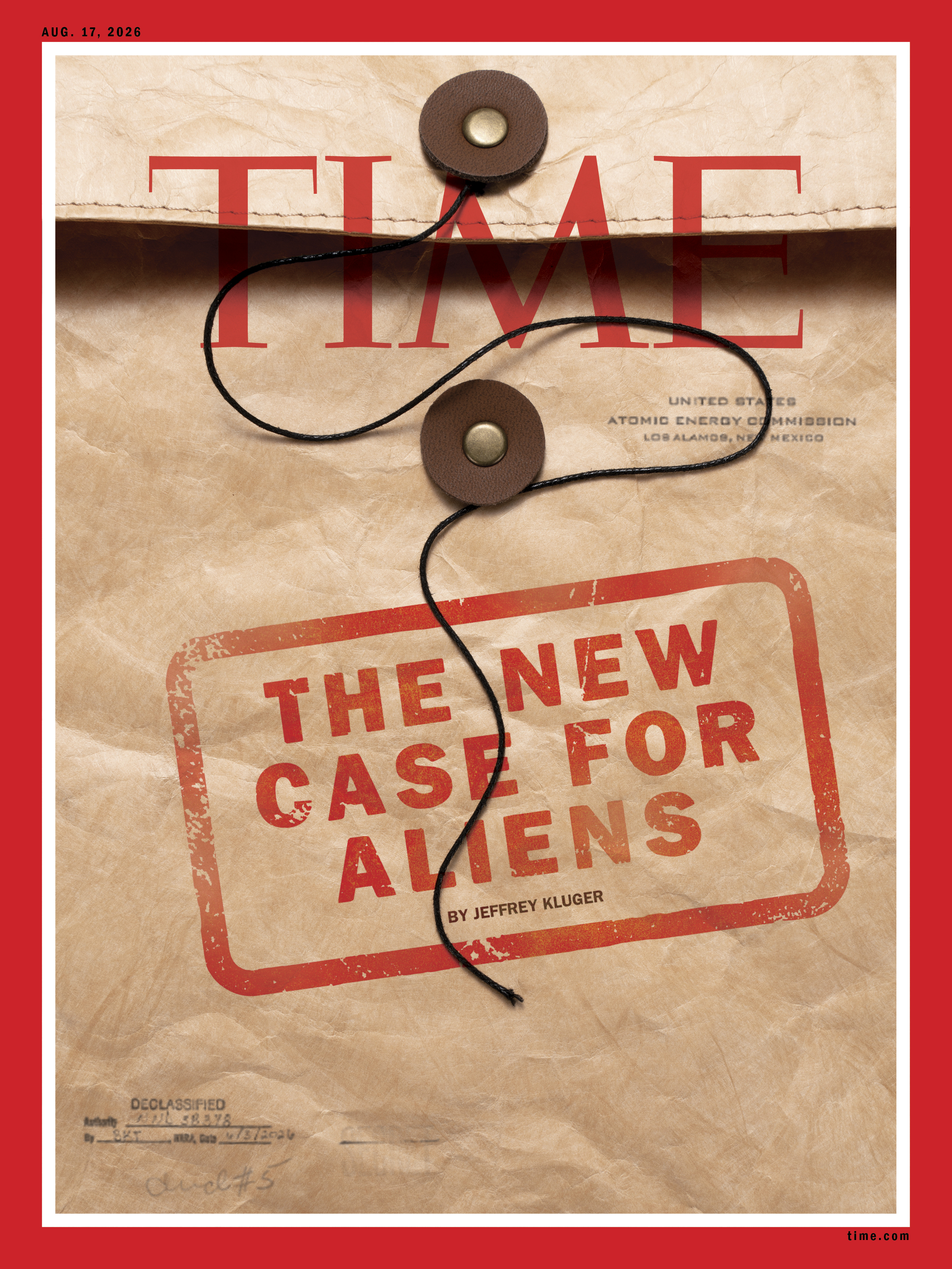
The boys grew up and moved on. Nothing came of their mysterious sighting, but the government preserved the report all the same, filing it away in a cache of documents it had already begun keeping, of both civilian and military accounts of flying, hovering, blinking objects that appeared in the skies, skittering about, sometimes touching down, and then vanishing back the way they came, just as Jerome’s and Benno’s object had. For 78 years, the boys’ story—and hundreds of others like it—had languished in storage. Until May 8, 2026, when President Donald Trump began a serial release of four tranches of more than 450 official reports going back to the middle of the last century, ordering that they be posted on a Department of Defense website and made available for public perusal.
After decades of secrecy, stigma, and sometimes silliness—like the conspiratorial tales about recovered spacecraft and alien remains at a place known as Area 51 in Nevada—the government has at long last begun taking things seriously. What used to be called UFOs and now go by the more decorous handle of UAPs—or unidentified anomalous phenomena—are being given the full investigatory treatment.
Congressional hearings into the origins of the sightings were held in 2022 and 2023. In 2022, the All-domain Anomaly Resolution Office (AARO) was established “to detect, identify and attribute objects of interest.” In December 2023, then President Joe Biden signed into law the Unidentified Anomalous Phenomena Disclosure Act, requiring the collection, review, and public disclosure of all sightings and encounters.
—TIME photo illustration
On June 12, capturing the global hunger for answers to the UAP mystery, director Steven Spielberg—who has long had a sort of seismographic sense of the popular mood—released his latest film, Disclosure Day, in which a government cover-up of extraterrestrial visitations is exposed. The movie grossed $94 million worldwide on its opening weekend alone. At about the same time, the White House established the UAP Science Advisory Council, a body led by Harvard astrophysicist and cosmologist Avi Loeb to study the national-security risks posed by UAPs.
“I was tasked to create a panel for the White House, AARO, the Director of National Intelligence, the FBI, and related agencies, so that all of these organizations are in contact [about UAPs],” says Loeb. “It’s clear, based on much better sensors that we have, that there are objects the intelligence agencies and the Pentagon do not, cannot figure out.”
It’s not just for the government, academia, and Hollywood to do that figuring. Last year, the nonprofit Disclosure Foundation, led by former Deputy Assistant Secretary of Defense for Intelligence Christopher Mellon, was launched with the aim of encouraging the release of UAP reports, promoting scientific investigation of sightings, supporting whistle-blowers, and formulating policy related to UAPs. On June 25 of this year the group convened a Capitol Hill forum in the Kennedy Caucus Room of the Russell Senate Office Building.
The daylong event featured political figures including Representatives Eric Burlison (Republican, Missouri), Anna Paulina Luna (Republican, Florida), André Carson (Democrat, Indiana), and Suhas Subramanyam (Democrat, Virginia), and Senator Mike Rounds (Republican, South Dakota). Loeb was present, as were other well-lettered experts discussing the technological, national-security, economic, psychological, and even religious implications of UAPs. The speakers acknowledged that in some respects they were there at their peril, since publicly discussing flying saucers still carries reputational risk.
“You’re black, you’re Muslim, you represent a district in Indiana,” Carson said of himself, “and now you want to talk about UAPs?”
But it’s a measure of the growing public interest in the phenomena and the mounting evidence that something is out there that more and more serious people are willing to take that risk. Even former President Barack Obama weighed in on the topic. In a February interview, Obama was asked if extra-terrestrial life exists, and he responded, “They’re real,” hastening to add, “But I haven’t seen them. They’re not being kept at Area 51. There’s no underground facility—unless there’s this enormous conspiracy and they hid it from the President of the United States.”
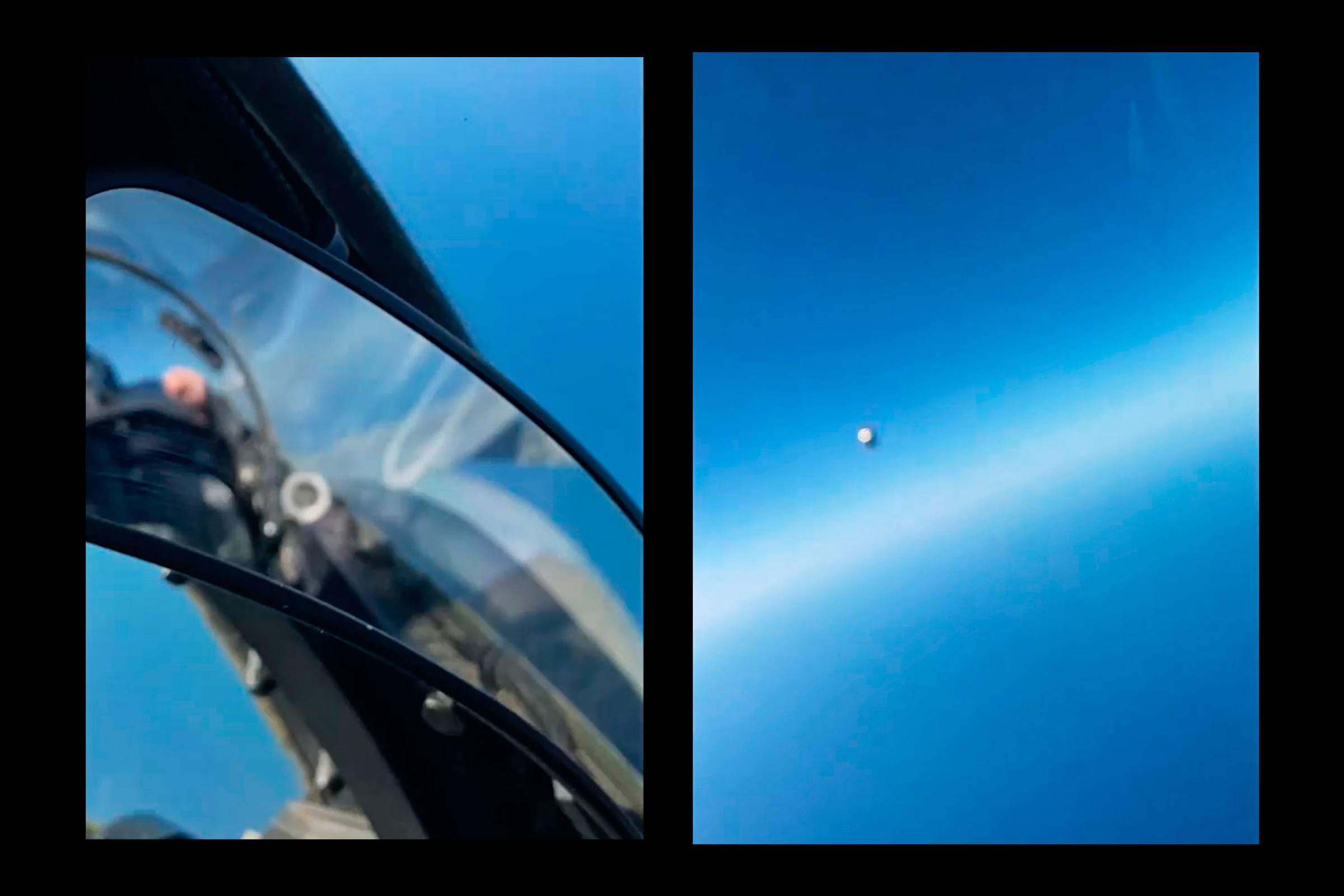
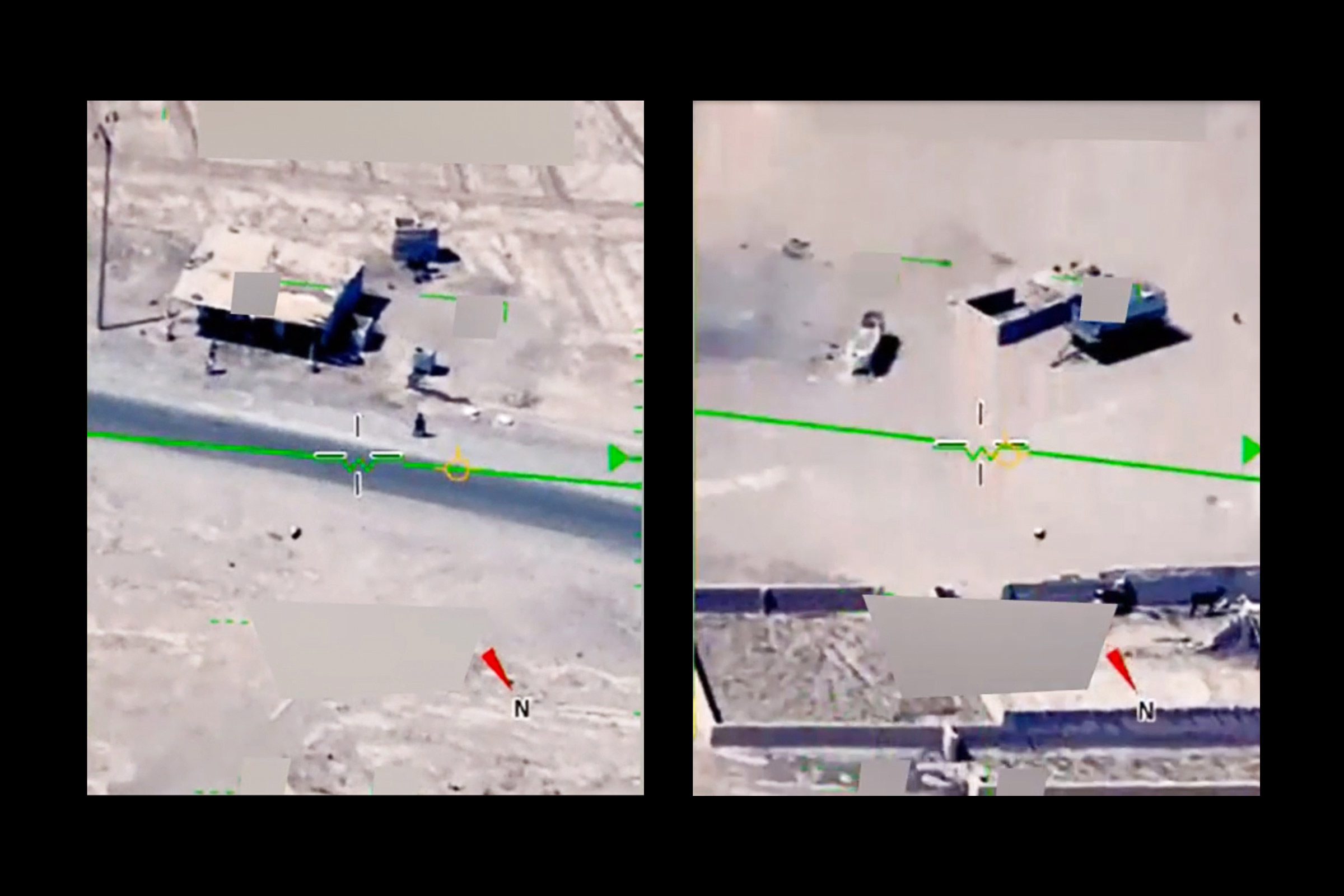
In an open hearing before the House Intelligence Counterterrorism, Counterintelligence, and Counterproliferation Subcommittee on May 17, 2022, Deputy Director of Naval Intelligence Scott Bray shared this video of a U.S. naval jet encounter with an unidentified anomalous phenomenon (UAP). The object’s path was fleeting, but a cockpit camera captured it before it vanished. The left-hand image includes a portion of the jet’s canopy. —U.S. Department of War (DOW)—The appearance of U.S. DOW visual information does not imply or constitute DOW endorsement.
Obama added that he based his belief in the likelihood of extraterrestrial beings in part on the fact that “statistically, the universe is so vast that the odds are good there’s life out there.” That’s a point a lot of believers make, especially since NASA’s Kepler Space Telescope and other space-based and Earth-based observatories have discovered thousands of exoplanets—or planets orbiting other stars—leading astronomers to conclude that virtually every one of the trillions of stars in the sky has at least one world circling it.
As with all things in a loud, messy, pluralistic democracy, public opinion plays a role here too—and Americans are clearly ready for action. According to a poll conducted by the Disclosure Foundation just weeks before the Capitol Hill forum, 84% of respondents want more information from the government on UAPs, 69% believe UAPs are real, 59% support hearings and transparency laws, and just 21% trust the federal government to be telling the complete truth. The responses are bipartisan. A statistically meaningless 1% separates the whopping 89% of Republicans and 88% of Democrats who say they want more information on UAPs.
“You could be a single-issue candidate running in the U.S.,” says Jordan Flowers, the Disclosure Foundation’s executive director. “That single issue could be [UAP] transparency, and you could get elected just based on that.”
Unlike other single issues like taxation, immigration, or climate, which unfold indefinitely over decades, UAP transparency has a fixed end point. The government will tell all it knows, the sightings will be investigated, and their origins will be determined to be terrestrial—highly advanced military or other assets—or, epochally, extraterrestrial.
“My null hypothesis would be that these are human-made objects being operated by adversarial nations, near strategic assets of the U.S.,” says Loeb. And if they’re not? If they do come from ... elsewhere? “That will be the biggest discovery ever made by humanity.”
A Question of Security
The U.S. Senate doesn’t lend out the Kennedy Caucus Room to just anybody. Opened in 1909, the room is a prepossessing place, with carved marble walls measuring 74 ft. long, 54 ft. wide, and 35 ft. high—climbing to an ornate ceiling decorated with gilded rosettes and acanthus leaves. The doors of the room open onto the Russell Building’s vaulted, marble rotunda, which rises three stories high.
The caucus room has seen a lot of history: it was the site of hearings on the sinking of the Titanic, the Teapot Dome scandal, Pearl Harbor, the Vietnam War, Watergate, Iran-Contra, and more. Both John and Robert Kennedy announced their presidential runs there. It was thus no small thing that the Disclosure Foundation was cleared to use the space to hold its June 25 summit. The 300-plus people in attendance took the event exceedingly seriously. Despite the once flaky, fringey, fantastical topic under discussion, the vibe was clearly not Burning Man, Comic Con, or South by Southwest. One attendee was decked out in a T-shirt featuring a bug-eyed alien playing electric guitar, but for everyone else in the room, business attire was the order of the day.
“Today, experts that rarely occupy the same room—physicists, historians, economists, intelligence professionals, educators, journalists, and policymakers—are gathered here in this room,” said Mellon in his opening remarks, “to discuss a subject that was, until very recently, untouchable.”
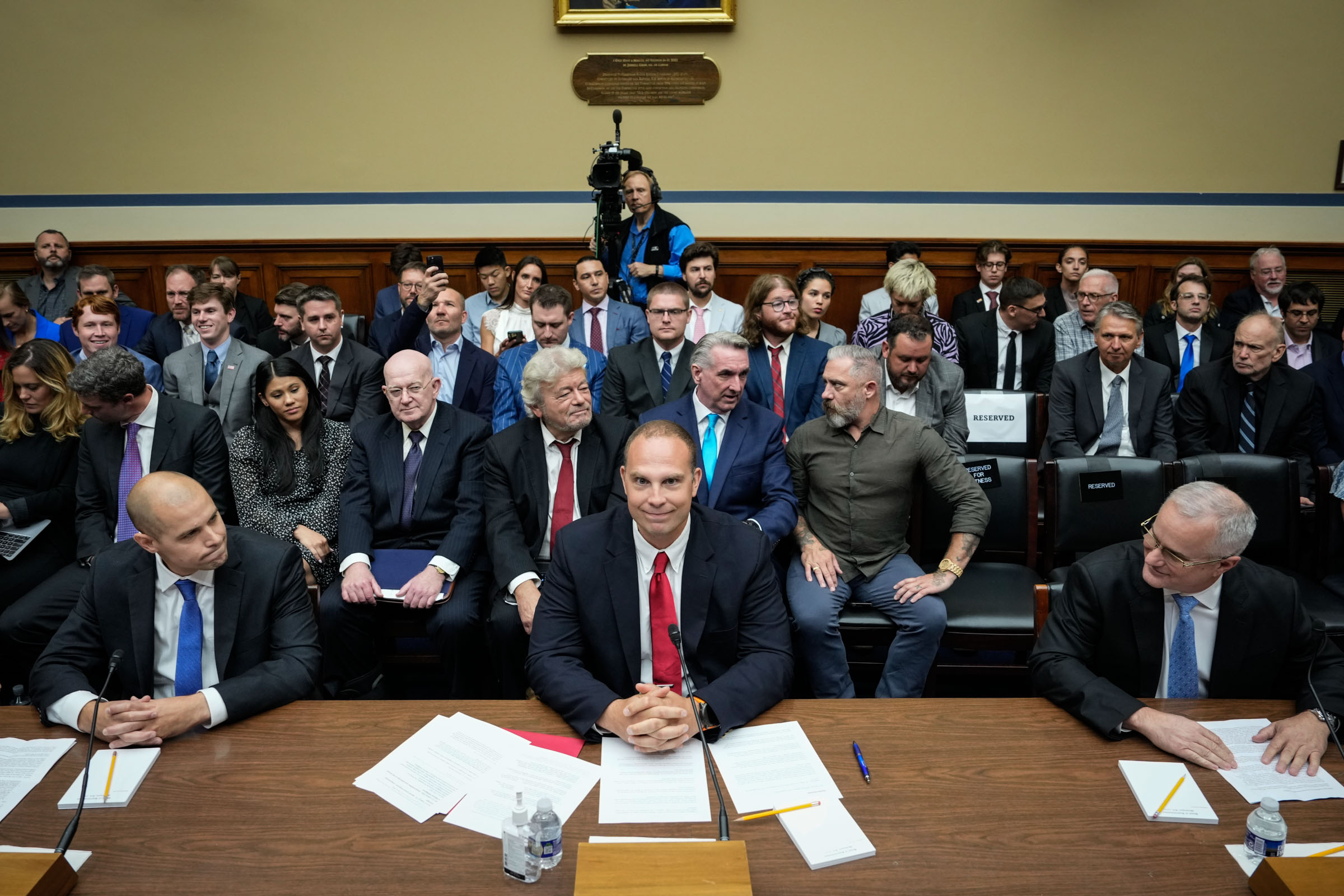
(L-R) Ryan Graves, executive director of Americans for Safe Aerospace, David Grusch, former National Reconnaissance Officer Representative of Unidentified Anomalous Phenomena Task Force at the U.S. Department of Defense, and Retired Navy Commander David Fravor take their seats as they arrive for a House Oversight Committee hearing titled "Unidentified Anomalous Phenomena: Implications on National Security, Public Safety, and Government Transparency" on Capitol Hill 26, 2023 in Washington, DC. —Drew Angerer—Getty Images
Of all of the panels that appeared throughout the day, it was a morning session on the security and defense implications of UAPs that had the most gravity. The panelists discussed the repeated sightings of UAPs both by naval pilots and personnel at military bases, raising concern about the permeability of armed American airspace. If the objects’ origins were indeed found to be extraterrestrial, the technology of the alien species far eclipses any flying machines human beings have ever developed. If they are terrestrial—built and flown by rival nations—they signal an arms race that we are already losing.
Retired naval Lieutenant Ryan Graves had his first encounter with UAPs off the East Coast of the U.S. 14 years ago and more in the two years that followed. “We came back from a deployment in 2012 and began to upgrade our radar systems,” he told TIME, “and we immediately saw objects in our working area that we were not expecting. There were usually anywhere between three and six objects within the airspace off the coast of Virginia Beach. Sometimes [they were] completely stationary at very high winds, sometimes flying at 250 to 350 knots [288 to 402 m.p.h.].”
The objects, Graves said, were 5 to 15 ft. in diameter, and appeared to be a gray or black cube inside a clear sphere. They gave off no exhaust and flew in such a way—diving and soaring and suddenly changing direction—that any human passenger would be subject to potentially deadly g-forces. Sometimes they flew so close to the Navy jets that the pilots were required to file hazard reports so that other planes operating in the vicinity could be warned.
“They would be outside doing these behaviors all day,” Graves says. “It might appear that these objects are using magical physics we don’t understand.” As part of the pilots’ routine rotation, they later shifted their operations to the waters off Jacksonville, Fla. They got no peace there either. The UAPs, says Graves, “were either already down there or they had followed us down, because we had over a dozen incidents.”
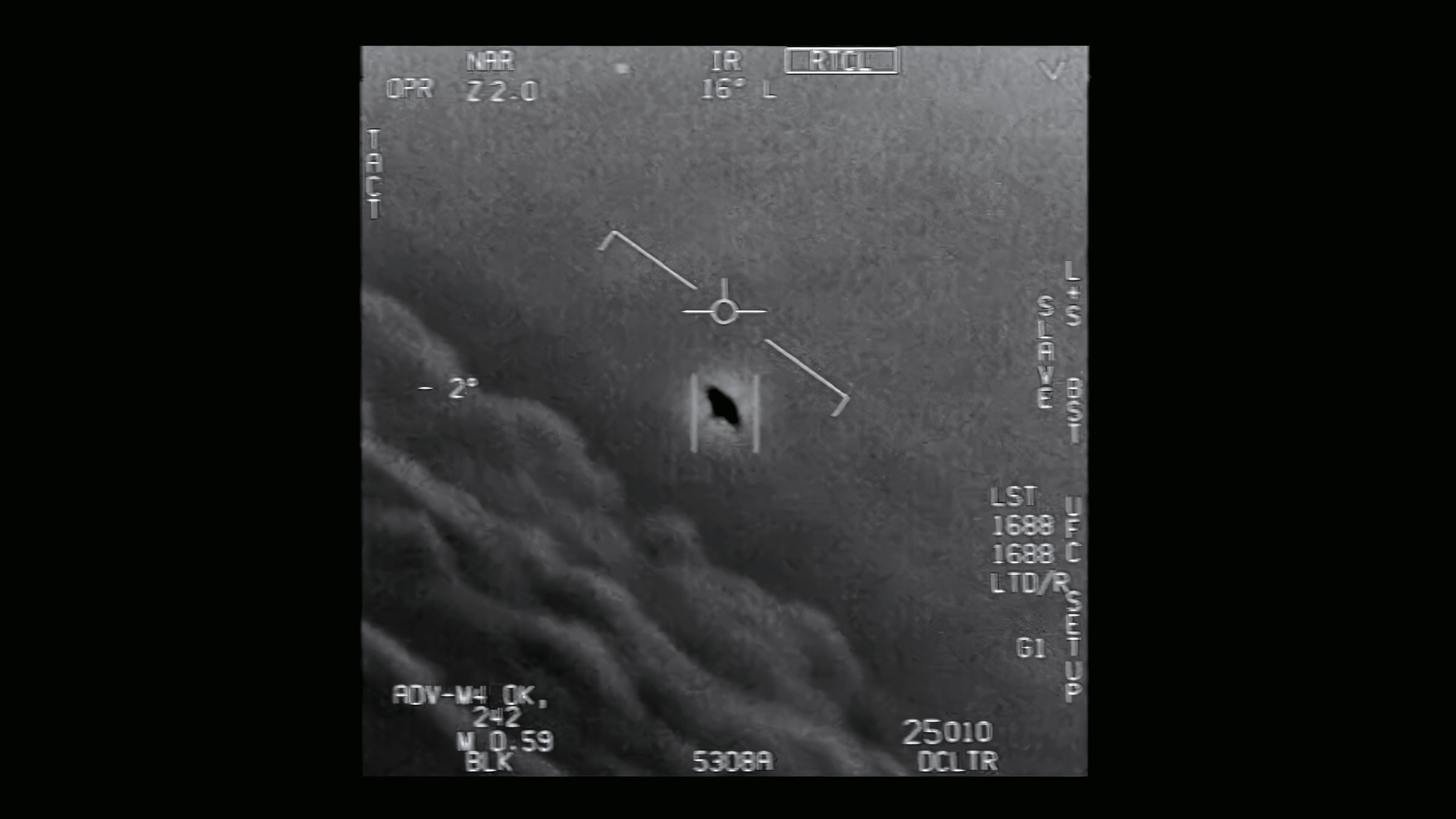
The naval flyers’ Virginia and Florida encounters are by no means the only experience the military has had with UAPs. One of the most compelling is the so-called Tic Tac incident, which occurred off the coast of California in 2004. During an otherwise routine deployment that year, radar personnel repeatedly noticed the reflection of a skittering airborne object they could not explain—looping and diving, climbing and then dropping from an altitude of 80,000 ft. to 20,000 ft. To crack the mystery, a team of flyers was scrambled into the sky. Once aloft, they discovered what they estimated to be a 45-ft.-long flying machine that bore a striking resemblance to a Tic Tac breath mint.
“All four of us looked down and saw a Tic Tac object moving very abruptly over the water,” said pilot David Fravor in a 2023 appearance before a congressional committee. “There were no rotors, no rotor wash, or any sign of visible control surfaces like wings. As we pulled nose onto the object within about a half-mile of it, it rapidly accelerated and disappeared.” Cockpit video preserved the encounter.
Military assets on the ground have been harassed too. For 17 straight nights in December 2024, Langley Air Force Base in Hampton, Va. was swarmed by objects that appeared overhead 45 minutes after sundown and repeatedly flew over the base. According to one eyewitness—former astronaut Scott Kelly, who in 2022 was tapped to serve on a NASA UAP study team—the objects appeared to be 20 ft. long, flying at an altitude of 3,000 to 4,000 ft., at a speed of 100 m.p.h. The incursions became serious enough that Langley canceled nighttime training flights and moved its F-22 jets to another air base.
More dramatic was a reported sighting by six federal law-enforcement officers in October 2023, near what the official memorandum described as “a sensitive national security site in the western United States.” For two consecutive days, just at dusk, the witnesses reported observing “a luminous ‘mother orb’ appear[ing] to produce smaller red orbs, one after another, multiple times over a period of several hours. The ‘red orbs’ reportedly persisted for several seconds before disappearing.”
On April 19, 2023, Sean Kirkpatrick, director of the All-domain Anomaly Resolution Office (AARO), shared a video that depicts an apparent silver, orblike object crossing a video sensor’s field of view. Kirkpatrick said the “metallic orbs” are the most common type of UAP and are reported from “all over the world.” —U.S. Department of War (DOW)—The appearance of U.S. DOW visual information does not imply or constitute DOW endorsement.
“It is clear that we have lost control of our airspace. Full stop,” says Flowers. “Whether this is some form of human intelligence, or whether it’s something else, I am not creative enough to say.”
“Many of these things are certainly not drones,” says Luis Elizondo, a former intelligence officer with the government’s Advanced Aerospace Threat Identification Program (AATIP). “They are advanced technology from somewhere. If you’re scrambling jets off Langley, you’ve got a problem.”
Not everyone is persuaded by the reports. “Great claims require great evidence,” says Jon Kosloski, director of AARO, “and the evidence just isn’t there yet.” Kelly does not minimize the security risk posed by rogue objects but does not think they have to have an exotic origin. “In science, eyewitness testimony is kind of opinion; it’s not data,” he says. “I have never seen anything that couldn’t be explained.”
Kelly points to a sighting he made during his days as a military pilot when he was flying a Tomcat jet off the coast of Virginia. In the midst of the maneuvers, the pilot in the back seat of the plane suddenly announced, “We just passed something. It looks like a UFO.”
“What?” Kelly asked.
“Yeah, maybe it was like an alien spaceship or something. It looked really weird.”
Kelly banked the jet around in the opposite direction, looking for an object through his wind screen, and indeed saw it in the distance, though it wasn’t showing up on radar. He drew closer and closer until he was on an intercept course, and the bogey at last resolved itself.
“It was Bart Simpson,” Kelly says. “It was a balloon.”
Are We Ready For Extraterrestrial Disclosure?
If UAPs are ever confirmed to have an extraterrestrial origin it will represent what Carlos Eire, professor of history and religious studies at Yale University and a speaker at the Disclosure Forum, calls a “rupture” in human civilization.
“A rupture is something after which nothing is the same,” he says. “It’s similar to the rupture that occurred for the natives of North and South America when Europeans showed up.”
Clinical psychologist Jennice Vilhauer, a member of the advisory boards of both Loeb’s UAP Council and the Disclosure Foundation, spoke at the June 25 event, and her words were sobering. “If this news were to come out tomorrow,” she says, “we’re entirely unprepared.”
An emotional contagion like panic is always possible, but Vilhauer does not think most people would react that way even to such paradigm-shifting news as nonhuman intelligence. “There are certain communities that would look at this through a catastrophic lens, like an end-times event,” she says. “But I don’t see this being something that would spread across the entire population.”
That doesn’t mean that there would not be a psychic impact. A lot, she says, would depend on whether alien life was perceived as either benevolent, indifferent, or hostile. Even a microbe could be hostile if it posed a risk of infection—a peril about which humans have always been mindful. During the first three moon-landing missions, returning astronauts were required to spend three weeks in medical quarantine against the chance that they picked up alien germs—a practical impossibility since no microorganisms could survive on the dry, airless moon.
An artist’s conception of the fast-moving interstellar comet Oumuamua, which has been discussed as a possible UAP. —ESO/M. Kornmesser
Also playing a role would be the question of what Vilhauer calls personal relevance—whether the news of nonhuman life affected any one person directly. The greatest emotional reaction would occur in people who perceive a high threat level and high personal relevance; the least effect would be in people who see low threat and low personal relevance. “Disclosure alone would be a huge, unprecedented event,” Vilhauer says. “Those two things together—personal relevance and threat—could create a really negative response.”
Mental health will not be the only thing that’s affected by UAP disclosure; spiritual health will be too. As long ago as the 1970s, divinity scholars established the concept of exotheology—a branch of Christian thought that includes the possibility of life in the cosmos. That can come in handy now. Eire believes that the three leading monotheistic religions—Christianity, Judaism, and Islam—will have the most work to do coming to terms with nonhuman intelligence. That’s because all three of them share the idea that there is one God, and that he created everything including human beings. Our species, we like to think, is his crowning creation—a belief that will be harder to hold onto if a cosmic species comes along that’s better, smarter, fitter than us. “The book of Genesis, which is shared in different ways by Jews, Christians, and Muslims, poses this very troubling story about human origins,” says Eire.
Christianity, Eire believes, will have a special hurdle to overcome in adjusting to the idea of off-Earth life because of its teaching that God became human. On the other hand, all three mono-theistic religions do have some practice with the idea of intelligent, nonhuman life. “Jews, Christians, and Muslims accept as a given that human beings are not alone in God’s creation,” says Eire. “There have always been angels.”
Questions about UAPs and the life-forms that may or may not have sent them our way may turn in part on faith, but they also turn on physics. While exobiologists continue to explore the possibility of microbial life on Mars and on ocean moons like Jupiter’s Europa and Saturn’s Enceladus, it is well accepted that our solar system has just one world with advanced, intelligent life, and that’s ours. That means looking for exceptional beings farther afield.
The closest star system to Earth is Proxima Centauri, a tidy 4.25 light-years—or 25 trillion miles—distant. Getting from there to here would in theory take at least 4.25 years, and only if you’re traveling at the speed of light—which Albert Einstein long ago proved can’t be done. Other star systems lie thousands and billions of light-years away, meaning that traveling the trans-Earth distance could take almost as long as the age of the universe itself.
Still, plenty of academics don’t rule out the possibility of alien visitors from the stars. “I would put the estimate of the chances that we’ve been visited—and I would define that as an exploration through our solar system, leading to them being aware that Earth has life and civilization—at maybe something like 50%,” says Jack Singal, professor of physics at the University of Richmond. He puts the odds that any of the claimed UFO or UAP sightings over the past century have actually been one of those visitations at a much lower 5%. “I think there’s just enough mundane explanations for these things,” he says.
Jonathan Miller, a program engineer for MIT’s department of mechanical engineering and the director of an academic program called Confronting Unknowns, which explores the question of UAPs, does not go as far as Singal, but he is open to the possibility that other civilizations are not as constrained by Einsteinian physics as we think they’d be. “There are the physics of traveling from point A to point B,” he says. “But there may be alternative ways to sort of bridge that gap. There’s probably an iceberg of possibilities [to explain UAPs] below the waterline.”
Some of those explanations may be straightforward—at least compared with extraterrestrials. If it’s possible that some rival power has developed advanced technology that can perform the acrobatics the UAPs do, it’s equally possible that the U.S. has as well and that witnesses are simply observing domestic hardware. The military is nothing if not secretive, and all of this work could be done in the dark—much the way the Manhattan Project, which developed the world’s first nuclear weapons, operated silently, invisibly, from June 1942 to August 1947.
It’s possible too that there is something even more prosaic than earthly or alien space technology at play. Miller speaks admiringly of the “mark one eyeballs of a well-trained pilot” as perhaps the most reliable sensor system on any plane—better than radar, infrared, or motion sensors. But those eyeballs can be fooled—especially given the thermal, chemical, and physical complexity of the atmosphere in which the UAPs are being seen and reported.
“The atmosphere is a crazy place,” says Singal. “You can see double, triple rainbows. You can go to some Arctic regions and see the sun appear several times at several different angles in the sky. You can have tornadoes that pick up and throw a car or impale a cow on a tree. Could it make a black triangle move across the sky for 10 seconds? I would say it could.”
“You get a lot of reports from naval officers, more so than from the Air Force,” says Kelly. “That’s because the Navy flies over water and it’s an environment that is very subject to optical illusions.”
Witnesses, of course, swear by the evidence of their eyes, and sightings like those of Graves and his fellow pilots, which involved large objects moving at close proximity between two naval jets, are hard to dismiss as just the hallucinatory interplay of light and air.
“We came within 50 ft. of the lead aircraft,” says Graves. “I think some of what we were seeing were true UAPs. What I mean by that is that these were true airborne assets that were physical in nature, that were exhibiting capabilities beyond our state of the art.”
The community of people who believe accounts like these and want to get to the bottom of them is growing. In addition to chairing the UAP Science Advisory Council, Loeb is co-directing the Harvard-based Galileo Project, which scans the skies looking for hints of extraterrestrial technology. Galileo relies on three Earth-based telescopes—in Massachusetts, Pennsylvania, and Nevada—using infrared, visible, and radio sensors to track moving objects that seem to deviate from the performance of earthly technology. In 2018, Loeb and his colleague Shmuel Bialy, then a post-doctorate researcher, made headlines with a paper in the Astrophysical Journal Letters, in which they entertained the idea that the cigar-shaped interstellar comet Oumuamua “may be a fully operational probe sent intentionally to Earth vicinity by an alien civilization.”
In 2017, the object flew into our solar system, whipped around the sun like a comet, and flew back out. On that departing leg of the journey, it accelerated when it should have been slowing down due to the gravitational pull of the sun. That suggested some propulsion system was at work. It is possible, Loeb and Bialy wrote, that the object is “floating in interstellar space as a debris from an advanced technological equipment.”
Other astronomers dismiss that idea, arguing that Oumuamua was pushed either by solar wind, the storm of charged particles forever streaming from the sun, or by solar radiation pressure, the gentle force imparted by electromagnetic energy when it contacts an object. The object has since soared back into deep space, taking the possibility of any answers with it.
Congress is staying on the UAP case—in its own dilatory way. In 2024, lawmakers took up the UAP Transparency Act, which would mandate declassification of all documents related to UAPs. The bill has not yet become law, and its potential impact has been partly mooted by the White House going ahead and releasing the four tranches of documents on its own.
For now, UAPs remain a riddle. They may be real, they may be illusion, they may simply be artifacts of human desire—something we see because we want to see them. A universe with other life-forms, after all, is a lot less lonely than one in which we are the only world with lights in the windows. The eyewitnesses, of course, would differ—knowing what they saw, believing what they saw, and remaining, in some cases, transformed by what they saw. In time—if the proof is found, if biological intelligence is discovered in the void—we may all be transformed the same way.
Correction, Aug. 7
The original version of this story misstated the location of Area 51. It is in Nevada, not Roswell, N.M.
В последнее время рынок языковых моделей развивается настолько стремительно, что новые релизы выходят почти каждый день, а «громкие» — каждую неделю. Пальма первенства в генерации текста, программировании или агентных сценариях постоянно переходит из рук в руки.
В этот раз поговорим о китайской компании Z.ai и о ее новом поколении линейки GLM, а также об агентной среде разработки ZCode 3.0, ориентированной на написание кода. Заменит ли она привычные Cursor и Open WebUI, став полноценным агентом «все в одном» — разберемся ниже.
Я до сих пор помню тот день, когда случайно положил собственный тестовый сервер.
Схема была банальной: пара IP-камер, простенький бэкенд, всё это выплёвывает видео в веб-морду. На тестах работало идеально. А потом кто-то закинул ссылку на трансляцию в корпоративный чат.
По ссылке одновременно кликнула тысяча(ладно, ладно вру конечно, но запросов было много) человек. Сервер завизжал кулерами, оператива кончилась за три секунды, а камера вообще перестала пинговаться.
Добро пожаловать в проблему Thundering Herd (эффект леммингов).
Если вы хоть раз пробовали масштабировать раздачу live-видео, вы эту боль знаете. Когда толпа зрителей ломится смотреть один и тот же поток, типичный сервер пытается честно открыть новое соединение или запустить отдельный процесс отдачи для каждого. Итог всегда один — OOM (Out of memory) и лежачий процессор.
Я не хотел решать это вливанием денег в толстые AWS-инстансы или покупкой нового железа. Была идея маршрутизировать всё максимально дешево, используя Go. Спойлер не будет долгим: в итоге мы выжали 8.8 Гбит/с на одном ядре процессора, причем сборщик мусора (GC) в этот момент вообще отдыхал.
President Donald Trump and top Republicans unleashed a series of attacks on progressive Abdul El-Sayed, the new Democratic nominee in the battleground state of Michigan. “When I watch Abdul, he’s full of s----,” the president said. NBC’s Garrett Haake reports for TODAY.
The Argentine Football Association announces 15 July as National Football Teams Day to mark Argentina's 2026 World Cup semi-final victory over England.
Uefa is planning to commission an independent valuation of Fifa’s World Cup sale plans after concerns that Gianni Infantino agreed to sell the tournament’s future profits to a private equity firm at below the market rate.
The European governing body is unmoved by the written apology issued by Infantino to Fifa’s 211 member associations on Tuesday after crisis talks in Morocco. It will continue to push for his removal, with its tactics including further scrutiny of a proposal the president belatedly conceded was “a mistake.”
Если вы хоть раз выбирали онлайн-активность для команды, то видели этот «зоопарк» названий: тимбилдинг, квиз, адвент, бизнес-игра, сюжетный квест. Агентства называют форматы по-разному, описывают одинаково восторженно, и под ярким словом невозможно понять, что вы на самом деле покупаете и подойдёт ли это вашим людям.
У нас в агентстве Найт Стрит богатый опыт в организации онлайн-игр. Разберём восемь форматов, и по каждому скажем прямо, какую задачу он закрывает и какую не закроет, сколько бы вам ни обещали в коммерческом предложении.
Officials in Washington state say they’re making progress in containing the raging Spokane wildfires that are responsible for burning more than 10,000 acres and scorching some 800 homes and buildings. It comes as the suspect accused of setting the fires is scheduled to be back in court Thursday to face a first-degree arson charge. NBC’s Morgan Chesky reports and TODAY's Al Roker tracks fire dangers.
A deal on the Strait of Hormuz could come as early as Thursday, with the Iranian foreign ministry saying a draft agreement between Iran and Oman is under review. It comes as there are new concerns over a potential shortage of U.S. weaponry. NBC’s Keir Simmons reports for TODAY.
Everyone who grew up by the Mediterranean Sea knows that a lazy day on the beach requires a certain level of planning. You should pack everything you’ll need, or may need, and get there early to secure a good spot. But the first thing you need to do when you get there – even before you spread out your blankets and put that sunscreen on – is to drop a watermelon in the sea, so that, by noon, when it’s so hot your skin feels as if it’s about to blister, it is ready for you, all cool and sweet. It’s just about the only thing capable of quenching your thirst and your hunger, while also cooling you down and giving you the sugar you need.
The other important bit about the watermelon – the part that separates wisdom from wishful thinking – is that you also need to tie a piece of string around it, complete with an empty plastic bottle at the other end, so that it bobs above the waves and marks the spot. This is something you learn the hard way – or at least we did. There is a very particular kind of disappointment that comes from standing waist-deep in the sea, staring into the blue, convinced that a whole watermelon cannot simply disappear. We searched. We dived. We accusedpassing currents. We briefly entertained the idea that another family had found it and were, at that very moment, enjoying our perfectly chilled watermelon. Then again, perhaps it is still out there somewhere, floating towards Sicily …
Kim Le Court staged a remarkable comeback from a mechanical problem to take a sensational sprint win while Marlen Reusser stayed in yellow
138km to go: Nelson is caught. But two of her teammates – Eleonora Ciabocco and Lene Robyn Clay – have been dropped. Mia Griffin, also of Picnic-PostNL, has been dropped too! Did they neglect to have their Weetabix this morning, or did Nelson steal it all at the Picnic-PostNL team hotel?
139km to go: Josie Nelson (Picnic-PostNL) – who hails from Lichfield in Staffordshire – has attacked solo approaching the first climb.
Gianni Infantino followed World Cup controversies with a widely scorned plan to let private investors in. Here’s how the game’s leaders can find a path forward
How can an organisation that runs the biggest sporting event in the world also be the one that sets the rules for the entire game? We saw the reality of such a conflict at the recent World Cup as Fifa ran roughshod over its rulebook – be it over the length of suspensions or the duration of half-time – in an attempt to generate more attention for its competition. One person with extensive knowledge of the inside workings of Fifa puts it like this: “They have shown that they will bend the rules to make them more money. This is a big conflict of interest. Not only should the commercial and the regulatory parts of Fifa be separated, but so should the development part and possibly one or two others as well.”
Jason Arday couldn't read or write until he was 18 years old. Now he's reached the top of the academic world. Here's how, and what he's determined to do next.