RSS Feeds
Trump participates in medal ceremony for Artemis II astronauts
Is the environmental impact of datacentres finally cutting through?
In this week’s newsletter: Anti-datacentre sentiment is growing across the political spectrum in the US – and the public is only just finding out about the potential effects on their energy bills
• Don’t get Down to Earth delivered to your inbox? Sign up here
Anti-datacentre sentiment is growing from across the political spectrum in the US.
More than a dozen states have considered moratoria on datacentres. New York became the first US state to enact a temporary ban last month. Progressive stalwarts Senator Bernie Sanders and Representative Alexandria Ocasio-Cortez have proposed a national moratorium. And even Greg Abbott, the far-right governor of Texas, called for a ban on datacentre development in rural swaths of his state.
‘Our new normal’: how marine heatwaves affect life in British seas
Iraq’s ghost villages: Islamic State drove people away – now a new enemy is preventing their return
Destroyed crops, riverbed cyclists and a ‘Rock of Starvation’: how drought has devastated the Danube
Continue reading...‘Special for Norway’: Leknessund breaks clear to win stage seven of Vuelta
Norway in mourning after death of King Harald
‘It’s only a small thing in the bigger picture’
The Norwegian Andreas Leknessund launched a successful solo attack on the final climb to the summit finish of Aramón Valdelinares to win stage seven of the Vuelta a España, ahead of his Uno-X Mobility teammate and compatriot Tobias Johannessen on a day when their country mourned the death of King Harald.
Leknessund made his move from a five-rider breakaway 7.5km from the finish at the end of the 149.8km ride from Vall d’Alba, and pulled away to win his first Grand Tour stage on his Vuelta debut.
Continue reading...Infallible style: Pope Leo appears in Vanity Fair’s ranks of most fashionable
Pontiff, who has caught the eye in trainers and a baseball cap, praised for taking dress to ‘heavenly heights’
For the first time in a decade, Vanity Fair has released a best-dressed list. Featuring 70 names, the list ranks the most fashionable people in the world in 2026. The lineup includes the usual suspects spanning Hollywood actors and global pop stars but nestled among the Hollywood stars is an unexpected entrant. Pope Leo XIV.
The 70-year-old head of the Catholic church has been praised by the magazine for taking papal style “to heavenly heights”. His most memorable look? A simple white cassock styled with a pair of Nike trainers.
Continue reading...Trump honoring Artemis II crew after historic mission
Cattle ranchers express concern about boosting foreign beef imports
Переезд на GPT-5.6: что мы переписали в коде и как изменился счёт за API

Мы делаем сервис доступа к моделям разных провайдеров, так что интерес в этой теме у нас прямой. В середине июля мы переносили внутренние сервисы на GPT-5.6. Работы планировали на день, но ушло две недели.
Ниже по порядку: что поменялось в линейке за одно поколение, во сколько после этого обходится один запрос и где ломается код, который формально продолжал работать.
Читать далееJudge temporarily blocks USPS from enforcing Trump's mail-in voting restrictions
Donald Trump’s immigration policy is changing America
Analysis: Has the U.S. lost the war with Iran?
Younger workers are more scared of AI than older employees, survey finds
How can you tell if a debt collector is about to garnish your paycheck?
'Pakistan cleaned up!' - England take five wickets for 19 runs
An $18bn settlement – and Zuckerberg barely blinked. The tech titans must be stripped of their power, and soon | Jonathan Freedland
Those who said Meta harms children struck a blow, but the ability of big tech to gouge profits and cause harm is barely diminished. That’s the battle to come
Follow the money. If you want to know how the tech giant Meta really feels about the $18bn it agreed to fork out to end a landmark lawsuit against it – an outcome widely hailed as a victory for campaigners – just look at its share price. It didn’t go down when word came on Wednesday that Meta had settled with the 29 US states that had argued that the company’s Facebook and Instagram platforms harmed children. On the contrary, Meta stock went up, initially surging by 5%, before levelling out at a gain of just over 1.25%. There could be no clearer proof that the money men reckon Meta dodged a bullet.
To be sure, there was plenty to hearten those who have long believed that social media damages teenagers especially, whether by exposing them to content they shouldn’t see or by sapping their self-esteem, offering them filters that show how much prettier they would look if they had cosmetic surgery or giving them a metric of their popularity – and unpopularity – in the form of a running tally of “likes” and views.
Jonathan Freedland is a Guardian columnist
Do you have an opinion on the issues raised in this article? If you would like to submit a response of up to 300 words by email to be considered for publication in our letters section, please click here.
Continue reading...MAPS: Netflix’s Multimodal Asset Personalization at Scale
By Emma Yanyang Kong, Aditya Deshpande, Asad Abbasi, Bowei Yan, David Fagnan, Ashish Rastogi, Dhaval Patel, Ray Zhang
Introduction
The Netflix experience is a journey of discovery. Every visual cue, from the artwork on a title to the video previews that autoplay while you browse, is there to connect you with a story you will love. We call these visual cues assets, and choosing the right one for each member is a personalization problem of its own. But which image or video preview of Squid Game should we show you? And what do we do right after a title launches, when there’s far too little interaction data to know which asset we should recommend to each member?
For years, our models answered the first question well and the second poorly. They learned which assets members interacted with, but treated every asset as an opaque ID, blind to what was actually in the artwork or video preview. Right after a title launched, its assets had no history, so we dialed up exploration on its assets to gather interaction data, and otherwise fell back to popularity heuristics that ignore your taste. Only once enough interactions had piled up could personalization take over. This is the classic cold-start problem.
This post shares how multimodal embeddings let our models see and hear the assets they recommend, so personalization can kick in far sooner, close to a title’s launch. Because a new asset arrives with its embedding the model already understands, that embedding carries member taste signals from related assets immediately. Consequently, the model needs far less interaction history before it can personalize. We cover three production systems, artwork personalization, query-aware artwork ranking, and video preview personalization, plus a cheap trick for choosing new embeddings before committing to full end-to-end integration and A/B testing.
Artwork Personalization
A single image is often a member’s first touchpoint with a title, so we create a diverse set of artworks for each title to appeal to different member tastes. We already use personalized artwork based on members’ interaction histories, but this approach breaks down for newer titles and their assets, where there is little or no behavioral data to learn from.
Making the Model See the Artwork
Our solution is to let the model “look” at the picture. We encode each artwork with CLIP, a pretrained image-text embedding model, and fold the result into how the model represents that asset, concatenating the per-asset CLIP image embedding, a 768-dimensional vector, with the asset’s learned ID embedding to give an asset representation:

This single change transforms how the model handles a brand-new artwork. Instead of treating it as an unseen ID, the model now receives a CLIP embedding the moment the asset is created. That allows a member’s preferences over visual themes, talent, and color palettes to be applied immediately, long before the asset accumulates any interactions of its own. Because those preferences are expressed in image-embedding space rather than tied to specific asset IDs, they transfer seamlessly across titles. If you consistently engage with artwork featuring a particular comedian, the model can carry that signal to their new title and prioritize the asset that places them front and center, even if it has never shown you that exact image before, as in the figure below. In this way, cold-start shifts from being a blind spot to something the embedding space already has an informed opinion about.

From Five Models to One
That shift, from scoring an asset by the ID it happens to carry to scoring it by what the image actually contains, powers a second big win, model consolidation. Each title’s artwork spans multiple canvases with different croppings (billboard, vertical-box, horizontal-panel, short-panel, landscape-panel), and historically we trained a separate model per canvas, since an ID-based model has no way to know that the cropped and resized renderings of one scene are related, so signal could not flow between canvases and each faced its own cold-start.
CLIP embeddings break that barrier. Because they are largely invariant to crop, resize, and aspect ratio, those near-identical renderings map to nearly the same vector, as the figure further below shows. A single unified model can therefore pool interaction signal across every canvas, so a member’s affinity learned on a high-traffic canvas immediately informs the artwork we pick on a sparse one. The result is one model in place of five, with the largest gains on the canvases that have the least interaction data.

Mixing Five Canvases of Training Data
Consolidation introduced a challenge that the per-canvas models never faced: how to effectively mix data across disparate canvases? The canvases differ widely in impression volume, and the interactions they log are not all worth the same to a member’s long-term experience. Training on pooled raw counts would let the highest-volume canvas and the most frequent interaction types dominate, so the low-data canvases we were trying to help would benefit least. Hand-tuning a weight per canvas would just trade that problem for a set of arbitrary hyperparameters and endless online sweeps to tune them.
Instead we use reward-based weighting, building on Netflix’s long-term reward modeling. Each training example is weighted by the long-term reward score attached to its interaction type:

where e(·) is the type of the observed positive interaction and ρ is that type’s long-term reward score. Because interaction types are not distributed evenly across canvases, weighting by long-term value rebalances the canvas mixture on its own, with no weight set by hand. A canvas contributes in proportion to the long-term value of the interactions it drives rather than to how many impressions it happens to get. Consolidation becomes feasible, and the unified model optimizes for long-term member satisfaction instead of whichever short-term action is most frequent.
A Note on Offline Evaluation
Every result presented here must clear two bars: an offline metric evaluation followed by a large-scale online A/B test. The offline metric is the subtle one. Judging a new model on logs from the current production policy is biased, because that policy shows some assets far more often than others. The logged rewards describe what the policy preferred, not what members would have chosen from the full candidate set, so a new model that disagrees with the logging policy looks worse than it is, because the impressions it would have picked are barely represented in the data.
We handle this with inverse propensity scoring (IPS) computed on a dedicated slice of exploration traffic. A small fraction of traffic is served by a randomized policy that samples among a title’s candidate assets from a known distribution, so the propensity of showing a given asset in a given context is logged exactly at serving time rather than estimated after the fact. Reweighting every observation by the inverse of its logged propensity gives:

where D is the exploration slice and r(x, a) is the observed reward, such as a play. Impressions that exploration made rare are upweighted accordingly, and the estimator becomes an unbiased estimate of the reward a candidate policy would have earned had we actually deployed it. Having propensities that are known by construction, rather than modeled after the fact, is in our experience the single biggest reason our offline numbers track online outcomes. We report IPS as a ratio against the production baseline, and a candidate has to win there before it gets any A/B traffic.
Combining Both Ideas Works Better
Two ideas are bundled together here, so we ablated them separately against the old five-model production system.
- V1, image embeddings only. The five per-canvas models kept as they were, each one augmented with image embeddings.
- V2, unified model only. A single model trained over all five canvases, but with learned ID embeddings alone and no image content.
- V3, both together. One unified model over all five canvases, with image embeddings in its asset representation.
As the chart below shows, each idea helped exactly where we expected: on the data-starved short-panel canvas and landscape-panel canvas. V3 was the clear winner. A change inside ±1% is not significant for this offline metric, and those bars are hatched in the chart. Most of what V1 and V2 do on their own sits inside that band.

In the online A/B test across all device platforms, which ran for at least four weeks, the results drew a much clearer line: Neither idea moved our online core member metrics on its own. V1 and V2 were both flat and non-significant, and only V3 won a statistically significant lift. It is what runs in production today.
The two ingredients need each other. V1 tells a per-canvas model what an asset looks like, but one sparse canvas has too few examples to teach it how to use that. V2 supplies plenty of data, but only ID-based data, which a new asset lacks. V3 has both, so mature canvases teach the shared model how CLIP embeddings map to member preference and that mapping transfers straight to the sparse ones. The effects compound rather than add, since the V3 short-panel lift (5.691%) exceeds V1 and V2 combined. The lesson is to look for a second blocking factor before concluding that content features do not help.
Cold-Start Challenge from a New UI Launch
The real test came from the product change that motivated the work. Netflix was preparing its largest TV home-screen redesign in a decade, which would make short-panel the dominant artwork canvas effectively overnight. This was a cold-start problem in its sharpest form. The canvas about to receive the most impressions had the least historical data, and waiting for short-panel interactions to accumulate would have degraded the user experience. Consolidation lets short-panel selection draw on signal pooled from every canvas, and CLIP embeddings let the unified model personalize a short-panel asset that has gathered very few interactions of its own.
We shipped V3 ahead of the launch and measured it with a month-long holdback A/B test, keeping a small control group on the prior per-canvas model. V3 absorbed the shift immediately, with statistically significant gains on both our core discovery metric and streaming hours, and larger gains than in the steady-state ablation. That stronger result is what we expected, since a sudden shift in which canvas dominates is exactly where V3 should help most.
Query-Aware Artwork Personalization
Your general taste is the right signal when browsing, but not when searching. For example, when searching for a specific actor, you want artwork that features them, even if your broader taste says otherwise. On the Netflix Search Page, the member’s intent is explicit and stated in the query, and the displayed artwork should reflect it.
The same CLIP embeddings we added for cold-start hand us this almost for free. Because CLIP projects text and images into one shared embedding space, we can measure how well a query matches a candidate artwork directly by the cosine similarity between the CLIP text embedding of the query and the CLIP image embedding of the asset. We blend that alignment term with the usual personalization score:

Here the personalization term is the score the artwork model above already produces for a member and asset, the second term compares the text embedding of the query against the image embedding of the asset, and the mixing weight α between 0 and 1 is tuned through online A/B testing. The first term is “what we think you like”; the second is “what you just asked for,” and α sets how much each matters.
Crucially, this took no extra modeling effort. The CLIP embeddings already sit in the asset representation from the artwork work above, so they carry the text-image alignment for free, and we get a query-aware ranker by adding a single similarity term at scoring time. The effect is visible in the search results themselves.

Personalizing Video Previews via MediaFM
Video previews raise the bar over still artwork. A video preview unfolds over time, and its appeal comes as much from motion, pacing, dialogue, and soundtrack as from any single frame. Our older video preview personalization models saw none of that. Like the early artwork models, they treated each preview as an opaque ID. Our first content-aware attempt, SeqCLIP, described a video preview by its frames, encoding each with a CLIP embedding and then averaging them into one vector. That captured what a video preview looked like, but a mean of still frames still misses what it sounds like, the dialogue and music that carry so much of a preview’s tone.
To capture the rest, we turned to MediaFM, Netflix’s first in-house multimodal foundation model. Trained on 80 million shots, MediaFM fuses the following three signals per shot into a single embedding:
- Visual: SeqCLIP
- Audio: A pretrained speech and audio embedding model
- Text: Captions encoded via a large-scale text model
Adopting MediaFM required no new infrastructure, since we simply integrate its shot embeddings into the asset representation, exactly as we did with CLIP embeddings for artwork.
The added modalities paid off. We evaluated both embeddings against the ID-only baseline offline with IPS and then in a five-week online A/B test across all device platforms, and both signals gave the same ordering, MediaFM > SeqCLIP > ID-only, and each step of added content awareness helped, with the gains largest on TV. Offline, both content-aware embeddings beat the ID-only baseline on IPS and MediaFM beat SeqCLIP, as the chart below shows. Online, MediaFM came out on top too, delivering a statistically significant lift in our core streaming metric over the ID-only baseline and outperforming SeqCLIP. This shows that the audio and timed-text signals, which a visual-only encoder like SeqCLIP cannot capture, add real value. We have since shipped MediaFM as the default video preview embedding across all platforms.

Choosing Embeddings Cheaply with a Proxy Task
New embeddings arrive constantly, but end-to-end trials are expensive, which cost data engineering, model retraining, and weeks of A/B test traffic. We couldn’t afford to run the full pipeline for every candidate, so we gated the funnel with a cheap question:
From the content embedding alone, can you predict which asset wins under a plain, unpersonalized policy?
We first select a fixed set of titles. For each title we use exploration data to find its debiased popularity winner, the asset with the highest interaction rate after we adjust for how often it was shown using its propensity score. We mark this winner with a binary label, 1 for the winner and 0 otherwise. We then train a linear probe to recover that label from the asset embedding alone, with no title, cast, or metadata, by minimizing the standard binary cross-entropy loss:

Keeping the probe linear and embedding-only is intentional, since it isolates how much of an asset’s popularity is actually encoded in the embedding. If the embedding captures the semantic drivers of popularity, a simple linear classifier should be able to identify likely winners. If it does not, the probe performs no better than random guessing, which is the baseline we score it against.
We first used the linear probe to screen and prune a broad set of candidate embeddings before modifying any production pipeline, narrowing the field to two finalists, SeqCLIP and the leading MediaFM variant. We then carried both through full offline evaluation and online A/B testing. All three signals, the linear probe accuracies, the offline IPS lifts, and the online A/B results, ranked MediaFM ahead of SeqCLIP, as the chart below shows. That alignment is why the linear probe now gates every new MediaFM version before release.

The Netflix Embedding Store
None of this would be practical without shared infrastructure. Every embedding in this post, CLIP for artwork, SeqCLIP and MediaFM for video previews, lives in the Netflix Embedding Store, a component of Netflix’s AI Platform that hosts dense embeddings for titles, games, member profiles and multimedia assets. A foundation model encodes raw asset content into a dense vector once, and the Embedding Store serves that vector to every downstream system, the artwork model, the query-aware ranker, the video preview model, and others, through the same interface. Crucially, it serves the exact same embeddings at training time and at online inference time, so there is no skew between what a model learns from and what it sees in production.
Its key property is that it decouples foundation-model updates from personalization-model deployments. A new embedding, or a new version of an existing one, can be registered, backfilled across the catalog, and validated entirely on its own, without touching the training or serving code of any model that consumes it. Once it is in the Embedding Store, it becomes available to every ranking and personalization model through configuration alone, no downstream code changes, no coordinated release. This is what let us swap CLIP into the artwork model, stand up the query-aware ranker on the same vectors, and roll MediaFM through the video preview model, each as an independent change rather than a cross-team migration.

What We Learned, and What’s Next
Three lessons stood out.
- Pretrained CLIP embeddings let us consolidate five artwork models into one while boosting performance on data-starved canvases. This benefit became especially clear when the redesigned TV home screen rolled out.
- For video, multimodality wins decisively. The audio and text signals that a purely visual encoder cannot access pushed MediaFM past SeqCLIP.
- A cheap proxy task yields big savings, efficiently pruning the candidate set before running full end-to-end experiments and online A/B tests.
Next, we aim to extend the Embedding Store toward a single shared semantic space for image, text, and video. Such a unified representation would enable cross-modal retrieval, such as matching a video preview to a search query, or a static artwork to the video preview it was derived from, as well as unified asset ranking across surface types and a more cohesive, intuitive discovery experience for members everywhere.
Acknowledgements
We thank Aneesh Vartakavi, Santiago Castro, and Avneesh Saluja for the CLIP embedding and MediaFM work that made the content-aware models described here possible, and Ratna Kavuri for the backend systems that serve multimedia personalization in production.
MAPS: Netflix’s Multimodal Asset Personalization at Scale was originally published in Netflix TechBlog on Medium, where people are continuing the conversation by highlighting and responding to this story.
Watch: Why rescuers fear new barrier lake could cause another Nepal-Tibet flood
Why Countries Are Pushing Social Media Bans Despite Their Flaws
Social Media and the Myth of the Big Tobacco Moment
You Can Photograph This Pretty Irish Castle. You Just Can’t Go In.
The State of Django 2026: Boring is so back
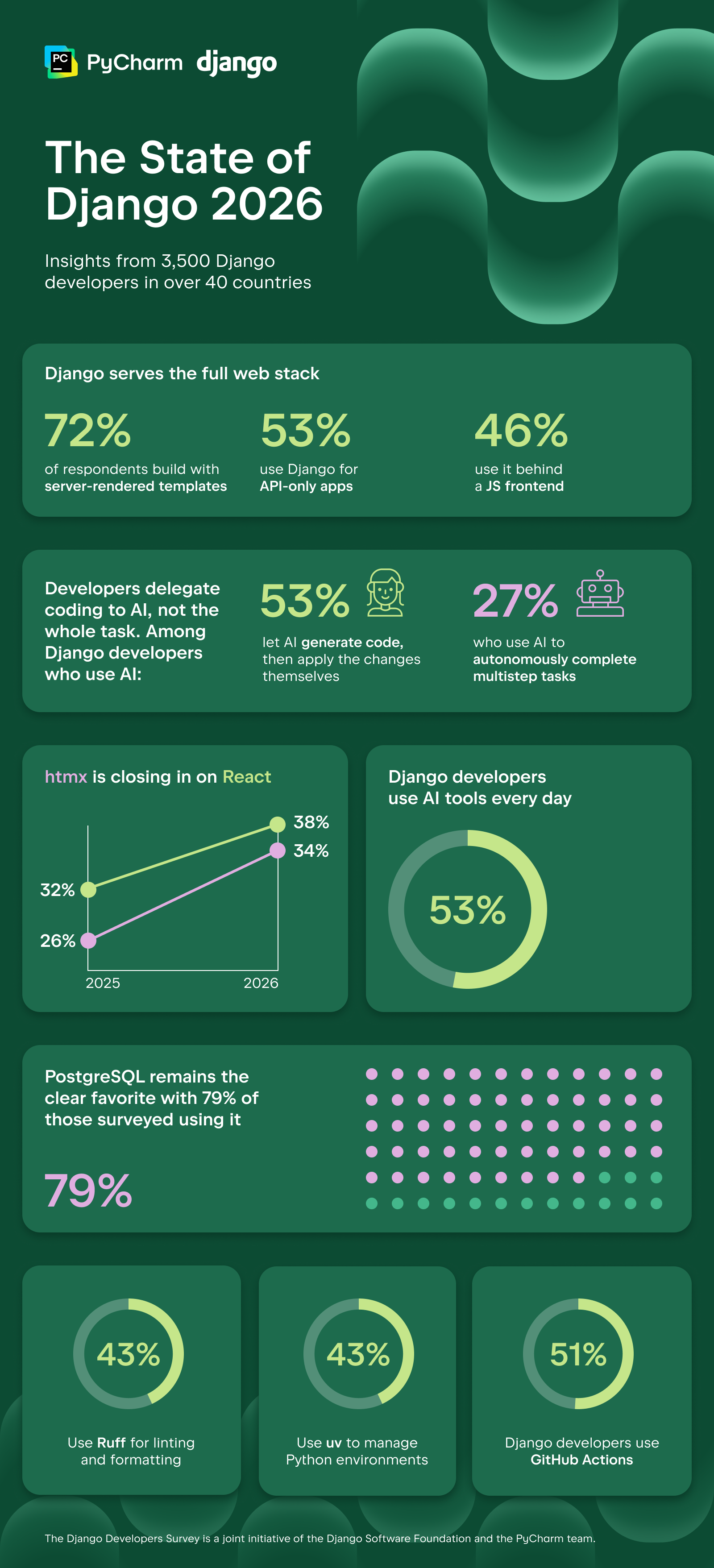
Welcome to the highlights from the fifth annual Django Developers Survey, a collaboration between the Django Software Foundation and PyCharm. This year’s report draws on responses from nearly 3,500 Django developers across more than 40 countries — from students in their first year to veterans with decades of experience.
In software, “boring” is a compliment. It means a technology works so reliably you can stop thinking about it. By that standard, Django in 2026 is thriving: PostgreSQL has been the database of choice for 76–79% of respondents for five consecutive years, Django’s template engine has held steady at around 80%, and nearly half of developers upgrade with every stable release — 43% are already on Django 6.0, months after it shipped. The core is boring in the best possible way. Mature, but not static.
Everything around that core, though, is moving fast. AI is now an everyday tool for most developers, and agents are beginning to move beyond answering questions to editing files, running commands, and completing larger tasks. Newer tools are consolidating workflows that once required several separate utilities, typing is becoming standard practice, and the boundaries between editors, terminals, automation, and AI are getting blurrier.
That may be Django’s particular advantage in 2026: it is mature enough to be dependable, active enough to keep moving, and stable enough to give developers room to change almost everything else.
As an open-source framework, Django depends on its community and needs funding to remain healthy and secure. The PyCharm team runs an annual fundraiser to support Django.
Until September 10, get PyCharm at 30% off, and JetBrains will donate 100% of your purchase amount to the Django Software Foundation.
1. AI is mainstream, but no workflow has won
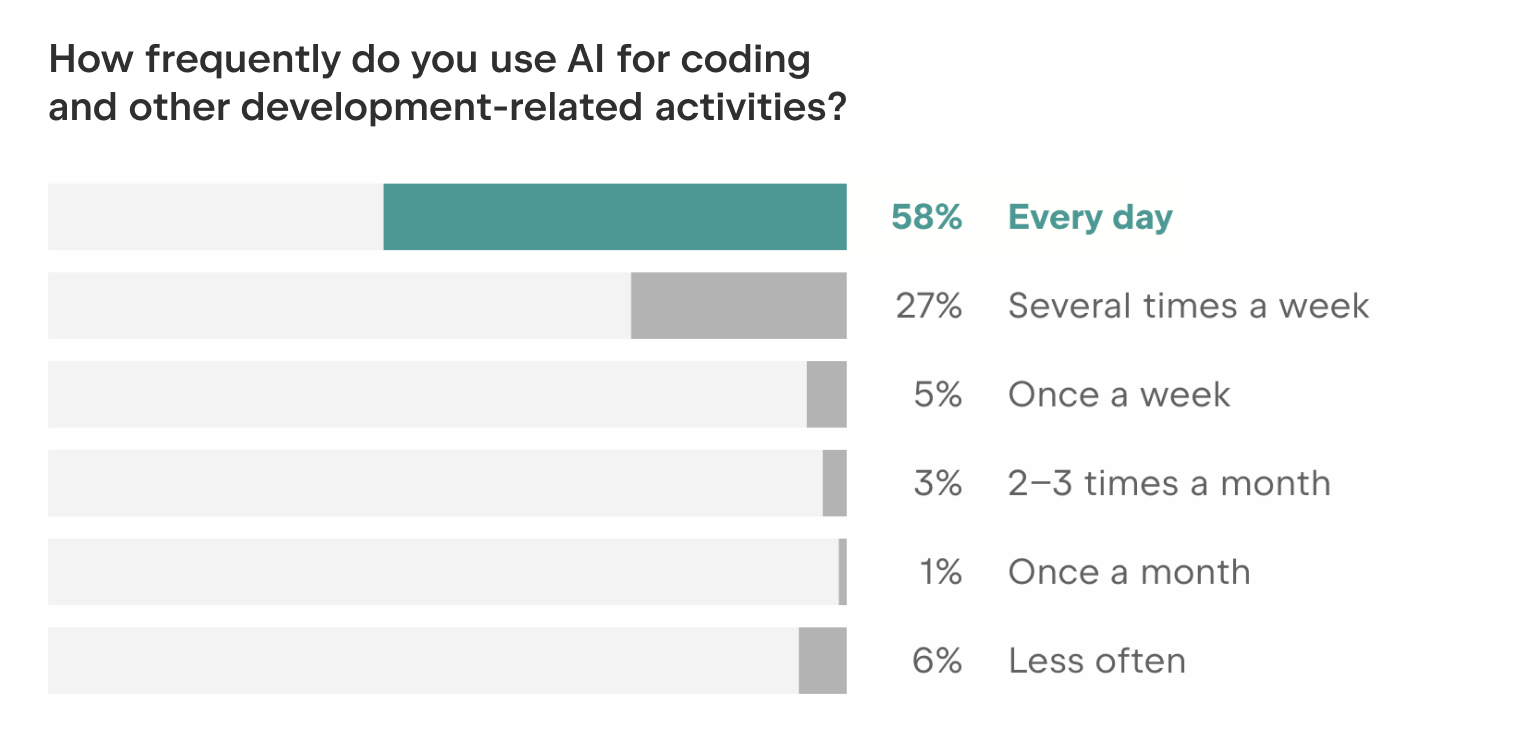
AI has become part of the normal Django development workflow. Only 10% of respondents said they regularly use no AI tools for coding, while 58% of AI users use them every day and another 27% several times a week.
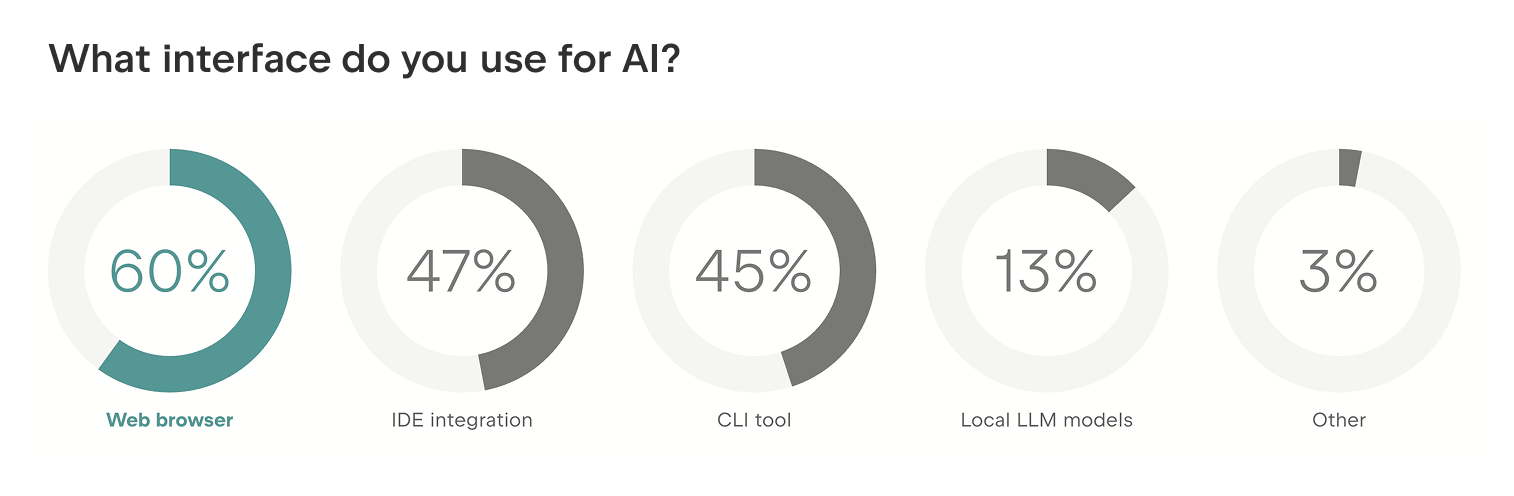
What remains unsettled is how developers use them. The interfaces are split almost evenly across the browser, the IDE, and the command line, and no tool dominates: Claude Code leads at 35%, with ChatGPT just behind at 33% and GitHub Copilot at 23%. And for all the attention on agents, a majority of AI users — 56% — still use it purely for chat and advice.
2. Dominating AI workflow is still supervised
Nearly half of AI users already work with AI through an IDE integration. But despite the growth of coding agents, the dominant workflow is still supervised: 59% have AI generate code and then apply the changes themselves, 44% let it edit files or run commands when instructed, and only 27% use it to autonomously complete multi-step tasks.
The emerging pattern is therefore less “replace the IDE with an agent” and more “bring the agent into the development environment.” Developers are adopting AI quickly, but the editor remains their home base for understanding the codebase, reviewing changes, and deciding what makes it into the project.
Nowhere is the shift clearer than in how developers learn. Django’s official documentation remains the top resource at 67%, but AI tools are now second at 51% — ahead of YouTube, reading source code, and Stack Overflow.
AI is already routine for writing code, debugging, research, and learning. But developers are still experimenting with where it belongs: in the browser, inside the IDE, at the terminal, or increasingly, acting directly on the codebase.
AI is changing the IDE faster than it is replacing it.
3. Python tooling is consolidating fast
Two tools that barely existed a few years ago are already near the top of the survey.
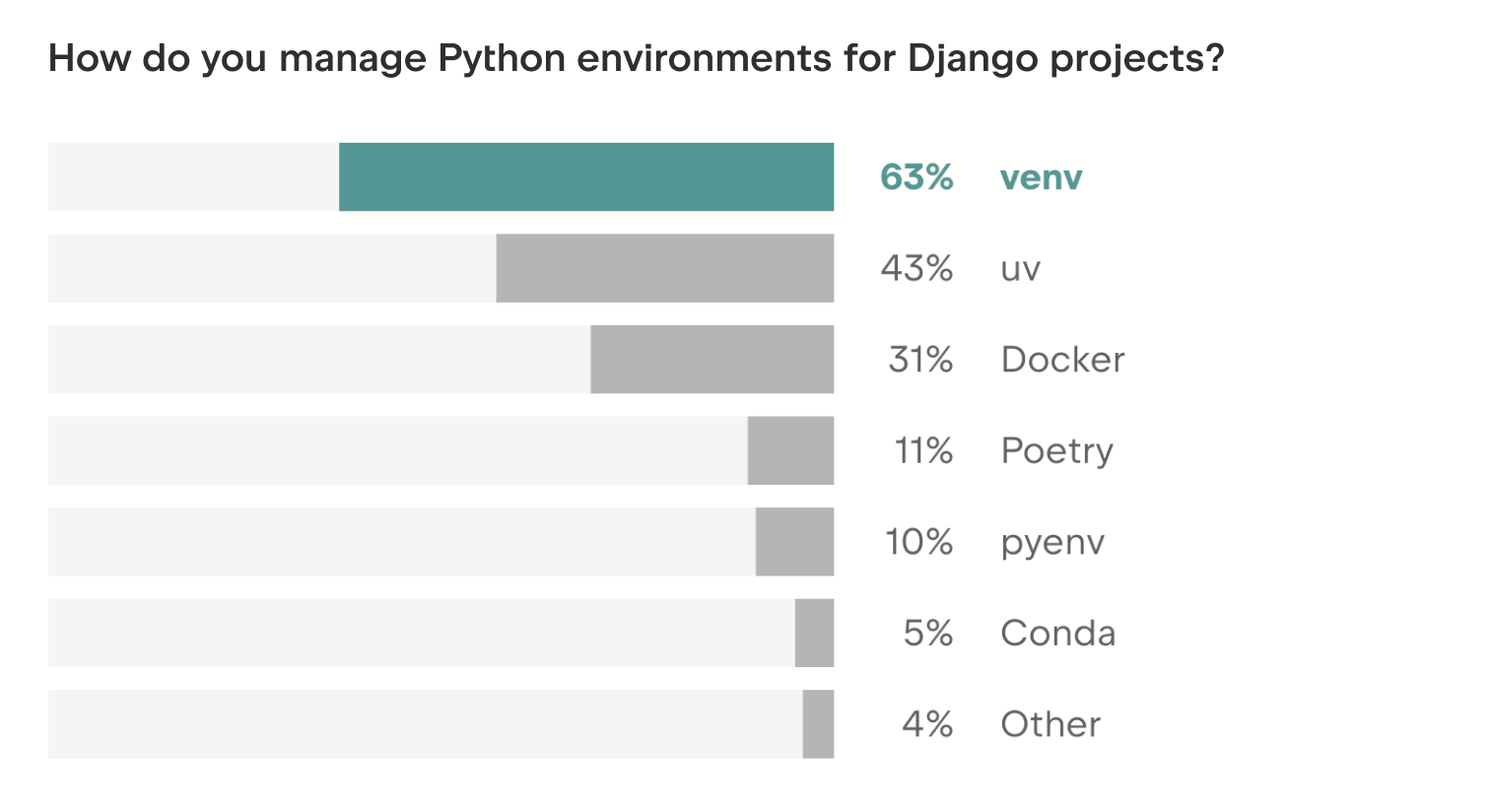
uv, released in February 2024, is already used by 43% of respondents for managing Python environments—second only to venv at 63% and ahead of Docker at 31%.
Ruff tells a similar story. At 43%, it is now the most widely used code-quality and formatting tool in the survey, ahead of IDE inspections at 27%, Black at 25%, pre-commit at 20%, and Flake8 at 17%.
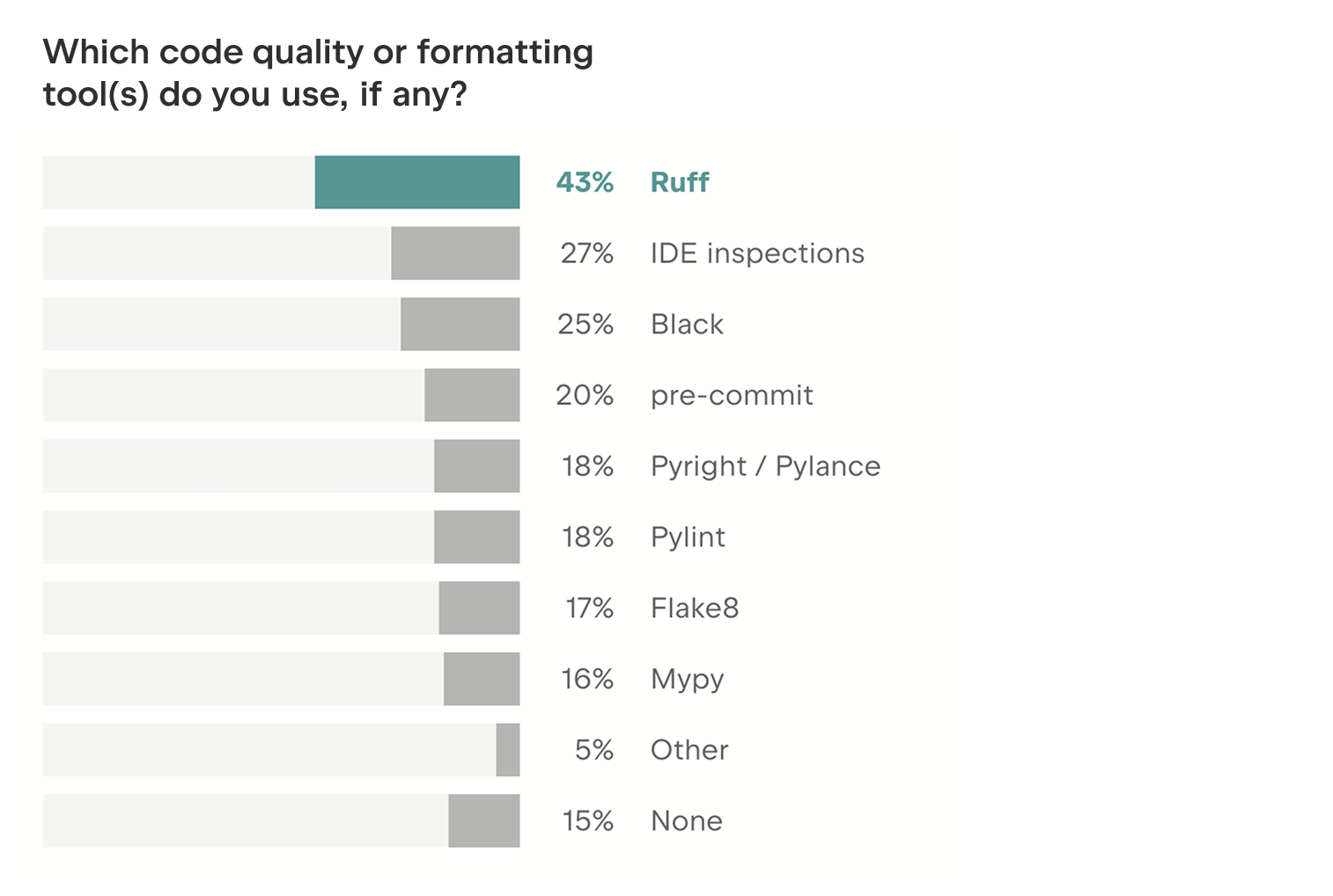
The shift is not that Python’s older tools have disappeared. It is that newer tools increasingly cover jobs that once required several separate utilities. The result is a Python toolchain beginning to consolidate around fewer, faster, more capable tools.
4. Type hints are winning. The type checker race is wide open.
Type hints are becoming the norm in Django development: 57% already use them, and another 26% plan to. What is much less settled is how developers check those types.

Among developers who use type hints, the most popular option isn’t a standalone type checker at all: 40% rely on the checker built into their IDE. Mypy follows at 32%, Ruff at 29%, and Pyright/Pylance at 22%. Newer entrants are already appearing too, with Astral’s ty reaching 12% and Meta’s Pyrefly at 4%.
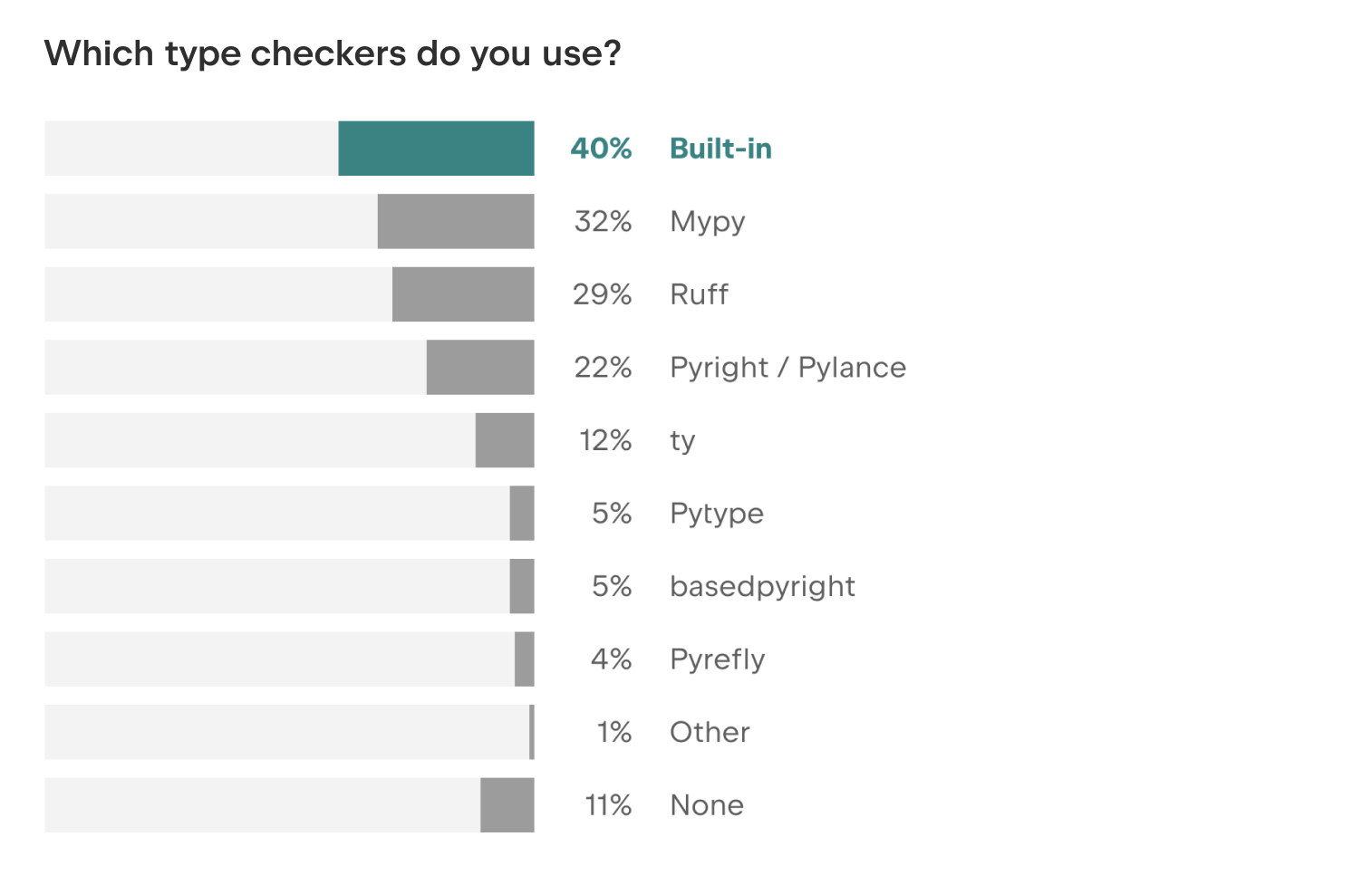
The practice, in other words, is converging faster than the tooling. Django developers increasingly agree that types are useful, but there is still no consensus on which tool should enforce them—or whether a separate tool is necessary at all.
That makes type checking an interesting space to watch in 2027: will one of the newer standalone tools break away from the pack, or will type checking increasingly become something developers simply expect their IDE to provide?
5. As AI writes more code, verification matters more
AI is moving beyond suggestions and into the codebase. That makes automated verification more important, not less.
The survey can’t tell us whether AI is driving greater adoption of tests or CI. What it does show is that most Django developers already have the infrastructure agents need: pytest is used by 45% of respondents and unittest by 43%, with pytest-django at 34%.
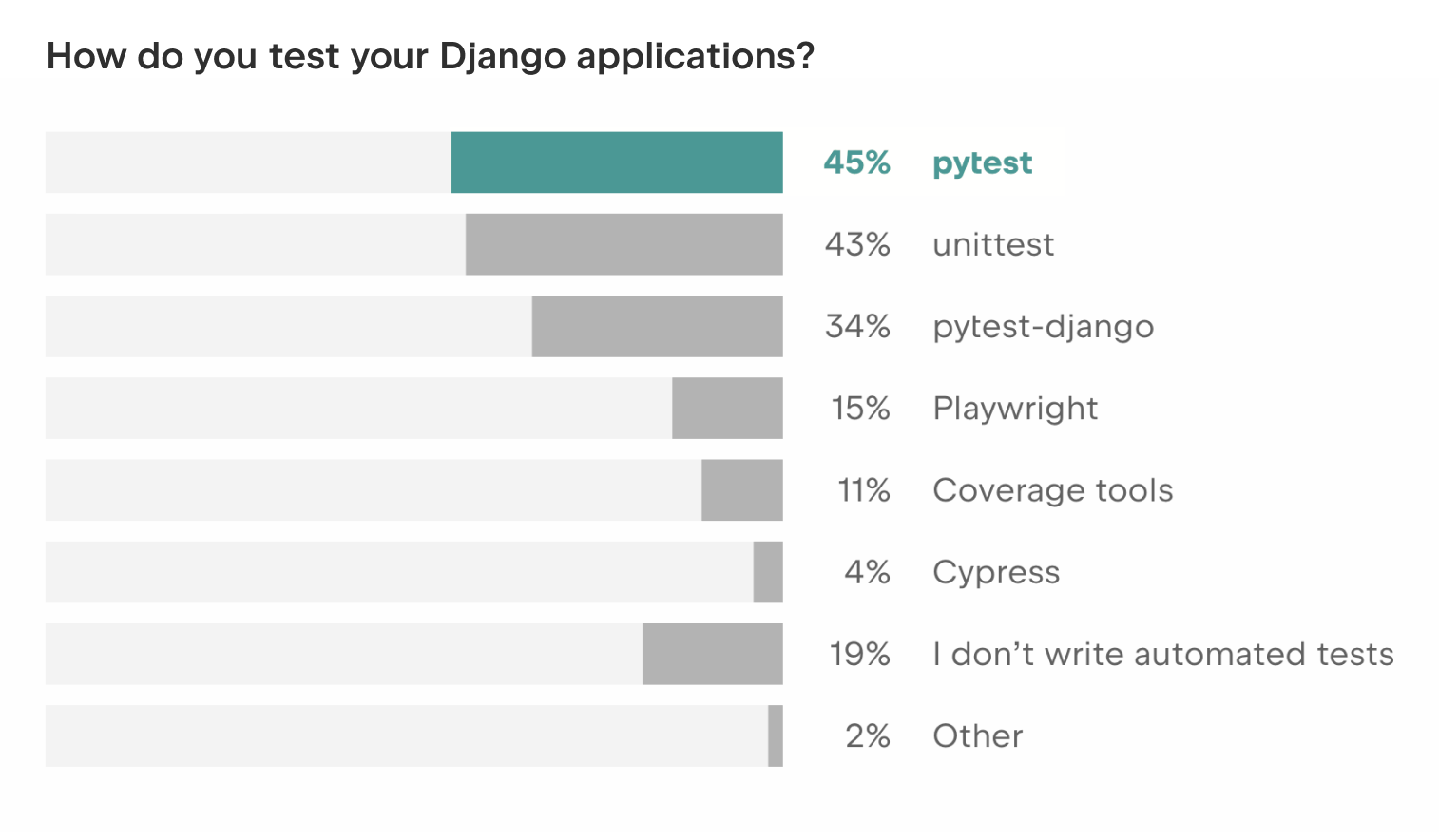
That testing culture sits alongside widespread CI/CD adoption — GitHub Actions is now used by a majority of respondents at 51%, with GitLab CI/CD at another 26%. Together, these create a natural feedback loop for agentic development: an agent can make a change, run the test suite, respond to failures, and hand the developer a result that has already passed the project’s checks.
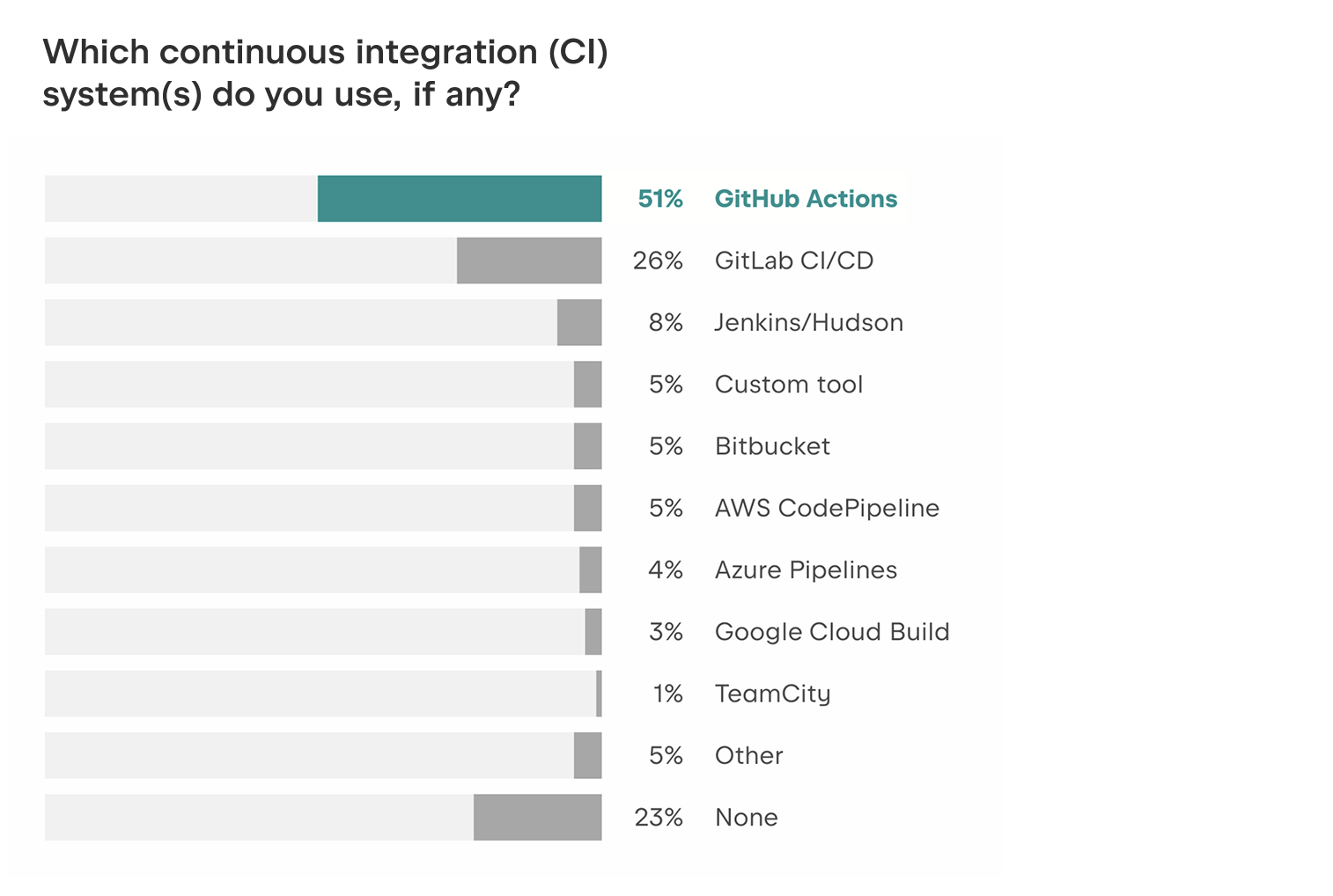
Not everyone has that loop in place: 19% of respondents write no automated tests at all. As more code is delegated to agents, that fifth of developers is working without the safety net that makes delegation trustworthy.
The emerging agentic workflow may depend as much on verification as generation. The more code we delegate, the more valuable it becomes to have tests and pipelines that can quickly tell both developers and agents whether a change actually works.
Agents can generate code. Tests and pipelines tell them whether it works.
6. One framework, two ways to build
Two distinct ways of building with Django are now firmly mainstream: letting Django render the interface, or using it as the backend for a separate frontend. 72% of respondents use server-rendered templates, while 53% use Django for API-only applications and 46% use it as the backend for a single-page application or dedicated JavaScript frontend.
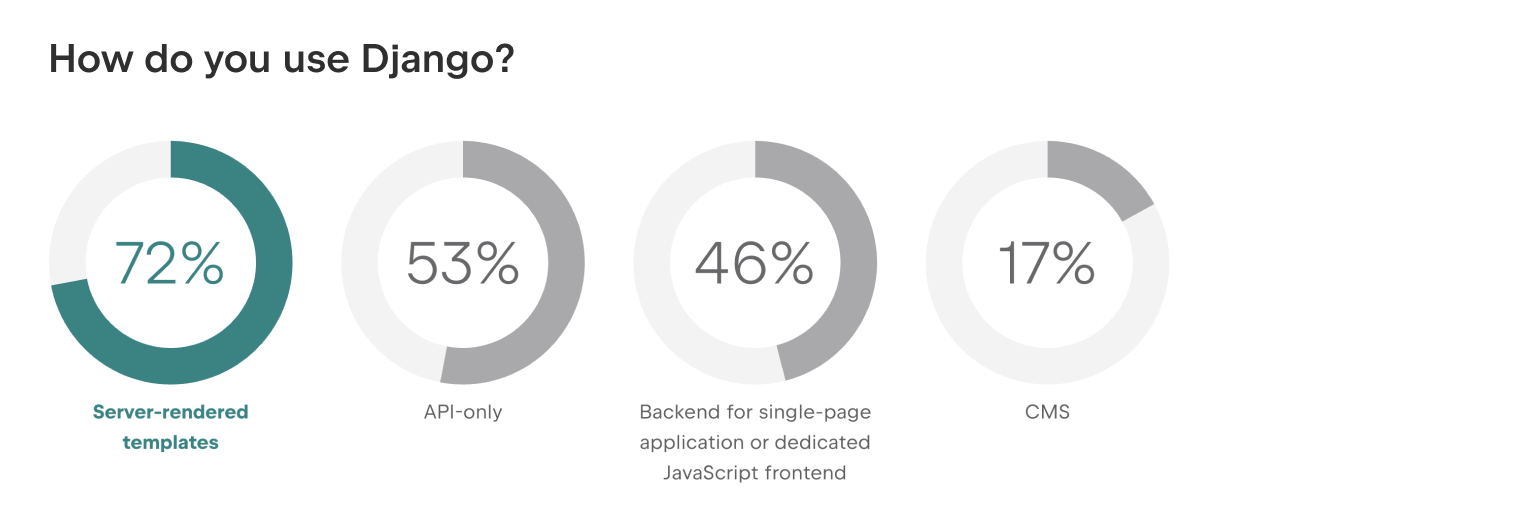
The balance is even clearer when developers are asked for their primary approach. Half primarily build server-rendered applications, while 44% primarily use Django for either APIs or dedicated JavaScript frontends.
The JavaScript numbers tell the sharper story. React has barely moved in five years — 37% in 2021, 38% today. What’s changed is everything around it: jQuery has fallen from 37% to 23%, Vue from 28% to 17%, while htmx has climbed from just 5% to 34%. htmx isn’t taking share from React — it’s modernizing the server-rendered side of the divide that jQuery used to own.
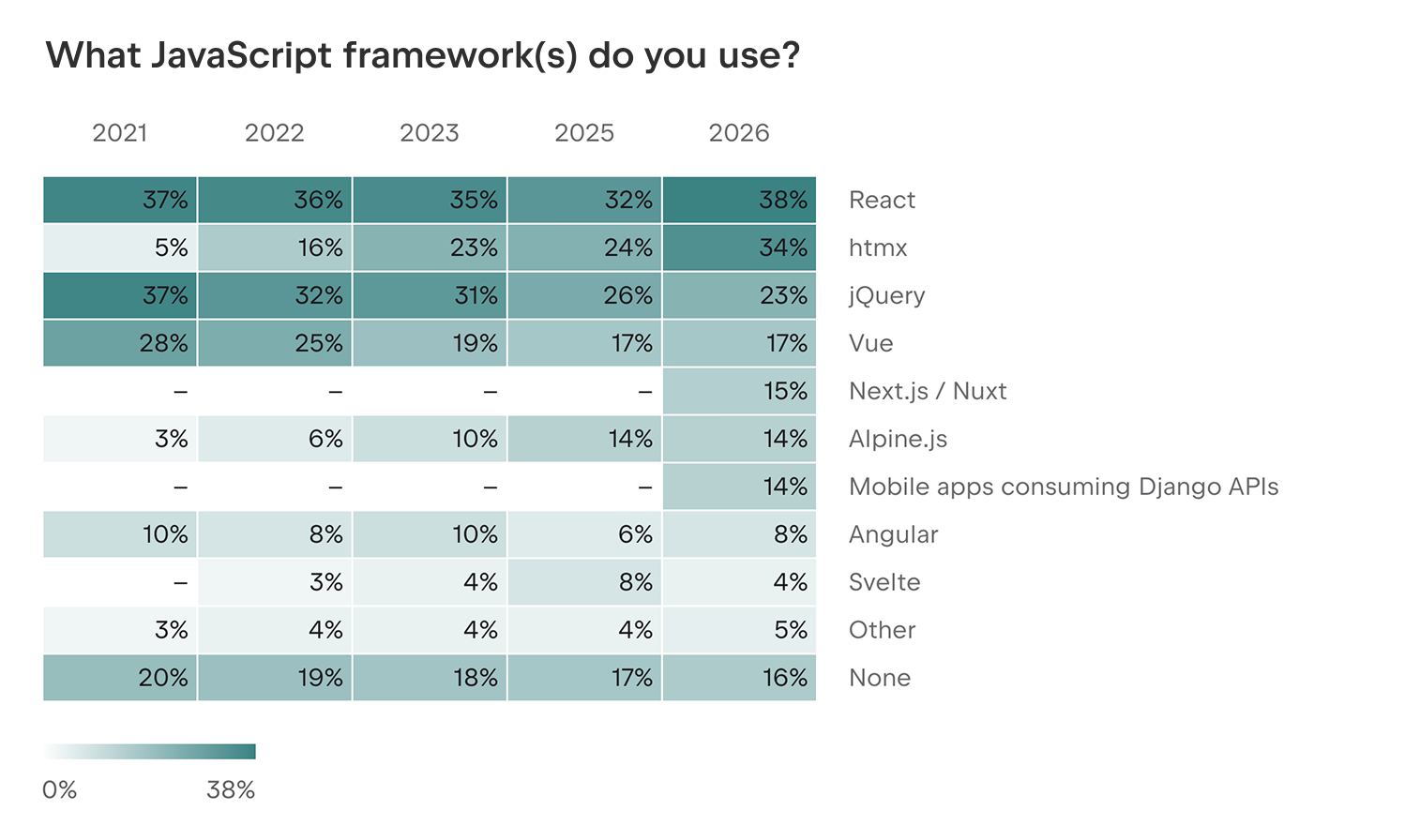
That flexibility is one of Django’s strengths. The same framework can sit at the center of a hypermedia application or behind an API consumed by React, mobile apps, or other clients.
Django remains unusually comfortable on both sides of the frontend divide.
Conclusion
Across the survey, the pattern is consistent: developers are changing their tools and workflows far faster than they are changing the framework underneath them. The parts of Django they value most remain familiar — models, the admin, authentication — and even deployment stays defiantly unfashionable, with 54% shipping monoliths and 44% self-hosting.
Even where Django itself is evolving, it does so deliberately: 33% of respondents use its async features and another 40% plan to — change offered as an opt-in, not a rewrite.
That stability is increasingly valuable. Developers can experiment with a new agent, replace several tools with Ruff or uv, add htmx to a template, or adopt a new type checker without having to rethink the framework underneath their application.
Django’s advantage in 2026 is not that it is the newest thing. It is that it gives developers a solid, dependable — yes, boring — place from which to try the newest things. Boring is so back.
PyCharm for Django Fundraiser
Get a new PyCharm Pro license or renew your existing one at 30% off, with 100% of your purchase amount going to the Django Software Foundation.
Explore the complete 2026 Django Developers Survey Results.
Fed's Kevin Warsh warns inflation is too high, sparking bets rate hikes are coming

Fed Chair Kevin Warsh reiterated his commitment to fighting inflation in a major speech — raising expectations that rate hikes may be coming, though he did not clearly spell out a path going forward.
(Image credit: Natalie Behring)

Fed chair hints at US rate rise amid inflation threat
От Copilot до AI-завода: где ИИ уже окупается и что собирать разработчику?
Иногда случается так, что компания покупает искусственный интеллект раньше, чем успевает понять, для чего он ей нужен и да это дань хаосу, страху выбыть из гонки. Генеральный директор уже услышал на форуме, что агенты заменят половину офиса; директор по инновациям уже пообещал пилот к концу квартала; HR заказал сотрудникам вебинар о промптах, потому что любое технологическое изменение в России прежде всего требует вебинара; а финансовый директор сидит на совещании, листает презентацию и пытается найти слайд, на котором вся эта новая цифровая жизнь наконец превращается в деньги. Только этого слайда пока нет. Зато к обеду нейросеть написала поздравление генеральному директору, а к вечеру появился приказ о создании рабочей группы — внедрение, можно сказать, пошло с успехом, все довольны.
Я намеренно сгущаю краски, но совсем немного (я очень осторожно выразился). Искусственный интеллект уже приносит бизнесу вполне материальный эффект: сокращает время обработки обращений, вытаскивает новичков на уровень более опытных сотрудников, управляет запасами, ищет дефекты, прогнозирует поломки и разбирает документы быстрее людей, которым ещё вчера приходилось переносить данные из одного окна в другое, сохраняя выражение лица человека, занятого интеллектуальным трудом. Однако деньги возникают не там, где модель лучше изображает собеседника, а там, где она встроена в повторяющуюся операцию и отвечает перед показателем, который не впечатляется ни качеством демо, ни количеством параметров: временем, себестоимостью, ошибкой, простоем, оборачиваемостью или прибылью.
Читать далееTennessee national guard fatally shot armed man in back, autopsy shows
Officials said Tyrin Johnson turned toward guard members with gun while running as report shows he was shot in back
Tennessee national guard members assigned to a federal anti-crime taskforce in Memphis fatally shot an armed 20-year-old man in the back, according to an autopsy report obtained by the Associated Press, contradicting police accounts that said the man was facing the troops when they fired.
Authorities have said that Tyrin Johnson turned toward guard members with a gun while running from them in the early morning hours after the Fourth of July holiday in Memphis when he was fatally shot in the chest.
Continue reading...Fed chair says delivering ‘stable prices’ is central bank’s job as inflation persists
However, Kevin Warsh didn’t say if interest rates would change in coming months, as inflation remains stubborn
The US Federal Reserve is not done fighting high inflation, its chair, Kevin Warsh, said in his first major speech in the role on Friday, emphasizing that it was “the Fed’s job to deliver stable prices”.
Warsh did not indicate where the Fed will take interest rates in the coming months, despite US inflation remaining stubbornly above the central bank’s 2% target amid the war in Iran. But his speech was taken by markets as a signal that rates may rise in the coming months, a move that may put him at odds with Donald Trump, who has aggressively called for rates to be cut.
Continue reading...Two-year curfew lifted in Sudan's capital
Код как борьба. Кратчайшая история IT. 0. Лейбниц, Бэббидж и Лавлейс

Представьте на секунду: первый компьютер спроектировали за полтора века до того, как его вообще можно было включить в розетку. Просто потому, что розеток ещё не существовало.
Звучит как анекдот, да? А на самом деле это буквально то, что случилось. И сегодня мы разберём, как так вышло, что три человека - философ семнадцатого века, викторианский математик и дочка поэта-скандалиста, развивая идеи друг от друга, придумали компьютер за сто пятьдесят лет до электричества.
Это первая статья цикла “Код как борьба: Кратчайшая история IT”. Эта статья про то, как рождалась идея вычислительной машины и как она столетиями ждала, пока человечество изобретёт материал, способный её выдержать.
ПогналиFed chair says delivering ‘stable prices’ is central bank’s job as inflation persists
However, Kevin Warsh didn’t say if interest rates would change in coming months, as inflation remains stubborn
The US Federal Reserve is not done fighting high inflation, its chair, Kevin Warsh, said in his first major speech in the role on Friday, emphasizing that it was “the Fed’s job to deliver stable prices”.
Warsh did not indicate where the Fed will take interest rates in the coming months, despite US inflation remaining stubbornly above the central bank’s 2% target amid the war in Iran. But his speech was taken by markets as a signal that rates may rise in the coming months, a move that may put him at odds with Donald Trump, who has aggressively called for rates to be cut.
Continue reading...More Americans oppose police license plate cameras than support them: survey
Индекс как алфавитный указатель: как база ищет и почему иногда не находит

В первой статье я объяснял кэш через холодильник. Продолжу тем же способом. Сейчас будет про индексы, а потом про то, почему индекс есть, а база его игнорирует.
Статья для тех, кто индексы ставил, но EXPLAIN читал по диагонали.
Fed chair voices concern about high inflation
Sandie Peggie's legal team claims tribunal applied 'wrong legal analysis'
Unlocking cosmic secrets with NASA's new Nancy Grace Roman telescope
South of France holiday scuppers Davey's blood donation
Ox Alpha (GLM-5.3-Flash). Что это было?.

20 августа на OpenRouter появилась строчка stealth/ox-alpha. Без карточки модели и даже намёка, кто её выложил. Провайдер значился как «Anonymous». Цена – ноль. Контекст – мильон. Площадка предупреждала: мы не владелец этой модели, а просто маршрутизируем запросы.
Через шесть дней у анона было имя, десятки триллионов обработанных токенов и полмиллиона разработчиков, которые за это время успели залить в него рабочий код. Спойлер, который уже не спойлер: это оказалась GLM-5.3-Flash от китайской Z.ai.
Но путь от «непонятно что» до «фронтир-модели» получился драматичным и заслуживает разбора. Ну а поскольку я лично пялился в этот тред почти неделю, обновляя ленту как одержимый – расскажу вам что там произошло, по порядку.
Читать далееBrilliant bowling - Relentless Robinson stars with the ball
Ordonez's move to Palace in doubt after medical
Exclusive discounts from CBS Mornings Deals
Vermont senator says he disagrees with Trump's tariffs on Canada
Smaller Revision Points to More Accurate Jobs Numbers
Fed will have "work to do" if inflation doesn't fade, Warsh says
The Bigger Bet Behind Nvidia’s $12.9 Billion Hugging Face Deal
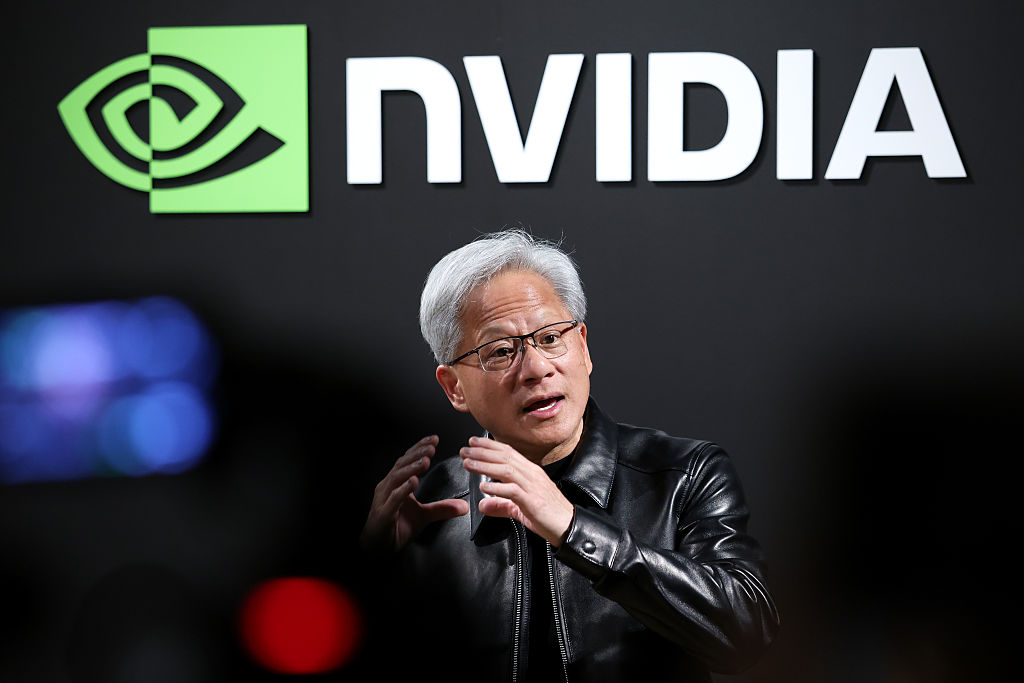
Nvidia has reportedly agreed to buy popular AI library Hugging Face for $12.9 billion. The deal is partly a hedge against an emerging threat: AI companies which consume enormous quantities of Nvidia hardware are increasingly developing chips of their own. In a future where AI becomes centralized in a small group of players with their own chips, those companies could demand lower prices from Nvidia or bypass it altogether.
Hugging Face, an online hub where developers share open AI models and datasets, gives Nvidia a stake in an alternative future, where downloadable AI models allow startups and governments to build systems of their own. Few would have the scale to develop custom chips. (Nvidia and Hugging Face did not respond for comment.)
With roughly 85% of the AI chip market, Nvidia’s share has only one way to go. But a smaller slice of a much larger market could still mean more sales, says Umesh Padval, a Managing Partner at Seligman Ventures. “If the deal goes through, I think it’s a brilliant chess move.”
Nvidia has thrown its weight behind open-source AI in recent months. It successfully lobbied Washington to loosen restrictions on selling its chips to China, which leads in open AI development. More recently, it struck a $6 billion deal with Poolside, to develop an American open alternative. In July, Nvidia helped lead an open letter defending open-source AI and urging Washington not to restrict it. “Open models strengthen safety and cybersecurity, accelerate innovation and diffusion, and enable sovereignty,” Nvidia boss Jensen Huang wrote in his first post on X.
Meanwhile, Google now exclusively uses its custom TPU chips to train its Gemini AI models. In August, Anthropic hired, Amir Salek, a former TPU team-lead at Google to spearhead a new in-house chip division. The same month, OpenAI shared the first results from its custom chip, Jalapeño. SemiAnalysis, the firm which conducted tests on OpenAI’s chip, said it beat “every Nvidia, AMD, and Google chip we have been able to test.”
“There’s kind of this two-way strategic battle,” says Richard Clode, a technology portfolio manager at Janus Henderson. “On the one hand, Nvidia doesn’t want to be reliant on just three customers, so [it] is deliberately trying, with financing and allocation of chips, [to] encourage other players and neo-clouds. And then vice versa, those hyperscalers don’t want to be completely reliant on just one compute provider.”
Nvidia’s 75% margin means that other firms’ in-house chips do not need to match its performance to save large customers money. Custom silicon has other benefits, too. Nvidia has previously given smaller cloud providers early access to its newest chips, ensuring that the largest players do not dominate supply. Developing chips in-house reduces exposure to those allocations, Clode says, while allowing AI companies to tailor hardware to their specific workloads.
AI companies are not developing these chips completely alone. Google, OpenAI, and Meta have partnered with Broadcom to help turn their specifications into custom silicon.
Those efforts are yet to make a dent in Nvidia’s bottom line. In August, Nvidia reported a blockbuster earnings report with record revenue of $96.2 billion, more than doubling year-over-year and beating Wall Street expectations. Companies like Google and OpenAI continue to buy large quantities even as they develop alternatives. They’ve “poured a lot of infrastructure capex into the existing infrastructure,” says Sriram Viswanathan, a founding managing partner at Celesta Capital and a former Intel executive. Moving to a different architecture, he said, is “a huge lift-and-pour-concrete situation. So I think it’s going to happen over a period of time, but not in one fell swoop.”
He points to Apple as a warning. Apple first developed chips for the iPad and iPhone while continuing to buy Intel processors for Macs. As its expertise matured, its silicon moved into Mac computers and Intel was cut out.
“Nvidia is executing like crazy, so in some ways it’s theirs to lose,” says Sean Lie, co-founder and chief technology officer at AI chip company Cerebras. “But I think we’re seeing a lot of cracks in that armor.”
The War Room newsletter: Let slip the dogs (and pigeons) of war
CSS задачи на 200 IQ

У вас бывает такое чувство, когда вы при выполнении работы упёрлись в какую-то проблему и что-то внутри подсказывает, что не может такого быть, чтобы у неё не было решения? Когда кажется, что уже всё пропало и мы столкнулись с фундаментальным ограничением реальности, но отказ принять это продолжает вести вас в дебри спецификаций, беседы на Github 10 летней давности и изучение статей гигантов уже прошедших этот путь и поделившихся с нами своими результатами? И вот спустя многие часы напряжённого скрипа извилин вы дописали очередную строчку, обновили страницу и вот оно, то, что вы хотели получить смотрит на вас с экрана? Это ощущение успеха, наверное, в той или иной степени знакомо каждому инженеру. В такие моменты мне, обычно, очень хочется поделиться результатом с коллегами и, по возможности, написать статью если это может быть полезно кому-то ещё. В этой записи я собрал 3 подобных ситуации, где в рамках нашей работы возникли решения, которые, насколько мне известно, довольно уникальны и в полной мере не были описаны раньше. Приглашаю вас разделить со мной радость обнаружения решения, которое казалось невозможным!
Читать далее