RSS Feeds
Model diagnosed with aggressive cancer after finding lump while shaving
Climate's Compounding Financial Toll Is Becoming Harder to Ignore
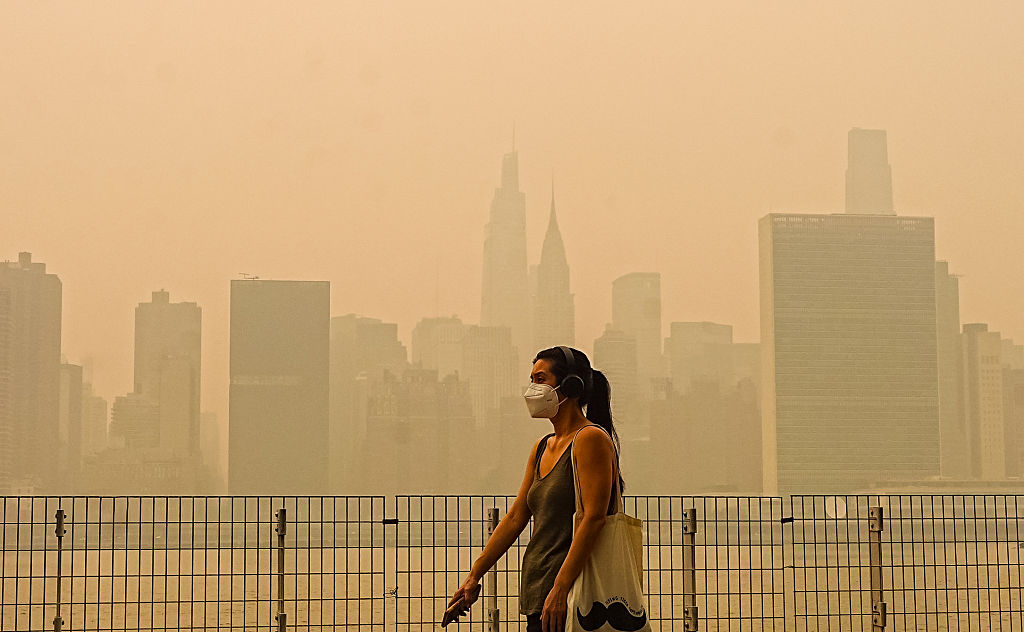
It’s felt all but impossible to escape the reality of our changing climate this past month, from extreme heat at London Climate Action Week to wildfire smoke across the U.S. northeast and midwest. While each individual event is dramatic in its own right, I’ve been struck by the breadth. Everywhere seems to be undergoing its own unique climate event at the same time.
In many conversations, climate change gets boiled down to individual events, or even just the simple sum of multiple events. But the impacts this summer offer a useful reminder that it’s not so simple. While economies may be able to absorb one climate shock, the risks grow when they accumulate and occur across geographies and assets simultaneously. You might call it “death by a thousand cuts.”
Already, this bludgeoning has become visible in insurance markets. Insurance is an obvious place for these challenges to show up first. Insurers price based on short-term risk and can’t defer a loss the way an equity investor can, so they either raise prices or exit the market. We’ve already seen those in the most at-risk markets, including both Florida and California.
But insurance is not alone. We’re starting to see indicators of other, similar slow-moving financial disasters. Earlier this month, the Bank of England quietly said that climate change was creating a spending pressure on governments, contributing to growing sovereign debt loads. Last month, the International Monetary Fund warned that climate disasters were creating an “impossible trilemma” for countries. Disasters drive countries to take on more debt, making it harder to fund the adaptation necessary to prepare, and then face higher default risk.
This is a dangerous cycle with implications for investors and businesses across the economy. Sovereign debt flows through to the rest of the economy. Too much of it leads to higher interest rates for businesses, lower private investment, and lower growth. One disaster, even a record one, can be absorbed. The danger is when they all happen at once, and then continue to happen. A never-ending string of extreme events threatens economic havoc in a way one event doesn’t.
Thus far, capital markets more broadly have been slow to respond to this threat for a variety of reasons. Climate risk is difficult to model and plays out over long time-periods. Meanwhile, investors discount future risks and prioritize quick returns. And, importantly, they generally expect that events will be non-correlated and therefore easier to absorb.
This view may change. The Bank of England warned last December of the possibility of a climate Minsky moment, where assets reprice rapidly due to climate shock. It’s also possible that repricing happens gradually over time. In any event, the cumulative effect of concurrent disasters should not be taken lightly. Markets often ignore risks when they feel isolated, or idiosyncratic, but once they are understood as systemic they are priced.
For many who work in climate, this season of extremes has revived the longstanding prediction that the effects of rising global temperatures will help drive a resurgence in concern among policymakers and the general public. I hope so, but I’m not so sure. While some studies have suggested extreme weather events can drive support for climate action, many others have shown minimal effect. And we’ve also seen the opposite effect: climate events that triggered populist backlash led by anti-climate politicians.
While it’s hard to predict how exactly these events will shape public engagement on climate, markets have a simpler logic to them. Climate related events are exacting a growing cost. And it’s now clear both that those costs will grow and that economies aren’t fully prepared. If and when investors look at the same information and determine that those costs aren’t fully accounted for, asset prices will take a hit.
To get this story in your inbox, sign up to TIME's Future Proof newsletter here.
When Trump accuses others of wrongdoing, you can bet he’s up to something himself | Arwa Mahdawi
Thursday’s speech about election integrity was a case in point, as the president seeks to undermine the system
America’s mad king is spiraling. Donald Trump’s approval ratings are mired in the 30s as the Iran war rages on with no end in sight. As prices rise and the US’s reputation tanks, Trump is building self-serving monuments and putting his face on new $1 coins to ensure he leaves a lasting legacy. Don’t worry, Donald, we’ll never forget you! Your name will forever be associated with corruption, crime and a nationwide outbreak of explosive diarrhea.
When the going gets tough, Trump tends to go into full-on victim mode. This week was no exception. On Thursday, the president gave a televised primetime speech in which he rehashed all his usual grievances. A random jab about trans people? Check. Boasting about how he’s single-handedly made America great again? Check. Demonizing the media? Check. Complaints about how unfair it was he lost to Joe Biden in 2020 coupled with accusations about Chinese interference and misinformation about election integrity? Check. “No country can be great without fair and honest elections,” Trump announced. “If there can be no trust, there can be no greatness. Unfortunately, the system we have falls catastrophically short of that standard.”
Arwa Mahdawi is a Guardian columnist
Continue reading...Nelson Mandela held a mirror to humanity – and showed us what solidarity means | Zohran Mamdani
In a speech given on Wednesday in honor of Nelson Mandela Day, New York’s mayor reflects on what Madiba can teach us in a fractured era
What a privilege it is to be together to honor the leadership of the Nelson Mandela Foundation. For 27 years, this organization has insisted that Madiba’s legacy belongs not only in museums, but in movements for freedom too. I would like to recognize a man whose legacy lives on in the millions that he inspired.
Madiba lives in every protest for justice, every call for democracy, every march with a righteous demand. Madiba lives in every township and slum where dignity remains just out of reach, and he lives in each person who reaches for that dignity, who works all day and then returns home with food for the hungry and medicine for the sick. Madiba lives each time someone bears witness to oppression, or want, or misery, and does not accept it as inevitable, but rather as something that we each can fight. So many of us are only where we are today – can only conceive of the principled as possible – because Madiba showed us the path.
Continue reading...‘They car-bombed my house – there’s not much more they can do’: the astonishing podcast taking on illegal bloodsports
After 20 mutilated animal corpses were left outside a rural primary school, the creators of award-winning podcast Buried began investigating – with a little help from Chris Packham. It plunged them into organised crime, the dark web and Line of Duty-esque rumours of police corruption
In 2024, a village in Hampshire woke up to something truly disturbing. A mound of dead animals had been dumped outside a school, and blood oozed out on to the streets before children’s classes started for the day. There were about 20 carcasses, including rabbits, hares, pheasants, a fox and a muntjac deer with its head severed. The village was dumbfounded, and the biggest question was: why?
The husband-and-wife investigative journalist team of Dan Ashby and Lucy Taylor – the pair behind the award-winning BBC podcast series, and now forthcoming documentary, Buried – found themselves wondering the same thing. Their new 10-part podcast, Buried: Dead Rabbit, delves into this and finds them plunged into the shady world of illegal bloodsports. Specifically, hare coursing – where dogs hunt hares to kill them, an activity that has been banned in the UK since 2005 – and its links to organised crime and the dangerous, violent characters who are terrorising villages across the country.
Buried: Dead Rabbit is on BBC Sounds now.
Continue reading...‘It becomes inevitable’: the toxic mix fuelling deadly political violence around world
After killing of a British former MP, experts say dehumanising rhetoric, declining institutional trust and disinformation fuelling a global problem
On 9 July, the body of Ann Widdecombe, an uncompromising, staunchly conservative former UK government minister turned TV personality and spokesperson for the radical-right Reform UK party, was found at her home in south-west England.
Two days later, a man was arrested in South Yorkshire. Believed to be previously unknown to the local police force and thought to have acted alone, he is suspected of driving 270 miles (435km) to the 78-year-old politician’s home and causing her catastrophic blunt-force injuries. Police have been examining whether a leftwing or single-issue cause may lie behind her killing.
Continue reading...White House backs Argentina players over Falklands banner in World Cup semi-final
White House Fifa taskforce chief defends Argentina footballers, saying US believes in free speech
The White House has backed Argentina’s footballers who displayed a banner supporting their country’s claim to the Falklands Islands after their World Cup semi-final victory against England.
After Argentina’s 2-1 win in a fractious match in Atlanta on Wednesday, some players held up a banner that said: “Las Malvinas son Argentinas” – using the country’s term for the South Atlantic islands.
Continue reading...How the Michigan Senate primary became a battle for Democrats’ soul

The Democratic Party is at war with itself, and nowhere is the fight clearer than the Michigan Senate primary. On one side: Rep. Haley Stevens, backed by Senate Minority Leader Chuck Schumer and the establishment, who says the left is too untested and too extreme to win a general election. On the other: Dr. Abdul El-Sayed, the former public health official who wants to blow up the whole premise of the question.
More than $40 million in outside money has already poured into this race — a big chunk of it from pro-Israel groups lining up against El-Sayed — because it’s less a Senate primary than a proxy war for where the party goes next. And at the center of it sits that dreaded word: electability.
That term has become a catch-all used by Democrats to encapsulate whatever approach they think has higher odds of winning the general election.
This week on America, Actually, I sat down with El-Sayed about what his theory of electability actually means.
Here are three takeaways from our conversation:
1. His electability pitch is an “America First” argument
El-Sayed takes the two things his critics treat as liabilities — his opposition to US support for Israel and his populism — and fuses them into a single kitchen-table argument: money going abroad is money not going to you. Anti-war politics and affordability policy become one and the same.
“My priority is money out of politics, money in your pocket, Medicare for all. That’s what I’m campaigning on,” he said. That reminded me of a similar argument I heard from Darializa Avila Chevalier, the socialist candidate who won an insurgent congressional primary in New York City.
“Kids need glasses, kids need schools, kids need functional infrastructure,” El-Sayed continued, fleshing out his case. “And I’m gonna find the money that we’re sending to do heinous things to other people and keep it here.”
He says that pitch appeals to a broader swath of the electorate than the traditional left: Voters, he says, feel that the government is making them “unable to afford my groceries, unable to afford a home… and then [it is] sending my money abroad telling me that somehow that’s in my best interest?”
2. He rejects the left-right dichotomy
El-Sayed also repeatedly rejected the left-right spectrum entirely. His read on Michigan isn’t that voters keep lurching between extremes — it’s that they are searching for a fresh type of politics, which neither traditional party was offering. Bernie Sanders in the 2016 primary, Donald Trump in that cycle’s general election, Joe Biden in 2020, Trump again in 2024. It’s not whiplash, he argues. It’s hunger. And that hunger reorganizes the whole map.
“If Michiganders wanted moderate[s], why would they have elected Donald Trump twice?” he asked.
“The better way to think about our politics is top-down: people who are locked out versus people doing the locking out. And if you’re on the side of the people doing the locking out, you’re going to have a really hard time in our politics right now.”
With this framework, El-Sayed thinks he can create a greater contrast with Republican nominee Mike Rogers than his Democratic counterpart can.
“Both Mike Rogers, the Republican, and Haley Stevens, my opponent in this primary, have been on the side of the people doing the locking out,” he said. “They take their money and do their bidding.”
3. The moderates are in hiding
The Stevens campaign rejected multiple requests for comment — which is becoming a bit of a trend on the Democratic establishment side of the party’s civil war. If you want to bash the left, they’ll talk. But if you’re interested in their vision, they are much less willing to be forthright. In some cases, it seems like the moderate lane of Democrats is downright scared of its own shadow.
But that’s also a political strategy. Stevens and her allies at groups like Third Way are making a bet: that if they can turn the race into a verdict on El-Sayed himself — the Hasan Piker streams, the old campaign clips, the loose-cannon caricature — voters will get nervous and retreat to the safe choice.
El-Sayed said the approach was an insult to voters: “It’s interesting taking political advice from a shop that exists specifically to launder old ideas and make them seem new again — and then, like, fail miserably at that.”
New episodes of America, Actually are in your feed every Saturday. Listen wherever you get your podcasts, or in the Today, Explained feed.
False nines or firing forwards - England's potential life after Kane
The Nordstrom Anniversary Sale is here — Save up to 40% on our favorite brands
Ukrainian drone attacks on Russia kill at least 9, injure over 60
How the World Cup final is starting to look a lot like the Super Bowl
World Cup winner Capdevila appeals to Trump after US travel permit denied
Wife of US heir and activist donor on fighting his extradition to US: ‘It’s incredible that this can happen’
Stella Schnabel says Trump administration is falsely accusing James ‘Fergie’ Chambers of contributing to Hamas
Although her husband, James “Fergie” Chambers, had been locked up in Spain for nearly a week, Stella Schnabel didn’t break down and cry until Thursday, when she finally got to speak to him for several minutes – enough time, she said, “for us to say we love each other and for him to say: ‘Tell the kids I love them.’”
Spanish authorities, operating on a US extradition request, arrested the 41-year-old Chambers, a US citizen and wealthy donor to leftwing and humanitarian projects worldwide, last Friday in Ibiza. He has been transferred to a prison in Madrid. The Trump administration’s Department of Justice is seeking his extradition for alleged financial support of Hamas, according to a spokesperson for the Spanish high court.
Continue reading...Hart, Rooney and Richards on rowing the Hudson and if Tuchel should keep his job
Pundits set out on the New York river to fulfil forfeit after Wayne’s errant prediction about Norway at the World Cup
The BBC punditry trio Wayne Rooney, Micah Richards and Joe Hart are fresh off a boat on New York’s Hudson River after an attempt to honour Rooney’s declaration that he would “row the River Mersey” if Norway reached the World Cup quarter-final. They did, prompting Erling Haaland to tease Rooney, saying: “I’m looking forward to seeing you, Wayney boy.”
How was it?
Continue reading...Gianni Infantino unlikely to face IOC sanctions over Balogun red card scandal
Donald Trump spoke to Fifa president before ban lifted
Human rights body FairSquare sent complaint to IOC
Gianni Infantino is poised to escape without sanction after complaints he breached rules on political neutrality in his dealings with Donald Trump over the Folarin Balogun affair.
The International Olympic Committee this week received a formal complaint from the human rights organisation FairSquare regarding Infantino’s conduct after Trump revealed he had called the Fifa president asking him to review Balogun’s ban from the USA’s last-16 tie against Belgium. The ban was subsequently suspended for 12 months after an unprecedented ruling from Fifa’s disciplinary committee.
Continue reading...'Less than human': how unhoused people in Atlanta are being treated during the World Cup – video
“This is what happens when you apply these incredibly violent economic forces to these cities … it's happened at every World Cup I've been to,” explains our chief sports writer, Barney Ronay.
Employees in Atlanta, Georgia, recently threw away tents, medication, identification and other belongings of unhoused people at a public park without warning. This led activists and a local official to point to an apparent violation of procedures created after a city employee ran over a tent with a front loader last year, killing a man. Cornelius Taylor was crushed inside his home as workers came to clear a homeless encampment.
The sweep through the park occurred less than a mile from a popular spot for World Cup watch parties, drawing into focus ongoing tension over the treatment of the city’s several thousand unhoused people during the tournament. A city official said the park where about 15 people have gathered for months was “not an encampment” and that the incident was not a sweep.
Watch Barney's latest report from downtown Atlanta as the World Cup edges closer to the final – and for more of his video diaries follow Guardian Sport on TikTok.
Continue reading...Checks and Balance newsletter: Make America worse at sports
Into the Wild inspired my life of adventure – but I learned the wrong lessons about freedom
The film helped me realise that getting out into nature would also allow me to escape my anxieties, but I started to see the costs of constant escape
It’s 5.30am, and I’m waking up on a granite slab overlooking the Domeland Wilderness, with nothing but forest, stone and silence for miles. I am 44 days into hiking the Pacific Crest Trail – a journey of about 2,650 miles from the Mexican border to Canada through desert scrubland, pine forests, deep valleys, volcanic terrain and alpine mountains. Each day, I walk about 20 miles with everything I need for the next four months on my back.
I was 16 when I first watched Into the Wild, the film telling the true story of Christopher McCandless, an adventurer who gave up his middle-class life to live in the wilderness. I’d always had a sense of adventure and was enticed by the idea of breaking away from expectations and moving through the world on my own terms. I began to fantasise about escaping my north London bubble to live somewhere as remote and unknown as the wild American landscapes in the film.
Continue reading...What will Keir Starmer do next?
Outgoing PM has joked about cookery classes and cutting hedges, but does the international stage beckon?
As his time in Downing Street comes to an end, Keir Starmer has been joking with friends about what he might do after he stands down as prime minister.
He has teased that he might take a cookery course. “He needs it, he only makes two meals,” one friend said. Another not entirely serious suggestion was cutting his father-in-law’s hedge in the expectation that if he did well, he could graduate to lawns.
Continue reading...4 Best Walking Pads for Small Spaces and Standing Desks (2026)
What the World Should Learn from Australia’s Social Media Law
Australia’s new social media law took effect on Dec. 10, 2025, raising the age to open or maintain social media accounts to 16. It was a global first. The law called for the biggest social media platforms to do more than just ask for a birthdate. Now, they would be legally required to take responsibility for verifying and enforcing an age minimum.
Half a year on, the world is watching closely. Are the restrictions working?
Some critics and media outlets have prematurely concluded that the policy has failed. They point to early surveys showing that under-16 social media use has fallen only partially, and that most kids are still accessing social media. And they argue that age limits will never work, that these laws miss the real problem of harmful platform design, and that the countries considering following Australia—of which there are many—should reconsider.
The truth is far more encouraging. There are several promising trends that other countries are now building upon, reflecting the importance of Australia’s pioneering policies.
It started with a relatively smooth rollout. All 10 platforms took steps to verify users' ages and remove accounts of those under 16. Now, fewer kids in the land down under are using social media, and more than a dozen other countries, including Indonesia, Canada, Malaysia, the UAE, France, Spain, and the U.K., are beginning their own journeys to rein in social media.
The world is, and should, follow Oz’s lead.
Early signs of success
When Australia’s law went into effect last December, 10 social media platforms—Facebook, Kick, Reddit, Threads, TikTok, Twitch, Instagram, Snapchat, X, and YouTube—removed 4.7 million under-16 accounts belonging to an estimated 2.5 million Aussies between the ages of eight and 15.
To be sure, that does not mean that these kids can’t access social media altogether, since many likely have several accounts across platforms. But it shows that the law made immediate progress and compelled platforms to take action on a massive scale.
Still, some have said that this decline is too modest, suggested that kids could also be finding workarounds, and concluded that therefore, the law is failing. So let’s look more closely at the numbers.
Several early studies indicate that social media use and account ownership among Australian children under 16 declined between 9% and 40%. To understand this wide variation between studies, it’s important to know what Australia’s social media age minimum actually does. The law prevents those under the age of 16 from creating or keeping accounts on covered platforms by limiting the age at which minors can sign the contract required to open an account and consent to share their data via a terms of service. Some studies examine account ownership, others measure actual usage, and still others focus on either individual platforms or multiple platforms combined, leading to substantial variation in the results of different studies.
The law does not eliminate children’s access to social media content. That is because it was never designed to. Account-based access—and the data the user agrees to share with the platform upon sign-up—is the vehicle for many of the worst social media harms that children experience, such as late-night notifications, interactions with anonymous strangers, posting one’s images online, “like” counts, and algorithmic recommendations designed to maximally “engage” or addict that particular child.
For this reason, studies that measure whether a kid has access to any platform, whether an underage user is using an account or not, will greatly underestimate the law’s effects.
We can see why this distinction matters when looking at YouTube, for example. YouTube is often accessed without an account because most of its content is viewable that way. This means that while many YouTube accounts have been revoked since the age minimum took effect, YouTube usage by under-16s is less likely to be affected by the new law compared to platforms like Snapchat, which require an account to view content. The difference shows up in data from the parental control company Qustodio: after the age minimum went into effect, Snapchat monthly usage dropped roughly 40% among 13- to 15-year-olds while YouTube usage dropped just 3%.
In Australia, we see how two things can be true at once: under-16 account ownership may have fallen substantially, while most children may still be viewing content on at least one of the covered platforms without logging in.
Another way to measure the law’s efficacy is to ask parents themselves. In a YouGov survey conducted one month after the law took effect, three in five Australians said the ban had been effective. A majority (61%) of parents of children 16-and-under reported at least two (out of four) positive behavioral changes in their kids, including more in-person social interaction (43%), children who are noticeably more present and engaged (38%), and improvements in their relationship with their child (38%).
When it comes to measuring parents' support for regulating social media use among kids, the results are resounding. Parents globally continue to support the policy by wide margins, which is a major reason the political will to replicate this law is spreading across countries.
Enforcement and compliance will improve over time
So social media use among Australian kids has declined somewhat. And while disappointment about the rate and speed of decline is understandable, it ultimately misunderstands how the law was crafted. The reality is that Australia’s protections are designed to improve over time in three ways.
First, the companies will be forced to improve. Australia’s eSafety Commissioner has framed this as the start of long-term cultural change, not a one-and-done fix. The regulator is now building evidence for enforcement against companies that didn’t take “reasonable steps” to comply. In addition, the Australian government recently doubled the fines for noncompliance to further incentivize the companies to take more effective action.
Second, norms will shift over the next few years as a “no account before 16” childhood becomes ordinary rather than exceptional. Fewer children will feel the need to use platforms to avoid being left out. In the long run, the law’s effectiveness will not be judged primarily by how it influenced today’s 15-year-olds. It will be judged by how it changes the nature of childhood for kids who are now 10 and under.
If Australian kids are like American kids, most were on track to open multiple social media accounts by the time they were 12, and a third of them would have soon been scrolling social media “almost constantly.” But now their parents will find it far easier to band together and point to the bright line the law has created. Their schools will no longer use social media to share information. As a result, delaying social media until age 16 should eventually become the standard, not the exception. This kind of societal shift takes time—but it is the key ingredient to permanently changing behavior.

Privacy protection is improving
Then there’s the issue of privacy. Won’t verifying everyone’s age force all users to hand over sensitive identity documents? It’s a legitimate concern, one that every government will need to address as it designs social media age limit policies.
The good news is that privacy-safe age verification already exists, and the Australian law—along with the global interest in it—is creating a robust market for better solutions. Consider two popular methods, neither of which requires people to submit any documents or even reveal their name or birthdate to the platform.
The first is biometric age estimation. For example, Instagram lets you verify your age by taking a short video selfie, which is analyzed by Yoti, a specialized third-party provider. Yoti estimates whether the user meets Instagram’s age minimum, and shares only that result with Instagram, after which both companies delete the facial data.
The second involves third-party vouching, where a person or company that already knows your age provides a single statement—typically, “this user is over 16”—without disclosing any of the data behind it. Google and Apple are making this easier to do at the device level, since many users already shared that information for other reasons (e.g., using Apple Pay or Google Wallet). Apple’s Declared Age Range API lets the operating system attest to a broad age range, with no birthdate and no document changing hands. In May 2025, Google added zero-knowledge proofs to Google Wallet, so users can confirm their age across apps and websites without handing over a name or date of birth.
Neither method requires you to share your name, birthday, or any form of ID. Developing these tools and prioritizing privacy protection will be key as Australia and the rest of the world take on social media regulation.
And let’s keep this all in perspective. The privacy question is about sharing a little bit of information once, at account creation, in order to grant a social media company the right to take, use, and sell gigabytes of your personal information for many years to come. The privacy risk of a single age check pales next to the privacy heist that begins the moment the age-check is passed. Age verification laws do not add a new stream of data. To protect children, they place a floodgate at the mouth of a raging river of data.
Companies are making their products safer
Some reformers worry that age limits are a distraction from another important goal: changing the manipulative design of social media products, including the algorithmic feeds, autoplay, infinite scroll, and round-the-clock notifications that exploit developmental vulnerabilities in young people. The worry is this: will age minimums let companies off the hook?
To be sure, design reform is essential. But age limits and design reform are complementary tools in the same project. They are stronger together than either is alone.
In fact, Australia’s age limits have already pressured companies to reform their products’ designs. Earlier this month, for instance, Snap announced that all 13 to 15-year-old Snapchat users worldwide will be moved to a “friends-only” experience where “they’ll be able to create, save, and showcase Stories and Spotlight videos on a dedicated profile that is visible only to their mutually accepted friends.” (Content from this age group was previously distributed to non-Friend audiences through Snapchat’s Spotlight feature.) This global change is in part due to the global spread of age minimum laws.
With age minimums as leverage, the trust and safety teams within each company can advocate for design changes, like Snapchat’s, that prioritize kids’ well-being and safety over engagement. Company leaders are more easily convinced when the alternative (ending up on the list of age-gated platforms in many more countries) is far more detrimental to the company’s bottom line.
In other words, age limits change the economic calculus for exploitative features. These laws incentivize companies to design their products with kids’ safety in mind and force them to prove their platforms are safe to avoid being age-limited, rather than allowing them to experiment on kids for decades until social scientists can prove that the platform’s design features are harming young users.
For instance, Canada’s proposed Safe Social Media Act (Bill C-34) makes the logic explicit: it bars under-16s from social media accounts but offers companies an exemption if they can demonstrate they are indeed safe. That is the key move. An age-limit law that says “companies with harmful designs may no longer serve kids” (as Indonesia’s does) is functionally equivalent to saying “companies must reform their design.” However, the burden of proof now lies on companies to prove the safety of their products before accessing vulnerable consumers—which is something that building contractors, restaurants, and drug makers already have to do.
Age limits do not let companies off the hook for design reform. On the contrary, we now see companies making regular announcements about their efforts to improve the safety of their products for teens. Design-reform laws set the goal; age limits create the business incentive to actually meet it. Countries should pursue both.
Better online spaces can now emerge
Finally, there are concerns that keeping kids off social media platforms will deprive them of access to information and important communities, and will limit their ability to express themselves. They see age minimums as an infringement on children’s rights. Governments should take these concerns seriously. But based on what has already happened in Australia, we believe age minimums will create a larger market for platforms that are both safer for young people and more conducive to authentic speech.
Let’s look at access first. As explained earlier, Australia’s age limit does not stop kids from accessing social media content. Plus, the wider internet remains available.
What’s more, age limits have the potential to expand young people’s opportunities for genuine online communities by moving discussions to better-designed and safer spaces. Countries that mandate design reforms and age limits open up more space for competition from new entrants who designed their products for safety from the start. Over time, use should shift away from the handful of manipulative giants who now dominate our kids’ free time.
Laws like Utah’s Digital Choice Act, which goes into effect later this year, could further accelerate this shift by enabling users to move their data to better-designed social media spaces as they please.
This shift to safer platforms matters most for kids in historically marginalized groups, who are often poorly served by products that were not designed with them in mind. Australia’s experience already hints at the possibility of a positive migration. In the months after the new law went into effect, the LGBTQIA+ youth organization Minus18 opened a free, moderated community for under-16s and saw a 303% surge in requests to join. As the group’s general manager says, “there is a strong signal that queer youth are seeking safe and moderated platforms.” They do note that some kids may also drift toward unmoderated corners of the internet. But this is precisely why the goal should be to also pass design reforms, in addition to age limits.
Importantly, as the world enters the next stage of social media regulation, we must consider the status quo. What is the cost of inaction?
When it comes to authentic expression, for instance, today’s large social media platforms, which prioritize virality and favor a small set of influencers and “supersharers,” are a poor vehicle. People tailor what they say to what the algorithm rewards—incentivizing fearful, outrageous, and polarizing content. Politicians, publishers, and aspiring influencers openly complain about the gap between what they want to express and what achieves reach. Many kids worry about the permanence of their posts, the possibility that anything they say could go viral, or the risk of being mocked. Nearly half of Americans say they self-censor out of fear of how they’ll be received. In a Knight Foundation study, 56% of students reported believing that social media stifles free expression due to fear of being attacked.
Our current system, which is optimized for engagement, is not a neutral public square that helps people express their authentic selves. It is often more like the ancient Roman Coliseum—a space designed to provoke aggressive combat to please the crowd. Unlike the more open and playful internet of the 1990s, many people find today’s social media platforms intimidating. If age limits can open up a market for online spaces where kids can express themselves safely and find supportive communities, the net result will be a gain, not a loss.
Give it time
The Australian social media law has not failed. In fact, it has changed the game for the better for everyone.
Already, hundreds of thousands of kids use these platforms less or not at all. Some have taken up offline outdoor activities as an alternative. Parents finally have a line they can hold together, and many are already reporting improved relationships with their children. Privacy-safe verification technology is improving more rapidly because Australia created a much larger market for it. Companies are reforming under pressure, and better-designed online spaces are being built.
Australia’s bold law set off a chain of responses around the world and across the industry. As lawmakers and companies take on the challenge of protecting kids online, parents are cheering them on. In each case, there will be important lessons learned and refinements made. But the most important lesson from Australia’s bold action is that this will be a long process, not a quick fix.
While we won’t know the full effects of the Aussie social media law for years, the signs of success are there, and one thing is certain: Australia did the world a huge favor by going first.
The ‘Devil’s Bargain’ at the Heart of American Politics Now
Low-T, High Chair
Tour de France stage 14: Pogacar powers clear to win his fourth stage of 2026 race – live reaction
Cycling updates from 12.10pm BST/1.10pm CET
As it happened: Relive stage 13 to Belfort
You can email Tanya | Sign up for The Recap
They are mulling over the possibilities in the studio. “I like to see Jonus go for a stage win, be nice to see the underdog get one.” says Robbie McEwen. The panel think he should keep on riding for first place.
Meanwhile the battle for that third podium place is wide open.
Continue reading...Faced with inadequate US healthcare, Black women fly to South Korea: ‘It could save your life’
Black women who feel minimized or dismissed in the US are traveling thousands of miles for South Korea’s patient-first approach
For years, Americans have crossed borders in search of affordable healthcare, whether it be for dental work in Mexico, prescription drugs in Canada, or hair transplants in Turkey. But a new destination in medical tourism is gaining momentum among Black American women, who are increasingly booking flights to Seoul, South Korea, for something else: care that feels inclusive.
South Korea holds a reputation as the global capital of cosmetic dermatology and plastic surgery. But many visitors are discovering comprehensive preventive medicine, extensive diagnostic testing and appointments that are more affordable and easier to access than in the United States. “Our clients have told us they want to know what’s actually going on in their body,” says William Ban, the co-founder and COO of Himedi, a preventive health platform that connects American clients with comprehensive diagnostic screening in South Korea. “They arrive in Korea and access a level of diagnostic thoroughness with same-day imaging, comprehensive panels and specialist review that would take months and significant out-of-pocket cost to assemble in the US, if they could access it at all.”
Continue reading...What will Keir Starmer do next?
Outgoing PM has joked about cookery classes and cutting hedges, but does the international stage beckon?
As his time in Downing Street comes to an end, Keir Starmer has been joking with friends about what he might do after he stands down as prime minister.
He has teased that he might take a cookery course. “He needs it, he only makes two meals,” one friend said. Another not entirely serious suggestion was cutting his father-in-law’s hedge in the expectation that if he did well, he could graduate to lawns.
Continue reading...Cuba edges toward breakdown as power cuts and US meddling push society to brink
As Cuba swelters under six-month oil blockade imposed by US, tempers are fraying and unrest is growing
When Cuba’s national grid collapses, as it did for the third time in 10 days on Tuesday, a collective groan spreads across its cities and people wonder, again, whether the island’s antiquated electricity system may soon become unrecoverable.
The 777-mile long Caribbean island of 9.5 million people has been sweltering under a six-month-long oil blockade imposed by the US, part of a pressure campaign to bring down its communist government. But the parlous state of Cuba’s infrastructure goes far further back.
Continue reading...Teen stuck on M25 for eight hours on first drive
Hunger striker taken to hospital as police launch 'chilling crackdown'
Andy Burnham considers radical shake-up to cut energy bills
Labour leader examining proposals to overhaul gas standing charges and make heat pumps cheaper to run than boilers
Andy Burnham is considering radical plans that could cut household energy bills by £130 a year and make running a heat pump cheaper than a gas boiler.
In his speech on Friday as he became the new Labour leader, Burnham promised to reduce the price of “essentials”, and a cost of living package is expected to be one of his first announcements in Downing Street.
Continue reading...White House backs Argentina players over Falklands banner in World Cup semi-final
White House Fifa taskforce chief defends Argentina footballers, saying US believes in free speech
The White House has backed Argentina’s footballers who displayed a banner supporting their country’s claim to the Falkland Islands after their World Cup semi-final victory against England.
After Argentina’s 2-1 win in a fractious match in Atlanta on Wednesday, some players held up a banner that said: “Las Malvinas son Argentinas” – using the country’s term for the South Atlantic islands.
Continue reading...False nines or firing forwards - England's potential life after Kane
Dangerous wildfire smoke impacting more than a dozen states
What the US and Canada Can Expect from the Wildfire Smoke This Weekend
8 killed and more than 60 wounded in Ukrainian drone attack on Russian regions

Kyiv's forces are continuing their aerial campaign against energy infrastructure and military targets inside Russia, aiming to undermine Moscow's war effort.
(Image credit: Moscow Region Governor Andrei Vo)

Appeals court gives Trump temporary win in mail-in voting fight
Eye masks, cherry gel and an afternoon kiwi: Ezri Konsa, Katarina Johnson-Thompson and other top sports stars on how to get a good night’s sleep
The England defender wears a tracker, the heptathlete is experimenting with kiwi fruits – and world champion swimmer Adam Peaty swears by hours and hours of history videos …
Katarina Johnson-Thompson
Continue reading...Scenic Route
Tell us: are you wearing the new Meta glasses?
If you’re wearing the new glasses, we want to know more about how you’re using them. We’d also like to hear from people about how they feel about others around them wearing the glasses
With over seven million pairs of glasses reported to have been sold by Meta in 2025, it is clear that their popularity is growing and we’d like to find out more about how people are using them.
There have been some concerns around nonconsensual filming and the data protection of users, however the glasses have proved life-changing for those with visual impairments and hearing loss.
Continue reading...Your Period Tracker Is (Probably) Spying on You
The Best Motion Sensors and Home Security Gadgets Without Cameras
US strikes hit Iran for seventh consecutive night
Russian online retail warehouses hit by deadly Ukrainian strikes
Mamdani Says He May Still Order Israeli Prime Minister Netanyahu’s Arrest in NYC
Madeline Horwath on free airport wifi – cartoon
Trump has normalized crypto. Is it the path to the next financial collapse? | Eduardo Porter
Cheerleading by the president, who made $1.2bn last year off uninsured currency, does not bode well for US economy
The scale of the graft is decidedly off the charts, but the revelation that Donald Trump raked in a personal fortune of $2.2bn during his first year in office should come as no surprise. The president didn’t even try to hide his venality. Not only did he refuse to sell businesses and put assets in a blind trust, as other presidents have done to limit opportunities for self-dealing; the quid pro quos with foreign governments and assorted magnates were exposed for all to see.
It is troubling that the president of the United States would so nonchalantly deploy his official powers to profit from dealings with money launderers and Middle Eastern princes. It is perhaps more so that the supposedly robust checks and balances upholding American governance proved powerless to stop him. (Here’s waiting for the supreme court to define Trump’s dealings as “official acts” in order to exonerate him.)
Continue reading...Enzo Fernández shows real quality for Argentina but Chelsea future is up in the air
Brash midfielder has admirers in Madrid, though his World Cup displays illustrate what he can offer Xabi Alonso’s Blues
Enzo Fernández was an unstoppable mix of style and spite during Argentina’s win over England. The midfielder’s first contribution during Wednesday’s semi-final in Atlanta was to plough into Elliot Anderson and clobber Manchester City’s new £116m signing round the head. He escaped without a booking, though, and made the most of some generous refereeing by showing the other side to his game when Argentina took control after going 1-0 down early in the second half.
Much has already been said about England’s attempt to hold on to their lead. A particular frustration for fans who watch the Premier League every week was that not enough was done to disrupt Fernández. The Chelsea midfielder is a wonderful player in possession but can struggle when opponents run past him. That weakness has caused structural issues for Chelsea and will be a factor if they decide to sell the Argentinian this summer. Against England, though, Fernández was given space to do as he pleased during the second half. He pulled the strings next to Alexis Mac Allister and proved his big-game mentality by scoring the equaliser with a bending shot from 25 yards in the 85th minute.
Continue reading...‘As individuals, we keep ourselves in cages, without connecting to others’: Jibak Bhattacharya’s best phone picture
On a break from work, the oncologist was struck by the sight of construction workers balancing on scaffolding for a new high-rise
There is no window in Jibak Bhattacharya’s consultation suite, in Kolkata’s Apollo multispeciality hospital. The oncologist took this photo in 2024 while on a break. “I often crave sunlight between seeing patients, so I step out on to the landing, which has a huge square glass window where you can enjoy the outside view,” he says. “Previously, it was unobstructed nature, but they are developing a high-rise now.”
Bhattacharya noticed the pattern made by three workers on the scaffolding, and how you could draw a line straight through it, as in noughts and crosses.
Continue reading...A year into a national guard deployment, DC residents say they live in ‘a city under siege’
Since Trump deployed troops last August, Washingtonians have banded together to resist and support one another
Every night as dusk settles in Lincoln Park, the sound of spoons and ladles banging metal pots and pans fills the air for five minutes straight, followed by the chant “We’ll be back.”
This nightly ritual is known as a cacerolazo, a form of resistance that dates back to the 1830s, from France to Latin America. Residents all over Washington DC have been participating in it almost every night for nearly a year, starting when Donald Trump deployed thousands of national guard troops to the city.
Continue reading...