RSS Feeds
Olympic cyclist admits to driving despite ban after crash that killed wife
China hits out at British Steel nationalisation
How testosterone testing will work in Hegseth's 'manly' military
Philippines condemns monkey video on Chinese media as racist
Japan relaxes royal succession rules - but ban on female emperors remains
Trump alleges China meddled in 2020 election and questions voting security ahead of midterms
Arsenal to assess Saliba back injury with surgery an option
Pavón: "La ventaja que tiene Argentina sobre España es la experiencia" | El Pelotazo
5 Takeaways From Trump’s Speech on Elections
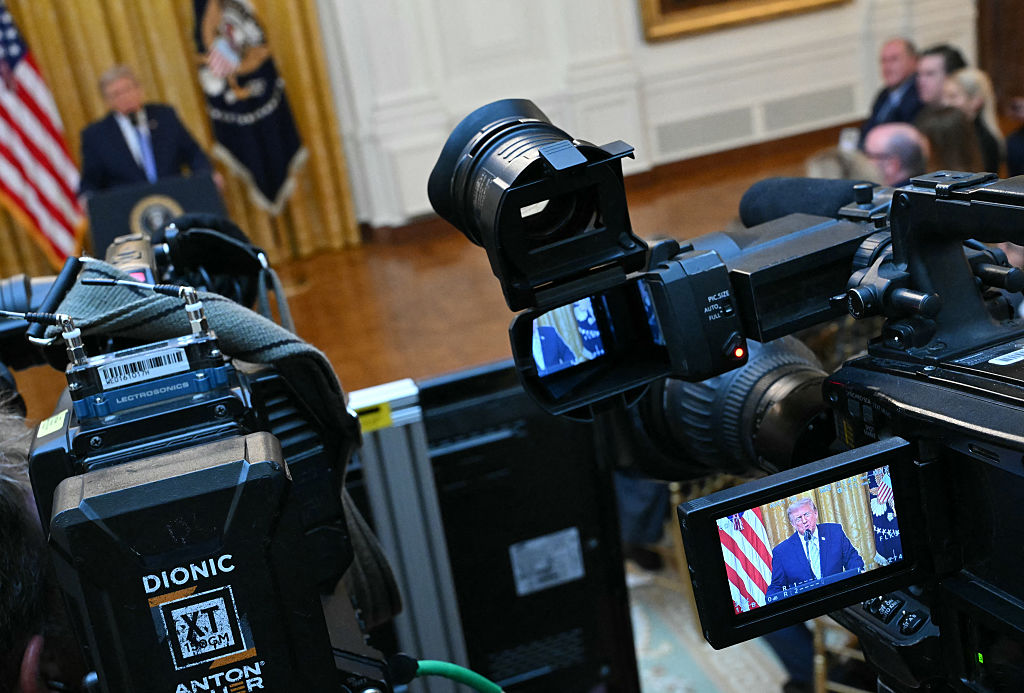
President Donald Trump’s presentation Thursday night from the White House had all the drama of a final scene in a classic whodunnit. New documents pulled from the forgotten archives. Reports of guns, faked voter registration documents, gift card payments for forgeries. Documents that Barack Obama had tossed into “burn bags” to hide from his successor. Fake ballots printed by China, ballot rigging by Venezuela, North Korea eyeing changes to votes.
For Trump’s base—of which 66% already believe the 2020 results were rigged—the night was a capstone confirmation of their suspicions that the system is so corrupt that nothing can be trusted. Trump, with documents he said he declassified with the help of his spy chiefs, had finally cracked the case and proven that foreign actors put their thumb on the scales in an election that Trump lost.
But almost immediately, the trove of new documents posted on the White House’s website—some with heavy redactions—told a much more complicated story. Trump’s presentation was a rhetorical win but a fact-checker’s minefield. And while Trump met his goal of leaving his supporters incensed, even that may end up backfiring bigly.
Election data is complicated…
Trump made some incredible claims that left viewers with the impression that hundreds of millions of Americans’ personal information had been hacked in 2020 by China in “the largest compromise of election data in history.”
But there’s a catch: in many cases, this information is already online. In fact, North Carolina’s State Board of Elections has online data that include individuals’ names, voter registration status, voter demographics, party affiliation, and address, as well as their county, precinct, and district information down to local school boards. In other states, the datasets are available from election boards or third-party vendors.
So while China may have found out who could vote and, in many cases, if they were likely to show up based on elections they participated in and those they skipped, that alone is not enough to prove malfeasance. And it was far from evidence that Beijing was doing anything unusual let alone nefarious.
… so is Washington’s relationship with Beijing
Even before Trump began his speech, the Chinese Embassy here in Washington had a denial for reporters: Beijing “has never and will never interfere in the presidential elections of the U.S.”
After Trump's speech, China's Foreign Ministry again strongly denied his claims of election meddling. "The U.S. allegations have no factual ground and are aimed at vilifying China. Similar accusations have long been proved to be unfounded," said spokesperson Lin Jian.
Complicating matters further is the late-September visit to Washington from Chinese leader Xi Jinping. Trump and Xi have a delicate relationship, one that may define the next century of geopolitical needs and turmoil. The White House, even before Trump’s speech, had started dialing back expectations for big breakthroughs for the summit in D.C. And the Trump posture toward China is as much about Xi as it is in regards to, frankly, the only other super power left on Planet Earth. An open feud between those two leaders—one that implicitly blames China, in part, on Trump’s defeat in 2020—is far from productive in the broader context.
Which may partly explain why some of the allegations in the new documents, such as an unexecuted plan to fabricate votes for Joe Biden and to pay journalists for glowing stories, might have been excluded from the intelligence assessments that made their way to the Oval Office. It’s why raw intelligence gets put through a filter before it’s passed onto the boss. One of the biggest lessons that haunts the Intelligence Community to this day dates to a reliance on raw reports leading up to the invasion of Iraq.
Then there’s this wrinkle: in Trump’s final days in office, then-Director of National Intelligence John Ratcliffe presented the findings of the nation’s spy organizations that, at least according to the unclassified version, there were no indications that any foreign actor—which would include China—attempted or succeeded in altering “any technical aspect” of the 2020 election vote. Ratcliffe is now running the CIA.
Trump is trying to salvage the SAVE Act, which may already be doomed
It took up just the last two minutes of Trump’s 27-minute speech, but the one action item that might actually be added to Washington’s agenda is a voting bill that doesn’t have the votes in the Senate. Trump’s obsession with the SAVE Act is rooted in his belief that voting is too easy for those who shouldn’t and that Democrats oppose the voter-ID requirements and mail-in restrictions only because phantom figures are propping up Trump’s political enemies.
Under the current rules of the Senate, that legislation would need 60 affirmative votes. Republicans, when they’re all well enough to cast ballots and are in Washington, currently have 53 seats, meaning seven Democrats would have to sign onto the legislation that they almost uniformly reject.
Trump has tried to cajole Republicans to pass high top-priority legislation by any means necessary, even if it means ending the 60-vote threshold baked into the filibuster or using some of the legislative trickery that allowed him to muscle through his One Big Beautiful spending bill. Until they do that, Trump is not interested in doing anything else, going so far as to allow perhaps the lone legislative win to get out of the Senate this year with bipartisan support—a bill addressing housing costs—to become law without his signature.
It’s left plenty of lawmakers frustrated that Trump seems to be actively working against an already tricky electoral environment for the GOP to defend its narrow majorities. And on a practical level, it won’t actually affect votes this year but rather leave lawmakers exposed to criticism that they’re making it hard for older voters, communities of color, and rural voters to cast ballots.
“I have been trying to explain for nearly a year that the SAVE Act, whether it’s the SAVE Act, the SAVE America Act, the new SAVE legislation that’s being proposed in the House, SAVE goes to Hollywood, SAVE goes to Hawaii, whatever the sequels are, all of them are fundamentally flawed and impossible to implement by this election,” Sen. Thom Tillis, a Republican who is retiring and has been given true freedom to speak his mind, said Thursday on the Senate floor. Like many Republicans, he supports the idea but sees little benefit of walking the plank to help nurse Trump’s paranoia.
“If I see a reconciliation bill come from the House with another failed attempt to confuse this election, I will use every device I have available to slow down the wheels of government until people cop a clue and do the math,” said Tillis.
Scary allegations are not the whole story
If voters listened to Trump’s speech without the benefits of fact-checkers or even Google, things sound really, really scary. China and Venezuela and Iran, oh my!
But while there are, no doubt, kernels of truth to what Trump is saying, it’s likely a lot more nuanced when an objective reading of the newly declassified documents is applied. After all, it’s one thing to have a low-confidence observation in a file and it’s another to be a verified operation.
It’s been understood for years that America’s adversaries and allies alike take a keen interest in how this country practices an imperfect democracy. It’s been well documented by now that Russia and Iran have looked at ways to influence outcomes, either through hack-and-publish campaigns of stolen emails or troll farms to spread conspiracy-minded trash. But there has, at least to this point, been no verified evidence that their meddling changed votes let alone outcomes.
A bipartisan Senate Intelligence Committee report released during Trump’s first term outlined the extent of Russia’s disinformation campaign in 2016. But it’s not clear just how many votes Moscow’s meddling moved into Trump’s column—something his defenders have long pointed to.
Still, that has not meant Trump has any less zeal for this 2020 rabbit hole. In recent weeks—and with a new acting Director of National Intelligence in place—Trump has hinted that he has finally found evidence of a rigged election.
And the newly declassified material released in part Thursday was enough to justify Trump’s innuendo that Venezuela too might have had a hand in 2020’s results—not because there was any proof that Venezuela’s since ousted leader Nicolás Maduro did anything in the U.S. but because he was able to do it in his own country.
That’s not to say U.S. elections are problem-free endeavors. There are places where the U.S. can harden its defenses against foreign interference—and, in recent years, millions of dollars have been spent to do exactly that. Back-up paper ballots and air-gapped—meaning not connected to the Internet—voting machines are now the norm.
Trump’s gut fears are actually justified. It’s now understood that Russia in 2016 poked the election systems in all 50 states to check what protections were in place and accessed—but did not change—some very local registration rosters in Florida and Illinois. Two Iranians were indicted on charges they broke into Alaska’s voter system in 2020, although they were not accused of making any changes. In the Intelligence Community’s assessment, China tried to shape the narrative around Trump’s third campaign for the White House but not the actual vote counts. (The report also noted Cuba, Venezuela, and Hezbollah also ran small-scale efforts to weaken Trump’s return to power but concluded it was negligible.)
In general, most experts agree that for a foreign vote-changing scheme to work, spooks would have to get physical access to the casting and counting systems used in thousands of different locations scattered around the country. That, to this point, has never been a real consideration.
This presentation may backfire on Republicans
Certainly, the main headline from Trump’s base will be a guttural toldjaso. At face value, Trump’s speech left voters with the impression that Trump had finally blown open the vault of evidence that the Deep State had buried findings that the 2020 election was not on the up-and-up, foreign influence was everywhere in plain sight, and no one should really trust those results—or maybe even those happening in just a few months.
But here’s the thing about Trump’s message Thursday night: it might be factually specious but it’s politically resonant. In an Economist/YouGov poll last month, half of Republicans think the 2020 presidential race was “rigged.” Among Republicans who identify with the Trump-led MAGA movement, that rises to two-thirds.
Presented with this new argument and buttressed by hand-picked evidence, that base is only going to further distrust the entire democratic process. Presented as chicanery, it’s tough to convince would-be voters that waiting in line to cast ballots is anything but a sucker’s game. Eroding confidence in the system may work for blaring claims that the Democrats (maybe) stole majorities in the House and Senate, but it’s bad for democracy and, perhaps more germane to Trump’s last two years in office, GOP turnout.
If Trump is going to avoid endless oversight hearings and maybe even a third impeachment, he needs some Republican cover. It’s mighty tough to do that if the Republicans only have a minority of either chamber. Trump may have felt good about his performance Thursday night, but he may end up regretting it the morning after Election Day if his base sits-out the balloting because Trump convinced them that voting is rigged and a waste of time.
Taking salsa classes can improve mental health, Oxford study suggests
Researchers find dance reduced depressive symptoms and social anxiety in young people in eight-week trial
Salsa is one of the most popular dance forms, with hundreds of millions of followers worldwide. A mix of Caribbean, Spanish and African musical styles and rhythms, it is believed to offer many cognitive and physical benefits, such as improving cardiovascular health, muscle tone and posture.
Now a randomised controlled trial suggests it could also reduce depression and anxiety. Researchers at the University of Oxford and the Oxford Health NHS trust studied 121 young adults with mild to moderate depression and anxiety who were randomly assigned to a salsa dance programme or a control group.
Continue reading...EU border chaos feared at Dover crossing as busiest summer weekend looms
British domestic holidays are being pushed to their highest levels since Covid
The start of the peak summer season is set to bring millions of drivers on to British roads, with concerns of traffic chaos as the port of Dover faces its biggest test yet of new EU border controls.
The semi-functioning entry-exit system (EES) is credited, along with the heatwaves and fears about flights after the war in Iran, with helping push British domestic holidays to its highest levels since Covid halted international travel.
Continue reading...Ann Widdecombe’s death should make Britain ask itself: what sort of political culture do we want? | Gaby Hinsliff
Dehumanising politicians is the first step towards justifying their elimination. It matters more than ever to keep putting the person back into the picture
Ann Widdecombe was never one to hide from an argument. And she wasn’t afraid for her safety either. She scoffed at friends’ suggestions that she should get electric gates, as an elderly woman with a public profile living alone on Dartmoor, just as she dismissed concerns about her health at 78.
Having lost friends in the Brighton hotel bombing that almost killed Margaret Thatcher, she wasn’t naive about security. But she was forged in a different era: one before Jo Cox was murdered, when the greatest risk was to politicians identified as symbols of the state, rather than as the embodiment of an idea. She posed happily for press photographs inside her retirement bungalow, including one available to anyone casually Googling that included the house’s distinctive name: Widdecombe’s Rest. She would have been so easy to find, had anyone gone looking. Perhaps she never really believed that anyone would.
Gaby Hinsliff is a Guardian columnist
Do you have an opinion on the issues raised in this article? If you would like to submit a response of up to 300 words by email to be considered for publication in our letters section, please click here.
Continue reading...Benjamina Ebuehi’s recipe for raspberry, cardamom and mascarpone tart | The sweet spot
This fruity summer dessert combines taste and texture with its layers of soft frangipane, crunchy sugar crust and a silky topping
If there’s one thing I’m very likely to have in my freezer, it’s a pack of ready-rolled puff pastry. And especially so during the warmer months, when I can use it for quick sweet or savoury tarts, be it a casual midweek bake or a fancier dinner party dessert. Layering texture is key, and here we’ve got crisp pastry; soft, slightly chewy at the edges frangipane; a crunchy demerara sugar crust; a silky mascarpone topping and squidgy raspberries.
Continue reading...Philippines demands ‘racist’ Chinese state media video depicting Filipinos as monkeys be taken down
Philippine defence secretary denounces video referencing South China Sea dispute as a ‘disgrace’ to regional leadership
The Philippines strongly condemned state-run China Daily for releasing an AI-generated video that depicted Filipinos as monkeys, saying the “racist” imagery is “offensive, distressing and unacceptable” and drawing a firm line against dehumanising propaganda.
Manila demanded that the video posted on China Daily’s Facebook account on 10 July be taken down. The Chinese embassy in Manila did not immediately respond to a request for comment.
Continue reading...Taking salsa classes can improve mental health, Oxford study suggests
Researchers find dance reduced depressive symptoms and social anxiety in young people in eight-week trial
Salsa is one of the most popular dance forms, with hundreds of millions of followers worldwide. A mix of Caribbean, Spanish and African musical styles and rhythms, it is believed to offer many cognitive and physical benefits, such as improving cardiovascular health, muscle tone and posture.
Now a randomised controlled trial suggests it could also reduce depression and anxiety. Researchers at the University of Oxford and the Oxford Health NHS trust studied 121 young adults with mild to moderate depression and anxiety who were randomly assigned to a salsa dance programme or a control group.
Continue reading...Weatherwatch: How English summer clouds can warn of trouble ahead
Mackerel skies and mare’s tails signal arrival of warm fronts that push moisture to high altitudes and creates distinctive clouds
“Mare’s tails and mackerel scales make lofty ships to carry low sails,” runs an old English saying about summer skies.
Mackerel skies are cirrocumulus or altocumulus clouds in regular but patchy rows, resembling the light and dark-scale pattern on a mackerel. The cirrocumulus version is white and wispy, altocumulus is grey and thicker. One easy rule is that cirrocumulus is narrower than a finger at arm’s length, altocumulus more like three fingers.
Continue reading...EU border chaos feared at Dover crossing as busiest summer weekend looms
British domestic holidays are being pushed to their highest levels since Covid
The start of the peak summer season is set to bring millions of drivers on to British roads, with concerns of traffic chaos as the port of Dover faces its biggest test yet of new EU border controls.
The semi-functioning entry-exit system (EES) is credited, along with the heatwaves and fears about flights after the war in Iran, with helping push British domestic holidays to its highest levels since Covid halted international travel.
Continue reading...The King of the North, Andy Burnham, Won’t Save Britain
Trump’s Obsession With Relitigating the 2020 Election Carries a Cost for Democracy
30% VistaPrint Coupon & Promo Codes | September 2026
iRobot Promo Code: 15% Off
Philippines condemns Chinese media depicting it as monkey in AI video
Burnham's 'Manchesterism' got him to No 10 - but will it work for the UK?
Cyclist Rohan Dennis pleads guilty to driving with suspended licence after crash that killed wife
Adelaide-based Olympian was banned from driving for five years over Melissa Hoskins’ 2023 death
Get our breaking news email, free app or daily news podcast
Former professional cyclist Rohan Dennis faces a jail sentence after admitting he drove while disqualified over the events leading up to the death of his Olympian wife, Melissa Hoskins.
A judge had previously warned the former Olympian he would be jailed if he drove while banned.
Continue reading...Takeaways From Trump’s Speech Claiming Election Vulnerabilities and China Interference
Jesy Nelson: Life Changing review – you just want to reach through the screen and hug the Little Mix star
What begins as another celebrity lifestyle documentary shifts completely when the former Little Mix star faces a devastating diagnosis for her newborn twin daughters. Every scene is affecting
The fact that cameras were there to witness the worst moment of Jesy Nelson’s life was seemingly a coincidence. Prime Video had been following the former Little Mix singer for a documentary on her life since leaving the band, as well as the birth of her premature twins. What no one could predict was that, seven months later, as producers continued to film the growing family, Nelson’s daughters, Ocean and Story, would be diagnosed with the life-threatening muscle wasting condition spinal muscular atrophy (SMA).
Jesy Nelson: Life Changing starts with a clip from the last time viewers saw Nelson as she relocated to Cornwall with the father of her twins, her fiance Zion Foster, last year. “When they start walking, they can walk on the sand,” a smiling Nelson tells Foster as they sit with their babies on the beach. Of course, anyone who has seen the headlines in recent months knows this is achingly foreboding; a lost future that must be grieved and reshaped.
Continue reading...Experience: I’m a world champion foosball player
The 2018 final against Germany went to penalties – we thrashed them and won gold
I was 12 years old when I first played foosball – table football – in the summer of 1975 in Beirut. My home city was under siege, split by civil war. School was cancelled and roads were closed. We couldn’t get to the beach and the only place to go was the amusement arcade. Luckily for me, it was across the road.
Alongside billiard tables and games machines were a couple of foosball tables. I watched older kids play for hours, mesmerised by a game where you could outsmart an opponent two feet away, then celebrate in their face. You needed 20 pence, or qurush in Lebanese money, to play: 10 pence for the table and 10 pence for the winner. Money was scarce, so I made a deal with the guy who owned the place – if I cleaned the tables, I could play for free. With machine guns rattling on the nearby green line, which divided the east and west of the city, I’d stuff a towel inside the goal and practise until I was confident enough to play. I got really good. By the following summer, I was winning 10 games in a row.
Continue reading...‘I used to do acid on a Wednesday. I don’t have time for that now’: alt-pop star Steve Lacy on his struggle to follow huge hit Bad Habit
A Grammy nom at 17, a US No 1 ... then silence. With new album Oh Yeah? finally out after four years away, the genre-hopping artist explains the trauma and heartbreak that informed it
Since Steve Lacy became a Grammy-winning artist with a No 1 hit in the US, little has changed for him. His single Bad Habit was one of the biggest songs of 2022, leading to a sold-out tour across North America, Europe and Australia. But off-stage? He bought a new home in Los Angeles, but he hasn’t made any new famous friends. He doesn’t get hounded in public, because he’s a natural homebody. Besides, he’s not really that famous, is he?
“I think my name is bigger than my face, which is great,” he says, smiling mischievously. Sitting in a private room in a London hotel, wearing a Serge Gainsbourg T-shirt and jeans so ripped that they might as well be shorts, Lacy says he thinks he has pulled off the greatest trick of modern pop stardom: being one of the most celebrated musicians of his generation while remaining almost unrecognisable.
Continue reading...As the UK and Europe battle deadly wildfires, what lessons can Australia offer?
Knowledge learned over more than a century in Australia is being tested by worsening fires. It’s a familiar narrative around the world
The violent hot red flames of deadly wildfires across the UK and Europe and scenes of panicked communities fleeing homes could not, at least geographically, be further away for Jan Harris.
But sitting in her new home at Reedy Swamp in rural New South Wales in Australia, the 67-year-old has found herself in tears.
Continue reading...Trump alleges China meddled in 2020 election and questions voting security ahead of midterms
Cyclist Rohan Dennis pleads guilty to driving with suspended licence after crash that killed wife
Adelaide-based Olympian was banned from driving for five years over Melissa Hoskins’ 2023 death
Get our breaking news email, free app or daily news podcast
Former professional cyclist Rohan Dennis faces a jail sentence after admitting he drove while disqualified over the events leading up to the death of his Olympian wife, Melissa Hoskins.
A judge had previously warned the former Olympian he would be jailed if he drove while banned.
Continue reading...How Andy Burnham Becomes Britain’s New Prime Minister
New Prime Minister Faces Old Problems: How to Make Britain’s Economy Grow
A Russian Political Battle Ends With a Visit From Masked Men
Special Report: Trump delivers speech on White House declassification of election documents
Special Report: Trump delivers speech on election infrastructure
US hits civilian infrastructure as it expands strikes against Iran
Tehran bombs US allies in Middle East after US attacks on bridges, energy facilities and key port
The US hit bridges, energy facilities and a key Iranian port on Friday, expanding its aerial campaign against Iran, and prompting swift Iranian strikes against US allies in the Middle East.
US airstrikes hit bridges in Iran’s southern Hormozgan province, killing at least seven people, Iranian state TV reported. The bridges were a key transit point for Bandar Abbas, Iran’s main port. Further US airstrikes brought down a tower in Chabahar port on the Gulf of Oman that the US military claimed the Islamic Revolutionary Guard Corps (IRGC) used to facilitate attacks on vessels in the strait of Hormuz. The US also targeted key electrical infrastructure and Iranshahr airport.
Continue reading...US hits civilian infrastructure as it expands strikes against Iran
Tehran bombs US allies in Middle East after US attacks on bridges, energy facilities and key port
The US hit bridges, energy facilities and a key Iranian port on Friday, expanding its aerial campaign against Iran, and prompting swift Iranian strikes against US allies in the Middle East.
US airstrikes hit bridges in Iran’s southern Hormozgan province, killing at least seven people, Iranian state TV reported. The bridges were a key transit point for Bandar Abbas, Iran’s main port. Further US airstrikes brought down a tower in Chabahar port on the Gulf of Oman that the US military claimed the Islamic Revolutionary Guard Corps (IRGC) used to facilitate attacks on vessels in the strait of Hormuz. The US also targeted key electrical infrastructure and Iranshahr airport.
Continue reading...Ученые обнаружили в ДР Конго новый вид обезьян
Беларусь экспортировала в Россию рекордный объем бензина в июне. Грозит ли это дефицитом и ростом цен внутри страны?
Federal panel signals it could support permanent fencing around White House park known for protests
Trump falsely alleges voting machines are "vulnerable" and "easily compromised"
Trump administration tightens visa rules for foreign students
How testosterone testing will work in Hegseth's 'manly' military
Philippines condemns Chinese media depicting it as monkey in AI video
More than 500 Rohingya vanished at sea - what happened?
'It's made me have an identity crisis': Londoners speak out about racist abuse
Canada fires prompt US air quality alerts as smoke blankets major cities
More than 500 Rohingya vanished at sea - what happened?
‘I’m sorry but I’m unable to speak’: hero of India’s Cockroach party weakens on 19th day of hunger strike
The climate activist and engineer Sonam Wangchuk, who has become the figurehead of anti-government protests in Delhi, is resisting calls to end his fast until the education minister resigns
As night falls on day 18 of his hunger strike, the lack of any sustenance except water shows. It is 7pm and Sonam Wangchuk looks weak. A physiotherapist sits beside him on the stage massaging his arms to soothe his aching joints. Propped up against pillows and bolsters, Wangchuk whispers: “I’m sorry, but I’m unable to speak.”
The activist and engineer has lost close to 9kg from a body that was spare and lean to begin with. Doctors say it is around this stage of a hunger strike that the body enters a state of severe starvation, breaking down fat and muscle, resulting in extreme weakness, impaired brain function and electrolyte imbalance.
Continue reading...