RSS Feeds
2 arrested on evidence-tampering charges after Texas teen's drowning
Man shot and killed by ICE agent in Maine was not the subject of a warrant, lawmakers say
Purdue University implementing new AI requirements for graduation
Luis de la Fuente se adueña de la frase que le dio esperanza a México, previo a Francia: "Y si sí"
Lindsey Graham's career and influence on American politics
'Easy to create divisions' - Kane says England are 'completely together'
Next PM urged to pave way for bigger council tax rises
Video-generation startup PixVerse raises $439M, valuation soars past $2B
The Papers: 'New twist in killer hunt' and 'One of a kind Ann'
X just tweaked its algorithm to make it more friendly, less battleground
Trump dramatically cuts size of two national monuments held sacred by tribes
Bears Ears and Grand Staircase-Escalante in Utah will lose ‘close to a million and a half acres each’ and open land to developers and oil industry
Donald Trump has approved a sharp reduction in the size of two national monuments in Utah held sacred by many Native Americans, in the latest move to open US public land to corporate developers and the oil and gas industry.
The two monuments, Bears Ears and Grand Staircase-Escalante, will see a reduction of “close to a million and a half acres each”, Trump said during an executive order signing event on Monday, undoing protections established by former presidents.
Continue reading...Marco Rubio launches campaign to dismantle international criminal court
Trump’s secretary of state claims the global tribunal is interfering with US military and law enforcement operations
Marco Rubio, the US secretary of state, launched a campaign to dismantle the international criminal court (ICC) on Monday, claiming the global tribunal was interfering with US military and law enforcement operations at the risk of American sovereignty.
Rubio invoked images of US border patrol agents and elected leaders being “dragged before an international court” and tried by judges from around the world in a lengthy op-ed published in the Wall Street Journal Monday.
Continue reading...Inglaterra llega a semifinales entre remontadas y carácter | Conexión Mundial
Messi guía a una Argentina curtida por la adversidad | Conexión Mundial
'One Day in September' chronicles how baseball's All-Star Game was born
Andy Serkis defends lack of diversity in Lord of the Rings cast
Video shows NBA's Brandon Clarke stopped by police 6 weeks before death
How an app helps millions make healthy food purchases
World-class UK medical research not delivering enough benefits for British people
Lettuce or salad greens could be source of diarrhea-causing illness, Michigan health officials say
How much should you give to the year-end teacher collection?
Hermes agent maker Nous Research in talks for new funding at $1.5B valuation
‘Lettuce or Salad Greens’ Identified as Potential Source of Cyclospora Outbreak
Major government target 'moving further out of reach'
Marco Rubio launches campaign to dismantle international criminal court
Trump’s secretary of state claims the global tribunal is interfering with US military and law enforcement operations
Marco Rubio, the US secretary of state, launched a campaign to dismantle the international criminal court (ICC) on Monday, claiming the global tribunal was interfering with US military and law enforcement operations at the risk of American sovereignty.
Rubio invoked images of US border patrol agents and elected leaders being “dragged before an international court” and tried by judges from around the world in a lengthy op-ed published in the Wall Street Journal Monday.
Continue reading...Police hope new photos will jog memories in investigation of murder of British backpacker Peter Falconio
Northern Territory force reopens evidence boxes in attempt to close investigation after 25 years
Northern Territory police have reopened evidence boxes to reveal several previously unseen photographs from the investigation into the murder of the British backpacker Peter Falconio and attempted abduction of his girlfriend, Joanne Lees.
Tuesday is the 25th anniversary of the outback disappearance, which still resonates as one of Australia’s most horrific and culturally defining crimes. It carries unanswered questions for Falconio’s family.
Continue reading...The Best Movies to Stream This Month (August 2026)
WATCH: The latest on Yellowstone bison launching man 8 feet in air
The Ridiculous Rise of Victor Marx
Judge Denounces Trump’s I.R.S. Suit as Improper Exercise in Self-Dealing
How my period is supercharging my ADHD
What we know about the cyclosporiasis outbreak linked to produce
Trump Sharply Cuts the Size of Two National Monuments in Utah
Francia llega encendida al gran duelo contra España | Conexión Mundial
España confirma su candidatura antes de medirse a Francia | Conexión Mundial
One of strictest US abortion bans could be overturned in November’s election
Idaho to have ballot measure for reproductive freedom law that would reverse ban on abortions at all pregnancy stages
One of the strictest abortion bans in the country will be on the ballot this November after Idaho’s secretary of state certified a ballot measure on Monday that would reverse the state’s abortion ban that prohibits the procedure at all stages of pregnancy.
The ballot initiative was headed by a volunteer-run group called Idahoans United for Women & Families, which ran a petition drive to get the measure in front of voters this fall. They gathered more than 100,000 signatures, surpassing the required 70,725 to get on the ballot.
Continue reading...Andy Burnham backs controversial asylum bill amid Labour dissent
Prime minister-in-waiting votes for plans to tighten appeals system as 14 Labour MPs oppose measures
Andy Burnham has backed the government’s controversial asylum changes, voting for legislation that has divided Labour MPs over plans to tighten the immigration system and reshape the appeals process.
The prime minister-in-waiting and Labour MP for Makerfield supported the immigration and asylum bill at its second reading in the House of Commons on Monday evening, despite a rebellion by 14 Labour MPs.
Continue reading...UK children will be one of unhealthiest generations in decades, doctors say
Analysis of 12 indicators including asthma, obesity and vaccination finds child health is ‘national embarrassment’
Children in the UK will grow up to be one of the unhealthiest generations in decades, with child health outcomes having declined or stalled completely across all areas, a group of leading paediatricians has said.
Reduced vaccination rates alongside rising hospital admissions for asthma and mental health disorders are all contributing factors to the UK’s record on children’s health, which should be seen as a “national embarrassment”, their analysis has found.
Continue reading...World Cup and sunshine prompt UK consumers to splash out on beer and online shopping
Despite spending increase in June, Barclays says most people still pessimistic about economy
Relentless sunshine and the World Cup coaxed consumers to spend more on beer and online shopping last month, with purse strings expected to remain loose as England fans gear up for Wednesday’s semi-final.
Most people remain pessimistic about the UK economy, according to data from Barclays Bank based on debit and credit card transactions.
Continue reading...The mysterious crypto firm backed by Farage's biggest donor
Tamara Keith and Amy Walter on Lindsey Graham's passing
Over half of adults with learning disabilities do not live past 65, report says
YouTube still recommending eating disorder videos to teens, research finds
No significant rain forecast for at least a week as UK heatwave continues
Lake Powell reaching critically low elevation levels, experts say
Critics got California's free diaper math wrong, but state won't release key Baby2Baby records
How You Could See a Comet This Week
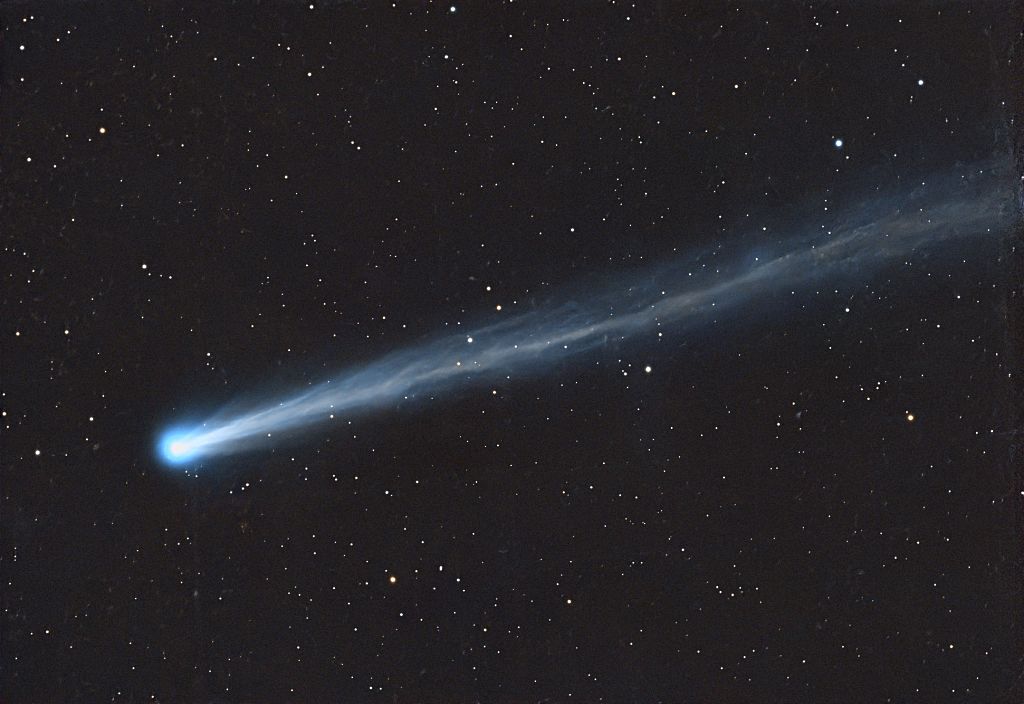
If you’ve ever wanted to see a comet, you could soon have a good opportunity.
This week, Comet 10P/Tempel 2 is set to return to the inner solar system, making it visible from Earth for the first time in years.
Here’s everything you need to know about how to spot it.
What is Comet 10P/Tempel 2?
A comet is a celestial body that orbits the Sun and is made up of frozen gases, rock, and dust, sometimes being likened to a “dirty snowball.”
“When frozen, they are the size of a small town,” according to NASA’s website. “When a comet’s orbit brings it close to the Sun, it heats up and spews dust and gases into a giant glowing head larger than most planets. The dust and gases form a tail that stretches away from the Sun for millions of miles.”
Comet 10P/Tempel 2, also known as “Tempel 2,” is a large comet with an estimated diameter of 10.6 kilometers, slightly smaller than the well-known Halley’s Comet. Tempel 2 completes its orbit around the Sun roughly every 5.5 years, meaning that we typically have the chance to see it at the same interval when that regular orbit brings it back into the part of the solar system where Earth is located.
When can you see it?
According to NASA, one of the best times to see Tempel 2 will be around the New Moon on July 14, when moonlight likely won’t interfere with the view as much as it might on other nights.
Astronomers predict that the comet will reach its peak brightness as it passes even closer to Earth in early August, though, so if you miss your shot at seeing it this week, don’t worry—there will be other nights to catch a glimpse of it before its orbit carries it away again, though it may be harder to spot if you live in the Northern Hemisphere.
Some experts have said that they expect that Tempel 2 will be “putting on its best showing since 1967,” so you’ll want to try getting a peak at this celestial phenomenon while you still can. Otherwise, you’ll have to wait another 5.5 years before you can get another shot at it!
How can you watch it?
Unlike some other passing celestial objects, Tempel 2 is not one that you can see with your naked eye alone; for this comet, you’ll need binoculars or a telescope, according to NASA.
Your best chance to see it is to get out of the city and find a location that has a dark, clear view of the night sky and is far away from light pollution. Wait until the sky is completely dark before looking for the comet; NASA recommends about 45-60 minutes after sunset.
“Through binoculars or a telescope, find the constellation Capricornus and look for a small fuzzy glow nearby, possibly with a brighter central knot and a short, broad, fan-shaped tail,” NASA advises on its website.