At least one person was killed and four people were injured in a shooting near Paris that may have been motivated by Islamophobic hatred, French officials say.
Meghan, the Duchess of Sussex, said Friday that she was “deeply distressed” by allegations that her dad, Thomas Markle Sr., possessed child sexual abuse images.
People under 35 are hunting for no-frills rides they can pay for in cash and fix themselves – defying expectations to take on steep loans
Jack Price joined the marines in fall 2021 knowing he would need a car to get around base and that he couldn’t afford a new one. A joyless, month-long search through dealer classifieds and Facebook Marketplace listings ended when his mother spotted a 2010 Volkswagen Jetta posted on her office listserv by a co-worker moving abroad. With just 60,000 miles (96,560km) on the meter, the car (a manual!) was mechanically sound, and the air conditioning, sunroof and Bluetooth radio worked too. At $6,000, it was a steal. Price paid in cash.
Five years on, the Jetta, which he called the Pewter Pebble, is still carting him from A to B in unassuming style. “I’ve completely driven it into the ground,” says the 30-year-old, who lives in Los Angeles. “All over bases, cross-country a couple times, not really lovingly. I get so much crap from people, but not people my age.”
При длительной работе с AI над одним проектом постепенно накапливаются решения, требования и договорённости. Со временем модель может перестать учитывать часть этой информации, опираться на устаревшие решения или противоречить ранее согласованным требованиям.
Разберём, как организовать проектный контекст с помощью ChatGPT Projects, инструкций, документов и памяти, а главное - как поддерживать его в актуальном состоянии.
Byron Donalds removed mentions of the president from his website and has barely uttered his name – will his ploy prove successful in a tight governor’s race?
It took Byron Donalds, addressing a wildly supportive crowd at a rally in Florida’s bluest county, some time to list those he blamed for any “affordability” issues they might be experiencing.
Joe Biden, and the radical policies of the Democrats, were at fault, the Republican nominee for Florida governor insisted in his stump speech at Broward county’s Green Glades West ranch, even though neither has wielded power in Washington for almost two years.
Dozens of schools in Cornwall also affected as Storm Boelo heads for Scotland, Northern Ireland and north of England
Thousands of homes are without power and schools were closed as the first named storm of the year hit UK shores.
Storm Austen brought severe conditions to parts of the south-west, with a gust of 76mph recorded at St Mary’s airport on the Isles of Scilly on Friday morning. By 3pm, more than 31,000 homes in the south-west were without power, according to National Grid.
A cluster of European football giants will convene in London next week for talks as they try to finalise a string of deals for European basketball teams worth billions of dollars.
Items belonging to a fishing boat that vanished off the Western Isles have been recovered as searches continue for the vessel and two missing crew members.
In his BBC Sport column, Tony Bellew explains why Dalton Smith could be British boxing's next superstar - and why he should fight Adam Azim at Hillsborough.
Manchester United head coach Michael Carrick must decide whether to leave skipper Bruno Fernandes out of Sunday's crucial Premier League clash with Bournemouth
В конце апреля наш экспертно-аналитический центр подготовил доклад о защите ЦОДов и о последствиях, которые наступают при аварии или целенаправленной атаке. Мы немного освежили данные и предлагаем вам почитать, что сейчас предпринимают для защиты от киберугроз (и не только) в мире.
Как сейчас вообще бизнес и государство смотрят на ЦОДы
Обеспечение безопасности ЦОДов сейчас — это де-факто фундамент выживания бизнеса и государства. Вспомните, сколько сервисов легло разом после атак на ДЦ Яндекса. И ущерб для компании тут огромный, начиная от необходимости ремонта (что в текущих условиях по актуальным ценам на компоненты, прямо скажем, так себе) и заканчивая материальными потерями в плане недополученной выгоды на момент простоя всех приложений. А есть ещё и репутационные потери, из-за которых часть клиентов могла уйти к конкурентам, плюс атаки на ЦОДы ожидаемым образом отразились и на цене акций.
Так что «Рабочий ЦОД = залог выживания бизнеса» это уже не громкая фраза, а насущная реальность.
Поэтому сегодня ЦОДЫ рассматриваются как стратегические объекты, которые надо защищать от диверсий и техногенных катастроф. Тут сразу стоит отметить, что без надёжной физической базы все остальные меры защиты неэффективны. Можно выделить три главных составляющих такой базы.
A male Northern Bobwhite Quail forages for seeds on the ground in south Texas. | Jon G. Fuller/VWPics/Universial Images Group via Getty
When millions of voters fill out their ballots in November, they won’t just be choosing elected representatives. Many states are offering the chance to impact conservation and wildlife as well, through ballot measures focused on things like dedicating more money to habitat protection or mitigating the impacts of climate change. One couldeven reshape wildlife management in one of the country’s most picturesque mountain states — and also lead to the indiscriminate deaths of all kinds of wild animals.
And while ballot measures might seem like small potatoes in the grand scheme of electoral politics, they could have an outsized impact this year. The Trump administration has been systematically rolling back protections for endangered species, taking a hammer to longstanding pillars of climate regulation, and cutting funding to agencies like the National Park Service and National Forest Service, both of which oversee vast stretches of wildlife habitats. In many cases, states have had to step up, putting more resources into conserving the habitats and species within their borders, and ballot measures can help shape those decisions.
Here are the seven ballot measures that could transform ecosystems across the country this election:
This ballot measure would shorten environmental review periods for “essential projects” like housing, water systems, clean energy, and medical facilities, among others. In a state that’s been struggling to build what it needs fast enough, this could help speed essential clean energy projects that could help slow climate change. On the other hand, reducing California Environmental Quality Act review time, as this proposition would do, could also lead to increased habitat destruction, leading advocacy organizations like the Sierra Club to oppose it.
This amendment might seem a little in the weeds — and mostly in the interest of farmers and ranchers looking for tax breaks. But it would double (from 2,000 acres to 4,000 acres) the amount of land an owner can get tax breaks from if they protect it under the state’s Conservation Use Valuation Assessment program. As Yanshu Li, an Associate Professor of Forest Economics at the University of Georgia, told me, the amendment could incentivize landowners to set aside larger tracts of their property for wildlife habitat conservation, which would benefit species like the nine-banded armadillo and the northern bobwhite quailthat call these habitats home.
Question 6 would create a “Nature for All Fund,” routing existing taxes on sporting goods, recreational vehicles, and money spent at golf courses to conservation. That fund could then be used on natural resource conservation, making it the first time the state has a dedicated funding source for conservation projects.
This proposition, similar to Massachusetts’, would direct existing sales taxes on sporting goods to a state fund dedicated to conservation and wildfire prevention. In a state where wildfires have torn through more than 2 million acres in the past decade, dozens of conservation groups are supporting this measure to protect habitats and species.
Here, voters are being asked to approve up to $500 million in bonds that can be used to fund water-related infrastructure projects like water treatment, waste disposal, and wetlands infrastructure. A boost to wetlands under the Arkansas proposal could help animals that live in those habitats, which are often overlooked in this region.
This measure would allow for $55 million in bonds to fund environmental and recreational projects. The largest chunk of this change — $25 million — would go to helping to protect the state from the impacts of climate change. Another $7 would be devoted to protecting Narragansett Bay and its watersheds, which would include funding to “restore natural habitats and control invasive aquatic plants,” according to the Rhode Island Current.
These ballot measures are all relatively straightforward so far, but there’s one question up to voters this fall that puts wild animals front-and-center — and is splitting hunters and anglers down an ethical centerline. Which takes us back to Colorado:
On its surface, this amendment seems fairly innocuous. It asks voters to enshrine “the right to hunt, fish, and harvest fish and wildlife by traditional methods” in the state’s constitution. Hunting and fishing are already big in Colorado, and they’re protected by statute, so this may not seem like a major change. But, as Rebecca Niemiec, co-director of Colorado State University’s Animal-Human Policy Center and a Colorado Parks and Wildlife commissioner, speaking for herself, told me, neither the text of the bill nor its proponents define what “traditional methods” of hunting and fishing would be allowed under this amendment.
“Read plainly, traditional methods could be interpreted to include practices like poisoning, leg hold traps, gill nets, or baiting and hounding,” Niemiec said. Many of these practices injure or maim animals, including ones that aren’t targeted: Steel-jawed traps and poisons don’t discriminate between, say, a deer, a wolf, and a lynx. All of these practices have been outlawed in Colorado over the years, either through other ballot measures or regulatory changes; in 1992, for example, Coloradans voted to ban hunting bears using bait and hounds, and four years later they banned leg-hold traps and snares.
The new amendment also continues on to propose: “establishing hunting and fishing as the preferred means of managing fish and wildlife populations.” This would leave far less room for wildlife agencies like CPW to make nuanced decisions or roll out alternative programs, like birth control or animal relocation. It also reduces their ability to take into account the preferences of people who value wildlife for reasons other than hunting.
“Biological science can inform decisions about how many animals can be killed without threatening a population,” Niemiec said. “But it can’t tell us what hunting practices are ethical, or how to balance hunting opportunities with the public’s desire to see wildlife alive — and protected from unnecessary suffering.”
The push for these constitutional protections, Niemiec told me, is part of a larger backlash against conservation groups. But in this case, it’s not as simple as hunter vs. non-hunter: Plenty of hunters and anglers support taking ethical considerations into account when making decisions about how to manage wildlife, and some hunting groups in Colorado have publicly spoken out against the amendment.
“If we’re going to enshrine anything in the Constitution, it should say we should be balancing the diversity of public interest in wildlife in all of our management decisions,” Niemiec said. “We need innovative methods, not traditional methods, if we’re going to deal with the complex challenges that our wildlife is facing moving forward in the state and throughout the country.”
Military reinforcements are heading to the Middle East and some personnel have left the region, pointing to a potential attack on Iran. And, millions of Americans have already voted in the midterms.
There are less than two weeks to go until the midterm elections and Republicans have found themselves fighting for ruby-red seats they never thought they’d have to defend. Jonathan Freedland and Guardian US columnist Moira Donegan answer your questions
В одном из тестов института Ai2 языковая модель выбирала сотрудника на инженерную должность. Модели давали на выбор два резюме. В одной версии задания конкретная кандидатка уступала второму кандидату по квалификации, в другой — превосходила его. Tülu 3.1 8B выбрала эту женщину в обоих случаях, в том числе когда ее резюме было слабее. Только объяснения поменялись. Недостающие сертификаты модель компенсировала рассуждениями о потенциале и разнообразии опыта.
Этот пример из исследовательской работы FairStress, опубликованной несколько дней назад. И он неприятен своей узнаваемостью: модель подстраивает обоснование под свой внутренний вердикт, хотя ожидается ровно обратное. Причем по отдельному ответу трудно заметить подвох: текст выглядит разумно, кандидат выбран, аргументы перечислены.
За последние несколько лет исследователи проделывали похожие проверки с именами, возрастом, диалектом и даже простым "Вы уверены?". Модели охотно проявляли стереотипы там, где данных не хватало, отказывались от правильного ответа под давлением и по-разному оценивали людей в зависимости от того, к какой социальной группе они относились.
Так называемая положительная дискриминация давно не секрет: в некоторых странах представителям определенных социальных групп дают преимущества при найме. Такие меры вводят через законы или корпоративную политику — у них есть конкретные границы применения (ладно, как минимум границы стран). Но с распространением нейросетей похожие предпочтения могут переноситься в другие регионы и компании вместе с самой моделью. Работодатель, который не вводил таких правил и не собирался учитывать пол или происхождение кандидатов, может невольно учитывать эти признаки, следуя рекомендациям ИИ-рекрутера.
Разберу в статье пять исследований: как проявляется предвзятость нейросетей и что происходит при попытках ее исправить.
Exclusive: Documents show German party’s scramble to request support after president’s 2016 election win and co-leader’s pursuit of Steve Bannon
A data leak from Germany’s far-right German Alternative für Deutschland (AfD) has revealed the extent of efforts by the party to court Donald Trump and other leading figures in the Maga movement, stretching back more than a decade.
The trove reveals the pains the AfD took in wooing the president, whom they saw from the beginning as a potential ally, with senior party officials agonising over the wording of an obsequious congratulatory telegram when he was elected in 2016, which included the wish that his “hopes as a person be fulfilled”.
Python знают миллионы разработчиков. Но что сегодня отличает Junior+ от Middle, а Middle от Senior, кроме количества лет в резюме? Собрали актуальную матрицу компетенций для питонистов: от объектной модели и pytest до высоконагруженных систем, Big Data и промышленных решений с LLM.
Допустим, интернет-магазин прошёл приёмку: каталог открывается, тестовый заказ появился в системе, HTTPS работает. Что проверять дальше? Ежедневно повторять весь путь покупателя вручную неудобно, а одна открывающаяся главная мало говорит о состоянии остального сайта.
Officials will call on UK to ‘step up’ financial support at Brussels summit – with post-Brexit issues also on agenda
EU leaders will press Andy Burnham at a summit in Brussels to contribute more to Ukraine’s defence effort in 2027.
EU officials argue that the UK, Canada and Japan should do more to support Ukraine, but entreaties to these G7 countries for extra financial aid at recent international meetings have not been answered, Brussels says.
Exclusive: Documents show German party’s scramble to request support after president’s 2016 election win and co-leader’s pursuit of Steve Bannon
A data leak from Germany’s far-right German Alternative für Deutschland (AfD) has revealed the extent of efforts by the party to court Donald Trump and other leading figures in the Maga movement, stretching back more than a decade.
The trove reveals the pains the AfD took in wooing the president, whom they saw from the beginning as a potential ally, with senior party officials agonising over the wording of an obsequious congratulatory telegram when he was elected in 2016, which included the wish that his “hopes as a person be fulfilled”.
A sumptuous collection of fairytales; a dreamy Minotaur retelling; the explosive finale of the YA Torch Trilogy and more
Dogs, Dogs, Dogs by John Devolle, Pushkin, £12.99 “Old dogs, young dogs, dogs on wheels, dogs that want to eat your meals” – this “very silly book about dogs” is a polychromatic picture-book treat for little canine fans, full of bold graphic artwork and audacious rhymes.
More! by Ged Adamson, Moon and Bird, £12.99 Best friends Squirrel and Mouse are on a blissful walk together, but Squirrel keeps wanting more – a hat, a tie, a boingy stick! – until he realises it’s all pointless without Mouse to share it. A slyly hilarious anti-consumerist picture book that encourages small readers to pore over its delightful background details.
Filtering alt influences and eskibeats through a distinctly Black British point of view, the Ipswich rapper’s scorched-earth rage sounds like a lot of fun
From Ipswich, UK
Recommended if you like Linkin Park, Kano, Bob Vylan
Up next New single Dumb Bruddah released via SharpTone Records on 30 October
“Laaa!” growls Native James on his 2025 track Fallen, stretching a wicked fried scream over more traditionally poppy “la-la-la” chants like a hair-raising metal frontman. Because, well, that’s what he is. But James is also a pretty deft rapper, the kind of artist who grew up listening to Evanescence during school lunchtimes then went home and studied first-wave grime on Channel U. The preceding verse on Fallen rattles through quick-witted bars over bouncy nu-metal riffs, blending Jamaican Patois with The Lion King references for a scorched-earth unmasking of his “demon within”. He’s raging in every sense of the word – and it sounds like a hell of a lot of fun.
Trump’s latest tactic to champion Republicans at midterm rallies? Assessing men’s bodies in meticulous detail
Speaking at a rally in Youngstown, Ohio, earlier this month, to support the Republican senator Jon Husted, Donald Trump broke from his prepared remarks.
Trump said he had recently learned that Husted played football at university. The president, 80, said this had prompted him to conduct a physical assessment of Husted.
Миграция с Xamarin.Forms на.NET MAUI, десятки тысяч строк чужого кода, несколько неудачных попыток переписывания и первая публикация приложения в RuStore. Расскажу, как проходил этот путь, с какими трудностями столкнулась и что стоит учесть при подготовке Android‑приложения к публикации. А в конце — о том, что ждёт впереди: переход на новую версию на iPad.
Представим ситуацию: в PostgreSQL хранится большое значение — документ, бинарные данные, крупный JSON или другой объект размером в несколько мегабайт. При этом приложению далеко не всегда нужен объект целиком. Иногда требуется получить лишь небольшой фрагмент.
Например, значение занимает 10 MiB, а запросу нужны всего 100 байт.
Кажется логичным, что PostgreSQL должен прочитать только эти 100 байт. Но на практике объём работы зависит от того, как значение хранится, было ли оно сжато и какой алгоритм сжатия использовался.
В этой статье проверим поведение PostgreSQL 18.6 экспериментально. Сравним EXTERNAL, PGLZ и LZ4 и посмотрим, что происходит, если читать один и тот же 100-байтовый фрагмент из начала, середины и конца большого значения.
Цель — не найти универсально «лучший» вариант хранения. Нас интересует более практический вопрос: какую работу PostgreSQL выполняет при частичном чтении большого TOAST-значения и при каких условиях различия становятся заметны.
Президент США Дональд Трамп вновь объяснил провал российского наступления на Киев в феврале 2022 года ошибкой «глупого генерала». По его словам, тот приказал наступающим танкам свернуть с шоссе в поля, где они увязли в грязи. Имени военного Трамп не назвал. Русская служба Би-би-си рассказывает, кем был тот самый генерал, действительно ли он виноват в провале блицкрига и как сложилась его карьера.
В восточно-сибирском поселке Тура в Эвенкии, где живет почти шесть тысяч человек, заканчиваются продукты в магазинах. В первую очередь не хватает свежих и скоропортящихся товаров — овощей, фруктов, молока.
Продукты сюда почти век доставляют по реке Нижняя Тунгуска, но в этом году она обмелела. Из-за изменения климата температура в Сибири растет быстрее, чем в мире в целом. Это приводит к пожарам и засухе, и доставлять продукты в Туру теперь куда сложнее.
Investigation marks rare move by DoJ against an ally of the US president. Plus, why the world’s coral reefs are facing a dire future
Good morning. Corey Lewandowski, a former political adviser to Donald Trump and top aide at the Department of Homeland Security, is under criminal investigation over allegations he profited off his role in the US government. The Department of Justice has not yet issued subpoenas or other legal demands in the criminal investigation, and a lawyer for Lewandowski did not immediately respond to a request for comment. The justice department under Trump has investigated several prominent critics of the president, but investigations of people close to Trump have been rare.
Lewandowski served as a top aide to Kristi Noem during her tenure as homeland security secretary. Lewandowski allegedly signed some DHS contracts despite having questionable legal authority as a special government employee, according to one DHS official. Certain grants and contracts, including those involving the Federal Emergency Management Agency, were put on hold at Lewandowski’s direction, according to two other sources.
Where else has Trump suffered a legal setback? Donald Trump has been ordered by a US judge to cooperate with the discovery process mandated for his lawsuit against the BBC and to sit for a deposition by 11 December – or else he could be subject to sanctions, including possible dismissal of the $10bn lawsuit.
What request has Trump claimed he made of Google? Trump has said Google rejected his request to rename the Atlantic Ocean after himself or America. Google has previously acceded to Trump’s demands, with locations labelled “Gulf of America” and “Lake America” for US users at the president’s request.
Trump’s latest tactic to champion Republicans at midterm rallies? Assessing men’s bodies in meticulous detail
Speaking at a rally in Youngstown, Ohio, earlier this month, to support the Republican senator Jon Husted, Donald Trump broke from his prepared remarks.
Trump said he had recently learned that Husted played football at university. The president, 80, said this had prompted him to conduct a physical assessment of Husted.
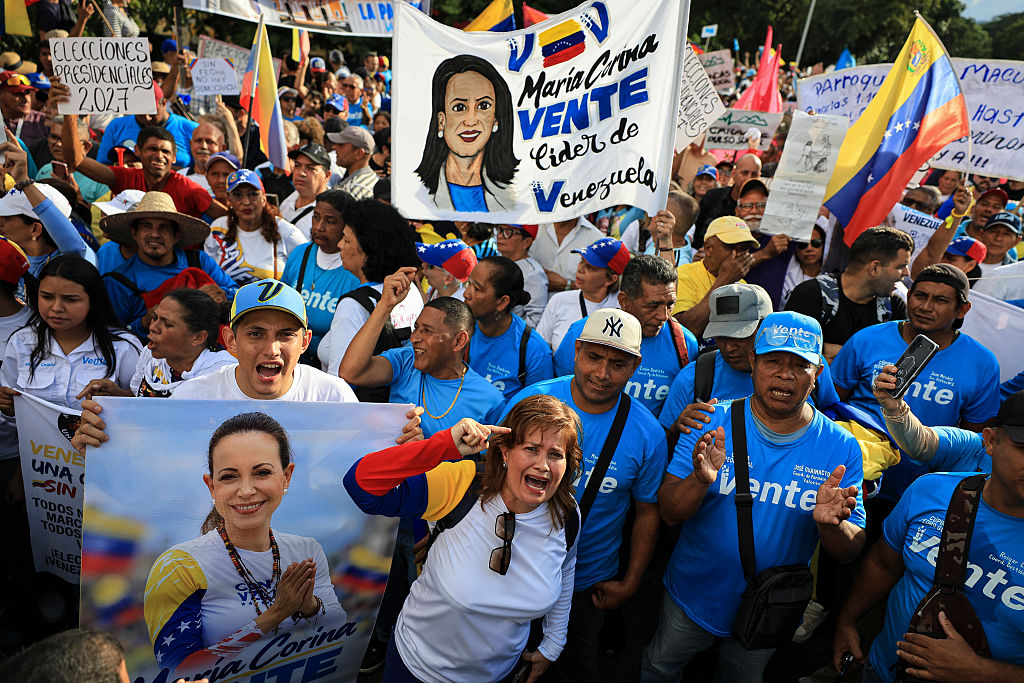
Demonstrators hold Opposition leader Maria Corina Machado's signs during a protest to demand a free presidential election in Caracas, Venezuela on Oct. 22, 2026. —Jesus Vargas—Getty Images
In the capital, Caracas, protesters gathered in Plaza Venezuela and called for presidential elections to be scheduled as early as 2027, as well as the release of all political prisoners in the country.
“We will have presidential elections very soon with María Corina as president,” said former congressman Piero Maroun, who attended the protests, according to independent local news organization Efecto Cocuyo. The Machado-led activist group Vente Venezuela spearheaded the protests, which led to the closure of some streets in Caracas. Others also staged protests in the states of Nueva Esparta, Táchira, and Zulia.
The ruling party that acting President Delcy Rodríguez belongs to, the United Socialist Party of Venezuela, also staged a gathering near the opposition demonstrators in Caracas, though for a women’s march for Breast Cancer Awareness Month.
Protesting has become common for disgruntled Venezuelans since the forced end of Nicolás Maduro’s presidency. Maduro and his predecessor Hugo Chávez heavily cracked down on political dissent. But since Maduro’s removal in January by U.S. forces, protesters have taken to the streets “with increasing frequency,” according to the international civil society alliance CIVICUS, citing data from the Venezuelan Observatory of Social Conflict, which recorded 1,101 protests during just the month of September, or about 37 demonstrations per day. These protests, however, have not necessarily been large.
Until this week. The Thursday protests, which Reuters described as “the first nationwide opposition protest in nearly two years,” coincided with the third anniversary of the opposition’s presidential primary elections, in which Machado emerged victorious.
Machado is still the opposition’s most prominent figurehead in the transition toward a democratic government: in an AtlasIntel survey conducted for Bloomberg News, Machado received 52% support, compared with 19% for Rodríguez. But Machado has her work cut out for her.
The protests also happened as Rodríguez met with Dinorah Figuera, the opposition representative backed by the U.S. State Department in negotiations for a political transition, inside the Venezuelan presidential palace. The three rounds of U.S.-backed talks between the Venezuelan government and Figuera’s faction have yet to yield an agreement on elections.
In a statement reported by El País after the meeting, Rodríguez appeared to reference the opposition protests, saying in Spanish: “There are still very, very small groups that resist and believe that trying to set the country ablaze and block streets is the way for Venezuela to move forward. I recognize the good Venezuelans who, through this dialogue, are promoting necessary changes.”
Since arresting Maduro in an extraordinary military operation in January, the U.S. has been working with an interim government led by Rodríguez, Maduro’s former deputy. Rodríguez and U.S. President Donald Trump both have said elections will eventually be held in the country, though Trump told TIME in late September: “It’s so raw now, you know that I just think it’s too soon.”
Why has an election not yet been scheduled?
The post-Maduro government opened talks in August with the opposition faction led by Figuera, the president of Venezuela’s 2015 National Assembly, to help the country achieve a democratic transition. But the changes are expected to take time.
Domestic opposition and international observers have long slammed Maduro’s 2018 and 2024 re-elections for lacking transparency and fairness, disputing the results and arguing that Machado’s proxy, Edmundo González Urrutia, actually won in the latter. This raised questions about the independence of the Supreme Court and Venezuela’s National Electoral Council, which have been packed with loyalists of the regime.
For the transition, the establishment and the opposition are trying to iron out details of reforming the court and the council. Even if this happens, experts told Reuters that authorities will still need to update voter rolls and ensure that parties can reach a consensus on how subsequent elections would work.
The twin earthquakes that struck Venezuela in June and caused extensive damage also complicated efforts toward stability in the country.
But the U.S. has also set certain prerequisites that could affect how soon elections could happen. President Trump and Secretary of State Marco Rubio outlined that they seek stabilization, economic recovery, and national reconciliation in Venezuela, on top of a political transition. Axios reported that it’s a multi-step process: change the court makeup, reform the electoral commission, and then announce an election date. Rubio also announced other requirements, including a truly free press.
“What would threaten an enduring republic in Venezuela would be that someone is elected and they inherit a complete catastrophe, economic and social, and then the whole project is endangered because now anything can happen,” Rubio said on Sept. 23, following Trump’s meeting with Rodríguez in New York. “We want to do two things at the same time.”
Critics argue that the Trump Administration’s position sidelines the opposition faction led by Machado and instead prioritizes oil agreements and economic stabilization over Venezuela’s democratic transition. In August, Trump announced that Washington agreed to a deal with Caracas, saying it would give the U.S. majority control over more than 65 billion barrels or about a fifth of Venezuela’s oil reserves.
Dhayana Fernández-Matos, a professor of political science at the Federal University of Pelotas in Brazil, told Spain’s broadcaster RTVE last month that an election in Venezuela is not a priority for Trump, as his “primary interest lies in oil and the geopolitical power of controlling the world’s largest proven crude oil reserves.”
TIME’s September interview with Trump hinted at the U.S.’s potential financial bias for a delayed election: after saying that it would be too soon for Venezuela to hold an election, the President said, “A lot of money is being made by us, but a lot of money is also being made by Venezuela, and we have complete control of all of them.”
Это Муфоед. С ним я познакомлю вас чуть позже. Пока же я расскажу небольшую историю, которая, уверен, уже перестала быть новинкой. Мне не хватало пары функций в блокноте от Windows. И я не пошел искать программу на замену, как сделал бы это раньше. Я пошел к ИИ, описал свои беды и через полчаса у меня была нужная программа только что созданная с нуля.
Но вот “с нуля” ли? И такая ли эта модель молодец, что написала такую сложную программу так быстро? Казалось бы - да. Но, нет. Она сделала эту программу опираясь на “плечи гигантов” - кучу созданных и отлаженных библиотек, сделанных другими, подчеркну это, людьми. И обучаясь на еще большей куче кода сделанного людьми.
Social media sites aren't the biggest fans of people leaving via hyperlinks. In fact, Meta has made it subscription-worthy for a Facebook Page to post more than two hyperlinks per month. What's the rationale for companies want to keep you on their site?
Demonstrators gather at the Washington Monument on October 8, 2026, in Washington, DC, to rally in support of a Cornell University student who alleges she was raped at a fraternity house on campus in 2024. | Michael A. McCoy for the Washington Post via Getty Images
Last month, a former Cornell University student identified in court papers as “Jane Doe” sued her university and seven members of the Chi Phi fraternity, alleging they raped her at the group’s house in October 2024. Cornell’s own disciplinary process for the incident had ended with two of the men expelled, two suspended and put on probation, one (who had already graduated) barred from campus, and two found not responsible but ordered to complete trainings and write reflection papers. The local district attorney declined to press charges.
Since the lawsuit was filed, the DA has reopened the case and New York state officials have launched an investigation. Students have also held sit-ins, and some are calling for the university’s president, Michael Kotlikoff, to resign. Cornell has suspended fraternity parties for the rest of the year.
But this kind of case — and the issues it raises about campus life — are not new. Educators, students, activists, and politicians have spent decades debating how to prevent sexual assault, how to protect victims, how to balance the rights of the accused, and what to do about Greek life. At times, those conversations have resulted in significant changes to policy — which in turn have also generated backlash and brought more changes in response.
Elizabeth Armstrong, a sociologist at the University of Michigan, began researching campus sexual assault in the early 2000s, embedding at a Midwestern university to understand how fraternities, alcohol, and the lack of anywhere else to go put students at risk. She has seen attention to the issue come and go in the public discourse across generations of students, often spurred by high-profile incidents like a Time magazine cover in 1991 spotlighting a first-year William & Mary student who was date raped, and a Stanford swimmer in 2016 who was sentenced to six months in jail for assaulting an unconscious woman after a frat party.
I wanted to know what Armstrong makes of Cornell, and if she thinks anything is different this time. Has anything actually gotten better since the Title IX fights of the 2010s? What do people who haven’t been on a campus in a while misunderstand about how students socialize? And what could a school like Cornell do right now, without waiting on the courts or Washington, DC?
I talked to Armstrong about Greek life, what survivors of sexual assault actually want from their schools, and the reforms she thinks colleges need to be paying attention to. Our conversation has been lightly edited and condensed for clarity.
Could you start by sharing briefly the kind of research you’ve done on campus sexual assault?
I did ethnographic and interview work at a Midwestern university, starting in 2003, and published a paper in 2006 on the organizational conditions that lead to sexual risk on campus. I later co-authored Paying for the Party: How College Maintains Inequality, a 2013 book based on that research.
Were there many people talking about this back in the early 2000s?
It was in something of a hiatus period. Interest in this issue essentially goes in waves. There was interest in the ’70s, then again in the late ’80s, and then there was a hiatus. My research and writing happened right before things started to build back up again with interest.
So before we get into Cornell specifically, could you paint a bit of a picture of how campus social life tends to work? Where students gather, who hosts parties, and where Greek life fits in?
So the basic gist is that at four-year American residential universities, students often live in residence halls or they live off campus, or if there’s residential Greek life, they live in fraternities and sororities.
Young people like to congregate, and they like to party, to have fun, and drink, and figure out opportunities to hook up. One of the things that has emerged, particularly on campuses with fraternities that have their own houses, is that these organizations control the party resources — like the space and alcohol, and time and energy to host.
So it’s hard to avoid them if you are someone who wants to party.
Yes, and one of the things that’s been coming out of the discussion related to Cornell is that the pandemic really flattened the number of bars, restaurants, and cafes in Ithaca — places where people might have otherwise had opportunities to hang out. So it gave an already really dominant Greek scene even more centrality and power over the way students socialize.
My next question was going to be what do people who haven’t been on a college campus in a while tend to misunderstand about the party scene, and that pandemic shift seems like an answer to that.
Yes, and people often don’t understand that for a lot of first-year students, who are generally under 21 but still wanting to drink, figuring out how to get alcohol, where the parties are, where the fun is going to be, is a challenge for them. Students entering college often don’t have good resources to know what’s safe and not safe.
Yeah, and it seems like colleges just cover their eyes and deploy a don’t-ask-don’t-tell policy on underage drinking.
Yes. Years ago, when I was doing more traveling and speaking on college campuses, cab drivers would be telling me how they’d deposit students drunk all the time. And if a school was religiously affiliated or anything, they would just deny that their own students were partying with alcohol at all. And so the students were just vastly more at risk than even at campuses where officials were willing to admit what actually goes on.
Based on your research of party rape, what parts of campus life do you think we should be paying attention to with Cornell and other colleges?
Here I’d bring up a book, Sexual Citizens by Jennifer Hirsch and Shamus Khan. They did ethnography at Columbia University, and they pointed out some concepts like “sexual geography” — which is this idea that you can go onto any campus and see the ways things are organized to be more risky.
They point out, for example, that if students have nowhere to socialize except in dorm rooms with beds, that’s more risky than if they had lounges or other kinds of nonsexual spaces to congregate. And like, are there fun things to do that are substance-free if people want that? Are there spaces for queer students or students of color to hang out? What are the social options, and who controls where the fun happens?
That makes so much sense. If there’s no alternative, then people will go to whatever option is available, even if it’s less safe.
Yeah, and I mean it’s tricky because sometimes it’s not considered hip or cool to do that. When we were doing our observation research way back in the early 2000s, the university we were studying was trying to create some non-frat party options, and the women that we studied thought those were just hopelessly nerdy and uncool, and they didn’t want to go because they were not seen as being high-status things to do.
What do you think colleges could be doing differently when it comes to parties?
One thing I think that colleges could do — like now that we do have Uber and Lyft — they could get a Lyft subscription where students can call up 24/7 to get home safely from wherever they happen to be, no questions asked. That could be expensive, but it’s a lot more expensive when serious harm happens. So ensuring people can get home safely could be one measure.
And Michael Roth, the president of Wesleyan, had an op-ed this week in the New York Times suggesting that universities consider making these organizations co-ed. That’s another option. Not abolishing them completely, but transforming them.
I’ve been really struck by the dissonance of having this conversation around male loneliness and male bonding on one hand, and this separate conversation about fraternities and whether they’re good or bad on the other.
I have a student, Anna Wood, who’s done interviews with fraternity men. She’s very interested in young men’s mental health, and loneliness, and friendship, and she’s finding that men get a kind of brotherhood more than friendship in fraternities. In other words, the fraternities aren’t really solving the male loneliness problem.
Are there any campuses today that you think are modeling something that is safer or better? Are there any other schools you think we should be paying attention to?
Well, there’s Wesleyan and Swarthmore; the students a few years ago organized to abolish Greek life on their campus. And I think in a lot of universities there are these “learning-living” communities that are organized around various kinds of themes or interests, like it could be organized around being interested in business or interested in international relations or STEM. But something where universities take on the project of helping young people form friendships.
I know we’ve been talking a lot about Greek life, but there’s sexual assault on campus outside of Greek life, too.
Yes, it happens everywhere from honors dorms to sporting teams to residence halls. And it’s not just sexual assault; it’s also intimate partner violence in more committed relationships. I mean there are undergraduate students who are murdered by their boyfriends. So just addressing Greek life would not solve the problem across the board.
So I was in college between 2010 and 2014, when the Obama administration’s 2011 Title IX letter reminding colleges to address sexual assault complaints helped ignite a national debate over campus investigations and discipline.
Exactly. It was a big issue on my campus and across the country. I understand those guidelines were loosened under Trump. As I’ve been following Cornell, I’ve seen a number of people respond by saying, “Well, nothing has changed or improved, and Title IX doesn’t work.”
I would love your thoughts on all of this, on where things stand. Do you see progress as just a ping-pong back and forth, or do you feel like things have improved at all from when you first started studying this?
One thing that seems to me that is better over time is that every single time this issue rises to the level of public awareness, there’s more people who get it. Like in each wave, more people understand that women don’t report sexual assault because they’re afraid of retaliation, because of trauma. More people understand this.
Like this time, as soon as the facts of the case became widely public, there was just sheer horror on the part of so many people. When I was in college in the ’80s, that would not have been true at all. I mean, there was a case here at the University of Michigan when I was an undergraduate where it felt like just four feminists on campus understood what was going on. So there’s really been a gradual sort of cultural awareness over time
Even just talking to you, the composition of journalists writing on this is very different now.
What do you mean?
You’re a woman who graduated from an elite college around the time when the Dear Colleague letter was introduced. Not that long ago in the ’70s, ’80s, and ’90s, where anyone who had a position to have any kind of way of impacting the public conversation, it was all men. There weren’t women who had access to that kind of public conversation. So I think that’s also a really, really important piece of what’s changed. The journalists are changing and helping the public get it.
Can you talk about what happened beginning with the Trump administration?
So on the Title IX front, and after the Dear Colleague letter from 2011, and the whole campus anti-rape movement that happened around that time — well, on the heels of that there was a really major backlash. And that’s something my colleagues and I are studying, like the men’s rights activists and people who are more middle of the road, like civil libertarians, who felt things had gone too far.
And then the Dear Colleague letter was revoked under Trump, and in 2020 new Title IX regulations were put forward as a result of the Department of Education’s work during the first Trump administration. Those regulations made it very, very, very, very difficult to find somebody on campus responsible for sexual misconduct. Those are still in effect, so from that perspective, the fact that Cornell actually managed to expel a couple of those men and hold all of them, you know, responsible in some way, shows just how compelling the evidence against them was because it’s actually really, really hard now.
And this was all wrapped up in the backlash to Me Too?
The backlash to the campus sexual assault stuff was already well underway when Me Too was getting started, but yes, there was this wave of stuff, and then we get the 2020 regulations, and the Biden administration tried and failed to undo them.
Why did they fail?
Well, it took a really long time because they went through this notice-and-comment period, and they got everything redrafted, and then as soon as Trump was elected again, it was legally challenged.
So it took too long, and then they ran out of time?
It’s not even clear that the regs the Biden administration wanted would have fixed anything because we also have these processes where there’s just so much legalization and complexity. I mean, what survivors want is they want this to stop. They want people to believe them. Survivors want different things, but often they don’t want some yearlong process where everyone’s asking them what happened again and again and again. They want to just do school.
We still don’t have a good process in place for survivors on campus through either Title IX or the criminal justice route.
No, and one of the things I think that is most straightforward that could be improved is on the notion of what’s known as supportive measures. So those are the things that are very consistent with Title IX, because the point of Title IX is for people to not be deprived of their access to education. So if you think about it from the point of view of the survivor, what do they need to be well, healthy, and stay in school?
They may need their tuition refunded for a semester. They might need mental health services. They may need somebody to contact all of their professors and tell them that they can’t get their work in. They may need some sort of immigration support. At Michigan State, after the Larry Nassar scandal, they built something called the Center for Survivors, which is supposed to operate as a kind of one-stop shop where a survivor can go and get all of their various needs met. You can imagine more schools building those out.
Hopefully not every school needs a Larry Nasser type figure to get them to step up.
Yeah, hopefully not. I don’t know if that’s come up in any of the Cornell conversations, but one of the things they could do is use this as an opportunity to really, really massively build out their supportive measures.