RSS Feeds
Aptoide becomes the first rival app store to return to Google Play in the US
4 savings account mistakes to avoid right now
Social media platforms still facing thousands of user addiction lawsuits after failed appeals
War in the Gulf has weakened two of America’s Arab allies
YouTube now requires creators to have twice as many watch hours to start earning money
Teen arrested over assault in Thetford anti-migrant disorder
Trump signs order on vaccination recommendations
Nigel Farage says incident at his home 'directly linked' to Ann Widdecombe murder
Russian court bars only anti-war party from standing in parliamentary elections
The Subway Is Sweltering. Is There a Way to Put That Heat to Good Use?
Child who died after incident near Edinburgh named
Former Thai MP allegedly kills official and confesses on YouTube
Russian court bars only anti-war party from standing in parliamentary elections
Ukraine's drone chief says push to cripple Russia in Crimea is just getting started
RFK Jr. wants to fix loophole that allows additives into food. Critics say it doesn’t go far enough.
Forest owner Marinakis sues Palace over gun banner
A Nighttime New York Boat Tour Turned Deadly in a Matter of Moments
Will Wisconsin Voters Think Francesca Hong Is Too Radical? Here’s Where She Stands.
Ukrainian drone attack on oil hub deep inside Russia kills 13, official says
Operator of boat in deadly crash faces federal charges
Labour peer urges Tories to sack former neo-Nazi who abused her
Badenoch adviser Joshua Bonehill-Paine was found guilty in 2016 of racially aggravated harassment of then MP Luciana Berger
The Labour peer Luciana Berger has urged Kemi Badenoch to “listen to victims” and reverse her decision to give a national advisory role to a former neo-Nazi.
Joshua Bonehill-Paine was jailed in 2015 for more than three years after posting antisemitic material online before a planned neo-Nazi rally. In 2016, he was found guilty of racially aggravated harassment for abuse directed at Berger, an MP at the time. He was also the founder and leader of the National British Resistance, a far-right group.
Continue reading...One Year Later, Trump’s ‘Takeover’ Has Changed D.C. Is It Better Off?
NOAA says contiguous U.S. set record in July for hottest month ever
University student stabbed man in heart over debt, murder trial hears
Liverpool sign Araujo on loan from Barcelona
Bernie Sanders calls on Silicon Valley to ‘pause AI development’ in interest of humanity
Progressive US senator urges Meta, OpenAI and Anthropic to ‘stop building machines that humans cannot control’
Senator Bernie Sanders has called on Meta, OpenAI and Anthropic executives to halt their development of artificial intelligence, warning that the US Senate will implement regulation if the companies continue deploying AI at their current pace.
In a new letter addressed to the CEOs of three of the country’s leading AI companies, Sanders said the capabilities of these AI models have reached a critical risk threshold and that the companies are losing control over the technology.
Continue reading...The Guardian view on Meta’s smart glasses: regulators must get on the front foot | Editorial
Privacy needs defending against invasive wearable gadgets. So far, businesses are ahead of the government
It is not yet clear to what extent Meta’s new smart glasses will live up to the nickname of “pervert glasses” – bestowed in recognition of the obvious appeal of wearable cameras to voyeurs. The past week has seen rising criticism of the devices, which in the UK have been banned by the pub chain Wetherspoons and the theatre group ATG, as well as restaurants, schools and members’ clubs. These organisations deserve praise for standing up for privacy. By contrast, regulators appear once again to be on the back foot.
There have, inevitably, already been reports of women being mistreated. Earlier this year the BBC spoke to several who had been filmed without their consent, with footage subsequently uploaded to social media. In one case, the content creator demanded a fee to remove it. In the year to March 2025, image-based sexual abuse and cyberflashing were responsible for more than half of an 11% increase in reported sexual offences in England and Wales. Normalisation of smart glasses would, clearly, make such offences easier to commit.
Do you have an opinion on the issues raised in this article? If you would like to submit a response of up to 300 words by email to be considered for publication in our letters section, please click here.
Continue reading...The Guardian view on the failed Gaza peace plan: Trump’s hollow claims are ignored in Jerusalem | Editorial
Israel’s prime minister, Benjamin Netanyahu, has no interest in agreeing to a deal. For relief to come to Gaza, real US pressure must be exerted
At the end of July, Donald Trump announced that a “monumental” US-backed deal had been struck on Gaza, securing the phased disarmament of Hamas in parallel with Israeli military withdrawal. Three days later it was reported that another 18 people had died in Israeli airstrikes. Not for the first time, it appeared that Mr Trump’s rhetoric had only a distant relationship with the reality it purported to describe.
Such suspicions were duly confirmed yesterday. Under pressure from far-right members of his coalition, Israel’s prime minister, Benjamin Netanyahu, explicitly rejected the sequencing of a 15-point plan from the increasingly hapless Board of Peace – an international body set up by the US president – and poured scorn on “a wave of rumours of … Israeli withdrawals on all fronts”. In a direct message to the White House, Mr Netanyahu stated that “we know how to stand our ground, even against our best friends when necessary.”
Do you have an opinion on the issues raised in this article? If you would like to submit a response of up to 300 words by email to be considered for publication in our letters section, please click here.
Continue reading...Clicks’ Power Keyboard brings BlackBerry-style typing to any phone — with some compromises
How Small, Independent Newspapers Are Still Finding Readers
Thousands evacuated as wildfires burn across western U.S. and Canada
We are chasing Ebola virus - it is ahead of us, WHO warns
Bernie Sanders calls on Silicon Valley to ‘pause AI development’ in interest of humanity
Progressive US senator urges Meta, OpenAI and Anthropic to ‘stop building machines that humans cannot control’
Senator Bernie Sanders has called on Meta, OpenAI and Anthropic executives to halt their development of artificial intelligence, warning that the US Senate will implement regulation if the companies continue deploying AI at their current pace.
In a new letter addressed to the CEOs of three of the country’s leading AI companies, Sanders said the capabilities of these AI models have reached a critical risk threshold and that the companies are losing control over the technology.
Continue reading...We are chasing Ebola virus - it is ahead of us, WHO warns
How much interest can $200,000 earn over the next year? 4 savings account options to know
Как мой младший сын сломал мою настолку четырьмя кибер-полицейскими

Мой младший сын кидает кубик. В пятый раз подряд.
На поле — четыре фишки «Кибер-полицейский». Они уже лежат там, занимают клетки, перекрывают проходы. Он не сжимает их в руке — они часть игрового пространства. Но именно они парализовали игру.
Он уже четыре минуты обдумывает ход, переставляя фишки с клетки на клетку, пересчитывая зоны контроля. Старший откидывается на спинку стула и утыкается в телефон. Я смотрю на часы. Мы играем уже два часа.
«Ну что, скоро?» — спрашиваю я.
«Подожди… подожди, — бормочет младший. — Если я пошлю полицейского сюда… нет, лучше сюда…»
Мы со старшим встречаемся взглядами. Никто не произносит этого вслух, но оба знаем: это сломано.
На столе — месяцы работы. Прототип игры, которую мы назвали «Война киборгов». И этот момент — пятый ход одного игрока подряд — сигнал: пора менять правила.
Читать далееEarthquake Hits Colombia Days After New President Takes Reins
'The Nerd Reich' tracks the 'unmasking of Silicon Valley's true politics'
Journalist Gil Durán argues that a small circle of Silicon Valley billionaires and venture capitalists have concluded that democracy is in their way — and that they should be governing in its place.

Flip-flopping Netanyahu rejects Gaza plan but cannot placate all his allies
Israeli prime minister faces incompatible demands from his far-right government ministers and from Donald Trump
Benjamin Netanyahu’s public rejection of a US-backed deal for Gaza drew scepticism in Israel, amid reports he was personally hammering out details of a pilot military withdrawal days earlier.
The Israeli prime minister is struggling to balance incompatible demands on Gaza policy from his key domestic and international allies.
Continue reading...Blazingly Fast or Blazingly Hyped? A Reality Check on Rewriting in Rust
This is a guest post by Mateusz Maćkowski and Marek Grzelak, co-maintainers of cot.rs and speakers at Rustikon 2026. You can watch the full talk here.
RIIR. If you’ve spent any time in open source communities, you’ve seen it. Someone opens an issue on a C or C++ project and suggests rewriting in Rust for memory safety and performance. Sometimes it’s a serious proposal. Sometimes it’s a meme. In 2026, it’s honestly a bit of both.
We wanted to find out which one it really is. Not in theory, but by looking at what actually happened when people did it. The wins, the performance numbers, the projects that were abandoned three years in, and the CVEs that showed up in freshly written Rust code. We’ve been in this ecosystem long enough to have seen all of it, and this blog post, based on our talk on Rustikon 2026, was our attempt to give it an honest look.
TL;DR
- RIIR can deliver real performance and safety gains, but not automatically. Some projects are faster because of Rust, some just because they were rewritten from scratch.
- Rewrites introduce new bugs. Even well-funded teams with experienced engineers make mistakes.
- Not every rewrite succeeds. Prisma, Loglog Games, and the curl/hyper integration all hit walls for different reasons.
- Binary size, platform support, and interoperability with other languages are real practical challenges.
- The best approach is almost always to expand incrementally rather than rewrite everything at once.
- Rust in the Linux kernel and Windows is arguably the biggest validation the RIIR movement has ever had.
What is RIIR? Why did it take off?
RIIR stands for Rewrite It In Rust. The phrase started appearing in issue trackers on C and C++ projects as a way to suggest migration to a memory-safe, performant alternative. According to Google Trends, the “rewrite rust” term started climbing significantly around 2022, which we think aligns roughly with the Rust 2021 edition release, though a lot happened around that time, and we wouldn’t claim to know for certain.
The reasons people reach for Rust when considering a rewrite come down to three things:
- Memory safety
- Performance
- Fearless concurrency
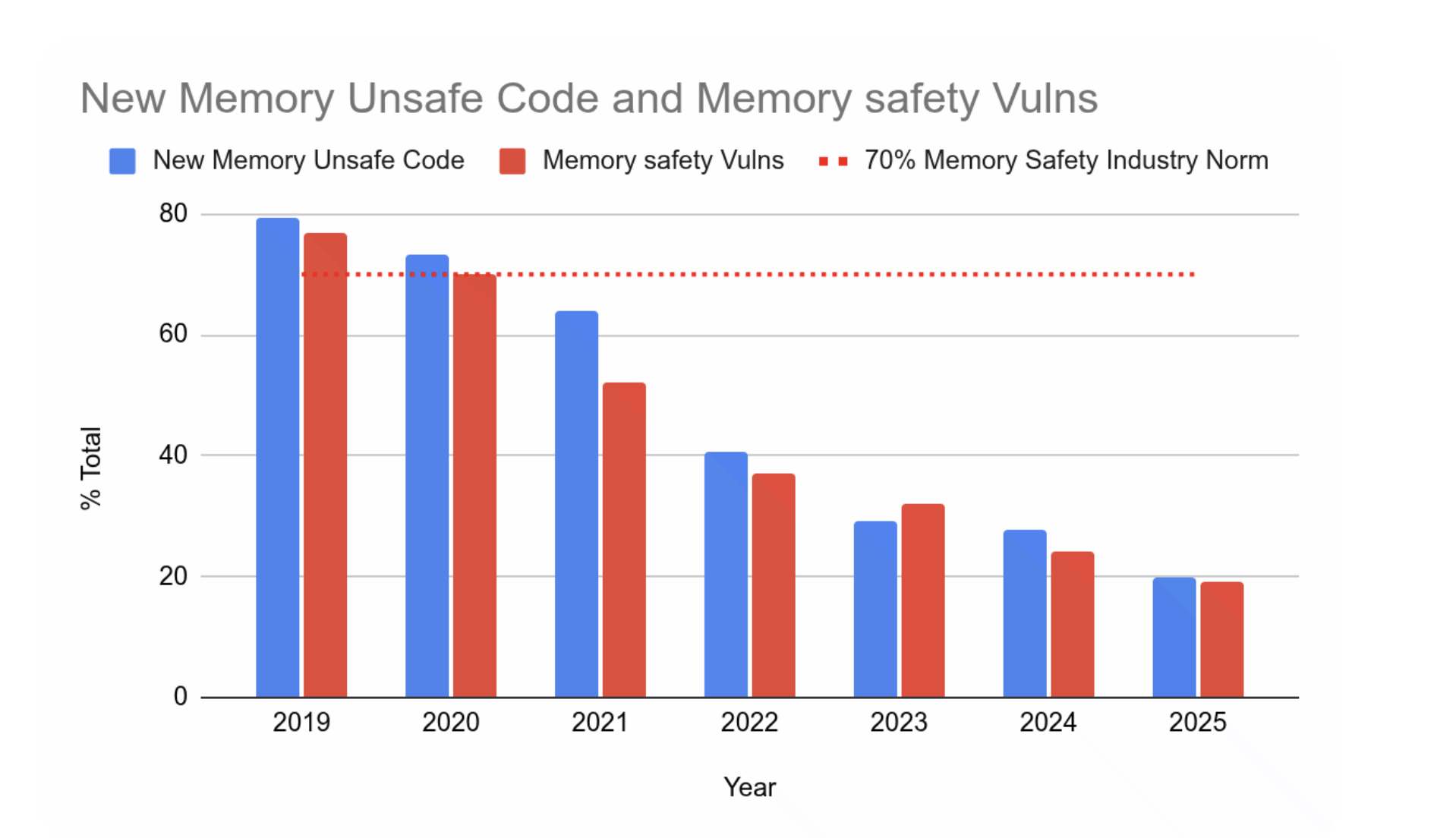
On memory safety, the Android team’s data is hard to argue with. After Android began transitioning new development to memory-safe languages, the velocity of Rust code in the codebase steadily increased. The data shows a clear linear correlation: as the velocity of memory-unsafe code decreases, so does the number of memory safety vulnerabilities.
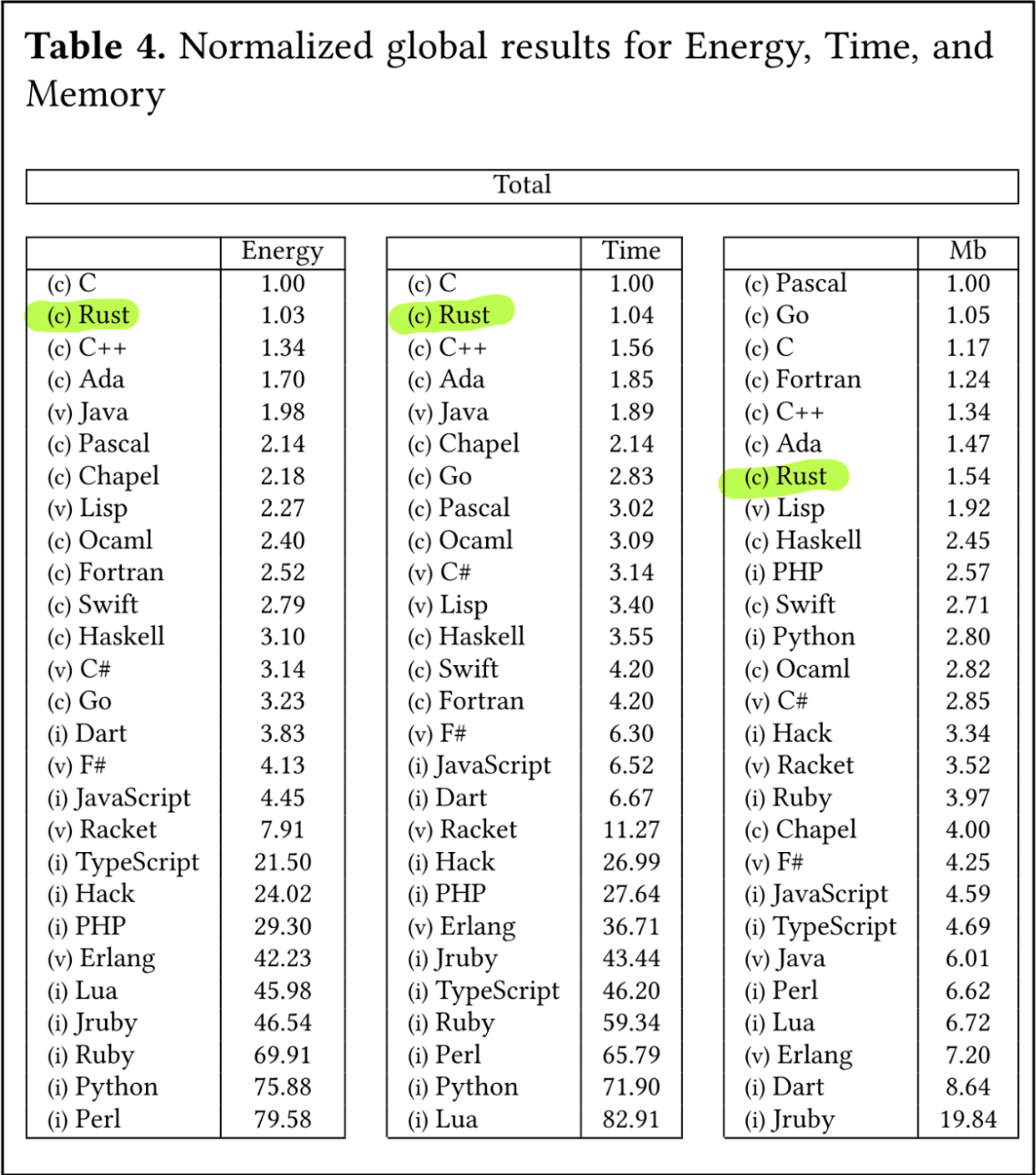
In terms of performance, a 2017 paper comparing energy efficiency, execution time, and memory usage across programming languages ranked Rust near the top for both energy efficiency and execution speed. The methodology is not perfect, and direct comparisons between languages are difficult, but the results still point to a broader trend: Rust performs competitively on both speed and efficiency. Memory usage was higher than the absolute best performers, but still within the upper half of the comparison.
And then there’s the Stack Overflow Developer Survey. Rust has been the most admired language for years running. A lot of RIIR projects probably exist simply because developers want to write Rust. That’s worth being honest about.
Three types of rewrites
Not all rewrites are the same, and it helps to be specific about what category you’re talking about. Here we have three categories.
Drop-in replacements aim to be functionally identical to the original. You replace the binary and nothing else changes. Projects like uutils coreutils, sudo-rs, youki as a container runtime replacement, and Arti as a Tor reimplementation all fall under this. There are thousands of these across the ecosystem, ranging from small file format libraries like the PNG crate replacing libpng, to larger infrastructure projects with serious corporate and community funding behind them.
Alternatives solve the same problem but make different choices. ripgrep instead of grep, delta instead of diff, bat instead of cat, Typst instead of LaTeX, Polars instead of pandas. These aren’t trying to be identical replacements. They’re often faster, more ergonomic, or designed with a different philosophy. Typst is a good example of the readability argument:
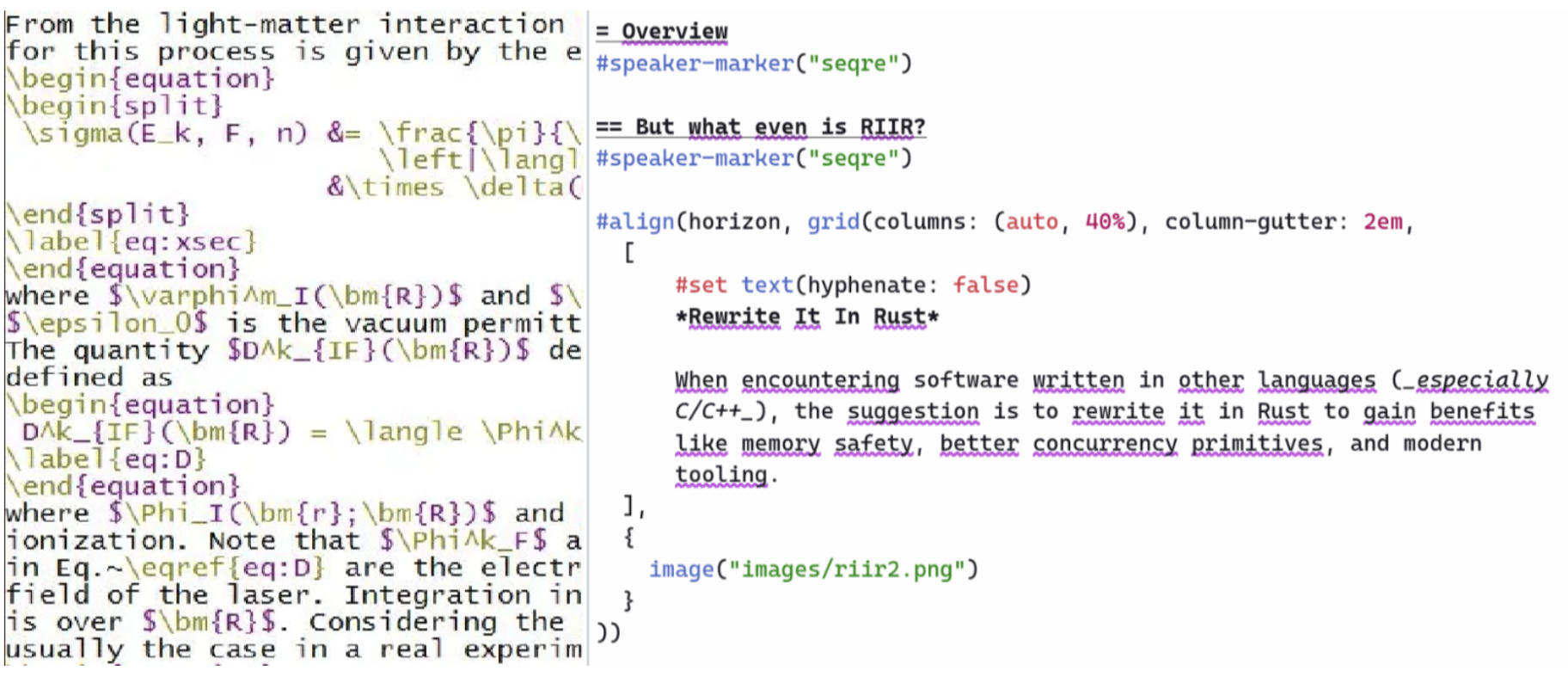
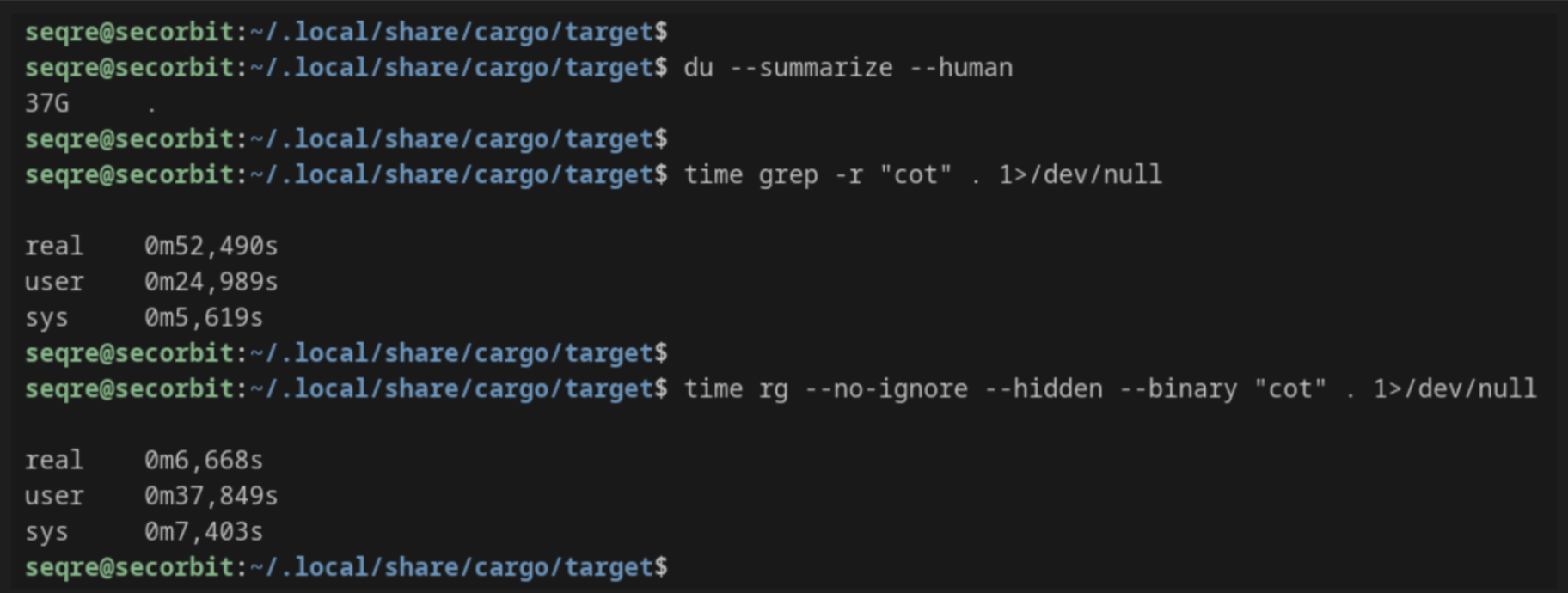
LaTeX and Typst can produce the same output, but the source code tells a very different story. And on raw performance, Marek ran both ripgrep and grep against a 37 GB cargo target directory searching for the word “cot”. grep finished in 52 seconds. ripgrep finished in six. That’s not a marginal difference.
Self-rewrites are when an existing project decides to rewrite part or all of itself in Rust, without replacing an external binary. Firefox, the Linux kernel, Windows, Cloudflare’s infrastructure, and the Fish shell all belong here. These are not small bets. Some of the most widely deployed software in the world now contains Rust, and it got there through this category.
Rust rewrite performance: Does it actually deliver?
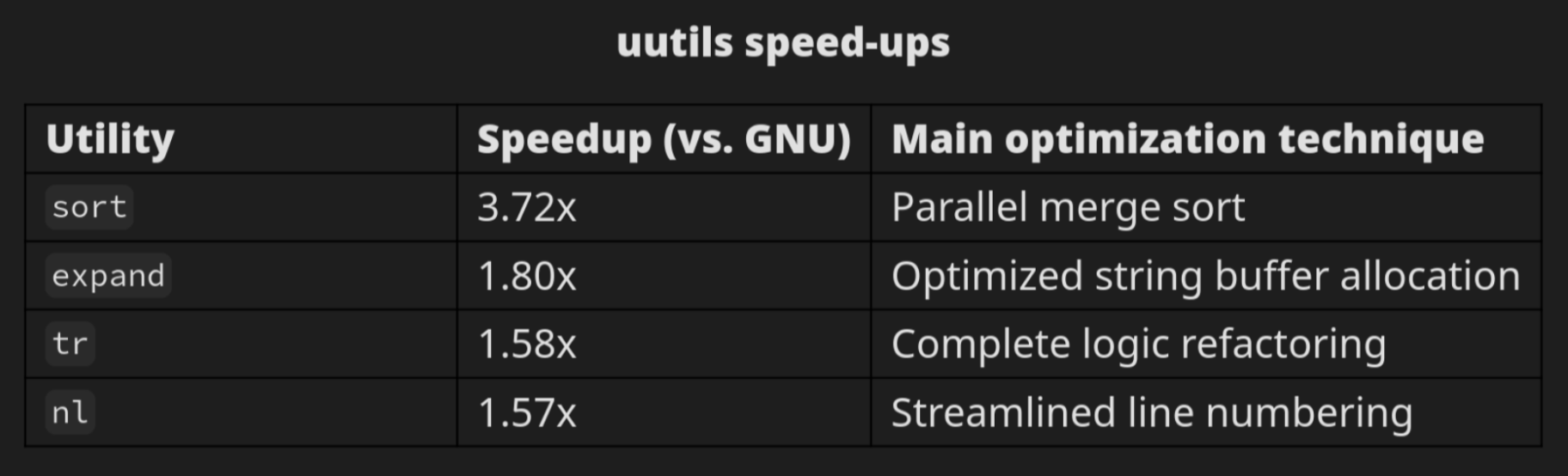
Sometimes, yes. Sometimes for the wrong reasons. Looking at uutils, sort runs almost four times faster than GNU sort. The reason is parallel merge sort, which Rust’s concurrency model makes considerably easier to implement correctly. But some other utilities are faster simply because they’re a fresh rewrite with 30 years of hindsight. The original project couldn’t experiment as freely because production users depended on it.
The PNG crate is a better example of Rust-specific gains. The Rust implementation is nearly twice as fast as libpng. Part of this comes from auto-vectorization: the Rust compiler generates SIMD instructions automatically from a regular for loop, while most C implementations require hand-written SIMD. The other part comes from streaming DEFLATE decompression, which fits more data into the CPU cache at once. Both are genuine Rust advantages.
Rust binary size: The problem and how projects solve it
Rust binaries are famously large, and the reasons are real: panic handling code, Debug trait implementations, the standard library compiled into each binary, monomorphization from generics, and static linking of all dependencies.
uutils dealt with this through a multicall binary format, the same approach used by BusyBox. All utilities are compiled into one binary and invoked through symlinks. The result: 73 MB of individual binaries becomes 13.8 MB as a multicall binary, which actually beats the 18.4 MB of the GNU coreutils standard install. Compressed with UPX, it gets down to 5 MB.
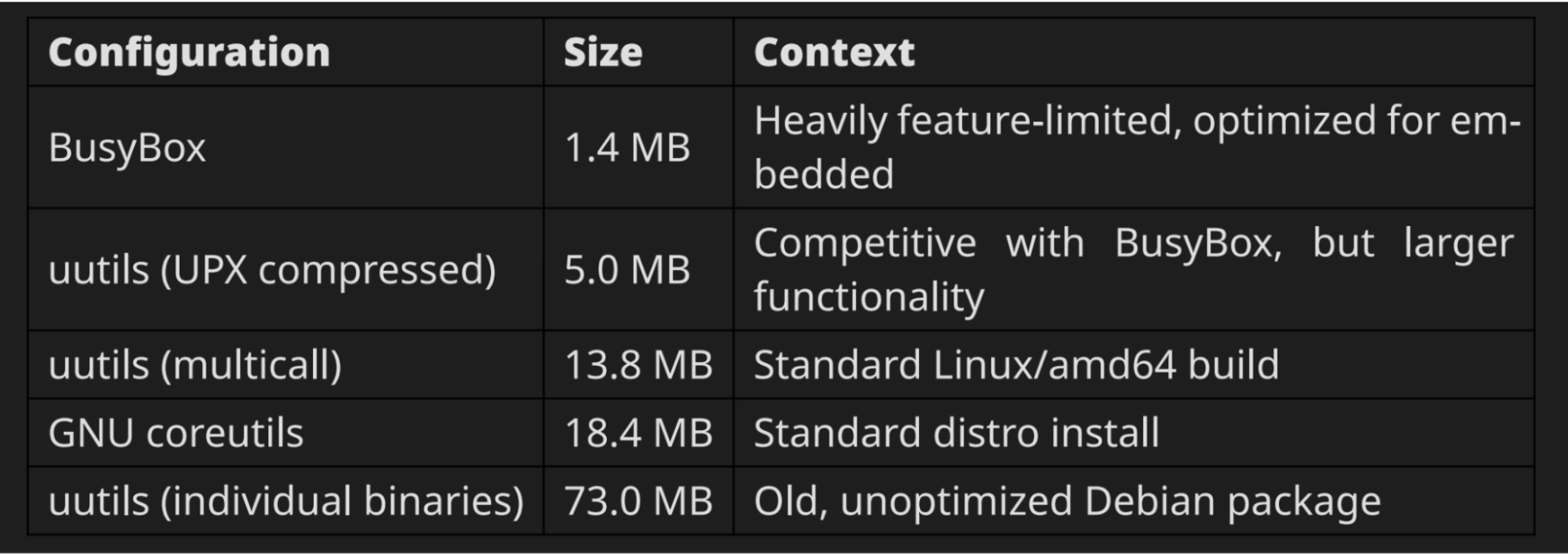
The problem is solvable, but it requires serious effort.
Rewriting in Rust: What can go wrong and why?
This part doesn’t get talked about enough. Every rewrite introduces new bugs. You’re writing code from scratch, which means you’ll inevitably introduce new bugs or regressions not found in the original project. This isn’t a Rust problem specifically; it’s a software rewrite problem. But it’s worth being clear-eyed about.
Cloudflare introduced an unwrap in a request-scoring component. uutils formatted dates slightly incorrectly, breaking unattended upgrades. sudo-rs echoed a partially typed password back to the terminal after a timeout. The first CVE in Rust code in the Linux kernel came from a race condition in an unsafe block in the Android binder driver. TARmageddon was an RCE vulnerability in async-tar caused by incorrect parsing of the .tar format.
If projects backed by significant funding and experienced teams still make these mistakes, we will too. That’s not a reason not to rewrite, but it is a reason to take testing seriously.
Sometimes, Rust isn’t even the right choice at all. Microsoft chose Go for the TypeScript compiler rewrite largely because Go is much closer to TypeScript in its programming model, which mattered while the codebase would contain both languages for quite some time. The NTPsec project chose Go because, at the time, Go had better network primitives and a less fragmented ecosystem. These were reasonable decisions, not failures of imagination.
And some rewrites that chose Rust still didn’t succeed. Prisma migrated away from their Rust query engine back to TypeScript due to skill-set gaps, deployment complexity, and runtime issues. Loglog Games abandoned Rust after three years of game development. They found it excellent for refactoring but poor for iteration speed, and noted that the Rust game development community focuses more on engine technicalities than on shipping finished games. The curl/hyper integration got to 95% completion and was then abandoned due to the difficulty of the last 5% and the lack of community momentum. Interestingly, the collaboration still benefited both projects: the process of trying to integrate them led to forced cleanups in both codebases.
Licensing is a real decision
One thing that doesn’t get discussed enough in RIIR conversations is that if you’re creating a new project that reimplements an existing one, your license choice has consequences.
A more restrictive license, like GPL, may exclude users who can’t introduce copyleft dependencies into proprietary projects. A more permissive license may draw criticism from the open source community, as some fear companies will use the code without contributing back. There’s no universally correct answer. It depends entirely on your project’s goals and community. But it’s a decision worth making consciously rather than by default.
Is the RIIR movement still happening in 2026?
The RIIR meme has faded somewhat. But the actual movement hasn’t. Rust in the Linux kernel is no longer experimental, and the maintainers declared the experiment a success at the 2025 Maintainers Summit. Rust is running in the Windows kernel. Cloudflare, Firefox, and countless infrastructure projects have committed significant Rust code to production.
The scale is real. Between Linux and Windows alone, Rust is running on billions of devices. That’s arguably the biggest validation the “rewrite it in Rust” idea has ever received.
How to actually do it well
If you’re considering a rewrite, a few things we’d recommend thinking through first. Make sure it actually makes sense for your use case. Ask whether your codebase is in a memory-unsafe language, whether it’s critical software, whether you have real performance and reliability requirements, and whether you have significant parallel or concurrent code that’s hard to reason about. The more of those boxes you check, the stronger the case.
Make sure your team is ready. Either they already know Rust, or they’re genuinely willing to learn and contribute to it. Google’s data suggests that around two-thirds of developers feel confident contributing to a Rust codebase within two months. But that’s not a guarantee, and the last 5% of a rewrite is almost always harder than you expect. Small rewrites take months. Medium ones take one to two years, and large rewrites take two to five. It almost always takes longer than you estimated.
Prefer expanding incrementally over rewriting completely. Adding new components in Rust while keeping the old codebase running is almost always less risky than a full replacement. You get the benefits without betting the whole project on it.
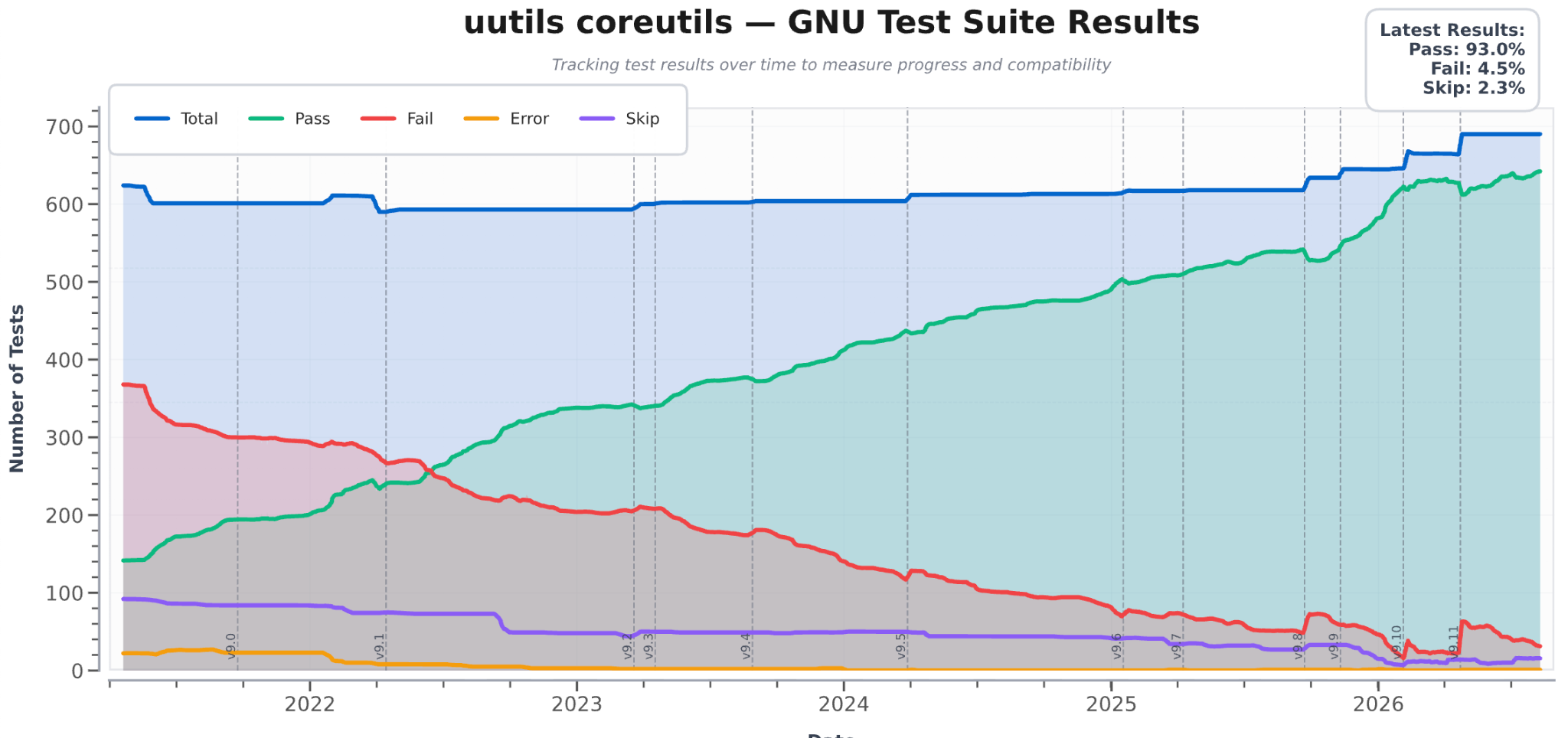
When you do rewrite, build a serious test suite. The best example of this in practice is uutils, which runs against the official GNU coreutils test suite to track parity. As of early 2026, they’re at 92.2% pass rate and climbing.
So is it worth it?
If your project is written in a memory-unsafe language, handles critical functionality, has real performance requirements, and involves substantial concurrent code, yes. A rewrite is strongly justified, and the evidence supports it.
Outside of those conditions, it’s still potentially worth it, but the analysis needs to be more careful. The enthusiasm is understandable as Rust is genuinely good. But it was designed as a systems programming language, and that’s where it does its best work. Treating RIIR as a default answer to every performance or safety concern is how you end up with a two-year rewrite project that ships six months late and introduces bugs you already fixed.
Frequently Asked Questions
What does RIIR mean?
RIIR stands for Rewrite It In Rust. It started as a suggestion in open-source issue trackers to migrate C and C++ projects to Rust for memory safety and performance, and became a broader cultural meme in the Rust community.
Is rewriting software in Rust worth it?
It depends on your situation. If your codebase is in a memory-unsafe language, handles critical functionality, and has real performance or concurrency requirements, the case for a Rust rewrite is strong. In other situations, the benefits are less clear, and the costs, but the learning curve, rewrite time, and new bugs deserve serious consideration.
What are the risks of rewriting in Rust?
Every rewrite introduces new bugs, including bugs the original project already fixed. Rust rewrites also require developers to learn the language, can take significantly longer than estimated, and may face challenges with platform support, binary size, and interoperability with other languages.
What is the best approach to migrating to Rust?
Incremental expansion rather than full rewrite. Add new components in Rust while keeping existing code running. When you do rewrite, invest in a thorough test suite that validates the new implementation behaves identically to the original.
Did Rust succeed in the Linux kernel?
Yes. At the 2025 Linux Kernel Maintainers Summit, the consensus was that the Rust experiment was a success. Rust is now a core part of the kernel and is no longer considered experimental.
JetBrains .NET Day Online 2026: Save the Date and Submit a Talk
A free, online event for the .NET community.

JetBrains .NET Day Online 2026 takes place on Wednesday, October 7. Expect a day of practical talks, live demos, and real-world lessons from community speakers and the JetBrains .NET team.
Two things are different this year. The event was two days last time, while this year it’s one. We’re also opening the call for speakers now rather than a few weeks out, which means you have more time to put a proposal together.
Register now → Save the date
Event basics
- Date: Wednesday, October 7, 2026
- Format: One day online livestream with real-time chat
- Time zone: Central European Summer Time, CEST (UTC+2). All agenda times will be listed in CEST.
- Cost: Free
- Recordings: Sessions will be available on demand after the event
- Landing page: https://lp.jetbrains.com/dotnet-day-online-2026/
What’s on the agenda
The full lineup will come together over the next few weeks. Here’s what’s already locked in:
- A keynote from the JetBrains .NET team on where the tools and the platform are heading and why.
- A live panel with JetBrains PMs and engineers, scheduled around the European lunch break so you can drop in without rearranging your day. Bring your questions to the chat, and we’ll get through as many as we can.
- Community talks, which is where you come in.
One thing that sets this event apart from most .NET content is that the people who build and support the tools are in the chat with you, including PMs, engineers, QA, and support staff. If you’ve been sitting on a question, October 7 is the day to ask it.
Call for speakers
We’re looking for talks that help .NET developers get better at the work they do. The goal is that they are practical, specific, and useful the day after the event.
Last year’s lineup covered .NET Aspire, clean architecture, C# nullability, messaging and queues, Blazor and Uno, F#, memory diagnostics, async/await, distributed logging, and what GenAI is doing to test-driven development.
We’re especially interested in talks on AI-assisted .NET development, where practitioners show what actually works on real projects rather than a polished demo.
Here’s how and when to apply online:
- Submit your proposal: https://sessionize.com/jetbrains-net-day-online-2026
- Deadline: Friday, September 4, 2026
- Suggested length: 30 minutes. If your talk genuinely needs 45 minutes, tell us why in your submission and we’ll consider it.
- What you get: a live audience, a professionally produced recording you can keep, and a team that handles the logistics so you can focus on the talk.
- Timing: we start in the CEST morning and run through the European day, same as last year. We’ll confirm your exact slot with you once the schedule comes together.
Never spoken at an online event before? Submit your talk anyway! We’re actively looking for speakers we haven’t featured before, including from parts of the .NET community that don’t get enough stage time. If you have a topic and you’re not sure it fits, send it in and let us decide.
How to join
If you want to speak
- Submit your talk by Friday, September 4: https://sessionize.com/jetbrains-net-day-online-2026
- Suggested length is 30 minutes. If your talk needs 45, tell us why in your submission.
If you want to watch
- Registration opens in [mid-August]. We’ll announce it here and on the event page.
- Tune in live on October 7 and bring your questions to the chat.
What’s coming next
We’ll announce the speaker lineup and the full agenda on this blog. For event updates in your feed, follow @JetBrainsRider and @ReSharper on Bluesky or X/Twitter.
Why Netanyahu rejected a Trump-backed Gaza peace plan
Пятнадцать месяцев финтеха агентами: кривая качества по всей истории проекта

У меня 12 лет опыта в Go. И я больше не имею права назвать себя программистом: мой код не пройдёт ту планку качества, которую я выставил для своих агентов. Хотя честнее так: они сами её выставили, я лишь ставил цели.
Заявление громкое, но у меня есть график. Красная пунктирная линия на нём: уровень моего лучшего рукописного кода. Синяя кривая: код, который пишут агенты. В апреле 2026 кривая ушла под красную линию и продолжает падать.
Читать далееCouple to move from Texas to Wrexham after watching Ryan Reynolds series
Flip-flopping Netanyahu rejects Gaza plan but cannot placate all his allies
Israeli prime minister faces incompatible demands from his far-right government ministers and from Donald Trump
Benjamin Netanyahu’s public rejection of a US-backed deal for Gaza drew scepticism in Israel, amid reports he was personally hammering out details of a pilot military withdrawal days earlier.
The Israeli prime minister is struggling to balance incompatible demands on Gaza policy from his key domestic and international allies.
Continue reading...Police use teargas on young Indians as government jobs protest escalates
Demonstrators accuse authorities of failing to tackle irregularities in exams for sought-after civil service jobs
Thousands of angry young job-seekers clashed with police in Jharkhand, one of India’s poorest states, on Monday as a weeks-long protest over alleged irregularities in recruitment drives for coveted government jobs escalated into a march on the state legislature.
Police fired water cannon and teargas and swung batons as they tried to stop flag-waving demonstrators from clambering over barricades and surging towards the assembly in Ranchi, the state capital. Some of the protesters responded by dancing and cheering as jets of water drenched the crowd.
Continue reading...Scores dead in Colombia after powerful earthquake strikes west of country
Quake of 7.4 magnitude collapses and severely damages buildings in several major cities, including Cali and Pereira
More than 100 people died after a powerful earthquake struck western Colombia, collapsing and severely damaging scores of buildings in major cities including Cali and Pereira.
The US and Colombian geological surveys reported that a 7.4-magnitude earthquake struck at 7.34am local time on Monday, with its epicentre in the western department of Chocó. It was felt in neighbouring Venezuela, still reeling from a deadly double earthquake on 24 June.
Continue reading...Один запрос, семь ИИ-поисковиков, ноль общих источников

Когда человек спрашивает у ассистента «к кому обратиться», он получает не десять синих ссылок, а один ответ с пятью-десятью доменами внутри. Я прогнал два запроса через семь ИИ-поисковиков в один заход и сравнил, кого именно они цитируют. Общего источника не нашлось ни одного, а три модели разных разработчиков выдали дословно совпадающие списки — потому что веб-поиск им делает один и тот же плагин. Ниже — стенд, цифры и пять мест, где методика такого замера ломается.
Читать далее