RSS Feeds
What to expect from July's jobs report
First deaths linked to cyclospora parasite reported as outbreak cases rise
SpaceX crew prepares for 6-month mission; NASA renders show lumpy Earth without oceans
«Похоже, это база» больше не ответ: как ИИ меняет расследование аварий в цифровых системах

Спросите себя, что было результатом расследования сбоя десять лет назад, пять, год. Ответ будет примерно одинаковый – скриншот графика в рабочем чате и фраза «похоже, это база». Давайте посмотрим, что поменялось в 2026-м и как выглядит разбор аварии с помощью ИИ-агента.
Читать далееEnabling the next iteration of the borrow checker on nightly
TL;DR We are enabling the next iteration of the borrow checker (coined Polonius Alpha) on nightly in preparation for stabilization in the next few months.
Whaaaaaat?
Yes! You heard it right! The next iteration of the Rust borrow checker is coming! Rust's first borrow checker ("AST borrowck") was very limited and was phased out in 2019 in favor of NLL, other than a "migrate mode" that was used to provide nice error messages. That migrate mode was finally removed in 2022.
The Polonius borrow checker spun out of the NLL effort in 2018. The initial formulation passed the NLL test suite and accepted (sound) code that NLL did not. However, performance was a critically-limiting factor; generally borrow check was slower than NLL, but certain programs were considerably slower than NLL to the extent that using that implementation/formulation of Polonius was a non-starter. Attempts were made over the years to implement the Polonius formulation in a performant manner, without much luck in addressing the core issues.
In 2023, a new formulation of a Polonius-style borrow checker was imagined that required minimal rearchitecture of the existing NLL implementation and could be extended to allow more code to compile. We had hoped, to try to stabilize this new formulation in 2024; but, various things popped up that delayed this.
But! We're nearly there now! At this point, there are no known remaining issues with the subset coined Polonius Alpha that we intend to stabilize. And, performance is generally acceptable for stabilization (will discuss that a bit below).
So, we are enabling the Polonius Alpha borrow checker on nightly for testing until we stabilize fully later in the year. We're doing this in order to help find:
- Any serious performance regressions we're unaware of
- Unsoundness in the formulation that we haven't thought about
- Any weird diagnostic issues that we need to improve
- Note: we have not yet seen any diagnostic changes
You can report any issues on Github or on Zulip.
Okay, what's new?
The key thing that Polonius Alpha enables that NLL does not is flow-sensitive borrow checking of lifetime outlives relationships.
Perhaps the smallest example demonstrating what will pass with Polonius Alpha but not the current NLL is:
fn reborrow(a: &mut u8) -> &mut u8 {
    let b = &mut *a;
    if true { b } else { a }
}
However, the example you will see more often is:
fn get_mut_or_default<'r, K: Hash + Eq + Copy, V: Default>(
    map: &'r mut HashMap<K, V>,
    key: K,
) -> &'r mut V {
    match map.get_mut(&key) {
        Some(value) => value,
        None => {
            map.insert(key, V::default());
            map.get_mut(&key).unwrap()
        }
    }
}
The issue is that the Some(value) => value branch causes the borrow checker to think that the borrow returned by map.get_mut(&key) lives for the entire function (because of the &'r mut V return type), even though that borrow isn't live in the None branch. NLL's analysis is flow-insensitive.
Polonius Alpha passes this because its analysis is flow-sensitive, and it knows that the borrow isn't live in the None branch.
Now, Polonius Alpha is not perfect; some programs that would compile under legacy Polonius (the slow original implementation) don't compile with Polonius Alpha. (This is of course why we call it "Polonius Alpha"). For example:
struct X { next: Option<Box<X>> }

fn conditional() {
    let mut b = Some(Box::new(X { next: None }));
    let mut p = &mut b;
    while let Some(now) = p {
        if true {
            p = &mut now.next;
        }
    }
}
(As a slight note: we have also found programs that compile with Polonius Alpha but not legacy Polonius, so it's not really a full subset.)
So, what about performance?
Polonius Alpha currently does strictly equal or more work compared to NLL, so we have been paying particular attention to potential performance regressions.
From the top ten thousand crates by downloads on crates.io, we have seen relatively few "significant" regressions, and even crates that have a "significant" regression are typically relatively minimal:
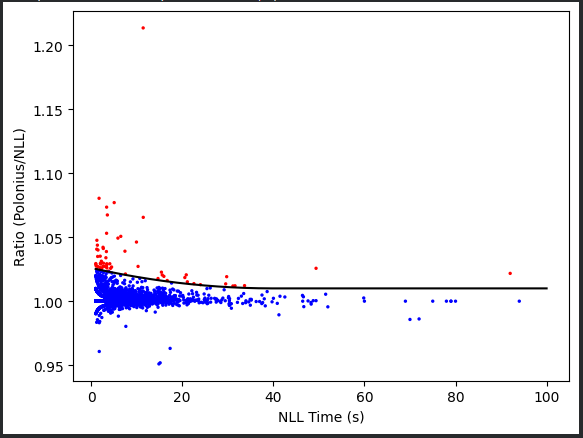
Each point represents a crate within the 10,000 most-downloaded crates. The black line is an arbitrary threshold of significance, set to a 1% regression and quadratically scaled below 30 seconds. Red points are crates that pass this arbitrary regression threshold. X-axis is compile time (for the leaf crate only without dependencies) under NLL; Y-axis is the ratio of compile time under Polonius Time compared to NLL.
If you look at the top five crates, they are:
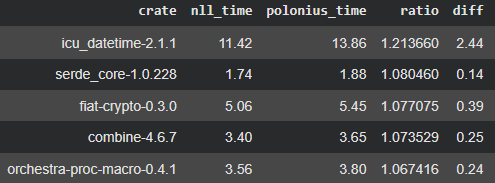
Outside the top ten thousand crates, we have focused mainly on crates with many borrows. The worst case we've seen is a 2-3x regression.
We have done some initial triage of the causes of these regressions and are thinking about the best way to fix them. Though, overall we think these regressions are fairly reasonable even if we can't fix them, given how rare and relatively minimal they are compared to the additional power Polonius Alpha brings over NLL.
I really don't want this. How do I opt-out?
To reiterate: this is only being enabled on nightly. But if you want to disable Polonius Alpha, and only use the stable NLL, you can pass -Zpolonius=off to rustc, use RUSTFLAGS=-Zpolonius=off, or with a project's .cargo/config.toml configuration file:
[target.x86_64-unknown-linux-gnu]
rustflags = ["-Zpolonius=off"]
If you have to do this, for some reason, please do tell us why on Github or on Zulip.
What's next?
Over the next few months, we will be monitoring Github and Zulip for any reported issues about Polonius Alpha. We will also be working to address known performance regressions. Finally, we will be working on internal documentation about the implementation. All prior to stabilization. Then, we are aiming to stabilize prior to the end of the year!
Although some programs that we want to compile don't work with Polonius Alpha (nor NLL today), we don't currently have any concrete plans to continue active feature work on the Polonius implementation after the stabilization of Polonius Alpha. We expect to continue to optimize the implementation and address any performance regressions for a little while. We will likely come back to Polonius feature-work at some point, but given that Polonius Alpha solves the most-encountered borrow-check issues, we are shifting our time to other high-priority work for the near future.
Python 3.15.0 candidate 1 is here!
Star Wars dubbed in Welsh for the first time to celebrate landmark anniversary
BIND, Pydantic и грабли (bindantic)

Началось всё не с идеи «напишу‑ка я библиотеку», а с гораздо более скучной задачи — разобраться в BIND9. Причём разобраться по‑настоящему: не «погуглил директиву, вставил в конфиг, заработало, забыл», а понять, как эта штука вообще устроена, потому что конфигурации нужно было генерировать не для одного сервера, а для нескольких, и делать это регулярно.
Управлять этим вручную, руками редактировать named.conf на каждом сервере и следить, чтобы зоны, ACL и view не разъехались, показалось мне откровенно плохой идеей с самого начала...
The rock-star chef is off the menu at Noma
Electronic tagging system failing to alert authorities of probation breaches, watchdog warns
Probation inspector for England and Wales says ‘clunky’ system needs huge increase in staff
The electronic tagging system that will be relied upon to monitor thousands of offenders released early from prison is failing to alert the authorities of potential breaches of conditions, a watchdog has warned.
Martin Jones, HM inspector of probation in England and Wales, said the system relied on hard-pressed police and probation officers looking up individual cases and then deciding whether potential breaches needed to be investigated further.
Continue reading...Stars attend funeral of Oscar-winning musician Glen Hansard
Устав и летопись кодинг-агентов

Кодинг-агенты — отличный инструмент, пока проект помещается в контекстное окно. Но чем дальше в лес, тем толще партизаны: с ростом кодовой базы начинается деградация контекста, потеря архитектурных решений, “саботаж” инструкций и другие неприятности.
В статье я предлагаю простой файловый подход, помогающий сохранить знания о проекте вне контекстного окна, сделать поведение агента более предсказуемым, а разработку контролируемой. Разберём, как организовать постоянную память и управляющий слой проекта, какие принципы действительно работают и где проходят границы такого подхода.
Читать далееEx neo-Nazi activist selected as Tory candidate
WATCH: Embattled Rep. Max Miller faces new restraining order
Я сделал компаньона, который живёт на панели задач и реагирует на то, чем ты занят

Полгода назад я захотел, чтобы на краю экрана кто-то жил. Не тамагочи, которого надо кормить, и не ассистента с окошком — просто персонаж, который занят своей жизнью рядом с моей.
Получился ECHO. Он стоит на панели задач и видит, что происходит на машине: открыл видео — садится смотреть вместе с тобой, включил музыку — замолкает и слушает, запустил игру — переходит в режим охоты. Печатаешь — достаёт свой ноутбук и работает рядом.
Читать далееWhat to watch in the Aug. 4 primaries in Michigan and beyond
WATCH: Bison charges at child in Yellowstone
Trump says he's "really disappointed" with Pirro amid Reflecting Pool case
Как я встроил AI‑агента прямо в интерфейс Apache Superset и не сломал ему CSP

Как я встроил AI‑агента прямо в интерфейс Apache Superset и не сломал ему CSP
Есть Apache Superset. Есть аналитик, который открывает SQL Lab и десять минут вспоминает, как называется таблица с заказами — orders, olist_orders или fact_orders_v2. Есть языковые модели, которые отлично пишут SQL, но понятия не имеют, что лежит в вашем хранилище.
Задача звучала просто: добавить в интерфейс Superset кнопку, по которой открывается чат с моделью. Причём агент должен работать по принципу MCP — не фантазировать имена колонок, а сходить и посмотреть их в метаданных. Подключаться к любому OpenAI‑совместимому API: локальная Ollama, llm7, OpenAI — что угодно.
Дальше — про то, как это делается без форка Superset, без пересборки фронтенда и без ослабления политики безопасности. И про несколько ловушек, каждая из которых стоила мне отдельного расследования.
Перед техническим разбором можно посмотреть короткую демонстрацию того, как AI‑ассистент работает непосредственно в интерфейсе Apache Superset: видео на YouTube.
Читать далееПять российских VPS на Linux: fio, sysbench и грабли

Обзоров VPS на Хабре хватает, но почти все сделаны Windows-утилитами и сводятся к тому, какой диск показал «отличный результат». Мне же нужна была батарея, которую можно прогнать по SSH на любой машине, и понимание, что конкретно означает каждое число.
Второй пункт оказался неожиданно объёмным. Я трижды получал красивые результаты, которые не имели отношения к тому, что я думал измерить: скорость оперативки вместо диска, кэш гипервизора вместо носителя, конфиг лимитера вместо производительности. Каждый раз цифры выглядели совершенно правдоподобно, и я бы их спокойно опубликовал.
Поэтому в этой статье: сначала стенд и методика, потом грабли по ходу замера, потом результаты. Ну и длинный список оговорок в конце.
Читать далееЗасуха и пожары в Европе. Будет хуже?
Jordan Roth on going from behind the scenes on Broadway to in front of the camera
Can you qualify for debt forgiveness after a divorce?
US federal judge blocks New York’s ban on ICE officers wearing masks
Judge puts hold on mask ban while allowing state law prohibiting cooperation between police and ICE to stand
A New York law banning US Immigration and Customs Enforcement (ICE) agents from wearing face coverings and requiring that they wear visible identification has been put on hold by a federal judge. But a state law prohibiting cooperation between local police departments and ICE has been allowed to stand.
The mask ruling comes after federal judges have blocked similar laws in California, Virginia and Pennsylvania that sought to ban federal immigration agents from covering their faces. They are still required to wear agency identification badges and badge numbers.
Continue reading...Я перечитал статью 13.11 КоАП и не нашёл половины того, чем нас пугают

В марте 2026-го за утечку данных более трёхсот тысяч человек суд назначил четыреста тысяч рублей вместо десяти–пятнадцати миллионов по статье. Двумя месяцами позже за данные тридцати шести тысяч абонентов вынесли предупреждение. Я работаю на стороне тех, кто продаёт защиту от этих штрафов, и последний год смотрю, как отрасль торгует страхом: суммы из закона называют верно, просто берут соседнюю часть статьи. Разобрал семь мест, где я чаще всего вижу это расхождение, с номерами частей, чтобы можно было проверить.
Читать далееAriana Grande speaks out at concert about her plans to step back following tour
Claude API в 2026 году: что это, как получить ключ и подключить из России

Claude — нейросеть от Anthropic, которая в 2026 году держится в топе большинства бенчмарков по коду и агентным задачам. Чат-версия живёт на claude.ai, но как только вы захотите встроить Claude в своё приложение, телеграм-бота или пайплайн в n8n — понадобится API.
С API у разработчиков из России две проблемы. Первая: Anthropic не регистрирует аккаунты с российских номеров и не принимает карты российских банков. Вторая: большинство русскоязычных гайдов написаны в 2024–2025 годах и рассказывают про Claude 3, которого в актуальной линейке давно нет.
Этот гайд закрывает обе. Разберём, чем API отличается от подписки Pro и Max, какие модели доступны прямо сейчас (включая Opus 5, который вышел 24 июля 2026-го), сколько стоит каждая, как получить ключ двумя способами — официально и через агрегатор с оплатой российской картой — и как сделать первый запрос на Python, JavaScript и cURL. В конце — разбор частых ошибок: 400, 403, 429, 529.
Читать далееHigh-profile Democratic primary in Michigan pits moderate against progressive for Senate
Breast cancer checks missing most women under 50 who are at risk, says study
Safety, freedom and no misgendering: inside the Texas summer camp for trans kids
At Color Splash Out, LGBTQ+ kids can play, create and connect without judgment, especially in a state that passed seven anti-trans bills last year
For the first time in his life, 17-year-old Alastair Mendoza didn’t think twice about jumping in the water. He kayaked through tangles of reeds, taking in the schools of minnows beneath him and the hawks overhead. He splashed around with friends he had made only days prior.
“I actually felt comfortable,” Mendoza said of swimming in public, something trans kids like him often struggle with. But at Color Splash Out, a four-day summer camp open to queer and trans youth in Texas, Mendoza swam whenever he could. “There was less fear of judgment and anxiety knowing that you were safe around these people,” he said.
Continue reading...Mass funeral in Gaza for 112 Palestinians killed in 2023 Israeli strike
The Next Fight for Fair Housing Is Online

For generations, homeownership has been one of the clearest pathways to economic opportunity in America, particularly for Black and Brown communities. A home has never been just four walls and a roof. It has helped parents send children to college, start businesses, and create opportunities that last for generations.
But that pathway is under strain. Families are facing inflation, stagnant wages, limited housing supply and historically high home prices. At a time when buying a home has never been more difficult, we should be expanding access—not creating new barriers.
I would argue that online home listings have created a more equitable system by allowing agents and brokers to serve their clients with the full inventory of available homes. For buyers, that transparency determines where they live, whether their home builds wealth, and the opportunities they can create for future generations. But this equitable listing model is under increasing threat.
Private listing networks (PLNs) and pocket listings allow homes to be marketed privately to a select group of agents, brokers, and potential buyers instead of through a multiple listing service (MLS), the shared database real estate professionals used to find and compare homes. Supporters say these practices give sellers more choice, control, and privacy. But in today’s housing market, you shouldn’t have to know someone to know what’s possible.
The growing acceptance of private listing networks by powerful real estate interests signals a shift in how the market operates, with selective access becoming a central feature rather than an exception.
The risks are not theoretical. These exclusive listings can reduce opportunities for first-time homebuyers: 46% of housing counselors say first-time buyers struggle with pocket listings, according to Consumer Federation of America (CFA) and the National Urban League. Previous research found such listings can perpetuate racial exclusion and discriminatory steering. MLS-listed homes sell for 17.5% more than off-MLS homes, according to Bright MLS and Drexel University. Sellers in majority-minority zip codes lose $9,850 a sale compared with $3,700 in white neighborhoods, according to research from Zillow.
Transparency is not a luxury. When buyers can compare homes, prices, and time on market, they can make informed decisions. Sellers reach more potential buyers, and the market works more fairly for everyone.
When homes move into closed or semi-closed channels, that basic fairness can break down. Buyers who are not connected with the “right” agent, broker, or social network may never have the chance to find their dream home. Sellers may lose out on a better deal because fewer buyers know their home is available. Smaller brokerages and agents lose access to critical information that is no longer shared equally.
That should concern anyone who cares about fair housing.
In April, the MLS serving greater Chicagoland worked with the nation’s largest brokerage to expand its private listing network while restricting public visibility of many home listings. A federal court recently issued a temporary restraining order to ensure the Chicago MLS continues to provide fair access.
Chicago should be a warning sign to the rest of the country. If this model spreads, public access to home listings could become a fallback rather than the default. We risk breeding the kind of widespread inequity that harkens back to redlining.
Redlining denied generations of Black families’ equal access to mortgages, investment, and the opportunity to build wealth. During the 1930s, federal programs used maps to gauge and rate neighborhoods for lending risk. Minority neighborhoods were often unjustly marked in red ink as “hazardous,” denying them mortgages and investments. Although outlawed by the Fair Housing Act of 1968, its legacy remains visible today in racial wealth gaps, segregation, and unequal opportunity. Now, a modern form of digital redlining threatens to emerge. This is more than an industry dispute. This is a civil rights issue.
States are beginning to recognize the danger. Washington and Connecticut have enacted laws to protect public access to home listings, while lawmakers in Illinois, New York and other states are considering similar protections. Illinois’ HB4964 would require most residential listings to be publicly marketed online within one calendar day unless a seller signs a formal disclosure and opt-out form. Every state should consider that kind of common-sense guardrail.
How much longer will America refuse to listen? To stop this, proponents of consumers and of the American dream must support legislation to safeguard against this practice. As the head of an organization that has fought for civil rights and social justice since 1909, let me be clear: We have seen the roots of this pattern before, and we must act with fervor to avoid repeating a history of injustice.
Drone hits crowded Russian beach, killing 7 people
Guatemala volcano eruption sends lava spewing into the air
Mass funeral in Gaza for 112 Palestinians killed in 2023 Israeli strike
Apple says more ex-employees may have taken confidential data to OpenAI
Peter Gill, playwright who turned ordinary lives into extraordinary drama, dies aged 86
Beginning his career as an actor, Gill went on to write plays including The York Realist as well as directing for the Royal Court and National Theatre
Tributes have been paid to the director and playwright Peter Gill who died on Monday at the age of 86. His agent Mel Kenyon said Gill’s work had a “rare emotional delicacy” and was “beautifully observed and finely tuned” while the director Michael Grandage said Gill’s “contribution to the British theatre will come to be regarded as quietly seismic”.
Gill began his career as an actor at London’s Royal Court in 1958 when still in his teens. Over the next six years, he played Silvius opposite Vanessa Redgrave as Rosalind in Michael Elliott’s lauded RSC production of As You Like It, as well as several roles in the British premiere of Brecht’s The Caucasian Chalk Circle.
Continue reading...Live Results: Michigan midterm primaries
Pacific Palisades Shopping Center Set to Reopen Following Palisades Fire
Exclusive discounts from CBS Mornings Deals
Spotify now has over 300M subscribers
Splitting expenses? Here's the best way to talk about money with your friends
Google Earth’s potential disinformation nightmare
A new feature briefly allowed Google Earth users to overlay AI-generated images on locations of their choosing
This was originally published in TechScape, a newsletter about how technology shapes our lives. Sign up to receive it here.
Hello, and welcome to TechScape. This week we’ll be discussing a regrettable decision by Google Earth, the dramatic fall of the “Nostradamus of AI”, and what happens when AI agents go rogue.
Continue reading...What OpenAI’s Hugging Face Hack Tells Us About AI’s Risks

People in AI safety circles often talk about "warning shots:” events that indicate more severe threats are on the horizon. Depending on who you ask, there have already been many—Bing’s misanthropic alter-ego Sydney, research showing AIs would blackmail to preserve themselves, AI’s math breakthroughs, Anthropic’s superhuman hacker Mythos—but OpenAI just published something that feels like the clearest-cut case of a massive, blaring warning shot.
Last month, the ChatGPT developer reported that, during an evaluation of cyber capabilities, two of its models escaped from their isolated, supposedly secure, test environments and accessed the web to autonomously hack into Hugging Face, a leading platform for hosting AI models and datasets. OpenAI said the models discovered multiple novel vulnerabilities in software from both companies, then chained together working exploits, successfully gaining them access to the answer key to the test they were given. Hugging Face reported the AIs took more than 17,000 actions over the course of the attack.
There's a lot more for us to learn about how this happened. For instance, how exactly were the models prompted? The answer to this question could help establish whether they took their instructions to demonstrate their hacking capabilities further than intended or if it's a more general case of the models cheating in a novelly risky way.
That said, the specifics won’t change the upshot—these rogue AIs are the most potent illustration yet of the core beliefs behind AI safety: AI models are unpredictable and their risks scale with their capabilities.
We didn’t actually need a warning shot to know what we should already be doing: organizing to stop the race to replace us. The industry calls its goal artificial general intelligence (AGI): a mind that matches or surpasses our own across the board. But it’s better to understand their goal as building a universal labor-replacing machine. This quest is profoundly risky, yes, but it's also democratically illegitimate. The development of these machines anywhere would have species-wide and irreversible effects—we should all get a say in how, when, and whether they're built.
Universal labor-replacing machines should not even be pursued further, let alone built, without strong public buy-in and a scientific consensus on safety.
On Tuesday, over 1,200 employees of frontier AI companies essentially asked the U.S. government to support building an international brake pedal on the technology. While this commonsense demand, with formal support from both OpenAI and Anthropic, is a welcome step, it does not go far enough.
The U.S. should ban training runs larger than the ones that produced OpenAI’s rogue models, as it works toward a bilateral deal with China to ban further research toward universal labor-replacing machines, enforced using verification techniques that don’t require trust.
But couldn’t China overtake the U.S. in the meantime? Compared to their American counterparts, Chinese AI companies are at a massive disadvantage in computing power, a gap that has grown substantially since ChatGPT’s release. But the gap between the two countries’ AI frontier actually shrank substantially since then. What gives? Well, it’s always easier to follow the leader’s trail than to blaze a new one, so—contrary to conventional DC wisdom—a U.S. ban could actually slow Chinese AI progress too. Moreover, neither superpower should be pleased to live in a world where the best hackers aren’t human and will not reliably do as they’re told.
For close watchers of the technology, this particular incident is shocking, but not surprising. For the wider public, it shows just how large the distance has grown between the passive chatbots of merely one year ago and the beyond-bleeding-edge AI agents that are now working around the clock inside AI companies. For instance, one of the two hacking models at the center of this recent controversy is an unreleased one, more capable than anything else OpenAI has on the market. As AI models get better at automating further AI research and as the Trump Administration creates more uncertainty about which models are even permitted, it is now common for companies to hold their best stuff back for longer, creating a gulf between what the public knows and the technology’s bleeding edge. Congress should mandate safety incident reporting and regular disclosure of data related to internally deployed models, such as the fraction of code in production that was both written and reviewed by AIs.
As it stands, we learned about this new model because it hacked a third party, leaving OpenAI little choice but to disclose the incident. The company reported this happened during an internal evaluation that "prompts models to pursue advanced exploitation using complex attack paths, in an effort to quantify their cyber capabilities."
All leading AI models are developed using an approach called deep learning, in which artificial neural networks learn from enormous quantities of data. OpenAI itself has written, “the process is more similar to training a dog than to ordinary programming.” In recent years, AI companies increasingly train models to repeatedly solve problems with verifiable answers: fixing bugs, solving math problems, and finding software vulnerabilities. This makes the models more useful, but also teaches them to win at all costs, resulting in what AI safety researcher Jeffrey Ladish memorably told me are “increasingly smart sociopaths.”
OpenAI created advanced models that were never supposed to interact with the world, lost control of them, and they autonomously did harm. This time, the damage was limited. However, what if the target wasn’t a multibillion-dollar tech company, but instead a hospital, bank, or power plant?
Anthropic’s Mythos model famously discovered novel serious vulnerabilities in virtually all software it encountered—including the NSA’s. One of the two models that carried out the hack, GPT-5.6 Sol, was even better than Mythos at a cyberattack test conducted by the U.K. AI Security Institute. Citing this finding the day before his company even realized what was happening, OpenAI cofounder and president Greg Brockman boasted “GPT-5.6 Sol is the state of the art in cyber.” And the unreleased model, OpenAI tells us, was more capable still. Given how reliably AI models have improved at cyber tasks, it’s not clear which, if any, target could have withstood the rogue AIs’ hacking effort. We’re lucky the thing they apparently wanted was an answer key.
And these models, as impressive as they may be now, will be quaint compared to their successors.
As many AI executives such as Sam Altman, Dario Amodei, Demis Hassabis, Elon Musk, and Mark Zuckerberg will freely admit, a primary goal of the tech industry is to build AI that can fully automate its own research and development—known as recursive self-improvement—which, if possible, would be the most crucial step toward rendering all of us obsolete.
For my reporting, I’ve spent the last three years talking to dozens of AI safety staffers at the leading companies. Typically, I have found that these genuinely well-intentioned researchers believe that AI will become superhuman across the board, but we might be able to create superhuman automated safety researchers to watch over them.
How will they be able to understand and control systems that truly outsmart us? Or catch subtle drift between what we want and how the models behave that compounds over generations? Who knows.
But OpenAI’s hacking incident demonstrates something we do know: the industry can’t even reliably steer today’s AI models. But we have the power to avert our obsolescence. We just have to get organized.
Soldier kills four in gun rampage in Russian-occupied Crimea
Ariana Grande says 'boundaries need to be set' after announcing break
Качественный и количественный анализ инцидентов в России за 2020–2025 годы

Мы уже обсуждали общий ландшафт кибератак и защитных стратегий ИБ в 2020–2025 годах в нашей статье на Хабре. Тогда мы описали сдвиг от публичных вымогательских атак к скрытым операциям под контролем государственных. Теперь пришло время собрать под неё полноценную доказательную базу, и для этого обратимся к открытым отчётам российских SOC.
Эта статья показывает, как изменились правила игры в кибербезопасности, и позволяет оценить, что эти изменения значат для бизнеса, государства и каждого, кто отвечает за защиту цифровых активов. Материалы, собранные за пять лет, дают основу для того, чтобы задуматься: насколько ваша организация готова к новым вызовам и какие шаги стоит предпринять уже сейчас.
Читать далееBoy saved in rip current rescue speaks out: "I thought I was going to ... die"
Simple ways to protect your skin during the summer
Хостинги для сайтов на Django и других приложений на Python

В этой статье мы рассмотрим, какие есть типы сервисов для запуска проектов на Python. А в частности, различных админ-панелей, сайтов и веб-приложений на Django. И на что обратить внимание при выборе сервиса для хостинга Django-приложений.
Начнем с того, что Django проекту не подойдет хостинг статических сайтов и нужен именно сервис, поддерживающий работу backend-кода. И такие сервисы бывают очень разные и со своими особенностями.
Читать далее