RSS Feeds
For the First Time, Zoox Can Charge People for Rides in Its Steering-Wheel-Free Robotaxis
Дальнобойные беспилотники и их дешевые убийцы. Как война в Украине изменила авиасалон Фарнборо
Alive by Melanie Challenger review – a maverick study of what it means to have a body
In this disorienting book, a poet argues we have been looking at nature – and ourselves – the wrong way
The eastern breakwater of Granton harbour is almost 1km long, and swimmers can follow its crooked finger, heading straight out into the Firth of Forth, while benefiting from its reassuring presence. One Thursday lunchtime, I thought: why not, let’s give it a go, and headed for its tip. I felt cold, but, as I progressed, I seemed to grow strangely warmer. I did not notice the complaints from my body: the creeping numbness which proceeded from my fingers to my elbow, nor the coldness of my pee. Only by the time I exited the water, club footed and claw handed, did it hit me that I was hypothermic.
The irony of this reckless exercise was that in my swim bag there was a book by Melanie Challenger called Alive: The Hidden Intelligence of the Living World. It’s an ambitious examination of the wisdom of bodies, a rhizomatic guide not just to our own, but also all the living forms around us: from bacteria to chimps. Her case is that we have ignored or misread the agency and purpose of bodies to our detriment; in a way it is a plea to listen to them. I wish I had read it before my ill-advised swim.
Continue reading...Back to School Office Chair Deals 2026: $200 and Less
Race to rescue remaining climbers after deadly avalanche in Pakistan
Зачем Токаев призывает Путина заморозить войну в Украине? Текстовая версия подкаста «Что это было» с Темуром Умаровым
GenRec: Towards LLM-Native Recommendation at Netflix
Authors: Ying Li, Arjun Rao, Shradha Sehgal
Introduction
Recommendations sit at the heart of the Netflix experience. Our current production models rely on thousands of hand‑crafted features over users, items, and interactions, along with specialized architectures for sequence modeling, feature interactions, and multi‑task objectives. This stack has evolved over many years to support diverse content types (movies, series, games, live, podcasts) and product surfaces, but its complexity makes it costly to onboard new use cases: adding a content type or surface can require significant feature engineering, architecture change, infrastructure work, and experimentation.
At the same time, large language models (LLMs) are changing how we think about recommendation, as shown by recent work such as PLUM, GLIDE, and OneRec-Think. Their broad world knowledge and strong language understanding make it possible to represent user histories and item metadata directly as text, capture rich relationships in a shared semantic space, and steer recommendations via natural‑language prompts. However, off‑the‑shelf LLMs are still far from production‑ready recommenders: they often over‑recommend globally popular content, hallucinate out‑of‑catalog items, ignore business constraints, and provide only limited personalization.
To address this, we built GenRec, an LLM‑backed recommendation ranker that post‑trains an internal foundation LLM on Netflix‑specific data and objectives. GenRec shows that an LLM‑based ranker can match or exceed a mature production system while relying on far fewer labeled examples and input signals.
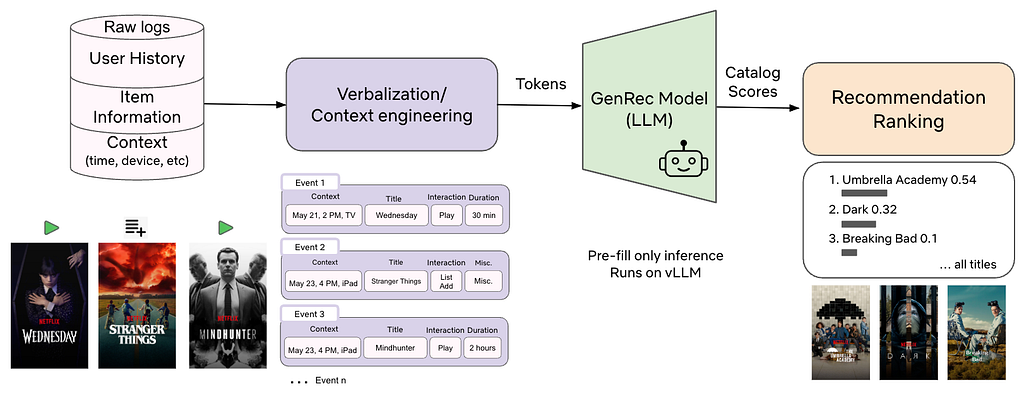
At a high level, GenRec:
- Verbalizes user histories, item metadata, and context as text.
- Post‑trains a Netflix‑adapted foundation LLM for ranking.
- Adds a catalog‑aware scoring head over Netflix titles.
- Uses reward signals to align with long‑term member value and business goals.
- Runs in prefill‑only mode on Netflix’s LLM serving stack for cost efficiency.
In a large‑scale A/B test against a well‑tuned production ranker, GenRec achieves statistically significant improvements in both short‑term and long‑term online metrics, while using only a small fraction of the Phase‑2 labeled data and input signals. It reduces our reliance on hand‑engineered features and shifts the focus from feature engineering to context engineering. In this blog post, we will describe how GenRec works, how it performs, and why we believe it points toward a more LLM‑centric future for recommendation at Netflix.
Problem Setting
We focus on a full‑catalog ranking task (or top‑K ranking when a candidate set is provided).
Given a user 𝑢, their interaction history 𝐻, and the current context 𝜏 (device, surface, locale, time, etc.), GenRec scores each item and produces a personalized ranking that can directly power recommendations or serve as input for downstream personalization systems.
Formally, we map a request (u,τ,t,H) — user, context, time, and history — to a ranking 𝜋 over the catalog C, where π(i) is the position assigned to item i. We optimize π for expected long‑term member utility (a proxy for satisfaction and retention), not just short‑term engagements.
From Foundation LLM to Recommendation Ranker
GenRec follows a two‑phase training framework (Figure 2):
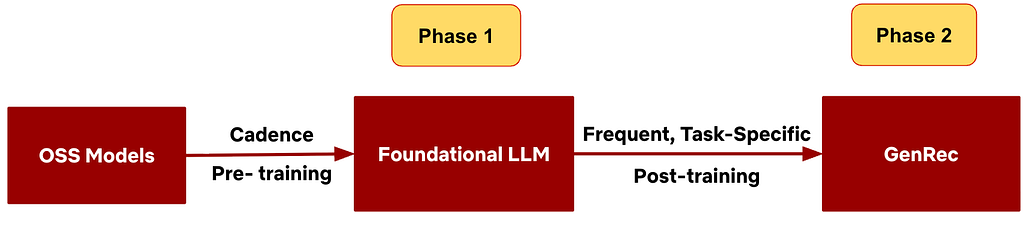
Phase 1 — Netflix-Adapted Foundation LLM.
We start from an open‑source LLM and adapt it on proprietary Netflix corpora, so it learns foundational capabilities such as
- Netflix content understanding
- Member behavior and preference patterns
- General language understanding and generation.
Phase 1 is updated relatively infrequently and serves as a shared, Netflix‑aware backbone for many applications.
Phase 2 — GenRec.
We then turn this foundation model into a high‑quality ranking model by post‑training on ranking‑specific data and objectives. Phase 2:
- Focuses on ranking quality and steering
- Incorporates multiple reward signals via reward‑weighted losses
- Is refreshed more frequently to track new content and evolving tastes
- Is explicitly optimized under serving cost constraints.
Training Data as Conversations
Netflix members generate hundreds of billions of interaction events spanning many surfaces (views, plays, durations, thumbs up/down, add to list, abandons, etc.). We convert this log data into single‑turn or multi‑turn “conversations” between a user and a recommender. Each turn contains:
- User message: verbalized context, profile, history, item metadata, and task (e.g., recommend what the user will watch or thumb next).
- Assistant message: the member’s actual engagement (e.g., which titles were played, for how long, what feedback they provided).
During Phase‑2 training, the LLM learns how assistant messages depend on user messages. This allows us to express rich recommendation signals as text, jointly supporting both the language-modeling (LM) and ranking objectives.
At inference time, we feed in the verbalized context and apply a catalog‑aware scoring head to rank items; we do not decode assistant messages. The conversational format is primarily used during training to support the LM objective and preserve strong language understanding over the verbalized text.
Verbalization and Context Engineering
Traditional recommenders operate on dense features and embeddings. GenRec takes a different approach: it verbalizes rich user histories and context as natural language, encoding raw interaction signals directly in the LLM’s semantic space. In doing so, it relies on the model to discover higher‑level patterns — such as item relationships and evolving user interests — rather than on manual feature engineering.
Naively verbalizing every interaction in a user’s history can quickly exceed the token budget and be too expensive at Netflix scale. The context window becomes our new “feature budget”, so we apply context engineering:
- Retain in full: high‑signal engagements (e.g., long plays, thumbs‑up) with richer details
- Omit: low‑signal events (e.g., very short plays or quick hovers)
- Summarize or compress: repetitive behaviors (e.g., binge‑watching )
- Elaborate selectively: important or cold‑start items (e.g., new releases)
Within a fixed token budget, we prioritize recent, high‑signal history and compress or drop older history. We also structure the prompt to maximize shared prefixes for better prefix caching. The goal is a compact, high‑information prompt that preserves ranking quality without prohibitive costs.
Objectives: Ranking, Language, and Rewards
The overall GenRec model is trained with a multi‑objective loss that combines a recommendation ranking objective, language modeling objectives, and alignment via reward‑weighted training.
1. Catalog‑Aware Ranking Objective
The primary task is a ranking objective that teaches the model to score items by engagement quality. We label positives using high‑value engagements (e.g., sufficiently long plays, strong explicit feedback), with thresholds and denoising logic, and train the model — via a cross‑entropy loss over the catalog or candidate set — to assign higher scores to these positives given a verbalized context.
2. Language Modeling Objective
We also retain a language modeling (LM) objective over the verbalized inputs and outputs. This helps preserve the model’s general language understanding, improves its ability to interpret rich natural‑language histories and item metadata, and keeps the door open for text‑generation use cases such as recommendation explanations.
3. Reward‑Weighted Loss for Alignment
Beyond raw ranking accuracy, GenRec must (1) respect business requirements — for example, balancing movies, series, games, live, and podcasts — and (2) optimize long‑term member satisfaction rather than just immediate clicks or plays.
Training only on raw interaction sequences can lead to undesirable behaviors, such as over‑favoring binge‑watching or over‑focusing on a single content type. To address this, we weight the ranking loss using signals from separate reward models. Each training example receives a scalar weight derived from two types of signals:
- Long‑term satisfaction proxies: estimate how much a short‑term engagement contributes to long‑term outcomes, such as return behavior, catalog exploration, or sustained engagement.
- Behavior rebalancing: adjust behaviors across content types and launch stages (for example, games vs. movies, new releases vs. evergreen titles) to better align with business goals.
The example’s ranking loss is then scaled by this weight: high‑value engagements receive larger weights, and low‑value ones are down‑weighted. This reward‑weighted approach is simpler and more cost-efficient than full reinforcement learning, yet provides effective alignment in practice. We have seen additional gains from RL‑style methods (e.g., GRPO), but leave them to future work due to their higher cost.
Model Architecture and Serving
Backbone and Scoring Head
GenRec’s architecture closely follows our foundational LLM: a decoder‑only Transformer trained with next‑token‑prediction style objectives, augmented with a catalog‑aware ranking head that scores only Netflix in-catalog items. The scoring pipeline works as follows:
- Verbalization: A verbalizer V serializes user history H, context 𝜏 , and relevant item metadata into a single text sequence x.
- Pooled representation: The LLM processes x, and we extract a pooled hidden state h that summarizes the user’s current preferences and context.
- Catalog‑aware scoring: Each catalog item i has a learned embedding eᵢ. A scoring head ϕ combines h and eᵢ (e.g., via dot product or small MLP) to produce a score sᵢ. Applying a softmax over scores yields a probability distribution which we convert into a ranking π.
All parameters — the backbone, scoring head, and item embeddings — are trained jointly. For very large catalogs, we can use sampled softmax or candidate sets for efficient training and inference. This architecture constrains recommendations to the Netflix catalog while supporting efficient scoring over large candidate sets.
Serving and Cost Optimization
GenRec is served on Netflix’s internal LLM stack using vLLM. At Netflix scale, serving cost is driven primarily by 1) Model size; 2) Context length; 3) Inference mode (prefill vs. autoregressive decoding). We control cost through three strategies:
- Smaller / distilled models: We train GenRec on smaller or distilled foundation models, often with larger or more targeted datasets, to capture most of the quality of larger models at lower serving cost.
- Aggressive context compaction: Using the context engineering described earlier, we minimize tokens while preserving ranking quality.
- Prefill‑only inference: Autoregressive decoding over large candidate sets would be prohibitively expensive. Instead, we run in prefill‑only mode: the model consumes the prompt once and scores the entire candidate set in a single forward pass, with no token‑by‑token decoding.
Together, these choices make it feasible to serve GenRec on high‑volume workloads within compute budgets.
Offline and Online Experiments
We evaluated GenRec against a mature production ranker that has been tuned over many years. The baseline model relies on thousands of engineered dense and embedding features, as well as custom architectures for modeling feature interactions and sequences. We assessed performance using both offline evaluation metrics and a large‑scale online A/B test.
GenRec vs Production Baseline
Offline, GenRec outperformed the production ranker on ranking metrics despite using far fewer input signals and labeled examples. With roughly 40× fewer Phase‑2 labeled training examples, GenRec achieved about +1.6% improvement in Mean Reciprocal Rank (MRR). As we increased Phase‑2 training data and enriched the input signals, GenRec’s offline metrics continued to improve.
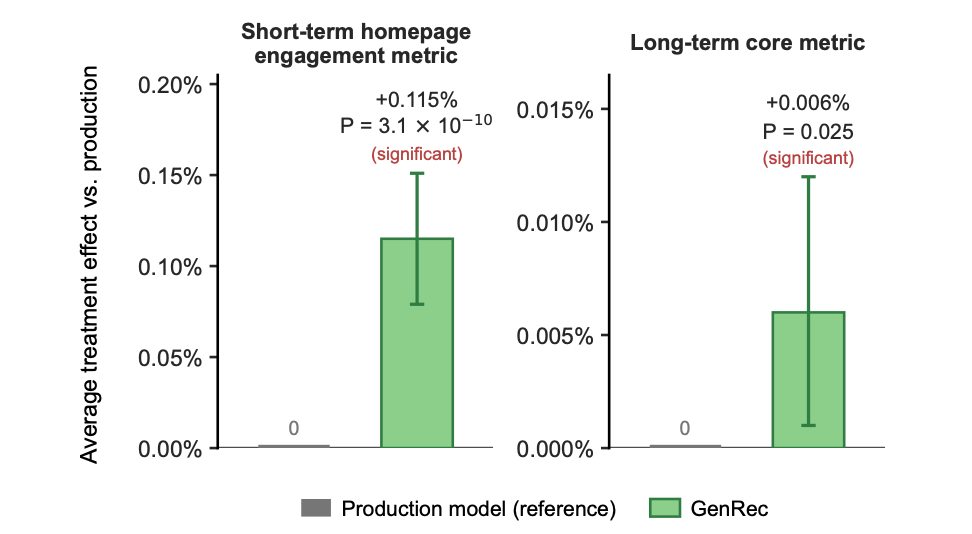
Online, we ran a large A/B test on batch‑compute recommendation surfaces, covering ~10% of Netflix traffic over ~4 weeks. In this low‑data, low‑signal configuration, GenRec delivered statistically significant gains over the production baseline on both short‑term and long‑term online metrics (Figure 3).
These results indicate that a properly post‑trained and aligned LLM‑backed ranker can be a strong alternative to traditional recommendation models, with substantial headroom as we further scale data and input signals.
Data, Model, and Phase Contributions
We ran ablations to understand where GenRec’s gains come from.
Data and Model Scaling
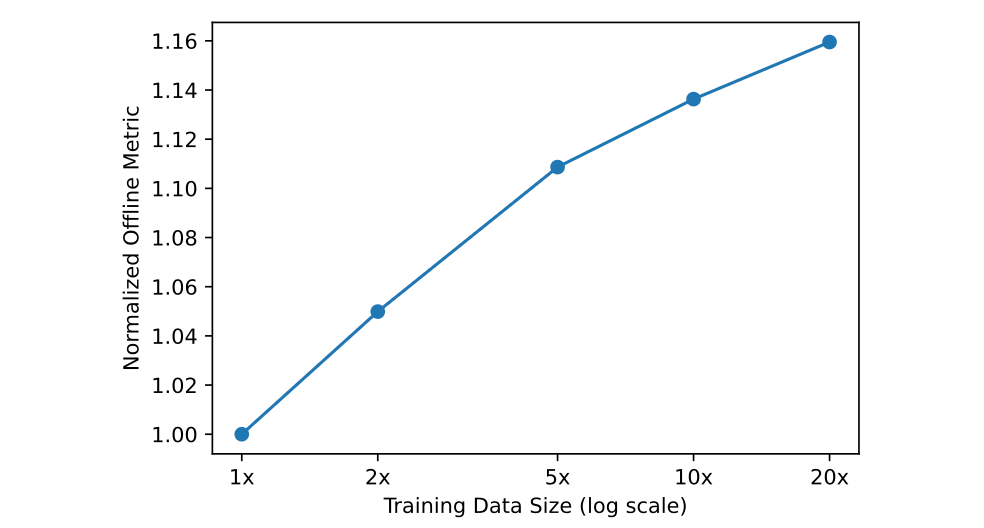
- Data scaling: For both ~1B and ~10B parameter backbones, offline MRR improves as we increase Phase‑2 post‑training data. Larger models reach higher absolute MRR but follow a similar scaling curve (see Figure 4).
- Model scaling: Under a fixed training budget, we post‑trained GenRec variants from ~1B to ~10B parameters. Within this budget, larger backbones consistently achieved higher offline MRR than smaller ones.
Phase-1 vs. OSS, Phase-2 vs. Phase-1
- Phase-1 vs. OSS: Using the Phase‑1 Netflix‑adapted foundation LLM as the base model improves offline ranking metrics by roughly 10–20% compared to starting directly from an off‑the‑shelf LLM.
- Phase-2 vs. Phase-1: Phase‑2 post‑training adds another 35–50% gain in offline ranking metrics when evaluated near the Phase‑1 training cutoff (i.e. when Phase‑1 model is the freshest). As time passes and Phase‑1 becomes stale with new content and shifting tastes, the relative benefit of Phase 2 grows to about 80% after 2 weeks.
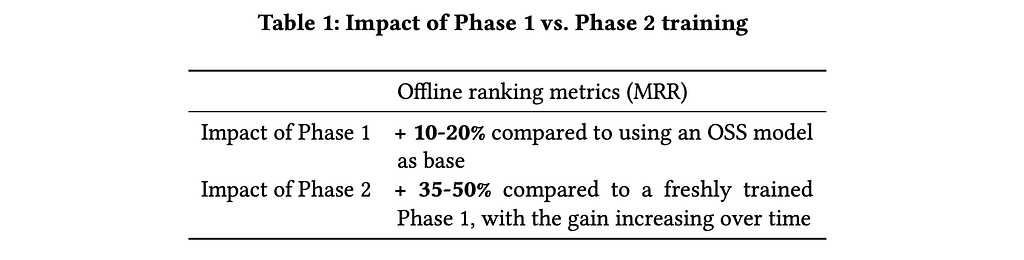
Data efficiency vs. production ranker
- Starting from a strong Phase‑1 model, GenRec matches or exceeds the production ranker using 10–40× fewer Phase‑2 labeled examples, depending on configuration. This marginal data efficiency is especially valuable because Phase 2 is refreshed far more frequently than Phase 1.
Context Length Optimization
Context length drives both quality and cost: longer verbalizations expose more behavior and context but increase training and serving cost. To study this trade‑off, we varied context length and verbosity and optimized them in three steps:
- Clean and compress events: drop low‑signal engagements and compress repetitive behavior to form a cleaned sequence of events.
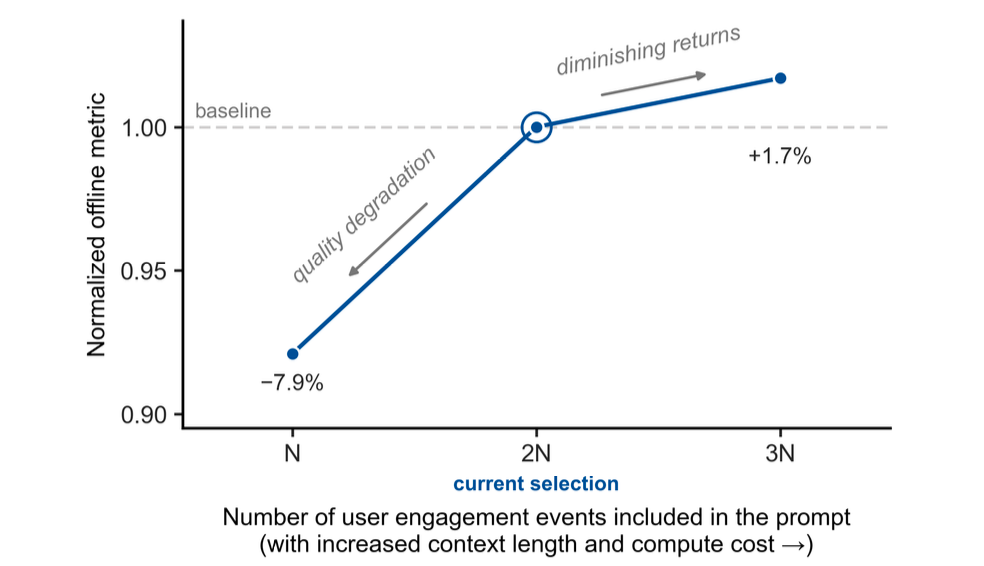
- Find the “elbow point”: vary how many historical events we include and plot MRR vs. number of events to identify an elbow beyond which additional context yields diminishing returns (see Figure 5).
- Optimize verbosity: for the retained events, test different levels of details and simplified wordings, measuring MRR each time.
In our experiments, we can reduce the context tokens to roughly one-third of the original budget with negligible degradation in offline ranking metrics. Since serving cost is approximately proportional to context length, we observed a similar reduction in serving cost.
Towards LLM‑Native Recommendation
GenRec is more than “swapping in a Transformer” for an existing ranker. It hints at a broader shift toward LLM‑native recommendation at Netflix. A few notable changes:
From Feature Engineering to Context Engineering
Traditional RecSys stacks revolve around large feature sets and heavy feature infrastructure. LLM‑centric systems instead revolve around constructing rich textual contexts from raw logs, metadata, and tools. The “prompt” becomes the new feature vector.
Modeling effort shifts from designing features to deciding which signals to include, how far back in time to go, how to compress or summarize history within a token budget. Our experiments on verbalization compaction illustrate this shift: careful context design can preserve quality while dramatically reducing serving cost.
From Customized Architectures to Foundation Backbones
Historically, each recommendation task often had its own custom architecture (two‑tower models, DLRM‑style networks, bespoke attention blocks). In an LLM‑centric world, many tasks share a common foundation backbone, with differentiation coming from data and verbalization strategies, post‑training objectives and rewards, and inference optimization.
GenRec leverages the same backbone as our foundation LLM rather than introducing a new architecture built from scratch. This makes it easier to share learnings across applications, and opens the door to natural‑language steering for future experiences.
Scaling Laws as Design Guides
Traditional RecSys can hit diminishing returns due to sparse IDs, heavy engineering objectives, and task‑specific architectures. With an LLM‑backed backbone, recommendation inherits clearer data and model scaling behavior: within cost limits, more data and larger models consistently improve quality. This brings RecSys design closer to the broader LLM paradigm, where scaling laws help guide model and data investment.
From RecSys Infra to LLM Infra
LLM‑backed recommenders push us toward LLM‑style infrastructure: GPU‑accelerated, vLLM/Triton‑based, with careful batching and caching. Over time, recommendation serving infra starts to look more like general LLM infra than classic RecSys stacks built around MLPs or factorization models.
Conclusions
We have presented GenRec, an LLM‑backed recommendation ranker at Netflix that adapts an internal foundation LLM for large‑scale personalization. By verbalizing user histories, context, and item metadata, adding a catalog‑aware ranking head, using reward‑weighted objectives aligned to long‑term satisfaction and business goals, and serving efficiently on our LLM infrastructure, we obtain a model that improves on a strong production ranker while using far fewer Phase‑2 labels and input signals.
GenRec is an early but promising step toward a more LLM‑centric recommendation stack at Netflix. Our results suggest that, with careful attention to cost, infrastructure, and alignment, LLM‑backed recommenders can play a central role in large‑scale personalization.
Acknowledgments
GenRec is the result of close collaboration among multiple teams and organizations across Netflix. The contributors to this work (in alphabetical order):
AI for members: Arjun Rao, Ashish Rastogi, Baolin Li, Fernando Amat Gil, Grace Huang, Justin Basilico, Kamelia Aryafar, Linas Baltrunas, Moumita Bhattacharya, Ogheneovo Dibie, Rein Houthooft, Shradha Sehgal, Sejoon Oh, Sergi Perez, Sourabh Medapati, Thea Wang, Yaochen Zhu, Yesu Feng, Ying Li, Yun Li, Yucheng Shi, Yunan Hu
AI platform and serving: Abhishek Agrawal, Adam Singer, Binh Tang, Daneo Zhang, Derek Olejnik, Ed Maddox, Erik Osheim, Lingyi Liu, Liping Peng, Meghana Chilukuri, Nicolas Hortiguera, Shaojing Li, ZQ Zhang
Product: Ilke Kaya, Michelle Kislak, Scarlet Chen, Si Cheng
GenRec: Towards LLM-Native Recommendation at Netflix was originally published in Netflix TechBlog on Medium, where people are continuing the conversation by highlighting and responding to this story.
Mario Vargas Llosa by Gerald Martin review – the Peruvian leftist who fell in love with Margaret Thatcher
This stylish biography of the author traces his journey from left to right, and from ‘posh Lima’ to Cricklewood
“At what precise moment had Peru fucked itself up?” Those words on the opening page of Conversation in the Cathedral announced the arrival of a writer who understood that national history could become the organising principle of fiction. At precisely the moment when Latin America was discovering the intoxicating possibilities of magical realism – a form whose exuberance had an elective affinity with revolutionary politics, collapsing the distinction between the marvellous and the possible – Mario Vargas Llosa plumped for old-fashioned realism instead.
It was a question of sensibility as much as politics, Gerald Martin suggests in this chatty yet coolly analytical biography. He traces the path of a novelist who began by dissecting oligarchy with surgical precision and ended happily dining among its ranks, completing one of literary history’s most spectacular political migrations – from the hard left to the hard right, over the course of half a century.
Continue reading...Spain sending troops as thousands enter enclave of Ceuta from Morocco
Nvidia’s Open Source Alliance Is Missing Some Key Names: OpenAI and Anthropic
Everyone Is Freaking Out About OpenAI and Anthropic’s Race for Dominance
I thought Nolan’s Odyssey was an epic bore. If you want Greek myths brought to life, try the thrill of opera!
Composers from Purcell to Birtwistle have created passionate dramas inspired by ancient Greek stories – and none of them require you to sit through three hours of solemn spectacle without an interval
For me, the most astonishing thing about Christopher Nolan’s The Odyssey is its barnstorming popularity. I found this cinematic epic for the ages visually bloodless, expressively monotonous and very, very long. Mind you, it is good to know that Nolan thinks that war is, on balance, you know, once you really think about it, probably a bad idea.
The music, too, was disappointing. If I were Nolan, I’d have asked Mica Levi to score The Odyssey. Ludwig Göransson could have surely done more to make a soundworld of genuine strangeness, but all he could manage is a falling tritone and then a descending fifth on the two reeds and pipes of a recreated aulos, which he uses as a melancholy leitmotif in all-too-conventional Hollywood fashion. (The aulos is beautifully played by Callum Armstrong on the soundtrack, at least.) The best sounds in the film come in the scene with Samantha Morton’s Circe, in which the crew’s gluttony is horrorshow ASMR: surround-sound mastication that threatens to devour the audience.
Continue reading...Giordano: Marina album review – a fascinating resurrection of an unsung early opera
Buratto/De Tommaso/Orchestra I Pomeriggi Musicali/Milletarì
(Decca)
The long-lost score, finally premiered 138 years after it was written, brims with melodic promise despite its dramatic shortcomings
It was a bold move by the 21-year-old Umberto Giordano to enter the 1888 one-act opera competition won by Mascagni’s Cavalleria Rusticana. Marina, set in Montenegro during an unspecified conflict with Serbia, came sixth, the score languishing until 2026, when it received its belated premiere at Milan’s Teatro dal Verme. This recording reveals a composer with a keen ear for musical colour even if the opera is no masterpiece.
When Marina, a Montenegrin, takes in Giorgio, a wounded Serb, the inevitable conflict with her brother and her bullish suitor precipitates a typical verismo catastrophe. After a militaristic opening, Marina takes centre stage with an aching ballad of lost opportunity. Her scene with the injured Giorgio follows abruptly, redeemed by Giordano’s knack for trotting out appealing melodies. It’s not the most sophisticated writing but it comes straight from the heart.
Continue reading...«Власти не нужно долго учить, нужно, чтобы шли работать». В России школьников вытесняют в колледжи, лишая шанса на высшее образование
Stop Saying There's a Nursing Shortage

Turn on the television or flip through a newspaper, and you might think that the U.S. desperately needs to train more nurses.
Arizona has nearly 30,000 nursing vacancies, local TV stations there recently reported; Pennsylvania Republicans met in early June to discuss how to fill the state’s nursing shortage. Two schools are even opening new nursing programs in Georgia to meet that state’s projected nursing shortage. “The Nursing Shortage Starts in the Classroom,” a recent Wall Street Journal headline proclaimed.
Yet more people are going into nursing; 280,308 people passed the NCLEX examination to become a registered nurse (RN) or licensed practical nurse (LPN) in 2025, a 34% increase from 2016, according to the National Council of State Boards of Nursing. And currently 7 million registered nurses and practical nurses hold an active license in at least one state, according to the National Council of State Boards of Nursing.
But there were only about 3.4 million jobs for registered nurses in 2024, the most recent year for which data are available, and 651,400 jobs for licensed practical and licensed vocational nurses in that year, according to the Bureau of Labor Statistics—meaning that there are substantively more actively licensed nurses than there are nursing jobs. This suggests that well over two million licensed nurses are not currently working as nurses for patients.
This data—and the experience of many nurses across the country—suggest that the U.S. may have less of an actual shortage of licensed nurses than a shortage of nurses who are willing to work in bedside jobs that have become increasingly demanding. Pressure on nursing has not let up since the pandemic, nurses say, because of cost-cutting at hospitals and health systems that ask them to do more work with fewer resources.
“We’re really putting a lot of money into building a pipeline for nursing, but if nurses are leaving after a year or two of getting into employment, the problem isn’t so much a pipeline problem as a leaking gas tank,” says Karen Lasater, a professor at the University of Pennsylvania School of Nursing who studies what she calls the nursing-retention crisis.
Why nursing jobs are getting more difficult
Conditions for nurses were bad before the pandemic, got even worse during it, and appear to be deteriorating further a few years out, according to research Lasater and her colleagues recently published. Postpandemic, more than two thirds of hospital nurses reported having too few staff, compared to 57% before the pandemic, according to the paper, which surveyed 50,044 nurses in hospitals across New York and Illinois. From December 2023 to March 2024, about one third of nurses said they were dissatisfied and that they intended to leave their employer—“significantly” higher than pre-pandemic and pandemic levels, according to the paper.
It wasn’t just their imagination that the work seemed like it was getting harder. Among nurses working on medical-surgical units, the average staffing ratio increased to six patients per nurse, up from 5.7 prepandemic, according to the paper. (In California, one of the few states with mandated staffing ratios, ER nurses are staffed at a ratio of four patients per nurse, and labor and delivery nurses are staffed at a ratio of two patients per nurse.)
“I fear that we’re headed to a worse place, because it’s apparent that we didn’t learn much from the COVID-19 pandemic,” Lasater says.
Ariana Lucio, a 45-year-old nurse in El Paso, Texas, has been a nurse for 14 years and currently works in the medical-surgical unit at Del Sol Medical Center, which is owned by HCA Healthcare, the largest health system in the U.S. HCA operates a network of for-profit hospitals across the country. Her hospital has been cutting back on staffing and embracing technology that makes work harder for nurses, says Lucio. Adequate staffing is a key issue for nurses unions and organizations, and Lucio, who is a member of National Nurses United, has protested staffing conditions at the hospital in the past.
Her unit used to have a unit clerk who would answer the phones, stock supplies, and handle paperwork, but the hospital eliminated the position, she says. Now, she says nurses are running to answer phones, clean the break room, and pick up the tasks the unit clerk used to do. In the past, the charge nurse—often the person managing a specific hospital unit—wasn’t assigned patients, Lucio says. No longer. The added responsibility of patients means the charge nurse can’t as easily help other nurses with difficulties they may encounter.
The hospital also used to predominantly use “sitters”: hospital employees who stay in a patient’s room for a given amount of time to keep a patient company or ensure that they stay in bed for safety reasons. But Lucio says that the hospital is relying more on virtual sitters: a person on a computer screen who watches and can talk to the patient remotely. If a patient tries to get out of bed and doesn’t listen to the virtual sitter’s instructions to get back in bed, the virtual sitter messages the nurses on duty, who then have to get the patient back in bed, Lucio says. With in-person sitters, the nurse is called less frequently because the in-person sitters can get the patient back in bed.
“It’s gotten harder, especially after COVID,” says Lucio, who recently became so burned out that she went from working full-time to part-time. “It’s coming not so much from patients but from changes in the administration.”
HCA, which owns Del Sol Medical Center, referred questions about staffing to a public relations team handling the hospital’s communications. In a statement to TIME responding to these examples of how staffing conditions have changed, Del Sol Medical Center said that its staffing is “safe and appropriate” and that it utilizes technology to “limit administrative tasks so our nurses can spend more time taking care of patients.”
“Like hospitals across the nation, we are actively recruiting new nurses to join our staff,” the hospital said. “We continue to provide a competitive wage for a hospital system in El Paso, as well as support our colleagues and their families by providing a generous and flexible benefit package with benefits specifically designed to support our colleagues’ families and careers."
A study of nearly 8,000 nurses who left the profession between 2018 and 2021 found that 26% left because of burnout, and 21% cited insufficient staffing. About two-thirds left because of planned retirement, suggesting that many of the others left before retirement age.
Data show that lower staffing ratios lower nurse burnout and improve patient outcomes. In one study of nurses at hospitals across Queensland, Australia, those who worked at hospitals that followed a minimum nurse staffing policy had 24% lower odds of high burnout and 27% lower odds of job dissatisfaction.
Minimum staffing ratios were good for patients, too; they were linked to lower mortality, a shorter length of stay, and less readmission, according to a separate study. The costs avoided due to fewer readmissions and shorter length of stay were more than twice the cost of the additional nurse staffing, the study found.
“There’s really substantive cost savings,” Lasater says.
But hospitals are often reluctant to invest in lowering their nurse-to-patient ratios. Doctors can bill for their services, making it easy for administrators to see that they bring in money, Lasater points out. But it’s harder for administrators to see that nurses have an impact on the balance sheet. Instead, hospitals treat nurses like a labor expense, she says.
Yet nurses can save hospitals money, research suggests. Generally in the U.S., insurance or government payers like Medicare pay hospitals to treat certain conditions in a patient. But if the patient stays longer than most patients with that condition do, the hospital foots the bill for the extra time. So if nurses can reduce patient length of stay and readmission, they can be good for the balance sheet.
In one study of hospitals in New York state, hospitals with fewer than six patients per nurse, patients were discharged sooner and readmitted less often than they were at hospitals with seven or more patients per nurse. Had hospitals been staffed at a ratio of four patients per nurse—a ratio proposed most recently in 2025 in legislation that did not pass—an estimated 4,370 lives and $720 million would have been saved over two years, the study projected.
Yet rather than add nurses, many hospitals are paring back, sometimes turning to apps where they can hire nurses as gig workers. Such apps often allow hospitals to avoid paying for benefits for these workers, says Katie Wells, a senior fellow at the AI Now Institute, which has studied gig apps for nursing. “Lean staffing has just become the norm,” Wells says.
The American Hospital Association argues that the issue is not lean staffing but that instead there are workforce shortages that are projected to continue for more than a decade.
“The growing complexity and intensity of patient care, along with overly burdensome regulatory requirements and increased administrative demands from corporate insurers, continue to place significant demands on nurses,” the association said in a statement provided to TIME.
Hospitals are also facing increased costs of caring for patients, according to a March 2026 post by Rick Pollack, AHA’s president and CEO. In 2025, he writes, hospital expenses grew 7.5%, more than twice the rate of growth in hospital prices. Hospitals are also caring for patients who are sicker and whose care is more complex than it used to be, he points out.
Some of the lean staffing can likely be attributed to the wave of private equity takeovers of hospitals in recent years. Hospitals that were acquired by private equity reduced full-time employees staffing by 11.6%, while control hospitals—those that were not taken over—increased staffing in the same time period, according to one 2025 study. The study also found that hospitals acquired by private equity reduced hospital-wide salary expenditures.
Lean staffing has also been embraced by for-profit hospitals that aren’t owned by private equity, Wells says. About one-quarter of hospitals were for-profit in 2020, but that share is growing. For-profit hospitals had “statistically significant” lower investments in nursing services, higher nurse staffing ratios, worse nurse job outcomes, and worse patient safety outcomes when compared to non-profit hospitals, one 2025 study looking at hospitals in Illinois found.
A few states have mandated minimum staffing ratios for hospitals. California has had minimum staffing ratios for nurses since 2004; research has shown that hospital nurses there have lower burnout than nurses nationally. (In California, the ratios differ depending on the unit; the medical-surgical unit has a mandated ratio of no more than five patients to one nurse, for instance, while the ICU has a mandated ratio of no more than two patients for one nurse.) Oregon passed mandatory nurse staffing ratios in 2023, which went into effect in June 2026.
Other states have considered nurse-to-patient ratio legislation but have not passed it, though a few states require hospitals to publicly report their nurse-to-patient ratios. Other states allow hospital nurses to formally decline assignments they believe are unsafe.
It’s one reason Lasater, the nursing professor, says that the best solution for getting more nurses to stay at hospitals is to mandate nurse-to-patient ratios by legislation. It works, she says.
“Hospitals have always had the opportunity to create better staffing conditions and to create more favorable working conditions,” she says. “They can voluntarily do this, but a large portion of them haven't.”
Correction, August 1
The original version of this story incorrectly described California's nursing mandates. The ratio is four patients per nurse in the ER, two patients per nurse in labor and delivery, five patients per nurse in the medical-surgical unit, and two patients per nurse in the ICU, rather than four nurses per patient, two nurses per patient, five nurses per patient, and two nurses per patient, respectively.
Hamas says it has agreed to disarm after Trump announces Board of Peace plan
Russian Bombardment Kills at Least Eight in Ukraine as Zelensky Renews Plea for Air Defense Supplies

Ukrainian President Volodymyr Zelensky said Russia launched over 70 missiles and 280 drones in an overnight attack on Ukraine that killed at least eight people, including three children, and left dozens injured.
Kyiv, the Ukrainian capital, and the western city of Lviv, near the Poland border, were most impacted, local officials reported.
“Dozens of ordinary homes, civilian businesses, and infrastructure facilities were destroyed and damaged,” said Zelensky on Thursday, as he decried the “critical shortage of air defense missiles from our partners” and called for assistance from other countries.
“All partners know how and with what they can help. Untimely assistance and delays in the delivery of anti-ballistic missiles lead to this kind of destruction, these kinds of casualties that, unfortunately, we are seeing today,” Zelensky added, doubling down on his previous statements on the perils of delayed defensive equipment.
Zelensky shared a series of images and videos that showed buildings reduced to rubble and emergency services carrying out search and rescue operations.
"This Russian terror once again proves that protection against the Russian missile threat is the most important task when it comes to saving the lives of our people," Zelensky declared.
The Russian Defense Ministry said its strikes targeted Ukrainian air bases, arms factories, and military telecommunications and logistics facilities.
Following the attack, Ukraine’s air force said it shot down just one of nine ballistic missiles sent into its airspace.
Zelensky has repeatedly appealed for more U.S.-made Patriot missile interceptors as they are capable of downing Russia’s ballistic missiles, but there’s a critical short supply.
At the NATO summit in Ankara, Turkey, earlier this month, U.S. President Donald Trump told Zelensky that the U.S. would extend Ukraine a license to manufacture Patriot missile interceptors.
The pair met again for a closed-door meeting in the Oval Office on Tuesday, sharing what Zelensky described afterward as a “good” sit-down.
They “discussed licenses for Patriot interceptor production and several other ideas that could help,” according to the Ukrainian leader, but no concrete details or next steps for manufacturing plans have been released.
During his time in Washington, Zelensky watched from inside the chamber as the U.S. Senate advanced a bill that would impose tougher sanctions on Russia.
Elsewhere, the European Commission stepped up its support for Ukraine, announcing Thursday it would disburse a further €3.47 billion (around $3.99 billion) for drones, missiles, air defense, and fighter jets under its €90 billion Ukraine Support Loan.
Ukraine’s new Prime Minister Sergii Koretskyi expressed gratitude, saying the “funds will strengthen our defense and help finance Ukraine’s most urgent needs.”
Zelensky later held a meeting with Ukraine’s new military chief Mykhailo Drapatyi and other defense officials to discuss the country’s challenges facing Russia’s ballistic missile attacks and its “ability to counter this tactic, both at the military and diplomatic levels.”
Russian missile "violated" airspace in Poland, says Tusk
Polish Prime Minister Donald Tusk said "during the Russian massive missile attack on western Ukraine, a violation of Polish airspace occurred."
He convened a “coordination team” early Thursday morning to assess the site where the projectile fell.
“I am in contact with the leaders of European countries regarding the violation of Polish airspace. Everyone declares full solidarity and readiness for any assistance,” Tusk added.
The leader of Poland, a NATO member, later said in a press conference that “there is no reason to believe that Poland was the target,” but maintained a violation had taken place.
“After my conversation with President Zelensky, it is quite clear to me that the next 100 days could decide the outcome of this war,” Tusk, who met with Zelensky on Wednesday, declared. “Right now, I would say the chances are fifty-fifty. Much depends on decisions made by the President of the United States.”
NATO is “in close contact with the Polish authorities about the violation of Poland’s airspace,” NATO spokesperson for the Supreme Headquarters Allied Powers Europe (SHAPE) Col. Martin O’Donnell told TIME in an emailed statement.
“The Supreme Allied Commander Europe (SACEUR), General Alexus G. Grynkewich, spoke earlier today with Poland's Chief of Defence General Wiesław Kukułan about NATO and Poland’s response to the incident, which remains under investigation,” the statement continued. “SACEUR underlined that NATO will continue to take all necessary measures to defend NATO territory.”
European leaders denounce Russian aggression against Ukraine
European officials were quick to denounce the overnight bombardment against Ukraine and the reported violation of Polish airspace.
“France condemns in the strongest possible terms the Russian strikes that killed civilians in Ukraine, as well as the violation of Polish airspace,” said French President Emmanuel Macron. “Our support for Ukraine and our allies will not waver. This is a matter of our collective security.”
European Council president António Costa echoed those remarks, warning that the incident underscored a broader threat posed by Russia.
“Last night, Russia launched a massive combined strike against Ukraine. During the attack, Polish airspace was also violated, underlining once again that Russia’s aggression is a threat to the security of Europe as a whole,” he said.
European Commission president Ursula von der Leyen labeled the attack “another unacceptable violation of our E.U. airspace caused by Russia’s latest strikes on Ukraine.”
“To put an end to this, we are helping Ukraine win this war in every way we can. And we are building a robust European security architecture on land, at sea and in the air,” she said.
This is not the first time Russia has reportedly violated the airspace of a NATO member.
In late May, a Russian strike hit an apartment building in eastern Romania—a crash E.U. leaders referred to as “a serious violation of Romania’s sovereignty and European airspace.”
‘Give respect to Africa and the bush people’: Mulatu Astatke on pioneering Ethio-jazz and honouring his roots
The multi-instrumentalist faced resistance when he premiered his sound in the 60s but audiences have fallen in love with it since. Now aged 82, he’s still finding new directions – and wants recognition for Africa’s indigenous artists
“Do you know the Metro club?” I feign recognition to the 82-year-old father of Ethio-jazz, Mulatu Astatke, who knows the UK capital’s vanished haunts better than I do (the Soho venue closed down decades ago). By then, he had immersed himself in the city’s 60s jazz scene, befriending Ronnie Scott and the saxophonist Joe Harriott, with whom he occasionally jammed across Soho’s clubs, as well as musicians from Africa and the Caribbean.
But when he returned to “Swinging Addis” years later with the new genre he’d innovated in England and the United States, the audience at one of his first performances weren’t so taken by his fusion of jazz riffs with the harp-like begena. “Stop,” Astatke was told. “No more!” He didn’t say a word. Instead, he bowed, said his thanks and walked off. “I said: ‘I’ll show you,’” recalls Astatke in his smoky voice. “‘One day, I’ll come back and show you.’”
Continue reading...Trump Says He Has ‘No Objection’ to Withdrawing Todd Blanche’s Nomination

President Trump said Thursday that he might pull Todd Blanche’s nomination as attorney general, after two Republican senators threatened to withhold their support.
“I have no objection to temporarily withdrawing Todd’s name, if they do not do the right thing,” Trump posted on Truth Social.
His comments came after the Senate Judiciary Committee postponed a vote Thursday that would have advanced Blanche’s nomination.
Republican Sen. John Cornyn of Texas, one of the key holdout votes, told reporters Wednesday that he had not received a written confirmation from the Department of Justice that it would eliminate provisions in a proposed settlement between Trump and the department over a lawsuit he filed concerning the leak of his tax returns.
The most contentious provisions would have created a $1.8 billion “Anti-Weaponization Fund” for Trump allies and Jan. 6 defendants, and shielded Trump and his family from future audits by the Internal Revenue Service.
“I think they [the administration] realizes that we are serious,” Cornyn, who lost his reelection bid in May after Trump endorsed his opponent, said after canceling an in-person meeting with Blanche.
The committee did not immediately announce a new date for a confirmation vote. Shortly after the postponement, Cornyn said negotiations between the committee members and the DOJ were still ongoing, and that the DOJ had received “some pushbacks” from the White House.
“I thought we were pretty close to landing the plane last night, but this morning there's been some more complications. I think if this were just between me and Todd Blanche, we would have worked this out,” Cornyn added.
Republican Sen. Thom Tillis of North Carolina, who is not seeking reelection over his disagreement with the Trump administration, has also made clear his opposition to the Anti-Weaponization Fund.
“He [Blanche] is a qualified candidate. We just need to get the issues off the table,” Tillis said on Wednesday.
What happens if Blanche is not confirmed?
Todd Blanche has been serving as acting attorney general for the DOJ since Trump removed Pam Bondi in April over her handling of the Epstein files. Unlike interim U.S. prosecutors, who can lawfully serve 120 days without a Senate confirmation, an acting attorney general can serve for as long as a president wants.
That is because of U.S. Code § 508, which states that “the Deputy Attorney General may exercise all the duties of that office” if the office of Attorney General is vacant and the law does not state a time limit for how long the acting attorney general can legally serve.
The law, which was passed decades before the Federal Vacancies Reform Act (VRA) of 1998, takes legal precedence. While the FVRA generally limits officials serving in a temporary capacity to no longer than 210 days after the position becomes vacant, the law also made exceptions to agency-specific laws that had been previously codified.
A similar arrangement existed under the Biden administration. In 2023, after Marty Walsh resigned as labor secretary, President Biden nominated Julie Su to fill the vacancy. Su, who had served as deputy labor secretary, ultimately failed to get confirmed by the Senate due to the lack of support from Sen. Joe Manchin of West Virginia and Sen. Kyrsten Sinema of Arizona.
Su served as acting labor secretary for the rest of the Biden administration under a similar statutory provision, despite Republicans' objections. In 2023, the Government Accountability Office, which oversees the federal government’s compliance with vacancy laws, concluded in a letter that time limitations “do not apply” to Su’s case.
What did Blanche say about the demands?
During his confirmation hearing earlier this month, Todd Blanche said the Anti-Weaponization Fund was “dead.”
However, Sen. Cornyn pointed out during the hearing that the settlement agreement made between Trump and the Department of Justice that included the fund could only be modified through “a written agreement” between two parties. When pressed by Cornyn, Blanche said Trump could potentially enforce the agreement if he decides to do so.
“They [Trump’s legal counsel] could say that we breached by not moving forward,” Blanche said.
TIME has also reached out to the Department of Justice for comment.
A Leaked Memo Ties Cyberattacks on Minnesota Water Utilities to Iran
Trump's attacks on mail balloting and concerns over delays turn midterms spotlight on Postal Service
Helm by Sarah Hall audiobook review – a breath of fresh air from the Pennines
Louise Brealey teases out the playful and poetic moments of these shapeshifting stories, told from the perspective of the northeasterly wind and those it has wreaked chaos on through the ages
The only named wind in the British Isles, Helm is a strong northeasterly gale that blows down the slopes of Cross Fell in the Pennines and is known for its unusual cloud formations. Helm has been known to dislodge roofs, haystacks, trees and riders from their horses.
Twenty years in the writing, Sarah Hall’s Helm is an ambitious novel that tells stories from the perspective of the wind, and from the people on whom, through the ages, Helm has wreaked chaos. Those figures include a Neolithic tribeswoman and seer called NaNay who is building a stone circle; an astrologer and exorcist known as a “wizard priest”; a Victorian meteorologist who travels across the Pennines by train and later by carriage into Helm’s “onslaught”; and a climatologist measuring microplastics in the atmosphere from her observation hut in the fells. Separated by centuries, their stories are nonetheless woven together, each of them bonded by weather.
Continue reading...'Major Incident' Declared as England Wildfire Swells to Size of 210 Soccer Pitches

The emergency services in Suffolk, England, have declared a “major incident” as they struggle to contain a wildfire that has swelled to around 370 acres, roughly the size of 210 soccer pitches.
“Changing wind conditions continue to affect the direction and behavior of the fire, making it difficult to predict how it may spread,” Suffolk Fire and Rescue Service said in an update Thursday afternoon.
More than 120 firefighters have been on site tackling the blaze at Dunwich Heath, an area of coastal lowland in the east of England, since the fire broke out on Wednesday.
The blaze has spread across heathland and fields, forcing dozens of people to be evacuated from their homes, with vast stretches of land left charred.
Chief fire officer Jon Lacey described the blaze as "one of the largest” he remembers in the history of Suffolk.
“The fire is still developing. It is a challenging environment to be able to extinguish that fire,” Lacey said at a Thursday press conference. “We have surrounded it with resources, particularly on the fire front that is moving forward to make sure that we can protect the buildings, other forestry, and other items that need to be protected.”
Prime Minister Andy Burnham has said the local authorities will have "all the support, mutual aid, [and] other services that they need,” as they continue to work around-the-clock amid another U.K. heat wave.
Read More: What Is a Fire Cloud and How Are They Making Europe's Wildfires More Dangerous?
The wildfire has caused power outages in the surrounding areas, placing additional challenges on local services.
U.K. Power Networks said a power cut affecting 116 customers across three postcodes in the area is under investigation.
Meanwhile, officials have quelled concerns about nearby nuclear power stations.
An EDF Energy spokesperson told TIME “the fire at Dunwich Heath is not currently affecting operations at Sizewell B power station but we are continuing to monitor the situation—we are not on high alert.”
Suffolk Fire and Rescue Service also said neither Sizewell B or Sizewell C—a second nuclear power station under construction nearby—are considered to be at risk.
“At the moment, Sizewell B and C are being monitored. We're in consultation with them, but we're not worried about fire spreading in that direction,” Lacey said.
Jenny Riddell-Carpenter, the Member of Parliament [MP] for Suffolk Coastal, praised the efforts of local officials and urged people to steer clear of the vicinity.
"I am so grateful, as I know so many others are, for the work of the fire brigade and the emergency services,” she said. “Please do avoid the area, and allow the fire and emergency services the space to respond.”
The wildfire has also raised concerns among local farmers.
Patrick Spencer, the lawmaker for Central Suffolk and North Ipswich, described the wildfire as an "extremely worrying situation" and expressed he is "deeply conscious of the impact on our farming community."
"At such a critical point in the year, with harvest under way or about to begin for many, this is an especially difficult time for farmers whose land, livestock, or livelihoods are at risk," he said.
A series of heat waves have recently gripped England, worsening wildfire conditions.
The U.K. Health Security Agency on Thursday said it estimates there were 2,877 heat-associated deaths during two notable periods of hot weather in May and June 2026, putting the country on track to record its highest number of heat-related deaths since modern records began.
Seven areas of England have officially been declared as being in drought, after “record low rainfall and exceptionally high temperatures.”
British Water Minister Emma Hardy warned that the U.K. needs to be prepared “for this new normal” moving forward.
“Our climate is changing, droughts are becoming increasingly common,” she said. “We expect water companies to follow their drought plans, to go further and faster to reduce leaks, and to ensure supplies are not disrupted even in the driest of weather.”
This is the third drought in the past five years, with former extreme dry spells happening in 2022 and 2025.
At the start of the summer, in the wake of last year’s blazes across North York Moors National Park in eastern England, the U.K. government strengthened its wildfire resilience, announcing it would be placing “teams of specialist firefighters will be positioned in key areas and ready to respond to fires across England.”
Read More: Photos Show the Destruction in France and Spain From Ferocious European Wildfires
The wildfire in England comes as other European countries, including France and Spain, continue to battle ferocious blazes.
Three firefighters died Wednesday while facing wildfires on the island of Crete and in the south of the mainland, the Greek fire department said.
How views on Trump's handling of Iran have shifted, according to this poll
What It Means to Plead the Fifth Amendment

Dr. Anthony Fauci’s decision to invoke his Fifth Amendment right to avoid answering lawmakers’ questions about the government’s handling of the COVID pandemic during a Senate hearing on Wednesday sparked outrage from Republicans.
Kentucky Sen. Rand Paul, the Republican chairman of the Senate Homeland Security and Governmental Affairs Committee, said following the hearing that the panel would vote next week on whether it would recommend to hold Fauci, an infectious disease expert who helped lead the country’s pandemic response, in contempt of Congress after he pleaded the Fifth more than 100 times.
Here’s what to know about the Fifth Amendment, why Fauci invoked it, and if he can be held in contempt of Congress for doing so.
What is the Fifth Amendment?
The Fifth Amendment was ratified in 1791 as part of the Bill of Rights. It stipulates multiple key legal protections for Americans, including that no person “shall be compelled in any criminal case to be a witness against himself.” In other words, the amendment establishes the constitutional right to avoid self-incrimination.
The American criminal justice system relies on the presumption that people are innocent until proven guilty; it’s the responsibility of prosecutors to prove that someone is guilty, rather than on the individual to prove their innocence. The Fifth Amendment is critical in preserving that presumption of innocence. And invoking the Fifth Amendment doesn’t necessarily mean that that person is guilty of a crime.
“Pleading the Fifth is not an admission of guilt—it is a constitutional protection designed to prevent coercion, mistakes, and unfair burden-shifting,” Whalen Law Office, a criminal defense law firm based in Texas, writes on its website.
Why did Fauci invoke the Fifth Amendment?
In his opening statement to the Senate committee on Wednesday, Fauci accused Paul of having an “obvious obsession with calling for my prosecution.”
“The only conclusion I can reach is that the sole reason he is calling me before this committee is to get me to say something, anything, that could vindicate his repeated public pledges that I end up, in his words, ‘behind bars,’” Fauci said.
“Although it pains me to do so because of the respect that I have for the legislative branch of government and my decades-long record of cooperating with Congress,” he said, “under the advice of my attorneys, I will invoke my right under the Fifth Amendment of the Constitution to refrain from answering your questions.”
Shortly before former President Joe Biden left office, in January 2025, he preemptively pardoned Fauci. Biden said he was issuing the pardon to shield Fauci from “politically motivated prosecutions.”
Fauci, the former director of the National Institute of Allergy and Infectious Diseases, has for years been a target of Republicans’ persistent criticisms and probes into the U.S. response to the COVID pandemic. GOP lawmakers have accused him of covering up information about the coronavirus’s origins and the vaccines developed to combat the disease—claims that Fauci has denied.
The pardon only protects Fauci from being charged for events or actions that happened before it was issued. He is not protected under the pardon for anything that happens after January 2025. He could therefore be at risk of legal consequences if he were accused of a crime that occurred after that date—for instance, if he were accused of lying under oath.
Several Republicans, including Health and Human Services Secretary Robert F. Kennedy Jr., have said that Fauci could still face perjury charges if he made false statements while under oath during the Senate hearing.
Senate Democrats criticized their Republican colleagues’ actions during the hearing on Wednesday. Instead of questioning Fauci, they thanked him for his years of work in public health.
“It must be enormously frustrating to know that this hearing is designed to entrap you,” Sen. Maggie Hassan, a Democrat from New Hampshire, said to Fauci during the hearing.
Can Fauci be held in contempt of Congress?
Paul said that the Senate Homeland Security and Governmental Affairs Committee will vote next week on whether to recommend holding Fauci in contempt of Congress. If the panel votes in favor of doing so, then the issue would go to the entire Senate to vote on.
Paul has argued that Fauci is not entitled to invoke his Fifth Amendment right because the pardon Fauci received from Biden protects him from any federal criminal prosecutions for his past actions during the COVID-19 pandemic, which was the subject of the Senate hearing on Wednesday. It’s unclear whether this argument would hold up in court; Paul said that it’s a “legal question that the courts may have to decide.”
Paul told CBS News after the Senate hearing one Wednesday that he believes “there is a very real chance that [Fauci] could be prosecuted” for refusing to answer the panel’s questions.
But Fauci’s lawyer, David Schertler, maintained that Fauci was within his constitutional right during the hearing.
“We are completely confident that Dr. Fauci has a valid Fifth Amendment privilege here and is on solid legal ground in asserting it,” Schertler said in an email to CBS News. “Rand Paul may be a doctor, but he is not a lawyer.”
Jordan Klepper on Trump being heckled: ‘That’s President Pedophile Protector’
Late-night hosts speak about Trump’s trip to Michigan, where a local again shouted the same name at him
Late-night hosts spoke about Donald Trump’s recent Michigan visit and his attendance at Lindsey Graham’s funeral.
Continue reading...ИИ-апокалипсис: вероятность 10%. Эксперты составили рейтинг угроз искусственного интеллекта
Fastest growing Ebola outbreak is worsening hunger in eastern Congo, UN agency chief warns
How the FCC’s New Rule Will Affect Robot Vacuums
At least 9 die as thousands of migrants breach Morocco's border with Ceuta, Spain says
«Система цементируется». Как Борис Надеждин проверил на себе изменения в российской власти
Hope dwindles for rescue after southwestern Japan earthquake as death toll climbs to 25
How music has helped tell America's story from the very beginning
Tony review – knives out in tasty reheat of Anthony Bourdain’s memoir
Dominic Sessa stars as a conceited yet vulnerable young chef alongside Antonio Banderas – but the feelgood factor is compromised by what we know of the author
For all the drugs and punch-ups, this is an unexpectedly sentimental coming-of-age story – or maybe origin myth – about the formative youthful kitchen experiences of legendary badass chef Anthony Bourdain. It is taken from the opening chapters in his bestselling memoir Kitchen Confidential; Canadian film-maker Matt Johnson directs and Dominic Sessa (the callow kid from Alexander Payne’s The Holdovers) plays the conceited, smug yet lonely and vulnerable young college student Tony. “Anthony” is in the future.
It is the mid-1970s and Tony effectively runs away from home after failing to get a residential summer writing scholarship that he had assured everyone was in the bag. He shows up nearly penniless in the seaside vacation resort of Provincetown, Massachusetts – a place that is pretty similar to Amity Island in Jaws, which is showing at every drive-in. The reason is that he has a desperate crush on Nancy (Emilia Jones) who is there for the summer too and whom he desperately wants to impress with his smouldering intellectualism.
Continue reading...Войну «надо останавливать»: зачем Токаев переубеждает Путина?
Group urges Congress to adopt proportional representation to end redistricting battles
How Russia Uses Sexual Violence to Wage War
Jared Leto: Hollywood’s Dark Secret review – the tales of abuse are utterly disturbing
Four women speak out about their underage experiences with the movie star and musician. Are the floodgates finally about to open?
Jared Leto has long been a person with something of a reputational issue. The public-facing side of this was bad enough – while playing The Joker in 2016’s Suicide Squad, he reportedly sent rats, dead pigs and used condoms to his cast mates – but for years there have been upsetting rumours about what he does in private. After a lengthy investigation, the BBC documentary Jared Leto: Hollywood’s Dark Secret has finally brought at least some of them to light.
This is, as you might imagine, not a fun thing to watch. The film, directed by Alice McShane, documents allegations of what are said to be decades of systematic criminal misconduct against teenage girls. The women interviewed here allege sexual assault, threatened sexual assault, sexualised grooming and statutory rape. They are backed up by anonymous male former co-workers who claim to have witnessed the machinery that Leto set up to procure underage girls from concerts.
Continue reading...Trump Pauses Iran Strikes as Officials Weigh Dwindling Air Defense Stocks
Violence surges in West Bank as Israeli settlers escalate attacks on Palestinians
Зачем российских школьников вытесняют в колледжи?
How Harlan Coben became the king of potboiler TV
The prolific crime author’s latest Netflix thriller I Will Find You has become one of the streamer’s most-watched shows of all time – but what’s his secret?
Netflix’s all-time top 10 English language series chart is starting to look like a stale old thing. It is topped by Wednesday, which is four years old, and includes dusty old hits including Stranger Things season four (four years old), Monster: The Jeffrey Dahmer Story (four years old), The Queen’s Gambit (six years old), and Bridgerton season one (six years old).
But wait. Just before you write off Netflix as a platform half a decade past its peak, a plucky new entry has entered the all-time top 10 to liven things up. That show is I Will Find You, the latest belched out from the glistening ovipositor of Harlan Coben. If you’re a fan of Coben’s work – and we’ll get into that in due course – then I Will Find You will be instantly recognisable, since it bears many of the author’s hallmarks.
Continue reading...A Line Held Tight – miners, mechs and mismanagement on a distant planet
Deep underground the player joins a colony of ruthlessly exploited pit workers who could be taking on the bosses. How things play out will depend on you
It is rare for video games to feature industrial action as a key theme, but it does happen. There’s the shady Dockworker’s Union in Disco Elysium and the Orbital Workers Union in space adventure Tacoma; then there is Lynx, the evil union-bashing corp in Hardspace: Shipbreaker. Soon we can add A Line Held Tight, a visual novel that puts workers’ rights – and workers’ lives – at the very centre of the narrative.
In the distant future, a colony of miners digs far beneath the surface of an isolated planet, searching for veins of some exotic ore, protected from the poisonous atmosphere within giant mech suits. But the working conditions are woeful and as a strike looms, an unpopular employee named the Canary must decide whether or not to stand with colleagues and fight against suppression. The player, of course, takes on the role of the Canary, navigating personal as well as political struggles in a world rendered in stark monochrome.
Continue reading...Missouri couple murdered in Guatemala after husband was deported
Shaboozey: The Outlaw Cherie Lee & Other Western Tales review – a striking addition to the rich canon of country concept albums
(American Dogwood/Empire)
Beneath the Hollywood narrators, Pink Floyd-y interludes and accompanying comic books lies songwriting that proves the Tipsy singer’s breakout success was no fluke
It’s fair to say that if Shaboozey never released another note of music, his place in history would still be assured.
He wasn’t the only Black country-leaning artist brought to a wider audience by a guest appearance on Beyoncé’s 2024 album Cowboy Carter, but no one else capitalised on the exposure quite so remarkably. Released two weeks after his guest appearance on that album’s Spaghettii, his single A Bar Song (Tipsy) unexpectedly eclipsed Beyoncé’s success, becoming the biggest-selling country single of the year – more than 1.75bn streams and counting on Spotify – and for a time, the joint longest-running US No 1 of all time. He’s received three nominations at the Country Music awards, an event traditionally resistant to artists of colour. The accompanying album, Where I’ve Been, Isn’t Where I’m Going, was by far the most successful sustained attempt to fuse hip-hop and country, two genres that have been warily circling each other for some time, spawning the occasional novelty hit such as Nelly and Tim McGraw’s Over and Over Again, the Ludacris-featuring 2010 remix of Jason Aldean’s Dirt Road, and Lil Nas X’s Old Town Road; the baleful, rap-influenced spectre of bro country; and the deep underground sub-genre of hick-hop, a hidden world of Maga politics, confederate flags and festivals held at Georgia mud holes. The album is still on the US chart, 112 weeks after its release.
Continue reading...Blanche's AG nomination on hold over opposition to DOJ's 'anti-weaponization fund'
Shell’s profits more than double after jump in oil and gas prices
Environmentalists renew calls for windfall tax to support households after Q2 earnings rise to almost $10bn
Shell has posted its second highest quarterly earnings on record as the energy market surge caused by the Middle East crisis helped to double its net profit to almost $10bn in the three months to June.
Europe’s biggest oil and gas company reported a quarterly profit of $9.8bn (£7.4bn), more than double the figure for the second quarter last year and the highest since its record-high earnings in the months after Russia’s invasion of Ukraine.
Continue reading...German chancellor chooses pope’s AI encyclical over pacy potboiler as holiday read
With his popularity at a record low, Friedrich Merz packs the papal guide Magifica humanitas
Summer is normally thought of as the time for pacy potboilers and brain-soothing page-turners – airport reads that wind up sandy and sunscreen-stained. Not so for Friedrich Merz’s holiday reading list.
Germany’s embattled chancellor, who has faced one rough patch after another since taking office 14 months ago, seems to be seeking spiritual guidance this year while putting his feet up.
Continue reading...