RSS Feeds
More details emerge on D.C.-area ground stop that left thousands of travelers stranded
Israel's latest strikes kill at least a dozen people in Gaza, including police officers
Unheard David Bowie songs from 1965 to be released – including ones with Jimmy Page on guitar
Compilation entitled David Bowie: The Shel Talmy Recordings will be released in September, collating material from when he recorded as Davy Jones
Unheard 1965 recordings by David Bowie, from when he was starting out in swinging 60s London as Davy Jones, are finally to be released – some featuring a pre-Led Zeppelin Jimmy Page.
Before he broke through with 1969’s Space Oddity, and scaled up through The Man Who Sold the World and Hunky Dory towards the explosive impact of his Ziggy Stardust alter ego in 1972, Bowie started out as a very different kind of artist: sharp-suited and coiffured, playing the kind of forthright, blues-influenced, sometimes faintly psychedelic pop-rock that was the hallmark of mid-60s London, from the Beatles to the Small Faces and the Who.
Continue reading...Unlicensed casinos could face ban on sponsoring UK sports teams from 2027
Proposal to protect vulnerable and stop money laundering could affect Premier League clubs and Formula One
Unlicensed casinos could be banned from sponsoring sports teams in the UK from next year, in a move that poses financial questions for Premier League football clubs such as Everton FC and sports including Formula One.
Plans for a ban, revealed by the Guardian on Sunday and confirmed by the government on Wednesday, are aimed at protecting vulnerable people and reducing the risk of sport being used by organised crime groups for money laundering.
Continue reading...Man's murder conviction quashed by Court of Appeal
I dreaded bedtime before new sleep apnoea treatment
Seal pup shot in head, third incident in less than year, hospital says
Heavy rains keep drenching South Texas sparking a tornado in San Antonio
Giant Statue Mocking Trump's War in Iran Draws Attention in D.C.

A golden statue titled the “Iran War Participation Trophy” is the latest piece of art to appear on the National Mall in Washington, D.C. in protest of President Donald Trump.
The giant installation has drawn attention since it was first spotted on Monday, with passersby stopping to read the lengthy inscription on the mock award.
“We hereby award President Donald J. Trump this participation trophy for his enthusiastic involvement in the Iran war,” reads the plaque at the base of the statue. “While some concern themselves with military strategy, diplomacy, or measurable outcomes, President Trump demonstrated the courage to participate regardless of the final score.”
“As the recipient of this prestigious award, President Trump joins the ranks of children everywhere who received recognition for simply showing up,” the plaque continues.
An accompanying plaque from the Secret Handshake, the anonymous artist collective behind the installation, encouraged visitors to leave more participation trophies for the President. As such, smaller trophies have since been placed at the base of the statue.
In an emailed statement to TIME, White House spokesperson Anna Kelly said: “These untalented ‘artists’ should stick to their ugly ‘art’ and refrain from weighing in on foreign policy—which they clearly know nothing about, given the fact that the United States military achieved all of its objectives during Operation Epic Fury.”
The Secret Handshake told TIME on Wednesday that the statue should be on the Mall “for the next several days” and described it as “an attempt to de-escalate the conflict through positive reinforcement.”

The satirical statue comes amid discord in D.C., with Democratic lawmakers rallying against Trump’s decision to resume the Iran war. The U.S. and Iran continue to trade strikes over the Strait of Hormuz, after Trump declared the interim cease-fire agreement signed on June 17 as “over.”
On July 10, Trump sent Congress a formal notification that the U.S.-Iran war had resumed. The Trump Administration views this notification as the start of a new 60-day window whereby the U.S. can engage in military action against Iran without seeking congressional approval.
The Democratic Party strongly disagrees, with lawmakers referencing how both the House of Representatives and the Senate passed War Powers Act resolutions last month aimed to restrict Trump from continuing the war.
Democrat Sen. Adam Schiff of California on Monday called for Congress to “reassert its war powers authority” and filed a new War Powers Resolution.
Senate Democrats further showcased their objection to the resumption of the war by blocking an annual defense policy bill on Tuesday. With a vote of 50-46, the National Defense Authorization Act fell short of the 60 votes needed to advance.
Meanwhile, the Iran war-related trophy is just the latest form of protest art to appear in D.C. since Trump returned to office last year.
In June 2025, a sculpture titled “Dictator Approved” was placed on the National Mall. The statue depicted a golden hand giving a thumbs up and crushing the head of the Statue of Liberty.
Beneath the sculpture, various plaques read messages of support for the President from world leaders. “President Trump is a very bright and talented man,” read one quote attributed to Russian President Vladimir Putin. Another, attributed to North Korea’s leader Kim Jong Un, read: “The extraordinary courage of Donald Trump.”
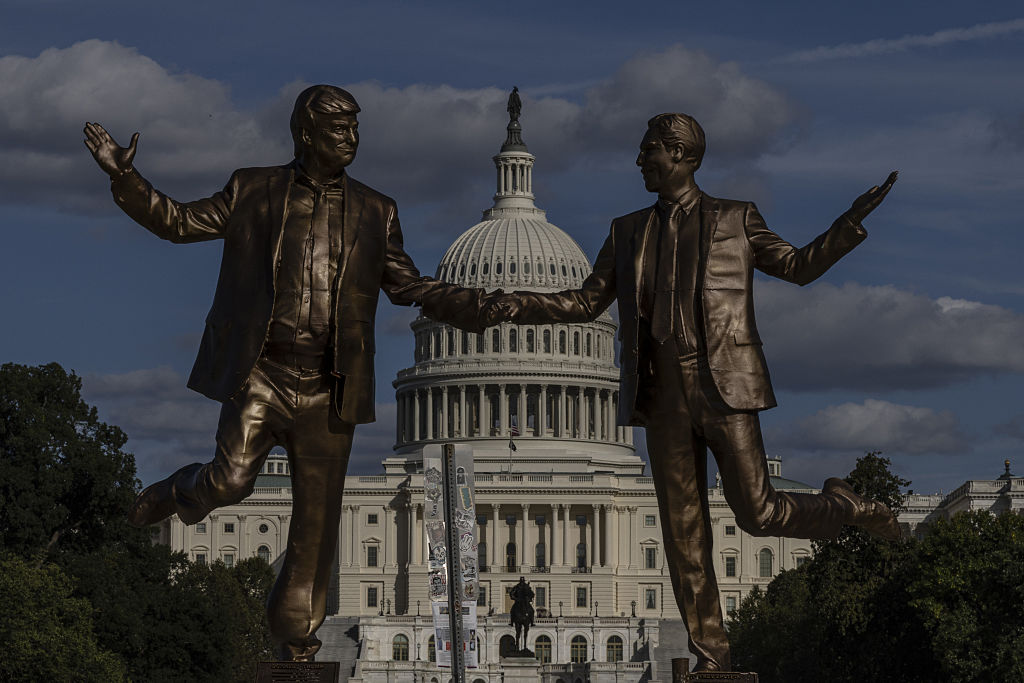
In September, a sculpture depicting the President holding hands with the late convicted sex offender Jeffrey Epstein appeared outside the U.S. Capitol.
An accompanying plaque read: “In honor of friendship month, we celebrate the long-lasting bond between President Donald J. Trump and his ‘closest friend’ Jeffrey Epstein.”
The sculpture appeared amid growing calls for Congress to release the full Epstein files. At the time, Trump's former relationship with the offender proved to be a key point of contention in the discourse.
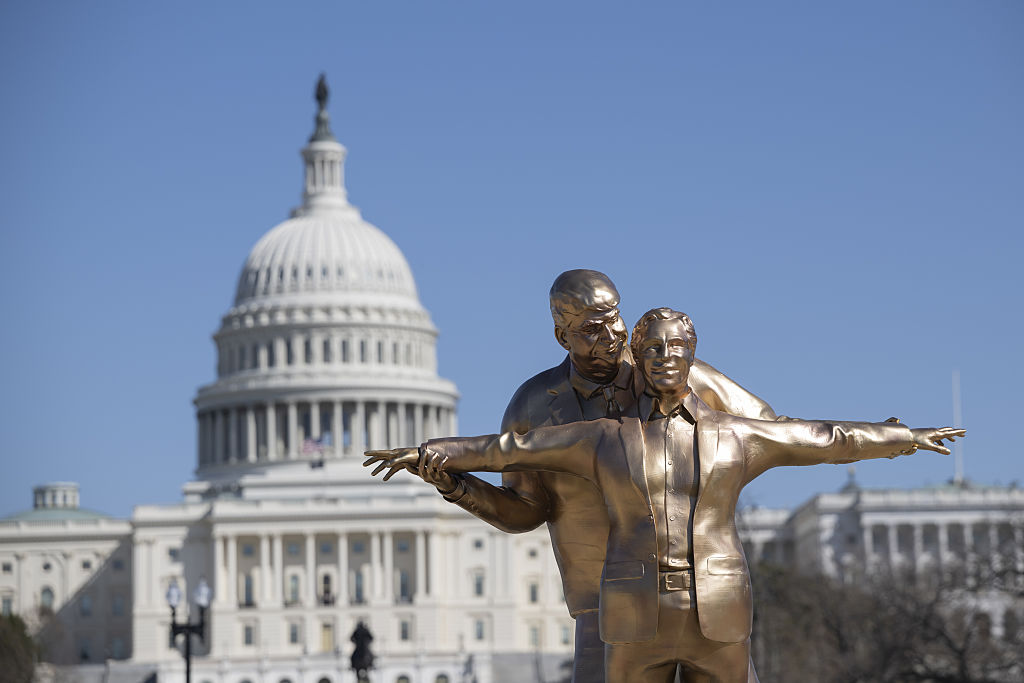
More recently, in March, a statue depicting Trump embracing Epstein in a Titanic-style pose appeared on the National Mall.
The gold-painted replica of Trump could be seen standing behind Epstein, arms outstretched, at the bow of a miniature model of the doomed ship, a reference to the iconic pose of Jack and Rose in the 1997 blockbuster.
Installed by the Secret Handshake, the sculpture was titled “The King Of The World”—a nod to the quote famously delivered by Leonardo DiCaprio’s character, Jack.
Wildfires prompt state of emergency, air quality alert in Minnesota
Hong Kong booksellers arrested for allegedly selling seditious books

Hong Kong was once known for its freedom of publication, but political changes have created a challenging environment for independent bookstores.
(Image credit: Kanis Leung)

How much interest can a $250,000 1-year CD account earn now?
Blood Tests for Alzheimer's Disease Are Showing Promise

For most of the past few decades, scientists chasing treatments for Alzheimer’s disease have focused on attacking the buildup of one protein in the brain that contributes to the disease: amyloid. They've had some success; there are currently two anti-amyloid treatments approved.
But while amyloid plaques are important in Alzheimer’s disease, memory and cognitive symptoms frequently only start once another protein, tau, also starts accumulating in the brain. While some experts believe the brain needs some amount of tau in order to function normally and maintain the architecture of neurons, abnormal tau tangles can contribute to cognitive problems associated with Alzheimer's.
That's why scientists at the Alzheimer’s Association International Conference in London are reporting a series of encouraging results in testing for and reducing levels of tau, creating new ways to potentially manage the disease.
A tau-lowering approach
Developing anti-tau medications is a challenge, because tau starts to function abnormally inside of cells—unlike amyloid, which aggregates into plaques outside of cells, which makes the amyloid clumps easier to target with things like antibodies. In the first study of its kind, researchers at the biotechnology company Biogen reported early results from their study of diranersen, a drug that shuts down tau production at the source.
Researchers used a type of gene-based approach that blocks cells from making tau. It works by attaching to the genetic instructions cells use to produce tau, which prevents the production of the protein.
The study included 416 people with Alzheimer’s disease who were randomly assigned to receive one of three different doses of diranersen or a placebo twice a year, delivered directly into the cerebrospinal fluid via a lumbar puncture. After 18 months, those who received diranersen had 50%-65% less tau in their brains, as detected by PET scans, compared to those who got a placebo treatment. This reduction seemed to translate into cognitive benefits: people who took the drug slowed their cognitive decline by up to 50% on certain brain tests that measure memory, recall, reasoning skills, and orientation. Interestingly, the trial showed that the participants treated with the highest dose of diranersen did not show greater improvement than those treated with the lowest dose; all derived some benefit.
“This is the first trial to ever show reduction in tau,” says Dr. Lawren VandeVrede, assistant professor of neurology at the UCSF Memory and Aging Center and a principal investigator in the study. “Other trials have shown reduction in the rate of accumulation of tau, but not in the actual reduction of tau in the brain. And importantly, we saw clinical benefit of doing that.”
Dr. Lennart Mucke, director of the Gladstone Institute of Neurological Disease and professor of neurology and neuroscience at the University of California San Francisco, published the groundbreaking paper involving mice that first showed the potential of reducing tau to address the progression of Alzheimer's disease. "It's very gratifying for me, of course," he says of the results. "Quite a few of my colleagues were concerned whether overall tau reduction would be well tolerated, and I always thought that it was by far the most pragmatic approach. Certainly our animal studies always suggested that even partial reduction is beneficial. And this Biogen trial clearly shows that also seems to be the case in humans."
Mucke disagrees with others in the field who maintain that some amount of tau is important for maintaining the normal structure of neurons; based on his work with animals, he believes that if disease processes like those involved in Alzheimer's disease start to appear, then tau becomes an enabler to the disease, essentially fueling the abnormal mechanisms along. "There are probably quite a few functions that tau is involved in that, under normal circumstances, don't do anything bad," he says. "But if a disease comes along—not only Alzheimer's, but epilepsy and autism spectrum disorders—tau reduction can dampen the down processes that lead to these diseases."
Debate on this point can, and should, continue, says Mucke. But the important lesson of the study, he adds, is that reducing tau matters, regardless of how it might be involved in the process of Alzheimer's disease.
The study is still an early trial of the experimental drug. But if diranersen's effects are confirmed by more studies, which Biogen says it plans to conduct, then VandeVrede can imagine a future where the drug might one day be taken alongside an anti-amyloid drug. (The ones currently on the market can at best slow cognitive decline by about 30%.) “If we see the benefit of tau, then my instinct is that clinicians will think, 'What if we use both?'” says VandeVrede. “If you slow down something with a drug, and can then slow it down again with another drug, you end up with something that may look like stabilization. And that would be a huge win in the Alzheimer’s world.”
The tau trackers
If there are clinical benefits to reducing tau, then doctors will need a good way to measure tau and track it in the brain. Other researchers at the conference reported success with a blood test that can detect tau levels up to 10 years before Alzheimer’s symptoms appear.
In a new study published in JAMA, researchers at Mass General Brigham and Harvard Medical School found that levels of a form of tau found in the blood, called ptau217, can identify people at higher risk of rapid cognitive decline. In a group of more than 2,700 cognitively normal people who were followed for years, those with the highest ptau217 levels had a 78% higher likelihood of becoming cognitively impaired in 10 years, and a 38% likelihood in five years, compared to those with lower levels. The researchers found that ptau217 levels in the blood provided more predictive information about cognitive decline beyond brain scans and genetic testing, the approaches most often used today.
Blood tests that measure tau are currently reserved for people who already have symptoms: either to help confirm Alzheimer’s disease or to rule it out. But these results are the first to show that a blood-based tau test could be useful in cognitively normal people—to identify those at highest risk of going on to develop Alzheimer’s before they get sick.
“I think this will change accessibility in early detection of Alzheimer’s disease dramatically,” says Rachel Buckley, associate professor of neurology at Mass General Brigham, who led the study. ”Especially if there is something we can do about treatment in the future for people who don’t yet have symptoms.”
The findings open a path to screening for and identifying people in the general population who might be at high risk of developing Alzheimer’s, similar to the way other conditions are managed to prevent disease rather than waiting until symptoms appear. These results "are a game-changer, in the same way we think about screening for cancer where people get tested before any symptoms," says Dr. Reisa Sperling, senior author of the paper, a professor of neurology at Harvard, and director of the Center for Alzheimer Research and Treatment at Brigham and Women’s Hospital. "For 10 years, I’ve been saying the same should be true of Alzheimer’s, and it’s finally [starting to] come true.”
That may still be a few years away. At the moment, people with higher tau levels still don’t have a specific treatment that will help them lower their levels—although studies have hinted that some basic prevention strategies, like maintaining a healthy heart, getting enough sleep, remaining socially engaged, and staying physically active, can slow or reduce the risk of Alzheimer’s. More rigorous studies of these behavioral interventions will produce results in coming years, Sperling says.
A multi-pronged approach to prevention
Researchers from Lund University also reported results of a study comparing how accurately primary care physicians and dementia specialists diagnosed Alzheimer’s in their patients if they used the experimental blood test for tau as well as other currently available tools, such as brain scans, family history of the disease, and a blood test on the market that compares amyloid to tau levels. They found that both groups of doctors were about 90% accurate when including the test, and that the blood test was especially useful for primary care doctors in ruling out Alzheimer’s.
But even with such tests and potential treatments in the future, questions about access remain. Screening for people without symptoms of Alzheimer’s is not currently covered by major payers and Medicare. Two years ago, the U.S. Preventive Services Task Force (USPSTF), a federally convened panel of independent experts that reviews available evidence on disease prevention and rates the strength of the data, determined that there was not enough evidence to support the benefit of screening the general population for Alzheimer’s disease. But things are evolving fast, says Maria Carrillo, chief science officer of the Alzheimer’s Association, and the group is laying the groundwork to encourage payers, including Medicare, to cover the cost of screening for tau should additional studies continue to support its importance in identifying those at higher risk.
What’s clear is that after decades of frustratingly slow progress, Alzheimer’s disease research is finally gaining momentum, and the latest findings point to the importance of looking beyond amyloid to including tau-based strategies as well. “We’re beginning to prepare for what that future is going to look like," says Carrillo, "and it’s exciting."
Полуфинал Англия — Аргентина: самый важный матч для Англии с 1966 года
Watch: Starmer's kind send-off across the Commons
Dramatic video shows wildfire surround freight train in Canada
Apple Intelligence approved for launch in China with Alibaba and Baidu
Stripe and Advent reportedly offered to buy PayPal for around $53.4B
From racist Bugs Bunny to the bear MPs want to ban: how cartoons have indoctrinated kids for over 100 years
Politicians are claiming that a hit Netflix animation is Russian propaganda aimed at the ‘militarisation of children’. But it’s far from a recent problem – even the CIA has funded kids’ entertainment
When Liberal Democrat MP Tom Gordon spoke earlier this month in the commons of the “militarisation of children”, he wasn’t warning of a generation suddenly taking arms. He was talking about a cartoon bear. Gordon, along with a cross-party group of more than 50 MPs, had written a parliamentary letter urging that an animated children’s show be banned on the basis it is Russian propaganda.
The accused animation is Masha and the Bear, a Russian programme aimed at preschoolers. The show is one of the most popular series on YouTube, and is available in the UK on ITVX and Netflix. The programme follows the adventures of the young, pink-hooded Masha and her brown bear companion in a remote woodland. But MPs – as well as Ukraine’s Center for Countering Disinformation and Estonia’s minister for foreign affairs – see Masha’s use of Soviet-era military costumes as a flex of Russian “soft power”.
Continue reading...U.S. reimposes blockade and steps up strikes as Iran threatens to halt all energy exports from the region
Fifa hit by injunction in Germany over World Cup ticket resale prices
Governing body did not appear before court in Frankfurt
Fifa gets 15% commission from both buyer and seller
Fifa has been hit with an injunction by a German court ordering it to stop “manipulative processes” in the sale of World Cup tickets. The Frankfurt regional court has granted a request for a preliminary injunction from Ticombo, an online ticket resale site based in Germany, which has instructed Fifa to be more transparent regarding its secondary ticketing sales by disclosing the identity and address of any commercial sellers.
The court has ordered Fifa “to cease facilitating ticket sales without informing buyers of the seller’s identity and address [specifically for sellers acting in a commercial capacity] in a timely manner prior to the buyer completing their purchase”.
Continue reading...Berlin man charged with 22 counts of raping unconscious women and filming the assaults
Assailant allegedly sedated victims using sleeping tablets and alcohol after meeting them online
A Berlin man has been charged with nearly two dozen counts of raping unconscious women and filming the acts, while investigators believe based on video evidence that the suspect may have attacked up to 60 victims.
In the latest of a series of high-profile cases involving the serial rape of unwitting targets on camera, Berlin prosecutors said they have indicted the 68-year-old German national on 22 counts of sexual assault of 14 women. The man, an electrician, has been in police custody since March.
Continue reading...Mum who murdered son, 5, before his body was dumped in river wants conviction reviewed
Dramatic video shows wildfire surround freight train in Canada
Cancer disparities researchers say federal funding changes have disrupted their work

In a survey, 93% of cancer researchers who study disparities said federal policy changes have affected them. Funding is harder to come by and they worry it's slowing progress in their field.
(Image credit: Andrew Brookes/Image Source)

Revealed: Farage’s £5m gift came after saying he needed ‘a million a year’ to stand as MP
Politician spoke to senior figures in Reform in March 2024 about covering lost earnings, sources tell the Guardian
Nigel Farage told senior figures in Reform UK he would need “a million a year” to cover lost earnings if he stood for parliament in the 2024 general election, sources have told the Guardian, raising further questions about why he was given £5m by a crypto billionaire.
Sources say the discussion took place in March 2024 – shortly before the undeclared gift was made by Christopher Harborne on 5 April, according to the Thailand-based crypto billionaire’s lawyers.
Continue reading...A modern odyssey: the archaeologist following Homer’s route on a bicycle
As Christopher Nolan’s star-studded adaptation is released, Australian archaeologist and cyclist Sam Wood has recreated Odysseus’ journey on two wheels
Backpacking around Europe is a rite of passage for many young Australians but when Sam Wood proposed a trip with his two brothers in 2009, he had something a little more ambitious in mind.
An avid cyclist who studied classical archaeology at the University of Sydney and spent three years working at the British Museum, he suggested retracing the route that the Carthaginian general Hannibal took over the Alps with his war elephants in 218BC.
Continue reading...Why Singing Is One of Sports' Most Enduring Rituals

Last Saturday night, on July 11, trains into Leeds, England, where I live, were canceled because of an electrical issue. The only way for me to get back home—or, in the case of most of my fellow passengers, to get to the big pub screens showing the England-Norway World Cup match—was to take the local double-decker bus. I was in the company of about two dozen teenage boys, many shirtless in the heat, drink cans locked in their fists, in a state of high excitement, and in possession of a battered boom box.
First, the muted strains of "Three Lions," the English football anthem exploring the great disappointment of being an English football fan in recent decades, began to mix with the muttering and chatter of the bus. Then as the music swelled towards the chorus, a wall of eager voices rose above the rest of the noise: "Football's coming home, it's coming home!" The sound was raucous, atonal, yet weirdly joyful, and as the bus swung round the curves past blackened stone cottages and fields freshly hayed, a middle-aged man in the front of the bus turned around, and, hanging onto the back of his seat, started to sing along.
An older couple put up their hands and began to sway. "No more years of hurt, no more need for dreaming!" A man with a cane coming up the stairs raised it triumphantly. He staggered into the aisle and held onto the seatbacks, belting out the lyrics as the bus pulled back into the road. The setting sun was pouring red through the clouds as a pair of children scampered into seats at the back and then jumped when the whole bus roared, "Three lions on a shirt!"
Why do sports fans sing?
It’s not just England, and it’s not just football. Group singing is an important tradition surrounding big events for many sports around the world. When crowds of people sing in unison in a stadium or arena—when fans of Turkish basketball sing “12 Giant Men,” for example, or cricket fans belt out “Mrs. Robinson”—it’s sometimes intended to pep up the players. Fans often write new lyrics referencing individual players or make jokes about the opponents (or about the singers themselves).
But fan singing serves another purpose, social scientists say. On a fundamental level, “music can turn a collection of individuals into a temporary social group,” says sports psychologist Andy Lane of University of Wolverhampton in the U.K. “The song effectively tells people: ‘We are experiencing this together.’”
When people who have watched a televised game sing on the bus or on the sidewalks of their neighborhoods—despite being nowhere near the stadium—it’s a continuation of the same effect. “After an important win, the emotional intensity remains high, and singing allows supporters to express joy, affiliation, and shared meaning in public,” says Lane. “It can be both spontaneous emotional release and a signal of belonging.” Watch rugby fans in the streets of Paris, singing after a match, and you can feel the energy.
After wrapping up “Three Lions” on the bus, the crowd segued into Oasis' "Wonderwall." (Not every place might have been willing to roll with a loud singalong on public transit, rather than in a stadium: A Dutch graduate student visiting from Germany gazed about him in disbelief, marveling that this would never happen in Germany—that someone would have called the police.)
Even non-fans can join in
This type of public singing can spread beyond the initial group to people who are not even sports fans. After “Wonderwall,” the bus continued into “Sweet Caroline,” the Neil Diamond hit from 1969 that has become an unofficial English football anthem. A grandmotherly woman leaned across the aisle, smiled, and told people within earshot that she was singing along to “Sweet Caroline” when she was a teenager.
It’s that sense of universality that makes these moments endure. “Familiar songs such as ‘Three Lions,’ ‘Wonderwall,’ and ‘Sweet Caroline’ are culturally shared, so they can temporarily reduce the boundary between supporters and bystanders,” says Lane. “People begin by joining the song, but in doing so they also join the group.”
Later that night, long after the bus had arrived at its destination, England won, advancing to the World Cup semifinals. On July 15, they will play Argentina. How many fan singalongs might fill the buses and streets today?
Trump endorses MyPillow founder Mike Lindell in Minnesota governor’s race
Republican Trump ally has spent years promoting discredited claims about 2020 election
Donald Trump has endorsed Mike Lindell’s bid for Minnesota governor, calling the MyPillow founder “one of America’s greatest and most hard working Patriots” in a Truth Social post on Wednesday.
Trump described Lindell as someone who had “sacrificed” more than almost anyone else “in fighting for our country, especially when it comes to Election Integrity”, invoking Lindell’s years spent promoting discredited claims about the 2020 election. Trump said Lindell “will MAKE MINNESOTA GREAT AGAIN” and gave him full-throated support ahead of the state’s 11 August Republican primary, where early voting is already under way.
Continue reading...Revealed: Farage’s £5m gift came after saying he needed ‘a million a year’ to stand as MP
Politician spoke to senior figures in Reform in March 2024 about covering lost earnings, sources tell the Guardian
Nigel Farage told senior figures in Reform UK he would need “a million a year” to cover lost earnings if he stood for parliament in the 2024 general election, sources have told the Guardian, raising further questions about why he was given £5m by a crypto billionaire.
Sources say the discussion took place in March 2024 – shortly before the undeclared gift was made by Christopher Harborne on 5 April, according to the Thailand-based crypto billionaire’s lawyers.
Continue reading...Albanese’s AI blueprint sparks calls for datacentre moratorium until new regulations in place
Prime minister’s plan will create energy regulations for datacentres in Australia
Get our breaking news email, free app or daily news podcast
Environmental and community groups have called for a pause on datacentre development until new regulations are in place after Anthony Albanese promised “greater clarity and speed” over their approval.
In his speech on artificial intelligence at the University of Sydney on Wednesday, the prime minister said Australia would create a legal obligation for large-scale datacentres to underwrite new power supply, pay their full share of grid connection and add as much energy to the grid as they take out of it.
Continue reading...Albanese’s AI plan is admirable – but will face tech giants more powerful than most national governments
The reality is Australia won’t be able to direct much of the activity of Anthropic, Microsoft, Google or OpenAI
Get our breaking news email, free app or daily news podcast
Anthony Albanese took a trip back in time during his much-anticipated speech on artificial intelligence on Wednesday.
Seeking to harness the momentous change bearing down on our lives, the prime minister told an audience at the University of Sydney that his government would keep pace with AI, even seeking to “get out in front” of the technological tidal wave.
Continue reading...Almost 145,000 Australians will lose support for autism under NDIS reforms, documents reveal
Internal estimates show 144,600 people will be taken off the scheme by 2030, many of them under 18
Get our breaking news email, free app or daily news podcast
Almost 145,000 Australians receiving support for autism on the national disability insurance scheme (NDIS) are expected to be removed by the end of the decade, internal estimates show, as the federal government moves ahead with plans to narrow the focus of the “diluted” $52bn scheme toward those with significant and complex needs.
From 2028, almost two-thirds of the 241,000 participants set to lose access to the NDIS will be aged 18 or under, health department documents released to Guardian Australia under freedom of information laws show.
Continue reading...Greater gliders not as great at gliding as thought – but still look like magic carpets, experts say
While new study challenges assumptions about how far they travel, witnessing them in action still takes your breath away, scientists say
Get our breaking news email, free app or daily news podcast
They may look like a fluffy flying carpet, but greater gliders are not as great at gliding as previously thought, Australian researchers have discovered.
The first study to measure the aerial ability of Australia’s largest gliding marsupial has found they soar across an average distance of 19 metres – far shorter than the 100 metres suggested in an 85-year-old study.
Continue reading...Will daylight saving time become permanent after House passes bill?
Heatwave prompts Italy's delivery riders to strike for extra rights
Mum who murdered son, 5, before his body was dumped in river wants conviction reviewed
Grizzlies | 60 Minutes Archive
Tommy Robinson says he 'got it wrong' over man he falsely accused of filming children
California Weather Shift Brings With It a Risk of Unhealthy Heat and Wildfires
Wildfire Smoke Spreads Across the Northeast as Temperatures Spike
Wildfires Rage in Ontario as Smoke Affects Toronto’s Air Quality
Goldman’s Former Top Lawyer Calls Epstein a ‘Masterful Liar’
Football Daily | Spain leave France at sixes and sevens as L’Équipe dish out the twos
Sign up now! Sign up now! Sign up now? Sign up now!
For a second there, it felt as if this was going to be a rerun for France of the Human Rights World Cup final. Conceding a penalty at the end of the first quarter and looking lost for most of the game, Les Bleus would eventually click. Kylian Mbappé would lock into PlayStation mode, thundering down the left-hand side before cutting in to erase the two-goal deficit. It would be another game for the ages, going beyond normal time – but Luis de la Fuente’s lads weren’t keen on any drama. In reality, Spain put on a suffocating display of control, even if there was little between the two sides in terms of possession. France, the great entertainers of this Geopolitics World Cup, are off home … though not before a jaunt to Miami for the bronze medal game.
Continue reading...