Trump told Mark Carney ‘you got to stop these fires from coming in’ as experts say wildfires symptom of climate crisis
Scientists have reacted with incredulity after Donald Trump accused Canada of “poisoning” the US’s air with smoke billowing from a slew of forest fires and threatened sanctions upon the country’s northern neighbor.
The US president has said that he raised the issue of smoke wafting into the US from nearly 1,000 Canadian wildfires with Mark Carney, the country’s prime minister, at the weekend’s World Cup final.
The United States launched a fresh barrage of strikes on Iran overnight as President Donald Trump threatened a major new escalation after Tehran opened a second front in its pressure campaign on the world economy.
The Amaurys of Paris own the race, but won’t share any of the $170 million in media revenue. Sponsors and riders say their resistance is dooming the sport.
Prime Minister Narendra Modi’s tightly constructed image is being punctured as a Gen Z-led protest movement uses videos and memes to seize the digital narrative.
Мы с коллегами исследуем не только интерфейсы, но и людей, которые ими пользуются: их задачи, привычки, ограничения и способы принимать решения.
Особенно интересно работать с продуктами, которых еще нет на рынке. В таких проектах нельзя просто спросить пользователей, какой сервис им нужен. Человеку сложно представить решение, которого он никогда не видел.
В этой статье я хочу рассказать, как мы помогаем компаниям создавать инновационные сервисы и снижать риски при запуске, сочетая глубинные интервью с анализом прямых и косвенных конкурентов.
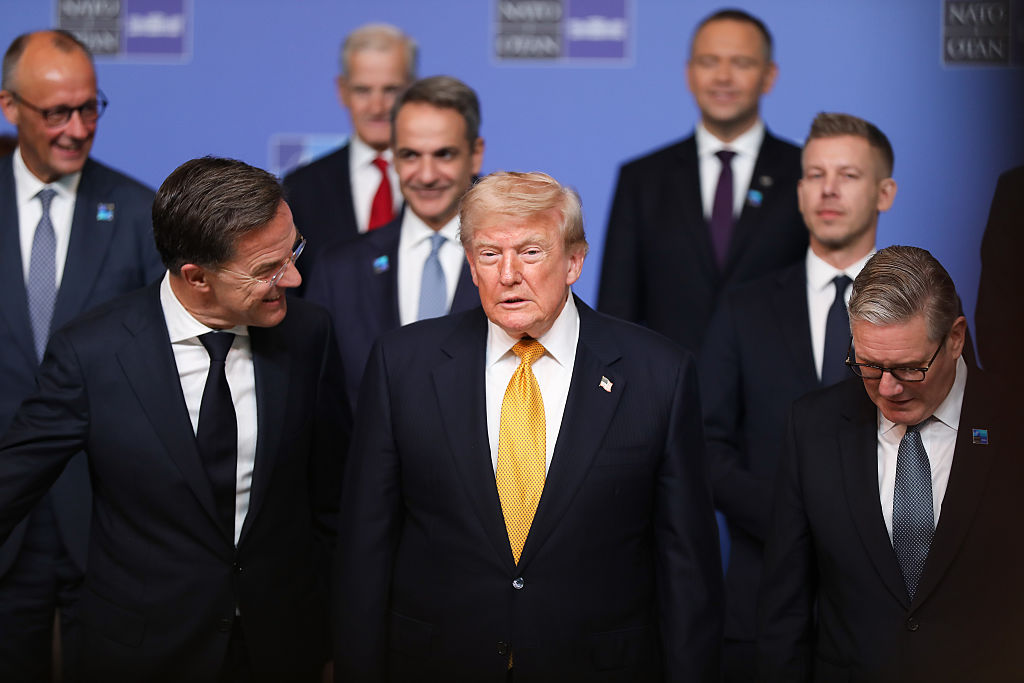
President Donald Trump and NATO Secretary General Mark Rutte at the NATO Summit in Ankara, Turkey, on July 8, 2026. —Klaudia Radecka-NurPhoto via Getty Images
The portents were not good. Before departing for the recent NATO summit in Ankara, President Donald Trump took to Truth Social to berate the alliance. He posted figures suggesting the alliance was a financial burden on the United States. He complained about allies neither contributing their fair shares nor standing with America. And he deemed it ridiculous for the U.S. to continue along this “one-sided” path.
Things didn’t improve when Trump touched down. During his first press conference at the summit, he singled out the big European allies—France, Germany, Italy, and the United Kingdom—for their lack of support over Iran. He reprised the demand that the Danish territory of Greenland be ceded to American control, and bashed the allies for insufficient defense spending. Trump suggested the allies were lucky to have him, claiming he only showed up as a favor to his “friend,” Turkish President Recep Tayyip Erdogan.
Yet a day later, the mood had changed. Trump departed Ankara praising “the love” among the allies. He was seduced by a carefully orchestrated procession of prime ministers and presidents of member countries of the alliance, each in turn swallowing hard and praising his leadership. They were following a script already played to great effect by NATO Secretary General Mark Rutte, who has helpedNATOsurvive Trump by perfecting the art of flattering the American president.
“Teflon Mark” and the art of the deal
When Rutte was appointed by the allies, he was not the obvious choice. As Dutch prime minister, he had led a country with a poor record of defense spending. There was also a strong argument at the time that NATO ought to select its first female Secretary General, or its first from an Eastern European ally.
But Rutte’s skill as a consensus-builder elevated his standing. Rutte had led Dutch coalition governments for nearly 14 years, and his reputation for deal-making and political survival had earned him the nickname, “Teflon Mark.” Crucially, for these reasons, Rutte also enjoyed the support of the Biden White House.
Rutte began work at NATO in Oct. 2024. Trump entered the White House for the second time three months later. Armed with an already well-honed gift for flattery, Rutte spared little time in cozying up to the incoming American president. At every opportunity since, he has praised Trump’s leadership. European and Canadian defense spending increases have, in Rutte’s telling, became the “Trump trillion.” He has an unerring ability to deflect difficult questions at press conferences—recently on Iran—so as to spare America any embarrassment.
When a Danish journalist accused him in Ankara of lacking self-respect for failing to counter Trump’s claims to Greenland, Rutte replied by comparing Trump’s impact on NATO to that of President Dwight D. Eisenhower, NATO’s first Supreme Allied Commander Europe and early advocate of fair transatlantic burden sharing. Trump rewarded Rutte by praising him as an “extraordinary person” and a “smart leader.”
Rutte’s unstinting support of Trump does carry a cost. Calling Trump “Daddy” at NATO’s 2025 Hague summit was cringeworthy for many diplomats. And sometimes Rutte’s spin on events rankles national sensitivities: his talking up of flights flown from bases in Italy to support Operation Epic Fury, the American war against Iran, recently drew a public rebuke from the Italian defense ministry. In January, Rutte intervened to set up a framework for discussing the Greenland question, prompting the Danish defense minister to point out that Rutte could not negotiate on Denmark’s behalf.
These reservations aside, Rutte remains, for now, an asset for the alliance: someone who can smooth over Trump’s impetuosity. NATO leaders understand his relationship with Trump is one of convenience, not political affinity. Rutte has worked tirelessly to support NATO’s broader agenda: standing up to Russia, supporting Ukraine, and, in his words, promoting “a stronger Europe in a stronger NATO.”
And Rutte is not averse to praising other NATO leaders. He commended German Chancellor Friedrich Merz for his “political courage” in ramping up German defense spending, and days before the NATO summit complemented then-British Prime Minister Keir Starmer for his “leadership” on Ukraine.
NATO’s savior?
Is it, then, too much to claim that without Rutte, NATO would be doomed? Similar questions were asked about Rutte’s predecessor, the Norwegian Jens Stoltenberg. As Secretary General during Trump’s first term, Stoltenberg too had an uncanny ability to read Trump’s mood and shield the allies from criticism.
Serious academic work has argued that Stoltenberg was, in part, responsible for NATO’s survival. Stoltenberg had to manage an American president who felt NATO was playing the U.S. as a sucker. In his memoirs, Stoltenberg recalls fearing, at the 2018 NATO summit, that the alliance “was about to stop functioning” if Trump made good on his threats to withdraw the U.S. security guarantee.
A deal brokered by Stoltenberg and Rutte—then at the summit as Dutch prime minister—kept Trump on board. Flattery, again, was the device. At the summit, Stoltenberg credited Trump’s strong leadership on defense spending for NATO’s revival.
What these examples suggest is that Secretary General of the NATO is no shrinking violet. Of the 14 office holders to date, five have been foreign ministers and two have served as defense ministers. The last three—Rutte, Stoltenberg, and his predecessor, the Dane Anders Fogh Rasmussen—came to the job as sitting prime ministers.
That standing allows the Secretary General to hold his own with NATO’s national leaders and with the alliance’s military commanders—the Supreme Allied Commander Europe and the Chair of the NATO Military Committee. The Secretary General can draw on considerable bureaucratic advantage: he heads up the International Staff at NATO headquarters, oversees the alliance’s polished public communications operation, and serves as the chief organizer of NATO summits.
But the Secretary General cannot countermand the nations. And here, ultimately, the U.S. carries the greatest influence. Despite his reservations, Stoltenberg could not prevent the U.S. from terminating NATO’s mission in Afghanistan in 2021. Today’s U.S. troop drawdowns in Europe, even if they directly affect NATO’s conventional defenses, are decided in the White House and the Pentagon. It is Rutte’s job to cast them in a positive light.
A shape shifting NATO
America has been critical of burden-shirking among the allies since NATO was formed. Trump has turned that sentiment into a weapon. Deference and sweet-talk have been Europe’s disarming response. It doesn’t always work: cozying up to the president—as Italian premier Giorgia Meloni recently found out—does not preclude a Trump tongue-lashing. Yet flattery did work in Ankara. Rutte deserves credit as the flatterer-in-chief.
Still, sycophancy only gets you so far. Practical measures aligned with American preferences are also needed. Away from the political theater, in recent months, the alliance has been quietly reshaping itself toward America’s preferred vision of European security: a “NATO 3.0.” Its chief architect, U.S. Under Secretary of War for Policy, Elbridge Colby, has spoken of the allies assuming “primary responsibility” for the conventional defense of Europe.
To that end, Europeans and Canadians are spending colossal sums on their militaries, and funneling more arms and aid to Ukraine, now that the U.S. is reluctant to do so. The transatlantic alliance may, as a result, be entering terra incognita.
The U.S. remains embedded in NATO’s command structure and is the ultimate guarantor of allied security through extended nuclear deterrence, but an unprecedented process of the Europeanization of NATO is under way. And it could fulfil America’s original vision for the alliance: that it serve as a framework within which Europe, as the historian Marc Trachtenberg has written, would be “able to defend itself without direct American support.”
That vision has gone unfulfilled for nearly eight decades. Its realization will be about more than NATO alone. It would involve a more defense-focused European Union, ad hoc coalitions of the willing, and regional and bilateral initiatives that criss-cross the continent. NATO will remain its center of gravity. And so the role of the Secretary General will continue to loom large.
“What’s the oldest note in your phone?” my younger sister asked, in the same tone one might use to share gossip. She was explaining what she called “notes app digest,” rereading notes like a kind of personal magazine of one’s own insight and nonsense.
I immediately scrolled. For better or worse, my notes app is the piece of technology closest to looking like the inside of my brain: a bit chaotic, annoyingly detail-oriented, and perhaps perpetually nostalgic. While handwritten to-do lists hold my life together, my notes app contains the catch-all, the weird (one that simply says “possum”), and the important (a list of people’s birthdays) coexisting.
Somehow, the mess of my notes resists all forms of optimization, or even coherence. Venturing back into our notes app isn’t just about fishing out that one password we swore we’d remember, or realizing we drafted a resignation letter in the same note as a reminder to get toilet paper. They are weirdly human markers of time, who and where we’ve been. Amid the endless push to optimize, streamline, and summarize our thoughts, notes have staying power.
For years, people have observed the delightful, vulnerable chaos of the notes app as a counterpoint to hyper-curated feeds. Charley Locke, writing for The Atlantic in 2024, noted that the app is “essentially built-in scratch paper on a phone, and it reveals a person’s digital subconscious.” A 2025 piece by Elahe Izadi for The Washington Post asked strangers to reveal the contents of their notes apps, an act somewhere between a confession and a grand reveal.
There are many reasons why people still default to writing notes, according to Dr. Bart Wojdynski, professor of journalism at the University of Georgia and director of the Digital Media Attention and Cognition Lab. It’s easy to use, and the icon connotes the idea of jotting on a post-it. “Maybe there’s an extent to which the basicness of the notes app also makes it feel less like it’s being read by our online overlords and used to market you ads,” Wojdynski says. (He noted he hadn’t read the user agreement in a bit, but it might feel “less likely that it’s being scraped to feed some LLM somewhere”). “I think this is related to people trying to have digital copies of their memory,” Wojdynski adds.
Recently, when looking back through notes, Andy Carr, 37, a PhD candidate and part-time adjunct instructor in New York, found something in addition to those for grocery shopping or lesson planning for college courses he teaches. In summer 2020, Carr, his brother, and his sister-in-law were navigating end-of-life care for his mother. There was a jumble of memories, from notes of contacts that hospice care nurses passed along to one reading “Skippy pb jingle—send writer to prison,” a vent about a peanut butter commercial that ran incessantly on the TV at home as the family worked to make his mom comfortable and provide as much physical help as they could.
Revisiting those notes, Carr found affirmation. For years after his mother’s passing, he struggled with feeling that he froze up at the time. The notes showed specific examples of all he had been present for and engaged with around his mother’s death, all of the things he’d taken down as important information to ensure nothing slipped through the cracks. He never deletes messages or notes, he said, and usually, rarely goes back to them: “But little things like this make me really grateful that I can.”
Nadia De Ala, 37, a leadership and negotiation coach who moved to Mexico from the Bay Area two years ago, still has the first note she ever put in the app in 2016: a poem she remembers writing while dreading her commute to a previous job. “I really feel like it’s a time capsule, because it keeps a lot of memories, the essence of who I’ve been at every iteration and season of my life,” she says, adding that it’s even interesting to look back on foods she liked to grocery shop for.
Our phones, in other words, can augment our memories. Julia Soares, assistant professor of psychology at New Mexico State University, says that devices can become “partners for helping us remember things.”
“You’ll find some very heartfelt things that are digital,” she explains, adding that sometimes people don’t think of these “digital scraps or mementos” as being particularly valuable, but many people hold onto voicemails or even emails.
Recently, over coffee, one of my dearest friends took me on a tour of her meticulously organized notes. If my notes app functions as the junk drawer of my mind, hers was like opening the door to different beautiful rooms: a list of good things that are happening, checklists for household maintenance, and a folder of notes her sister assembled of their mom’s recipes, complete with videos: a living cookbook. In our conversation, my sister talked about her own notes app discoveries: goals she’d written down only to be met with surprise at how much she’d grown since then, or the minutiae of everyday life she documented for no obvious reason. Other people shared their own earliest notes: addresses of apartments they were touring, passages of favorite books they kept for inspiration, a compliment they’d received, nonsensical thoughts that somehow got funnier the longer they kept them.
A slingshot backward through a scroll, and I meet: Myself from 2017 who saved a recording of her childhood cat purring; 2019 me, writing interview questions for my first book; my 2022 self nervously drafting multiple iterations of the same message asking for her stuff back at the end of a relationship; me in 2024, who apparently was fleetingly into logging everything she baked.
Look at this mess, I think, as I thumb through 1,781 half-baked thoughts, drafts, memories, and past selves. What chaos. I could never delete her.
Analysis of satellite images of Myanmar shows dozens of alleged scam compounds have appeared in recent months, despite a purported crackdown on the criminal organizations.
В статье разберём основные изменения GoLand 2026.2, а также расскажем, какие возможности для Go-разработки уже доступны в OpenIDE и чего ожидать от её предстоящего перехода на платформу 2026.2.
Advances in A.I. are making it possible to create all kinds of music from scratch, but they also raise questions about what is legal and who will actually listen.
Top officials overseeing state elections and law enforcement are stepping up plans to prepare for what they worry could be interference in the midterms.
Поддерживаемые Ираном йеменские хуситы сообщили в четверг, что нанесли удар по двум саудовским нефтяным танкерам. Это первая атака после того, как группировка в понедельник объявили о морской блокаде Саудовской Аравии. Американские военные тем временем провели двенадцатую подряд ночь ударов по Ирану.
Бывший вице-премьер российского правительства, давний любитель шахмат, оказался в списке санкционируемых лиц и организаций, включенных в 21-й раунд европейских санкций против России.
Abdul El-Sayed, US Democratic Senate candidate from Michigan, speaks during a campaign event in Detroit, on July 18, 2026. | Nic Antaya/Bloomberg via Getty Images
Abdul El-Sayed is among America’s most prominent proponents of Medicare-for-all.
The frontrunner in Michigan’s Democratic Senate primary literally wrote the book on that policy (or at least, a book on it). In El-Sayed’s view, Medicare should cover “all necessary healthcare” for every American — without co-pays, premiums, or deductibles — and be “accepted everywhere.”
Key takeaways
• American healthcare is expensive largely because our hospitals, doctors, and drugmakers charge unusually high prices.
• American physicians earn about twice as much as Canadian doctors and four times as much as Swedish ones.
• To make Medicare-for-all affordable, we need to push down many doctors’ salaries, which is politically difficult.
• Expanding the supply of doctors — by funding more residencies and easing barriers for foreign-trained physicians — would lower costs and make universal coverage more feasible.
Alas, despite his many years of advocacy, El-Sayed has seemingly failed to persuade his wife of that last point: According to a recent report from the Washington Free Beacon, El-Sayed’s partner, the psychiatrist Sarah Jukaku, does not accept Medicare as a form of payment at her private practice.
This bit of gossip is of little importance, in and of itself. The Free Beacon’s story does nothing to refute the case for El-Sayed’s candidacy or his healthcare plan (his wife’s business is, well, her business). As hit pieces go, it’s weak tea.
Nevertheless, the tension between El-Sayed’s healthcare proposals and his wife’s business practices is real. And it is illustrative of a major challenge facing anyone who wishes to reform our nation’s misbegotten healthcare system: To meet the medical needs of all Americans, reformers will need to defy the interests of most doctors — and in many cases reduce their compensation.
And that won’t be easy. Few people feel a deep fondness for insurance companies. But El-Sayed is far from the only American who loves a physician.
The biggest obstacle to Medicare-for-all
To understand why Medicare-for-all would be bad news for many doctors — and how the Free Beacon’s story illustrates that point — we must first dwell on one fundamental fact about America’s healthcare system: It’s a rip-off.
The US spends about twice as much per person on medical goods and services as other wealthy countries. And yet, all that money does not actually buy us much more care. Compared to our peers abroad, Americans are less likely to see a doctor, secure a long hospital stay, or access a timely appointment for medical treatment. On the other hand, we do have the privilege of paying radically higher healthcare prices.
To take just one telling example: In the United States, a coronary bypass surgery will typically cost more than $89,000; in Australia, it costs just $17,741.
Such exorbitant prices are the chief obstacle to any version of universal healthcare. Even with one-third of working-age Americans uninsured or underinsured — and thus, consuming too little medical care — the bill for America’s health sector ran to $5.7 trillion in 2025.
In El-Sayed’s vision, Americans would consume vastly more medical services than they do today: The uninsured would suddenly have access to every doctor in the country, while everyone else would see their co-pays and deductibles drop to zero, encouraging them to schedule far more doctors’ visits.
This would be a costly proposition in any country. At America’s current healthcare prices, it would be prohibitively expensive. There is simply no way to realize anything approaching the left’s healthcare ambitions without slashing the amount of money that Americans pay per medical service.
Doctors will pay a price for universal healthcare
Medicare-for-all advocates are aware of this fact. And they’re typically eager to talk about one source of America’s high healthcare prices: The inefficiencies of our private health insurance model.
In America’s byzantine system, each insurer needs its own teams of auditors, claims reviewers, and myriad other specialists, while every major healthcare provider needs a horde of administrators to navigate the idiosyncratic rules of all these different insurance companies. Americans pay dearly for this bureaucratic bloat. By one estimate, our system’s administrative costs are $500 billion higher than they would be if the insurance industry was consolidated into a single public insurer.
And yet, as large as that figure may seem, it still represents a fraction of America’s excess healthcare costs. The primary cause of our nation’s exorbitant medical prices is simpler than administrative redundancies: our healthcare providers charge exceptionally high rates.
Hospitals are the biggest culprits on this front. But physicians are also part of the problem.
According to a 2026 study from economists at the University of Chicago, Stanford, and the US Census Bureau, American physicians earn about twice as much as Canadian ones — and four times as much as Swedish doctors.
Critically, this does not merely reflect America’s greater wealth or wage inequality. It is true that educated professionals of all kinds — financial analysts, lawyers, software engineers, etc. — earn more in the US than they do in other rich countries. But American doctors don’t just earn unusually high absolute incomes — they also occupy an atypically rarified place within their own country’s class hierarchy. About 42 percent of American specialty physicians are in the top 1 percent of their nation’s income earners. Among Canadian specialists, that figure is just 27 percent; for Swedish ones, it is 7 percent.
The main driver of these disparities is straightforward: America imposes fewer price controls on its healthcare sector than other nations do.
And this is where Jukaku’s practice reenters the picture.
The public parts of America’s insurance system — Medicare and Medicaid — pay rates that are only modestly above international norms. It is when American doctors bill private insurers — or the rich consumers of boutique medicine — that they really make bank.
As a result, top clinicians like Jukaku often decline to take Medicare. If you’ve got affluent patients beating down your door, accepting Uncle Sam’s rates just doesn’t pay.
Unless the government forces doctors and hospitals to swallow steep pay cuts, however, Medicare-for-all won’t pencil out. According to a widely cited 2018 analysis by the economist Charles Blahous, if a single-payer system kept provider payments constant, national health spending would rise by $3.25 trillion over a decade, even with administrative savings taken into account. By contrast, if all providers were forced to accept Medicare’s rates, health spending would actually fall by $2.05 trillion over the same period.
Soaking physicians is tough politics
Thus, there is a clear conflict between progressives’ healthcare ambitions and medical providers’ material interests.
Yet the left is often reluctant to acknowledge this reality. El-Sayed tends to portray insurers as the sole economic beneficiaries — and political defenders — of America’s inequitable healthcare system. The fact that hospitals and doctors also profit off the status quo’s dysfunctions does not feature prominently in his rhetoric. To the contrary, El-Sayed suggested in 2020 that doctors like his wife are actually underpaid, even though American psychiatrists earn far higher salaries than their counterparts abroad.
To be fair, progressives aren’t alone in eliding providers’ culpability. Virtually all Democratic politicians do the same. And not without reason. Politically speaking, it is one thing to denounce the greed of private insurers — the faceless bureaucracies standing between Americans and their desired treatments. It’s quite another to call for reducing the wages of doctors, men and women who perform laudatory work and enjoy widespread admiration.
Precisely for this reason, however, reformers must grapple with healthcare providers’ investment in the current system. The American Medical Association (AMA), the lobby representing our nation’s physicians, was instrumental in killing past attempts to move toward single-payer. And at least some segments of the medical profession would surely mobilize against any contemporary Medicare-for-all bill that imposed substantial cost controls on the healthcare sector. What’s more, in doing so, they would be able to draw on a resource the private insurance industry lacks — the public’s trust.
How to make healthcare less expensive right now
There is no easy answer to the problems all this presents. But part of the solution is to chip away at providers’ payment rates where progressives already have the power to do so. This would not only help drive down costs for existing healthcare in the short term, an urgent priority all its own, but also would smooth the path to universal coverage in the long run.
That project can take many forms. One would be state-level payment regulations. In Maryland, hospitals receive the same rates, no matter whether their patients pay with Medicare, private insurance, or cash. And their budgets are also fixed, so that they aren’t able to milk fees out of unnecessary care. Rhode Island, meanwhile, caps the growth of its hospital reimbursement rates at the pace of overall inflation. Other states could follow their lead.
But policymakers should also address the supply constraints that undergird American doctors’ high salaries. US physicians’ ability to command high pay doesn’t just reflect America’s weak cost controls but also a persistent shortage of working doctors. The US has roughly 2.7 physicians for every 1,000 of its residents; the average among comparable countries is 3.9, according to a Kaiser Family Foundation analysis.
In this context, forcing down doctors’ pay might seem perilous. After all, doing so would reduce young people’s incentive to pursue a medical career, potentially deepening the shortage.
In reality, however, there is no dearth of qualified people who want to practice medicine in the US. We just don’t let many of them do so.
This is partly because American policymakers consciously sought to restrict the number of doctors in the country, beginning in the 1980s. As Robert Orr of the Niskanen Center explains, the US government issued a report in 1981 warning of an imminent “physician surplus” and recommending “immediate action to curtail both the domestic training of physicians as well as the admittance of those trained outside of the country.”
The report’s argument rested on false premises; it failed to anticipate that Americans’ demand for healthcare would rise sharply as they grew wealthier. Nonetheless, its recommendations were largely implemented: Federal support for medical-school scholarships was pared back while funding for residencies has been capped since 1997.
At the same time, policymakers maintained high barriers to the immigration of fully-trained foreign doctors: Even physicians with years of experience, and credentials in nations with high medical standards, are typically required to complete a multi-year residency before being able to practice in the US.
Ending the federal freeze on residency funding will require congressional action. But states can immediately make it easier for foreign doctors to practice within their borders. In fact, Tennessee established a pathway for such physicians to ply their trade in the state, without having to repeat a residency, in 2023. And many states subsequently enacted similar reforms.
Removing the bottlenecks on America’s doctor supply won’t eliminate the political hurdles to Medicare-for-all. But it would put downward pressure on doctors’ salaries, reduce the risks of capping physician pay, and make the left’s vision of healthcare abundance more feasible. After all, you can’t actually eliminate the care rationing that so many Americans resent by extending insurance coverage or enacting price controls alone. No matter how we pay for our medical services, we can only deliver as much care as our health sector’s resources allow.
Don’t hate the doctor, love the sick
In saying all this, I don’t mean to convey disdain for the medical profession. Like El-Sayed, some of my best friends are doctors! In fact, my mother, father, brother, and sister-in-law are all physicians. And they all have contributed far more to American society than I ever will. My brother spends his workdays providing lifesaving treatments to cancer patients; I often spend mine sitting at a desk in my pajamas, arguing about politics on the internet.
Physicians deserve to be well-paid for their strenuous labor. But if we want healthcare in America to be universally affordable and widely accessible, we will need to pay many of them a bit less.
Among the shared updates, two fixes backported from 2026.1 are worth highlighting:
MPS-38409 – The new read-only-inspector style applies the read-only property to all editor cells in the inspector. When this style is applied to a cell in the main editor, the inspector becomes read-only for the inspected node while that cell is selected.
MPS-37407 – The Help menu on macOS now displays items with the correct height and spacing.
Check out all the updates in each particular version below:
When IntelliJ IDEA 2026.1 arrived, creating a new IntelliJ Platform plugin became simpler. It replaced the old IDE plugin generator and the IntelliJ Platform Plugin Template with the new web-API-based IDE plugin generator, which combines the best parts of the previous approaches. The new IDE plugin generator is intended to reduce maintenance overhead and provide a smoother, more consistent experience for all plugin developers. This blog post explains the reasons behind the change and offers some context about our plans for the future.
Plugin creation before the generator
Before the new generator, there were two recommended approaches to creating IntelliJ Platform plugins:
IDE plugin generator – working offline in the IDE
IntelliJ Platform Plugin Template on GitHub
IDE plugin generator
The IDE plugin generator was available after installing the Plugin DevKit plugin in IntelliJ IDEA 2025.3 and older. You just had to go to File | New | Project… and select the IDE Plugin item in the Generators section of the New Project dialog. Subsequent steps in the wizard allowed you to select the plugin type (regular plugin or theme), and, if the Plugin type was selected, provide additional dependencies, like the LSP, Database Tools and SQL, and language plugins.
IntelliJ Platform Plugin Template
The GitHub template approach allowed you to create a plugin with preconfigured GitHub Workflows covering typical use cases. It also included issue templates and Dependabot configuration.
Challenges with the previous solutions
Supporting two separate approaches to plugin creation doubled maintenance costs. Every platform release or change in the default plugin setup required us to update templates in two places.
The IDE plugin generator was a part of the Plugin DevKit plugin, and any change to the generator required a new release of the plugin. Even if we updated it and released it quickly, users didn’t always update right away. Sometimes they would keep older IDE and Plugin DevKit versions without getting the newest template versions.
On top of that, the two approaches differed in functionality. For example, the IDE plugin generator offered a way to select additional dependencies, which was missing in the GitHub template. On the other hand, the template provided GitHub integration, while the IDE plugin generator did not.
Last but not least, developers were confused as to why there were two entry points for plugin creation. This could cause them to spend unnecessary time learning the differences between the approaches and deciding which one to use for their project.
We solved these problems with a single unified entry point to plugin creation.
The new IDE plugin generator
Popular frameworks provide web APIs for project generation, for example Spring Initializr or the Quarkus project generator. They allow you to generate projects from a web browser, but also directly from JetBrains IDEs, which use these APIs for project creation.
The IDE client is available in the same place and is almost identical to the previous standalone version. In the new version, when you open the IDE Plugin generator, you will notice a slight UI change on the first page:
The Server URL field contains the URL of of the API that is used to generate plugins. Clicking it will open the web UI page in the default system browser.
The second page is very similar to the previous generator:
In addition to previously available dependencies, it contains:
The Split Mode (Remote Dev) feature under the Architecture group. Checking it will generate a plugin that’s ready for remote development scenarios. See the Split Mode (Remote Development) section in the SDK docs for more information.
The GitHub feature under the Version Control group. It includes workflows, issue templates, and Dependabot configuration, all available in the IntelliJ Platform GitHub Template. Information about connecting the created project to a GitHub repository is described in the generated README.md file.
Web UI
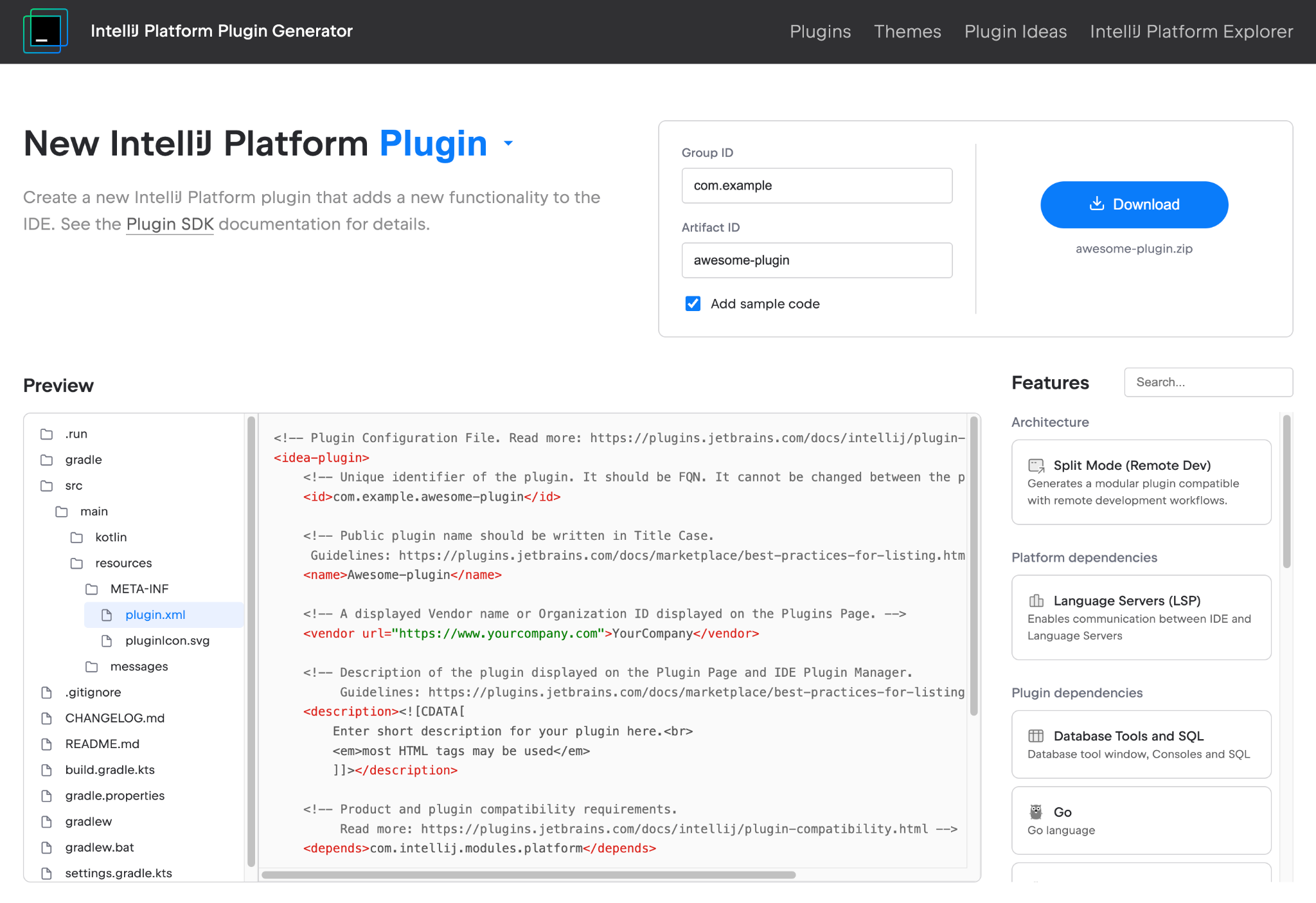
The web UI allows you to generate and download plugins outside the IDE. It provides the same features as the IDE client and has a straightforward UI:
In the header, select the plugin type: plugin or theme. Then, select the features you want to include in the generated project. The Preview area allows you to browse project files, which can help you understand how selected features affect the output. Once you’ve provided all the necessary information and selected the options you need, click the Download button to generate and download the plugin project. Now you can open it in your IDE.
Plans
We’re planning to continue expanding the IDE plugin generator by introducing new features gradually, for example, UI integration tests or a Qodana setup for reporting plugin issues locally or on CI/CD servers.
Try out the new generator and let us know what you think in the comments section or on the JetBrains Platform forum. What missing features would you like to see added?
From Lionel Messi’s final flourish to players who barely featured, we rank every MLS representative who appeared in the 2026 World Cup
Messi was always going to be No 1. In what was likely his last World Cup, the Argentinian put together an incredible tournament, registering eight goals, four assists and the most progressive passes of any player, according to Futi. With zero defensive responsibility on his shoulders, Messi was free to do as he liked. The 39-year-old roamed the field with ease and effortlessly drew Argentina back from the brink time and time again. It was Messi who led his country to a 3-2 win against Cape Verde, Messi who assisted and then equalized against Egypt, and Messi who created both of Argentina’s late goals against England. In the final, however, Messi disappeared. Across 139 minutes including stoppage time, Messi completed just 28 of 39 passes, registered only one shot and hardly affected the game. He may have left the tournament with no personal or team accolades – a rarity for him – but Messi extended a World Cup legacy that few players have ever to come close to rivaling.
Программа nanoCAD Механика PRO в первую очередь предназначена для создания проектов машиностроительной отрасли (детали, механизмы и оборудование). Возможности продукта позволяют решать задачи для выпуска документации с деталями высотой точности. Строительное направление отличается тем, что погрешность на монтаже может доходить до 1 см. Но есть отдельные направления на стыке строительства и машиностроения, это малые архитектурные формы, которые поставляются высокой заводской готовности из металла, пластика и дерева. С учетом развития науки и техники, изготовление таких объектов возможно в короткие сроки и с высокой точностью сборки на монтаже.
Применение nanoCAD Механика PRO позволяет решать задачи не только оформления проектной документации, но и формирования 3D-модели для передачи ее на производство со станками с ЧПУ. Дополнительно 3D-модель может использоваться для передачи геометрии в ТИМ-проекты с целью наполнения базы данных проекта и визуализации, так как малые архитектурные формы могут быть частью строительного проекта. Использование продуктов экосистемы nanoCAD позволяет комплексно решать подобные задачи.
В этой статье рассматриваются практические приемы работы в nanoCAD Механика PRO на примере малых архитектурных форм, которые помогут ускорить процесс конструирования и избежать типичных ошибок. Материал является продолжением вебинара и ориентирован на пользователей, уже знакомых с базовым функционалом программы.
Долгое время — да и до сих пор в большей части индустрии — в разработке цифровых продуктов существовал привычный порядок вещей: бизнес или продакт придумывает идею, передает ее аналитику, тот — архитектору, и только потом задача доходит до разработчиков и QA. Каждый делает свою часть работы, передавая друг другу артефакты.
Но есть компании, которые освоили концепцию продуктового разработчика. Такой человек сфокусирован не только на закрытии задач по ТЗ, а еще стремится донести дополнительную пользу и глубоко погрузиться в бизнес. Где-то говорят про T-shaped специалиста, где-то уже — про M-shaped. Мы решили разобраться в этой роли с точки зрения более-менее прикладного контекста через опыт людей, в чьих командах такие специалисты либо уже есть, либо внедряются.
Мы с семьей давно привыкли смотреть фильмы на проекторе: в таком формате есть особая атмосфера домашнего кинотеатра, но без лишних затрат на билеты, с удобным диваном, любимыми перекусами и возможностью в любой момент поставить просмотр на паузу. Долгое время такого сценария мне вполне хватало, пока мы не начали чаще выбираться за город. Там иногда бывают перебои с электричеством, и привычный вечерний просмотр через проектор не всегда удается организовать. Именно поэтому решено было присмотреться к моделям проекторов со встроенным аккумулятором. Долго экспериментировать с незнакомыми брендами не хотелось, поэтому выбор пал на Wanbo ToGo Pro. Причина довольно простая: у нас в семье уже есть проектор Wanbo, который полностью устраивает по качеству картинки и возможностям, но, к сожалению, не имеет автономного питания. В этом обзоре расскажу, насколько удачным оказался переход на ToGo Pro, как проектор показал себя в реальном использовании и стоит ли рассматривать его к покупке.
Карманы такие же древние как и само человечество: некое подобие оных было обнаружено даже у ледяного человека Этци, а это, на секудочку, еще Медный век. Ну а карманы нужны, чтобы носить в них технологические штуковины — иногда полезные, иногда крайне странные. Сегодня мы взглянем на некоторые из них.
Bryson DeChambeau believes he would have been “right there for the Claret Jug” if he had not received a two-shot penalty in the Open Championship last week at Royal Birkdale.
DeChambeau made a positive start to last week’s tournament after opening with a 67 and then a 66 on Friday, but his second-round score was later adjusted to 68 after he was handed a retrospective two-stroke penalty at the 5th hole after a video review. The 32-year-old was punished after match officials ruled he had improved the area of his backswing by standing on and flattening some long grass.
Four Palestinians and two Israelis killed and several hurt after armed settlers entered village with military support
Israel has said it is preparing a major military operation in the West Bank after four Palestinians and two Israelis were killed during a confrontation that began after armed settlers entered a Palestinian village with support from the Israeli military.
Several more people were seriously injured at the scene after a scuffle broke out over an Israeli settler’s weapon and the military opened fire, according to residents. Dozens more have been reported wounded in ensuing settler attacks on neighbouring Palestinian towns.